Guernsey Visa Guide 2026: Types, Requirements, Fees and How to Apply
By MAS Inspire | Editorial draft: 27 November 2026 (fees and rules re-verified 28 November 2026)
Introduction
Guernsey is the second-largest of the Channel Islands, a self-governing Bailiwick in the English Channel about 27 miles from the Normandy coast of France and 70 miles from mainland Britain. Its capital is St Peter Port, a harbour town of cobbled streets, colourful houses and a fort-protected marina. The Bailiwick of Guernsey also includes the islands of Alderney and Sark. Around 63,000 people live on the island, and the currency is the pound sterling (the Guernsey pound circulates alongside Bank of England notes).
Guernsey is a British Crown Dependency. That single fact shapes everything in this guide: Guernsey is not part of the United Kingdom, not part of the European Union and not in the Schengen Area, yet its immigration system is built on UK immigration law. There is no separate Guernsey visa application form for visitors — you apply through the UK Visas and Immigration (UKVI) online service, state "Bailiwick of Guernsey" as your destination, and your application is referred to the Guernsey Immigration and Nationality Division for a decision. At the same time, Guernsey has its own Population Management Law, which limits how long a visitor may stay on the island even when the visa itself allows six months.
This Guernsey visa guide explains the visa requirement for Pakistani passport holders, the visa types, the fees, the documents, the processing times and the step-by-step application route from Vietnam, plus work, study and family routes, extensions, overstaying and entry tips — including travel via the UK.
Table of contents
- Why choose Guernsey?
- Do Pakistani passport holders need a visa?
- Guernsey visa categories
- Visa comparison
- Eligibility
- Documents
- Application procedure
- Fees
- Processing times
- Applying from Vietnam
- Student visa
- Work visas
- Family, settlement and Population Management
- Mistakes and refusals
- FAQs
- Official websites
1. Why people visit, study and work in Guernsey
- The coastline: cliff paths, sandy beaches, the smaller islands of Herm and Sark (Sark has no cars), and some of the clearest sea views in the British Isles.
- History and heritage: Castle Cornet in St Peter Port, the German Occupation museums and fortifications from the Second World War, and the island's Norman-French past.
- Food and the sea: fresh seafood, local produce and a compact restaurant scene built around the harbour.
- Finance and professional work: Guernsey is an international finance centre, and its largest employers are in banking, insurance, fund administration, law and accountancy.
- English-language study: Guernsey has English-language schools that suit learners who want a short course in a small, safe island community rather than a big city.
- A slower pace: many visitors come precisely because Guernsey is small, walkable and quiet — a contrast to London, which is the usual gateway in.
For a Pakistani citizen living in Vietnam, Guernsey is a realistic short-visit destination and a possible work destination if a Guernsey employer sponsors you first. It is not a study-abroad destination in the usual sense, because Guernsey has no degree-awarding university of its own — Guernsey students go to UK universities — so a long study stay normally means the UK, not the island.
2. Do Pakistani passport holders need a visa for Guernsey?
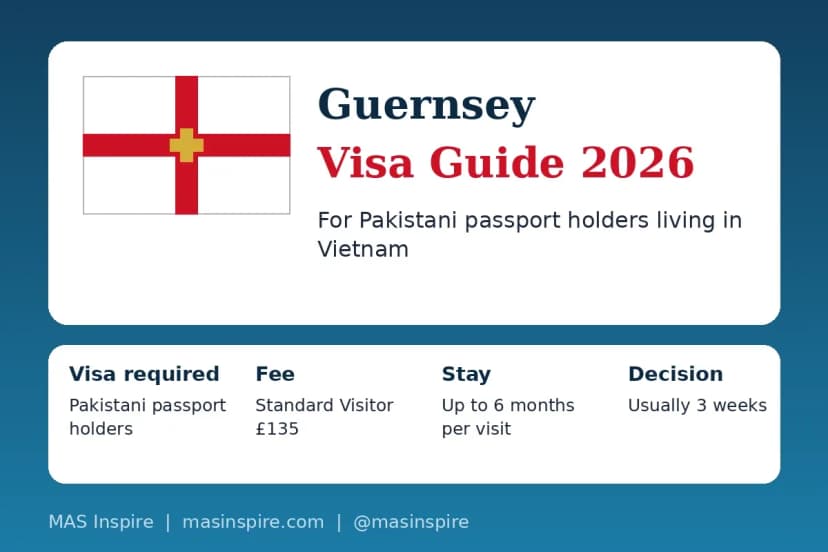
Yes. Pakistani passport holders need a visa before travelling to Guernsey. Pakistan is on the UK Home Office visa-national list, and Guernsey applies the same visa-national rules as the UK. There is no visa on arrival for Guernsey, and you cannot obtain a Guernsey visa at the airport or the harbour.
The important detail is that there is no separate Guernsey visa. The States of Guernsey states this plainly: "Guernsey doesn't have a separate application to visit the Bailiwick. You will need to use the same application used for the UK. If a visa is approved, this will cover you for any area of the Common Travel Area." The Common Travel Area (CTA) is the UK, Ireland, Jersey, Guernsey and the Isle of Man.
What that means in practice:
- You apply online through the UK Visas and Immigration service for a Standard Visitor visa (or the relevant work, study or family route).
- You must state "Bailiwick of Guernsey" as the destination in your application. All applications naming Guernsey are referred to the Guernsey Immigration and Nationality Division for a decision.
- If you arrive in the UK, Jersey, Guernsey or the Isle of Man without the necessary visa, you may be refused entry and returned to your country of origin.
- A visa granted for Guernsey also covers the rest of the CTA, so the same visa lets you enter the UK on the way in — which is how almost everyone reaches the island anyway, by air or sea via England.
- Guernsey does not issue Biometric Residence Permit (BRP) cards. It uses wet-ink endorsements — a stamp in your passport. If the online form asks for a postcode for BRP collection, the States of Guernsey instructs applicants to enter "SW1 H0AX".
The Electronic Travel Authorisation (ETA) does not apply to you. The ETA is only for non-visa nationals — people who would otherwise travel visa-free. Since 23 April 2026, non-visa nationals travelling direct to the Bailiwick of Guernsey from outside the Common Travel Area need an ETA, but as a Pakistani passport holder you are a visa national, so you need a visa, not an ETA. Do not buy an ETA instead of a visa: an ETA is not a visa and will not get a Pakistani passport holder into Guernsey.
There is one more Guernsey-only limit that surprises visitors. A Standard Visitor visa allows a stay of up to six months in the CTA, but Guernsey's Population Management Law only allows visitors to stay on the island for up to 90 days within any 12-month period without holding a Population Management Permit or Certificate. So your visa may say six months, but your stay in Guernsey itself is effectively capped at 90 days in a year unless you hold a permit. If you think you might go over that limit, contact the Population Management Office before you travel.
3. Types of Guernsey visas
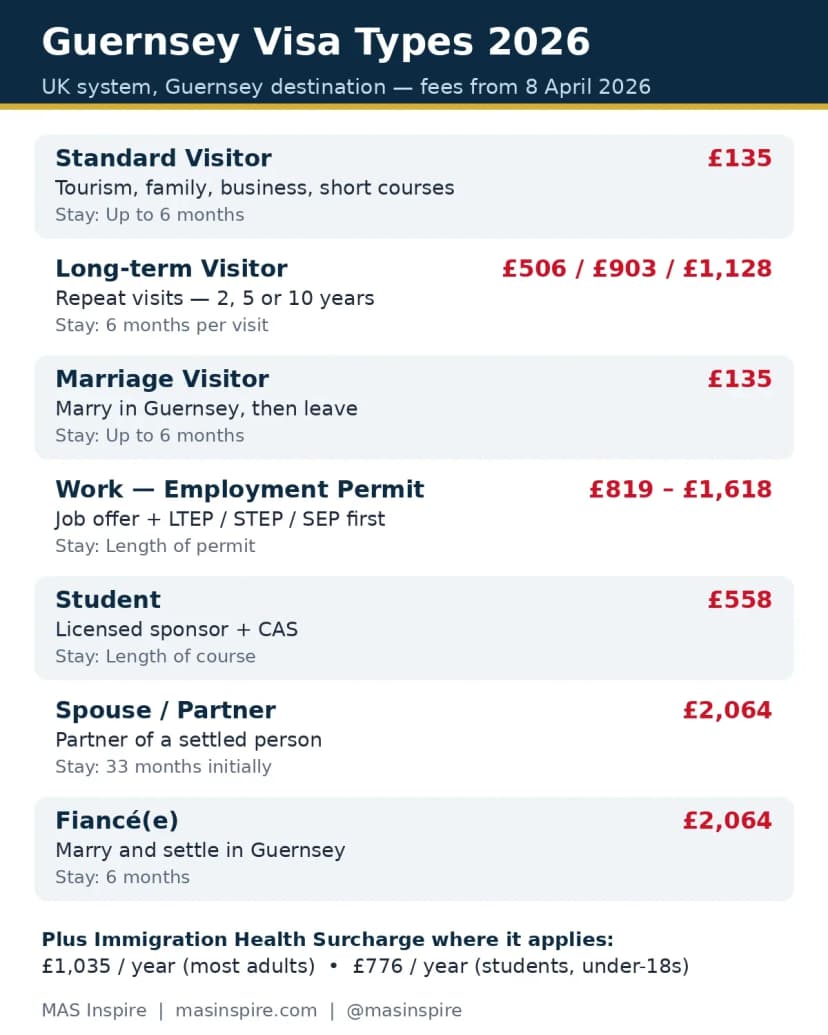
Standard Visitor visa
The main short-stay visa: tourism, visiting family and friends, permitted business activities such as meetings and conferences, and short courses of study of up to six months. It allows a stay of up to six months per visit in the CTA, subject to the 90-day Guernsey Population Management limit described above. You may not do any paid or unpaid work for a UK or Guernsey employer, and you may not run a business or live in Guernsey through repeated long visits. Long-term versions (2, 5 and 10 years) allow repeated visits of up to six months each, but they do not let you stay longer per visit.
Other visitor visas: business, sport, medical, marriage
Business, sport and medical visits are handled under the same Standard Visitor application, with evidence matched to the purpose — an invitation letter for business, a medical appointment letter for treatment. The Marriage Visitor visa is for people who intend to marry or enter into a civil partnership in Guernsey as part of a holiday and who do not plan to stay or settle in the CTA afterwards. The Standard Visitor visa for medical reasons allows up to 11 months, and for academics up to 12 months.
Work visa (Employment Permit route)
Guernsey work visas are employer-led and two-stage. First, your Guernsey employer must obtain an Employment Permit through the Population Portal — a Long Term Employment Permit (LTEP) for longer roles, or a Short Term Employment Permit (STEP) or Seasonal Employment Permit (SEP) for shorter and seasonal roles. Only then do you apply for the visa, through the UKVI "British Crown Dependencies" service, selecting "Work Permit for the Bailiwick of Guernsey" (for an LTEP) or "Seasonal Worker (temporary worker)" (for a STEP or SEP). You cannot apply for a Guernsey work visa without a job offer and an Employment Permit reference number. The closest UK equivalent is the Skilled Worker route, but for Guernsey the permit comes first and the visa follows it.
Student visa
A Student visa is for study in the Bailiwick, normally a course at a licensed sponsor institution. In practice this is a narrow route for Guernsey itself: the island has English-language schools but no degree-awarding university, so full-degree study means applying for a UK university and a UK Student visa instead. Short English courses of up to six months can be taken on a Standard Visitor visa. See section 11 for the detail.
Family visas: fiancé(e), spouse or partner, child, dependant
The fiancé(e) visa is for a person engaged to marry and settle in the Bailiwick; the spouse or unmarried partner visa is for someone already married to a British citizen or a person settled in the Bailiwick, or who has lived with that person in a relationship similar to marriage for at least two years. The child visa is for a child under 18 joining a parent who is present and settled in the Bailiwick. Dependants of Work or Employment Permit holders apply through the same work-visa service, selecting "Partner or child of current work permit holders". Family applicants also need the correct Population Management document — typically a Family Member Resident Permit (FMRP) or an Open Market Family Member Resident Permit (OMFMRP).
Other routes: Youth Mobility, UK Ancestry, Entrepreneur
The Youth Mobility Scheme (YMS) allows people aged 18 to 30 (35 in some cases) of certain nationalities to live and work in the CTA for up to two years. Pakistan is not on the published Youth Mobility Scheme nationality list, so this route is not open to Pakistani passport holders. The UK Ancestry visa is open to Commonwealth citizens — which includes Pakistanis — who can prove a grandparent was born in the UK, the Channel Islands or the Isle of Man, and who meet the other eligibility requirements. The Entrepreneur route is for someone who wants to set up a business in the Bailiwick; the States of Guernsey encourages prospective applicants to contact the Immigration and Nationality Division before applying. The EU Settlement Scheme route applies to EU, EEA and Swiss nationals and their family members, not to Pakistani nationals.
4. Guernsey visa comparison table
| Visa type | Who it is for | Maximum stay | Work allowed? | Home Office fee (from 8 April 2026) |
|---|---|---|---|---|
| Standard Visitor (up to 6 months) | Tourism, family visits, business meetings, short courses | 6 months per visit; 90 days in Guernsey in any 12 months without a permit | No | £135 |
| Standard Visitor, long-term 2 years | Repeat visitors | 6 months per visit | No | £506 |
| Standard Visitor, long-term 5 years | Repeat visitors | 6 months per visit | No | £903 |
| Standard Visitor, long-term 10 years | Repeat visitors | 6 months per visit | No | £1,128 |
| Standard Visitor, medical reasons | Private medical treatment | Up to 11 months | No | £234 |
| Standard Visitor, academic | Academics on sabbatical or research | Up to 12 months | No (except academic work) | £234 |
| Marriage Visitor | Marrying or entering a civil partnership in Guernsey, then leaving | Up to 6 months | No | £135 |
| Work (Employment Permit: LTEP) | Employee with a Guernsey job offer and Long Term Employment Permit | Length of the permit and visa granted | Yes, for the sponsoring employer | £819 (up to 3 years) / £1,618 (over 3 years), plus Immigration Health Surcharge |
| Work (STEP / SEP seasonal) | Short-term or seasonal worker with a STEP or SEP | Length of the permit | Yes, for the sponsoring employer | See work-visa fee table in section 8 |
| Student | Study at a licensed sponsor in the Bailiwick | Length of the course | Limited, as set out in the visa conditions | £558, plus Immigration Health Surcharge at the reduced student rate |
| Fiancé(e) | Engaged to marry and settle in the Bailiwick | 6 months, then marry and switch to a partner visa | No | £2,064 (Appendix FM partner entry clearance) |
| Spouse / unmarried partner | Partner of a British citizen or a person settled in the Bailiwick | 33 months initially (entry clearance) | Yes | £2,064, plus Immigration Health Surcharge |
| Child / dependant | Child under 18, or dependant of a permit holder | Matches the sponsor's visa | Depends on the route | Same fee as the main route |
All fees above are the Home Office fees in force from 8 April 2026, confirmed unchanged in the Home Office fee table that applies from 8 October 2026. The Immigration Health Surcharge (IHS) is charged on top for visas of more than six months: £1,035 per year for most adults and £776 per year for students, their dependants and anyone under 18. Always confirm the figure on the GOV.UK payment page on the day you apply — the portal checkout is the controlling figure.
5. Guernsey visa eligibility requirements
Identity and nationality
You must hold a valid Pakistani passport. Your passport should be valid for your whole stay and have at least one blank page for the wet-ink visa endorsement. You must be outside the UK and the Common Travel Area when you apply for entry clearance, and you must state "Bailiwick of Guernsey" as the destination. If you are living in Vietnam, apply as a resident of Vietnam: your Vietnamese residence status (temporary residence card or valid visa and proof of address in Ho Chi Minh City or elsewhere) will be part of the evidence.
Genuine purpose
For a visitor visa, you must be a genuine visitor: you will leave the CTA at the end of your visit, you will not live in Guernsey through frequent or successive visits, and you will not work or run a business. For work, study and family routes, your purpose must match the route — a real job with a permit, a real course with a licensed sponsor, or a real relationship with a settled person.
Financial capacity
You must show you can pay for your travel, your stay and your return without working or claiming public funds. There is no fixed minimum balance published for a visitor visa; the caseworker looks at your income, savings, the cost of the trip and your ties to Vietnam. As a practical guide, show bank statements for the last six months, salary slips or business income, and a realistic budget for flights, accommodation and daily costs in Guernsey, which is an expensive island. For a Student visa you must show the funds for tuition and living costs set out in the Student guidance for the length of your course. For a Skilled Worker-style work visa, your salary must meet the going rate for the job. For a spouse or partner visa, you and your partner must meet the Appendix FM financial requirement — check the current minimum income requirement on GOV.UK before applying, because it has changed in recent years.
Health and character
Vietnam is on the UK list of countries whose residents need a tuberculosis (TB) test for visas of more than six months. If you apply for a work, study or family visa, you will need a TB certificate from a UKVI-approved clinic in Vietnam (clinics operate in Hanoi and Ho Chi Minh City). A visitor visa of up to six months does not normally require a TB certificate. You must also disclose any criminal convictions and any previous visa refusals; a history of overstaying or deception can lead to refusal and a re-entry ban.
English language
A visitor visa has no English-language requirement. Work, study and family routes do: a Student visa requires English at the level set by your sponsor (normally CEFR B2 for degree-level study, B1 below degree level); a Skilled Worker route requires CEFR B1 in reading, writing, speaking and listening; a spouse or partner visa requires CEFR A1 for a first application. An approved Secure English Language Test (SELT) from a Home Office-approved provider is the usual evidence. Your teaching background and qualifications may help you prepare, but they do not replace the test unless the route expressly allows an alternative.
6. Complete Guernsey visa document checklists
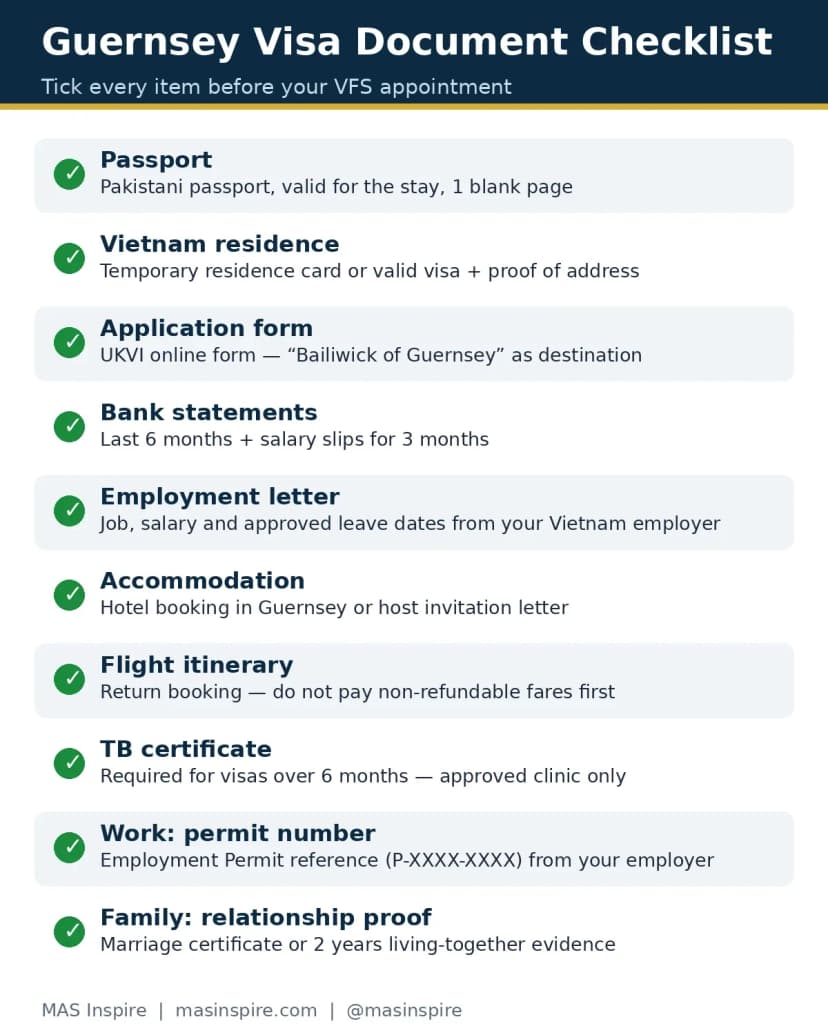
All documents not in English or Welsh must be translated by a certified translator, with the translator's confirmation that the translation is accurate, the date, and their contact details. Upload clear scans through the VFS Global portal after you apply online, or pay for scanning at the visa application centre.
General documents (every applicant)
| Document | Notes |
|---|---|
| Current Pakistani passport | Valid for the whole stay, with at least one blank page for the wet-ink endorsement; also include previous passports and any previous UK or Schengen visas. |
| Vietnam residence evidence | Temporary residence card (TRC) or valid Vietnamese visa, plus proof of address in Vietnam (rental contract or utility bill). |
| Completed online application form | Printed confirmation page; "Bailiwick of Guernsey" stated as the destination. |
| Biometrics appointment confirmation | VFS Global appointment letter for Hanoi or Ho Chi Minh City. |
| TB test certificate | Required for visas of more than six months; from a UKVI-approved clinic in Vietnam. |
| Translations | Certified English translations of any document not in English. |
Tourist and family visitor checklist
| Document | Notes |
|---|---|
| Bank statements, last 6 months | Showing income, savings and a balance that covers the trip; explain any large deposits. |
| Employment letter | From your employer in Vietnam (or your business registration if self-employed), stating your job, salary, length of employment and approved leave dates. |
| Salary slips, last 3 months | Matching the bank statements. |
| Accommodation proof | Hotel booking in Guernsey or an invitation letter from your host, with their address and Population Management status if relevant. |
| Flight itinerary | Outbound and return bookings; do not pay for non-refundable tickets before the visa is granted. |
| Travel itinerary | Day-by-day plan: arrival via the UK, ferry or flight to Guernsey, places you will visit, departure date. |
| Invitation letter (family visit) | From your host in Guernsey, with their full name, address, immigration status and relationship to you. |
| Ties to Vietnam | Employment contract, TRC, rental contract, family ties — evidence you will return. |
| Travel insurance | Not a visa requirement, but strongly recommended: Guernsey is outside the UK National Health Service, and medical costs are high. |
Business visitor checklist
| Document | Notes |
|---|---|
| Invitation letter from the Guernsey company | On company letterhead, stating the purpose, dates, meetings and who pays the costs. |
| Your employer's letter | Confirming your role, that the trip is business-related and that you remain employed in Vietnam. |
| Business registration or employment proof | Company registration, tax records or employment contract. |
| Financial evidence and accommodation | As in the visitor checklist above. |
Work visa checklist
| Document | Notes |
|---|---|
| Employment Permit reference number | The P-number (for example, P-XXXX-XXXX) issued for your LTEP, STEP or SEP; your employer supplies it. |
| Job offer and employment contract | Job title, salary, hours, start date and employer details, matching the permit. |
| English-language test result | Approved SELT at the level the route requires. |
| Financial evidence | As required by the route, if your sponsor does not certify maintenance. |
| TB certificate | From a UKVI-approved clinic in Vietnam. |
| Immigration Health Surcharge payment | Paid online as part of the application, at £1,035 per year for most adults. |
Student visa checklist
| Document | Notes |
|---|---|
| Confirmation of Acceptance for Studies (CAS) | Issued by your licensed sponsor institution in the Bailiwick or the UK. |
| English-language test result | At the level your sponsor requires. |
| Financial evidence | Tuition plus living costs for the course length, held for 28 days as the guidance requires. |
| Academic qualifications | Certificates and transcripts listed on the CAS. |
| TB certificate and IHS payment | TB certificate from an approved clinic; IHS at the reduced student rate of £776 per year. |
Family visa checklist
| Document | Notes |
|---|---|
| Relationship evidence | Marriage certificate, or evidence of living together for at least two years for an unmarried partner; photos, messages and joint documents. |
| Sponsor's status evidence | Your partner's British passport or proof of settlement in the Bailiwick, plus their Population Management status. |
| Financial requirement evidence | Income and savings meeting the Appendix FM minimum; check the current threshold on GOV.UK. |
| English-language test (A1 or above) | Approved SELT, unless exempt. |
| Accommodation evidence | Where you will live in Guernsey, and that the household can accommodate you. |
| Population Management document | Family Member Resident Permit (FMRP) or Open Market Family Member Resident Permit (OMFMRP), as advised by the Population Management Office. |
7. How to apply for a Guernsey visa: step-by-step
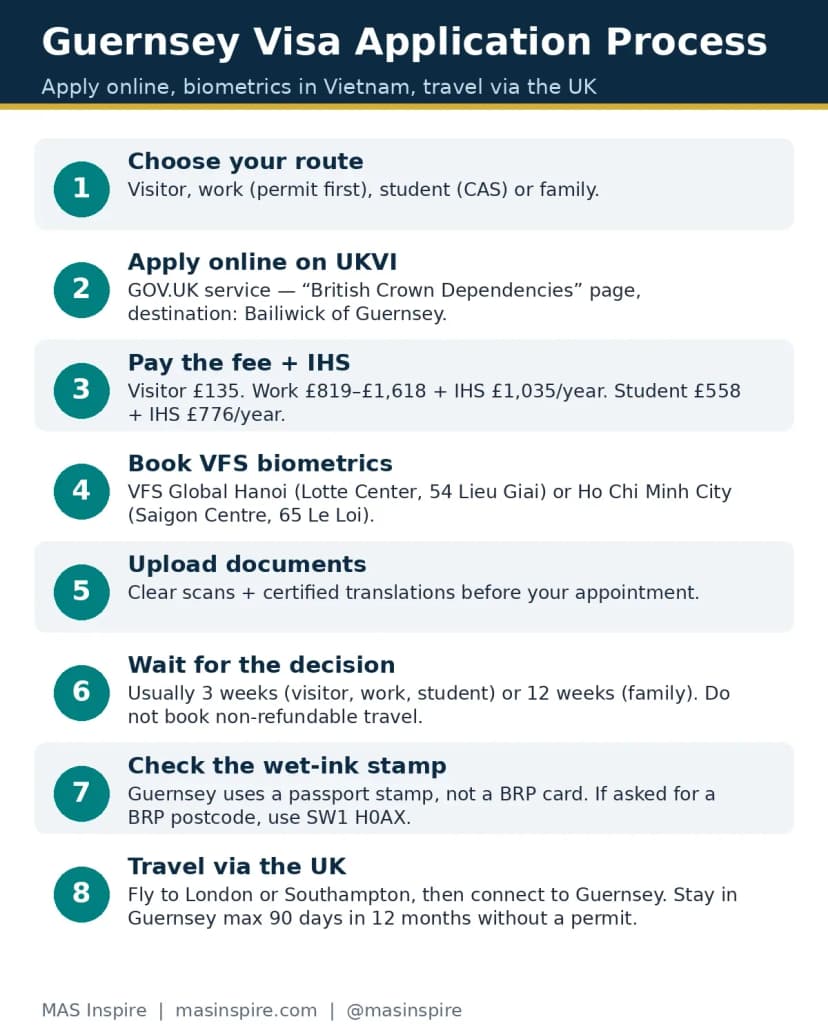
- Choose the right route. Decide whether you are a visitor, a worker (with a permit already in hand), a student (with a CAS) or a family applicant. A visitor cannot switch to a work visa inside the Common Travel Area — you would have to leave the CTA and apply again from outside it.
- Check the official guidance. Read the States of Guernsey visa guidance pages at gov.gg (visa guidance for employment, and visa guidance for other categories) and the matching GOV.UK pages for your route. Confirm the current fee and the document list on the day you apply.
- Apply online on the UKVI service. Complete the application on GOV.UK (for most routes) or on the visas-immigration.service.gov.uk service (for family, ancestry and entrepreneur routes). Make sure you are on the "British Crown Dependencies" page where the service offers it, select Guernsey as the destination, and state "Bailiwick of Guernsey" as the destination in the form. For a work visa, enter your Employment Permit reference number, your job title, your salary and your employer's details.
- Pay the fee and the Immigration Health Surcharge. Pay online by card. The fee is non-refundable even if the visa is refused. The IHS, where it applies, is paid for the full length of the visa. If the form asks for a BRP collection postcode, enter "SW1 H0AX" — Guernsey uses wet-ink endorsements, not BRP cards.
- Book and attend your biometrics appointment. After you apply online, you will be directed to VFS Global to book an appointment at the UK visa application centre in Hanoi or Ho Chi Minh City. Attend in person with your passport and appointment letter; your fingerprints and photograph are taken there. Pakistani and Vietnamese passports cannot use the UK ID Check app, so an in-person visit is required.
- Upload your supporting documents. Upload scans through the VFS Global portal before your appointment, or pay for the scanning service at the centre. Check that every page is legible and that translations are included.
- Wait for the decision. Standard processing from outside the UK is three weeks for visitor, work and student visas and twelve weeks for family visas, counted from your biometrics appointment. Do not book non-refundable travel until the visa is approved and your passport is returned to you.
- Receive your passport and check the endorsement. A successful Guernsey application results in a wet-ink endorsement (stamp) in your passport, not a BRP card. Check the dates, the visa type and the conditions before you travel. If anything is wrong, contact the Guernsey Immigration and Nationality Division immediately.
- Travel via the UK. Fly to London (usually Gatwick) or Southampton, then take a connecting flight or ferry to Guernsey. Keep your passport, your visa endorsement and your accommodation details with you. There are no routine immigration checks on arrival from the UK into Guernsey, but your visa must already have been granted — arriving without it can mean refusal and return to your country of origin.
- Register under the Population Management Law if you are staying. Visitors staying up to 90 days in any 12 months need no permit. Anyone living or working in Guernsey needs the correct Population Management Permit or Certificate at all times. Sort this out with the Population Management Office before you travel if your stay will be longer than 90 days.
8. Guernsey visa fees and financial requirements in 2026
Guernsey visa fees are the Home Office fees, because applications are made through the UKVI service. The fees below are those in force from 8 April 2026, confirmed unchanged in the Home Office fee table that applies from 8 October 2026. Fees are payable online in pounds sterling by card; the portal checkout shows the final amount, and that amount is the controlling figure.
| Visa or service | Fee | Notes |
|---|---|---|
| Standard Visitor visa, up to 6 months | £135 | Single fee for the main visitor route. |
| Standard Visitor, 2-year long-term | £506 | Up to 6 months per visit. |
| Standard Visitor, 5-year long-term | £903 | Up to 6 months per visit. |
| Standard Visitor, 10-year long-term | £1,128 | Up to 6 months per visit. |
| Standard Visitor, medical (up to 11 months) | £234 | Private medical treatment. |
| Standard Visitor, academic (up to 12 months) | £234 | Academics on sabbatical or research. |
| Marriage Visitor visa | £135 | Up to 6 months. |
| Skilled Worker / Guernsey work visa, up to 3 years (outside the UK) | £819 | Plus IHS of £1,035 per year. |
| Skilled Worker / Guernsey work visa, over 3 years (outside the UK) | £1,618 | Plus IHS of £1,035 per year. |
| Health and Care Worker, up to 3 years | £324 | Exempt from the IHS. |
| Health and Care Worker, over 3 years | £628 | Exempt from the IHS. |
| Student visa | £558 | Plus IHS at the reduced student rate of £776 per year. |
| Spouse / partner visa (entry clearance, outside the UK) | £2,064 | Plus IHS of £1,035 per year. |
| Immigration Health Surcharge, most adults | £1,035 per year | Paid upfront for the whole visa. |
| Immigration Health Surcharge, students and under-18s | £776 per year | Paid upfront for the whole visa. |
| Priority service (where available) | £500 extra | Decision usually within 5 working days. |
| Super priority service (where available) | £1,000 extra | Decision usually by the end of the next working day. |
A worked example: a three-year Guernsey work visa costs £819 in application fees plus £3,105 in Immigration Health Surcharge (£1,035 × 3 years), a total of £3,924 before any priority service, TB test, translations or VFS service charges. A one-year student visa costs £558 plus £776 in IHS, a total of £1,334 before tuition and living costs. Budget separately for the TB test (third-party reports put the cost at roughly VND 1,500,000–3,000,000 at approved clinics in Hanoi and Ho Chi Minh City, but no official fee is published, so confirm with the clinic), document translations, and VFS optional services such as document scanning and courier return of your passport.
Figure conflicts you should know about. Some third-party visa websites still show the old visitor fee of £115 (the fee before April 2025) or a US$115 figure with a PKR 43,577 conversion. Those figures are out of date: the current Home Office fee is £135, in force since 8 April 2026. Separately, the States of Guernsey's ETA announcement of 30 March 2026 states the ETA costs £16, while GOV.UK now charges £20 for a UK ETA; the Guernsey page has not been updated and says the increase to £20 was due "in the near future". This does not affect Pakistani applicants, who need a visa rather than an ETA, but it shows why the portal checkout — not a secondary website — is the figure to trust.
9. Guernsey visa processing times
Processing times are Home Office service standards, counted from the date you attend your biometrics appointment, not from the date you start the online form. They are targets, not guarantees: verification checks, interviews and busy periods can extend them.
| Visa category | Applied from outside the UK | Applied from inside the UK / CTA | Priority option |
|---|---|---|---|
| Standard Visitor | 3 weeks | 8 weeks | 5 working days (£500), where available |
| Marriage Visitor | 3 weeks | 8 weeks | 5 working days (£500), where available |
| Student / Child Student | 3 weeks | 8 weeks | 5 working days (£500), where available |
| Skilled Worker / Guernsey work visa | 3 weeks | 8 weeks | 5 working days (£500), where available |
| Health and Care Worker | 3 weeks | 3 weeks | 5 working days (£500), where available |
| Partner / spouse (family visa) | 12 weeks | 8 weeks (if income and English requirements are met) | 30 working days, where available |
| Parent / child (family visa) | 12 weeks | Up to 12 months in some in-country cases | Check availability when you apply |
| Settlement (indefinite leave to remain) | Not applicable | 6 months | Not generally available |
Apply as early as you can: a visitor visa application can be made up to three months before travel. For a family visa, build the full twelve-week standard into your plans. Guernsey applications are referred to the Guernsey Immigration and Nationality Division for a decision, which can add time if the Division needs further information, so do not book non-refundable flights or accommodation until the visa is in your passport. If your application will take longer than the standard, UKVI will normally write to you.
10. Applying for a Guernsey visa from Vietnam
There is no Guernsey embassy or consulate in Vietnam, and no separate Guernsey visa office. As a Pakistani citizen living in Vietnam, you apply online through the UKVI service and give your biometrics in Vietnam. Apply as a resident of Vietnam, not as an applicant in Pakistan: your Vietnamese residence evidence is part of the file, and your biometrics appointment will be at a VFS Global centre in Vietnam.
Where to give biometrics in Vietnam
VFS Global operates the UK visa application centres in Vietnam. The two centres confirmed by multiple sources are:
- Hanoi: VFS Global, Lotte Center Hanoi, 54 Lieu Giai, Ba Dinh District.
- Ho Chi Minh City: VFS Global, Saigon Centre, 65 Le Loi, District 1.
One source also lists a Da Nang centre. That listing is not confirmed by the other sources used for this guide, so check the VFS Global website for the current list of centres and opening hours before you book. Book early: Ho Chi Minh City slots fill fastest in the peak seasons of July to September and December to January.
The British mission in Vietnam
For general enquiries, the British Embassy is in Hanoi (Central Building, 31 Hai Ba Trung Street, Hoan Kiem District) and the British Consulate General is in Ho Chi Minh City (25 Le Duan Boulevard, Ben Nghe Ward, District 1). Neither office accepts visa applications in person — applications are online and biometrics are at VFS Global — but they are the right contact if you need consular help while travelling. The Guernsey Immigration and Nationality Division itself can be contacted at immigration@gcis.gov.gg or on +44 (0) 1481 221420.
Practical points for applicants in Vietnam
- TB test: for any visa longer than six months, book a TB test at a UKVI-approved clinic in Hanoi or Ho Chi Minh City. The certificate is normally valid for six months from the examination. Allow time for the chest X-ray and the certificate, which can take one to three days.
- Bank statements: if your salary is paid into a Vietnamese bank account, provide six months of statements with a certified translation of any Vietnamese-language pages. Explain any large or unusual deposits in a cover letter.
- Cover letter: write a short cover letter in English explaining who you are, where you live in Vietnam, why you want to visit Guernsey, your travel dates, where you will stay, and why you will return to Vietnam. For a teacher, an employer letter confirming your job and approved leave is strong evidence of ties.
- Payment: the visa fee is paid online by card in pounds sterling. Check with your Vietnamese bank that international online payments are enabled before you start the application.
- Passport return: VFS Global normally returns your passport after biometrics, and you are contacted when a decision is made. Keep your passport safe and do not travel internationally while the application is pending unless the centre advises you that you may.
11. Guernsey student visa guide 2026
Guernsey is a poor fit for a full degree, and an honest guide should say so. The island has no degree-awarding university. Guernsey's own students study at UK universities with means-tested grants from the States of Guernsey, and they are treated as home students for tuition-fee purposes. If your goal is a bachelor's or master's degree, apply to a UK university and for a UK Student visa — not a Guernsey one.
What Guernsey does offer is short English-language study. The island has English-language schools, including Accent Multilingual Services, and suits learners who want a short course in a small, safe island community. The routes are:
- Short course up to six months: study on a Standard Visitor visa (£135, usually decided in three weeks). You may study for up to six months, and you may not work.
- Short-term study of six to eleven months (English language): the UK short-term study route covers English-language courses of six to eleven months. The fee and the exact Guernsey application path for this route were not verified from an official source at the time of writing, so do not rely on a figure from this guide — confirm the fee and the application route on GOV.UK and with the Guernsey Immigration and Nationality Division before you apply.
- Full-time study in the Bailiwick on a Student visa: £558 plus IHS at £776 per year, usually decided in three weeks from outside the UK. You need a Confirmation of Acceptance for Studies (CAS) from a licensed sponsor, English at the level the sponsor requires, and funds for tuition and living costs held as the Student guidance requires. This route is rare for Guernsey because so few institutions on the island can sponsor it — confirm with the institution that it holds a sponsor licence before you pay any deposit.
If you are a Pakistani English teacher living in Vietnam, the realistic study use of Guernsey is a short English-language or professional-development course on a visitor visa. A degree plan belongs in the UK, where the Student visa, the CAS system and the university sector are built for it.
12. Guernsey work visas and job opportunities
Guernsey's economy is built on finance — banking, insurance, fund administration, trust and legal services — followed by tourism and hospitality, retail, construction, health and social care, and agriculture and horticulture, including seasonal work. Salaries are generally higher than in the UK, but so is the cost of living, and housing is tightly controlled by the Population Management Law.
How the Guernsey work visa works
There are two stages, and the order matters. First, your Guernsey employer applies for an Employment Permit through the Population Portal. The permit types are the Long Term Employment Permit (LTEP) for longer roles, the Short Term Employment Permit (STEP) for shorter roles, and the Seasonal Employment Permit (SEP) for seasonal work. Second, once the permit is granted, you apply for the visa through the UKVI "British Crown Dependencies" service, selecting "Work Permit for the Bailiwick of Guernsey" for an LTEP or "Seasonal Worker (temporary worker)" for a STEP or SEP. You will need the Employment Permit reference number, your job title, your salary and your employer's details. Do not book travel until the visa is approved.
Who can work in Guernsey
You need a job offer from a Guernsey employer and a permit before you apply. You cannot arrive as a visitor and then look for work or switch to a work visa inside the Common Travel Area: the States of Guernsey states that if your immigration permissions do not allow you to work, you cannot change those conditions within the CTA — you must leave the CTA and apply to return. A visitor visa does not allow any employment activity, including remote work for a Guernsey employer. Remote work for a non-Guernsey employer while visiting is limited by the Population Management Law to 10 days within a 30-day period and no more than 90 days within a 12-month period without a permit.
English teaching and other roles
There is no large international-school ESL market in Guernsey comparable to Vietnam or the Gulf: the island's schools are small, and teaching posts normally require UK-recognised qualifications and local registration. The realistic openings for an overseas applicant are in finance and professional services (if you hold the relevant qualifications), hospitality and tourism (hotels, restaurants and seasonal roles), health and social care, and seasonal agriculture. For seasonal work, ask the employer whether the role is covered by a STEP or SEP and what accommodation is provided, because housing is the hardest part of any Guernsey move. Never pay an agent a fee for a Guernsey job offer: a genuine employer sponsors the permit itself, and any demand for payment for a job or a visa is a warning sign.
13. Family immigration, settlement and the Population Management Law
Family routes to Guernsey follow the UK Appendix FM system, with a Guernsey layer on top. A fiancé(e) visa lets you come to the Bailiwick for six months to marry and then apply to stay as a partner. A spouse or unmarried partner visa is for someone already married to a British citizen or a person settled in the Bailiwick, or who has lived with that person in a relationship similar to marriage for at least two years — you will be asked to evidence the two-year requirement. A child visa is for a child under 18 joining a parent who is present and settled in the Bailiwick, or arriving at the same time. Dependants of Work or Employment Permit holders apply through the work-visa service as the partner or child of a current work permit holder.
The Guernsey layer is the Population Management Law. Everyone living in Guernsey must hold a Population Management Permit or Certificate at all times. Family applicants typically need a Family Member Resident Permit (FMRP) or an Open Market Family Member Resident Permit (OMFMRP), depending on the sponsor's residential status. A child of a householder does not need a permit until age 16, unless they want part-time employment before then. Contact the Population Management Office before you apply if you are unsure which permit fits your situation — getting the immigration visa without the right permit can still leave you unable to live on the island lawfully.
Settlement (indefinite leave to remain) is a long-term goal, not a starting point: it normally follows years of lawful residence on a qualifying route, and the standard in-country processing time is six months. There is no published shortcut, and no agent can sell you settlement. If a family application is refused, the decision letter explains whether you can seek an administrative review or reapply, and what evidence was missing.
Extensions
A Standard Visitor visa can sometimes be extended in-country, but only in limited circumstances, and the in-country standard processing time is eight weeks. You must apply before your current permission expires, and you must still meet the visitor rules — you cannot extend a visit into residence, and you cannot switch from a visitor visa to a work visa inside the CTA. Work, student and family visas are normally extended in-country if you still meet the route requirements; the standard in-country time is eight weeks for most routes and three weeks for Health and Care Worker applications. If your circumstances change — a new employer, a new course, a relationship ending — get advice before your permission expires, because an expired permission leaves you overstaying.
Overstaying
Overstaying means remaining in the CTA after your permission ends, or staying in Guernsey beyond the 90-day Population Management limit without a permit. The consequences are serious: you may be removed, you may be refused future visas, and a period of overstaying can lead to a re-entry ban. If you realise you have overstayed, or that you will, contact the Guernsey Immigration and Nationality Division or an immigration adviser immediately rather than waiting — voluntary, prompt action is always better than being found. Never work while overstaying: it is a separate breach and makes any future application far harder.
14. Common Guernsey visa application mistakes and reasons for refusal
- Forgetting to name Guernsey as the destination. If your application does not state "Bailiwick of Guernsey", it may be decided as a UK-only application and not referred to the Guernsey Immigration and Nationality Division.
- Applying for an ETA instead of a visa. The ETA is only for non-visa nationals. A Pakistani passport holder with an ETA and no visa will be refused boarding or entry.
- Planning a six-month stay in Guernsey on a visitor visa. The visa allows six months in the CTA, but the Population Management Law caps a stay on the island at 90 days in any 12 months without a permit.
- Working, or planning to work, on a visitor visa. Any employment activity — including remote work for a Guernsey employer — is not allowed on a visitor visa.
- Trying to switch from visitor to worker inside the CTA. It is not possible. You must leave the CTA and apply from outside it.
- Weak financial evidence. Unexplained large deposits, a balance that does not cover the trip, or statements that do not match your salary slips are among the most common refusal reasons.
- Missing or untranslated documents. Every non-English document needs a certified translation; missing pages and blurry scans cause delays and refusals.
- Booking non-refundable travel before the decision. Flights and hotels should be booked only after the visa is granted and your passport is back in your hands.
- Applying for a work visa without a permit. A Guernsey work application without an Employment Permit reference number will fail — the employer's permit comes first.
- Using out-of-date fee figures. Some websites still show the old £115 visitor fee. The current fee is £135, and the portal checkout is the controlling figure.
- Previous refusals or overstaying not disclosed. Always declare previous refusals and any overstaying. The Home Office holds the records, and non-disclosure is treated as deception.
If your application is refused, read the refusal notice carefully: it states the exact paragraphs of the Immigration Rules you failed and what evidence was missing. You can usually reapply with stronger evidence once the gaps are fixed. For family and human-rights refusals, the notice will explain whether an administrative review or appeal right applies.
15. Frequently asked questions
1. Do Pakistani citizens need a visa for Guernsey?
Yes. Pakistan is on the UK visa-national list, and Guernsey applies the same rules. You need a visa before you travel; there is no visa on arrival for Guernsey.
2. Is there a separate Guernsey visa?
No. There is no separate Guernsey visa application. You apply through the UK Visas and Immigration online service, state "Bailiwick of Guernsey" as your destination, and your application is referred to the Guernsey Immigration and Nationality Division for a decision.
3. Can I visit Guernsey on a UK visa?
Yes. A visa granted for the Bailiwick of Guernsey covers the whole Common Travel Area, and a UK Standard Visitor visa granted with Guernsey as the destination covers your entry through the UK and your stay on the island. The key point is to name Guernsey as the destination when you apply.
4. How much does a Guernsey visitor visa cost in 2026?
The Standard Visitor visa costs £135 for up to six months. Long-term versions cost £506 for two years, £903 for five years and £1,128 for ten years, with up to six months per visit. These are the Home Office fees in force from 8 April 2026, confirmed unchanged in the fee table that applies from 8 October 2026.
5. How long does a Guernsey visa take?
Usually three weeks from your biometrics appointment for visitor, work and student visas, and twelve weeks for family visas such as a spouse or partner visa. These are service standards, not guarantees, and Guernsey applications are referred to the Guernsey Immigration and Nationality Division, which can add time.
6. Do I need an ETA for Guernsey?
No, not as a Pakistani passport holder. The ETA is only for non-visa nationals travelling direct to Guernsey from outside the Common Travel Area. You need a visa, not an ETA. Note also the fee conflict: the States of Guernsey's March 2026 announcement says the ETA costs £16, while GOV.UK now charges £20 for a UK ETA — the portal checkout is the controlling figure.
7. How long can I stay in Guernsey on a visitor visa?
Your visa allows up to six months in the Common Travel Area, but Guernsey's Population Management Law allows visitors to stay on the island for only 90 days within any 12-month period without a Population Management Permit or Certificate. Plan your trip within the 90-day island limit.
8. Where do I apply for a Guernsey visa from Vietnam?
Apply online through the UKVI service, then attend a biometrics appointment at a VFS Global UK visa application centre in Hanoi (Lotte Center, 54 Lieu Giai) or Ho Chi Minh City (Saigon Centre, 65 Le Loi). A Da Nang centre is listed by one source but is not confirmed — check the VFS Global website before booking.
9. Do I need a TB test to apply from Vietnam?
For a visa of more than six months, yes: Vietnam is on the UK list of countries whose residents need a tuberculosis test, from a UKVI-approved clinic in Hanoi or Ho Chi Minh City. A visitor visa of up to six months does not normally require one.
10. Can I work in Guernsey on a visitor visa?
No. A visitor visa does not allow any employment activity, including remote work for a Guernsey employer. To work in Guernsey you need a job offer, an Employment Permit (LTEP, STEP or SEP) obtained by your employer, and a work visa.
11. Can I switch from a visitor visa to a work visa while in Guernsey?
No. You cannot change your immigration conditions inside the Common Travel Area if your current permission does not allow work. You must leave the CTA and apply for the work visa from outside it.
12. Can I study in Guernsey?
Short English courses of up to six months can be taken on a Standard Visitor visa. Guernsey has English-language schools but no degree-awarding university, so a full degree means applying to a UK university on a UK Student visa instead. A Guernsey Student visa costs £558 plus the Immigration Health Surcharge at £776 per year, and requires a Confirmation of Acceptance for Studies from a licensed sponsor.
13. How do I travel to Guernsey, and what should I expect on arrival?
Fly to London (usually Gatwick) or Southampton, then take a connecting flight or ferry to Guernsey. There are no routine immigration checks between the UK and Guernsey, but your visa must already have been granted before you travel — arriving without the necessary visa can mean refusal and return to your country of origin. Carry your passport with the wet-ink endorsement, your accommodation details and your return ticket, and keep your travel insurance documents with you.
14. What happens if I overstay in Guernsey?
Overstaying — remaining after your permission ends, or staying on the island beyond the 90-day Population Management limit without a permit — can lead to removal, future visa refusals and a re-entry ban. Contact the Guernsey Immigration and Nationality Division or an immigration adviser immediately if you think you may overstay.
15. Is Guernsey in the UK, the EU or the Schengen Area?
None of the three. Guernsey is a self-governing British Crown Dependency: it is not part of the United Kingdom, not part of the European Union and not in the Schengen Area. It is in the Common Travel Area with the UK, Ireland, Jersey and the Isle of Man, and its immigration rules are built on UK immigration law with local Guernsey administration.
16. Official Immigration Websites
| Website | What it is for |
|---|---|
| States of Guernsey — Guernsey visa guidance for other categories | Official Guernsey guidance for visitor, family, fiancé(e), child, Youth Mobility, Ancestry and Entrepreneur routes; states that there is no separate Guernsey visitor application and that "Bailiwick of Guernsey" must be named as the destination. |
| States of Guernsey — Guernsey visa guidance under the Employment Permit Policy | Official Guernsey work-visa guidance: employer permit first (LTEP, STEP, SEP), then the UKVI Crown Dependencies application. |
| GOV.UK — Visa processing times: applications outside the UK | Official Home Office service standards: 3 weeks for visitor, student and work visas; 12 weeks for family visas. |
| States of Guernsey — Introduction of ETA for non-visa nationals travelling to the Bailiwick of Guernsey | Official States of Guernsey announcement (30 March 2026): ETA required from 23 April 2026 for non-visa nationals travelling direct from outside the Common Travel Area; £16 at announcement, with an increase to £20 flagged as due in the near future. |
| GOV.UK — Apply for an Electronic Travel Authorisation (ETA) | Official ETA application service. Note: the ETA is for non-visa nationals only and does not apply to Pakistani passport holders. |
| GOV.UK — Tuberculosis tests for visa applicants | Official list of countries where a TB test is required and the approved clinics, including Vietnam. |
| Visit Guernsey — Travelling to Guernsey | Official visitor information on passports, visas, the ETA from 23 April 2026 and contact details for the Guernsey Border Agency. |
| States of Guernsey — Immigration | Guernsey immigration home page: the Immigration and Nationality Division, contact details (immigration@gcis.gov.gg, +44 (0) 1481 221420) and Population Management information. |
Guernsey rewards the traveller who plans carefully: name the Bailiwick as your destination, respect the 90-day island limit, keep your finances and documents in order, and apply early from Vietnam through the UKVI service and VFS Global. The island is small, but its immigration rules have two layers — the UK system and Guernsey's own Population Management Law — and a successful trip is one that satisfies both. Check the official sources above on the day you apply, because fees and rules change, and the portal checkout is always the final word on what you pay.
Disclaimer: This guide is general information based on official sources checked on 28 November 2026. It is not legal or immigration advice. Immigration Rules and Home Office fees change; always confirm the current requirements on gov.gg and GOV.UK before applying.