Introduction
Guinea-Bissau is a small Portuguese-speaking country on the West African coast, with its capital at Bissau and a population of about 2.1 million people. It is best known for the Bijagós Archipelago, a UNESCO World Heritage Site since 2025, the saltwater hippos of Orango, and its cashew trade. It is not the same country as Guinea (Conakry) to its south-east, nor Equatorial Guinea further south: the three countries have different governments, different visa systems and different entry rules, and confusing them is one of the most common mistakes travellers make.
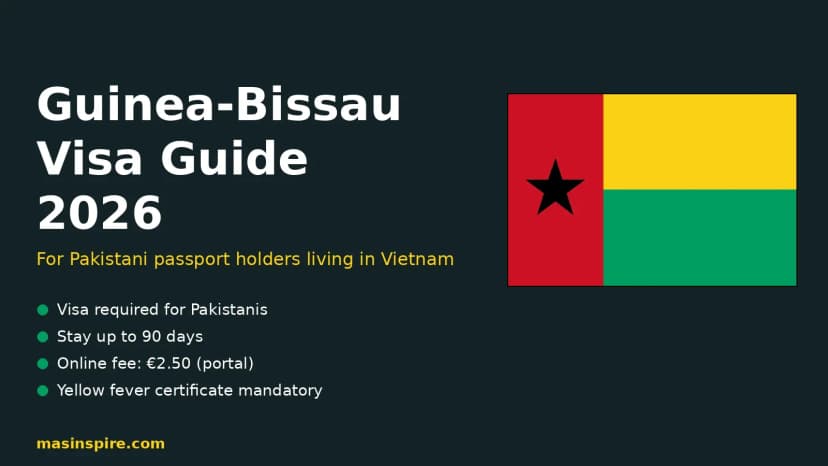
Pakistani passport holders need a visa to enter Guinea-Bissau. There is no visa-free access for Pakistani citizens, and there is no Guinea-Bissau embassy in Vietnam or in Pakistan. The practical route for most applicants is the official Electronic Visa Application System at rgb-visa.com: you pre-enrol and pay online, then the biometric visa itself is issued on arrival at Osvaldo Vieira International Airport in Bissau. A second route is a visa on arrival backed by a letter of authorisation from the Migration Office of Guinea-Bissau, and a third is a visa obtained in advance from a Guinea-Bissau embassy, most usefully in Paris, Lisbon, Dakar or Beijing.
One warning belongs at the top of this guide, because it shapes every figure that follows. The official portal publishes only one fee — a 2.50 euro online processing fee — and no processing time at all. The actual visa fee payable at the border or at a consulate is not published on the portal, and the secondary sources disagree sharply about it, from about 40 US dollars to about 120 US dollars. This guide therefore states exactly what is verified, names the conflicts, and tells you which source controls each figure, instead of presenting one unverified number as fact.
This guide is written for Pakistani passport holders living in Vietnam. It reflects official information checked on 28 November 2026. It is educational guidance, not legal advice or a promise of approval. Entry rules can change without notice, and the border officer always has the final word.
Why People Visit, Study, and Work in Guinea-Bissau
Visitors travel to Guinea-Bissau for the Bijagós islands, wildlife, beaches, Creole culture and music, and the colonial-era old town of Bissau. Business visitors come for cashew trading, fisheries, construction and development work. A small number of foreign students and researchers come for marine biology, conservation and Portuguese-language study. Family visitors travel to join relatives living and working in the country.
Guinea-Bissau is a low-infrastructure destination. Flights are few, most arriving via Lisbon or Dakar, and services outside Bissau are limited. The United States Department of State rates the country Level 3, Reconsider Travel, in an advisory dated 11 December 2025, citing unrest, inadequate health infrastructure and landmines, and the United Kingdom Foreign, Commonwealth and Development Office advises a high degree of caution. A military transition has governed the country since late November 2025. None of that changes the visa rules, but it means you should read the current travel advisories, hold comprehensive travel insurance, and keep your plans flexible before you commit to non-refundable bookings.
The visa system is purpose-based in a narrow sense: the official portal describes one biometric visa, issued for a stay of up to 90 days, with multiple-entry and long-stay variants available on request for frequent travellers. There is no separate published tourist, business, student or work visa product with its own fee schedule. Your purpose still matters — it decides which supporting documents you must carry — but you should not expect a distinct student or work visa counter. Confirm the correct handling of your purpose with the mission or the Migration Office in writing before you travel.
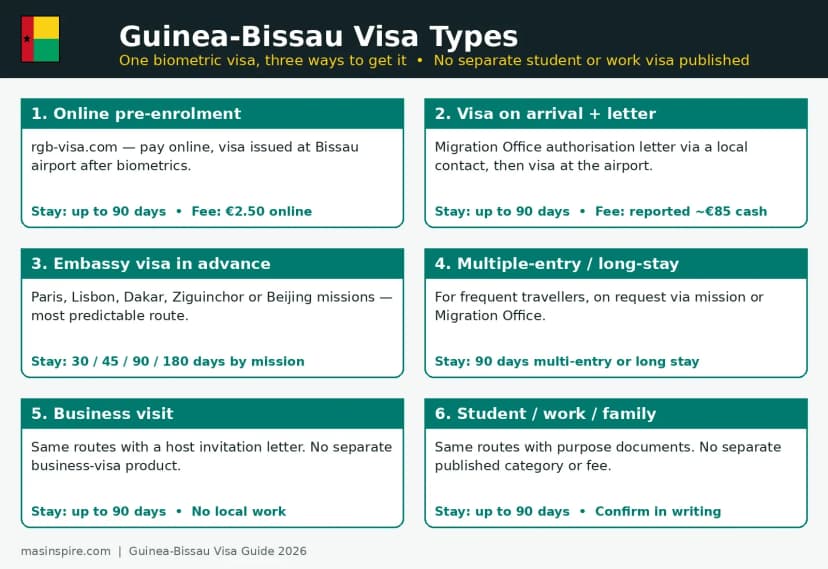
Types of Guinea-Bissau Visas and Entry Permissions
1. Biometric visa via online pre-enrolment
This is the route the official portal describes first, and the recommended route for Pakistani applicants in Vietnam because it needs no embassy visit. You complete the pre-enrolment form on the official Electronic Visa Application System at rgb-visa.com, pay online, and receive a visa-issuing confirmation and a visa slip by email. On arrival at Osvaldo Vieira International Airport, your biometric data — fingerprints and photograph — and your biographical data are collected, and the single-entry biometric visa is issued. The portal states the visa is for a stay of up to 90 days and requires information on travel and accommodation. The portal also states plainly that this biometric visa is currently issued only on arrival at Guinea-Bissau International Airport, with more locations possibly added later. Do not treat the online step as a finished visa: it is a pre-enrolment and a confirmation to show at the border and to the airline.
2. Visa on arrival with a Migration Office authorisation letter
The second route is a visa on arrival backed by a letter of authorisation from the Migration Office of Guinea-Bissau. According to the official portal, you send details of your intended arrival, the duration of your visit and a scanned copy of your passport to your contact in Guinea-Bissau. Your contact takes the documents to the Migration Office and requests the letter; the Chief Officer of the Migration Office approves or rejects the request. If approved, your contact sends you the letter by email or fax, you print it, and you show it when applying for the visa on arrival. If you have no contact in Guinea-Bissau, the portal says you may send your request directly to Mr. Lino Lopes, the Chief Migration Officer. This route is slower and depends on a local contact, so it suits travellers who already have a host, employer or family member in the country.
3. Embassy or consular visa obtained in advance
The third route is a visa issued by a Guinea-Bissau embassy or consulate before you travel. The United Kingdom Foreign, Commonwealth and Development Office directs travellers to the Embassy of Guinea-Bissau in Paris, France — 94 Rue St Lazare, 75009 Paris, email embgbfr@gmail.com, telephone +33 1 48 74 36 39 — and notes that embassies in neighbouring countries, including Senegal, may also issue visas. Other useful missions are the Embassy in Lisbon, Portugal (Rua Alcolena 17-A, 1400-004 Lisboa, telephone +351 213 030 440), the Embassy in Dakar, Senegal, and the Consulate-General in Ziguinchor, Senegal, which travellers report issues visas quickly. For applicants in Asia, the Embassy in Beijing is concurrently accredited to Vietnam, which makes it the geographically closest mission, but accreditation does not guarantee that it accepts visa applications from Pakistani residents in Vietnam — write to the mission first and get its answer in writing. An embassy visa is the most predictable option because the review is finished before you travel, and it is the option the United Kingdom advice treats as the standard route.
4. Multiple-entry and long-stay visas for frequent travellers
The official portal states that foreigners who frequently travel to Guinea-Bissau may ask for a 90-day visa with multiple entries or a long-stay visa with multiple entries. No separate fee, form or eligibility list for these variants is published on the portal, so the fee and conditions must be confirmed with the mission or the Migration Office that issues them. A consulate fee schedule from the Consulate-General in Algarve, Portugal, lists a 180-day visa at 180 euros for normal processing and 210 euros for urgent processing, but that is a local schedule and other missions may charge differently. Do not assume a multiple-entry visa is available on arrival without prior confirmation.
5. Business visa
There is no separately published business-visa product with its own fee. Business travellers use the same biometric-visa, authorisation-letter or embassy routes, and support the application with a business purpose: an invitation letter from the Guinea-Bissau host company, details of meetings or commercial activity, and evidence of funds. The host company should be ready to be contacted, and for the authorisation-letter route the host can also act as the local contact who takes your documents to the Migration Office. A business visit is not permission to take up local employment.
6. Student visa
No separate student-visa category, fee or checklist is published on the official portal or in the reviewed official material. Students should use the same pre-enrolment or embassy route and carry an admission or enrolment letter from the institution in Guinea-Bissau, proof of funds, accommodation evidence and the standard documents. Because the category is not published, the institution or host should confirm the correct handling with the Migration Office or the issuing mission before the student travels, and the student should allow extra time. Do not pay any agent who claims to sell a distinct Guinea-Bissau student visa with a fixed published fee — no such fee schedule was found.
7. Work visa
No separate work-visa category, fee or checklist is published either. Foreign workers should not travel on a visitor biometric visa and start work: the employer in Guinea-Bissau should sponsor the application, provide an employment contract or invitation, and confirm the correct route with the Migration Office or the issuing mission in writing. No salary threshold or labour-approval document is published in the sources reviewed for this guide, so any figure an agent quotes for a Guinea-Bissau work permit should be treated as unverified until the mission confirms it.
8. Family and visit visa
Family visitors use the same routes, supported by a sponsor or invitation letter from the host in Guinea-Bissau, evidence of the relationship, and the host's identity and address details. For the authorisation-letter route, the family host is the natural local contact for the Migration Office request. There is no published family-reunion residence permit route for ordinary visitors; a family stay beyond the visa's permitted period requires an extension application in Bissau, which is not guaranteed.
9. Transit
No standalone transit-visa product was identified in the official material reviewed. Some secondary guides describe a transit e-visa, but that claim could not be verified against the official portal, which lists no transit category. If you only change planes at Osvaldo Vieira International Airport without passing through immigration, confirm with your airline whether a visa is needed. If you must leave the airport or pass through immigration, assume a normal visa is required and arrange the pre-enrolment or an embassy visa in advance.
10. Visa exemptions and dual nationals
Citizens of 14 West African states — Benin, Burkina Faso, Cabo Verde, Côte d'Ivoire, Gambia, Ghana, Guinea, Liberia, Mali, Niger, Nigeria, Senegal, Sierra Leone and Togo — are exempt from visa requirements. Pakistan is not on that list, and Pakistani passport holders always need a visa. The official portal adds that Guinea-Bissau residents with dual nationality who travel on a foreign passport are exempt if they hold a valid Guinea-Bissau passport or national identity card. That exemption does not apply to a Pakistani citizen with no Guinea-Bissau nationality.
Guinea-Bissau Visa Comparison Table
| Route | How it is obtained | Stay | Best for | Key limit |
|---|---|---|---|---|
| Biometric visa via online pre-enrolment (rgb-visa.com) | Pre-enrol and pay online; biometrics and visa issued on arrival at Bissau airport | Up to 90 days, single entry | Most Pakistani applicants in Vietnam; no embassy visit needed | Not a finished visa until issued at the border; portal publishes no total fee or processing time |
| Visa on arrival with authorisation letter | Local contact requests a letter from the Migration Office, or apply directly to the Chief Migration Officer | Up to 90 days, single entry | Travellers with a host, employer or family in Guinea-Bissau | Needs a local contact and advance approval; slower |
| Embassy or consular visa in advance | Apply at Paris, Lisbon, Dakar, Ziguinchor or Beijing mission | 30, 45, 90 or 180 days depending on mission and fee paid | Travellers who want certainty before departure | No mission in Vietnam; fees and times vary by mission |
| Multiple-entry / long-stay visa | On request for frequent travellers, via mission or Migration Office | 90 days multiple entry, or long stay | Repeat business or family travel | No published fee or eligibility list; confirm in writing |
| Business visit | Same routes, with a host invitation letter | Up to 90 days | Meetings, trade, conferences | No separate business-visa product; no local employment allowed |
| Student / work / family | Same routes, with purpose documents | Up to 90 days | Study, employment, family visits | No separate published category, fee or checklist for any of these |
| Transit | No standalone transit product identified | Not applicable | Airside connections only | Confirm with the airline; leaving the airport needs a normal visa |
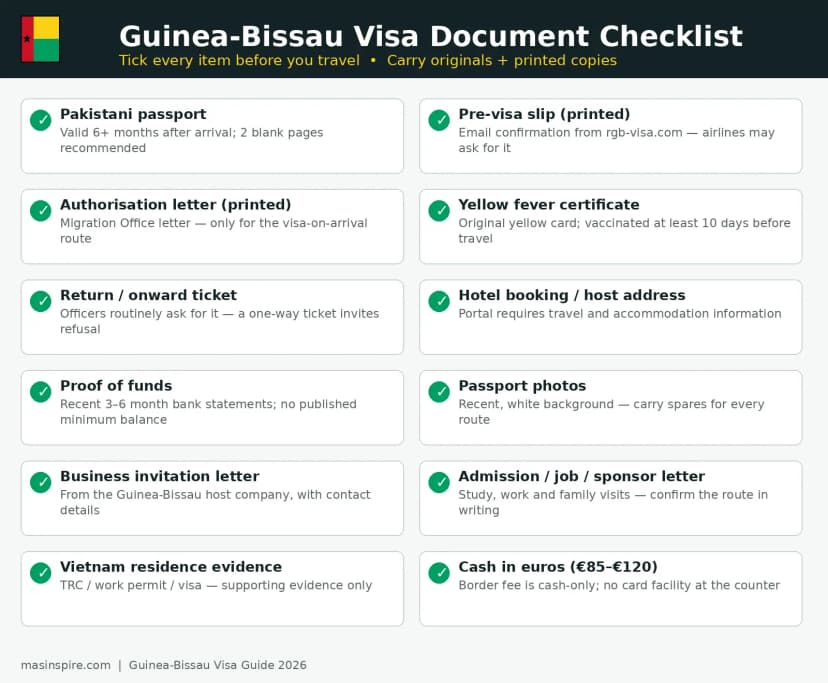
Eligibility Requirements
The core eligibility rules are short and strict. Your passport must be valid for at least six months after the date you arrive — the United Kingdom advice states this as an entry requirement, and the official portal requires a valid passport. Your yellow fever vaccination certificate is mandatory for entry; without it you can be refused entry. You must be able to show a return or onward ticket, an address or accommodation in Guinea-Bissau, and enough money for your stay. You must also arrive with the correct prior approval: either the printed pre-visa slip from the online pre-enrolment, or the printed Migration Office authorisation letter, or a visa already in your passport.
Carry two blank passport pages if you can. The portal does not state a blank-page number, but Pakistan-focused guides recommend two, and the biometric visa is issued as a sticker or stamp at the border. A damaged passport, or a passport reported lost or stolen, will be refused.
Document checklist
| Document | Required for | Notes |
|---|---|---|
| Pakistani passport, valid at least 6 months after arrival | All routes | Two blank pages recommended; original only, no copies in place of the original |
| Printed pre-visa slip / visa-issuing confirmation from rgb-visa.com | Online pre-enrolment route | Sent by email after acceptance; airlines may ask for it before boarding |
| Printed Migration Office authorisation letter | Visa-on-arrival route | Obtained through a local contact or directly from the Chief Migration Officer |
| Visa already in passport | Embassy route | Issued by the mission before travel |
| Yellow fever vaccination certificate (yellow card) | All routes | Mandatory; vaccination at least 10 days before travel; carry the original |
| Return or onward flight ticket | All routes | Officers routinely ask for it; a one-way ticket invites refusal |
| Hotel booking or host address in Guinea-Bissau | All routes | The portal requires travel and accommodation information |
| Proof of funds (bank statements, cash) | All routes | No published minimum balance; recent 3 to 6 month statements are commonly requested |
| Passport-size photographs | Embassy route; carry spares for all routes | Recent, white background; biometrics are also taken at the airport |
| Cover letter stating purpose and itinerary | Embassy and authorisation-letter routes | Keep it short and consistent with your ticket and hotel booking |
| Business invitation letter | Business visits | From the Guinea-Bissau host company, with contact details |
| Admission letter / employment contract | Study / work | No separate published category; the host must confirm the route with the mission |
| Sponsor letter and proof of relationship | Family visits | Host identity and address details in Guinea-Bissau |
| Vietnam residence evidence (TRC, work permit, visa) | Applicants living in Vietnam | Supporting evidence only; it does not replace the Guinea-Bissau visa |
| Travel insurance | Strongly recommended for all routes | Not confirmed as a legal entry requirement; essential given limited health services |
| Cash in euros for the border fee | Visa-on-arrival and pre-enrolment routes | Card payment is not available at the immigration counter; carry exact cash if possible |
Health deserves emphasis. Yellow fever vaccination is required for entry into Guinea-Bissau: the United Kingdom advice states that you must have a certificate proving you have had a yellow fever vaccination, and other official health sources confirm the certificate is checked on arrival. Get the vaccination at least 10 days before travel, because the certificate only becomes valid 10 days after the shot, and carry the original yellow card with your passport. Malaria prophylaxis is strongly advised for the whole country all year round; discuss it, plus hepatitis A and typhoid vaccination, with a travel clinic in Ho Chi Minh City at least four weeks before departure.
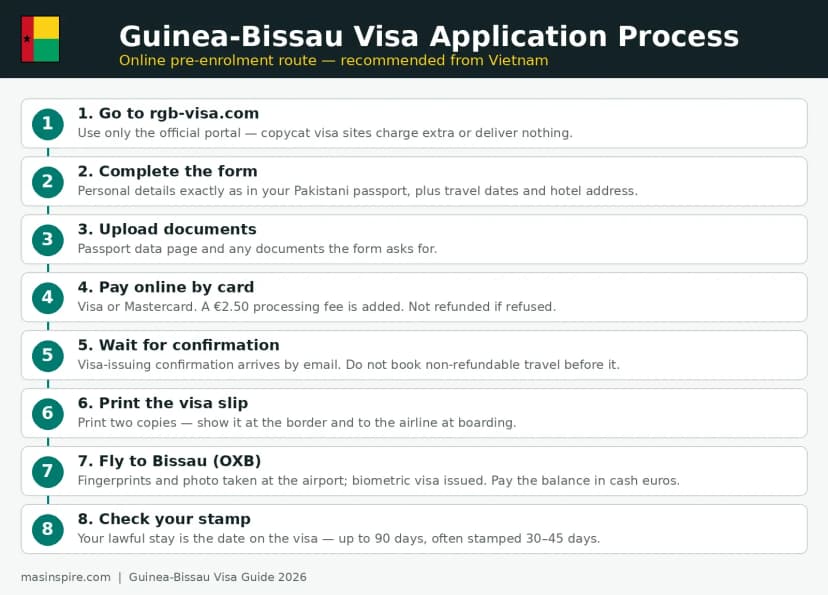
How to Apply: Step-by-Step
Route A — Online pre-enrolment (recommended from Vietnam)
Step 1: Go to the official Electronic Visa Application System at rgb-visa.com and read the instructions on the home page. Use only that address; copycat visa sites exist and charge extra or deliver nothing.
Step 2: Complete the online application form with your personal details exactly as they appear in your Pakistani passport, plus your travel dates, purpose of visit and accommodation address in Guinea-Bissau.
Step 3: Upload the documents the form asks for, including a scan of your passport data page.
Step 4: Pay online by Visa or Mastercard. The portal adds a 2.50 euro processing fee to the payment. Keep the payment receipt. The portal states these amounts are not refunded if the visa is not granted.
Step 5: Wait for the visa-issuing confirmation, which the portal says is sent by email if the request is made online. Do not book non-refundable travel until you have it.
Step 6: Print the visa slip and the confirmation email. The portal states the slip serves as a receipt, must be printed and shown to the visa officer at the border, and can also be used by airline companies to grant passengers approval to board. Print two copies and keep one in hand luggage.
Step 7: Fly to Osvaldo Vieira International Airport in Bissau. At immigration, present your passport, the printed slip, your yellow fever certificate, return ticket, hotel booking and proof of funds. Your fingerprints and photograph are taken, and the biometric visa is issued. Pay any remaining visa fee in cash at the counter — carry euros.
Step 8: Check the dates stamped or printed on your visa before you leave the counter. Your lawful stay is governed by those dates, not by the 90-day maximum on the portal.
Route B — Visa on arrival with an authorisation letter
Step 1: Send your intended arrival details, the duration of your visit and a scanned copy of your passport to your contact in Guinea-Bissau. If you have no contact, the portal says you may send your request directly to Mr. Lino Lopes, the Chief Migration Officer.
Step 2: Your contact takes your documents to the Migration Office and files the request for the letter of authorisation. The Chief Officer of the Migration Office approves or rejects it.
Step 3: When approved, your contact sends you the letter by email or fax. Print it and carry the original printout.
Step 4: Travel to Bissau airport with the letter, passport, yellow fever certificate, return ticket, accommodation evidence and cash euros. Present the letter at immigration and pay the visa fee at the counter.
Route C — Embassy visa in advance
Step 1: Choose the mission — Paris is the one the United Kingdom advice names; Lisbon and Dakar are the practical alternatives, and Beijing is the closest to Vietnam. Write to the mission first and ask whether it accepts applications from a Pakistani citizen resident in Vietnam, and request its current form, checklist, fee and payment instructions in writing.
Step 2: Complete the mission's application form and assemble the documents from the checklist above, plus the mission's own requirements.
Step 3: Submit the application and pay the fee exactly as the mission instructs. Some missions accept bank transfer or card payment at the consulate; others require a bank deposit receipt. Never pay a fee to a personal account or through an unofficial agent.
Step 4: Collect the visa or receive your passport back by post, then check the validity dates, number of entries and permitted stay before you travel.
Visa Fees and Financial Requirements
The fee position is the least certain part of this guide, and it is stated here exactly as the sources leave it. The only fee verified on the official portal is the 2.50 euro online processing fee added to the online payment. The portal does not state the main visa fee, and no official fee schedule for Pakistani applicants was found. Everything else in the table below is a reported figure from a secondary source, and the sources conflict.
| Fee item | Amount | Source and status |
|---|---|---|
| Online processing fee (pre-enrolment) | 2.50 euros | Official portal rgb-visa.com, verified live 28 November 2026; non-refundable if the visa is refused |
| Visa fee payable at Bissau airport | Not published on the portal; reported about 85 euros cash | Most-cited traveller figure: first-hand accounts and several guides report 85 euros in exact cash; carry 85 to 120 euros |
| Visa fee, other reported figures | 55 to 120 euros, or 40 to 120 US dollars | Conflicting secondary reports: about 60 euros (iVisa and United Kingdom advice via Lisbon); 40 to 50 US dollars cash (TravelVisaStack); 80 to 100 US dollars e-visa and 90 to 120 US dollars visa on arrival (Apricot Tours); 63.95 euros (GoVisit Africa) |
| Consulate-General in Algarve schedule, 30 to 45 day visa | 60 euros normal / 70 euros urgent | Local consulate schedule reported by PassportReports; other missions may differ |
| Consulate-General in Algarve schedule, 90 day visa | 90 euros normal / 110 euros urgent | Local consulate schedule reported by PassportReports; other missions may differ |
| Consulate-General in Algarve schedule, 180 day visa | 180 euros normal / 210 euros urgent | Local consulate schedule reported by PassportReports; other missions may differ |
| Ziguinchor consulate, 30 day visa | Reported 20,000 West African CFA francs | Traveller report via Wikivoyage; unverified and possibly out of date |
| Extension fee in Bissau | Reported 5,000 to 10,000 CFA francs | Unverified; other reports say up to 20,000 CFA francs; confirm at the immigration office |
Controlling rule: the portal checkout controls the 2.50 euro processing fee, and the officer or mission that issues your visa controls the balance. Budget for the highest reported figure — about 120 euros or 120 US dollars in cash — plus the 2.50 euro online fee, and treat any lower figure as a pleasant surprise. Pay only through the portal's card payment or the mission's stated method, and keep every receipt: the portal states the online amounts are not refunded if the visa is not granted.
Financial requirements are also unpublished. No minimum bank balance is stated on the portal or by any mission in the sources reviewed. Pakistan-focused guides commonly advise a certified bank statement covering the last 3 to 6 months, and you should carry one, plus a card and cash. The local currency is the West African CFA franc (XOF), fixed at about 655 XOF to 1 euro. Bring euros in cash: card payment is not available at the immigration counter, ATMs in Bissau are limited, and change may be given in CFA francs. Declare foreign currency on arrival if asked, and note that taking local currency out of the country is restricted.
Visa Processing Times and Validity
The official portal publishes no processing time. Every processing time below is therefore a reported figure, and the reports conflict. Apply 4 to 6 weeks before travel so that a delay, a missing document or a mission that does not accept your application still leaves you time to switch routes.
| Route | Reported processing time | Source and status |
|---|---|---|
| Online pre-enrolment (rgb-visa.com) | 3 business days; other sources say 3 to 7 working days or 5 to 10 business days | No time published on the portal; 3 days per VisaVerge and visa-applications.org; 3 to 7 days per Apricot Tours; 5 to 10 days per TrekFeed and HolidaySG |
| Visa-on-arrival authorisation letter | 5 to 10 working days | Apricot Tours; the letter also depends on your contact and the Migration Office |
| Embassy visa, Lisbon | About 5 working days | United Kingdom advice as summarised by Holistay; Wikivoyage reports same-day issue in some cases |
| Embassy visa, general | 2 to 4 weeks | AMG Visa, verified 28 October 2026; about 2 working days where an invitation is required, per Backpack.travel |
| Visa on arrival at the airport counter | 15 to 30 minutes in the queue, once approved | TravelVisaStack; allow much longer for queues and form-filling |
Validity is a second conflict. The official portal states the single-entry biometric visa is for a stay of up to 90 days. In practice, travellers report shorter stamps: one first-hand account received a 45-day stamp at Bissau airport, and several guides describe a 30-day visa on arrival extendable by 30 days. The controlling rule is the one the guides themselves repeat: your lawful stay is governed strictly by the dates printed on your issued visa and entry stamp, not by the 90-day maximum. Read those dates at the counter, photograph them, and plan your departure inside them. Multiple-entry and long-stay variants exist on request for frequent travellers, but no published validity schedule was found beyond the Algarve consulate's 30 to 45, 90 and 180 day bands.
Applying from Pakistan or Vietnam: Guidance for Pakistani Passport Holders
There is no Guinea-Bissau embassy or consulate in Vietnam, and none in Pakistan. The missions that handle applications from this region are the Embassy in Beijing, which is concurrently accredited to Vietnam, the Embassy in Paris, the Embassy in Lisbon, the Embassy in Dakar and the Consulate-General in Ziguinchor. There is also an Embassy in Ankara, Turkey, which Pakistan-focused guides name as a filing channel, and missions in Brussels, Madrid and Moscow. No single mission is confirmed as the designated post for Pakistani residents in Vietnam, so the online route is the practical default.
For a Pakistani citizen living in Ho Chi Minh City or elsewhere in Vietnam, the recommended plan is Route A: pre-enrol on rgb-visa.com, pay the 2.50 euro processing fee by card, print the confirmation and visa slip, and have the biometric visa issued at Bissau airport. Your Vietnamese residence status does not change the Guinea-Bissau rules, but carry your temporary residence card, work permit or Vietnamese visa as supporting evidence of your residence abroad, and make sure your Pakistani passport is valid for at least six months after arrival. Apply on the Pakistani passport throughout; do not mix passports or travel documents.
Flights from Vietnam usually route through Lisbon or Dakar, since Bissau has few direct connections. If your routing takes you through Lisbon, the Lisbon embassy is a useful fallback: write to it before travel and ask whether it will issue the visa during your transit. If you route through Dakar, the Dakar embassy and the Ziguinchor consulate are the regional options, and overland travellers from Senegal commonly use Ziguinchor. Do not rely on obtaining a visa at a land border from Senegal or Guinea: the portal says the biometric visa is currently issued only on arrival at the international airport, and land-border issuance is inconsistent.
Get your yellow fever vaccination in Vietnam before departure. Travel clinics in Ho Chi Minh City provide the vaccination and the international certificate; allow at least 10 days between the vaccination and your arrival in Guinea-Bissau. Buy euros in cash in Vietnam before you fly, in small notes, because the border fee is cash-only and change may be limited. Keep your pre-visa slip, yellow fever certificate, return ticket and hotel booking in your hand luggage, not in checked baggage, and keep digital copies on your phone as backup.
From Pakistan, the same three routes apply. Pakistan-focused guides advise a certified 6-month bank statement and an account maintenance certificate, a verifiable flight itinerary and a hotel reservation, and a processing expectation of 2 to 4 weeks for an embassy filing. Those are agency recommendations, not published official requirements, and the figures conflict with the portal's own route, so treat the online pre-enrolment as the primary channel and the embassy route as the certainty option.
Student Visa Guide
Guinea-Bissau has a small higher-education sector, and very few Pakistani students study there. There is no published student-visa category, fee or checklist. If you have an admission offer, use the online pre-enrolment or embassy route and carry the admission or enrolment letter, proof of funds for the full stay, accommodation evidence, your yellow fever certificate and the standard documents. Ask the institution to contact the Migration Office or the issuing mission to confirm how a student should be handled, and get that confirmation in writing before you pay for travel. Allow 4 to 6 weeks. Do not use a tourist or visitor entry to begin a long course and assume you can convert it inside the country: extensions are discretionary and are handled in Bissau, not at the institution.
Students should also weigh the practicalities honestly. Teaching is in Portuguese and Creole, health services are limited, and the United States advisory cites inadequate health infrastructure. Comprehensive insurance, a realistic budget in euros and CFA francs, and a confirmed place to live should be settled before departure, not after arrival.
Work Visa and Job Opportunities
There is no published Guinea-Bissau work-visa category, fee, salary threshold or labour-approval document in the sources reviewed. Employment is therefore arranged case by case through the employer and the Migration Office or the issuing mission. If you have a job offer, do not travel on a visitor biometric visa and start work. Ask the employer to provide a written employment contract or invitation, to confirm the correct route with the Migration Office, and to confirm whether any separate residence or work authorisation is needed after arrival. Get the answer in writing before you resign from a job in Vietnam or pay any fee.
Be cautious about offers that promise a Guinea-Bissau work visa for a fixed fee. No official fee schedule exists to check such a promise against, and the portal states the government visa office reserves the right to reject applications. Genuine opportunities are concentrated in cashew processing and trade, fisheries, construction, development projects and teaching, and they normally come through an employer you can verify independently. Never pay a recruitment fee to a personal account, and never hand your original passport to an agent without a verifiable office and a written receipt.
Family Immigration and Permanent Residence
Family visits use the same visa routes, supported by a sponsor or invitation letter from the host in Guinea-Bissau, evidence of the relationship such as a marriage or birth certificate, and the host's identity and address. For the authorisation-letter route, the family host is the natural local contact for the Migration Office request.
There is no published family-reunion residence permit, and no general permanent-residence programme was identified in the sources reviewed. The portal mentions a long-stay visa with multiple entries for frequent travellers, which is the closest published route to a longer stay, but its conditions are not published. Anyone planning to live in Guinea-Bissau long term should ask the Migration Office in Bissau, in person or through the host, what residence formalities apply after entry, and should not assume a visitor visa can be converted into residence. Dual nationals holding a valid Guinea-Bissau passport or identity card are exempt from the visa requirement, as the portal states.
Extensions, Overstay and Leaving Guinea-Bissau
Extensions are possible but not guaranteed. Apply at the Serviço de Migração e Fronteiras, also called the Serviço de Migração e Estrangeiros, in Bissau before your current permission expires. Bring your passport, your visa or entry stamp, a passport photograph, proof of funds and your reason for staying, and the fee in cash in CFA francs. Reported extension fees conflict — 5,000 to 10,000 CFA francs in some guides, 10,000 to 20,000 CFA francs in others — and no official fee was found, so confirm the amount at the office. The process can take a few days. Do all extension paperwork in Bissau: extensions cannot be arranged on the Bijagós islands, and all immigration administration takes place in the capital.
Overstay is treated seriously. A fine is charged for exceeding the term of your visa and is paid on departure, but the amount is not published and the reported figures conflict badly — from 500 CFA francs per day to 5,000 CFA francs per day, with reported caps from 50,000 to 150,000 CFA francs. No figure in this paragraph should be budgeted as certain; carry cash in CFA francs or euros, allow extra time at departure, and expect the officer to set the figure. A serious overstay can mean detention and deportation at your own expense, and an overstay record can affect future visits. The safest course is to apply for the extension before expiry, or leave on time.
On departure, keep your visa fee receipt, your entry stamp and your yellow fever certificate available. Exit checks enforce overstay penalties at the airport and at overland crossings towards Senegal. Declare currency if asked, and remember that taking local currency out of the country is restricted.
Common Application Mistakes and Reasons for Refusal
The most common mistake is arriving without any prior approval. The portal is clear that the biometric visa is issued on arrival, but only after online pre-enrolment or a Migration Office authorisation letter; travellers who arrive with neither, hoping to buy a visa at the counter with no paperwork, risk refusal and return at their own expense. Airlines may also refuse boarding without the pre-visa slip or authorisation letter.
The second mistake is the yellow fever certificate: arriving without it, with a photocopy instead of the original, or vaccinated fewer than 10 days before travel. The certificate is a mandatory entry requirement, not a recommendation. The third is a passport with less than six months' validity, or a damaged passport. The fourth is arriving without cash euros and expecting to pay by card at the immigration counter, where no card facility exists.
Other mistakes include confusing Guinea-Bissau with Guinea (Conakry) or Equatorial Guinea when booking flights, filling forms or choosing an embassy; assuming a 90-day stay when the stamp says 30 or 45 days; using an unofficial copycat website instead of rgb-visa.com; booking non-refundable travel before the confirmation arrives; and travelling without insurance or without reading the current travel advisories. The portal states the government visa office reserves the right to reject applications, and fees paid online are not refunded if the visa is not granted. If your application is refused, ask the mission or the Migration Office for the reason in writing before reapplying, and do not reapply with the same unchanged documents.
Frequently Asked Questions
1. Do Pakistani citizens need a visa for Guinea-Bissau?
Yes. Pakistani ordinary passport holders need a visa. Pakistan is not among the 14 West African states whose citizens are visa-exempt, and there is no visa-free or visa-on-arrival-without-approval route for Pakistani citizens.
2. Can Pakistani citizens get a visa on arrival in Guinea-Bissau?
Yes, but only with prior approval. Either pre-enrol online at rgb-visa.com and bring the printed confirmation and visa slip, or obtain a Migration Office authorisation letter through a local contact. The biometric visa is then issued on arrival at Osvaldo Vieira International Airport in Bissau, currently the only place it is issued.
3. Is there a Guinea-Bissau e-visa?
Not a full e-visa. The official system is an Electronic Visa Application System for pre-enrolment: you apply and pay online, and the biometric visa itself is issued at the airport after your fingerprints and photograph are taken. Several secondary guides call it an e-visa, but the portal's own wording is pre-enrolment followed by issuance on arrival.
4. How much does a Guinea-Bissau visa cost?
The only verified figure is the 2.50 euro online processing fee on the official portal. The main visa fee is not published on the portal. The most commonly reported figure is about 85 euros in cash at the airport, but reports range from 40 to 120 US dollars and 55 to 120 euros, and consulate schedules differ. Carry 85 to 120 euros in cash and budget for the higher figure.
5. How long can I stay in Guinea-Bissau?
The portal states the single-entry biometric visa is for a stay of up to 90 days. In practice, travellers report stamps of 30 or 45 days. Your lawful stay is governed by the dates printed on your issued visa and entry stamp, so read them at the counter and plan inside them.
6. How long does Guinea-Bissau visa processing take?
The portal publishes no processing time. Secondary sources report 3 business days, 3 to 7 working days, or 5 to 10 business days for the online route; 5 to 10 working days for an authorisation letter; and 5 working days to 4 weeks for an embassy visa. Apply 4 to 6 weeks before travel.
7. Is yellow fever vaccination mandatory for Guinea-Bissau?
Yes. A certificate proving yellow fever vaccination is required for entry, and it is checked on arrival. Get vaccinated at least 10 days before travel and carry the original yellow card with your passport.
8. Is there a Guinea-Bissau embassy in Vietnam?
No. There is no Guinea-Bissau mission in Vietnam. The Embassy in Beijing is concurrently accredited to Vietnam, and the embassies in Paris, Lisbon and Dakar also issue visas. The online pre-enrolment route is the practical option from Vietnam because it needs no embassy visit.
9. Can I apply for a Guinea-Bissau visa from Vietnam as a Pakistani citizen?
Yes. Pre-enrol on rgb-visa.com using your Pakistani passport, pay by card, and print the confirmation. Carry your Vietnamese residence evidence as supporting documentation. If you prefer an embassy visa, write to the Beijing, Paris or Lisbon mission first and confirm it will accept your application.
10. Can I extend my Guinea-Bissau visa?
Yes, in principle. Apply at the Serviço de Migração e Fronteiras in Bissau before your current permission expires. Extensions are not guaranteed, the fee is not officially published, and the process can take a few days. Extensions cannot be arranged on the Bijagós islands.
11. What happens if I overstay in Guinea-Bissau?
A fine is charged and paid on departure, but the amount is not published and reported figures conflict. A serious overstay can lead to detention and deportation at your own expense and can affect future visits. Apply for an extension before expiry or leave on time.
12. Can I work in Guinea-Bissau on a tourist or visitor visa?
No. The visitor biometric visa does not permit local employment. Work requires an employer sponsor and confirmation of the correct route with the Migration Office or the issuing mission. No separate published work-visa category or fee was found.
13. Can I study in Guinea-Bissau?
There is no separate published student-visa category. Students use the same pre-enrolment or embassy route with an admission letter, proof of funds and accommodation evidence, and should have the institution confirm the handling with the Migration Office before travelling.
14. Do I need a transit visa for Guinea-Bissau?
No standalone transit-visa product was identified in the official material reviewed. If you stay airside without passing through immigration, confirm with your airline whether a visa is needed. If you leave the airport or pass through immigration, arrange a normal visa in advance.
15. Is Guinea-Bissau safe to visit?
Check the current advisories before deciding. The United States Department of State rates Guinea-Bissau Level 3, Reconsider Travel, in an advisory dated 11 December 2025, citing unrest, inadequate health infrastructure and landmines, and the United Kingdom advises a high degree of caution. A military transition has governed since late November 2025. Hold comprehensive insurance and keep plans flexible.
Official Immigration Websites
| Website | What it is for |
|---|---|
| Guinea-Bissau Electronic Visa Application System (rgb-visa.com) | Official pre-enrolment portal: online form, card payment, 2.50 euro processing fee, visa confirmation and visa slip |
| United Kingdom FCDO — Guinea-Bissau entry requirements | Official United Kingdom advice: visa required, passport 6 months validity, yellow fever certificate, Paris embassy contacts |
| United States Travel Advisory — Guinea-Bissau, Level 3 | United States Department of State advisory dated 11 December 2025: Reconsider Travel, unrest, health infrastructure, landmines |
| Ministry of Foreign Affairs of Guinea-Bissau (mne.gov.gw) | Guinea-Bissau foreign ministry site, cited by visa guides as the official government site |
| List of diplomatic missions of Guinea-Bissau | Background reference for missions, including the Beijing embassy's concurrent accreditation to Vietnam |
Secondary sources consulted for reported figures that the official portal does not publish include the VisaVerge Guinea-Bissau visa guide, VisaVerge e-visa guide, Backpack.travel Guinea-Bissau visa rules, Holistay Guinea-Bissau visa requirements, Don't Stop Living — visa on arrival at Bissau airport, Apricot Tours — Guinea-Bissau visit visa from Pakistan, TravelVisaStack — Guinea-Bissau visa for Pakistan citizens, iVisa — Guinea-Bissau visa, OneTimeLivin — Guinea-Bissau visa rules for Pakistan passport holders, TrekFeed — Guinea-Bissau eVisa guide, HolidaySG — Guinea-Bissau e-visa, Visa Applications — Guinea-Bissau visas and PassportReports — Guinea-Bissau visa requirements. Where these sources disagree with the official portal or with each other, the conflict is disclosed in the article and the official portal controls.
Final Checklist and Conclusion
Before you apply, confirm that you have chosen the right route — online pre-enrolment, authorisation letter or embassy visa — and that you have not confused Guinea-Bissau with Guinea (Conakry) or Equatorial Guinea. Check that your Pakistani passport is valid for at least six months after arrival, that your yellow fever vaccination was given at least 10 days before travel and that you carry the original certificate, that you have a return ticket and an address in Guinea-Bissau, and that you have printed the pre-visa slip or authorisation letter in duplicate. Carry 85 to 120 euros in cash for the border fee, plus the 2.50 euro online processing fee already paid by card, and keep every receipt.
Guinea-Bissau rewards careful travellers: the Bijagós islands, the wildlife and the music are real, and the visa system is workable once you understand that the online step is a pre-enrolment, not a finished visa, and that the border officer sets the fee and the stay. The honest limits of this guide are part of its value — the portal publishes no total fee and no processing time, and the secondary figures conflict. Budget for the highest reported fee, apply 4 to 6 weeks early, and confirm anything that matters in writing with the mission or the Migration Office before you spend money you cannot get back.
Disclaimer: This article is for general educational purposes only. It is not legal advice, immigration representation or a guarantee of visa approval. Government fees, procedures and eligibility rules may change. The Migration Office of Guinea-Bissau, its official portal at rgb-visa.com and the issuing embassy or consulate are the authoritative sources for individual decisions.