Laos Visa Guide 2026: Requirements, Fees and How to Apply for Pakistani Passport Holders in Vietnam
Updated: 27 November 2026. Verified: 28 November 2026. This guide is written for Pakistani passport holders living in Vietnam. Visa rules change with little notice, so always confirm the current position with the Lao embassy or consulate before you book or travel. This guide is general information, not immigration advice.
Table of Contents
- Introduction
- Do Pakistani Passport Holders Need a Visa for Laos?
- Important Correction: No Visa on Arrival and No E-Visa for Pakistanis
- Types of Laos Visas for Pakistani Passport Holders
- The Embassy Tourist Visa: Your Main Route
- Laos Visa Fees
- Processing Times
- Complete Document Checklists
- How to Apply: Step-by-Step
- Applying from Vietnam: Hanoi, Da Nang and Ho Chi Minh City
- Entering Laos from Vietnam: Border Crossings
- The Lao Digital Immigration Form (LDIF)
- Work, Business and Student Routes
- Extending Your Stay, Overstay and Fines
- Frequently Asked Questions
- Official Immigration Websites
Introduction
Laos is one of the most relaxed destinations in South-East Asia: slow boats on the Mekong, the temples of Luang Prabang, the karst valleys of Vang Vieng and the coffee country of the Bolaven Plateau. For most Western tourists the entry rules are simple, because they can buy a visa on arrival or apply for an e-visa online. For a Pakistani passport holder, the position is different, and that difference is the whole point of this guide.
Pakistan is on the list of nationalities that cannot get a visa on arrival in Laos, and the official e-visa portal does not list Pakistan in its fee schedule. That means the ordinary shortcuts do not work for you. The lawful route is a sticker visa obtained in advance from a Lao embassy or consulate, and because you live in Vietnam you are in a good position: Laos has an embassy in Hanoi and consulates-general in Da Nang and Ho Chi Minh City, and the Ho Chi Minh City consulate is the natural place to apply from if you live in the south.
This guide explains the embassy route in full: what the visa gives you, what it costs, how long it takes, which documents to prepare, which border crossings you can use, and the separate digital arrival form that every foreign traveller must now complete. Where sources disagree, the disagreement is disclosed in the text and in the flags at the end of the package, with the controlling source named. Where a figure could not be verified at all, this guide says so plainly instead of inventing a number.
Do Pakistani Passport Holders Need a Visa for Laos?
Yes. A Pakistani citizen travelling on an ordinary Pakistani passport needs a visa to enter Laos. Pakistan is not on the Lao visa-exemption list. The exemption list covers fifteen nationalities, mainly ASEAN member states plus Japan, South Korea, Russia, Mongolia, Belarus and a small number of European states, for stays of 14 to 30 days. Pakistan is not among them, and there is no visa-free route for Pakistani ordinary passport holders.
Two further points matter. First, the exemption does not apply to you even though you live in Vietnam: Lao entry rules are decided by the passport you travel on, not by your country of residence or by a Vietnamese residence card. Your Vietnamese temporary residence does not change your Lao visa requirement. Second, holders of Pakistani diplomatic and official or service passports are in a different position: under the Lao visa policy, Pakistani diplomatic and service passport holders may enter without a visa for up to 90 days. That exemption applies only to diplomatic and service passports, not to an ordinary passport, so it does not help a private tourist or business traveller.
Your passport must be valid for at least six months after the date you arrive in Laos, and it must have at least two blank pages. Airlines check this before boarding, and Lao immigration checks it on arrival. If your passport is close to expiry, renew it first: a visa cannot rescue a passport that fails the six-month rule.
Important Correction: No Visa on Arrival and No E-Visa for Pakistanis
Most general Laos visa guides describe three easy ways in: visa-free entry, a visa on arrival, or an e-visa. None of those three descriptions applies to a Pakistani ordinary passport holder, and following them is the most common way Pakistani travellers get into trouble. Read this section before you believe any other guide.
Visa on arrival: not available. Laos publishes a list of nationalities that are ineligible for a visa on arrival and must obtain a visa from a Lao diplomatic mission in advance. Pakistan is on that list, together with Afghanistan, Bangladesh, Nigeria, Turkey and about twenty other states. Multiple independent sources checked in November 2026, including the Lao visa policy summary and the Laos visa-on-arrival checkpoint guide, agree on this point. Do not fly to Vientiane or Luang Prabang expecting to buy a visa at the airport, and do not plan to buy one at a land border. Airlines usually check for a visa before boarding, so you may be stopped at check-in in Vietnam before you even reach Laos.
E-visa: not available to Pakistanis, on the controlling sources. The official Lao e-visa portal is laoevisa.gov.la, run by the Consular Department of the Lao Ministry of Foreign Affairs. It issues a single-entry tourist visa, known as the T-B3, for a 30-day stay. Two careful checks of the portal's own fee list, one on 2 October 2026 and one on 19 November 2026, found that Pakistan is not in the list of nationalities that can apply, and both checks concluded that Pakistanis must apply at a Lao embassy or consulate instead. The portal's fee calculator is the controlling source here: if your nationality is not in its list, you cannot complete an e-visa application or pay for one.
There is a conflict to disclose. A non-official website with a similar name, evisagov.la, lists Pakistan among the countries eligible for a Laos e-visa. That site is not the official portal: the only official address is laoevisa.gov.la, ending in .gov.la, and the official portal's own list is what governs. Some travel-agent sites also state that Pakistanis can obtain a visa on arrival, or list a Laos visa on arrival for Pakistani citizens. Those claims contradict the Lao exclusion list and the portal checks above, and this guide treats them as wrong. The safe rule is simple: if a site that is not laoevisa.gov.la or a Lao embassy tells you that you can get a Laos visa on arrival or an e-visa on a Pakistani passport, do not rely on it. Get your visa from the embassy first, and confirm the position with the embassy in writing before you travel.
What this means in practice. Your only route as a Pakistani tourist is a sticker visa issued in advance by a Lao embassy or consulate. From Vietnam that means the Lao Embassy in Hanoi, the Consulate-General in Da Nang, or the Consulate-General in Ho Chi Minh City. The rest of this guide is built around that route.
Types of Laos Visas for Pakistani Passport Holders
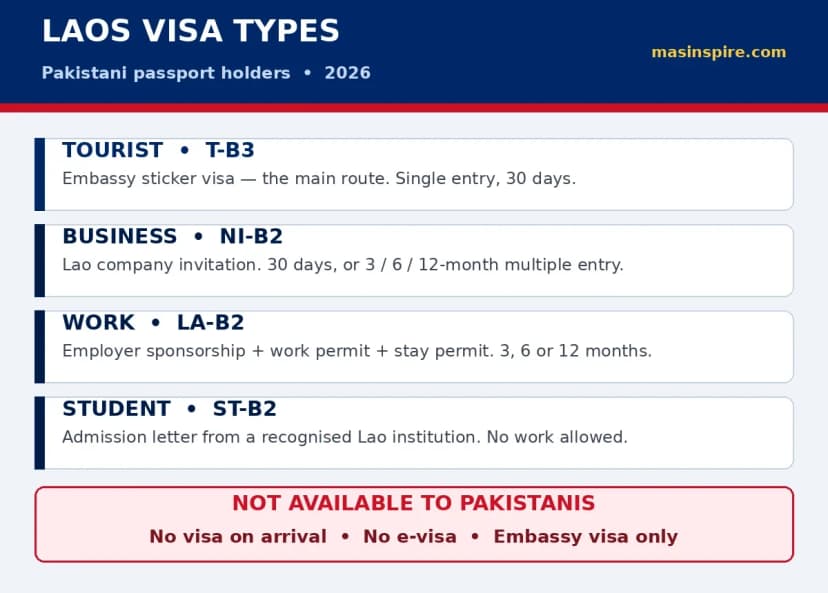
Laos issues visas by code under its Law on Entry-Exit and Management of Foreigners. The table below compares the routes that are realistically open to a Pakistani passport holder living in Vietnam, and shows which popular routes are closed to you.
| Visa route | Code | Purpose | Stay | Available to Pakistanis? | Where to apply |
|---|---|---|---|---|---|
| Tourist visa (embassy sticker) | T-B3 | Tourism, family visit | 30 days from entry, single entry | Yes — the main route | Lao embassy or consulate in Vietnam |
| Visa on arrival | T-B3 | Tourism | 30 days from entry | No — Pakistan is on the exclusion list | Not available |
| E-visa | T-B3 | Tourism only | 30 days from entry, single entry | No — Pakistan is not on the official portal fee list | Not available (laoevisa.gov.la) |
| Business visa | NI-B2 | Business meetings, investment enquiries | 30 days, with 3, 6 or 12-month multiple-entry options | Yes, with a Lao company invitation | Lao embassy or consulate |
| Labour (work) visa | LA-B2 | Employment with a Lao employer | 3, 6 or 12 months | Yes, with employer sponsorship and a work permit | Lao embassy or consulate |
| Expert visa | E-B2 | Experts, NGO staff | As issued | Yes, with sponsoring organisation | Lao embassy or consulate |
| Student visa | ST-B2 | Study at a recognised Lao institution | Duration of the course | Yes, with an admission letter | Lao embassy or consulate |
| Transit visa | TR-B3 | Passing through Laos to a third country | Short stay, as issued | Yes, through an embassy | Lao embassy or consulate |
| Visa exemption | — | Tourism | 14–30 days | No — Pakistan is not exempt | Not available |
For most readers of this guide the tourist sticker visa is the only route that matters. The business, work, expert and student visas are covered in the section on work, business and student routes below, because each of them needs a sponsor in Laos and cannot be obtained by simply applying as a tourist.
Every Lao tourist visa is single entry. Once you use it and leave Laos, it is finished. If you leave and want to return, you need a new visa. There is no multiple-entry tourist visa for Pakistanis; multiple-entry options exist only for business and investor categories, arranged through the embassy.
The Embassy Tourist Visa: Your Main Route
The embassy tourist visa is a sticker placed in your passport by a Lao mission. It is a single-entry visa for tourism or a family visit. The stay it gives you is 30 days counted from the date you arrive in Laos, and the visa must be used within two months of issue. That two-month use-by window is important: do not apply too early. If you apply in January for a trip in April, the visa may expire before you travel. Apply a few weeks before departure, not months.
The 30-day stay can be extended inside Laos. Since 1 January 2025 a tourist visa can be extended twice, for 30 days each time, giving a maximum total stay of 90 days. Extensions are done at an immigration office in Laos, not online, and the fee is charged per day. The extension rules are set out in the section on extending your stay below.
Because you live in Vietnam, you will apply at a Lao mission in Vietnam. The embassy and consulates in Vietnam accept applications from foreign residents, and this is the normal route for a Pakistani resident of Vietnam. You should email or telephone the mission before you travel to it, confirm that it accepts applications from Pakistani passport holders resident in Vietnam, and ask for its current form, fee and processing time. Missions set their own fees and times, and the answer you get from Ho Chi Minh City may differ from the answer in Hanoi.
There is no Lao embassy in Pakistan that this guide could confirm. That does not matter while you live in Vietnam, because you will apply in Vietnam. If you are visiting Pakistan when you decide to travel, you would need to apply at a Lao embassy abroad that accepts your application, and you should confirm that with the mission first. The Embassy of Pakistan in Hanoi has a consular area that covers the Lao PDR, which is useful to know if you need help while you are in Laos, but it cannot issue you a Lao visa.
Laos Visa Fees
Fees are the least certain part of this guide, and this section is honest about that. Lao embassies set their own fees for each nationality, and no official fee for Pakistani citizens was published in a source this guide could verify as of 28 November 2026. Do not treat any figure below as a guaranteed price. Confirm the fee with the mission before you go, and take enough cash to cover it.
| Item | Fee | Notes |
|---|---|---|
| Embassy tourist visa (single entry, 30 days) for a Pakistani passport holder | Ask the embassy — no official fee published | Set by each mission; confirm in writing before you travel |
| Embassy tourist visa at the Hanoi mission, as reported by travellers | About USD 40–50 | Reported by a travel guide for the Hanoi embassy; not an official published fee for Pakistanis |
| E-visa (general, most nationalities) | About USD 50, plus a bank charge | Not available to Pakistanis; shown so you can recognise the figure if another site quotes it |
| E-visa (Chinese passports, for comparison) | About USD 35 | Not available to Pakistanis; shown for comparison only |
| Visa on arrival (general, by nationality) | About USD 20–42 | Not available to Pakistanis; shown for comparison only |
| Business visa, multiple entry, 3 months (investor route) | 300,000 Lao kip | Investor and business category, through the embassy |
| Business visa, multiple entry, 6 months (investor route) | 600,000 Lao kip | Investor and business category, through the embassy |
| Business visa, multiple entry, 12 months (investor route) | 1,200,000 Lao kip | Investor and business category, through the embassy |
| Visa extension inside Laos | 20,000 Lao kip per day, plus a form fee | About USD 1–2 per day; the form fee is reported as 25,000–40,000 kip — see the conflict note below |
| Overstay fine | USD 10 per day | Paid in cash at the checkpoint on departure |
| Lao Digital Immigration Form (LDIF) | Free | Filed on the official immigration portal; any site charging a fee for it is an intermediary |
Two conflicts need to be disclosed. First, the Hanoi embassy tourist-visa fee is reported as about USD 35 in one older guide and about USD 40–50 in a more recent one. The difference is probably the mission changing its fee over time, and it may also reflect different fees for different nationalities. The controlling figure is whatever the mission tells you when you ask, so ask before you travel and do not budget on the lower number.
Second, the extension form fee is reported as 25,000 kip in some sources and 30,000 or 40,000 kip in others, on top of the 20,000 kip per day. The per-day figure of 20,000 kip is consistent across sources; the one-off form fee is not. For a full 30-day extension, budget roughly 630,000 kip in total, which was about USD 28 at September 2026 exchange rates, and expect the office to confirm the exact total when you apply.
One agency site states that Pakistani applicants need a certified six-month bank statement with a closing balance of PKR 1,000,000 to 2,000,000 and an Account Maintenance Certificate. That figure is unverified: it comes from a single commercial visa agent, no official source confirms it, and this guide does not present it as a requirement. Embassies commonly ask for a recent bank statement as proof of funds, but no official minimum balance for Pakistani visitors was found. Take a recent statement, and ask the mission what it expects.
Pay in clean US dollar notes or in Vietnamese dong where the mission accepts them. Lao missions in Vietnam have been reported to accept cash in USD or dong, and sometimes cards, but do not assume a card will work. Take exact change where you can: change at a border or an embassy counter is often thin, and damaged or marked dollar notes are a classic refusal point at Lao borders.
Processing Times
| Route | Processing time | When to apply |
|---|---|---|
| Embassy tourist visa, Hanoi mission (as reported) | 1–3 working days; same-day collection possible if you submit in the morning | At least 1–2 weeks before travel |
| Embassy tourist visa, other missions (example: Washington) | 10 business days | At least 3–4 weeks before travel |
| E-visa (general, for eligible nationalities) | 3 working days after a complete application and payment | At least 5 days before travel; the FCDO says apply at least 5 days in advance |
| Visa on arrival (general, for eligible nationalities) | Issued at the border, queue time varies | Not available to Pakistanis |
| Business or work visa (embassy) | About 3–7 working days for the visa itself; work-permit quota approval takes longer | Several weeks before travel; the employer starts the process |
| Student visa (embassy) | About 7–10 working days as reported | Several weeks before the course starts |
| Visa extension inside Laos | 1–2 working days at an immigration office | Before your current stay expires |
The processing-time conflict is real and worth understanding. The Hanoi mission is reported to issue a tourist visa in one to three working days, and sometimes the same afternoon if you submit in the morning. The Lao Embassy in Washington, by contrast, states that it needs ten business days. Both can be true at the same time, because each mission sets its own timetable. The figure that matters to you is the one for the mission where you actually apply, which is why this guide recommends applying at least two weeks before travel and confirming the mission's current time by phone or email first.
For the e-visa, the official processing target is three working days after a complete application and full payment, if the information meets the criteria; applications needing correction take longer. That figure is included for completeness only, because the e-visa is not available to Pakistani passport holders on the controlling sources. Do not build your travel plan around a three-day e-visa timetable that you cannot use.
Lao public holidays close the missions and slow processing, and the e-visa portal's own guidance notes that applications submitted in the afternoon start processing the next day. Build in a buffer of several extra days around Lao New Year in mid-April and other public holidays.
Complete Document Checklists
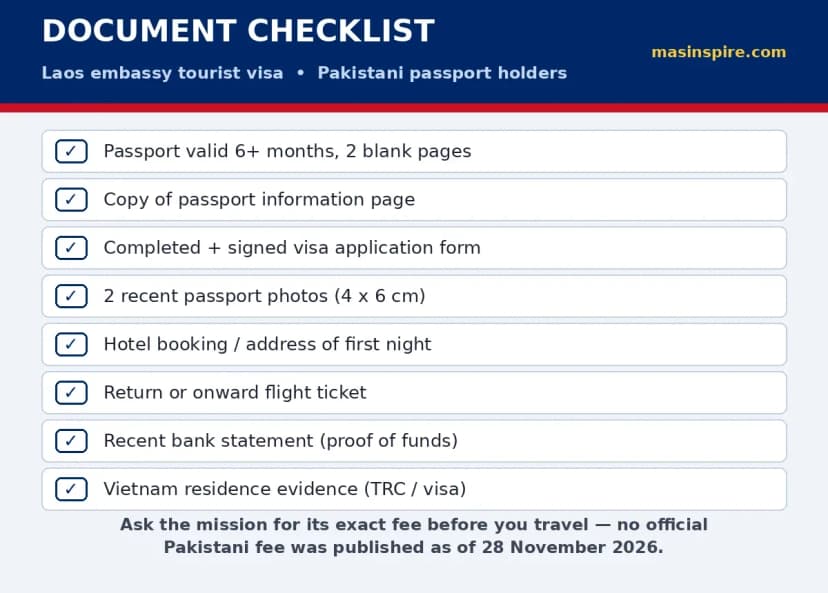
Prepare the documents below before you visit the mission. The tourist checklist is the one most readers need. The other checklists are for business, work and student applications, which need a sponsor in Laos.
| Document | Tourist | Business | Work | Student |
|---|---|---|---|---|
| Pakistani passport, valid at least 6 months after arrival, with at least 2 blank pages | Yes | Yes | Yes | Yes |
| Copy of the passport information page | Yes | Yes | Yes | Yes |
| Completed and signed visa application form | Yes | Yes | Yes | Yes |
| Recent passport-size photos (4 x 6 cm), not older than 6 months | 2 photos | 2 photos | 2 photos | 2 photos |
| Hotel booking or address of first night in Laos | Yes | Yes | Yes | Yes |
| Return or onward ticket, or confirmed flight itinerary | Yes | Yes | Yes | Yes |
| Recent bank statement as proof of funds | Yes | Yes | Yes | Yes |
| Vietnam residence evidence (temporary residence card or visa) | Recommended | Recommended | Recommended | Recommended |
| Invitation letter from a Lao company | No | Yes | Yes | No |
| Employment contract and work permit (employer applies) | No | No | Yes | No |
| Admission or enrolment letter from a recognised Lao institution | No | No | No | Yes |
| Evidence of funding for tuition and living costs | No | No | No | Yes |
| Polio vaccination certificate from NADRA | See note below | See note below | See note below | See note below |
Tourist checklist in detail. Take your original passport, a copy of its information page, the completed application form, two recent passport-size photographs, a hotel booking, a return ticket or flight itinerary, and a recent bank statement. Bring your Vietnamese residence evidence as well: you are applying as a resident of Vietnam, and the mission may want to see it. Take the visa fee in cash. Keep a photocopy of everything you submit, and keep a photograph of your visa sticker once it is issued.
Photo specification. Passport-size photographs for a Lao visa are 4 x 6 cm. For the e-visa the portal asks for one recent colour digital photograph in the same size; for an embassy application, take two printed photographs. White background, no glasses, recent and recognisable.
Polio certificate. One Pakistan-focused guide states that a polio vaccination certificate from NADRA is needed to leave Pakistan. That requirement, if it applies, attaches to departure from Pakistan, not to the Lao visa itself. This guide could not verify whether the certificate is required when you depart from Vietnam, so confirm this with the Lao mission in Vietnam and, if you are flying from Pakistan, with the airline and the Pakistani authorities before you travel.
What the mission may also ask for. Some missions ask for a travel itinerary, proof of employment in Vietnam, or a letter from your employer. Bring more evidence than the minimum: a short itinerary, your employment contract or a letter from your school or employer in Vietnam, and a hotel booking for your first nights. It is better to have a document and not need it than to be sent away and lose a day.
How to Apply: Step-by-Step
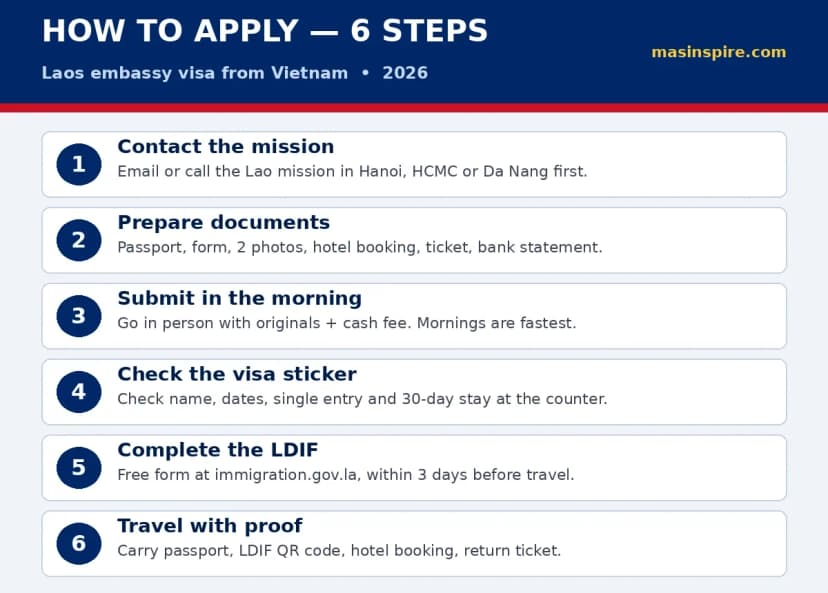
The embassy route is straightforward, but it has one hard rule: the visa must exist before you travel. There is no way to fix a missing visa at a Lao airport or border if you hold a Pakistani passport.
Step 1: Decide your dates and route. Choose your entry date and how you will enter Laos: by air into Vientiane, Luang Prabang or Pakse, or overland from Vietnam with a visa already in hand. Remember the visa must be used within two months of issue, so do not apply more than a few weeks before departure.
Step 2: Contact the mission. Email or telephone the Lao Embassy in Hanoi or the Consulate-General in Ho Chi Minh City or Da Nang. Confirm that it accepts applications from Pakistani passport holders resident in Vietnam, and ask for the current application form, the exact fee, the accepted payment method, the processing time, and whether you need an appointment. Get the answer in writing where you can.
Step 3: Prepare your documents. Use the tourist checklist above. Complete the form in English, check every spelling against your passport, and make sure the dates on your hotel booking and ticket match the dates on the form. A mismatch is the most common reason an application is delayed.
Step 4: Submit in person. Go to the mission in the morning, with your original passport, the form, photographs, supporting documents and the fee in cash. Morning submission matters: the Hanoi mission has been reported to return the visa the same afternoon when the paperwork is submitted in the morning. Keep the receipt the mission gives you.
Step 5: Collect your passport and check the visa. When you collect your passport, check the visa sticker before you leave the counter: your name, passport number, the visa's validity dates, the number of entries (single), and the permitted stay (30 days). If anything is wrong, raise it at the counter, not at the border.
Step 6: Complete the Lao Digital Immigration Form. Within three days before you travel, complete the LDIF on immigration.gov.la. It is free, and it is separate from the visa. See the LDIF section below for the details.
Step 7: Travel with your documents. Carry your passport with the visa sticker, a printed copy of your LDIF confirmation or QR code, your hotel booking, your return ticket and your bank statement. Airlines may ask to see the visa before boarding, and Lao immigration may ask for your address in Laos and your return ticket on arrival.
Step 8: Check your entry stamp. When you enter Laos, make sure your passport is stamped. You need a valid entry stamp to leave Laos, and a missing stamp can lead to fines or delays when you depart.
Applying from Vietnam: Hanoi, Da Nang and Ho Chi Minh City
Laos has three missions in Vietnam. For a Pakistani resident of Vietnam, the practical choice is the mission nearest to where you live: Ho Chi Minh City if you live in the south, Da Nang if you live in the centre, and Hanoi if you live in the north. All three handle visa applications, but each sets its own hours and procedures, so confirm before you travel to the mission.
| Mission | Address | Hours as reported | Best for |
|---|---|---|---|
| Embassy of Laos, Hanoi | 40 Quang Trung Street, Hanoi | Monday to Friday, 8:00–11:30 and 13:30–16:00 | Residents of northern Vietnam |
| Consulate-General of Laos, Da Nang | 16 Tran Quy Cap Street, Da Nang | Monday to Friday, 8:30–16:30 as reported | Residents of central Vietnam |
| Consulate-General of Laos, Ho Chi Minh City | 93 Pasteur Street, Ho Chi Minh City | Monday to Friday, 8:30–11:30 and 13:30–16:30 as reported | Residents of southern Vietnam, including Ho Chi Minh City |
The office hours above carry a conflict to disclose: sources report the Hanoi embassy's hours as 8:00–11:30 and 13:30–16:00 in some guides and 8:30–11:30 and 13:30–16:30 in others, and the Da Nang and Ho Chi Minh City hours are similarly reported in more than one version. The addresses are consistent across sources; the hours are not. Telephone the mission before you go, and go in the morning.
Getting to Laos from Vietnam. The most reliable way in for a Pakistani traveller is to fly: direct flights connect Hanoi with Vientiane, and Ho Chi Minh City with Vientiane and Luang Prabang, with schedules and fares changing by season. Check the airline's current timetable before you book, and book the flight only after the visa is in your passport, or on a fare you can change. If you prefer to travel overland, read the border-crossings section below first: the crossing you choose decides whether your trip is possible at all.
Money. Laos uses the Lao kip. US dollars are widely accepted for visa fees and at borders, but day-to-day spending is in kip, and ATMs in Vientiane, Luang Prabang and Pakse dispense kip. Bring clean US dollar notes for the visa and for the border, and a card that works in Vietnam as a backup. Do not rely on paying by card at a land border.
Entering Laos from Vietnam: Border Crossings
The overland route from Vietnam is where Pakistani travellers most often go wrong, because the rules for land borders are stricter than the rules for airports, and the e-visa does not work at any Vietnam–Laos crossing.
The e-visa is not valid at any Vietnam–Laos land border. The official e-visa is accepted at only nine designated entry points: three airports, three Lao–Thai Friendship Bridges, the Boten road checkpoint and two railway stations. None of the nine is on the Vietnam border. If you hold an e-visa and arrive at a Vietnam–Laos crossing, it will not be accepted, and the e-visa fee is not refunded. This matters less to you directly, because you cannot get an e-visa on a Pakistani passport in any case, but it matters if anyone advises you to buy one for an overland trip: that advice is wrong twice over.
Only one Vietnam crossing issues a visa on arrival, and it does not help you. Of the nine Laos–Vietnam crossings, only Dansavanh, opposite Lao Bao in Vietnam on Route 9, is on the official visa-on-arrival checkpoint list. The other eight crossings issue neither a visa on arrival nor an e-visa. But even at Dansavanh, a visa on arrival is not available to a Pakistani passport holder, because Pakistan is on the national exclusion list. So for you, the practical rule is the same at every Vietnam–Laos crossing: arrive with a sticker visa already in your passport.
| Lao checkpoint | Opposite side (Vietnam) | Visa on arrival | E-visa | Advice for Pakistanis |
|---|---|---|---|---|
| Dansavanh (Savannakhet) | Lao Bao, Quang Tri | Yes, for eligible nationalities | No | Sticker visa in advance — VOA does not apply to Pakistanis |
| Nam Phao (Bolikhamsai) | Cau Treo, Ha Tinh | No | No | Sticker visa in advance only |
| Pang Hok (Phongsaly) | Tay Trang, Dien Bien | No | No | Sticker visa in advance only |
| Nam Kan (Xieng Khouang) | Nam Can, Nghe An | No | No | Sticker visa in advance only |
| Na Phao (Khammouane) | Cha Lo, Quang Binh | No | No | Sticker visa in advance only |
| Nam Soy (Houaphanh) | Na Meo, Thanh Hoa | No | No | Sticker visa in advance only |
| Phou Keua (Attapeu) | Bo Y, Kon Tum | No | No | Sticker visa in advance only |
| Dak Ta Ock (Sekong) | Nam Giang, Da Nang | No | No | Sticker visa in advance only |
| La Lai (Salavan) | La Lay, Quang Tri | No | No | Sticker visa in advance only |
The two most popular Vietnam–Laos crossings are Lao Bao–Dansavanh on Route 9 and Cau Treo–Nam Phao on Route 8. Lao Bao–Dansavanh is the easier of the two, and it is the only one where a visa on arrival exists at all, but for a Pakistani traveller both crossings require the same thing: a sticker visa obtained in Vietnam before you set out. Travellers are turned away at these borders regularly when they arrive without a visa, and at Nam Phao–Cau Treo there is no way to fix the problem at the border: the nearest mission is a long way back.
On the return journey, note that Vietnam's e-visa is a separate system. Ten Laos–Vietnam land gates accept the Vietnam e-visa, including Lao Bao, Cau Treo, Tay Trang and Bo Y, but you cannot buy a Vietnam visa at the border, so arrange your Vietnam re-entry before you leave Vietnam. Your Vietnamese residence status and the conditions of your Vietnamese visa or residence card decide what you need for the return; check that before you depart, not at the border.
The Lao Digital Immigration Form (LDIF)
Since 1 September 2025, Laos has required all foreign nationals and stateless persons travelling on a passport to complete the Lao Digital Immigration Form, the LDIF, before entering or leaving the country. It replaces the paper arrival and departure cards. It is not a visa, and it does not change who needs a visa: you need both the visa and the LDIF.
Complete the LDIF on the official portal, immigration.gov.la, within three days before arrival and again within three days before departure. It is free. The form asks for your identity details, passport number, address in Laos and a photograph of your passport, with a verification selfie in some reports. You receive a QR code, valid for three days, to show at immigration. Any website charging a fee for the LDIF is an intermediary, not the official channel.
There is a coverage conflict to disclose. The LDIF was introduced at four checkpoints: Wattay International Airport in Vientiane, Luang Prabang International Airport, Pakse International Airport, and the Lao–Thai Friendship Bridge I. The Lao authorities announced that it would be extended to all international checkpoints from the beginning of 2026, and some 2026 guides describe it as a general requirement at all entry points, while the UK FCDO still lists only the original four checkpoints. The safe approach is to complete the LDIF for every trip regardless of your entry point, and to be ready for a paper card as well at smaller land crossings. Completing a free form you did not strictly need costs you ten minutes; arriving without one at a checkpoint that requires it can cost you hours.
Work, Business and Student Routes
A tourist visa never permits work in Laos. If you want to work, study or do business in Laos, you need the right visa before you travel, and each route needs a sponsor in Laos.
Business visa (NI-B2). For business people who come to invest, attend meetings or gather economic information. It is issued through a Lao company, which provides an invitation letter. Short-term business visas cover 30 days; multiple-entry business visas are available for 3, 6 or 12 months, at 300,000, 600,000 and 1,200,000 Lao kip respectively. Longer validity, up to 60 months, exists for concession investors under the investment-promotion law. A business visa is not a work permit: it covers business activity, not employment.
Work visa (LA-B2). For foreign employees of a Lao-registered employer, including companies, development agencies, NGOs, embassies and international schools. Three documents are involved, and they are separate: the LA-B2 visa itself, issued for 3, 6 or 12 months depending on the employment contract; a work permit card from the Ministry of Labour and Social Welfare, applied for by the employer, not by you; and a stay permit card from the Department of Immigration. The employer must first obtain approval for a foreign-worker quota. Teaching English in Laos is possible through this route, but only with a sponsoring school or employer and a work permit: do not travel on a tourist visa and look for teaching work on arrival. No official fee for a Pakistani work visa was found; secondary sources quote several hundred US dollars in total processing, quota and visa fees, and this guide does not present that as a verified figure.
Expert visa (E-B2). For foreign experts and NGO staff, arranged with the sponsoring organisation.
Student visa (ST-B2). For students enrolled at a recognised Lao institution, which sponsors the application. You need an acceptance or enrolment letter and evidence of funding for tuition and living costs. The student visa does not permit work, and there is no student work allowance. Reported processing is about seven to ten working days, but that figure is from secondary sources and should be confirmed with the mission.
Investment. Approved investors, shareholders and company directors can obtain an investor business visa through the One-Stop Service, with an investment or concession licence and an enterprise registration certificate. Laos has no retirement visa and no digital-nomad visa.
Extending Your Stay, Overstay and Fines
A 30-day tourist stay is often enough, but if your plans change, extend legally before your stay expires. It is far cheaper than overstaying, and it keeps your record clean for future trips.
| Item | Rule |
|---|---|
| Initial stay | 30 days from the date you arrive |
| Extensions | Two extensions of 30 days each, since 1 January 2025 |
| Maximum total stay | 90 days (30 + 30 + 30) |
| Extension fee | 20,000 Lao kip per day, plus a one-off form fee reported as 25,000–40,000 kip |
| Where to extend | Department of Immigration office in Vientiane, or a provincial immigration office in Luang Prabang, Pakse, Savannakhet and other capitals |
| How long it takes | About 1–2 working days; your passport is usually held and returned the next day |
| Overstay fine | USD 10 per day, paid in cash at the checkpoint on departure |
| Overstay beyond 90 days without extension | Fine of USD 2,000 in Lao kip, deportation and a ban on returning, according to the UK FCDO |
To extend, visit an immigration office before your current stay expires, with your passport, a photograph and the application form. The fee is charged per day of extension. A full 30-day extension costs about 630,000 kip, roughly USD 28 at September 2026 rates, though the exact form fee varies between sources as noted in the fees section.
Overstaying is charged at USD 10 per day, paid at the point of exit, and it is recorded. A short overstay is usually resolved by paying the fine, but a longer overstay can lead to detention, deportation and an entry ban of one to three years. The FCDO warns that a tourist who stays more than 90 days without extending faces a fine of USD 2,000 in kip, deportation and a ban on returning. Do not treat the USD 10 daily fine as a cheap way to stay longer: five days of overstay costs more than a month of legal extension at the daily rate, and the record follows you.
Safety note. The UK FCDO advises against all but essential travel to Xaisomboun Province because of intermittent attacks on infrastructure and armed clashes. There is no Laos-wide no-travel warning, but check the current FCDO advice before you travel, take travel insurance, and keep your passport, visa and entry stamp safe. Laos also has some of the harshest drug laws in the world, including for cannabis; even small amounts can lead to arrest and long prison sentences.
Frequently Asked Questions
1. Do Pakistani passport holders need a visa for Laos?
Yes. Pakistan is not on the Lao visa-exemption list, so an ordinary Pakistani passport holder needs a visa. The visa must be obtained from a Lao embassy or consulate before travel. Your Vietnamese residence does not change this: the rule is decided by your passport, not by where you live.
2. Can Pakistanis get a Laos visa on arrival?
No. Pakistan is on the Lao list of nationalities that are ineligible for a visa on arrival and must obtain a visa from a Lao diplomatic mission in advance. Do not fly to Laos expecting to buy a visa at the airport, and do not plan to buy one at a land border. Airlines often check for a visa before boarding.
3. Can Pakistanis apply for the Laos e-visa?
Not on the controlling sources. The official portal, laoevisa.gov.la, lists the nationalities that can apply in its fee schedule, and checks on 2 October 2026 and 19 November 2026 found that Pakistan is not on that list. A non-official lookalike site lists Pakistan as eligible, but that site is not the government portal and its list does not govern. Apply at a Lao embassy or consulate instead, and confirm the position with the mission before you travel.
4. How much does the Laos embassy visa cost for a Pakistani passport holder?
No official fee for Pakistani citizens was published in a source this guide could verify as of 28 November 2026. The Hanoi mission's tourist visa has been reported at about USD 40–50, and an older guide reported about USD 35. Ask the mission where you apply for its exact fee before you travel, and take the fee in cash.
5. How long does the embassy visa take?
The Hanoi mission is reported to take one to three working days, sometimes returning the visa the same afternoon if you submit in the morning. Other missions take longer: the Lao Embassy in Washington states ten business days. Each mission sets its own time, so confirm with the mission where you apply and apply at least two weeks before travel.
6. How long can I stay in Laos on a tourist visa?
Thirty days from the date you arrive. The visa is single entry and must be used within two months of issue. You can extend it twice inside Laos, for 30 days each time, up to a maximum total stay of 90 days.
7. Can I extend my Laos tourist visa?
Yes, twice, for 30 days each time, at an immigration office in Vientiane or a provincial capital. The fee is 20,000 Lao kip per day plus a small form fee. Apply before your current stay expires, and expect the office to hold your passport for about one to two working days.
8. What is the Lao Digital Immigration Form, and do I need it?
The LDIF is a free online arrival and departure form at immigration.gov.la, mandatory since 1 September 2025 for all foreign nationals travelling on a passport. Complete it within three days before arrival and again within three days before departure. It is separate from your visa: you need both. It replaces the paper arrival card at the checkpoints where it applies.
9. Which border crossing from Vietnam should I use?
If you travel overland, Lao Bao–Dansavanh on Route 9 is the best-known crossing, and it is the only Vietnam–Laos crossing on the visa-on-arrival list. But as a Pakistani passport holder you cannot use a visa on arrival at any crossing, so you must already hold a sticker visa in your passport whichever crossing you choose. Do not set out for Cau Treo–Nam Phao or any other crossing without a visa: there is no way to obtain one there.
10. Can I enter Laos overland with an e-visa?
No. The Lao e-visa is accepted at only nine designated entry points, and none of them is on the Vietnam border. It is not valid at any Vietnam–Laos or Cambodia–Laos land crossing. In any case, the e-visa is not available to Pakistani passport holders on the official portal's list, so this route is closed to you twice over.
11. Can I work in Laos on a tourist visa?
No. A tourist visa never permits work. To work in Laos you need a labour visa (LA-B2) with a sponsoring Lao employer, a work permit from the Ministry of Labour and Social Welfare, and a stay permit card. The employer applies for the quota and the work permit; you cannot arrange these as a tourist after arrival.
12. Can I study in Laos?
Yes, with a student visa (ST-B2), arranged with a recognised Lao institution that sponsors your application. You need an admission letter and evidence of funding for tuition and living costs. The student visa does not permit work.
13. What happens if I overstay my Laos visa?
You pay a fine of USD 10 per day at the checkpoint when you leave, and the overstay is recorded. A longer overstay can lead to detention, deportation and a ban on returning for one to three years. The UK FCDO warns that staying more than 90 days without an extension can bring a fine of USD 2,000 in kip, deportation and a ban. Extend before your stay expires: it costs about USD 1–2 per day, far less than the fine.
14. Do I need a polio vaccination certificate?
A Pakistan-focused guide states that a polio vaccination certificate from NADRA is needed to leave Pakistan. This guide could not verify whether it is required when you depart from Vietnam, because the requirement attaches to departure from Pakistan rather than to the Lao visa. Confirm with the Lao mission in Vietnam, and with your airline if you are flying from Pakistan.
15. Where do I apply if I live in Ho Chi Minh City?
At the Consulate-General of Laos in Ho Chi Minh City, at 93 Pasteur Street, open Monday to Friday with morning and afternoon sessions as reported. Telephone first to confirm the hours, the fee, the processing time and whether you need an appointment, and take your documents and the fee in cash. The embassy in Hanoi (40 Quang Trung Street) and the consulate in Da Nang (16 Tran Quy Cap Street) are the alternatives if you live in the north or centre.
Official Immigration Websites
| Website | What it is for |
|---|---|
| laoevisa.gov.la | Official Lao e-visa portal, run by the Consular Department of the Lao Ministry of Foreign Affairs. Apply for an e-visa here if your nationality is listed, and use its fee calculator to check the fee for your passport. The only official e-visa address; any other domain is not the government portal. |
| immigration.gov.la | Official portal of the Department of Immigration of the Lao PDR. Complete the Lao Digital Immigration Form (LDIF) here, free, within three days before arrival and before departure. |
| UK FCDO — Laos travel advice | United Kingdom Foreign, Commonwealth and Development Office travel advice for Laos, including passport validity, the LDIF, visa routes, extensions and the warning about Xaisomboun Province. |
| Embassy of India, Vientiane — LDIF announcement | Official announcement from the Embassy of India in Vientiane on the Lao Digital Immigration Form: mandatory from 1 September 2025, filed within three days before travel, at the four pilot checkpoints first. |
Final note: this guide was verified on 28 November 2026. Lao visa rules, fees, checkpoint lists and the LDIF rollout change with little notice. Before you book, check the official portal and confirm the current fee, processing time and entry-point list with the Lao mission where you will apply. If anything in this guide conflicts with what the mission tells you, follow the mission.