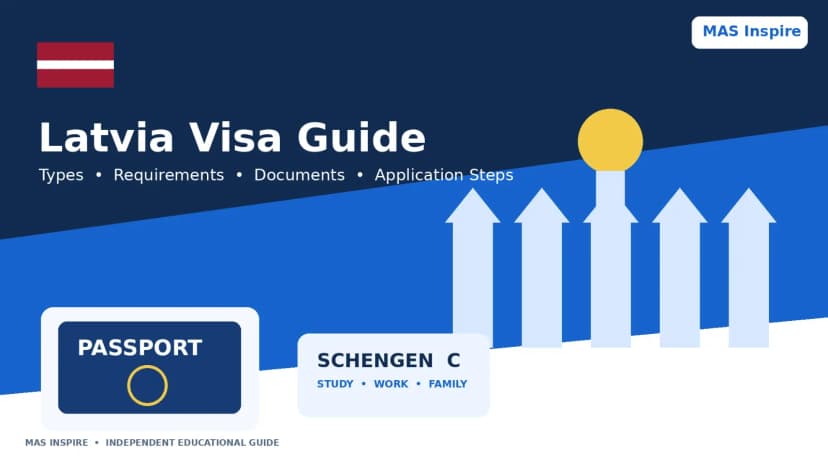
Latvia Visa Guide 2026: Types, Documents and Application Steps
Editorial date: 27 November 2026. Verified: 28 November 2026. This guide is written for Pakistani passport holders living in Vietnam who want to visit, study, work or join family in Latvia. Latvia is a Baltic member of the European Union and the Schengen Area. A short visit of up to 90 days needs a Schengen short-stay visa (type C); a longer stay needs a Latvian national long-stay visa (type D), a temporary residence permit, or another lawful status matched to the purpose. Latvia has no embassy in Vietnam: for a short-stay visa you apply through the Embassy of Hungary in Hanoi, which represents Latvia, and for a long-stay visa or residence permit you must use a Latvian mission — confirm which one before you plan anything. Read the linked official pages again when you apply, because the law and consular capacity can change.
Last verified: 2026-11-27. For international travellers, students, workers and families, including Pakistani passport holders legally residing in Vietnam.
Important: A visa permits travel for an approved purpose; a residence permit authorizes qualifying longer residence; the right to work must be independently established. A visa does not guarantee admission at the border. Requirements and fees can change. This independent MAS Inspire guide is general education, not legal advice.
Table of contents
- Introduction
- Why People Visit, Study, and Work in Latvia
- Types of Latvia Visas
- Visa Comparison Table
- Eligibility Requirements
- Complete Document Checklists
- How to Apply: Step-by-Step
- Visa Fees and Financial Requirements
- Visa Processing Times
- Applying from Pakistan or Vietnam
- Student Visa Guide
- Work Visa and Job Opportunities
- Family Immigration and Permanent Residence
- Common Application Mistakes and Reasons for Visa Refusal
- Frequently Asked Questions
- Official Immigration Websites
- Final Checklist and Conclusion
Introduction
Latvia is a Baltic member of the European Union and Schengen Area. Most visitors who need a visa for a short trip use the common Schengen short-stay C visa; longer stays generally require a Latvian national D visa, a temporary residence permit, or another lawful status matched to the purpose. An international student and a three-day conference visitor therefore should not start with the same application.
The key practical question is not simply whether Latvia issues a “tourist,” “student” or “work” visa. It is which immigration document gives the intended rights, whether an employer, university or family sponsor must act first, and which mission is authorised to accept the application. Check your passport nationality as well as your legal residence. Latvia's visafree list is the starting point for short-stay nationality checks; individual exceptions can apply.
This guide uses official information reviewed on 2026-11-27. Read the linked government pages again when you apply because the law and consular capacity can change.
Why People Visit, Study, and Work in Latvia
Riga's historic centre, Baltic coastline and forests attract short-stay visitors. Universities attract international degree students and researchers, while companies recruit people for technical, professional and seasonal roles. Other common reasons for travel are trade fairs, family visits, conferences and training.
Types of Latvia Visas
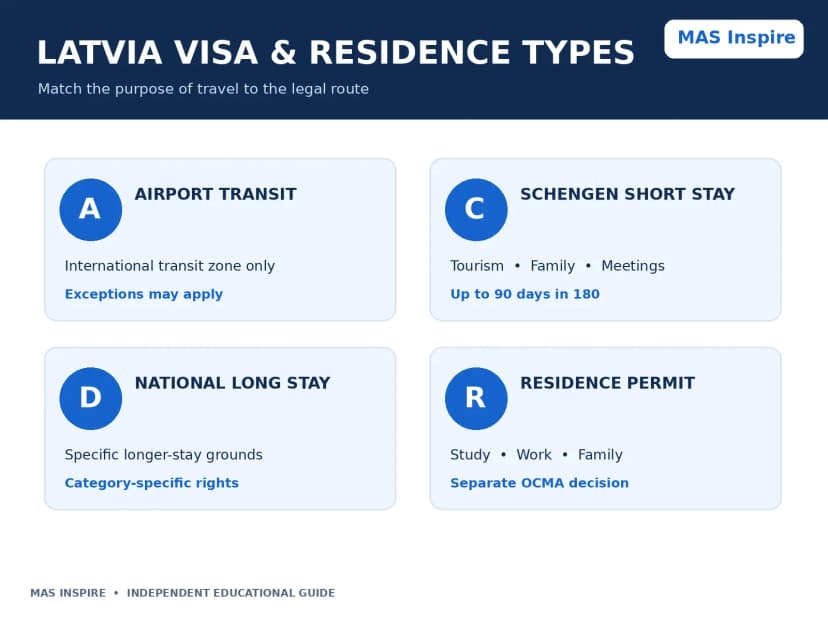
Schengen C visa: tourism, family visits and business
A short-stay C visa allows visits of up to 90 days in any rolling 180-day period, subject to the visa sticker's permitted days and entries. It covers tourism, visiting friends or relatives, meetings, trade fairs and some short educational or cultural activities. Applicants need a genuine itinerary, accommodation and funding evidence. A host's invitation may be relevant; it does not replace the applicant's own eligibility. General C visas do not independently permit employment in Latvia. The fee and processing rules are the Schengen-wide ones; see docs, fees and times.
Airport transit A visa
The airport transit visa is for staying in the international transit area of an airport without entering the Schengen territory. Pakistan is on the EU Visa Code’s common list (Annex IV) of nationalities required to hold an airport transit visa when passing through the international transit area of a Schengen airport, subject to exemptions — for example, holders of a valid Schengen visa or certain other visas or residence permits. A flight itinerary, onward ticket and proof of admission to the final destination may be required. Leaving the international zone, changing airports or collecting checked baggage may instead require a C visa. Confirm transit rules for the actual routing and document held before booking. Source: Visa Code Annex IV. (The Latvian MFA’s own consular page on visa types is currently unavailable while the ministry migrates its websites; re-check it at publication.)
National D visa and long stays
Latvia issues national D visas for particular long-stay purposes, normally where a specific legal basis exists. MFA lists a EUR 90 standard fee and a 15-day decision period that may extend to 60 calendar days. A D visa is not an indefinite settlement permit; its permitted period and rights depend on the issued category. A residence permit is normally the main route for continuing residence beyond short stays. The mission and whether an OCMA decision or approved invitation is needed vary by basis. Sources: times, fees, residence.
Employer-sponsored work and seasonal work
Latvian employers generally need to register a vacancy and arrange the required OCMA invitation or sponsorship, depending on the planned duration and status. Short-term employment may use a C or D visa marked with the right to employment; seasonal D visas may cover up to six months in a 12-month period. Longer-term employment typically uses a temporary residence permit with the relevant work rights. Work is restricted to authorised activities or employer where specified. See work and workvisa.
EU Blue Card and highly qualified workers
The EU Blue Card is a residence route, not a separate sightseeing visa. It is intended for qualifying highly skilled employment with employer documentation and applicable qualification and salary conditions. From 1 April 2026, the salary threshold is EUR 2,723 gross per month (1.5 times the previous year’s national average gross wage of EUR 1,815), or EUR 2,178 per month for occupations on the Cabinet’s shortage-occupation list (1.2 times the average wage). The euro figures are re-set every 1 April against the latest average wage, so confirm the threshold in force on your filing date with OCMA. Under the September 2026 law the card is issued for up to two years (or the contract term plus three months if shorter). OCMA’s Blue Card review fee is EUR 160 within 10 working days or EUR 280 within 5 working days. Latvia provides official guidance on the route at startup. Because contract conditions and recognised qualifications are case-specific, obtain a current OCMA assessment before relying on any online summary. Employment rights follow the actual permit.
Study, language courses, exchange and internships
Full-time degree study at an accredited institution generally calls for a study-based temporary residence permit when residence exceeds the short-stay allowance. A short language course, university visit or exchange may fit a C visa where short and permitted, but a longer programme may require a D visa or residence status. For internships and practical training, a cooperation agreement and, when relevant, employment authorisation matter. University invitations or OCMA-approved sponsorship may be prerequisites. The study agreement alone is not a visa. See study and residence.
Research and academic activities
Researchers with a hosting institution may qualify for residence based on scientific collaboration; very short visits to conferences may fall under a C visa or a narrow employment-rights exception. The invitation, research agreement, funding and host's legal status determine the route. Do not assume that a conference visa allows paid teaching. Review long and workvisa.
Remote-work D visa: Latvia's digital-nomad route
Latvia has an actual long-term remote-work visa, commonly described as a digital nomad visa. It is for eligible third-country nationals employed by, or self-employed in, an OECD member country, with remote duties. OCMA's June 2026 guidance specifies prior employer service of at least six months for employees and an income test calculated as 2.5 times the national average monthly gross pay: EUR 4,538 in the 2026 guidance. Applicants provide evidence from the relevant OECD country's tax or social authority, housing and an insurance policy with at least EUR 42,600 coverage. The published route provides an initial one-year visa, and does not permit work for a Latvian employer. Pakistani nationality is not itself proof of eligibility: the OECD employment/self-employment criterion must also be met. Source: remote.
Entrepreneurs, startup founders and investment
Latvia has residence options for qualifying founders, entrepreneurs and certain investors; these are residence grounds, not a single general “business visa.” Founders should examine OCMA's startup route and required business documentation. The 15 September 2026 law removed residence routes based on real-estate purchase and subordinated credit-institution investment and introduced a possible EUR 150,000 state alternative-investment-fund-manager route that OCMA said was not operational because the fund had not been created. Never market an inactive investment scheme as currently available. Sources: newlaw and startup.
Family reunification and spouse routes
Family of a Latvian citizen, qualifying Latvian resident, or EU free-movement beneficiary may have distinct family residence rights. Relationship proof, sponsor status, accommodation, maintenance and any special EU-family procedure are relevant. Under September 2026 reforms, accompanying family on the student route is restricted to certain groups, including NATO-country citizens or doctoral students, as specified by OCMA. A marriage certificate alone does not guarantee eligibility. Sources: newlaw and residence.
Permanent residence, humanitarian protection and job seeking
Latvia does not offer a general, stand-alone visa authorising any foreigner to enter for an unrestricted job search. Check other nationality-specific mobility grounds separately. Settlement is a later residence process: the 2026 reform focuses permanent status on EU long-term residence, generally after at least five years of qualifying temporary residence, with integration and other requirements. Refugee status, subsidiary protection and humanitarian relief are legal protection procedures, not tourism or employment visa products. Seek OCMA or legal-aid guidance for these specialised circumstances. Source: newlaw.
Figure conflict — disclosed: secondary guides disagree on the 2026 remote-work income benchmark. One November 2026 guide calculates about EUR 4,213 a month from the 2.5-times-average-wage formula, while another quotes EUR 4,538. OCMA's own June 2026 remote-work guidance states EUR 4,538, and that official figure is the controlling one used in this guide. The benchmark is re-set as Latvian average wages move, so confirm the figure in force on your filing date with OCMA.
Visa Comparison Table
| Route | Typical purpose | Duration/validity | Local work rights | Sponsorship/host |
|---|---|---|---|---|
| C visa | Tourism, family, meetings | Up to 90/180; sticker controls | No, unless separately authorised | Often evidence of host or booking |
| A visa | Airport-side transit | Airport international zone only | No | Onward travel evidence |
| D visa | Permitted longer visit | Basis-dependent; generally up to one year for work | Only if endorsed/authorised | Often invitation or OCMA basis |
| Study residence permit | Accredited higher education | Based on programme and permit decision | Limited/conditional; verify endorsement | Institution's agreement and approval |
| Employment residence | Longer employment | Permit decision/contract dependent | As authorised | Employer sponsorship |
| EU Blue Card | Qualifying skilled role | Contract and permit dependent | As authorised | Qualifying employer |
| Remote-work D | Remote work for OECD-based activity | Published one-year route | No Latvian local employment | OECD activity proof, not Latvian sponsor |
| Startup/family/research | Specific longer residence | Case-dependent | Permit-specific | Founder, relative or institution evidence |
| Permanent EU long-term residence | Settlement after qualifying residence | Continuing status subject to law | Status-dependent | Residence and integration record |
The visa's validity dates, entry count and permitted duration are not the same. A multiple-entry five-year C visa, for example, does not allow five uninterrupted years in Schengen.
Eligibility Requirements
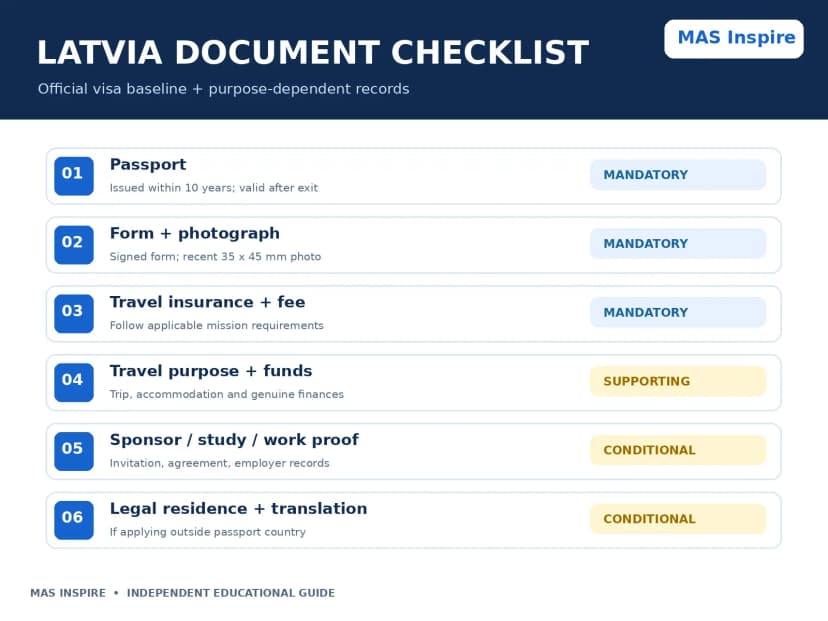
For a short-stay application, establish the purpose, genuine ability to pay, lawful travel documents, planned accommodation and intention to leave before authorised stay ends. Latvia's MFA requires a passport issued within the preceding 10 years, expiring at least three months after intended Schengen departure, and with two blank visa pages. Travel health insurance must cover Schengen states throughout the stay, with the Schengen-wide minimum cover of EUR 30,000. Source: docs.
Complete Document Checklists
Short-stay C or applicable D visa checklist
| Document | Mandatory or conditional? | Practical notes |
|---|---|---|
| Passport/travel document | Mandatory | Ten-year issue rule, three-month remaining validity after exit, blank pages |
| Correct completed, signed application | Mandatory | MFA online form; print/sign where instructed |
| Recent 35 × 45 mm colour photo | Mandatory | Follow mission photo specification |
| Travel medical insurance | Mandatory for visa application | Valid for Schengen stay; verify appropriate cover |
| Consular fee or recognised exemption | Mandatory/conditional | Official fee; provider charges extra |
| Trip purpose and route | Supporting evidence required | Itinerary, invitation, event programme, tickets |
| Accommodation | Supporting evidence required | Host address or hotel booking |
| Means of support | Supporting evidence required | Genuine bank documents, sponsor evidence |
| Intended departure and residence ties | Supporting evidence required | Leave approval, job/study status, family responsibilities |
| Additional nationality questionnaire | Conditional | Check MFA's prior-consultation requirement |
| Legal residence in application country | Conditional, often essential | Vietnamese permit, card and lawful-status proof |
| Minor's parental consent | Conditional | If required by route and guardian circumstances |
| Translations/legalisation | Conditional | Ask receiving mission; 2026 language rules apply |
Official baseline: docs; additional nationality check: prior.
Residence and purpose-specific checklist
| Route | Main purpose-specific records | Check with authority |
|---|---|---|
| University | Accredited institution admission/study agreement, OCMA invitation/sponsorship, subsistence, passport, application, photo, fee | Updated 2026 subsistence and student-family rules |
| Employment | Employer vacancy/opinion, invitation or sponsorship, contract, qualifications, passport and relevant residence application | Pay threshold, contract, work endorsement |
| EU Blue Card | Contract, qualifications/experience evidence, relevant salary and sponsorship | Current Blue Card thresholds |
| Remote worker | OECD tax/social-insurance evidence, employer letter or self-employment income, six-month history as applicable, housing, insurance | EUR 4,538 2026 monthly income benchmark; EUR 42,600 coverage |
| Startup | Business plan/qualifying venture evidence, founder identity, OCMA forms and financial support | Startup eligibility under new law |
| Family | Relationship certificates, sponsor identity/status, financial and housing records | Changed rules for student dependants |
| Research/exchange | Hosting or cooperation agreement, institutional status and funding | Employment-related restrictions |
For residence applications, certified criminal-history records, translated civil-status certificates or additional healthcare cover may be requested according to route. Do not submit fabricated itineraries, bank records or invitations. See residence, study, work, remote and newlaw.
How to Apply: Step-by-Step
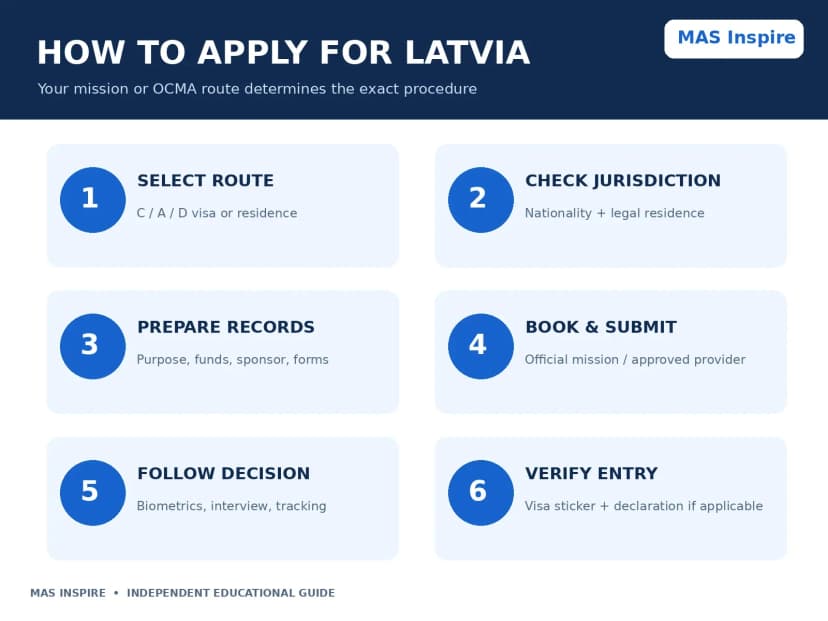
Step 1 — Choose the immigration document. Identify C, A, D, temporary residence or another special status. A short trip to an exhibition is different from taking a Latvian job. Obtain clarity from the employer or university before spending on an appointment.
Step 2 — Confirm passport and legal-residence rules. Check visa exemption, territorial jurisdiction and whether an authorised representative country will accept your nationality and lawful Vietnamese residence. For Pakistani citizens, check prior consultation and transit rules.
Step 3 — Collect the correct records. Download the mission's list and prepare your original passport, form, photo, insurance, proof of purpose, financing and ties. A long-stay employment or study application may require OCMA-approved invitation or sponsorship before you apply.
Step 4 — Use an official form or account where required. MFA references an online visa application form, but this does not mean every application is fully electronic. OCMA has a separate residence process — see the OCMA residence permits pages. (OCMA’s online visa-guidance tool at vizucelvedis.pmlp.gov.lv was showing “Not available” when checked on 2026-11-27.) Use only the link published by the competent Latvian authority or representing embassy.
Step 5 — Complete and sign the form. Enter information that matches the passport and bookings. Make sure address, dates, employment history and contact details are consistent. If the provider asks for printed forms, print and sign them; do not assume an online draft equals a submitted application.
Step 6 — Prepare uploads and payment. Upload documents only where the actual portal permits it; otherwise take them to the appointment. Budget official fees in euros plus any genuine outsourced-service charges, courier charges or local-currency conversion. Obtain a receipt.
Step 7 — Arrange appointment, fingerprints or interview. Schengen biometrics are generally recorded at submission, with exemption/reuse rules, including previous collection during the preceding five years under Latvia's guidance. Applicants may be asked to attend an interview or provide additional records.
Step 8 — Submit through the competent channel. A Schengen representative embassy may handle Latvian C visas, not automatically Latvian national D visas or residence permits. Keep copies of the final application and receipt.
Step 9 — Follow the official tracking instruction. Use the receipt/reference number and tracking channel actually issued by the relevant embassy or provider. There is no verified single public Latvian tracking portal for all visa and residence categories.
Step 10 — Collect the passport and check entry duties. Review name, validity dates, entries and allowed days. Take the original proof of travel purpose, funds, insurance and lodging to the border. Consider Latvia's separate electronic declaration and the EU Entry/Exit System; visa issuance does not guarantee admission. Sources: mfa, docs, times, eta, eues.
Visa Fees and Financial Requirements
| Item | Official amount | Key qualification |
|---|---|---|
| Schengen C visa, age 12+ | EUR 90 | Standard fee; visa facilitation/exemptions possible |
| C visa, age 6 to under 12 | EUR 45 | Under-six applicants generally exempt |
| Latvian national D visa | EUR 90 | Other exemptions may apply |
| Initial temporary residence review, ordinary 30-day service | EUR 160 | OCMA's published fee schedule; check application type |
| Temporary residence review, 10-working-day service | EUR 280 | Availability and case conditions apply |
| Temporary residence review, 5-working-day service | EUR 560 | Availability and case conditions apply |
| Employer sponsorship request, paper | EUR 17 | Additional per-person and work-right charges possible |
| Employer sponsorship request, specified electronic form | EUR 10 | Additional charges may apply |
| EU Blue Card review, 10-working-day service | EUR 160 | OCMA published fee schedule; 5-working-day service EUR 280 |
| C/D service-provider charge | Varies | Not a government visa fee |
Sources: fees and rfees. Other residence-card, invitation and priority fees may apply; do not treat the table as a total project cost.
The MFA's visa-document page specifies EUR 14 per day for a stay of up to 30 days and EUR 780 monthly for a stay above 30 days, subject to the relevant purpose and current rules. For employment-related visas, the means test is the sector’s average monthly gross wage (or the sectoral general-agreement minimum); where the sector average exceeds the national average gross wage, the national average applies — EUR 1,815 per month from 1 April 2026. The remote-work route specifies EUR 4,538 monthly and insurance coverage of at least EUR 42,600. These are different tests and should not be combined into a universal bank-balance rule. For study residence permits, older OCMA pages quote outdated figures: confirm the correct amount under the new law directly before relying on it. Sources: docs, remote, newlaw.
Figure conflict — disclosed: some third-party visa pages still quote the old Schengen fee of EUR 80 for adults and EUR 40 for children aged 6 to 12. That was the fee before the June 2024 increase. The Latvian MFA fee page (updated 2 January 2025, re-read 28 November 2026) lists EUR 90 for applicants aged 12 and over, EUR 45 for children aged 6 to 12, and EUR 90 for a long-stay visa. The MFA page is the controlling source; budget EUR 90 and confirm the amount at the mission where you pay, because a visa centre service charge is added on top and is not a government fee.
Visa Processing Times
| Procedure | Official timing | Important caveat |
|---|---|---|
| Schengen C visa | Usually 15 calendar days; up to 45 | Time begins after valid lodging; consular requests may delay |
| National D visa | 15 calendar days; up to 60 | After all documents; more scrutiny possible |
| Short-stay filing window | Six months to at least 15 days ahead | Filing early does not guarantee decision before flight |
| D visa earliest filing | Three months before visit | Subject to authorised mission procedure |
| Temporary residence initial review | Check OCMA service tier; 2026 law sets a maximum of four months | Fee-linked expedited tiers are not universal guarantees |
| Blue Card, family and startup | Varies | Seek current category-specific OCMA confirmation |
Sources: times, rfees and newlaw. Leave additional time for employer sponsorship, admission documents, legalisation, appointment availability and passport return.
Applying from Pakistan or Vietnam
Pakistani passport holders legally living or working in Vietnam
A Pakistani ordinary-passport holder should generally expect to require a Schengen visa for Latvia. The Pakistani passport is also on Latvia's official prior-consultation list, meaning additional review can apply; this does not equal an automatic refusal. MFA's representation list names the Embassy of Hungary in Hanoi for Latvian short-stay applications in Vietnam. Before booking, ask the embassy or its designated provider whether they accept Pakistani citizens who hold the precise Vietnamese status you have and whether Vietnam must be your habitual legal residence. A work permit alone may not be sufficient evidence if the receiving mission asks for a residence card or longer remaining lawful stay.
Bring the passport, Vietnamese residence permit/card or visa and supporting employment contract or business registration, proof of current address, salary evidence, leave approval and realistic return arrangements as relevant. Where records are in Vietnamese or Urdu, confirm translations and authentication with the actual accepting mission. Do not assume the Hungarian representation accepts Latvian D-visa or residence-permit requests; the Latvian embassy with territorial jurisdiction or OCMA must confirm that route. Official sources: represent, prior, mfa.
Applying while based in Pakistan
Latvia lists the German Embassy in Islamabad as its representative for short-stay visas for the specified Islamabad consular district, and German Consulate General in Karachi for Sindh and Balochistan. The published Islamabad note covers Punjab and the former North-West Frontier Province; the exact modern administrative allocation should be reconfirmed. Applicants in Pakistan follow the local representative's current appointment and documents process. Those legally resident in Vietnam should not assume they must apply in Pakistan, nor that they automatically qualify to apply in Hanoi. The deciding question is the competent authority's nationality, residency and territorial-jurisdiction practice. Source: represent.
Pakistani travellers transiting an airport should separately investigate the A visa requirement and exemptions, even when they do not intend to enter Latvia. Check whether any visa-free or third-country residence exemption applies. Source: Visa Code Annex IV.
Long-stay route from Vietnam — not confirmed on an official page: secondary reporting indicates that long-stay visa applications from people resident in Vietnam go to Latvia's Embassy in China (Beijing), with a VFS Global centre in Hanoi handling lodgement and passport return. The MFA's own pages confirm only that other Schengen states do not issue long-stay visas for Latvia. Do not book travel to Beijing or pay any agent on the strength of this guide alone — confirm the competent long-stay mission in writing with the Latvian MFA or OCMA before you plan a study or work application from Vietnam.
Student Visa Guide
Start by confirming whether the Latvian institution is accredited and whether the proposed course is long enough to require residence permission. Obtain a genuine admission letter and signed study agreement. Ask the international office whether it will secure the required OCMA-approved invitation or submit the residence application as an authorised representative. Then confirm your passport, application form, photo, police-clearance requirement if applicable, financial means, health coverage, fees and address evidence.
The official study-residence pages outline these items, but parts of those pages predate September 2026 reforms. In particular, family members accompanying students now face restrictions described in the new law, and historical posted student subsistence figures should not be repeated as current. A study permit does not imply unrestricted employment: OCMA's work-rights guidance references conditional student work of up to 20 hours per week in a stated exception, but the actual permit and study programme control. Confirm work limits with OCMA and your university. Sources: study, newlaw, workvisa.
For language courses, summer schools and exchanges, determine the duration and whether attendance counts as short travel, study residence or work-related training. A course brochure is not an immigration decision. Research assistants who are paid or placed by an employer may require separate right-to-employment confirmation.
Work Visa and Job Opportunities
A job offer and an authorisation to work are separate from the permission to travel. Most third-country employees need an employer to register the vacancy, obtain the appropriate labour-market input and apply for OCMA invitation or sponsorship. After that, the worker applies in the authorised consular channel for a visa with work endorsement or residence permit. Employers may be responsible for employment, residence and return-related obligations. Sources: work and workvisa.
For skilled candidates, ask whether the role meets EU Blue Card requirements. For short seasonal work, check the six-month-in-twelve-month rule and verify the corresponding visa sticker. For remote workers, confirm that your employer or self-employment is genuinely OECD-based and that you will not perform local Latvian employment under a remote-work visa.
No broad Latvian “job seeker visa” was confirmed in the official categories reviewed. Do not travel on a tourist visa assuming you can start a local job later without authorisation. Use the Latvian State Employment Agency's official employer processes and ask prospective employers to provide realistic timelines and specific sponsorship steps.
Work salary threshold — not confirmed on an official page: one secondary employer guide cites a minimum gross monthly salary of about EUR 1,685 for employment-based residence permits in 2026. That figure was not found on an OCMA page, so this guide does not present it as fact. Confirm the salary your employer must pay with the employer and OCMA; the EU Blue Card thresholds above are the only work salary figures with a verifiable arithmetic basis (1.5 and 1.2 times the EUR 1,815 national average gross wage).
Family Immigration and Permanent Residence
Family reunification depends on the sponsor's status and the legal relationship. Married partners, children and qualifying dependent relatives do not all necessarily follow one checklist. EU free-movement family members may qualify for distinct facilitated procedures, so identify the sponsoring person's citizenship before choosing a route. Documentary evidence may include civil-status records, custody and consent, financial means and accommodation.
Permanent residence is not earned merely by holding a long-validity C visa. Latvia's 2026 reforms move toward one EU long-term-resident status for qualifying applicants, with at least five years of temporary residence and additional integration conditions. Whether a study period counts fully, or an absence interrupts residence, must be confirmed under the applicable legal rules. Latvian language competence and financial resources have formed part of settlement assessment; the precise 2026 implementation should be checked. Sources: newlaw and residence.
Common Application Mistakes and Reasons for Visa Refusal
Pay attention to two different digital systems. Latvia's Electronic Travel Declaration at https://eta.gov.lv/ may apply to a person who does not have a Latvian-issued visa or residence permit, even if that person enters using permission from another Schengen state. Relevant travellers must generally file at least 48 hours before arrival; exemptions exist. This declaration is not a visa or entry permit. The EU Entry/Exit System records short-stay border crossings and biometrics under different rules. Sources: eta and eues.
A Schengen or national-visa application may be refused if the purpose or accommodation is insufficiently demonstrated, the supporting records cannot be trusted, means of subsistence are inadequate, there is a concern about departure before permitted stay ends, or the applicant fails another legal condition. False records or concealed employment can undermine an application and future credibility. Border authorities can refuse entry even with a valid visa if current entry conditions are not met.
ETIAS — status conflict, disclosed: older 2026 sources said the EU travel authorisation ETIAS would launch in the last quarter of 2026. In July 2026 the EU removed that target from its official portal without naming a new date, and November 2026 reporting expects a 2027 start — an expectation, not an official date. As of 28 November 2026 ETIAS is not in operation and no applications are being collected. This does not change anything for a Pakistani passport holder, who needs a visa rather than ETIAS in any case. Never pay a website that claims to sell you an ETIAS authorisation today.
Frequently Asked Questions
1. Do all international visitors need a Latvia visa?
No. Visa-free nationalities and exemptions exist; verify your passport in visafree.
2. Is a Latvia visa different from a Schengen visa?
A Latvian C visa is a Schengen short-stay visa. A Latvian D visa is national and serves different longer-stay purposes.
3. How many days can I stay on a C visa?
No more than 90 in any rolling 180 days, and never beyond the dates and duration printed on the visa.
4. What is the standard C visa fee?
Generally EUR 90 for age 12 and older; exceptions and fee waivers apply. See fees.
5. What does a Latvia long-stay D visa cost?
The MFA's standard listed fee is EUR 90, subject to legal exemptions. See fees.
6. How long does a Latvian Schengen visa take?
Usually 15 calendar days, but some applications take as long as 45. See times.
7. Can I work in Latvia on a tourist visa?
A regular tourist C visa does not authorise local employment; an eligible work endorsement or permit is needed.
8. Does Latvia offer a digital nomad visa?
Yes, an OECD-linked remote-work D route exists. It does not allow employment by a Latvian employer. See remote.
9. Is there a Latvia job seeker visa?
No general stand-alone job seeker visa was verified; seek a qualifying employer-backed or other lawful route.
10. Can a Pakistani living in Vietnam submit in Hanoi?
Possibly for a Latvian C visa through Hungarian representation, but acceptance depends on nationality, the specific Vietnamese legal residence status and the mission's rules. Confirm first.
11. Must Pakistani nationals undergo extra review?
Pakistan appears on MFA's Schengen prior-consultation list. It is an added review, not a universal ban. See prior.
12. Does a Vietnamese residence permit remove Latvian visa requirements?
No. It may support local application eligibility, but passport-nationality rules still apply.
13. Is Latvia's electronic travel declaration a visa?
No. It is a separate pre-entry reporting obligation for certain travellers. See eta.
14. Can I bring my family while studying?
Not automatically. The September 2026 law restricts simultaneous accompanying family for students; confirm current exceptions. See newlaw.
15. Can I obtain residence by buying property?
The September 2026 reform removed the former residence route based on property purchase. Do not rely on old agency material. See newlaw.
Official Immigration Websites
| Official institution | What to check |
|---|---|
| Latvian MFA visa information | Eligibility, filing jurisdiction, procedure |
| Latvian MFA documentation | Travel-document and visa checklist |
| Latvian MFA fees | Visa charges and exceptions |
| MFA consular representation | Applying from Hanoi, Islamabad or Karachi |
| Latvian OCMA residence permits | Longer-term rights and residence |
| OCMA employment | Work-rights and sponsorship |
| OCMA remote work | Digital nomad D requirements |
| 2026 immigration reform | Newly changed residence rules |
| Latvia's electronic declaration | Entry declaration exemptions and timing |
| European Commission Schengen information | Shared Schengen law and application guidance |
| Electronic Travel Declaration (eta.gov.lv) | Pre-entry declaration form, at least 48 hours before arrival |
| UK FCDO — Latvia travel advice, entry requirements | Passport validity, EES, overstay rules (written for British passport holders) |
Final Checklist and Conclusion
Before an appointment or payment, confirm your exact passport nationality, purpose, legal residence, accepting consulate and current legal basis. Check that passport validity, translated records, health cover, financial proof and employer or school sponsorship are appropriate. Add several weeks of scheduling margin. For a long-term pathway, check OCMA's latest rules instead of treating visa validity as residency entitlement.
Latvia's immigration system is navigable when the visa category is matched to the real purpose, official sources are used, and post-September-2026 reforms are taken seriously. Pakistani passport holders living in Vietnam should confirm Hungarian representation acceptance for short stays and the separate competent Latvian channel for D and residence applications. MAS Inspire provides educational information only and cannot guarantee a visa or admission.