Libya Visa Guide 2026: Requirements, eVisa, Fees and Embassy Steps for Pakistanis in Vietnam
Editorial date: 27 November 2026. Verified: 28 November 2026. Written for Pakistani passport holders living in Vietnam. This guide is information only, not legal or immigration advice. Visa rules and the security situation in Libya change without notice, so confirm every figure with the official sources in Section 16 before you book anything.
1. Quick Answer: Do Pakistanis Need a Visa for Libya?
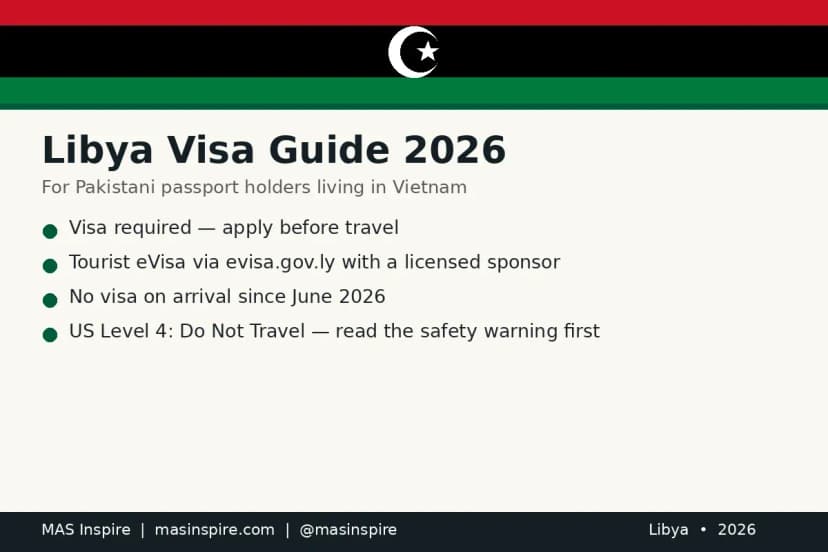
Yes. As a Pakistani passport holder, you need a visa before you travel to Libya. There is no visa on arrival for you, and there is no visa-free entry. The Government of National Unity suspended visa-on-arrival issuance at Libyan airports and air entry points in a circular dated 9 June 2026, announced on 11 June 2026, and no public notice restoring routine airport issue could be confirmed as of November 2026.
The main route in 2026 is the official Libya eVisa portal, evisa.gov.ly, but it comes with a condition that catches many applicants out: a tourist eVisa needs a registered Libyan tourism company as sponsor, with a sponsor letter naming the tour group and the places to be visited. Independent tourist travel, where you simply book a hotel and apply alone, is generally not how the system works. You must also hold at least US$1,000 or the equivalent in convertible currency, and your passport must be valid for at least six months.
There is one serious complication you must understand before spending any money. Sources disagree about whether Pakistani nationals can actually get a Libyan visa at all in practice. The official eVisa nationality checker lists Pakistan as eligible to apply online, according to checks of the portal reported in October and November 2026. At the same time, several travel guides report that Pakistani, Bangladeshi, Iranian, Syrian and Yemeni passport holders are the nationalities most likely to be refused, and one Pakistan-focused guide published in October 2026 states that there is currently no functioning standard visa route for Pakistani nationals. Eligibility to apply is not the same as approval, and an application is not a guarantee of entry. Do not book non-refundable flights or pay a tour operator in full until you have a written approval in hand.
Finally, and most importantly, this is not a normal tourist destination in 2026. The United States rates Libya Level 4, Do Not Travel, its highest level, and the United Kingdom advises against all travel to most of Libya. Pakistan's own Ministry of Foreign Affairs has advised Pakistanis to refrain from unnecessary travel to Libya and to postpone travel there. Read Section 2 in full before you go any further.
2. Safety Warning First: Read This Before You Plan Anything
Libya remains one of the most strictly warned-against destinations in the world. The warnings below are current as of the verification date of this guide, 28 November 2026, and they should shape your decision more than any visa fee or itinerary.
| Government | Advice in force | Date | What it means for you |
|---|---|---|---|
| United States, Department of State | Level 4: Do Not Travel — for any reason | Advisory issued 13 August 2026 | Crime, terrorism, health concerns, unrest, kidnapping and landmines. No US Embassy in Libya; help is handled through the US Embassy in Tunis, Tunisia. |
| United Kingdom, FCDO | Against all travel to most of Libya; against all but essential travel to Tripoli, Benghazi, Al-Bayda, Derna, Jebel Akhdar and Misrata | Updated 21 July 2026 | Travel insurance is usually invalid if you travel against FCDO advice. No in-person British consular help in Libya. |
| Pakistan, Ministry of Foreign Affairs | Refrain from unnecessary travel; postpone travel to Libya | 14 April 2016 advisory; 20 April 2019 notice | Pakistan's most recent published advice on Libya is to postpone travel. The Pakistan Embassy in Tripoli remains the contact point for Pakistanis in Libya. |
| Canada | Avoid all travel | Updated 26 May 2026 | Consistent with the US and UK position. |
Libya is split between rival administrations. The Government of National Unity, based in Tripoli, is the internationally recognised government and runs the eVisa system and the airports most visitors would use. A rival administration controls the east, including Benghazi. A ceasefire between eastern and western forces is in place, but the FCDO describes the political situation as fragile and warns that clashes between armed groups can break out without warning, as they did in Tripoli in May 2025. Terrorist groups linked to the Islamic State and al-Qaida in the Islamic Maghreb use the Fezzan region in the south-west as a base, and the US advisory warns of landmines and unexploded ordnance, including in populated areas.
Practical consequences follow from this. Consular help inside Libya is extremely limited. Pakistan's embassy in Tripoli is the mission that would assist a Pakistani national in difficulty, and its Crisis Management Cell in Islamabad can be reached on +92-51-920-7887 and +92-51-920-7685, but evacuation or emergency help in a fast-moving security incident cannot be relied on. If you travel against official advice, your travel insurance will very likely be invalid, and most insurers will not cover you. The US advisory goes as far as advising travellers who go anyway to prepare a will, designate insurance beneficiaries, establish a power of attorney and leave DNA samples with a medical provider.
Our honest position is this: for ordinary tourism, Libya is not a sensible destination in 2026, and this guide exists so that anyone with a genuine, unavoidable reason to travel — family, essential business, humanitarian or official work — understands the real rules and the real risks. If your reason is sightseeing alone, the responsible choice is to wait until the advisories change.
3. Libya Visa Types Compared
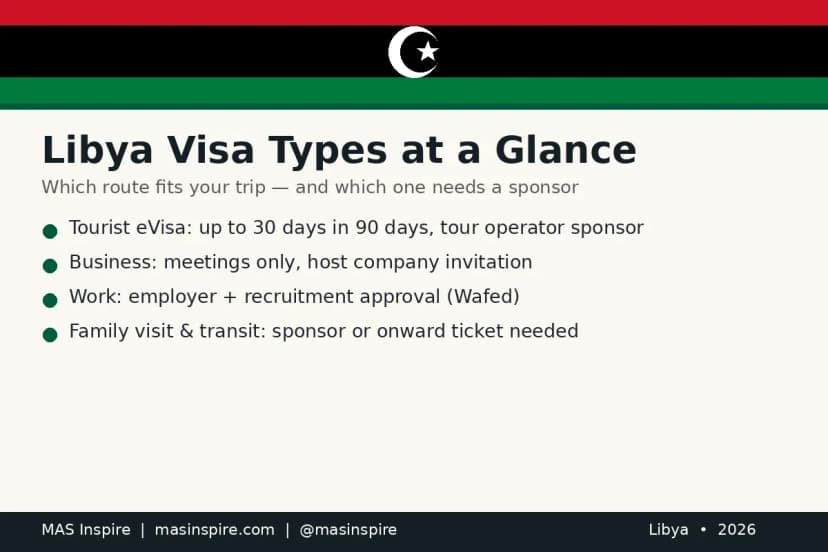
Libya's visa categories follow the purpose of your trip. The table below summarises them for a Pakistani passport holder. Every category requires approval before travel, and every category except a sponsored official entry runs through the eVisa portal or a Libyan embassy.
| Visa type | Purpose | Typical stay | Sponsor needed? | Route |
|---|---|---|---|---|
| Tourist eVisa | Organised tourism, visiting landmarks | Up to 30 days, within a 90-day validity | Yes — registered Libyan tour operator | eVisa portal, evisa.gov.ly |
| Business visa | Meetings, negotiations, conferences — not employment | Typically up to 30 days, single entry | Yes — Libyan host company invitation | eVisa portal or embassy |
| Work visa | Employment in Libya | Set by the work permit and residence approval | Yes — registered employer plus recruitment approval | Employer-led, Wafed and eVisa systems |
| Family visit visa | Visiting a relative in Libya | Set by the issued visa | Yes — host relative, invitation and proof of relationship | Embassy, with prior referral |
| Transit visa | Passing through Libya to another country | Short, set by the issued visa | Usually — onward ticket and next-country visa | Embassy or eVisa portal |
| Official / diplomatic entry | Government, UN or NGO missions | Case by case | Yes — government or agency sponsor, cleared through the Libyan Ministry of Foreign Affairs | Government-to-government, not a public application |
Two points in that table deserve emphasis. First, there is no category for an independent, self-organised tourist. The tourist route is built around a licensed Libyan tour operator, and the operator's letter is a required document, not a nice extra. Second, a work visa is not something you can apply for on your own. Your Libyan employer must first obtain recruitment approval from the Foreigners Affairs Department of the Passports, Nationality and Foreigners Affairs Authority. Only then does the entry-visa stage begin.
Visa-exempt nationalities are a short list — Algeria, Malaysia, Mauritania and Tunisia are shown as fully exempt on the eVisa checker, with Turkey partly exempt. Pakistan is not exempt. Do not confuse the 23 nationalities that used to be able to get a visa on arrival with an exemption: that visa-on-arrival facility was suspended in June 2026 for air travellers, and it never included Pakistan in any case.
4. Tourist eVisa: The Main Route and Its Sponsor Rule
The Libya eVisa system was launched by the Government of National Unity, first in March 2024 and then relaunched in a second phase on 29 June 2026 alongside the Wafed platform for foreign workers. By 30 June 2026 the government reported about 6,000 electronic visas issued through the two systems. The public portal is evisa.gov.ly, and it is the only official eVisa website. Any other site offering a Libya eVisa is a third-party service, and you should not pay it as if it were the government.
For a tourist eVisa, the official conditions reported from the portal's own visa-type guides are:
- A Libyan tourism company registered with the Passports, Nationality and Foreigners Affairs Authority must sponsor the visit, and the company must hold a delegate card.
- You must upload the tourism company's letter naming the tour group and the places to be visited.
- You must hold at least US$1,000 or the equivalent in convertible currency.
- Your passport must be valid for at least six months and must entitle you to return to the issuing country.
The usual stay reported for a tourist eVisa is up to 30 days within a 90-day validity window, single entry as standard. Multiple entry is reported for verified business needs, not for ordinary tourism. Your approval is sent by email, and you should print it and carry it with your passport, because the airline will ask for it before boarding and border officers will ask for it on arrival.
Here is the conflict you must weigh, stated plainly. The eVisa nationality checker lists Pakistan among the nationalities able to submit an online application, and a licensed tour operator checked the official list on 16 November 2026 and confirmed Pakistan appears on it. But an established tour operator's guide warns that passport holders from Pakistan, Bangladesh, Iran, Syria and Yemen will most likely be rejected and should consult the nearest Libyan embassy, and a Pakistan-focused guide updated 20 October 2026 goes further, saying there is no functioning standard visa route for Pakistani nationals at present and that only diplomatic, UN, NGO or oil-sector personnel with pre-arranged government sponsorship are the rare exception. The controlling source for your own case is therefore not a website at all: it is the answer you get from the eVisa portal when you run your own nationality check, and the answer you get in writing from the Libyan Embassy in Hanoi or Islamabad. If the portal accepts your application and issues an approval, that approval controls. If it does not, no third-party guide can override that. Never pay an agent who promises a guaranteed Libyan visa for a Pakistani passport.
5. Embassy Visa: When to Apply in Hanoi or Islamabad
If you are living in Vietnam, your nearest Libyan mission is the Embassy of Libya in Hanoi. That is the practical advantage of your situation: you do not need to fly to Pakistan to apply. If you are in Pakistan, the filing mission is the Embassy of Libya in Islamabad. In both cases, confirm submission arrangements, the fee and the payment method directly with the mission before you travel to it, because several sources note that appointment links and office details change, and that some embassy web pages are directed at Libyan citizens' passport services rather than foreign visitor-visa applicants.
| Mission | Address as listed | Phone | |
|---|---|---|---|
| Embassy of Libya, Hanoi | A3 Van Phuc, Van Phuc Diplomatic Compound, Ngoc Ha Ward, Hanoi (2026 listing); an older listing gives 298B Kim Ma Street, Ba Dinh District | +84 24 3845 3379 (also listed as +84 24 3845 3009) | libyanembassy.hanoi@gmail.com |
| Embassy of Libya, Islamabad | House No. 10, Ataturk Avenue, F-6/3, Islamabad (Pakistan Foreign Ministry list); other directories give House No. 1, Parveen Shakir Road, Street 20, F-7/2 | +92 51 8466213-4 (Foreign Ministry list); +92 51 2214378 (directories) | Libya.emb.pk@gmail.com (Foreign Ministry list); libyabureupak@hotmail.com (directories) |
| Embassy of Pakistan, Tripoli | Tripoli (contact the Foreign Office in Islamabad for current details) | Crisis Management Cell, Islamabad: +92-51-920-7887 and +92-51-920-7685 | Via the Ministry of Foreign Affairs, Pakistan |
Two disclosures belong in this section. First, the Hanoi address conflict: a 2026 Hanoi embassy directory lists the Libyan Embassy at A3 Van Phuc in the Van Phuc Diplomatic Compound, while an older and widely repeated listing gives 298B Kim Ma Street, Ba Dinh District. The telephone number +84 24 3845 3379 and the email address libyanembassy.hanoi@gmail.com agree across both listings, so telephone or email first, and confirm the address before you go. Second, the Islamabad address conflict: Pakistan's own Foreign Ministry list gives House No. 10, Ataturk Avenue, F-6/3, with telephone 051-8466213-4 and email Libya.emb.pk@gmail.com, while commercial embassy directories give House No. 1, Parveen Shakir Road, F-7/2, with telephone +92 51 2214378. The Foreign Ministry list is the controlling source, and the directories may be out of date, but the disagreement is wide enough that you should telephone before visiting either address.
The embassy route is normally used when the eVisa route does not fit: family visits, cases needing a prior referral from the Libyan Passports and Immigration authority, and applicants whose nationality or circumstances need individual clearance. The referral process, as described by a Pakistan-focused research guide, runs like this: your Libyan host sends your passport copy and visit details to the competent Libyan authority, the authority issues a referral identifying you, your passport number, your purpose, your authorised stay and your sponsor, and the referral is sent to the embassy where you will lodge. You then submit your passport, photographs, form and supporting documents to that embassy, attend an interview if directed, pay the fee as instructed, and collect your passport after issuance. Expect this to be slow. A Pakistan-focused agent guide puts embassy processing for Pakistanis at 4 to 8 weeks, which is longer than the general embassy range of 5 to 20 business days reported for other nationalities, and the difference is not explained by any official source, so treat the longer figure as the planning figure for a Pakistani applicant.
6. Visa Fees in 2026
Libya's visa fees are the least settled figure in this guide, and you should read this section as a conflict disclosure rather than a price list. Three different figures are reported for the same tourist entry, and no single official fee page settles the matter for a Pakistani applicant.
| Fee as reported | Amount | Source | Status |
|---|---|---|---|
| Tourist eVisa, flat fee | US$63 | VisaVerge Libya Visa Guide 2026, updated January 2026; Saiga Tours eVisa guide | Most widely reported eVisa price; the figure shown at portal checkout controls |
| National visa tariff, tourist / visitor entry | 300 Libyan dinars (about US$47, about PKR 12,900 at November 2026 rates) | Visarun, citing Libya's national visa tariff | Government tariff figure; conflicts with the US$63 eVisa figure |
| Portal fee per person, tourist eVisa | About US$82 | IntoLibya, a licensed Libyan tour operator, November 2026 | Operator-reported portal charge; conflicts with both figures above |
| Multiple-entry visa, tariff | 1,000 Libyan dinars (about US$155, about PKR 43,000) | Visarun, citing the national tariff | Tariff figure only; confirm at application |
| Transit visa, tariff | 100 Libyan dinars (about US$16, about PKR 4,300) | Visarun, citing the national tariff | Tariff figure only; confirm at application |
| Work entry, tariff | 300 Libyan dinars (about US$47) | Visarun, citing the national tariff | Entry charge only; work residence charges are separate |
| Embassy single-entry visitor visa, Manchester consulate | GBP 200 | Visarun | UK consulate price; not applicable in Hanoi or Islamabad, shown to illustrate how much local mission pricing varies |
| Embassy fee for Pakistanis | Not published | Varioline Traveller research, September 2026; AMG Visa, October 2026 | Both sources state the official fee is not established from current authoritative sources; the embassy sets it at lodgement |
What to do with this conflict: the amount that controls is the amount the official portal shows you at checkout, or the amount the embassy in Hanoi or Islamabad quotes you in writing before you pay. Do not treat US$63, 300 dinars or US$82 as a promise. Pay only through the official portal or the channel the embassy directs you to, keep the receipt, and budget for the highest reported figure plus the tour operator's own service charge, which is separate from the government fee and is set by the operator. One Pakistan-focused agent guide also lists its own service charges, PKR 7,500 for consultation and PKR 60,000 indicative document processing, but those are that company's prices, not government fees, and they are not verified by any official source. The widely quoted PKR 1,000,000 to PKR 2,000,000 bank-balance figure in some agent guides is likewise a company requirement, not an official Libyan rule; the official funds rule reported from the portal is the US$1,000 in convertible currency stated in Section 4.
There is no verified refund policy for a refused Libyan eVisa. Assume the government fee is not refunded if your application is refused, and do not pay any agent a large non-refundable sum before the eVisa approval arrives.
7. Processing Times: How Long to Wait
Processing times also conflict across sources, and the honest range is wide. The table below separates what each source actually says, so you can plan on the slowest credible figure rather than the fastest.
| Route | Processing time as reported | Source |
|---|---|---|
| Tourist eVisa, screening | As fast as 48 hours | VisaVerge, January 2026 update |
| Tourist eVisa, usual | Several days to a week | Libyan eVisa portal FAQ, as reported by Visarun |
| Tourist eVisa, with licensed operator | About 10 days to issue | IntoLibya, November 2026 |
| Business eVisa | 7 to 14 business days, longer with security vetting | TrekFeed eVisa guide, 2026 |
| Embassy processing, general | Often 5 to 20 business days; commonly about 20 working days | VisaVerge, January 2026 update |
| Embassy processing, Pakistani applicants | 4 to 8 weeks | AMG Visa, verified 28 October 2026 |
| Work file | No fixed time; recruitment approval comes first and can take months | Visarun work checklist; no official timeline published |
Our planning advice: start at least two months before your intended travel date, and do not book non-refundable travel until the visa is issued. The 48-hour figure is the fastest reported screening time for a straightforward tourist eVisa, not a promise for a Pakistani applicant, whose file is likely to face extra security vetting. The 4-to-8-week figure for Pakistanis comes from a commercial agent guide, not an official source, and it is not independently verified — but it is the only Pakistan-specific timeline available, and it is consistent with the sponsor-referral and security-clearance steps described in Section 5, so it is the figure to plan around. If your sponsor has not yet obtained the ministry reference number, the clock has not even started: pre-approval and referral stages sit outside the processing times above. Track your application through the portal or the mission that holds your passport, and keep a copy of every reference number, receipt and email.
8. Document Checklist
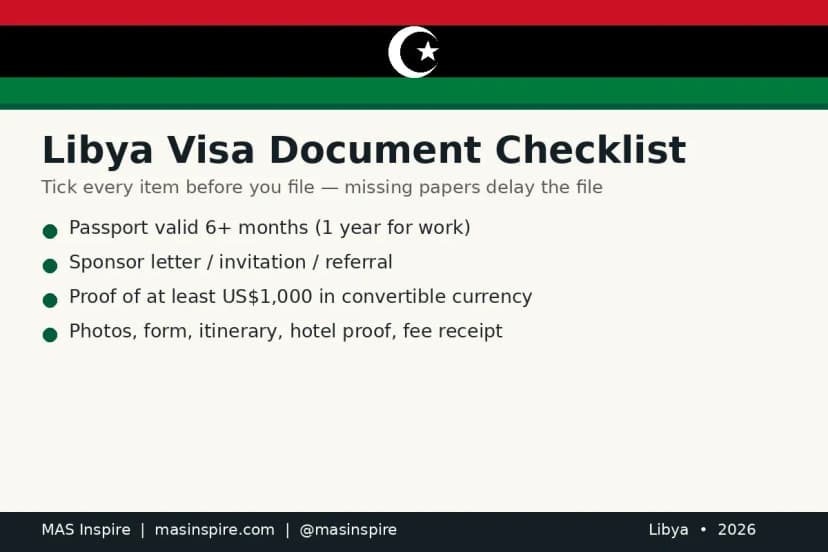
Use this checklist as your packing list. The embassy or the portal may ask for more, and Arabic translations may be required for some documents, particularly for work files, where certified Arabic translations are reported as standard. Bring originals and copies, and keep a full copy set at home in Vietnam.
| Document | Details | Who needs it |
|---|---|---|
| Pakistani passport | Valid at least 6 months beyond travel; at least 1 year for a work visa; blank visa pages; a copy of the biodata page | Everyone |
| Passport photographs | Two recent passport-size photographs, as specified by the embassy or portal | Everyone |
| Completed application form | Libyan entry-visa form, or the online eVisa form on evisa.gov.ly | Everyone |
| Tour operator sponsor letter | From a Libyan tourism company registered with the Passports, Nationality and Foreigners Affairs Authority, naming the tour group and places to be visited; sponsor's delegate card details | Tourist eVisa |
| Business invitation letter | Libyan host company letter stating purpose, dates, address and sponsor details, and confirming you are not seeking employment | Business visa |
| Prior approval / referral note | Referral from the competent Libyan Passports and Immigration authority, identifying you, your passport number, purpose, authorised stay and sponsor | Embassy route, family visit |
| Proof of funds | At least US$1,000 or equivalent in convertible currency; bank statement if the embassy asks for it | Everyone; the US$1,000 figure is the official portal rule |
| Accommodation proof | Hotel booking or host address matching your itinerary and sponsor letter | Tourist and business |
| Flight itinerary | Return or onward ticket; do not pay for non-refundable tickets before approval | Everyone |
| Vietnam residence proof | Your Vietnamese temporary residence card or visa, and proof of address in Ho Chi Minh City, showing you are applying from your country of residence | Applicants in Vietnam |
| Employment letter / work contract | For work: registered employer's recruitment approval from the Foreigners Affairs Department, plus contract and certified Arabic translations | Work visa |
| Proof of relationship | Family registration or marriage certificate, as applicable, for a family visit | Family visit |
| Fee payment receipt | Portal payment confirmation or embassy bank-transfer receipt, as directed | Everyone |
| Travel insurance | Strongly advised; note that most policies are invalid if you travel against FCDO or Level 4 advice — check the policy wording before you rely on it | Everyone |
Two documents in that list are routinely misunderstood. First, a hotel booking alone does not replace the sponsor letter. The portal's tourist rules require the registered tourism company's letter, and a hotel reservation is an additional document, not a substitute. Second, the bank-balance figures of PKR 800,000 to PKR 2,000,000 that appear in agent guides are those agents' own file-strength requirements, not a published Libyan rule. The published rule is the US$1,000 in convertible currency. A stronger bank statement may still help your file, but do not treat an agent's figure as the law.
9. How to Apply: Step-by-Step
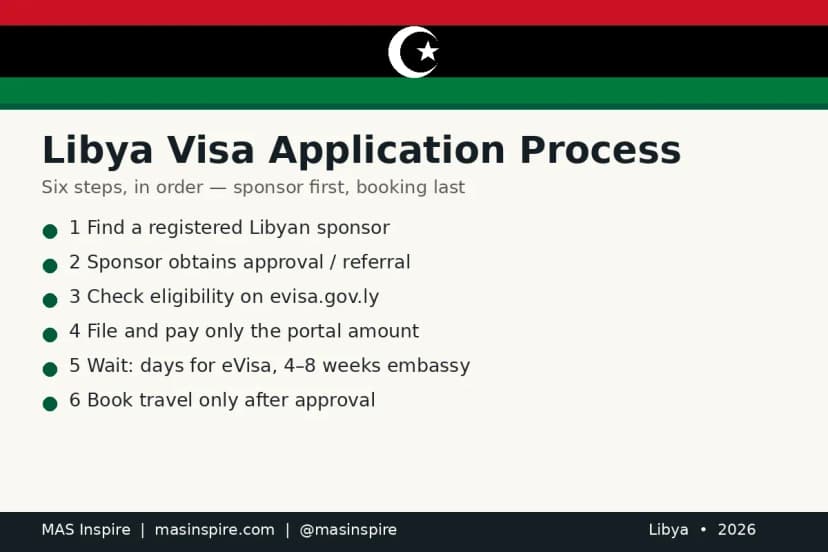
Follow these steps in order. The process has two halves — the Libyan side, where your sponsor obtains approval, and your side, where you file and wait — and the Libyan side comes first.
- Decide whether you have a genuine, essential reason to travel. Read Section 2 again. If the reason is ordinary tourism, reconsider. If it is essential, proceed.
- Find your sponsor. For tourism, engage a licensed Libyan tour operator registered with the Passports, Nationality and Foreigners Affairs Authority. For business, ask your Libyan host company for its invitation letter. For work, your employer starts the recruitment-approval process. Without a sponsor, there is no application.
- Ask the sponsor to obtain the approval or referral. The sponsor requests prior approval or a referral from the competent Libyan authority. Confirm the referral reference in writing before you file, and check that it names you, your passport number, your purpose and your authorised stay.
- Run the eVisa eligibility check yourself. Go to evisa.gov.ly, the only official portal, select Pakistan as your nationality and your visa category, and see what the portal itself says. If the portal does not accept Pakistani applications for your category, stop and contact the embassy in Hanoi instead.
- Prepare your documents. Use the checklist in Section 8. Make sure your passport has at least six months of validity, your photographs are recent, and your itinerary, accommodation and sponsor letter all agree with each other.
- File the application. Complete the form on evisa.gov.ly, upload the sponsor letter and supporting documents in the formats the portal accepts, and pay only the amount the portal shows at checkout. If you are on the embassy route, submit the original passport, photographs, referral and documents to the Embassy of Libya in Hanoi, or in Islamabad if you are in Pakistan.
- Wait, and do not book non-refundable travel. Plan on several days to a week for a straightforward eVisa, about 10 days with an operator, and 4 to 8 weeks for an embassy file for a Pakistani applicant. Do not chase the mission daily; keep your reference numbers and check the portal status.
- Check the approval carefully when it arrives. Confirm the name spelling, passport number, validity dates, number of entries and permitted stay. Print the approval and carry it with your passport. If anything is wrong, contact the issuing authority before you travel.
- Book travel only after approval. Arrange flights through a transit hub such as Istanbul, Tunis, Cairo, Dubai or Doha, and confirm the airline will carry you on your Libyan approval. Keep your sponsor's contact details and your hotel address with you.
- On arrival, expect checks. Border officers may ask for your approval, passport, proof of funds of at least US$1,000, accommodation details and return ticket. Your entry point must match your approval, and you must enter through an approved airport.
10. Work Visas and the Wafed System
Work in Libya is a separate system from a visit, and it is employer-led from start to finish. You cannot apply for a Libyan work visa on your own, and a tourist or business visa does not authorise employment.
The process reported for a Pakistani worker is: a registered Libyan employer sponsors you and holds a delegate card; the employer obtains recruitment approval from the Foreigners Affairs Department of the Passports, Nationality and Foreigners Affairs Authority, with the involvement of the Ministry of Labour for a foreign-worker admission permit; the employer then files the work-entry application through the government platform; and you complete the consular stage with a passport valid for at least one year, certified Arabic translations of your documents, and the employer's paperwork. In June 2026 the government announced the second phase of the Wafed and eVisa systems, bringing company and worker administration onto the electronic platforms, and reporting at the time described a dedicated company portal for the work category. The public work checklist available before that phase is the one summarised above, and no official processing timeline for a work file has been published, so a work application should be planned in months, not weeks.
Be cautious about job offers. Libya's oil, construction and service sectors do employ foreign workers, but the combination of a Level 4 advisory, a suspended visa-on-arrival system and a sponsor-gated work route is exactly the environment in which fake job offers and advance-fee fraud thrive. The US State Department specifically documents online scams connected with Libya, typically beginning through internet postings or unsolicited emails. Never pay an agent or an employer a recruitment fee up front, never hand over your original passport to a private agent, and verify any employer through the Libyan embassy and through the employer itself before you sign anything. A genuine employer will arrange the recruitment approval and will not ask you to pay for it. If you are offered work in Libya while living in Vietnam, ask the employer which charge covers entry and which covers work residence, because the national tariff lists those separately, and get the answer in writing.
11. Business, Family Visit and Transit Visas
A business visa covers meetings, contract negotiations, conferences and market research. It does not cover employment, and the invitation letter is the centrepiece of the file: it must state the purpose of the visit, confirm the host company's details and address, give the dates, and make clear that you are not seeking employment. Business eVisa processing is reported at 7 to 14 business days, longer when security vetting applies. A multiple-entry business visa is reported as available for verified business needs, with a tariff figure of 1,000 Libyan dinars, but the figure is a tariff figure only and must be confirmed at application. If you are attending a conference, ask the organiser for the invitation letter early, because the letter must be in place before the sponsor stage can complete.
A family visit visa needs a host relative in Libya who invites you and provides proof of the relationship, such as a family registration document or marriage certificate. The referral route in Section 5 applies: the host obtains the referral from the Libyan authority, the referral is sent to the embassy, and you lodge there. There is no published fee or processing time for a family visit for a Pakistani applicant, so confirm both with the embassy in Hanoi or Islamabad before you file.
A transit visa is for passing through Libya to a third country. You will need an onward ticket and a visa for your next destination if one is required. The tariff figure reported for a transit visa is 100 Libyan dinars, but again this is a tariff figure, not a confirmed checkout price. Given that there are no direct flights between Vietnam and Libya and that any Libya transit would be an unusual routing, most Pakistani travellers in Vietnam will never need a transit visa; if a flight itinerary routes you through Tripoli, check with the airline whether a transit visa is required for your connection, and whether you stay airside.
Official and diplomatic entry is not a public route at all. It is arranged government to government, or through a UN agency or recognised NGO, with clearance through the Libyan Ministry of Foreign Affairs and the General Administration for Passports, Nationality and Foreigners' Affairs. If you are travelling for humanitarian or official work, your sponsoring organisation handles the clearance, and you should not attempt to apply as a tourist.
12. Entry Rules, Airports and Arrival Checks
Your main airports are Mitiga International Airport in Tripoli, code MJI, and Benina Airport in Benghazi, code BEN. Most international arrivals use Mitiga. Your entry point must match the approval, and the eVisa is reported to work through approved airports only, so do not assume you can enter at any border post. Land borders and seaports were not covered by the June 2026 visa-on-arrival suspension, which was framed for airports and air entry points, but that does not make a land entry a practical alternative for a Pakistani visitor, and no official guidance confirms a land-border visa process for your nationality.
At the border, expect officers to check your passport and visa approval, your proof of at least US$1,000 in convertible currency, your accommodation address, and your return or onward ticket. Keep your sponsor's name, telephone number and address available, because officers may contact the sponsor. Your passport must have at least six months of validity, and you should have blank pages for the entry stamp.
Two entry bars are absolute. First, holders of Israeli passports, and anyone with evidence of having visited Israel, are refused entry to Libya. If your passport contains an Israeli stamp or an Israeli visa, do not attempt to travel. Second, do not attempt to enter without a visa. Unauthorised entry risks detention and deportation, and in the current security environment the consequences of detention are far more serious than in a normal destination. The FCDO also warns that the legal system and law enforcement in Libya are weak in many areas, and that armed groups rather than courts handle law enforcement in some places.
On departure, keep your entry stamp and approval until you have left the country. If your stay needs to be extended, the reported route is an application through the immigration offices in Libya with approval, not an automatic extension at the airport. Do not overstay: an overstay in Libya can lead to fines, detention and difficulty obtaining any future Libyan visa.
13. Money, Flights and Travel Practicalities
There are no direct flights between Vietnam and Libya. The usual routings reported for Libya are through Istanbul, Tunis, Cairo, Dubai or Doha, and you should confirm the active airline corridor before booking, because routes change with the security situation. Your flights must be booked only after your visa approval arrives, and you should choose changeable tickets where possible. Check with the airline before departure that it will accept your Libyan eVisa approval for boarding, because airlines face fines for carrying passengers who are refused entry, and some will refuse boarding if the approval looks unfamiliar.
Money needs planning. The official funds rule is at least US$1,000 in convertible currency, and you should carry it in a form you can show at the border. The Libyan dinar is the local currency, and the tariff conversions in this guide use November 2026 rates: 300 dinars at about US$47, or about PKR 12,900, and 1,000 dinars at about US$155, or about PKR 43,000. Those are rounded estimates, and the dinar's value moves, so recheck the rate at payment time. International bank cards may not work reliably in Libya, and ATMs cannot be relied on, so plan your cash carefully and keep it secure. Keep receipts for any currency exchange.
Health preparation matters. The US advisory cites health concerns as one of its reasons for the Level 4 rating, and medical facilities in Libya are limited, particularly outside Tripoli and Benghazi. The FCDO notes that hospitals and telecommunications were damaged by the September 2023 Storm Daniel flooding in the east, and that flooding also affected Tripoli and Misrata in December 2024. Carry any prescription medicine in its original packaging with a prescription, and check with your doctor about vaccinations and about medical evacuation cover before you travel — noting again that most standard travel insurance will not cover travel against a Level 4 or FCDO warning, so a policy that does cover you will need to be arranged specifically, if it is available at all. The local emergency number reported by the US State Department is 1515, but response capability varies significantly by area.
Telecommunications and movement inside Libya need care. The FCDO advises against all travel to most of the country outside the cities listed in Section 2, which means the sites most visitors want to see — Leptis Magna, Sabratha, Ghadames and the Nafusa Mountains — are all in areas where the UK advises against all travel. Do not travel overland between cities without local advice, do not venture off roads, and do not touch anything resembling unexploded munitions. Landmines are reported in populated areas, not only in remote battlefields, and the US advisory warns against walking in roadside ditches or shoulders and against entering areas marked with red and white plastic tape.
14. Common Reasons for Refusal and Delays
Most Libyan refusals and delays for a Pakistani applicant come from a short list of causes, and most of them are avoidable if you know them in advance.
- No sponsor, or a sponsor that is not registered. A tourist application without a registered Libyan tour operator's letter, or with a letter from an unregistered company, will not proceed. Confirm the operator is registered with the Passports, Nationality and Foreigners Affairs Authority and holds a delegate card.
- Documents that do not agree. If your itinerary, hotel booking and sponsor letter give different dates, cities or addresses, the file stalls. Make all three agree before you submit.
- Nationality-based refusal. As disclosed in Section 4, Pakistani passport holders are reported to face a higher refusal risk, and some guides say rejection is the likely outcome. There is no document you can add that removes this risk; the portal's own decision controls.
- Security vetting. Extra checks can extend a file by weeks with no explanation. This is the most likely reason the Pakistan-specific timeline of 4 to 8 weeks is longer than the general 5-to-20-business-day range.
- Israeli travel evidence. Any evidence of a visit to Israel in your passport leads to refusal. This is a firm rule, not a discretionary one.
- Passport validity. Less than six months of validity, or too few blank pages, will stop a file at the first check. For work, the bar is one year.
- Unpaid or wrong fee. Paying the wrong amount, paying through a third-party site, or paying before the sponsor approval exists can all waste the fee. Pay only the amount the official portal shows at checkout, or the amount the embassy quotes in writing.
- Applying through an agent who promises a guarantee. No agent can guarantee a Libyan visa for a Pakistani passport. An agent who asks for a large advance fee, your original passport, or payment through an unofficial channel is a warning sign.
If your application is refused, ask the issuing authority for the reason in writing and keep the refusal record. A refusal does not necessarily bar a future application, but a fresh application with the same sponsor and the same documents is likely to get the same answer. If the refusal was caused by a missing document or a sponsor problem, fix that specific cause before reapplying. If the refusal was nationality-based, reapplying quickly is unlikely to help, and your time and money are better spent on a different destination.
15. Frequently Asked Questions
1. Do Pakistani passport holders need a visa for Libya?
Yes. You need a visa before travel. There is no visa-free entry and no visa on arrival for Pakistani passport holders.
2. Can I get a visa on arrival in Libya?
No. Visa-on-arrival issuance at Libyan airports and air entry points was suspended by a Government of National Unity circular dated 9 June 2026, announced on 11 June 2026, and no public notice restoring it could be confirmed as of November 2026.
3. Is there a Libya eVisa for Pakistanis?
The official portal, evisa.gov.ly, lists Pakistan among the nationalities able to submit an online application, according to checks reported in October and November 2026. However, other guides report that Pakistani applicants are among the most likely to be refused, and one Pakistan-focused guide says there is no functioning standard route at present. Eligibility to apply is not the same as approval, so run the portal's own check and confirm with the embassy in Hanoi.
4. How much is a Libya tourist visa in 2026?
There is no single verified fee. US$63 is the most widely reported tourist eVisa fee, the national tariff lists 300 Libyan dinars (about US$47), and one licensed operator reports about US$82 at the portal. The amount the official portal shows at checkout, or the amount the embassy quotes in writing, is the figure that controls. Embassy fees for Pakistanis are not published.
5. How long does a Libya visa take?
Reports range from 48 hours for a straightforward tourist eVisa screening, to several days to a week on the portal FAQ, to about 10 days with a licensed operator, to 5 to 20 business days at an embassy, to 4 to 8 weeks for Pakistani applicants through an embassy. Plan on at least two months and do not book non-refundable travel until the visa is issued.
6. Do I need a sponsor to visit Libya?
Yes, for tourism. A registered Libyan tour operator must sponsor the visit and provide a letter naming the tour group and the places to be visited. A hotel booking alone does not replace the sponsor letter. Business visitors need a host company invitation, and workers need a registered employer.
7. How long can I stay in Libya on a tourist visa?
The usual stay reported for a tourist eVisa is up to 30 days within a 90-day validity window, single entry as standard. Your exact stay is set by the visa issued to you, so check the dates and entries on your approval before you travel.
8. Where do I apply from Vietnam?
At the Embassy of Libya in Hanoi, listed at A3 Van Phuc, Van Phuc Diplomatic Compound, Ngoc Ha Ward, with telephone +84 24 3845 3379 and email libyanembassy.hanoi@gmail.com. An older listing gives 298B Kim Ma Street, Ba Dinh District, so confirm the address by telephone or email before you visit. You can also apply through the eVisa portal online.
9. Is Libya safe to visit in 2026?
Every major government says no for ordinary travel. The US rates Libya Level 4, Do Not Travel, the UK advises against all travel to most of the country, and Pakistan's Foreign Ministry advises Pakistanis to postpone travel. This guide is written for people with a genuine, essential reason to travel, not as an encouragement to go sightseeing.
10. Can I work in Libya on a tourist visa?
No. A tourist or business visa does not authorise employment. A work visa needs a registered Libyan employer, recruitment approval from the Foreigners Affairs Department, and a passport valid for at least one year. The employer leads the process through the Wafed and eVisa systems.
11. What documents do I need for a Libya visa?
A passport valid for at least six months, two passport photographs, the completed form, the sponsor or invitation letter, proof of at least US$1,000 in convertible currency, accommodation proof, a flight itinerary and the fee receipt. Embassy applicants also need the prior referral from the Libyan Passports and Immigration authority, and work applicants need recruitment approval and certified Arabic translations.
12. Will my Pakistani passport be refused because I visited Israel?
If your passport contains evidence of a visit to Israel, you will be refused entry to Libya. Israeli passport holders are also refused. Do not attempt to travel in that situation.
13. Do I need a transit visa for Libya?
Only if your journey routes you through Libya to another country. The tariff figure reported for a transit visa is 100 Libyan dinars, but confirm the price and whether you need one with the airline and the embassy, especially if your connection stays airside. Most travellers from Vietnam will not need one.
14. Can my family visit me in Libya, or can I visit family there?
A family visit needs a host relative in Libya who invites you and provides proof of the relationship, and the host must obtain a referral from the Libyan authority before you lodge at the embassy. There is no published fee or processing time for this route, so confirm both with the embassy in Hanoi or Islamabad.
15. What should I do if my Libya visa is refused?
Ask the issuing authority for the reason in writing and keep the record. Fix the specific cause, such as a missing document or an unregistered sponsor, before reapplying. If the refusal was nationality-based, a quick reapplication with the same file is unlikely to succeed, and you should consider a different destination.
16. Official Immigration Websites
| Source | What it is for | Website |
|---|---|---|
| Libya eVisa portal | The only official eVisa website; eligibility check, application, payment and approval | https://evisa.gov.ly/ |
| US Department of State, Libya Travel Advisory | Level 4: Do Not Travel advisory, issued 13 August 2026 | https://travel.state.gov/en/international-travel/travel-advisories/libya.html |
| UK FCDO, Libya travel advice | Travel advice, updated 21 July 2026; entry requirements and regional warnings | https://www.gov.uk/foreign-travel-advice/libya |
| Ministry of Foreign Affairs, Pakistan — current situation in Libya | Pakistan's advice to postpone travel; Crisis Management Cell contacts | https://mofa.gov.pk/current-situation-in-libya |
| Ministry of Foreign Affairs, Pakistan — list of foreign missions | Official listing for the Embassy of Libya in Islamabad | https://mofa.gov.pk/list-of-foregin-mission |
| Ministry of Foreign Affairs, Pakistan — press briefing, 14 April 2016 | Travel advisory: refrain from unnecessary travel to Libya, Iraq, Syria and Yemen | https://mofa.gov.pk/press-releases/record-of-the-press-briefing-by-spokesperson-on-14-april-2016 |
Last checked: 28 November 2026. Figures in this guide were re-verified against the sources above and the secondary sources listed in the package file on that date. Where sources conflicted, the conflict is disclosed in the article and the controlling source is named. If an official page has changed since then, the official page controls.