Lesotho Visa Guide 2026: Requirements, Fees and Application Steps for Pakistanis in Vietnam
Editorial date: 27 November 2026. Verified: 28 November 2026. Written for Pakistani passport holders living in Vietnam. Lesotho's visa system changed in late 2025, and several figures in circulation conflict with each other. This guide names the conflict, names the controlling source for each figure, and says plainly where no figure could be verified at all. Always confirm the current position with the Lesotho Ministry of Home Affairs before you pay anything or book a non-refundable ticket.
1. Lesotho Visa for Pakistanis in Vietnam: The Short Answer
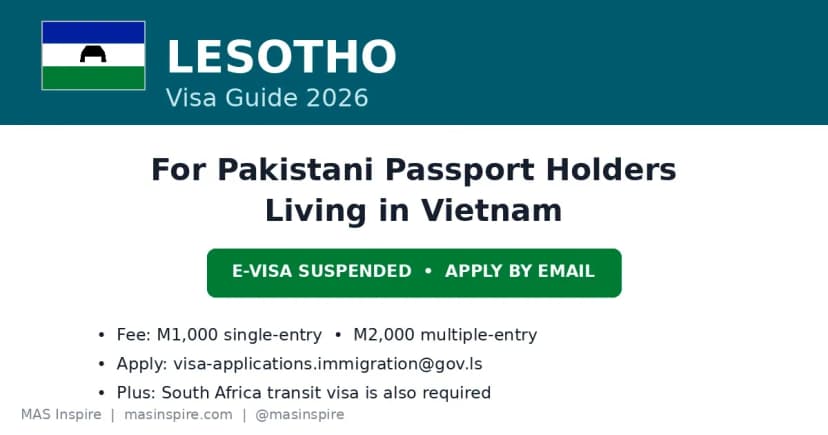
Yes, you need a visa. A Pakistani passport holder needs a Lesotho visa before travelling, and there is no visa on arrival for walk-up travellers. The online e-visa system that Lesotho launched in May 2017 is suspended, so you cannot currently apply through the e-visa portal at evisalesotho.com. The working route in November 2026 is an email application to the Department of Immigration in the Ministry of Home Affairs in Maseru, or an application lodged by your host in Lesotho at the Ministry. If your application is approved, you receive a visa-on-arrival approval letter by email, and you must enter within 72 hours of that letter, through Maseru Port of Entry (Maseru Bridge) or Moshoeshoe I International Airport only.
There is a second visa in this trip that many travellers miss. Lesotho is entirely surrounded by South Africa, and every route into Lesotho, by air or by land, passes through South Africa. Pakistani passport holders need a South African transit visa even to change planes airside at O.R. Tambo International Airport in Johannesburg, under South Africa's Immigration Directive 11 of 2022, in force since 1 August 2022. If you cross into Lesotho by road, you need a South African port-of-entry (visitor) visa instead. Sort out the South African visa first, because the Lesotho document list itself asks for it.
The headline fee for the current manual route is M1,000 (Lesotho maloti) for a single-entry visa and M2,000 for a multiple-entry visa, for an ordinary passport. At the mid-market rate on 27 November 2026 of about M17.33 per US dollar, that is roughly US$58 single-entry and roughly US$115 multiple-entry. That figure conflicts with the US$150 single-entry and US$250 multiple-entry figures still published by the Lesotho High Commission in London, which date from the e-visa era. The conflict is disclosed in full in Section 5. Do not pay either figure until the Ministry of Home Affairs tells you, in writing, what to pay and how to pay it, because no payment method for the email route is published online.
Plan on a long lead time. Published processing times for the current route range from at least five working days, to a maximum of ten working days, to four weeks or more for embassy and email processing. This guide recommends that you start at least six to eight weeks before travel and treat the ten-working-day figure as the best case, not the promise. There is no Lesotho mission in Vietnam and none in Pakistan, so do not plan a trip to an embassy unless the Ministry directs you to one.
2. Do Pakistanis Need a Visa for Lesotho?
Yes. Pakistan is on Lesotho's list of visa-required nationalities. Lesotho gives visa-free entry of 90 days to citizens of a long list of countries, including the United Kingdom, the United States, Canada, Australia, South Africa, Botswana, Namibia, Zambia, Zimbabwe, Kenya, Malaysia, Singapore and Japan, and 14 days to citizens of European Union member states, Iceland, New Zealand, Norway and Switzerland. Pakistan is in neither list. Your Vietnamese residence does not change this: Lesotho's visa requirement follows your passport nationality, not where you live. A Vietnamese temporary residence card, a Vietnamese work permit, or a long stay in Ho Chi Minh City gives you no exemption and no shortcut.
There is no visa on arrival in the ordinary sense. What exists is a pre-approved visa-on-arrival arrangement: you apply in advance, the Ministry of Home Affairs approves the application, and you receive an approval letter by email. You then present that printed letter at the border, and the visa is issued on arrival. Turning up at Maseru Bridge or Moshoeshoe I International Airport without that letter and expecting a visa is strongly discouraged by Lesotho's own Foreign Ministry guidance, and you should not attempt it. Airlines flying into Johannesburg may also refuse boarding if you cannot show both the South African visa and the Lesotho approval letter.
Your passport must be valid for at least six months from the date of entry, according to the Lesotho High Commission in London, and you need four blank pages. Four blank pages are needed because both South African and Lesotho border control stamp your passport on the way in and on the way out. One page of this guide's own sources, the High Commission's frequently asked questions, says three months beyond planned entry in one answer and six months in another. That is a genuine conflict inside a single official source, and it is disclosed in the flags list. The safe course is six months and four blank pages, which satisfies both versions.
Children travelling with you need their own passports and their own applications. South Africa has separate rules for children travelling through its territory, including requirements about birth certificates and parental consent, so check the South African requirements for your children at the same time as your own transit visa. Do not assume a child can travel on a parent's passport or on a parent's visa.
3. The E-Visa Is Suspended: What to Use Instead
Lesotho introduced its e-visa system on 1 May 2017 for tourism, business, student and diplomatic travel. When it was running, applications were made online, the fee was paid by card on the portal, and processing was commonly described as 72 hours, or two to three working days. That system is now suspended. Multiple sources checked in November 2026 agree on the suspension, including the Visa Policy of Lesotho summary, which states plainly that electronic visa processing via the portal has been suspended, and the Lesotho High Commission in London, which directs applicants to contact the Immigration Department by email instead.
The practical consequence is that evisalesotho.com is not a route you can use, and you should not pay money through it or through any website that claims to sell a Lesotho e-visa. The High Commission in London warns explicitly about fraudulent online visa websites and states that the only official website for visa applications is the Immigration Department under the Ministry of Home Affairs. The Ministry of Home Affairs' own website still carries the older statement that every foreign citizen must obtain a visa through the e-visa system. That page has not been updated to reflect the suspension, which is itself a conflict between the Ministry's website and the current practice described by the High Commission and by the Ministry's own email channel. Treat the email route as the live route and the Ministry website's e-visa sentence as out of date.
The replacement route is an email application to visa-applications.immigration@gov.ls, the address published by the High Commission in London. Some secondary sources render the same address with capital letters and a hyphen in a different place, as VISA-Applications.Immigration@gov.ls. Email addresses are not case-sensitive, and the two renderings reach the same mailbox. Use the High Commission's exact spelling, visa-applications.immigration@gov.ls, in your first email, and keep the Ministry's reply as your record of the correct channel.
Your host in Lesotho can also lodge the application for you in person at the Ministry of Home Affairs in Maseru. For a tourist with no host, the email route is the one to use. For a business visitor, the Lesotho host company normally handles or supports the application. For a family visit, the sponsor in Lesotho is the natural applicant. Whichever route you use, the decision remains with the Ministry of Home Affairs in Maseru. No embassy, agent or website can approve a Lesotho visa on the Ministry's behalf.
Because the system is manual, expect a slower and less predictable process than an online portal. There is no online tracking, no published service standard for the email queue, and no expedited or priority service that could be verified. One third-party site advertises standard, rush and super-rush e-visa processing at US$200, US$235 and US$265. Those prices belong to a commercial intermediary selling the old e-visa product, not to the current suspended system, and they should not be relied on. Do not pay an agent for speed that the Ministry does not offer.
4. Lesotho Visa Types Compared
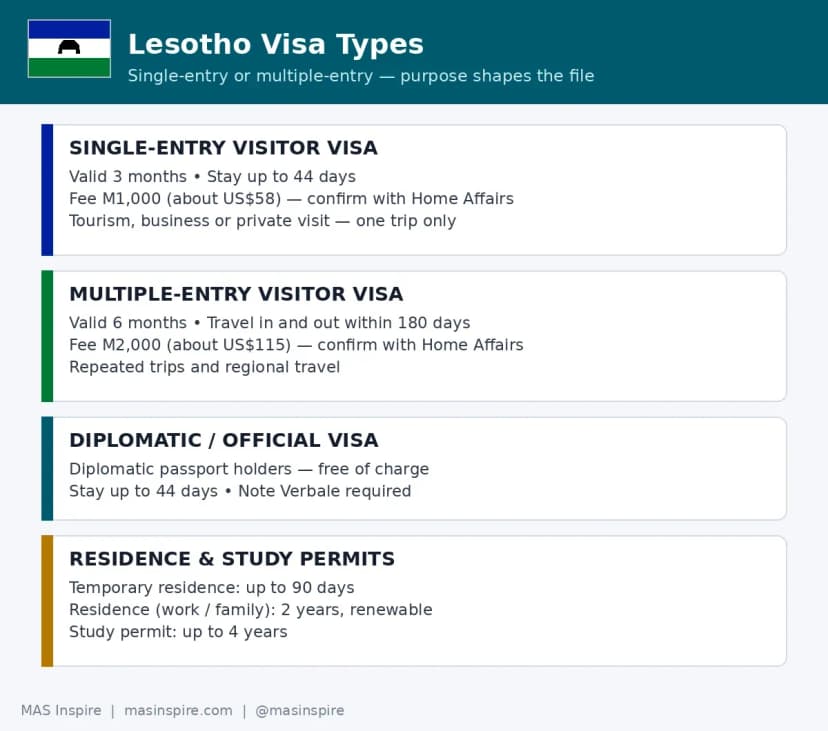
Lesotho issues only two kinds of entry visa: a single-entry visa for one journey, valid for three months, and a multiple-entry visa for multiple journeys, valid for six months. That is the Ministry of Home Affairs' own classification. The purpose of your visit, tourism, business, private visit, study or diplomacy, determines which supporting documents you must supply, not which visa you receive. There is no separate tourist visa, business visa and student visa as distinct visa products with distinct fees. There is one entry-visa system, and the purpose shapes the file.
| Visa or permit | Who it is for | Validity | Permitted stay | Route in November 2026 |
|---|---|---|---|---|
| Single-entry visitor visa | Tourism, business or private visit, one trip | 3 months | Up to 44 days per the High Commission; see Section 7 conflict | Email to the Ministry of Home Affairs, or host lodges in Maseru |
| Multiple-entry visitor visa | Repeated trips, business travel, regional travel | 6 months | Travel in and out only within 180 days; see Section 7 conflict | Email to the Ministry of Home Affairs, or host lodges in Maseru |
| Diplomatic or official visa | Diplomatic passport holders, official government business | As granted, up to 44 days stated | Up to 44 days | Note Verbale plus invitation; free of charge; report to Home Affairs on entry for a manual stamp |
| Temporary residence permit | Stays of up to 90 days for a specific purpose | Up to 90 days | As granted | Apply inside Lesotho after entry on a visitor visa |
| Residence permit (work, business, family, missionary) | Living in Lesotho for work, business, teaching, medicine, missionary work or joining family | Two years | Two years, renewable | Apply inside Lesotho after entry; employer or sponsor supports it |
| Study permit | Full-time study in Lesotho | Up to four years | Duration of the course, up to four years | Apply inside Lesotho after entry on a visitor visa, with institution admission |
A tourist visa does not permit work. The High Commission states this plainly: a visitor entering for tourism is prohibited from undertaking any business activities, and a business visitor must demonstrate that they are not receiving income in Lesotho. If you intend to work, teach, practise medicine or run a business in Lesotho, you need the residence-permit route described in Section 13, and you should not enter on a tourist visa and start working. Working without the correct permit can lead to a fine, imprisonment, or both under Lesotho law, and to removal.
There is no digital-nomad visa, no retirement visa and no investment visa for Lesotho that could be verified. If a website offers you one, treat it as unverified. Long stays are handled through the residence-permit system, not through a special visa category. Extensions of a visitor stay are possible by applying at the Department of Immigration in Maseru before the current stay expires, and the immigration officer decides how many extra days to grant. Do not overstay and then apply; apply before expiry.
5. Fees: What You Will Actually Pay
This is the section where the sources disagree most sharply, and the disagreement matters because it is about money. There are two official-looking fee schedules in circulation, and they cannot both be current. This guide sets out both, names the source of each, and tells you which one to follow and how.
| Visa | Fee on the current manual route | Fee still published by the London High Commission | Approximate US dollars at M17.33 per US$1 (27 Nov 2026) |
|---|---|---|---|
| Single-entry visitor visa | M1,000 | US$150 | M1,000 is about US$58; US$150 is about M2,600 |
| Multiple-entry visitor visa | M2,000 | US$250 | M2,000 is about US$115; US$250 is about M4,330 |
| Diplomatic or official visa | Not stated for the manual route | Free | Free on the High Commission schedule |
| Business visa, single entry | M1,000 (same entry-visa fee) | US$150 | Same conversion as the visitor visa |
| Business visa, multiple entry | M2,000 (same entry-visa fee) | US$250 | Same conversion as the visitor visa |
The M1,000 and M2,000 figures come from the most recent Pakistan-specific reporting checked on 19 November 2026, which attributes them to the Ministry of Home Affairs' current manual procedure, and they are consistent with the Ministry's own statement that there are only two visa kinds, single-entry and multiple-entry. The US$150 and US$250 figures come from the Lesotho High Commission in London, whose visa page was updated on 4 June 2025 and still lists those dollar amounts for tourist and business visas, with a 44-day stay for single entry and 180 days for multiple entry. Those dollar figures match the e-visa fees published when the portal was running, including the 2017 Fragomen notice that set the e-visa fees at US$150 single-entry and US$250 multiple-entry. The most likely explanation is that the High Commission page was not updated when the e-visa system was suspended and the fee moved to maloti, but that is an inference, not a verified fact, and this guide does not present it as one.
The controlling source is the Ministry of Home Affairs in Maseru, because it decides applications and instructs applicants how to pay. Its published email procedure does not publish a payment method at all: how to pay is not published online, and the Ministry tells the applicant when it processes the application. That means you must email first, receive the Ministry's instructions, and pay exactly as instructed. Do not pay US$150 or US$250 to any account on the strength of the High Commission page alone, and do not pay M1,000 or M2,000 to any account on the strength of a secondary website alone. Pay only on the Ministry's written instruction, keep the receipt, and keep the email thread.
Third-party figures are worse still and should be ignored. One commercial site lists a Lesotho e-visa at about US$30 single-entry and US$80 multiple-entry; another lists about US$50; a third lists US$200 to US$265 for tiered processing. None of these matches either official figure, none of them is the current manual route, and none of them should be used for budgeting. Budget for the maloti fee plus the South African visa fee, plus flights, insurance and accommodation, and keep a margin for the possibility that the Ministry confirms the dollar fee instead. The exchange rate used here, M17.33 per US dollar on 27 November 2026, is a mid-market rate from XE; the rate you actually get from a bank or card will differ, and the loti is pegged one-to-one to the South African rand, so rand movements move the loti with them.
There are also fees beyond the visa itself that no source consolidates into one total. The South African transit or visitor visa has its own fee, which depends on where you apply and is not stated in this guide because it could not be verified for applicants in Vietnam. Your host in Lesotho may charge for an invitation letter or for lodging the application. Medical reports, medical insurance, bank statements and travel to Johannesburg all cost money. No verified total trip cost is published anywhere, and this guide does not invent one.
6. Processing Time: How Long to Allow
Processing time is the second major conflict in this guide, and the range is wide enough to change your travel date. Four different figures are in circulation for what is, in substance, the same manual application.
| Source | Processing time stated | What it applies to |
|---|---|---|
| Lesotho High Commission, London | At least five working days | Visa applications generally; times vary with the number of applications received |
| Ministry of Home Affairs manual procedure, reported 19 November 2026 | Maximum ten working days | Email applications by Pakistanis, ending in a 72-hour visa-on-arrival letter |
| Government service charter, reported by a secondary source | Three to five working days | Government service standard; the same source gives up to ten working days for the emailed manual procedure |
| VisaVerge Lesotho guide, refreshed January 2026 | At least four weeks | Embassy and email processing after the e-visa suspension, with backlogs |
When the e-visa portal was running, processing was described as 72 hours, or two to three working days. That figure is historical now. It does not apply to the email route, and you should not plan around it. The four-week figure is the most cautious and comes from a secondary guide, not from the Ministry, so it is not an official service standard either. The honest position is that the Ministry has not published a single binding service standard for email applications, and the range you should plan around is five working days at best and four weeks or more at worst.
This guide's recommendation is to start six to eight weeks before your intended travel date. Email the Ministry, wait for its reply with the document list and payment instructions, and only then book non-refundable flights and hotels. If the Ministry replies quickly, you have slack. If it takes four weeks, you are still on schedule. Do not book a flight for the week after you send the email. Do not assume that a reminder email will speed up a manual queue, although a polite follow-up after ten working days with your full name, passport number and date of application is reasonable.
The 72-hour figure that appears in this process is not a processing time. It is the validity of the approval letter: once the Ministry approves your application, the visa-on-arrival letter it emails you is valid for entry within 72 hours. That is a tight window. It means you must be ready to travel, with your South African visa already in hand and your flight already booked, when the approval arrives. It also means you should tell the Ministry your intended travel date in your application, so that the approval, if granted, is timed to your trip rather than issued weeks early and expiring before you can use it.
7. How Long You Can Stay: Validity Versus Permitted Stay
Validity and permitted stay are different things in Lesotho, and confusing them is the most common mistake in the sources. Validity is how long the visa itself lasts. Permitted stay is how many days you may actually remain in the country on that visa. Lesotho's own sources give different numbers for both, and this section lays them out side by side.
| Measure | Single-entry visa | Multiple-entry visa | Source |
|---|---|---|---|
| Visa validity | 3 months | 6 months | Ministry of Home Affairs |
| Maximum stay, visitor visa | 44 days | Travel in and out only within 180 days | High Commission in London; e-visa era rules |
| Maximum stay, High Commission FAQ answer | 30 days | Not stated separately | High Commission in London, FAQ on visa duration |
| Visa-on-arrival approval letter | Entry within 72 hours of issue | Entry within 72 hours of issue | Ministry manual procedure, reported November 2026 |
The 44-day figure is the most widely repeated. The High Commission's tourist visa page grants a single-entry permit of 44 days, and its fee answers repeat that a single-entry visitor may remain for a maximum of 44 days from the date of issue, while a multiple-entry visitor may travel in and out only within 180 days from the date of issue. The same High Commission page, in its frequently asked questions, answers the question "What is the visa duration?" with a maximum stay of 30 days. Both answers are on the same official page. There is no way to reconcile them from the page alone, and this guide does not try. The 30-day figure may be a general statement, the 44-day figure may be the visa-specific rule, or one of them may be out of date. The controlling document is the visa or approval letter you actually receive: it will state the stay you have been granted, and the immigration officer at the border has the final say on the conditions of your entry.
Plan your trip for 30 days or fewer unless your approval letter says otherwise. That keeps you inside both figures. If you need longer, apply for an extension at the Department of Immigration in Maseru before your current stay expires. The extension application must be submitted before expiry, and the immigration officer decides how many days to grant. Do not overstay. The UK Foreign Office warns that overstaying without permission can lead to detention and weekly fines, and an overstay in Lesotho can also complicate your exit through South Africa.
For multiple-entry visas, the 180-day figure is a window, not a stay. It means you may travel in and out of Lesotho during the 180 days from the date of issue. It does not mean you may stay continuously for 180 days. Each entry is still subject to the permitted stay granted at the border. Keep every entry and exit stamp, and keep your approval letter and visa with your passport for the whole trip.
8. Documents Checklist for Pakistani Applicants
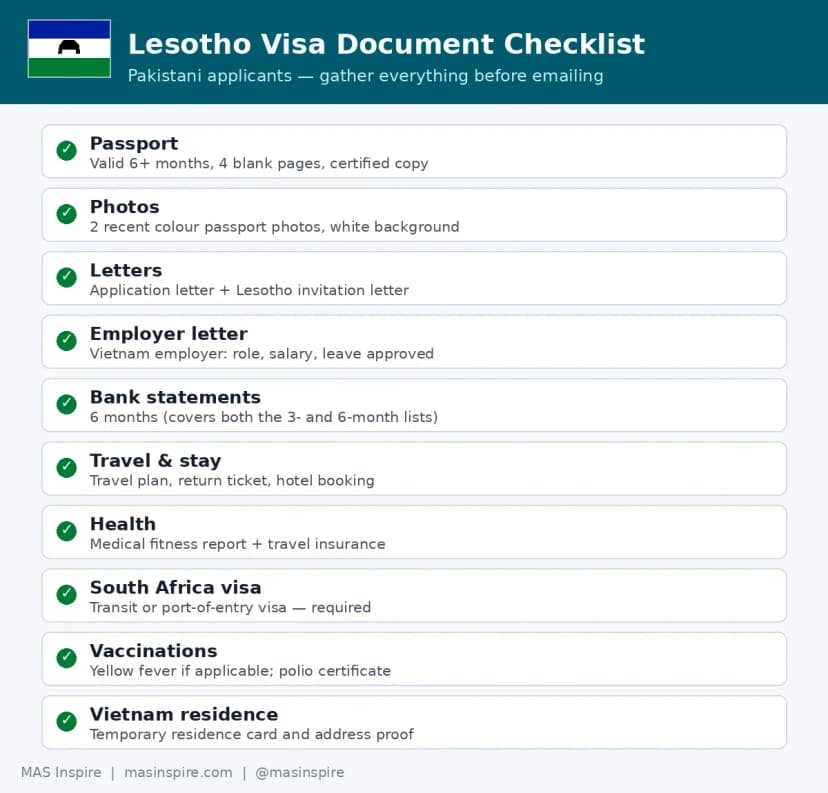
The document list below combines the High Commission in London's published list with the Pakistan-specific list reported from the Ministry of Home Affairs' manual procedure. Where the two lists differ, both versions are shown and the difference is noted. Gather everything before you email the Ministry, because a manual process with an incomplete file is the slowest kind of delay.
| Document | Detail | Who provides it |
|---|---|---|
| Passport | Valid at least six months from entry; four blank pages; certified copy for the application | You |
| Passport photographs | Two recent colour passport-size photographs, taken within the past six months, white background | You |
| Completed application form | The form the Ministry sends you after your first email; complete it exactly as instructed | You, on the Ministry's form |
| Application letter to the Director of Immigration | Formal letter requesting the visa, stating purpose, dates and where you will stay | You |
| Invitation letter | Letter from your host in Lesotho inviting you; for business, an official invitation from the Lesotho host company on its letterhead | Host in Lesotho |
| Employer letter (Vietnam) | On company letterhead: your position, salary, length of employment, approved leave, and the purpose and duration of the visit | Your employer in Vietnam |
| Bank statements | Three months (Pakistan-specific list) or six months (High Commission list); see the conflict note below | You, from your bank |
| Proof of accommodation | Hotel booking confirmation, or host accommodation details | You or your host |
| Travel plan and onward or return ticket | Itinerary and confirmed onward or return ticket; do not buy a non-refundable ticket before approval | You |
| Medical fitness report | Report on your fitness to travel, required on the Pakistan-specific list | Your doctor or clinic |
| Medical insurance | Travel health insurance covering the trip; health facilities in Lesotho are limited, so cover should include evacuation | You, from an insurer |
| South African visa | Transit visa or port-of-entry visa for travel through South Africa; the Lesotho list asks for it expressly | You, from South Africa |
| Yellow fever certificate | Where applicable; carry it if you have travelled from or through a yellow-fever risk country | You, from a vaccination centre |
| Polio vaccination certificate | NADRA polio certificate, needed to leave Pakistan; relevant if you depart from Pakistan rather than Vietnam | You, via NADRA |
| Vietnam residence evidence | Temporary residence card or visa, and evidence of your address in Vietnam; the Ministry may ask how you are resident where you apply from | You |
Two conflicts in this list deserve attention. First, bank statements: the Pakistan-specific list asks for three months, while the High Commission's list asks for bank statements or pay slips for the last six months. Six months satisfies both, so provide six months if you can. One secondary source reports that a private-visit application should demonstrate financial sufficiency of M10,000. That figure could not be verified against an official source, so this guide reports it as an unverified secondary figure and does not present it as a rule. Provide statements that genuinely show you can pay for the trip, and do not borrow money into the account to inflate the balance; a sudden large deposit is more likely to hurt than to help.
Second, passport validity: the High Commission's main visa page requires six months from the day of entry, while its FAQ says the passport must be valid for three more months beyond the planned entry date. Use six months. Photographs should be recent and on a white background. Keep a certified copy of your passport as well as the original; the High Commission asks for a certified copy with the application, and you will need the original for travel and for the South African visa.
For a private or family visit, the sponsor's side of the file is heavier: the sponsor's invitation letter, copies of the sponsor's passport, the sponsor's residence permit if the sponsor is a foreigner in Lesotho, the return ticket, and three months' bank statements from the sponsor or from you. For a business visit, you need both letters: one from your employer in Vietnam and one from the host company in Lesotho. For study, you will need the admission letter from the Lesotho institution as well, and you should read Section 14 before you apply, because the entry visa is only the first step.
9. Step-by-Step Application Process from Vietnam
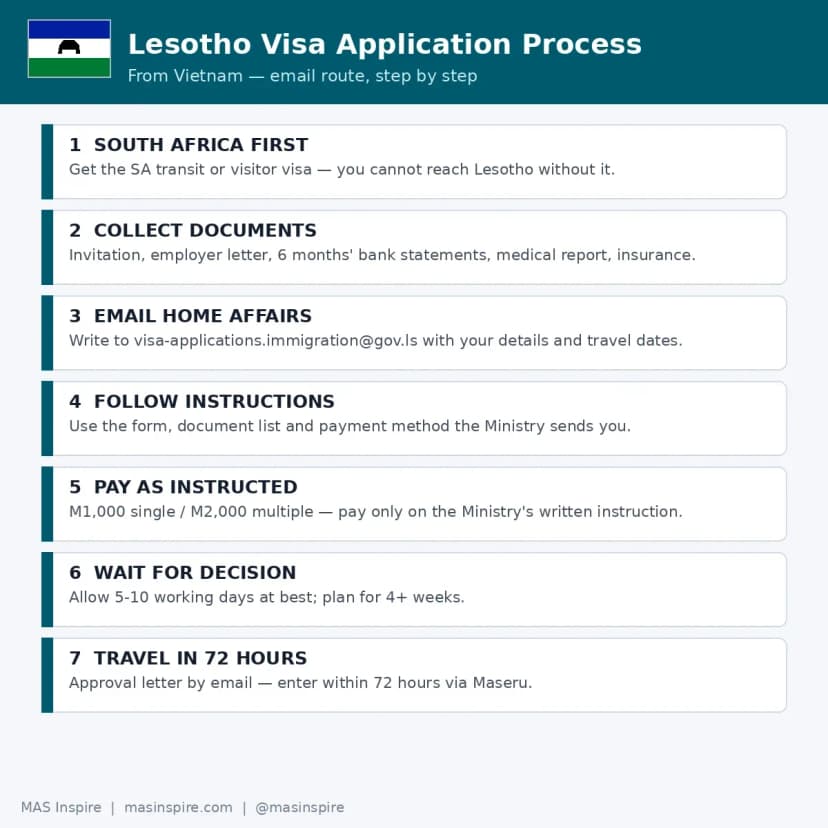
Apply from Vietnam, where you live, by email. Do not travel to Pakistan to apply, and do not travel to New Delhi or Beijing unless the Ministry tells you to. The steps below follow the Ministry's email procedure as reported in November 2026 and the High Commission's published guidance.
- Sort out South Africa first. Apply for the South African transit visa or visitor visa before, or at the same time as, the Lesotho application. Lesotho's document list asks for the South African visa, and you cannot reach Lesotho without passing through South Africa. See Section 11 for the detail, including the rule that Pakistani passport holders need a transit visa even airside.
- Collect the documents in Section 8. Get the invitation letter from Lesotho, the employer letter from Vietnam, six months of bank statements, the medical report, medical insurance, and your travel plan. Scan everything clearly in colour. Keep the originals.
- Email the Ministry of Home Affairs. Write to visa-applications.immigration@gov.ls. State that you are a Pakistani passport holder resident in Vietnam, give your full name as in your passport, your passport number, your intended travel dates, the purpose of your visit, and where you will stay. Attach the documents or ask the Ministry which documents it wants first and in what format. Keep the email short, polite and complete.
- Wait for the Ministry's reply. The reply should give you the application form, the exact document list for your case, and the payment instructions. Do not pay anything before you receive those instructions. Save the reply and every later email in the thread.
- Complete the form and pay as instructed. Fill in the form the Ministry sends you. Pay the fee exactly as the Ministry instructs, whether that is the maloti fee or the dollar fee, and keep the receipt or proof of payment. If the instructions are unclear, ask in writing before you pay.
- Ask your host to lodge the application if that is faster. If you have a host in Lesotho, your host can lodge the application in person at the Ministry of Home Affairs in Maseru. This is the alternative the Ministry itself offers. Agree in advance who is doing what, so the same application is not lodged twice.
- Wait for the decision. Allow up to ten working days as the best case and four weeks or more as the cautious case. A polite follow-up after ten working days, quoting your name, passport number and date of application, is reasonable. Do not book non-refundable travel while you wait.
- Receive the approval letter by email. If approved, the Ministry emails you a visa-on-arrival approval letter. Check the name, passport number, dates and conditions on it immediately, and reply at once if anything is wrong.
- Travel within 72 hours of the letter. The approval letter is valid for entry within 72 hours. Book or confirm your flight so that you arrive inside that window, and enter only through Maseru Port of Entry or Moshoeshoe I International Airport.
- Carry the full file when you travel. Carry the printed approval letter, your passport, your South African visa, your return ticket, accommodation proof, insurance, medical report, bank statements and invitation letter. The immigration officer decides your entry and your permitted stay, and the letter alone is not a guarantee of entry.
If your application is refused, ask the Ministry in writing for the reason. There is no published appeal process for a visitor visa that could be verified, and no verified information about whether you can reapply immediately. Do not reapply with the same file and hope for a different result; fix the reason for the refusal first. If you used an agent, check that the agent actually emailed the Ministry and ask to see the sent email and the reply. Never pay an agent who promises a guaranteed visa or a guaranteed approval letter.
10. Where to Apply: Nearest Mission and the Email Route
There is no Lesotho embassy or high commission in Vietnam, and none in Pakistan. Lesotho has a very small diplomatic network, and the missions that exist are the ones that matter for this guide. Two of them are relevant to you, for different reasons, and it is important not to confuse them.
| Mission | Relevance to you | What it can and cannot do |
|---|---|---|
| High Commission of Lesotho, New Delhi, India | Accredited to Vietnam, as well as Afghanistan, Bangladesh, Bhutan, Kyrgyzstan, Maldives, Nepal, Sri Lanka, Tajikistan, Turkmenistan and Uzbekistan | The accrediting mission for Vietnam; the Ministry's email route is the normal channel, and you should not travel to New Delhi unless the Ministry directs you there |
| Embassy of Lesotho, Beijing, China | Accredited to Pakistan, as well as Cambodia, Laos, Myanmar, North Korea and Singapore | The accrediting mission for Pakistan; relevant to your nationality, but you live in Vietnam, so the New Delhi accreditation and the email route are the practical channels |
| High Commission of Lesotho, Pretoria, South Africa | Closest mission on your travel route; accredited to southern African states, not to Vietnam or Pakistan | Not your accrediting mission; do not present it as the mission for your application |
| High Commission of Lesotho, London, United Kingdom | Publishes the most detailed English-language visa guidance and the email address | A source of guidance, not the deciding authority; decisions rest with the Ministry in Maseru |
| Ministry of Home Affairs, Maseru, Lesotho | The deciding authority for all visa applications | Receives email applications at visa-applications.immigration@gov.ls; telephone for the Ministry of Foreign Affairs in Maseru is +266 2231 1150 |
The practical answer is therefore simple: apply by email to the Ministry in Maseru. The New Delhi High Commission is the mission accredited to Vietnam, and the Beijing Embassy is the mission accredited to Pakistan, but neither of them is a place you need to visit for a visitor visa under the current manual procedure. If the Ministry, in its reply to your email, directs you to a particular mission, follow that direction. If it does not, do not invent a mission visit.
One secondary consultancy states that applications are processed via the High Commission in New Delhi or London or the e-visa portal. That statement mixes the old e-visa route with missions that are not the deciding authority, and it should not be followed over the Ministry's own email instruction. Another secondary source says the nearest Lesotho mission is commonly in South Africa. That is geographically true and legally misleading: the Pretoria High Commission is not accredited to Vietnam or Pakistan, and proximity on the map is not accreditation.
Contact details that could be verified are few. The Ministry of Foreign Affairs and International Relations in Maseru is listed with the telephone number +266 2231 1150. The official websites are homeaffairs.gov.ls and foreignaffairs.gov.ls. No verified email address for the New Delhi High Commission or the Beijing Embassy could be confirmed for this guide, and no street address is given here for either mission, because an unverified address is worse than none. Use the Ministry email address above as your first contact.
11. South Africa Transit: The Second Visa You Cannot Skip
Every visitor to Lesotho must travel through South Africa, whether by air or by land. The UK Foreign Office states this without qualification, and Lesotho's own document list asks Pakistani applicants for a South African visa for transit or re-entry. For a Pakistani passport holder, this is not a formality. It is a second visa application, with its own fee, its own processing time, and its own refusal risk, and it must be secured before you travel.
South Africa's general rule exempts many nationalities from a transit visa when they stay airside at O.R. Tambo, Cape Town, King Shaka or Lanseria airports. Pakistani and Bangladeshi ordinary passport holders are expressly excluded from that exemption. Under Immigration Directive 11 of 2022, in force since 1 August 2022, they must apply for a transit visa at a South African consular post or on the South African e-visa system, even if they do not leave the transit area. The South African High Commission in Canberra states the same exception in plain terms, and Fragomen's client notice of 2022 records the change. If you fly from Ho Chi Minh City to Johannesburg and connect to Maseru, you need that transit visa even if you never pass through South African immigration.
If you enter South Africa, whether to stay overnight, to cross by road to Maseru Bridge, or to drive from Bloemfontein, a transit visa is not enough. Travellers using land ports of entry to transit through South Africa must apply for a port-of-entry visa, which is the ordinary South African visitor visa. That is the visa you need for a road crossing, and it is also the visa you need if you plan to spend time in Johannesburg or Cape Town on the way. Note also that a South African e-visa is single-entry: once you leave South Africa for Lesotho, you need a fresh visa to come back through South Africa on your return. Plan for two South African entries, one on the way in and one on the way out, unless your visa is multiple-entry.
South Africa's transit-visa checklist, as published by its Canberra mission, asks for form DHA-84 completed in black ink, a machine-readable passport valid for at least 30 days after the intended visit with three blank pages, two passport-size photographs, a travel itinerary showing onward flight details, and proof of your visa or permit or residence status for the destination country, which in this case is your Lesotho approval letter. Processing time at that mission is stated as ten working days from receipt of a complete application. Fees depend on nationality and on where you apply, and no fee for applicants in Vietnam could be verified for this guide. Apply through the South African mission or visa centre that covers Vietnam, and confirm its fee, appointment system and processing time before you lodge anything.
Two cautions belong here. First, South Africa's overstay penalties are severe: even a one-day overstay has been reported as triggering a 12-month ban, and a 31-day overstay a five-year ban, under Regulation 27. Keep your South African stay inside the period stamped in your passport. Second, the polio rule: residents of Pakistan must receive a polio vaccine dose between four weeks and twelve months before international travel and hold the international vaccination certificate, and Pakistani airports check it at departure. If you depart from Vietnam rather than Pakistan, the rule applies differently, but carry your polio certificate if you hold one, and carry your yellow fever certificate if you have travelled from or through a yellow-fever risk country.
12. Getting There: Flights and the Johannesburg to Maseru Link
There are no direct flights from Vietnam to Lesotho. The route is Ho Chi Minh City to Johannesburg, then Johannesburg to Maseru, or Johannesburg to Maseru by road. From Ho Chi Minh City, the usual routings are via Dubai, Doha, Abu Dhabi, Singapore or Istanbul to O.R. Tambo International Airport in Johannesburg. From Johannesburg, the onward leg to Lesotho is the fragile part of the journey, and it changed in November 2025.
Airlink, the regional airline that operated daily flights between Johannesburg and Moshoeshoe I International Airport in Maseru, suspended those flights with effect from 5 November 2025, citing a lack of serviceable fire and rescue equipment at Moshoeshoe I International Airport. The Lesotho News Agency reported the suspension on 6 November 2025, and Airlink said normal services would resume as soon as the airport operator restored the required emergency response capability. A similar suspension for the same reason had happened in December 2024. Whether Airlink or South African Airways flights on the Johannesburg to Maseru route have resumed, and on what schedule, could not be verified as of 28 November 2026. Do not assume the flight exists. Check the airline's own timetable for your date before you book the long-haul leg, and have a road alternative ready.
The road alternative is a transfer from Johannesburg to Maseru, a drive commonly estimated at roughly 400 to 450 kilometres and about five hours, depending on route and border delays, or a shorter transfer from Bloemfontein, roughly 120 to 140 kilometres from Maseru, which has far fewer international connections. If you drive or are driven across the border, remember that you need a South African port-of-entry visa, not merely a transit visa, and that both countries will stamp your passport, which is why four blank pages are required. If you hire a car in South Africa, carry a letter of authorisation from the rental company for taking it across the border, and check whether the route you plan needs a four-wheel-drive vehicle; the Sani Pass route does.
Moshoeshoe I International Airport is about 18 kilometres south-east of central Maseru, and it does not operate at night. If your Johannesburg flight lands late, plan a night in South Africa and an early crossing, and drive in daylight. The 72-hour validity of your Lesotho approval letter makes the timing tight: a cancelled Johannesburg to Maseru flight or a missed connection can consume a large part of that window. Build in a buffer day in Johannesburg, keep your South African visa valid for the extra day, and keep the Ministry's email address and your approval letter accessible if you need to explain a delay.
13. Work in Lesotho: Permits, Sponsorship and the Labour Test
Lesotho does not offer a standalone work visa that you apply for from abroad and then arrive and start work. The route is two steps: first, an entry visa, then a work and residence permit applied for inside Lesotho after you arrive. One established guide to Lesotho work visas states this directly: foreign employees can travel on a general tourist visa and apply for a work and residence permit after arrival. Do not treat that as permission to work on a tourist visa. You may not work until the permit is approved.
The governing law changed in 2024. The Labour Code Order of 1992 was repealed by the Labour Act 2024, gazetted on 2 April 2024. Under section 161 of the Labour Act 2024, no employer may employ a non-citizen, and no non-citizen may accept employment, without a valid work permit from the Director of the National Employment Service. Before granting a permit, the Director must certify that the labour market database shows no Lesotho citizen who qualifies for the job. That is a genuine labour-market test, and it means a job offer alone is not enough: your employer must show that no qualified Basotho candidate is available.
The practical sequence is as follows. First, secure a written job offer from an employer registered in Lesotho. There is no self-sponsored work permit, so the employer is essential. Second, the employer submits the work-permit file, including the labour-market justification, the signed employment contract, and your academic and professional certificates, to the Director of the National Employment Service. Third, you apply for the entry visa by the email route in Section 9, with the employer's invitation and contract in your file. Fourth, after arrival, you apply for a residence permit at the Department of Immigration and Passport Services in the Ministry of Home Affairs, with the employer's letter, your passport, photographs, proof of accommodation, medical certificates and police clearances. The work permit runs for up to two years per grant and is renewable while the job continues; the residence permit is issued for two years.
Fees for the work-permit route are published in the Labour Act's fee schedule, but they could not be verified against an official source for this guide, so they are reported here as secondary figures with that caveat: an application or renewal fee of M1,000, plus a permit fee of M2,000 for six months or less, M2,500 for over six months and under two years, or M3,000 for two years. One secondary source gives a combined government-fee total of LSL 10,800 for the work and residence route, including a M2,800 handling charge. Do not budget on either figure without confirmation from the employer or the Ministry. The Government of Lesotho has also been moving to transform separate work permits and residence permits into a joint work-visa system, announced in 2023, but no completed new system with published forms and fees could be verified as of November 2026.
Working without a permit carries real penalties under the Labour Act, including a fine of up to M5,000, six months in prison, or both, for the worker and the employer. Teaching is a common route for a Pakistani English teacher, and Lesotho has schools that employ foreign teachers, but a teaching job still needs the same permit, the same labour-market test, and the same residence permit. Do not resign from your job in Vietnam, and do not pay recruitment fees, until the work permit and the entry visa are both in hand. No verified salary benchmark for foreign teachers in Lesotho could be established for this guide, so no salary figure is given, and any recruiter who quotes one should be asked to put it in the written contract.
14. Study in Lesotho: Student and Residence Permits
Study in Lesotho follows the same two-step pattern as work: an entry visa first, then a permit inside the country. The e-visa system, when it ran, listed a student visa type, and the High Commission's visa page says that most nationalities planning to come to Lesotho for study are required to apply for a visa. Under the current manual system, you apply for the entry visa by email, with the admission letter from the Lesotho institution in your file, and then apply for a study permit after entry.
The study permit is issued for up to four years, which is the longest of the residence-permit categories. The temporary residence permit covers stays of up to 90 days for a specific purpose, the standard residence permit covers two years for work, business, family and similar purposes, and the study permit covers the duration of the course up to four years. Which permit you receive depends on the institution, the course and the Ministry's decision, and you should confirm the category with the institution before you travel.
Documents for a study application, in addition to the standard list in Section 8, include the admission or enrolment letter from the institution in Lesotho, evidence of the course, its duration and its fees, proof that you can pay the fees and support yourself, and, where the institution requires it, evidence of your previous qualifications. The institution should also be able to tell you whether it sponsors or supports the permit application, and whether it has admitted Pakistani students before. If an institution cannot answer those questions, treat that as a warning sign.
No verified tuition-fee benchmark for international students in Lesotho could be established for this guide, and no verified list of institutions with places for Pakistani students exists in the sources checked. The National University of Lesotho is the country's main university, but this guide does not state its fees, its admission deadlines or its requirements for Pakistani applicants, because none of those figures could be verified. Ask the institution directly, in writing, and keep its reply. Do not pay tuition or an agent's fee before you have the entry visa and a written admission letter.
15. Money, Health, Safety and Arrival Practicalities
Lesotho's currency is the loti, plural maloti, code LSL, symbol M. It is pegged one-to-one to the South African rand, and rand banknotes are accepted everywhere in Lesotho. At the mid-market rate on 27 November 2026, one US dollar was about M17.33, so M1,000 was about US$58 and M2,000 about US$115. Cash of M25,000 or more must be declared on entry. Bring a mix of cash and cards, and check with your bank in Vietnam before travel that your cards will work in Lesotho and South Africa, and what fees apply. Keep your bank statements from the visa application; they are also useful evidence of funds if an officer asks.
Health facilities in Lesotho are limited, and the US State Department's advisory of 17 June 2026 cites inadequate health infrastructure, with facilities, services, hygiene and quality control not meeting US standards, and pharmacies neither well regulated nor well stocked. Comprehensive travel health insurance that includes medical evacuation to South Africa is not a luxury for this trip; it is a practical necessity, and it is on the visa document list. Lesotho is a high-altitude country, and altitude is a real consideration for visitors arriving from sea-level Ho Chi Minh City. Take the first days slowly, drink water, and seek medical advice promptly if you feel unwell.
Vaccination requirements are limited but real. Yellow fever vaccination is required where applicable, which in practice means if you arrive from a country with a risk of yellow-fever transmission, or if you have spent more than 12 hours in the airport of such a country. Vietnam is not a yellow-fever risk country, so a traveller flying directly from Vietnam via a non-risk hub will not normally need a yellow fever certificate, but carry it if you hold one. The polio certificate is different: residents of Pakistan must hold an international polio vaccination certificate for travel, and Pakistani airports check it at departure. If you travel from Vietnam, carry the certificate if you have it, and check the current requirement with the airline if you route through Pakistan.
Safety advice is consistent across the official sources. The US State Department rates Lesotho at Level 2, Exercise Increased Caution, updated 17 June 2026, citing crime, including armed robbery and carjacking, and health. The UK Foreign Office has no advice against travel to Lesotho. Canada advises exercising a high degree of caution. The practical advice is the same as for any unfamiliar city: avoid walking alone after dark in Maseru, keep valuables out of sight, use trusted transport, and keep your passport, approval letter and insurance details in a safe place with copies kept separately. The US Embassy in Maseru can be reached on +266 2231 6666 in an emergency, and your own country's mission covering Lesotho should be noted before you travel, because Pakistan has no mission in Lesotho.
On arrival, enter only through Maseru Port of Entry or Moshoeshoe I International Airport with your printed approval letter. The immigration officer decides your entry and your permitted stay, and may ask for your return ticket, accommodation proof, insurance and bank statements. Make sure you get your passport stamped, and check the stamp and the stay written in it before you leave the counter. Keep the approval letter and all stamps until you have left Lesotho and re-entered South Africa. If you plan to extend your stay, apply at the Department of Immigration in Maseru before your current stay expires.
Frequently Asked Questions
1. Do Pakistani passport holders need a visa for Lesotho?
Yes. Pakistan is a visa-required nationality for Lesotho. You must obtain approval before you travel. Your residence in Vietnam does not exempt you, because the requirement follows your passport, not your place of residence.
2. Can I apply for a Lesotho e-visa online?
Not at the moment. The e-visa system, launched in May 2017, is suspended, and the portal at evisalesotho.com is not a working application route. Apply by email to the Ministry of Home Affairs instead, as described in Section 9.
3. What is the email address for a Lesotho visa application?
Write to visa-applications.immigration@gov.ls, the address published by the Lesotho High Commission in London. Some sources render it with capital letters as VISA-Applications.Immigration@gov.ls; it is the same mailbox. Keep the Ministry's reply as your record.
4. How much is the Lesotho visa fee for Pakistanis?
On the current manual route the fee is M1,000 for a single-entry visa and M2,000 for a multiple-entry visa, which is about US$58 and about US$115 at the 27 November 2026 mid-market rate. The London High Commission still publishes US$150 and US$250 from the e-visa era. Pay only as the Ministry instructs you in writing; see Section 5 for the full disclosure.
5. How long does a Lesotho visa take to process?
Published figures range from at least five working days, to a maximum of ten working days, to four weeks or more. Start six to eight weeks before travel and treat ten working days as the best case. There is no verified expedited service for the email route.
6. How long can I stay in Lesotho on a visitor visa?
A single-entry visa is valid for three months and a multiple-entry visa for six months, but validity is not the same as permitted stay. The High Commission states a maximum stay of 44 days for a single-entry visitor and travel within 180 days for a multiple-entry visitor, while its own FAQ says 30 days. Plan for 30 days unless your approval letter says otherwise, and check Section 7.
7. What is the 72-hour visa-on-arrival letter?
If your application is approved, the Ministry emails you a visa-on-arrival approval letter. You must enter Lesotho within 72 hours of that letter, and only through Maseru Port of Entry or Moshoeshoe I International Airport. The 72 hours is the entry window, not the length of your stay.
8. Do I need a South African visa to visit Lesotho?
In practice, yes. Every route into Lesotho passes through South Africa, and Pakistani passport holders need a South African transit visa even to change planes airside at Johannesburg. If you cross by road or enter South Africa, you need a South African port-of-entry visa instead. See Section 11.
9. Is there a Lesotho embassy in Vietnam or Pakistan?
No. There is no Lesotho mission in Vietnam and none in Pakistan. Vietnam is accredited to the Lesotho High Commission in New Delhi, and Pakistan is accredited to the Lesotho Embassy in Beijing, but the normal route for a visitor visa is the email application to the Ministry in Maseru. See Section 10.
10. Can I fly directly from Johannesburg to Maseru?
Airlink suspended its daily Johannesburg to Maseru flights on 5 November 2025 because of a lack of serviceable fire and rescue equipment at Moshoeshoe I International Airport. Whether flights have resumed could not be verified as of 28 November 2026. Check the airline timetable for your date and have a road alternative ready; see Section 12.
11. Can I work in Lesotho on a tourist visa?
No. A tourist visa prohibits work and business activity. To work you need a job offer from a registered Lesotho employer, a work permit from the Director of the National Employment Service, and a residence permit from the Ministry of Home Affairs. The permit runs for up to two years and requires a labour-market test. See Section 13.
12. Can I study in Lesotho?
Yes, with an entry visa followed by a study permit applied for inside Lesotho after arrival. The study permit runs for up to four years. You need an admission letter from the institution, proof of funds, and the standard entry-visa documents. Tuition fees could not be verified for this guide; ask the institution directly. See Section 14.
13. What documents do I need for a Lesotho visa?
A passport valid for six months with four blank pages, two recent photographs, the Ministry's application form, a letter to the Director of Immigration, an invitation letter from Lesotho, an employer letter from Vietnam, six months of bank statements, accommodation proof, a travel plan and return ticket, a medical report, medical insurance, and your South African visa. The full checklist is in Section 8.
14. Do I need yellow fever or polio vaccination for Lesotho?
Yellow fever vaccination is required where applicable, normally only if you arrive from a yellow-fever risk country. Vietnam is not one. Residents of Pakistan must hold an international polio vaccination certificate for international travel, and Pakistani airports check it. Carry both certificates if you hold them.
15. Is Lesotho safe to visit?
The US State Department rates Lesotho at Level 2, Exercise Increased Caution, updated 17 June 2026, citing crime including armed robbery and carjacking, and limited health facilities. The UK has no advice against travel. Exercise increased caution, avoid walking alone after dark in Maseru, and carry comprehensive insurance including medical evacuation.
16. Official Immigration Websites
| Organisation | Website | What it is for |
|---|---|---|
| Ministry of Home Affairs, Lesotho | homeaffairs.gov.ls — Do I need a visa? | Visa issuance and residence permits; note that this page still states the e-visa route, which is suspended in practice |
| Ministry of Home Affairs, Lesotho — Immigration | homeaffairs.gov.ls — Immigration services | Immigration services, visa and residence-permit law, Aliens Control Act 1966 |
| Ministry of Foreign Affairs and International Relations, Lesotho | foreignaffairs.gov.ls — Consular services | Consular services; visas obtainable at Lesotho diplomatic and consular missions |
| Lesotho e-visa portal (suspended) | evisalesotho.com | Former e-visa portal; suspended — do not apply or pay through it |
| High Commission of the Kingdom of Lesotho in the UK | lesothohc.org.uk — Types of visas | Most detailed English visa guidance; publishes the Ministry email address and the US$150 and US$250 fees |
| UK Foreign, Commonwealth and Development Office — Lesotho entry requirements | gov.uk — Lesotho entry requirements | Entry requirements, passport validity, South Africa transit, overstay penalties |
| US Department of State — Lesotho travel advisory | travel.state.gov — Lesotho travel advisory | Level 2 advisory, updated 17 June 2026; crime and health guidance |
| South Africa — transit visa guidance (Canberra mission) | dirco.gov.za — Transit visa | Transit-visa exception for Pakistani and Bangladeshi passport holders; DHA-84 checklist |
Sources checked 27–28 November 2026. Visa rules change without notice. Confirm the fee, the payment method, the processing time and the permitted stay with the Lesotho Ministry of Home Affairs at visa-applications.immigration@gov.ls before you pay or travel.