

By MAS Inspire | Last reviewed: 27 November 2026 (key figures re-verified 27 November 2026)
This guide is educational and is not legal advice. Always follow the latest instructions of the Population and Immigration Authority (PIBA) and the Israeli mission responsible for your application.
Introduction
Israel uses a range of entry visas and residence statuses rather than one universal visa. A short visit may require a B/2 visitor visa or, for a visa-exempt passport, an Electronic Travel Authorization (ETA-IL). Study normally requires an A/2 student visa. Employment generally requires a B/1 work visa backed by an Israeli employer's permit. Other categories cover clergy, volunteers, qualifying family members and people eligible under the Law of Return.
A visa, an electronic travel authorization and permission to remain in Israel are not interchangeable. ETA-IL is a pre-travel authorization for eligible visa-exempt nationals; it is not a residence permit and does not guarantee admission. A visa's validity is also not necessarily the same as the period a border officer authorizes on arrival.
Important for Pakistani passport holders: ordinary Pakistani passports are generally endorsed as valid for all countries except Israel. This is a major independent obstacle, not merely a visa requirement. A Pakistani national living in Vietnam should not assume a Vietnamese residence card, a Vietnamese-issued visa or the fact that Vietnam appears on Israel's eVisa-B2 eligible-country list makes a Pakistani passport usable for travel to Israel. Obtain written guidance from Pakistan's Directorate General of Immigration & Passports and the Israeli Embassy in Hanoi before taking any steps. Do not attempt travel on a passport that is not valid for Israel.
Why People Visit, Study, and Work in Israel
Visitors travel for tourism, religious and cultural sites, family visits, business meetings and medical treatment. International students attend recognised universities, colleges and yeshivas. Employers may recruit foreign workers in authorised sectors or seek permission for foreign experts whose skills meet the applicable criteria. Religious institutions, volunteer organisations and eligible families have their own procedures.
Israel is not an open labour market for visitors. A B/2 visitor must not take employment. A student A/2 visa is not a general work permit. A foreign national must hold the correct status and, where required, a valid work permit tied to an authorised employer and sector.
Types of Israel Visas
B/2 visitor visa and ETA-IL
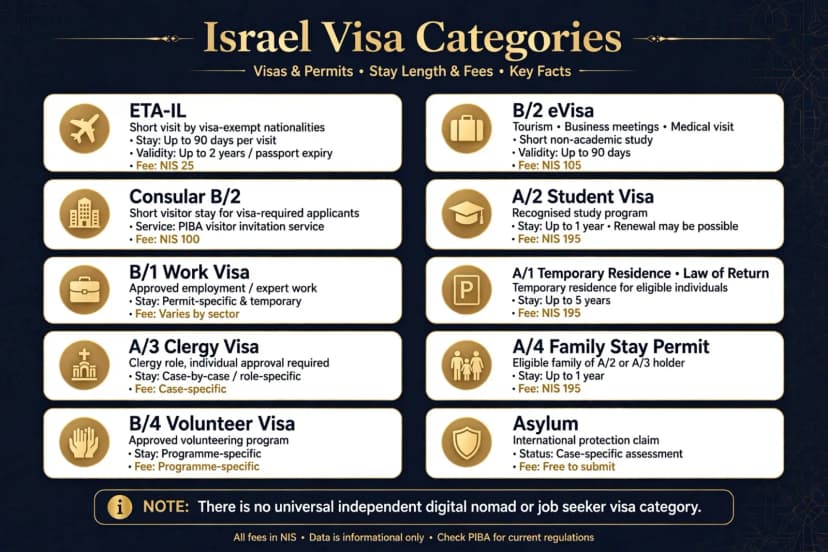
The B/2 category covers tourism, visiting friends or relatives, business meetings, medical tourism and short non-academic study. It does not permit employment. The official visa-options page says B/2 visas are usually single-entry and commonly valid for three months from issue; the actual visa and border permission govern the individual case. The permitted stay is determined by the authority, and visitors must not treat the visa's issue validity as permission to remain for the whole period.
Nationals of visa-exempt countries must obtain ETA-IL before travel. The official ETA-IL service lists a NIS 25 fee, validity of up to two years or until passport expiry (whichever comes first), and visits of up to 90 days or less. A new passport or change in name, gender or citizenship requires a new authorization. Apply only through the official Israel-entry/PIBA website. ETA-IL is not available to a passport nationality that requires a B/2 visa.
For visa-required nationalities, the PIBA eVisa-B2 system is available to eligible nationalities listed for the pilot. On the live portal the pilot is currently limited to Indian and Sri Lankan citizens residing in their home countries; an Israeli Embassy announcement of 23 October 2026 lists 63 countries including Vietnam, but that expansion is not yet in effect on the portal and no start date was given. The published fee is NIS 105, non-refundable. The official page lists passport copy, recent photograph, return ticket, Israeli-valid health insurance, accommodation or host details and evidence of funds; additional invitation or official documents may apply. Some applicants may still be asked to attend a consulate. The authority's current country list and application portal must be checked before relying on the online route.
A/2 student visa
The A/2 visa is for foreign students admitted to eligible higher-education institutions or yeshivas, and specified recognised study programmes. PIBA lists an admission letter, proof of tuition payment, proof of living means, valid passport, photograph and original birth certificate. A/2 status may be issued for up to one year and renewed where eligible; renewal may require an academic transcript or grades sheet. The published service fee on the PIBA student page is NIS 195. Do not assume that an A/2 holder may work: the student status is for study, and ordinary employment is not authorised by that visa.
Language courses or short non-academic study may fall under B/2 rather than A/2 depending on the course and circumstances. Ask the institution and mission to confirm the correct category before applying.
B/1 work visa and foreign experts
B/1 is the principal temporary work-visa category. PIBA identifies foreign workers in approved sectors such as industry, welfare, construction and agriculture, as well as foreign experts. The employer, company or other authorised inviting party normally initiates the permit application in Israel; the approval is then transmitted to the consulate for visa issuance. The worker cannot simply enter as a tourist and start work.
The employer must hold the relevant permission and register the worker according to the applicable sector procedure. Work is restricted to the approved employer and conditions. A B/1 visa is not a general job-search visa, and changing employers or sectors requires formal authorisation. Foreign experts may need a CV, diplomas, professional certificates and evidence explaining the employer's need. PIBA publishes different employer-side fees by category; the 2026 fee schedule and calculator should be checked for the precise case. For example, the official expert-permit page publishes an employer application fee of NIS 1,420 for most experts and NIS 1,060 for expert chefs, while separate annual charges may apply.
A/1 temporary residence under the Law of Return
A/1 is for a person eligible to make Aliyah under Israel's Law of Return who has not yet decided to become an Israeli citizen. PIBA says this temporary residence visa can be valid for up to five years and permits the holder to live and work in Israel. Evidence may include a foreign passport, proof of eligibility under the Law of Return, birth or community records, photographs and an explanatory letter. The published PIBA service fee is NIS 195. This is not a general skilled-worker or investor route; eligibility under the Law of Return is central.
A/3 clergy visa
A/3 is for clergy invited to perform a religious role by a recognised religious institution. The inviting institution in Israel submits the request to the Ministry of Interior/PIBA, and approval is sent to the consulate. A person who is merely visiting religious sites or attending meetings should use the appropriate visitor route rather than assuming A/3 applies.
A/4 family status for students or clergy
Eligible spouses and children under 18 of certain A/2 students or A/3 clergy may apply for a family stay permit. PIBA's published service page lists a NIS 195 fee, individual applications for each passport holder, valid passports, birth and relationship records and proof that the principal student or clergy member holds the relevant status. The authority may require documents to be authenticated and translated. A/4 should not be confused with family reunification for the spouse of an Israeli citizen or permanent resident.
B/4 volunteer visa
B/4 is used for specified volunteer placements, including certain kibbutz, moshav, welfare-institution, Baha'i-centre and youth-movement programmes. It is not a general permission to take paid employment. The host organisation and the Israeli mission should confirm that the programme qualifies and provide the required invitation and supporting paperwork.
Family reunification with an Israeli citizen or permanent resident
A foreign spouse or common-law partner of an Israeli citizen or permanent resident may be able to apply for legal status through a gradual, documented procedure. The Israeli partner or their representative submits the online request through PIBA's service. The authority examines the genuineness and exclusivity of the relationship, personal status, identity, residence and other eligibility factors. The process is not an automatic spouse visa and may involve staged temporary status, interviews and repeated evidence. Family members of students or clergy follow the separate A/4 process.
Permanent residence and settlement
Israel does not offer a simple general-purpose permanent-residence visa to every foreign worker, student or long-term visitor. Permanent status may arise through specific legal routes, including qualifying family procedures, humanitarian decisions or other statutory grounds. Eligibility under the Law of Return is a separate immigration route. Do not assume that holding B/1 or A/2 for a certain number of years automatically leads to permanent residence.
Transit, exchange, internships and research
There is no universal independent “digital nomad” or “job seeker” visa category identified in the official PIBA visa-options list. Israel also does not provide a general points-based skilled-worker visa: employment is based on the applicable B/1 employer and permit framework. Exchange, internship, academic research and training activities must be classified according to the programme, institution, remuneration and work involved. A/2 may fit recognised academic study; paid work or expert activity may require B/1; short non-academic study may fit B/2. Confirm the route with the Israeli mission before travel. Do not assume a B/2 visa authorises an internship or research employment.
For transit, do not assume that remaining airside or changing airports removes visa requirements. Ask the airline and the responsible Israeli mission whether your itinerary requires a visa or other clearance, especially if you must pass border control, collect baggage or change terminals.
Humanitarian protection and asylum
Asylum is not a visitor-visa category. Foreign nationals seeking political asylum may submit an online application to PIBA; the published service is free. The process includes later in-person registration and interview stages. A submission receipt is not confirmation that the claim has been accepted. Special humanitarian stay permits are a separate, case-specific process with supporting evidence and a fee determined by status. People facing danger should seek qualified legal assistance and use official protection channels; they should not rely on a tourist visa as a substitute for a protection claim.
Visa Comparison Table
| Route | Main purpose | Work rights | Published fee / charge | Validity or stay |
|---|---|---|---|---|
| ETA-IL | Short visit by visa-exempt nationalities | No employment | NIS 25 | Valid up to 2 years / passport expiry; visit up to 90 days |
| B/2 eVisa | Tourism, business meetings, medical visit, short non-academic study | No | NIS 105 | Visa validity up to 90 days as decided; stay set at border |
| Consular B/2 | Short visitor stay for visa-required applicants | No | PIBA visitor invitation service lists NIS 100; consular charge may differ | Individual decision |
| A/2 | Recognised study | No general work right | NIS 195 | Up to 1 year; renewal may be possible |
| B/1 | Approved employment / expert work | Only as authorised | Varies by sector and employer procedure | Permit-specific and temporary |
| A/1 | Law of Return temporary residence | Yes | NIS 195 | Up to 5 years |
| A/3 | Clergy role | Only within approved religious role | Check mission / PIBA | Individual approval |
| A/4 | Eligible family of A/2 or A/3 holder | No general work right | NIS 195 | Up to 1 year |
| B/4 | Approved volunteering | Volunteering only | Check mission / PIBA | Programme-specific |
| Asylum | International protection claim | Depends on status and separate permission | Free to submit | Case-specific |
Fees are official published figures available on the cited pages at the verification date. They are not a complete consular fee schedule. Some charges are paid by the Israeli inviter or employer rather than by the foreign applicant. Confirm the precise amount and payment method before filing.
Eligibility Requirements
The first eligibility test is nationality. A visa-exempt passport holder may need ETA-IL; a visa-required passport holder needs a B/2 visa or another appropriate category. A small group of nationalities can use the eVisa-B2 pilot; other visa-required nationalities must apply through an Israeli mission. A residence permit issued by a third country does not change the applicant's nationality-based visa classification.
The second test is purpose. The applicant must select a category that matches the real activity: tourism, study, employment, religious service, volunteering, family status or protection. A visitor cannot lawfully work simply because a company has offered a job. A student admission letter does not itself authorise employment.
The third test is evidence. The authority may assess the applicant's identity, travel history, funds, accommodation, purpose, sponsor, ties and compliance history. Security screening or additional documents may be required. The official eVisa-B2 page specifically notes that some applicants may be asked to attend the nearest consulate.
Complete Document Checklists
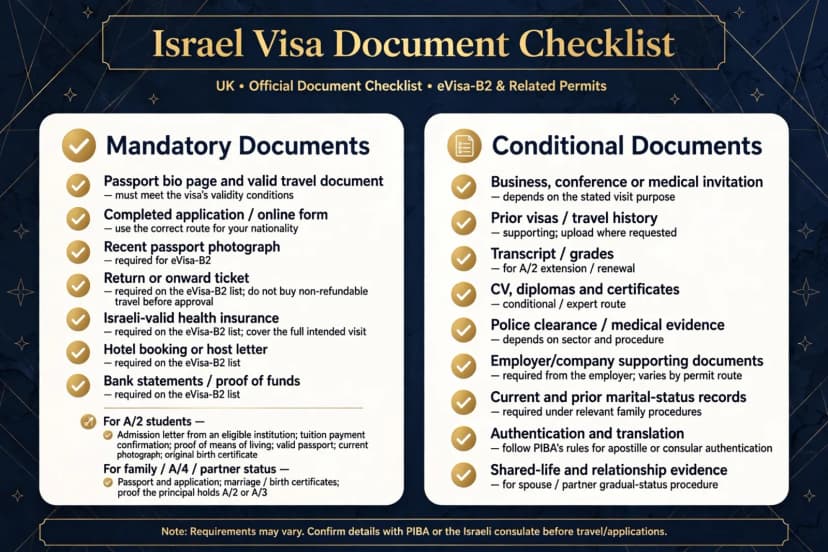
The following tables separate common core evidence from conditional documents. The exact checklist on the relevant PIBA page or Israeli mission controls.
Visitor / B/2 checklist
| Document | Status | Notes |
|---|---|---|
| Passport bio page and valid travel document | Required | Must meet the visa's validity conditions |
| Completed application / online form | Required | Use the correct route for nationality |
| Recent passport photograph | Required for eVisa-B2 | Follow mission specifications for consular filing |
| Return or onward ticket | Required on eVisa-B2 list | Do not buy non-refundable travel before approval |
| Israeli-valid health insurance | Required on eVisa-B2 list | Cover the full intended visit |
| Hotel booking or host letter | Required on eVisa-B2 list | Host letter should identify address and contact details |
| Bank statements / proof of funds | Required on eVisa-B2 list | The official page lists recent statements or other proof of means |
| Business, conference or medical invitation | Conditional | Depends on the stated visit purpose |
| Prior visas / travel history | Supporting | Upload where requested or relevant |
A/2 student checklist
| Document | Status | Notes |
|---|---|---|
| Admission letter from eligible institution | Required | Confirm the institution/programme qualifies |
| Tuition payment confirmation | Required | As listed by PIBA |
| Proof of means of living | Required | No universal minimum amount stated on the cited service page |
| Valid passport | Required | For the visa period |
| Current photograph | Required | Follow mission format |
| Original birth certificate | Required | PIBA lists original certificate |
| Transcript / grades | Conditional | For extension / renewal |
B/1 work checklist
| Document | Status | Notes |
|---|---|---|
| Israeli employer permit / PIBA approval | Required | Employer initiates the process |
| Employment contract | Required where specified | Must match approved conditions |
| Passport and visa application | Required | Mission-specific filing |
| CV, diplomas and certificates | Conditional / expert route | Evidence of expertise and qualifications |
| Police clearance / medical evidence | Conditional | Depends on sector and procedure |
| Employer/company supporting documents | Required from employer | Varies by permit route |
Family / A/4 / partner status checklist
| Document | Status | Notes |
|---|---|---|
| Passport and application | Required | Separate application for each passport holder where applicable |
| Marriage / birth certificates | Required as relevant | Establish relationship |
| Proof principal holds A/2 or A/3 | Required for A/4 | Valid status must be shown |
| Current and prior marital-status records | Conditional | Required under relevant family procedures |
| Authentication and translation | Conditional / often required | Follow PIBA's rules for apostille or consular authentication |
| Shared-life and relationship evidence | Conditional | For spouse / partner gradual-status procedure |
How to Apply: Step-by-Step
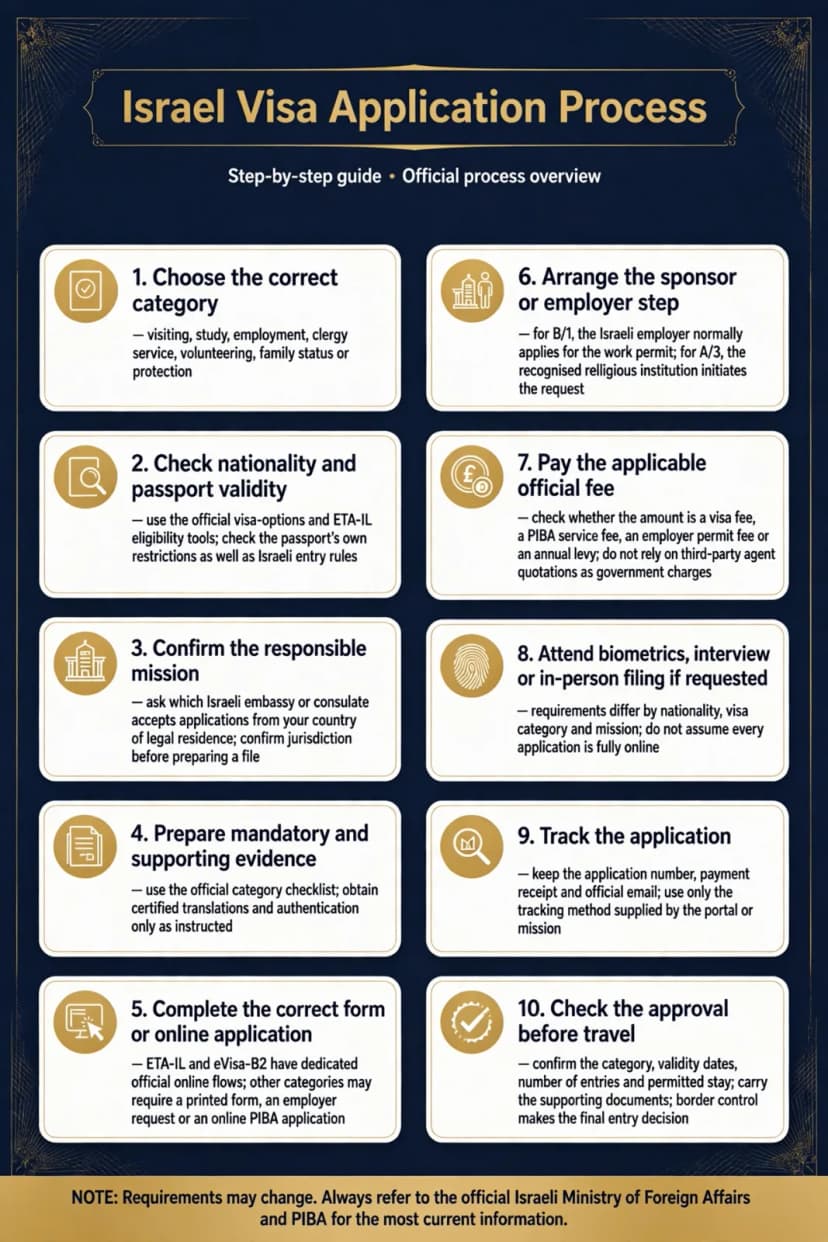
- Choose the correct category. Identify whether the purpose is visiting, study, employment, clergy service, volunteering, family status or protection.
- Check nationality and passport validity. Use the official visa-options and ETA-IL eligibility tools. Check the passport's own restrictions as well as Israeli entry rules.
- Confirm the responsible mission. Ask which Israeli embassy or consulate accepts applications from your country of legal residence. Confirm jurisdiction before preparing a file.
- Prepare mandatory and supporting evidence. Use the official category checklist. Obtain certified translations and authentication only as instructed.
- Complete the correct form or online application. ETA-IL and eVisa-B2 have dedicated official online flows. Other categories may require a printed form, an employer request or an online PIBA application.
- Arrange the sponsor or employer step. For B/1, the Israeli employer normally applies for the work permit. For A/3, the recognised religious institution initiates the request. Family procedures require the Israeli partner or eligible principal applicant to take the prescribed steps.
- Pay the applicable official fee. Check whether the amount is a visa fee, a PIBA service fee, an employer permit fee or an annual levy. Do not rely on third-party agent quotations as government charges.
- Attend biometrics, interview or in-person filing if requested. Requirements differ by nationality, visa category and mission. Do not assume every application is fully online.
- Track the application. Keep the application number, payment receipt and official email. Use only the tracking method supplied by the portal or mission.
- Check the approval before travel. Confirm the category, validity dates, number of entries and permitted stay. Carry the supporting documents and understand that border control makes the final entry decision.
Not every application follows all ten steps. An ETA-IL is an online authorization; a B/1 case begins with an Israeli employer; an asylum claim follows a distinct protection process.
Visa Fees and Financial Requirements
| Item | Published amount | Who / what it relates to |
|---|---|---|
| ETA-IL | NIS 25 | Eligible visa-exempt visitor authorization |
| eVisa-B2 handling fee | NIS 105 | Eligible visa-required visitor applicant; non-refundable |
| PIBA B/2 visitor invitation service | NIS 100 | Israeli citizen/resident inviting a foreign visitor through PIBA |
| A/2 student visa service | NIS 195 | Student application |
| A/1 Law of Return temporary residence | NIS 195 | Eligible A/1 applicant |
| A/4 family stay permit | NIS 195 | Eligible family member of student/clergy |
| Foreign expert employer permit | NIS 1,420 (most experts); NIS 1,060 (expert chefs) | Employer-side permit application; additional charges may apply |
These amounts are not interchangeable. The NIS 100 B/2 invitation service is not necessarily the same charge as a consular visa fee. B/1 costs vary by sector, duration and employer route. The PIBA 2026 foreign-worker fee schedule includes separate annual charges. For financial evidence, the eVisa-B2 page asks for recent bank statements or another document demonstrating sufficient funds; the student page asks for proof of means of living. The cited pages do not establish one universal minimum bank balance for all applicants.
Visa Processing Times
A single processing time does not apply to all Israeli visas. The official ETA-IL information recommends submitting at least 72 hours before making travel bookings, and official mission information says a reply is generally expected within 72 hours. This is guidance, not a guarantee. The eVisa-B2 portal does not promise a universal processing time. Consular B/2, A/2, B/1 and family procedures depend on completeness, nationality, sponsor approvals, security checks, appointments and the responsible mission. PIBA's service pages do not publish one universal processing time for these categories. Treat the timing as not officially published / case-specific unless the responsible authority gives you a current estimate.
Applying from Pakistan or Vietnam
Pakistani passport holders
Pakistan's ordinary passport is generally stated to be valid for travel to all countries except Israel. The U.S. Department of State's Pakistan reciprocity page also records this passport restriction, and Pakistan's Passports Act requires citizens to travel only where their passport is valid. This means the issue is not solved by applying for an Israeli visitor visa from a third country. Pakistani nationals must obtain authoritative advice from Pakistan's Directorate General of Immigration & Passports about their individual passport and any applicable exception before considering travel.
Pakistan does not appear in the published eVisa-B2 eligible-country list surfaced by the Israeli Embassy's notice. Nor can a Pakistani citizen use ETA-IL, which is only for eligible visa-exempt nationalities. The ordinary route for visa-required nationals is a consular B/2 application, but a Pakistani passport's Israel exclusion creates a separate validity barrier that must be resolved first. Do not submit a misleading application or travel document.
Pakistani citizens legally living or working in Vietnam
A Vietnamese residence card or work permit proves lawful residence in Vietnam; it does not change Pakistani citizenship or automatically make the holder eligible for Israel's eVisa-B2 pilot. Vietnam appears in the Israeli Embassy's published eVisa-B2 eligible-country list, but eligibility is tied to the applicant's nationality/country eligibility, not simply the place where the applicant happens to live. A Pakistani passport holder should therefore not select Vietnam as a workaround.
The Israeli Embassy in Hanoi lists a consular section for people planning to visit Israel and gives the contact email HanoiConsularDepartment@hanoi.mfa.gov.il and telephone +84 24 37187500. The embassy asks applicants to schedule visits by email. A Pakistani resident in Vietnam should write before submitting anything, disclose Pakistani citizenship and Vietnamese legal residence, provide the passport type and ask whether the mission can accept an inquiry or application, whether any exceptional travel document route exists, and what proof of Vietnamese residence it requires. The embassy's public page does not explicitly confirm that it will accept a Pakistani national's application, so acceptance must not be assumed.
Applying from Pakistan versus Vietnam
| Issue | Applying from Pakistan | Applying while resident in Vietnam |
|---|---|---|
| Nationality rule | Pakistani passport restriction remains central | Same Pakistani passport restriction remains central |
| ETA-IL | Not available on the basis of Pakistani nationality | Not available merely because of Vietnamese residence |
| eVisa-B2 | Pakistan is not shown in the published pilot eligible list | Vietnam's listing does not confer eligibility on Pakistani citizens |
| Consular contact | Confirm through Pakistan's government and nearest Israeli mission responsible for the case | Israeli Embassy Hanoi consular email / appointment process; ask for written jurisdiction confirmation |
| Residence evidence | Pakistani residence and civil records as requested | Vietnamese residence card, work permit and local address may be relevant if the mission agrees to assess a case |
| Passport validity | Check the explicit Israel exclusion with Pakistan DGIP | The same passport restriction applies outside Pakistan |
Practical conclusion: lawful residence in Vietnam is not a substitute for a passport valid for Israel. Before paying any fee, obtain written confirmation from Pakistan DGIP and the Israeli Embassy in Hanoi. If the passport restriction cannot lawfully be resolved, do not proceed with travel planning.
Student Visa Guide
Students should first obtain admission from an institution eligible for the A/2 route. The official PIBA page requires an admission letter, tuition payment confirmation, proof of living means, valid passport, photograph and original birth certificate. The fee shown is NIS 195, and the visa may be issued for up to one year. Renewal can require grades or a transcript. Applicants should confirm whether their programme is academic, yeshiva-based, language-only or short-term, because the correct status may differ. A student visa should not be treated as permission to work. Family members may be eligible for a separate A/4 stay permit, subject to the published conditions and documents.
Work Visa and Job Opportunities
A foreign national generally needs a genuine job offer and an employer authorised to hire foreign workers under the applicable programme. The employer must obtain the permit and complete the required registration before the worker begins employment. B/1 status is temporary and tied to the approved conditions. Foreign experts may need to demonstrate advanced qualifications or specialised experience, and the employer must explain the need for the hire. A job advertisement, offer letter or informal promise is not itself a work permit. There is no general job-seeker visa in the official categories reviewed, and a visitor must not work while waiting for a work permit.
Family Immigration and Permanent Residence
Family routes differ according to the relationship and the principal person's status. A/4 is for qualifying family members of certain students or clergy. A foreign spouse or partner of an Israeli citizen or permanent resident may apply under the gradual family-status procedure. The latter requires a genuine relationship and ongoing review; it is not a one-step automatic grant. Permanent residence is not a routine reward for holding a temporary visa. People eligible under the Law of Return should examine the A/1 or Aliyah route, while humanitarian cases should use the separate relevant process.
Common Application Mistakes
- Applying under B/2 when the real purpose is paid employment or a structured work placement.
- Treating ETA-IL validity as permission to stay for two years.
- Assuming an approved ETA-IL or visa guarantees admission at the border.
- Using a third-country residence permit as if it changed nationality-based eligibility.
- Assuming every visa-required nationality can use eVisa-B2.
- Paying an unofficial intermediary without confirming the official fee and portal.
- Submitting incomplete, inconsistent or unauthenticated civil documents.
- Booking non-refundable flights before the authority has decided the application.
- Starting work before the B/1 permit and visa conditions are effective.
- Assuming long residence on a temporary visa automatically creates permanent residence.
- For Pakistani passport holders, overlooking the passport's Israel-exclusion endorsement.
Reasons for Visa Refusal or Entry Denial
Applications may be refused or delayed where the authority is not satisfied with the stated purpose, funds, accommodation, sponsor, documents, identity, travel history or compliance record. Inconsistencies, false statements, altered records, missing employer approval, an ineligible institution or a category that does not match the activity can undermine an application. Security screening may lead to additional questions or checks. Even with a valid visa or ETA-IL, an officer at the border may refuse entry under applicable law and procedures. Do not conceal prior refusals, employment plans or passport restrictions.
Frequently Asked Questions
1. Do I need a visa to visit Israel in 2026?
It depends on your passport nationality. Visa-exempt nationals need ETA-IL before travel; visa-required nationals need a B/2 visa or other appropriate visa. Check the official eligibility tool.
2. How much does ETA-IL cost?
The official ETA-IL site lists NIS 25. It is valid for up to two years or until passport expiry, whichever comes first.
3. How long can I stay with ETA-IL?
Eligible visitors may travel for visits of up to 90 days or less. The authorization does not grant a two-year stay.
4. Can I work in Israel on a tourist visa?
No. B/2 visitors are not permitted to work. Employment normally requires B/1 status and the relevant employer permit.
5. Can I apply for an Israel eVisa from Vietnam?
The eVisa-B2 pilot on the live portal is currently limited to Indian and Sri Lankan citizens residing in their home countries. An embassy announcement of 23 October 2026 lists 63 countries including Vietnam, but that expansion is not yet in effect. Eligibility is based on nationality, not simply residence in Vietnam. Check the live list before applying.
6. Can a Pakistani citizen living in Vietnam apply for ETA-IL?
No, not on the basis of Pakistani nationality. ETA-IL is for eligible visa-exempt nationalities. A Vietnamese residence permit does not change that.
7. Can a Pakistani passport holder travel to Israel?
Pakistani ordinary passports are generally endorsed as not valid for Israel. Contact Pakistan's Directorate General of Immigration & Passports and obtain authoritative written advice before considering any application or travel.
8. What is the Israel student visa fee?
The PIBA student-visa service page lists NIS 195. Check the relevant mission for any additional consular charges or current payment instructions.
9. Can A/2 students work part-time?
The official student route is for study and does not provide a general right to work. Do not take employment unless PIBA confirms a separate lawful permission.
10. How do I get an Israel work visa?
An Israeli employer generally initiates the work-permit request in Israel. After approval, the consular visa process is completed according to the mission's instructions.
11. Is there an Israel digital nomad visa?
No general digital-nomad visa appears in the official PIBA visa categories reviewed for this guide. Do not assume remote work is authorised under B/2.
12. Is there an Israel job-seeker visa?
No general job-seeker visa appears in the official category list reviewed. A job offer does not replace the B/1 employer permit process.
13. Does a visa guarantee entry?
No. Final admission is subject to border control. ETA-IL and eVisa-B2 approvals permit travel to the border but do not guarantee entry.
14. Can a foreign spouse of an Israeli citizen obtain residence?
A foreign spouse or partner may apply under the gradual family-status procedure. Approval depends on eligibility and continuing examination; it is not automatic.
15. Where can I ask about applying from Vietnam?
Contact the Israeli Embassy in Hanoi at HanoiConsularDepartment@hanoi.mfa.gov.il. Ask whether it has jurisdiction for your nationality and legal residence before making an appointment.
Official Immigration Websites
- Israel Population and Immigration Authority (PIBA) — ETA-IL and visa information
- ETA-IL: official information
- eVisa-B2: official information and document list
- PIBA visa options
- PIBA: B/2 visitor visa service
- PIBA: A/2 student visa service
- PIBA: A/1 Law of Return temporary residence
- PIBA: foreign expert work permit
- PIBA: family status for foreign partner
- PIBA: family members of students or clergy
- PIBA: asylum application
- Israeli Embassy in Vietnam — consular section
- Israeli Embassy in Vietnam — contact details
- Pakistan Directorate General of Immigration & Passports
Final Checklist and Conclusion
Before applying, identify the exact passport and category; check the official nationality list; verify passport validity and any national restrictions; confirm which mission has jurisdiction; collect the correct documents; check the latest official fees; and wait for the decision before committing to travel. Workers must ensure the employer has the required permit before employment begins. Students must use a qualifying programme and maintain their status. Visitors must not work, overstay or misrepresent the purpose of travel.
For Pakistani nationals living in Vietnam, the passport restriction is a threshold issue. Vietnamese residence does not by itself make a Pakistani passport valid for Israel or confer access to the eVisa pilot. Obtain written guidance from Pakistan DGIP and the Israeli Embassy in Hanoi before taking further steps.
Disclaimer: This article is for general educational information, not legal advice or a guarantee of a visa or entry. Immigration rules, fees, security requirements and consular practices can change. The law and current instructions of PIBA and the responsible Israeli mission prevail. MAS Inspire is an independent educational resource and is not an Israeli government authority or visa agency.


