


By MAS Inspire | Last reviewed: 27 November 2026 (key figures re-verified 27 November 2026)
Introduction
Indonesia welcomes visitors for tourism, family visits, business meetings, education, employment, investment and longer-term residence. The correct immigration route depends on your passport, reason for travel, intended activities, length of stay and whether you have an Indonesian sponsor.
Indonesia's system is not simply a choice between a tourist visa and a work visa. It uses letter-and-number visa indexes, including C-series visitor visas, D-series multiple-entry visitor visas and E-series limited-stay visas. After arrival, a foreign national may hold a Visit Stay Permit (ITK), Limited Stay Permit (ITAS) or Permanent Stay Permit (ITAP), depending on the route.
This 2026 guide explains the main pathways, documents, fees and application steps, including practical notes for Pakistani passport holders who legally live or work in Vietnam. It is educational information, not individual legal advice. Always check the live Indonesian e-Visa portal before applying.
Why People Visit, Study, and Work in Indonesia
Indonesia offers tourism destinations such as Bali, Yogyakarta, Jakarta, Komodo National Park and the Borobudur area. It also attracts international students, researchers, business visitors, investors and professionals in sectors such as technology, education, engineering, manufacturing, hospitality and energy.
The purpose of travel matters. Attending a meeting is not the same as taking a paid job. Studying at a university is not the same as attending a short course. Working remotely for a foreign employer is not automatically covered by a tourist visa. Select the visa whose authorized activities match what you will actually do.

Types of Indonesia Visas
Indonesia publishes a broad set of visa indexes. The categories below are a practical map, not an exhaustive list of every sub-index.
1. Tourist and visitor visas
- B1 Visa on Arrival/e-VoA: A single-entry visitor route for nationals on the current eligible list. The initial stay is up to 30 days and may be extended once for a total of up to 60 days. Pakistan is not shown on the official VoA list consulted for this guide; Pakistani ordinary passport holders should not plan to board on the assumption that they can obtain VoA.
- C1 single-entry visitor visa: Used for tourism, family visits, certain meetings/events and transit. The initial stay is up to 60 days; extensions may be available up to a cumulative 180 days. It requires a sponsor under the published C1 guidance and does not permit Indonesian-source work or remuneration.
- D1 multiple-entry visitor visa: For repeated visits for permitted visitor activities, including tourism and family visits. The exact validity, stay per entry, fee and sponsor rules depend on the option displayed in the portal.
2. Business visitor visas
- C2: Single-entry business visit activities such as meetings, negotiations, business events and permitted inspections. It is not a general employment visa.
- D2: Multiple-entry business visitor route for eligible repeated business visits.
- Other C/D indexes cover more specific activities, including pre-investment, product promotion, speakers, film production, auditing, sport, arts and cultural activities. Use the precise activity index shown by Immigration.
A visitor visa does not authorize ordinary paid employment in Indonesia. If you will fill a position, provide services to an Indonesian entity or receive local remuneration, ask the employer and immigration adviser to confirm the correct work route.
3. Student and language-study visas
Indonesia has limited-stay education visas, including:
- E30: Non-formal education, such as eligible language, professional or skills courses.
- E30A: Primary/secondary education.
- E30B: Higher education.
- E30F: Student exchange, where the index and current eligibility apply.
The student normally needs an educational institution or other permitted sponsor. A short course may instead fit a C9 short-study visitor visa, depending on its duration and nature. Do not use a visitor visa for a course that requires a formal student stay permit.
4. Work and employer-sponsored visas
Indonesia offers limited-stay work visas, including E23 variants for different sectors and roles, E24 variants for certain digital occupations, E25 variants for commissioners and executives, and E26 for specified shipboard/offshore work. Other specialist indexes cover religious workers and researchers.
A genuine Indonesian employer or other eligible sponsor normally coordinates the immigration process and applicable manpower approvals. A foreign worker must work only in the approved role, employer and activity scope. The visa or ITAS alone should not be treated as a blanket permission to work for any company.
5. Job seeker and skilled-worker routes
Indonesia does not operate a general open-ended job-seeker visa comparable to countries that permit entry solely to search for work. The practical route is normally to secure a qualifying offer and sponsor first, then apply under the relevant work category.
Skilled professionals may qualify for a work visa when an Indonesian sponsor can lawfully employ them and meet the applicable requirements. The exact occupation, qualifications, employer documentation and approval route matter.
6. Digital nomad and remote-worker route
E33G — Remote Worker is an official limited-stay option for a foreign national working remotely for a company outside Indonesia. The official immigration guidebook summary describes a one-year stay, no local sponsor, a foreign employment contract, annual salary of at least USD 60,000, three months of bank statements with a balance of at least USD 2,000 and a fee of IDR 7,000,000.
The E33G route does not authorize work for, or payment from, Indonesian individuals or companies. The source currently available is the official 2024 guidebook; check the portal for any revised 2026 requirements before relying on these figures.
7. Entrepreneur, startup and investor routes
Investor options include E28 and its variants. Some routes are designed for an investor establishing or participating in an Indonesian company; others cover specified capital-market investments, corporate investment or special economic zones. Golden Visa pathways can provide longer limited-stay periods, including 5- or 10-year options for qualifying categories.
Investment commitments, company capital, roles and guarantee deposits are index-specific. Do not transfer a threshold from one Golden Visa category to another. The published headline thresholds for the individual routes are: E28C capital-market investor — USD 350,000 in Indonesian government bonds, listed shares or mutual funds for a 5-year stay, or USD 700,000 (or a residential apartment worth at least USD 1,000,000) for 10 years; E28B company founder — USD 2,500,000 for 5 years or USD 5,000,000 for 10 years (Muse enhancement, verified 25 Nov 2026). Government charges are separate — 2026 guides quote IDR 13,000,000 for 5 years / IDR 19,500,000 for 10 years per applicant; confirm on the portal. Review the official Golden Visa information and the exact e-Visa category before committing funds.
8. Family, spouse and dependent visas
Family routes include E31 variants for spouses, children, parents and eligible dependants of Indonesian citizens or foreign nationals holding qualifying Indonesian permits. E31A is associated with a foreign spouse joining an Indonesian citizen; other indexes cover joining an eligible ITAS/ITAP holder or children in specified family circumstances.
Prepare civil-status documents, proof of relationship and any required legalization, translation or Indonesian sponsor documents. A family visa does not automatically authorize employment; separate work authorization or a permitted combined activity may be required.
9. Permanent residence and settlement
ITAP is Indonesia's permanent stay permit. It is not a general first-entry visa. Many applicants must first hold an eligible ITAS and satisfy the relevant conditions. Immigration guidance describes ITAP as valid for five years and renewable for an unlimited period, subject to continued compliance and reporting obligations. Certain spouses of Indonesian citizens and other defined groups may have specific routes.
In January 2026, Immigration also described Global Citizen of Indonesia (GCI) arrangements for defined groups, including former Indonesian citizens, qualifying descendants and certain family members. GCI is a specific diaspora/family policy, not an unrestricted permanent-residence route for every foreign national.
10. Transit visas
A short transit may be covered by a visitor visa such as C1 where the activity and eligibility match. Do not assume that every nationality can transit visa-free or that an airside connection permits entry into Indonesia. If you must pass immigration, collect baggage, change airports or stay overnight landside, confirm the correct visa with the airline and Indonesian Immigration.
11. Exchange, internship, training and research
Indonesia has purpose-specific visitor and limited-stay indexes for short study, internships, training, research, academic activities and other specialist purposes. Examples include C9 for short study, C22 for internship-related activity and E29 for research. The sponsor, host institution and activity determine the right category. An internship that involves productive work must not be treated as ordinary tourism.
12. Humanitarian protection
Indonesia is not a general immigration destination with a conventional permanent refugee resettlement visa. Refugees and asylum seekers are handled under Indonesia's domestic framework and cooperation arrangements, including the role of UNHCR. Anyone seeking protection should contact UNHCR and qualified legal assistance rather than applying under a tourist or employment visa.
Visa Comparison Table
| Route | Main purpose | Typical stay/validity | Work rights | Fee information |
|---|---|---|---|---|
| B1 e-VoA | Tourism/eligible visitor activity | 30 days; one extension to total 60 days | No local employment | Check portal; standard published VoA tariff can change |
| C1 | Tourism, family visit, specified events/transit | 60 days initially; extensions up to 180 days | No Indonesian-source work/pay | IDR 1,000,000 |
| C2 | Single-entry business visit | As granted; check index | No ordinary employment | Check portal |
| D1/D2 | Multiple-entry tourism/business | Category options may be 1, 2 or 5 years; stay per entry shown in grant | No ordinary employment | Check portal |
| E30/E30A/E30B | Education | Index-specific; E30 non-formal 1 or 2 years; formal options vary | Study; work not automatically allowed | E30 IDR 6m/8.5m; formal 4-year E30A/B IDR 12m per 2025 notice |
| E23/E24/E25 | Sponsored employment | Often 180 days, 1 or 2 years initially; index-specific | Only approved role/activity | Check portal and employer approvals |
| E28 / Golden Visa | Qualifying investment | Some categories 5 or 10 years | Only within permitted conditions | E28C USD 350k (5yr) / USD 700k (10yr); E28B USD 2.5m/5m; govt charges IDR 13m/19.5m — confirm on portal |
| E31 | Eligible family reunification | Index-specific | Not automatically | Check portal |
| E33G | Remote work for foreign employer | 1 year in official guidebook | No Indonesian clients/employers | IDR 7m in official guidebook |
| ITAP | Permanent stay permit | 5 years, renewable under conditions | Depends on underlying status and authorization | Published fee depends on service; check portal |
Eligibility Requirements
Requirements differ by index, nationality and sponsor. Common eligibility checks include:
- A valid national passport or accepted travel document. Several official visitor categories require at least six months' validity at application.
- A genuine purpose of travel that matches the selected visa index.
- A sponsor, guarantor, employer, school, family member or host institution where required.
- Evidence of sufficient funds where the category specifies it.
- Return/onward travel evidence where required by the relevant visa or carrier.
- Relevant invitation, employment, enrolment, relationship or investment documents.
- Compliance with any nationality-specific screening, calling-visa or additional approval rules.
A residence permit in a third country can help establish lawful residence for a consular application, but it does not override nationality-based restrictions or guarantee that a consulate will accept the case.

Complete Document Checklists
The lists below distinguish common core evidence from conditional supporting material. The portal's category-specific checklist controls.
| Document | Visitor C1/C2 | Student E30 | Work E23/E25 | Family E31 | E33G |
|---|---|---|---|---|---|
| Passport identity page; validity as required | Core | Core | Core | Core | Core |
| Recent colour passport photo | Core | Core | Core | Core | Core |
| Sponsor/guarantor letter and sponsor details | Required for C1 under published guidance | School/eligible sponsor | Employer/sponsor | Family sponsor | Not required locally in official guide |
| Proof of funds | C1: 3-month statement, min. USD 2,000 | Official E30 notice: min. USD 2,000 | As required by category | As required by category | 3-month statement, min. USD 2,000 |
| Invitation / itinerary / business documents | Purpose-dependent | Admission/enrolment evidence | Employment/role approvals | Relationship proof | Foreign employment contract |
| Education/qualification records | If relevant | School/academic documents | If relevant to role | Usually not core | Not specified in summary |
| Civil-status certificates | If relevant | If relevant | If relevant | Core where relationship is basis | Not applicable |
| Return/onward ticket | May be requested | Check category | Usually not core for residence route | Check category | Check portal |
| Residence permit in country of application | If applying abroad and requested | If applying abroad and requested | If applying abroad and requested | If applying abroad and requested | Not generally listed in guide summary |
Recommended supporting evidence: accommodation details, travel itinerary, prior visas and travel history, employer leave approval, proof of lawful residence in Vietnam, translated/legalized civil records, and a concise cover letter. These are not universal mandatory documents; submit them only where relevant or requested.
How to Apply: Step-by-Step
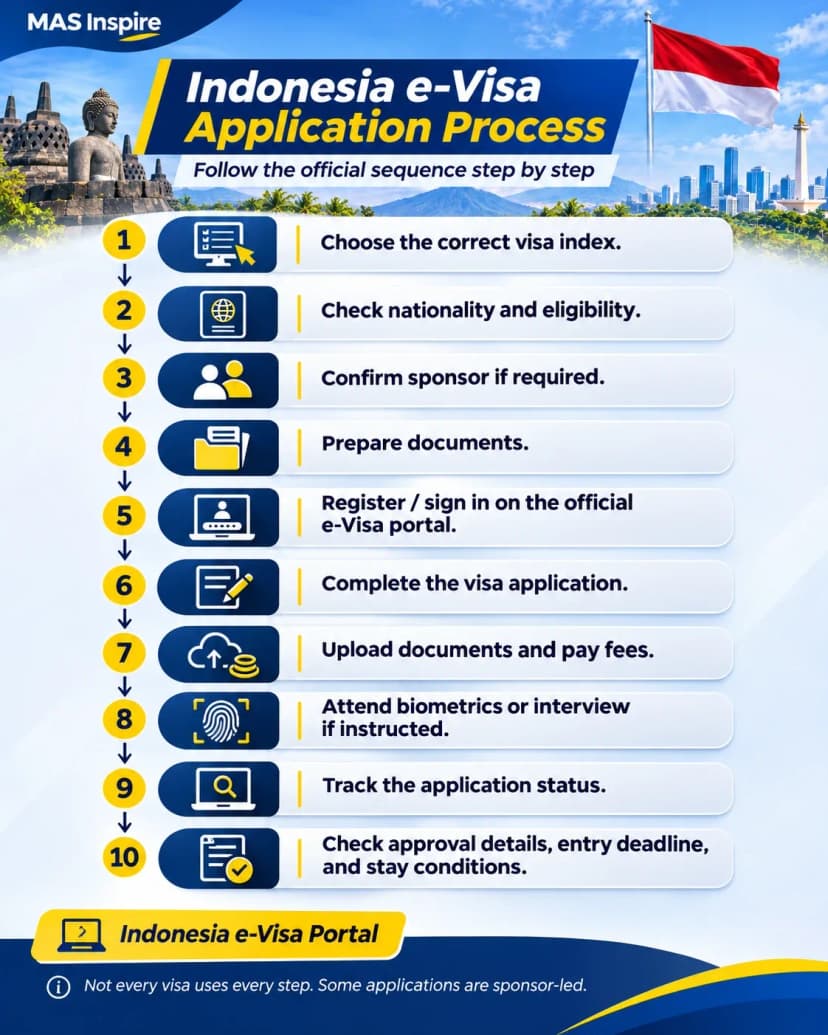
- Choose the correct visa index. Match the planned activity, duration and number of entries to the official category. Do not select a tourist visa for work or long-term study.
- Check nationality and place-of-application rules. Confirm whether your passport is eligible for visa exemption or VoA, whether additional screening applies, and whether a consulate will accept an application from a non-citizen resident.
- Confirm sponsorship. Ask the employer, school, Indonesian family member or other sponsor to confirm that they can sponsor the exact visa index.
- Prepare documents. Follow the portal checklist for file formats, passport validity, photo requirements, translations and supporting evidence.
- Create an account where required. Use the official e-Visa portal. The applicant or eligible sponsor may need an account depending on the category.
- Complete the application. Enter passport details, travel purpose, sponsor information and intended stay accurately. Names and passport numbers must match the travel document.
- Upload documents and pay. Pay only through the official payment flow and retain the payment reference. Fees can include visa and other immigration charges.
- Attend biometrics/interview if instructed. Do not assume all categories require an appointment. Follow the specific notice from the portal or Indonesian mission.
- Track the application. Use the portal account or the consular tracking method provided. Respond promptly to document requests.
- Review the approval and entry conditions. Check the visa index, entry deadline, permitted stay, entries, sponsor details and restrictions. On arrival, comply with immigration inspection and any ITAS/ITK activation or reporting requirements.
Not every application uses all ten steps. Some categories are filed by a sponsor; some are processed centrally online; some consular cases may require additional steps.
Visa Fees and Financial Requirements
Official amounts verified for selected routes include:
- C1 visitor visa: IDR 1,000,000. Published C1 guidance also specifies a bank statement for the preceding three months showing at least USD 2,000 (or equivalent) in the applicant's or sponsor's name.
- E30 non-formal education: IDR 6,000,000 for a one-year stay permit or IDR 8,500,000 for two years, according to the Immigration announcement of 16 July 2025. The same announcement specifies living-funds evidence of at least USD 2,000.
- E30A/E30B formal education: the 2025 announcement lists IDR 12,000,000 for a four-year option. Other durations and categories may have different fees.
- E33G remote worker: IDR 7,000,000 for one year in the official guidebook summary; USD 60,000 annual salary and USD 2,000 bank balance requirements are also stated there.
Separate from the visa fee, Bali charges a tourist levy of IDR 150,000 per person per trip (payable online via Love Bali or at the airport). Arriving travellers must also complete the free "All Indonesia" arrival declaration (allindonesia.imigrasi.go.id) up to three days before arrival — mandatory since 1 September 2025 at Soekarno-Hatta, Juanda, Ngurah Rai and the Batam ports (Muse enhancement, verified 25 Nov 2026).
For B1, C2, D visas, E23 work, E28 investment, E31 family and other indexes, use the current fee and guarantee displayed by the official portal. Do not rely on third-party fee calculators. Fees may include separate stay-permit, re-entry-permit or verification charges.
Visa Processing Times
The published C1 page gives a four-working-day processing time after payment is received. The E33G guidebook summary states approximately five working days for verification. These are official published indicators, not guaranteed completion dates.
For other categories, a single universal processing time is not officially published in the sources reviewed. Employer approvals, sponsor verification, document corrections, nationality screening, consular workload and requests for additional evidence can extend processing. Apply well before travel and avoid non-refundable bookings until the visa is granted.
Applying from Pakistan or Vietnam
Pakistani ordinary passport holders
Pakistan is not shown in the current VoA/visa-exemption list consulted for this guide. Pakistani ordinary passport holders should therefore plan for an appropriate visa in advance and confirm the live result through the official e-Visa portal. The Ho Chi Minh City Consulate General's official page also publishes a list of calling-visa nationalities; Pakistan was not among the listed countries in the page reviewed. That does not remove the need for an ordinary visa.
Pakistani citizens legally living or working in Vietnam
A Pakistani citizen resident in Vietnam may explore an online application through the official portal, where the selected visa and sponsor pathway permit it. If consular handling is required, contact the Indonesian mission responsible for the Vietnamese place of residence before preparing an in-person submission.
- Southern Vietnam: the Consulate General of Indonesia in Ho Chi Minh City lists its office at 18 Phung Khac Khoan Street, Saigon Ward, Ho Chi Minh City. Visa telephone: +84-28-3825-1888/9 or 3822-3799 ext. 112/119; email: hochiminh.kjri@kemlu.go.id.
- Hanoi: the Embassy of Indonesia in Hanoi is at 50 Ngo Quyen Street, Hoan Kiem, Hanoi; email: hanoi.kbri@kemlu.go.id.
Before applying locally, send the post a concise enquiry with: Pakistani passport nationality, Vietnamese residence card/permit type and expiry, current city, intended Indonesian visa index, purpose, sponsor details and proposed travel date. Ask whether they accept applications from Pakistani non-citizen residents, whether an appointment or original documents are required, and whether any additional security clearance applies.
A Vietnamese temporary residence card, work permit or long-term visa proves lawful stay in Vietnam; it does not guarantee local application acceptance, approval or exemption from Indonesian nationality-based requirements.
Applying from Pakistan versus Vietnam
| Issue | Applying from Pakistan | Applying from Vietnam |
|---|---|---|
| Place of application | Indonesian mission/official online route applicable to residence in Pakistan | Official portal; local mission only after confirming jurisdiction and acceptance |
| Proof of residence | Pakistani address/status as applicable | Valid Vietnamese residence card/visa and evidence of lawful stay may be requested |
| Sponsor | Depends on visa index | Same Indonesian sponsor rules; Vietnam residence does not replace sponsor |
| Nationality screening | Pakistani passport rules apply | Pakistani passport rules still apply |
| Extra step | Confirm current local mission procedure | Obtain written confirmation from KBRI Hanoi/KJRI HCMC before relying on local filing |
Student Visa Guide
International students should first obtain an admission or acceptance document from the Indonesian educational institution and ask its international office which E30 sub-index applies. Formal education routes include E30A for primary/secondary education and E30B for higher education; E30 also covers qualifying non-formal education such as language and professional courses. Exchange students may have a separate index.
The official 2025 announcement says E30 non-formal applicants need a sponsor, a passport valid for at least six months, a recent colour photo and proof of funds equivalent to at least USD 2,000. It lists IDR 6 million for one year and IDR 8.5 million for two years. The announcement also describes four-year options for E30A/E30B. Confirm the current exact tuition, sponsor and fee requirements with the institution and portal.
Do not assume a student visa grants unrestricted employment. Ask the institution and Immigration whether a proposed internship or paid activity is permitted and whether separate authorization is needed.
Work Visa and Job Opportunities
A foreign national generally needs a qualifying Indonesian sponsor and the correct work-related visa/permit route before starting employment. The employer should confirm the job title, work location, duration, required manpower approvals and the appropriate E23, E24, E25 or other index. Certain roles are restricted or require specific qualifications and approvals.
Do not begin work on a tourist, business visitor or remote-worker visa. E33G is designed for remote work for a foreign company and expressly excludes work for or payment from Indonesian entities. A work permit or employer approval and an immigration stay permit are related but distinct compliance elements; the employer should coordinate the complete process.
Family Immigration and Permanent Residence
A foreign spouse or dependent may qualify for an E31 family visa where the sponsor and relationship meet the relevant rules. Prepare official marriage or birth records and any required legalization and translation. For a spouse of an Indonesian citizen, ask Immigration whether E31A or a GCI-related route is applicable. For family members of a foreign ITAS/ITAP holder, the relevant sub-index depends on the sponsor's status.
ITAP is a permanent stay permit, usually following an eligible prior status or a specific direct route. Immigration information describes a five-year permit renewable for an unlimited period, subject to requirements. GCI is a distinct 2026 policy for defined diaspora and family groups; it should not be described as a general permanent visa for all foreigners.
Common Application Mistakes
- Choosing a visitor visa for an activity that is actually employment, formal study or an internship.
- Assuming a Pakistani passport is eligible for VoA because a different passport is.
- Treating visa validity as the same as permitted stay.
- Applying without the required Indonesian sponsor.
- Uploading unclear scans or inconsistent passport details.
- Providing financial evidence that does not meet the category's stated period or amount.
- Assuming a Vietnamese residence permit guarantees local consular processing.
- Relying on an outdated fee or third-party website.
- Working for an Indonesian entity while holding a visitor or E33G remote-worker status.
- Overstaying or failing to comply with reporting, address or permit conditions.
Reasons for Visa Refusal or Delay
Applications may be refused, returned or delayed if the purpose is unclear, the selected index does not match the activities, the sponsor is ineligible, documents are incomplete or inconsistent, funds are insufficient where required, or the applicant fails to satisfy additional screening. False declarations, altered documents, undisclosed prior immigration violations or attempts to work outside the permitted scope can create serious consequences.
The immigration authority does not guarantee approval. Submit truthful documents and respond to official requests within the stated deadline.
Frequently Asked Questions
1. Do Pakistani citizens need a visa for Indonesia?
Pakistani ordinary passport holders should plan to obtain a visa before travel. Pakistan does not appear on the current official VoA/visa-exemption list reviewed for this guide. Confirm the live portal result before booking.
2. Can a Pakistani citizen apply for an Indonesian visa from Vietnam?
Possibly, depending on the visa index and whether the Indonesian mission responsible for the applicant's Vietnamese residence accepts the case. A Vietnam residence permit is not an automatic guarantee. Contact KJRI Ho Chi Minh City or KBRI Hanoi first.
3. Is Indonesia's C1 visa a tourist visa?
C1 is a single-entry visitor visa used for tourism, family visits, specified events and transit. It initially permits up to 60 days, with extensions potentially available up to 180 days.
4. How much does the C1 visa cost?
The official Jakarta Central Immigration page lists IDR 1,000,000. Check the live portal for any additional payment components or changes.
5. Can I work in Indonesia on a tourist or business visa?
No. Visitor visas do not authorize ordinary employment or local remuneration. A proper work route and sponsor are required.
6. Does Indonesia have a digital nomad visa?
Yes. E33G is an official remote-worker limited-stay visa for work for an overseas company. The official guidebook summary lists a USD 60,000 annual salary threshold, USD 2,000 bank balance and IDR 7 million fee for one year. Reconfirm the live rules.
7. What is the minimum bank balance for an Indonesian visa?
There is no single amount for every visa. The C1 guidance specifies at least USD 2,000 in a three-month bank statement. The E30 announcement and E33G guidebook also state USD 2,000 for their respective routes.
8. Can I study Indonesian in Indonesia?
Qualifying non-formal language courses may use E30. Short study may fit a visitor category in some circumstances. Ask the institution which index applies.
9. Can I convert a visitor visa to a work visa?
Some status conversions may be permitted under specific rules and sponsor conditions, but they are not automatic. Do not enter on a visitor visa intending to work without confirming eligibility and conversion procedures in advance.
10. How long can I stay in Indonesia on C1?
The initial stay is up to 60 days. The official page says extensions may bring the cumulative stay to a maximum of 180 days, subject to approval and conditions.
11. Does Indonesia offer permanent residence?
Indonesia has ITAP, a permanent stay permit available through qualifying pathways. It is not an automatic outcome of a tourist visa or ordinary short-term stay.
12. Is there a general job-seeker visa?
A general open job-seeker visa was not identified in the official categories reviewed. Most foreign employment routes require an Indonesian sponsor and qualifying job arrangement.
13. Do I need an interview or biometrics?
Not every category follows the same process. Follow the instructions shown in the e-Visa portal or issued by the Indonesian mission. Do not assume an appointment is required unless instructed.
14. How long does an Indonesian visa take?
C1's published service information says four working days after payment; the E33G guide summary says about five working days for verification. Other categories vary and do not have one universal published processing time.
15. Can I enter Indonesia after the visa is approved?
Approval does not guarantee entry. Check the visa's entry deadline, permitted stay and conditions, carry supporting documents and comply with the immigration officer's decision at the border.
Official Immigration Websites
- Indonesia e-Visa portal
- Directorate General of Immigration
- Immigration visa index list
- Stay permit information — ITK, ITAS, ITAP
- Golden Visa information
- Indonesian Consulate General in Ho Chi Minh City
- Indonesian Embassy in Hanoi
Final Checklist and Conclusion
Before applying, confirm:
- ☐ Your visa index matches your real purpose and planned activities.
- ☐ Your passport and travel document meet validity requirements.
- ☐ You have checked nationality-based eligibility, including VoA/exemption status.
- ☐ Your Indonesian sponsor, employer, school or family member is eligible and ready.
- ☐ You have prepared the mandatory documents and any conditional evidence.
- ☐ You have checked the current fee and financial threshold on the official portal.
- ☐ You understand visa validity, permitted stay, entries and work restrictions.
- ☐ You have checked whether biometrics, an interview or in-person submission is required.
- ☐ If applying from Vietnam on a Pakistani passport, the relevant Indonesian mission has confirmed it will accept your case.
- ☐ You will not work or study outside the activities permitted by your status.
Indonesia offers a wide range of immigration routes, from short visits to study, employment, investment, family residence and long-term stay. The safest approach is to choose the correct index first, confirm the current requirements on the official portal, and ensure your documents and actual activities match the visa granted.
Educational information disclaimer: This guide is general information, not legal advice and not an official statement by the Government of Indonesia. Immigration rules, fees and procedures can change without notice. Check official government sources and obtain qualified advice for complex cases. MAS Inspire is an independent information publisher and does not issue visas or guarantee outcomes.


