Ghana Visa Guide 2026: Types, Requirements, Documents and Application Steps
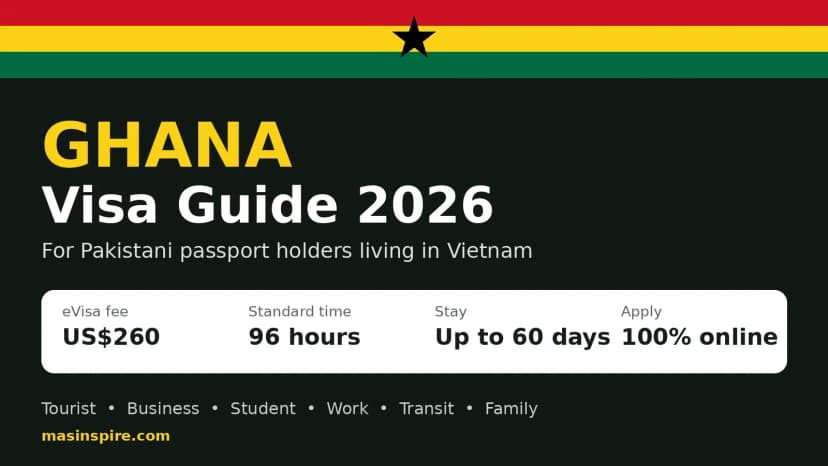
For Pakistani passport holders living in Vietnam. Figures checked on 27 November 2026. Always confirm the live fee on the official eVisa portal before you pay, because Ghana changed its whole visa system on 25 May 2026 and older guides still quote the old consular prices.
Table of Contents
- 1. Introduction
- 2. Do Pakistani Passport Holders Need a Visa for Ghana?
- 3. Ghana Visa Types at a Glance
- 4. Tourist Visa (B2 eVisa)
- 5. Business Visa (B1 eVisa)
- 6. Student Visa and Student Residence Permit
- 7. Work Visa and Residence Permit
- 8. Transit Visa
- 9. Family and Dependant Visas
- 10. Ghana Visa Fees 2026
- 11. Processing Times
- 12. Complete Document Checklists
- 13. How to Apply from Vietnam: Step-by-Step
- 14. Extending Your Stay and Overstay Penalties
- 15. Entry Tips for Arrival at Accra Airport
- 16. Official Immigration Websites
- Frequently Asked Questions
Introduction
Ghana is a West African country on the Gulf of Guinea, with Accra as its capital and Kotoka International Airport (now officially Accra International Airport) as its main international gateway. Visitors come for business in Accra, gold and cocoa trade, conferences, beaches along the coast, the historic castles of Cape Coast and Elmina, national parks, and family visits. Ghana also hosts international students at universities such as the University of Ghana, Kwame Nkrumah University of Science and Technology (KNUST) and Ashesi University, and foreign workers in mining, energy, construction, telecommunications and non-governmental organisations.
The most important fact in this guide is the date 25 May 2026. On that day, Africa Day, Ghana launched its official electronic visa portal and moved tourist and business visa applications online. The portal is run by the Ghana Immigration Service together with the Ministry of Foreign Affairs. From that date, holders of African passports stopped paying visa fees, while all other nationalities, including Pakistanis, pay a flat eVisa fee. Any guide written before May 2026 that tells you to queue at an embassy for a sticker visa, or quotes a fee of around US$60 to US$200, is describing the old system. This guide uses the new system as its controlling source and flags every place where older sources still disagree.
This guide is written for a Pakistani passport holder living in Vietnam. That matters for two practical reasons. First, there is no Ghanaian embassy or high commission in Vietnam, so the online eVisa is not just the easiest route, it is effectively the only realistic route for a short visit. Second, you will be travelling from Vietnam rather than from Pakistan, so some Pakistan-specific departure requirements, such as the polio certificate, may not apply to you in the same way. Both points are explained below.
All fees, processing times and validity periods in this guide were checked on 27 November 2026. Visa rules change without notice, so treat the official eVisa portal as the final word before you pay or book a non-refundable flight.
Do Pakistani Passport Holders Need a Visa for Ghana?
Yes. Pakistani passport holders need a visa before travelling to Ghana. Pakistan is not a member of the Economic Community of West African States (ECOWAS), and it has no bilateral visa waiver with Ghana, so the visa-free and free Electronic Travel Authorisation (ETA) routes do not apply to a Pakistani passport.
Ghana now sorts travellers into three routes. Citizens of ECOWAS states and of the Alliance of Sahel States enter visa-free. All other African passport holders apply online for a free ETA. Everyone else, including Pakistanis, Americans, Britons, Europeans, Indians and Chinese nationals, applies for a paid eVisa. The eVisa portal accepts applications from more than 190 countries, and Pakistan is explicitly included.
Do not travel to Ghana hoping to sort out a visa on arrival. The old visa-on-arrival system was replaced by the eVisa portal on 25 May 2026, and at least one 2026 guide states plainly that Ghana no longer offers visa on arrival. A separate set of sources still mentions a US$200 visa on arrival arranged in advance by a host in Ghana, and the Ghana Immigration Service fee schedule does list a US$200 emergency entry visa. These are not the same thing, and the conflict is disclosed in full in the fees section below. For a Pakistani traveller, the safe rule is simple: hold an approved eVisa before you board your flight, because airlines can refuse boarding to a passenger without a visa for Ghana.
Your passport must be valid for at least six months beyond your intended stay in Ghana. Sources differ on blank pages: the Accra airport immigration guide says at least two blank pages, while a Pakistan-focused guide says three. Carry three blank pages to satisfy the stricter reading. Your passport should also be in good condition, with no damaged biodata page.
Ghana Visa Types at a Glance
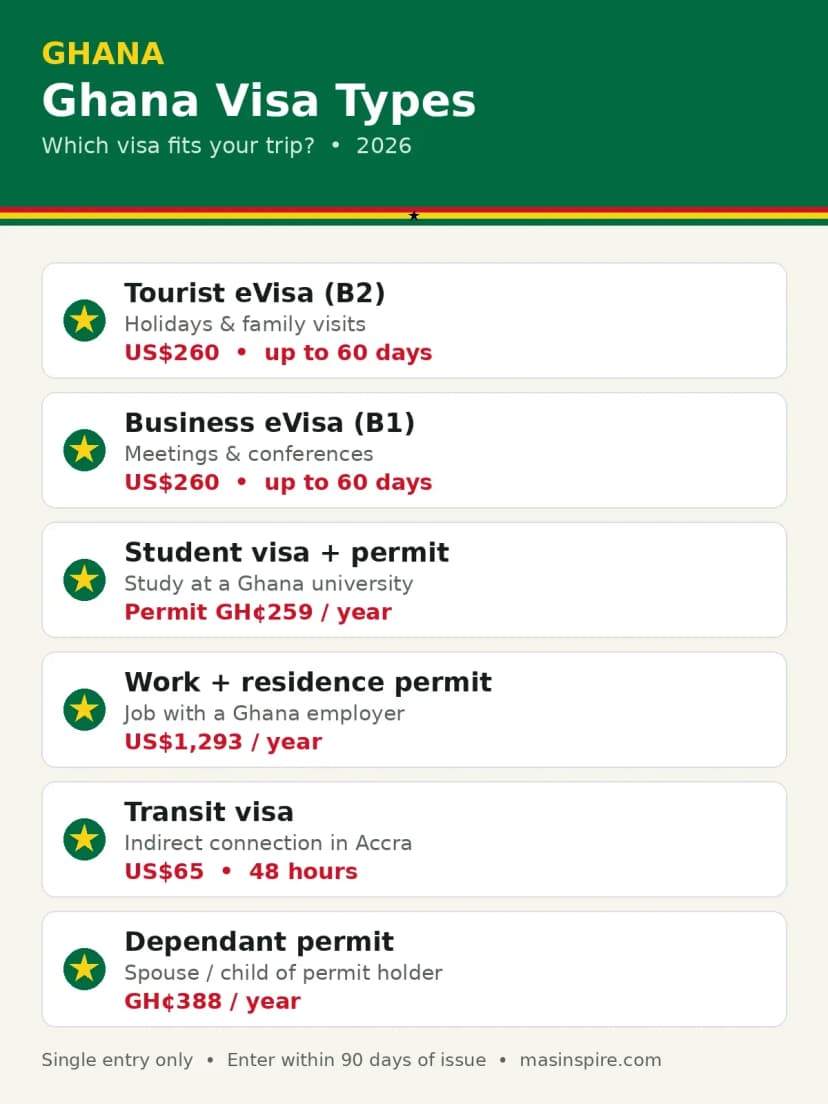
The eVisa portal issues two visa categories online: the B1 business visa and the B2 tourist visa. Student, work and family residence are not issued as eVisas. For those, you enter Ghana on a visa obtained through a Ghanaian mission and then apply for the relevant residence permit from the Ghana Immigration Service after arrival. Transit has its own separate rule at the airport. The table below summarises every route covered in this guide.
| Visa or permit | Who it is for | How you get it | Typical stay | Can you work? |
|---|---|---|---|---|
| Tourist eVisa (B2) | Holidays, sightseeing, visiting friends and family | Online at the eVisa portal | Up to 60 days, set at the border; enter within 90 days of issue | No |
| Business eVisa (B1) | Meetings, conferences, commercial visits, trade | Online at the eVisa portal | Up to 60 days, set at the border; enter within 90 days of issue | No, meetings and business visits only |
| Student entry visa, then student residence permit | Students admitted to a recognised Ghanaian institution | Entry visa through a Ghanaian mission; residence permit from the Ghana Immigration Service after arrival | Duration of the academic programme; permit usually one academic year, renewable | No, not without separate authorisation |
| Work and residence permit | Employees of Ghana-registered companies, quota and NGO staff | Employer applies through the Ghana Immigration Service; you enter on a visa first | Usually one year, renewable | Yes, for the named employer only |
| Transit visa | Passengers who must clear immigration during a connection in Accra | At the airport on arrival, or through a mission in advance | 48 hours | No |
| Dependant residence permit | Spouse, children under 18, or parents over 60 of a permit holder or Ghanaian citizen | Through the Ghana Immigration Service after arrival | Tied to the sponsor's permit, usually one year | No |
| Emergency entry visa | Genuine emergencies where a host or sponsor arranges entry in advance | Arranged in advance with the Ghana Immigration Service | Up to 30 days, according to the sources that still list it | No |
There is no separate Ghana visa category for job seekers, digital nomads, retirees or investors in the sources reviewed. If you want to look for work, attend interviews or explore business, use the business eVisa for the visit itself, and understand that it does not authorise employment. Any job must be arranged through the work-permit route described below.
Tourist Visa (B2 eVisa)
The B2 tourist eVisa is the route for holidays, sightseeing and visiting friends or family in Ghana. It is applied for entirely online, and the approval is sent to your email as a document you print and carry. The eVisa is single entry only. It is valid for entry within 90 days of the date it is issued, so do not apply too early: an eVisa issued in mid-October, for example, would expire in mid-January. If you do not enter Ghana within that 90-day window, the eVisa expires and you must apply and pay again.
The length of stay is not printed on the eVisa itself. The border officer at Accra International Airport decides it when you arrive, up to a maximum of 60 days. Plan your trip on the assumption that you may be given fewer than 60 days, and keep your return ticket and accommodation bookings consistent with the stay you request. A stay of up to 30 days is the figure some older sources quote, which is another reason to treat the border officer's decision as the controlling one and to carry evidence for your full itinerary.
Tourist eVisa applicants must show a confirmed return or onward ticket, hotel bookings or a host invitation covering the stay, and proof of funds for the trip. The portal asks for a bank or credit card statement for the last three months. You must also upload your yellow fever vaccination certificate, which is a mandatory entry requirement for Ghana and is checked both in the application and on arrival. There is no interview for a routine tourist eVisa, but the Ghana Immigration Service may ask for extra documents or clarification, and any such request will extend the processing time.
The tourist eVisa does not allow you to work, study on a full-time programme, or run a business in Ghana. If your real purpose is business meetings, apply for the B1 instead, so the purpose on your visa matches the purpose you declare at the border.
Business Visa (B1 eVisa)
The B1 business eVisa covers meetings, negotiations, conferences, trade fairs, site visits and other commercial visits that do not amount to taking up employment in Ghana. It uses the same portal, the same fee tiers and the same processing times as the tourist eVisa. It is also single entry, valid for entry within 90 days of issue, with a stay of up to 60 days set at the border.
The difference is the supporting evidence. A business applicant needs a signed invitation letter from the host company in Ghana, the identity document of the person who signed it, the company's certified registration documents, and the company's tax clearance certificate. You should also carry a cover letter from your own employer or business in Vietnam explaining the purpose of the trip, your role, and who is paying for the visit, plus your meeting schedule or conference registration where relevant.
Business visitors sometimes assume a business visa lets them start work, sign an employment contract, or stay on to run a company. It does not. Employment requires a work and residence permit applied for by the Ghanaian employer through the Ghana Immigration Service. Attending a meeting and being employed are different things in Ghanaian immigration law, and overstaying a business visit to work without a permit can lead to fines and removal.
If you are travelling for a conference, keep the invitation and registration documents with you on arrival, because the border officer may ask about the event, your host, and where you will be staying. Keep the contact details of your host company in your phone and on paper, in case the officer wishes to verify them.
Student Visa and Student Residence Permit
There is no student eVisa on the portal. The portal lists only tourist (B2) and business (B1) visas, and the University of Ghana advises non-ECOWAS students to obtain a valid visa or entry permit through the Ghana High Commission in their country. For a Pakistani student living in Vietnam, that means contacting a Ghanaian mission in Asia, since there is no Ghanaian mission in Vietnam. The nearest missions are the Embassy of Ghana in Beijing, the High Commission of Ghana in New Delhi, and the High Commission of Ghana in Kuala Lumpur. Which of these covers Vietnam has not been confirmed in the sources reviewed, so you must ask the mission directly before you plan around it, and you must start this process months before your course begins.
Do not enter Ghana on a tourist eVisa and assume you can simply convert it into a student stay. The correct sequence is an entry visa for study, followed by a student residence permit after arrival. The Ghana Immigration Service requires every foreign student to hold a student residence permit for the length of their studies, and permits are usually issued for one academic year and renewed.
To obtain the student residence permit after arrival, the Ghana Immigration Service asks for an application letter from your school to the Comptroller-General, copies of your admission letter and school fee receipts, two recent passport photographs, your passport, a copy of your Non-Citizen Ghana Card, and a bond, guarantor letter, birth certificate or affidavit where applicable. The published fee for a student residence permit is GH¢259 per year for non-ECOWAS nationals, against GH¢194 for ECOWAS nationals, under the fee schedule effective 15 May 2025. An expired student residence permit carries a penalty of GH¢300 per month for non-ECOWAS nationals.
Students may not take paid work without authorisation from the Ghana Immigration Service, and the Service charges penalties for illegal employment. There is no post-study work route for graduates identified in the sources checked in October 2026, so do not enrol on the assumption that a Ghanaian degree leads automatically to a work permit. Budget for the Non-Citizen Ghana Card as well: first registration costs the cedi equivalent of US$120, and annual renewal costs US$78. Tuition at major universities is charged in US dollars to international students, and you should confirm the current fee schedule with the university itself, because the figures change every academic year.
Work Visa and Residence Permit
Ghana does not issue a standalone work visa. The system works in two parts: you enter Ghana on a visa, and your employer then applies for a work permit and a residence permit together through the Ghana Immigration Service. For a Pakistani national, that means you need a genuine job offer from a Ghana-registered company before you travel, and the employer must be willing to sponsor you through the process.
The main route is the company-sponsored work and residence permit for employees of Ghana-registered companies. Other routes exist for companies with a Ghana Investment Promotion Centre quota, for immigrant quota permits, for NGO and missionary workers, and for shareholders in executive roles. In each case the employer must show that the role, the company and the applicant meet the requirements, and the applicant must provide a passport, CV, educational and professional certificates, an employment letter or contract, a police clearance report from the home country, and a medical report from the Ghana Immigration Service clinic. The employer provides company registration documents, audited accounts and a tax clearance certificate.
The published fee for a work and residence permit is US$1,293 per year for a non-ECOWAS employee, against US$647 for an ECOWAS employee. Permits under a Ghana Investment Promotion Centre quota cost US$388. These figures come from the Ghana Immigration Service fee schedule effective 15 May 2025, as reported in October 2026. Older guides quote lower figures, around US$1,200 for a year, and some directory sites quote wide ranges in cedis; the fee schedule figure is the controlling one, but you should confirm the current amount with the Service before paying. On top of the permit fee, budget for the Non-Citizen Ghana Card at US$120 for first registration and US$78 for annual renewal, and for the Ghana Immigration Service medical examination, reported at US$250 for a first application and US$150 for a renewal.
The Ghana Immigration Service indicates eight to ten weeks for processing a residence permit, although practitioners report that a complete application is often approved in about three to four weeks. Do not resign from a job in Vietnam, sell belongings, or book a one-way flight until the permit is approved. A work permit is tied to the named employer: changing employers means a new application, and working for anyone else on that permit is not allowed.
Transit Visa
Most Pakistani travellers will fly to Ghana directly or through a hub such as Dubai, Doha, Istanbul, Addis Ababa or London, and will not need a transit visa at all if they stay airside in Accra. The rule is clear on this point: passengers on direct airside transit are exempt from obtaining a visa, provided they remain in the international transit area without passing through immigration, their bags are checked through to the final destination, and they hold a confirmed onward ticket.
A transit visa becomes necessary when the connection is indirect. That means you must clear immigration in Accra, for example because your bags were not checked through and you need to collect them and check in again, because you have separate tickets on different airlines, or because you need to leave the airport for an overnight hotel. In that case the Ghana Immigration Service charges US$65, payable in US dollars or the cedi equivalent at the Service's own rate, and the transit visa is valid for 48 hours when issued.
One airport guide states the transit visa is valid for 48 to 72 hours and that the fee varies, which conflicts with the Ghana Immigration Service figure of US$65 for 48 hours. The Service's figure is the controlling one, because it quotes the Service's own published rule, but the discrepancy is worth knowing if an officer quotes a different period at the airport. To apply, you need a passport valid for at least six months, a confirmed onward itinerary, a visa for your final destination if one is required, two recent passport photographs, a completed disembarkation card, and your yellow fever vaccination certificate, which is required even for transit passengers aged nine months and over.
The practical advice is to book a through ticket with bags checked to your final destination wherever possible. That single choice removes the transit visa, the US$65 fee, and the risk of missing a connection while clearing immigration. If your itinerary forces an indirect transit, confirm with the airline before departure whether your bags will be through-checked, and keep the US$65 fee in cash and card as a fallback.
Family and Dependant Visas
There is no family visit eVisa category separate from the tourist eVisa. If you are visiting a spouse, parent, child or other relative in Ghana for a short stay, apply for the B2 tourist eVisa and support it with an invitation letter from your host in Ghana, evidence of the relationship, and the host's address and contact details. The host's letter should state the relationship, the dates of the visit, where you will stay, and who is paying for the trip.
For a longer stay as a dependant, Ghana issues a dependant residence permit. This covers spouses, children under 18, and parents over 60 of a permit holder or of a Ghanaian citizen. The published fee is GH¢388 per year for non-ECOWAS dependants, against GH¢259 for ECOWAS dependants, under the fee schedule effective 15 May 2025. A dependant permit does not carry the right to work. A dependant who wants to work must qualify for a work permit in their own right.
Family applications are often delayed by weak relationship evidence. Carry originals or certified copies of marriage certificates, birth certificates or other civil-status documents, and make sure the names on them match your passport exactly. Documents in Urdu must be translated into English and, where the mission or the Service asks for it, attested. If your sponsor in Ghana is a Ghanaian citizen, the Service may also ask for the sponsor's Ghana Card or passport and proof of their address and income.
Ghana Visa Fees 2026
The eVisa fee is a flat rate that does not change by nationality. Every Pakistani applicant pays the same amount as an American, British or Indian applicant for the same processing speed. The only choice is how fast you want the decision. Fees are generally non-refundable, and applications cannot be edited or withdrawn after submission, so check every detail before you pay.
| Service | Fee (US dollars) | Approximate Pakistani rupees | Approximate Vietnamese dong |
|---|---|---|---|
| Tourist or business eVisa, standard | US$260 | PKR 72,800 | VND 6,900,000 |
| Tourist or business eVisa, priority | US$338 | PKR 94,640 | VND 8,960,000 |
| Tourist or business eVisa, express | US$442 | PKR 123,760 | VND 11,700,000 |
| Transit visa (indirect transit only) | US$65 | PKR 18,200 | VND 1,720,000 |
| Emergency entry visa (if arranged in advance) | US$200 | PKR 56,000 | VND 5,300,000 |
| Yellow fever vaccination at Accra airport (Port Health) | US$20 | PKR 5,600 | VND 530,000 |
The rupee figures above are the November 2026 conversions reported for the eVisa tiers, and the dong figures are approximate conversions at about 26,500 dong per US dollar in November 2026. Both will move with the exchange rate, and the portal will charge you in US dollars, so the amount that leaves your card depends on your bank's rate on the day. Pay with an international card that works for online payments in US dollars, and keep the payment receipt and the application reference number.
Two conflicts must be disclosed openly, because older guides still present the old numbers as current. First, several pre-2026 agent and directory sites quote consular sticker-visa fees of US$82 for a single-entry visa, US$117 for a three-month multiple-entry visa, US$140 for six months and US$175 for one year, while other sites quote approximately US$150 for a tourist visa or a range of US$60 to US$200. Those figures belong to the old mission-issued visa system. They are not the eVisa fee, and they should not be used to budget a 2026 trip. The controlling figure for a tourist or business visa is the portal checkout price: US$260 standard, US$338 priority, US$442 express.
Second, the visa-on-arrival question is genuinely unsettled in the sources. One 2026 guide states that Ghana no longer offers visa on arrival at all after 25 May 2026. Another 2026 guide, updated in November 2026, still lists a visa on arrival with host pre-approval at US$200 for 30 days. The Ghana Immigration Service fee schedule effective 15 May 2025 lists a US$200 emergency entry visa, which is a different instrument from a routine visa on arrival. The honest position is that a routine visa on arrival cannot be relied on, and an emergency entry visa is exactly what its name says: an emergency route arranged in advance, not a normal way to enter. Apply for the eVisa before you travel.
Other in-country fees worth budgeting for are the visitor's permit extension at GH¢65 per month for non-ECOWAS nationals, the overstay penalty at GH¢300 per month, the student residence permit at GH¢259 per year, the work and residence permit at US$1,293 per year, the dependant residence permit at GH¢388 per year, and the Non-Citizen Ghana Card at US$120 for first registration and US$78 for annual renewal. None of these is payable through the eVisa portal, and all should be confirmed with the Ghana Immigration Service at the time you apply.
Processing Times
Processing times for the eVisa are published by the portal and are the same for tourist and business applications. The standard service is the one most travellers will use, and you should still apply at least two to three weeks before departure so that a request for extra documents does not force you to rebook a flight.
| Service | Published processing time | Fee | Best for |
|---|---|---|---|
| eVisa, standard | Within 96 hours (4 days) | US$260 | Trips planned two or more weeks ahead |
| eVisa, priority | Within 48 hours (2 days) | US$338 | Trips within the next week |
| eVisa, express | Within 5 hours | US$442 | Genuine last-minute travel only |
| Transit visa (indirect transit) | Issued at the airport on arrival | US$65 | Connections that require clearing immigration |
| Student entry visa via a mission | Not published; allow several weeks | Confirm with the mission | Study starting in a new academic term |
| Work and residence permit | 8 to 10 weeks indicated; often 3 to 4 weeks for a complete file | US$1,293 per year | Employment arranged in advance |
| Visitor's permit extension | Apply before expiry; allow several working days in Accra | GH¢65 per month | Staying longer than the border stamp allows |
The 96-hour, 48-hour and 5-hour figures are decision windows for a complete application, not guarantees. If the Ghana Immigration Service asks for a corrected document or extra evidence, the clock effectively restarts, and no published source promises compensation for a delayed decision. The express service is expensive and should be reserved for genuine urgency, not for a trip you simply left late. Note also that the eVisa is valid for entry within 90 days of issue, so there is a window to aim for: apply roughly two to four weeks before travel, early enough to fix problems, and late enough that the 90-day validity comfortably covers your departure date.
For mission-issued visas, such as a student entry visa, no standard processing time is published in the sources reviewed. Older agency guides quote seven to ten working days for a regular mission application and three to five working days for an urgent one, but those figures come from the pre-eVisa era and cannot be verified against a current official source, so they are not presented here as fact. Ask the mission directly and build in at least six to eight weeks for any route that goes through a mission rather than the portal.
Complete Document Checklists
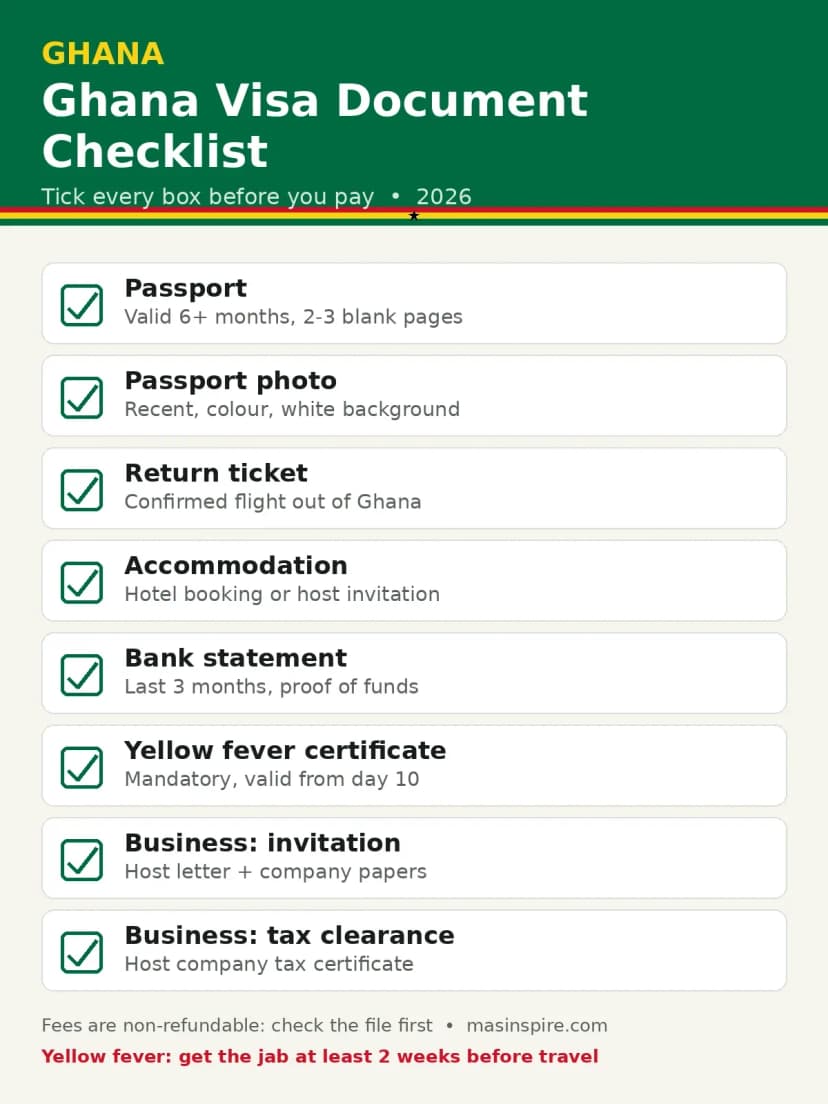
Gather every document before you start the online application. The portal does not let you edit or withdraw an application after submission, and a missing document is the most common reason for a delay. Scan documents in colour, at a readable resolution, and keep the originals for the journey.
Tourist eVisa (B2) checklist
| Document | Requirement |
|---|---|
| Pakistani passport | Valid at least 6 months beyond your intended stay; at least 2 blank pages, ideally 3; colour scan of the biodata page |
| Passport photograph | Recent colour photo taken within the last 6 months, white background, face clearly visible |
| Return or onward ticket | Confirmed booking out of Ghana, matching your stated travel dates |
| Accommodation proof | Hotel booking covering the whole stay, or a host invitation letter with the host's address |
| Proof of funds | Bank or credit card statement for the last 3 months, showing you can fund the trip |
| Yellow fever certificate | International Certificate of Vaccination or Prophylaxis, valid from 10 days after the dose, for life |
| Travel itinerary | Planned dates, places to visit, and contact details in Ghana |
| Payment card | International card able to pay US$260, US$338 or US$442 online |
Business eVisa (B1) checklist
| Document | Requirement |
|---|---|
| Pakistani passport | Valid at least 6 months beyond your intended stay; at least 2 blank pages, ideally 3 |
| Passport photograph | Recent colour photo taken within the last 6 months, white background |
| Return or onward ticket | Confirmed booking out of Ghana |
| Accommodation proof | Hotel booking or host invitation covering the stay |
| Invitation letter | Signed letter from the Ghanaian host company stating the purpose, dates and who pays |
| Signatory's identity document | Copy of the ID of the person who signed the invitation letter |
| Company registration | Certified registration documents of the Ghanaian host company |
| Tax clearance certificate | Current tax clearance certificate of the host company |
| Employer cover letter | Letter from your employer or business in Vietnam explaining your role and the trip purpose |
| Yellow fever certificate | International Certificate of Vaccination or Prophylaxis, as for tourists |
| Proof of funds | Bank statement for the last 3 months, or sponsor evidence |
Student entry and residence permit checklist
| Document | Requirement |
|---|---|
| Pakistani passport | Valid at least 6 months beyond your intended stay |
| Admission letter | Offer from a recognised Ghanaian university or institution |
| School fee receipts | Proof of fees paid, or proof of a scholarship or funding |
| School introduction letter | Letter from the school to the Comptroller-General of Immigration |
| Passport photographs | Two recent passport photographs |
| Non-Citizen Ghana Card | First registration US$120; copy required with the permit application |
| Accommodation proof | University housing or private address in Ghana |
| Financial support proof | Bank statements or sponsor letter covering tuition and living costs |
| Yellow fever certificate | Mandatory for entry, as for all travellers aged 9 months and over |
| Bond or guarantor letter | Where applicable, plus birth certificate or affidavit |
Work and residence permit checklist
| Document | Requirement |
|---|---|
| Pakistani passport | Valid passport and a copy of the biodata page |
| Employment letter or contract | Signed contract with the Ghana-registered employer |
| CV and certificates | Curriculum vitae, educational and professional certificates |
| Police clearance report | Clearance from the home country, Pakistan |
| Medical report | Medical examination at the Ghana Immigration Service clinic |
| Non-Citizen Ghana Card | First registration US$120; renewal US$78 |
| Company documents | Business registration, audited accounts, tax clearance certificate |
| Passport photographs | Two recent passport photographs |
| Yellow fever certificate | Mandatory for entry |
Transit and family checklists
For indirect transit, carry your passport, confirmed onward itinerary, visa for your final destination if one is required, two recent passport photographs, a completed disembarkation card, and your yellow fever certificate. For a family visit on a tourist eVisa, add the host's invitation letter, evidence of the relationship such as a marriage or birth certificate, and the host's address and contact details. For a dependant residence permit, carry the sponsor's permit or Ghanaian citizenship evidence, relationship documents, passport photographs, and proof of the sponsor's address and means.
How to Apply from Vietnam: Step-by-Step
There is no Ghanaian embassy or high commission in Vietnam. Ghana's last mission in Hanoi closed in 1966, and the current mission list shows no office in Vietnam. The nearest Ghanaian missions in Asia are the Embassy of Ghana in Beijing, the High Commission of Ghana in New Delhi, and the High Commission of Ghana in Kuala Lumpur. Whether any of them is concurrently accredited to Vietnam has not been confirmed in the sources reviewed, so do not book a flight to Beijing, New Delhi or Kuala Lumpur on the assumption that the mission there will handle your case. For a tourist or business visit, you do not need a mission at all, because the eVisa is applied for fully online.
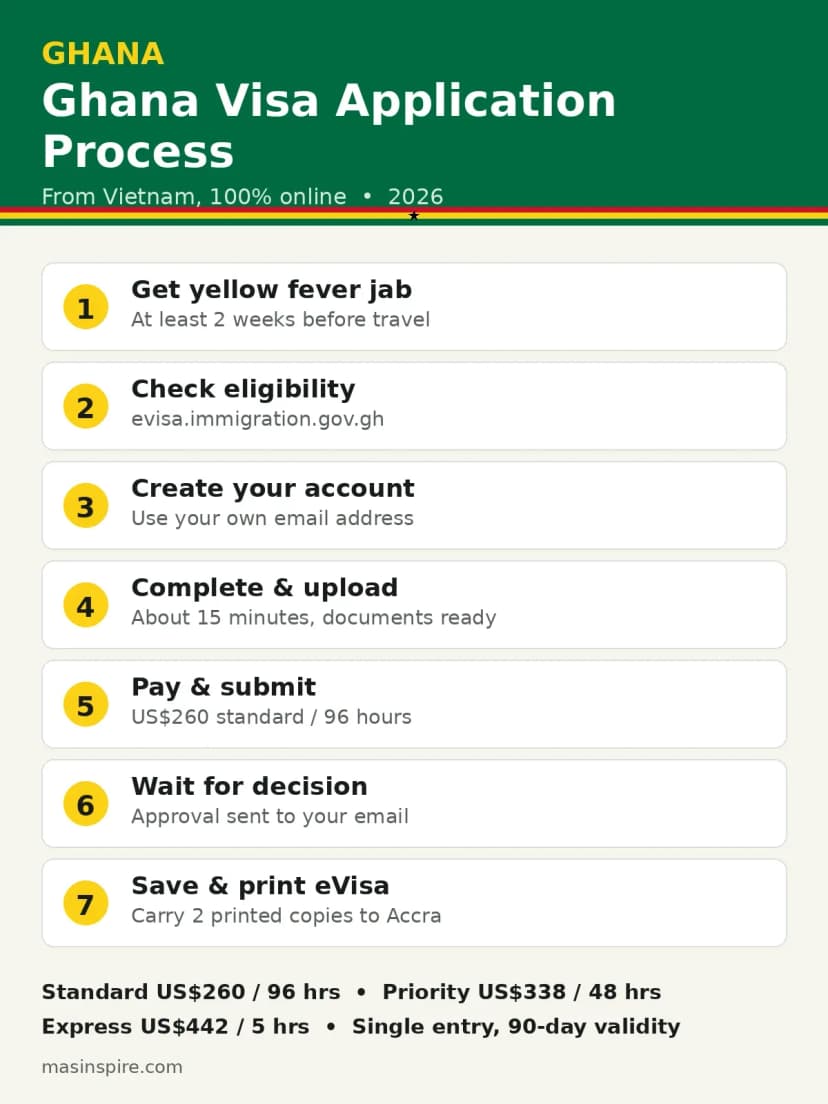
Follow these steps from Vietnam:
Step 1: Get the yellow fever vaccination first
Book the yellow fever vaccine at a designated vaccination centre in Ho Chi Minh City or Hanoi at least two weeks before you apply, because the certificate only becomes valid 10 days after the dose. Ask for the International Certificate of Vaccination or Prophylaxis, the yellow booklet, and check that your name matches your passport exactly. One dose is valid for life under the International Health Regulations as amended in July 2016, and no booster can be demanded. If you were vaccinated years ago, the old certificate is still valid; carry it rather than assuming a border officer will know the history.
Step 2: Check your eligibility on the official portal
Open the official eVisa portal and use the eligibility checker. Select Pakistan as your nationality and confirm that you need an eVisa, not an ETA or visa-free entry. Use only the official portal. Ignore third-party sites that charge a service fee on top of the official fee unless you have knowingly chosen a paid helper, and never pay a visa fee to an individual agent on social media.
Step 3: Create your account
Register on the portal with an email address you can access from Vietnam and from Ghana, because the decision and the eVisa itself are sent to that address. Use your own email, not an agent's, so that you receive the approval directly. Keep your application reference number safe; you will need it to track the application, and a six-digit verification code is sent to your registered email when you check the status.
Step 4: Complete the application and upload documents
Fill in your travel details exactly as they appear in your passport, and upload the documents from the checklist for your visa type. The portal estimates about 15 minutes for this step once your documents are ready. Double-check names, dates and passport numbers before you continue, because the application cannot be edited after submission.
Step 5: Pay and submit
Choose standard (US$260, 96 hours), priority (US$338, 48 hours) or express (US$442, 5 hours) and pay securely online. The fee is generally non-refundable, so only pay when the file is complete and correct. Save the payment receipt and the confirmation email, and note the reference number.
Step 6: Wait for the decision and save the eVisa offline
The decision is emailed to you. When it is approved, download the eVisa PDF and save it offline on your phone and in your email, and print at least two copies. Do not rely on airport Wi-Fi to open it. Check that the name, passport number and dates on the eVisa match your passport before you travel.
Step 7: Travel and present your documents on arrival
Fly to Accra with your passport, printed eVisa, yellow fever certificate, return ticket, accommodation proof and bank statements in your hand luggage, not in checked baggage. At the border, present them in the order the officer asks for, and answer questions about your purpose, host and length of stay honestly and briefly.
If you are applying for a student entry visa or any route that needs a mission, email the nearest mission first, in Beijing, New Delhi or Kuala Lumpur, and ask in writing whether it handles applications from Pakistani nationals resident in Vietnam, what the current fee is, and whether you must attend in person. Do not travel to another country for a visa appointment until you have that answer in writing. Your Vietnam temporary residence card and a letter from your employer or school in Vietnam may help show your residence status, so carry copies when you deal with any mission.
Extending Your Stay and Overstay Penalties
If you need more time in Ghana, apply for an extension before your permitted stay runs out. Extensions are handled by the Ghana Immigration Service, in person at its headquarters on Independence Avenue in Accra, and at its regional offices. The Service says an extension of a visitor's visa or permit may be granted for an initial three months, up to a maximum of six months. Take the extension form, an application letter explaining why you need more time, two passport photographs, a copy of your return ticket, your passport, and proof of funds.
The fee for extending a visitor's permit is GH¢65 per month for non-ECOWAS nationals, GH¢39 per month for ECOWAS nationals, and GH¢26 per month for people with Ghanaian parentage or a Ghanaian spouse, under the fee schedule effective 15 May 2025. A three-month extension at GH¢65 per month costs GH¢195. Apply at least a week before your stay expires, and keep the receipt and any stamp or endorsement the Service gives you.
Overstaying is expensive and follows you. The penalty for an expired visitor's permit is GH¢300 per month for non-ECOWAS nationals, GH¢200 per month for ECOWAS nationals, and GH¢52 per month for people with Ghanaian parentage or a Ghanaian spouse. The penalty is charged per month of overstay, and it must generally be paid before departure is permitted or your status is regularised. A long overstay can lead to detention, deportation proceedings and a re-entry ban, and it will complicate any future Ghana eVisa application, because the overstay is recorded in the Immigration Service database. An expired residence permit carries a separate penalty of GH¢300 per month for non-ECOWAS nationals.
Set a reminder on your phone for seven days before your permitted stay ends, and another for three days before. If you think you may need longer, start the extension application in the first week after arrival rather than in the last days of your stay, because the process takes several working days and you do not want to be caught by a public holiday or a request for an extra document.
Entry Tips for Arrival at Accra Airport
Most travellers arrive at Accra International Airport, formerly Kotoka International Airport, the country's main international gateway. The arrival sequence is health screening, immigration, biometrics, baggage collection and customs. Port Health officers, not immigration officers, inspect your yellow fever certificate, and the Ghana Airports Company places Port Health in Terminal 3. Fingerprints are taken from arriving visitors at immigration.
Yellow fever is the one vaccination Ghana enforces. Proof of vaccination is required for all travellers aged nine months and over, regardless of where they are arriving from. The World Health Organization records Ghana's rule exactly that way, and the UK Foreign Office states plainly that you must have a certificate to enter Ghana. The certificate becomes valid 10 days after your first dose and is then valid for life. Airlines can refuse boarding without it, so the time to fix this is in Vietnam, not at the airport. The airport does list a Port Health yellow fever vaccination service at US$20 for Ghanaians and foreigners alike, but a dose given on arrival does not become valid for 10 days, so it cannot rescue a trip that has already started, and you may instead be vaccinated on arrival at your own cost, quarantined, or denied entry. Get vaccinated in Vietnam.
Other health precautions are recommended rather than required. The US Centers for Disease Control and Prevention and the UK TravelHealthPro service recommend vaccines and malaria prevention according to where you go, how long you stay and what you do. Malaria is a real risk in Ghana, so discuss prophylaxis, insect repellent and bed nets with a travel clinic in Ho Chi Minh City before departure. No COVID-19 vaccination or test is required for entry as of 2023. Travellers departing from Pakistan should also note that a polio vaccination certificate from NADRA is reported as a requirement for leaving Pakistan; if you are flying from Vietnam on a Pakistani passport, check with your airline whether it applies to your routing.
At immigration, keep your answers short and consistent with your application. Have your printed eVisa, passport, yellow fever certificate, return ticket and hotel booking in one folder in your hand luggage. If the officer asks how long you will stay, give the number of days on your return ticket, not a vague range. Keep the address and phone number of your hotel or host ready, and keep some Ghanaian cedis or a working international card for the taxi from the airport. Avoid changing money with strangers in the arrivals hall; use the airport bureaux or an ATM inside the terminal.
Practical notes for the stay: Ghana's currency is the Ghana cedi (GH¢). Cash is widely used outside major hotels, and card acceptance is uneven. Keep your passport and eVisa copies in your phone and a paper copy separate from the originals. Save the Ghana Immigration Service headquarters address, Independence Avenue, Accra, and the emergency number 112. The UK Foreign Office advises against all but essential travel to the Bawku Municipal area in the Upper East region, so check current travel advice before any trip outside Accra, Kumasi, Cape Coast and the coastal towns.
Official Immigration Websites
Use the official sources below as your first reference. If any figure in this guide disagrees with the live portal, the live portal wins. Third-party visa sites, agents and social media posts are not immigration authorities.
| Organisation | What it is for | Website |
|---|---|---|
| Ghana Immigration Service, eVisa Portal | Official eVisa applications, eligibility checker, fees, tracking and decisions for tourist and business visas | evisa.immigration.gov.gh |
| Ghana Immigration Service | Residence and work permits, extensions, fee schedule, overstay rules and office locations | gis.gov.gh |
| Ministry of Foreign Affairs, Ghana | Directory of Ghanaian missions abroad, including the missions in Beijing, New Delhi and Kuala Lumpur | mfa.gov.gh |
| Accra International Airport, Immigration | Arrival procedures, transit rules and airport contact information | accracityinternationalairport.com |
| Accra International Airport, Port Health | Yellow fever certificate checks and airport vaccination services | accracityinternationalairport.com |
| Embassy of Ghana, Beijing | Nearest Ghanaian mission to Vietnam in China; confirm by email whether it covers Vietnam | mfa.gov.gh |
| High Commission of Ghana, New Delhi | Nearest Ghanaian mission in India; confirm by email whether it covers Vietnam | mfa.gov.gh |
| High Commission of Ghana, Kuala Lumpur | Nearest Ghanaian mission in Southeast Asia; confirm by email whether it covers Vietnam | mfa.gov.gh |
The Beijing, New Delhi and Kuala Lumpur missions are listed here through the Ministry of Foreign Affairs directory because no separate official mission website address was verified for them in the sources reviewed. Ask the Ministry or the mission directly for the current email address and appointment system before you travel to any of them.
Frequently Asked Questions
1. Do Pakistani citizens need a visa to visit Ghana?
Yes. Pakistanis need a visa before travelling. The easiest route is the official eVisa for tourism or business, applied for online at the Ghana Immigration Service portal. Pakistan is not on the visa-free ECOWAS list and does not qualify for the free ETA, which is only for African passport holders.
2. How much does a Ghana eVisa cost for a Pakistani passport holder?
The flat fee is US$260 for standard processing within 96 hours, US$338 for priority processing within 48 hours, and US$442 for express processing within 5 hours. The fee is the same for all non-African nationalities and is generally non-refundable.
3. How long does a Ghana eVisa take to process?
Standard processing is within 96 hours, priority within 48 hours, and express within 5 hours, for a complete application. If the Immigration Service asks for extra documents, the process takes longer, so apply at least two to three weeks before departure.
4. How long can I stay in Ghana on an eVisa?
The eVisa is single entry and valid for entry within 90 days of the date it is issued. The border officer decides your permitted stay on arrival, up to a maximum of 60 days. If you do not enter within 90 days, the eVisa expires and you must apply again.
5. Can I apply for a Ghana visa from Vietnam?
Yes. The eVisa is applied for fully online, so you can apply from Vietnam without visiting a Ghanaian mission. There is no Ghanaian embassy or high commission in Vietnam, which makes the online route the practical choice for tourist and business visits.
6. Is a visa on arrival available in Ghana?
Do not rely on it. One 2026 guide says visa on arrival ended when the eVisa portal launched on 25 May 2026, while another still lists a US$200 visa on arrival with host pre-approval. The Immigration Service fee schedule lists a US$200 emergency entry visa, which is not a routine visa on arrival. Hold an approved eVisa before you board your flight.
7. Is yellow fever vaccination mandatory for Ghana?
Yes. Proof of yellow fever vaccination is required for all travellers aged nine months and over, whatever country they arrive from. The certificate becomes valid 10 days after the first dose and is then valid for life. Airlines can refuse boarding without it.
8. Can I work in Ghana on a tourist or business eVisa?
No. Neither the tourist nor the business eVisa authorises employment. To work, your Ghanaian employer must apply for a work and residence permit through the Ghana Immigration Service, and you need that permit before you start the job.
9. Is there a student visa for Ghana?
There is no student eVisa on the portal, which issues only tourist and business visas. Students obtain an entry visa through a Ghanaian mission and then apply for a student residence permit from the Ghana Immigration Service after arrival. The permit fee is GH¢259 per year for non-ECOWAS nationals.
10. Do I need a transit visa if I connect through Accra?
Not if you stay airside and your bags are checked through to your final destination. If you must clear immigration, for example to collect and re-check bags or stay overnight outside the airport, you need a transit visa costing US$65, valid for 48 hours.
11. Can I extend my stay in Ghana?
Yes. Apply to the Ghana Immigration Service in Accra before your permitted stay expires. Extensions may be granted for an initial three months, up to six months, at GH¢65 per month for non-ECOWAS nationals. Bring the extension form, a letter, two photos, a copy of your return ticket and your passport.
12. What happens if I overstay my Ghana visa?
You pay a penalty of GH¢300 per month for non-ECOWAS nationals, and the overstay is recorded, which can complicate future applications. A long overstay can lead to detention, deportation and a re-entry ban, so extend before expiry rather than after.
13. What documents do I need for a Ghana tourist eVisa?
A passport valid for at least six months with two to three blank pages, a recent passport photo, a confirmed return ticket, hotel bookings or a host invitation, a bank statement for the last three months, and your yellow fever certificate. Business applicants also need a host company invitation, the signatory's ID, company registration and a tax clearance certificate.
14. Which Ghanaian mission covers Vietnam?
That has not been confirmed in the sources reviewed. There is no Ghanaian mission in Vietnam. The nearest missions are in Beijing, New Delhi and Kuala Lumpur. Email the mission before travelling to ask whether it handles applications from Pakistani nationals resident in Vietnam, and use the online eVisa for tourist and business trips in any case.
15. Is the Ghana eVisa single entry or multiple entry?
Single entry only. The portal currently issues single-entry eVisas, and older multiple-entry consular visas at US$117 to US$175 belong to the pre-2026 system. If you plan to leave Ghana and return, you will need a new eVisa for the second entry.
Editorial note: This guide was prepared on 27 November 2026 for Pakistani passport holders living in Vietnam. Visa fees, processing times and entry rules change without notice. Confirm every figure on the official eVisa portal before you pay or travel. This guide is general information, not legal or immigration advice.