

By MAS Inspire | Last reviewed: 27 November 2026 (key figures re-verified 27 November 2026)
Introduction
Egypt welcomes visitors to its ancient monuments, Red Sea resorts, cultural sites, universities and commercial centres. Before travelling, however, foreign nationals need to identify the correct entry permission for their passport and purpose. A tourist e-Visa, a consular visa, a work permit and a residence permit are different legal instruments. Choosing the wrong route can lead to delays, refusal or problems at the border.
This guide explains the main entry and longer-stay pathways, the official online visa route, document preparation, costs that can be verified, and special considerations for Pakistani passport holders who live or work in Vietnam. The rules below were checked on 25 November 2026. Because nationality-specific controls and consular practice can change, confirm your individual case with an Egyptian mission before making travel commitments.
Why People Visit, Study, and Work in Egypt
Travellers visit Egypt for the Pyramids of Giza, the Egyptian Museum and Grand Egyptian Museum, Luxor and Aswan, Nile cruises, Red Sea destinations, family visits and business meetings. International students may pursue Arabic-language courses, university degrees or research. Employers and organisations recruit foreign specialists in sectors where they need particular expertise. Each purpose has its own permission requirements: permission to enter as a visitor does not automatically permit study, employment or long-term residence.

Types of Egypt Visas and Entry Permissions
1. Tourist and visitor permission
The official e-Visa portal offers a tourism visa for single or multiple entries to eligible nationalities. The published e-Visa prices are US$30 for single entry and US$65 for multiple entry. The portal does not state in its FAQ a universal stay duration that should be assumed for every issued visa; read the validity, number of entries and permitted stay printed on the actual approval. Some nationalities must use an Egyptian embassy or consulate instead of the e-Visa portal.
A tourist permission is for tourism and other activities allowed by its conditions. It does not authorise paid employment. Visitors should have a passport valid for at least six months from arrival, an e-Visa printout where applicable, travel itinerary and accommodation details. A company or personal invitation may be relevant for business or family visits.
Visa on arrival (Muse enhancement, verified 25 Nov 2026): for eligible nationalities, a single-entry tourist visa on arrival costs US$30 (raised from US$25 on 1 March 2026), paid in cash at the bank counter before passport control. Pakistani passport holders can use it only if they hold a valid and used visa (or residence permit) from the US, UK, Schengen Area, Japan, Canada, Australia or New Zealand (Egyptian Tourism Authority); a Gulf/UAE residence permit alone does not qualify. Since 1 August 2026 Cairo airport has run an electronic visa-on-arrival QR pilot (card payment instead of cash) — it changes how you pay, not who is eligible. The digital QR route costs US$36 in total (US$30 visa + US$6 service charge); the paper sticker remains US$30 (corroborated 27 Nov 2026 vs UK government travel advice and the Egyptian Tourism Authority announcement).
Five-year multiple-entry tourist visa (Muse enhancement, verified 25 Nov 2026): introduced for frequent visitors at USD 700; stay per visit is reported as up to 90 days (2023 Interior Ministry decision) or up to 180 days (Minister of Interior Decision No. 1919 of 2025) — confirm with the mission. It does not permit work and does not replace a residence permit; applications go through an Egyptian embassy or consulate.
The free "Sinai only" entry stamp at Sharm El Sheikh airport (under 15 days, Sharm/Dahab/Nuweiba/Taba resorts) does not apply to Pakistani passports — Pakistan is on the excluded list, so a full visa is needed even for a Sharm-only holiday.
2. Business visitor visa
A short business visit may cover meetings, negotiations, conferences or site visits, subject to the visa issued and the authorities' interpretation of the proposed activities. It is not a substitute for a work permit. Applicants should prepare a letter from their employer, an invitation from the Egyptian host, details of the meetings, accommodation and travel itinerary. The official e-Visa portal specifically identifies a supporting company or invitation letter as an example of evidence that may be relevant at arrival. The correct application channel and fee depend on nationality and the mission's instructions.
3. Student and language-study stay
A person accepted by an Egyptian university, school or language institution should obtain the institution's written admission or enrolment evidence and ask the institution and Egyptian authorities which entry visa and subsequent residence formalities apply. The Ministry of Interior provides temporary and other residence services, but the sources reviewed do not publish a single student-visa fee, standard validity or universal processing time. Student residence is not a general work authorisation. Any work activity must be separately authorised.
4. Employment and employer-sponsored work
Foreign nationals intending to work in Egypt need the appropriate entry and residence status and a work permit. Egypt's Ministry of Labour has a dedicated General Administration for Work Permits for Foreigners. Its published service describes applications by companies seeking to recruit foreign nationals and refers to evidence of professional experience and authenticated documents. The employer should lead the process and obtain written instructions on the current requirements, fees and sequencing before the employee travels or starts work.
A tourist visa, business visitor visa or e-Visa is not permission to take employment. Do not start work merely because an employer has offered a job or because you have entered Egypt legally.
5. Job-seeker permission
The official sources reviewed do not establish a general-purpose Egypt job-seeker visa that allows foreign nationals to enter and search for work without an employer or other qualifying basis. Treat this category as not verified / do not assume available. A prospective worker should secure an employer and have the employer consult the Ministry of Labour and immigration authorities.
6. Skilled-worker immigration
Egypt's foreign-worker framework is principally an employment authorisation process rather than a published points-based skilled-migration route comparable to certain immigration countries. Eligibility, occupational restrictions, employer documentation and approvals must be checked with the Ministry of Labour. No general points threshold or guaranteed skilled-worker pathway is identified in the official pages reviewed.
7. Digital nomad visa
No dedicated Egyptian digital-nomad visa category was verified in the official sources reviewed for this guide. A foreign national working remotely should not assume that tourist entry authorises remote work. Obtain advice from the Egyptian mission and competent immigration authority about the nature of the activity and the correct residence status before relying on a visitor permission.
8. Investor and entrepreneur routes
Egypt has investment-related government services and residence categories, but the sources reviewed do not establish a single visa called a digital startup or entrepreneur visa with a uniform investment threshold. Investors should approach the General Authority for Investment and Free Zones (GAFI) and the Ministry of Interior to determine the legal entity, investment registration, residence basis, minimum capital if any, fees and supporting documents for the specific project. Do not rely on an assumed minimum investment figure.
9. Family, spouse and dependent residence
Foreign spouses and dependants may have a route to residence based on their relationship to an Egyptian citizen or a foreign resident, subject to the applicable rules and documentary proof. The Egyptian consular FAQ lists marriage and birth records as supporting evidence for certain family cases. The exact process, whether an entry visa is needed first, and the residence duration depend on the relationship and applicant's nationality. Prepare original civil-status documents and ask whether authentication, legalisation and Arabic translation are required.
10. Permanent and long-term residence
The Ministry of Interior lists special residence, ordinary residence, five-year residence, three-year residence and temporary residence services. These are residence permissions, not ordinary tourist visas. The eligibility requirements are category-specific. The official page for ordinary residence, for example, describes a particular historic continuous-residence cohort; it should not be interpreted as a general entitlement for a new arrival. The reviewed official pages do not establish an automatic permanent-residence pathway after a fixed number of years for all foreign nationals.
11. Transit and short airport stays
Transit requirements depend on nationality, route, airport, whether the traveller remains airside, ticketing and whether they need to pass immigration or collect baggage. The reviewed e-Visa FAQ does not set out a complete transit policy. Ask the airline and Egyptian mission before travel, especially if changing airports, collecting baggage or leaving the international transit area. Do not assume that a tourist e-Visa is a transit visa.
12. Exchange, internship, training and research
Students and professionals participating in exchange programmes, internships, training or academic research should obtain a letter from the host institution describing the programme, dates, funding and activities. Whether the correct permission is a visitor, student, work or other category depends on whether the participant will be paid, enrolled or performing work. No single universal internship or researcher visa fee was verified. The host institution should confirm the appropriate category with the authorities.
13. Humanitarian protection and other special cases
Humanitarian protection, asylum and refugee matters are not ordinary tourist visa categories. People seeking international protection should use the relevant official protection channels and competent agencies, including UNHCR where applicable, and should not rely on this visitor-visa guide for case-specific protection advice. Diplomatic, official, service and other special passport holders may be excluded from the e-Visa portal and should contact the nearest Egyptian mission.
Visa Comparison Table
| Category | Main purpose | Route / sponsor | Fee and validity |
|---|---|---|---|
| Tourist e-Visa | Tourism / eligible visits | Official portal; eligible nationalities only | US$30 single / US$65 multiple; read issued visa for validity and stay |
| 5-year multiple-entry tourist visa | Frequent repeat visits | Egyptian embassy/consulate | USD 700; up to 90–180 days per visit (confirm with mission) |
| Consular visitor visa | Tourism or visit where consular route applies | Egyptian embassy/consulate; possible prior clearance | Varies; confirm with mission |
| Business visit | Meetings / conferences | Consular or eligible e-Visa route; host letter may be needed | Varies by nationality and channel |
| Student | Study / enrolment | Institution evidence; entry and residence steps | Not officially published as one universal fee |
| Work | Employment | Egyptian employer and Ministry of Labour work permit | Varies; employer to confirm |
| Family | Join eligible family member | Relationship evidence and residence application | Varies by case |
| Investor | Qualifying investment activity | Investment authority and immigration route | No universal threshold verified |
| Transit | Transit through Egypt | Airline / mission confirmation | Nationality and itinerary-specific |
| Permanent / long-term residence | Long-term lawful residence | Ministry of Interior residence category | Eligibility and fees category-specific |
Egypt Visa Eligibility Requirements
Eligibility is not determined by nationality alone. Authorities may consider passport type, ordinary versus diplomatic status, place of lawful residence, purpose of travel, previous immigration history, security clearance, sponsor, financial evidence and the completeness of the application. A visa approval is permission to seek entry, not an absolute right to enter.
For an e-Visa, the passport nationality must appear on the portal's current eligible list. The portal's FAQ lists Vietnam but does not list Pakistan in the version reviewed on 25 November 2026. Applicants with Pakistani passports should therefore not submit an e-Visa application on the assumption that a Vietnamese residence card changes their nationality-based eligibility.
Complete Document Checklists
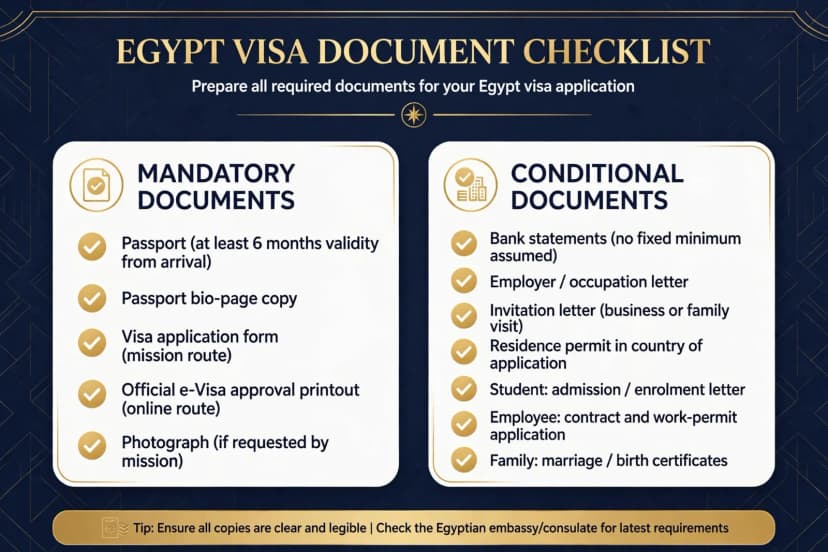
The following tables separate common identity evidence from purpose-specific or conditional evidence. They are preparation aids, not a claim that every item is mandatory for every applicant. The responsible mission may request additional papers or originals.
Core visitor / tourist documents
| Document | Status | Notes |
|---|---|---|
| Passport | Essential | e-Visa FAQ specifies at least six months' validity from arrival |
| Passport bio-page copy | Commonly requested | Follow the relevant form and mission checklist |
| Official e-Visa approval | If applying online | Print and carry it |
| Visa application form | If applying through a mission | Obtain the current version from that mission |
| Photograph | If requested by mission | Follow exact size and background requirements |
| Itinerary | Supporting / may be requested | Include dates and transport details |
| Accommodation details | Supporting / may be requested | Hotel booking or host address |
| Bank statements | Conditional | Do not assume a fixed minimum balance; ask the mission |
| Employer / occupation letter | Conditional | Useful to explain employment and leave |
| Invitation letter | Purpose-dependent | Business or family visit where relevant |
| Residence permit in country of application | If applying abroad | Check required remaining validity with the mission |
Student, work and family evidence
| Purpose | Typical evidence to discuss with authority | Important qualification |
|---|---|---|
| Student | Admission/enrolment letter, passport, photographs, financial/guardian evidence if requested | Ask institution about residence conversion and deadlines |
| Employee | Employer request, contract/offer, qualifications, experience records, authenticated documents, work-permit application | Employer-led work permit; no work before authorisation |
| Family | Marriage/birth certificates, sponsor's Egyptian ID or residence card, proof of address and support if requested | Legalisation and Arabic translation may be required |
| Investor | Company/investment registration, ownership or capital evidence, business plan if requested | Threshold and residence category require official confirmation |
| Research / exchange | Host invitation, programme details, funding and duration | Category depends on paid/unpaid activity and enrolment |
How to Apply: Step-by-Step
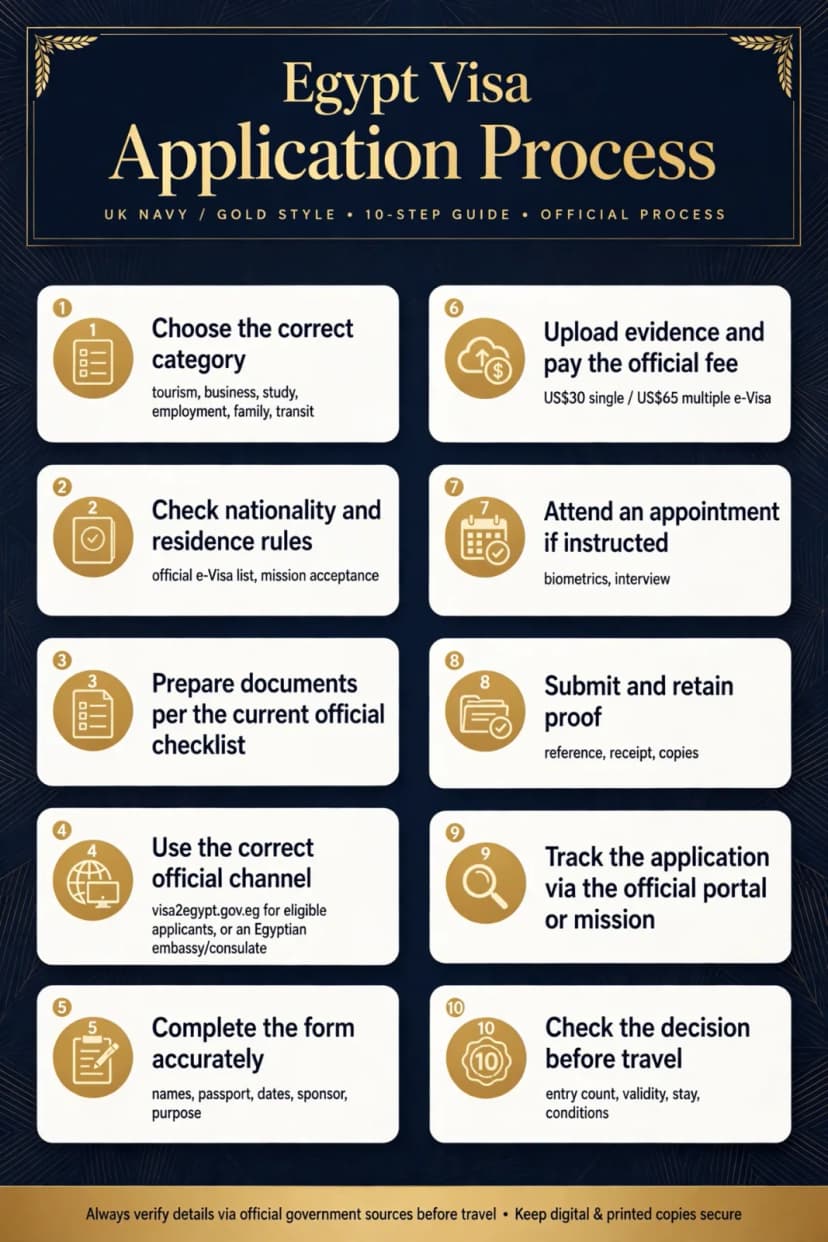
- Choose the correct category. Identify the real purpose: tourism, business meeting, study, employment, family, transit or another authorised basis. Do not describe work as tourism.
- Check nationality and residence rules. Review the official e-Visa list and ask the Egyptian mission responsible for your place of lawful residence whether it accepts your application. Nationality-specific prior approval may apply.
- Prepare documents. Use the current checklist from the official portal or mission. Keep originals and copies. Arrange translation and legalisation only as instructed.
- Use the correct official channel. Eligible applicants use visa2egypt.gov.eg. Other applicants should contact an Egyptian embassy or consulate. Do not use an intermediary website that imitates a government portal.
- Complete the form accurately. Ensure names, passport numbers, travel dates, employment, sponsor and purpose match the supporting documents.
- Upload evidence and pay the official fee. The e-Visa portal currently lists US$30 single-entry and US$65 multiple-entry tourist visas. Consular fees are separate and must be confirmed with the mission. The portal says processing fees are non-refundable and incomplete applications may be rejected.
- Attend an appointment if instructed. The mission may request personal appearance, biometrics, interview or additional documents. Do not assume these are waived.
- Submit and retain proof. Keep the application reference, receipt and copies of everything submitted.
- Track the application. Use the official portal's tracking function if available, or the mission's stated contact method. There is no single processing-time promise for all nationalities.
- Check the decision before travel. Verify entry count, validity dates, permitted stay and any conditions. Carry the visa printout, itinerary, accommodation and relevant invitation documents. Border officials make the final admission decision.
Visa Fees and Financial Requirements
| Item | Published amount | Currency / notes |
|---|---|---|
| Tourist e-Visa, single entry | 30 | US dollars (USD) |
| Tourist e-Visa, multiple entry | 65 | US dollars (USD) |
| Visa on arrival (eligible nationalities only) | 30 | US dollars (USD) — raised from US$25 on 1 Mar 2026; Pakistanis only with a valid and used US/UK/Schengen/Japan/Canada/Australia/NZ visa; digital QR route at Cairo US$36 total (US$30 + US$6 service charge) |
| Consular tourist / visitor visa | Not universally published | Ask the competent Egyptian mission |
| Student / residence permissions | Not verified as a single standard fee | Ministry of Interior / mission confirmation required |
| Work permit | Varies | Employer should obtain current Ministry of Labour fee schedule |
| Financial minimum / bank balance | No universal figure verified | Evidence may be requested; do not rely on unofficial thresholds |
Dated note (Muse, 25 Nov 2026): Prime Ministerial Decree No. 2553 of 2026 raises the fixed fee component in entry and transit visas from US$12 to US$15 with effect from 1 January 2027; the single-entry visa is expected to rise from US$30 to US$33, but the government has not published new consumer prices — confirm the fee on the portal before paying in 2027.
Dated note (Muse, 27 Nov 2026): since 29 July 2026 a departure fee of EGP 100 applies to everyone leaving Egypt (Law 148 of 2026) — a separate charge from the visa fee.
The e-Visa portal states that the processing fee is non-refundable. Use only the payment method shown on the official portal or confirmed in writing by the mission. Do not pay a private agent on the assumption that the fee is a government charge.
Visa Processing Times
The official sources reviewed do not publish one processing time that applies to every applicant and category. Security clearance, nationality, local mission workload, missing documents, interviews and verification can extend the process. An Egyptian consular FAQ notes that some nationalities require special approvals submitted at least one and a half months before travel; a UK consular page indicates clearance may take 2–6 weeks. Those statements are mission-specific guidance, not a guaranteed timeline for Hanoi or Islamabad.
Apply well in advance and do not buy non-refundable tickets before the mission confirms the required process. The four-working-day service note on one Egyptian consular FAQ applies to that consular context and should not be generalised to Pakistani applicants or the Embassy in Hanoi.
Applying from Pakistan or Vietnam: Pakistani Passport Holders
Pakistani citizens applying from Pakistan
Pakistan is not on the e-Visa portal's published eligible-nationality list reviewed for this guide. Egyptian consular sources list Pakistan among nationalities subject to prior clearance. A Pakistani applicant should contact the Egyptian Embassy responsible for Pakistan and ask for the current application form, security-clearance procedure, fee, originals/copies, photographs, interview requirements and expected timeline. Do not assume that a standard tourist visa can be issued immediately or that airport visa-on-arrival arrangements apply.
Pakistani citizens legally living or working in Vietnam
The Egyptian Ministry of Foreign Affairs lists an Embassy in Hanoi at 63 Đ. Tô Ngọc Vân, Quảng An, Tây Hồ, Hà Nội, telephone +84 24 3829 4999, email embassy.hanoi@mfa.gov.eg. Contact the Embassy before preparing or sending an application. Explain that you hold a Pakistani passport and state your Vietnamese residence status and its expiry date. Ask explicitly whether the Embassy accepts visa applications from Pakistani nationals who are legal residents of Vietnam, whether it can forward the case for prior clearance, and whether the applicant must attend in person.
A Vietnamese temporary residence card or work permit is evidence of lawful stay in Vietnam; it does not change the passport nationality and does not itself confer eligibility for Egypt's e-Visa. It may help establish consular jurisdiction or local residence, but the Embassy must confirm whether it will accept the case. Do not infer acceptance from the fact that Egypt has an embassy in Hanoi.
Documents Pakistani residents in Vietnam should be ready to discuss
- Original Pakistani passport and clear bio-page copy.
- Vietnamese temporary residence card / residence permit and copy, with validity dates.
- Vietnam work permit and employer confirmation, if applicable.
- Completed Egyptian visa application form supplied by the Embassy.
- Recent photographs in the exact format requested.
- Recent bank statements and employment letter if requested.
- NADRA polio vaccination certificate — Egypt requires proof of polio vaccination from travellers coming from Pakistan. (Muse enhancement, verified 25 Nov 2026.)
- Travel itinerary, accommodation and return/onward travel details.
- Invitation letter and host details for business or family travel.
- Any security-clearance form or additional documents required for Pakistani nationals.
These are preparation items, not a definitive mandatory list for Hanoi. The Embassy may ask for further evidence, may decline to accept an application from a non-Vietnamese national, or may direct the applicant to apply in Pakistan. Obtain its response in writing where possible.
Pakistan versus Vietnam application route
| Issue | Applying in Pakistan | Applying while resident in Vietnam |
|---|---|---|
| e-Visa eligibility | Pakistani passport not listed in reviewed portal | Vietnamese residence does not change Pakistani nationality eligibility |
| Consular office | Egyptian mission responsible for Pakistan | Embassy of Egypt in Hanoi; acceptance must be confirmed |
| Prior clearance | Pakistani nationality is listed by Egyptian consular sources | Same nationality-based clearance may apply; Hanoi must confirm procedure |
| Residence evidence | Pakistan identity/address evidence as requested | Vietnamese residence card and work permit may be requested |
| Fees / timing | Confirm with mission | Confirm directly with Hanoi; no universal published figure |
Student Visa Guide
Start with admission. Ask the university or language institution to provide a formal letter that identifies the programme, course dates, attendance mode and tuition or funding arrangements. Confirm whether you should obtain an entry visa before travel and which local office handles student residence after arrival. Keep evidence of accommodation and financial support available if requested. Minors may need guardian consent and parental identity documents. The official consular FAQ for some contexts mentions recent enrolment evidence and a guardian declaration for students, but that should not be treated as a universal student checklist.
Do not enrol in a programme on the assumption that a tourist visa automatically converts into student residence. Confirm the process, deadline, fee and whether leaving and re-entering is required. Student status does not automatically grant unrestricted employment rights.
Work Visa and Job Opportunities
A foreign worker should have a genuine Egyptian employer and a defined role. The employer should contact the Ministry of Labour's General Administration for Work Permits for Foreigners to confirm whether the position is open to foreign nationals, what qualifications or experience must be documented, and what company-side approvals are needed. The Ministry's service describes authenticated professional experience documentation as part of its requirements in relevant cases. The exact checklist can depend on occupation and employer.
Do not begin paid work, freelance activity or an internship that amounts to employment until the necessary permission is granted. A business visitor permission is not a work permit. Confirm whether the work permit and residence authorisation are separate steps and whether the employer must complete a local registration after arrival.
Family Immigration and Permanent Residence
A spouse or dependent may be able to apply for residence based on a qualifying family relationship. Prepare civil-status records and ask the mission whether documents must be authenticated by the issuing country's authorities, the Egyptian mission and/or Egypt's Ministry of Foreign Affairs, and translated into Arabic. Family-based residence is not automatically permanent; the applicant must obtain and renew the correct permit.
The Ministry of Interior lists multiple residence categories, including temporary, three-year, five-year, ordinary and special residence. Each has its own eligibility conditions. Do not assume that buying property, marrying an Egyptian citizen, studying or holding a work permit automatically grants permanent residence or citizenship. Obtain current written criteria from the Ministry of Interior for the precise route.
Common Application Mistakes
- Applying for an e-Visa when the passport nationality is not on the current eligible list.
- Assuming a residence card in a third country overrides nationality-based restrictions.
- Choosing tourism when the actual purpose is employment or long-term study.
- Submitting incomplete, inconsistent or inaccurate forms.
- Using unofficial websites that add fees or misrepresent themselves as government portals.
- Providing unverified hotel bookings, invitation letters or financial statements.
- Ignoring security-clearance requirements or applying too close to departure.
- Treating visa validity as the same thing as permitted stay.
- Starting work before the work permit is issued.
- Assuming a visa guarantees admission at the border.
Reasons for Visa Refusal or Delay
An application may be refused, delayed or returned if it is incomplete, the applicant uses the wrong category, the passport or residence evidence is inadequate, information conflicts across documents, the purpose of travel is unclear, the applicant does not meet nationality-specific requirements, or required prior approval is missing. The e-Visa portal specifically warns that incomplete applications may be rejected and fees are non-refundable. Security and admissibility decisions may not be fully explained to the applicant. Never submit false documents or conceal relevant facts.
Frequently Asked Questions
1. Do all nationalities need a visa for Egypt?
No. Entry rules depend on nationality and passport type. Some travellers may be visa-exempt or eligible for an online or arrival route. Check the current official e-Visa portal and Egyptian mission guidance.
2. Can I apply for an Egypt e-Visa online?
Only if your passport nationality appears on the official portal's eligible list and your passport type meets the portal's rules. The portal list reviewed for this guide includes Vietnam but not Pakistan.
3. How much does an Egypt tourist e-Visa cost?
The official portal lists US$30 for a single-entry tourist e-Visa and US$65 for a multiple-entry tourist e-Visa. Consular visa fees are separate.
4. How long must my passport be valid?
The official e-Visa FAQ requires at least six months' validity from the arrival date. For consular applications, confirm the mission's current passport-validity rule.
5. Can a Pakistani citizen get an Egypt e-Visa?
Pakistan does not appear on the official e-Visa eligible-nationality list reviewed on 25 November 2026. Pakistani applicants should contact an Egyptian embassy or consulate and ask about prior clearance.
6. Can a Pakistani living in Vietnam apply at the Egyptian Embassy in Hanoi?
The Embassy exists and publishes its contact details, but its public page does not confirm that it accepts applications from Pakistani residents. Contact it directly with passport and Vietnamese residence details before lodging an application.
7. Does a Vietnamese residence card make a Pakistani eligible for the e-Visa?
No such effect is stated by the official portal. E-Visa eligibility is based on the passport nationality list. A residence card may be relevant to consular jurisdiction, not to changing nationality.
8. Can I work in Egypt on a tourist or business visa?
No. The e-Visa disclaimer states that business or employment without the required permit or pass is an offence. A work permit and appropriate residence status are required.
9. Is there an Egypt digital nomad visa?
No dedicated digital-nomad visa was verified in the official sources reviewed. Ask the Egyptian authorities how your specific remote-work activity is classified before relying on visitor status.
10. Is there a general Egypt job-seeker visa?
No general-purpose job-seeker category was verified in the official sources reviewed. A prospective employee should secure an employer and ask about the work-permit route.
11. How long does an Egypt visa take?
There is no universal official processing time for every nationality and visa category. Prior clearance can take weeks in some consular contexts. Confirm the current estimate with the office handling your case.
12. Does an e-Visa guarantee entry?
No. The official portal says an e-Visa is not final authority to enter Egypt and border authorities may refuse entry.
13. Can I extend my stay in Egypt?
Residence and extension matters are handled by the Egyptian immigration authorities. Check with the Passports, Immigration and Nationality Administration before your permitted stay expires. Do not overstay while waiting for informal advice.
14. Can I apply for permanent residence after studying or working?
The Ministry of Interior lists several residence categories, but the reviewed sources do not establish an automatic permanent-residence entitlement after a fixed period for every foreigner. Ask the Ministry about the specific category and eligibility.
15. Where can I verify Egypt visa information?
Use the official Egypt e-Visa portal, Ministry of Interior, Ministry of Labour and the Egyptian embassy or consulate responsible for your place of residence. Contact details for the Embassy in Hanoi are published by the Ministry of Foreign Affairs.
Official Immigration Websites and Contacts
- Egypt official e-Visa portal: eligible nationalities, online application, fees, FAQ and disclaimer.
- Egypt Ministry of Interior — Passports, Immigration and Nationality Administration: residence categories and immigration services.
- Egypt Ministry of Interior — residence application information: instructions and offices for residence applications.
- Egypt Ministry of Labour: labour legislation and work-permit administration.
- Egypt Ministry of Labour — foreign work permit administration: employer and foreign-worker permit information.
- Egypt Ministry of Foreign Affairs — consular directory: Egyptian missions and contact information.
- Embassy of Egypt in Hanoi: +84 24 3829 4999; 63 Đ. Tô Ngọc Vân, Quảng An, Tây Hồ, Hà Nội.
Final Checklist and Conclusion
Before submitting, confirm that your passport nationality is eligible for the chosen route; that the category matches your real purpose; that the Egyptian mission accepts applications from your country of lawful residence; and that you have the current official checklist, fee and timeline. Keep evidence of legal residence if applying outside your country of citizenship. For Pakistani passport holders in Vietnam, obtain a direct answer from the Embassy in Hanoi on local acceptance and prior-clearance procedure before booking travel.
Egypt offers several routes for short visits and longer-term residence, but a visitor visa is not a work permit and an entry visa is not a residence card. Use official government channels, submit accurate documents and follow the conditions printed on your approval. No private guide can guarantee a visa or admission.
Disclaimer: This article is for general educational purposes only. It is not legal advice and does not replace instructions from the Egyptian Ministry of Interior, Ministry of Labour or an Egyptian embassy/consulate. Rules, fees and procedures may change without notice. Verify your individual case before acting.


