DR Congo Visa Guide 2026: Types, Requirements, Fees and Application Steps
By MAS Inspire | Editorial draft: 27 November 2026 (fees and rules re-verified 28 November 2026)
Table of contents
- Introduction
- Why People Visit, Study, and Work in DR Congo
- Types of DR Congo Visas
- Visa Comparison Table
- Eligibility Requirements
- Complete Document Checklists
- How to Apply: Step-by-Step
- Visa Fees and Financial Requirements
- Visa Processing Times
- Applying from Pakistan or Vietnam
- Student Visa Guide
- Work Visa and Job Opportunities
- Family Immigration and Permanent Residence
- Common Application Mistakes
- Reasons for Visa Refusal
- Frequently Asked Questions
- Official Immigration Websites
- Final Checklist and Conclusion
Introduction
The Democratic Republic of the Congo (DR Congo or DRC) is a large Central African country with important business, cultural, educational and family connections across the region and around the world. Visitors may travel for tourism, meetings, family visits or other short stays. People planning to work, study or join relatives for a longer period need to understand that these purposes may involve a different immigration process from the online airport-visa route.
This guide explains the eVisa information published by the Direction Générale de Migration (DGM), the documents applicants should prepare, the online application sequence and the important difference between a short-stay airport visa and a longer-term immigration status. It also explains what Pakistani passport holders legally living or working in Vietnam should check before travelling.
The most important practical point is the fee discrepancy in the official information. The eVisa FAQ describes a USD 300 total made up of a USD 50 non-refundable administrative fee and a USD 250 visa price. The portal homepage separately lists an ordinary visa at USD 250 and a specific visa at USD 800. Do not assume these figures are interchangeable. Review the amount displayed at checkout and confirm it with DGM before paying.
Information verified: 26 November 2026. Fees and timelines may change — verify on the official portal, https://evisa.gouv.cd. No visa is guaranteed by submitting an application, and approval remains a decision for the competent Congolese authorities.
Why People Visit, Study, and Work in DR Congo
People travel to DR Congo for a wide range of reasons. Some make short visits for meetings, commercial discussions, conferences or project work. Others visit relatives, attend family events or explore the country's cultural and natural heritage. The country's major cities, including Kinshasa and Lubumbashi, are important centres for commerce, public administration, education and regional connections.
A short visit and a long-term move are not the same immigration purpose. A person entering for a brief visit should use the appropriate short-stay route shown by DGM and must respect the conditions and permitted duration of that entry. A visitor should not assume that an airport visa authorises employment, enrolment in a long academic programme or residence beyond its stated period.
Study applicants should contact the institution that intends to enrol them. The institution may need to provide admission evidence, sponsorship or other documents for a DGM process. Similarly, a person recruited by a Congolese employer should obtain written guidance from the employer about the applicable work authorisation and residence formalities before travelling. A family member planning to live in the country should ask DGM about the correct family-residence process rather than relying on a short family-visit visa.
The right immigration route depends on the real purpose, duration and circumstances of the stay. Describing a work or study plan as tourism can create serious problems at the border or during a later status application. Applicants should state their purpose accurately and obtain written instructions from the relevant authority or sponsor whenever the online portal does not cover their circumstances.

Types of DR Congo Visas
The official eVisa FAQ identifies three eVisa labels:
| Official eVisa label | General use | What is verified |
|---|---|---|
| Visa volant ordinaire | Ordinary short visit | Homepage lists USD 250 and a 7-day stay; FAQ describes the USD 300 total structure |
| Visa volant spécifique | A specific short-visit category | Homepage lists USD 800 and a 30-day stay; the extra administrative-fee treatment must be confirmed |
| Visa volant pour visite de famille | Family visit | The category is listed in the FAQ; separate price, validity and detailed conditions are not officially verified here |
The portal FAQ also describes the airport visa as a Visa Aéroportuaire (VAP). It is a seven-day, single-entry airport visa, with USD 90 payable at the border or entry point. The FAQ says the eVisa must be used within three months of issue. Applicants should carefully distinguish the three-month use window from the seven-day stay: the former is the period in which the eVisa must be used, while the latter is the stated period of the airport visa.
Work, study and residence are different processes
A work permit, student status, family residence or long-stay authorisation is not listed as a separate eVisa type on the portal. These cases normally require DGM procedures and may involve an employer, educational institution or family sponsor. The exact permit name and route depend on the applicant's situation. Fees, processing times, bank-balance minima and fixed document counts for these longer-term procedures are not officially published on the eVisa portal. Ask DGM and the sponsor for current written requirements.
No verified dedicated digital-nomad visa or job-seeker visa was identified. Do not rely on online claims that either category is available without confirmation from DGM.
Visa Comparison Table
The table below separates what is stated by the official portal from matters that require confirmation. It is not a substitute for the category selected in the live application.
| Route or status | Main purpose | Published fee information | Published stay / validity information |
|---|---|---|---|
| Visa volant ordinaire | Ordinary short visit | Homepage: USD 250. FAQ: USD 300 total, including USD 50 administrative fee and USD 250 visa price | Homepage: 7 days' stay |
| Visa volant spécifique | Specific short visit | Homepage: USD 800. If the USD 50 administrative fee applies in addition, total would be USD 850; confirm checkout | Homepage: 30 days' stay |
| Visa volant pour visite de famille | Short family visit | Separate category price not officially published in the verified material; FAQ's general eVisa cost statement needs confirmation for this category | Separate validity not officially published in the verified material |
| Airport visa (VAP) | Airport entry route described in the FAQ | USD 90 payable at border / entry point | 7 days, single entry |
| Work authorisation / residence | Employment and longer stay | Not officially published on the eVisa portal — confirm with DGM / employer | Not officially published on the eVisa portal — confirm with DGM / employer |
| Student / study status | Study and longer stay | Not officially published on the eVisa portal — confirm with DGM / educational institution | Not officially published on the eVisa portal — confirm with DGM / educational institution |
| Family residence / long stay | Living with qualifying family | Not officially published on the eVisa portal — confirm with DGM / sponsor | Not officially published on the eVisa portal — confirm with DGM / sponsor |
The ordinary-visa budget example in the FAQ is USD 300 for the eVisa plus USD 90 for the VAP, or USD 390 before any other costs. This is an explanation of the stated amounts, not a guarantee that every applicant will be charged exactly that amount in every case. The homepage and FAQ should be reconciled at checkout.
Eligibility Requirements
Eligibility is determined by the Congolese authorities and the live portal. Applicants should begin by checking whether their nationality is eligible to use the eVisa route and whether the portal accepts applications from their current country of residence. Do not assume that holding a residence permit in a third country automatically creates eligibility or changes the fee.
Before applying, check the following:
- Your passport is valid for the travel dates and meets the requirements displayed by the official portal.
- Your nationality is accepted for the selected eVisa category.
- Your stated purpose matches the category selected.
- Your intended arrival date falls within the eVisa's three-month use window, as described by the FAQ.
- You understand the stated duration and single-entry condition of the VAP.
- You can provide the information and supporting files requested by the live portal.
- You can pay the non-refundable administrative fee and any later amount requested after acceptance.
- You have checked current entry-health requirements, including yellow fever guidance, before departure.
A person intending to work, study or reside in DR Congo should not use an ordinary short-visit category as a substitute for the relevant long-stay authorisation. Obtain instructions from DGM and the sponsoring employer, educational institution or family member before making travel arrangements.
The portal's live nationality and residence questions are decisive. If the portal does not clearly accept your case, contact DGM support rather than guessing or submitting inconsistent information.
Complete Document Checklists
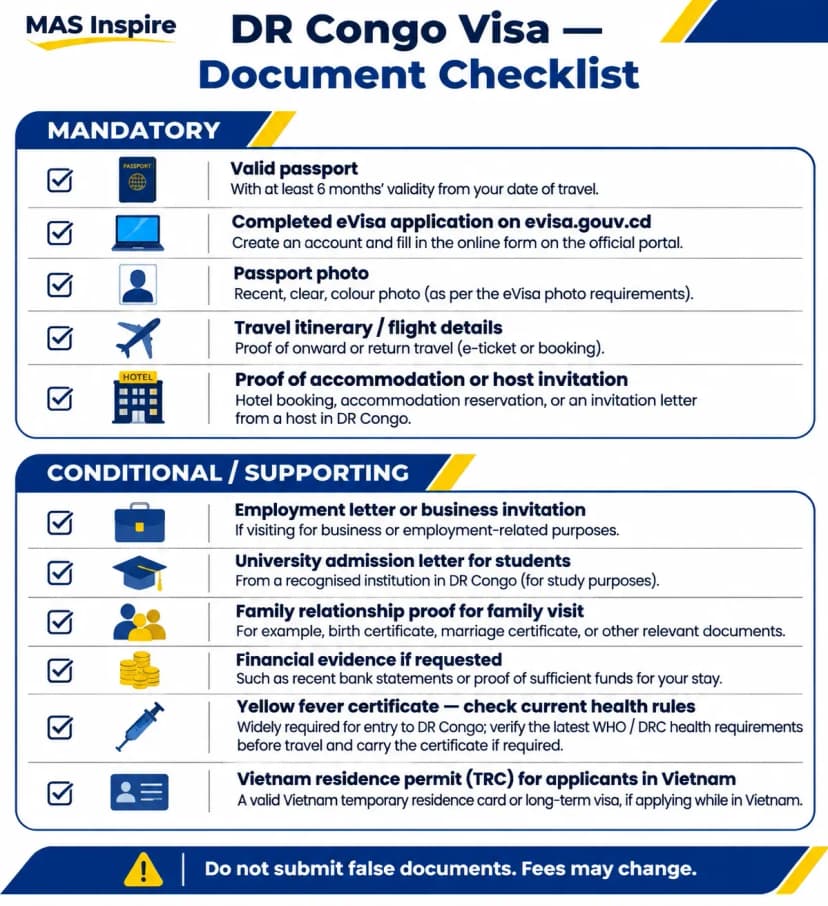
The portal's live form is the controlling source for the exact documents and file specifications for an individual application. The lists below are practical preparation guides, not claims that every item is mandatory for every applicant. No fixed document count is asserted.
Short-stay eVisa preparation
| Document or evidence | Status | Notes |
|---|---|---|
| Passport identity and travel document details | Mandatory for an application | Enter details exactly as printed in the passport; follow the portal's validity and upload instructions |
| Completed online application | Mandatory | Complete all required fields truthfully |
| Digital photograph, if requested by the portal | Conditional | Follow the portal's current format and image rules |
| Travel purpose explanation | Recommended / if requested | Keep the explanation consistent with the selected category |
| Accommodation details | Conditional | Provide if requested or relevant to the itinerary |
| Return or onward travel details | Conditional | Provide if requested; do not treat this guide as setting a universal rule |
| Invitation or host information | Conditional | Particularly relevant where the visit is hosted or family-related |
| Proof of funds or financial support | Conditional | No official minimum balance is verified; follow the portal's request |
| Additional supporting documents | Conditional | Upload only what the portal or DGM requests |
| Yellow fever certificate | Health / entry requirement, if required | Check current WHO and DRC health requirements before travel; it is not a visa fee |
Family-visit preparation
| Document or evidence | Status | Notes |
|---|---|---|
| Passport and completed online application | Mandatory for the application | Follow the live portal instructions |
| Family relationship explanation | Recommended / if requested | Explain the relationship accurately |
| Host or inviting relative's details | Conditional | Provide the information requested by the portal |
| Invitation or supporting family records | Conditional | Requirements depend on the case; confirm with DGM |
| Accommodation and travel details | Conditional | Provide if requested |
| Financial support evidence | Conditional | No minimum amount is officially verified here |
The family-visit eVisa is listed by the FAQ, but its separate price, duration and detailed document rules were not verified. Confirm them before paying.
Work, study and long-stay preparation
| Document or evidence | Status | Notes |
|---|---|---|
| Passport | Core identity document | Confirm exact requirements with DGM |
| Employer offer, contract or sponsorship letter | Conditional / normally relevant to work cases | Employer should confirm the correct authorisation route |
| Institutional admission or enrolment letter | Conditional / normally relevant to study cases | Educational institution should provide guidance |
| Sponsor identity and organisation details | Conditional | Depends on the permit route |
| Qualifications, professional records or academic history | Conditional | Provide only as requested by the relevant authority |
| Family relationship records | Conditional | Relevant to family residence |
| Police, medical or other certificates | Conditional | Do not assume these are required in every case; obtain a current official list |
| Financial evidence | Conditional | No bank-balance minimum is verified |
| Residence application forms and local filings | Conditional | In-country steps may apply; confirm with DGM |
Mandatory versus supporting evidence: the portal determines which uploads are mandatory for the chosen eVisa application. Supporting documents may help explain the purpose of travel, but adding unsolicited or inconsistent paperwork can create confusion. Use clear, legible files and ensure names, dates and passport numbers match across all records.
How to Apply: Step-by-Step
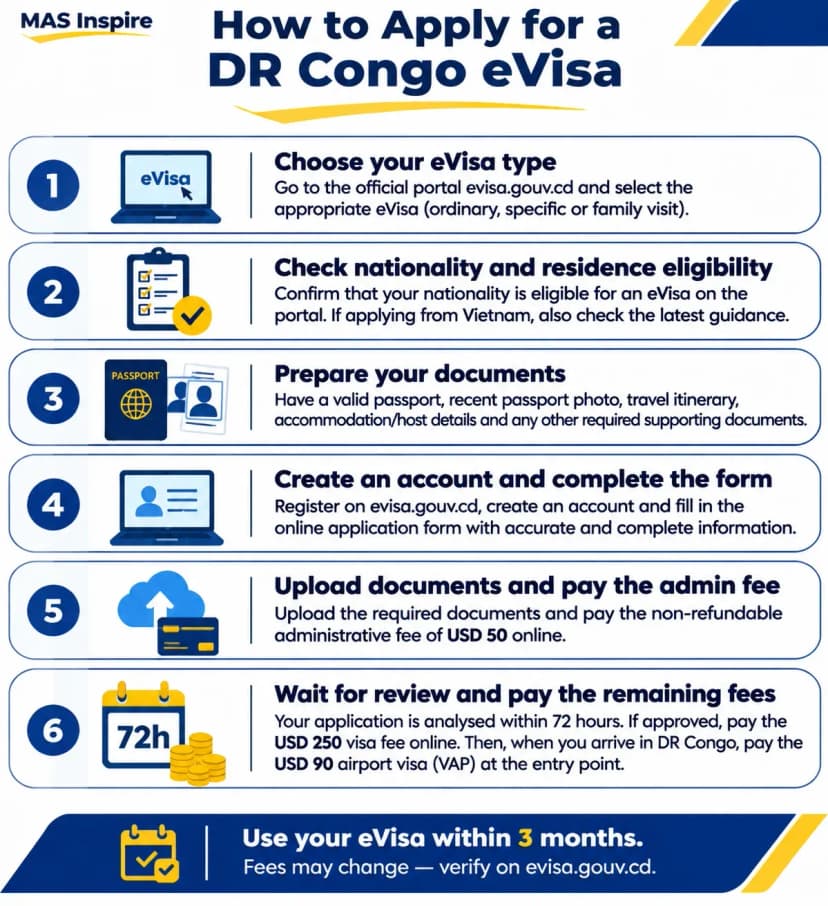
The DGM homepage describes a five-step process and analysis within 72 hours. The practical preparation sequence below expands that flow into ten actions without suggesting that the portal requires routine biometrics or an interview.
- Choose the correct category. Review the portal's three listed eVisa types and select the one that matches the actual visit. If the purpose is work, study or residence, contact DGM and the sponsor about the separate long-stay route.
- Check nationality and residence eligibility. Use the live portal to confirm that your passport nationality and current application circumstances are accepted. A residence permit from another country does not guarantee eligibility.
- Prepare your documents. Gather passport details and any files requested for your selected category. Make sure scans and photographs follow the current portal instructions.
- Create an account. Use the official portal at https://evisa.gouv.cd. Check the web address carefully before entering personal or payment information.
- Complete the application form. Enter accurate personal, passport, travel and purpose information. Review spellings, dates and document numbers before continuing.
- Upload documents and pay the administrative fee. The FAQ describes a USD 50 non-refundable administrative fee paid with the application. The later USD 250 visa price is described as payable once the application is accepted. Check the precise amount shown at checkout because the homepage and FAQ price information do not fully reconcile.
- Attend biometrics or an interview only if requested. The portal information used for this guide does not publish a routine biometrics step. Do not assume an appointment is required; follow a direct instruction from DGM if one is issued.
- Track the application. Use the portal account and official communications to monitor the case. Keep payment confirmations and application references.
- Read the decision and follow passport instructions. An application is not approved merely because it was submitted or the administrative fee was paid. Follow the decision notice and any official instructions about the travel document.
- Travel and complete the VAP / arrival process. The FAQ describes a seven-day, single-entry airport visa and a USD 90 payment at the border or entry point. Carry the documents requested by the authorities and check health-entry requirements before departure.
Application stages at a glance
| Stage | Applicant action | Fee / timing stated in verified material |
|---|---|---|
| Online submission | Complete form and upload requested files | USD 50 non-refundable administrative fee |
| Review | Wait for DGM analysis | Homepage says analysis within 72 hours |
| After acceptance | Pay visa price as instructed | FAQ describes USD 250 visa price |
| Arrival | Complete airport visa / entry process described by FAQ | USD 90 VAP, payable at border / entry point |
The homepage's 72-hour analysis statement should not be read as a guarantee of approval, passport return, travel readiness or completion of every later step. Allow time for follow-up requests and do not buy non-refundable travel based solely on an estimated review period.
Visa Fees and Financial Requirements
Only the amounts below are included because they are the verified figures in the research brief. Do not rely on unofficial agency prices or add assumed service charges.
| Fee item | Amount | When / how it is described |
|---|---|---|
| eVisa administrative fee | USD 50 | Paid with application; non-refundable |
| eVisa visa price in FAQ | USD 250 | Paid once application is accepted |
| FAQ eVisa total | USD 300 | USD 50 + USD 250 |
| Visa volant ordinaire homepage listing | USD 250 | Homepage also lists 7 days' stay |
| Visa volant spécifique homepage listing | USD 800 | Homepage also lists 30 days' stay |
| VAP airport visa | USD 90 | Payable at border / entry point |
Important official price discrepancy
The FAQ's USD 300 total appears to describe an ordinary eVisa cost consisting of a USD 50 administrative fee and a USD 250 visa price. The homepage separately lists the ordinary category at USD 250 and the specific category at USD 800. These presentations do not fully reconcile.
Where the USD 50 administrative fee is additional to the homepage-listed visa price, the specific category would amount to USD 850 in total. That is an interpretation of the two published figures, not a separately confirmed total. Applicants must check the exact amount displayed at checkout on https://evisa.gouv.cd before paying and contact DGM if the breakdown is unclear.
For the ordinary route described by the FAQ, the basic budget is USD 300 + USD 90 VAP = USD 390, before any other costs. This does not include flights, accommodation, insurance, health-related expenses or any other costs that may apply.
No official bank-balance minimum, work permit fee, student permit fee, family-residence fee or long-stay processing charge is verified in this guide. For those routes, the correct wording is: Not officially published on the eVisa portal — confirm with DGM / the sponsoring employer or institution.
Visa Processing Times
The official homepage states that analysis is completed within 72 hours. This is the only processing-time figure used in this guide. It should be treated as the portal's stated analysis period, not a guarantee that every application will receive a decision within that time.
An application may require additional review, clarification or documents. The applicant should monitor the account and email used for the application and respond promptly to any official request. Avoid submitting duplicate applications unless DGM instructs you to do so.
| Process | Published timing |
|---|---|
| eVisa analysis | Within 72 hours, according to the homepage |
| Work authorisation | Not officially published on the eVisa portal |
| Student / study status | Not officially published on the eVisa portal |
| Family residence / long stay | Not officially published on the eVisa portal |
| Family-visit eVisa validity | Not officially published in the verified material |
For unpublished times, ask DGM and the relevant sponsor for a current estimate. Do not use a travel agent's estimate as an official processing commitment.
Applying from Pakistan or Vietnam
Applicants should distinguish nationality, legal residence and the place from which an application is submitted. These are related but separate questions. A Pakistani passport holder legally living or working in Vietnam should use the official online eVisa portal as the main starting route, while checking whether the portal accepts the applicant's nationality and current residence circumstances.
A Vietnamese residence card or temporary residence card (TRC) does not guarantee eligibility to apply locally, and it does not itself grant permission to enter DR Congo. Check the nationality eligibility questions and instructions on the official portal before paying.
Pakistani applicants living or working in Vietnam should prepare to carry or provide, as relevant:
- A valid Pakistani passport.
- Their Vietnam residence permit or TRC.
- Evidence of lawful employment or other lawful residence in Vietnam.
- The application and supporting documents requested by the portal.
- Official application and payment records.
No officially verified DR Congo embassy in Vietnam was found in this research. Do not rely on an unverified address or assume that a local in-person application route exists. Before travelling to another country to apply in person, confirm the available consular route with the nearest verified DR Congo mission and obtain its instructions directly.
Do not assume that applying from Pakistan rather than Vietnam changes the eVisa fee. The verified fee information in this guide does not establish a location-based price difference. Check the amount displayed by the official portal.
If the portal does not accept the applicant's nationality or residence circumstances, contact DGM support at support@evisa.gouv.cd or +243 97 296 3195 / +243 84 030 4237. Keep written records of the response. Do not make a non-refundable trip to an embassy or consulate until its location and service have been confirmed through an official source.
Student Visa Guide
A person planning to study in DR Congo should first obtain guidance from the educational institution. The portal's three eVisa labels do not include a separate student eVisa category. A short visit to attend a meeting or explore a campus should not be confused with authorisation to enrol in a course or remain for a long academic programme.
Ask the institution's international office or admissions team to confirm the appropriate immigration process and whether it can sponsor or support the application. The institution should explain which DGM office handles the case, which forms are current, whether an in-country residence process is required and what documents must be provided.
Commonly relevant supporting material may include an admission or enrolment letter, passport details, evidence of the programme and sponsor information. These are preparation examples, not a definitive mandatory list. DGM and the institution must confirm the exact checklist. Police certificates, medical records, financial statements and other documents should be supplied only when the authority or institution requests them.
The student permit fee, processing time, minimum financial requirement and fixed document count are not officially published on the eVisa portal. Do not rely on invented figures or a short-stay eVisa fee as a student permit price. Ask for the current requirements in writing before paying fees or making travel commitments.
Work Visa and Job Opportunities
Foreign nationals intending to work in DR Congo should obtain the correct authorisation before starting employment. The ordinary and specific eVisa categories are short-stay airport-visa labels; they should not be treated as work permits. A visitor status does not automatically permit paid employment.
A genuine employer should be prepared to explain the recruitment arrangement and the immigration steps it will support. Ask for the employer's legal name, a written offer or contract, the role and work location, and a clear explanation of who will coordinate DGM filings. Confirm whether the employer must provide sponsorship or supporting documents and whether the applicant must complete any residence formalities after arrival.
Professional qualifications, work history and other records may be relevant, depending on the position and the permit route. The employer and DGM should specify which documents are required. Do not assume that every applicant must submit the same police, medical, education or financial documents.
Work permit fees, processing times, bank-balance minima and fixed document counts are not officially published on the eVisa portal — confirm with DGM / the sponsoring employer. No verified digital-nomad visa or job-seeker visa was identified in this research. A person who wants to work remotely or travel to look for employment should obtain a written answer from DGM about the lawful status available for their exact circumstances. Do not work on the assumption that a visitor visa covers employment.
Be cautious if a recruiter promises guaranteed immigration approval, asks for unexplained payments or refuses to identify the sponsoring employer. Verify the employer and the immigration process independently before sending money or original documents.
Family Immigration and Permanent Residence
The official FAQ lists visa volant pour visite de famille as an eVisa category. This is a family-visit route, not proof that the applicant has permission to settle permanently or reside in DR Congo for an extended period. The separate fee, duration and detailed conditions for the family-visit category were not verified in the material used for this guide.
A person planning to live with a spouse or relative should ask DGM which family-residence or long-stay procedure applies. The family member in DR Congo may need to provide sponsorship or supporting evidence. The authority should confirm the relationship documents, forms, translations or legalisations required in the individual case.
Do not assume that a family-visit eVisa automatically converts into a residence permit, or that an applicant can remain after the short-stay period expires while waiting for another status. Obtain written guidance about whether an application can be made from abroad or in-country, the lawful status required while it is pending, and the consequences of a refusal.
Family-residence and permanent-residence fees, processing times, financial minima and fixed document counts are not verified on the eVisa portal. Confirm them directly with DGM. The portal's general eVisa fee information should not be presented as a permanent-residence fee.
Common Application Mistakes
Common errors can delay an application or create problems at entry. Reduce risk by checking the following before submitting:
- Choosing the wrong category. Select the category that matches the real purpose of the visit. Work, study and residence need separate guidance.
- Assuming all published prices are identical. The FAQ's USD 300 total and the homepage's USD 250 / USD 800 category listings do not fully reconcile.
- Ignoring the administrative fee. The FAQ describes USD 50 as non-refundable and payable with the application.
- Forgetting the VAP charge. The FAQ describes USD 90 payable at the border or entry point.
- Confusing validity with permitted stay. The three-month period to use the eVisa is not the same as the seven-day VAP stay.
- Entering inconsistent passport information. Copy names, dates and document numbers carefully.
- Assuming a third-country residence card guarantees eligibility. A Vietnam TRC does not guarantee local eligibility.
- Treating the 72-hour analysis statement as a guaranteed approval time. It is a published analysis period, not a promise of approval.
- Assuming routine biometrics are required. The portal information used here does not publish a routine biometrics step; attend only if instructed.
- Relying on unofficial embassy details. No DR Congo embassy in Vietnam was verified in this research.
- Using a short-stay visa for long-term work or study. Obtain the correct DGM and sponsor guidance.
- Ignoring health-entry rules. Check current WHO and DRC yellow fever requirements before departure.
Reasons for Visa Refusal
The verified material for this guide does not publish a definitive list of refusal grounds. The final decision belongs to the competent Congolese authorities. In general, applicants should avoid preventable issues such as inaccurate information, inconsistent supporting records, an unclear travel purpose, selecting an unsuitable category or failing to respond to an official request.
A refusal may have consequences for travel plans and future applications. Do not assume that payment of the administrative fee guarantees approval; the FAQ describes the USD 50 fee as non-refundable. If a decision is negative, read the official notice carefully and ask DGM whether there is a review, correction or reapplication route. Do not submit altered documents or conceal a previous decision.
If the portal requests additional evidence, provide accurate and relevant material in the format and timeframe stated by the authority. Where the applicant's purpose is employment, study or residence, the sponsor should clarify the correct route before another short-stay application is submitted.
Frequently Asked Questions
1. What is the official DR Congo eVisa website?
The official eVisa portal is https://evisa.gouv.cd. The DGM main website is https://dgm.cd. Use the official domain when entering personal or payment details.
2. Which eVisa categories are listed by DGM?
The official FAQ lists visa volant ordinaire, visa volant spécifique and visa volant pour visite de famille.
3. How much does a DR Congo eVisa cost?
The FAQ describes USD 300 total: USD 50 non-refundable administrative fee plus a USD 250 visa price payable after acceptance. The homepage separately lists ordinary at USD 250 and specific at USD 800. Confirm the exact checkout total because the published figures do not fully reconcile.
4. How much is the airport visa (VAP)?
The FAQ states USD 90, payable at the border or entry point. It describes the VAP as a seven-day, single-entry airport visa.
5. How long is the eVisa valid for use?
The FAQ says the eVisa must be used within three months of issue. The VAP stay described by the FAQ is seven days, single entry. Check the decision document for the conditions applying to your case.
6. How long does DGM take to analyse an eVisa application?
The homepage states analysis within 72 hours. This is not a guarantee of approval or of total end-to-end processing.
7. Is there a separate work visa on the eVisa portal?
A work permit is not listed as a separate eVisa type on the portal. Work cases normally involve DGM and employer sponsorship or supporting procedures. Fees and times are not officially published on the eVisa portal; confirm with DGM and the employer.
8. Is there a student eVisa?
A separate student eVisa is not listed among the three FAQ categories. Students should work with their educational institution and DGM to confirm the correct study and residence process. Fees and times are not officially published on the eVisa portal.
9. Can I apply for a family visit?
The FAQ lists visa volant pour visite de famille. Its separate price, validity and detailed conditions were not verified here, so confirm the category details and total at checkout or with DGM.
10. Can a Pakistani passport holder living in Vietnam apply online?
The online eVisa portal is the main starting route. The applicant must check nationality eligibility and the portal's residence questions. A Vietnam residence permit or TRC does not guarantee eligibility. Carry the TRC and employment proof, and confirm any in-person route with a verified DRC mission before travelling.
11. Is there a DR Congo embassy in Vietnam or a digital-nomad visa?
No DR Congo embassy in Vietnam was officially verified in this research. No verified digital-nomad or job-seeker visa was identified. Confirm consular options and any proposed immigration category directly with DGM or a verified DRC mission.
12. Do I need a yellow fever vaccination certificate?
Check current WHO and DR Congo health-entry requirements before travel and carry the certificate if required. Health requirements can change and should be checked separately from visa fees.
13. What happens if my DR Congo eVisa application is refused?
Read the official decision notice carefully and ask DGM whether there is a review, correction or reapplication route. Do not submit altered documents or conceal a previous decision. Payment of the USD 50 administrative fee does not guarantee approval.
14. Can I work in DR Congo on a tourist eVisa?
No. The ordinary and specific eVisa categories are short-stay airport-visa labels; they are not work permits. A visitor status does not automatically permit paid employment. Obtain the correct work authorisation through DGM and the sponsoring employer before starting work.
15. Do I need a return ticket for a DR Congo eVisa?
Return or onward travel details are conditional — provide them if the portal requests them. Do not treat this guide as setting a universal rule; follow the live portal's request for your category.
Official Immigration Websites
Use these official channels for the latest instructions:
- DR Congo eVisa portal — DGM: https://evisa.gouv.cd
- Direction Générale de Migration: https://dgm.cd
- eVisa support email: support@evisa.gouv.cd
- eVisa support telephone: +243 97 296 3195
- Additional support telephone: +243 84 030 4237
If a page, payment instruction or contact detail appears inconsistent, confirm it through the official portal or DGM before proceeding. Do not rely on a third-party website to resolve a discrepancy in the official fee schedule.
Final Checklist and Conclusion
Before submitting an application, confirm that you have:
- Checked that your nationality and circumstances are eligible on the official eVisa portal.
- Selected the category that matches your actual purpose.
- Read the current portal instructions and prepared the requested files.
- Checked the USD 50 administrative fee and the later visa-price instruction.
- Compared the checkout total with the FAQ and homepage information.
- Budgeted for the USD 90 VAP if the airport visa described by the FAQ applies.
- Understood the three-month eVisa use window and the seven-day, single-entry VAP stay.
- Saved the application reference, payment receipt and official correspondence.
- Obtained employer, institution or family-sponsor guidance for any long-stay purpose.
- Checked current WHO and DR Congo health requirements, including yellow fever guidance.
DR Congo's online route can be a useful starting point for eligible short visits, but applicants must distinguish the eVisa from work, study and residence authorisations. The most important unresolved issue in the published fee information is the difference between the FAQ's USD 300 total and the homepage's separate USD 250 and USD 800 category prices. Confirm the amount shown at checkout before paying.
This article is educational information, not legal advice and not an official DGM publication. MAS Inspire is not a government authority and does not guarantee visa approval. Fees and timelines may change — verify on https://evisa.gouv.cd.
Information verified: 26 November 2026.