Djibouti Visa Guide 2026: Types, Requirements, Documents and Application Steps
By MAS Inspire | Editorial draft: 27 November 2026 (fees and rules re-verified 28 November 2026)
Planning a trip, study period or job in Djibouti? This guide explains the country's entry visa framework, the online application route, supporting documents, residence cards and work authorization. It also explains what Pakistani passport holders who live or work legally in Vietnam should check before applying.
Immigration requirements can change, and the final decision belongs to Djibouti's competent authorities. Use the official Djibouti eVisa portal and the Journal Officiel legislation as the controlling starting points. This article was checked on 26 November 2026.
Verification note — 28 November 2026. The official eVisa portal (evisa.gouv.dj) could not be text-fetched again on 28 November 2026 (the same DNS/resolution failure as on 26 November), so no portal text was read directly; the portal’s fee and checklist claims below rest on Law No. 40/AN/19/8th L and on secondary sources. The reported eVisa fees (USD 12 transit, USD 23 short stay) were re-confirmed on 28 November 2026 against multiple independent sources that cite the official portal (Wikipedia, “Visa policy of Djibouti”; quicktraveltools.com, which records checking the portal on 10 October 2026), but they remain reported figures — confirm the exact amount inside the live official application before paying.
Two points conflict across sources and are flagged here, not settled: (1) Visa on arrival. The UK FCDO (updated 27 July 2026) says a tourist visa can be bought on arrival in cash US dollars, while the official line is that the eVisa replaces visas issued at the point of entry and IATA Timatic’s visa-on-arrival scope is itself disputed — do not travel relying on a visa on arrival. (2) Entry points. Wikipedia states eVisa holders may enter through Ambouli International Airport or any other border crossing, while other 2026 guides say Ambouli only — confirm the permitted entry point before travel. Business eVisa (USD 30–40) and multiple-entry (USD 40–50) fees appear in one 2026 guide only and are not verified, so they are not quoted as fees in this guide. A Pakistan-specific guide (UrduPoint, last checked 7 November 2026) states students and workers cannot use the eVisa and must apply at a Djibouti embassy — consistent with this guide’s “apply in advance” advice, but confirm the channel with the Immigration Directorate. Transit duration: eVisa guides describe 1–14 days; Law No. 40/AN/19/8th L, Article 12, states 3–15 days — the law controls.
Table of contents
- Why visit, study or work in Djibouti
- Types of Djibouti visas
- Visa comparison table
- Eligibility requirements
- Complete document checklists
- How to apply
- Visa fees and financial requirements
- Processing times and validity
- Applying from Pakistan or Vietnam
- Student visas and study stays
- Work visas and job opportunities
- Family immigration and permanent residence
- Common application mistakes
- Reasons for visa refusal or entry problems
- Frequently asked questions
- Official websites and final checklist
Why visit, study or work in Djibouti
Djibouti occupies a strategic position at the entrance to the Red Sea and the Gulf of Aden. Visitors travel for tourism, family visits, business meetings, port and logistics-related activities, regional events and transit. The country also hosts education, research, development and employment opportunities connected with its public institutions, international organizations, transport infrastructure and private sector.
The reason for travel matters. A short visit, an academic programme and paid employment are not interchangeable immigration purposes. Choose the route that accurately describes the planned activities and obtain the appropriate authorization before undertaking regulated work.

Types of Djibouti visas
Djibouti's Law No. 40/AN/19/8th L identifies three broad visa groupings:
1. Transit visa
A transit visa is for a traveller passing through Djibouti en route to another country. The law describes a transit period of three to fifteen days, subject to the traveller holding an entry visa for the final destination where required and a ticket for onward travel. Check whether the itinerary actually requires a transit visa and whether the airport or border route is covered by the authorization issued.
2. Short-stay visa: tourism, private visits and business
The law groups private, business and tourist travel within short-stay visas, whose validity must not exceed three months. The exact permitted stay, entry count and validity printed on the issued visa govern the individual case. A business visitor should not assume that a business visit visa authorizes local employment or paid work for a Djiboutian employer.
The official eVisa portal describes an electronic authorization that replaces the visa issued at the point of entry. Its published application process is online. It asks applicants for passport, transport, accommodation and invitation information. Check the portal for the currently available purpose and duration choices before paying.
3. Long-stay visa
The 2019 law describes a long-stay visa with validity from 90 days to 12 months, renewable once. It may lead to the issue of a residence document under the applicable procedures. A long-stay visa is not itself a permanent residence grant, nor does it automatically confer employment rights.
4. Student or study-related stay
The law's entry conditions require a student to apply in advance and provide evidence of sufficient and stable means of support and a certificate of enrolment or pre-enrolment at a public or private institution approved by the relevant education or higher-education ministry. A study-purpose visa does not authorize employment under the immigration law. The reviewed public sources do not provide a separate published student eVisa fee or a universal student processing time.
5. Work and employer-sponsored stay
Foreign employment requires more than a visitor visa. The law gives Djiboutian citizens priority in recruitment. An employer may recruit a foreign national only where it establishes that it could not find a Djiboutian candidate matching the position. A foreign worker must have the required work authorization and regular residence status. Employment authorization is linked to the specified activity and employer; do not begin work while an application is pending.
The Djibouti Ports and Free Zones Authority publishes a separate process for employees of companies operating in Free Zones. Its page describes one-month single-entry and 12-month multiple-entry entry visas in that specific administrative context, together with company-submitted documents and residence/work-permit arrangements. This is a Free Zone procedure, not a universal visa schedule for every employer.
6. Family members
The 2019 law includes a residence-card route for a spouse of a Djiboutian national who entered regularly and resides permanently in Djibouti, and for family members of a residence-card applicant. The exact documentary evidence and status depend on the family relationship and principal applicant's status. A spouse or dependent should not assume that the principal applicant's work permission transfers automatically.
7. Investor, entrepreneur and Free Zone business cases
The legislation and Free Zone authority material recognize special treatment in some investor, shareholder and Free Zone situations. These are not evidence of a general-purpose startup visa or digital-nomad visa. Applicants should obtain written confirmation from the relevant investment, Free Zone and immigration authorities about the correct entry and residence category before committing funds.
8. Categories not established as general visa products
The official sources reviewed do not establish a standalone digital-nomad visa, job-seeker visa, general skilled-worker points route, or automatic permanent-residence pathway. Nor do they provide a distinct general internship, exchange or researcher visa product in the public eVisa material. Such activities may need to be assessed under the relevant study, professional, business, long-stay or special authorization route. Humanitarian and refugee protection are governed by special provisions and should not be treated as ordinary visitor visas.
Visa comparison table
| Route | Main purpose | Legal/official description | Work rights | Fee and timing |
|---|---|---|---|---|
| Transit | Passing through to another country | 3–15 days under Law 40/AN/19 | No general work right | Check official portal/authority |
| Short stay — tourism/private | Holiday or private visit | Validity no more than 3 months | No | Portal-displayed fee; no universal published time |
| Short stay — business | Meetings or business visit | Included in short-stay purposes | Does not itself authorize employment | Portal/consular confirmation required |
| Student | Approved study | Prior application, admission evidence and sufficient stable support | No, under the general visa rule | Not publicly standardized |
| Long stay | Longer stay/settlement-related purpose | 90 days to 12 months; renewable once under law | Only with separate authorization where required | Case-specific |
| Work/employment | Paid employment | Employer and work authorization required | Only within authorization | Employer/authority process; no general public fee table |
| Family | Joining qualifying family member | Residence-card provisions in law | Depends on separate status/permission | Case-specific |
| Free Zone employee | Employment with a Free Zone company | Separate DPFZA procedure | As authorized by relevant permit | DPFZA publishes process times for its own cases |
Eligibility requirements
Eligibility depends on nationality, travel purpose, passport validity, supporting evidence and any special bilateral or administrative rules. The 2019 law requires a valid passport and documents supporting the purpose and conditions of the stay. The official eVisa portal's general checklist requires a passport valid for at least six months.
For tourism or a private visit, the law refers to a return or onward ticket (and, where relevant, permission to enter the next country), hotel reservation or accommodation certificate, or tour-operator sponsorship. The online portal also asks for the accommodation address and an invitation letter from the host or organization with contact details.
For business or professional travel, the law refers to a letter from the organization, establishment, investment agency or employer confirming that the visitor is expected, work authorization where the activity requires it, and hotel or accommodation evidence. Distinguish business meetings from actually taking up employment.
For study, prepare proof of admission or pre-admission to an approved institution and evidence of sufficient, stable financial support. The authority may request additional documents. No universal minimum bank balance was identified in the reviewed official material.
For employment, the prospective employer should confirm the work authorization process and the relevant residence procedure. The employer's recruitment justification and employment contract may be required. Do not use a tourist or student visa as a substitute for work permission.

Complete document checklists
The lists below separate documents expressly mentioned by official sources from items that may be requested depending on the case. They are not a claim that every applicant must submit every item.
General eVisa / short-stay checklist
| Document | Status | Notes |
|---|---|---|
| Passport bio-data page; passport valid at least 6 months | Official portal requirement | Check remaining validity and legibility |
| Flight reservation or other transport evidence | Official portal requirement | Keep onward/return details consistent |
| Accommodation address | Official portal requirement | Hotel or host address |
| Invitation letter with host/organization contacts | Official portal requirement | Explain purpose and dates |
| Payment card (Visa, Mastercard or American Express) | Official portal requirement | Portal lists accepted card brands |
| Return/onward ticket | Law-based entry evidence for visitor | Include onward-country visa if applicable |
| Hotel booking/accommodation certificate or tour-operator sponsorship | Law-based visitor evidence | Match the actual stay arrangement |
| Passport photograph | Conditional / portal may request | Follow the live upload specification |
| Travel itinerary and proof of funds | Supporting evidence where requested | No fixed public bank-balance threshold found |
| Yellow fever certificate | Conditional health requirement | Relevant when arriving from a yellow-fever-risk country; check current health rules |
Business visit checklist
| Document | Status | Notes |
|---|---|---|
| Passport and eVisa/visa application | Essential | Follow portal or mission instructions |
| Invitation or confirmation letter from Djiboutian organization/employer | Law-based | State purpose, dates and contact details |
| Accommodation evidence | Law-based | Hotel or host certificate |
| Return/onward travel evidence | Visitor entry evidence | Where applicable |
| Work authorization | Required if the activity is employment | A business invitation is not a work permit |
| Additional company or project documents | Conditional | Confirm with the inviting organization and immigration authority |
Student checklist
| Document | Status | Notes |
|---|---|---|
| Passport and application | Essential | Use current official instructions |
| Enrolment/pre-enrolment certificate | Law-based | Institution must be approved by the relevant ministry |
| Evidence of sufficient and stable means | Law-based | No published universal minimum located |
| Accommodation and travel details | May be requested | Check the portal/authority |
| Sponsor/guardian documents | Conditional | For sponsored students or minors |
| Academic records and certificates | Supporting / institution-dependent | Confirm with the school and immigration authority |
Work and long-stay checklist
| Document | Status | Notes |
|---|---|---|
| Passport and long-stay application | Essential | Confirm the appropriate route first |
| Employment contract | Work cases | Employer-specific and may need official validation |
| Work authorization | Required for employment | Must precede work |
| Employer/company supporting documents | Conditional / often employer-led | Company registration, license or recruitment evidence as applicable |
| Accommodation and arrival details | May be required | Confirm current checklist |
| Passport photographs | May be required | Free Zone authority lists two for its 12-month process |
| Residence-card application and evidence | Required for qualifying longer stays | A stay beyond three consecutive months triggers residence-card requirement under the law |
| Family relationship documents | Family cases | Marriage/birth certificates and proof of status may be requested |
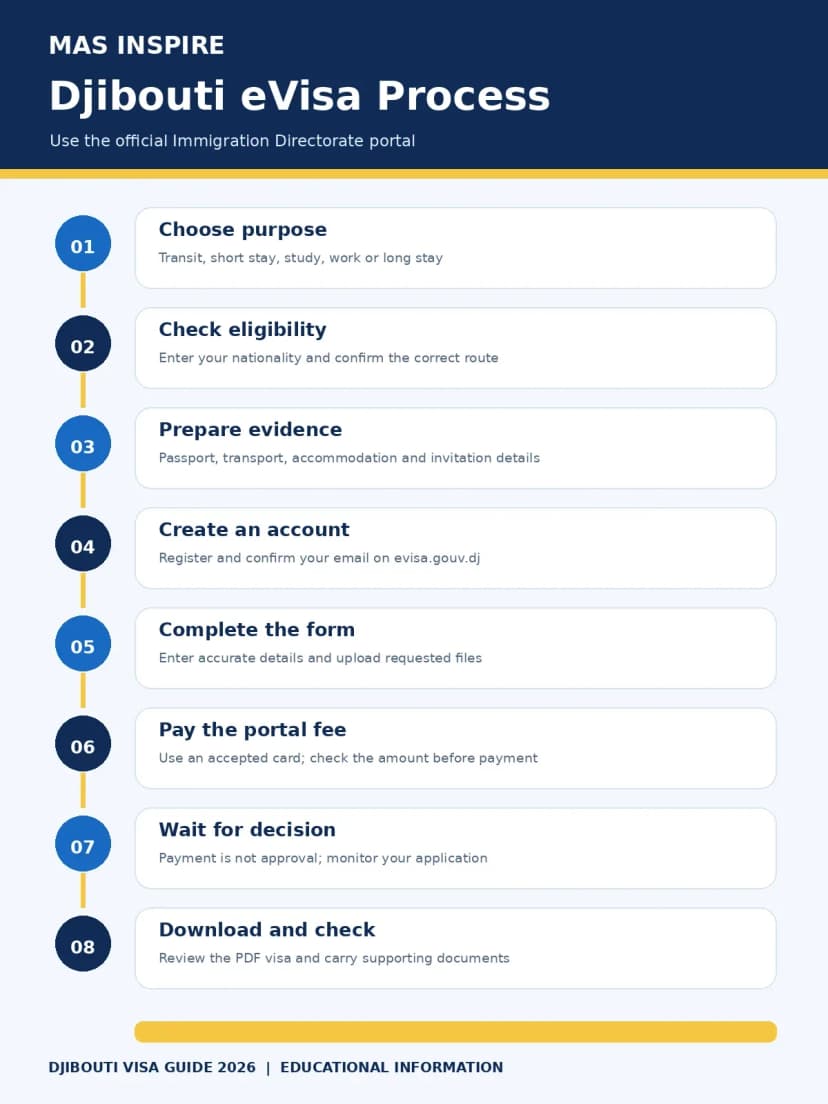
How to apply for a Djibouti visa
The actual sequence depends on the visa category and whether the application is made through the eVisa portal, a diplomatic mission or an employer/Free Zone channel.
- Choose the correct purpose. Decide whether the trip is transit, tourism/private visit, business, study, employment, family or another special case.
- Check nationality and place-of-application rules. Review the official eVisa portal and ask the Immigration Directorate or relevant mission if your nationality or residence country creates a special rule.
- Prepare the documents. Use the relevant checklist above and the live portal upload requirements. Ensure names, passport details, dates and accommodation information match.
- Register on the official portal. The portal describes creating an account and confirming the email address before logging in.
- Complete the application accurately. Enter the correct purpose, intended dates and personal details. Do not misstate a business or work purpose as tourism.
- Upload documents and pay. The portal accepts Visa, Mastercard and American Express. The amount should be checked on the official portal before payment; no fixed public fee table was available in the sources reviewed.
- Attend any additional appointment if instructed. The public portal material reviewed does not establish a universal biometrics or interview requirement. Follow any direct instruction from the authority or mission.
- Submit and retain proof. Keep the application reference, payment confirmation and copies of uploaded documents.
- Monitor the application. Use the portal's account or the contact method provided for the application. Do not assume that payment means approval.
- Check the issued authorization before travel. Confirm name, passport number, validity, permitted stay and entry conditions. Carry the PDF eVisa and supporting travel documents. Border officials make the final admission decision.
Visa fees and financial requirements
No reliable public official fee schedule was available in the official portal material reviewed on 26 November 2026. The eVisa portal asks applicants to pay online but does not expose a stable public table that can be quoted for every nationality and duration. Therefore:
- Use the amount shown inside the official application after selecting the relevant category and details.
- Reported (not verified on the portal's public pages): independent guides and Wikipedia consistently report USD 12 for a transit eVisa (1–14 days) and USD 23 for a short-stay eVisa (15–90 days), single-entry, non-refundable — the 2019 Djibouti-franc rates were DJF 2,000 (transit) and DJF 4,000 (short stay). Treat these as reported figures only; the portal itself does not publish a stable public fee table, so confirm the exact amount inside the live official application before paying. Note the small duration difference: the eVisa guides describe transit as 1–14 days, while Law 40/AN/19 describes transit of 3–15 days.
- Confirm any consular fee directly with the mission before attending.
- Do not treat a third-party agency's service charge as a government visa fee.
- Do not assume the Free Zone authority's procedures or charges apply to ordinary tourist applicants.
- No general minimum bank balance was found in the reviewed law or portal. Study applicants must show sufficient and stable means, but the reviewed legislation does not state a universal numerical threshold.
| Fee or financial item | Amount | What is verified |
|---|---|---|
| General eVisa fee | Not publicly stated in reviewed official portal pages | Confirm in the live portal before payment |
| Transit eVisa (reported) | USD 12 (reported; confirm in live portal) | 1–14 days per eVisa guides; Law 40/AN/19 describes transit of 3–15 days |
| Short-stay eVisa (reported) | USD 23 (reported; confirm in live portal) | 15–90 days per eVisa guides; single-entry, non-refundable |
| Transit visa fee | Not publicly stated | Confirm by category and nationality |
| Short-stay tourist/private visa fee | Not publicly stated | Confirm in the portal/mission |
| Business visa fee | Not publicly stated | Confirm in the portal/mission |
| Long-stay / work-related visa and residence charges | Not publicly stated as one universal amount | Employer/authority-specific; Free Zone rules may differ |
| Student financial evidence | No fixed minimum published in reviewed source | Law requires sufficient and stable means |
Processing times and validity
The eVisa portal material reviewed explains the online steps but does not publish a universal processing-time commitment. Apply well ahead of departure and avoid non-refundable bookings until the authorization is issued. The Free Zone authority separately publishes a normal processing period of five working days for its own company-submitted entry-visa files, with emergency options at additional cost. Those Free Zone timings should not be generalized to standard eVisa applications.
The 2019 law describes transit visas of three to fifteen days, short-stay visa validity not exceeding three months, and long-stay visa validity of 90 days to 12 months, renewable once. The visa or entry authorization issued to an individual may specify a shorter period or other conditions. Visa validity is not automatically the same as the number of days the holder may remain after entry.
A foreign national who remains in Djibouti beyond three consecutive months must apply for a residence card under the law. The card's validity cannot exceed one year or the validity of the travel document. Check renewal requirements before expiry.
Applying from Pakistan or Vietnam
Pakistani passport holders
A Pakistani passport holder should select Pakistani nationality in the official eVisa process and follow the result and document requirements shown for that passport. The reviewed official sources did not provide a complete Pakistan-specific visa exemption list, additional restriction list or published fee table. Do not infer eligibility from a third-party visa checker alone.
Pakistani citizens legally living or working in Vietnam
Legal residence in Vietnam may be useful evidence of the applicant's current lawful residence, but it does not change the applicant's nationality and does not by itself prove that a Djiboutian embassy in Vietnam will accept an application. The reviewed official sources did not confirm a Djibouti diplomatic mission in Vietnam or a Vietnam-specific consular filing arrangement.
Recommended approach:
- Start with the official Djibouti eVisa portal and enter Pakistani nationality truthfully.
- Check whether the portal accepts the application from the applicant's current location and whether it requests a Vietnam residence card or other proof of lawful residence.
- If the portal directs the applicant to a mission, ask the Djibouti Immigration Directorate which embassy or consulate has jurisdiction for a Pakistani resident in Vietnam and whether it accepts third-country residents.
- Prepare a valid Vietnam residence card/permit, work permit or other lawful-status evidence if requested. These documents demonstrate residence in Vietnam; they do not replace the Djibouti visa requirements.
- If applying from Pakistan instead, follow the instructions of the Djiboutian authority or mission responsible for Pakistan. The reviewed sources did not establish a different Pakistan-versus-Vietnam fee or eligibility rule.
- Do not travel to another country for a consular application until the receiving mission confirms in writing that it will accept the application and specifies appointment and document rules.
What if the applicant is working in Vietnam?
A Vietnamese work permit or temporary residence card is relevant to lawful residence in Vietnam, not an automatic qualification for Djibouti entry. Applicants should be ready to explain their occupation, intended travel dates, funding and reason for returning to Vietnam if the authority requests this evidence.
Student visas and study stays
A student intending to study in Djibouti should obtain admission or pre-admission from a public or private institution approved by the relevant education authority. The 2019 law also refers to sufficient and stable means of support. Ask the institution which immigration steps it supports and whether it will provide an enrolment certificate, accommodation evidence or other sponsor documentation.
Do not assume a student visa permits part-time work. The immigration law states that holders of visas issued for study purposes are not authorized to take employment. Obtain written confirmation of any separate authorization before accepting paid work, internships or employment-linked training.
Work visas and job opportunities
A foreign worker generally needs an employer willing to sponsor the process and obtain the required work authorization. The law reserves hiring priority for Djiboutian citizens and allows recruitment of a foreign national when the employer establishes that a suitable Djiboutian candidate could not be found. The work authorization is tied to the relevant activity and employer, and a residence document is also required for a qualifying stay.
The Free Zone Authority's published process is specific to companies in the Free Zones. It describes company-submitted files, employment contract and company-license documents, and separate long-stay/residence/work-permit steps. Applicants employed outside the Free Zones should not assume those forms or timeframes apply to them.
A tourist, private-visit or student visa is not a lawful substitute for work authorization. Confirm the employer's obligations, the worker's status and any renewal requirements before starting work.
Family immigration and permanent residence
The law provides residence-card provisions for certain spouses of Djiboutian nationals and family members of a residence-card applicant. The precise route depends on the principal applicant's status, the family relationship, regular entry and evidence required by the Immigration Directorate.
The reviewed law describes residence cards with a maximum validity of one year, subject to travel-document validity. It does not establish a general automatic permanent-residence entitlement after a stated number of years. Investors, Free Zone shareholders and other special cases may be governed by additional rules; obtain a written decision or guidance from the competent authority rather than assuming that a long-stay visa leads to settlement.
Common application mistakes
- Selecting tourism when the real purpose is employment, study or a long-term stay.
- Using a passport with less than six months' validity when the portal requires at least six months.
- Providing inconsistent dates, accommodation addresses or invitation details.
- Uploading unreadable passport scans or documents that do not match the portal's file specifications.
- Assuming a payment receipt is an approval.
- Relying on an unofficial website or agent instead of the government portal.
- Treating a business invitation as permission to work.
- Assuming a Vietnam residence permit creates a Djibouti consular entitlement.
- Remaining beyond three consecutive months without checking the residence-card requirement.
- Beginning work before the relevant work authorization and residence status are in place.
Reasons for visa refusal or entry problems
Djibouti's law states that visa refusal is an act of national sovereignty and need not be accompanied by reasons. While an individual refusal reason may not be disclosed, practical risk factors include incomplete or inconsistent documents, an unclear travel purpose, inadequate evidence for the stated activity, passport validity problems, failure to meet entry conditions, or concerns about compliance with immigration rules. Never submit false documents or make misleading declarations.
An issued visa does not guarantee admission at the border. Carry evidence supporting the purpose and conditions of the stay and comply with the validity and stay limits stated in the authorization.
Frequently asked questions
1. Do I need a visa to visit Djibouti?
Most foreign visitors should expect to need a visa. Check the official eVisa portal for the applicant's nationality and travel purpose before booking.
2. What is the official Djibouti eVisa website?
The Immigration Directorate's official portal is evisa.gouv.dj. Check the domain carefully and avoid lookalike commercial websites.
3. How long must my passport be valid?
The eVisa portal says the passport must be valid for at least six months. Check the exact rule for the travel date and any carrier requirements.
4. What documents does the eVisa portal list?
It lists a passport valid for at least six months, transport reservation or other transport evidence, accommodation address, invitation letter with host/organization contacts, and a payment card.
5. How much does a Djibouti visa cost?
The official portal does not provide a stable public fee table in the material reviewed. The fee should be confirmed in the live official application before payment.
6. How long does a Djibouti eVisa take?
The reviewed official portal material does not promise a universal processing time. Apply early and do not assume approval by a particular date.
7. Can I get a transit visa?
The 2019 law provides for transit visas of three to fifteen days, subject to onward travel and destination-country entry permission where required. Confirm current availability for the itinerary.
8. Can I work in Djibouti on a tourist visa?
No. The law prohibits employment for people holding visas for tourism, study, health or personal purposes. Obtain the correct work authorization and residence status.
9. Can I study in Djibouti?
The law refers to prior application, admission or pre-admission at an approved institution, and sufficient stable means of support. Ask the institution and Immigration Directorate for the current procedure.
10. Does a long-stay visa mean permanent residence?
No. A long-stay visa may lead to a residence document under the law, but it is not itself permanent residence.
11. When do I need a residence card?
The 2019 law requires a residence card when a foreign national continues to stay after three consecutive months in Djibouti. Confirm the application steps and timing with Immigration.
12. Can a Pakistani citizen living in Vietnam apply online?
The official portal is the appropriate first point of contact. Enter Pakistani nationality accurately. A Vietnam residence permit does not itself guarantee eligibility for a local consular application.
13. Is there a Djibouti embassy in Vietnam?
The official sources reviewed did not confirm a Djibouti embassy or consulate in Vietnam. Ask the Immigration Directorate which mission handles residents of Vietnam if a consular filing is necessary.
14. Can I apply for a digital nomad visa?
The reviewed official sources do not establish a standalone digital-nomad visa. Do not assume remote work is covered by a tourist visa; seek written guidance for the intended activity and stay.
15. Can my family join me?
The law contains provisions for spouses of Djiboutian nationals and family members of residence-card applicants. Eligibility and documents depend on the principal applicant's status and the family relationship.
Official websites and final checklist
| Official source | What it covers |
|---|---|
| Djibouti Immigration Directorate — eVisa portal | Official online visa applications and applicant checklist. |
| Journal Officiel — Law No. 40/AN/19/8th L | Visa categories, residence cards, employment and refusal provisions. |
| Djibouti Ports and Free Zones Authority — Entry Visa | Free Zone employee entry-visa procedure and processing times. |
| Djibouti National Tourism Office — Entry formalities | Confirms the eVisa and embassy/consular routes; eVisa support contact. |
| UK Government (FCDO) — Djibouti entry requirements | Independent government travel advice: visa requirement, passport validity, yellow-fever rules. |
Before departure, check that you have selected the correct category, entered your nationality correctly, obtained the required authorization, checked the passport validity, carried your invitation/accommodation/transport evidence, reviewed health-entry requirements, and confirmed the permitted stay and any residence-card or work-permit obligations. Keep digital and printed copies of the visa and supporting records.
Conclusion: Djibouti's system distinguishes short visits, transit and long-stay cases, while employment and residence require additional compliance. The safest approach is to use the government eVisa portal, follow the applicable law and obtain written clarification wherever nationality, local consular jurisdiction, work or long-term residence creates uncertainty.
Disclaimer: This guide is educational information, not legal advice, and MAS Inspire is not a government authority or visa-issuing agency. Rules, fees and processing arrangements may change. Always verify the current requirements with Djibouti's Immigration Directorate or the responsible diplomatic mission before applying or travelling.