Curaçao Visa Guide 2026: Types, Requirements, Fees and Application Process
By MAS Inspire | Editorial draft: 27 November 2026 (fees and rules re-verified 28 November 2026)
Table of contents
- Introduction
- Why People Visit, Study, and Work in Curaçao
- Types of Curaçao Visas
- Visa Comparison Table
- Eligibility Requirements
- Complete Document Checklists
- How to Apply: Step-by-Step
- Visa Fees and Financial Requirements
- Visa Processing Times
- Applying from Pakistan or Vietnam
- Student Visa Guide
- Work Visa and Job Opportunities
- Family Immigration and Permanent Residence
- Common Application Mistakes
- Reasons for Visa Refusal
- Frequently Asked Questions
- Official Immigration Websites
- Final Checklist and Conclusion
Introduction
Curaçao is a Caribbean island and a constituent country of the Kingdom of the Netherlands. It is known for its colourful Dutch-Caribbean architecture, beautiful beaches, international business environment and multicultural society.
The island attracts tourists, students, international employees, entrepreneurs, investors, retirees and family members joining relatives.
However, travelling to Curaçao involves immigration rules that differ from those governing travel to the European Netherlands. Curaçao has its own immigration administration and residence-permit system, while short-stay Caribbean visas are handled through the Dutch Kingdom's consular network.
The immigration system distinguishes between:
- Short-stay Caribbean visas.
- Visa-exempt visitor admission.
- Temporary residence permits.
- Employment permits.
- Study and internship residence authorisations.
- Family-reunification permits.
- Investor and financially independent residence arrangements.
- Permanent or indefinite residence authorisations in qualifying circumstances.
The correct application depends on your nationality, intended duration of stay, purpose of travel and personal circumstances. A tourist visa does not automatically provide permission to work or establish permanent residence.
Important: A Caribbean visa is not a Schengen visa. A visa issued for Curaçao does not automatically give its holder permission to visit Amsterdam or other Schengen destinations.
Why People Visit, Study, and Work in Curaçao
Tourism
Curaçao attracts visitors interested in:
- Caribbean beaches and diving.
- Snorkelling and marine activities.
- Historic Willemstad.
- Cultural festivals and local cuisine.
- Family holidays.
- Yacht and cruise tourism.
Education
International students may enrol in recognised educational institutions and apply for residence authorisation for study. The immigration authority requires evidence of educational registration and sufficient financial resources.
Employment
Foreign nationals may work in Curaçao when the relevant employment and residence permissions have been obtained. The employer normally plays an essential role in the process.
Business and investment
Curaçao offers opportunities in tourism, international services, trade, logistics and other commercial activities. Foreign entrepreneurs must obtain the applicable business authorisation and residence permission.
Retirement
People who have sufficient independent income or retirement resources may explore the rentier or retired residence categories.

Types of Curaçao Visas
Curaçao does not operate a single visa system covering every purpose. Short visits and long-term immigration are treated separately. Some routes are visas, while others are residence permits or employment authorisations.
1. Tourist and visitor visa
The short-stay Caribbean visa is intended for people who need permission to visit Curaçao for tourism or other temporary purposes.
Eligible purposes can include:
- Holidays.
- Visiting friends and relatives.
- Recreation.
- Cultural activities.
- Short business visits.
- Certain short educational or event-related visits.
Who can apply? Applicants whose nationality requires a Caribbean visa and who satisfy the applicable conditions. Pakistani ordinary passport holders should generally expect to need a visa unless a specific exemption applies.
Main requirements commonly include a valid passport, completed application, travel purpose and itinerary, accommodation evidence, evidence of sufficient funds, travel medical insurance, return or onward travel arrangements and additional documents according to the visit purpose.
Duration: A short-stay Caribbean visa can cover travel within the Caribbean parts of the Kingdom for up to 90 days within a 180-day period. The period actually authorised for Curaçao must be checked separately. Visa validity and permitted stay are not necessarily the same. Conflicting official wording — read carefully: the VFS Global Caribbean-visa checklist states that a standard Caribbean visa allows a maximum stay of 30 days each time you enter one Caribbean part of the Kingdom, and no more than 90 calendar days in total over one year across the Caribbean parts — while the Netherlands Worldwide visa-free-travel page states a 90-day maximum in any 180-day period for travellers who do not need a visa. The two rules appear to describe different situations (visa holders versus visa-exempt travellers). Confirm the stay actually authorised for your case with the issuing mission or the Curaçao border authorities before travelling.
Employment: Ordinary tourist admission does not permit paid employment.
Official information: Short-stay Caribbean visa.
2. Business visitor visa
A business visitor generally travels for temporary professional activities such as meetings, negotiations, conferences, trade events, business discussions and official visits.
A business visit does not automatically permit employment in Curaçao. Additional evidence may include an invitation from a Curaçao company, an employer's letter, a description of the business purpose, a meeting schedule, evidence of who will pay travel expenses, and accommodation and return-travel arrangements.
There is no separate general-purpose business immigration category established by the official sources reviewed for this guide. The short-stay Caribbean visa process is used where a visa is required.
3. Student residence permit
International students who plan to study in Curaçao must apply for residence authorisation for study.
The official Admission Office requirements include registration with an educational institution, a valid passport, birth certificate, criminal-background documentation, evidence of sufficient living expenses, required payment and a student declaration.
The published financial requirement is at least XCG 1,000 per month, excluding tuition fees. This can be demonstrated through an appropriate bank balance, recurring bank transfer, student loan or qualifying guarantee declaration.
The official first-application fee published for the study category is XCG 625.
Students should not assume they can work freely alongside their studies. Any employment must comply with the applicable work-authorisation rules.
Official source: Curaçao study and internship permits.
4. Work and employer-sponsored residence
Foreign employees generally need two related permissions:
- An employment permit.
- Residence authorisation allowing them to live in Curaçao.
The employer must initiate the employment-permit application. The Admission Office explains that the residence application can be submitted after a positive employment-permit decision.
Typical employment documents include a passport, employment contract, employer's company documents, job description, qualifications, professional experience, employment-permit approval, criminal-record certificate, birth certificate, proof of payment and additional documents required by the Admission Office.
The employer must follow local labour-market and employment-permit rules. A visitor cannot simply arrive and begin paid employment.
Official source: Curaçao work information.
5. Job-seeker visa
No standalone general job-seeker category was verified in the official immigration categories reviewed. Applicants should secure an appropriate employment opportunity and establish the employer-sponsored immigration process before relocating. A visitor should not assume that tourist admission authorises a job search that involves work or employment.
6. Skilled-worker immigration
Curaçao does not have a separate general skilled-worker points-based immigration programme verified in the official sources reviewed. Skilled foreign workers may be employed through the regular employment-permit and residence-authorisation system. Relevant qualifications can support an employment application but do not replace employer sponsorship.
7. Digital nomad residence
No separate general-purpose digital-nomad residence category was verified in the official Curaçao immigration categories reviewed. Remote work for a foreign company should not automatically be assumed to be permitted under tourist admission. People considering remote work from Curaçao should obtain written clarification from the Admission Office regarding their precise circumstances.
8. Entrepreneur and self-employed residence
Foreign nationals intending to establish a business may apply through the relevant business and residence-permit arrangements. The official immigration guidance states that applicants establishing their own company need a business permit and residence authorisation.
The general process includes applying for the business permit through the Ministry of Economic Development, registering the company with the Chamber of Commerce, completing the relevant labour-register requirements and applying for residence authorisation.
Official source: Curaçao work and sole-proprietorship information.
9. Family reunification and spouse residence
Curaçao recognises family-reunification and family-formation residence arrangements. The general family residence system covers spouses, partners in qualifying circumstances, children and parents.
Applicants must demonstrate their relationship and sufficient financial support. The general Admission Office guidance provides a first-application fee of XCG 655 for family reunification or formation.
The special Rib'e Lugá programme also identifies dependent spouses and children, including qualifying dependent student children aged 18–27. Its historical eligibility restrictions mean it should not be assumed to be open to every newly arriving applicant.
Official source: Family residence permits.
10. Permanent and indefinite residence
Curaçao has indefinite residence arrangements in certain circumstances. The investor programme, for example, recognises an indefinite residence outcome for qualifying investments from XCG 1,500,000.
Other applicants must establish eligibility under the applicable immigration legislation and their individual residence history. An ordinary tourist visa does not provide a direct route to permanent residence. Applicants should obtain confirmation of their eligibility before treating temporary residence as a settlement pathway.
11. Transit visa
Transit requirements depend on nationality, travel documents, itinerary and whether the passenger must pass immigration control. Do not assume that transit through Curaçao is automatically visa-free. Check the official Caribbean visa requirements.
12. Internship and training residence
An internship requires appropriate residence authorisation. The Curaçao Admission Office states that an internship application is required regardless of the duration of the internship. This is important because an internship takes place in a workplace and cannot automatically be treated as ordinary tourism.
Official source: Study and internship permits.
13. Research and academic activities
There is no separate general researcher visa category confirmed in the official pages reviewed. Depending on the actual activity, researchers and academics may need a study, internship, employment or another appropriate residence authorisation. Applicants should obtain written guidance before starting research or taking up an academic position.
14. Humanitarian protection
Humanitarian and protection matters should be handled through the competent Curaçao authorities and the applicable Kingdom and international legal framework. No general humanitarian visitor visa or economic-migration route should be confused with a protection application. People facing persecution or serious harm should seek qualified legal assistance and contact the competent authorities.
Visa Comparison Table
| Category | Main purpose | Permission required | Work rights |
|---|---|---|---|
| Tourist | Holiday and recreation | Short-stay visa if required | No |
| Business visitor | Meetings and negotiations | Short-stay visa if required | No ordinary employment |
| Student | Education | Study residence permit | Subject to authorisation |
| Employee | Paid employment | Employment and residence permits | As authorised |
| Job seeker | Search for employment | No standalone category verified | No |
| Skilled worker | Skilled employment | Employer-sponsored route | As authorised |
| Digital nomad | Remote work | No dedicated category verified | Not automatically permitted |
| Entrepreneur | Operate a business | Business and residence permits | As authorised |
| Investor | Qualifying investment | Investor residence permit | Subject to permit conditions |
| Family | Join eligible relatives | Family residence permit | Not automatically |
| Retired | Retirement | Retired residence authorisation | Not automatically |
| Rentier | Live on independent means | Rentier residence authorisation | Not automatically |
| Internship | Practical training | Internship residence permit | Only as authorised |
| Researcher | Academic activity | Depends on actual activity | Depends on permit |
| Transit | Pass through Curaçao | Depends on nationality and itinerary | No |
Eligibility Requirements
Immigration eligibility is determined by the purpose of travel and the applicant's individual circumstances.
Nationality
The Dutch government maintains a list of nationalities that do not require a Caribbean visa. Pakistan is not included in the published general visa-exempt list. Therefore, Pakistani ordinary passport holders should normally plan to obtain a Caribbean visa before travelling, subject to any applicable exemption.
Some travellers who would otherwise require a visa may qualify for specific exemptions because they hold particular multiple-entry visas or residence permits issued by countries such as the United States or Canada. These exceptions must be checked individually.
Official information: Caribbean visa requirements and travel without a visa.
Passport requirements
Official general entry guidance includes a passport issued no more than 10 years ago and valid for the entire stay, evidence of onward or return travel, and evidence of the purpose of the visit. Check the current checklist for any additional passport-validity conditions.
Financial requirements for visitors
The Netherlands Worldwide guidance gives the following general financial benchmarks:
| Accommodation arrangement | Indicative funds |
|---|---|
| Hotel accommodation | USD 150–200 per person per day |
| Staying with family | USD 100 per person per day |
| Formal sponsorship | Sponsor assumes financial responsibility |
These are entry-guidance figures, not a guaranteed bank-balance threshold for every visa application.
Medical insurance
Official guidance requires medical or travel insurance covering at least USD 15,000 in medical expenses, including hospital care, emergency treatment, repatriation and repatriation in the event of death. Applicants should verify the exact requirements applicable to their visa and trip.
Complete Document Checklists
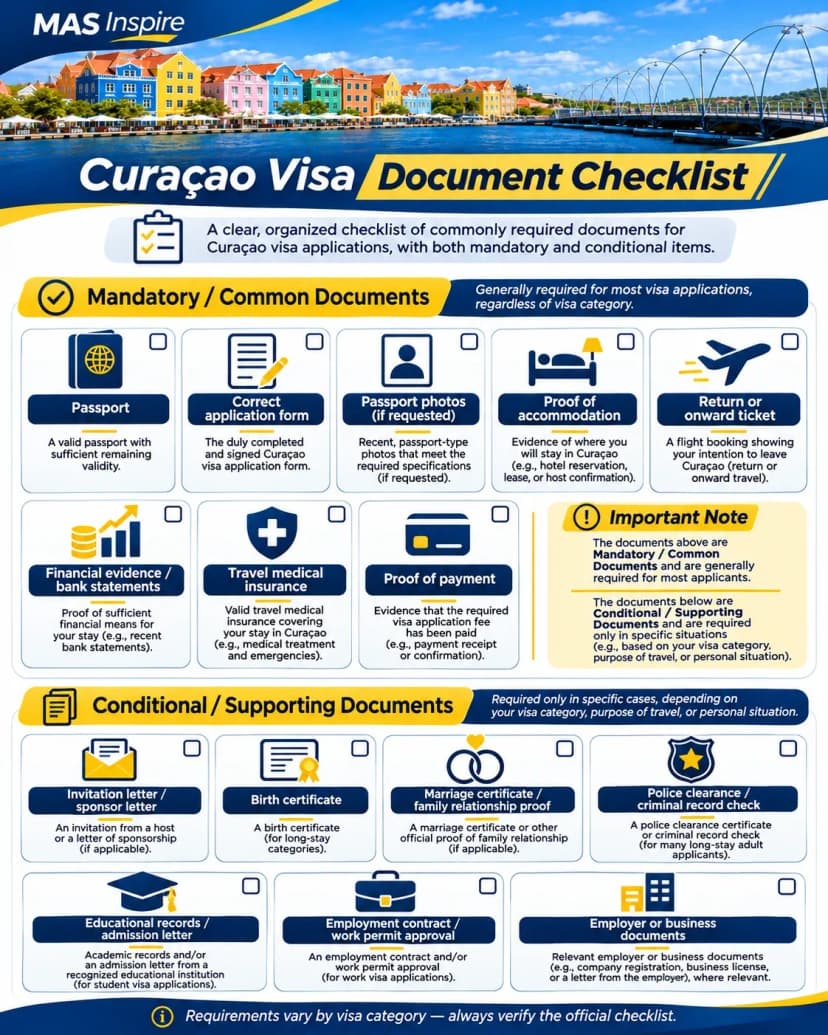
The following tables separate common requirements from conditional evidence. They are planning checklists, not a claim that every applicant must provide every item.
Tourist and visitor checklist
| Document | Status |
|---|---|
| Valid passport | Mandatory |
| Completed visa application | If visa required |
| Passport photographs | If requested by application checklist |
| Accommodation reservation | Supporting evidence |
| Return or onward ticket | Required entry evidence |
| Travel itinerary | Supporting evidence |
| Bank statements | Financial evidence |
| Travel medical insurance | Required entry evidence |
| Employment letter | Conditional |
| Approved leave letter | Conditional |
| Invitation letter | Conditional |
| Sponsor's financial documents | Conditional |
Business visitor checklist
| Document | Status |
|---|---|
| Passport | Mandatory |
| Visa application | If required |
| Business invitation | Where applicable |
| Employer letter | Supporting |
| Business meeting schedule | Supporting |
| Company registration documents | If requested |
| Financial sponsorship evidence | Conditional |
| Accommodation and travel arrangements | Supporting |
Student residence checklist
| Document | Status |
|---|---|
| Passport copy | Mandatory |
| Birth certificate | Mandatory |
| Criminal background check | Mandatory |
| Educational institution registration | Mandatory |
| Proof of payment | Mandatory |
| Proof of living expenses | Mandatory |
| Student declaration | Mandatory |
| Guarantee declaration | If using a guarantor |
| Student loan documentation | If applicable |
| Health insurance | Check applicable conditions |
Employment checklist
| Document | Status |
|---|---|
| Passport | Mandatory |
| Employment permit approval | Required for normal employer-sponsored route |
| Employment contract | Employment evidence |
| Employer's documents | Required according to category checklist |
| Birth certificate | According to permit checklist |
| Criminal background check | According to permit checklist |
| Qualifications | As relevant |
| Professional experience | As relevant |
| Proof of payment | Mandatory |
| Residence application | Mandatory |
Family residence checklist
| Document | Status |
|---|---|
| Passport | Mandatory |
| Application form | Mandatory |
| Birth certificate | According to category |
| Marriage certificate | For spouse application |
| Criminal background check | Generally required for adults |
| Guarantee declaration | As applicable |
| Sponsor's residence documentation | As applicable |
| Sponsor's financial evidence | According to category |
| Employer's declaration | Where applicable |
| Children's school declaration | Where applicable |
| Custody or parental-consent documents | If applicable |
| Apostilles or legalisation | Depending on document origin |
The general Curaçao family page specifies an original birth certificate not older than one year, criminal-record documentation for adult applicants and additional relationship evidence. Confirm the current checklist before applying.
Investor checklist
| Document | Status |
|---|---|
| Passport | Mandatory |
| Residence application | Mandatory |
| Investment evidence | Mandatory |
| Business documentation | Relevant |
| Proof of funds | Mandatory |
| Financial capacity evidence | Mandatory |
| Source-of-funds documentation | May be requested |
| Proof of payment | Mandatory |
Rentier and retired checklist
| Document | Status |
|---|---|
| Passport | Mandatory |
| Birth certificate | Mandatory according to category checklist |
| Good-conduct declaration | According to category checklist |
| Bank declaration | Required for rentier where specified |
| Retirement or pension evidence | Relevant for retired category |
| Proof of payment | Mandatory |
| Additional financial documentation | As requested |
Official information: Rentier and retired permits.
How to Apply: Step-by-Step
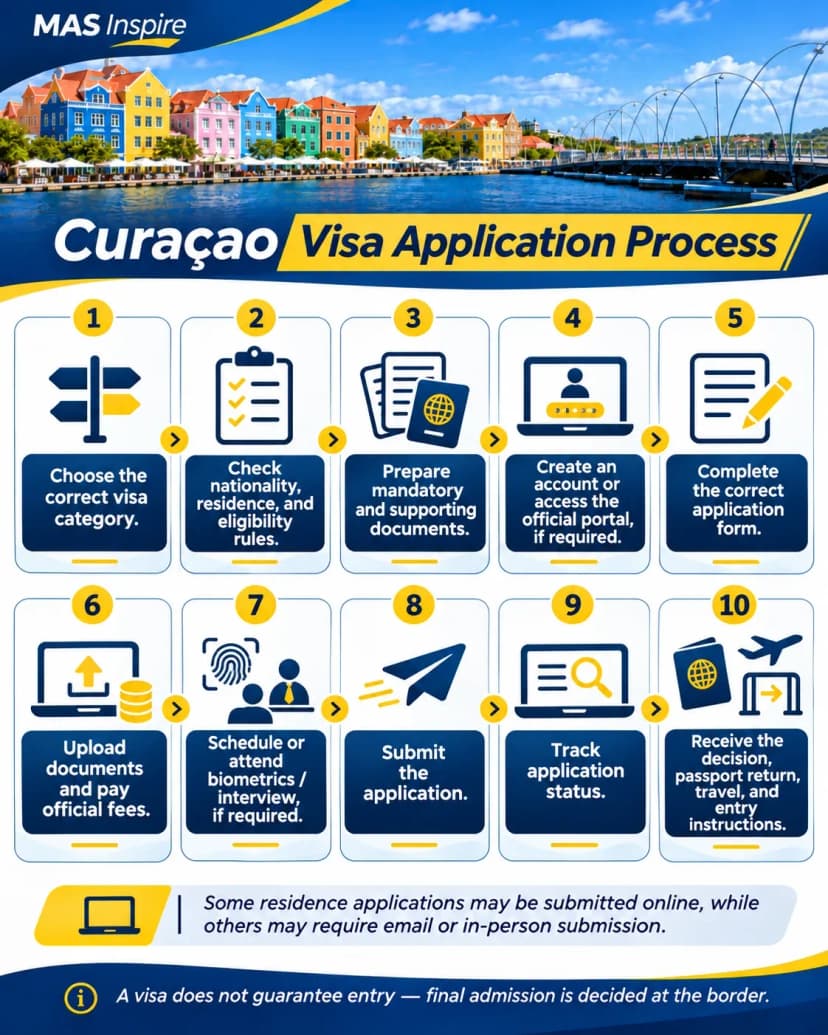
The exact process differs between short-stay visas and Curaçao residence permits. Not every application follows every step below.
Step 1: Choose the correct visa category
Determine whether you intend to visit, attend business meetings, study, complete an internship, work, join family, retire, invest or establish a business. The purpose determines the correct immigration procedure.
Step 2: Check nationality, residence and eligibility
Use the official Netherlands Worldwide visa requirements checker. If you are Pakistani, check the requirements for Pakistani nationals and any applicable exemption based on another visa or residence document.
Step 3: Prepare mandatory and supporting documents
Obtain the official checklist for your application purpose. Ensure that civil-status certificates, police clearances and other documents meet applicable validity, translation and legalisation requirements.
Step 4: Create an account where required
For residence permits, use the official Curaçao Admission Office application system. Follow the instructions for the specific application type.
Step 5: Complete the correct form
Short-stay applications use the Netherlands Worldwide and relevant consular application process. Long-term applications use the forms and procedures specified by Curaçao's Admission Office.
Step 6: Upload documents and pay fees
Pay only through the official payment procedure. For employment, the employer must first obtain the necessary employment authorisation.
Step 7: Attend biometrics or interview
For short-stay Caribbean visa applications, personal appearance is generally required. Applicants applying through VFS Vietnam must follow the appointment instructions and biometric requirements that apply to their case.
Step 8: Submit the application
Submit to the relevant visa application centre or Curaçao Admission Office. Not all long-term application purposes are currently available for online submission. The Admission Office states that some applications must instead be submitted as scanned PDF documents by email.
Step 9: Track your application
Use the tracking method provided by the relevant authority or service provider. Keep payment receipts, reference numbers and correspondence.
Step 10: Understand the decision and prepare for travel
If approved, check the visa's validity dates, number of permitted entries and authorised stay. Verify that your passport and supporting documents are available, complete the Digital Immigration Card, and follow entry instructions at Curaçao immigration control. The Digital Immigration Card (dicardcuracao.com) is mandatory for every non-resident visitor arriving by air and must be completed before travel; use only the official free portal, as copycat websites charge a fee for the same free form.
A visa does not guarantee entry. Final admission remains subject to border-control decisions.
Visa Fees and Financial Requirements
Curaçao uses the Caribbean guilder, commonly designated XCG. Some international visa charges are collected in the local currency of the application location or another currency specified by the consular fee schedule.
Published Curaçao residence fees
| Category | Application fee | Currency |
|---|---|---|
| Study — first application | 625 | XCG |
| Family reunification — first application | 655 | XCG |
| Family reunification — renewal | 625 | XCG |
| Rentier — first application | 635 | XCG |
| Investor — investment from 500,000 | 1,865 | XCG |
| Investor — investment from 750,000 | 3,095 | XCG |
| Investor — investment from 1,500,000 | 6,170 | XCG |
Sources: Study and internship, family residence, rentier and retired and investor residence.
Fee note: the Admission Office prices several residence categories by permit duration — for example, the study permit is listed at XCG 625 for one year, XCG 1,240 for two years and XCG 1,855 for three years. The XCG 625 family-renewal figure in the table above comes from the earlier published schedule and could not be re-verified on the live Admission Office pages on 28 November 2026; confirm the exact renewal fee with the Admission Office before paying. The rentier first-application fee of XCG 635 is the one-year figure; longer durations cost more.
Investor thresholds and associated fees
| Business investment | Permit duration | Published fee |
|---|---|---|
| XCG 500,000 | 3 years | XCG 1,865 |
| XCG 750,000 | 5 years | XCG 3,095 |
| XCG 1,500,000 | Indefinite | XCG 6,170 |
These figures are from the published wealthy-investor arrangement. They are not a promise of approval or a complete estimate of the cost of investing and relocating.
Other financial requirements
| Category | Requirement |
|---|---|
| Student | At least XCG 1,000 per month, excluding tuition |
| Tourist staying in hotel | USD 150–200 per person per day |
| Tourist staying with family | USD 100 per person per day |
| Family residence | Financial support according to sponsor and family circumstances |
| Rentier | Sufficient independent financial means |
| Investor | Qualifying investment and independent financial capacity |
Short-stay visa fees
For applicants in Vietnam, the official Netherlands Worldwide consular-fees schedule (2026) lists the Caribbean visa at €80 (children aged 6–11: €40; children under 6: free). Applicants using VFS may also pay a separate service fee. Do not rely on an old fee quotation or a third-party agency's advertised price.
Official reference: Netherlands Worldwide consular fees.
Visa Processing Times
| Application | Published processing information |
|---|---|
| Short-stay Caribbean visa | Usually 15 calendar days |
| Long-stay Caribbean visa | Usually 15 calendar days for the visa decision; confirm the applicable route |
| Curaçao study residence | Admission Office decision period up to 4 months |
| Family residence | Admission Office decision period up to 4 months |
| Other residence applications | Depends on the category and applicable procedure |
| Employment permit | Depends on the labour-authorisation process |
The 15-day short-stay period is an indicative visa-processing period, not a guarantee that the entire travel or immigration process will be completed within 15 days. For residence applications, the Curaçao Admission Office states that it has four months to make a decision on applications covered by its general decision guidance.
Applicants should submit early and avoid making non-refundable travel arrangements before receiving the necessary decision.
Applying from Pakistan or Vietnam
This section is particularly important for Pakistani passport holders who legally live or work in Vietnam.
Pakistani passport holders
Pakistani ordinary passport holders are generally subject to the Caribbean visa requirement. The application must be made before travel, unless a specific exemption applies.
Official information: Applying for a Caribbean visa in Pakistan.
Applicants in Pakistan should confirm that they need a Caribbean visa, select the correct application purpose, follow the Pakistani application checklist, complete the relevant application, book the authorised appointment, attend in person and provide the required documents and biometrics.
Pakistani citizens legally residing in Vietnam
Pakistani nationals who legally live or work in Vietnam may apply through the Netherlands' visa application arrangements in Vietnam, subject to the applicable rules. The Netherlands Worldwide government website provides a process for people living in Vietnam who wish to apply for a Caribbean visa.
Official link: Applying for a Caribbean visa in Vietnam.
Documents Pakistani applicants in Vietnam should prepare
| Document | Purpose |
|---|---|
| Pakistani passport | Identity and nationality |
| Vietnam residence card or valid visa | Evidence of lawful stay |
| Vietnam work permit, if applicable | Employment and residence evidence |
| Vietnamese employment letter | Employment and ties |
| Approved leave letter | Travel permission |
| Bank statements | Financial evidence |
| Travel itinerary | Purpose and dates |
| Accommodation reservation | Where the applicant will stay |
| Return or onward ticket | Departure arrangements |
| Travel medical insurance | Medical coverage |
| Invitation letter | If visiting family or business contacts |
| Vietnamese translations | Where required |
The Vietnam application guidance says documents must be in English or Dutch. Documents in Vietnamese must be translated into English by a notary public office. Applicants should confirm the current translation rules and appointment arrangements on the official page.
Does a Vietnam residence permit guarantee application eligibility?
No. A Vietnamese residence permit does not remove the Pakistani applicant's nationality-based visa requirement. It is evidence of lawful residence in Vietnam and may establish the appropriate country for lodging the application. The consular authority can still assess whether the applicant is lawfully resident in Vietnam, has a credible travel purpose, has adequate financial evidence, has sufficient reasons to return and meets all other visa requirements.
Can Pakistani applicants apply in Ho Chi Minh City?
The official Netherlands Worldwide information for Vietnam identifies VFS Global application facilities in Hanoi and Ho Chi Minh City. Applicants should make an appointment through the official booking system rather than visiting without confirmation. Check the current location, appointment availability and service arrangements before attending.
Applying from Pakistan versus Vietnam
| Issue | Applying from Pakistan | Applying from Vietnam |
|---|---|---|
| Nationality | Pakistani | Pakistani |
| Visa requirement | Generally required | Generally required |
| Application route | Dutch visa application arrangements in Pakistan | VFS Vietnam, subject to current arrangements |
| Residence evidence | Pakistani residence/address evidence as applicable | Vietnam legal-residence evidence |
| Employment documents | Pakistan employment evidence, if relevant | Vietnam work permit and employer letter, if relevant |
| Document language | Follow Pakistan checklist | English or Dutch; Vietnamese documents translated as required |
| Personal appearance | Generally required | Generally required |
| Processing | Usually 15 calendar days, subject to case | Usually 15 calendar days, subject to case |
Long-stay applicants in Vietnam
If a Pakistani national has been approved for a Curaçao residence permit and needs a long-stay Caribbean visa to collect that permit, the relevant procedure is different from an ordinary tourist application.
Official information: Long-stay Caribbean visa applications in Vietnam.
A long-stay visa is not a substitute for the underlying Curaçao residence approval.
Student Visa Guide
International students should first secure admission to an appropriate educational institution.
Student application procedure
- Select an educational institution.
- Obtain the registration or admission documentation.
- Prepare the required civil-status and identity documents.
- Obtain the criminal background check.
- Demonstrate sufficient financial resources.
- Pay the applicable fees.
- Submit the residence application.
- Await the decision.
- Complete the remaining requirements for issuance of the permit.
Student financial requirement
The published minimum is XCG 1,000 per month, excluding tuition fees.
The official guidance recognises several ways of proving this amount, including regular transfers from a bank, a local bank statement showing at least XCG 12,000, student-loan evidence or a qualifying local guarantor's declaration. The student must also submit the prescribed student declaration.
Official source: Curaçao study and internship permits.
Can students work?
A student permit should not be interpreted as unrestricted permission to work. Students must check whether proposed employment requires a separate work authorisation and whether their residence conditions permit it.
Work Visa and Job Opportunities
Foreign nationals interested in working in Curaçao should generally obtain a job offer before beginning immigration procedures.
Employer-sponsored process
The official system requires the employer to apply for the employment permit first. The employer must demonstrate compliance with local labour requirements.
The government employment portal explains that employers must register the available position with the labour authority at least five weeks before submitting the employment-permit application and demonstrate that they have actively sought suitable local candidates. Confirm the current procedure and any exceptions with the relevant authority.
Industries to investigate
Potential areas of employment include tourism and hospitality, restaurants and hotels, healthcare, financial services, construction, logistics and shipping, information technology, education, and technical and engineering services. These are possible sectors to research, not a statement that vacancies or work permits are guaranteed.
Important employment warning
Do not begin working simply because you have entered Curaçao as a tourist. A residence permit alone does not necessarily authorise employment. The employment permission must also be in place.
Family Immigration and Permanent Residence
Spouse and children
Curaçao permits applications for qualifying family members. The general family residence system includes spouses or partners, children and parents. Applicants must demonstrate their relationship and financial support.
Financial support
The general family guidance distinguishes between sponsorship by Dutch citizens and sponsorship by foreign residents. The published financial standards include the following spouse income references:
| Sponsor situation | Spouse income reference |
|---|---|
| Dutch citizen | XCG 1,500 gross per month |
| Foreign resident | XCG 3,000 gross per month |
Additional child-related amounts may apply, according to age. These figures relate to the family application circumstances described by the Admission Office and should not be treated as universal amounts for every family case.
Permanent residence
Permanent or indefinite residence is not automatically obtained by holding a tourist visa, student permit or temporary employment permit. The applicable eligibility conditions depend on the specific legal route.
The wealthy-investor programme explicitly provides an indefinite residence outcome at the published XCG 1.5 million investment threshold. Applicants considering settlement through another route should consult the Admission Office and the applicable immigration legislation.
Common Application Mistakes
Avoid the following:
- Applying for a Schengen visa when a Caribbean visa is required.
- Assuming that a Netherlands visa automatically provides permission to live or work in Curaçao.
- Applying under the wrong visit purpose.
- Using a tourist visa to undertake paid employment.
- Providing incomplete financial evidence.
- Submitting expired civil-status or police certificates.
- Failing to apostille or legalise documents where required.
- Ignoring translation requirements.
- Assuming a Vietnamese residence permit removes Pakistani nationality-based visa restrictions.
- Starting work before the employment permit is approved.
- Confusing the visa validity period with the permitted stay.
- Relying on outdated third-party fee information.
- Purchasing non-refundable tickets before approval.
- Failing to provide accurate and consistent information.
Reasons for Visa Refusal
Applications may be refused or delayed where the applicant does not satisfy the visa requirements, cannot demonstrate the purpose of travel, provides inconsistent information, has inadequate financial evidence, submits incomplete documents, cannot establish required sponsorship, has relevant immigration or criminal-record issues, fails to satisfy residence or employment requirements, provides documents that cannot be verified or does not meet entry conditions.
A refusal is not necessarily permanent. Applicants should read the decision carefully and follow the available objection or appeal procedure. The Curaçao Admission Office publishes information about objections and appeals on its official website.
Frequently Asked Questions
1. Do Pakistani citizens need a visa for Curaçao?
Generally, yes. Pakistani ordinary passport holders are not included in the general visa-exempt nationality list. Specific exemptions may apply in certain circumstances.
2. Is Curaçao part of the Netherlands?
Curaçao is a constituent country within the Kingdom of the Netherlands. It has its own immigration administration and residence-permit system.
3. Is a Curaçao visa the same as a Schengen visa?
No. A Caribbean visa for Curaçao is separate from a Schengen visa for the European Netherlands.
4. Can I apply for a Curaçao visa from Vietnam?
People legally living in Vietnam can apply through the Netherlands visa application arrangements in Hanoi or Ho Chi Minh City, subject to the applicable application conditions.
5. Can a Pakistani living in Vietnam apply locally?
Yes. The official Netherlands Worldwide website provides a Caribbean visa application route for Vietnam residents. However, legal residence in Vietnam does not guarantee approval.
6. How long does a Curaçao tourist visa take?
The Netherlands Worldwide guidance indicates that most short-stay Caribbean visa decisions are communicated within approximately 15 calendar days. Individual cases can take longer.
7. How much money do I need for a Curaçao visit?
The official general visitor guidance indicates USD 150–200 per person per day for hotel accommodation or USD 100 per person per day when staying with family, subject to individual circumstances.
8. Can I work in Curaçao on a tourist visa?
No. Ordinary tourist admission does not authorise paid employment. The relevant employment and residence permissions are required.
9. Can international students study in Curaçao?
Yes. Students must apply for the relevant residence authorisation and demonstrate registration with an educational institution and adequate financial support.
10. What is the student financial requirement?
The published requirement is XCG 1,000 per month, excluding tuition fees.
11. Does Curaçao offer a digital-nomad visa?
A separate general digital-nomad residence category was not verified in the official immigration categories reviewed.
12. Can I obtain residence through investment?
Yes. Curaçao has a wealthy-investor residence arrangement with qualifying investment thresholds beginning at XCG 500,000.
13. Can I bring my spouse and children?
Qualifying spouses, children and other eligible relatives may apply for family residence authorisation, subject to relationship, sponsorship and financial requirements.
14. Can I obtain permanent residence?
Certain routes provide indefinite residence, including the qualifying wealthy-investor arrangement. Other settlement pathways depend on individual eligibility and the applicable legislation.
15. Does a Curaçao visa allow me to visit Amsterdam?
No. A Caribbean visa for Curaçao is not a Schengen visa and does not automatically permit entry to the European Netherlands.
Official Immigration Websites
| Website | Purpose |
|---|---|
| Immigration Curaçao | Immigration and residence permits |
| Curaçao digital application portal | Online permit applications |
| Netherlands Worldwide | Caribbean visa requirements |
| Short-stay Caribbean visa | Visitor visa |
| Apply from Pakistan | Pakistani applicants |
| Apply from Vietnam | Vietnam residents |
| Long-stay visa from Vietnam | Residence-permit collection |
| Government employment portal | Employment permits |
| Curaçao tourism authority | Visitor information |
Use official government sources as the primary reference points when preparing an application. Check that each page still applies to the correct visa or residence category.
Final Checklist and Conclusion
Before travelling or relocating to Curaçao, confirm that you have:
- Identified the correct visa or residence category.
- Checked nationality-based requirements.
- Verified the appropriate application location.
- Obtained the required documents.
- Arranged financial evidence.
- Checked the applicable visa and residence fees.
- Obtained an employment permit if intending to work.
- Obtained educational registration if applying as a student.
- Prepared the required sponsorship evidence if joining family.
- Checked passport and insurance requirements.
- Confirmed the permitted length of stay.
- Received the relevant immigration decision.
Curaçao offers different possibilities for international visitors, students, employees, investors and families. However, each route has its own eligibility rules and procedures.
Pakistani passport holders legally residing in Vietnam should pay particular attention to nationality-based visa requirements and the Vietnam-specific application process.
The most reliable approach is to use the official Netherlands Worldwide visa guidance and Curaçao Admission Office information before making travel or relocation commitments.
Educational disclaimer: This article is intended for general information and educational purposes. Immigration policies, fees and procedures can change. MAS Inspire is not a government immigration authority, embassy, consulate or visa-approval agency. Always verify current requirements with the competent authorities before submitting an application.