Czechia Visa Guide 2026: Types, Requirements, Fees and How to Apply
By MAS Inspire | Editorial draft: 27 November 2026 (fees and rules verified 28 November 2026)
Important: Czechia is a Schengen member: a short visit uses a Schengen visa, but a stay over 90 days needs a Czech long-term visa or residence permit. Pakistanis need a visa for both. This guide is for Pakistani citizens legally living or working in Vietnam. It is educational information, not legal advice.
Table of contents
- Why People Visit, Study, and Work in Czechia
- Types of Czechia Visas and Permits
- Visa Comparison Table
- Eligibility Requirements
- Complete Document Checklists
- How to Apply: Step-by-Step
- Visa Fees and Financial Requirements
- Visa Processing Times
- Applying from Pakistan or Vietnam
- Student Visa Guide
- Work Visa and Job Opportunities
- Family Immigration and Permanent Residence
- Common Application Mistakes
- Reasons for Visa Refusal
- Frequently Asked Questions
- Official Immigration Websites
- Final Checklist and Conclusion
Why People Visit, Study, and Work in Czechia
Czechia sits in the heart of Europe, with Prague as its capital and Václav Havel Airport (PRG) as the main gateway. Visitors come for Prague's Old Town, Charles Bridge and Prague Castle, and the spa towns. Students come for affordable public universities; workers for manufacturing, IT, engineering, logistics and hospitality jobs. The currency is the Czech koruna (CZK), not the euro, though Schengen fees are in euros and long-term fees in koruna. A Schengen visa covers up to 90 days in any 180 days; longer stays need a long-term visa (Type D, up to one year) or a residence permit such as the Employee Card or EU Blue Card. Applying under the wrong category is one of the most common reasons applications fail.

Types of Czechia Visas and Permits
1. Short-stay Schengen visa (Type C) — tourism, business, family visits
The Schengen visa is the standard route for visits of up to 90 days in any 180-day period. Purposes include tourism, business, conference, culture, sports, family visits, short study, research, short-term work, seasonal work, training and airport transit. It does not authorise regular employment, and Czechia must be the main destination. Holders are registered in the EU Entry/Exit System (EES) — fingerprints and a photo are taken at the first Schengen entry.
2. Airport transit visa (Type A)
Pakistani passport holders transiting through the international transit area of a Czech airport without entering Schengen territory may need an airport transit visa, depending on routing and exemptions. Check the rules for your itinerary before booking.
3. Long-term visa (Type D) — stays over 90 days, up to one year
Long-term visas are for third-country nationals staying in Czechia for more than three months for a defined purpose (health, culture, sports, official, family, study, training, internship, volunteering, working holiday, seasonal work, entrepreneurship, other). A long-term visa is issued for a maximum of one year; before it expires, the holder can apply at a Ministry of the Interior office for an extension or a change of status to a long-term residence permit. Incomplete applications are not accepted — under Section 169h of the Act on the Residence of Foreign Nationals they are returned.
4. Employee Card — the main work-and-residence permit
The Employee Card (zaměstnanecká karta) combines residence and the right to work for a specific job with a specific employer. It covers all kinds of employment, regardless of education or qualification. It lasts up to two years and can be renewed. The job must be in the central register of vacancies and pay at least the statutory minimum wage for at least 15 hours per week.
Vietnam warning: the Czech Embassy in Hanoi does not accept applications for long-term visas for business purposes or for Employee Cards outside the Key and Research Staff Programme, under Government Regulation No. 220/2019 Coll. A Pakistani resident in Vietnam will usually have to apply at another competent mission, normally the embassy in the country of citizenship. See Applying from Pakistan or Vietnam.
5. EU Blue Card — highly qualified employment
The Blue Card is for third-country nationals employed in Czechia for more than three months in a position requiring high qualification. The applicant needs a university degree or higher professional education of 3+ years, an employment contract for at least one year, and a salary of at least 1.5 times the average gross annual salary announced by the Ministry of Labour and Social Affairs. The job must be in the Blue Card database; state its reference number. The Blue Card is valid for three months longer than the contract, up to three years
6. Long-term residence permit for study
Students admitted to an accredited Czech programme can apply for a long-term visa for study (up to one year) or directly for a long-term residence permit for study (decided within 60 days). Students on accredited programmes have free access to the Czech labour market — no separate work permit is needed.
7. Long-term residence permit for family reunification
Family members of a Czech citizen, permanent resident or long-term resident can apply for a family residence permit — generally a spouse or registered partner, minor children. The application is lodged at a Czech embassy, and the decision period is up to 90 days.
8. Long-term visa for business / entrepreneurship (trade licence)
A person who will run a business in Czechia — for example as a self-employed person with a Czech trade licence (živnostenský list) — can apply for a long-term visa for business purposes, valid for up to one year, followed by a long-term residence permit for business. This needs trade-register entry, proof of funds and a genuine business basis; simply registering a company does not guarantee approval. Note the Hanoi restriction: the Embassy in Hanoi does not accept long-term visa applications for business purposes, so a Vietnam-resident applicant must file at another competent mission.
9. Seasonal employment
Seasonal work — typically in agriculture, forestry or tourism — has its own two-track system. Work of up to 3 months uses a Schengen visa for seasonal employment; work of more than 3 months uses a long-term visa for seasonal employment, valid for up to 6 months within 12 consecutive months. A work permit from the Czech Labour Office is also required — the visa alone does not authorise the work.
10. Digital Nomad Programme — not open to Pakistani nationals
Czechia's Digital Nomad Programme is a fast-track lane, not a visa of its own: admitted participants get priority processing of an ordinary one-year long-term visa while working remotely for a foreign employer or as a freelancer with a Czech trade licence. It is open only to citizens of 13 listed countries — Australia, Brazil, Canada, India, Israel, Japan, Mexico, New Zealand, Singapore, South Korea, Taiwan, the UK and the US — and only to highly qualified IT and marketing specialists earning at least 1.5 times the Czech average gross wage. Pakistani nationality alone is not eligible.
11. Other long-term routes
The Ministry of Foreign Affairs also lists long-term visas for research (with a hosting agreement), culture, sports, health, training, internships, volunteering and leave to remain. There is no general job-seeker visa for applicants abroad, and no working-holiday agreement with Pakistan. Czech graduates may have a separate post-study route — confirm the rules on the Information Portal for Foreigners.
12. Permanent residence
Permanent residence is a settlement status, not a first-entry visa. The standard route is five years of continuous legal residence in Czechia on a long-term visa or long-term residence permit, plus a Czech language examination and other conditions. Blue Card holders can qualify after five years in the EU with at least two years in Czechia. See Family Immigration and Permanent Residence.
Visa Comparison Table
| Route | Main purpose | Where to apply | Stay / validity | Work rights |
|---|---|---|---|---|
| Schengen visa (Type C) | Tourism, business, family visit, short study | VFS Global Vietnam (Hanoi, HCMC, Da Nang) | Up to 90 days in any 180 days | No regular employment |
| Airport transit visa (Type A) | Transit without entering Schengen | VFS Global / Czech mission | Transit only | No |
| Long-term visa (Type D) | Study, family, business, seasonal work, training | Czech embassy in Hanoi (2-year rule) | Up to 1 year, extendable | By purpose; free labour access for study |
| Employee Card | Employment, any skill level | Czech embassy (NOT Hanoi, except Key and Research Staff Programme) | Up to 2 years, renewable | Yes, for the specific job and employer |
| EU Blue Card | Highly qualified employment | Czech embassy | Contract + 3 months, max 3 years | Yes, for the specific job |
| Long-term residence — study | Degree or accredited study | Czech embassy or in Czechia | Duration of study, renewable | Yes — free labour-market access |
| Long-term residence — family | Joining family in Czechia | Czech embassy | Typically up to 2 years, renewable | Yes, generally |
| Long-term visa — business | Self-employment / trade licence | Czech embassy (NOT Hanoi) | Up to 1 year, then residence permit | Yes, for own business |
| Seasonal employment | Season-related work | Czech embassy | 3 months (Schengen); 6 months (long-term) | Yes, + Labour Office permit |
| Permanent residence | Long-term settlement | Ministry of the Interior, in Czechia | Indefinite | Full labour-market access |
Eligibility Requirements
- A visa is required. Pakistani passport holders need a visa for Czechia for any purpose and any length of stay; Vietnamese residence does not change this.
- A valid passport. Schengen: valid 3+ months after departure from the Schengen Area, issued within 10 years, 2+ blank pages. Long-term: valid 3+ months beyond the visa applied for, under 10 years old.
- Lawful residence in Vietnam. Non-Vietnamese applicants must show a TRC and a copy. Long-term in Hanoi needs 2+ years' Vietnam residence.
- Purpose evidence. Admission for study; a registered vacancy and contract for work; proof of family relationship; trade-licence registration for business; a hosting agreement for research.
- Financial means. Schengen: bank statements (last 3 months) + proof of occupation and income. Long-term: proof of funds — CZK 55,000 for university study (half under 18).
- Accommodation. Proof for the whole stay — hotel booking for a visit; rental contract or host confirmation for a long stay.
- Health insurance. Schengen: at least EUR 30,000, valid in all Schengen states. Study residence: at least EUR 60,000.
- Clean criminal record. Long-term: criminal-record extract from the citizenship country and any state of 6+ months in the last 3 years. Documents must generally be under 180 days old; foreign documents need apostille/legalisation and an official Czech translation.
- Correct application location. Schengen: VFS Global. Long-term: Embassy in Hanoi direct.
Complete Document Checklists
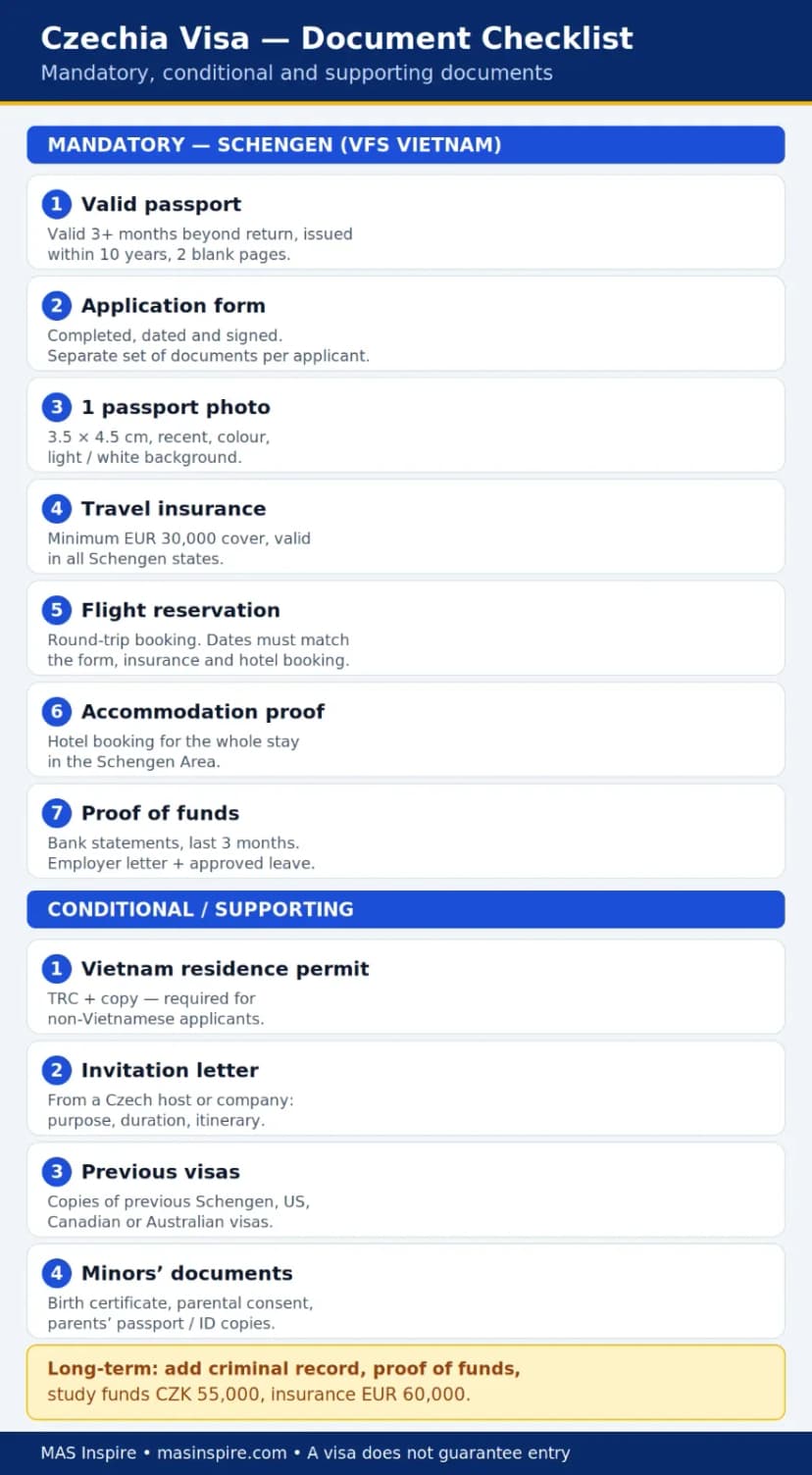
The exact list is category-specific. Vietnamese documents must be presented with an official translation into Czech or English by a translator certified by the Department of Justice.
General Schengen (short-stay) documents — VFS Global Vietnam
| Document | Status | Notes |
|---|---|---|
| Visa application form | Required | Completed, dated, signed; one set per applicant |
| Passport + data-page copy | Required | Valid 3+ months after return, 2 blank pages, issued within 10 years; bring previous passports |
| One photo (3.5 × 4.5 cm) | Required | Recent, colour, light/white background |
| Vietnamese residence permit + copy | Required for non-Vietnamese applicants | Proves lawful residence in Vietnam |
| Previous Schengen / US / Canadian / Australian visas | If available | Supports travel history |
| Detailed travel itinerary | Required | Dates must match form, insurance, flights, accommodation |
| Round-trip air ticket reservation | Required | Reservation (not necessarily paid) |
| Proof of accommodation | Required | Hotel booking for the whole stay in the Schengen Area |
| Travel medical insurance | Required | Minimum EUR 30,000, valid in all Schengen states |
| Proof of occupation | Required | Labour contract; employer letter (role, salary, start, leave) |
| Bank statements, last 3 months | Required | Plus tax declaration (business); social insurance copy (employees) |
| Parental consent, birth certificate, parents' passport/ID copies | Required for minors | Other parent's consent (one parent travelling); both parents' consent (travelling alone) |
| Invitation letter | Conditional | Business: Czech company (purpose, duration, itinerary). Family: host in Czechia |
Long-term visa and residence-permit documents
| Document | Status | Notes |
|---|---|---|
| Application form | Required | Completed in Czech where required; signed |
| Passport | Required | Valid 3+ months beyond the visa applied for, issued within 10 years, 2 blank pages |
| 2 photos (3.5 × 4.5 cm) | Required | Recent, current appearance |
| Proof of accommodation | Required | Rental contract, ownership deed or host confirmation |
| Proof of funds | Required | Study: CZK 55,000 (half under 18); other: funds or a host covering costs |
| Proof of purpose | Required | Admission, contract + vacancy number, trade licence, hosting agreement, family documents |
| Criminal-record extract | Required | Citizenship + any state of 6+ months in last 3 years; apostilled, translated into Czech |
| Travel health insurance | Required | At least EUR 60,000 for study; comprehensive cover for workers |
| Health certificate | Conditional | If requested — freedom from listed infectious diseases |
| Documents under 180 days old | Rule | Except passports, civil-registry documents, photographs |
Pakistani applicants: document preparation
A Pakistani applicant will usually need a police clearance certificate from Pakistan and, depending on residence history, from Vietnam or any other country of 6+ months' residence in the last 3 years. Civil documents need attestation/apostille and an official Czech translation. Start police certificates late: most documents must be under 180 days old. A Vietnamese TRC proves lawful residence in Vietnam but does not replace a Czech visa or prove Hanoi will accept a long-term application.
How to Apply: Step-by-Step
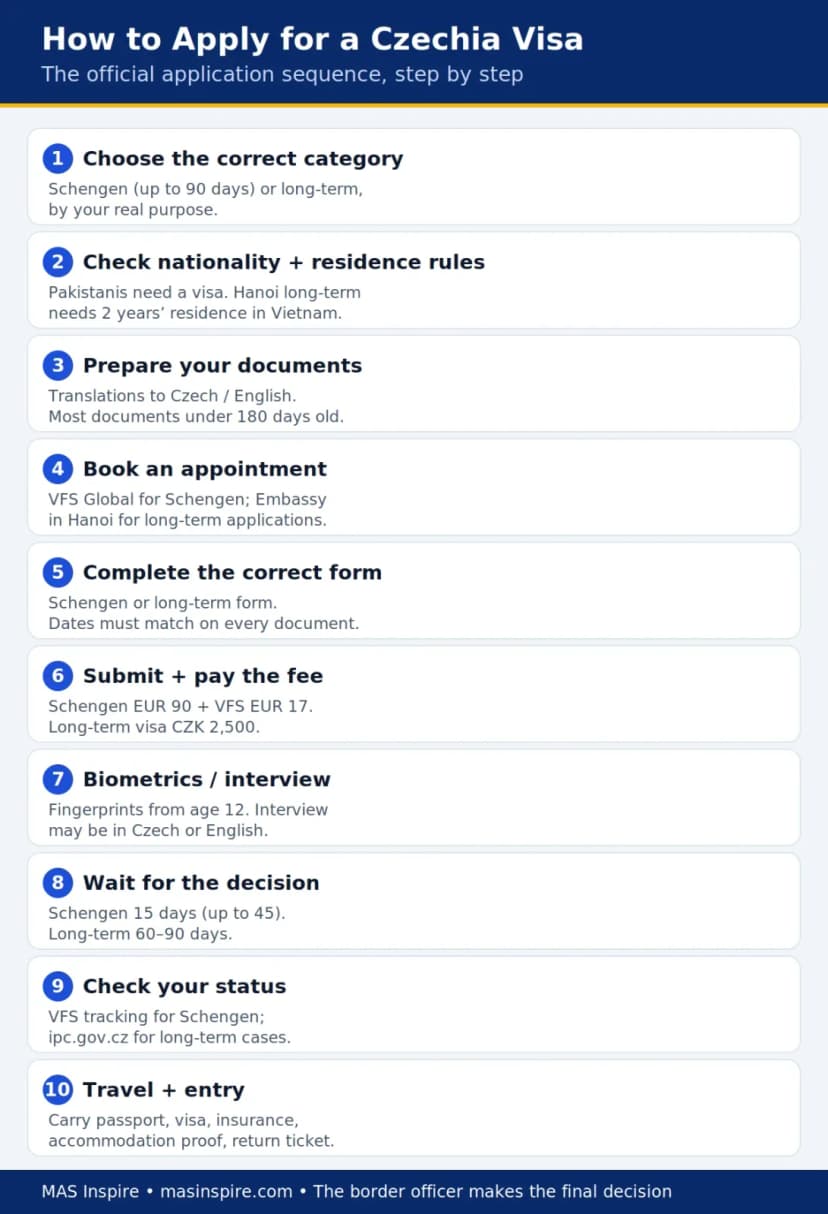
- Choose the correct category. Decide: short visit, study, employment, seasonal work, family reunification, business or another defined purpose. A Schengen visa cannot become a work permit inside Czechia.
- Check nationality and residence rules. Pakistanis need a visa for every purpose. Long-term applications in Hanoi need 2+ years' residence in Vietnam; Hanoi takes no business visas or Employee Cards outside the Key and Research Staff Programme.
- Prepare the documents. Follow the exact checklist for your category. Arrange police certificates, translations and apostilles/legalisation early — most documents must be under 180 days old; incomplete long-term files are returned.
- Book an appointment. Schengen: VFS centres in Hanoi, Ho Chi Minh City and Da Nang, booked via the VFS website. Long-term: the Embassy in Hanoi (attach a TRC copy when registering). EU family members, official passports, delegations and humanitarian cases apply directly at the embassy (Hanoi.Consulate@mzv.gov.cz).
- Complete the correct form. Provide consistent, truthful details; arrival and departure dates must be identical on the form, insurance, flights and accommodation.
- Submit in person and pay. Applicants 12+ give fingerprints. Schengen: EUR 90 + EUR 17 VFS fee. Long-term visa: CZK 2,500; Employee Card/Blue Card: CZK 5,000 at an embassy. Fees are non-refundable. Long-term applicants may be interviewed in Czech or English — arrange your own interpreter if you speak neither.
- Wait for the decision. Schengen: 15 days (up to 45). Long-term: 60 days for study, 90 for most other purposes (up to 120 complex); Employee Card 60 (90 complex); Blue Card 90.
- Collect the visa, check it and travel. Verify the validity dates, entries and permitted stay, and carry your passport, visa, insurance, accommodation proof and return ticket. The EES records fingerprints and a photo at first entry; the border officer decides on entry.
- Register after arrival (long stay). Register with the Ministry of the Interior within 30 calendar days and collect the residence card within 60 days of biometrics.
Visa Fees and Financial Requirements
Schengen fees are in euros, long-term fees in koruna (~CZK 24–25 per EUR 1). Confirm the VND conversion before paying.
| Procedure | Published fee |
|---|---|
| Schengen visa (Type C), adult | EUR 90 (VND 2,750,000, VFS June 2026) |
| Schengen visa, child aged 6–11 | EUR 45 (VND 1,380,000) |
| Schengen visa, child under 6 | Free |
| VFS Global service fee (Vietnam) | EUR 17 (VND 523,000) |
| Long-term visa (Type D), standard | CZK 2,500 |
| Long-term visa for business / entrepreneurship | CZK 5,000 (see note below) |
| Employee Card, at an embassy | CZK 5,000 |
| Employee Card, inside Czechia | CZK 2,500 |
| EU Blue Card, at an embassy | CZK 5,000 |
| EU Blue Card, inside Czechia | CZK 2,500 |
| Long-term residence permit for study | CZK 2,500 |
| Permanent residence permit | CZK 2,500 (in Czechia) |
Notes. The VFS schedule states VND amounts are "as per current exchange rate" and "subject to change without notice" — the figures above are from June 2026, so confirm the live figure at booking. The CZK 5,000 business long-term visa fee is reported by secondary sources; the government portal (portal.gov.cz) states the standard fee as CZK 2,500 — confirm the business figure with the mission. All fees are non-refundable; no express fee exists for faster decisions.
Financial requirements. There is no single minimum bank balance for all categories. Schengen applicants show bank statements for the last 3 months plus proof of occupation and income — no fixed daily euro amount is published in the official Vietnam list, so show statements that clearly cover the trip, accommodation and return. (No daily figure verified on an official page.) For long-term visas, the published funds figure for university study is CZK 55,000 (half that under 18), or proof that a host organisation covers the costs. For work, the salary is the test: at least the minimum wage for an Employee Card (CZK 22,400/month in 2026; CZK 24,900 from 1 January 2027 per secondary sources), and at least 1.5 times the average wage for a Blue Card (CZK 73,823/month for 1 May 2026–30 April 2027, per secondary sources; the MFA confirms the 1.5-times rule).
Visa Processing Times
| Application | Standard decision time | Extended time |
|---|---|---|
| Schengen visa (Type C) | 15 calendar days | Up to 45 calendar days |
| Long-term visa (study) | 60 days | Up to 120 days, complex cases |
| Long-term visa (other) | 90 days | Up to 120 days, complex cases |
| Long-term residence permit, study | 60 days | — |
| Employee Card | 60 days | 90 days in complex cases |
| EU Blue Card | 90 days | — |
| Family reunification | Up to 90 days | — |
| Permanent residence | 60 days | 90 days in complex cases |
Apply 15 days to 6 months before travel for Schengen, months ahead for long-term. Pakistani applications can be subject to prior consultation between Schengen states under Article 22 of the Visa Code (flagged on the VFS Vietnam page), which can extend a decision to the full 45 days.
Applying from Pakistan or Vietnam
Do Pakistanis need a visa for Czechia?
Yes — for every purpose and any length of stay. Pakistan is not on the Schengen visa-free list, and holding a Vietnamese residence permit does not change the requirement, because it follows nationality, not residence.
Pakistani citizens legally living or working in Vietnam
- Schengen visa — apply in Vietnam through VFS Global. Short-stay applications go to VFS centres in Hanoi, Ho Chi Minh City and Da Nang; non-Vietnamese applicants must submit their TRC and a copy.
- Long-term visa or residence permit — Hanoi only if you have lived in Vietnam for at least two years. The Embassy in Hanoi states that non-citizen residents can apply there only after at least two years of residence in Vietnam (attach a copy of the residence permit when registering). If you have lived in Vietnam for less than two years, file in your home country. Whether Pakistanis are exempt could not be verified — confirm with the embassy in writing.
- Employee Cards and business long-term visas are effectively closed in Hanoi. Under Government Regulation No. 220/2019 Coll., the Hanoi embassy does not accept long-term visa applications for business purposes or Employee Card applications outside the Key and Research Staff Programme. A Vietnam-based Pakistani with a Czech job offer will usually need to apply in Pakistan (Embassy in Islamabad) or through the Key and Research Staff Programme. Blue Card, family, study, research and seasonal applications are listed as accepted — confirm the current list with the embassy.
The only Czech mission in Vietnam is the Embassy in Hanoi (13–15 Chu Van An Street, Ba Dinh; Hanoi.Consulate@mzv.gov.cz); there is no visa-handling consulate in Ho Chi Minh City. VFS centres in Ho Chi Minh City and Da Nang take Schengen applications only.
Applying from Pakistan
In Pakistan, Czech Schengen applications are lodged in person at the Embassy in Islamabad — there is no visa application centre in Pakistan — with appointments allocated through a monthly email registration draw (normally the last working day of the month). Secondary reporting in November 2026 indicated a zero Employee Card quota at the embassy (Regulation 220/2019); if still in force, the Blue Card, study and family routes are the realistic ones from Pakistan. Confirm with the embassy.
Vietnamese passport holders
Vietnamese nationals also need a Schengen visa for Czechia; the fees, VFS centres and processing times above apply to them too, but without the 2-year rule for long-term permits.
Student Visa Guide
Czechia is a realistic study destination: public universities offer English-taught degrees, tuition is generally lower than in Western Europe, and accredited-programme students have free labour-market access.
Which permit? A long-term visa for study (up to one year) or a long-term residence permit for study — both CZK 2,500, decided within 60 days. The visa is the usual first step from abroad.
Documents. Passport; form; 2 photographs; admission/enrolment proof; funds — CZK 55,000 for university studies (half under 18) or a host covering costs; criminal-record extract (18+); health insurance of at least EUR 60,000; accommodation proof. Documents must generally be under 180 days old, with verification and an official Czech translation.
Working while studying. Students on accredited programmes have free access to the Czech labour market — no separate work permit is needed. Work must not jeopardise student status.
After graduation. Czech graduates may be eligible for a residence permit to seek work or start a business (commonly a 9-month permit) — a post-study route, not a general job-seeker visa. Confirm conditions on the Information Portal for Foreigners. Short study (up to 90 days) uses a Schengen visa.
Work Visa and Job Opportunities
Employee Card. The main route for most foreign workers: any skill level, any sector, as long as the job is in the central register of vacancies and pays at least the minimum wage (CZK 22,400/month in 2026). The applicant needs a contract or pre-contract, the vacancy number, accommodation proof, criminal-record extracts, and possibly a health certificate and proof of qualification. Fee: CZK 5,000 at an embassy (CZK 2,500 inside Czechia); decision 60 days (90 complex). Changing employer or position must be reported to the Ministry of the Interior. (Hanoi restriction: no Employee Cards outside the Key and Research Staff Programme.)
EU Blue Card. For highly qualified roles: a degree of at least three years, a contract of at least one year, and a salary of at least 1.5 times the average gross annual salary (CZK 73,823/month for 1 May 2026–30 April 2027, per secondary sources; the MFA confirms the 1.5-times rule). The vacancy must be in the Blue Card database; state its reference number. Fee CZK 5,000 at an embassy; decision 90 days; valid for the contract plus three months, max three years.
Seasonal work and business. Seasonal workers need a Labour Office work permit: up to 3 months on a Schengen visa, over 3 months on a long-term seasonal visa (max 6 months in 12). A trade licence (živnostenský list) supports a business long-term visa; Hanoi does not accept these.
Sectors. Demand exists in manufacturing, automotive, engineering, IT, logistics, warehousing and hospitality, mostly around Prague and Brno. A job offer alone does not create eligibility — the vacancy must be registered, the wage must meet the minimum, and the permit must be obtained before starting work. Never pay a recruiter for a fabricated contract: a fake job offer is a common refusal reason and can lead to a ban.
Family Immigration and Permanent Residence
Family reunification. A spouse or registered partner, minor children and in some cases dependent relatives of a Czech citizen, permanent resident or long-term resident can apply at a Czech embassy for a family residence permit. Evidence: the relationship (marriage/birth certificates, apostilled and translated), the sponsor's status, accommodation and funds. Decision up to 90 days. EU citizens' family members have a separate procedure and can apply directly at the Embassy in Hanoi.
Permanent residence. The standard route is five years of continuous legal residence on a long-term visa or residence permit, plus a Czech language exam and a clean record. Fee in Czechia: CZK 2,500; decision 60 days (90 complex). Blue Card holders can qualify after five years in the EU with at least two years in Czechia.
Language requirement — conflict flagged. The commonly cited requirement is a Czech exam at A1 level, but some 2026 secondary sources state A2. Check the Ministry of the Interior's pages for the level in force — this guide could not verify a single authoritative figure, so do not book a course or an exam on either level alone.
Common Application Mistakes
- Using a Schengen visa for a stay over 90 days.
- Assuming a Vietnamese residence card removes the visa requirement.
- Filing an Employee Card or business visa at the Hanoi embassy, which does not accept them.
- Applying for a long-term visa in Hanoi with under two years' Vietnam residence.
- Submitting an incomplete long-term application (returned, not processed).
- Using documents over 180 days old, or foreign documents without apostille/legalisation and an official Czech translation.
- Dates that do not match across the form, insurance, flight reservation and hotel booking.
- For work: accepting a job that is not in the central register of vacancies, or a wage below the statutory minimum.
Reasons for Visa Refusal
A refusal may result from ineligibility, missing or unreliable documents, inconsistent statements, insufficient purpose or financial evidence, unmet criminal-record or legal requirements, misrepresentation, or not responding to an official request. For Schengen visas, the refusal notice states the legal grounds (under the EU Visa Code). A Czech Schengen refusal is appealed to the Ministry of Foreign Affairs (60 days), then to the competent Czech court within 30 days. For long-term visas, appeal within 15 days of delivery of the decision. This list is illustrative, not a complete statutory list.
Frequently Asked Questions
1. Do Pakistani citizens need a visa for Czechia?
Yes — for any purpose and any length of stay. A Vietnamese residence permit does not change this.
2. How much does a Czechia Schengen visa cost?
EUR 90 for adults, EUR 45 for children aged 6–11, free under 6. In Vietnam, VFS Global adds a EUR 17 service fee (VND 2,750,000 and VND 523,000 on the June 2026 schedule; VND amounts change with the exchange rate).
3. How long does a Czechia Schengen visa take?
15 calendar days as standard, up to 45 in justified cases. Prior consultation can extend Pakistani cases to the full 45 days.
4. Where do I apply for a Czechia visa in Vietnam?
Schengen: VFS Global centres in Hanoi, Ho Chi Minh City and Da Nang. Long-term: the Embassy of the Czech Republic in Hanoi.
5. Can I apply for a long-term visa in Hanoi if I have lived in Vietnam for less than two years?
No — only after at least two years of residence in Vietnam; otherwise file in your home country. Whether Pakistanis are exempt could not be verified — confirm with the embassy.
6. Can I get an Employee Card through the Hanoi embassy?
As a rule, no — under Regulation No. 220/2019 Coll., Hanoi takes neither Employee Cards (outside the Key and Research Staff Programme) nor business long-term visas.
7. What is the difference between a long-term visa and an Employee Card?
A long-term visa (Type D) covers up to one year for a defined purpose such as study, family or business. An Employee Card is a residence permit combining residence and work for a specific job and employer, valid up to two years and renewable.
8. How much do I need to earn for an EU Blue Card in Czechia?
At least 1.5 times the average gross annual salary set by the Ministry of Labour and Social Affairs — reported as CZK 73,823 per month for 1 May 2026–30 April 2027. The 1.5-times rule is confirmed by the Ministry of Foreign Affairs; confirm the koruna figure when you apply.
9. Is there a Czechia digital nomad visa for Pakistanis?
No. The Digital Nomad Programme covers only 13 listed nationalities (Australia, Brazil, Canada, India, Israel, Japan, Mexico, New Zealand, Singapore, South Korea, Taiwan, the UK and the US), and only IT and marketing specialists. Pakistan is not on the list.
10. Can international students work in Czechia?
Yes — students on accredited programmes have free labour-market access and need no separate work permit. Work must not jeopardise the study purpose.
11. How much money do I need to show for a student visa?
For university studies, CZK 55,000 (half that under 18), or a host organisation covering the costs. Health insurance of at least EUR 60,000 is required for a long-term residence permit for study.
12. How long does a long-term visa take?
90 days (60 for study), up to 120 complex. Employee Card: 60 days (90 complex). Blue Card: 90 days.
13. Can I apply for permanent residence after five years?
Usually yes — five years of continuous legal residence, plus a Czech language examination and other conditions. Blue Card holders: five years in the EU, at least two in Czechia. Note the A1/A2 conflict flagged in this guide.
14. Can I change from a tourist visa to a work permit inside Czechia?
Generally no. A Schengen visa does not convert into an Employee Card or another residence permit inside Czechia; long-term applications are lodged at a Czech embassy abroad.
15. Do I need travel insurance for a Czechia visa?
Yes — at least EUR 30,000 for Schengen, valid in all Schengen states; at least EUR 60,000 for a study residence permit; comprehensive cover for workers until public insurance begins.
Official Immigration Websites
- Czech Ministry of Foreign Affairs — Schengen Visas
- Czech Ministry of Foreign Affairs — Long-Term Visa
- Czech Ministry of Foreign Affairs — Blue Card
- Czech Embassy in Hanoi — Visa Appointment
- VFS Global — Czech Republic Visa Information (Vietnam)
- Ministry of the Interior — Information Portal for Foreigners (ipc.gov.cz)
- Ministry of Industry and Trade — Digital Nomad Program
- Czech Ministry of Foreign Affairs — Digital Nomad Program (Taipei office)
- European Commission — Highly-qualified worker in Czechia
- gov.cz — Application for a long-term visa
Final Checklist and Conclusion
Before applying, confirm the visa requirement, pick the right category, verify where to lodge (VFS for Schengen; Hanoi embassy for long-term, subject to the 2-year rule and Hanoi restrictions), prepare valid verified documents, check the fee in the right currency, and register with the Ministry of the Interior within 30 days of arrival. Before spending on translations or travel, get written confirmation from the Hanoi embassy that you qualify to file there and that Hanoi accepts your category.
Czechia's routes have sharp edges: no visa centre in Pakistan, a 2-year residence condition and category restrictions in Hanoi, and a vacancy-register system for work. The safest application matches the real purpose, is filed at the right mission, and is supported by complete, truthful evidence. No website or adviser can guarantee approval.
Disclaimer: This article is general educational information, not legal advice. Rules, jurisdiction, fees and procedures may change; the competent Czech authority's current instructions and the decision notice take precedence. MAS Inspire is an independent educational publisher, not a Czech government authority or visa-approval agency.