Cyprus Visa Guide 2026: Types, Requirements, Documents and Application Steps
By MAS Inspire | Updated 26 November 2026 | Fees and rules re-verified 28 November 2026 | Reading time: about 18 minutes
Table of contents
- Introduction
- Why People Visit, Study, and Work in Cyprus
- Types of Cyprus Visas
- Visa Comparison Table
- Eligibility Requirements
- Complete Document Checklists
- How to Apply: Step-by-Step
- Visa Fees and Financial Requirements
- Visa Processing Times
- Applying from Pakistan or Vietnam
- Student Visa Guide
- Work Visa and Job Opportunities
- Family Immigration and Permanent Residence
- Common Application Mistakes
- Reasons for Visa Refusal
- Frequently Asked Questions
- Official Immigration Websites
- Final Checklist and Conclusion
Introduction
Cyprus is a Mediterranean island in the European Union, known for its beaches, ancient sites, English-speaking universities, and a growing technology and services sector. Every year, visitors, students, workers, remote workers and families apply to enter or live in Cyprus. This guide explains the system in plain English, with the official fees, documents and steps that were verified on Gov.cy on 26 November 2026.
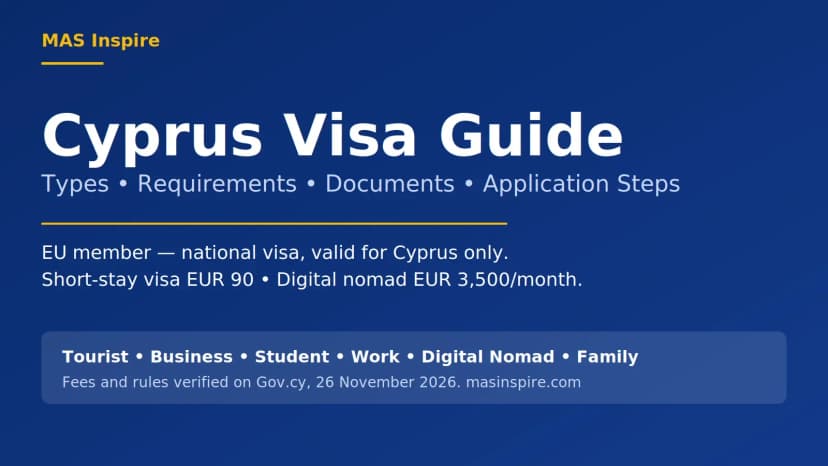
Read this first, because Cyprus is often misunderstood. Cyprus is in the EU, but it is not yet a full member of the Schengen Area. A visa issued by Cyprus is a national visa. It is valid for Cyprus only, and it does not automatically allow travel to France, Germany, Spain or other Schengen states. A Cyprus residence permit is also not a Schengen residence permit. If you hold a valid multiple-entry Schengen visa or a residence permit from certain other countries, you may be able to visit Cyprus without a separate Cyprus visa, but you must check the current list on the official Visas page before you travel.
A second point matters just as much. In Cyprus, a visa and a residence permit are different things. A short-stay visa lets you visit for up to 90 days. It does not let you work, study for a degree, or live in Cyprus long-term. If you plan to stay longer than 90 days, you normally need an entry permit and then a residence permit, issued through the Migration Department in Cyprus. Applying for the wrong one is one of the most common reasons for delay.
This guide does not guarantee that any application will succeed. No website can. It gives you the official rules, so you can prepare a complete, honest application and avoid the mistakes that cause refusals.
Why People Visit, Study, and Work in Cyprus
People choose Cyprus for different reasons, and the reason for the trip decides which visa or permit to apply for.
Tourism and family visits. Cyprus offers warm weather, beaches in Ayia Napa, Protaras, Limassol and Paphos, and historic sites in Nicosia, the Troodos Mountains and the Akamas Peninsula. Many visitors also travel to see family or attend weddings and other events.
Study. Universities and colleges in Cyprus teach many programmes in English. International students apply for a student entry permit before travel and a residence permit after arrival. Student life is often more affordable than in some larger EU countries, but tuition, housing and living costs still need to be planned in advance.
Work. Employers in Cyprus hire third-country nationals when they cannot fill a post locally or from the EU. The main route is a single permit for remunerated employment, applied for by the employer. Specialist routes exist for highly qualified workers, researchers and intra-company transfers.
Remote work. Cyprus has a Digital Nomad Visa scheme for people who work remotely for an employer or clients outside Cyprus. It is not a work permit for a Cyprus employer. The income requirement is EUR 3,500 net per month, and the scheme is capped at 500 permits.
Business and investment. Business visitors attend meetings, conferences and trade events on a short-stay visa. Investors and entrepreneurs use longer-term residence routes, including the accelerated permanent-residence route for property investment, subject to the conditions in force at the time of application.
Family and settlement. Family members of lawful residents, EU citizens and investors can apply for family reunion or a residence permit as a dependant. After five years of lawful continuous residence, some residents may qualify for long-term residence.
Choose your category by your real purpose. A tourist visa cannot be turned into a work permit by finding a job after arrival, and a student permit does not allow full-time work.
Types of Cyprus Visas
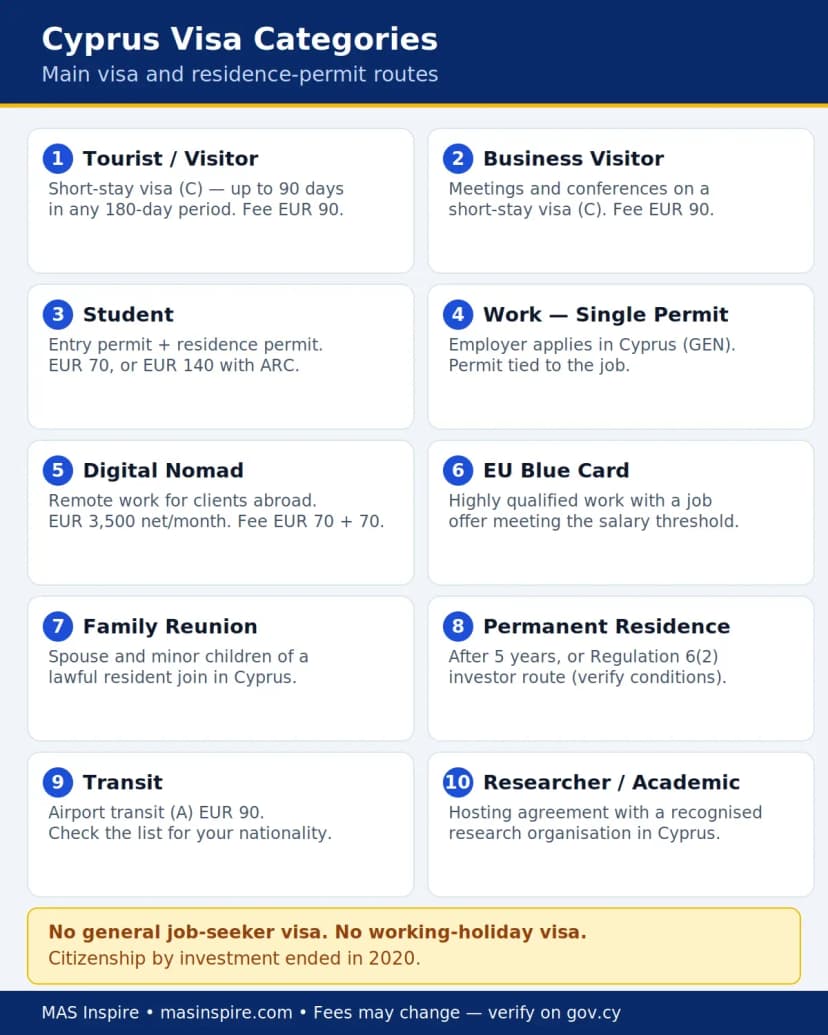
1. Short-stay visa (Category C) — tourist and visitor
This is the standard visa for tourism, visiting family or friends, attending a cultural or sporting event, or receiving short medical treatment. It allows a stay of up to 90 days in any 180-day period. It can be single-entry or multiple-entry. It does not allow work.
Who can apply: Nationals of countries that need a visa to enter Cyprus, including Pakistani passport holders. EU, EEA and Swiss citizens do not need a visa.
Fee: EUR 90 for adults; EUR 45 for children aged 6-12; free for children under 6.
2. Business visitor visa (Category C)
This is a short-stay visa for business meetings, conferences, negotiations and trade fairs. The applicant must show an invitation from a Cyprus company or organisation, and must not take up employment in Cyprus. The fee and the 90-day limit are the same as for a tourist visa.
3. Transit visa (Category C and airport transit)
A transit visa is for travellers passing through Cyprus to a third country. Most travellers who stay in the international transit area and do not pass through passport control do not need one, but the requirement depends on nationality and on the airport. An airport transit visa (Category A) applies only to a small list of nationalities. Check the official list for your nationality before booking.
4. Student visa and residence permit
There is no single "student visa" that covers the whole course. The process has two parts: a student entry permit, applied for before travel, and a residence permit, issued after arrival in Cyprus. The student must have an offer from a recognised educational institution in Cyprus and must show sufficient funds, accommodation and health insurance. See the Student Visa Guide below.
5. Work visa and single permit for remunerated employment (GEN)
A third-country national who wants to work for a Cyprus employer needs a temporary residence and work permit. The employer normally starts the application in Cyprus, and the worker applies for an entry permit at a Cyprus mission abroad. The permit is tied to the employer and the job. Changing employer requires a new application or a change of status.
6. EU Blue Card
The EU Blue Card is for highly qualified non-EU nationals with a higher-education qualification and a job offer in Cyprus that meets the salary threshold in force. It gives a residence and work permit, and after a period of lawful residence it can lead to long-term residence. The salary threshold changes, so check the current Migration Department document list before applying.
7. Digital Nomad Visa (temporary residence permit)
For non-EU/EEA nationals who work remotely using telecommunications technology for an employer or clients outside Cyprus, or who are self-employed and work for clients outside Cyprus. Applicants must show a stable net monthly income of at least EUR 3,500. The permit is issued for one year and can be renewed for up to two more years, for a total of three years. Family members may join the holder in Cyprus but may not work in Cyprus. The scheme is capped at 500 permits.
8. Entrepreneur, startup and investor residence
Cyprus has residence routes for entrepreneurs and investors, including the accelerated permanent-residence route under Regulation 6(2) of the Aliens and Immigration Regulations. This route is commonly described as requiring a property investment of EUR 300,000 and a secure annual income from abroad, but the exact conditions were not re-verified on Gov.cy in this research session. Do not rely on the EUR 300,000 figure alone; confirm the current conditions with the Migration Department or a licensed adviser before making any investment.
9. Family reunion and spouse visas
Family members of a lawful resident in Cyprus, including a spouse and minor children, can apply for a residence permit as a dependant. The sponsor must show lawful residence, accommodation and sufficient income. Family members of EU citizens have a separate, more favourable route under EU free-movement rules. A short-stay visa is still needed for a first visit if the family member is a visa national.
10. Researcher and academic permits
Researchers who have a hosting agreement with a recognised research organisation in Cyprus can apply for a residence permit for research. Academic staff employed by a university or college apply through the work-permit route. The exact document list depends on the hosting agreement and the institution.
11. Exchange, internship and training
Cyprus does not have a single general "internship visa" for all nationalities. Short internships are often covered by a short-stay visa, while longer training or work placements need a residence and work permit or a specific scheme. Students can do a traineeship as part of their studies under their student permit, with the institution's approval. Always check whether the placement counts as work, because that decides the permit you need.
12. Humanitarian protection
Cyprus has an asylum and international-protection system for people who seek protection from persecution or serious harm. Applications are made in Cyprus to the Asylum Service, not at a Cyprus embassy abroad. This guide does not give advice on asylum claims. Anyone in need of protection should seek help from the Asylum Service, the UN Refugee Agency (UNHCR) in Cyprus, or a qualified legal adviser as soon as possible.
What Cyprus does NOT have
- No general job-seeker visa. There is no visa that lets you travel to Cyprus to look for a job. The only similar route is the 12-month post-study stay for graduates of master's-level programmes (level 7 or higher) who completed their studies in Cyprus.
- No working-holiday visa for most nationalities. Do not assume a working-holiday scheme exists for your country.
- No golden visa for citizenship. Cyprus ended its Citizenship by Investment Programme in 2020. Residence by investment is not citizenship, and it does not lead directly to a Cyprus passport.
- No e-visa for all nationalities. Short-stay applications are paper-based through a mission or an authorised centre.
Visa Comparison Table
| Visa or permit | Main purpose | Maximum stay | Work in Cyprus? | Main fee (EUR) |
|---|---|---|---|---|
| Short-stay visa (C) — tourist | Tourism, family visit | 90 days in 180 days | No | 90 (adult); 45 (age 6-12); free (under 6) |
| Short-stay visa (C) — business | Meetings, conferences | 90 days in 180 days | No | 90 |
| Transit / airport transit | Passing through Cyprus | Transit only | No | 90 (C); check official list (A) |
| Student entry + residence permit | Full-time study | Up to 1 year, renewable | Yes, up to 20 hrs/week in term | 70 (entry + residence); 140 (with ARC) |
| Single permit — work (GEN) | Employment with a Cyprus employer | Duration of contract, renewable | Yes, for that employer | Check official portal |
| EU Blue Card | Highly qualified work | 1-4 years, renewable | Yes, for that employer | Check official portal |
| Digital Nomad Visa | Remote work for clients abroad | 1 year, renewable up to 3 years | No work for Cyprus employer | 70 + 70 ARC registration |
| Family reunion / dependant | Join a lawful resident | Same as sponsor, renewable | Depends on permit type | Check official portal |
| Permanent / long-term residence | Settlement | Permanent / long-term | Yes, with conditions | Check official portal |
| Investor — Regulation 6(2) | Property investment + residence | Permanent | Yes, with conditions | Check official portal; investment not a fee |
Fees are official fees only. Service-provider, courier, translation and legalisation charges are extra. "Check official portal" means the fee was not re-verified on Gov.cy in this session.
Eligibility Requirements
Eligibility depends on your nationality, your purpose, and your residence status. These are the rules that apply to most third-country nationals.
Nationality. EU, EEA and Swiss citizens do not need a visa or a work permit to enter, live or work in Cyprus, although they must register if they stay longer than three months. Nationals of most other countries, including Pakistan, Vietnam, India, Bangladesh, the Philippines and most African states, need a visa to visit Cyprus and a permit to live or work there. Some nationalities are visa-exempt for short stays; check the official list for your passport, not for your country of residence.
Valid passport. Your passport must be valid for at least three months after the date you plan to leave Cyprus, must have been issued within the last 10 years, and must have at least two blank pages. A damaged passport, or one with too little validity, can lead to refusal.
Purpose and funds. You must show a clear, genuine purpose and enough money for your stay and your return journey. For a tourist, that means accommodation, a travel plan and bank statements. For a student, it means tuition, living costs and health insurance. For a digital nomad, it means a stable net income of at least EUR 3,500 per month from outside Cyprus.
Health insurance. Short-stay visa applicants must have travel medical insurance of at least EUR 30,000, valid in Cyprus. Students and residents need health insurance that covers their stay in Cyprus.
Clean record and previous compliance. A criminal record, a previous overstay, a false document, or a refusal in Cyprus or another EU state can affect a new application. Previous travel history is not a formal requirement, but a history of returning on time can support a short-stay application.
Residence in the country of application. You should normally apply in the country where you legally live. If you live in Vietnam on a valid residence permit, a Cyprus mission may accept your application there if it is accredited for Vietnam. It may also direct you to the mission in your country of nationality. A residence permit in Vietnam does not create a right to apply in Vietnam. See the Pakistan or Vietnam section below.
No work on a visitor visa. A short-stay visa never gives a right to work in Cyprus, even part-time or remotely for a Cyprus employer. If you are offered a job, you must leave and apply for the correct work permit, unless the Migration Department allows a change of status in Cyprus — which is not the normal route.

Complete Document Checklists
The lists below are the usual documents. The mission or the Migration Department can ask for more. Mandatory means the application is likely to be refused or delayed without it. Conditional means it applies only to some applicants. Supporting means it strengthens the application but is not always listed as mandatory.
Short-stay visa (tourist / business) — mandatory
| Document | Notes |
|---|---|
| Completed and signed visa application form | Use the form from the mission or VFS Global |
| Passport | Valid 3+ months beyond departure; issued within 10 years; 2 blank pages |
| Two recent passport photographs | Colour, white background, as specified by the mission |
| Travel medical insurance | Minimum EUR 30,000, valid in Cyprus |
| Flight reservation | Do not pay for a non-refundable ticket before a decision |
| Accommodation proof | Hotel booking, or invitation and host's address |
| Proof of funds | Recent bank statements, salary slips, or sponsor's evidence |
| Proof of ties to home / residence country | Employment letter, enrolment, property, or family evidence |
| Visa fee payment | EUR 90 adult; EUR 45 child 6-12; free under 6 |
Short-stay visa — conditional and supporting
| Document | When it applies |
|---|---|
| Invitation letter from a Cyprus host or company | Family visit or business visit |
| Host's ID, residence permit and proof of address | If staying with a host in Cyprus |
| Business registration and invitation | Business meetings or conferences |
| Previous passports and visas | If you have travelled before |
| Proof of legal residence in the country of application | If applying outside your country of nationality |
| Marriage or birth certificates | If travelling with family |
Student entry and residence permit — mandatory
| Document | Notes |
|---|---|
| Entry permit application (form M.58) and residence permit application | Filed through the institution or an authorised representative |
| Passport | Valid for the full period of study, with blank pages |
| Letter of acceptance from a recognised institution in Cyprus | With course, duration and fees |
| Proof of tuition payment or sponsorship | As required by the institution and the Migration Department |
| Proof of sufficient funds | Bank statements or sponsor's evidence for living costs |
| Health insurance | Covering the stay in Cyprus |
| Accommodation proof | Dormitory, rental, or host's address |
| Clean criminal record certificate | From the country of origin or residence, if requested |
| Medical certificates | As listed in the Migration Department document list |
| Passport photographs | As specified |
| Fee payment | EUR 70 (entry + residence) or EUR 140 (with ARC) |
Work — single permit (GEN) — mandatory
| Document | Notes |
|---|---|
| Application by the Cyprus employer | The employer starts the single-permit process |
| Employment contract | Signed, with salary, duties and duration |
| Passport | Valid, with blank pages |
| Qualifications and CV | For the post, with translations if needed |
| Clean criminal record certificate | From the country of origin or residence |
| Medical certificates | As listed by the Migration Department |
| Health insurance | Covering the stay |
| Accommodation proof | As required |
| Fee payment | Check the current Migration Department list |
Digital Nomad Visa — mandatory
| Document | Notes |
|---|---|
| Temporary residence permit application (digital nomad) | Form from the Migration Department document list |
| Passport | Valid |
| Proof of remote work | Employment contract with an employer outside Cyprus, or client contracts if self-employed |
| Proof of income | At least EUR 3,500 net per month, stable, from outside Cyprus |
| Health insurance | Covering the stay in Cyprus |
| Accommodation proof | Rental or host's address in Cyprus |
| Clean criminal record certificate | From the country of origin or residence |
| Medical certificates | As listed |
| Fee payment | EUR 70 permit + EUR 70 Aliens Register registration |
Family reunion — mandatory (typical)
| Document | Notes |
|---|---|
| Residence permit application for the family member | Filed in Cyprus |
| Passport of the family member and sponsor | Valid |
| Proof of family relationship | Marriage or birth certificate, legalised/apostilled |
| Sponsor's residence permit and proof of income | Sufficient income and accommodation |
| Health insurance | For the family member |
| Accommodation proof | In Cyprus |
| Fee payment | Check the current list |
A note on document numbers. The official lists do not give a single fixed number of documents for every applicant, because the list changes with nationality, purpose and family situation. Do not trust a website that promises a fixed "10 documents" for every case. Use the mission's or the Migration Department's current list for your category.
How to Apply: Step-by-Step
Cyprus does not use one identical online process for every visa. The steps below are the normal sequence; adapt them to your category.
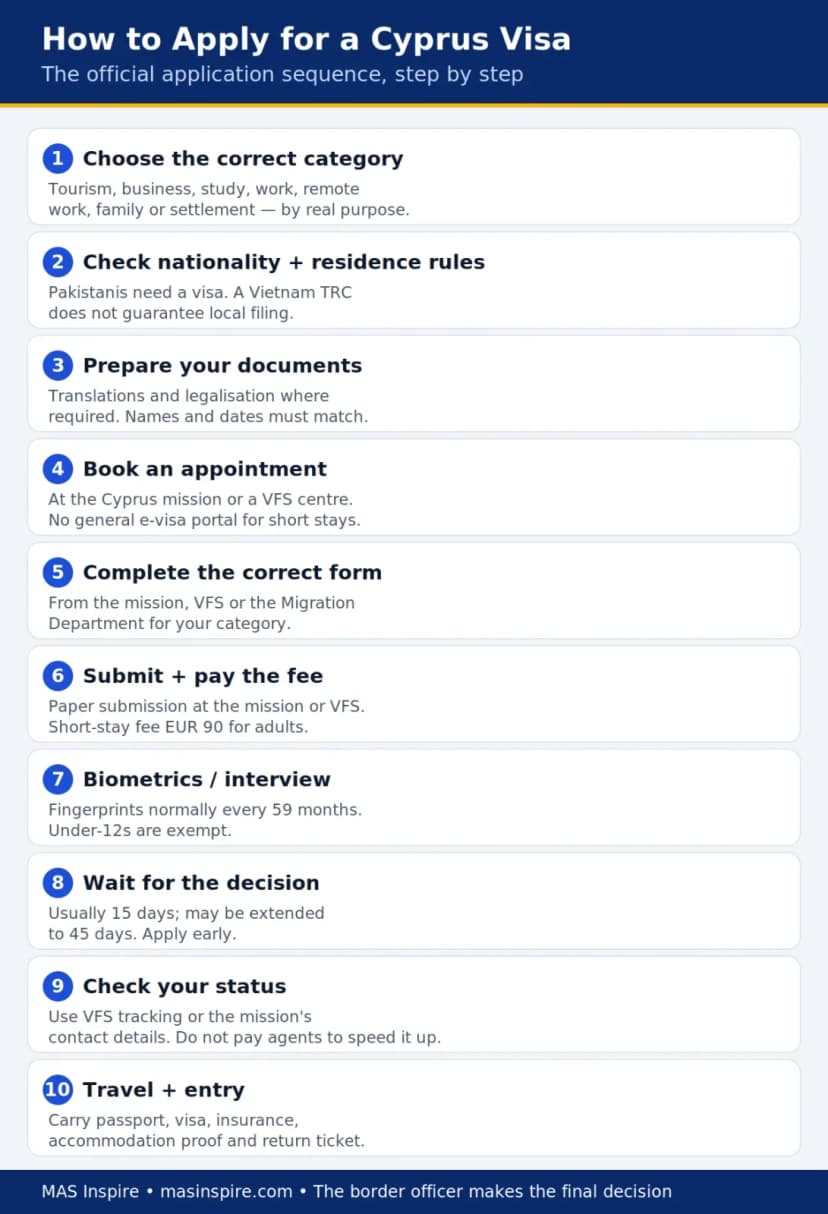
Step 1: Choose the correct visa category. Decide your real purpose — tourism, business, study, work, remote work, family or settlement. If you are not sure, check the official Visas page and the Migration Department document lists before you apply. Applying for the wrong category wastes the fee.
Step 2: Check nationality, residence and eligibility rules. Confirm whether your passport needs a visa, whether you may apply in the country where you live, and whether you need an entry permit, a residence permit, or both. Pakistani passport holders need a visa. A Vietnam residence permit does not guarantee that you can file in Vietnam.
Step 3: Prepare mandatory and supporting documents. Collect the documents in the checklist for your category. Get translations and legalisation or apostille where required. Make sure bank statements, insurance and invitations are current and consistent — the dates, names and addresses must match across documents.
Step 4: Create an account on the official application website, if required. There is no general Cyprus e-visa account for short-stay visas. Some residence-permit renewals can be made online through the Migration Department. VFS Global, where used, has its own appointment and tracking system. Do not pay any agent who claims to have a special online portal.
Step 5: Complete the correct visa application form. Use the form from the Cyprus mission, VFS Global, or the Migration Department for your category. For students, the institution often files the entry-permit application. For work, the employer files the single-permit application. Fill in every field honestly, and sign the form.
Step 6: Upload documents and pay official fees. Short-stay applicants submit paper documents at the mission or VFS centre and pay the fee there, as instructed. Residence-permit applicants submit documents in Cyprus and pay the fee shown in the Migration Department list. Keep every receipt.
Step 7: Schedule biometrics or an interview, if required. Short-stay applicants give fingerprints at the mission or VFS centre, normally every 59 months, and may be interviewed. Students and other residence applicants give biometrics and medical tests in Cyprus after arrival.
Step 8: Submit the application. Submit the complete file before the deadline — at least 15 days before travel for a short-stay visa, and no earlier than six months before travel. For students and workers, submit well before the course or job start date, because entry and residence permits take one to three months.
Step 9: Check application status using the official tracking method. Use the VFS tracking page or the mission's contact details for a short-stay visa, and the Migration Department for a residence permit. Do not trust a third party who says they can speed up a decision for a fee.
Step 10: Understand the decision, passport return, travel and entry requirements. If the visa is issued, check the dates, the number of entries, and the name and passport number on the sticker before you leave the centre. If it is refused, read the reason given and the appeal or reapplication options. At the border, carry your passport, visa, insurance, accommodation proof and return ticket. A visa does not guarantee entry; the border officer makes the final decision.
Visa Fees and Financial Requirements
| Item | Official fee (EUR) | Source |
|---|---|---|
| Short-stay visa, adult | 90 | Gov.cy Visas |
| Short-stay visa, child 6-12 | 45 | Gov.cy Visas |
| Short-stay visa, child under 6 | Free | Gov.cy Visas |
| Short-stay visa, Cape Verde adult / child 6-12 | 67.50 / 33.75 | Gov.cy Visas |
| Visa issued at the border | 90 | Gov.cy Visas |
| Extension of a short-stay visa | 30 | Gov.cy Visas |
| Facilitation fee | 35 | Gov.cy Visas |
| Pupils, students, researchers, non-profit event participants (up to age 25) and diplomatic/service passport holders | Free | Gov.cy Visas |
| Student entry + residence permit | 70 | Migration Dept, Students |
| Student entry + residence + ARC | 140 | Migration Dept, Students |
| Student residence permit issue / renewal | 55 | Migration Dept, Students |
| Student change of status | 55 | Migration Dept, Students |
| First Aliens Register registration | 70 | Migration Dept, Students |
| Digital Nomad permit | 70 | Migration Dept, Digital nomads |
| Digital Nomad Aliens Register registration | 70 | Migration Dept, Digital nomads |
| Travel medical insurance (short-stay) | At least EUR 30,000 cover | Gov.cy Visas |
| Digital nomad income | At least EUR 3,500 net / month | Migration Dept, Digital nomads |
Financial requirements are not a single bank balance for every applicant. For a short stay, show enough money for the trip and the return. For a student, show tuition and living costs. For a digital nomad, show EUR 3,500 net per month. For family reunion, the sponsor must show sufficient income and accommodation. Always use the current Migration Department list for the exact amount for your category.
Visa Processing Times
| Application | Published time |
|---|---|
| Short-stay visa (C) | Usually 15 days; may be extended to 45 days. Apply at least 15 days before travel, no earlier than 6 months before travel (9 months for seafarers) |
| Student entry permit | Within 1 month, if the file is complete |
| Student residence permit | Within 3 months, if the file is complete |
| Digital Nomad Visa | 5-7 weeks for examination |
| Work single permit (GEN) | Not officially published in this guide; check the Migration Department |
| Family reunion / residence permit | Not officially published in this guide; check the Migration Department |
| Permanent / long-term residence | Not officially published in this guide; check the Migration Department |
Processing times are working estimates, not guarantees. Incomplete files, extra checks, and busy periods cause delays. Apply early.
Applying from Pakistan or Vietnam
This section is for Pakistani passport holders who legally live or work in Vietnam.
Do you need a visa? Yes. Pakistani passport holders need a visa to enter Cyprus. A Vietnam residence permit does not change your nationality for visa purposes.
Where do you apply? Cyprus has no resident diplomatic mission in Vietnam. The Gov.cy country page for Vietnam says the High Commission of Cyprus in New Delhi, India, is also accredited to Vietnam, and it lists an Honorary Consulate in Hanoi. An honorary consulate is not a visa-issuing embassy. In practice, you must contact the High Commission of Cyprus in New Delhi first and ask whether you may file in Vietnam, in India, or in Pakistan. VFS Global is used by Cyprus in some countries; check the VFS Global Cyprus page for Pakistan and India to see where Pakistani nationals may file.
Does a Vietnam residence permit guarantee local filing? No. Legal residence in Vietnam helps to show ties and a place to return to, but it does not guarantee that a mission will accept your application in Vietnam. Some missions accept applications only from nationals of the country where they are based, or only from residents with a long-term permit. Confirm this in writing before you book travel or pay any fee.
Applying from Pakistan. If you apply from Pakistan, you apply through the Cyprus mission or VFS centre that covers Pakistan. The documents are the same as for any short-stay applicant, plus proof of your ties to Pakistan.
Applying from Vietnam. If the accredited mission allows it, you will need: a valid Pakistani passport; a valid Vietnam residence permit (TRC) or long-term visa with enough validity left; proof of legal work or study in Vietnam, such as an employment contract or work permit; a Vietnam address; and bank statements showing income in Vietnam. Bring the original TRC and a copy. If the mission does not accept applications in Vietnam, you may need to apply in Pakistan or in India, if that mission accepts third-country residents.
Extra documents that are often requested. Proof of legal residence in Vietnam; a work permit or employment letter from a Vietnam employer; recent Vietnam bank statements; a Vietnam tax or social-insurance record if available; and a clear travel plan showing that you will return to Vietnam or Pakistan. All documents in Vietnamese or Urdu should be translated into English.
Do not assume. Do not assume that a valid Schengen visa, a Vietnam TRC, or a previous Cyprus visa guarantees a new visa. Each application is decided on its own facts.
Student Visa Guide
- Get an offer. Apply to a recognised university or college in Cyprus and get a letter of acceptance. Check that the institution is recognised and that the course is full-time.
- Prepare funds and insurance. Show tuition payment or sponsorship, living costs, accommodation and health insurance.
- Entry permit. The institution or an authorised representative files the entry-permit application (form M.58) with the Migration Department. Examination takes up to one month if the file is complete.
- Travel. If the entry permit is approved, you travel to Cyprus and present the permit at the border.
- Register within seven days. After arrival, register with the Migration Department and apply for the residence permit. Examination takes up to three months.
- Study and work. A residence permit is issued for up to one year and is renewable for the duration of the course. You may work up to 20 hours per week in term time and 38 hours in holidays, in approved occupations, after signing an approved employment contract.
- After graduation. If you complete a master's-level qualification (level 7 or higher), you may stay for up to 12 months to look for work or start a business. This is not a general job-seeker visa for all graduates.
Work Visa and Job Opportunities
Cyprus hires third-country nationals mainly in hospitality and tourism, construction, agriculture, domestic work, healthcare, information technology and financial services. The main route is the single permit for remunerated employment (GEN). Your employer applies in Cyprus, and you apply for an entry permit abroad. You cannot normally start work until the permit is issued.
Do not pay an agent who promises a Cyprus work visa without a real employer and a real contract. A genuine offer will name the employer, the job, the salary, the working hours and the duration. Check the employer with the Cyprus Department of Labour if you are unsure. If you lose your job, your permit may end; check the conditions with the Migration Department before you travel.
Family Immigration and Permanent Residence
Family reunion. A lawful resident can sponsor a spouse and minor children for a residence permit, if the sponsor shows lawful residence, sufficient income and suitable accommodation. Family members of EU citizens use the EU free-movement route. Processing and income requirements are set by the Migration Department and change, so check the current list.
Long-term residence. After five years of lawful continuous residence in Cyprus, some residents may qualify for long-term residence status. The exact conditions, including absences and income, are set in Cyprus law and must be checked at the time of application.
Investor permanent residence — Regulation 6(2). This accelerated route is for investors who buy property in Cyprus and meet the published income conditions. The commonly cited property figure is EUR 300,000, but this was not re-verified on Gov.cy in this session. Do not invest on the basis of this guide alone. Confirm the current conditions, the type of property that qualifies, and the income requirement with the Migration Department before any purchase.
Common Application Mistakes
- Applying for a tourist visa when you plan to study or work.
- Booking non-refundable flights and hotels before a decision.
- Submitting bank statements that do not match the stated income, or a large deposit with no explanation.
- Using an invitation letter with a different name, address or date from the application form.
- Letting the passport fall below three months' validity after departure, or having fewer than two blank pages.
- Forgetting travel insurance, or buying insurance that does not cover Cyprus.
- Applying too late — less than 15 days before travel for a short-stay visa.
- Giving false information or a false document. This can lead to refusal and a ban.
Reasons for Visa Refusal
The most common reasons are: the purpose of the trip is not clear or not credible; funds are insufficient or not properly shown; the applicant has not shown that they will leave Cyprus before the visa expires; the travel insurance is missing or inadequate; the passport is invalid or damaged; a document is false or inconsistent; the applicant has overstayed or breached immigration rules before; or the applicant is considered a risk to public order, public health or security. A refusal letter gives the reason. You can usually reapply with a stronger file, or appeal where the law allows. A refusal does not mean you can never apply again, but you must address the reason given.
Frequently Asked Questions
1. Do Pakistani citizens need a visa for Cyprus?
Yes. Pakistani passport holders need a visa to enter Cyprus.
2. Is Cyprus in the Schengen Area?
No, not yet as of 26 November 2026. A Cyprus visa is valid for Cyprus only.
3. Can I visit Schengen countries with a Cyprus visa?
No. A Cyprus national visa does not give a right to travel in Schengen states.
4. Can I enter Cyprus with a Schengen visa?
Some holders of a valid multiple-entry Schengen visa or a residence permit from certain countries may visit Cyprus without a separate Cyprus visa, under the conditions on the Gov.cy Visas page. Check the current list for your nationality and document type.
5. How much is a Cyprus tourist visa?
EUR 90 for adults, EUR 45 for children aged 6-12, and free for children under 6.
6. How long can I stay on a tourist visa?
Up to 90 days in any 180-day period.
7. Can I work on a tourist visa in Cyprus?
No. A short-stay visa never allows work in Cyprus.
8. Is there a job-seeker visa for Cyprus?
No. There is no general job-seeker visa. Graduates of master's-level programmes in Cyprus may stay up to 12 months to seek work.
9. What is the Digital Nomad Visa income requirement?
At least EUR 3,500 net per month from work outside Cyprus.
10. Can students work in Cyprus?
Yes, up to 20 hours per week in term time and 38 hours in holidays, in approved occupations, after signing an approved employment contract.
11. Can a Pakistani resident in Vietnam apply for a Cyprus visa in Vietnam?
Not automatically. Cyprus has no resident mission in Vietnam. Contact the High Commission of Cyprus in New Delhi, which is accredited to Vietnam, and check whether you may file in Vietnam, India or Pakistan.
12. How long does a Cyprus student permit take?
An entry permit is examined within one month and a residence permit within three months, if the file is complete.
13. Can my family join me in Cyprus?
A lawful resident can sponsor a spouse and minor children, subject to income and accommodation requirements. Family members of EU citizens have a separate route.
14. Does buying property in Cyprus give citizenship?
No. Cyprus ended its Citizenship by Investment Programme in 2020. Property investment may lead to permanent residence under Regulation 6(2), not to citizenship.
15. What should I do if my visa is refused?
Read the refusal reason, correct the problem, and reapply with a stronger file, or appeal where the law allows. Do not submit the same file again without changes.
Official Immigration Websites
| Official source | Link |
|---|---|
| Gov.cy — Visas | https://www.gov.cy/en/information/visas/ |
| Gov.cy — Migration Department, Digital nomads | https://www.gov.cy/mip-md/en/documents/digital-nomads-and-family-members/ |
| Gov.cy — Migration Department, Students | https://www.gov.cy/mip-md/en/documents/students/ |
| Gov.cy — Ministry of Foreign Affairs | https://www.gov.cy/mfa/ |
| Gov.cy — Ministry of Foreign Affairs, Vietnam | https://www.gov.cy/mfa/en/vietnam/ |
| European Commission — Legal migration and integration | https://home-affairs.ec.europa.eu/policies/migration-and-asylum/legal-migration-and-integration_en |
| VFS Global — Cyprus | Check the VFS Global website for the country where you will file |
Final Checklist and Conclusion
Before you submit, check that you have: chosen the correct category; a passport valid for three months beyond departure with two blank pages; travel insurance of at least EUR 30,000 for a short stay; the correct fee; proof of funds and accommodation; proof of ties to your home or residence country; and, for students and workers, the correct entry permit and institution or employer documents.
Cyprus is a rewarding destination for visitors, students, remote workers and families, but the rules are strict and they change. Use only official sources, apply early, and be honest in every document. A complete application is the best way to avoid delay or refusal.
Disclaimer: This article is educational information only. It is not legal or immigration advice, and it does not guarantee a visa or a permit. Fees, processing times and requirements may change. Always check the official Gov.cy pages and the Cyprus mission that covers your country before you apply. MAS Inspire is not an official immigration authority.