Cuba Visa Guide 2026: Types, Requirements, Documents and Application Steps
By MAS Inspire | Editorial draft: 27 November 2026 (fees and rules re-verified 28 November 2026)
Table of contents
- Introduction
- Why People Visit, Study, and Work in Cuba
- Types of Cuba Visas
- Visa Comparison Table
- Eligibility Requirements
- Complete Document Checklists
- How to Apply: Step-by-Step
- Visa Fees and Financial Requirements
- Visa Processing Times
- Applying from Pakistan or Vietnam
- Student Visa Guide
- Work Visa and Job Opportunities
- Family Immigration and Permanent Residence
- Common Application Mistakes
- Reasons for Visa Refusal
- Frequently Asked Questions
- Official Immigration Websites
- Final Checklist and Conclusion
Introduction
Cuba has a specific immigration system, and the right permission depends on why you are travelling. A short holiday normally uses the electronic tourist visa, while study, employment, investment, family and longer-term residence require a different immigration classification and often a Cuban institutional sponsor. Visitors should also complete D'Viajeros before departure. It is a separate arrival declaration, not a visa.
This guide explains the principal routes, documents, fees and application steps using Cuban government tourism information, the official eVisa portal and the migration framework published in 2026. Rules can differ by nationality and by the Cuban mission handling an application. Confirm your individual case before purchasing non-refundable travel.
Why People Visit, Study, and Work in Cuba
Visitors travel to Cuba for its historic cities, music, architecture, beaches, family connections and cultural experiences. Students and researchers may attend Cuban institutions or approved exchange programmes. Professionals, technical specialists, artists, journalists, sports personnel, religious workers, investors and business representatives may qualify for purpose-specific temporary residence when their activity is authorised by the relevant Cuban body.
A tourist permission is not a substitute for a work, study or residence authorisation. Do not undertake paid employment, enrol in a long-term course or carry out a sponsored professional assignment on a tourist entry permission unless the Cuban authorities have expressly authorised that activity.

Types of Cuba Visas
The 2026 regulation groups visas by immigration classification. It is not a simple system in which every purpose has an independent online visa application. The main groups are:
| Classification / route | Typical purpose | Important point |
|---|---|---|
| Visitor — tourist (A-1) | Holiday and ordinary tourism | Single entry; generally up to 90 days, extension subject to approval |
| Visitor — transit (A-3 / A-4) | Transit up to 72 hours or transfer exceeding 72 hours | Confirm the correct code and onward-travel conditions with the mission |
| Visitor — crew (A-5) | Crew duties | Not a general visitor visa |
| Visitor — event / business offer (A-6 / A-7) | Event participation or business/service offer | Confirm invitation and activity limits |
| Temporary resident — technical/scientific (D-1) | Specialist or scientific work | Requires the appropriate Cuban sponsor/contracting body and activity approval |
| Temporary resident — student/scholar (D-2) | Study, scholarship, research or training | Admission/hosting by a Cuban institution is central |
| Temporary resident — artist (D-3) / sport (D-4) | Professional artistic or sporting activity | Relevant Cuban authority or accredited institution must support the request |
| Temporary resident — journalist (D-6) | Press, film, television or media work | Accreditation/authorisation is relevant |
| Temporary resident — business (D-7) | Commercial or business activity | Requires the appropriate business/institutional basis |
| Temporary resident — religious (D-8) | Religious activity | Sponsorship/approval may be required |
| Temporary resident — medical treatment (D-10) | Treatment in Cuba | Medical institution and treatment documentation required |
| Permanent resident (E-1 / E-2) | Spouse/family of Cuban citizen or other qualifying cases | Not an automatic entitlement; formal approval required |
| Real-estate resident (F-1 / F-2) | Qualifying property owner/tenant in designated real-estate complexes and family | Not a general property-purchase or retirement visa |
| Humanitarian / provisional residence | Protection or other legally recognised grounds | Individual assessment by Cuban authorities |
| Diplomatic / invited | Official or formally invited purposes | Usually arranged through the relevant government or Cuban host |
Not identified as standalone Cuban categories in the reviewed legislation: a digital-nomad visa, job-seeker visa, points-based skilled-migration programme, generic startup visa or ordinary independent internship visa. An internship, exchange or research placement may instead need to fit an approved student, academic, technical, cultural or other temporary-residence activity. Ask the Cuban host and consulate to classify it.
Tourist and visitor permission
The Cuban Tourism Portal states that the tourist visa is single-entry and permits a stay of up to 90 days, extendable for another 90 days. It is available through eVisaCuba, a Cuban consular office, or authorised travel agencies and airlines. The eVisa is linked to the passport used in the application. If your passport changes, contact the consulate before travelling.
Business meetings, event attendance, transit and crew activity may use different visitor subcategories. A tourist visa should not be assumed to authorise paid work, journalism, professional services or a business assignment. The invitation or business offer must match the purpose declared to the authorities.
Student, exchange and research routes
The migration regulation expressly recognises foreign students and scholarship holders admitted under educational, research or training programmes at Cuban centres. It also refers to self-financed or remunerated study. Applicants should first secure written admission or acceptance from the Cuban institution and ask it which immigration subcategory, authorisation and consular procedure applies. Research placements should be described accurately: a visiting researcher may fall under an academic or technical/scientific basis rather than a tourist category.
Work, professional activity and investment
Temporary residence can cover technical/scientific services, employment, business, investment, cooperation, arts, sports, journalism and religious activity. In most cases, the Cuban employer, ministry, institution, accredited organisation or project sponsor must initiate or support the process. The applicant should not travel expecting to find a job and convert a tourist stay into work permission.
The 2026 regulation requires a work permit issued by Cuba's Ministry of Labour and Social Security for foreign residents whose classification permits work or who are authorised to work, subject to exceptions for provisional and permanent residents. A temporary resident may not freely switch to unrelated work: the approved activity governs the permitted stay.
Family, permanent and humanitarian residence
The law recognises permanent residence categories including a spouse or other family member of a Cuban citizen and other qualifying cases. A Cuban citizen seeking family reunification must make a formal request and provide evidence such as family civil-status certificates, accommodation/material conditions and the foreign relative's financial solvency. The regulation also identifies humanitarian residence for people referred by UNHCR Havana, people in vulnerable situations and people granted temporary protection for humanitarian reasons. These are case-specific legal pathways, not ordinary visitor options.
Visa Comparison Table
| Purpose | Likely route | Sponsor / invitation | Work allowed? | Duration / fee |
|---|---|---|---|---|
| Tourism | Visitor A-1 | Not normally | No | Up to 90 days; extension may be approved; tourist fee depends on channel |
| Transit | Visitor A-3 / A-4 | Itinerary and onward travel | No | Category-specific; confirm mission tariff |
| Event / business visit | A-6 / A-7 | Event organiser or Cuban business contact may be required | Only activity specifically authorised | Check mission |
| Study / scholarship | Temporary resident D-2 | Cuban school/university/programme | Only if separately authorised | Case-specific |
| Technical / scientific work | D-1 | Cuban contracting institution | With required work authorisation | Case-specific |
| Artist / sport / journalist / religious | D-3 / D-4 / D-6 / D-8 | Relevant Cuban body or host | Only approved activity | Case-specific |
| Investor / business | Temporary-resident business/investor subcategory | Cuban partner or competent authority | Not automatically | Case-specific |
| Family / permanent | E-1 / E-2 or relevant residence route | Cuban relative and formal evidence | Permanent/provisional residents are excepted from the ordinary work-permit rule, but other rules apply | Case-specific |
| Humanitarian | Humanitarian residence | Competent authority / protection basis | Depends on approved status and authorisation | Case-specific |
Eligibility Requirements
For a tourist application, prepare to show that you have a valid passport, an email address, a genuine tourism purpose, an itinerary and onward or return travel. Cuba's tourism portal lists travel medical insurance and a return ticket among its entry requirements. The portal states a six-month passport-validity rule measured from entry. Airlines may apply document checks before boarding.
For a long-stay category, eligibility depends on the purpose and the Cuban sponsor. A student needs an accepted course or programme; an employee or technical specialist needs a legitimate Cuban contracting or hosting basis; an artist, journalist, athlete or religious worker may need authorisation from the relevant Cuban institution; and family residence requires proof of the relationship and the legal basis for residence.
There is no general public minimum bank-balance figure in the sources reviewed for all applicants. Do not rely on a made-up universal amount. The consulate or sponsor may request evidence of funds, accommodation or support in an individual case.
Complete Document Checklists
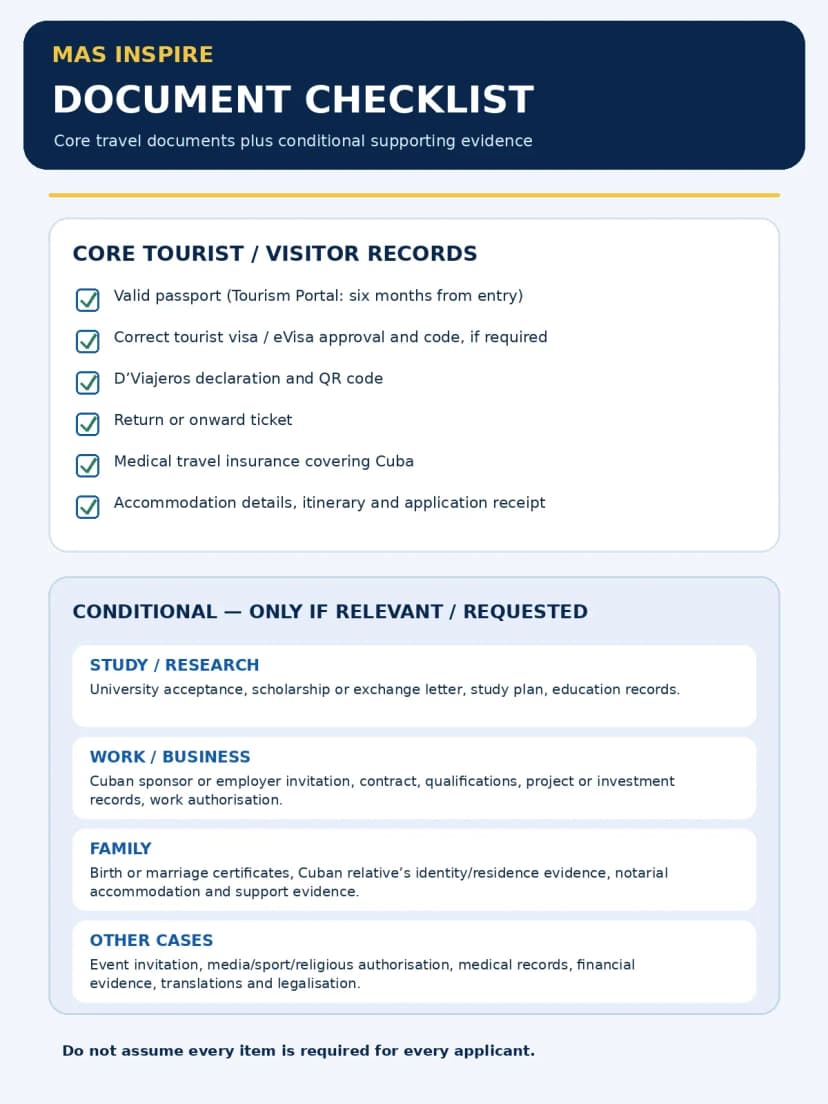
The following are preparation lists, not a claim that every item is mandatory in every case. The Cuban mission and live eVisa form determine the final checklist.
Tourist / visitor checklist
| Document or evidence | Status |
|---|---|
| Passport valid for the period required by Cuba (Tourism Portal says six months from entry) | Required |
| Current email address and eVisa application details | Required for eVisa route |
| Tourist visa/eVisa approval and code | Required where visa is required |
| D'Viajeros QR declaration | Required for arrival process |
| Return or onward ticket | Listed entry requirement |
| Medical travel insurance covering Cuba | Listed entry requirement |
| Accommodation details and travel itinerary | Supporting; may be requested |
| Evidence of sufficient funds | Supporting; no universal published amount located |
| Passport photo / extra forms | Only if requested by the portal or consulate |
Study / research checklist
| Document or evidence | Status |
|---|---|
| Passport and relevant visa/residence application | Required |
| Admission or acceptance letter from Cuban institution | Core requirement for study |
| Scholarship / exchange award or funding letter, if applicable | Conditional |
| Course, research or training plan and dates | Supporting / may be requested |
| Proof of tuition payment or financial support, if applicable | Conditional |
| Education certificates, transcripts and translations | Conditional / institution-specific |
| Health or medical documents requested by institution/mission | Conditional |
| Accommodation and insurance evidence | May be requested |
Employment / business / investment checklist
| Document or evidence | Status |
|---|---|
| Passport and relevant application | Required |
| Cuban employer, host institution or business invitation | Core, where applicable |
| Contract, assignment letter or description of services | Conditional by route |
| Approval from competent Cuban authority / sponsor | Where required by category |
| Professional qualifications and CV | May be requested |
| Work permit or evidence of its processing | Required where the law applies |
| Corporate / investment documentation | Conditional for business/investment route |
| Police, medical, financial or civil records | Only if requested |
Family / humanitarian checklist
| Document or evidence | Status |
|---|---|
| Passport and application | Required |
| Birth, marriage or recognised family-relationship certificates | Core where family basis applies |
| Cuban relative's identity / residence evidence | May be required |
| Cuban citizen's formal reunification request | Required for that procedure |
| Notarial accommodation/material-support evidence | Specified in the family-reunification regulation |
| Evidence of relative's financial solvency | Specified in the regulation |
| Medical/radiographic/serological records | Specified in the relevant family procedure; confirm current instructions |
| UNHCR or competent-authority documents | Conditional for humanitarian cases |
Documents issued abroad may need legalisation/certification and Spanish translation. Ask the Cuban mission about the applicable chain of authentication for documents issued in Pakistan or Vietnam. Never submit altered certificates, fabricated bank statements or false invitations.
Note on D'Viajeros timing: sources conflict on the completion window. The official D'Viajeros FAQ says within 72 hours before arrival, while some guides and airlines say within 7 days. Follow the official FAQ and re-check the current window before departure.
How to Apply: Step-by-Step
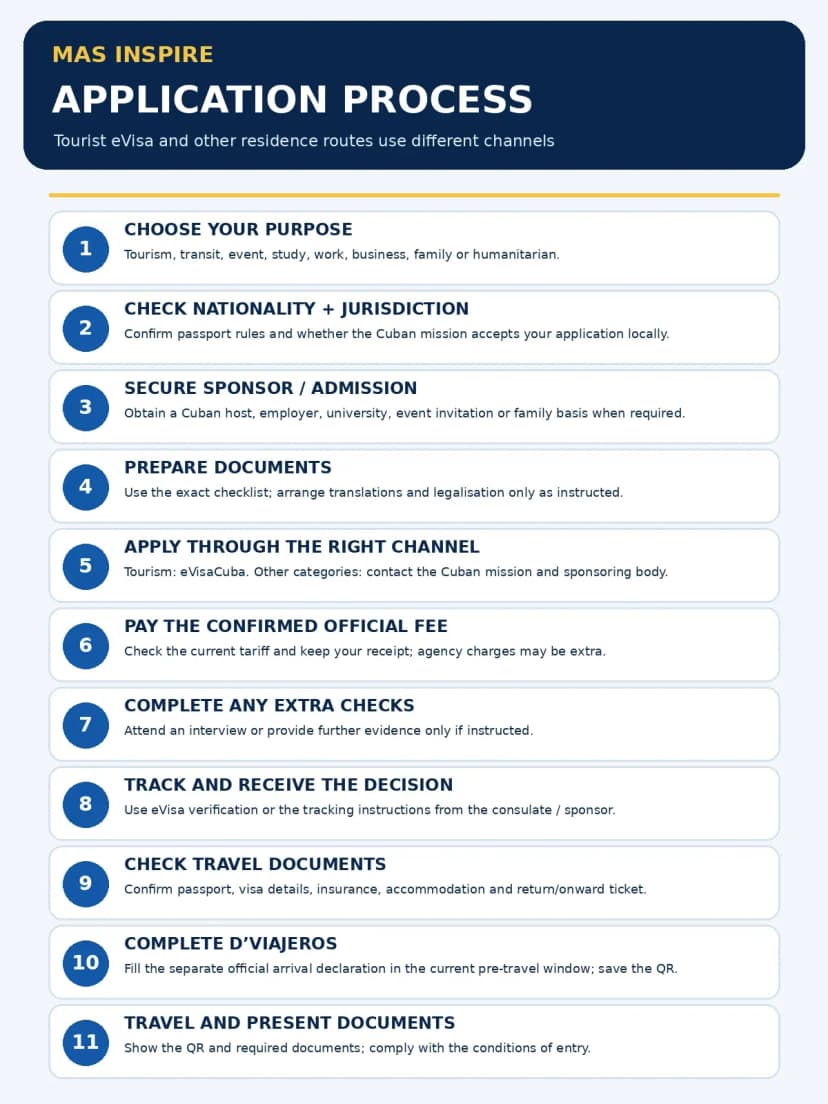
- Choose the correct category. Tourism, transit, event, study, work, business, family and humanitarian purposes are not interchangeable.
- Check nationality and place of application. Verify visa requirements for the passport you will travel on and ask the Cuban mission whether it accepts applications from your country of lawful residence.
- Secure the Cuban sponsor first, where needed. Obtain the university acceptance, employer/host request, event invitation, family-reunification basis or other relevant approval.
- Prepare documents. Follow the exact mission or eVisa checklist. Arrange translations and legalisation only as instructed.
- Use the correct channel. For tourism, start at eVisaCuba. For other categories, contact the competent Cuban embassy/consulate or sponsor; do not assume the tourist portal handles them.
- Complete the application accurately. Names, passport number, nationality, travel purpose and dates must match the passport and supporting evidence.
- Pay the applicable official fee. Check the current fee displayed by eVisaCuba or confirmed by the mission. Keep the receipt.
- Attend any interview or provide further evidence. Biometrics or interviews are not confirmed as a universal requirement; follow the individual instruction.
- Track the case. Use the eVisa verification/status feature for tourist applications or the tracking instructions supplied by the consulate/sponsor.
- Before departure, complete D'Viajeros and re-check entry rules. Enter the tourist visa code where requested, generate the QR code, save it offline and carry the passport, insurance and onward ticket.
These steps are a practical sequence, not a claim that all categories use the same portal or process. For sea travel, eVisaCuba instructs applicants to contact a consular office.
Visa Fees and Financial Requirements
Resolution 37/2026 of the Ministry of Foreign Affairs came into force on 1 October 2026. It states consular charges in USD or EUR depending on the country/consular office. The Gazette tariff includes:
| Service | Published fee |
|---|---|
| Tourist visa sold to an individual user | USD/EUR 30 |
| Tourist visa sold to travel agencies and airlines | USD/EUR 25 |
| Tourist visa sold to agencies/airlines in the United States | USD 50 |
| Tourist visa sold to individual users in the United States | USD 50 |
| Passport visa / visa slip | USD/EUR 75 |
| Visa application processing charge (listed separately) | USD/EUR 30 |
| Application to consular officer for change of immigration category | USD/EUR 90 |
| Grant of change of immigration category | USD/EUR 30 |
The USD/EUR 30 visa-application charge is listed separately from the passport visa issuance fee; whether it applies to a particular electronic tourist-visa transaction depends on the channel and consular processing. Do not add fees together without confirmation. The tariff does not publish one universal fee for every student, employee, investor or residence case. Third-party agency service charges, courier charges and local payment conversion may be additional. D'Viajeros itself is a government declaration form, not a paid visa.
No universal minimum bank balance was located in the official sources reviewed. Where proof of funds is requested, ask the consulate what evidence and amount apply to your category and circumstances.
Visa Processing Times
The eVisaCuba portal states that applicants should receive a response within 72 business hours. This is a portal estimate, not a guarantee of approval or a general processing time for long-term visas. The 2026 regulation gives authorities internal procedural time limits for some visa communications, but these are not the same as a guaranteed end-to-end decision time for an applicant. Study, work, family and residence files may take longer depending on sponsor approvals and document verification. Do not book inflexible travel based solely on a processing estimate.
Applying from Pakistan or Vietnam
Pakistani passport holders living or working in Vietnam
A Pakistani passport holder should not assume that a Vietnamese residence card makes them visa-exempt or guarantees that a Cuban mission in Vietnam will accept the case. First contact the Cuban Embassy in Hanoi and Consulate General in Ho Chi Minh City, state that you hold a Pakistani passport and legally reside/work in Vietnam, and ask in writing:
- whether your nationality is eligible for the intended visa category;
- whether the mission accepts applications from Pakistani nationals resident in Vietnam;
- whether the application must be handled by a different Cuban mission or through a particular consular channel;
- whether additional screening, an interview, sponsor approval or original documents are required;
- the current fee, payment method, appointment process and processing estimate.
Prepare your Pakistani passport, Vietnamese temporary/permanent residence card or visa, Vietnamese work permit if relevant, proof of current address, employment evidence, itinerary, accommodation, insurance and funds evidence if requested. These are sensible supporting records, not a verified universal official checklist for Pakistani nationals.
The Cuban Embassy in Hanoi is listed at 65A Ly Thuong Kiet, Hoan Kiem, Hanoi. The Cuban Tourism Portal also lists a Consulate General at 45 Phung Khac Khoan Street, Ho Chi Minh City. The official mission website is misiones.cubaminrex.cu/en/vietnam. Contact the mission before attending because the public information does not confirm jurisdiction for every case.
Applying from Pakistan
An applicant in Pakistan should contact the Cuban Embassy in Islamabad / the Cuban diplomatic mission responsible for Pakistan and confirm the current application route, category, fee and whether an in-person submission is required. Do not infer that a Pakistani national can use the same simplified tourist eVisa flow as every other nationality. The eVisa portal is the official tourist channel, but nationality eligibility and consular processing should be confirmed before payment.
Student Visa Guide
Secure admission from a Cuban educational institution before applying. Ask the institution whether it will sponsor or register the student with Cuban immigration and which temporary-residence subcategory applies. Submit the passport, acceptance letter, study dates, funding or scholarship evidence, education records and any health, insurance, accommodation or translation documents requested. A scholarship administered under a government cooperation plan may have different handling or fee exemptions. Student status does not automatically permit employment; separate authorisation may be necessary.
Work Visa and Job Opportunities
Cuba's temporary-residence framework includes technical/scientific specialists, employees, investors/business representatives, artists, athletes, journalists, religious workers and cooperants. These routes depend on a legitimate Cuban host, employer, institution or approved project. The 2026 regulation requires a Ministry of Labour and Social Security work permit for foreign residents in classifications that allow work or otherwise authorise it, except provisional and permanent residents. Temporary residents must remain within the approved activity. A job offer alone is not necessarily enough: the Cuban sponsor must confirm the government approvals and immigration process.
A general job-seeker or digital-nomad route was not identified in the legislation reviewed. Do not enter as a tourist to work remotely for a Cuban entity or take up local employment without written confirmation that the activity is permitted.
Family Immigration and Permanent Residence
The migration regulation recognises permanent-resident categories, including E-1 for a spouse or other family member of a Cuban citizen and E-2 for other qualifying cases. Family reunification is a formal procedure. The regulation specifies documents such as Cuban and foreign birth certificates, marriage or recognised union evidence, radiographic and serological examinations, notarial accommodation authorisation, and evidence of the Cuban family member's material conditions and the foreign relative's financial solvency. The precise list depends on the family relationship and current implementing instructions.
Humanitarian residence is a separate status for legally recognised protection or vulnerability cases. The regulation refers to UNHCR Havana, vulnerable foreigners and temporary protection for humanitarian reasons. It is not a general settlement shortcut.
Common Application Mistakes
- Applying for a tourist visa when the real purpose is employment, study or professional activity.
- Assuming an eVisa and D'Viajeros QR code are the same document.
- Entering passport details incorrectly or using a different passport after the visa is issued.
- Applying through a mission without confirming that it accepts applications from the applicant's country of lawful residence.
- Assuming a Vietnamese residence permit removes nationality-based visa requirements.
- Paying an agency or intermediary without checking the official tariff and service charge.
- Leaving insurance, onward travel or the arrival QR declaration until the airport.
- Treating a published portal response target as a guaranteed decision date.
Reasons for Visa Refusal
The sources reviewed do not provide one exhaustive public refusal checklist for every Cuban category. Common risk factors include an incorrect visa category, incomplete or inconsistent documents, an unsubstantiated purpose, missing sponsor approval, inadequate evidence where requested, inaccurate declarations, failure to meet nationality or consular-jurisdiction rules, or concerns about compliance with the proposed activities. A refusal is case-specific; request the official reason and follow the review or reapplication instructions provided by the competent authority.
Frequently Asked Questions
1. Do I need a visa to visit Cuba?
Most foreign visitors need a tourist visa unless their passport is covered by a visa-exemption arrangement. Check the Cuban Tourism Portal and the responsible consulate for your nationality.
2. What is the official tourist visa website?
The official electronic tourist visa portal is eVisaCuba.
3. How long can I stay in Cuba as a tourist?
The Tourism Portal states up to 90 days, with a possible extension for another 90 days subject to approval.
4. Is the Cuba eVisa the same as D'Viajeros?
No. The eVisa is the tourist permission. D'Viajeros is the separate advance immigration, customs and health declaration that produces a QR code.
5. How long does eVisaCuba take?
The portal says a response is expected within 72 business hours. This is not a guarantee and does not cover every long-stay category.
6. How much does a Cuban tourist visa cost in 2026?
The tariff lists USD/EUR 30 for tourist visas sold directly to users and USD/EUR 25 for sales to agencies and airlines. Special US-channel rates are USD 50. Confirm the charge shown for your consular route.
7. Can I work in Cuba on a tourist visa?
A tourist visa is not a work permit. Employment or professional activity requires the correct immigration classification and any required work authorisation.
8. Can I study in Cuba?
Yes, where admitted to a Cuban institution or approved programme and authorised under the relevant student/scholar or other temporary-residence route.
9. Is there a digital nomad visa for Cuba?
No standalone digital-nomad category was identified in the reviewed 2026 migration classifications.
10. Can Pakistani citizens apply for a Cuba visa from Vietnam?
They should ask the Cuban Embassy in Hanoi or Consulate General in Ho Chi Minh City to confirm nationality eligibility and local application jurisdiction in writing. Vietnamese residence does not guarantee acceptance.
11. Does a Vietnamese residence card make a Pakistani applicant visa-exempt?
No. It proves lawful residence in Vietnam; it does not change the nationality shown on the travel passport or create visa exemption.
12. Is travel insurance required?
The Cuban Tourism Portal lists travel insurance with medical coverage among the entry requirements. Confirm acceptable coverage and proof with your airline and consulate.
13. Do I need a return ticket?
The Cuban Tourism Portal lists a round-trip airline ticket among the entry requirements. Official traveller guidance also refers to proof of onward or return travel.
14. Can I extend my tourist stay?
The Tourism Portal says the tourist stay may be extended for another 90 days. Apply through the competent Cuban immigration authority before your authorised stay expires; approval is not automatic.
15. Does Cuba offer permanent residence through marriage?
The law recognises a permanent-residence category for a spouse or other family member of a Cuban citizen, but applicants must complete the formal procedure and receive approval. Marriage alone does not guarantee residence.
Official Immigration Websites
| Official website | Link |
|---|---|
| Cuba Tourism Portal — Regulations and Formalities | https://www.cuba.travel/en/useful-information/regulations-and-formalities |
| eVisaCuba | https://evisacuba.cu/en/inicio |
| D'Viajeros | https://dviajeros.mitrans.gob.cu/inicio |
| Cuba Tourism Portal — Embassies | https://www.cuba.travel/en/usefulinformation/embassies |
| Cuban Embassy in Vietnam | https://misiones.cubaminrex.cu/en/vietnam |
| Cuban Official Gazette — 2026 migration legislation | https://www.cibercuba.com/s/gacetaoficial/pdf/goc-2026-o39.pdf |
| Cuban Official Gazette — Resolution 37/2026 consular tariff | https://api-gaceta.eltoque.com/files/goc-2026-o80.pdf |
Final Checklist and Conclusion
Before travelling, confirm the visa category, passport validity, nationality eligibility, consular jurisdiction, sponsor approvals, fee, insurance, return/onward ticket and accommodation details. Complete D'Viajeros within the current official window and save the QR code. Carry copies of the documents supporting your declared purpose. Pakistani nationals resident in Vietnam should obtain written confirmation from the Cuban mission before paying or booking travel.
Cuba offers several visitor and residence pathways, but they are purpose-specific. Use the tourist eVisa only for tourism, and secure the appropriate institutional or family basis for longer-term study, work or residence. Always rely on the current Cuban authority instructions for the final decision.
Educational-information disclaimer: MAS Inspire is an independent educational information resource, not a Cuban government agency, embassy, consulate or immigration representative. This article does not provide legal advice and cannot guarantee visa issuance or entry.