Croatia Visa Guide 2026: Types, Requirements, Fees and Application Steps
By MAS Inspire | Editorial draft: 27 November 2026 (headline figures re-verified 28 November 2026)
Croatia attracts visitors for its Adriatic coastline, historic cities, national parks and growing opportunities in tourism, technology, education and international business. Whether you plan a short holiday, university course, employment, family move or remote-work stay, you must choose the correct immigration route before travelling.
Croatia is part of both the European Union and the Schengen Area. This matters because a short-stay visa issued by Croatia is generally a Schengen visa, while longer residence is regulated under Croatian national immigration law. A visa sticker does not automatically grant a right to work or settle.
Pakistani citizens holding ordinary passports need a visa to visit Croatia. The same applies when the applicant is living in Vietnam: lawful Vietnamese residence may determine where an application can be lodged, but it does not create visa-free access or guarantee local acceptance.
Table of Contents
- Why People Visit, Study, and Work in Croatia
- Types of Croatia Visas and Residence Routes
- Visa Comparison Table
- Eligibility Requirements
- Complete Document Checklists
- How to Apply: Step-by-Step
- Visa Fees and Financial Requirements
- Visa Processing Times
- Applying from Pakistan or Vietnam: Pakistani Passport Holders
- Student Visa Guide
- Work Visa and Job Opportunities
- Family Immigration and Permanent Residence
- Common Application Mistakes
- Reasons for Visa Refusal
- Frequently Asked Questions
- Official Immigration Websites
- Final Checklist and Conclusion
Why People Visit, Study, and Work in Croatia
Visitors come for Dubrovnik, Split, Zagreb, the islands and national parks. Business travellers attend meetings, conferences and trade events. International students enrol in recognised higher-education programmes and research projects. Employers recruit foreign nationals in sectors such as tourism, hospitality, construction, manufacturing, transport and specialist services. Eligible remote workers may seek Croatia's digital-nomad temporary stay, provided their work is for a foreign employer or their own business established outside Croatia and they do not provide services to Croatian employers under that route.

Types of Croatia Visas and Residence Routes
1. Tourist and private visitor — Schengen C visa
A C visa is for a short visit not exceeding 90 days in any 180-day period across the Schengen Area. It can cover tourism, visiting family or friends, private travel and other permitted short-stay purposes. It does not authorise ordinary employment in Croatia. Applicants must establish purpose, accommodation, sufficient means, travel medical insurance, travel arrangements and reasons to leave the Schengen Area before the permitted stay ends.
2. Business visitor — Schengen C visa
Meetings, negotiations, conferences and similar short business visits generally use a C visa where the traveller is visa-required. The invitation should explain the host, event, dates, purpose and who pays expenses. Business visitor status is not a work permit and should not be used to take up a Croatian job or perform unauthorised productive work.
3. Airport transit — Schengen A visa
An A visa is for transit through the international transit area of an airport. It does not permit entry into Croatia or travel around the Schengen Area. Whether a Pakistani traveller needs an airport-transit visa depends on the applicable nationality and exemption rules and the itinerary; check the competent consulate before booking.
4. Student and language study — temporary stay for education
Third-country nationals may be granted temporary stay for secondary-school education or university studies, and related qualifying educational purposes. The applicant normally needs proof of admission or enrolment from the recognised institution, a valid passport, health insurance, means of support, accommodation information and any applicable criminal-record certificate. A language course does not automatically qualify: confirm that the course and institution meet the legal basis for the requested stay. Study residence is not a general unrestricted work authorisation; verify any student work entitlement and limits with MUP and the institution before accepting employment.
5. Employment — stay-and-work permit
Most third-country nationals who take Croatian employment need a stay-and-work permit tied to the authorised employer, job and conditions. The employer usually initiates the process. In the standard route, the employer requests a labour-market test from the Croatian Employment Service (HZZ); where the test shows no suitable domestic worker, the employer may proceed to seek the required opinion and submit the permit application. Some occupations and statutory cases are exempt from the labour-market test, while some exemptions still require an HZZ opinion. High-demand occupation lists and exceptions can change. Do not start work until the relevant authorisation is valid.
A job-seeker visa or general open job-search residence permit is not identified as a standard Croatian route in the official categories reviewed. A job offer is not, by itself, permission to work.
6. Seasonal work
Seasonal work in sectors specified by law, including agriculture, forestry, hospitality and tourism, can be authorised under a stay-and-work permit. Special rules apply to short seasonal employment (including a statutory route of up to 90 days in a calendar year) and to longer seasonal stays. The employer must follow the applicable procedure; the worker cannot rely on a tourist visa to work.
7. EU Blue Card / highly qualified employment
Highly qualified third-country workers may qualify for an EU Blue Card if the job, qualifications, contract, salary and other statutory conditions are met. This is a specific residence-and-work route, not a generic skilled-worker points system. Check current Croatian transposition and MUP instructions before applying. Regulated professions may require recognition of professional qualifications.
8. Digital nomad temporary stay
Croatia offers temporary stay for a digital nomad who is a non-EU/EEA/Swiss national employed by, or performing work through communication technology for, a company outside Croatia or their own company registered abroad, and who does not perform work or provide services to Croatian employers under this category. The stay may be granted for up to 18 months. If granted for less than 18 months, an extension of up to six months may be requested no later than 60 days before expiry. A new application is subject to a six-month waiting period after expiry of the relevant previous stay.
MUP currently states a minimum monthly means threshold of EUR 3,622.50, or EUR 43,470 for a 12-month stay and EUR 65,205 for an 18-month stay. Add 10% of the average monthly net salary for each additional family member or qualifying partner. Evidence can include a bank statement for the total period, regular income evidence or at least six months of payslips. This threshold is date-sensitive: recheck MUP immediately before filing.
9. Entrepreneur, startup and investor routes
Croatia does not present a simple, stand-alone “startup visa” or passive-investor visa in the general temporary-stay list. A foreign founder may need to meet the specific company, ownership, employment, capital, business activity and permit rules applicable to their circumstances. Company registration or investment alone does not confer residence or work rights. Obtain an assessment from MUP or a qualified Croatian immigration lawyer before committing funds.
10. Family reunification and life partnership
Temporary stay may be granted to qualifying close family members of Croatian citizens, EU/EEA citizens under relevant EU rules, and eligible third-country nationals lawfully resident in Croatia. The sponsor's status matters. For some work-permit holders, family reunification may be subject to a one-year lawful-residence condition; exceptions apply to certain sponsor categories. Spouses, minor children and other legally recognised close family members may qualify depending on the relationship and sponsor status. Life partnership is separately recognised in Croatian law. Evidence of a genuine relationship and official civil-status documents may be required.
11. Researcher, academic, exchange, internship and training
Temporary stay is available for scientific research and qualifying education. Researchers generally need a hosting agreement or equivalent institutional documentation and must meet the relevant statutory conditions. Exchange, internship, traineeship and posted-worker situations may fall under specific legal provisions rather than a generic “internship visa”. The host institution or employer should confirm the correct route and whether the stay counts toward long-term residence.
12. Humanitarian protection
International protection (asylum or subsidiary protection) is a distinct legal process for people who meet the relevant protection criteria; it is not a route for ordinary economic migration. Croatia also recognises specified humanitarian temporary-stay grounds, including certain serious health or vulnerability circumstances and victims of violence. Applicants should seek advice from the competent authorities or recognised legal-aid/protection organisations.
13. Long-term residence and permanent stay
Long-term residence may generally be available after five years of qualifying uninterrupted legal residence, subject to absence limits, valid status at decision time, means, health insurance, integration/language and public-order requirements. MUP describes uninterrupted residence as absences not exceeding ten months in total over five years or a single absence not exceeding six months. Certain categories, including some seasonal, posted-worker, trainee and intra-corporate-transfer stays, may be excluded from the qualifying period. Permanent stay is a separate, more limited route in defined cases, including certain family members/life partners of Croatian citizens and other statutory groups. Neither is automatic.
Visa Comparison Table
| Route | Main purpose | Permission | Duration / work rights | Published fee or threshold |
|---|---|---|---|---|
| A airport transit | Airside airport transit | Schengen visa | Transit area only | EUR 90 standard fee |
| C short stay | Tourism, private or business visit | Schengen visa | Up to 90/180; no ordinary employment | EUR 90 standard fee |
| D long stay | Entry after Croatian stay/work approval | National entry visa | Valid up to 6 months; authorised stay up to 30 days for entry formalities | EUR 93 |
| Study | Secondary/university study | Temporary stay | Usually up to 1 year per approval; work rights limited by applicable rules | MUP administrative and card fees apply; check current schedule |
| Employment | Croatian job | Stay-and-work permit | Permit-specific; employer/job conditions apply | MUP administrative and card fees; employer route varies |
| Seasonal work | Seasonal job | Stay-and-work permit | Category- and contract-specific | Check MUP / police authority |
| Digital nomad | Remote work for foreign entity | Temporary stay | Up to 18 months; no Croatian-employer work | EUR 3,622.50/month currently stated means threshold; fees below |
| Family | Join eligible family member | Temporary stay | Sponsor and relationship dependent | MUP administrative and card fees |
| Research | Scientific research | Temporary stay / relevant researcher route | Host agreement and legal basis dependent | Check authority / host |
| Long-term residence | Settlement after qualifying residence | Long-term residence status | Indefinite, subject to conditions | Check MUP |
Eligibility Requirements
For short stays, eligibility depends on nationality, travel purpose, travel document, means, insurance, accommodation, itinerary and intention to leave before the authorised stay expires. A visa is required for Pakistani ordinary passport holders. Visa-exempt nationalities may travel visa-free for short stays but remain subject to border checks and the 90/180 rule.
For temporary residence, general requirements include proof of the intended purpose, valid travel document, sufficient funds, health insurance, absence of relevant entry bans/SIS alerts and no threat to public policy, national security or public health. First-time applicants generally need evidence of no criminal conviction from their home country and any country where they lived for more than one year immediately before arriving, subject to statutory exceptions (including specified students and researchers). Documents may require legalisation/apostille and certified translation.

Complete Document Checklists
| Document | Short-stay A/C | Study / family / other temporary stay | Work permit | Digital nomad |
|---|---|---|---|---|
| Valid passport / travel document | Mandatory | Mandatory | Mandatory | Mandatory |
| Completed official form | Mandatory | Relevant MUP form | Relevant permit application | Relevant MUP form |
| Photo | Mandatory | As requested | As requested | As requested |
| Purpose evidence | Itinerary / invitation | Admission, family evidence, host agreement etc. | Employment contract and employer file | Foreign work contract / company evidence |
| Accommodation/address | Supporting / requested | Required address details | Required address details | Croatian address / intended address |
| Financial evidence | Mandatory | General means requirement | As applicable | Mandatory; threshold specified by MUP |
| Health insurance | Schengen travel insurance, normally EUR 30,000 minimum | Mandatory | As applicable / statutory coverage | Mandatory for intended stay |
| Criminal-record certificate | Not normally standard for C visa | Generally first-time, subject to exceptions | As required by route | Required; legalised as instructed |
| Education / professional proof | If relevant | Admission / qualifications | Qualifications for job; regulated profession recognition if applicable | Not generally education-based |
| Invitation / sponsorship | If applicable | Sponsor / host evidence | Employer documentation | Not a Croatian sponsor; foreign employment proof |
| Biometrics | Usually fingerprints unless exempt | Residence-card biometrics | Residence-card biometrics | Residence-card biometrics |
The competent authority can request additional evidence. This table is a guide, not a fixed universal document count.
How to Apply: Step-by-Step
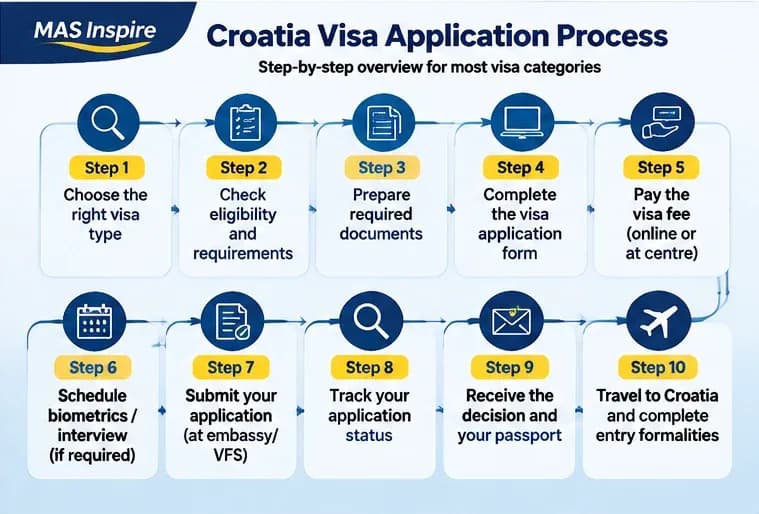
- Choose the correct route. Decide whether the trip is a short Schengen visit, study, employment, family move, research or digital-nomad stay.
- Check nationality and residence. Use the MVEP visa-requirements overview. Determine whether the application should be lodged in Vietnam or another country where you are legally resident.
- Confirm the competent authority. For a short-stay visa, apply to the Schengen state that is the main destination. For Croatia, use the competent Croatian mission or its authorised VFS centre.
- Prepare documents. Follow the official category checklist. Arrange certified translations and legalisation where required.
- Complete the correct form. C visa applications use the Schengen visa form/online process. Temporary stay and work applications use the relevant Croatian forms and procedures. Do not confuse the D visa form with the underlying residence application.
- Book and pay. Book through the mission/VFS process where applicable. Pay the official visa or administrative fee and any separately disclosed service charge.
- Attend in person. Provide the application, passport, photograph and fingerprints where required. An interview or further documents may be requested.
- Submit and retain proof. Keep the receipt and reference details. VFS accepts and forwards applications but does not decide them.
- Track through the designated channel. Use the VFS tracker for applications lodged there or follow the mission/MUP instructions for residence matters.
- After the decision. Check the visa sticker and permitted stay. For D visa holders, travel after the underlying approval and complete arrival/address-registration and biometric residence-card steps. Do not work until work authorisation is effective.
Not every category uses all ten steps. Some temporary-stay applications can be lodged at a police administration/station in Croatia if the law allows it; other applicants must apply through a mission before travel.
Visa Fees and Financial Requirements
| Item | Official amount found | Notes |
|---|---|---|
| Schengen A/C visa | EUR 90 | Adult standard fee; exemptions may apply. Note: the general Schengen reduced fee for children aged 6–12 is EUR 45, but MVEP's own fees page lists all children up to the age of 12 as exempt from A/C visa fees — confirm the applicable fee with the mission or VFS before paying; the Croatia-specific MVEP list controls for Croatian applications. |
| National D visa | EUR 93 | Separate from underlying residence approval and VFS service fee |
| Temporary stay application (police-station route) | EUR 46.45 | MUP published administrative fee; category and application channel matter |
| Biometric residence card | EUR 31.85 | Regular production |
| Biometric residence card (accelerated) | EUR 59.73 | Where available |
| Additional biometric-card administrative fee | EUR 9.29 | MUP published fee |
| Digital-nomad temporary stay via diplomatic mission | EUR 55.74 | MUP-published grant fee; plus D visa EUR 93 and card fee EUR 41.14 where applicable |
| Digital-nomad means threshold | EUR 3,622.50/month | Current MUP figure at verification date; threshold may change |
Do not add these fees mechanically: the correct combination depends on category, where the application is lodged and whether a D visa or residence card is needed. VFS service fees are additional and vary by centre. The visa fee is generally not refunded if refused.
Visa Processing Times
| Application | Published time |
|---|---|
| Schengen C visa | Normally 15 calendar days; may extend to 45 days |
| Temporary stay / work permit | No single universal published time verified; varies by case, authority, completeness and labour-market procedure |
| D visa | Depends on underlying approval and consular processing; check the responsible mission/VFS |
| Residence card | Check local police administration and current production process |
Apply early. A Schengen application may generally be lodged up to six months before travel and should normally be lodged at least 15 calendar days before travel. Local Croatia/VFS instructions should be checked for the current appointment process.
Applying from Pakistan or Vietnam: Pakistani Passport Holders
Pakistani ordinary passport holders are visa-required for Croatia. A Pakistani national who legally lives or works in Vietnam may use the Croatian VFS Vietnam channel for visa applications where the centre and mission accept the case. The official Croatian visa-centre list identifies a VFS centre in Hanoi, and VFS describes itself as the Embassy's contracted service provider. Its published address is Joint Visa Application Centre, 11th floor, VINAFOR Building, 127 Lo Duc, Hai Ba Trung, Hanoi; check the current appointment page before visiting because opening arrangements can change.
Vietnam is covered diplomatically by the Croatian Embassy in Malaysia, and Croatia also lists an honorary consulate in Hanoi. Note: MVEP's missions page directs consular matters for Vietnam to the consular office of the Embassy of Croatia in Indonesia (Jakarta), and the VFS Hanoi Croatia checklist states that the Embassy may call the applicant for an interview at the Embassy of the Republic of Croatia in Jakarta. Confirm the competent mission and interview location with VFS or the mission before applying. VFS Vietnam lists the Croatia application service. The actual competent mission and acceptance rules should be confirmed with VFS/mission before paying or travelling to an appointment.
A Vietnamese temporary residence card, work permit or other lawful status is useful evidence that the applicant is resident in Vietnam, but it does not guarantee that the Croatian mission will accept the application locally or approve the visa. Prepare proof of lawful Vietnamese residence, employment or business, address, income, bank activity and reasons for returning to Vietnam, in addition to the category-specific checklist. If Vietnam is only a temporary visit and Pakistan is the applicant's ordinary residence, the mission may direct the applicant to apply in Pakistan or the country of lawful residence.
The official Pakistan country overview confirms that Pakistani ordinary passport holders require a Croatian visa. The overview lists Croatian diplomatic/consular contacts for Pakistan, including Karachi honorary consular contact information and regional mission details; confirm the current competent application location directly with MVEP because the country overview is not itself a complete appointment instruction. Do not assume the listed honorary consulate accepts visa applications.
Student Visa Guide
First obtain admission to an eligible Croatian educational institution. Ask the institution to confirm whether your programme supports temporary stay for education and whether any work rights apply. Prepare the admission/enrolment evidence, passport, accommodation/address information, proof of funds, health insurance and first-time criminal-record certificate if applicable. Apply through the competent Croatian police administration or diplomatic mission according to your circumstances. If a visa-required student applies abroad and is granted temporary stay, a D visa may be required to enter Croatia. After arrival, complete address registration and biometric residence-card formalities as instructed.
Scholarships do not automatically replace immigration requirements. Ask the institution and scholarship provider for official evidence of tuition coverage, stipend and accommodation.
Work Visa and Job Opportunities
A Croatian employer normally has to support the work-permit process. The employer should confirm the job classification, salary and conditions, whether an HZZ labour-market test is needed, whether an HZZ opinion is required and which exceptions apply. The worker should verify the employer and contract independently. Never pay an unverified recruiter for a guaranteed permit. A permit may be restricted to a named employer and occupation; changing jobs can require a new or amended authorisation.
Applicants in regulated professions may need formal recognition of foreign qualifications. A job offer, business invitation or tourist visa is not permission to work. Digital-nomad status is not a substitute for a Croatian employment permit and does not authorise services to Croatian employers under that category.
Family Immigration and Permanent Residence
Family members should establish the sponsor's exact immigration status and relationship category before applying. The sponsor may need to meet a minimum lawful-residence period, depending on the permit basis. Provide civil certificates, proof of relationship, sponsor's permit, accommodation and means evidence as required. Documents issued abroad may need legalisation and Croatian translation.
Long-term residence normally requires five years of qualifying legal stay, subject to absence limits and exclusions. It is not a simple five-year clock for every permit type. Check whether student, seasonal, posted-worker, trainee or other special periods count and whether language/integration requirements apply. Permanent stay is distinct and available only to defined groups.
Common Application Mistakes
- Applying to Croatia when another Schengen country is the true main destination.
- Treating a Vietnamese residence permit as a Croatian visa exemption.
- Using a C visa for employment or a D visa as if it were the residence permit itself.
- Submitting incomplete, inconsistent or untranslated civil and financial documents.
- Providing unexplained deposits or funds that do not match the stated income.
- Relying on an unverified employer, recruiter or invitation letter.
- Ignoring the Schengen 90/180 calculation or the conditions printed on the visa.
- Missing address-registration or biometric-card steps after arrival.
- Assuming a student or digital-nomad permit automatically allows local Croatian employment.
Reasons for Visa Refusal
A visa or permit can be refused where the applicant fails to establish the purpose or conditions of travel, provides false or unreliable information, lacks adequate funds or insurance, has an invalid travel document, does not demonstrate a credible intention to leave after a short visit, has an entry ban/SIS alert, or raises public-policy, security or public-health concerns. Work and residence applications can also fail where the employer, job, qualifications, sponsorship or statutory criteria are not satisfied. Read the written decision and appeal instructions; deadlines and procedures depend on the decision type.
Frequently Asked Questions
1. Do Pakistani citizens need a visa for Croatia?
Yes. Pakistani ordinary passport holders require a visa for Croatia. Check the MVEP nationality overview and the competent application channel.
2. Can a Pakistani living in Vietnam apply for a Croatia visa in Vietnam?
The Croatia VFS centre in Hanoi accepts applications under the Embassy's service arrangement. Lawful residence in Vietnam is relevant, but does not guarantee local jurisdiction or approval. Confirm acceptance with VFS/mission first.
3. Does a Vietnam work permit make a Pakistani citizen visa-free for Croatia?
No. It does not change Pakistani nationality-based visa requirements.
4. How much is a Croatia tourist visa?
The standard Schengen C visa fee is EUR 90 for adults. VFS service fees may be additional and exemptions may apply.
5. How long can I stay in Croatia on a Schengen visa?
A short stay is limited to 90 days in any 180-day period across the Schengen Area, subject to the number of days authorised on the visa sticker.
6. What is a Croatia D visa?
It is a national long-stay entry visa for certain people already granted Croatian temporary stay or a stay-and-work permit who need a visa to enter. It is not the underlying residence or work approval.
7. Can I work in Croatia on a tourist visa?
No. A tourist or business C visa does not authorise ordinary employment.
8. Does Croatia have a digital nomad visa?
Croatia has temporary stay for digital nomads, for up to 18 months, for qualifying non-EU/EEA/Swiss remote workers working for a foreign company or their own foreign-registered company and not serving Croatian employers under this route.
9. What income is required for Croatia digital nomad status in 2026?
MUP currently publishes EUR 3,622.50 per month, or EUR 43,470 for 12 months / EUR 65,205 for 18 months. Verify again before applying because the threshold is indexed to wage data.
10. Does Croatia have a job-seeker visa?
No general job-seeker visa was identified in the official categories reviewed. A job offer and the appropriate work authorisation are normally required before employment.
11. Can international students work in Croatia?
Student work rights are subject to the applicable Croatian law and student status. Confirm the exact entitlement with MUP and the institution; do not assume unrestricted employment.
12. How long does a Croatia Schengen visa take?
The normal period is 15 calendar days and can be extended to 45 days where further examination or documents are needed.
13. Can my family join me in Croatia?
Potentially. Eligibility depends on the sponsor's status, relationship and any applicable waiting period or exception.
14. How long until I can get long-term residence?
The general rule is five years of qualifying uninterrupted legal residence, but some periods do not count and absence limits and other conditions apply.
15. Is visa approval guaranteed if I submit all documents?
No. The competent authority assesses each case and can request more evidence or refuse an application.
Official Immigration Websites
- Ministry of the Interior (MUP)
- Ministry of Foreign and European Affairs (MVEP)
- Croatian Government portal — visas
- Croatia VFS Vietnam
- European Commission — Schengen visa rules
- EU Immigration Portal — Croatia employed workers
Final Checklist and Conclusion
Before submitting, confirm your nationality-based visa requirement, the correct Schengen main-destination consulate, lawful residence in the country where you apply, the correct C/D/residence/work route, current fees, current means threshold, passport validity, insurance, accommodation, translations, legalisation, appointment, biometrics and post-arrival reporting. Keep copies of every submission and do not make non-refundable travel arrangements until you understand the risk and the authority's instructions.
Croatia offers several lawful pathways for visitors, students, employees, family members, researchers and qualifying digital nomads. The key is to match the purpose of travel to the correct permission and follow the official instructions current on the date of application.
Disclaimer: This article is for general educational information and is not legal advice. Immigration rules, consular jurisdiction, fees and procedures may change. The competent Croatian authority’s current instructions and the applicant’s individual decision notice take precedence. MAS Inspire is an independent educational publisher, not a Croatian government authority or visa-approval agency.