Cote d'Ivoire Visa Guide 2026: Types, Fees, Documents and How to Apply
By MAS Inspire | Editorial draft: 27 November 2026 (headline figures re-verified against official sources 28 November 2026)
Introduction
Cote d'Ivoire — Ivory Coast — is West Africa's economic hub, with Abidjan's lagoon skyline, the Basilica of Our Lady of Peace in Yamoussoukro, cocoa and coffee trade, and beaches at Grand-Bassam and Assinie. Most visitors need a visa, and the process is different from many other countries: there is no visa on arrival without pre-enrolment, and the only official e-visa channel is SNEDAI. This guide explains, in plain English, who needs a visa, which type to choose, what documents are truly required, what it costs, how long it takes, and how to apply — including a dedicated section for Pakistani passport holders living or working in Vietnam. It does not guarantee approval. Fees and rules can change; always check the official SNEDAI page before you pay.
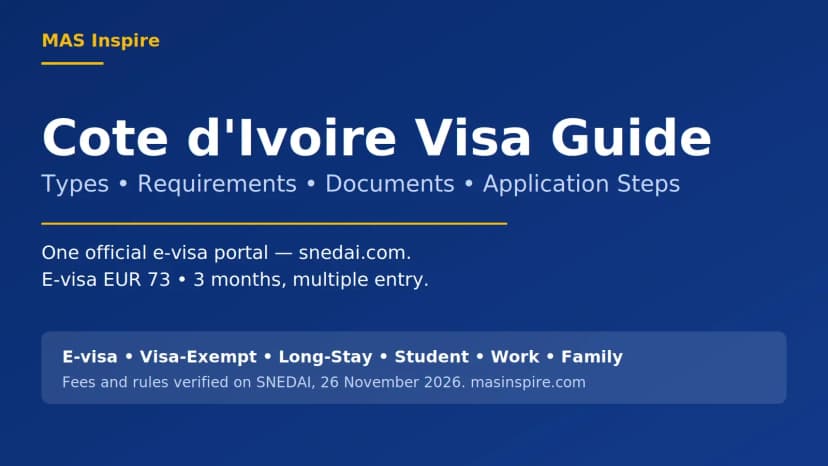
Key fact in 30 seconds: Most non-exempt travellers apply online at snedai.com, pay EUR 73, wait for a DST decision — SNEDAI is reported to reply within about 48 working hours, although the live SNEDAI e-visa page states no processing time (see Visa Processing Times) — then receive the visa at Abidjan airport after fingerprints and a photo. Bring your passport (6 months' validity), return flight reservation, invitation or accommodation certificate, payment receipt, approved pre-enrolment document, and yellow fever certificate.
Table of contents
- Introduction
- Why People Visit, Study, and Work in Cote d'Ivoire
- Types of Cote d'Ivoire Visas
- Visa Comparison Table
- Eligibility Requirements
- Complete Document Checklists
- How to Apply: Step-by-Step
- Visa Fees and Financial Requirements
- Visa Processing Times
- Applying from Pakistan or Vietnam
- Student Visa Guide
- Work Visa and Job Opportunities
- Family Immigration and Permanent Residence
- Common Application Mistakes
- Reasons for Visa Refusal
- Frequently Asked Questions
- Official Immigration Websites
- Final Checklist and Conclusion
Why People Visit, Study, and Work in Cote d'Ivoire
People visit for tourism — Abidjan, Yamoussoukro, Grand-Bassam (a UNESCO-listed historic town), Tai National Park and the beaches — and for business in cocoa, coffee, cashew, mining, energy, telecoms, construction and port logistics. Abidjan is a regional business centre for French-speaking West Africa. Students come for French-language study and for universities in Abidjan, including Universite Felix Houphouet-Boigny. Workers come for jobs with Ivorian companies, international organisations and regional firms, usually only with an employer sponsor. Family members join relatives who already live and work in the country. French is the official language, and the currency is the West African CFA franc (XOF). That matters in practice: most official forms and embassy communication are in French, so keep a French version of your invitation letter and hotel booking where possible, and allow extra time for translation of supporting documents.

Types of Cote d'Ivoire Visas
Cote d'Ivoire does not publish a long menu of named visa categories on SNEDAI in the way some countries do. The system is simpler, and this guide does not invent categories. The e-visa is the main short-stay route, and long stays are handled through a visa plus an in-country residence title. Read the table first, then the detail below it.
1. E-visa (short stay — tourism, business visits, family visits)
Who can apply: Most non-exempt nationals, including Pakistani and Vietnamese passport holders, who are travelling for tourism, a business meeting, a conference, or a family visit. Purpose and permitted activities: Short visits only. Tourism, visiting friends or family, attending meetings or conferences. It is not a work permit. Validity: 3 months, multiple entries, from the date the pre-enrolment is approved. Where it works: The e-visa route is for arrival by air at Abidjan Félix-Houphouët-Boigny International Airport, where the visa is issued after biometric enrolment. It cannot be used for entry at a land border or seaport — for those, obtain a visa from an Ivorian embassy in advance. Duration of stay: The e-visa itself is a 3-month multiple-entry visa; the permitted stay on each entry is set by the border authorities — do not confuse the visa's 3-month validity with a guaranteed 3-month stay. Work rights: No. You may not take a job in Cote d'Ivoire on an e-visa. Sponsorship: An invitation letter or a certificate of accommodation is mandatory at pre-enrolment. Fee: EUR 73, including bank charges (SNEDAI). Source: https://snedai.com/e-visa/
2. Visa-exempt entry
Who can apply: Nobody needs to apply. Nationals of the ECOWAS countries listed in Deliverable 1, plus the Central African Republic, Seychelles, Morocco, Mauritania, Philippines, Republic of Congo, Rwanda, Singapore, Chad and Tunisia, are exempt from a visa under SNEDAI's list. Note: Pakistan, Vietnam, India, Bangladesh, the UK, the EU, the US, Canada and Australia are not on that list and need an e-visa. Check the live SNEDAI list before travel, because exemption lists change. Secondary sources disagree on the exact count of exempt nationalities (21–24); the live SNEDAI list controls.
3. Long-stay visa (via an embassy, where applicable)
Who can apply: People who intend to stay longer than a short visit — for study, work, family reunion or other long-term reasons. How it works: There is no separate long-stay e-visa form published on SNEDAI. Long-stay applicants should contact the nearest Ivorian embassy or consulate before travel to ask whether a long-stay visa is issued there, what form to use, and what fee applies. Fee and processing time: Not officially published on SNEDAI; ask the embassy and get the answer in writing. Do not travel on a short-stay e-visa and assume you can simply extend it into a long stay. After arrival: Apply for a residence title in Cote d'Ivoire (see Family Immigration and Permanent Residence).
4. Student route (no standalone student e-visa published)
There is no separate student e-visa category published on SNEDAI. Students normally enter on the e-visa or a long-stay visa and then regularise their stay in-country with a residence title, with proof of enrolment from the institution. See the Student Visa Guide below. Fees and processing times for the student residence step were not officially published.
5. Work route (employer-sponsored; no standalone work e-visa published)
There is no separate work e-visa category published on SNEDAI. Work requires an employer sponsor in Cote d'Ivoire, a contract, and an in-country work/residence authorisation. See the Work Visa section below. Do not accept a job offer that tells you to enter as a tourist and start work — that is not a legal work route.
6. Transit
SNEDAI does not publish a separate transit-visa category or fee. If you are only changing planes in Abidjan and staying airside, check with your airline and the nearest Ivorian embassy whether a visa is required for your nationality and routing. Do not assume transit is visa-free.
7. Categories that do not exist as published standalone visas
- Digital nomad visa: Not officially published. Do not apply as a digital nomad; apply for the purpose that matches your real trip (tourism or business visit) and do not work for an Ivorian employer.
- Job-seeker visa: Not officially published. There is no published visa that allows you to enter to look for a job. Find the job and the sponsor first.
- Entrepreneur / startup / investor visa: Not officially published as a named category on SNEDAI. Business visitors use the e-visa; anyone planning to invest or start a company should contact the nearest Ivorian embassy and, in-country, the investment promotion authorities, and should not rely on a tourist visa for that purpose.
- Exchange, internship and training: No separate published category. Use the e-visa for a short visit, or the long-stay route through an embassy, and carry the invitation from the host organisation.
- Researcher / academic: No separate published category. Same route as above, with a host-institution invitation.
8. Humanitarian protection (concise, informational)
Cote d'Ivoire is a party to international refugee instruments, and asylum and protection claims are handled through the national authorities and UNHCR, not through the e-visa system. This guide does not give legal advice on asylum. Anyone who needs protection should contact UNHCR or the relevant Ivorian authority directly, and should not use a tourist e-visa as a substitute for a protection claim.
Visa Comparison Table
| Visa / route | Purpose | Fee (official) | Validity | Work rights | Sponsor / invitation |
|---|---|---|---|---|---|
| E-visa (short stay) | Tourism, business visit, family visit | EUR 73 incl. bank charges | 3 months, multiple entry | No | Invitation letter or accommodation certificate — mandatory |
| Visa-exempt entry | Tourism / business (eligible nationalities only) | EUR 0 | Varies — check SNEDAI list | No (unless separately authorised) | Not applicable |
| Long-stay visa (embassy) | Study, work, family, other long stay | Not officially published — ask embassy | Varies | Only with separate authorisation | Depends on purpose — employer or institution |
| Student route | Study | Not officially published | Varies; residence title in-country | No, unless authorised | Institution enrolment letter |
| Work route | Employment | Not officially published | Varies; residence title in-country | Yes, with employer sponsor only | Employer contract / sponsor |
| Digital nomad | — | Not applicable | — | — | No standalone category published |
| Job seeker | — | Not applicable | — | — | No standalone category published |
| Transit | Changing planes | Not officially published | Varies | No | Check with airline / embassy |
Eligibility Requirements
- Passport: Valid for at least 6 months, with at least one blank page (U.S. Department of State). SNEDAI requires the identity page(s) to be uploaded.
- Nationality: Check the SNEDAI exempt list first. If your nationality is not exempt, you need an e-visa. Pakistan and Vietnam are not exempt.
- Purpose: Your stated purpose must match your documents — a tourist needs accommodation or an invitation; a business visitor needs a business invitation; a student needs enrolment proof.
- Return travel: A return flight reservation is mandatory at pre-enrolment.
- Accommodation: An invitation letter or a certificate of accommodation is mandatory. A hotel booking alone is not automatically the same as a certificate of accommodation — follow the SNEDAI form's wording for your case.
- Health: Yellow fever vaccination is required, with the international certificate (WHO Yellow Card) shown at Abidjan airport. Check current health advice with your doctor and the U.S. CDC / WHO before travel.
- Funds: SNEDAI does not publish a minimum bank balance for the e-visa. This guide does not invent one. Carry proof you can fund your stay and your return, and be ready to show it if asked at the border.
- Children: Children under 12 are reported to be exempt from fingerprints but must still be present at the airport, and must have their own passport and pre-enrolment. SNEDAI's live e-visa page text does not state this exemption — confirm it with SNEDAI or the DST before travelling with a child under 12.
- Criminal record / previous refusals: SNEDAI does not publish a list of refusal grounds. Give true information in every field; a false statement is a common reason for refusal and for later bans.
Complete Document Checklists
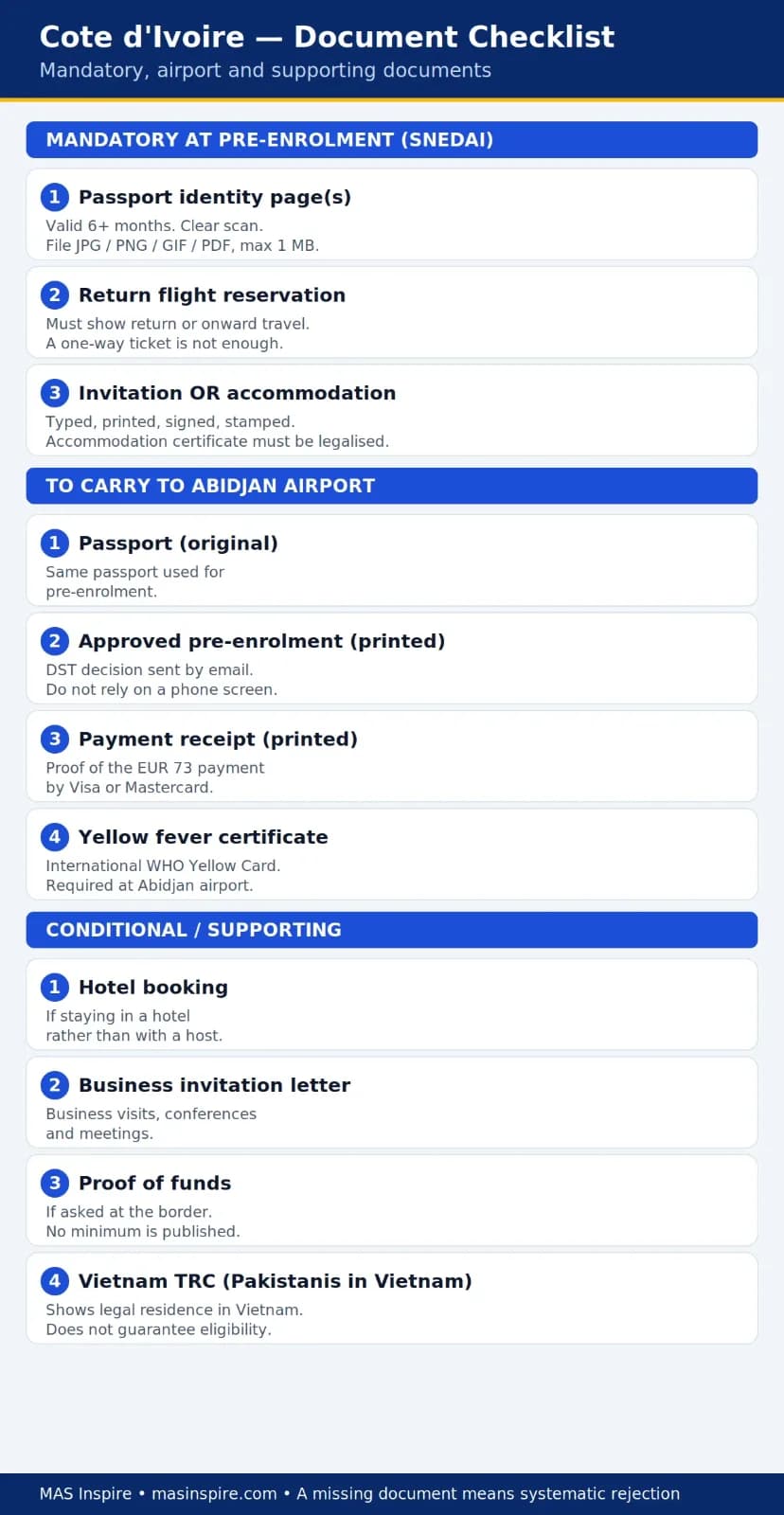
SNEDAI clearly specifies only three documents for e-visa pre-enrolment. Do not claim a longer fixed list is mandatory. The tables below separate mandatory from conditional and recommended evidence. Each uploaded file must be JPG, PNG, GIF or PDF and 1 MB or less (SNEDAI).
E-visa — mandatory (SNEDAI)
| Document | Notes |
|---|---|
| Passport identity page(s) | Passport valid at least 6 months; scan must be clear and legible |
| Return flight reservation | Must show return/onward travel; a one-way ticket is not enough |
| Letter of invitation OR certificate of accommodation | Must be typed, printed, signed and stamped; the accommodation certificate must be legalised, according to SNEDAI |
E-visa — to carry to Abidjan airport (mandatory at arrival)
| Document | Notes |
|---|---|
| Passport (original) | Same passport used for pre-enrolment |
| Approved pre-enrolment document (printed) | DST decision sent by email; print it — do not rely on a phone screen |
| Payment receipt (printed) | Proof of the EUR 73 payment |
| International yellow fever vaccination certificate | WHO Yellow Card; required at the airport |
Supporting / conditional documents (recommended, not listed as mandatory by SNEDAI)
| Document | When it helps |
|---|---|
| Hotel booking confirmation | If staying in a hotel rather than with a host |
| Business invitation letter | Business visits, conferences, meetings |
| Proof of funds / bank statement | If asked at the border; no minimum is published |
| Travel insurance | Recommended; not listed as mandatory by SNEDAI |
| Employment letter or leave approval | To show ties to home / residence country |
| Vietnam residence permit / TRC (for Pakistanis in Vietnam) | Shows legal residence in Vietnam; see next section — it does not guarantee eligibility |
| Birth / marriage certificates | Family visits; only if relevant |
Long-stay / student / work — conditional checklist (ask the embassy; not a SNEDAI list)
| Document | Notes |
|---|---|
| Passport and visa photocopies | Mandatory for a first provisional residence title, per servicepublic.gouv.ci |
| Admission / enrolment letter | Students |
| Employment contract and sponsor letter | Workers |
| Proof of accommodation in Cote d'Ivoire | Long-stay applicants |
| Academic transcripts and certificates | Students; carry originals and translations |
| Police clearance / medical certificate | Only if the embassy or DST asks for it — not confirmed as mandatory |
How to Apply: Step-by-Step
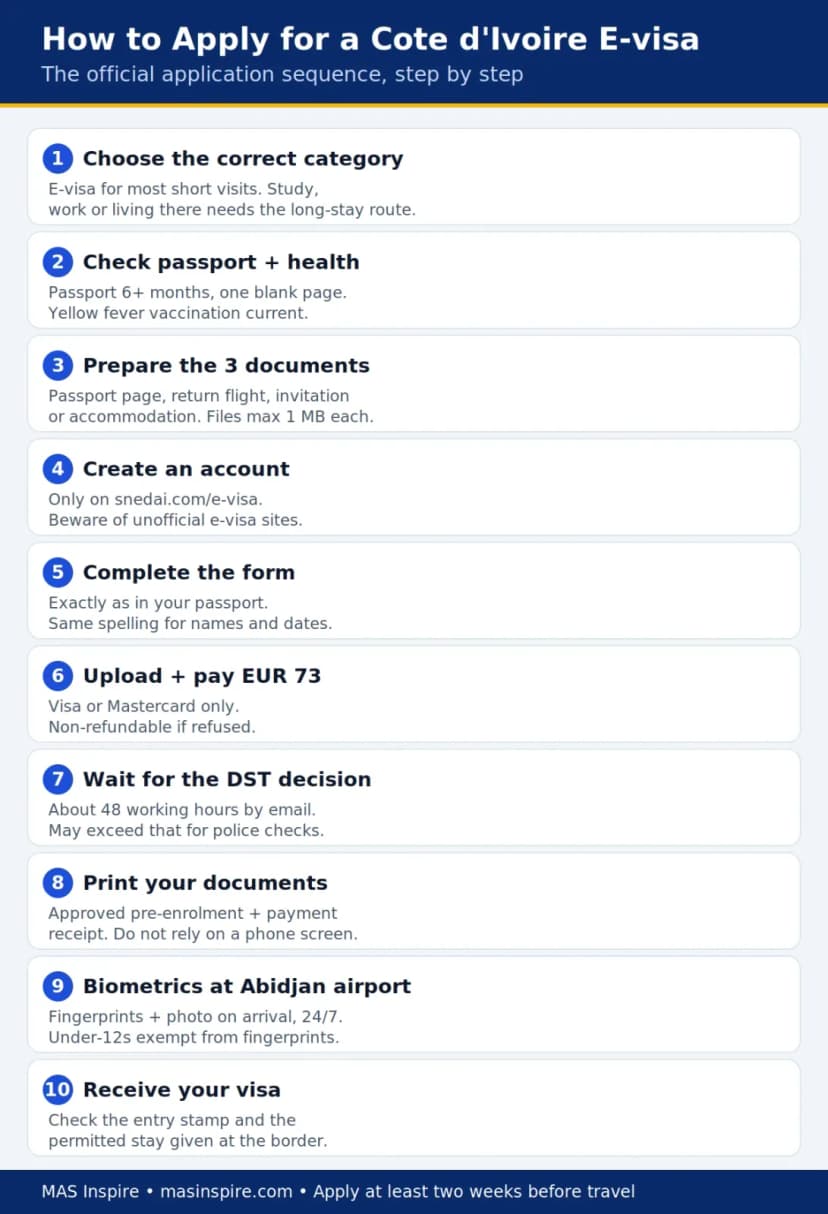
Step 1 — Choose the correct visa category. Most short visits use the e-visa. If you plan to study, work or live in Cote d'Ivoire, do not assume the e-visa is enough — contact the nearest Ivorian embassy first.
Step 2 — Check nationality, residence and eligibility. Check the SNEDAI exempt list. Confirm your passport has 6 months' validity and a blank page. Confirm your yellow fever vaccination is current.
Step 3 — Prepare mandatory and supporting documents. Scan your passport identity page clearly. Get your return flight reservation. Get your invitation letter or accommodation certificate — typed, printed, signed and stamped, and legalised if it is an accommodation certificate.
Step 4 — Create an account on the official application website. Go to https://snedai.com/e-visa/ only. SNEDAI says to check your email; if you do not receive the verification code, wait a few minutes and check spam. A fallback code was previously reported on the SNEDAI page, but it was not visible on the live page when checked on 28 November 2026 — follow whatever the live page shows, not this guide.
Step 5 — Complete the correct visa application form. Fill in every field exactly as in your passport. Use the same spelling for names, dates and passport number. Save the email confirmation of your submission.
Step 6 — Upload documents and pay official fees. Upload the three mandatory documents and pay EUR 73 by Visa or Mastercard. SNEDAI says the fee includes bank charges, and no fee is refunded if the visa is refused.
Step 7 — Biometrics or interview, if required. There is no biometrics appointment before travel for the e-visa. Biometrics (fingerprints and photo) are taken at Abidjan airport on arrival, 24 hours a day, 7 days a week. Children under 12 are exempt from fingerprints but must be present.
Step 8 — Submit the application and wait for the DST decision. The DST decision is sent to you by email. SNEDAI is reported to reply within about 48 working hours, but the live SNEDAI e-visa page states no processing time, and police verification can extend the wait — so treat 48 working hours as indicative only. Do not book non-refundable travel until you have the approval.
Step 9 — Check application status using the official tracking method. Use the SNEDAI e-visa page and the email address you used to apply. SNEDAI does not publish a separate public tracking portal in the pages checked; if the 48-hour window passes, contact SNEDAI through the contact details on snedai.com.
Step 10 — Understand the decision, passport return, travel and entry requirements. Print the approved pre-enrolment document and the payment receipt. At Abidjan airport, present them with your passport and yellow fever certificate, complete biometric enrolment, and receive your visa. Check the entry stamp and the permitted stay given at the border, and keep your documents for the whole trip.
Visa Fees and Financial Requirements
| Item | Official fee | Notes |
|---|---|---|
| E-visa (short stay) | EUR 73, including bank charges | SNEDAI; Visa or Mastercard only; non-refundable if refused |
| Visa-exempt entry | EUR 0 | Eligible nationalities only |
| Consular visa (embassy, where applicable) | EUR 50 reported, excluding bank charges | Secondary sources quoting official material; not confirmed on SNEDAI's e-visa page — confirm with the embassy before paying |
| Long-stay visa (embassy) | Not officially published | Ask the nearest embassy before travel |
| Student residence title (in-country) | Not officially published | ONECI / DST; ask in Abidjan |
| Work / residence authorisation (in-country) | Not officially published | Employer sponsor; ask DST / ONECI |
| Transit visa | Not officially published | Check with airline / embassy |
There is no published minimum bank balance for the e-visa, and this guide does not invent one. Budget for the EUR 73 fee, flights, accommodation, travel insurance, yellow fever vaccination, and any translation or legalisation costs. Fees are charged in euros for the e-visa; your bank may add its own exchange fee. Keep the payment receipt — you must show it at Abidjan airport.
Visa Processing Times
| Step | Published time |
|---|---|
| E-visa DST decision | About 48 working hours (Mon–Fri) — indicative only; the live SNEDAI e-visa page states no processing time, and police verification can extend the wait |
| Approved pre-enrolment validity | 3 months from approval |
| E-visa validity | 3 months, multiple entry |
| Biometrics at Abidjan airport | On arrival; airport visa service is 24/7 |
| Long-stay / residence title | Not officially published |
| Resident card (ONECI, in-country) | 15 working days for a first application; 7 working days for renewals (ONECI) |
A note on the 48-working-hour figure: The live SNEDAI e-visa page (checked 28 November 2026) publishes the EUR 73 fee and the three mandatory documents but states no processing time. The 48-working-hour figure is the indicative time SNEDAI is widely reported to give, including by French visa agencies quoting SNEDAI, and it can be exceeded for police verification.
Apply at least two weeks before travel, and longer if you need an embassy long-stay visa. Do not book non-refundable flights or hotels until the DST approval arrives.
Applying from Pakistan or Vietnam
This section is for Pakistani passport holders who legally live or work in Vietnam — and, by extension, for Pakistanis applying from Pakistan and Vietnamese passport holders.
Do you need a visa? Yes. Pakistan and Vietnam are not visa-exempt for Cote d'Ivoire. Both need an e-visa for a short stay.
Can you apply from Vietnam? Yes, for the e-visa. The e-visa is applied for online at snedai.com, wherever you are. You do not need to visit an Ivorian embassy to get a short-stay e-visa. That is the practical advantage of the pre-enrolment system.
Does a Vietnam residence permit guarantee you can apply locally? No. A Vietnam Temporary Residence Card (TRC) or work permit proves you legally live or work in Vietnam, and you should carry it and a copy of it, but SNEDAI does not state that a Vietnam residence permit gives a Pakistani applicant any special eligibility, and it does not replace the three mandatory e-visa documents. Do not assume it guarantees approval.
Is there an Ivorian embassy in Vietnam? No. There is no Ivorian embassy or consulate in Vietnam. The nearest mission is the Consulate General in Guangzhou, China (+86 20 3836 8416), then the Embassy in Beijing (+86 10 6532 1223). You would only need those missions for a long-stay visa or for a question the e-visa system cannot answer — and you should email or call them first, because travelling to Guangzhou for a visa that can be done online is usually unnecessary.
Applying from Pakistan: There is also no Ivorian embassy in Pakistan. Pakistanis in Pakistan use the same online e-visa route. For a long-stay visa, contact the nearest Ivorian embassy in the region and ask in writing what is required. Pakistan's own embassy in Abidjan (https://mofa.gov.pk/abidjan) can help Pakistanis who are already in Cote d'Ivoire, for example with consular help, but it does not issue Ivorian visas.
Extra documents to carry (in addition to the three mandatory e-visa documents): your Vietnam TRC or work permit and a copy; your Vietnam employer's letter or your Vietnam visa/TRC stamp showing legal residence; proof of your return to Vietnam (return flight to Vietnam, TRC validity); and, for business visits, the Ivorian host's invitation. If any document is in Urdu or Vietnamese, carry an English or French translation.
Differences between applying from Pakistan and from Vietnam: The e-visa fee, documents and processing time are the same. The difference is practical: from Vietnam you have a legal residence to return to, which can help show ties, and you may need to show your TRC at check-in and at the border. From Pakistan you show ties to Pakistan instead. In both cases, the invitation or accommodation certificate remains mandatory.
| Question | Short answer |
|---|---|
| Do Pakistanis and Vietnamese need a visa? | Yes — neither nationality is visa-exempt. |
| Where do you apply? | Online at snedai.com/e-visa, from anywhere. |
| Is there an Ivorian embassy in Vietnam? | No — nearest is the Consulate General in Guangzhou (+86 20 3836 8416). |
| Is there an Ivorian embassy in Pakistan? | No — use the same online e-visa route. |
| Does a Vietnam TRC guarantee approval? | No — it proves legal residence only. |
| E-visa fee and validity | EUR 73, 3 months, multiple entry. |
Student Visa Guide
There is no standalone student e-visa on SNEDAI. Plan in this order: (1) get admission from an Ivorian institution and an enrolment letter; (2) ask the nearest Ivorian embassy whether a long-stay student visa is issued there and what it costs; (3) if you enter on an e-visa for a short stay, understand that it does not by itself give you student residence — you must regularise your stay in-country with a residence title, with your enrolment letter, passport and visa copies, and proof of accommodation. Fees, processing times and any work rights for students were not officially published. Do not work in Cote d'Ivoire on a student stay unless the DST / ONECI authorises it. Study in French: most courses are in French, so check the language requirement with the institution before you apply.
Work Visa and Job Opportunities
Work in Cote d'Ivoire is employer-sponsored. The usual order is: find a job, sign a contract, let the employer support your work and residence authorisation, and only then travel. There is no published work e-visa you can buy online, and no published job-seeker visa. Sectors that hire foreign staff include cocoa and agribusiness, mining, energy, telecoms, banking, construction, logistics and international organisations, mainly in Abidjan. Be very careful with job offers that ask you to pay a fee, enter as a tourist and start work, or send documents to an unofficial agent. Check the employer, the contract and the embassy route before you pay anything or travel.
Family Immigration and Permanent Residence
Family members of people living in Cote d'Ivoire normally use the long-stay route through an embassy, with proof of the relationship (marriage or birth certificates) and proof of the sponsor's legal residence. After arrival, apply for a provisional residence title (titre provisoire de sejour) and then a resident card (carte de resident) through the DST and ONECI in Abidjan (https://carte-resident.ci). The public-service portal lists a first application for a provisional residence title and requires a photocopy of the passport and visa. There is no published permanent-residence-by-years rule on the pages checked, and no published fee for family residence titles. ONECI does publish a processing time for resident cards: 15 working days for a first application and 7 working days for renewals. Ask the DST / ONECI in Abidjan, in writing, before you plan a move.
Common Application Mistakes
- Using a non-official e-visa website instead of snedai.com.
- Uploading a blurry passport scan, or a passport with less than 6 months' validity.
- Missing the invitation letter or accommodation certificate — SNEDAI says a missing document leads to systematic rejection.
- Booking only a one-way flight.
- Using a different spelling of your name from your passport.
- Not printing the approved pre-enrolment document and payment receipt.
- Forgetting the yellow fever certificate.
- Applying too late, and booking non-refundable travel before the DST decision arrives.
- Stating a different purpose from the one your documents support.
- Giving false information or using a false document.
Reasons for Visa Refusal
SNEDAI does not publish a list of refusal reasons. The reasons below are the ones that follow from its published rules and from normal border practice, and they are the ones to avoid: missing or unclear documents; a passport that is expired or too short in validity; no return flight; no invitation or accommodation certificate; information that does not match the passport; a purpose that does not match the documents; and a previous false statement or immigration problem. If your e-visa is refused, SNEDAI says the fee is not refunded. Re-check the live SNEDAI page, correct the problem, and apply again only with true, complete documents — or ask the nearest Ivorian embassy for advice before re-applying.
Frequently Asked Questions
1. Do I need a visa for Cote d'Ivoire?
Most travellers do. Only nationals on SNEDAI's visa-exempt list do not. Pakistan and Vietnam are not exempt.
2. Where do I apply for the e-visa?
Only at https://snedai.com/e-visa/. SNEDAI says it is the only site officially recognised by the State of Cote d'Ivoire.
3. How much is the e-visa?
EUR 73, including bank charges, paid by Visa or Mastercard. It is non-refundable if refused.
4. How long does the e-visa take?
SNEDAI is reported to reply within about 48 working hours, but the live SNEDAI e-visa page states no processing time and police verification can extend the wait. Treat 48 working hours as indicative only and apply at least two weeks before travel.
5. How long is the e-visa valid?
3 months, multiple entry, from approval of the pre-enrolment. The permitted stay on each entry is set at the border.
6. What documents do I need?
Only three at pre-enrolment: passport identity page(s), return flight reservation, and an invitation letter or certificate of accommodation.
7. Do I need yellow fever vaccination?
Yes. The international yellow fever certificate is required at Abidjan airport.
8. Are fingerprints taken?
Yes, at Abidjan airport, with a photo. Children under 12 are reported to be exempt from fingerprints but must be present (confirm with SNEDAI — the exemption is not stated on the live e-visa page).
9. Can I work on an e-visa?
No. Work needs an employer sponsor and a separate authorisation.
10. Is there a digital nomad visa?
No standalone digital nomad visa was officially published. Do not work for an Ivorian employer on a tourist e-visa.
11. I am a Pakistani living in Vietnam. Can I apply from Vietnam?
Yes, online at snedai.com. There is no Ivorian embassy in Vietnam. Your Vietnam TRC proves legal residence but does not guarantee eligibility or approval.
12. Is there an Ivorian embassy in Pakistan?
No. Pakistanis use the same online e-visa route. Pakistan's embassy in Abidjan helps Pakistanis already in Cote d'Ivoire.
13. Can I extend my e-visa in Cote d'Ivoire?
SNEDAI does not publish an extension procedure. If you need a longer stay, contact the DST / ONECI in Abidjan before your visa expires, and do not overstay.
14. What if my e-visa is refused?
The fee is not refunded. Check the SNEDAI rules, correct the problem, and apply again with true, complete documents, or ask the nearest Ivorian embassy.
15. Can I transit through Abidjan airport without a visa?
SNEDAI does not publish a separate transit-visa category or fee. If you are only changing planes in Abidjan and staying airside, check with your airline and the nearest Ivorian embassy whether a visa is required for your nationality and routing. Do not assume transit is visa-free.
Official Immigration Websites
| Official website | Address |
|---|---|
| SNEDAI — E-visa (official application portal) | https://snedai.com/e-visa/ |
| ONECI — Resident Card Application Centre, Abidjan | https://carte-resident.ci/English/index.html |
| Service Public de Cote d'Ivoire — residence titles | https://servicepublic.gouv.ci |
| U.S. Department of State — Cote d'Ivoire travel information | https://travel.state.gov/en/international-travel/travel-advisories/cote-d-ivoire.html |
| Ministry of Foreign Affairs, Pakistan — Embassy in Abidjan | https://mofa.gov.pk/abidjan |
| France Diplomatie — Cote d'Ivoire | https://www.diplomatie.gouv.fr/en/information-by-country/cote-d-ivoire/political-and-economic-relations |
Final Checklist and Conclusion
Before you apply:
- ☐ Passport valid 6+ months with a blank page.
- ☐ Return flight reservation.
- ☐ Invitation letter or accommodation certificate (typed, signed, stamped, legalised if required).
- ☐ Yellow fever certificate.
- ☐ Visa or Mastercard for EUR 73.
After approval:
- ☐ Print the approved pre-enrolment document and payment receipt.
- ☐ Check the 3-month validity.
- ☐ Carry all documents to Abidjan airport.
- ☐ Complete biometrics on arrival.
- ☐ Check your entry stamp and permitted stay.
Cote d'Ivoire's system is simple once you understand it: one official e-visa portal, three mandatory documents, EUR 73, about 48 working hours, and a visa issued at Abidjan airport. The hard part is not inventing a category that does not exist — there is no published digital-nomad, job-seeker or startup visa, and long stays, study and work all run through an embassy and then a residence title in Abidjan. Use only snedai.com, give true information, apply early, and re-check the official page before you travel.
Disclaimer: This article is educational information only, not legal or immigration advice and not a guarantee of visa approval. Immigration rules, fees and procedures change. Verify every requirement on the official SNEDAI page and with the nearest Ivorian embassy before applying or travelling. MAS Inspire is not an official immigration authority.