Cook Islands Visa Guide 2026: Types, Requirements, Fees and How to Apply
By MAS Inspire | Editorial draft: 27 November 2026 (fees and rules re-verified 28 November 2026)
The Cook Islands is a South Pacific destination known for its lagoons, volcanic landscapes and close-knit island communities. Whether you are planning a holiday, considering a job, enrolling in a course, joining family or exploring an investment, it is important to understand the country's immigration framework before you travel.
One point causes frequent confusion: the Cook Islands distinguishes between a visa and a permit. A visa allows a person without continuing rights to travel to and enter the country. A permit authorises that person to stay for the approved period and purpose. Some short-term visitors can receive their visitor permit at the border without applying for a visa in advance, while people coming to work, study or reside normally need the appropriate visa-and-permit approval.
This guide summarises the official information available on 26 November 2026. It is an educational resource, not legal advice or a guarantee of entry or approval.
Table of contents
- Why people visit, study and work in the Cook Islands
- Types of Cook Islands visas and permits
- Visa comparison table
- Eligibility requirements
- Complete document checklists
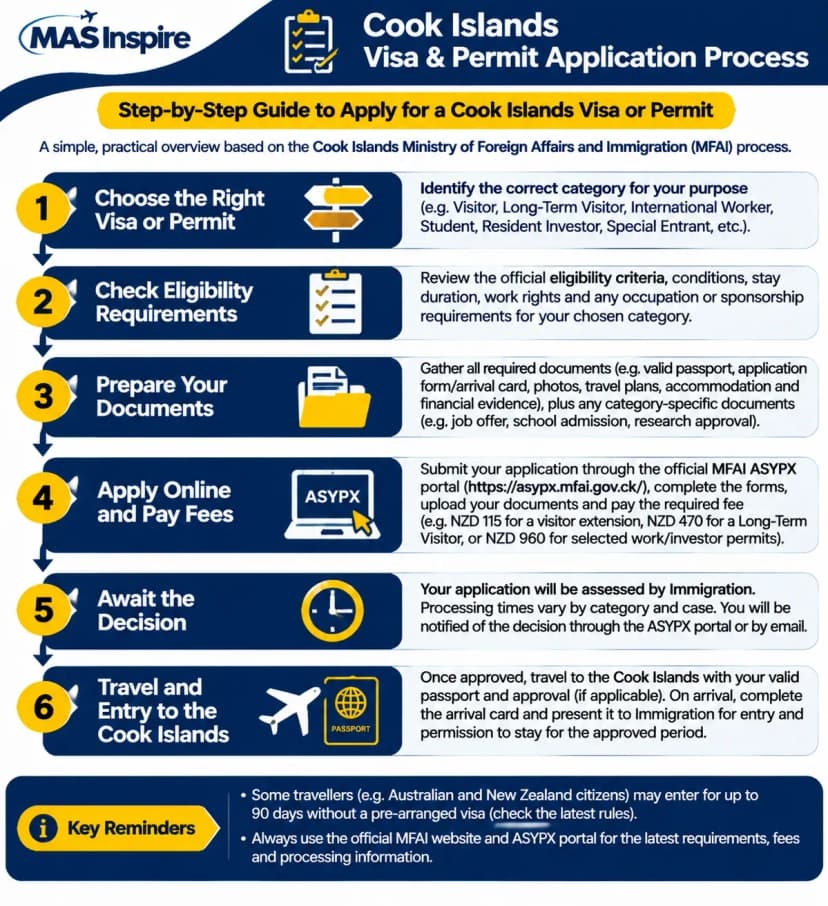
- How to apply: step-by-step
- Visa fees and financial requirements
- Visa processing times
- Applying from Pakistan or Vietnam: guidance for Pakistani passport holders
- Student visa guide
- Work visa and job opportunities
- Family immigration and permanent residence
- Common application mistakes
- Reasons an application may be refused or delayed
- Frequently asked questions
- Official immigration websites
- Final checklist and conclusion
Why people visit, study and work in the Cook Islands
Visitors come for holidays, sightseeing, family visits, sporting activities and short business exploration. Longer-term applicants may be interested in employment, government-supported programmes, formal study, research, internships, family life or investment. The immigration category must match the real purpose of the stay. A visitor permit is not a substitute for permission to work or undertake a course of study.

Types of Cook Islands visas and permits
The official MFAI list groups the available pathways into resident, work and investor, international child/student/research/intern, visitor and special categories. The terms below describe the categories published by MFAI; they are not a claim that every category is available to every applicant.
1. International Visitor Visa and Permit
For most passport holders, a visit of less than 31 days can be considered for an International Visitor Permit on arrival. The traveller does not normally need to apply for a visitor visa before departure, but must satisfy the border officer that the visit is genuine and that the entry requirements are met. Conditions include identity, character and health requirements, onward travel, sufficient funds, and no intention to work for gain or reward or study during the visit.
The initial permit on arrival has no fee. An eligible extension for a further 31 days costs NZD 115. The published criteria limit continuous visitor stays and restrict repeated back-to-back visitor permits; check the current criteria before planning a long stay.
2. New Zealand or Australian Visitor Visa and Permit
New Zealand and Australian citizens travelling on the relevant passport may be granted a visitor permit on arrival for up to 90 days, provided they meet the visitor conditions. The October 2026 amendments extended the 90-day arrangement to Australian citizens. The arrival permit is free; an eligible further three-month extension costs NZD 235.
3. Long-Term Visitor Visa and Permit
This route is for a genuine visitor who wants to stay longer than the ordinary arrival period but will not work for gain or reward or study. Applicants must meet identity, character, health, onward-travel and sufficient-funds requirements and hold health insurance for the permit period. The fee is NZD 470. MFAI states that non-New Zealand and non-Australian nationals cannot extend visitor status beyond eight months at one time; the corresponding limit for New Zealand and Australian visitors is 12 months. Stays over six months require evidence of good character and acceptable health.
4. International Worker Visa and Permit
This category is for a foreign national offered employment in the Cook Islands. The applicant needs a written offer that meets employment-law minimum terms. The prospective employer must show that the vacancy was publicly advertised and that a suitable Cook Islander or permanent resident could not be recruited on the same terms. The employer must also agree to enrol the worker in, and allow time to attend, an approved values or language programme unless already completed.
Applicants must meet health and character requirements, show sufficient funds or have a sponsor, provide onward travel arrangements or a bond, demonstrate English proficiency, and submit a CV or equivalent record of qualifications and experience. International Worker visas and permits are listed at NZD 320 for one year, NZD 640 for two years, or NZD 960 for three years. The October 2026 amendments confirm the one-, two- and three-year options. A permit is conditional: it does not give unrestricted permission to work for any employer. A change of employer requires a new application and new employment agreement.
5. Government Worker Visa and Permit
This route applies to an applicant with an employment offer or contract from a Cook Islands Government agency, or a role/volunteer programme supported by a government agency under the published criteria. Evidence of sufficient funds or sponsorship and the required written agreement are needed. The fee is NZD 320 for one year, NZD 640 for two years, or NZD 960 for three years. A volunteer receiving a stipend, accommodation or another benefit should not assume that ordinary visitor volunteering rules apply; the correct work-related approval is required.
6. Specialist Worker Visa and Permit
Specialist workers provide technical expertise or specialist consulting under a contract with a government agency, a Cook Islands registered business or incorporated society, or an overseas business approved as a foreign enterprise by the Business Trade and Investment Board (BTIB). General identity, health, character, funds and onward-travel requirements apply. The listed fee is NZD 260. The criteria include information-sharing with BTIB as part of the decision process.
7. Resident Investor Visa and Permit
The investor route is for applicants who meet the immigration requirements and have or obtain BTIB approval to register as a foreign entity, while complying with relevant investment laws and codes. English proficiency, health, character and sufficient funds or sponsorship are also relevant. The listed fee is NZD 960. This is not a generic passive-investment or automatic citizenship route; applicants should obtain BTIB and MFAI guidance on the proposed investment before committing funds.
8. International Adult Student Visa and Permit
An adult student needs a written offer from a Cook Islands Government school or registered private school. The offer must identify the institution, course, start date, minimum course duration, study hours if part-time, and vacation dates. Applicants must show English proficiency and sufficient funds or sponsorship, and provide onward travel evidence or a bond. Student status is for genuine study. Work for gain or reward for more than 20 hours per week requires permission from the principal immigration officer. The listed fee is NZD 470.
9. International Child Visa and Permit
This route covers a dependent child whose parent or guardian has an approved Government Worker or International Worker visa and permit. The parent/guardian must demonstrate sufficient funds or sponsorship and provide the child's birth certificate or legal adoption papers, together with evidence of the parent or guardian's right to bring the child. The child must be single. The listed fee is NZD 470. Work is not the purpose of this category; any limited work permission is subject to the specific rule and written approval.
10. International Research Visa and Permit
Researchers must have approval from the Cook Islands Research Committee for research specifically in the Cook Islands. They must be genuine researchers, have sufficient funds or sponsorship from an accepted university or suitable organisation, and agree to the required information sharing. The category does not authorise paid employment. The listed fee is NZD 470.
11. International Intern Visa and Permit
An intern needs a written internship offer with a Cook Islands Government agency, registered business or incorporated society. They must be enrolled at a recognised educational institution outside the Cook Islands, or have completed a related qualification within the previous 12 months. English proficiency, sufficient funds or sponsorship, and onward travel or a bond are also required. The criteria describe a genuine internship and do not permit paid work under this category. The listed fee is NZD 960.
12. Resident Spouse and Resident Child Visas and Permits
A Resident Spouse application requires evidence of a genuine, stable and likely-to-endure monogamous relationship, alongside identity, character, health and sufficient-funds or sponsorship requirements. The listed fee is NZD 470. A Resident Child applicant must have a qualifying parent or guardian (a Cook Islander, permanent resident, or holder of an approved Resident Spouse or Resident Investor visa and permit), be single, and provide birth/adoption and parental-entitlement evidence. The listed fee is NZD 470.
13. Special Spouse Visa and Permit
This category is for the spouse of a person applying for or holding a qualifying principal visa and permit. The relationship must be genuine, stable and monogamous; sufficient funds or sponsorship are required. The spouse's approval depends on the principal applicant's approval. The listed fee is NZD 470. Work is not automatic: any work permission must be included in the permit conditions or separately approved.
14. Special Entrant Visa and Permit
The Special Entrant category is a discretionary route for a genuine purpose or activity that does not fit the permissions and conditions of another visa-and-permit class. Applicants must meet general identity, character, health, translation and funds requirements. The listed fee is NZD 960. It should not be treated as a general-purpose alternative where a standard category applies.
Categories not identified as separate standard routes
The current public MFAI category list does not identify a general job-seeker visa, digital-nomad visa, standalone startup visa, or conventional transit visa. Business visitors may be able to explore a business or employment opportunity as visitors, but that is not permission to take up paid work. Investment is addressed through the Resident Investor category. No general humanitarian visa category was identified in the public list reviewed; protection or exceptional circumstances require direct contact with MFAI and appropriate specialist advice.
Visa comparison table
| Category | Main purpose | Work rights | Published fee (NZD) |
|---|---|---|---|
| International Visitor | Short visit under 31 days | No paid work; no study | Free on arrival |
| NZ/AU Visitor | Visit up to 90 days | No paid work; no study | Free on arrival |
| Long-Term Visitor | Extended genuine visit | No paid work; no study | $470 |
| International Worker | Employment with qualifying employer | Only as authorised by permit | $320 / $640 / $960 |
| Government Worker | Government role or approved programme | As authorised by permit | $320 / $640 / $960 |
| Specialist Worker | Specialist contract | As authorised by permit | $260 |
| Resident Investor | Approved investment/business | Subject to approved status and conditions | $960 |
| Adult Student | Approved formal study | Over 20 hours/week requires permission | $470 |
| International Child | Dependent child of qualifying worker | Not a general work route | $470 |
| Researcher | Approved research | No paid work under this category | $470 |
| Intern | Approved internship | No paid work under this category | $960 |
| Resident Spouse / Child | Qualifying family residence | Check permit conditions | $470 |
| Special Spouse | Spouse of principal permit holder | Only if authorised | $470 |
| Special Entrant | Exceptional purpose not covered elsewhere | Only as expressly authorised | $960 |
Fees are application fees published by MFAI and may not include ancillary costs such as document certification, translation, medical checks, insurance, travel, or any separately applicable sponsorship or endorsement charges.
Eligibility requirements
Although each category has its own criteria, applicants should expect MFAI to consider:
- Identity: valid passport and reliable identity evidence. Names and dates should be consistent across documents.
- Character: applicants must meet good-character requirements. People intending to stay more than six months must provide a police certificate under the published guidance.
- Health: applicants must meet the Cook Islands health standard. The ASYPX guidance says a stay of six months or more also requires a medical clearance letter from the Cook Islands Ministry of Health.
- Funds: applicants must show that they can support themselves and any dependants. There is no single universal bank-balance figure on the MFAI FAQ; the amount depends on length of stay, accommodation, living costs and personal circumstances.
- Onward travel: visitors and several permit categories must provide evidence of an onward travel plan or meet the applicable bond requirement.
- Purpose: the evidence must match the category. A visitor cannot use a visitor permit to work for gain or reward or undertake study.
- Sponsorship: where funds are insufficient or the category requires it, an acceptable sponsor may be needed.
- Translations: documents not in English should be translated as required by MFAI. Follow the portal's current certification and upload instructions.

Complete document checklists
The following are preparation checklists, not a claim that every item is mandatory in every case. The exact portal checklist and category-specific criteria take priority.
| Document or evidence | Visitor | Worker | Student / Research / Intern | Family / Resident |
|---|---|---|---|---|
| Valid passport / identity | Required | Required | Required | Required |
| Completed application / arrival card | Arrival card | ASYPX application | ASYPX application | ASYPX application |
| Passport photo | If requested | If requested | If requested | If requested |
| Proof of onward/return travel or bond | Required | Required | Category-dependent; often required | As required |
| Accommodation details | Supporting / on arrival | As applicable | As applicable | As applicable |
| Funds or sponsor evidence | Required | Required | Required | Required |
| Health / medical evidence | As required | Required | Required | Required |
| Police certificate | For stays over six months | As required | As required | As required |
| Employment offer and contract | Not applicable | Required for worker routes | Internship offer for intern | Principal applicant if relevant |
| Employer advertising / local recruitment evidence | Not applicable | Required for International Worker | Not applicable | Not applicable |
| CV, qualifications and experience | Not applicable | Required for International Worker | Academic records as relevant | Not applicable |
| English proficiency evidence | Not usually listed for visitor | Required for International Worker | Required for adult student and intern | Category-dependent |
| School admission / course details | Not applicable | Not applicable | Required for student | Child relationship / parent status instead |
| Research Committee approval | Not applicable | Not applicable | Required for researcher | Not applicable |
| Birth / adoption certificate | For dependants if requested | For dependants | Required for International Child | Required for child route |
| Marriage / relationship evidence | Not applicable | For dependent spouse if applicable | Not applicable | Required for spouse route |
| Health insurance | Recommended for all; required for long-term visitor | Check category / sponsor | Check category | Check category |
For a worker application, also prepare the employer's recruitment evidence, the signed employment agreement, any sponsor documentation, and the proposed role description. For a student, obtain a complete school offer letter. For an investor, obtain BTIB advice and registration/investment documentation before applying. For a researcher, secure Research Committee approval first.
How to apply: step-by-step
Step 1: Choose the correct category
Decide whether the real purpose is a short visit, long-term visit, employment, government programme, specialist contract, investment, study, research, internship or family residence. Do not select a visitor category to avoid work or study requirements.
Step 2: Check nationality, residence and eligibility
Review the current MFAI criteria and the entry requirements for the passport you will travel on. Check onward travel, passport validity, health, character, funds and any sponsor or employer requirements. A residence permit from Vietnam or another country is not a Cook Islands visa and does not replace the passport-nationality assessment.
Step 3: Prepare the documents
Use the category-specific checklist. Obtain original or certified civil documents where required, English translations, police certificates, medical evidence, employer or school letters, insurance and proof of funds. Keep names and dates consistent.
Step 4: Create an ASYPX account
For visa and permit applications, use the official ASYPX online system. MFAI states that all visa and permit applications go through ASYPX. Short-term visitors qualifying for a permit on arrival do not normally need to submit a pre-travel visitor application.
Step 5: Complete the application
Select the correct category and complete all fields accurately. Do not omit previous immigration history or material facts. Contact MFAI if the portal does not show a category matching your circumstances.
Step 6: Upload documents and pay
MFAI's upload guidance states that files uploaded to ASYPX must be PDFs with a maximum file size of 680 KB each. Follow the live portal instructions, upload readable scans and pay the applicable non-refundable fee through the official process.
Step 7: Biometrics or interview, if requested
The public category guidance reviewed does not establish a universal biometrics or interview requirement for every applicant. Attend any appointment or provide any additional verification specifically requested by MFAI.
Step 8: Submit the application
Check that all mandatory fields, declarations and attachments are complete before submission. Retain the application reference, payment confirmation and copies of uploaded evidence.
Step 9: Track the application
Use ASYPX to track progress. MFAI's general FAQ says processing can take up to 20 working days, but this is not a guaranteed service standard for every category or period. Respond promptly to requests for additional information.
Step 10: Review the decision and travel documents
If approved, check the visa and permit carefully: name, passport number, validity, travel permissions, approved stay, employment or study conditions, and any restrictions. Carry the visa document when travelling and show it to the airline or immigration officer if asked. Do not travel or begin work/study until the required permission is in force.
Seasonal 2026 notice: MFAI's public notice states that online ASYPX applications close at 3:00 pm on Monday 30 November 2026. Applications received before the deadline continue to be processed before the festive-period closure (21 December 2026 – 1 January 2027). New applications are not considered between 1 December 2026 and 4 January 2027, with consideration resuming on 5 January 2027. Applicants should check the live notice before relying on these dates.
Visa fees and financial requirements
The following fees are shown on MFAI's fee schedule, last updated 10 November 2026. All amounts are in New Zealand dollars (NZD).
| Fee type | Amount |
|---|---|
| International Worker — 3 years | $960 |
| Government Worker — 3 years | $960 |
| Resident Investor | $960 |
| International Intern | $960 |
| Special Entrant | $960 |
| International Worker — 2 years | $640 |
| Government Worker — 2 years | $640 |
| Resident Spouse / Resident Child | $470 |
| International Adult Student / International Child / Research | $470 |
| Long-Term Visitor | $470 |
| Sponsorship application or transfer | $470 |
| Considering Work Rights (International Adult Student / Special Spouse) | $330 |
| Specialist Worker | $260 |
| NZ or Australian visitor extension | $235 |
| International visitor extension | $115 |
| Initial qualifying visitor permit on arrival | Free |
MFAI also lists a NZD 55 passport endorsement fee, NZD 55 bond or transfer processing fee, NZD 30 Cook Islands Status endorsement fee, NZD 50 per hour out-of-hours call-out charge, and printing/records charges. These are ancillary charges and not necessarily payable in every case.
There is no single fixed minimum bank balance published for all applicants in the MFAI FAQ. The assessment considers the length and purpose of the stay, accommodation costs, expected spending and accessible savings. Bank statements from a reputable institution and recognised payment cards may be used as evidence. Future wages from work in the Cook Islands do not count as sufficient funds for the funds assessment. An eligible sponsor may be able to support the application.
Visa processing times
MFAI's general FAQ says an application can take up to 20 working days. This is a general indication, not a guaranteed timeframe. Completeness of the file, additional checks, the category, the time of year and any request for further information can affect the result. Do not book non-refundable travel based only on an assumed processing date.
Applying from Pakistan or Vietnam: guidance for Pakistani passport holders
The official visitor criteria reviewed describe the International Visitor Permit as available on arrival to “all other” passport holders for an intended stay of less than 31 days, provided the person meets the conditions. The criteria reviewed do not name Pakistani citizens as a separate nationality group requiring a pre-arrival Cook Islands visitor visa. This should not be read as a guarantee of boarding or entry: airlines may check transit-country visas and travel documents, and the final decision on entry rests with Cook Islands Immigration.
For a Pakistani citizen legally living or working in Vietnam:
- Travel using a valid Pakistani passport. Cook Islands tourism guidance says international passports should be valid for at least six months beyond the departure date from the Cook Islands.
- For a qualifying short visit under 31 days, prepare proof of onward or return travel, accommodation, sufficient accessible funds and evidence consistent with a genuine visit. Do not plan to work or study on visitor status.
- Carry evidence of lawful residence in Vietnam as useful supporting context, but do not assume it changes the Cook Islands nationality-based visitor rule or guarantees local processing.
- For work, study, research, investment, family or long-term visitor applications, use ASYPX and the specific category criteria. Confirm directly with MFAI whether the application can be lodged while resident in Vietnam and whether any original documents or additional checks are required.
- Check every transit point on the itinerary. A Cook Islands visitor permit does not grant entry to, or transit through, New Zealand, Australia or another country.
For a Pakistani applicant applying while resident in Vietnam, the reviewed official sources do not identify a Cook Islands embassy or consulate in Vietnam that accepts these immigration applications. The published route is the central MFAI online system, with case-specific questions directed to MFAI in Rarotonga. Applicants in Pakistan should likewise use the official criteria and confirm whether any consular assistance is available for their particular case; do not rely on an unverified agent or assume an application must be filed in Pakistan.
Contact MFAI before purchasing tickets if the passport, transit route, residence status or intended activity creates uncertainty: visapermit@mfai.gov.ck, telephone +682 29 347 (Monday–Friday, 8:00 am–4:00 pm Cook Islands time).
Student visa guide
The International Adult Student category is designed for genuine enrolment at a Cook Islands Government school or registered private school. The offer letter should specify the programme, start date, minimum duration, study hours and scheduled breaks. Applicants must show English proficiency, funds or sponsorship, and onward travel arrangements or a bond. The application fee is NZD 470.
A student should not assume unrestricted work rights. The criteria state that work for gain or reward exceeding 20 hours per week requires the principal immigration officer's permission. Any work permission should be obtained in writing and reflected in the permit conditions. International children of qualifying worker parents use the separate International Child route, also listed at NZD 470.
Work visa and job opportunities
A person who intends to take paid employment should obtain the correct work approval before starting. The International Worker route requires an offer of employment and employer recruitment evidence. The employer must demonstrate that the position was publicly advertised and that a suitable Cook Islander or permanent resident was not available on equivalent terms. Applicants also need English proficiency, health and character clearance, funds or sponsorship, onward travel or a bond, and a CV.
Government Worker and Specialist Worker routes may be more appropriate for government-supported programmes, specialist consulting or technical assignments. A change of employer requires a new application; do not assume an existing permit automatically transfers to a different role or business. The official FAQ also states that sponsors cannot seek reimbursement from sponsored workers for money paid as a result of sponsorship.
Family immigration and permanent residence
The resident spouse and child categories require qualifying family relationships and evidence of identity, health, character and financial support. A Special Spouse permit may be available to the spouse of a principal visa applicant or holder, but its validity is linked to the principal applicant and work is not automatic.
MFAI identifies four permanent residence pathways: in own right, as the spouse of a Cook Islander or permanent resident, as an eligible child, and by descent. For a non-New Zealand citizen applying in their own right, the published criteria include at least 10 years of continuous residence, completion of the Kia Orana Values programme, community-service evidence and supporting statutory declarations. The spouse route also includes a continuous-residence requirement and at least five years in the qualifying relationship. Eligible-child and descent routes have their own criteria.
Permanent residence is not an automatic progression from a work permit. MFAI says permanent residence rounds occur at intervals and applications are by invitation. The latest round noted on the MFAI page closed on 26 June 2026. Check the official PR page for the next invitation, cap and process; do not assume that a new round is open.
Common application mistakes
- Choosing a visitor permit when the real purpose is paid work, formal study or an extended stay.
- Assuming a visa and a permit are interchangeable.
- Relying on future Cook Islands wages as proof of sufficient funds.
- Submitting an incomplete employment offer without evidence of local recruitment efforts.
- Uploading files that exceed the ASYPX PDF size limit or are unreadable.
- Using inconsistent names, dates or passport details across documents.
- Failing to provide English translations or required certified documents.
- Assuming a Vietnamese residence permit changes the immigration treatment of a Pakistani passport.
- Ignoring transit visa requirements for New Zealand, Australia or another connecting country.
- Booking non-refundable travel before approval or before checking the visa's travel conditions.
Reasons an application may be refused or delayed
The public material does not provide a single exhaustive refusal list for every category. An application may be unsuccessful or delayed if the applicant does not meet the category criteria, cannot demonstrate a genuine purpose, has insufficient funds, lacks required sponsorship or employer evidence, does not meet health or character standards, submits incomplete or inconsistent information, or fails to satisfy onward-travel requirements. Misrepresentations and breaches of prior immigration conditions can also create serious problems. The decision is made by Cook Islands Immigration; paying a fee does not guarantee approval.
Frequently asked questions
1. Do Pakistani citizens need a visa before travelling to the Cook Islands?
For a qualifying visit of less than 31 days, the published general rule for international passport holders provides for an International Visitor Permit on arrival, subject to entry conditions. MFAI's reviewed criteria do not list a separate Pakistani pre-arrival visitor visa requirement. Confirm with MFAI and the airline before departure.
2. How long can an international visitor stay?
The standard International Visitor Permit is for up to 31 days. An eligible extension for a further 31 days costs NZD 115. Long-term visitor status has separate requirements and limits.
3. Can Australian citizens receive 90 days on arrival?
Yes. The October 2026 amendments extended the 90-day arrival visitor arrangement to Australian citizens travelling on an Australian passport, alongside New Zealand citizens.
4. What is the visitor extension fee?
As of the MFAI fee schedule reviewed on 26 November 2026, it is NZD 115 for an international visitor's further 31 days and NZD 235 for an eligible New Zealand or Australian visitor's further three months.
5. Can I work on a visitor permit?
No. Visitor status is for genuine visiting purposes and does not permit paid employment. Obtain the appropriate work visa and permit before starting work.
6. Is there a digital nomad visa?
No separate digital-nomad category appears in the current public MFAI category list reviewed for this guide. Do not assume remote work is permitted under visitor status; seek written guidance from MFAI about your exact circumstances.
7. Can I apply for a Cook Islands work permit without a job offer?
The standard International Worker route requires a written offer of employment and employer recruitment evidence. Other categories, such as Specialist Worker or Government Worker, have their own contract or programme requirements.
8. Can international students work?
The International Adult Student criteria state that work for gain or reward for more than 20 hours per week requires permission from the principal immigration officer. Check the permit conditions before taking any job.
9. How much money must I show?
MFAI does not publish one universal minimum balance for every applicant. It assesses funds in light of the length and purpose of the stay, accommodation, living costs and available savings or sponsorship.
10. How long does processing take?
MFAI's general FAQ says processing can take up to 20 working days. This is not a guarantee, and additional checks or seasonal operating arrangements may affect timing.
11. Can I apply from Vietnam if I am a Pakistani citizen?
The official online application route is ASYPX. The reviewed public guidance does not publish a Pakistan-specific or Vietnam-resident application procedure. Contact MFAI to confirm how to submit any original documents and whether your residence location affects the case.
12. Does a Vietnam residence permit guarantee Cook Islands entry?
No. It is evidence of lawful residence in Vietnam, not permission to enter the Cook Islands. The Cook Islands will assess the passport, purpose, funds, health, character and other applicable conditions.
13. Is permanent residence automatic after several years of work?
No. Permanent residence has separate eligibility criteria and an invitation-based process. A work permit alone does not guarantee permanent residence.
14. Is there a separate transit visa?
No separate transit category was identified in the current public MFAI list reviewed. Check the entry and transit requirements of each country on your route and ask the airline about through-ticket and transit arrangements.
15. Where do I apply and ask questions?
Use the official ASYPX portal for visa and permit applications. For questions, contact MFAI at visapermit@mfai.gov.ck or +682 29 347.
Official immigration websites
| Website | Link |
|---|---|
| Cook Islands Ministry of Foreign Affairs and Immigration — Immigration | mfai.gov.ck/immigration |
| Visa and permit criteria | mfai.gov.ck/immigration/visa-and-permit-criteria |
| Immigration fees | mfai.gov.ck/immigration/fees |
| ASYPX online applications | asypx.mfai.gov.ck |
| Immigration FAQs | mfai.gov.ck/immigration/faqs |
| Permanent residence criteria | mfai.gov.ck/immigration/permanent-residence |
| Cook Islands travel entry requirements | cookislands.travel/entry |
Final checklist and conclusion
Before travelling or applying, make sure you have selected the correct category, checked the current rules for your passport, confirmed whether you need a visa before travel or can obtain a permit on arrival, prepared proof of funds and onward travel, arranged any required sponsor or employer documents, completed the relevant health and character checks, and reviewed the exact conditions and expiry dates on any approval. If you are travelling on a Pakistani passport from Vietnam, also check every transit country and confirm any uncertainty directly with MFAI.
The Cook Islands' system can be straightforward for a qualifying short visit, but work, study, investment and residence applications require careful preparation. Use the official government criteria and current fee schedule, keep copies of all records, and do not treat an approval in one category as permission to undertake activities covered by another.
Educational-information disclaimer: This article is general information prepared from official public sources checked on 26 November 2026. It is not immigration, legal or travel-agent advice. Immigration officers make the final decisions on visas, permits and entry. Confirm all requirements with the Cook Islands Ministry of Foreign Affairs and Immigration before relying on this guide.