


Bulgaria Visa Guide 2026: Types, Requirements, Documents and Application Steps
Bulgaria is one of Europe's most affordable destinations, and since 1 January 2025 it has been a full member of the Schengen Area. That single fact changes almost everything about how a Pakistani passport holder applies: a short visit to Bulgaria is now a Schengen visa application, the same visa that covers France, Germany, Italy and the rest of the Schengen zone, and the days you spend in Bulgaria count towards the same 90-day allowance as days spent anywhere else in Schengen. This guide explains the visa types, the 2026 fees, the documents, the processing times and the exact route for applying from Vietnam, where most readers of this guide live and work.
Bulgaria at a Glance: Key Facts for Pakistani Travellers
Bulgaria sits in south-eastern Europe, bordered by Romania to the north, Serbia and North Macedonia to the west, Greece and Turkey to the south, and the Black Sea to the east. Its capital and largest city is Sofia, and other cities travellers commonly visit are Plovdiv, Varna on the Black Sea coast, and Burgas. Two recent steps matter directly to your visa application.
First, Bulgaria became a full member of the Schengen Area on 1 January 2025. Checks on people at the internal air and sea borders had already been lifted on 31 March 2024, and the Council decision of 12 December 2024 lifted the checks at the internal land borders from 1 January 2025. The European Commission confirmed the change in its announcement of 3 January 2025, and the Bulgarian Ministry of Foreign Affairs states the same dates on its visa page. Since 31 March 2024 Bulgaria has issued uniform Schengen visas that are valid throughout the Schengen Area, not Bulgaria-only visas. A visa issued by Bulgaria therefore lets you travel to the other Schengen states under the Schengen rules, and time spent in Bulgaria counts towards the same 90 days in any 180-day period as time spent in any other Schengen country. There is no separate 90 days for Bulgaria on top of 90 days elsewhere.
Second, Bulgaria adopted the euro on 1 January 2026 and became the 21st member of the euro area. The lev was exchanged at a fixed and irrevocable rate of 1.95583 lev per euro, the two currencies circulated side by side during January 2026, and from 1 February 2026 the lev was no longer legal tender.
| Fact | What applies in 2026 |
|---|---|
| Schengen membership | Full member since 1 January 2025; air and sea borders open since 31 March 2024 |
| Currency | Euro since 1 January 2026; 1 euro = 1.95583 lev (fixed conversion rate) |
| Short-stay visa | Uniform Schengen Type C, up to 90 days in any 180-day period |
| Short-stay visa fee | 90 euro for adults; children aged 6 to under 12 exempt (see the fee section for a conflict note) |
| Standard Type C decision time | 15 calendar days, extendable to 45 calendar days |
| Long-stay visa | National Type D, 100 euro or 200 euro depending on category |
| Where Pakistanis in Vietnam apply | Embassy of Bulgaria in Hanoi, or VFS Global Bulgaria in Vietnam |
| Travel medical insurance | Minimum cover of 30,000 euro, valid across the Schengen Area |
Bulgaria is also a country where the border experience itself has changed. The EU's Entry/Exit System, known as EES, began its phased rollout on 12 October 2025 and reached full operation across the Schengen Area on 10 April 2026. When you arrive from outside Schengen, a border officer or kiosk records your passport details with a facial image and fingerprints instead of an ink stamp. EES is free and needs no action from you in advance, but allow extra time at the airport on your first entry. The separate ETIAS pre-travel authorisation is not in operation and has no announced start date: the EU withdrew its earlier late-2026 timeline in July 2026. ETIAS, when it eventually launches, will apply only to visa-exempt travellers, so as a Pakistani passport holder who needs a visa, ETIAS will not apply to you in any case. Do not pay any website that claims to sell you an ETIAS authorisation for Bulgaria today.
Do Pakistani Passport Holders Need a Visa for Bulgaria?
Yes. Pakistani nationals need a visa before travelling to Bulgaria. Pakistan is listed in Annex I to Regulation (EU) 2018/1806, which names the third countries whose nationals must hold a visa when crossing the external borders of the Schengen Area. There is no visa on arrival for Pakistani tourists in Bulgaria, and there is no Bulgarian e-visa that a Pakistani passport holder can use instead of a consular visa. Any agent offering a Bulgarian visa on arrival or e-visa for a Pakistani passport is not describing a real product.
Holding a valid visa does not automatically guarantee entry. The Bulgarian Ministry of Foreign Affairs states this expressly on its visa page: a visa is permission to present yourself at the border, and the border officer makes the final decision on whether you may enter.
First, a valid visa or residence permit for another country does not remove the Bulgarian requirement. A valid UK, US, Canadian or Gulf residence permit does not by itself let a Pakistani passport holder enter Bulgaria without a visa. What can help is a valid Schengen visa already issued by another Schengen state: if you hold one, you may use it to enter Bulgaria within its validity and its permitted days, because Bulgaria applies the common Schengen rules. Second, children need their own visa. A child travelling on a parent's passport entry, or with a separate passport, must be covered by a visa application of their own, submitted by a parent or legal guardian, with the additional documents for minors described in the checklists section. Third, Pakistan appears on Annex 16 to the Visa Code Handbook, the list of nationalities subject to prior consultation under Article 22 of the Visa Code: at least one Schengen member state requires its central authorities to be consulted during the examination of visa applications lodged by Pakistani nationals, and that consultation can add time to the process. Treat the standard 15-day decision period as a best case rather than a promise, and apply well before the 15-day minimum. The prior-consultation rule does not apply to airport transit visa applications.
If you live in Vietnam on a work permit or a temporary residence card, your legal residence in Vietnam is what decides where you apply, not your Pakistani nationality. The Schengen rule is that you apply at the consulate with territorial responsibility for the country where you legally reside, and for the country of your main destination. A Pakistani citizen legally resident in Vietnam therefore applies for a Bulgarian visa in Vietnam, through the Hanoi embassy or its visa centre, and does not need to travel to Pakistan to apply. The exception is the Type D long-stay visa, which must be lodged at the mission of your permanent place of residence, with only a narrow exception for people legally staying in a third country; it is flagged as the main open point in this guide.
Types of Bulgaria Visas for Pakistani Passport Holders
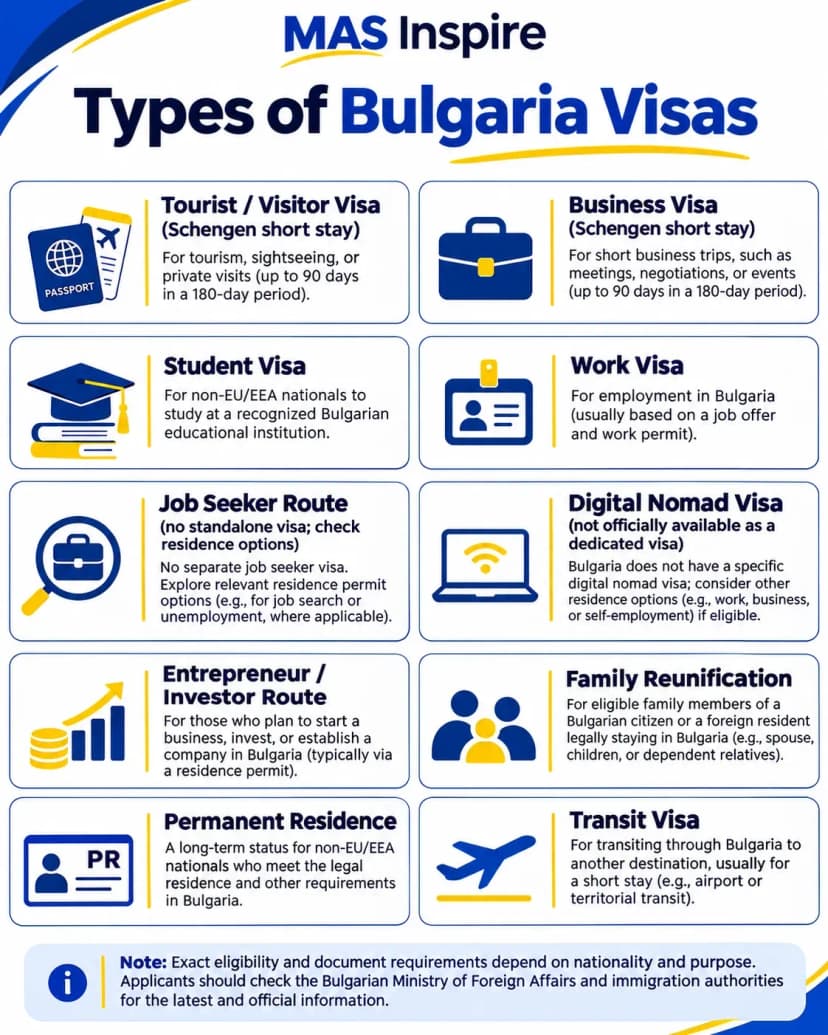
Type A — Airport Transit Visa
A Type A visa lets you stay in the international transit area of a Bulgarian airport while you change flights on your way to another country. It does not let you leave the transit area or enter Bulgaria. It is normally issued for a validity of three months from the date of issue, and it may be single, double or, in exceptional cases, multiple entry. The fee is 90 euro.
Type C — Schengen Short-Stay Visa
Type C is the visa most readers of this guide will apply for. It covers tourism, private and family visits, short business trips, conferences, cultural and sporting events, short medical treatment and other permitted short stays. It allows a stay of up to 90 days in any 180-day period across the whole Schengen Area, and it does not authorise ordinary employment. The visa may be single, double or multiple entry. The fee is 90 euro for adults, and the standard decision time is 15 calendar days, extendable to 45.
Type D — National Long-Stay Visa
Type D is the entry visa for anyone who intends to settle in Bulgaria for a long period or permanently on a qualifying legal ground: work, study, research, family reunification, business establishment or another ground recognised by the Foreigners in the Republic of Bulgaria Act. The Ministry of Foreign Affairs publishes two categories. Under Article 15, paragraph 1, a long-stay visa is valid for up to six months with a right to stay of up to 180 days, and the fee is 100 euro. Under Article 15, paragraph 2, a visa valid for up to one year with a right to stay of up to 360 days may be issued to researchers, students on programmes of up to one year, post-graduate and trainee students, and foreigners sent on assignment by a foreign employer; the fee is 200 euro. A personal interview is mandatory for every Type D applicant, with no exception. Type D is only the entry document: after arrival you must apply for a residence permit on the same ground. There is no single published processing time for Type D, and this guide deliberately gives none.
Work: Employment and the Single Residence and Work Permit
Ordinary employment in Bulgaria is not something a visa alone gives you. A non-EU national who wants to work in Bulgaria generally needs an approved single residence and work permit, then a Type D visa, and then a residence permit after arrival. The employer normally starts the process before you travel, and for the standard route must show a prior search for a suitable local worker. Be very cautious of anyone who promises a Bulgarian work visa in exchange for an upfront payment: the Bulgarian authorities do not sell work permits through agents.
EU Blue Card: Highly Qualified Employment
The EU Blue Card is a separate route for highly qualified employment, requiring a higher-education qualification, normally at least three years at a recognised institution, a qualifying employment contract, and an employer-led approval. The EU Immigration Portal describes a gross salary threshold of at least 1.5 times the Bulgarian average salary, calculated using the data for the 12 months before the contract is concluded,
Seasonal Work
For seasonal work of up to 90 days, no work permit is required, but the employer must register the employment and you must hold a short-stay visa if one is required for your nationality. For seasonal work of more than 90 days and up to nine months, you generally need a seasonal-worker permit and a Type D visa.
Study: Student Visa and Residence Permit
A non-EU student needs admission to an eligible Bulgarian institution and programme, a Type D visa to enter, and a residence permit after arrival, generally issued for up to one year at a time, and for 18 months in the final year of study. A private language course does not automatically qualify: confirm that the programme and the institution meet the statutory student-residence conditions before you pay tuition fees.
Researcher, Academic and Trainee Routes
A researcher may qualify where there is a signed hosting agreement with a Bulgarian research organisation for a defined research project. A researcher does not need a separate work permit for the authorised research activity, but generally needs a Type D visa where one is required and a residence permit after arrival, generally issued for up to one year with the possibility of renewal.
Family Reunification and Spouse Route
Family members of a Bulgarian citizen, or of a foreigner legally resident in Bulgaria, can qualify for long-stay residence on family grounds, most commonly spouses and children. Family members of EU, EEA and Swiss citizens exercising free-movement rights need to prove only the family relationship or household membership.
Business, Entrepreneur and Investor Routes
Bulgaria does not operate a single simple investor visa. People who plan to start a business, invest or establish a company generally proceed through a residence-permit route beginning with a Type D visa, and the Investment Promotion Act route is one of the grounds that can support the one-year Type D visa under Article 15, paragraph 2.
No Standalone Job-Seeker Visa and No Dedicated Digital Nomad Visa
There is no standalone Bulgarian job-seeker visa that lets you travel to Bulgaria simply to look for work, and Bulgaria does not have a dedicated digital nomad visa. Remote workers should look at the ordinary routes — work, business, study or family. Do not pay for a Bulgarian digital nomad visa package: there is no such visa to buy.
| Visa type | Purpose | Maximum stay | Fee |
|---|---|---|---|
| Type A airport transit | Change flights in the transit area | Transit only, no entry | 90 euro |
| Type C Schengen short stay | Tourism, visit, business, events | 90 days in any 180 days | 90 euro |
| Type D long stay, Article 15(1) | Work, study, family, business, settlement | Up to 6 months, up to 180 days | 100 euro |
| Type D long stay, Article 15(2) | Research, study up to 1 year, assigned workers, investors | Up to 1 year, up to 360 days | 200 euro |
| EU Blue Card | Highly qualified employment | Long stay with residence card | 100 or 200 euro Type D fee |
| Seasonal work | Seasonal employment up to 9 months | Up to 90 days, or up to 9 months with permit | 90 euro Type C, or Type D fee |
Bulgaria Visa Fees 2026
Fees are charged for processing the application, not for the visa itself, and the MFA states in bold capitals on its fees page that the charges collected are not refundable in case the applicant is refused a visa.
| Application | Fee |
|---|---|
| Airport transit visa, Type A | 90 euro |
| Short-stay visa, Type C | 90 euro |
| Long-stay visa, Type D, Article 15(1) | 100 euro |
| Long-stay visa, Type D, Article 15(2) | 200 euro |
| Children aged 6 to under 12, Type A or Type C | Exempt under the MFA fees page (see the conflict note below) |
| Children under 6 | Free under the EU Visa Code |
A conflict in the published sources needs to be stated plainly, because it affects what a family with children will pay. The Bulgarian Ministry of Foreign Affairs' own fees page says that children who are between 6 and under 12 years of age are exempt from the requirement to pay a visa fee. The European Commission's general Schengen fee table, by contrast, lists 45 euro for children aged 6 to 11. These two statements cannot both describe the same Bulgarian application. The controlling source for a Bulgarian application is the Bulgarian Ministry of Foreign Affairs' own fees page, and the MFA page says exempt.
Two further costs sit outside the government fee. First, if you apply through VFS Global, the centre charges its own service fee on top of the government fee. The MFA does not publish a single consolidated schedule of VFS service charges for Vietnam, and the VFS Bulgaria Vietnam page is built as a scripted web application whose appointment and fee details could not be read in text form during the check for this guide, so no service-fee figure is stated here: ask VFS for the current charge in writing before your appointment. Second, budget separately for translations, document legalisation, travel to Hanoi, accommodation if you need to stay overnight, and the travel insurance premium. Pay the fee only through the channel the embassy or VFS tells you to use, and keep the receipt: the MFA lists proof of fee payment among the admissibility documents for a Schengen application.
How Long Can You Stay? The 90/180-Day Rule
The rule is simple to state and easy to get wrong in practice: as a short-stay visitor you may spend no more than 90 days in the Schengen Area in any rolling 180-day period. The 180-day window is not a fixed calendar block. It is a moving window that looks backwards from each day you are in Schengen, and it counts every day you spent in any Schengen country during the previous 180 days. Days in Bulgaria count exactly the same as days in France, Germany, Greece or any other Schengen state, because Bulgaria is a full Schengen member. You do not get a fresh 90 days by changing country or by leaving Schengen briefly. Before every trip, count your Schengen days over the previous 180 days, and keep a margin: do not plan a trip that uses your 90th day on your planned departure date, because a delayed flight or a missed connection can turn a legal stay into an overstay.
The validity dates and the number of entries printed on your visa sticker are not the same thing as the number of days you may stay. A multiple-entry visa valid for six months does not authorise a six-month stay; it authorises stays that together respect the 90/180 limit inside that validity period. If the sticker allows fewer than 90 days, for example because it was issued for the dates of one specific trip, that shorter number governs your stay.
For Type D holders the position is different. A Type D visa gives a right to stay in Bulgaria for up to 180 days, or up to 360 days for the Article 15(2) category, within its validity, and its holder may also travel in the rest of Schengen for up to 90 days in any 180-day period under the short-stay rules. Once your residence permit is issued, the permit governs your stay in Bulgaria, and the Type D visa itself is cancelled. Overstaying a Type C visa, or staying beyond the validity of a Type D visa without a residence permit, can lead to a fine, a removal order and a future entry ban, and the overstay is recorded in the Entry/Exit System, so it will be visible to every Schengen state on your next application.
Processing Times: What to Expect
For a Type C short-stay visa, the position is clear and published by the Bulgarian Ministry of Foreign Affairs. A decision is taken within 15 calendar days from the date of submission of an admissible application. In individual cases where a more detailed examination is necessary, that period may be extended up to 45 calendar days. You must submit your application no earlier than six months before the start of the planned visit and no later than 15 days before it, in person or through an authorised agent, except for humanitarian cases. The 15 days run from submission of an admissible application, not from your first enquiry.
Three things can lawfully stretch a Type C decision beyond the headline 15 days. The first is the prior-consultation rule: Pakistan is on the Annex 16 list of nationalities subject to prior consultation under Article 22 of the Visa Code, so central authorities of other member states may be consulted during the examination of your application, and the MFA warns that this may affect the duration of the procedure. The second is a request for additional documents or an interview, which pauses the process while you respond. The third is volume: applications lodged in the weeks before summer holidays and the Lunar New Year period in Vietnam are routinely slower, because every Schengen mission in Hanoi and Ho Chi Minh City is busy at the same time. Apply six to eight weeks before travel where you can, and never book non-refundable flights or hotels before the visa is in your passport.
For a Type D long-stay visa, the position is different, and this guide states it without softening: no single universal published processing time exists for Type D applications. The Bulgarian Ministry of Foreign Affairs publishes no Type D processing time on its fees page, on its visa page, or in its published Type D guidance document. No figure appears in any of those three official sources. This guide therefore gives no Type D processing time at all. In particular, this guide never gives any day-range figure for Type D, because no such figure comes from any official Bulgarian source. Commercial websites variously quote processing times for Type D, but none of those figures appears on an official Bulgarian source, so this guide does not repeat any of them, and you should not plan your travel, your resignation or your university start date around a number a commercial website invented. Ask the embassy in Hanoi for its current Type D timing in writing for your category, and allow several months.
One related point is worth stating because it causes real confusion. The 15-day and 45-day figures are calendar days, not working days, and they describe the decision period after submission, not the total time from your first enquiry. The time you spend gathering documents, waiting for an appointment slot, or travelling to Hanoi is not included. Appointment availability is a separate bottleneck: book as early as the six-month window allows.
Where to Apply from Vietnam: Hanoi and VFS Global
The rule that decides where you apply is the Schengen territorial rule, and the Bulgarian Ministry of Foreign Affairs states it in plain language: you must apply for a Schengen visa at the consulate with territorial responsibility for the country where you legally reside, and for the country of your main destination. If Bulgaria is the country where you will spend the most days, you apply for a Bulgarian visa. If you will spend the same number of days in two or more Schengen countries, you apply to the country of your first entry.
For a Pakistani citizen legally resident in Vietnam, that rule points to Vietnam. Bulgaria has one mission in Vietnam, the Embassy of Bulgaria in Hanoi, and it works with VFS Global as its external visa service provider in Vietnam. VFS Global operates visa application centres in Hanoi, Da Nang and Ho Chi Minh City serving 26 countries, and Bulgaria is named among those countries.
The embassy's contact details below are taken from the Bulgarian Ministry of Foreign Affairs' own embassy page, which is the controlling source. An address conflict exists and is disclosed here rather than hidden: older directories and several commercial websites still list the embassy at 5 Nui Truc Street, Van Phuc, Hanoi. The Ministry of Foreign Affairs' own embassy page, however, gives the address as No. 5, Lane 294 Kim Ma Street, Ngoc Ha Ward, Hanoi.
| Contact | Detail |
|---|---|
| Embassy | Embassy of the Republic of Bulgaria in Hanoi |
| Address (MFA page, controlling source) | No. 5, Lane 294 Kim Ma Street, Ngoc Ha Ward, Hanoi 100000, Vietnam |
| Older address still shown in directories | 5 Nui Truc Street, Van Phuc, Hanoi — treat as superseded; confirm before travelling |
| Telephone | +84 24 3845 2908 |
| Embassy.Hanoi@mfa.bg | |
| Consular office hours | Monday to Friday, 9:00 to 12:00 |
| Visa and consular information by telephone | +84 24 3845 6453, 14:00 to 16:00 |
| Consular email | Consular.Hanoi@mfa.bg |
| Out-of-hours hotline | +84 83 940 9129 |
| Visa application centre | VFS Global Bulgaria in Vietnam, visa.vfsglobal.com/vnm/en/bgr |
Before you travel, email the consular office at Consular.Hanoi@mfa.bg and ask three questions in writing: whether your application should be lodged at VFS Global or directly at the embassy, which VFS centre serves your province of residence in Vietnam, and what the current VFS service charge is. Keep the reply. Two points in this guide could not be verified from a readable official page and are flagged as open: the VFS Bulgaria Vietnam web page is built as a scripted application, and its appointment availability, centre addresses and current service fee could not be read in text form during the check for this guide, so those details must be confirmed on the live VFS page; and the VFS service charge for Bulgaria in Vietnam has no published consolidated figure, so no amount is stated here.
The most important warning in this section concerns Type D. The Ministry of Foreign Affairs' published Type D guidance says that a long-stay visa application is submitted only at the diplomatic and consular mission at the applicant's permanent place of residence, or at a mission accredited in the state of the applicant's permanent residence. A person legally staying in a third country, different from the country of permanent residence, may as an exception apply in that third country, after explaining the reasons and if their return to the state of permanent residence is guaranteed. For a Pakistani citizen whose permanent residence is Pakistan but who lives and works legally in Vietnam, that exception is the only route to a Type D application in Hanoi, and it is an exception, not a right. The embassy in Hanoi has not published a written confirmation that it accepts Type D applications from Pakistani nationals resident in Vietnam, and this guide could not verify that acceptance. Email the consular office first, explain your residence status in Vietnam, ask in writing whether the exception will be applied to your case and what evidence of guaranteed return to Pakistan they require, and keep the reply. This is the main open point in this guide.

Complete Document Checklists
No checklist on any website replaces the checklist the embassy or VFS gives you for your own application, because the exact list depends on your visa type, your purpose and your personal circumstances. Use the checklists below to prepare, then compare them line by line with the official checklist you receive, and follow the official one where they differ. Bring originals and photocopies.
Checklist 1: Every Applicant, Type C and Type D
| Document | What is required |
|---|---|
| Passport | Valid at least 3 months beyond your planned departure from Bulgaria or the Schengen Area; issued within the previous 10 years; at least 2 blank pages |
| Passport copies | Photocopy of the page with your personal data, and copies of previous Bulgarian and Schengen visas if any |
| Visa application form | Completed legibly in block capitals, names in Latin letters as spelled in the passport, the rest in English or Bulgarian, signed personally by you |
| Photograph | One recent colour photograph, 3.5 cm by 4.5 cm, light background, full face occupying 70 to 80 percent of the photo, eyes not red, no dark glasses, no cropped amateur snapshot |
| Travel medical insurance | Valid for EU member states for the entire trip, covering repatriation, emergency medical assistance and emergency hospital treatment, minimum 30,000 euro |
| Proof of transport | Round-trip flight reservation or tickets, matching the dates of the trip |
| Proof of accommodation | Hotel booking for the whole stay, or an invitation-declaration from a host in Bulgaria, or proof of sufficient funds for accommodation |
| Proof of funds | Evidence of sufficient means for the stay and the return journey (see the proof-of-funds section for the published minimums) |
| Purpose of trip | Documents showing the purpose, such as a tourist plan, a business invitation, an admission letter or an employment contract |
| Intention to leave | Documents that let the officer assess your intention to leave before the visa expires, such as employment, family and residence ties to Vietnam |
| Fee payment | Proof that the visa fee has been paid |
| Biometrics | Ten fingerprints and a photograph taken at submission, unless exempt |
| Legal residence in Vietnam | Your Vietnamese temporary residence card, work permit or long-term visa, and proof of your address in Vietnam |
For minors travelling without their parents or guardians, the MFA requires a copy of the birth certificate and the original plus a photocopy of a power of attorney notarised by both parents or guardians, or by one parent or guardian, stating that they agree to the child travelling unaccompanied. If one parent is deceased, a death certificate is provided; if a parent has been deprived of parental rights, or a travel permit has been issued, a court decision is provided. Family members of EU, EEA and Swiss citizens need to provide proof only of the family relationship or household membership.
Checklist 2: Tourist and Private Visit, Type C
Add a day-by-day travel plan naming the cities and the accommodation for each night; hotel bookings covering the whole stay with your name on them; a return flight reservation; bank statements showing steady income and a balance comfortably above the published minimums; and evidence of your ties to Vietnam, such as your employment contract and leave approval and your temporary residence card. If you are staying with a friend or relative in Bulgaria, add their invitation-declaration, a copy of their identity document or residence permit, and proof of their address.
Checklist 3: Business Visit, Type C
Add an invitation from the Bulgarian company on its letterhead, naming you, the purpose and dates of the visit, who pays the costs, and a contact person; evidence of the commercial relationship, such as contracts, correspondence or order history; your employer's letter confirming your job, your salary, the purpose of the trip and that your leave is approved; and your company's business registration if you are self-employed.
Checklist 4: Student, Type D
Add the admission letter or certificate of admission; proof of tuition payment or the payment schedule; your academic records and diplomas, with certified translations where required; proof of accommodation; proof of sufficient funds, at least the minimum monthly wage or minimum pension under Bulgarian law for the period of stay; obligatory health insurance; a home address in Bulgaria; and, for the initial application for permission to stay, a previous-convictions certificate issued by the state of your citizenship or of your customary residence, if you are over 18.
Checklist 5: Employment and Work, Type D
Add the approved work permit or single residence and work permit approval, normally obtained by the employer before you apply; the employment contract; the employer's invitation and company documents; proof of accommodation; proof of funds; health insurance; and the previous-convictions certificate for the initial residence application if you are over 18.
Checklist 6: Family Reunification, Type D
Add proof of the family relationship, such as a marriage certificate or birth certificate, legalised and translated as required; a copy of the sponsor's Bulgarian identity document or residence permit; proof of the sponsor's address and lawful residence in Bulgaria; proof of accommodation; and proof of sufficient funds. Family members of EU, EEA and Swiss citizens exercising free-movement rights need to provide proof only of the family relationship or household membership, and are exempt from the requirement to present proof of secured maintenance, accommodation and transport.
Checklist 7: Type D General Requirements
Every Type D applicant should also prepare original documents plus two copies of the documents that substantiate the application and the financial resources for subsistence and accommodation; evidence of a home in Bulgaria; obligatory health insurance; and sufficient subsistence means, without resorting to the social assistance system, amounting to at least the minimum monthly wage or the minimum pension under Bulgarian law for the period of stay. The personal interview is mandatory, with no exception: know your purpose, your sponsor, your accommodation, your funds and your return plan, and answer consistently with what you wrote on the form.
Documents That Need Extra Care
Bank statements should show regular income over several months, not a single large deposit made the week before the application: officers treat last-minute deposits as borrowed money. Employment letters should be on company letterhead, signed, dated, and specific about your job title, start date, salary and approved leave dates. Flight reservations should be reservations, not purchased tickets: do not buy a non-refundable ticket before the visa is issued. Insurance must cover the whole trip and the whole Schengen Area, and the certificate must show the cover amount of at least 30,000 euro in writing.
How to Apply: Step-by-Step
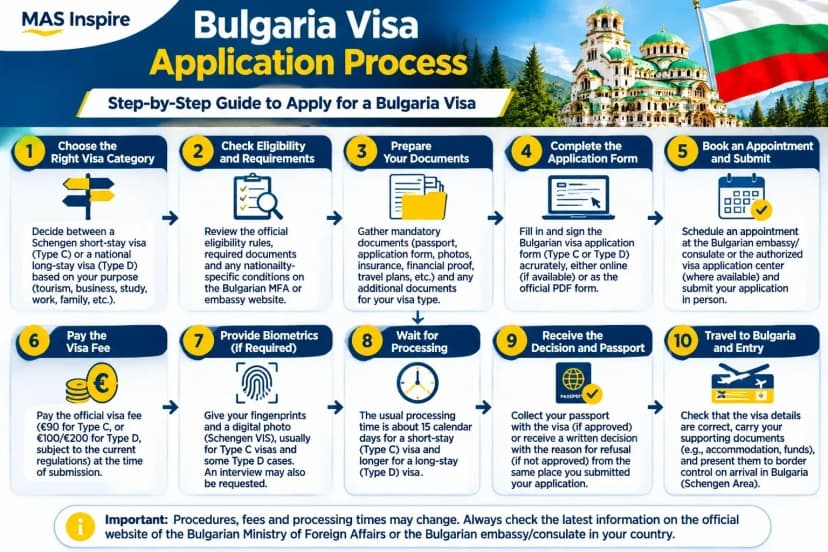
Step 1: Choose the Right Visa Category
Decide between a Schengen short-stay visa, Type C, and a national long-stay visa, Type D, based on your purpose and how long you will stay. Tourism, a family visit, a short business trip, a conference or a short course is Type C. Work, full-time study, research, family reunification or settlement is Type D, followed by a residence permit.
Step 2: Check Eligibility and Requirements
Read the official eligibility rules, the required documents and any nationality-specific conditions on the Bulgarian Ministry of Foreign Affairs visa page and on the embassy's page, and confirm anything unclear with the consular office in Hanoi. Check that your passport meets the three tests: issued within the last 10 years, valid for at least 3 months beyond your planned departure, and with at least 2 blank pages.
Step 3: Prepare Your Documents
Gather the mandatory documents — passport, application form, photographs, insurance, financial proof, travel plans and purpose evidence — and any additional documents for your visa type, using the checklists in this guide and the official checklist from the embassy or VFS. Arrange translations and legalisation early, because they take the longest. Make photocopies of everything, including your passport data page and any previous Schengen visas.
Step 4: Complete the Application Form
Fill in the visa application form accurately, either online where that option is available or on the official PDF form. Complete all fields legibly in block capitals, write names in Latin letters exactly as spelled in your passport, and complete the rest in English or Bulgarian. Sign the form personally. Read every answer twice against your documents before you submit: a date that contradicts your flight reservation, a hotel name that does not exist, or an employer name spelled differently on two documents will be noticed.
Step 5: Book an Appointment and Submit
Schedule an appointment at the Bulgarian Embassy in Hanoi or at the authorised VFS Global visa application centre, whichever the consular office tells you to use, and submit your application in person. Arrive early, bring the originals and the copies, and bring the fee payment in the form the centre asks for. At the appointment you will give your fingerprints and a digital photograph for the Schengen Visa Information System, unless you are exempt.
Step 6: Pay the Visa Fee
Pay the official visa fee, 90 euro for Type C or 100 or 200 euro for Type D, plus the VFS service charge if you apply through the centre, at the time of submission and through the channel you are told to use. The fee is not refunded if the visa is refused, and the service charge is not refunded either.
Step 7: Provide Biometrics and Attend an Interview if Required
Give your fingerprints and a digital photograph at the appointment. Children under 12 are exempt from fingerprinting under the Schengen rules. An interview may be requested for a Type C application; for a Type D application the personal interview is mandatory and no exception is made. At the interview, answer in your own words, consistently with your form and your documents.
Step 8: Wait for Processing
The usual processing time is about 15 calendar days for a short-stay Type C visa, extendable to 45 calendar days where a more detailed examination is necessary. For a long-stay Type D visa there is no single published processing time, and you should not plan around any number you see on a commercial website. If the embassy asks for additional documents, send them promptly and completely.
Step 9: Receive the Decision and Your Passport
Collect your passport with the visa if approved, or receive the written decision with the reason for refusal if not approved, from the same place you submitted your application. Read the visa sticker immediately and check the name spelling, the passport number, the validity dates, the number of entries and the number of days. If you are refused, the decision letter states the reasons and the appeal options: read it carefully, keep it, and get advice before reapplying, because a second application with the same file and the same weaknesses will fail the same way.
Step 10: Travel to Bulgaria and Enter
Check that the visa details are correct, carry your supporting documents — accommodation proof, funds, return ticket and insurance — and present them to border control on arrival in Bulgaria. Expect the Entry/Exit System check: a facial image and fingerprints at the external border, instead of an ink stamp. On arrival, start the residence-permit process at once if you hold a Type D visa, because the deadlines are short.
Proof of Funds: How Much Money Do You Need to Show?
Bulgaria publishes its minimum funds figures, and they are higher than many applicants expect, because the rule counts living costs and accommodation separately. The figures come from the reference amounts Bulgaria notified to the European Commission, under Article 17 of the Ordinance on the Terms and Conditions for Issuing Visas and Determining the Visa Regime.
For a short-stay visa, you must show at least 50 euro per day for each day of the stay requested, and not less than 500 euro in total, or a document for prepaid tourist services. Separately, you must show financial resources for accommodation of not less than 50 euro for each day of the stay, or a document for prepaid nights in a hotel or tourist shelter, or an invitation-declaration by a Bulgarian person or company undertaking to cover all your costs during your stay. You must also show the means to leave the country, or a ticket.
Worked examples make the rule concrete. A 7-day tourist trip with a prepaid hotel needs at least 500 euro for living costs, because the 500 euro floor applies, plus the prepaid hotel. The same 7-day trip without a prepaid hotel needs at least 500 euro for living costs plus 350 euro for accommodation, a total of at least 850 euro. A 10-day trip without a prepaid hotel needs at least 500 euro for living costs plus 500 euro for accommodation, a total of at least 1,000 euro.
How you show the money matters as much as how much you show. Bank statements covering the last three to six months, showing regular salary credits and ordinary spending, are far stronger than a single recent statement with one large deposit. Payslips, your employment contract, and tax or salary evidence support the statements. A sudden large deposit a week before the application, with no explanation, is one of the most common reasons for a refusal on funds: officers read it as borrowed money that will be returned the day after the visa is issued.
For Type D, the funds test is different and is set by Bulgarian law rather than by a daily rate. You must have a home, obligatory health insurance, and sufficient subsistence means, without resorting to the social assistance system, amounting to at least the minimum monthly wage or the minimum pension under Bulgarian law for the period of stay. The Ministry of Foreign Affairs does not publish a euro figure for the minimum monthly wage in its Type D guidance, and this guide does not invent one: confirm the current minimum monthly wage in writing with the embassy, and show funds that comfortably exceed it for the whole period of your stay.
Travel Insurance, Flights and Accommodation
The Ministry of Foreign Affairs requires health insurance valid for EU member states for the entire period of the trip, covering all costs for repatriation, emergency medical assistance and emergency hospital treatment for the period of stay specified in the visa, and the insurance amount cannot be less than 30,000 euro. Buy the policy from an insurer whose cover is accepted for Schengen visas, and check before you pay that the certificate states the cover amount, the territorial validity covering all Schengen states, and the exact dates of your trip. A domestic Vietnamese health insurance policy that covers only Vietnam does not meet the requirement. A policy that covers only Bulgaria and not the other Schengen states does not meet it either.
For flights, a reservation is enough at the application stage, and you should not buy a non-refundable ticket before the visa is issued. The reservation must match the dates on your form and on your accommodation bookings, and the return or onward flight must be shown. If your route transits through another country, check the transit rules for every stop: a connection through Istanbul, Doha or Dubai has different requirements from a connection through another Schengen airport, and a Pakistani passport holder's transit position depends on the airport, the airline and the onward visa held.
For accommodation, the booking must cover the whole stay, name you, and give the address. A single night booked for a ten-day trip, a booking in someone else's name, or a booking that starts after your arrival date will be treated as an incomplete file. If you are staying with a host, the host's invitation-declaration should state the address, the dates, the relationship to you and that the host will cover your accommodation costs, and it should be accompanied by proof of the host's identity and address. If you are travelling to more than one city, book each night in sequence and show the internal travel between them.
After You Arrive in Bulgaria: Residence Permits and Registration
A Type C visa ends at the border in the sense that there is nothing more to do: you visit, you leave within your permitted days, and your entries and exits are recorded by the Entry/Exit System. A Type D visa is different: it is the beginning of a second process that must be completed inside Bulgaria, and the deadlines are short.
Within 14 days of arriving, apply for your residence permit at the Migration Directorate of the Ministry of Interior, or at the migration unit of the regional police directorate for your place of residence. This 14-day figure comes from secondary guidance on the Bulgarian residence process rather than from a Ministry of Foreign Affairs publication, so confirm the current deadline with the Migration Directorate or the embassy before you travel, and treat 14 days as the deadline to work to, not as a figure to test. Take your passport, visa, proof of address, insurance, proof of funds and the documents for your ground of stay. The long-stay visa is cancelled when the residence permit is issued, and the permit then governs your stay. A student residence permit is generally issued for up to one year at a time, and for 18 months in the final year of study.
Your residence permit also changes your travel position inside Schengen. Holders of a Bulgarian residence permit in the uniform format are entitled to visa-free short stays in the other Schengen countries under the Schengen rules, for no more than 90 days in any 180-day period, within the validity of the permit.
Two practical matters deserve attention on arrival. First, register your address and keep proof of it: landlords, universities and employers in Bulgaria will ask for it, and the Migration Directorate will expect it. Second, keep every document from your visa application, including the decision, the insurance certificate and the entry record, because you will need them again for the residence permit, for any extension, and for any future Schengen application.
Common Reasons for Refusal and How to Avoid Them
The refusal letter gives a standard reason code and a short explanation; the real cause is usually visible in the file if you know where to look.
The most common reason is weak or inconsistent purpose. An itinerary that does not match the flight dates, a hotel booking that covers only part of the stay, a business invitation with no named contact, or a study application without an admission letter all tell the officer that the purpose is not credible.
The second most common reason is funds. A balance below the published minimums, a single large deposit just before the application, bank statements that show no regular income, or statements in a name that is not yours will all lead to a refusal.
The third reason is weak ties to Vietnam. If you cannot show a job, a business, a family, a lease or a residence status that brings you back to Vietnam, the officer has no reason to believe you will leave Bulgaria before the visa expires. Your temporary residence card, your employment contract, your leave approval and your family circumstances are the evidence.
The fourth reason is previous immigration history. An earlier overstay in Schengen, a previous refusal that was not addressed, or a visa application to another country with contradictory information will be found, because Schengen states share visa data through the Visa Information System and the Entry/Exit System. Never hide a previous refusal or overstay: declare it, explain what changed, and show the evidence.
The fifth reason is the wrong consulate or the wrong visa type. Applying for a Bulgarian visa when your main destination is another Schengen country, or applying for a Type C visa when you intend to work or study, will fail.
The sixth reason is documents that do not meet the formal requirements: a passport with less than 3 months of validity beyond departure, a photograph that does not meet the specification, insurance below 30,000 euro or valid for the wrong dates, or a form with unanswered fields. These are the easiest refusals to avoid and the most frustrating to receive, because the application was winnable.
If you are refused, do not reapply the next day with the same file. Read the refusal letter, identify the exact reason, gather the missing or stronger evidence, and only then apply again. The refusal letter also states your appeal options: take advice on them before the appeal deadline passes, because an appeal has its own time limits and a reapplication is not always the better route.
Frequently Asked Questions
Do Pakistani passport holders need a visa for Bulgaria?
Yes. Pakistan is listed in Annex I to Regulation (EU) 2018/1806, so Pakistani nationals must hold a visa before travelling to Bulgaria. There is no visa on arrival and no Bulgarian e-visa for Pakistani passport holders.
How much is the Bulgaria visa fee for Pakistani citizens in 2026?
The government fee is 90 euro for a Type C short-stay visa or a Type A airport transit visa, 100 euro for a Type D visa under Article 15(1), and 200 euro for a Type D visa under Article 15(2). The MFA states that children aged 6 to under 12 are exempt from the Type A and Type C fee, although the European Commission's general fee table lists 45 euro for that age group, so confirm the child fee in writing before you pay.
How long does a Bulgaria visa take to process from Vietnam?
For a Type C visa, the MFA gives a standard decision time of 15 calendar days from the submission of an admissible application, extendable to 45 calendar days where a more detailed examination is necessary. For a Type D visa, no single published processing time exists, and this guide gives none.
Can I apply for a Bulgaria visa from Vietnam if I am a Pakistani citizen?
Yes for a Type C visa, because you apply at the consulate responsible for the country where you legally reside, and that is Vietnam. For Type D, confirm in writing with the embassy in Hanoi first: applications are normally lodged at the mission of your permanent residence.
Where do I submit my Bulgaria visa application in Vietnam?
Through VFS Global Bulgaria in Vietnam, at visa.vfsglobal.com/vnm/en/bgr, or directly at the Embassy of Bulgaria in Hanoi if the consular office tells you to. The embassy's address on the MFA page is No. 5, Lane 294 Kim Ma Street, Ngoc Ha Ward, Hanoi.
How long can I stay in Bulgaria on a Schengen visa?
Up to 90 days in any rolling 180-day period across the whole Schengen Area, including days spent in any other Schengen country. The validity dates and the number of entries on the visa sticker are separate from the number of days you may stay, and if the sticker allows fewer than 90 days, that shorter number governs.
Does a Bulgaria visa let me visit other Schengen countries?
Yes. Since 31 March 2024 Bulgaria has issued uniform Schengen visas valid throughout the Schengen Area, and since 1 January 2025 it has been a full Schengen member. A Bulgarian Type C visa lets you travel to the other Schengen states under the Schengen rules, within its validity and your 90/180-day allowance.
What is the minimum bank balance for a Bulgaria visa?
Bulgaria's published minimums are 50 euro per day for living costs, with a floor of 500 euro in total, plus 50 euro per day for accommodation unless your hotel is prepaid or a host covers it. A 10-day trip without a prepaid hotel therefore needs at least 1,000 euro, and a 7-day trip needs at least 850 euro.
Do I need travel insurance for a Bulgaria visa?
Yes. Travel medical insurance is mandatory, valid for all EU member states for the entire trip, covering repatriation, emergency medical assistance and emergency hospital treatment, with a minimum cover of 30,000 euro. A policy that covers only Vietnam, or only Bulgaria, does not meet the requirement.
Can I work in Bulgaria on a tourist visa?
No. A Type C short-stay visa does not authorise ordinary employment. You may attend meetings, negotiations and events that fit a declared business purpose, but you may not take up a job. Ordinary employment requires an approved single residence and work permit, then a Type D visa, then a residence permit after arrival.
Does Bulgaria have a digital nomad visa?
No. Bulgaria does not have a dedicated digital nomad visa. Remote workers who want to live in Bulgaria should look at the ordinary routes, such as work, business, study or family, and check whether any of them fits their circumstances.
Can I apply for a Type D visa in Hanoi as a Pakistani living in Vietnam?
Only as an exception, and only if the embassy agrees. The MFA's Type D guidance says applications are lodged at the mission of your permanent place of residence, and that a person legally staying in a third country may apply there as an exception, after explaining the reasons and if their return to the state of permanent residence is guaranteed.
What documents do I need for a Bulgaria visa from Vietnam?
A passport valid at least 3 months beyond departure, issued within the last 10 years, with 2 blank pages; a completed and signed application form; a recent 3.5 by 4.5 cm photograph; travel medical insurance of at least 30,000 euro; a return flight reservation; accommodation for the whole stay; proof of funds; evidence of your purpose; proof of your legal residence in Vietnam; and the fee payment receipt.
Is ETIAS required for Bulgaria in 2026?
No. ETIAS is not in operation and has no announced start date, after the EU withdrew its earlier late-2026 timeline in July 2026. When ETIAS eventually launches it will apply only to visa-exempt travellers, so as a Pakistani passport holder who needs a visa, ETIAS will not apply to you. The Entry/Exit System, EES, is different: it is live, it records your facial image and fingerprints at the external border, and it is free.
What should I do if my Bulgaria visa is refused?
Read the refusal letter carefully, because it states the reasons and your appeal options. Do not reapply immediately with the same file. Identify the exact weakness, gather stronger or missing evidence, and only then apply again, or take advice on an appeal before the appeal deadline passes.
Official Websites
| Source | What it is | Address |
|---|---|---|
| Bulgarian Ministry of Foreign Affairs — Visa for Bulgaria | Schengen rules, where to apply, deadlines, 15 and 45 day decision times, document requirements | https://www.mfa.bg/en/services-travel/consular-services/travel-bulgaria/visa-bulgaria |
| Bulgarian Ministry of Foreign Affairs — Fees | Type A and Type C 90 euro, Type D 100 and 200 euro, child exemption, non-refundable fees | https://mfa.bg/en/services-travel/consular-services/fees |
| Bulgarian Ministry of Foreign Affairs — Long-Stay Visa Type D | Type D categories, validity, interview requirement, third-country exception, subsistence rule | https://www.mfa.bg/upload/716/VISA_TYPE_D.pdf |
| Bulgarian Ministry of Foreign Affairs — Airport Transit Visa Type A | Type A rules and validity | https://www.mfa.bg/upload/714/VISA_A_en.pdf |
| Bulgarian Ministry of Foreign Affairs — Embassy of Bulgaria in Hanoi | Embassy address, telephone, email, consular hours | https://www.mfa.government.bg/en/embassies/vietnam |
| VFS Global — Bulgaria in Vietnam | Visa application centre for Bulgaria in Vietnam | https://visa.vfsglobal.com/vnm/en/bgr |
| VFS Global — Individuals | Visa application centre network | https://www.vfsglobal.com/en/individuals/index.html |
| European Commission — Bulgaria and Romania join the Schengen Area | Full Schengen membership from 1 January 2025 | https://home-affairs.ec.europa.eu/news/bulgaria-and-romania-join-schengen-area-2025-01-03_en |
| European Commission — Statement on Bulgaria and Romania becoming fully part of Schengen | Council decision of 12 December 2024 | https://ec.europa.eu/commission/presscorner/api/files/document/print/en/statement_24_6401/STATEMENT_24_6401_EN.pdf |
| EUR-Lex — Reference amounts for Bulgaria | Proof-of-funds minimums, 50 euro per day and 500 euro floor | https://eur-lex.europa.eu/legal-content/EN/TXT/?uri=CELEX%3A52024XC02879&qid=1730744286607 |
| European Commission — Reference amounts handbook annex | Proof-of-funds reference amounts for all Schengen states | https://home-affairs.ec.europa.eu/document/download/7130e21d-c1c8-41fd-9c83-b6fe312d4f5c_en?filename=handbook-annex-25_en.pdf |
| European Union — Bulgaria country profile | EU membership, euro area membership | https://european-union.europa.eu/principles-countries-history/eu-countries/bulgaria_en |
| European Central Bank — Bulgaria introduces the euro | Euro adoption on 1 January 2026 | https://www.ecb.europa.eu//press/pr/date/2026/html/ecb.pr260101~c830245e42.en.html |
| European Central Bank — Bulgaria adopts the euro | Euro area membership and conversion rate | https://www.ecb.europa.eu/press/economic-bulletin/focus/2026/html/ecb.ebbox202508_01~b4379b735b.en.html |
| European Commission — Bulgaria adopts the euro on 1 January 2026 | Conversion rate 1.95583 lev per euro | https://trade.ec.europa.eu/access-to-markets/en/news/bulgaria-adopts-euro-1-january-2026 |
| Council of the EU — Joining the euro area timeline | Euro adoption timeline | https://www.consilium.europa.eu/en/policies/join-the-euro-area/timeline-joining-the-euro-area/ |
| EU Immigration Portal — Employed worker in Bulgaria | Single permit and labour-market test | https://home-affairs.ec.europa.eu/policies/migration-and-asylum/eu-immigration-portal/employed-worker-bulgaria_en |
| EU Immigration Portal — Highly qualified worker in Bulgaria | EU Blue Card rules and salary threshold | https://home-affairs.ec.europa.eu/policies/migration-and-asylum/eu-immigration-portal/highly-qualified-worker-bulgaria_en |
| EU Immigration Portal — Seasonal worker in Bulgaria | Seasonal work rules | https://home-affairs.ec.europa.eu/policies/migration-and-asylum/eu-immigration-portal/seasonal-worker-bulgaria_en |
| EU Immigration Portal — Student in Bulgaria | Student residence conditions | https://home-affairs.ec.europa.eu/policies/migration-and-asylum/eu-immigration-portal/student-bulgaria_en |
Final Checklist Before You Submit
Read this list the night before your appointment, and do not submit until every line is true. Your passport is valid for at least 3 months beyond your planned departure, was issued within the last 10 years, and has at least 2 blank pages. Your form is complete, signed, and consistent with every supporting document. Your photograph meets the 3.5 by 4.5 cm specification. Your insurance covers at least 30,000 euro, the whole Schengen Area, and the exact dates of your trip. Your flight reservation and your accommodation bookings cover the same dates as your form. Your bank statements cover three to six months, show regular income, and show a balance above the published minimums with a margin. Your purpose documents match your declared purpose, and your covering letter explains your trip and your ties to Vietnam in plain language. Your Vietnamese residence document is valid and covers your return. You have originals and photocopies of everything, you have kept a complete copy of the file, and you have the fee ready in the form the centre asks for. And if you are applying for Type D from Vietnam, you have the embassy's written answer on whether the third-country exception will be applied to your case.
This guide was checked on 29 November 2026 against the official sources listed in Section 16, and every fee, stay length, processing time and address in it was verified against those sources on that date. The final decision on your visa and on your entry into Bulgaria rests with the Bulgarian authorities and the immigration officer at the border, and the immigration officer makes the final decision and the guide does not guarantee visa approval or entry.


