

By MAS Inspire | Last reviewed: 27 November 2026 (Flanders €180 single-permit retribution added; key figures re-verified 27 November 2026)
Important: This guide is educational information, not legal advice and not an official Belgian government publication. Immigration rules, fees, regional thresholds and consular procedures can change. Always check the official page for your visa category and the Belgian representation responsible for your place of legal residence before paying fees or making travel arrangements. A visa or residence permit is never guaranteed.
Table of contents
- Introduction
- Why visit, study and work in Belgium
- Types of Belgium visas and residence routes
- Visa comparison
- Eligibility requirements
- Document checklists
- How to apply
- Fees and financial requirements
- Processing times and validity
- Applying from Pakistan or Vietnam
- Student visa guide
- Work visas and job opportunities
- Family immigration and permanent residence
- Common mistakes
- Refusal reasons
- Frequently asked questions
- Official immigration websites
- Final checklist and conclusion
Introduction
Belgium is a destination for tourism, business, higher education, research, employment and family life. The correct immigration route depends on the purpose and length of the stay. A short visit is generally handled under the Schengen visa system. A move to Belgium for more than 90 days normally involves a Belgian national long-stay visa (type D), a residence authorisation, or both. Employment and self-employment also require the relevant work authorisation.
This guide explains the main routes for non-EU nationals, including Pakistani citizens who legally reside or work in Vietnam. Rules and fees can change. The information below was checked on 25 November 2026 against official Belgian and EU sources. Always re-check the authority responsible for your particular region, visa category and place of residence before paying or booking an appointment.
Why visit, study and work in Belgium
Belgium combines international institutions and business centres with universities, research organisations, historic cities and a multilingual labour market. Brussels hosts major EU and international organisations. Flanders, Wallonia and the Brussels-Capital Region each have distinct labour-market and economic systems. Belgium's higher education institutions offer programmes in Dutch, French, German and English, depending on the institution and course.
The attraction does not remove immigration requirements. A visitor visa does not authorise ordinary employment; admission to a university does not itself grant permission to enter; and a work contract alone is not always enough to start working. Applicants must obtain the correct authorisation for the intended activity.

Types of Belgium visas and residence routes
Belgium broadly distinguishes short-stay C visas from long-stay D visas. The C visa normally covers visits of up to 90 days in any rolling 180-day period across the Schengen area. A D visa is a national visa for a stay exceeding 90 days. The D visa is often the entry document used after an underlying study, work, family or other residence route is approved. The residence card is normally obtained after arrival and local registration.
1. Tourism, private visits and short courses — type C
A Pakistani passport holder normally needs a Schengen visa for tourism, visiting relatives or friends, medical visits, cultural events, conferences and other temporary purposes. The applicant must show a genuine temporary purpose, accommodation, adequate means, travel medical insurance and credible plans to leave before the authorised stay expires. A short course may fit a C visa only where its duration and purpose meet the short-stay rules; longer studies require the student route.
A C visa may be single-, double- or multiple-entry. The visa sticker states its validity and the number of days permitted. A multiple-entry visa valid for a year does not permit a year of continuous residence: the 90/180-day limit still applies.
2. Business visitor — type C
Meetings, negotiations, trade fairs and conferences may be undertaken as a business visitor where the activities remain within the visitor rules. A Belgian host or employer may provide an invitation explaining the event, dates, costs and relationship. A business visitor visa is not a work permit and does not authorise taking up a Belgian job, providing ordinary productive labour or receiving Belgian employment remuneration where a work authorisation is required.
3. Student and language-study route — type D
Non-EU nationals admitted to an eligible recognised higher-education programme generally apply for a D visa for studies. The file commonly includes an admission or enrolment certificate, proof of sufficient means, health cover, a medical certificate and police clearance, together with the prescribed application material. Language courses and study at private or non-recognised institutions can follow different rules; do not assume that every course qualifies for the standard higher-education student residence route.
For the 2026–2027 academic year, Study in Flanders publishes a minimum student subsistence amount of €1,062 per month. The accepted evidence routes include a blocked account, qualifying scholarship, bank guarantee or eligible sponsor undertaking (Annex 32). Check the Immigration Office and the relevant institution for the amount and acceptable proof applicable on the actual filing date.
Students may work only within the conditions attached to their student status and Belgian employment rules. The commonly applicable student-work limit during the academic year is 20 hours per week, provided the work is compatible with studies; during official school holidays, broader work is generally possible. Confirm the current rule and the wording on the residence card with the regional employment authority. Student status is not an unrestricted work permit.
4. Employee work, single permit and skilled employment
For most non-EU employees working in Belgium for more than 90 days, the employer applies for a single permit through the competent region. The permit combines residence and work authorisation. The correct region is normally determined by the place of employment. Flanders, Wallonia and Brussels have separate procedures, criteria, shortage occupation lists and salary thresholds. An applicant should not apply independently for a work visa before the employer has obtained the necessary regional authorisation.
Highly qualified employees may qualify for a highly-skilled worker route or an EU Blue Card if they meet the relevant qualification, contract and salary conditions. The European Commission's Belgium profile describes the highly-qualified worker route as requiring a higher-education qualification (or equivalent), an employment contract of at least one year and the applicable salary threshold; the Blue Card has its own contract, qualification and salary conditions. Thresholds are regional and can be updated annually. A job offer is not a guarantee of approval.
5. Job-seeker route
Belgium does not offer a general, open-ended job-seeker visa for every foreign national. A specific orientation year may be available to certain graduates of Belgian higher-education programmes to seek work or establish a business after graduation. Eligibility and application deadlines are specific to the student's prior residence status and qualification. Do not treat this as a route for any overseas applicant to arrive without a job and search indefinitely.
6. Self-employed, entrepreneur and investor activity
A non-EEA/Swiss national who intends to conduct a self-employed professional activity generally needs a professional card from the region where the business activity will be based. The application is assessed by the regional authority and may require a business plan, evidence of qualifications and experience, financial forecasts, proof of economic benefit and other regional documents. Once the professional card is approved, the applicant normally applies for a D visa. Belgium does not have one general federal “digital nomad visa”; remote work for a foreign business does not automatically create a right to reside in Belgium.
7. Family reunification and spouse/partner residence
Eligible spouses, registered partners, minor children and certain other family members may apply to join a Belgian citizen or a foreign national legally resident in Belgium. The route depends on the sponsor's status and the relationship. Conditions can include proof of the family relationship, stable and sufficient resources, adequate housing, health insurance and evidence that the relationship is genuine. Rules differ for family members of EU citizens, Belgians and non-EU residents. A fiancé(e) or intended partner may need a specific visa to marry or legally cohabit, with its own evidence and deadlines; it is not automatically equivalent to a spouse's family-reunification right.
8. Researcher, academic, trainee and internship routes
Researchers hosted by an eligible research organisation may use the researcher authorisation route and a hosting agreement. Internships and traineeships may require a regional work authorisation or proof of an exemption before a D visa is lodged. Academic visitors should ask the host institution to identify the correct category rather than using a tourist visa for an activity that is in fact employment or a formal traineeship.
9. Au pair
Belgium has a regulated au-pair route. The host family must obtain the required regional employment authorisation and work permit before the young person applies for a visa. Conditions include age limits, education, language learning, approved courses, accommodation, insurance and limits on household tasks. It is not a general domestic-worker route and cannot be used as a substitute for an ordinary employment permit.
10. Airport transit — type A
An airport transit visa allows a traveller to remain in the international transit area while changing aircraft at a Schengen airport. It does not permit entry into Belgium. Pakistan is included in the common EU list of nationalities requiring an airport transit visa, subject to specified exemptions (for example, certain valid visas or residence permits). If the traveller must pass border control, collect baggage landside or change airports, a type A visa is not sufficient; a type C visa may be needed.
11. Permanent residence and settlement
Permanent residence is not a visa category that can normally be requested from abroad as an initial entry route. Many non-EU nationals may become eligible for EU long-term resident status after five years of qualifying legal and continuous residence, subject to conditions such as stable resources, health insurance and exclusions or special counting rules for some residence periods. Other permanent or unlimited residence statuses have their own conditions. Time spent in Belgium as a student may count differently for long-term resident purposes. Check the Immigration Office before relying on a five-year calculation.
12. Humanitarian protection
International protection (asylum) is a separate legal process for people who fear persecution or serious harm and meet the applicable protection criteria. It is not a migration shortcut, work visa or ordinary family route. Applicants should use the Belgian asylum authorities and qualified legal assistance. Temporary protection may be activated for particular crises under EU and Belgian law; it is not a general visa category.
Visa comparison
| Route | Main purpose | Permission / duration | Work rights | Main decision path |
|---|---|---|---|---|
| Schengen C | Tourism, visit, short business | Up to 90 days in 180 | No ordinary employment | Embassy/consulate or authorised provider |
| Airport transit A | Airside transit only | Transit period | None | Embassy/consulate |
| Student D | Qualifying long-term study | Study residence, renewable subject to rules | Limited student work | Immigration Office / embassy; institution supports |
| Employee single permit + D | Employment over 90 days | Permit-specific | As authorised by permit | Employer applies to competent region; D visa follows |
| EU Blue Card | Highly qualified employment | Permit-specific | As authorised | Regional authority / Immigration Office |
| Professional card + D | Self-employment | Card and residence validity | Approved self-employed activity | Regional authority, then D visa |
| Family reunification D | Join eligible family sponsor | Residence status-specific | Depends on residence status | Embassy and Immigration Office |
| Researcher / trainee | Research or internship | Hosting / authorisation-specific | As authorised | Host organisation and competent authority |
| Au pair | Regulated cultural exchange | Maximum period governed by permit | Only approved au-pair duties | Host family applies regionally |
Eligibility requirements
The first eligibility question is nationality: whether a visa is required for the intended stay. Pakistani ordinary passport holders generally need a visa for both short stays and long stays. The second question is where the applicant legally resides. Belgium's Foreign Affairs guidance says an application should be lodged with the Belgian embassy or consulate competent for the applicant's country of residence. A person temporarily visiting a third country should not assume that they can apply there.
For a short stay, the applicant must establish the purpose, accommodation, sufficient means, travel medical insurance and intention to leave within the permitted period. For long stays, the underlying category controls: admission and subsistence for students; an approved single permit for most employees; a professional card for self-employed activity; or the statutory relationship and sponsor conditions for family reunification.
Document checklists
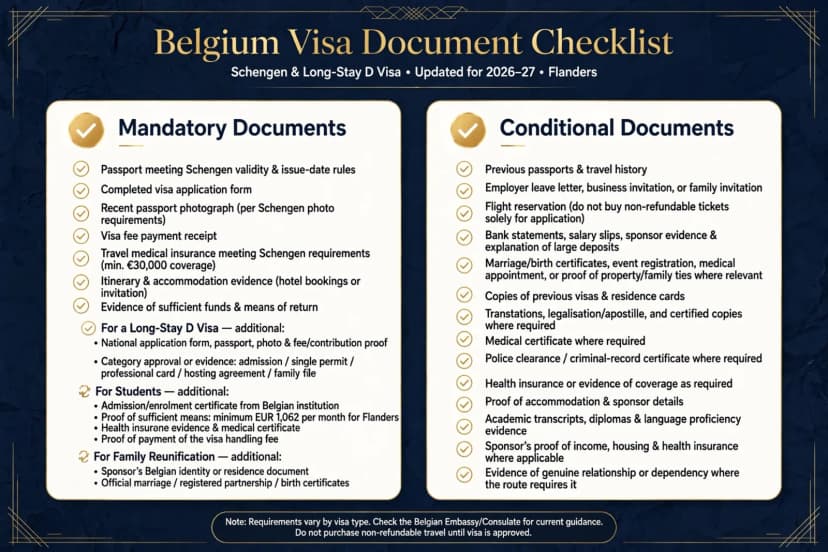
The list below is a preparation aid, not a promise that every item is mandatory in every case. The embassy or category-specific checklist controls. Documents may need legalisation/apostille and translation into an accepted language.
Short-stay C visa
| Core / normally requested | Conditional or supporting evidence |
|---|---|
| Passport meeting Schengen validity and issue-date rules; application form; photograph; fee | Previous passports and travel history |
| Travel medical insurance meeting Schengen requirements | Employer leave letter, business invitation or family invitation |
| Itinerary and accommodation evidence | Flight reservation; do not buy non-refundable tickets solely for an application |
| Evidence of sufficient funds and means of return | Bank statements, salary slips, sponsor evidence and explanation of large deposits |
| Evidence of purpose and circumstances | Marriage/birth certificates, event registration, medical appointment, property or family ties where relevant |
Long-stay D visa — common supporting file
| Core / category-specific | Conditional or supporting evidence |
|---|---|
| National application form, passport, photo and fee/contribution proof | Copies of previous visas and residence cards |
| Category approval or evidence: admission, single permit, professional card, hosting agreement or family file | Translations, legalisation/apostille and certified copies |
| Medical certificate where required | Police clearance / criminal-record certificate where required |
| Health insurance or evidence of coverage as required | Proof of accommodation and sponsor details |
| Proof of financial means where the category requires it | Additional evidence requested by the embassy or Immigration Office |
Student documents
- Passport, completed national visa form and compliant photograph.
- Admission/enrolment certificate from the eligible Belgian institution.
- Proof of sufficient means using an accepted method for the relevant academic year.
- Evidence of health insurance and medical certificate as specified by the checklist.
- Criminal-record certificate where required for the applicant's age/category.
- Academic transcripts, diplomas and language evidence requested by the institution or embassy.
- Proof of payment of the applicable visa handling fee and any separate administrative contribution.
Employee / single-permit documents
- Passport and national D visa application material.
- Employer's approved single permit or regional authorisation.
- Employment contract and qualification documents where required.
- Medical certificate and criminal-record certificate if requested for the D visa.
- Proof of payment of applicable charges and translations/legalisations where required.
Family reunification documents
- Passport and visa form; sponsor's Belgian identity or residence document.
- Official marriage, registered partnership or birth certificates proving the relationship.
- Sponsor's proof of income, housing and health insurance where applicable.
- Evidence of genuine relationship or dependency where the route requires it.
- Legalisation/apostille and translation of civil-status records.
How to apply: step-by-step
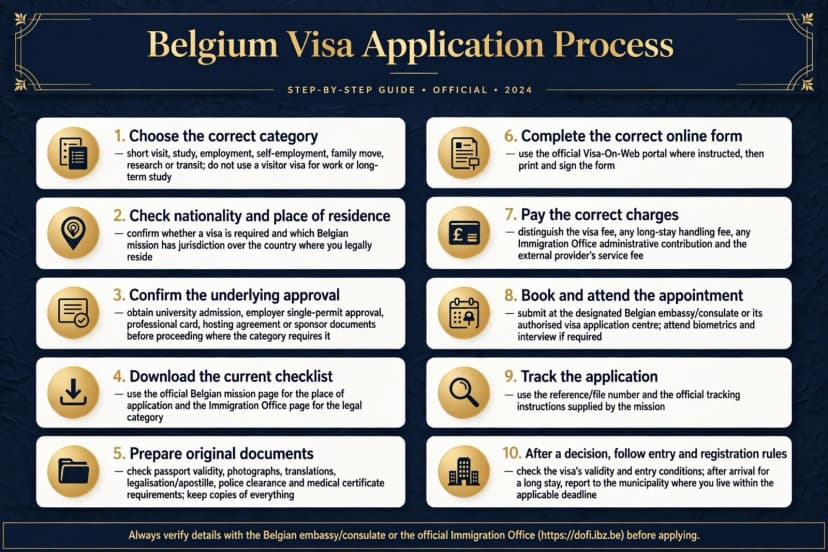
- Choose the correct category. Decide whether the trip is a short visit, study, employment, self-employment, family move, research or transit. Do not use a visitor visa for work or long-term study.
- Check nationality and place of residence. Confirm whether a visa is required and which Belgian mission has jurisdiction over the country where you legally reside.
- Confirm the underlying approval. Obtain university admission, employer single-permit approval, professional card, hosting agreement or sponsor documents before proceeding where the category requires it.
- Download the current checklist. Use the official Belgian mission page for the place of application and the Immigration Office page for the legal category.
- Prepare original documents. Check passport validity, photographs, translations, legalisation/apostille, police clearance and medical certificate requirements. Keep copies of everything.
- Complete the correct online form. For visa applications, use the official Visa-On-Web portal where instructed, then print and sign the form.
- Pay the correct charges. Distinguish the visa fee, any long-stay handling fee, any Immigration Office administrative contribution and the external provider's service fee. They are not necessarily the same charge.
- Book and attend the appointment. Submit at the designated Belgian embassy/consulate or its authorised visa application centre. Attend biometrics and interview if required.
- Track the application. Use the reference/file number and the official tracking instructions supplied by the mission. Some D visa files are referred to the Immigration Office in Belgium.
- After a decision, follow entry and registration rules. Check the visa's validity and entry conditions. After arrival for a long stay, report to the municipality where you live within the applicable deadline and complete residence-card formalities. A visa does not replace local registration.
Fees and financial requirements
| Item | Amount / rule checked 25 Nov 2026 | Notes |
|---|---|---|
| Schengen C visa, adult | €90 | Standard EU fee; exemptions may apply |
| Schengen C visa, age 6–11 | €45 | Under six: generally no visa fee |
| External service provider | Varies | Additional service charge may apply |
| Long-stay D handling fee | €250 from 1 July 2026 | Confirm local payment instructions and currency |
| Student subsistence, Flanders 2026–27 | €1,062/month | Verify current Immigration Office amount and acceptable evidence |
| Single permit / professional card | Varies | Regional charges and processes apply |
| Flanders single-permit retribution | €180 per application from 1 Sep 2026 | First applications and renewals for employment in the Flanders Region; Brussels and Wallonia had not announced an equivalent charge |
| Family reunification | Varies | Administrative contribution may apply; exemptions and category rules differ |
Important fee distinction: Belgian mission pages report a €250 long-stay handling fee from 1 July 2026. This should not be confused with any separate administrative contribution (redevance) payable to the Immigration Office for certain residence applications, nor with VFS service fees. The applicable administrative contribution depends on the category and can change. Use the official fee calculator/table at the Immigration Office and the local mission's payment page immediately before filing. Fees are generally not refunded merely because a visa is refused.
Processing times and validity
For Schengen C visas, the standard EU decision period is 15 calendar days; an individual case may take up to 45 calendar days if additional examination or documents are needed. Appointment availability, document preparation, public holidays and passport return add time. Submit early, but no more than six months before the intended trip under the ordinary rule.
Long-stay D processing is category-dependent. Some straightforward categories may be handled in weeks, while family, student, researcher or other files referred to the Immigration Office may take months. The Belgian authorities do not publish one universal processing time for every D visa. Use the official tracking tool and category-specific estimates, and do not make irreversible travel or employment plans until the authorisation is issued.
Visa validity is not the same as permitted stay. A C visa's “valid from/until” dates and “duration of stay” field must both be respected. A D visa is an entry visa linked to a long-stay purpose; the residence card and underlying decision govern the ongoing right to reside and work.
Applying from Pakistan or Vietnam
Pakistani passport holders applying in Pakistan
Follow the Embassy of Belgium in Islamabad's current visa instructions and its authorised application provider. Pakistani nationals generally require a Schengen visa for a short visit and a D visa for a long stay. The common EU airport-transit list also includes Pakistan, so a Pakistani traveller changing aircraft in Belgium may need a type A visa even when remaining airside, unless an exemption applies. Check the exact itinerary, destination visa and any residence permits before buying tickets.
Pakistani passport holders legally living or working in Vietnam
The Belgian Embassy in Hanoi states that it is responsible for Vietnam. Its visa application instructions direct applicants to submit through the Belgian Visa Application Centres in Hanoi, Ho Chi Minh City or Da Nang; personal appearance is in principle compulsory. The Embassy says applications should be lodged at the Belgian Visa Application Centre and explains how to obtain the file number and track a case.
A Pakistani citizen who genuinely and legally resides or works in Vietnam should first establish that Vietnam is their country of residence for consular-jurisdiction purposes. Prepare the valid Vietnamese residence card/temporary residence documentation, work permit where applicable, and evidence of the current lawful stay. Contact the Embassy/VFS before booking to confirm that the applicant's specific residence status is accepted for filing in Vietnam and to obtain the Pakistani-national checklist. The existence of a Vietnamese residence permit does not guarantee that the Embassy will accept every application locally or that the visa will be granted.
Applicants should expect to provide the same category evidence as other applicants, plus any additional proof requested because of nationality or residence history. Examples may include a Vietnamese residence card, work permit, employer letter, proof of address, evidence of income in Vietnam and documents explaining the applicant's ties and travel history. Do not submit a Pakistani national's case under a Vietnamese-national checklist without checking the correct list.
If the applicant is only visiting Vietnam temporarily, the Belgian Embassy may direct them to apply in Pakistan or their actual country of legal residence. This must be confirmed with the mission before an appointment is booked.
Student visa guide
Start with a genuine admission to a qualifying institution and programme. Ask the university's international office whether it is recognised for the student residence procedure and whether it will provide the required admission certificate and blocked-account/sponsorship instructions. Check the annual financial amount on the filing date: the published Flanders figure for 2026–27 is €1,062 per month, but applicants should verify that this is the correct figure for their institution and application date.
Plan for more than tuition. Budget for accommodation, living costs, transport, insurance, local registration and the costs of translating and legalising documents. A sponsor must meet the formal conditions for an accepted undertaking; a casual promise from a relative is not automatically valid financial evidence. If the university offers a blocked account, follow its own deposit and refund rules and retain proof of transfer.
Students should maintain enrolment, make satisfactory academic progress and comply with the residence conditions. Work must remain within the legal student-work limits. Before accepting a job, ask the employer to verify whether the proposed hours and contract are permitted for a non-EU student. After graduation, check whether the orientation-year option is available to the specific graduate and submit within the applicable deadline.
Work visas and job opportunities
Most non-EU workers need an employer willing to complete the regional single-permit procedure. The employer chooses the route based on job duties, qualifications, salary, location and labour-market criteria. The applicant should verify the employer, written contract, salary, work location and permit conditions. Do not pay an intermediary for a “guaranteed” work permit or travel to Belgium as a tourist intending to start work without authorisation.
The EU Blue Card is a distinct route for qualifying highly skilled employment and has specific qualification, contract and salary requirements. Self-employed applicants use the professional-card route, which is assessed by the region. Belgium has no general digital-nomad visa category identified in the official routes reviewed for this guide. A person working remotely from Belgium should obtain individual immigration and tax advice before relying on a visitor status or assuming a foreign employment contract is enough.
Family immigration and permanent residence
Family reunification is sponsor-specific. Identify whether the sponsor is Belgian, an EU citizen exercising free-movement rights, or a non-EU resident. This distinction can change the applicable rules and evidence. Prepare civil-status documents early because records from Pakistan or Vietnam may require legalisation and translation. Authorities may examine the authenticity of the relationship, sponsor income, accommodation and insurance. A family member's right to work depends on the residence status issued; check the exact card or decision.
Permanent residence or EU long-term resident status is a later-stage application, not an automatic consequence of holding a D visa for five calendar years. Periods of absence, student residence and the type of permit can affect the calculation. Applicants should maintain lawful residence, keep renewal and registration records, and check the current conditions for the exact status sought.
Common application mistakes
- Applying for a C visa when the real purpose requires a D visa or work authorisation.
- Choosing Belgium as the destination when another Schengen country is the main destination.
- Treating a multiple-entry visa's validity as permission to stay continuously.
- Using a visitor visa to work, undertake an internship or start a long course.
- Providing unexplained deposits, inconsistent bank statements or unsupported sponsor promises.
- Submitting incomplete, untranslated or unlegalised civil-status and police documents.
- Applying in Vietnam without confirming that the applicant's legal residence gives the Belgian mission jurisdiction.
- Confusing the €250 D-visa handling fee with a separate administrative contribution or VFS fee.
- Buying non-refundable tickets before a decision or relying on unofficial processing-time promises.
Reasons for visa refusal
A refusal may follow where the purpose or conditions of travel are not credible, the applicant lacks sufficient means, insurance or required documents, the authority doubts the intention to leave after a short stay, the submitted information is inconsistent, the applicant has a relevant entry alert or public-policy issue, or the underlying long-stay authorisation is missing or not satisfied. A prior refusal does not automatically require refusal of a later application; a new file must address the actual concerns and be assessed on its merits. Read the refusal notice and follow the appeal or review route and deadline stated in it. Never conceal a previous refusal or submit false documents.
Frequently asked questions
1. Do Pakistani citizens need a visa for Belgium?
Yes, ordinary Pakistani passport holders generally need a visa for short visits and for long stays. Check the exact category and any personal exemption before applying.
2. Can I visit Belgium with a Schengen visa issued by another country?
Usually yes, if it is a valid uniform Schengen visa and you comply with its territorial, entry and stay conditions. Apply through the country that is your main destination, or the country of first entry if no main destination can be determined.
3. How long can I stay in Belgium on a tourist visa?
A short-stay visa permits no more than 90 days in any 180-day period across the Schengen area, subject to the visa sticker's shorter duration or validity.
4. What is the Belgium Schengen visa fee in 2026?
The standard adult fee is €90; children aged six to under 12 pay €45, and children under six are generally exempt. A visa-centre service fee may be added.
5. What is the long-stay D visa fee?
Belgian mission guidance states that the long-stay handling fee is €250 from 1 July 2026. Separate administrative contributions and service-provider fees may also apply depending on the category.
6. How much money must a Belgian student show?
For 2026–2027, Study in Flanders publishes €1,062 per month. Check the current Immigration Office amount and accepted proof method for the relevant application.
7. Can a Pakistani living in Vietnam apply for a Belgium visa in Vietnam?
Potentially, if Vietnam is the applicant's genuine legal country of residence and the Belgian Embassy confirms jurisdiction. A Vietnamese residence permit does not by itself guarantee local acceptance. Contact the Embassy/VFS before booking.
8. Where can I submit a Belgian visa application in Vietnam?
The Belgian Embassy's published instructions name Visa Application Centres in Hanoi, Ho Chi Minh City and Da Nang. Confirm current locations, appointment availability and category-specific submission arrangements.
9. Can I work in Belgium on a tourist visa?
No. A tourist/business visitor visa does not authorise ordinary employment. Most non-EU employees need the appropriate work authorisation, commonly a single permit for work over 90 days.
10. Does Belgium have a digital nomad visa?
No general Belgian digital-nomad visa category was identified in the official routes reviewed. Remote work does not automatically create a right to reside; obtain advice on the correct status.
11. Is there a general job-seeker visa for overseas applicants?
Belgium does not provide a general open job-seeker visa for all overseas applicants. Certain graduates may qualify for a post-study orientation year.
12. Do Pakistani citizens need an airport transit visa in Belgium?
Pakistan appears on the common EU airport-transit visa list. Exemptions can apply depending on the traveller's visas, residence permits and circumstances. Check the exact itinerary.
13. How long does a Belgium visa take?
The standard Schengen decision period is 15 calendar days and may extend to 45 days. D visa processing depends on the category and may take weeks or months.
14. Does a Belgium D visa automatically give permanent residence?
No. It is a long-stay entry visa. Residence registration and a residence card follow, and permanent/long-term residence has separate conditions.
15. Can I appeal a Belgium visa refusal?
The refusal notice explains the available remedy and deadline. Follow the instructions in the decision and consider qualified legal advice for complex cases.
Official immigration websites
- Belgian Immigration Office (DVZ/IBZ) — residence, visa categories, administrative contributions and application tracking.
- Belgian FPS Foreign Affairs — Visa for Belgium — general visa guidance and competent mission.
- Belgian Embassy in Vietnam — Visa application — submission process, fees, tracking and contact.
- Belgian Embassy in Vietnam — Data and biometrics — visa centres and appearance rules.
- Study in Flanders — Visa requirements — student means and accepted proof.
- Working in Belgium — single permits and employment formalities.
- FPS Employment — Foreign workers — regional work authorisations.
- European Commission — Schengen visa application — fees and decision time.
- EU Immigration Portal — Highly qualified worker in Belgium — skilled worker route.
- EU Immigration Portal — EU Blue Card in Belgium — Blue Card eligibility.
- Belgian FPS Employment — Au pair work — regulated au-pair conditions.
- Belgium.be — Starting a business — professional card context.
- EU Visa Code — legal basis for Schengen short-stay visas.
Final checklist and conclusion
Before submitting, confirm that the selected category matches the real purpose; Belgium is the correct destination/competent state; the application is being lodged in the correct country of residence; the current official checklist is followed; all documents are genuine, complete, translated and legalised where necessary; the correct fees have been calculated; and sufficient time is allowed for biometrics and processing. Keep copies and monitor the official tracking service.
Belgium offers several legitimate routes for visitors, students, employees, researchers, entrepreneurs and family members, but each has different requirements. Pakistani nationals living in Vietnam should verify local consular jurisdiction before filing and should pay particular attention to airport-transit requirements. Use official sources for the final decision, and do not rely on an agent's guarantee of approval.
Disclaimer: This article is general educational information, not legal advice and not an official statement by the Belgian authorities. Immigration rules, fees, thresholds and procedures may change. The competent Belgian authority decides each application. MAS Inspire is an independent information publisher and is not a government immigration office or visa decision-maker.


