

Aruba Visa Guide 2026: Types, Requirements, Documents and Application Steps
MAS Inspire | Research verified: 29 November 2026
For Pakistani passport holders living in Vietnam — and for Pakistani applicants applying from Pakistan.
Important scope note: Aruba is a constituent country of the Kingdom of the Netherlands in the Caribbean. Aruba uses the Kingdom's Caribbean visa framework for short visits. A Caribbean visa is not a Schengen visa and does not authorise travel to the European Netherlands or other Schengen states. Long-term residence, study and employment are handled through Aruba's Department of Integration, Management and Admission of Foreigners (DIMAS).
Introduction
Aruba is a small Caribbean island and a constituent country of the Kingdom of the Netherlands. Its entry rules depend on your nationality, your purpose of travel, your residence status and how long you intend to stay. Some travellers can enter without a visa. Others must obtain a Caribbean visa before departure. A visa does not guarantee admission: the Aruban immigration officer makes the final decision at the border, and that decision is separate from the visa decision made in The Hague.
The single most important distinction in this guide is between a short-stay visitor visa and a residence permit. A short-stay Caribbean visa generally covers visits of up to 90 days within a 180-day period across the Caribbean parts of the Kingdom. Anyone planning to live, study long-term or work in Aruba must use the relevant DIMAS permit route instead. Do not travel as a tourist intending to take paid employment, and do not assume that a visitor visa can be converted into a work permit after arrival. It cannot.
The information below reflects official material available on 29 November 2026. Government rules, fees and application arrangements can change, and Aruba's work-permit policy in particular changed during November 2026, with a new short-duration permit taking effect on 1 December 2026. Always reopen the linked official pages before paying any fee or booking non-refundable travel, and get any point that affects your own case confirmed in writing by the mission or by DIMAS.
Why People Visit, Study and Work in Aruba
Visitors travel to Aruba for its beaches and dry, sunny climate, for nature and water sports, for family visits, for cultural events and conferences, and for business meetings. Tourism and hospitality are the backbone of the local economy, and the island's hotels, restaurants, resorts and tour operators employ large numbers of people. Aruba also has education and healthcare institutions that admit qualifying students and trainees, including the University of Aruba, the Instituto Pedagogico Arubano, EPI, the International School of Aruba, Dr. Horacio Oduber Hospital and the Xavier University School of Medicine.
For a Pakistani reader in Vietnam, Aruba is a long-haul destination with no direct flight. The realistic routing is through a major hub such as Amsterdam, London, New York, Miami, Toronto or Panama City, and the transit rules of the hub country are a separate question from the Aruba visa itself. If your routing passes through the Schengen Area, the United Kingdom, the United States or Canada, check whether you need a transit visa or an entry visa for that country as well. A Caribbean visa does not authorise transit through, or entry to, any of those places. Plan the whole journey, not just the Aruba leg, before you pay for tickets.

Types of Aruba Visas for Pakistani Passport Holders
1. Short-stay Caribbean visa
This is the main visa for a person who needs a visa to visit Aruba for up to 90 days in a 180-day period. It can cover tourism, visiting family or friends, business visits, official visits, and certain short study, cultural, sporting or religious events. The applicant selects the checklist matching the primary purpose. It does not authorise ordinary paid work or long-term residence. It is not valid for the European Netherlands or the Schengen Area. The visa is a regional visa: the same sticker covers Aruba, Bonaire, Curacao, Saba, St Eustatius and St Maarten, subject to the visa's validity and entry conditions.
2. Visa-exempt short visits
Some nationalities do not need a Caribbean visa, and some people who normally need one qualify for a specific exemption. The exemption list includes, among others, holders of a valid residence permit issued by the Schengen territory, the United States, Canada, the United Kingdom or Ireland, and holders of a valid multiple-entry Schengen visa. There are also limited transit, cruise and special-passport exemptions. Check the precise conditions on the official visa-needed checker: a residence permit or visa from Vietnam is not listed as a general exemption, so a Vietnamese temporary residence card does not by itself remove the visa requirement for a Pakistani passport holder. Pakistani diplomatic passport holders are listed as visa-exempt; that special rule must not be applied to ordinary Pakistani passports. If you hold a valid residence permit from the Schengen territory, the United States, Canada, the United Kingdom or Ireland, check the exact conditions of that exemption before assuming you can travel without a visa, because the exemption has its own validity and purpose conditions.
3. Long-stay Caribbean visa
A long-stay Caribbean visa is not a general route to move to Aruba. It is used when a person has already applied for a residence permit in a Caribbean part of the Kingdom and needs a visa to travel there to collect that permit. The official guidance expressly says that a long-stay visa can only be requested if the residence-permit application has also been made. For Aruba, the long-stay checklist identifies a Temporary Admission document (VTA) as evidence of the purpose of travel. If you have not applied for a residence permit, do not apply for a long-stay visa: it will not be the right route, and the application will fail on its own terms.
4. Work and residence permit — paid employment
A foreign national who will work for an Aruban employer needs the appropriate work-and-residence authorisation. DIMAS describes paid employment as employer- and job-specific, and its published route refers to a labour-market review and supporting employer documentation. The DIMAS portal has also published a temporary policy notice effective 24 April 2025 stating that applicants may submit directly to DIMAS without first visiting the Department of Labour (DPL) for the labour-market test. Because the public pages contain both the general description and the temporary policy notice, applicants and employers should follow the current portal workflow and obtain written confirmation of the applicable process. The work-permit picture changed again in November 2026, and the current position is set out in full in the section on working in Aruba.
5. Student residence permit
A student intending to study in Aruba needs a temporary residence permit, not merely a visitor visa. DIMAS lists eligibility conditions including adulthood (18 or older), proof of solvency or a guarantor, and full-time study at a listed accredited institution. The listed institutions include the University of Aruba, Instituto Pedagogico Arubano, EPI, International School of Aruba, Dr. Horacio Oduber Hospital and Xavier University School of Medicine. The student permit allows study and trainee experience but does not authorise paid employment. Required evidence includes suitable housing, judicial documentation, enrolment, an institutional declaration, proof of solvency and private insurance.
6. Intern and trainee residence permit
DIMAS has a separate intern and trainee route. Published conditions include being at least 18, being enrolled at a foreign educational institution and being financially solvent. The stay may not exceed 12 months. The checklist includes a rental agreement, internship agreement, proof of enrolment, solvency, legal documents, private insurance and a guarantor form. This is a permit route, not an unrestricted employment visa, and the work done must be within the internship or traineeship, not an ordinary job.
7. Family reunification and family formation
Family residence is possible only under defined sponsor and relationship conditions. DIMAS distinguishes reunification (the relationship existed before the sponsor settled in Aruba) from family formation (the relationship was created after settlement). The official family-reunification page describes different pathways depending on whether the sponsor has permanent status, a temporary permit and at least three years of legal residence, or another qualifying status. Some family permits do not include permission to work. Minor children may require custody evidence and consent from the other parent. Ask DIMAS which category applies before making travel plans, because the wrong category is one of the most common reasons for a refused family application.
8. Residence for an indefinite period
DIMAS describes an indefinite residence permit for applicants who can prove at least 10 years (120 months) of qualifying legal residence in Aruba, subject to additional conditions, including population-register evidence and limits on certain absences. Adults granted this permit have permission to work. It is not an immediate investor, job-seeker or skilled-migrant visa, and it is not available to a new arrival. It is a long-term status earned through a decade of lawful residence.
9. Business, investor and professional routes
DIMAS lists separate routes for companies, investors and shareholders, professionals (knowledge-based immigrants) and short-term projects. Certain professionals may be exempt from a labour-market review, and investors and shareholders may qualify for an exemption, but these are conditional categories rather than a blanket entrepreneur or digital-nomad visa. Applicants should use the exact DIMAS category and eligibility list, and should not assume that owning a business, or having capital, automatically qualifies them for residence.
10. Transit, job-seeker and remote-work categories
The official material reviewed does not establish a general Aruba job-seeker visa or a skilled-worker points-based immigration programme. Do not treat the Caribbean visitor visa as a transit authorisation without checking the applicable transit exemption and onward-ticket conditions, especially if your routing passes through another Caribbean part of the Kingdom or through the United States. Aruba does have a remote-work programme, One Happy Workation, but it is open only to United States nationals, as explained in the section on working in Aruba. It is not a visa route for Pakistani passport holders. Humanitarian or protection matters require case-specific advice from the competent Aruban authorities; this guide does not identify a general public visa category for such cases.
Visa Comparison Table
| Route | Main purpose | Permission / duration | Work rights | Where to verify |
|---|---|---|---|---|
| Short-stay Caribbean visa | Visitor, family, business, qualifying event | Up to 90 days in 180 days | No ordinary paid work | NetherlandsWorldwide |
| Visa-exempt visitor | Short visit where exemption applies | Standard admission 30 days; extensions to 90 days (guarantor) or 180 days (Aruban property); US nationals 90 days without extension | No, unless separately authorised | Visa-needed checker |
| Long-stay Caribbean visa | Travel to collect approved residence permit | Connected to residence process | Not itself a work permit | NetherlandsWorldwide and DIMAS |
| Paid employment permit | Employment with Aruban employer | Permit-specific | Only as authorised | DIMAS |
| Short-duration work permit (from 1 Dec 2026) | Temporary work recruited from abroad | Up to 6 months, no extension | Only for the named employer and sector | Government of Aruba and DIMAS |
| Student residence permit | Full-time study at listed institution | Permit-specific | No paid work | DIMAS |
| Intern / trainee | Internship or trainee experience | Up to 12 months on published page | Only within permit conditions | DIMAS |
| Family residence | Join qualifying family member | Permit-specific | Often restricted; check permit | DIMAS |
| Indefinite residence | Long-term lawful resident | Indefinite if granted | Adults: yes | DIMAS |
| Investor / professional | Qualifying business or professional activity | Permit-specific | Depends on authorisation | DIMAS business |
| One Happy Workation | Remote work for employer or clients abroad | 1 week to 90 days | Remote work only, never for an Aruban employer | Aruba Tourism Authority |
Eligibility and Entry Requirements
Nationality and exemptions
Visa need is determined by nationality and the particular exemption conditions. Use the official government checker for the passport you will travel on, not merely your country of residence. Pakistani ordinary passport holders should plan on needing a Caribbean visa unless they independently meet a published exemption. The official list specifically names Pakistani diplomatic passport holders as exempt; it does not give the same exemption to ordinary Pakistani passports. A Vietnamese temporary residence card, work permit or visa does not itself appear among Aruba's listed visa-waiver residence documents. A valid residence permit from the Schengen territory, United States, Canada, United Kingdom or Ireland may qualify under the stated exemption rules, subject to their exact conditions, and a valid multiple-entry Schengen visa is also listed among the exemptions. If you rely on any exemption, carry the document that creates it and be ready to show it at check-in and at the Aruban border, because airlines check visa requirements before boarding.
General visitor entry conditions
Aruba's published entry information says visitors must have a passport issued no more than 10 years earlier and valid for the whole stay; proof of return or onward travel; evidence of the purpose of stay; adequate funds; and medical insurance. The NetherlandsWorldwide general requirements specify funds of US$150 to US$200 per person per day for hotel stays or US$100 per person per day when staying with family, and medical cover of at least US$15,000 including hospital care, emergency treatment and repatriation. A sponsor may bear financial responsibility where accepted. A complete, approved online ED Card is also required for every traveller, including children. The final authorisation for admission remains with the local immigration officer at the border, who has the exclusive authority to grant or refuse admission. A visa is permission to present yourself at the border; it is not a promise of entry.
Stay length and the two different clocks
Two different rules govern how long you may stay, and confusing them is the most common planning mistake for Aruba. The first is the visa clock: the short-stay Caribbean visa framework describes a maximum stay of 90 days in a 180-day period across the Caribbean parts of the Kingdom. The second is the local admission clock: Aruba's own visitor page says the standard admission period for a tourist is 30 days, and that extensions may be requested, with an overall maximum generally up to 180 days per calendar year in qualifying cases.
The official Aruba visitor page adds the detail. United States nationals may stay up to 90 days without requesting an extension. Other visitors may request an extension within the initial 30 days for a total stay of up to 90 days, or up to 180 days if they own property in Aruba (a house, condominium, time-share, apartment or a qualifying yacht of at least 14 metres moored in Aruba). Without property, a declaration of guarantee from an Aruban resident is required for the longer extension. All extensions beyond 30 days require travel insurance (medical and liability) and sufficient funds. Dutch nationals may qualify for stays of up to 180 consecutive days. Do not assume a visa sticker guarantees 90 days in Aruba: the immigration officer determines the admission period, and extensions require approval. Confirm the applicable rule for your nationality and circumstances before booking a long stay, and never book a return ticket dated after the admission period you have actually been given.
Health and other entry conditions
Medical insurance of at least US$15,000 is listed as an entry requirement on the official Aruba visitor page, and the same figure appears in the Caribbean visa checklist. Some official pages describe insurance as strongly advised rather than mandatory for visa-exempt visitors, while the visa checklist and the extension rules treat it as required. The safe reading is to hold compliant insurance for the whole trip in every case, and to treat it as mandatory if you are applying for a visa or requesting an extension. Travellers arriving from a country with a risk of yellow fever transmission may be asked for a yellow fever vaccination certificate; Pakistan and Vietnam are not yellow-fever-endemic countries, but if your routing or recent travel history includes an endemic country, check the requirement before departure. Aruba also applies a US$20 sustainability fee to most air arrivals, collected through the ED Card process, as explained in the section on the ED Card.
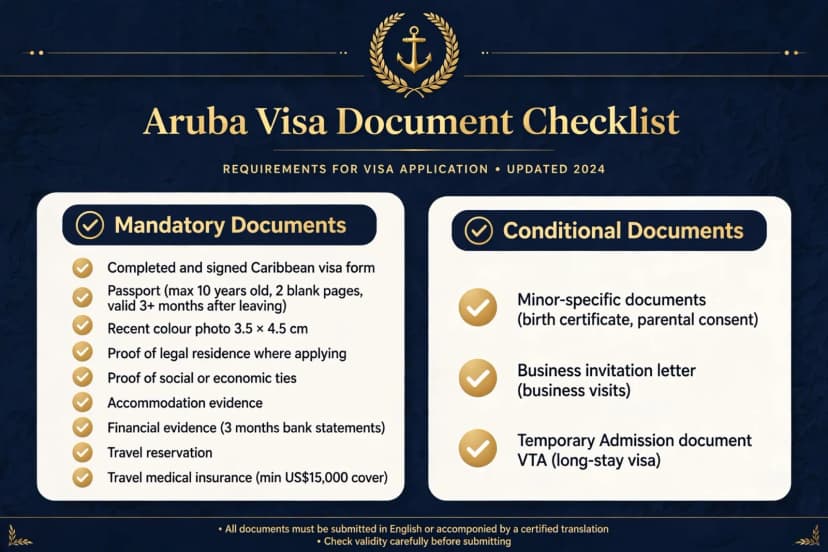
Complete Document Checklists
The following tables distinguish the official baseline from additional evidence that depends on the applicant's circumstances. The Dutch Ministry may request an interview or further documents. An incomplete application can be rejected and the fee is not refunded. Documents submitted for a Caribbean visa application in Vietnam must be in English or Dutch; documents in Vietnamese must be translated into English by a notary public office.
Short-stay tourism checklist
| Document | Status | Notes |
|---|---|---|
| Completed and signed Caribbean visa form | Mandatory | Print and submit original; details must match passport |
| Passport / travel document | Mandatory | No more than 10 years old; 2 blank pages; signed; valid at least 3 months after leaving the Caribbean parts of the Kingdom |
| Recent colour photo | Mandatory unless digital photo taken by provider | 3.5 by 4.5 cm, no more than 6 months old, light background |
| Proof of legal residence where applying | Mandatory | Residence permit, visa or work permit; for a Vietnam applicant, Vietnamese residence evidence |
| Proof of social or economic ties | Mandatory | Employment, business, study, property or family evidence as applicable |
| Accommodation evidence | Mandatory | Hotel or rental for entire stay, or proof of property or host details as relevant |
| Financial evidence | Mandatory | Usually 3 months of bank statements if self-funded; 3 recent payslips if employed |
| Travel reservation | Mandatory | Reservation in applicant's name; paid ticket not required |
| Travel medical insurance | Mandatory | Valid throughout Caribbean parts of Kingdom; at least US$15,000 cover including repatriation |
| Minor-specific documents | Conditional | Birth certificate, parental consent, guardian documents or court order where applicable |
Official source: the NetherlandsWorldwide tourism visa checklist.
Business and official visit additions
In addition to the personal, residence, ties and travel documents, provide an invitation from the company or event in the Caribbean part of the Kingdom stating the applicant's details, visit dates and purpose. For a trade fair or congress without a personal invitation, official guidance allows supporting evidence such as contracts, invoices, orders, annual accounts, commercial-register extracts and the event admission ticket. Official delegations may need an intergovernmental-organisation invitation and a note verbale or letter from the government body. A business visitor must not do productive work for an Aruban employer on this visa; if the trip involves actual employment, the DIMAS work route applies instead.
Study, event or family visit additions
Choose the official checklist matching the primary purpose: study, cultural, sporting or religious event, or family and friends. Expect to show event or institution details, invitation or host information and evidence of the relationship where relevant. For a family visit, evidence of the relationship and the host's status in Aruba is normally required. For a short study or event visit, the invitation or enrolment evidence and the programme dates are central. The exact list is purpose-specific; do not substitute a tourism checklist without checking the official page for your purpose, because a purpose mismatch is a common reason for refusal.
Long-stay visa checklist
For a long-stay visa to collect an approved residence permit, the applicant must first have applied for that residence permit. The general checklist includes the signed form, passport, photo and proof of legal residence where applying. For Aruba, the official checklist identifies the Temporary Admission document (VTA) as the purpose-of-travel evidence. Without the residence-permit application and the VTA, a long-stay application has no basis.
DIMAS residence permit documents
Residence permit documents vary by category. Work applicants may need the labour contract, legal documents, no-objection certificate, Form A, employer declaration and employer and employee registration evidence. Students need housing, judicial documentation, enrolment, institution declaration, solvency and private insurance. Family applicants need civil-status and relationship documents. Use the DIMAS downloads and forms page and the relevant category page; do not rely on the tourist-visa list for a residence application. DIMAS permit fees and deposits are category-specific and are not published as a single flat figure, so confirm the amount for your category on the live portal before paying.
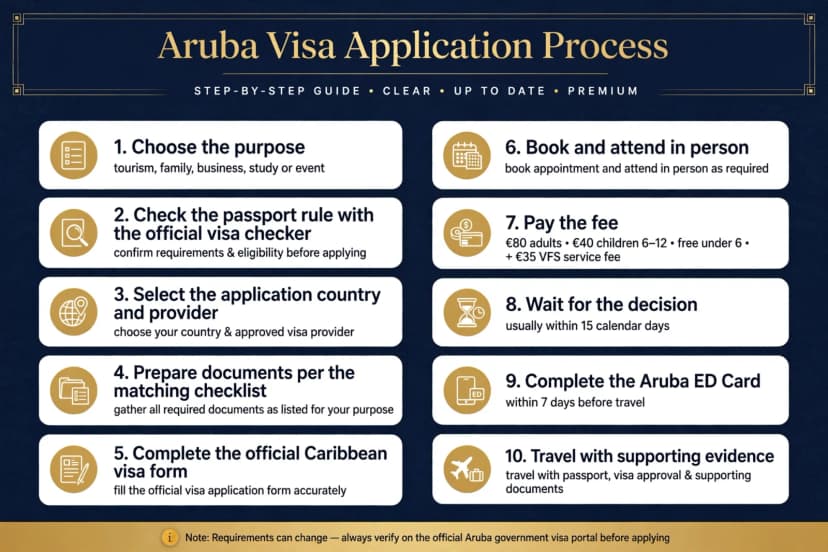
How to Apply: Step-by-Step
Short-stay Caribbean visa
- Choose the purpose. Identify tourism, family or friends, business or official visit, or study or event as the main purpose. The purpose decides which checklist you follow.
- Check the passport rule. Use the official Caribbean visa checker and review exemptions. Do not assume a Vietnamese residence card removes a nationality-based visa requirement.
- Select the application country. The NetherlandsWorldwide country page tells you where to apply and which provider is used. For Vietnam, that is VFS Global in Hanoi or Ho Chi Minh City.
- Prepare documents. Follow the matching checklist and provide original documents and colour copies as instructed. Translate Vietnamese documents into English through a notary public office.
- Complete the official form. Use the Caribbean visa application form on the Dutch consular services portal; check that all details match the passport and supporting evidence.
- Book and attend. In most cases applicants must attend in person, including children. An interview or extra documents may be requested.
- Pay the fee. Pay the official visa fee (80 euros for adults, 40 euros for children aged 6 to 11, free for children under 6) plus the 35-euro VFS service fee where applicable. Confirm the current amount and accepted payment method on the official country page before attending.
- Wait for the decision. Track updates through the application channel. Most cases are decided within 15 calendar days, but additional checks can take longer.
- Complete the Aruba ED Card. The ED Card is mandatory for each traveller and may be completed within 7 days before travel. Use the official ED Card portal only.
- Travel with supporting evidence. Carry accommodation, return or onward travel, funds, insurance and visa documents. Admission is decided by the Aruban border officer.
Residence permit route
For work, study, family or business residence, identify the correct DIMAS category, review its current checklist and submit through the DIMAS online portal when required. The DIMAS portal says applicants register, upload scanned documents, and pay applicable administration and processing fees and any deposit before completing the request. The portal's current policy notice and DIMAS category page should be checked for current submission rules. Do not buy a ticket or start work until the required authorisation is granted.
Common mistakes that cause refusals
Common problems include choosing a Schengen visa instead of a Caribbean visa; assuming a Vietnamese residence card waives a Pakistani passport's visa requirement; applying under the wrong purpose; submitting incomplete or untranslated documents; providing inconsistent employment, bank or travel details; failing to demonstrate ties to the country of residence; presenting a non-compliant passport or photograph; and failing to show accommodation, onward travel or adequate funds. A visa can also be refused where the authority is not satisfied about the purpose, credibility, supporting evidence or admissibility. The authority may request additional documents or an interview. No agency can guarantee approval, and any agent who promises a guaranteed visa should be treated as a warning sign. If an application is refused, read the refusal reasons carefully before reapplying, because a second application with the same gaps will fail the same way.
Visa Fees and Financial Requirements
| Item | Amount published in official material reviewed | What it covers |
|---|---|---|
| Caribbean visa application fee | 80 euros adults; 40 euros children aged 6 to 11; free under 6 | The visa itself; non-refundable if refused |
| VFS service fee | 35 euros | Separate provider charge, on top of the visa fee; confirm at booking |
| Aruba sustainability fee | US$20 | Per passenger arriving by air, paid through ED Card; exemptions apply |
| Minimum medical insurance | US$15,000 | Required minimum medical cover for visitor entry and visa checklist |
| Funds for hotel stay | US$150 to US$200 per person per day | General entry financial means benchmark |
| Funds when staying with family | US$100 per person per day | General entry financial means benchmark |
| DIMAS permit fee and deposit | Category-specific; check portal | Administration, processing and possible security deposit |
The visa fee and a conflict to note
The Caribbean visa fee is 80 euros for adults, 40 euros for children aged 6 to 11 and free for children under 6, with a 35-euro VFS service fee on top, per the NetherlandsWorldwide consular fees list for Vietnam for 2026 and the VFS Global fee table. There is a small conflict in the published material: the VFS Global one-pager describes the child band as 6 to 12 years, while the NetherlandsWorldwide consular fees list for Vietnam describes it as 6 to 11 years. This guide follows the NetherlandsWorldwide consular fees list, because it is the Dutch government's own fee publication for the country of application. The difference affects only children aged 12, who would pay the adult fee under the government list and the child fee under the VFS wording. If you are applying for a 12-year-old, confirm the amount in writing with VFS or the mission before paying. Fees can change, so confirm the current amount on the official fee page or at booking before paying. The visa fee is not refunded if the application is refused.
The sustainability fee
The official Aruba tourism authority describes a US$20 sustainability fee for visitors arriving by air, collected during the ED Card process. Since 1 December the fee payment is integrated into the online ED Card system and must be completed before ED Card approval, by credit card only. It is distinct from the visa fee and from the hotel levies. Children under 8 are exempt, as are Aruba residents, crew on duty and transit passengers staying under 24 hours under a transport agreement. There is also an exemption for repeat visitors, and here the published material conflicts: the Tourism Authority's FAQ describes the exemption as applying to a return within the same calendar year, while the fee collector, Aruba Wastewater Sustainable Solutions (AWSS), describes it as a return within one year of the last visit, applied automatically since 7 July 2025. This guide follows AWSS, because AWSS is the body that collects the fee and operates the exemption in the system. If the system does not recognise a repeat visit, the visitor pays again and may request a refund with proof from AWSS. Verify whether an exemption applies to you before payment, and use only the official ED Card portal: unofficial sites charge extra for the same form.
Financial means
The general published guidance refers to US$150 to US$200 per person per day for hotel accommodation or US$100 per person per day when staying with family. A sponsor may be responsible where accepted, through a declaration of guarantee from a legal resident of Aruba. The consular officer may assess the applicant's actual circumstances rather than applying a rigid daily figure, so bank statements, payslips and a coherent travel plan matter more than a single number. Show funds that cover the whole trip, including the return journey, and make sure the figures in the bank statements, the employer letter and the application form agree with each other. Inconsistency between documents is a frequent refusal trigger.
Processing Times and Validity
| Application | Official timing and validity information |
|---|---|
| Short-stay Caribbean visa from Vietnam | Most applicants informed within 15 calendar days; apply no earlier than 6 months before travel |
| Long-stay Caribbean visa from Vietnam | Most applicants informed within 15 calendar days |
| Short-stay visa validity and stay | Visa may allow up to 90 days in 180 days; border admission period can be shorter and Aruba local extension rules apply |
| Short-duration work permit (from 1 Dec 2026) | Government target of about two weeks for complete applications |
| Student, work and family residence | Permit-specific; no universal processing time safely established |
| DIMAS portal | Processing depends on request type, completeness and required payments |
Do not confuse visa validity (the period in which the visa can be used) with the number of days authorised for a particular stay. The NetherlandsWorldwide Vietnam short-stay page says the earliest application is 6 months before travel and that most applicants receive a decision within 15 calendar days. It also says personal submission is required and that applications can be made through VFS Global in Hanoi or Ho Chi Minh City. The 15-day figure is a normal-case estimate, not a guarantee: additional checks, a request for further documents, an interview or a busy period can extend it. Apply well before the travel date, and do not book non-refundable travel until the visa is in hand. For residence permits, DIMAS does not publish a single processing time, and recent reporting describes permit delays affecting businesses preparing for the December peak season, so employers and applicants should allow generous time and keep the application complete.
What to do while you wait
After submission, track the application through the channel VFS gave you and keep your phone and email reachable, because a request for extra documents or an interview can arrive at any point and usually carries a short deadline. Do not book non-refundable hotels or internal Caribbean travel until the visa is issued. If the stated time passes with no decision, contact VFS or the mission through the official channel and ask for a status update, keeping a record of the exchange. Do not pay any third party who offers to speed up the decision: VFS only accepts the application, the decision is made by the Consular Service Organisation in The Hague, and no payment to an intermediary can change it.
The Caribbean Carpet Programme
Eligible repeat travellers can register for the Caribbean Carpet Programme. Applicants must be aged 18 or over, need a visa, expect to travel to the Caribbean parts more than once in the next 4 years, and have ties with a person or organisation there. Participants only appear in person for the first application, need no flight or hotel proof, get priority processing, and can receive a visa valid for 1 to 4 years. Registration is not automatic, and it is not available to first-time travellers. If you expect to visit Aruba or another Caribbean part of the Kingdom repeatedly over the next few years, ask about the programme at your first application, because the long-validity visa it offers removes the need to reapply for each trip.
Applying from Vietnam: Pakistani Passport Holders
If you are a Pakistani national living or working in Vietnam
A Pakistani ordinary passport holder should first use the official nationality checker. The exemption information specifically identifies Pakistani diplomatic passport holders as exempt; it does not create a general exemption for ordinary Pakistani passports. A Vietnamese temporary residence card, work permit or visa does not itself appear among Aruba's listed visa-waiver residence documents. A valid residence permit from the Schengen territory, United States, Canada, United Kingdom or Ireland may qualify under the stated exemption rules, subject to their exact conditions.
For a short-stay Caribbean visa, the official NetherlandsWorldwide page for Vietnam says applications can be lodged through VFS Global in Hanoi or Ho Chi Minh City. Applicants must attend in person. Documents submitted must be in English or Dutch; documents in Vietnamese must be translated into English by a notary public office. The general checklist requires proof of legal residence in the country of application, normally valid at least 3 months after leaving the Caribbean parts of the Kingdom, and evidence of social or economic ties such as employment, salary, payslips and bank statements. A Pakistani applicant in Vietnam should therefore prepare:
- Pakistani passport meeting the passport rules;
- valid Vietnamese temporary residence card, visa and work permit, if applicable;
- employer letter stating role, contract duration and salary;
- recent payslips and bank statements;
- Vietnamese employment or business evidence and notarised English translations where needed;
- trip purpose, hotel or host evidence, travel reservation and travel medical insurance;
- any invitation or event evidence matching the primary purpose.
The applicant should verify VFS appointment availability, local fees, payment methods and any nationality-specific handling directly with the official Vietnam application page and the VFS booking system. A Vietnam residence permit establishes lawful residence; it does not guarantee visa approval or prove every other eligibility requirement. The strongest applications from Vietnam show stable employment or business, regular income, a clear travel purpose and a clear reason to return, because the decision-maker's central question is whether the applicant will leave Aruba at the end of the visit.
Practical points for applicants in Ho Chi Minh City and Hanoi
Ho Chi Minh City and Hanoi both have VFS Global centres handling Netherlands applications, and the Netherlands also has an embassy in Hanoi and a consulate-general in Ho Chi Minh City. For a standard Caribbean visa application, however, you go to VFS Global, not to the embassy or consulate-general: the Dutch missions in Vietnam do not accept standard visa applications directly. Book the appointment through the official VFS channel only. Appointment booking is free, and VFS has warned publicly against intermediaries who sell appointment slots or promise guaranteed approval. Bring originals and colour copies as instructed, and keep a complete copy of everything you submit. If you live outside Hanoi or Ho Chi Minh City, plan the trip to the centre as part of the application timeline, and remember that children must also attend in person in most cases.
If your employer or school is your sponsor
If an employer or institution in Vietnam is supporting the trip, a letter on official letterhead stating your role, your salary, the length of your employment, the approved leave dates and the purpose of the trip strengthens the application. If you are self-employed, business registration, tax evidence and bank statements serve the same purpose. If a host in Aruba is inviting you, the invitation should state the host's full details, your relationship, the visit dates and where you will stay, and the host should be ready to provide a declaration of guarantee if asked. A vague invitation with no dates, no address and no relationship stated adds little.
Applying from Pakistan
The official short-stay application page for Pakistan provides the application route and purpose-specific checklists. Applicants living in Pakistan should use that page rather than assume the Vietnam process applies. It also highlights the Caribbean Carpet Programme for eligible repeat travellers, as described above. The document logic is the same — passport, photo, proof of legal residence, ties, accommodation, finance, travel reservation and insurance — but the evidence of ties will be Pakistani employment, business, family and financial evidence rather than Vietnamese evidence, and the translation rules follow the local instructions on the Pakistan country page.
Pakistan versus Vietnam: practical difference
| Issue | Applying in Vietnam | Applying in Pakistan |
|---|---|---|
| Application location | VFS Hanoi or Ho Chi Minh City | Follow Pakistan country page and appointment instructions |
| Legal residence evidence | Vietnamese residence permit, visa or work permit | Evidence of residence in Pakistan |
| Additional ties | Vietnam employment, study, business, bank and salary evidence | Pakistan employment, business, family and financial ties as applicable |
| Language | Vietnamese documents need notarised English translation; documents in English or Dutch | Follow local document and translation rules |
| Processing estimate | Most cases: 15 calendar days | Check current country page |
| Repeat-travel facility | Caribbean Carpet Programme may be relevant | Caribbean Carpet Programme may be relevant |
Where you apply should follow where you legally live. A Pakistani national who lives in Vietnam should apply in Vietnam; a short visit to Pakistan does not normally make Pakistan the right place to apply, and the mission may direct you back to your country of residence. If your residence situation is unusual — for example, you are between visas in Vietnam, or you have recently moved — confirm the correct place of application in writing before booking an appointment, because an application lodged in the wrong jurisdiction can be refused without examination of its merits. Applicants in Pakistan should also check the Pakistan country page for the current appointment and submission instructions before travelling to a centre.
The Aruba ED Card and the Sustainability Fee
Every traveller to Aruba must complete the online Embarkation and Disembarkation (ED) Card, including infants and children, each with their own card. The ED Card is free, and it can be submitted only within 7 days before travel; attempting to complete it earlier will not work, and the practical advice is to do it 3 to 5 days before departure, so that there is time to correct an error. The approved ED Card, with its QR code, is checked by the airline before boarding and scanned by Aruban border control on arrival. Do not leave it for the boarding line.
The US$20 sustainability fee for air arrivals is paid inside the ED Card process, by credit card only — Visa, Mastercard or Discover — and the ED Card is not approved until the fee is paid where it applies. The fee applies to most visitors aged 8 and over. Exempt are Aruba residents, children under 8, crew on duty, transit passengers staying under 24 hours under a transport agreement, and repeat visitors returning within one year of their last visit, as described in the fees section. Cruise passengers generally do not need an ED Card, except passengers on vessels required to go through Aruba immigration. If your flight itinerary changes after you submit the ED Card, you will need to complete a new one with the updated details; if you have already paid the sustainability fee, the system recognises your passport number and does not charge you again. Use only the official portal at edcardaruba.aw. Any other website is unofficial and will charge additional fees on top of the US$20.
On the ED Card form you also state your intended length of stay. Visitors who own property in Aruba may indicate up to 180 days, and if the immigration officer grants the number of days requested, there is no need to visit DIMAS for an extension. Visitors without property should state a realistic number of days consistent with their visa and their return ticket, because the figure on the card is part of what the officer sees at the border.
Studying in Aruba
Secure admission to a listed qualifying institution and check whether the intended programme is full-time, because part-time study does not meet the published student-permit conditions. The DIMAS student page sets out an adult applicant requirement (18 or older), a solvency or guarantor requirement, housing, judicial documentation, enrolment evidence, an institutional declaration and private insurance. A student permit does not authorise paid employment, so a student who needs income must not plan on working in Aruba to fund the stay. A student wishing to remain after graduation must make a separate application assessed as a first-time administrative application, according to DIMAS, and should start that process before the student permit expires rather than after.
For a Pakistani student in Vietnam, the practical sequence is: admission first, then the DIMAS student residence permit application, then — once the permit is approved — a long-stay Caribbean visa to travel to Aruba to collect the permit. The long-stay visa requires the Temporary Admission document (VTA) as evidence of purpose. Do not apply for a short-stay tourist visa intending to study long-term: the tourist visa does not authorise enrolment as a resident student, and the mismatch can create problems at the border and with the institution. If the intended study is a short course or event of under 90 days, the short-stay visa with the study or event checklist may be the right route instead; the distinction turns on the length and nature of the programme, so confirm it with the institution and with DIMAS before choosing. Tuition, living costs and the solvency figure are set by the institution and by DIMAS for the permit category, not by a single published number, so ask the institution for its current fee schedule and the exact solvency evidence it expects, and keep the funding proof consistent across the admission letter, the permit application and the visa file.
Working, Family and Long-Term Residence in Aruba
Working in Aruba
A job offer alone is not permission to work. The employer and employee must follow the DIMAS work-and-residence procedure and comply with any labour-market review or exemption. Paid employment permits are tied to the employer and the specified job title. A permit should not be treated as open work authorisation, and changing employer or job normally requires a new process. Confirm the live process because the DIMAS portal has described a temporary policy change to direct submission since 24 April 2025, under which applicants no longer need to visit the Department of Labour for the labour-market test and may submit directly at DIMAS.
Recent changes — verify live before relying on them. DIMAS reiterated on 6 November 2026 that first-time regular work-permit applications for foreign workers remain suspended under Justice Minister Arthur Dowers, with exemptions only for listed professions, including highly educated professionals, hotel managers, chefs and kitchen staff, specialised technicians, IT professionals, education and healthcare workers, accountants, bakers, butchers and workers on qualifying short-term construction projects. The suspension was reiterated because the end of the Hunto pa Progreso programme had been misunderstood as reopening the route; it did not. From 1 December 2026 a temporary six-month work permit is available for foreign workers recruited from abroad, known as the short-duration work permit. It covers the hotel and tourism sector including restaurants, bars and catering; the wellness and beauty sector including spas, beauty salons and hair salons; cleaning and facility services; and airport-related activities including passenger service, baggage handling and customer service. The permit lasts a maximum of six months with no possibility of extension, the worker must come from abroad and must leave after six months, and any later application must be made from outside Aruba. To reapply in the same category the worker must have spent at least six months abroad. The employer applies to DIMAS, must be up to date with tax and social insurance obligations, and must provide insurance and complete documentation including a conduct certificate. The government has said it will aim to process complete applications within about two weeks. Because the portal notice, the DIMAS category page and these announcements describe different sequences, confirm the live workflow with DIMAS before applying, and treat any reported further policy changes for January 2027 as unconfirmed announcements rather than settled rules.
Remote work and the One Happy Workation programme
Aruba's One Happy Workation programme lets visitors work remotely for an employer or clients outside Aruba while staying on the island. It is important to state its limits plainly. The programme is open only to United States nationals with a valid passport. The minimum stay is one week and the maximum is 90 days. There is no separate application form: the visitor books a participating accommodation package and selects One Happy Workation as the purpose of visit on the ED Card. No government documentation is issued, because 90 days is already permissible for United States nationals. Participants must be employed or self-employed in their home country and may not render services to, or receive income from, an Aruban company or individual, as that requires a work or business permit. Pakistani passport holders cannot use this programme as a visa route: they still need a Caribbean visa where one is required, and they are admitted on the ordinary tourist terms described in this guide, with a standard admission of 30 days and the extension rules set out above. A Pakistani remote worker in Vietnam who wants to work from Aruba should therefore plan on the tourist admission framework, not on One Happy Workation, and should confirm the position in writing before travelling, because the programme's eligibility is nationality-based.
Business, investment and professional activity
Aruba has separate DIMAS categories for companies, investors and shareholders, professionals and short-term projects. An investor or shareholder may be eligible for an exemption from the labour-market test, and certain knowledge-based professionals may be exempt from a labour-market review. This does not mean every foreign business owner qualifies for residence, or that a visitor may operate a business without permission. Use the official category-specific criteria, and expect the application to turn on the actual investment, the business plan and the category conditions, not on a general claim of being an entrepreneur.
Family reunification and family formation
A spouse, registered partner or child may qualify depending on the sponsor's legal status, the length and nature of residence, and the timing of the family relationship. DIMAS distinguishes reunification, where the relationship existed before the sponsor settled in Aruba, from family formation, where the relationship was created after settlement. The family-reunification page identifies conditions for different sponsor groups, including sponsors with permanent status and sponsors with a temporary permit and at least three years of legal residence. Some family permits are issued without work rights. The family-reunification page lists civil-status documents, and minor children may need custody evidence and consent from the other parent. Ask DIMAS which category applies before making travel plans, and assemble the civil-status evidence early, because documents from Pakistan, such as marriage and birth certificates, may need attestation and translation, and that process takes time.
Permanent and indefinite residence
The DIMAS route for indefinite residence generally requires at least 10 years of legal residence (120 months), plus other criteria including population-register evidence and limits on certain absences. The permit for adults grants work permission. It is a long-term status, not an entry visa or a shortcut for new arrivals. There is no published route by which a visitor, a property purchase or a short stay leads directly to permanent residence. Anyone selling a shortcut to Aruban permanent residence should be treated with suspicion.
Official Websites
| Source | What it covers |
|---|---|
| NetherlandsWorldwide — Caribbean visa overview | The Caribbean visa framework for Aruba, Bonaire, Curacao, Saba, St Eustatius and St Maarten |
| NetherlandsWorldwide — Do I need a visa for the Caribbean parts of the Kingdom? | The official nationality checker and exemption list |
| NetherlandsWorldwide — Short-stay Caribbean visa | Short-stay visa rules, purposes and stay limits |
| NetherlandsWorldwide — Applying for a short-stay Caribbean visa in Vietnam | The Vietnam application route through VFS Global in Hanoi or Ho Chi Minh City |
| NetherlandsWorldwide — Applying for a short-stay Caribbean visa in Pakistan | The Pakistan application route and checklists |
| NetherlandsWorldwide — Tourism checklist (Caribbean visa) | The official tourism document checklist |
| NetherlandsWorldwide — Business and official visit checklist | Documents for business and official visits |
| NetherlandsWorldwide — Long-stay checklist (Caribbean visa) | Documents for the long-stay visa, including the VTA |
| NetherlandsWorldwide — Consular fees in Vietnam | The 2026 consular fee list: Caribbean visa 80 euros, child 6 to 11 years 40 euros, under 6 free |
| VFS Global — Caribbean visa information and fees | The VFS fee table: visa 80 euros, child 40 euros, service fee 35 euros |
| Dutch consular services — Caribbean visa application form | The official online application form for the Caribbean visa |
| DIMAS Aruba | Aruba's immigration department: residence, work, study and family permits |
| DIMAS — Paid employment | The work and residence permit route for paid employment |
| DIMAS — Student residence permit | The student permit: conditions, institutions and documents |
| DIMAS — Family reunification and family formation | Family residence categories and sponsor conditions |
| DIMAS — Residence for an indefinite period | The indefinite residence route after 10 years of legal residence |
| DIMAS — Online application portal | The portal for residence permit applications and status checks |
| Government of Aruba — Short-duration work permit | The six-month temporary work permit effective 1 December 2026 |
| Aruba.com — Immigration regulations and entry requirements | Admission periods, extensions, funds, insurance and the officer's final authority |
| Aruba ED Card — official portal | The mandatory online ED Card, completed within 7 days before travel |
Frequently Asked Questions
1. Do Pakistani citizens need a visa for Aruba?
Pakistani ordinary passport holders should assume a Caribbean visa is required unless they qualify for a specific official exemption. The listed exemption for Pakistan concerns diplomatic passports, not ordinary passports.
2. Is an Aruba visa the same as a Schengen visa?
No. A Caribbean visa for Aruba is not valid for the European Netherlands or other Schengen countries, and a Schengen visa does not authorise travel to Aruba. They are separate systems, applied for through separate routes.
3. Can a Pakistani living in Vietnam apply for an Aruba visa in Vietnam?
Yes. The official NetherlandsWorldwide page provides a short-stay application route in Vietnam through VFS Global in Hanoi or Ho Chi Minh City. Applicants must provide proof of legal residence and submit in person. Eligibility and approval remain case-specific.
4. Does a Vietnam residence card exempt me from an Aruba visa?
No general exemption is stated for a Vietnamese residence card. The listed residence-permit exemptions refer to the Schengen territory, United States, Canada, United Kingdom and Ireland, among other specific exemptions. Your Vietnamese residence card proves lawful residence where you apply; it does not waive the nationality-based visa requirement.
5. How long can I stay in Aruba on a Caribbean visa?
The short-stay Caribbean visa framework allows up to 90 days within a 180-day period. The Aruban border authority determines the actual admission period, and the standard admission for a tourist is 30 days, with local extension rules that can take a stay to 90 days, or to 180 days for property owners and Dutch nationals. Do not assume the visa sticker guarantees 90 days.
6. Can I work in Aruba with a tourist visa?
No. Paid employment requires the appropriate DIMAS work-and-residence authorisation. First-time regular work-permit applications remain suspended as of 6 November 2026, with exemptions for listed professions, and a temporary six-month permit for workers recruited from abroad takes effect on 1 December 2026. A tourist visa never authorises local employment.
7. Is there an Aruba student visa?
Students need a temporary residence permit from DIMAS, not a tourist visa. The published student route requires full-time study at a listed institution, solvency or a guarantor, housing and other supporting documents. It does not authorise paid work.
8. Can I work remotely from Aruba as a digital nomad?
There is no general Aruba digital-nomad visa. The One Happy Workation programme is open only to United States nationals, for 1 week to 90 days, with no separate form. Pakistani passport holders cannot use it as a visa route; they are admitted on ordinary tourist terms and must still hold a Caribbean visa where one is required.
9. What is the Aruba ED Card?
It is a mandatory online embarkation and disembarkation form for travellers entering Aruba. The official guidance says to complete it within 7 days before travel and obtain approval before departure. Every traveller, including infants and children, needs their own card.
10. How much is Aruba's sustainability fee?
The published fee is US$20 for visitors arriving by air, collected through the ED Card process and paid by credit card. Children under 8, Aruba residents, crew on duty, transit passengers under 24 hours and repeat visitors returning within one year of their last visit are exempt. Use only the official portal at edcardaruba.aw.
11. How much money should I show for Aruba?
The general published guidance refers to US$150 to US$200 per person per day for hotel accommodation or US$100 per person per day when staying with family. A sponsor may be responsible where accepted. The consular officer may assess the applicant's actual circumstances, so coherent bank statements, payslips and a realistic travel plan matter.
12. What insurance do I need?
The official entry and visa guidance specifies at least US$15,000 in medical cover, including hospital care, emergency treatment and repatriation. Check that the policy covers all Caribbean parts of the Kingdom and the entire trip, and note that insurance is expressly required for any extension beyond 30 days.
13. How long does an Aruba Caribbean visa take?
For applications in Vietnam, most applicants are informed within 15 calendar days. This is not a guarantee; additional checks or missing documents may extend the time. Apply no earlier than 6 months before travel and well before the departure date.
14. Can I settle permanently in Aruba?
DIMAS has an indefinite residence route that generally requires at least 10 years of qualifying legal residence and additional conditions. It is not available simply because someone visits, buys property or holds a tourist visa. There is no shortcut route to permanent residence.
15. Does a Caribbean visa let me visit Curacao or other Caribbean parts of the Kingdom?
Yes. The short-stay Caribbean visa is a regional visa for Aruba, Bonaire, Curacao, Saba, St Eustatius and St Maarten, subject to the visa's validity and entry conditions. It does not authorise travel to the European Netherlands or Schengen states.
This guide was checked on 29 November 2026 against the official sources listed above, including the NetherlandsWorldwide Caribbean visa pages, the 2026 consular fees list for Vietnam, the VFS Global fee table, the Aruba immigration regulations, the ED Card portal and DIMAS. Rules, fees and application arrangements can change without notice, so confirm every material point with NetherlandsWorldwide, DIMAS and the relevant application provider before acting. This guide is general information, not legal advice. The immigration officer makes the final decision on admission at the border, and this guide does not guarantee visa approval or entry.


