


By MAS Inspire | Last reviewed: 27 November 2026 (key figures re-verified 27 November 2026)
On this page
- Introduction
- Why visit, study and work
- Visa types
- Visa comparison
- Eligibility
- Document checklists
- Application steps
- Fees and finances
- Processing times
- Pakistan and Vietnam
- Student guide
- Work and jobs
- Family and residence
- Mistakes
- Refusals
- FAQs
- Official websites
- Final checklist
Introduction
Algeria, officially the People's Democratic Republic of Algeria, combines Mediterranean cities, Roman archaeological sites, mountain landscapes and vast Saharan regions. International visitors travel for tourism, family visits, commercial activity, study, cultural events and employment. The correct entry permission depends on nationality, passport type, purpose, intended duration and the country where the applicant legally resides.
Many foreign nationals must obtain a visa before travelling. Algeria's official system is primarily handled through its diplomatic and consular missions. Do not assume that an online form, an airline booking, a residence permit in another country or a visa issued by a neighbouring state replaces an Algerian visa.
This 2026 guide explains the categories confirmed by the Algerian MFA, the principal documents, the application process and the special position of Pakistani citizens legally living or working in Vietnam. It is an educational resource, not a promise of approval.
Why People Visit, Study, and Work in Algeria
Visitors come to explore Algiers, the Casbah, the Mediterranean coast, Roman-era sites such as Djémila and Timgad, the Aurès Mountains and the Sahara. Business travellers may attend meetings, inspect projects, negotiate contracts or meet Algerian commercial partners. Students may enrol in recognised Algerian educational institutions or participate in scholarship programmes. Foreign specialists may be engaged for projects that require the appropriate work authorisation.
The purpose must match the visa. A business visitor should not undertake paid employment on a business visa. A tourist visa is not a route to take up a job, and a study visa does not automatically create unrestricted employment rights.

Types of Algeria Visas
The MFA expressly identifies the categories below. Availability and supporting documents should be checked with the competent mission. The MFA does not publish a single exhaustive eligibility matrix or one fee schedule for every nationality.
1. Tourist visa
For leisure travel, sightseeing and private tourism. The official instructions require either a certificate of accommodation issued by a host and legalised by the relevant town hall, a hotel reservation, or a travel-agency certificate describing the nature and location of the trip. Travel insurance and the general application documents also apply. The tourist visa does not authorise employment.
The MFA mentions a 48-hour issuance timeframe for tourists travelling in an organised framework through travel agencies, counted after receipt of a complete file by the relevant diplomatic or consular post. This is a narrow provision, not a general service standard for all tourists. Separately, tourists on organised trips to the Great South (Sahara) with an approved Algerian travel agency can receive a visa on arrival for up to 30 days: the agency files the traveller's passport details in advance and issues a QR-code boarding authorisation, and the fee is paid on arrival. The trip must include at least one southern wilaya (for example Tamanrasset, Djanet, Illizi, Adrar, Timimoune, Bechar or Tindouf). This is an official measure, not an agency arrangement — confirm the current procedure with the agency and the MFA notice before relying on it.
2. Business visa
For business visits such as meetings, commercial discussions and partner visits. The MFA requires an employer mission letter or an invitation from the Algerian business partner, plus a hotel reservation or a support certificate from the inviting organisation. A mission-specific checklist may require further evidence. Business-visitor status is not permission to take a salaried position or perform work requiring a work authorisation.
3. Study visa
For a foreign national admitted to a public or private educational establishment approved by the Algerian State. The MFA identifies one of the following bases: an enrolment certificate; a scholarship certificate issued by Algerian authorities or the applicant's own country's authorities; or proof of means to pay for study and the stay. Language courses should be confirmed with the institution and the mission: the published general visa page does not establish a separate universal language-student category. The study visa itself is not a general work permit.
4. Work visa
For foreign nationals entering to take up authorised employment. The MFA lists three key supporting items: a Temporary Work Authorization, an employment contract and an undertaking to repatriate the foreign worker at the end of the employment relationship. The employer must coordinate the relevant authorisation under Algerian employment rules. A job offer alone is not enough to establish eligibility. The work visa and the subsequent foreign-resident card are distinct legal steps.
5. Temporary work visa
For a temporary work stay of no more than three months. The MFA specifies two alternative documentary routes:
- An assistance or service-provision contract. Under the published MFA instructions, this route does not require prior Provisional Authorization for Temporary Work (APTT).
- An employment contract, an APTT and a repatriation commitment.
The correct route depends on the actual contractual arrangement. Do not label ordinary paid employment as a service contract merely to avoid an authorisation requirement.
6. Family visa
For a qualifying family visit. The MFA requires an accommodation certificate prepared by a member of the applicant's Algerian family and legalised by the town hall for the host's place of accommodation. Ask the mission whether it needs proof of the relationship, the host's Algerian identity documents or additional civil-status records. A family visit visa should not be confused with a residence or family-reunification entitlement.
7. Medical visa
The MFA lists a medical visa category. The general page does not provide a detailed universal checklist, financial threshold, duration or fee. Applicants should ask the responsible mission and the Algerian medical provider for the required medical appointment/admission evidence, treatment plan, accommodation and payment arrangements. Do not infer that the tourist checklist alone is sufficient.
8. Cultural visa
For an invitation to a seminar or a cultural, scientific or sporting event. The MFA requires an invitation and proof of resources for the duration of the stay. The host or organiser should provide accurate event dates, venue and the nature of participation.
9. Transit visa
For a traveller transiting Algeria en route to another country where a visa is required, the MFA says the application should include evidence of the destination-country visa where applicable and proof of resources. The stated transit stay is up to seven days. Crew stopover permits of two to seven days are separately mentioned for ship and aircraft crews. Transit permission is not a general short-stay visitor visa.
10. Diplomatic, service, courtesy and press visas
These are official-purpose categories, not ordinary tourist or employment routes. Applicants should use the relevant government, diplomatic, institutional or media accreditation channel. Press applicants should check the specific accreditation and visa instructions with the Algerian mission.
Categories not verified as standalone Algerian visa routes
The official MFA category list does not identify a general job-seeker visa, digital-nomad visa, points-based skilled-worker visa, startup visa, or general entrepreneur visa. Do not market these as established Algerian visa categories. An investor may have investment-related procedures under Algerian law, but that does not create a generic investor visa on the published MFA list. Exchange, internship and researcher activities must be matched to the actual study, work, cultural or other category confirmed by the mission; no separate universal visa category was verified. Algeria's foreign-resident card is a residence document, not a visa. The official sources reviewed do not provide a general permanent-residence or settlement visa comparable to immigration systems that grant permanent status through a points route.
Humanitarian protection and asylum are distinct from ordinary consular visa categories. This guide does not treat them as a travel visa or offer individual asylum advice. People needing protection should seek qualified legal assistance and appropriate UNHCR or competent Algerian-authority guidance.
Visa Comparison Table
| Category | Main purpose | Key category evidence | Work rights | Fee / processing |
|---|---|---|---|---|
| Tourist | Leisure and sightseeing | Hotel, legalised host accommodation or travel-agency certificate | No employment | Mission-specific; not universally published |
| Business | Meetings and commercial visits | Employer mission letter or Algerian partner invitation; accommodation/support | No general paid-work right | Mission-specific |
| Study | Approved education | Enrolment, scholarship or proof of means | No automatic general work right | Mission-specific |
| Work | Employment | Temporary Work Authorization, employment contract, repatriation commitment | Only within authorised terms | Mission-specific |
| Temporary work | Work up to 3 months | Service contract OR employment contract + APTT + repatriation commitment | Limited to authorised assignment | Mission-specific |
| Family | Visit Algerian family | Host's legalised accommodation certificate | No employment right established | Mission-specific |
| Medical | Treatment | Confirm medical evidence with mission | No employment right | Not universally published |
| Cultural | Event, seminar, sport or science | Invitation and proof of resources | No general employment right | Mission-specific |
| Transit | Passing through Algeria | Destination visa where required and proof of resources | No employment right | Mission-specific; stay up to 7 days |
| Diplomatic/service/press | Official or media purpose | Mission-specific official documentation | Only within the official purpose | Mission-specific |
Eligibility Requirements
Eligibility is not determined by nationality alone. Before applying, establish:
- Whether your passport nationality is visa-exempt for the intended visit and whether any exemption is limited to diplomatic or official passports.
- Whether the Algerian mission accepts applications from your country of legal residence.
- Whether your passport meets the validity and blank-page requirements stated by that mission.
- Whether the stated purpose matches the selected category.
- Whether the required host, employer, school, travel agency or medical institution can provide verifiable evidence.
- Whether you can demonstrate the resources and insurance required for the category.
The MFA's general page states passport validity of at least six months. Missions can publish additional requirements, such as blank pages, typed forms, extra photographs or a minimum lead time. Follow the mission serving your residence, not a checklist copied from another country's embassy.
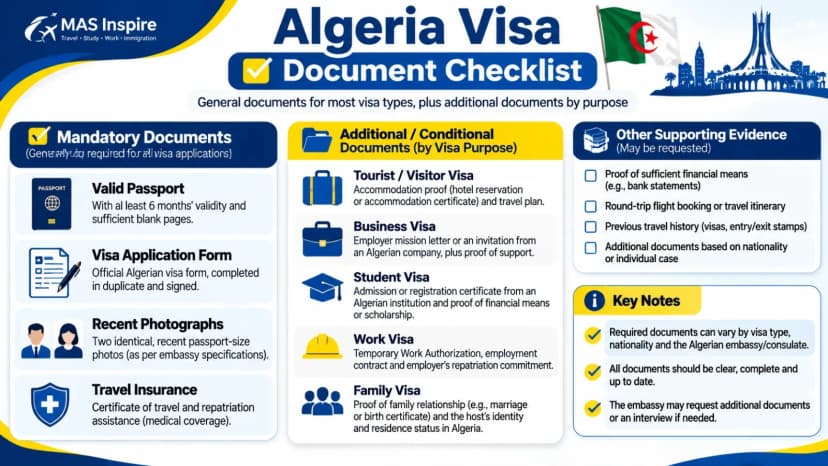
Complete Document Checklists
The following separates the general MFA requirements from category-specific evidence and prudent supporting material. A mission may request further documents.
General application documents
| Status | Document | Notes |
|---|---|---|
| Official general requirement | Passport | Valid at least six months under the MFA general instructions |
| Official general requirement | Passport photocopy | Include the identity page; ask whether used visa pages are also required |
| Official general requirement | Two recent identical identity photographs | Follow the mission's size/background specification |
| Official general requirement | Visa application form | Download from the responsible mission; complete in duplicate |
| Official general requirement | Travel and repatriation insurance certificate | Confirm dates and geographic coverage |
| Required for applicants resident outside country of origin | Residence card and photocopy | For Pakistani applicants in Vietnam, provide valid Vietnamese residence evidence |
| Supporting / mission-dependent | Flight itinerary, accommodation and travel plan | Confirm whether a paid ticket is required before purchase |
| Supporting / mission-dependent | Employment, business, financial or family evidence | Submit only genuine and relevant evidence |
Category-specific checklist
| Visa | Officially identified category evidence | Further evidence to confirm |
|---|---|---|
| Tourist | Legalised host accommodation certificate OR hotel booking OR travel-agency certificate | Itinerary, funds, return/onward travel if requested |
| Business | Employer mission letter OR Algerian partner invitation; hotel booking OR host-organisation support certificate | Company registration, role, meeting schedule, cost coverage |
| Study | Approved institution enrolment OR qualifying scholarship certificate OR proof of means for study and stay | Tuition/payment evidence, accommodation, academic records, language evidence if requested |
| Work | Temporary Work Authorization, employment contract, repatriation commitment | Employer records, qualifications, occupational approvals if applicable |
| Temporary work | Service/assistance contract OR employment contract + APTT + repatriation commitment | Assignment scope, duration and employer/contractor details |
| Family | Accommodation certificate from Algerian family member, legalised by relevant town hall | Relationship documents, host ID and address evidence if requested |
| Cultural | Invitation to seminar/event and proof of resources | Event programme, organiser details, employment/affiliation evidence if requested |
| Transit | Destination-country visa where required and proof of resources | Confirm route, tickets and whether transit visa is required |
| Medical | Not fully itemised on general MFA page | Medical appointment/admission, treatment plan, funding and accommodation; confirm with mission |
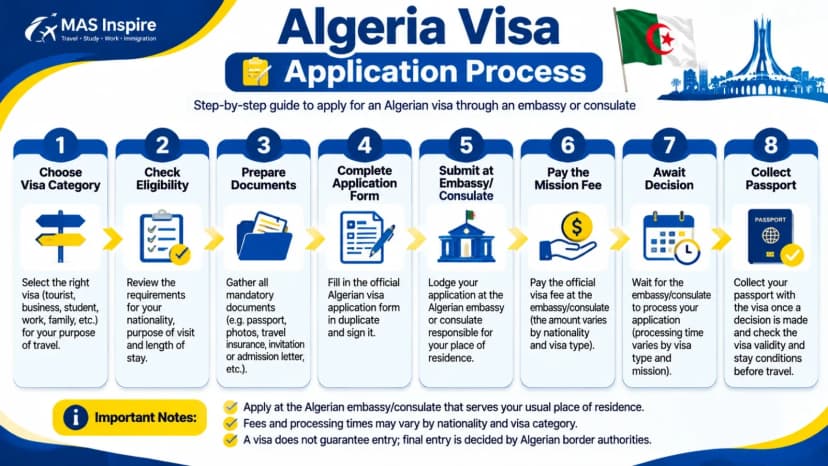
How to Apply: Step-by-Step
Algeria's process is mission-led. Not every application uses an online account, upload portal, biometrics appointment or online tracking system.
Step 1 — Choose the correct visa category. Define the real purpose: tourism, business meetings, study, employment, family visit, medical treatment, cultural event or transit. Do not use a visitor category to conceal work.
Step 2 — Check nationality and residence. Check exemptions and passport-type rules with the Algerian MFA or mission. If applying outside your country of nationality, confirm that the mission accepts residents of your current country and prepare your residence card.
Step 3 — Obtain the current checklist. Download the form and instructions from the responsible embassy/consulate. Ask about photographs, number of copies, translation, legalisation, insurance wording, appointment and accepted payment method.
Step 4 — Create an account only if the mission requires one. The general MFA instructions direct applicants to diplomatic/consular posts and do not establish a universal online visa account. Do not use unofficial agents' websites as government portals.
Step 5 — Complete the correct form. Use the form for the selected visa category. The MFA says forms are completed in duplicate. Check that names, passport numbers, dates, host details and travel purpose match the supporting documents.
Step 6 — Assemble evidence and confirm the fee. Include the general documents and category-specific evidence. Ask the mission for the exact fee in the applicable currency, payment method and whether the fee is refundable. Fees vary by nationality and reciprocity.
Step 7 — Arrange biometrics or an interview only if instructed. The general MFA page does not publish a universal biometric or interview requirement. Follow the mission's instructions; do not assume either is always required or never required.
Step 8 — Submit the application. Submit to the mission responsible for your usual residence, using its accepted in-person, representative or postal process. Retain the receipt and copies.
Step 9 — Follow the mission's status instructions. No universal online tracking portal or standard processing period was verified. Contact the mission using the reference or receipt details it provides. Avoid repeated unrequested enquiries.
Step 10 — Check the visa and entry conditions. On return of the passport, verify spelling, passport number, validity dates, number of entries and permitted stay. Carry accommodation, invitation, insurance and onward-travel evidence. A visa does not remove border-control discretion.
Visa Fees and Financial Requirements
Algeria does not publish one universal consular fee applicable to every nationality. The MFA explicitly says fees vary by country and that nationals of certain countries may be exempt under reciprocity. A consulate may also vary the amount by visa category, validity, number of entries, age or local payment rules. For example, individual Algerian missions publish fee schedules for the nationalities within their jurisdiction; those figures must not be transplanted to Pakistani applicants in Vietnam.
| Item | Amount / rule verified | What it covers |
|---|---|---|
| Consular visa fee | Varies by nationality and mission; exact amount not universally published | Visa application processing |
| Great South visa on arrival | Fee paid on arrival (amount varies; confirm with the agency) | Up to 30 days for organised Sahara tours via an approved agency |
| Tourist financial evidence | No universal minimum officially stated on the MFA page | Resources for the trip, if requested by mission |
| Study financial evidence | Proof of means to pay for study and stay is one permitted basis if not relying on a scholarship | Tuition and living costs |
| Cultural visa financial evidence | Proof of resources for the stay | Event-related visit |
| Transit financial evidence | Proof of resources | Transit period |
| Foreign-resident card stamp | The Ministry of Interior's French page refers to a fiscal stamp; amount must be confirmed from current applicable rules | Residence-card application |
Do not rely on amounts quoted by travel agencies, old embassy pages or another nationality's consulate as the fee for your application. Obtain the exact amount and accepted payment method in writing from the mission where you will lodge the application. Unofficial agency estimates for Pakistani applicants circulate (around €40 for a tourist visa, per a guide checked October 2026) — treat any such figure as an estimate only and pay only the amount the mission states.
Visa Processing Times
There is no single processing time for all Algerian visa applications in the official general guidance reviewed. Processing can depend on nationality, category, completeness, season, security or administrative consultation and the responsible mission. The MFA's 48-hour statement is specifically for organised tourists applying through travel agencies after the complete file has been received. It is not a general promise for individual tourist, business, work or study applicants.
Do not buy non-refundable tickets based on an assumed processing period. Ask the mission for its current estimate and whether prior approval from Algerian authorities may be required.
Applying from Pakistan or Vietnam
Pakistani passport holders
Pakistani ordinary passport holders should plan on obtaining an Algerian visa before travel unless the Algerian authorities confirm a specific exemption applicable to their passport. Pakistan's official FIA list of visa-abolition agreements identifies Algeria's three-month exemption as applying to diplomatic and official passport holders, not ordinary passports. The Algerian Embassy in Islamabad publishes the same general Algerian visa instructions as the MFA. Pakistani travellers should also carry a NADRA polio vaccination certificate — Pakistan requires it for outbound travel.
Official references: Pakistan FIA visa-abolition list and Embassy of Algeria in Islamabad.
Pakistani citizens legally living or working in Vietnam
The Algerian Embassy in Hanoi is the relevant first contact for a Pakistani national who is legally resident in Vietnam. Its published instructions state that visa applications should be lodged with the embassy or consulate for the applicant's usual place of residence. They also state that an applicant originating from a foreign country and residing in the host country must provide the residence card and a copy.
This supports making an enquiry to the Hanoi Embassy; it does not prove that every Pakistani applicant will automatically be accepted for every visa category. Before preparing a submission, email or telephone the embassy and ask it to confirm:
- Whether it accepts an application from a Pakistani ordinary-passport holder resident in Vietnam;
- Whether the applicant's Vietnamese temporary residence card, permanent residence card or other status document is accepted;
- Whether the applicant must submit in person or may use a representative;
- The current visa fee for a Pakistani national and the payment currency/method;
- The exact number and format of forms and photographs;
- Whether additional nationality-specific documents, police records, translations or legalisations are required;
- Whether prior approval or an interview is likely for the intended category.
Embassy of Algeria in Hanoi: 13 Phan Chu Trinh, Hoan Kiem, Hanoi, Vietnam. Telephone: +84 24 3933 2151. Email: ambassade@amb-algerie.vn. Published working hours on its contact page: Monday to Friday, 09:00–16:00, excluding national and religious holidays. Confirm current consular intake hours before attending. Official contact page.
Applying in Pakistan versus Vietnam
| Issue | Applying in Pakistan | Applying in Vietnam |
|---|---|---|
| Mission | Embassy of Algeria in Islamabad | Embassy of Algeria in Hanoi; confirm jurisdiction and acceptance |
| Residence evidence | Normally evidence of residence in Pakistan may be relevant | Vietnamese residence card and copy are expressly identified for foreign nationals resident in the host country |
| Nationality | Pakistani ordinary passport | Still a Pakistani passport; Vietnam residence does not change nationality-based rules |
| Fee | Ask Islamabad for the current Pakistani-national fee | Ask Hanoi for the current Pakistani-national fee; do not assume it matches Islamabad |
| Additional checks | Follow Islamabad's current instructions | Confirm acceptance, local legal status, translations and any extra checks before applying |
A Vietnamese work permit, temporary residence card or employer letter does not guarantee Algerian visa approval. It is evidence of lawful residence and may support local jurisdiction; the Algerian mission decides whether it can accept and approve the application.
Student Visa Guide
A study visa requires a genuine educational purpose and evidence connected to an Algerian institution recognised by the Algerian State. The MFA identifies three possible evidentiary bases: a registration certificate from an approved public or private educational institution; a scholarship certificate from Algerian authorities or the applicant's own country; or proof of financial means to pay for studies and the stay.
Before applying, obtain written admission and confirm the exact programme, attendance dates, tuition, accommodation and language of instruction. Ask the institution whether it assists with visa documentation. Prepare academic transcripts and certificates if the embassy requests them, but do not treat every supporting document as a universal statutory requirement. The general MFA page does not publish a fixed bank balance or standard student visa processing time.
A study visa is not itself a blanket work authorisation. Students should obtain written guidance from the competent Algerian authorities before accepting paid employment or an internship.
Work Visa and Job Opportunities
A foreign national intending to work in Algeria must follow the work authorisation framework, not simply enter as a visitor. The Algerian MFA identifies a Temporary Work Authorization, employment contract and repatriation commitment as core work-visa documents. The Ministry of Labour lists Law No. 81-10 of 11 July 1981 on employment of foreign workers and Decree No. 82-510 of 25 December 1982 on work permits and temporary work authorisations among the governing instruments.
For temporary assignments not exceeding three months, the MFA distinguishes a service/assistance contract route (without prior APTT under the published instructions) from an employment-contract route requiring APTT and a repatriation commitment. Employers should obtain advice from the relevant labour authority before the worker travels. The foreign worker should not start duties until the required authorisation and immigration status are in place.
The Ministry of Interior's foreign-resident-card guidance lists a work permit, temporary work authorisation or qualifying foreign-worker employment declaration among the employment-related documents that may support a resident-card application. This reinforces that a visa, work authorisation and residence card are separate legal instruments.
No general Algeria job-seeker visa, points-based skilled-migration visa or digital-nomad visa was found in the official MFA visa list reviewed. A job offer or remote-work arrangement should not be assumed to create an entry or residence right.
Family Immigration and Permanent Residence
A family visa is listed by the MFA for a visit and requires an accommodation certificate prepared by a member of the Algerian family and legalised by the relevant town hall. The public visa page does not fully explain every family-reunification route, spouse residence right or documentary rule. Applicants seeking to live with family in Algeria should ask the embassy and local authorities whether the case requires a family visa followed by a resident-card application or another procedure.
The Ministry of Interior says a foreigner wishing to establish residence should apply for a foreign-resident card through the competent security services. Its published French page says the application should be made 15 days before visa expiry. The listed documents include a local form, birth certificate, five recent photographs, fiscal stamp, medical certificate, passport copy bearing the entry visa where applicable, and residential lease. Depending on the case, it also lists work authorisation, school/university enrolment, evidence of commercial/professional activity or proof of means of subsistence.
The same ministry page describes the ordinary resident card as valid for two years, or for the validity of the document authorising the person's presence. An Arabic Ministry of Interior page describes a 10-year card for a foreign national who proves continuous lawful residence for at least seven years, and qualifying accompanying children. Because the detailed long-term provision is available in Arabic and may depend on legal conditions, obtain direct confirmation from the local authority; do not advertise it as automatic permanent residence or citizenship.
Common Application Mistakes
- Applying to a mission that does not serve the applicant's usual residence.
- Assuming residence in Vietnam changes a Pakistani applicant's nationality-based visa rules.
- Submitting an expired or insufficiently valid passport.
- Using a generic application form instead of the current mission form.
- Providing accommodation evidence that is not legalised when legalisation is required.
- Using a business invitation for a trip that is actually employment.
- Omitting the work authorisation or repatriation commitment for an employment visa.
- Treating a service contract as a substitute for an employment contract when the facts do not support that classification.
- Assuming the visa fee is the same in every country.
- Assuming 48-hour processing applies to every tourist application.
- Booking non-refundable travel before the mission confirms the procedure.
- Submitting inconsistent dates, names, addresses or financial evidence.
- Providing false, altered or misleading documents.
Reasons for Visa Refusal or Delay
The general MFA page does not publish a complete list of refusal grounds. Common practical risks include incomplete files, a mismatch between purpose and category, insufficient or unverifiable invitation/accommodation evidence, unclear funding, inadequate insurance, passport problems, missing residence evidence for an overseas application, doubts about the genuineness of documents, or a need for additional checks. These are risk factors, not a claim that every one is a formal statutory ground in every case.
Some missions state that refusal reasons are not always communicated and fees may be non-refundable. Applicants should use genuine evidence, answer questions accurately and avoid submitting fabricated documents. If refused, ask the mission whether a reason or reapplication guidance can be provided; do not assume an appeal mechanism or deadline without checking the applicable rules.
Frequently Asked Questions
1. Do Pakistani citizens need a visa for Algeria?
Ordinary Pakistani passport holders should obtain a visa before travel. Pakistan's official visa-abolition list identifies the Algeria exemption for diplomatic and official passport holders, not ordinary passports.
2. Can a Pakistani citizen apply for an Algerian visa in Vietnam?
The Algerian Embassy in Hanoi publishes a process for applications by foreign nationals resident in the host country and asks for a residence card and copy. A Pakistani resident should contact the embassy first to confirm acceptance and category-specific requirements.
3. Does a Vietnamese residence card guarantee an Algerian visa?
No. It supports proof of legal residence and may establish the appropriate consular location. It does not guarantee acceptance or approval.
4. How long must my passport be valid?
The Algerian MFA's general instructions say at least six months. Check whether the responsible mission imposes additional requirements.
5. What documents are generally required?
The MFA lists a passport, photocopy, two recent identical photos, application form completed in duplicate and travel/repatriation insurance. Add the category-specific documents and local mission requirements.
6. How much does an Algeria visa cost?
There is no single universal fee. The MFA says consular fees vary by country and reciprocity. Ask the mission where you apply for the exact fee and payment method.
7. Is there an Algeria eVisa?
The official general instructions reviewed direct applicants to diplomatic and consular posts and mission-specific forms. No general eVisa application route was verified in the official sources reviewed.
8. How long can I stay in Algeria?
The MFA states a maximum of 90 days per entry, with an exceptional extension not exceeding a further 90 days, and a cumulative stay not exceeding 180 days per year. Your visa sticker and category conditions control.
9. Is a tourist visa extendable?
The MFA says an extension may be possible in Algeria under certain conditions. Approval is not automatic; contact the competent local authority before the authorised stay expires.
10. Can I work in Algeria on a business visa?
A business visa should not be treated as work authorisation. Employment requires the relevant work authorisation and work visa process.
11. What is the difference between a work visa and a temporary work visa?
The standard work visa requires a Temporary Work Authorization, employment contract and repatriation commitment. A temporary work visa is for up to three months and has two alternative document routes described by the MFA.
12. Can I study in Algeria?
Yes, the MFA lists a study visa for applicants with an approved institution's registration certificate, a qualifying scholarship certificate or proof of means to pay for study and stay.
13. Is there a digital nomad visa?
No standalone digital-nomad category was identified in the official MFA visa list reviewed. Do not assume remote work is authorised under a tourist visa.
14. Is there a job-seeker visa or points-based skilled-worker programme?
Neither category appears in the official MFA visa list reviewed. Employment generally requires an employer and the relevant authorisation.
15. Does Algeria offer permanent residence?
The official materials reviewed describe a foreign-resident card, normally valid for two years or tied to the underlying authorisation. A separate Arabic Ministry of Interior page describes a 10-year card after at least seven years of continuous lawful residence, subject to conditions. This is not an automatic permanent-residence or citizenship grant.
Official Immigration Websites
- Algerian Ministry of Foreign Affairs — Entry visa
- Algerian MFA — Embassies and consulates directory
- Embassy of Algeria in Hanoi
- Hanoi Embassy — Visa instructions
- Hanoi Embassy — Contact details
- Embassy of Algeria in Islamabad
- Algerian Ministry of Interior — Foreign resident card
- Algerian Ministry of Labour — Employment legislation
- Pakistan Federal Investigation Agency — Visa abolition agreements
Final Checklist and Conclusion
Before submitting:
- [ ] Confirm whether your nationality and passport type require a visa.
- [ ] Select the category matching the real purpose of travel.
- [ ] Contact the mission responsible for your usual legal residence.
- [ ] If applying outside your country of nationality, include the residence card and copy.
- [ ] Check passport validity and mission-specific blank-page rules.
- [ ] Download and complete the current application form in the required number of copies.
- [ ] Prepare photographs, passport copy and travel/repatriation insurance.
- [ ] Obtain the correct invitation, accommodation, enrolment, work or transit evidence.
- [ ] Confirm the exact consular fee, currency and payment method.
- [ ] Confirm appointment, interview, biometrics and submission arrangements.
- [ ] Do not rely on an unverified processing estimate.
- [ ] Check the visa sticker and permitted stay before travel.
Algeria offers several clearly defined consular visa categories, but the detailed process is administered through its overseas missions. The most important practical step is to apply through the mission responsible for your usual residence and obtain its current category-specific checklist. For Pakistani passport holders living or working in Vietnam, the Algerian Embassy in Hanoi is the appropriate first point of contact, but local acceptance and exact requirements must be confirmed before submission.
Disclaimer: This article is for general educational purposes and is not legal advice, immigration representation or a guarantee of visa approval. Requirements, fees and procedures can change. Always verify the current rules with the Algerian government or the responsible embassy/consulate before acting.


