Syria Visa Guide 2026: Types, Requirements, Documents and Application Steps
Last checked: 28 November 2026. This guide is for Pakistani passport holders living in Vietnam. Visa rules change without notice — always confirm the live rules with the Syrian embassy in Islamabad or the Syrian embassy in Beijing (accredited to Vietnam) and with your airline before paying any fee or booking a non-refundable ticket.
Introduction
Syria is not a normal tourist destination in 2026, and this guide does not pretend otherwise. The country is rebuilding after thirteen years of civil war and a change of government in December 2024, flights to Damascus and Aleppo have resumed, and visitor numbers are rising fast — the tourism ministry reported about 719,000 foreign visitors in the first half of 2026, against 131,000 in the same period of 2025. At the same time, the United States rates Syria Level 4, "Do Not Travel", the United Kingdom advises against all travel to Syria, and Canada tells its citizens to avoid all travel there. Those warnings have not been lowered since the change of government. If you are a Pakistani passport holder living in Vietnam and you are considering Syria — for family, for ziyarat (religious pilgrimage), for business, or for tourism — read the safety section of this guide first, then read the visa rules, because the two are inseparable here: the visa system itself is in transition, official sources contradict each other, and a mistake at the border can mean being turned back.
The single most important fact about the Syrian visa in 2026 is that there is no single reliable route that works the same way for every nationality. The official e-visa portal, evisa.sy, shows only a "Coming Soon" message and is not accepting applications, and Syrian embassies generally do not issue tourist visas. Most visitors in practice get a visa on arrival at Damascus airport or at a land border and pay the fee in US-dollar cash. But Pakistani passport holders are on the restricted list: multiple 2026 sources say Pakistanis need prior approval — a security clearance arranged in advance through a licensed Syrian travel agency or sponsor — before travelling, typically taking three to four weeks. After approval, the visa itself is issued and paid for at the port of entry. That is the route this guide explains, with every conflict flagged in the open, because for Syria in 2026 the honest answer to several questions is that no official source has published one.
Do Pakistani Passport Holders Need a Visa for Syria?
Yes. Pakistani passport holders need a visa to enter Syria. There is no visa-free entry for Pakistani ordinary passport holders, and no exemption applies to Pakistan under the current rules. The visa-free list under the transitional government's Decision No. 128 of 1 July 2025 is short — Lebanon, Jordan, Malaysia and Mauritania need no visa, and Serbia enters free — and Pakistan is not on it. Pakistan sits in Group 3 of the Decision No. 128 fee schedule, which means a visa is required and a fee is payable.
What is genuinely disputed is not whether you need a visa, but how you get one. Three different answers circulate, and all three come from sources that are at least partly official:
- Answer one — visa on arrival. Most visitors get their visa at the airport or land border and pay in cash. This is how the system works in practice for most nationalities in 2026, and it is the route described by the main 2026 travel guides. The visa typically stamped on arrival is reported as a 15-day single-entry tourist visa, although the Decision No. 128 schedule prices a one-month single-entry visa — a conflict this guide reports in full below.
- Answer two — prior approval first, visa at the border. For Pakistanis specifically, the consistent 2026 reporting is that you need advance approval — a security clearance obtained through a licensed Syrian travel agency or sponsor, or through the Immigration and Passports Department — before you travel, typically taking three to four weeks. Once approved, the visa is issued and paid for at the port of entry at the Decision No. 128 Group 3 fee. This is the route a Pakistani applicant should plan around, because it is the only one that accounts for Pakistan being on the restricted-nationalities list.
- Answer three — visa from a Syrian embassy before departure. The Government of Canada's travel advice states that non-Arab nationals cannot obtain a visa at border points of entry and must obtain one from the nearest Syrian embassy or consulate before departure. The US State Department's country information (updated 11 August 2026) likewise says visas must be obtained before arrival from a Syrian diplomatic mission. The Syrian civil aviation authority's published entry rule says the same thing: an entry visa obtained in advance from a Syrian diplomatic mission, unless exempt. Against that, the 2026 travel guides report that Syrian embassies generally do not issue tourist visas at all, with the exception of the Syrian embassy in Washington DC, which may process requests from US citizens.
This guide does not pick one of these answers and hide the other two. The safe reading for a Pakistani passport holder is to treat prior approval as mandatory, to contact the Syrian embassy in Islamabad or the Syrian embassy in Beijing before booking anything, and to confirm the boarding rules with the airline in writing — because airlines have refused boarding to passengers who arrived at the airport without the right pre-arrangement, and because in November 2026 the rules changed overnight at least once (see the section on what changed).
Two hard entry bars apply regardless of route. First, holders of Israeli or Iranian citizenship cannot enter Syria, according to the UK Foreign, Commonwealth & Development Office (FCDO). Second, if your passport shows previous travel to Israel, you may be refused entry — and the detailed reporting goes further: any Israeli visa or stamp in the passport, or an Egyptian or Jordanian land-border stamp from a crossing adjoining Israel (Taba, Wadi Araba, or the Allenby/King Hussein Bridge), means refusal of entry and transit. If your passport carries any such stamp, do not travel on that passport; if you hold a second valid passport without such stamps, seek the embassy's advice on which to use, and never attempt to hide a stamp.
What Changed in December 2024 — and Why Old Guides Are Dangerous
On 8 December 2024, the government of Bashar al-Assad fell after opposition forces took Damascus. Ahmed al-Sharaa was named transitional president on 29 January 2025. The institutions that ran the old visa system were reorganised, and much of what was published about Syrian visas before December 2024 is now history, not current information. Any guide, agency page or forum post dated before December 2024 should be treated as background only. In particular:
- The e-visa was a product of the old government. The electronic visa service was launched on 1 May 2024 under the Assad government, built jointly by the ministries of Tourism, Communications, Interior and Foreign Affairs, and applications were submitted through evisa.sy. A few months later that government was gone. The portal has not worked since the transition: Internet Archive captures of 28 August and 1 October 2026 show only a "Coming Soon" message and no application form, and multiple checks in September and October 2026 found the same. It is not currently possible to apply for a tourist e-visa through the official portal.
- The new fee schedule dates from July 2025. Decision No. 128 of the Ministry of Foreign Affairs and Expatriates, issued 1 July 2025 and in force from 6 July 2025, sets visa fees by nationality group. On 29 April 2026 the ministry told the official SANA news agency that nothing in the decision had changed and entry still followed Decision No. 128 without any change. That makes Decision No. 128 the controlling fee document for 2026 — but its full text has not been published on an official Syrian website that this guide could read, and the fee table circulates through secondary reporting of the decision. The figures in this guide are therefore presented as the Decision No. 128 schedule as reported, not as figures read on an official Syrian page.
- Sanctions have changed substantially. The United States terminated its Syria sanctions programme (Executive Order 14312, June 2025), Congress repealed the Caesar Act in December 2025, and the State Sponsor of Terrorism designation was rescinded on 24 August 2026. That matters for banking and for airlines returning to Damascus, but it has not changed the travel advisories: the US Level 4 rating, the FCDO advice against all travel, and Canada's avoid-all-travel advice all remain in force.
- The rules moved overnight in November 2026. In November 2026 there was confusion about new rules requiring all foreign travellers to have pre-approval before travelling to Syria. Travellers of various nationalities were refused entry at various entry points, while others were permitted to enter as normal. As of 13 November 2026 those new rules had been scrapped and normal entry procedures were restored, according to the Foreign Minister's confirmation reported at the time. The episode is a warning, not an anecdote: a rule that is true on Monday can be different on Friday, and no guide — including this one — can substitute for a check with the embassy and the airline in the days before departure.
- A new currency is in circulation. A new Syrian pound was introduced in 2026, with 100 old pounds equal to 1 new pound. Prices quoted in Syrian pounds in older sources may be in the old currency. Visa fees themselves are set in US dollars, so this does not change the visa fee, but it matters for everything else you pay for inside Syria.
Safety First: The Official Advice in 2026
- United States — Level 4: Do Not Travel. The US State Department's Syria travel advisory, reissued on 23 October 2026, is Level 4, the highest level: "Do not travel to Syria for any reason due to the risk of terrorism, civil unrest, kidnapping, hostage taking, crime, and armed conflict." The US government suspended embassy operations in Syria in 2012, and the Czech Republic serves as the protecting power for the United States in Syria. The US government is unable to provide routine or emergency consular services to US citizens in Syria.
- United Kingdom — advises against all travel. The FCDO advises against all travel to Syria due to unpredictable security conditions and the threat of terrorist attacks. The advice covers the whole country, including Damascus and Aleppo, and was updated on 2 September 2026. The FCDO warns that your travel insurance could be invalidated if you travel against its advice, that there is no British consular support inside Syria, and that Daesh carries out regular attacks across the country, including in Damascus, naming hotels, cafes, markets, transport hubs, government sites and places of worship as potential targets. British nationals who need help are told to call the FCDO in London on +44 (0)20 7008 5000.
- Canada — avoid all travel. Canada's advice (last updated 23 July 2026) is "Avoid all travel to Syria due to the volatile security situation in the region, armed clashes and airstrikes, criminality, kidnappings and the threat of terrorism." Canadians in Syria are told they should leave.
- Australia likewise advises against all travel to Syria.
The pattern across the four governments above is unanimous, and none of them has lowered its advice since the change of government. A bombing near a Damascus hotel in July 2026 made international news. The FCDO notes intermittent electricity, internet and mobile service in many areas, checkpoints on major routes, and advises against driving at night.
If you still decide to travel — for example for an urgent family reason or ziyarat — take these steps, all of which follow directly from the official advice above:
- Get travel insurance in writing that covers Syria specifically, including medical evacuation. A standard policy that excludes countries under a Level 4 or "advise against all travel" warning will not pay out. Ask the insurer in writing before you buy.
- Tell your family your exact itinerary, hotel and return date, and keep your passport photo page, visa and insurance details copied to them and to your own email.
- Carry cash in US dollars. Cards are unreliable even though foreign Visa and Mastercard have been reported working at about 4,200 terminals in Damascus and Aleppo since 27 August 2026 — mostly in upscale hotels and large stores. Do not rely on ATMs.
- Register your presence with the Pakistani embassy responsible for Syria (see Section 10) before you travel, and keep its emergency number saved offline.
- Do not travel to the northeast, the northwest border areas, or anywhere near active front lines or military installations, and do not photograph military or security sites.
Types of Syria Visas for Pakistani Passport Holders
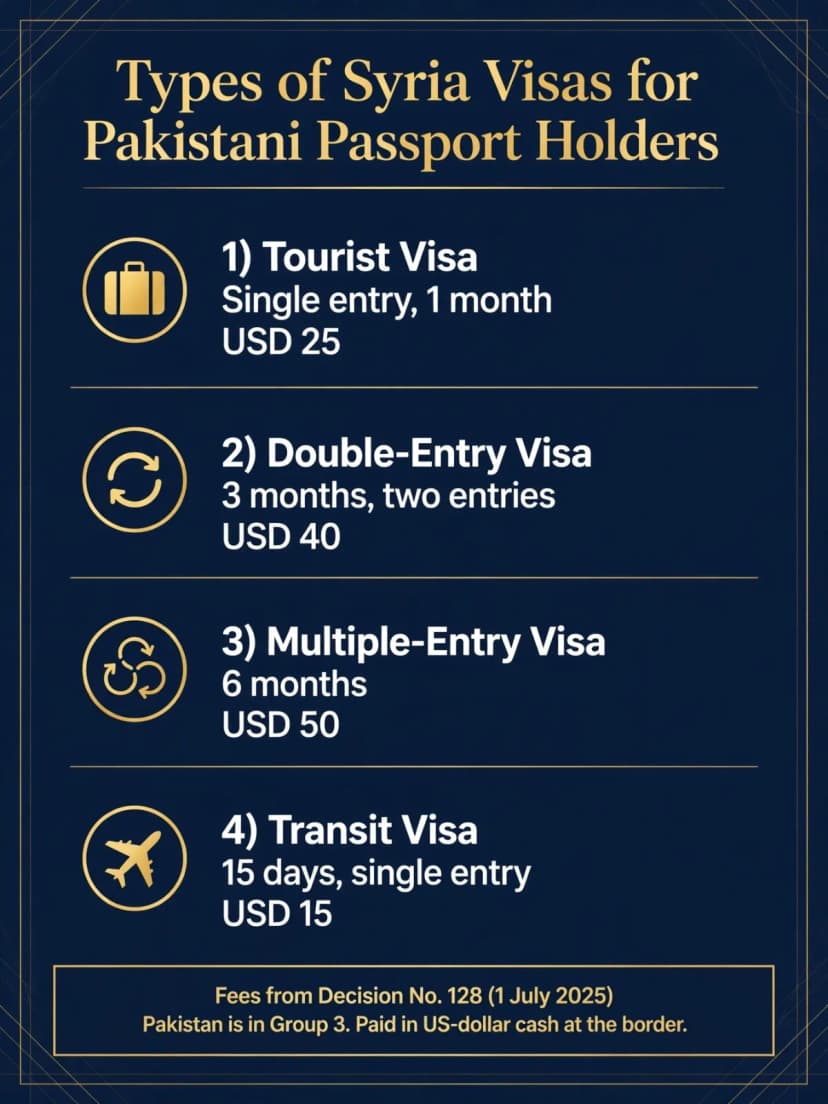
Syria does not publish a single official visa-types page that this guide could read, and there is no published student-visa class, no published family-reunification class, and no published digital-nomad or retirement route for 2026. The types below are the categories that appear in the Decision No. 128 fee schedule and in the 2026 reporting, and each one is labelled with how firmly it is established.
Tourist visa (single entry, one month)
The standard short-stay visa. Under Decision No. 128, a Pakistani passport holder pays USD 25 for a one-month single-entry visa. In practice at the border, the visa most commonly stamped for tourists in 2026 is reported as a 15-day single-entry visa — a direct conflict with the one-month validity in the fee schedule, reported in full in the fees section. The visa is extendable locally according to some 2026 guides, but no official extension fee or procedure was found; treat any extension as something to arrange at the Immigration and Passports Office in Damascus before the current permission expires, not as a right. Tourist visas are the category most Pakistani visitors will use, including ziyarat travellers, because no separate pilgrimage visa class is published.
Double-entry visa (three months, two entries)
Priced at USD 40 for Pakistani passport holders under Decision No. 128: a visa valid for three months with two entries. No 2026 source describes the practical use of this category at the border in detail, and it is not clear whether it is routinely issued on arrival or only through a mission. Ask for it specifically when arranging prior approval if your itinerary needs two entries — for example, entering Syria, leaving for Lebanon, and re-entering.
Multiple-entry visa (six months)
Priced at USD 50 for Pakistani passport holders under Decision No. 128: a visa valid for six months with multiple entries. As with the double-entry visa, no 2026 source confirms routine issue of this category on arrival to Pakistani nationals, and the six-month figure is the visa's validity, not a permitted stay of six months. The stay allowed on each entry is set by the visa or entry permission actually issued — do not assume six months in the country.
Transit visa (15 days, single entry)
Priced at USD 15 for Pakistani passport holders under Decision No. 128, with a validity of 15 days. The transit category is for passing through Syria to a third country. Some 2026 fee tables list a separate three-day transit at USD 25 for unclassified nationalities; for Pakistan the Decision No. 128 table gives USD 15 for the 15-day transit. Do not confuse the two. If you are transiting, carry proof of your onward journey and the visa for your next destination.
Business visa
Canada's travel advice lists a business visa as required, separately from the tourist visa, and the pre-2024 embassy practice required an invitation letter from a Syrian company, attested by the Syrian chamber of commerce, with the invitation faxed or sent to the embassy in advance. No current 2026 business-visa fee, document list or processing time has been published by the transitional government, and no 2026 source confirms that embassies are issuing business visas. If you are travelling for business, arrange it through your Syrian counterpart and the licensed travel agency handling your prior approval, and get the invitation and the approval in writing before you book. Do not travel on a tourist visa and then conduct business.
Student visa
Canada's travel advice lists a student visa as required, and Syria's higher-education system — public universities supervised by the Ministry of Higher Education and Scientific Research, private Syrian universities, and the Syrian Virtual University — does admit Arab and foreign students. But no student-specific entry category, document list, fee or residence-permit procedure was found on any official Syrian source in this check, and the e-visa portal that would have carried it is not operational. Section 12 explains the student route in the detail the evidence allows, which is: confirm the category with the nearest Syrian mission and the university before anything else.
Work visa and residence permit
No published 2026 work-visa route, fee or processing time was found. Work in Syria requires a Syrian sponsor and a permit arranged inside the country; there is no online work-permit portal and no published salary threshold. Section 13 states this plainly rather than inventing a procedure. Do not accept a job offer for Syria that cannot show you the sponsor's approval paperwork and the visa route in writing.
What does not exist (as far as this check could establish)
There is no published visa-on-arrival exemption for Pakistani passport holders, no published visa-free stay, no published e-visa, no published family-reunification visa class, no published permanent-residence route or timeline, and no published retirement or digital-nomad visa. If an agent offers you one of these, ask for the official source. This guide found none.
Visa Comparison Table
| Visa type | Entries | Validity | Fee for Pakistani passport (Decision No. 128) | Prior approval needed? | Where issued |
|---|---|---|---|---|---|
| Tourist (single entry) | Single | 1 month (schedule); 15 days commonly stamped on arrival — see conflict note | USD 25 | Yes — Pakistan is on the restricted list | At the airport or land border, after approval |
| Double-entry | Two | 3 months | USD 40 | Yes | At the border or through a mission — confirm in advance |
| Multiple-entry | Multiple | 6 months | USD 50 | Yes | At the border or through a mission — confirm in advance |
| Transit | Single | 15 days | USD 15 | Yes | At the airport or land border, after approval |
| Business | Not published | Not published | Not published | Yes | No confirmed 2026 route — arrange via sponsor and mission |
| Student | Not published | Not published | Not published | Yes | No confirmed 2026 route — confirm with mission and university |
Read the table with the conflicts in mind. The "validity" column mixes two different things that 2026 sources report differently: the validity printed in the Decision No. 128 fee schedule, and the stay actually stamped at the border. The fee column is the Decision No. 128 Group 3 schedule as reported by multiple 2026 sources; it has not been read on an official Syrian page. The "where issued" column reflects the practical position in 2026, not a published rule, because the published rules contradict each other. If any cell of this table matters to your trip — above all the validity and the issue point — confirm it with the embassy and with your airline before you pay for anything.
Visa Fees: What Each Route Costs
The controlling fee document is Decision No. 128 of the Ministry of Foreign Affairs and Expatriates, issued 1 July 2025, in force from 6 July 2025, and confirmed unchanged on 29 April 2026. It sorts nationalities into groups and sets four prices per group: a one-month single-entry visa, a three-month double-entry visa, a six-month multiple-entry visa, and a 15-day single transit visa. Pakistan is in Group 3 with Algeria, Cuba, Egypt, China, Morocco, Sri Lanka, Sudan, Yemen and others. The Group 3 fees are:
| Visa | Fee for Pakistani passport holders |
|---|---|
| Single entry, 1 month | USD 25 |
| Double entry, 3 months | USD 40 |
| Multiple entry, 6 months | USD 50 |
| Transit, 15 days, single entry | USD 15 |
Fees are charged in US dollars or the equivalent at the Central Bank of Syria's published exchange rate, with fractions rounded up, and are paid at border crossings or airports in Syria. In practice, pay in clean, undamaged US-dollar cash. The earlier land-border fee exemption was removed in mid-2025, so land crossings charge the same schedule. Carry small denominations: change is not guaranteed, and cards and ATMs are unreliable at the border even though card terminals have returned in parts of Damascus and Aleppo.
Three warnings about the fees, because the internet is full of wrong numbers for Syria:
- The USD 50–100 figures are not the Pakistan fee. Several Pakistan-focused agency pages quote an "official consular/eVisa rate" of about USD 50–100 (PKR 14,000–28,000) for a Syria visa from Pakistan. That range does not match the Decision No. 128 Group 3 schedule (USD 25 single entry) and no official source supports it; it appears to be an agency estimate or bundled service price, not a government fee.
- The USD 61 "average fee" is not official. Some visa-aggregator pages quote an average application fee of about USD 61 for Pakistan to Syria. That is an aggregator's average across visa types or providers, not a published government figure. Do not budget from it.
- Older fee tables are wrong for 2026. A February 2025 tour-operator table put Pakistan at USD 40 for 15 days, and pre-2024 embassy practice charged fees in Pakistani rupees (an old agency schedule quoted Rs. 950 plus service charges). Both are superseded by Decision No. 128. Any fee quoted from a source dated before July 2025 should be ignored.
No official figure was found for an extension fee, an overstay fine, a registration fee, or a student or work visa fee. This guide does not publish figures for those. If anyone quotes you one, ask for the source.
One warning: the only official e-visa portal name is evisa.sy, and it is not operational. Any other website offering Syrian visas is a third-party commercial service, not the Syrian government — do not pay a visa fee to it, and do not treat its fee table as official.
Processing Times
Stage 1 — prior approval (security clearance). The consistent 2026 reporting for restricted nationalities, including Pakistan, is that advance approval takes three to four weeks. It is arranged through a licensed Syrian travel agency or sponsor, or through the Immigration and Passports Department. Some agency pages for Pakistan quote four to eight weeks for the whole process, and an older Islamabad embassy schedule quoted ten working days — but that schedule dates from the pre-2024 system. Plan on three to four weeks for the approval alone, and do not book a non-refundable flight until it is in hand.
Stage 2 — the visa itself. Once approval is granted, the visa is issued at the port of entry — Damascus or Aleppo airport, or a land border — and paid for there. That part takes as long as the border queue. Separately, the FCDO states that an application made through evisa.sy takes approximately five to seven days for a decision, while noting that times may vary. That five-to-seven-day figure cannot be reconciled with the portal showing "Coming Soon" and not accepting applications, and this guide reports it as an FCDO figure that currently has no working portal behind it. Do not plan a trip around it.
The November 2026 lesson. In November 2026, travellers were refused entry without warning when a pre-approval requirement was briefly imposed on all nationalities, and the requirement was then scrapped on 13 November 2026. Processing times and requirements can change that fast. The only safe timetable is: start at least six weeks before travel, get the approval in writing, confirm boarding with the airline a few days before departure, and carry the approval letter, the hotel booking and the return ticket in print as well as on your phone.
Complete Document Checklists
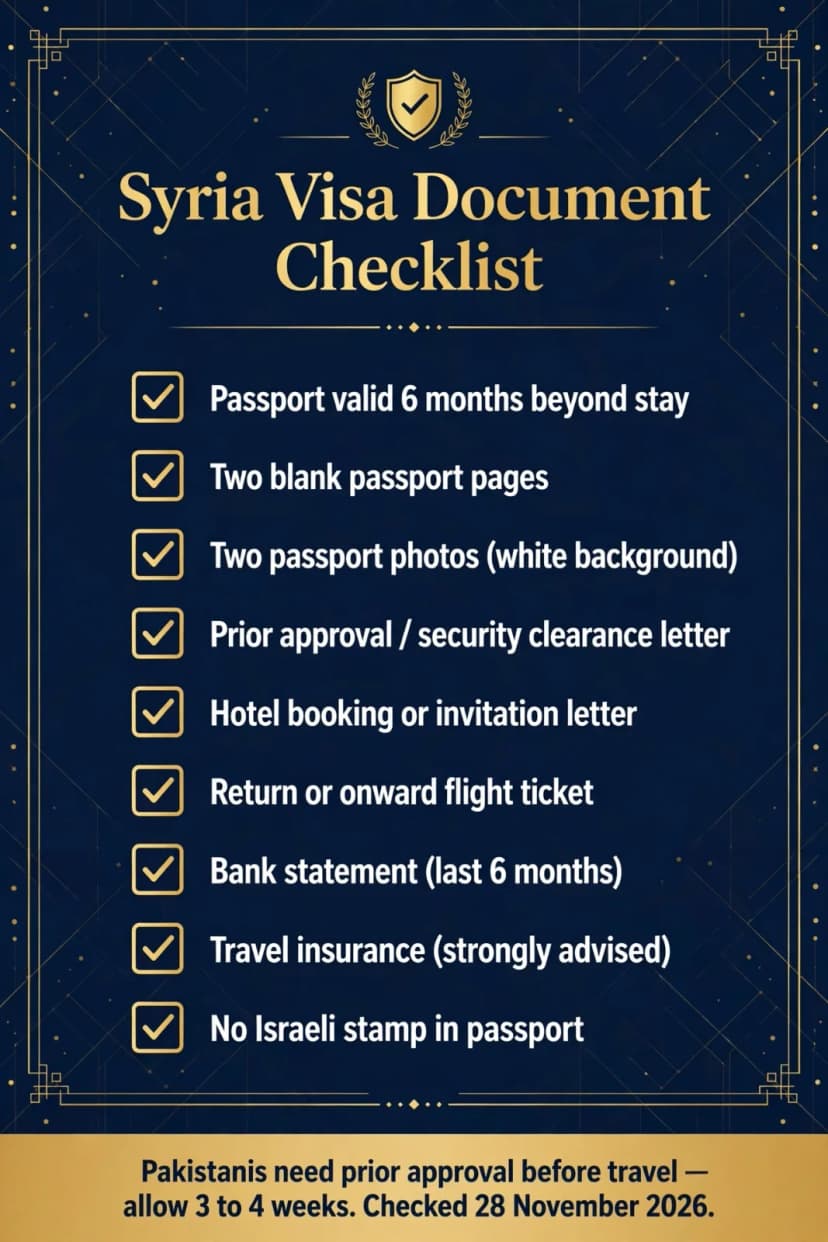
No official Syrian document checklist for Pakistani applicants has been published for 2026. The checklists below are compiled from the pre-2024 Islamabad embassy requirements (which remain the best evidence of what the embassy asks for), the 2026 Pakistan-focused guides, the FCDO and Canadian advice, and the aviation authority's entry rule. Anything marked "reported, not official" has no official source behind it.
Tourist visa — document checklist
- Original passport, valid at least six months beyond your intended stay, with at least two blank pages. (The six-month figure comes from the Syrian civil aviation authority and from Canada's advice; the FCDO says three months after arrival for British passports. Carry six months to satisfy both readings. The two-blank-pages figure comes from 2026 agency guides, not an official page — it is reported, not official.)
- Completed visa application form (embassy form where the embassy issues; no online form exists while evisa.sy is "Coming Soon").
- Two recent passport-size photographs, white background. (The 35 mm x 45 mm size and white background come from 2026 agency guides; no current official Syrian photo rule is published — the old Stockholm embassy page asked for a plain white background, and a 40 x 60 mm format circulates in photo tools without official backing.)
- Prior approval / security clearance letter from the licensed Syrian travel agency or sponsor that arranged it. This is the document that matters most for a Pakistani passport holder.
- Invitation letter from a resident of Syria, or proof of booked accommodation (hotel reservation). The old Islamabad embassy practice required the invitation letter in Arabic, attested by the Syrian chamber of commerce, with one copy faxed directly to the embassy — that is pre-2024 practice, reported here as background, not as a current rule.
- Confirmed return or onward flight ticket.
- Bank statement for the last six months, with a branch verification stamp and signature, plus an Account Maintenance Certificate where the embassy asks for one. One 2026 agency guide quotes a closing balance of PKR 1,000,000–2,000,000; another quotes PKR 400,000–1,000,000. No official page publishes any minimum bank balance — treat both figures as that agency's advice, not a government rule.
- Copy of your Pakistani CNIC (the old Islamabad embassy schedule asked for it).
- Covering letter explaining the purpose and dates of the trip.
- Travel insurance — strongly recommended given limited medical infrastructure in many areas. Not confirmed as a mandatory visa document.
- Cash in US dollars for the visa fee (USD 25 for the single-entry visa), in clean, undamaged notes.
Business visa — document checklist
- All of the tourist-visa documents above, plus an invitation letter from the Syrian company, attested by the Syrian chamber of commerce. The old Islamabad practice required the invitation in Arabic, with a copy sent to the embassy in advance.
- Company registration or business documents for the inviting Syrian company, and your own employer's letter stating the purpose of the visit.
- No current 2026 business-visa fee or processing time has been published; confirm both with the mission before filing.
Student visa — document checklist
- All of the tourist-visa documents above, plus the university admission letter and the secondary-school certificate legalised by the issuing country's Ministry of Foreign Affairs, the Syrian embassy in that country, and the Syrian Ministry of Foreign Affairs, with a certified Arabic translation. That legalisation chain is reported for foreign students by the university guidance; no official 2026 student-visa checklist was found.
- No student-visa fee has been published. Confirm the fee, the category and the residence-permit procedure with the mission and the university before paying anything.
Transit visa — document checklist
- Passport valid six months beyond the stay, two blank pages, and the visa for your next destination.
- Confirmed onward ticket showing you leave Syria within the transit validity.
- USD 15 in cash for the transit fee (Decision No. 128, Group 3).
- Prior approval is still reported as required for Pakistani nationals even for transit — do not assume transit is exempt.
For every applicant — the Israel-stamp check
Before you submit anything, check every page of your passport for an Israeli visa or stamp, and for Egyptian or Jordanian land-border stamps from crossings adjoining Israel (Taba, Wadi Araba, Allenby/King Hussein Bridge). Any of these means refusal of entry and transit. If you find one, stop and seek the embassy's advice before spending money on flights or an agency.
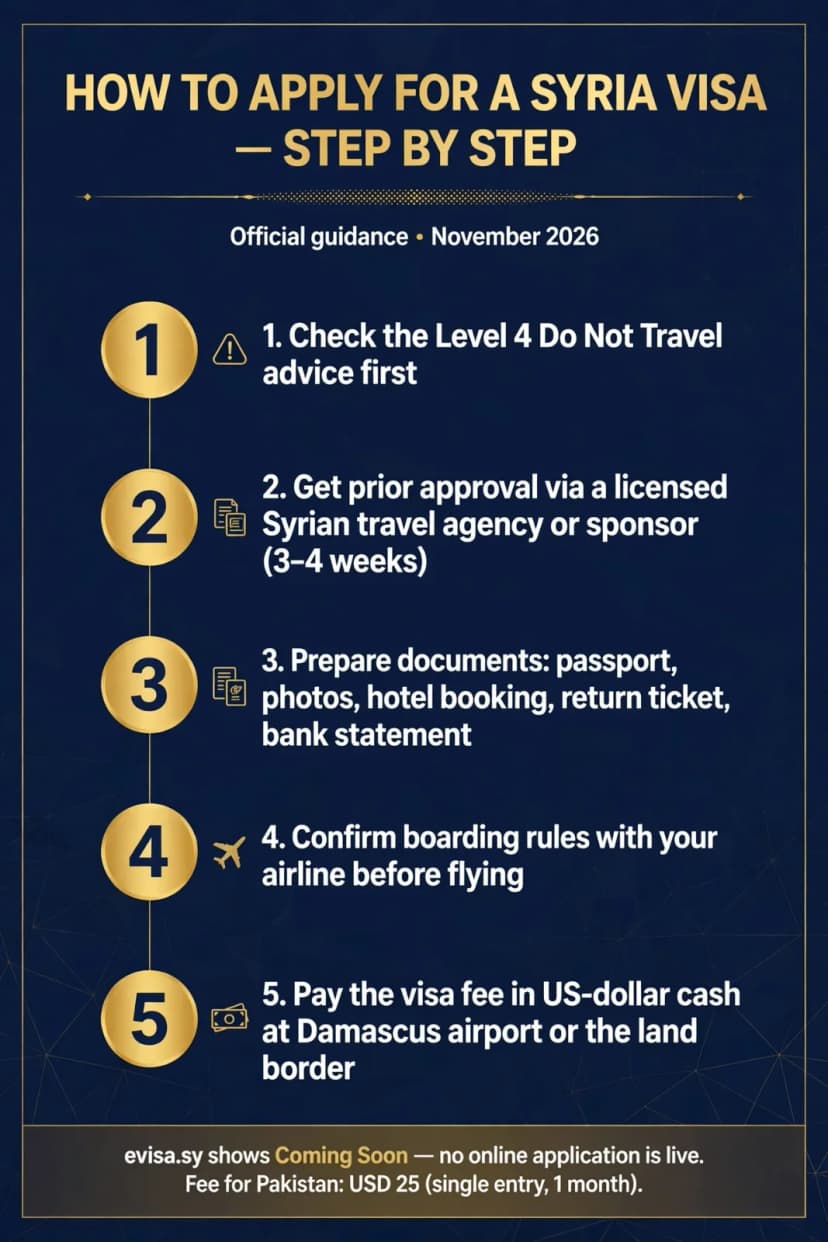
How to Apply: Step-by-Step
Step 1 — Read the travel advisories and decide. Read the US Level 4 advisory, the FCDO advice against all travel, and Canada's avoid-all-travel advice (Section 16 has the links). Check that your travel insurance will cover Syria in writing, including medical evacuation. If the trip is not essential, reconsider. Do not book anything non-refundable before the visa route is confirmed.
Step 2 — Contact the Syrian embassy. For a Pakistani living in Vietnam, the two missions that matter are the Syrian embassy in Islamabad (for Pakistan-side filing and for family in Pakistan who may need to help) and the Syrian embassy in Beijing, which is accredited to Vietnam. Ask both, in writing: (a) does a Pakistani passport holder need prior approval before travel; (b) who arranges it; (c) what is the current fee for a single-entry tourist visa; (d) will the airline be told to board you; and (e) what is the current stay stamped on arrival — 15 days or one month. Keep the replies. If the two missions disagree, follow the stricter answer.
Step 3 — Arrange prior approval through a licensed Syrian travel agency or sponsor. This is the stage the 2026 sources describe for restricted nationalities including Pakistan. The agency or sponsor applies for the security clearance with the Immigration and Passports Department. Expect three to four weeks. Get the approval in writing, with a reference you can show at the border and to the airline. Do not pay an agent who cannot name the agency's licence or show you the approval document. Never pay a visa fee to a website.
Step 4 — Prepare the documents. Use the checklist in the previous section. Legalise or attest documents the embassy asks for. Make sure the passport has six months' validity and two blank pages, and check every page for Israeli stamps. Print the hotel booking, the return ticket and the approval letter as well as keeping them on your phone — electricity and internet are intermittent in many areas, and a dead phone at the border is a real problem.
Step 5 — Confirm boarding with the airline. Airlines have refused boarding to passengers bound for Damascus who did not have the right pre-arrangement, and some airlines' systems still show outdated Syrian visa information. A few days before departure, ask the airline in writing whether a Pakistani passport holder with your approval letter will be boarded, and ask the airline to confirm with the Syrian authorities if its system says a visa in advance is required. Do this before you go to the airport.
Step 6 — Fly or cross the border, and pay the fee in cash. At Damascus or Aleppo airport, or at the Masnaa–Jdeidat Yabous crossing from Lebanon or the Nassib–Jaber crossing from Jordan, present the passport, the approval letter, the hotel booking and the return ticket, and pay the visa fee in US-dollar cash (USD 25 for the single-entry visa for a Pakistani passport). Check the visa stamp before you leave the counter: the validity dates, the number of entries and the permitted stay. If the stay stamped is 15 days when you expected one month, that is the stay you have — plan around the stamp, not the schedule.
Step 7 — Register if you stay more than 14 days. If you intend to stay in Syria for longer than 14 days, you must register with the Syrian Immigration and Passports Office before the 15th day after your arrival. Canada's advice states this plainly, and says the requirement applies each time you enter on a tourist visa, whether single or multiple entry. Ask the immigration office in Damascus for the registration procedure on arrival; do not leave it until day 14.
Step 8 — Arrange any extension before the permission expires. If you need to stay longer than the visa allows, contact the Immigration and Passports Office before the current permission expires. No official extension fee or processing time was found for 2026, and no official overstay fine was found either — do not overstay on the assumption that a fine will be small.
Common mistakes to avoid
- Booking a non-refundable flight before the prior approval is in hand. The approval is the long pole; the flight is not.
- Relying on evisa.sy. The portal shows "Coming Soon" and is not accepting applications. A "confirmation" from any other visa website is not a Syrian visa.
- Travelling on a passport with an Israeli stamp, or with an Egyptian or Jordanian border stamp from a crossing adjoining Israel. That is a refusal, not a delay.
- Carrying only a card. Visa fees are paid in US-dollar cash at the border, and cards and ATMs are unreliable there.
- Assuming the stay is one month because the fee schedule says so. The stamp on arrival is what counts, and 15 days is the stay most commonly reported at the border in 2026.
- Assuming the embassy will issue the visa. In 2026 the embassies generally do not issue tourist visas; the visa is issued at the border after approval. Confirm the route with the mission rather than assuming either way.
- Travelling without insurance that covers Syria in writing. Standard policies commonly exclude countries under a Level 4 advisory, and the FCDO warns your insurance could be invalidated.
Applying from Vietnam and Pakistan — No Syrian Mission in Vietnam
There is no Syrian embassy or consulate in Vietnam. That is the first practical fact for a Pakistani living in Ho Chi Minh City. The Syrian embassy accredited to Vietnam is the embassy in Beijing, and the embassy in Islamabad is the mission for Pakistan-side matters.
Syrian Embassy in Beijing (accredited to Vietnam, Laos and Mongolia). Address: No. 6 Dong Si Jie, Sanlitun, Beijing 100600, China. Telephone: +86 10 6532 1372 (general) and +86 10 6532 4787 (visa office, as listed in directories). Website: www.syria.org.cn — note that the site returned an error when last checked (403, 9 November 2026), so do not rely on it loading. The ambassador listed in directories is from the pre-2024 period; the current ambassador's name was not verified in this check, and a new Syrian ambassador to China was received in 2025 according to Chinese foreign-ministry reporting. Confirm the current visa-office hours and whether a Pakistani resident in Vietnam can file through Beijing before travelling there. You will need a Chinese visa to visit the embassy in person, which is itself a separate application — factor that into the timetable, and try the telephone and email first.
Syrian Embassy in Islamabad. The address is reported differently across directories, and this guide flags that rather than picking one silently: House No. 30, Hill Road, F-6/3, Islamabad (the address on the old embassy visa schedule and several directories), and House No. 24, Street No. 27, Sector F-6/2, Islamabad (other directories). Telephone: +92 51 2279470–71 (and 2824769 in older listings); fax +92 51 2279472. The ambassador named in one directory is Dr. Ramez Alraee — that listing was not verified as current for 2026. The old office timings were Monday to Friday, 09:00 to 12:00, and the old processing time was ten working days; both are pre-2024 figures and are reported here as background only. If family in Pakistan can visit the embassy, ask them to confirm the current address, the current fee, and whether the embassy issues visas or directs applicants to the prior-approval route — and to get the answer in writing.
Syrian Embassy in New Delhi. India hosts a Syrian embassy in New Delhi, accredited to Myanmar, Nepal, Sri Lanka and Bangladesh — not to Vietnam or Pakistan. It is not the mission for a Pakistani resident in Vietnam, and this guide does not recommend filing there.
Pakistan's representation in Syria. No verified Pakistani consular presence inside Syria was found in this check. Do not assume there is a Pakistan embassy in Damascus that can help you in an emergency. Before travelling, ask Pakistan's Ministry of Foreign Affairs which mission covers Syria for consular emergencies, and save that mission's emergency number. If you are in Syria and need help, the realistic channels are that covering mission and your family in Pakistan and Vietnam — there is no walk-in Pakistani consular office to rely on.
Applying from Vietnam in practice. Because there is no Syrian mission in Vietnam, the realistic sequence for a Pakistani in Ho Chi Minh City is: (1) contact the Beijing embassy by phone or email; (2) arrange prior approval through a licensed Syrian travel agency or sponsor (which does not require a visit to an embassy); (3) fly to Syria with the approval letter and pay the visa fee at the border; or, if the Beijing embassy directs you to file in person, (4) apply for a Chinese visa and visit Beijing. Do not fly to Damascus hoping to sort the visa out on arrival without the approval — that is the exact situation in which travellers were refused entry in November 2026.
Entering Syria: Airports and Land Borders
Damascus International Airport (DAM). Damascus is the main gateway. Syrian airspace reopened on 8 April 2026, and by mid-2026 around 13 airlines served Syria across some 21 international routes, with Fly Cham the largest operator. Turkish Airlines flies from Istanbul, AJet from Istanbul Sabiha Gökçen and Ankara, flyadeal from Jeddah (launched 10 May 2026), and Syrian Air resumed Amsterdam–Damascus on 2 July 2026. More routes were announced for December 2026, including Aegean from Athens (from 2 December), EgyptAir from Cairo (Damascus from 4 December), and Eurowings bookings for January 2027. Schedules change quickly — check with the airline, not with this guide, and confirm the boarding rules in writing (Step 5 above). On arrival, the visa fee is paid in US-dollar cash at the airport, and the visa is stamped into the passport; travellers may ask for the stamp on a separate piece of paper instead, according to 2026 guides.
Aleppo International Airport (ALP). Aleppo also takes international flights in 2026, with fewer routes than Damascus (about five international routes in mid-2026). EgyptAir planned Aleppo flights from 6 December 2026, and a domestic Damascus–Aleppo service and an Aleppo–Moscow service began on 18 November 2026. The same visa-on-arrival-after-approval procedure applies. Latakia and Qamishli airports were reported in rehabilitation in September 2026; neither is confirmed as an international entry point for foreign tourists, so do not plan to enter through them.
From Lebanon — Masnaa–Jdeidat Yabous. The main and most used land crossing, on the Beirut–Damascus highway, a relatively short distance from Beirut. It has been reported as operating around the clock since March 2026, while other sources give fixed hours (roughly 06:00 to midnight) — the hours have changed repeatedly, so check on the day of travel. The procedure is: your passport is stamped on the Lebanese side on exit, then on the Syrian side after you pay the visa fee in cash in dollars. Other Lebanon crossings: Jousieh–Al-Qaa (daily, hours disputed), Jisr Qamar–Dabbousieh (foot traffic only, no vehicles), and Al-Arida (limited operation, foot traffic only since 8 March 2026 because of bridge damage, reported as reserved for Syrians arriving from Lebanon). On the return journey, Lebanon imposes a mandatory entry stamp fee on all non-Lebanese entering overland of one million Lebanese pounds (about USD 11–12), paid in cash at the border. You also need a valid Lebanese visa or entry permission to cross through Lebanon in the first place — that is a separate requirement, and this guide does not cover Lebanese visas.
From Jordan — Nassib–Jaber. The only official crossing in operation between Syria and Jordan, about 100 km north of Amman. It resumed passenger traffic on 28 October 2026 after a short closure. Confirm the current passenger hours with both sides before travelling, and carry the same documents and cash as for the airport.
From Türkiye. The Turkish crossings are generally not available to foreign tourists in 2026. Do not plan a route through Türkiye.
From Iraq. The Bukamal–Qaim crossing exists but is not a practical tourist route in 2026, and no 2026 source describes foreign tourists entering Syria that way. Do not plan on it.
Student Route: Studying in Syria
Studying in Syria is possible on paper and very difficult in practice in 2026, and this guide will not dress that up. Syria's higher-education system consists of public universities supervised by the Ministry of Higher Education and Scientific Research, private Syrian universities, and the Syrian Virtual University. The ministry's announcements page shows 2026/27 rounds for transfer and private-university comparisons (extended to 2 November 2026), but no Arab or foreign public-university admission round was found in the retrieved lists.
Canada's travel advice lists a student visa as required, and the FCDO's general rule — you must have a visa to travel to Syria — applies to students as much as to tourists. Beyond that, the specifics are unverified: no student-specific entry category, document list, fee or residence-permit procedure was found on any official Syrian source in this check, and the e-visa portal that would have carried the student application is not operational. One 2026 education guide reports that a student-specific entry category, its documents, fees and the residence-permit procedure were not found on an official Syrian source, and that evisa.sy could not be opened because of a certificate error.
If you are considering study in Syria, the sequence is: (1) apply to the university through the Ministry of Higher Education round for Arab and foreign students, and get the admission letter; (2) have your secondary-school certificate legalised by the issuing country's Ministry of Foreign Affairs, the Syrian embassy in that country, and the Syrian Ministry of Foreign Affairs, with a certified Arabic translation; (3) confirm the entry-visa category, fee and procedure with the nearest Syrian mission — the Beijing embassy if you are in Vietnam, the Islamabad embassy if you are in Pakistan — before paying any tuition or booking travel; and (4) ask the university in writing what residence permit you will hold, how it is issued, and what it costs. Do not pay tuition before the visa category is confirmed in writing. No tuition, living-cost or scholarship figure for Syria in 2026 was verified in this check, and this guide publishes none.
Work Route: Jobs, Business and Work Permits
There is no verified work route to Syria for a Pakistani passport holder in 2026. No published work-visa category, fee, processing time, salary threshold or permit procedure was found on any official Syrian source, and there is no online work-permit portal. Work in Syria requires a Syrian sponsor and a permit arranged inside the country, and the details of that arrangement are not published. This guide states that plainly rather than inventing a procedure, a fee or a timeline.
What is known: Canada's travel advice lists a business visa as required, separately from the tourist and student visas. The pre-2024 Islamabad embassy practice for business visas required an invitation letter from a Syrian company attested by the Syrian chamber of commerce, with a copy sent to the embassy in advance. Whether that practice still applies under the transitional government is unverified. If you are offered work in Syria, ask the employer for: the name and registration of the sponsoring company, the written approval for your entry, the visa category you will travel on, and the residence and work permit you will hold once inside. If the employer cannot produce those in writing, do not travel. Be especially careful with offers that ask you to pay a fee for the job, the visa or the permit before you travel — no official Syrian fee for a work visa was found, so any such payment demand has no published basis.
If your reason for going to Syria is work, get the paperwork in writing first, and read the safety section again before you decide.
Family Visits and Ziyarat (Religious Pilgrimage)
Many Pakistanis who travel to Syria do so for ziyarat — visiting the shrines of Sayyida Zaynab and Sayyida Ruqayya in Damascus and other holy sites — or to visit family. There is no separate published pilgrimage visa class for 2026, so ziyarat travellers use the ordinary tourist-visa route described in this guide: prior approval, then the visa at the border, USD 25 for the single-entry visa.
In practice, most Pakistani ziyarat travel is organised through pilgrimage operators in Pakistan who arrange the group, the sponsor in Damascus, the hotel and the transport. If you travel with an operator, ask for: the name of the licensed Syrian travel agency handling the prior approval, the approval letter itself, the hotel booking in your name, the return ticket, and a written statement of what is included and what you will pay at the border. The old Islamabad embassy schedule quoted a group-visa service charge through an agent; that figure is pre-2024 and is not a current price. Do not pay an operator who cannot show you the approval or who asks you to travel without it.
For family visits, the same route applies: an invitation letter from the resident in Syria (the old practice required it in Arabic, attested by the Syrian chamber of commerce, with a copy sent to the embassy — reported here as background, not as a current rule), plus the hotel booking or the host's address, the return ticket, and the prior approval. There is no published family-reunification visa class, and no published route to permanent residence through family. If a family member in Syria is a Syrian national, ask the embassy whether any different rule applies to you — dual nationality and Syrian descent carry their own rules, including the possibility of military-service obligations for men of Syrian descent aged 18 or over, which Canada's advice flags. This guide does not advise on dual nationality; the embassy does.
Frequently Asked Questions
1. Do Pakistani passport holders need a visa for Syria?
Yes. Pakistani ordinary passport holders need a visa. Pakistan is in Group 3 of the Decision No. 128 fee schedule, and there is no visa-free entry or exemption for Pakistan. The practical question is the route: prior approval before travel, with the visa issued and paid for at the border.
2. Is there a Syria e-visa for Pakistanis in 2026?
Not in practice. The official portal evisa.sy was launched in May 2024 under the previous government and shows only a "Coming Soon" message in captures from August and October 2026. It is not accepting applications. The FCDO still links to evisa.sy and quotes a five-to-seven-day processing time, but that cannot be reconciled with the portal not working. Do not plan your trip around an e-visa application until the portal actually opens.
3. Can I get a visa on arrival in Syria?
Most nationalities can get a visa on arrival at Damascus or Aleppo airport or at a land border, paying in US-dollar cash. For Pakistanis, the consistent 2026 reporting is that you need prior approval — a security clearance arranged in advance through a licensed Syrian travel agency or sponsor, typically taking three to four weeks — before you travel, and the visa is then issued and paid for at the port of entry. Canada's advice and the US State Department say non-Arab nationals should get the visa from an embassy before departure, which conflicts with the on-arrival practice. Treat prior approval as mandatory.
4. How much is the Syria visa fee for a Pakistani passport?
USD 25 for a one-month single-entry visa, USD 40 for a three-month double-entry visa, USD 50 for a six-month multiple-entry visa, and USD 15 for a 15-day transit visa, under Decision No. 128 (Group 3). The fee is paid in US-dollar cash at the airport or border. Agency pages quoting USD 50–100 are not the government fee.
5. How long can I stay in Syria on a tourist visa?
This is disputed. The Decision No. 128 schedule prices a one-month single-entry visa, but the visa most commonly stamped on arrival in 2026 is reported as a 15-day single-entry tourist visa. The stay you actually get is the one stamped in your passport at the border. Plan for 15 days unless the stamp says otherwise, and arrange any extension before the permission expires.
6. How long does the Syria visa take for Pakistanis?
Allow three to four weeks for the prior approval alone, and start at least six weeks before travel. The FCDO quotes five to seven days for an e-visa decision, but the e-visa portal is not operational, so that figure cannot be relied on. Older Islamabad embassy schedules quoted ten working days, but those date from the pre-2024 system.
7. Is Syria safe to visit in 2026?
No government advises that it is. The US rates Syria Level 4, "Do Not Travel" (reissued 23 October 2026); the UK advises against all travel (updated 2 September 2026); Canada says avoid all travel (updated 23 July 2026); Australia advises against all travel. Visitor numbers are rising and flights have resumed, but the advisories have not been lowered since the change of government. This guide does not present tourism in Syria as currently viable.
8. Can I apply for a Syria visa from Vietnam?
There is no Syrian embassy in Vietnam. The Syrian embassy in Beijing is accredited to Vietnam (No. 6 Dong Si Jie, Sanlitun, Beijing 100600; +86 10 6532 1372). Contact it first, and arrange prior approval through a licensed Syrian travel agency or sponsor. You will need a Chinese visa if you visit the Beijing embassy in person.
9. Where is the Syrian embassy in Pakistan?
In Islamabad. The address is reported as House No. 30, Hill Road, F-6/3, and also as House No. 24, Street No. 27, Sector F-6/2 — directories disagree, so confirm before visiting. Telephone: +92 51 2279470–71. The old office hours (Monday to Friday, 09:00–12:00) and processing times are pre-2024 figures.
10. Will an Israeli stamp in my passport stop me entering Syria?
Yes. If your passport shows previous travel to Israel, you may be refused entry, and the detailed reporting says any Israeli visa or stamp, or an Egyptian or Jordanian land-border stamp from a crossing adjoining Israel (Taba, Wadi Araba, Allenby/King Hussein Bridge), means refusal of entry and transit. Holders of Israeli or Iranian citizenship cannot enter Syria at all, according to the FCDO.
11. How long must my passport be valid for Syria?
Carry six months' validity beyond your intended stay, with at least two blank pages. The Syrian civil aviation authority and Canada say six months; the FCDO says three months after arrival for British passports. Six months satisfies both readings. The two-blank-pages figure comes from 2026 agency guides, not an official page.
12. Do I need to register after arriving in Syria?
Yes, if you stay more than 14 days. You must register with the Syrian Immigration and Passports Office before the 15th day after arrival, and the requirement applies each time you enter on a tourist visa, according to Canada's travel advice. Ask the immigration office in Damascus for the procedure on arrival.
13. Can I enter Syria from Lebanon?
Yes — the Masnaa–Jdeidat Yabous crossing on the Beirut–Damascus highway is the main land route, reported as operating around the clock since March 2026, though other sources give fixed hours. You pay the visa fee in US-dollar cash on the Syrian side. You also need a valid Lebanese entry permission, and Lebanon charges a one-million-Lebanese-pound entry stamp fee (about USD 11–12) on the return. Turkish crossings are generally not open to foreign tourists.
14. Is Damascus airport open in 2026?
Yes. Damascus International Airport takes international flights, with around 13 airlines and 21 routes in mid-2026 after Syrian airspace reopened on 8 April 2026, and Aleppo also takes international flights. More routes were announced for December 2026. Check schedules and boarding rules with the airline directly — airlines have refused boarding to passengers without the right pre-arrangement.
15. Can I work or study in Syria on a tourist visa?
No. There is no published 2026 work-visa route, fee or procedure, and no student-specific entry category, fee or residence-permit procedure was found on any official Syrian source. Business travel needs a sponsor and an invitation; study needs a university admission and a confirmed visa category from the mission. Do not travel on a tourist visa and then work or study.
Official Immigration Websites
| Website | What it is | What this guide used it for |
|---|---|---|
| https://evisa.sy | Official Syrian e-visa portal (Ministry of Foreign Affairs, Tourism, Interior) | The portal itself — shows "Coming Soon" in August and October 2026 captures; not accepting applications |
| https://www.gov.uk/foreign-travel-advice/syria/entry-requirements | UK FCDO Syria travel advice — entry requirements (updated 2 September 2026) | Visa required; apply and check status via evisa.sy; about 5–7 days processing; passport 3 months after arrival; Israeli/Iranian citizens cannot enter; advises against all travel |
| https://travel.state.gov/content/travel/en/traveladvisories/traveladvisories/syria-travel-advisory.html | US State Department Syria Travel Advisory (reissued 23 October 2026) | Level 4: Do Not Travel — terrorism, civil unrest, kidnapping, hostage taking, crime, armed conflict |
| https://travel.state.gov/content/passports/en/country/syria.html | US State Department Syria International Travel Information (updated 11 August 2026) | Visas must be obtained before arrival from a Syrian diplomatic mission |
| https://travel.gc.ca/destinations/syria | Government of Canada — Syria travel advice (last updated 23 July 2026) | Avoid all travel; tourist, business and student visas required; non-Arab nationals cannot get a visa at the border; register before day 15 if staying over 14 days |
| https://www.syria.org.cn | Syrian Embassy in Beijing (accredited to Vietnam) | Embassy accredited to Vietnam; site returned an error (403) when checked 9 November 2026 |
| https://en.wikipedia.org/wiki/List_of_diplomatic_missions_of_Syria | Wikipedia — List of diplomatic missions of Syria | Beijing embassy accredited to Vietnam, Laos, Mongolia; New Delhi embassy accredited to Myanmar, Nepal, Sri Lanka, Bangladesh |
| https://en.wikipedia.org/wiki/Visa_policy_of_Syria | Wikipedia — Visa policy of Syria | Visa-required baseline; Decision No. 128 groups; e-visa history |
Final Checklist and Conclusion
- [ ] You have read the US Level 4 advisory, the FCDO advice against all travel, and Canada's avoid-all-travel advice, and you have decided with them in front of you.
- [ ] Your travel insurance covers Syria in writing, including medical evacuation, and you have the insurer's written confirmation.
- [ ] Your passport is valid for at least six months beyond your stay, has two blank pages, and carries no Israeli stamp and no Egyptian or Jordanian border stamp from a crossing adjoining Israel.
- [ ] You have contacted the Syrian embassy in Islamabad or the Syrian embassy in Beijing and have their current answer, in writing, on prior approval, the fee and the boarding rules.
- [ ] Your prior approval / security clearance is arranged through a licensed Syrian travel agency or sponsor, and you hold the approval letter with a reference.
- [ ] Your hotel booking and return ticket are confirmed and printed, and your bank statement is ready.
- [ ] Your airline has confirmed in writing that a Pakistani passport holder with your approval letter will be boarded.
- [ ] You carry the visa fee in clean US-dollar cash (USD 25 for the single-entry visa), plus enough cash for the trip — cards and ATMs are unreliable at the border.
- [ ] You know the registration rule: if you stay more than 14 days, register with the Immigration and Passports Office before day 15.
- [ ] Your family has your itinerary, hotel, insurance details and a copy of your passport and visa.
Syria in 2026 is a country reopening and a country still under the highest travel warnings at the same time, and the visa system reflects that contradiction: a fee schedule from July 2025, an e-visa portal that does not work, embassies that generally do not issue tourist visas, a visa on arrival that works for most nationalities but requires prior approval for Pakistanis, and rules that changed overnight in November 2026 and were then reversed. The honest summary for a Pakistani passport holder living in Vietnam is this: you need a visa; the fee for the single-entry visa is USD 25 under Decision No. 128; you need prior approval before you travel, which takes three to four weeks; the e-visa portal is not an option; and the stay you get is the one stamped at the border, commonly reported as 15 days. Everything else — the exact validity, the extension, the business and student routes — is either disputed between official sources or unpublished, and this guide has said so wherever that is the case rather than filling the gap with a guess.
This guide was checked on 28 November 2026 against the UK FCDO Syria travel advice, the US State Department Syria travel advisory and country information, the Government of Canada Syria travel advice, the Decision No. 128 fee schedule as reported by multiple 2026 sources, and the 2026 reporting on evisa.sy, the Damascus and Aleppo flight resumption, and the Lebanon and Jordan land crossings. Visa rules for Syria change without notice, so check the official sources in Section 16 again in the days before you travel, and do not book anything you cannot afford to lose until the approval is in your hand. Whatever this guide or any approval letter says, the Syrian immigration officer at the border makes the final decision.