Sudan Visa Guide 2026: Types, Requirements, Documents and Application Steps
Last checked: 28 November 2026. This guide is for Pakistani passport holders living in Vietnam. Read the security warning first: the United States rates Sudan Level 4 — Do Not Travel — and the United Kingdom advises against all travel to Sudan. This guide explains the visa rules for the small number of people who still have a genuine, essential reason to go — family, humanitarian work, or official business — and it does not present tourism to Sudan as currently viable. Visa rules change without notice — always confirm the live rules with a Sudanese embassy before paying any fee or booking a non-refundable ticket.
Introduction
Sudan is a country of extraordinary history — the pyramids of Meroë, the temples of the Kingdom of Kush, the meeting of the Blue and White Niles at Khartoum, and the Red Sea coast at Port Sudan. It is also, in November 2026, a country in the middle of a devastating civil war. Since April 2023 the Sudanese Armed Forces and the paramilitary Rapid Support Forces have fought across the country, Khartoum has been badly damaged, the British Embassy in Khartoum is closed, the United States Embassy in Khartoum suspended operations in April 2023, and every major government travel advisory tells its citizens not to go. There is a second route that appears in the sources and must be handled with care. The General Directorate of Passorts and Immigration confirmed in July 2025 that the "counter visa" — a visa issued on arrival at the border — remains in force, with approval given by its headquarters. But Sudan publishes no list of which nationalities may receive a counter visa, and no official source confirms that Pakistani passport holders qualify. Do not plan a journey around it. The only safe assumption for a Pakistani passport holder is the embassy visa, applied for in advance, backed by a sponsor's entry permit.
The visa system itself is old-fashioned and sponsor-driven. Sudan has no e-visa and no official online visa portal — a warning that matters, because websites selling a "Sudan eVisa" are not selling anything official, and the portal at evisa.gov.ss belongs to South Sudan, a different country. A Pakistani passport holder must obtain a visa in advance from a Sudanese embassy, and before the embassy can issue it, a sponsor inside Sudan must first obtain a unique entry permit number from the Aliens Department of the Ministry of Interior. That two-step, sponsor-first process is the single most important thing to understand: without a sponsor in Sudan, there is normally no visa at all. The Sudanese Embassy in London — one of the few Sudanese missions that publishes its visa procedure in full in English — describes it plainly: applying for the visa through the Aliens Department at the Ministry of Interior as a first step, and obtaining the unique entry permit number, comes before the embassy stage. The other practical shock for a reader in Vietnam is the mission map. Sudan's embassy in Hanoi closed in August 2018, and the old listings that still show an embassy at 61 Ly Thuong Kiet Street and an honorary consulate in Ho Chi Minh City are stale directories, not live missions. The realistic options are the Sudanese Embassy in Islamabad, the Sudanese Embassy in Beijing, or another Sudanese embassy in the region — and whether Beijing or New Delhi will accept an application from a Pakistani resident of Vietnam is itself unverified and must be asked directly. Section 9 works through each option in detail.
Do Pakistani Passport Holders Need a Visa for Sudan?
Yes. Pakistani passport holders need a visa before travelling to Sudan, and you should not plan around a visa on arrival. The visa policy of Sudan, as recorded in the standard reference sources, lists Pakistan under "visa required": visitors must obtain a visa from one of the Sudanese diplomatic missions unless they are citizens of one of the small number of visa-exempt countries. Pakistan is not one of them. The visa-exempt list is short — Egypt, Kuwait and the United Arab Emirates indefinitely, and Yemen for 30 days on direct arrival — and the visa-on-arrival list is equally short, covering nationalities such as Eritrea, Kenya, Malaysia, Qatar and Turkey. Pakistan appears on neither list.
There is one narrow, recent development that does not change this answer but is worth recording accurately. On 7 November 2026, Sudan and Pakistan signed a visa-exemption agreement covering diplomatic and official passports. The agreement has not yet been ratified, and it does not cover ordinary passports in any case. If you hold an ordinary Pakistani passport — the green passport most readers hold — the agreement makes no difference to you, now or when it is ratified. Holders of diplomatic or official Pakistani passports should ask the Sudanese Embassy in Islamabad whether the agreement has entered into force before relying on it.
The United States State Department's country information page for Sudan states the rule in the same terms: a visa is required, and you must obtain it from a Sudanese embassy before arriving in Sudan. The FCDO says the same: "You must have a visa to enter Sudan." There is no published exemption for Pakistani nationals, no transit-without-visa arrangement confirmed for any nationality, and no published provision for obtaining a visa at Port Sudan airport as a Pakistani without prior approval. The counter visa described in section 3 exists as a mechanism, but since Sudan does not publish which nationalities it covers, a Pakistani traveller who arrives without a visa is gambling on the discretion of the border authorities in a war zone — the worst possible place to take that gamble.
Your passport itself must meet the standard conditions. All visitors must hold passports valid for at least six months from the date of arrival, and the United States State Department specifies six months' validity beyond the arrival date and two blank pages for entry. The FCDO measures the same six months from the date you arrive. Wise's visa checker, updated 6 November 2026, lists three blank pages — one more than the State Department's two — so the safe course is to carry a passport with at least six months' validity beyond your planned return and at least three blank pages.
One more passport condition is specific to Sudan and catches people out. The FCDO states that if your passport has an Israeli visa, entry or exit stamp, you will not be allowed to enter Sudan. The United States State Department, however, states that as of April 2021 Sudan allows entry to travellers with Israel entry and exit stamps. These two official sources directly contradict each other. Until a Sudanese mission confirms the current rule in writing for your passport, assume the stricter FCDO rule applies: if your passport carries any Israeli stamp or visa, obtain a fresh passport before applying, or get a written answer from the embassy that will issue your visa.
Children are not exempt from any of this. The FCDO records that children aged 17 and under must have their father's consent to enter and exit Sudan, and that a child travelling without their father needs a letter giving consent for entry and exit, stamped at the Sudanese embassy before travel. If the father is absent, the mother or guardian needs a court order showing sole custodial rights; divorced parents need divorce documents; if the father has died, the death certificate is needed. The FCDO notes the consent rule is not always enforced — but it is a rule, and a family travelling with children should have the stamped letter in hand rather than discovering at Port Sudan airport that an officer is enforcing it that day.
Types of Sudan Visas for Pakistani Passport Holders
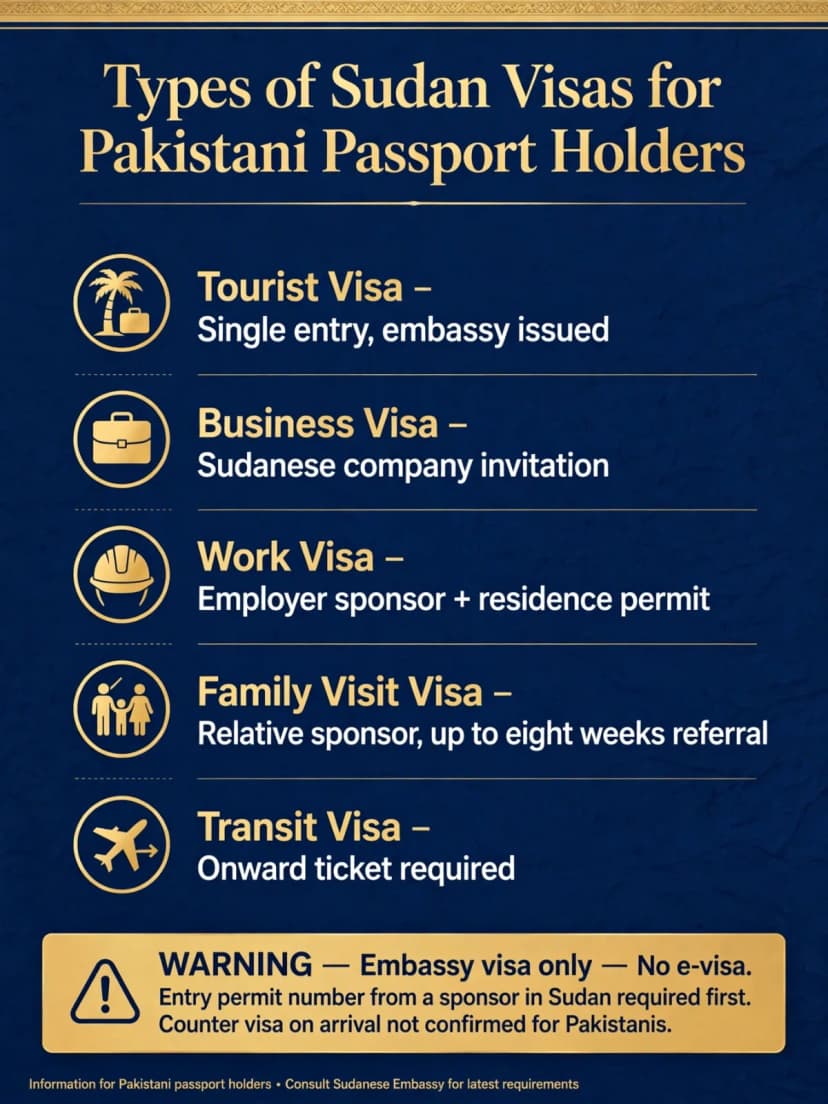
Sudan does not publish a single consolidated visa-type list the way countries with online portals do. The categories below are drawn from the published procedures of the Sudanese embassies in London, Berlin, The Hague and Washington, as consolidated in the EnvoyAtlas Sudan guide checked 25 October 2026, and from Pakistan-focused guides. Every category rests on the same foundation: a sponsor in Sudan obtains an entry permit number from the Ministry of Interior's Aliens Department, and the embassy issues the visa once that number reaches it through official channels. Diplomatic and official visas are the exception — those wait for approval from the Ministry of Foreign Affairs.
Tourist visa
The tourist visa is the standard short-visit visa issued by a Sudanese embassy, and it is the category most readers will be asking about. It rests on an entry permit number requested by a tour operator licensed in Sudan or another sponsor. In normal times that sponsor would be a licensed tour company; in 2026, with no tourist industry operating, a genuine tourist sponsor is very hard to find, and that is one more reason this guide does not present tourism as currently viable. London-based guides describe the tourist visa as single-entry with a validity of two months. The United States reciprocity schedule gives the tourist (B-2 class) visa as single-entry with three months' validity — that is the validity window of the visa, not a guaranteed length of stay. How long you may actually stay once inside Sudan is a separate, unresolved question dealt with in section 6: published reports say 30 days in some guides and 90 days in others, and no official source settles it.
Business and investment visa
The business visa covers meetings, contracts, trade and investment. It needs an invitation from a Sudanese company, which applies for the entry permit through the Ministry of Interior, plus a letter from your own employer. London-based guides describe it as single-entry with a validity of two months; the Berlin embassy also lists six-month and twelve-month multiple-entry business visas. A Pakistani businessman in Vietnam would normally apply through the Islamabad embassy if he is in Pakistan, or through Beijing or another regional mission if he is applying from Vietnam — and in either case the Sudanese company is doing half the work before the embassy sees the file.
Work entry visa and humanitarian assignments
Foreigners going to Sudan to work need an entry visa backed by a letter from the sponsoring employer or organisation stating the job, the length of stay and who bears the costs. Aid workers additionally need a certificate from the Humanitarian Aid Commission. This is the most realistic category in 2026, because humanitarian organisations are among the few employers still operating in Sudan. The work entry visa is an entry visa only — the right to live and work in Sudan comes from a residence permit applied for after arrival through the Aliens Affairs Department, usually by the sponsor. The United States State Department notes that Sudanese law requires a negative HIV test result to obtain a work or residence visa; confirm this with the issuing embassy, because it is a condition that must be satisfied before travel, not after arrival.
Student visa
A student visa is listed by several missions, including Berlin, as a category, and Pakistan-focused guides list it as a category for Pakistani citizens. No official Sudanese source found for this guide publishes a student-specific document list, fee, or procedure, and no Sudanese university admission route is operating normally during the war. Section 10 covers what is known and what is not. Do not pay any agent who claims to hold a confirmed Sudanese student-visa allocation for 2026.
Family and private visit visa
The private or family visit visa covers visiting relatives in Sudan, backed by an invitation letter from the relative and proof of the relationship. London-based guidance notes that a private visa application is referred for approval, a process that can take up to eight weeks. For a Pakistani in Vietnam with family in Sudan, this is likely the most relevant category after the humanitarian route, and the eight-week referral time is the reason to start the sponsor's entry-permit application long before any planned travel date.
No published family-reunification visa class, separate from the private visit visa, was found, and no published permanent-residence route, timeline or fee for foreign nationals was found. Residence permits for those staying for work, study or family reasons are handled by the Aliens Affairs Department, but it publishes no procedure, fee or timeline that could be quoted here. Do not assume a visit visa can simply be extended: no official extension procedure or fee was found.
Transit visa
A transit visa is listed by several missions, including Berlin, and by Pakistan-focused guides. No official source found for this guide publishes its documents, fee, or maximum transit stay, and there is no confirmed transit-without-visa arrangement for any nationality passing through Port Sudan airport. If your journey routes through Sudan to a third country — which in practice means very few itineraries, since Sudan is not a transit hub in 2026 — apply for the transit visa in advance and carry the visa for your final destination as well.
Visa on arrival — the counter visa
The counter visa is an entry visa issued at the border, and the General Directorate of Passports and Immigration confirmed in July 2025 that it remains in force, with approval given by its headquarters. Sudan does not publish which nationalities may receive it, and no official source confirms that Pakistani passport holders qualify. The London embassy's published procedure makes no mention of it for ordinary visitors; its route is the sponsor's entry permit. Treat the counter visa as a mechanism that exists for some travellers, not as a route you can rely on. Arriving at Port Sudan without a visa and hoping for a counter visa is not a plan.
No separate e-visa, and no visa-free route for Pakistanis
To be explicit: Sudan operates no electronic visa system for general travellers, there is no official Sudanese e-visa portal, and any website claiming to sell a Sudan e-visa is not an official channel. The genuine online portal at evisa.gov.ss belongs to South Sudan. There is also no visa-free entry, no visa-on-arrival entitlement, and no exemption for Pakistani ordinary passport holders. The 7 November 2026 diplomatic and official passport agreement is unratified and does not cover ordinary passports.
Visa Comparison Table
| Visa type | Entry | Typical validity | Sponsor needed? | Main backing document |
|---|---|---|---|---|
| Tourist visa | Single entry | 2 months (London guides); 3 months (US reciprocity schedule) | Yes — licensed tour operator or sponsor | Entry permit number from the Aliens Department |
| Business / investment visa | Single entry; 6- or 12-month multiple entry at Berlin | 2 months single; 6 or 12 months multiple | Yes — Sudanese company | Company invitation; entry permit number |
| Work entry visa | Single entry as standard | Tied to assignment; residence permit follows | Yes — employer or organisation | Sponsor letter; Humanitarian Aid Commission certificate for aid workers |
| Student visa | Single entry as standard | Not published | Yes — institution or sponsor | Admission letter; entry permit number |
| Family / private visit visa | Single entry | 2 months in London-based guides | Yes — relative in Sudan | Invitation letter; proof of relationship |
| Transit visa | Single entry | Not published | Not confirmed | Onward ticket; visa for final destination |
| Counter visa on arrival | Issued at the border | Not published | Approval by the Directorate's headquarters | Prior approval; nationalities covered not published |
| Diplomatic / official visa | Single entry | 2 months in London-based guides | Ministry of Foreign Affairs approval | Official note; MFA approval |
Visa Fees: What Each Route Costs
There is no single official Sudan visa fee. Each Sudanese mission sets its own fee, and the published figures differ widely — so widely that quoting one figure without naming the mission would be misleading. The figures below are the published fees for specific missions, with the mission named in every case. No official fee for a Pakistani passport holder applying at the Sudanese Embassy in Islamabad was found in any source consulted for this guide; the Islamabad fee is unverified, and you must ask the embassy directly before paying anything.
The best-documented fee is Berlin's. The Sudanese Embassy in Berlin charges EUR 80 for a single-entry visa of any category — tourist, transit, business, humanitarian, study, family or visit — and EUR 480 for a six-month multiple-entry visa and EUR 960 for a twelve-month multiple-entry visa, according to the EnvoyAtlas guide checked 25 October 2026. The Sudanese Embassy in Washington charges USD 154 for its visa categories, on the same source. The London embassy's older published figures, quoted in secondary guides, are approximately GBP 75 (about USD 103) for all nationalities except United States passport holders, who pay about USD 138 (GBP 100). Those London figures come from older guidance and should be confirmed with the embassy before relying on them.
Pakistan-focused agency guides quote different numbers again: Travel Visa Stack, updated 20 October 2026, puts the fee at around USD 100–150 for a single-entry visa; GoTravel.pk quotes approximately PKR 15,000–25,000 for a tourist or business visa, PKR 20,000–30,000 for a student visa, PKR 30,000–40,000 for a work visa and PKR 10,000–15,000 for a transit visa. None of these is an official embassy figure. They are agency prices and estimates, reported here only so that you can recognise them for what they are. The fee you will actually pay is the fee charged by the mission where you apply, and it may be none of the figures above.
Two further fees apply after arrival, and both are also reported rather than officially published. Registration with the Aliens Department within three days of arrival carries a fee: one secondary guide puts it at approximately USD 45, another at approximately GBP 35. The exit visa that a single-entry visa holder may need to leave Sudan is reported at about USD 50 by a London-based guide, and the FCDO says you may need to show proof of your sponsor and pay the exit visa fee, without stating an amount. A travel permit to leave Red Sea State also carries a fee, again without a published amount. Budget for all three, confirm each amount on arrival, and keep receipts.
Fees are normally paid at the embassy when you submit, and are not refundable if the visa is refused. No official Sudanese source publishes a refund policy, an appeal route, or a fee-waiver provision. Pay only at the embassy counter or through the payment route the embassy itself directs you to, and never pay a third-party website that claims to sell a Sudan visa online.
| Mission or source | Fee reported | What it covers |
|---|---|---|
| Embassy in Berlin (EnvoyAtlas, checked 25 Oct 2026) | EUR 80 | Single-entry visa, any category |
| Embassy in Berlin (EnvoyAtlas, checked 25 Oct 2026) | EUR 480 | Six-month multiple-entry visa |
| Embassy in Berlin (EnvoyAtlas, checked 25 Oct 2026) | EUR 960 | Twelve-month multiple-entry visa |
| Embassy in Washington (EnvoyAtlas, checked 25 Oct 2026) | USD 154 | Visa categories as listed by the embassy |
| Embassy in London (older guidance, via Byevisa) | About GBP 75 (about USD 103) | Single-entry visa, non-US nationalities |
| Embassy in London (older guidance, via Byevisa) | About USD 138 (GBP 100) | Single-entry visa, US passport holders |
| Embassy in Islamabad | Not published — unverified | Ask the embassy directly |
| Agency reports (Travel Visa Stack, Oct 2026) | About USD 100–150 | Single-entry visa, estimate only |
| Agency reports (GoTravel.pk) | PKR 15,000–40,000 by category | Estimates only, not official |
| Aliens Department registration (reported) | About USD 45 or about GBP 35 | Registration fee on arrival — figure conflicts |
| Exit visa (reported, via Visa Genie) | About USD 50 | Exit visa for single-entry holders — not always enforced |
Processing Times
Processing times are as unsettled as the fees, because the decisive step — the entry permit — happens inside Sudan, before the embassy stage, and its timing is not published. The figures below are mission-specific reports, not a single official timetable, and the honest planning figure is the longest one: start at least two months before travel, and longer for a private or family visit visa.
The United States State Department's country information does not publish a processing time. The EnvoyAtlas guide, consolidating mission practice, reports up to 10 working days in Washington once the file is complete, and two to three weeks in The Hague. Canada's travel advice, as summarised in the Arman Education Sudan study guide, advises applying at least two months before travel and warns that approval is not automatic. Travel Visa Stack reports standard processing of one to two weeks, longer if Ministry of Interior pre-approval is required. GoTravel.pk reports five to fifteen working days, longer in peak seasons. A London-based guide reports that a private visa application, once submitted, is referred for approval in a process that can take up to eight weeks. A Pakistan agency listing advertises three working days for a visit visa package — that is a commercial claim, not an official processing time, and it should not be relied on.
The structure of the delay is worth understanding. Step one is the sponsor's application to the Aliens Department in Sudan for the entry permit number; the embassy cannot act until that number reaches it through official channels. Step two is the embassy's own processing once the number has arrived. Neither step has a published service standard, and during the war both steps are subject to disruption — the Aliens Affairs Department's Khartoum premises were destroyed during the war, and although the department was formally reopened in Khartoum State in February 2026, services are being restored step by step. Build in slack for both steps, do not book a non-refundable ticket until the visa is in your passport, and treat any agent who guarantees a date as unreliable.
Complete Document Checklists
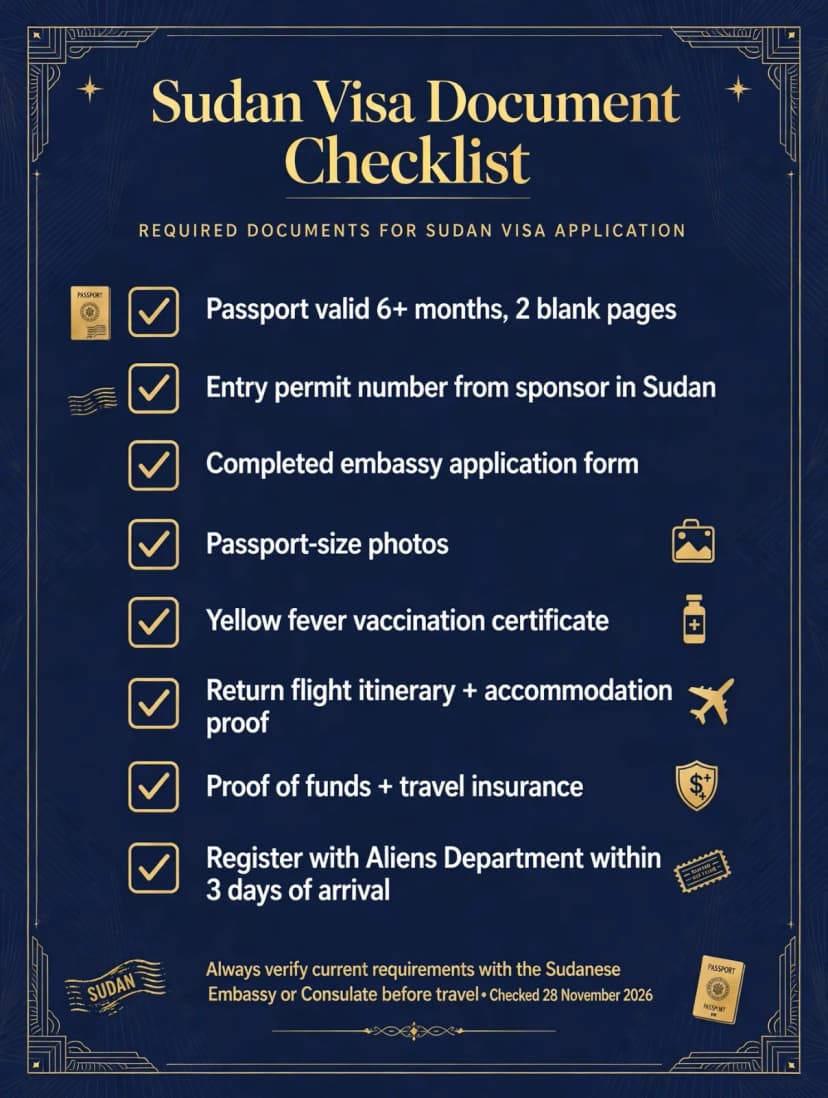
No single official Sudanese checklist for Pakistani applicants was found. The lists below combine the documents named across the London, Washington, Berlin and Canberra embassy procedures and the Pakistan-focused guides, and each item is marked where its source is a specific mission. Take the full file to the embassy — Sudanese missions are described across the guides as strict about paperwork — and expect the embassy to ask for more on a case-by-case basis.
All applicants — core documents
- Original Pakistani passport, valid at least six months beyond the date of arrival, with at least two blank pages (three is safer — see section 2)
- Completed Sudanese visa application form, signed — the form comes from the embassy where you apply; several missions publish it on their own websites
- One or two recent passport-size photographs — London and Washington ask for one attached to the form; the FCDO's registration procedure needs two more after arrival, so carry spares
- The unique entry permit number obtained by your sponsor from the Aliens Department of the Ministry of Interior — this is the document the whole application turns on; the London embassy's procedure requires it before the embassy stage
- Cover letter explaining your purpose, dates and sponsor, signed by you
- Confirmed return or onward flight itinerary — where flights are available; in 2026 this means a routing into Port Sudan, normally via Doha, Cairo, Dubai, Istanbul or Addis Ababa
- Proof of accommodation in Sudan, or the invitation letter from your host giving their address
- Proof of sufficient funds — bank statements for the last three to six months are the usual request; no official minimum balance is published
- Yellow fever vaccination certificate — the FCDO and the United States State Department both state it is required for entry (see the conflict note in section 13)
- Travel and medical evacuation insurance — strongly recommended given the security and health situation; the FCDO warns that travelling against its advice may invalidate ordinary travel insurance, so check the policy wording before buying
- Copy of your CNIC — requested in Pakistan-focused guides for applications made in Pakistan
- Copy of your Vietnam temporary residence card or visa — for applications made from Vietnam, to show your legal residence there
Tourist visa — additional documents
- Entry permit number obtained by a licensed Sudanese tour operator or sponsor
- Hotel bookings or host details for the whole stay
- Evidence of the funds to cover the stay, in cash terms — Sudan is a cash-only economy and foreign bank cards do not work, so the embassy may ask how you will pay for things
Business visa — additional documents
- Invitation letter from the Sudanese company, which applies for the entry permit
- Letter from your own employer in Vietnam or Pakistan confirming the purpose of the visit
- Company registration or NTN/business documents, where the embassy asks for them
Work visa — additional documents
- Letter from the sponsoring employer or organisation stating the job, the length of stay and who bears the costs
- Employment contract or assignment letter
- Certificate from the Humanitarian Aid Commission, for aid workers
- Negative HIV test result — Sudanese law requires it for a work or residence visa, according to the United States State Department; confirm the format with the issuing embassy
Student visa — additional documents
- Admission letter from the Sudanese institution
- Evidence of funds for tuition and living costs — no official amount is published
- Academic documents as requested by the embassy
Family or private visit visa — additional documents
- Invitation letter from the relative in Sudan, with their full name, address and contact details
- Proof of relationship — family registration documents, marriage certificate or birth certificate as applicable
- Copy of the host's Sudanese identity document, where the embassy asks for it
Children travelling with you — additional documents
- The child's passport, with at least six months' validity
- Father's written consent letter for the child to enter and exit Sudan, stamped at the Sudanese embassy before travel — required by the FCDO for children aged 17 and under travelling without their father
- If the father is absent: a court order showing sole custodial rights
- If the parents are divorced: divorce documents
- If the father has died: the death certificate
- The child's birth certificate or other evidence of the legal relationship
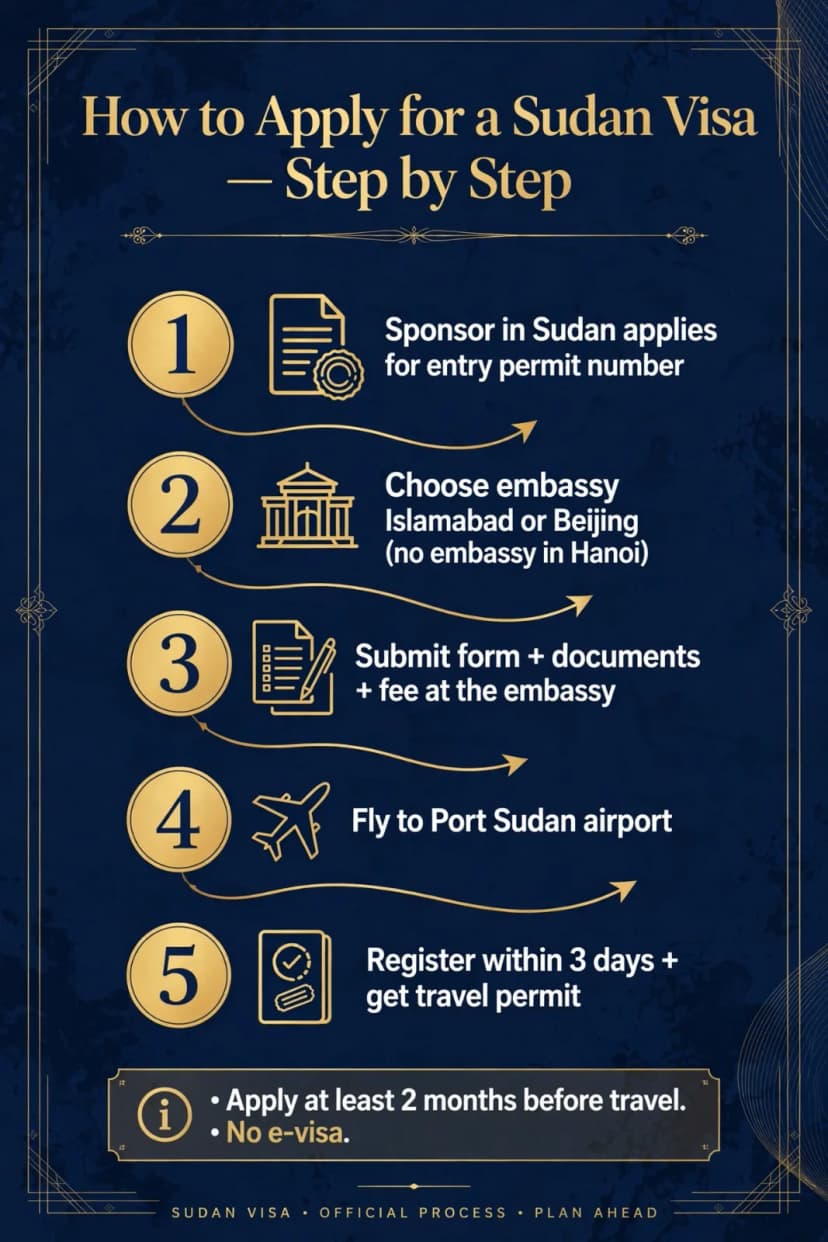
How to Apply: Step-by-Step
Embassy visa — step by step
Step 1 — Decide whether you have a genuine, essential reason to travel. Read the United States Level 4 advisory and the FCDO advice in full. If your reason is tourism, stop here: tourism is not currently viable, and no sponsor, no tour operator and no visa can make it viable. If your reason is family, humanitarian work or an official assignment, continue — and keep a written evacuation plan that does not depend on any government's help, because the United States government states plainly that it cannot guarantee your safety travelling to airports, borders or during onward travel, and the British Embassy in Khartoum is closed with no consular staff in Sudan.
Step 2 — Find your sponsor in Sudan and start the entry permit. Your sponsor — a relative, a Sudanese company, a licensed tour operator or a humanitarian organisation — applies to the Aliens Department of the Ministry of Interior for your entry permit. This is the first step, not a formality at the end: the London embassy's published procedure puts the Aliens Department application first, and the unique entry permit number is what the embassy waits for. Give the sponsor a clear copy of your passport data page and your planned dates, and ask for written confirmation when the permit number has been issued and sent to the embassy through official channels.
Step 3 — Choose the embassy and confirm it is accepting applications. The realistic options for a Pakistani living in Vietnam are set out in section 9. Whichever mission you choose, telephone or email it before travelling or posting anything, and confirm three things: that it is accepting visa applications from a Pakistani resident of Vietnam, what its current fee is, and whether it wants the application in person or by post. Sudanese missions have had limited operations during the war, and a wasted journey to a closed or non-accepting mission is the most avoidable mistake in this process.
Step 4 — Assemble the file. Use the checklist in section 7 for your category. Get the yellow fever vaccination at least ten days before travel and keep the certificate with your passport. If children are travelling, get the father's consent letter stamped at the embassy before travel. Make photocopies of everything, including the entry permit number, and keep a set separate from the originals.
Step 5 — Complete the application form. Use the form from the embassy where you are applying — forms differ between missions. Enter the entry permit number exactly as issued. London requires ordinary visit and tourist applications to be handed in at the embassy in person; official visas and applications from people of Sudanese origin can go by post or courier. Other missions have their own rules; ask.
Step 6 — Submit, pay and wait. Submit the file at the embassy, pay the fee the mission charges, and keep the receipt. Do not book a non-refundable ticket until the visa is issued. Expect the process to take weeks, not days, and longer for a private visa referral. If the embassy says the file has been referred, that is normal for some categories and can take up to eight weeks.
Step 7 — Check the visa when it is issued. Confirm the name spelling, the passport number, the validity dates, the number of entries (normally single entry) and any conditions stamped on it. A single-entry visa means exactly that: one entry, and you may need an exit visa to leave.
Step 8 — Fly to Port Sudan, not Khartoum, unless your sponsor advises otherwise. Port Sudan New International Airport (PZU) is the country's functioning international gateway. Khartoum International Airport officially reopened in October 2025 but was subject to drone attacks, and the FCDO warns the risk of further attacks continues; the United States State Department describes Khartoum airport as operating for limited commercial traffic only. Confirm the live flight position with your airline before departure, and have a sponsor-arranged plan for the journey from the airport to your accommodation.
Step 9 — Register within three days of arrival. You must register with the Aliens Department at the Ministry of Interior within three days of arrival, with two passport-size photos and a fee. Some larger hotels will do this for you — ask when you check in. Failure to register can lead to a fine. Note the conflict in section 13: some reference sources state the deadline as 24 hours rather than three days. Registering on the first day satisfies both readings and is the safe course.
Step 10 — Get a travel permit before leaving Red Sea State, and an exit visa before leaving Sudan. You will not be allowed to leave Red Sea State without a travel permit, applied for once in the country, for a fee. If you entered on a single-entry visa, you may need an exit visa to leave — ask at Port Sudan Airport Immigration, show proof of your sponsor, and be ready to pay the exit visa fee.
Counter visa on arrival — why this guide does not give steps for it
No step-by-step is given for the counter visa, because no official source publishes who qualifies for it. The Directorate confirmed in July 2025 that it remains in force with headquarters approval, and that is all that is verified. A guide that invented steps for it would be inventing a route. If a Sudanese mission tells you in writing that you qualify for a counter visa and how to obtain the headquarters approval, follow its instructions and keep them in writing.
Applying from Vietnam and Pakistan — No Sudanese Embassy in Hanoi
This section is the one most readers will need, and it contains the least comfortable finding in the guide: there is no Sudanese embassy in Vietnam.
Sudan's embassy in Hanoi closed in August 2018. That is recorded in the list of diplomatic missions in Vietnam, which places Sudan in its table of closed missions with the year 2018. Older directories still list an embassy at 61 Ly Thuong Kiet Street, Hoan Kiem District, Hanoi, with telephone (84-4) 3718 5911 and an honorary consulate in Ho Chi Minh City at 194 No Trang Long Street, Binh Thanh District — but those listings are stale. The 68 Solutions 2026 guide to embassies in Hanoi lists the Embassy of Sudan as closed since August 2018, and no current Sudanese government source, no Vietnamese foreign ministry listing, and no 2026 reporting contradicts that. Do not travel to 61 Ly Thuong Kiet Street expecting a functioning embassy, and do not send documents or money to the old Hanoi contact details. Whether the Ho Chi Minh City honorary consulate still functions in any form is unverified, and an honorary consulate would not normally issue visas in any case.
Option 1 — Apply in Pakistan through the Sudanese Embassy in Islamabad
For most Pakistani readers this is the most straightforward route, because it is the mission in your country of nationality and it is where the Pakistan-focused guides direct applicants. The Sudanese Embassy in Islamabad is listed at House No. 8, Street No. 16, Sector F-6/3, Islamabad, with telephone (+92) 51 230 7691 / 2 and the website sudanembassy.com.pk. Two cautions apply. First, the address is reported inconsistently across directories: other listings give House No. 7, Street No. 1, G-6/3; House No. 1A, Street 32, F-8/1; and House No. 13-A, School Road, F-6/1, with different telephone numbers. The F-6/3 address is the most consistently repeated current listing, but telephone the embassy and confirm the address and opening hours before travelling. Second, no official fee for a Pakistani applicant at Islamabad was found; ask the fee, the form, and whether the application must be made in person when you call.
Option 2 — Apply through the Sudanese Embassy in Beijing
The Sudanese Embassy in Beijing is the nearest functioning Sudanese embassy to Vietnam, and it is the mission a Pakistani resident of Vietnam would most naturally approach without leaving the region. Its chancery is at No. 1, Dong Er Jie, San Li Tun, Beijing 100600, telephone (+86) 10 6532 2205 and (+86) 10 6532 3715, according to the Beijing municipal government's foreign embassies listing and the travel directories that repeat it. Sudan also has a Consulate-General in Guangzhou, which may be closer to Vietnam but whose visa-issuing role is not confirmed. What is not verified is whether the Beijing embassy accepts visa applications from a Pakistani national who is resident in Vietnam rather than in China, and what fee it charges a Pakistani applicant. Some Sudanese missions accept applications only from residents of their country of accreditation; others accept third-country nationals. You must ask Beijing directly — by telephone or email — before booking any travel to China, and get the answer in writing if you can. Do not assume that proximity means jurisdiction.
Option 3 — Apply through the Sudanese Embassy in New Delhi
Sudan maintains an embassy in New Delhi, listed among its current missions. No street address, telephone number or visa procedure for New Delhi was verified from an official source for this guide, and whether New Delhi accepts applications from a Pakistani resident of Vietnam is unverified. New Delhi is a realistic option only if you are already travelling to India, and only after the embassy confirms it will take your application.
Option 4 — Apply through the Sudanese Embassy in Cairo
Sudan maintains an embassy in Cairo, with a Consulate-General in Aswan. Cairo is relevant because Egypt is the main regional hub for Sudan travel — Port Sudan flights route through Cairo, and the United States directs its own Sudan-related consular emergencies to its embassy in Cairo. Whether the Cairo embassy accepts applications from a Pakistani resident of Vietnam is unverified, and Cairo should be treated as a fallback to be confirmed by telephone, not as a default.
Option 5 — Apply through the Sudanese Embassy in London
London is included because it is the mission whose procedure is published in full in English at sudanembassy.org.uk, and its visa-service page is the clearest official statement of the entry-permit system anywhere. It is not a practical option for most readers in Vietnam — it would mean travelling to the United Kingdom to apply — but its published procedure is the reference standard this guide uses, and a reader who happens to be in the United Kingdom should follow it exactly.
Which option should you choose?
If you can travel to Pakistan, Islamabad is the natural first choice: it is your national mission, and it is the one the Pakistan-focused guides are written around. If you cannot leave Vietnam, Beijing is the nearest mission and the one to ask first — but only after it confirms it will accept your application. In either case, the sponsor's entry permit comes first, and the embassy stage comes second. And in every case, confirm the mission is open, accepting applications, and charging the fee it states, before you spend money on travel or tickets.
Student Route: Studying in Sudan
There is no verified, functioning student-visa route to Sudan in 2026 that this guide can recommend. A student visa is listed as a category by several Sudanese missions, including Berlin, and by Pakistan-focused guides, which describe it as requiring an admission letter, a passport and financial proof, with agency-quoted fees of around PKR 20,000–30,000. But no official Sudanese source found for this guide publishes a student-specific document list, fee, processing time, or residence-permit procedure, and no Sudanese university is operating a normal admissions route for foreign students during the war. The Arman Education study guide for Sudan, checked for this guide, states plainly that no official student-visa category, residence procedure, work-right rule or cost-of-living figure was found.
The practical position is therefore simple: do not plan to study in Sudan in 2026, and do not pay any agent who claims to hold a confirmed Sudanese student visa or university place. If you have a genuine academic reason to go — for example, a research affiliation with a Sudanese institution — treat it as a sponsored visit: the institution acts as your sponsor, obtains the entry permit number, and you apply for the entry visa at an embassy on that basis, then regularise your stay through the Aliens Affairs Department after arrival. Ask the embassy which visa category it will issue for that purpose, because the category determines the documents, and get the answer before you pay anything. Students who are already in Sudan should keep their registration current with the Aliens Department and keep their sponsor institution informed of their address at all times.
Work Route: Jobs, Business and Work Permits
Sudan is not a jobs market for foreign workers in 2026, and this guide does not present it as one. The economy is cash-only, foreign bank cards do not work, there are no international ATMs, medical services are extremely limited, and the United States State Department warns that even minor health issues could require medical evacuation at the traveller's expense. No Pakistani should travel to Sudan in 2026 looking for general employment.
The work route that does exist is the sponsored one: a specific employer or organisation in Sudan — in practice, a humanitarian organisation, a United Nations agency, or a company with an established Sudan operation — sponsors your entry visa, states the job, the length of stay and who bears the costs in its letter, and obtains the entry permit number. Aid workers additionally need a certificate from the Humanitarian Aid Commission. On arrival, the right to live and work comes from a residence permit applied for through the Aliens Affairs Department, usually by the sponsor. No official fee, document list or processing time for a residence permit was found for this guide, so the sponsor must confirm the current procedure after arrival.
Family Visits and Permanent Residence
Family visits are, with humanitarian work, the most genuine reason a Pakistani in Vietnam might need a Sudan visa in 2026. The route is the family or private visit visa: a relative in Sudan invites you, acts as your sponsor, obtains the entry permit number from the Aliens Department, and you apply at an embassy with the invitation letter and proof of the relationship. London-based guidance warns that a private visa application is referred for approval and can take up to eight weeks, so start the sponsor's application at least two months — and preferably three — before any planned travel date.
Children travelling for a family visit need the father's consent letter described in section 2, stamped at the embassy before travel. Keep the family's documents together — invitation letter, proof of relationship, the entry permit number, and the consent letter — and carry copies separately from the originals.
Common Mistakes to Avoid
Mistake 1 — Treating Sudan as a tourist destination in 2026. The war is the fact that overrides every other fact. Do not plan a holiday, do not book a tour, and do not assume that a visa makes travel safe. The United States says "Do not travel to Sudan for any reason." The FCDO advises against all travel. Travel insurance bought for a trip against FCDO advice may be invalid.
Mistake 2 — Applying for a "Sudan e-visa" online. There is no official Sudan e-visa. Websites selling one are not official channels, and evisa.gov.ss is South Sudan's portal. The only route is a Sudanese embassy, after a sponsor's entry permit.
Mistake 3 — Applying at the embassy before the sponsor has the entry permit number. The entry permit comes first. An application submitted without it will wait or be refused, and the fee is not refundable.
Mistake 4 — Going to Hanoi expecting an embassy. The Sudanese Embassy in Hanoi closed in August 2018. The old address and telephone number in directories are stale. Confirm the mission you plan to use is open and accepting applications before you travel.
Mistake 5 — Arriving without a visa and hoping for a counter visa. The counter visa exists, but Sudan publishes no list of qualifying nationalities. A Pakistani who arrives without a visa is relying on the discretion of border officers in a war zone.
Mistake 6 — Travelling on a passport with an Israeli stamp without checking. The FCDO says you will be refused entry; the United States State Department says entry has been allowed since April 2021. Get a written answer from the issuing embassy, or renew the passport first.
Mistake 7 — Forgetting the yellow fever certificate. The FCDO and the United States State Department both state it is required for entry. Get the vaccination at least ten days before travel and carry the certificate with your passport.
Mistake 8 — Failing to register after arrival. Registration with the Aliens Department is required — three days by the FCDO's account, 24 hours by some reference sources. Register on day one and keep the receipt.
Mistake 9 — Leaving Red Sea State or leaving Sudan without the right permit. You need a travel permit to leave Red Sea State, and you may need an exit visa to leave the country on a single-entry visa. Both are applied for in the country, both carry fees, and neither should be left to the last day.
Mistake 10 — Carrying cards instead of cash, or carrying too much cash. Foreign bank cards do not work in Sudan, there are no international ATMs, and the economy is cash-only. At the same time, the United States State Department records an exit maximum of USD 3,000 and warns that travellers carrying large amounts of United States currency have been detained and had currency confiscated. Plan the cash you need with your sponsor, carry it in clean post-2006 bills, and declare what you must.
Mistake 11 — Paying an agent for a guaranteed visa, job or student place. No agent can guarantee a Sudanese visa, because the decision turns on the entry permit issued inside Sudan.
Reasons for Refusal
No official Sudanese refusal list is published, so the reasons below are drawn from the structure of the system and the conditions the official sources do state.
No sponsor and no entry permit number. This is the commonest reason. Without a sponsor in Sudan who has obtained the entry permit number, the embassy has nothing to issue a visa against.
Passport validity or blank pages. A passport with less than six months' validity beyond arrival, or without two blank pages, fails the entry condition stated by the United States State Department and the FCDO.
Israeli stamp or visa in the passport. The FCDO states this leads to refusal of entry. The conflicting United States position is set out in section 2; do not rely on it.
Missing or inconsistent documents. Sudanese missions are described as strict about paperwork. A missing invitation letter, an unsigned form, a photograph that does not meet the requirement, or dates that do not match between the cover letter, the invitation and the flight itinerary can all cause a refusal or a referral that takes weeks.
No yellow fever certificate. Both the FCDO and the United States State Department state the certificate is required for entry. Arriving without it risks refusal at the border even if the visa was issued.
Children without the father's consent letter. The FCDO's consent rule for children aged 17 and under is a stated entry condition. A family that arrives without the stamped letter risks the child being refused entry or exit.
Security and admissibility concerns. Sudan is in an armed conflict, and the authorities control entry tightly. Any inconsistency in the stated purpose of travel, any suggestion that the visit is not what the invitation describes, or any adverse record can lead to refusal. There is no published appeal route for a refused Sudanese visa; the practical remedy is to fix the named problem, obtain a fresh entry permit if needed, and reapply.
Frequently Asked Questions
1. Do Pakistani citizens need a visa for Sudan?
Yes. Pakistani ordinary passport holders must obtain a visa in advance from a Sudanese embassy. Pakistan is not on Sudan's visa-exempt list and not on its visa-on-arrival list. A visa-exemption agreement for diplomatic and official passports was signed on 7 November 2026 but is not yet ratified and does not cover ordinary passports.
2. Is there a Sudan e-visa I can apply for online?
No. Sudan operates no electronic visa system and no official online visa portal. Any website selling a "Sudan eVisa" is not an official channel, and evisa.gov.ss belongs to South Sudan, a different country. Visas are issued by Sudanese embassies after a sponsor obtains an entry permit number inside Sudan.
3. How much does a Sudan visa cost for a Pakistani passport?
There is no single official fee, and no official fee for a Pakistani applicant at the Islamabad embassy was found. Published mission fees are EUR 80 for a single-entry visa at the Berlin embassy (EUR 480 for six-month multiple entry, EUR 960 for twelve-month multiple entry) and USD 154 at the Washington embassy. Older London figures are about GBP 75 for non-US nationalities. Agency estimates of USD 100–150 or PKR 15,000–25,000 are not official fees. Ask the mission where you apply for its current fee before paying.
4. How long does a Sudan visa take to process?
There is no published official timetable. Reported mission times are up to 10 working days in Washington once the file is complete and two to three weeks in The Hague, while Canada's advice is to apply at least two months before travel, and a London-based guide warns a private visa referral can take up to eight weeks. Plan on at least two months from the start of the sponsor's entry-permit application.
5. How long can I stay in Sudan on a tourist visa?
This is unverified. London-based guides describe the tourist visa as single-entry with a validity of two months, and the United States reciprocity schedule gives three months' validity for the tourist class — but validity is not the same as permitted stay. Published guides report a stay of 30 days in some cases and 90 days in others, and no official source settles the question. Ask the issuing embassy to state the permitted stay in writing.
6. What is the entry permit number and how do I get one?
It is a unique number issued by the Aliens Department of the Ministry of Interior in Sudan, obtained by your sponsor in Sudan — a relative, a company, a licensed tour operator or an organisation — before the embassy can issue your visa. You cannot obtain it yourself from outside Sudan. Your sponsor applies for it, and it is sent to the embassy through official channels. Without it, there is normally no visa.
7. Is there a Sudanese embassy in Vietnam?
No. Sudan's embassy in Hanoi closed in August 2018, and the old listings showing an embassy at 61 Ly Thuong Kiet Street and an honorary consulate in Ho Chi Minh City are stale directories. There is no Sudanese mission in Vietnam where you can apply. The realistic options are Islamabad, Beijing, New Delhi or Cairo — and whether Beijing or New Delhi will accept an application from a Pakistani resident of Vietnam is unverified and must be asked directly.
8. Can I get a visa on arrival in Sudan?
Do not plan on it. The General Directorate of Passports and Immigration confirmed in July 2025 that the counter visa issued on arrival remains in force, but Sudan publishes no list of which nationalities qualify, and no official source confirms that Pakistani passport holders qualify. The safe route is the embassy visa obtained in advance.
9. Is it safe to travel to Sudan in 2026?
No government advises it. The United States rates Sudan Level 4 — Do Not Travel — renewed 15 May 2026, citing unrest, crime, kidnapping, terrorism, landmines and health threats. The United Kingdom advises against all travel. The British Embassy in Khartoum is closed, the United States Embassy in Khartoum has been suspended since April 2023, medical services are extremely limited, and Port Sudan airport has been disrupted by drone strikes.
10. Do I need a yellow fever certificate for Sudan?
Carry one. The FCDO states that to enter Sudan you must have a certificate proving yellow fever vaccination, and the United States State Department also states that yellow fever vaccination is required. Canada's travel advice, as summarised in secondary sources, states that proof is not required to enter — a direct conflict. The safe course is to follow the FCDO and the State Department: get vaccinated at least ten days before travel and carry the certificate, which is valid for life.
11. Do I need to register after arriving in Sudan?
Yes. The FCDO states you must register with the Aliens Department at the Ministry of Interior within three days of arrival, with two passport-size photos and a fee, and that failure to register can lead to a fine. Some reference sources state the deadline as 24 hours rather than three days. Register on your first day to satisfy both readings, and ask your hotel whether it can do the registration for you.
12. Do I need an exit visa to leave Sudan?
Possibly. The FCDO states that if you enter on a single-entry visa you will need an exit visa to leave, though this is not always enforced, and that you can get information from Port Sudan Airport Immigration, where you may need to show proof of your sponsor and pay the exit visa fee. A London-based guide reports the fee at about USD 50. Arrange it before your departure day.
13. Can I enter Sudan if my passport has an Israeli stamp?
The official sources disagree. The FCDO states that if your passport has an Israeli visa, entry or exit stamp, you will not be allowed to enter Sudan. The United States State Department states that as of April 2021 Sudan allows entry to travellers with Israel entry and exit stamps. Until a Sudanese mission confirms the current rule in writing, assume the stricter FCDO rule applies and renew your passport if it carries an Israeli stamp.
14. Can I work or study in Sudan on a visit visa?
No. A visit visa does not carry a right to work or study. Work requires a work entry visa backed by a sponsoring employer, plus a residence permit after arrival, and Sudanese law requires a negative HIV test for a work or residence visa. Study requires an admission letter and a sponsor's entry permit, and no functioning student route was verified for 2026. Do not travel to Sudan looking for general employment.
15. What happens if my Sudan visa is refused?
There is no published appeal route. Visa fees are not refundable. The practical remedy is to find out the reason — most commonly a missing entry permit number, a passport-validity problem, or incomplete documents — fix it, obtain a fresh entry permit if the old one has expired, and reapply. Do not pay any agent who promises to overturn a refusal for a fee.
Official Immigration Websites
| Organisation | What it is | Website |
|---|---|---|
| UK Foreign, Commonwealth and Development Office | Sudan travel advice — entry requirements, safety, registration, exit visas (updated 11 May 2026) | https://www.gov.uk/foreign-travel-advice/sudan/entry-requirements |
| US Department of State | Sudan Travel Advisory — Level 4, Do Not Travel (issued 15 May 2026) | https://travel.state.gov/content/travel/en/traveladvisories/traveladvisories/sudan-travel-advisory.html |
| US Department of State | Sudan International Travel Information — visa, passport, health, currency, local law | https://travel.state.gov/content/travel/en/international-travel/International-Travel-Country-Information-Pages/Sudan.html |
| Embassy of the Republic of Sudan, London | Visa Service — the official entry-permit procedure (sudanembassy.org.uk) | https://www.sudanembassy.org.uk/visa-service/ |
| Embassy of Sudan, Beijing (Beijing municipal listing) | Chancery address and telephone for the nearest functioning mission to Vietnam | https://english.beijing.gov.cn/beijinginfo/facts/embassy/202005/t20200513_1895977.html |
| Sudanese Embassy in Islamabad | Embassy website listed in Pakistan directories (sudanembassy.com.pk) — confirm address and fee by telephone | https://sudanembassy.com.pk/en/ |
| Wikipedia — Visa policy of Sudan | Visa-exempt and visa-on-arrival lists; police registration; admission restrictions | https://en.wikipedia.org/wiki/Visa_policy_of_Sudan |
| Wikipedia — List of diplomatic missions of Sudan | Current Sudanese missions abroad, including Beijing, New Delhi, Cairo and Islamabad | https://en.wikipedia.org/wiki/List_of_diplomatic_missions_of_Sudan |
| Wikipedia — List of diplomatic missions in Vietnam | Records the Sudanese Embassy in Hanoi as closed in 2018 | https://en.wikipedia.org/wiki/List_of_diplomatic_missions_in_Vietnam |
Final Checklist and Conclusion
Before you spend any money, work through this list in order. If you cannot tick the first three boxes, do not proceed.
- You have a genuine, essential reason to travel — family, humanitarian work or an official assignment — not tourism.
- You have read the United States Level 4 advisory and the FCDO advice in full, and you have a written evacuation plan that does not depend on government help.
- You have a named sponsor in Sudan who has agreed to obtain your entry permit number from the Aliens Department of the Ministry of Interior.
- Your passport is valid at least six months beyond your planned return and has at least three blank pages, with no Israeli stamp or visa unless the issuing embassy has confirmed in writing that it is acceptable.
- You have a yellow fever vaccination certificate, with the vaccination given at least ten days before travel.
- You have confirmed by telephone that the embassy you will use — Islamabad, Beijing, New Delhi or Cairo — is open, is accepting applications from a Pakistani resident of Vietnam, and has told you its current fee and form.
- Your file is complete: signed form, photographs, entry permit number, cover letter, invitation, flight itinerary, accommodation, proof of funds, insurance with medical evacuation cover, CNIC copy, and Vietnam residence proof.
- If children are travelling, the father's consent letter is stamped at the embassy before travel.
- You have not booked a non-refundable ticket, and you have budgeted for the registration fee, the Red Sea State travel permit fee and a possible exit visa fee, all in cash — foreign cards do not work in Sudan.
- You have a sponsor-arranged plan for the journey from Port Sudan airport to your accommodation, and a communication plan with your family for confirming you are safe.
Sudan in November 2026 is a country at war, and this guide has not hidden that from you at any point. The pyramids of Meroë and the temples of Kush will still be there when the war ends, and the right time to visit them as a tourist is after the advisories change, not before. For the small number of Pakistanis who must travel now — to family, or to help — the route exists but it is narrow: a sponsor first, an entry permit number second, an embassy visa third, registration within three days of arrival, a travel permit to leave Red Sea State, and possibly an exit visa to leave. Where this guide found a conflict, it reported both sides; where it found no official figure, it said so. Use it as a starting point, confirm every live detail with the embassy that will stamp your passport, and do not travel against the advice of your own government without understanding that no one will be able to help you if things go wrong.
*This guide was checked on 28 November 2026. Visa rules change without notice. Always confirm the live rules with the Sudanese embassy that will issue your visa — Islamabad, Beijing, New Delhi or Cairo — before paying any fee or booking a non-refundable ticket. Nothing in this guide is immigration advice; the Sudanese authorities set and enforce the entry rules, and the immigration officer at Port Sudan makes the final decision. This guide is educational information only and does not guarantee visa approval or entry.