Slovenia Visa Guide 2026: Types, Requirements, Documents and Application Steps
Last checked: 28 November 2026. This guide is for Pakistani passport holders living in Vietnam. Visa rules change without notice — always confirm the live rules on the Slovenian government portal (gov.si), with the mission that represents Slovenia where you live, and on the European Commission's Schengen visa pages before paying any fee or booking a non-refundable ticket.
Introduction
Slovenia is one of Europe's smallest and most rewarding destinations: Lake Bled and its island church, the Julian Alps, the Soča Valley, the Postojna caves, the Adriatic coast at Piran, and a compact, walkable capital, Ljubljana. For a Pakistani living in Vietnam, the visa picture is both simpler and more complicated than for most countries in this series. It is simpler because Slovenia is a full member of the Schengen Area, so there is no separate "Slovenian visa" for a short visit — you apply for one standard Schengen visa, and the fee, the stay limit and the core documents are the same across all 29 Schengen states. It is more complicated because Slovenia has no embassy in Vietnam and no embassy in Pakistan, so every application goes through another country that represents Slovenia — and the representing country is different depending on where you live.
If you live in Ho Chi Minh City, the good news is concrete and officially confirmed: the Netherlands' visa application location in Ho Chi Minh City also accepts Schengen visa applications for Slovenia, through VFS Global. If you live in Hanoi, the position is less clear, and this guide says so plainly. If you are applying from Pakistan, Germany represents Slovenia for short-stay visas, through the German Embassy in Islamabad and the German Consulate General in Karachi. Long stays are a different world again: a national long-stay (D) visa costs EUR 77 and is issued only by a Slovenian mission — for Pakistan that means the Embassy of Slovenia in Tehran — while work and study normally run through residence permits decided inside Slovenia.
Every fee figure names its source. Where sources disagree, the conflict is disclosed; where no fee, stay length or processing time could be verified, the guide says so and names the office to ask.
Do Pakistani Passport Holders Need a Visa for Slovenia?
Yes. Pakistan is listed in Annex I of Regulation (EU) 2018/1806, the EU regulation that names the third countries whose nationals must hold a visa to cross the external borders of the member states. Slovenia's own Ministry of Foreign and European Affairs confirms that Pakistani citizens need a visa to enter Slovenia. There is no visa-free entry, no visa on arrival and no e-visa for an ordinary Pakistani passport.
Two further points matter and are often missed. First, Pakistani citizens also need an airport transit visa (Visa A) simply to stay in the international transit area of a Slovenian airport while changing planes to a third country. Pakistan is on the common Schengen list of nationalities subject to the airport transit visa requirement, alongside Afghanistan, Bangladesh, Iran, Iraq, Nigeria and Sri Lanka, among others. You are exempt from the transit-visa requirement if you already hold a valid Schengen visa, a long-stay visa or a residence permit issued by a Schengen state, a valid visa or residence permit issued by the United States, Canada or Japan, or if you are a qualifying family member of an EU, EEA or Swiss citizen — but if none of those exemptions applies, do not book a connection through Ljubljana Jože Pučnik Airport without a Visa A.
Second, a Schengen visa is not a Slovenia-only document. A short-stay visa issued for Slovenia lets you travel throughout the Schengen Area — all 29 states — for up to 90 days in any 180-day period, and the 90 days are counted across the whole area, not per country. That is why the "main destination" rule matters so much: under the EU Visa Code you must apply to the country where you will spend the most nights, or to the country of first entry if the stays are equal. If Slovenia is not your main destination, do not apply for a Slovenia visa — apply to the country where you will spend the longest, or your application can be refused as lodged at the wrong consulate, and the EUR 90 fee is not refunded.
A valid Vietnamese temporary residence card (TRC) does not change the visa requirement. Your residence in Vietnam changes where you apply, not whether you need a visa. Likewise, a previous Schengen visa in an old passport helps your credibility but does not exempt you from applying again once it has expired. The only Pakistani passport holders who do not need a visa are those who also hold a valid residence permit issued by a Schengen state, or who hold another nationality that is visa-exempt and travel on that passport.
At the border, the Entry/Exit System (EES) now records non-EU short-stay travellers electronically: it began rolling out on 12 October 2025 and became fully operational on 10 April 2026, so overstays are detected automatically. The separate ETIAS authorisation for visa-exempt visitors is not in operation and has no announced start date — and in any case it will never apply to you as a visa national: you need a visa, not an ETIAS.

Types of Slovenia Visas for Pakistani Passport Holders
Slovenia's visa system has two layers: the harmonised Schengen layer for short stays, and the national layer for long stays. Most Pakistani applicants will only ever need the first. The table in the next section compares them side by side; this section explains each type in words.
Schengen short-stay visa (Type C) — tourism. The standard visitor visa for holidays, sightseeing and visiting friends — the visa for a trip built around Lake Bled, Ljubljana and the coast. It allows up to 90 days in any 180-day period across the whole Schengen Area, issued as a single-entry, double-entry or multiple-entry visa. First-time applicants from Pakistan usually receive a single-entry visa valid only for the dates of their trip; applicants with a clean travel history may receive a multiple-entry visa. It does not allow you to work in Slovenia.
Schengen short-stay visa (Type C) — family or friends visit. The same Type C document, but for visiting family or friends in Slovenia. Instead of (or in addition to) hotel bookings, you provide a formal invitation from your host, who may also need to provide a guarantee letter and proof of their legal residence and income. The consulate checks the genuineness of the relationship and the host's means; a weak invitation is a common refusal ground.
Schengen short-stay visa (Type C) — business. The same Type C visa, for meetings, conferences, trade fairs and negotiations. You add an invitation letter from the Slovenian company, evidence of your own employment or business in Vietnam or Pakistan, and proof of the business relationship. It does not allow you to take up employment in Slovenia.
Airport transit visa (Type A). Required for Pakistani nationals who remain in the international transit area of a Slovenian airport while connecting to a third country, unless an exemption applies (see the previous section). It allows no entry into Slovenia itself. The fee is the same EUR 90 as a short-stay visa.
National long-stay visa (Type D). This is Slovenia's own national visa for stays of more than 90 days and up to one year, for a limited list of purposes defined in the Foreigners Act (Zakon o tujcih, ZTuj-2), Articles 19–30: joining an EU, Slovenian or UK citizen family member; a course or training of at least 20 hours a month; an international study exchange; research, university teaching, art, culture or business backed by an opinion from the competent ministry that it serves Slovenia's interest; professional sport or coaching with a Slovenian club; accredited foreign journalism; and religious or charity work. It costs EUR 77 and is free for close family members of Slovenian or other EU citizens. You apply at a Slovenian embassy or consulate no more than three months before travel. It cannot be renewed — before it expires you apply inside Slovenia for a temporary residence permit, and the time on the D visa then counts towards permanent residence. It is not a work visa: ordinary employment runs through the single permit, not the D visa.
Temporary residence permit — study. Students do not normally use the D visa. You apply for a temporary residence permit for the purpose of study at a Slovenian diplomatic or consular mission abroad, with admission from a Slovenian educational institution. The permit is issued for the duration of your studies and is the route described in the student section below.
Single permit (enotno dovoljenje) — work and residence. This is the main route for a Pakistani who has a job offer from a Slovenian employer. It is one document that combines the residence permit and the work authorisation, decided by the local administrative unit (upravna enota) with the consent of the Employment Service of Slovenia. A first single permit is issued for the duration of the employment contract, up to two years, and can be extended for up to three years under the reform in force since 21 May 2025. There is no separate "Slovenia work visa" to apply for at an embassy — the single permit is the work route, and a D visa is used only as the entry visa to travel to Slovenia once the permit is approved.
EU Blue Card. For highly qualified employment: a university degree and a Slovenian job offer paying at least the Blue Card salary threshold. It is decided faster than an ordinary single permit (around one to two months in secondary reporting). No Blue Card salary threshold for Slovenia could be verified from an official source, so the figure is not stated here — confirm it with the mission before relying on it.
Temporary residence permit for digital nomads. Opened on 21 November 2025 under an amendment to the Foreigners Act, this is a residence permit — not a visa — for third-country nationals who work remotely for an employer or clients outside Slovenia. It lasts up to one year, cannot be extended, and after it expires you must stay outside Slovenia for at least six months before applying again. There is no quota and no labour-market test, and family members can join immediately. The income requirement is set by a formula — at least twice Slovenia's average net monthly salary — not a fixed figure, and the current value of that formula is a point of disagreement between sources, disclosed below.
Temporary residence permit — family reunification. For joining a family member who already lives legally in Slovenia. The sponsor must show adequate income and housing, and the applicant applies at a Slovenian mission abroad. Family members of EU citizens use the D visa route instead, which is free of charge.
There is no Slovenian retirement visa, no passive-income visa, no investor visa with a published route for Pakistanis, and no "job-seeker visa" of the kind Germany offers. Any agent who offers you one of those for Slovenia is selling a fiction.
Visa Comparison Table
| Visa / permit | Purpose | Maximum stay | Fee (adult) | Where a Pakistani applies |
|---|---|---|---|---|
| Schengen Type C — tourism | Holiday, sightseeing | Up to 90 days in any 180 days | EUR 90 | Representing mission: Netherlands via VFS Global, Ho Chi Minh City (from Vietnam); Germany, Islamabad/Karachi (from Pakistan) |
| Schengen Type C — family/friends visit | Visiting family or friends in Slovenia | Up to 90 days in any 180 days | EUR 90 | Same as above |
| Schengen Type C — business | Meetings, conferences, trade fairs | Up to 90 days in any 180 days | EUR 90 | Same as above |
| Airport transit visa (Type A) | Airside transit through Ljubljana airport | Transit area only | EUR 90 | Same as above |
| National long-stay visa (Type D) | Family of EU/Slovenian/UK citizen; course 20+ hours/month; exchange; research, teaching, art, sport, journalism, religious work | More than 90 days, up to 1 year; not renewable | EUR 77 (free for family of EU/Slovenian citizens) | Slovenian mission only — Embassy of Slovenia in Tehran (from Pakistan); see Vietnam note below |
| Temporary residence permit — study | Full-time study at a Slovenian institution | Duration of studies | See fees section — permit fee bands, not a single published figure | Slovenian mission abroad |
| Single permit — work and residence | Employment with a Slovenian employer | First permit up to 2 years; renewal up to 3 years | See fees section — permit fee bands | Administrative unit in Slovenia, via the employer; entry on a D visa |
| EU Blue Card | Highly qualified employment | Duration of contract | See fees section | Administrative unit in Slovenia, via the employer |
| Temporary residence permit — digital nomad | Remote work for non-Slovenian employer/clients | Up to 1 year; not extendable; 6-month gap before reapplying | EUR 117 from abroad (reported, single source — see fees section) | Any Slovenian embassy or consulate |
| Temporary residence permit — family reunification | Joining a family member resident in Slovenia | As issued, tied to sponsor's permit | See fees section | Slovenian mission abroad |
Visa Fees: What Each Route Costs
The short-stay fee is the one figure in this guide that is fixed by EU law and beyond dispute. Under the EU Visa Code, as amended with effect from 11 June 2024, the Schengen short-stay visa fee is EUR 90 for adults and EUR 45 for children aged 6 to under 12; children under 6 are normally exempt from the fee. Those are the fees charged by every Schengen state, including Slovenia and the states that represent it. The fee is payable when you lodge the application, it is non-refundable even if the visa is refused, and it is charged in the local currency equivalent at the mission's rate — so the exact dong or rupee amount will differ slightly from the euro figure on the day you pay.
The national long-stay (D) visa fee is EUR 77, and it is free for close family members of Slovenian or other EU citizens. That figure is consistent across the 2026 secondary sources that read the Administrative Taxes Act tariff, and it is the figure the Embassy of Slovenia in Tehran charges for D visas. The appeal fee against a D-visa refusal is reported as EUR 153 with an eight-day appeal window; that figure comes from a single secondary source and is labelled reported, not verified.
Residence permit fees are charged in bands, and the bands below are taken from 2025–2026 secondary guides that read the Slovenian fee tariff — no official Slovenian fee page was available to confirm them at the time of writing, so they are reported figures, not verified ones. A temporary residence permit application costs EUR 13 if lodged at a mission abroad and EUR 4.50 if lodged in Slovenia; issuing the permit costs EUR 102 abroad and EUR 50 in Slovenia; the residence card itself costs EUR 15.47; and a single permit lodged in Slovenia costs EUR 70. A first-time applicant applying from abroad should therefore expect roughly EUR 200 or more in state fees in total for a residence-permit route — around EUR 77 for the D visa, EUR 13 for the application, EUR 102 for issuance and about EUR 15 for the card — before any translation, legalisation or travel costs. The digital nomad permit is reported to cost EUR 117 in total from abroad (EUR 102 application fee plus EUR 15 for the card), with a further EUR 13 if the card is collected at a Slovenian mission outside Europe; that total comes from a single secondary source and is labelled reported.
Three costs applicants routinely forget: the visa centre service fee, translations, and insurance. VFS Global charges a service fee on top of the EUR 90 visa fee in Vietnam; no current VFS service fee for Slovenia applications in Vietnam could be verified, so it is not stated here — ask VFS Global in Ho Chi Minh City before your appointment. Documents not in English or Slovenian generally need a certified translation, and Pakistani documents usually need attestation before a Slovenian mission will accept them. Travel medical insurance must cover at least EUR 30,000, valid in all Schengen states for the whole trip; a policy that covers only Slovenia, or expires before your return date, will get the application refused.
There is no published minimum bank balance for a Schengen visa. No official Slovenian or EU page states a fixed amount. The consulate assesses "sufficient means of subsistence" for the planned stay and the return journey, in light of your itinerary, accommodation and income. One Pakistan-focused agency guide quotes a benchmark of roughly PKR 1,800,000–3,500,000 as a closing balance; that is that agency's advice, not a government rule, and this guide does not adopt it. What matters is a credible pattern: regular salary credits or business income over the last three to six months, a balance that plausibly covers the trip, and a job or business in Vietnam that you have a reason to return to. A large lump sum deposited a week before the application, with no history behind it, hurts more than it helps.
For long stays, the means figure is fixed by law: the basic minimum income is EUR 507.43 a month for a single applicant. Two secondary sources disagree on the date from which that figure applies — one says 1 March 2026, another says 1 April 2026 — and the conflict is flagged below; the amount itself is consistent across sources. For a family, the applicant counts as 1.00, each additional adult adds 0.57 and each child adds 0.59 of that figure. A draft amendment to the Foreigners Act, published for consultation until 26 August 2026, would double these thresholds to EUR 1,014.86 a month for a single applicant; it is a draft, not law, and this guide does not treat it as the current rule — but check before you apply, because it may have moved since this guide was checked.
| Item | Fee |
|---|---|
| Schengen short-stay visa (Type C), adult | EUR 90 |
| Schengen short-stay visa (Type C), child 6 to under 12 | EUR 45 |
| Schengen short-stay visa (Type C), child under 6 | Normally free |
| Airport transit visa (Type A), adult | EUR 90 |
| National long-stay visa (Type D) | EUR 77 (free for family of EU/Slovenian citizens) |
| D-visa refusal appeal (reported, single source) | EUR 153 |
| Temporary residence permit — application abroad / in Slovenia (reported) | EUR 13 / EUR 4.50 |
| Temporary residence permit — issuance abroad / in Slovenia (reported) | EUR 102 / EUR 50 |
| Residence card (reported) | EUR 15.47 |
| Single permit lodged in Slovenia (reported) | EUR 70 |
| Digital nomad permit from abroad (reported, single source) | EUR 117 |
| Travel medical insurance (minimum cover) | EUR 30,000 |
| VFS Global service fee in Vietnam | Not verified — ask VFS Global before the appointment |
Processing Times
The EU Visa Code sets the standard decision time for a short-stay Schengen visa at 15 calendar days from the date the application is lodged, extendable to 45 days where further checks are needed or the consulate must consult another member state. That is the legal framework every representing mission works under. In practice, the German missions in Pakistan — which represent Slovenia there — state that short-term visas usually take about 14 calendar days. One Pakistan-focused guide reports a different split: complete applications take no less than 15 days and may take up to 30 days where additional checks are required. This guide reports all three figures and follows the Visa Code: plan on 15 days, allow 45, and do not book a non-refundable ticket for a departure less than three weeks after your appointment.
You may lodge a short-stay application no earlier than six months before the trip (nine months for seafarers) and no later than 15 calendar days before departure. An application lodged later than 15 days before travel can be refused as inadmissible without examination. For a first-time applicant from Pakistan, apply six to eight weeks before travel: the appointment itself can take days or weeks to secure at a busy VFS centre, and the 15-day clock only starts once the file is lodged.
No official processing time is published for the D visa. One university source puts the decision at around two weeks and advises applying between three weeks and three months before arrival; this guide treats that as reported, not verified, and advises allowing at least two months. For the single work-and-residence permit, the statutory decision deadline is reported as up to one month (30 days) from a complete application, extendable to two months (up to about 90 days) where additional checks or Employment Service consent are needed; in practice secondary sources put the total at roughly one and a half to three months, with some reporting three to five or even three to six months once the job search, the labour-market test and the administrative unit's queue are counted. The EU Blue Card is reported at around one to two months. The digital nomad permit is reported at 30–60 days. None of those permit timelines is an official published figure, and all of them are labelled reported in this guide. The honest summary is: short-stay visas are measured in weeks, residence permits in months, and the job search before them in longer still.
Complete Document Checklists
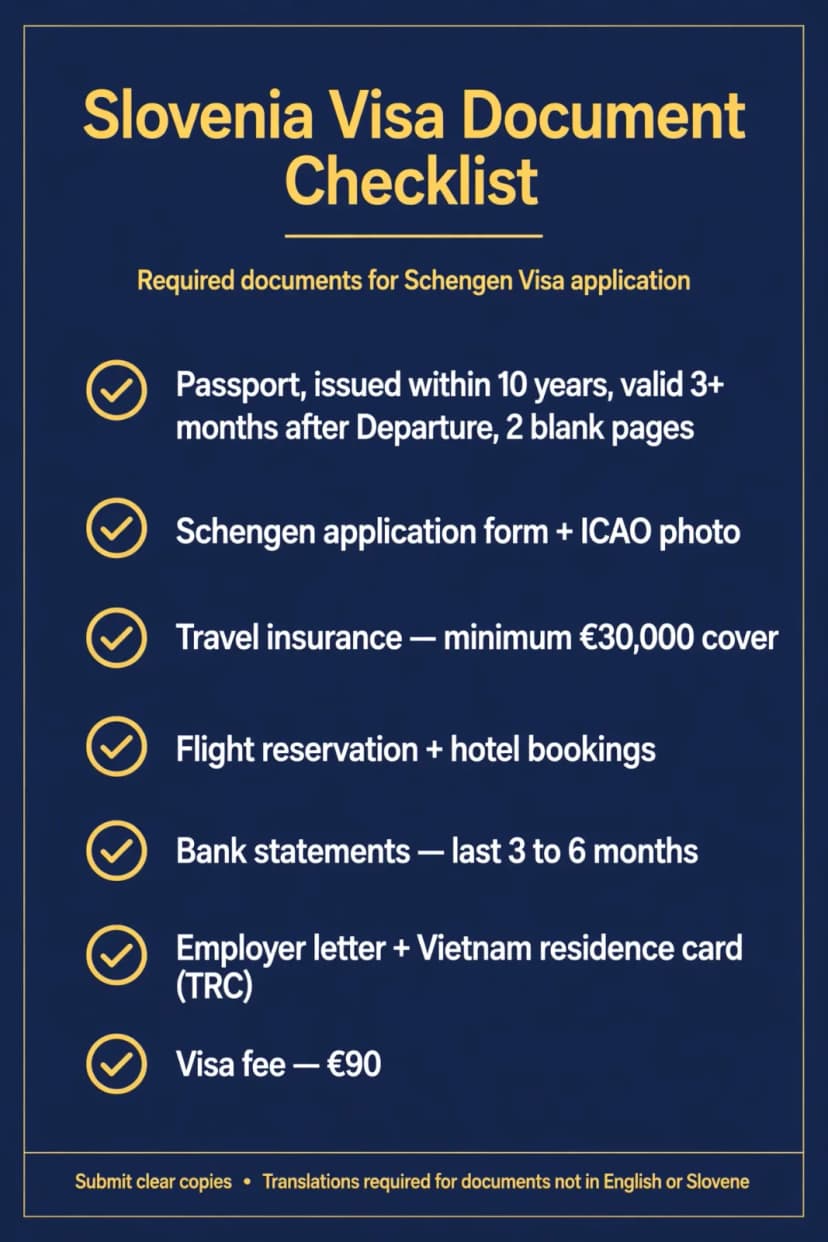
The checklists below follow the standard Schengen document list and the Slovenian long-stay requirements as reported in the 2026 sources. The representing mission's own checklist is the controlling document — the NetherlandsWorldwide checklist for Ho Chi Minh City, or the German mission's checklist in Pakistan — and you must follow it line by line, because a missing document is the most common reason a file is refused. Bring originals and one photocopy of everything, and keep a complete second copy for yourself.
Short-stay Schengen visa (Type C) — tourism
- Valid Pakistani passport: issued within the last 10 years, valid for at least three months beyond your planned departure from the Schengen Area, with at least two blank pages.
- Completed and signed Schengen visa application form (VIDEX online form for applications through the German missions in Pakistan; the NetherlandsWorldwide form for applications lodged in Vietnam).
- One recent passport-size photograph meeting the ICAO biometric standard (white background, no older than six months).
- Travel medical insurance covering at least EUR 30,000 for emergency care, hospital treatment and repatriation, valid in all Schengen states for the whole trip.
- Flight reservation (return or onward) — a reservation, not a paid non-refundable ticket, until the visa is issued.
- Proof of accommodation for the whole stay: hotel bookings, or a host's invitation with the host's address.
- Proof of sufficient means: bank statements for the last three to six months, showing regular income; salary slips; and, if employed, a letter from your employer in Vietnam confirming your job, salary, approved leave and return date.
- Proof of ties to Vietnam: your Vietnamese temporary residence card (TRC) or valid visa, your labour contract, and evidence of your life in Ho Chi Minh City.
- Cover letter explaining the purpose of the trip, the itinerary day by day, and why you will return to Vietnam.
- Proof of civil status where relevant (marriage certificate, family registration) if it supports the application.
- For a minor travelling with one parent or alone: notarised consent from the non-travelling parent(s) and the child's birth certificate.
- Visa fee payment (EUR 90) plus the VFS service fee.
Short-stay Schengen visa (Type C) — family or friends visit
All of the tourist documents above, plus:
- Formal invitation from your host in Slovenia, with the host's full name, address and contact details.
- Host's proof of legal residence in Slovenia and proof of income or a formal guarantee letter, as the representing mission's checklist requires.
- Evidence of the relationship with the host (photos, message history, previous visits) where the checklist asks for it.
Short-stay Schengen visa (Type C) — business
All of the tourist documents above, plus:
- Invitation letter from the Slovenian company, on letterhead, stating the purpose, dates and who pays the costs.
- Evidence of your employment or business in Vietnam (labour contract, business registration, tax documents) and of the business relationship with the Slovenian company.
- Proof of previous business dealings where relevant (contracts, invoices, correspondence).
Airport transit visa (Type A)
- Completed Schengen application form and passport meeting the same validity rules.
- Photograph, travel medical insurance and fee (EUR 90).
- Confirmed onward ticket to the third country and proof that you may enter it (its visa or residence permit).
National long-stay visa (Type D)
- Completed D-visa application form and passport valid at least three months beyond the planned stay, with two blank pages.
- One photograph (45 × 35 mm) meeting the ICAO standard.
- Travel health insurance of at least EUR 30,000 including repatriation.
- Proof of sufficient means of at least the basic minimum income, EUR 507.43 a month, for the whole stay.
- Documents proving the purpose of stay: for family reunion, proof of the family link; for a course, admission and proof of payment for a course of at least 20 hours a month; for an exchange, the exchange documents; for research, teaching, art or business, the competent ministry's opinion; for sport, the contract with a Slovenian club; for journalism, accreditation; for religious or charity work, the inviting organisation's documents.
- Police clearance certificate where the mission requires it.
- EUR 77 fee receipt (free for family of EU/Slovenian citizens).
Temporary residence permit — study
- Admission letter from a Slovenian educational institution and proof of enrolment.
- Proof of sufficient means (at least the basic minimum income, EUR 507.43 a month) and health insurance.
- Passport, photograph, completed permit application form and the permit fee.
- Police clearance certificate and, where required, proof of accommodation in Slovenia.
Single permit — work and residence
- A genuine job offer and signed employment contract from a Slovenian employer.
- The employer's application through the administrative unit, with Employment Service consent (the labour-market test) or proof of exemption.
- Passport, photograph, health insurance and proof of means at or above the applicable threshold.
- Police clearance certificate, and proof of qualifications where the job requires them.
- The permit fees set out in the fees section.
Digital nomad permit
- Proof of remote work for an employer, client or business registered outside Slovenia: employment contract, service contract or business registration, plus a declaration from the employer (or a self-declaration if self-employed) confirming the remote arrangement.
- Evidence of monthly funds of at least twice Slovenia's average net monthly salary (about EUR 3,377 a month on the latest published figure — see the conflict note in the work section).
- Passport valid at least three months beyond the planned stay, health insurance valid in Slovenia, and a certificate of no criminal record.
- Proof of accommodation in Slovenia.
How to Apply: Step-by-Step
Short-stay Schengen visa from Vietnam (Ho Chi Minh City)
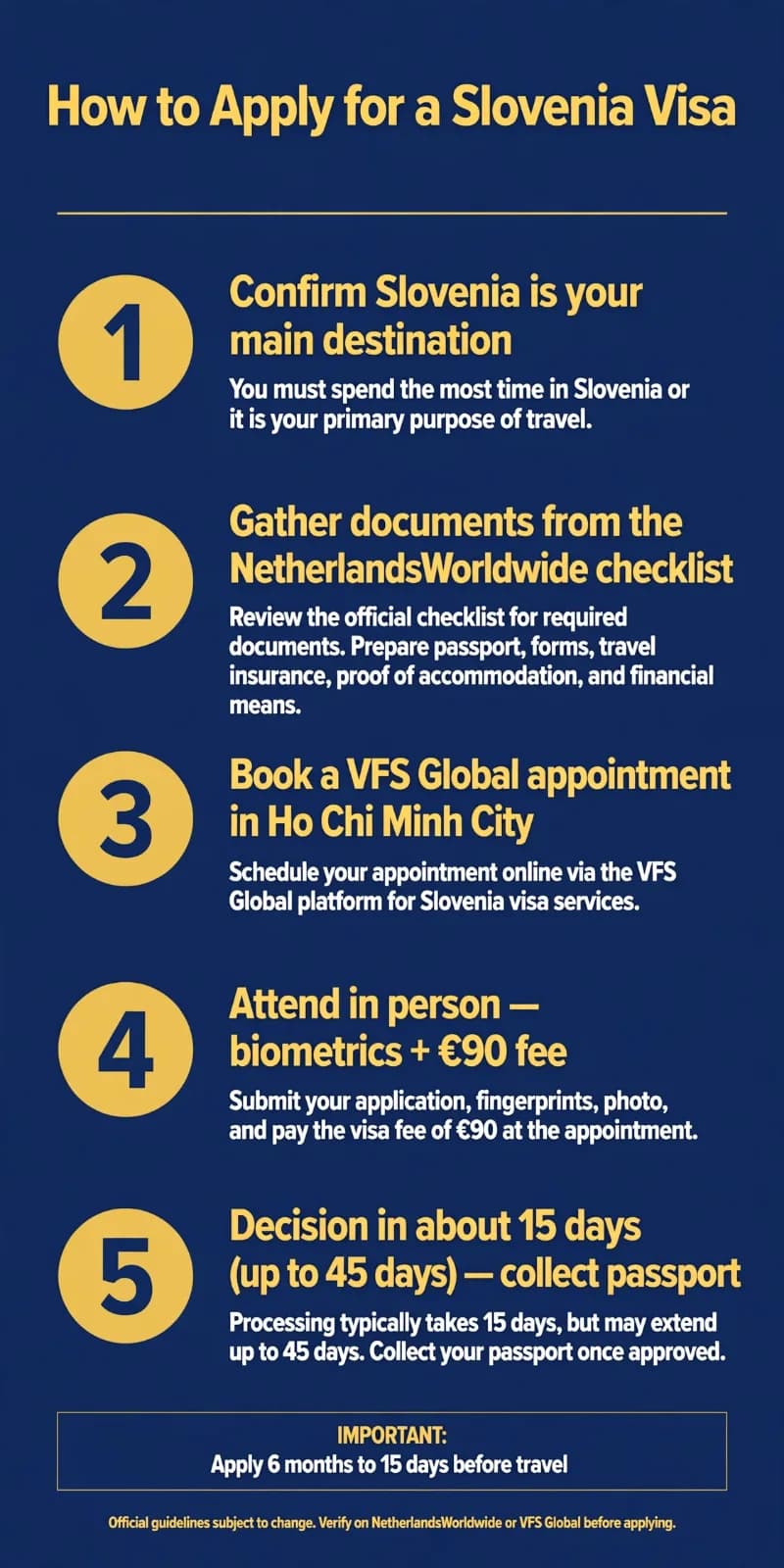
- Confirm Slovenia is the right consulate. Slovenia must be your main destination — the country where you spend the most nights. If another Schengen country is your main destination, apply there instead. If your nights are split equally, apply to the country you enter first.
- Check the NetherlandsWorldwide checklist. The Netherlands represents Slovenia for short-stay visas in Ho Chi Minh City. Read the Schengen visa document checklist on netherlandsworldwide.nl for Vietnam and gather every document on it, plus the checklist itself — you must bring the checklist to the appointment.
- Book a VFS Global appointment. Make the appointment at VFS Global in Ho Chi Minh City through the NetherlandsWorldwide pages. Book early: appointment availability, not the 15-day decision clock, is usually the bottleneck. You may apply up to six months before travel and no later than 15 calendar days before departure.
- Complete the application form. Fill in the Schengen application form as the checklist directs, and prepare the supporting documents, translations and insurance exactly as specified.
- Attend the appointment in person. Give your fingerprints and a photograph (biometrics) and hand in the file with the checklist. First-time applicants must appear in person; fingerprints are normally reused for 59 months if you have given them for a previous Schengen visa.
- Pay the fee. Pay the EUR 90 visa fee (in the local currency equivalent) plus the VFS service fee. Keep the receipt — it is your proof of lodging and your tracking reference.
- Wait for the decision and collect your passport. You will receive an email once the application has been processed; the email does not say whether it was approved. Collect your passport from VFS Global or have it sent to you. If approved, the visa sticker will be affixed to a page in your passport — check the dates, the number of entries and the spelling of your name before you leave the counter.
Short-stay Schengen visa from Pakistan
- Confirm Slovenia is your main destination, as above.
- Complete the VIDEX online form at videx.diplo.de, choosing Slovenia as the destination, and print it with its barcode.
- Register on the waiting list of the German Embassy in Islamabad or the German Consulate General in Karachi, according to your province of residence.
- Attend the appointment with the full file, give biometrics and pay the EUR 90 fee.
- Wait about 14 calendar days for the decision (up to 45 days if further checks are needed) and collect your passport.
Long-stay D visa and residence permits
- Identify the right route first. Ordinary work goes through the single permit, study through a study residence permit, remote work through the digital nomad permit, and only the limited purposes listed in the Foreigners Act use the D visa itself.
- For a D visa, apply in person at a Slovenian embassy or consulate no more than three months before travel, with the documents in the D-visa checklist and the EUR 77 fee.
- For a single permit, your Slovenian employer starts the process through the administrative unit, which seeks Employment Service consent. Once the permit is approved, you apply for a D visa as your entry visa at the Slovenian mission.
- For a study or digital nomad permit, lodge the permit application at a Slovenian mission abroad (or, if you are already legally in Slovenia, at the administrative unit).
- On arrival in Slovenia, register your address. If you stay in private accommodation, report your temporary address to the administrative unit within one week. Hotels and guesthouses register you themselves. Visitors must also register with the police within three days of arrival if their accommodation does not do it for them; failure to register can lead to a fine.
Applying from Vietnam and Pakistan
From Vietnam — the Netherlands represents Slovenia in Ho Chi Minh City
This is the most important section in the guide for its intended reader, and its core fact is officially confirmed. The NetherlandsWorldwide website — the official site of the Dutch government for consular services — states, on its page for applying for a Schengen visa for the Netherlands in Vietnam: "You can also apply for a Schengen visa for Luxembourg or Slovenia at the Netherlands' visa application location in Ho Chi Minh City." The application is lodged at VFS Global in Ho Chi Minh City, biometrics are taken there, and the file is decided under the same Schengen rules as any other short-stay application. If you live in Ho Chi Minh City or the south, this is your route, and it is a normal, established arrangement — not an exception you need to argue for.
Two things about the Vietnam position are not settled, and this guide flags both. First, Hanoi. An older visa-information page states that in Hanoi, applications for a visa to Slovenia are processed by the Embassy of Hungary. That is plausible — Hungary represents several Schengen states in Hanoi — but it could not be confirmed against a current official source, and the NetherlandsWorldwide page mentions only Ho Chi Minh City for Slovenia. If you live in the north, contact the Embassy of Hungary in Hanoi and the Embassy of the Netherlands in Hanoi before you travel south, and do not assume the Hungary route is still live. Second, the new Slovenian Consulate General in Ho Chi Minh City. Vietnam's WTO Center reported that Slovenia would open a Consulate General in Ho Chi Minh City on 19 August, marking its first diplomatic representation in Vietnam, at a meeting celebrating 30 years of bilateral ties — which dates the opening to August 2024. Whether that Consulate General accepts visa applications could not be verified from an official source. Until it is confirmed, treat the Netherlands/VFS route as the live one.
For long stays from Vietnam, the position is thinner still. Slovenia's Embassy in Beijing is accredited to Vietnam (alongside Mongolia, North Korea and Thailand), so the Beijing embassy is the Slovenian mission with formal responsibility for Vietnam. But no source confirmed that a Vietnam resident can lodge a D-visa or residence-permit application in Beijing, or what its appointment and document rules are for third-country nationals resident in Vietnam. If you need a D visa or a residence permit from Vietnam, contact the Embassy of Slovenia in Beijing first and ask directly whether it accepts applications from Pakistani nationals resident in Vietnam, and what it requires. Do not travel to Beijing for an appointment until that is confirmed in writing.
Your Vietnamese residence status matters to the application. Apply as a resident of Vietnam: your TRC, your labour contract with your school or employer, your Vietnamese bank statements and your proof of address in Ho Chi Minh City are the ties that show you will return. A Pakistani who is only visiting Vietnam as a tourist cannot use the Ho Chi Minh City route as a resident and should apply in Pakistan instead. Note also that your exit from Pakistan is governed by a separate Pakistani rule reported by UrduPoint: a polio vaccination certificate from NADRA is needed to leave Pakistan. That is a Pakistani exit requirement, not a Slovenian entry requirement, and it matters only if your journey starts in Pakistan.
From Pakistan — Germany represents Slovenia for short stays; Tehran for long stays
Slovenia has no embassy in Pakistan. For short-stay visas, Germany represents Slovenia: applications go to the German Embassy in Islamabad (Ramna 5, Diplomatic Enclave) or the German Consulate General in Karachi (92-A/7, Block 5, Clifton), according to your province of residence, through the VIDEX online form and the German missions' waiting-list system. The German missions state that short-term visas usually take about 14 calendar days. For long-stay D visas, the Embassy of Slovenia in Tehran is the competent mission for Pakistan. One older and now out-of-date source states that Sweden represented Slovenia in Islamabad; that appears to be a superseded arrangement, and this guide follows the current reporting that Germany is the representing state. The conflict is flagged below. Confirm the representing mission on gov.si before you apply, because representation agreements do change.
Student Route: Studying in Slovenia
Slovenia's universities — above all the University of Ljubljana, the University of Maribor and the University of Primorska — teach a growing number of programmes in English, and tuition fees for non-EU students are modest by Western European standards. But the student route is a residence-permit route, not a visa route, and it needs to be planned in months, not weeks.
You apply for a temporary residence permit for the purpose of study at a Slovenian diplomatic or consular mission abroad, before travelling. The core requirements are admission to a Slovenian educational institution, proof of sufficient means of at least the basic minimum income (EUR 507.43 a month), health insurance, a valid passport, a photograph, the permit application form and the permit fee, plus a police clearance certificate and proof of accommodation where the mission requires them. Some students enter Slovenia on a D visa first and then apply for the permit inside the country; the D visa is available for an international study exchange, and for a course of at least 20 hours a month that does not itself require a study permit. Which of those two doors fits your case depends on the exact programme, so ask the Slovenian mission and the university's international office before choosing.
No single published fee for a study residence permit could be verified, so none is stated: use the permit fee bands in the fees section (EUR 13 to apply abroad, EUR 102 for issuance, EUR 15.47 for the card) as planning figures and confirm the total with the mission. No official processing time for a study permit was found either; allow at least two to three months from lodging to decision, and do not pay tuition or book flights until the permit is in hand. Students may work part-time under the conditions of their permit — confirm the current hours limit with the university. After graduation, the realistic next step is a single permit with a Slovenian employer, not an automatic right to stay.
Work Route: Jobs, the Single Permit and the Digital Nomad Permit
The single permit — the only ordinary work route
If a Slovenian employer offers you a job, the route is the single residence and work permit (enotno dovoljenje). There is no separate work visa to apply for, and no Slovenian mission will issue you a visa on the strength of a job offer alone. The mechanics are employer-led: the employer applies through the administrative unit (upravna enota) in the place where you will live, and the administrative unit obtains the consent of the Employment Service of Slovenia (Zavod Republike Slovenije za zaposlovanje) — the labour-market test, which generally requires the employer to have advertised the vacancy and shown that no suitable worker is available in Slovenia or the EU. Nationals of Bosnia and Herzegovina and Serbia benefit from bilateral employment agreements under which their work permit counts as that consent; Pakistan has no such agreement, so a Pakistani applicant goes through the full test.
A first single permit is issued for the duration of the employment contract, up to two years, and can be extended for up to three years under the reform in force since 21 May 2025. Since that reform, you may also start work before the final permit is issued, on the basis of a certificate that the application has been lodged plus Employment Service consent. Changing jobs with the same employer, changing employers, or working for two or more employers needs written approval from the administrative unit, with Employment Service consent. A draft amendment would require A1-level Slovenian at renewal; that is a draft, not the current rule, but it is a reason to start learning the language early rather than at renewal time.
Processing times for the single permit are the least certain figures in this guide. The statutory decision deadline is reported as up to one month (30 days) from a complete application, extendable to two months (up to about 90 days) where additional checks or consent are needed. Secondary guides variously report six to twelve weeks overall, one and a half to three months in practice, two to four months for a standard application, and three to six months once the job search and the labour-market test are counted. This guide reports the range and advises planning on three to six months from the job offer to arrival. No official processing time was found.
The digital nomad permit — real, new, and income-tested
On 21 November 2025 Slovenia began accepting applications for a temporary residence permit for digital nomads, created by an amendment to the Foreigners Act. It is a residence permit, not a visa, and it is designed for people who work remotely using information technology for an employer, client or business registered outside Slovenia. You may be an employee of a foreign company, a contractor under a civil-law contract with a foreign client, or self-employed with a business registered abroad. You may not work for a Slovenian company or earn income from Slovenian sources on this permit.
The permit lasts up to one year and cannot be extended. When it expires you must remain outside Slovenia for at least six months before you can apply for a new one. There is no quota and no labour-market test, and your family can join you immediately — unusually generous by European standards. You need a passport valid at least three months beyond the planned stay, health insurance valid in Slovenia, a certificate of no criminal record, proof of accommodation, and monthly funds of at least twice Slovenia's average net monthly salary for the whole of your stay.
That income figure is where the sources disagree, and the disagreement is the point: the law sets a formula, not a fixed amount, and the formula's current value moves each time Slovenia's Statistical Office publishes new wage data. EY's tax news put it at approximately EUR 3,140 a month at launch; a specialist guide using the August 2026 published figure gives EUR 3,377.10 a month; another guide gives approximately EUR 3,398 a month as of November 2026. All three are readings of the same formula at different dates. This guide states the formula as the verified fact and the three readings as the reported range, and advises confirming the current figure with the Slovenian mission before applying — a figure that was right in August may be wrong by the time you file. The total fee from abroad is reported as EUR 117 (EUR 102 plus EUR 15 for the card) by a single secondary source and is labelled reported. Processing is reported at 30–60 days. For a Pakistani English teacher in Vietnam earning a Vietnamese salary, this permit is unlikely to be realistic unless your remote income genuinely clears the threshold: twice the Slovenian average net salary is roughly three times a typical Vietnamese teaching salary.
EU Blue Card
The EU Blue Card is the skilled-employment alternative to the ordinary single permit: a university degree plus a Slovenian job offer at or above the Blue Card salary threshold, decided by the administrative unit. Secondary reporting puts its processing at around one to two months. No Blue Card salary threshold for Slovenia could be verified from an official source, so the figure is not stated — ask the mission for the current threshold before assuming you qualify.
What will not work
Do not pay an agent who promises a Slovenia work visa without a named Slovenian employer and a contract: the single permit requires a real employer, a real vacancy and Employment Service consent. Do not travel on a tourist visa to look for work — a Type C visa does not allow employment and cannot be converted into a work permit inside Slovenia. Do not resign from your teaching job in Vietnam or book one-way travel until the permit decision is in your hands.
Family Visits and Permanent Residence
Visiting family in Slovenia uses the same Type C visa as tourism, with the invitation and guarantee documents described in the checklist section. The consulate checks the host's legal residence and means and the genuineness of the relationship; a host who cannot show either is a common reason for refusal. If your family member is an EU or Slovenian citizen, the long-stay D visa for joining them is free of charge and is the right route for a stay of more than 90 days.
Family reunification for a stay of more than 90 days runs through a temporary residence permit: the sponsor in Slovenia must show adequate income and housing, and the applicant applies at a Slovenian mission abroad. Immediate family members of a digital nomad permit holder can join at once, with no waiting period. No published processing time for a family reunification permit could be verified.
Permanent residence requires five years of continuous legal residence on temporary permits, and time on a D visa counts towards that period when the temporary permit application is filed before the D visa expires. Permanent residence normally requires basic Slovenian at level A2, and a draft amendment would raise that to B1 — a draft, not current law. Citizenship generally requires ten years of residence. There is no published shortcut, no investment route and no permanent residence on arrival.
Common Mistakes to Avoid
- Applying to the wrong consulate. Slovenia must be your main destination. A trip that spends five nights in Austria and two in Slovenia is an Austrian application, not a Slovenian one, and the wrong consulate can refuse it without examining the merits.
- Booking non-refundable travel before the visa is issued. Apply six to eight weeks ahead and book refundable reservations until the sticker is in your passport.
- A lump-sum bank deposit just before applying. Consulates read the pattern of income over three to six months. A sudden large credit with no history is treated as funds parking and damages credibility.
- Insurance that does not cover the whole trip. The policy must cover at least EUR 30,000, be valid in all Schengen states, and run to your return date. A policy that ends the day you arrive in Ljubljana will be refused.
- Forgetting the airport transit visa. If your itinerary connects through Ljubljana airport to a third country and you hold no Schengen visa or other exemption, you need a Visa A. Check the routing before you book.
- Applying less than 15 days before travel. The application is inadmissible, and the fee is still payable.
- Assuming the new Consulate General in Ho Chi Minh City takes visa applications. Until that is confirmed officially, the Netherlands/VFS route is the live one.
- Trusting an agent's fee or timeline. The only fees in this guide that are fixed by law are EUR 90, EUR 45 and EUR 77. Any other figure an agent quotes — especially a "guaranteed" work permit price — should be checked against the mission before money changes hands.
- Overstaying. The EES records entries and exits electronically, and overstaying is now detected automatically. An overstay can mean a fine, an entry ban and refusals on every future Schengen application.
- Failing to register after arrival. Hotels register you, but if you stay in private accommodation you must report your address to the administrative unit within a week, and police registration within three days applies where your host does not register you.
Reasons for Refusal
Schengen refusals follow the standard grounds in the EU Visa Code, and the refusal letter states the ground or grounds that applied. For Pakistani applicants the most common are: the purpose and conditions of the stay are not justified (a vague itinerary, unconvincing invitation or accommodation that does not cover the whole trip); insufficient means of subsistence; no proof of ties strong enough to show you will return (no stable job, no residence status, nothing anchoring you in Vietnam); doubts about the authenticity of documents (bank statements, employment letters and insurance policies are all checked, and a forged document can mean a multi-year ban); and a previous overstay or a refusal that was not addressed. A refusal is not the end of the road: the letter states the appeal route, and you may reapply once the named problem is fixed — but reapplying with the same file and a new cover letter changes nothing. For a D visa, the appeal window is reported as eight days with a EUR 153 fee (single secondary source, labelled reported). Fix the named problem, add the missing evidence, and only then reapply.
Frequently Asked Questions
1. Do Pakistani passport holders need a visa for Slovenia? Yes. Pakistan is in Annex I of Regulation (EU) 2018/1806, and Slovenia's Ministry of Foreign and European Affairs confirms that Pakistani citizens need a visa. There is no visa-free entry, no visa on arrival and no e-visa for an ordinary Pakistani passport. A valid Vietnamese residence card does not change that — it changes where you apply, not whether you need a visa.
2. How much is a Slovenia Schengen visa? EUR 90 for adults and EUR 45 for children aged 6 to under 12; children under 6 are normally exempt. The fee has applied across the Schengen Area since 11 June 2024. It is non-refundable even if the visa is refused, and VFS Global charges a separate service fee on top of it in Vietnam — the current service fee could not be verified, so ask VFS Global in Ho Chi Minh City before your appointment.
3. How long can I stay in Slovenia on a Schengen visa? Up to 90 days in any 180-day period, counted across the whole Schengen Area — not 90 days in Slovenia plus 90 days elsewhere. Your visa sticker states the exact validity period and the number of days allowed; the sticker, not this guide, is the authority.
4. Where do I apply for a Slovenia visa from Vietnam? In Ho Chi Minh City, at the Netherlands' visa application location (VFS Global), because the Netherlands represents Slovenia for short-stay visas there — confirmed on the official NetherlandsWorldwide website. If you live in the north, the position is unverified: an older source says the Embassy of Hungary in Hanoi handles Slovenia applications, but that could not be confirmed against a current official source, so contact the Hungarian embassy and the Netherlands embassy before travelling.
5. Is there a Slovenian embassy in Vietnam? Slovenia's Embassy in Beijing is accredited to Vietnam, and a Slovenian Consulate General in Ho Chi Minh City was announced to open on 19 August 2024 (the 30th anniversary of bilateral ties). Whether the Consulate General accepts visa applications could not be verified; until it is confirmed, use the Netherlands/VFS route for short-stay visas and contact the Beijing embassy for long-stay questions.
6. Where do I apply from Pakistan? For short-stay visas, Germany represents Slovenia: the German Embassy in Islamabad or the German Consulate General in Karachi, according to your province, through the VIDEX online form. For long-stay D visas, the Embassy of Slovenia in Tehran is the competent mission.
7. How long does a Slovenia Schengen visa take? The EU Visa Code allows 15 calendar days for a decision, extendable to 45 days where further checks are needed. The German missions in Pakistan state about 14 calendar days in practice. Apply six to eight weeks before travel and no later than 15 days before departure.
8. Do I need an airport transit visa to change planes in Ljubljana? Yes, unless an exemption applies. Pakistan is on the common Schengen list of nationalities that need an airport transit visa (Visa A) to stay in the international transit area of a Slovenian airport. You are exempt if you hold a valid Schengen visa, a long-stay visa or a residence permit from a Schengen state, or a valid visa or residence permit from the United States, Canada or Japan, among other exemptions.
9. What is the D visa, and who needs it? The national long-stay visa (Type D) is for stays of more than 90 days and up to one year, for a limited list of purposes: joining an EU, Slovenian or UK citizen family member; a course of at least 20 hours a month; an international study exchange; research, teaching, art, sport, journalism or religious work. It costs EUR 77 and is free for close family members of EU or Slovenian citizens. Ordinary work and study use residence permits, not the D visa alone.
10. Can I work in Slovenia on a tourist visa? No. A Type C Schengen visa does not allow employment, and you cannot convert it into a work permit from inside Slovenia. Work requires a single residence and work permit, started by a Slovenian employer through the administrative unit with Employment Service consent.
11. How does the Slovenia single work permit work? Your Slovenian employer applies for a single permit (enotno dovoljenje) through the local administrative unit, which seeks the Employment Service's consent — the labour-market test. A first permit runs for the contract length up to two years, with renewal up to three years. Processing is reported at roughly one and a half to three months in practice, and three to six months including the job search and labour-market test; no official processing time was found.
12. Does Slovenia have a digital nomad visa? Slovenia has a temporary residence permit for digital nomads, open since 21 November 2025 — not a document literally called a visa. It lasts up to one year, cannot be extended, and requires monthly funds of at least twice Slovenia's average net salary (about EUR 3,377 a month on the latest published figure; other readings EUR 3,140 and EUR 3,398 — the law sets a formula, not a fixed amount). You must work for an employer or clients outside Slovenia.
13. How much money do I need to show? There is no published minimum bank balance for a Schengen visa. The consulate assesses whether your means are sufficient for the planned stay and return, looking at three to six months of statements and your regular income. For long stays the figure is fixed by law: at least the basic minimum income of EUR 507.43 a month for a single applicant.
14. Do I need travel insurance? Yes. Travel medical insurance covering at least EUR 30,000 for emergency care, hospital treatment and repatriation, valid in all Schengen states for the whole trip, is a mandatory document for a Schengen visa and for the D visa. A policy that covers only Slovenia, or that expires before your return, will lead to refusal.
15. Is Slovenia safe to visit? The US State Department rates Slovenia Level 1, "Exercise Normal Precautions" (issued 15 May 2026), and the UK Foreign Office does not advise against travel to any part of Slovenia (advice updated 11 August 2026). The main risks are petty crime in tourist areas and the mountains: follow local guidance in the Julian Alps, check the weather, and never hike alone. Register your address after arrival, as the law requires.
Official Immigration Websites
| Website | What it is for |
|---|---|
| gov.si — Government of the Republic of Slovenia | Official portal of the Slovenian government, including the Ministry of Foreign and European Affairs and its visa pages |
| netherlandsworldwide.nl — Applying for a Schengen visa for the Netherlands in Vietnam | Official Dutch government page confirming that Slovenia Schengen applications can be lodged at the Netherlands' visa location in Ho Chi Minh City |
| visa.vfsglobal.com — VFS Global, Netherlands in Vietnam | Appointments and passport collection for Slovenia applications lodged in Ho Chi Minh City |
| gov.uk — UK Foreign Office travel advice for Slovenia | Entry requirements and safety advice (updated 11 August 2026) |
| travel.state.gov — US State Department, Slovenia Travel Advisory | Slovenia advisory, Level 1 "Exercise Normal Precautions" (issued 15 May 2026) |
| eur-lex.europa.eu — Regulation (EU) 2018/1806 | The EU regulation listing Pakistan among the nationalities that need a visa |
| ec.europa.eu — European Commission, Schengen visa policy and ETIAS | EU Visa Code rules, the 90/180-day rule, the short-stay calculator and the ETIAS status page |
| ess.gov.si — Employment Service of Slovenia | Labour-market consent for single permits |
| mzz.gov.si — Ministry of Foreign and European Affairs of Slovenia | Slovenian missions abroad, including the Embassy in Beijing (accredited to Vietnam) and the Embassy in Tehran (competent for Pakistan long stays) |
| pakistan.diplo.de — German missions in Pakistan | VIDEX form, waiting list and processing information for Slovenia short-stay applications from Pakistan |
| studyinslovenia.si — Study in Slovenia | Admissions and practical information for international students |
| investslovenia.org — SPIRIT Slovenia | Business and investment information for the business-visa route |
Final Checklist and Conclusion
Before you lodge anything, run through this list. Slovenia is your main destination — you spend the most nights there. Your passport was issued within the last 10 years, is valid for at least three months beyond your departure from the Schengen Area, and has two blank pages. Your insurance covers EUR 30,000 in all Schengen states for the whole trip. Your bank statements show three to six months of regular income, not a sudden lump sum. Your employer in Vietnam has given you a letter confirming your job, salary, approved leave and return date, and your TRC is valid. Your accommodation covers every night, your flights are reservations rather than non-refundable tickets, and your cover letter explains the trip day by day. You have booked the right appointment — VFS Global in Ho Chi Minh City through the Netherlands route if you live in the south — at least six weeks before travel and no later than 15 days before departure. You have checked the current representing mission on gov.si, because representation agreements change. And if your plan is a long stay, you have identified the right door before spending anything: the D visa, the single permit through a real Slovenian employer, the study permit through a university admission, or the digital nomad permit if your remote income clears twice the Slovenian average salary.
Slovenia rewards the applicant who treats it as a Schengen application with a Slovenian main destination, not as a country with its own shortcut. The fee is EUR 90, the stay is 90 days in 180, the decision takes about 15 days, and the application goes through the Netherlands in Ho Chi Minh City or Germany in Pakistan because Slovenia has no mission of its own in either place. Get those four facts right, file a complete and honest application, and the rest of the trip — Bled at dawn, Ljubljana's riverside cafes, the road into the Julian Alps — is the easy part.
This guide was checked on 28 November 2026 against the Slovenian government portal (gov.si), the NetherlandsWorldwide page for Schengen visas in Vietnam (opened and read), the German missions' guidance for Pakistan via UrduPoint (checked 28 November 2026), Regulation (EU) 2018/1806, the EU Visa Code, the US State Department Slovenia advisory (Level 1, 15 May 2026) and the UK Foreign Office travel advice for Slovenia (updated 11 August 2026). Visa rules change without notice, and the immigration officer at the border makes the final decision.