Sint Maarten Visa Guide 2026: Types, Requirements, Documents and Application Steps
Last checked: 28 November 2026. This guide is for Pakistani passport holders living in Vietnam. Visa rules change without notice — always confirm the live rules on NetherlandsWorldwide (netherlandsworldwide.nl) and the VFS Global website before paying any fee or booking a non-refundable ticket.
Introduction
Sint Maarten is the Dutch southern half of a single Caribbean island shared with French Saint-Martin: Philipsburg's boardwalk and Great Bay beach, the famous low-flying aircraft over Maho Beach at Princess Juliana International Airport, the Simpson Bay lagoon, and a cruise port that brings some of the largest ships in the Caribbean. For a Pakistani passport holder living in Vietnam, the trip is possible — but the visa is not the one most travellers expect. Sint Maarten is a constituent country within the Kingdom of the Netherlands, and it is not in the Schengen Area. The visa you need is a Caribbean visa, a common visa for the Dutch Caribbean that is entirely separate from a Schengen visa. A Schengen visa does not get you into Sint Maarten, and a Caribbean visa does not get you into the European Netherlands.
The good news is that the system is well documented by the Dutch government itself. The NetherlandsWorldwide website of the Dutch Ministry of Foreign Affairs states the rules plainly, VFS Global publishes the fee and the processing time, and the island runs its own free electronic ED Card that every air traveller must complete before check-in. The bad news is the distance: there is no Dutch Caribbean visa office in Vietnam, the application goes through the Dutch mission network and its outsourcing partner VFS Global, and the details that matter most to a Pakistani applicant — which VFS centre in Vietnam takes a Caribbean visa application, and whether the 30-day or the 90-day uninterrupted-stay figure applies on Sint Maarten — are not settled on any single official page. This guide gives you the verified figures, names every conflict it found, and tells you exactly what to confirm before you pay any fee or book a non-refundable ticket.
This guide is written for Pakistani passport holders living in Vietnam. It covers the short-stay Caribbean visa first, then the fees, the processing times, the full document checklists, the step-by-step application, the ED Card, the long-stay and work routes, the French side of the island, and the mistakes that get applications refused.
Do Pakistani Passport Holders Need a Visa for Sint Maarten?
Yes. Pakistani passport holders need a visa before travelling to Sint Maarten. Pakistan is not on the visa-free list for the Caribbean parts of the Kingdom of the Netherlands, and no visa on arrival and no eVisa exists for Pakistani nationals. The visa must be obtained in advance from a Dutch mission or through VFS Global, the Dutch government's visa outsourcing partner. OneTimeLivin, which checked the official NetherlandsWorldwide rule on 13 November 2026, states it plainly: "Pakistan passport holders need a visa to visit Sint Maarten", and VisaList's Pakistan-specific page says the same — a sticker visa is required, the applicant must be present, and the visa must be used within 90 days of issue.
The visa you apply for is the short-stay Caribbean visa. It is a common visa for all six Dutch Caribbean territories — Aruba, Bonaire, Curaçao, Saba, St Eustatius and St Maarten — and it is valid for the Caribbean parts of the Kingdom only. It is not valid for the European part of the Netherlands, which is part of the Schengen Area, and it does not authorise travel to any other Schengen country. Do not confuse it with a Schengen visa: the two visas have different forms, different fees and different rules, and holding one does not automatically give you the other.
There are, however, exemptions that can spare you a Caribbean visa application altogether. If you already hold one of the visas or residence permits listed below, you do not need a Caribbean visa at all. Check this list before you start an application, because the most common way a Pakistani traveller already qualifies is by holding a multiple-entry Schengen visa from an earlier trip to Europe.
You do not need a Caribbean visa if you hold a valid multiple-entry Schengen visa, or a residence permit for the Netherlands or another Schengen country. You do not need one if you hold a multiple-entry visa or a residence permit for the United Kingdom or Ireland. You do not need one if you hold a valid residence card for the United States or Canada. You do not need one if you hold a visa for Saint Martin, the French part of the island — but that exemption covers St Maarten only, not the other Caribbean parts of the Kingdom. And you do not need one if you hold a valid residence permit for French Guiana, Guadeloupe, Martinique, Mayotte, Réunion, Saint Barthélemy or Saint Martin.
One exemption does not apply to Pakistanis, and it is the one most often misunderstood. A multiple-entry visa for the United States or Canada exempts only nationals of a short list of countries — Bolivia, China, Cuba, the Dominican Republic, Guyana, Haiti, India, Jamaica and Venezuela. Pakistan is not on that list. So a valid multiple-entry US or Canadian visa in a Pakistani passport does not exempt you from the Caribbean visa requirement, even though a US or Canadian residence card does. An ESTA is not a US visa at all and exempts nobody. Check which document you actually hold before assuming you are exempt, and carry the qualifying visa or permit with you — the exemption is checked against the document, not against your word.
There is no border between Sint Maarten and Saint Martin, the French side of the island, and people and goods travel freely between the two sides. That does not mean the visa rules are shared. The two sides are separate jurisdictions with separate immigration systems, and a Caribbean visa does not authorise entry to the French side. The French side is covered in its own section below, because this is the single most common planning mistake on this island.

Types of Sint Maarten Visas for Pakistani Passport Holders
There is no menu of ten visa classes for Sint Maarten, and any website that lists one is inventing categories. For a Pakistani passport holder, the Dutch Caribbean system has one short-stay visa with several purposes, one long-stay route that is really a residence permit, and one frequent-traveller programme. Everything else — work, study, family reunion — is handled through the residence permit system on the island, not through a visa sticker.
The short-stay Caribbean visa is the visa almost every Pakistani traveller needs. It covers stays of up to 90 days within a 180-day period across the Caribbean parts of the Kingdom, it is issued as a multiple-entry visa as standard, and it covers tourism, visiting family or friends, business, and study or events. VFS Global lists exactly these four short-stay purposes: Tourism, Family/Friends Visit, Business, and Study/Event. The purpose you select decides which supporting documents you file, but the visa itself is the same Caribbean visa, the fee is the same, and the stay limit is the same. It does not permit paid work. If you intend to work, you need a work permit, and that is a different process handled on the island.
The long-stay Caribbean visa is for stays longer than 90 days. In most cases you do not apply for this as a standalone visa in the way you apply for a short-stay visa. For Sint Maarten, a host in the country must submit the application for you, and for a stay of more than 90 days you will in practice need a residence permit issued by the Immigration and Border Protection Service in Philipsburg. The Caribbean visa application form itself explains that if you hold a letter of invitation for Sint Maarten — a landing permit — a single-entry visa valid for 90 days will be issued in response to your application for entry, and the residence permit then governs the longer stay. Do not book a one-way ticket and assume a long-stay visa will be issued at the airport. It will not.
The Caribbean Carpet Programme is the frequent-traveller route. If you travel regularly to Aruba, Curaçao, St Maarten, Bonaire, Saba or St Eustatius, you may be able to apply for a short-stay visa through this programme, which the Dutch government describes as an easier application route for frequent visitors. No published eligibility list, fee or processing time for the programme was found on the official pages checked for this guide, so treat it as a question to raise at VFS Global or the Dutch mission rather than a route you can plan around. If you have held Caribbean visas before and travelled compliantly, mention it when you apply.
There is no separate transit visa category published for the Caribbean parts of the Kingdom, and no separate student visa sticker. A student attends a short course or event on a short-stay Caribbean visa under the Study/Event purpose, and a longer course needs a residence permit. There is no published family-reunification visa sticker either; family reunion is a residence permit category handled by the Immigration and Border Protection Service. There is no visa on arrival, no eVisa portal, and no online-only application. The application is made on paper and in person, with biometrics, at a VFS Global centre or a Dutch mission.
Visa Comparison Table
| Visa route | Who it is for | Maximum stay | Entries | Where to apply |
|---|---|---|---|---|
| Short-stay Caribbean visa — Tourism | Holiday, sightseeing, cruise stopover, visiting the island | Up to 90 days within a 180-day period; see the 30-day conflict note below | Multiple-entry as standard | VFS Global or Dutch mission, in person |
| Short-stay Caribbean visa — Family/Friends Visit | Visiting family or friends living in Sint Maarten | Up to 90 days within a 180-day period | Multiple-entry as standard | VFS Global or Dutch mission, in person |
| Short-stay Caribbean visa — Business | Meetings, conferences, trade events, business visits without paid work | Up to 90 days within a 180-day period | Multiple-entry as standard | VFS Global or Dutch mission, in person |
| Short-stay Caribbean visa — Study/Event | Short course, exam, conference or event | Up to 90 days within a 180-day period | Multiple-entry as standard | VFS Global or Dutch mission, in person |
| Long-stay Caribbean visa / residence permit | Stay longer than 90 days, work, study, family reunion, relocation | Longer than 90 days, as granted | Single-entry visa for entry, then a residence permit | Host in Sint Maarten submits; residence permit from the Immigration and Border Protection Service |
| Caribbean Carpet Programme | Frequent visitors to the Dutch Caribbean | As granted under the programme | As granted | Via the Dutch mission or VFS Global; eligibility not published |
| Exemption — no visa needed | Holders of a multiple-entry Schengen, UK or Irish visa, a Schengen/UK/Irish residence permit, a US/Canada residence card, or a Saint Martin visa | Up to 90 days within a 180-day period | Not applicable | No application; carry the qualifying document |
The stay limit in the table is the figure the Dutch government publishes for the short-stay Caribbean visa: a maximum of 90 days within a 180-day period. But there is a conflict about how many of those days you may spend uninterrupted on Sint Maarten itself, and it is flagged in full in the fees and processing sections and in the flags at the end of this guide. The short version is that the official visa application form states the maximum uninterrupted stay in one Caribbean country is 90 days, while older published material, including Wikipedia's summary of the visa policy, states the maximum uninterrupted stay in one individual country is 30 days. Plan your itinerary so that it works under either reading, and confirm the figure printed on your own visa sticker when you collect your passport — the sticker is the controlling document.
Visa Fees: What Each Route Costs
The short-stay Caribbean visa fee for an adult is EUR 80. A child aged 6 to 12 pays EUR 40. A child under 6 pays nothing. These are the figures published by VFS Global on its Caribbean visa fee pages, and they are the figures repeated in the Dutch government's own guidance for other nationalities. Do not confuse them with the Schengen visa fee, which is EUR 90 for an adult and EUR 45 for a child aged 6 to 12. The Caribbean visa is cheaper than the Schengen visa, and paying the Schengen fee for a Caribbean application is a mistake that will cost you time at the counter.
On top of the visa fee, VFS Global charges a service fee. The figure published on most VFS Caribbean visa pages is EUR 35 per application, payable in the local currency equivalent. One VFS page, for Venezuela, lists EUR 32. The VFS service fee for Vietnam was not published on any page checked for this guide, so the exact amount you will pay in Ho Chi Minh City or Hanoi is unverified — budget for EUR 35 and confirm the dong amount when you book the appointment. All fees are non-refundable, including if the visa is refused. VFS states this plainly on its fee pages, and there is no refund of the service fee if you withdraw or if your application is declared inadmissible.
There are no other mandatory government fees for the short-stay visa itself. The electronic ED Card is free — the official portal at entry.sx charges nothing, and any website charging a fee for the ED Card is a third-party service or a scam. Travel insurance is a separate cost and is not a government fee, although some guidance says medical cover of at least USD 15,000 is expected; that figure is reported, not verified on an official page, and is discussed below. Optional VFS services such as courier return of your passport, SMS updates or premium lounge access cost extra and are genuinely optional. Say no to every optional service you do not need, and keep the receipt for every fee you do pay.
No fee is published for the Caribbean Carpet Programme, no fee is published for a long-stay Caribbean visa as a standalone item, and the residence permit fees for Sint Maarten are not published on the Immigration and Border Protection Service pages checked for this guide. Secondary sources citing the island's fees ordinance put a temporary residence permit at NAf 500 and a permanent residence permit at NAf 750 for adults, but those figures are reported, not verified against an official page, and the official service page leaves its own cost field blank. Get the residence permit fee from the Immigration and Border Protection Service itself before you file, and do not budget on the NAf figures alone.
Processing Times
Apply early. The earliest you can apply for a short-stay Caribbean visa is 6 months before you intend to travel, and in most cases you will be told within 15 calendar days whether your application has been successful. VFS Global states the average processing time as 15 calendar days and the maximum as 45 calendar days. The NetherlandsWorldwide country pages say the same thing in the same words: the earliest you can apply is 6 months before travel, and in most cases you will be informed within 15 calendar days. Some applications take longer than 30 calendar days — for example where the application is referred to the central authorities in the Netherlands for a decision, or where additional documents are requested. The Dutch government states plainly that it is not possible to speed up processing, and asks applicants not to contact NetherlandsWorldwide or the embassy about the status of an application before 30 calendar days have passed. Track the application with the track-and-trace code VFS gives you, and contact the Visa Application Centre, not the embassy, if you have a question after 30 days.
There is no published expedited or priority service for the Caribbean visa, and no published processing time for applications made from Vietnam specifically. The 15-day figure is the network-wide average, and the realistic planning window for a Pakistani applicant in Vietnam is longer: an appointment wait at VFS, the 15-day decision period, and courier time for the passport to come back. Apply at least six weeks before travel, and do not book a non-refundable ticket or hotel until the visa is in your passport. The visa must be used within 90 days of issue according to VisaList's Pakistan-specific page, so do not apply so early that the visa expires before you fly either. The sweet spot is roughly six to eight weeks before departure.
The long-stay route is slower. The Immigration and Border Protection Service says permit requests generally take 6 to 8 weeks, while the Ministry of Justice's own page says six weeks to three months. Both figures are reported here because both come from official Sint Maarten sources and they do not agree. Plan on three months for any residence permit, and do not travel to the island while a first-time residence application is pending — first-time applicants must wait abroad for the decision.
Complete Document Checklists
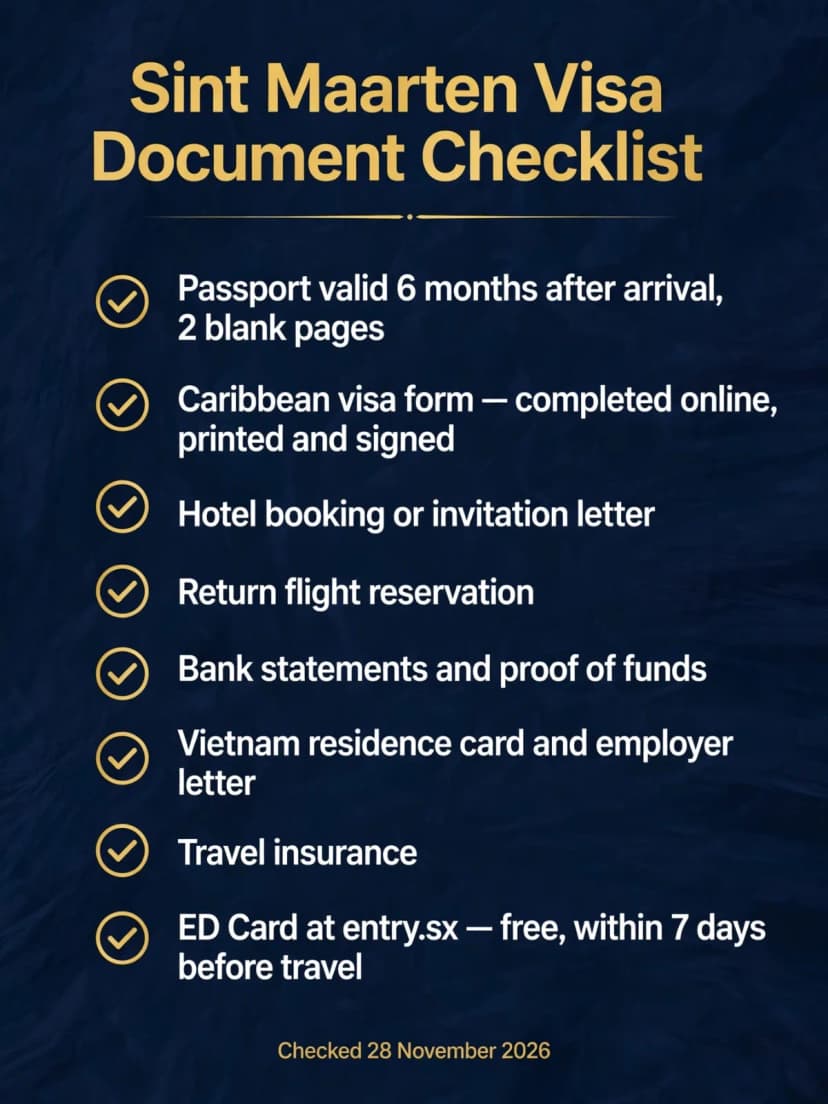
The checklists below are built from the VFS Global Caribbean visa document lists and the NetherlandsWorldwide application guidance. They are the standard documents for a short-stay Caribbean visa application. The exact checklist for your purpose and your country of application is the one VFS Global Vietnam gives you when you book, and it is the controlling list — if it asks for something extra, file it.
Short-stay Caribbean visa — every applicant
- A Pakistani passport valid for at least 6 months after the date you arrive in Sint Maarten, with at least two blank pages. The 6-month figure comes from the UK Foreign and Commonwealth Office travel advice for St Maarten, which states the passport must have an expiry date at least 6 months after the date you arrive. NetherlandsWorldwide's own summary states no minimum passport validity, which conflicts with the FCDO figure — carry six months to satisfy both readings. The two blank pages are the standard Dutch visa requirement; no Caribbean-specific blank-page figure was published, so two is the safe number.
- A completed short-stay Caribbean visa application form, filled in online through the Dutch Ministry of Foreign Affairs portal, then printed and signed. The form is provided free of charge. Do not use a Schengen form — the Caribbean form is a different document, and it asks you to name the Caribbean country you will visit first and the period of stay per country.
- One recent passport photograph, no older than 6 months, meeting the Dutch photo requirements (colour, light background, face clearly visible, no head covering except for religious reasons). VFS Global takes a digital photograph at some centres; confirm whether you need to bring one.
- Proof of the purpose of your visit: hotel booking or a signed invitation letter from your host in Sint Maarten, with the host's full name, address and contact details, and the dates of your stay.
- A round-trip flight reservation showing your departure from Vietnam and your return, with booking references. Do not pay for a non-refundable ticket before the visa is issued.
- Proof of sufficient funds for the stay and for your return journey: recent personal bank statements, payslips from your employer in Vietnam, or tax records. No minimum bank balance and no daily amount is published for the Caribbean visa — no figure is given on any official page checked for this guide, so do not trust any website that quotes one. Show a balance that credibly covers the trip and a steady income.
- Proof of ties to Vietnam and to Pakistan: your Vietnamese temporary residence card, your employment contract or employer's letter from your school or employer in Ho Chi Minh City, and evidence of your return to Vietnam. This matters because a Pakistani passport holder living in Vietnam is applying outside his country of nationality, and the officer needs to see why you will return.
- Travel medical insurance. Some guidance for the Dutch Caribbean states medical cover of at least USD 15,000, including hospital care, emergency treatment and repatriation. That figure is reported by a Sint Maarten travel guide citing official Dutch Caribbean guidance, but it was not found on the NetherlandsWorldwide pages checked for this guide, so it is labelled reported, not verified. Buy a policy that covers at least USD 15,000 and explicitly covers the Caribbean, and carry the certificate.
- The visa fee of EUR 80 and the VFS service fee, paid as VFS Vietnam requires — confirm the payment method when you book, because some centres take card only and some take cash in local currency.
Short-stay Caribbean visa — by purpose
- Tourism: hotel bookings for the whole stay, a day-by-day itinerary, and the documents above.
- Family or friends visit: a signed invitation letter from your host in Sint Maarten, a copy of the host's passport or residence permit, and proof of the host's address.
- Business: an invitation letter from the company or organisation in Sint Maarten, stating the purpose and dates of the visit, and a letter from your employer in Vietnam confirming your job and the business purpose of the trip.
- Study or event: an invitation or enrolment letter from the institution or event organiser, and proof of payment or registration where applicable.
Children under 18
- A birth certificate, both parents' passports, and written consent from both parents or legal guardians if the child travels with only one parent or alone. VFS publishes specific requirements for minors on its Caribbean visa pages; confirm the current list at the centre, because the consent letter may need to be signed in a particular form.
Long stay, work and residence — first-time applicants
- A valid passport, a recent certificate of good conduct (police clearance) covering the last five years and issued no more than six months before the application, proof of housing in Sint Maarten, proof of sufficient means, a sponsor guarantee declaration where applicable, and civil status certificates no older than three years. The employer applies separately for the employment permit. These documents are filed with the Immigration and Border Protection Service in Philipsburg, not with VFS, and the application is made while you are abroad.
How to Apply: Step-by-Step
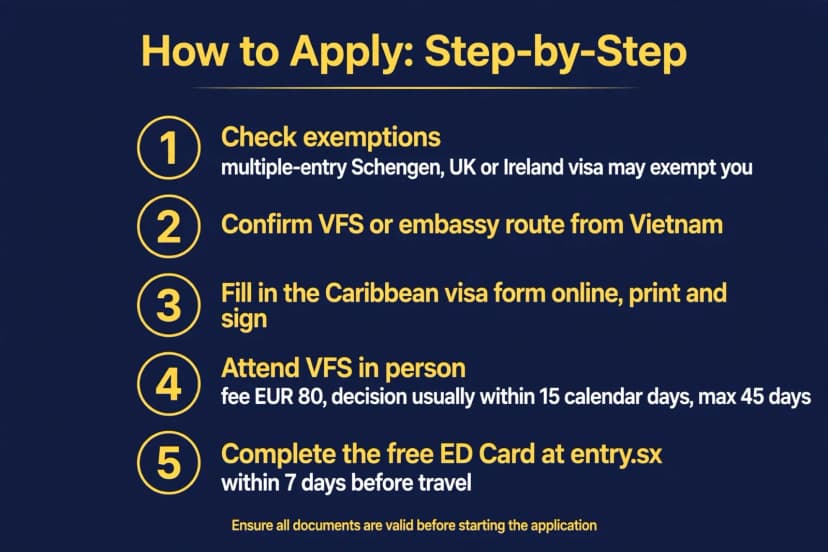
Step 1: Check whether you need a visa at all. Go through the exemption list in the second section of this guide. If you hold a valid multiple-entry Schengen visa, a multiple-entry UK or Irish visa, a Schengen, UK or Irish residence permit, or a US or Canadian residence card, you do not need a Caribbean visa. If you hold only a multiple-entry US or Canadian visa, you still need one, because Pakistan is not on the US/Canada visa exemption list. If you are exempt, skip to the ED Card section — you still need the ED Card and you still need to meet the entry conditions.
Step 2: Confirm where to apply from Vietnam. This is the one step this guide cannot close for you, and it is flagged as unverified. No NetherlandsWorldwide page for a short-stay Caribbean visa in Vietnam was found, and no VFS Vietnam page for the Caribbean visa was found either. VFS Global in Hanoi and Ho Chi Minh City handles Netherlands Schengen visa applications, and the Dutch Embassy in Hanoi and the Consulate-General in Ho Chi Minh City handle long-stay applications directly. Whether a Caribbean visa application in Vietnam goes through VFS or through the embassy is not published. Before you travel to any appointment, confirm the route with VFS Global Vietnam and with NetherlandsWorldwide, and get the answer in writing. Do not assume the Schengen route and the Caribbean route use the same counter.
Step 3: Create an account on the Dutch Ministry of Foreign Affairs online portal and fill in the short-stay Caribbean visa application form. Select the Caribbean visa, not the Schengen visa. Name St Maarten as the Caribbean country you will visit, and give the period of stay per country. Print the completed form and sign it. The form is free.
Step 4: Book an appointment at VFS Global or the Dutch mission, whichever the confirmation in Step 2 directs you to. Book as early as you can — appointment waits for Netherlands visas from Vietnam have been reported at a week to more than a month, and the Caribbean visa is a rarer application than the Schengen visa, so do not assume a next-day slot.
Step 5: Gather the documents from the checklist above, in original plus one copy where the checklist says so. Check that your passport has six months' validity and two blank pages, that your photograph is less than six months old, and that every letter states the correct dates. A single wrong date across the form, the hotel booking and the flight reservation is the most common avoidable delay.
Step 6: Attend the appointment in person. You must be present — VisaList confirms that applicants for the Sint Maarten sticker visa are required to be present. Give your fingerprints and have your photograph taken. Pay the EUR 80 visa fee and the VFS service fee, and keep every receipt and the track-and-trace code.
Step 7: Wait for the decision. In most cases you will be informed within 15 calendar days; the maximum is 45 calendar days. Do not contact the embassy about the status before 30 days have passed. Track the application with the code VFS gave you.
Step 8: Collect your passport or have it couriered back. Check the visa sticker immediately, before you leave the centre: your name, the validity dates, the number of entries, and the duration of stay. If anything is wrong, tell the VFS agent at once — if you notice it later, contact the Dutch embassy immediately. The duration of stay printed on the sticker is the number of days you may stay, and it may be shorter than the 90 days you asked for. Obey the sticker, not the brochure.
Step 9: Complete the electronic ED Card at entry.sx within 7 days before travel, and carry the confirmation. The ED Card is not a visa, but the airline will ask for it at check-in.
Step 10: Fly, and carry the same documents you filed — passport, visa, return ticket, accommodation proof, insurance certificate and bank statements — in your hand luggage. The immigration officer at Princess Juliana International Airport makes the final decision on entry, and a visa does not guarantee admission.
Applying from Vietnam and Pakistan — No Dutch Caribbean Office in Vietnam
There is no Dutch Caribbean visa office in Vietnam and no mission of Sint Maarten anywhere in Vietnam or Pakistan. Your application goes through the Kingdom of the Netherlands' own network, and from Vietnam that means VFS Global and the Dutch Embassy in Hanoi and the Dutch Consulate-General in Ho Chi Minh City.
VFS Global handles Netherlands visa applications in Vietnam at two centres: Hanoi, Room 207, 2nd floor, Ocean Park Building, 1 Dao Duy Anh, Phuong Mai, Dong Da district; and Ho Chi Minh City, 3rd floor, REE Tower, 9 Doan Van Bo, Ward 12, District 4. These addresses come from a Vietnam visa agency's published guide to Netherlands visas, not from VFS itself, so confirm them on the VFS Global website before you travel. The Dutch Embassy in Hanoi is at the 7th floor, BIDV Building, 194 Tran Quang Khai, Hoan Kiem district, and the Dutch Consulate-General in Ho Chi Minh City is at Room 909, 9th floor, Saigon Tower, 29 Le Duan, District 1. Long-stay Netherlands applications are accepted directly at the embassy or consulate-general, while short-stay Schengen applications go through VFS. Where the Caribbean visa sits between those two routes is the unverified point flagged throughout this guide.
If you are applying from Pakistan rather than Vietnam, the same logic applies: apply through the Dutch mission network or its outsourcing partner in Pakistan, and confirm the route on NetherlandsWorldwide for Pakistan before you travel to an appointment. No Pakistan-specific Caribbean visa fee, centre address or processing time was verified for this guide, so none is printed here. There is no Pakistani diplomatic mission in Sint Maarten. If you need consular help while on the island, check the Pakistan Ministry of Foreign Affairs mission list before you travel and save the details of the nearest Pakistani mission in the region.
The flight itself is long and has no direct route. The usual routings from Ho Chi Minh City run through Amsterdam on KLM, through Paris, or through a United States hub — and a routing through the United States needs a US transit visa or ESTA eligibility of its own, which a Pakistani passport holder does not have. The Amsterdam routing is the natural one for a Dutch Caribbean destination, but remember that a Caribbean visa does not authorise entry to the European Netherlands. A same-airport transit through Amsterdam Schiphol without passing through Schengen passport control is a different matter from entering the Netherlands, and you should confirm the transit rules for your exact itinerary with the airline and the Dutch mission before you book. Do not book a routing that requires you to enter the Schengen Area unless you also hold a Schengen visa.
Carry your Vietnamese temporary residence card with your passport for the whole trip. You will need it to prove your residence in Vietnam when you apply, and you will need it to re-enter Vietnam on your return. Check that it is valid for the whole trip before you apply — a residence card that expires while you are abroad is a problem that is much easier to fix in Ho Chi Minh City than in Philipsburg.
The ED Card: The Free Form Every Air Traveller Must Complete
Sint Maarten runs a digital Embarkation/Disembarkation Card, known as the ED Card, on the official government portal at entry.sx. It is separate from the visa, it is not a visa, and it does not replace any passport or visa requirement. It is a registration of your arrival and departure, and it applies to every traveller arriving at Princess Juliana International Airport, including visitors, residents and transfer passengers. Complete it within 7 days before your travel, and complete it before you check in for your flight — airlines ask for proof of the completed form at check-in, and you need your passport details, your flight details and your accommodation address to fill it in. You will receive a confirmation by email, with a QR code: print it or save it on your phone, and keep it with your passport.
The official portal states that all travellers who visit, transit through or reside in Sint Maarten must complete the ED Card, and travel reporting since its launch on 8 October 2024 describes it as mandatory for everyone, including children, with check-in refused without it. One Sint Maarten travel guide, updated in 2026, says the card is not mandatory in the official sense yet but is highly recommended. That disagreement is flagged as a conflict: the government portal presents it as mandatory, and the practical advice is the same either way — complete it, because the airline will ask for it and it costs nothing. The official process is free of charge. Beware of lookalike websites charging a processing fee: the official portal is entry.sx, it charges USD 0, and any site charging for the ED Card is not the government.
Residents of Sint Maarten are a special case: a Sint Maarten law firm has argued, citing the National Ordinance on Admission and Expulsion and the Admission Decree, that residents are not legally obliged to complete the ED Card, and that only tourists and temporary visitors must do so. That argument does not change anything for a Pakistani visitor — you are a tourist or temporary visitor, and you must complete the form. Each traveller needs an individual form, including children, although one person may complete a group or family registration listing every traveller. If your flight or accommodation changes after you file, update the form. If a form is denied, it can be re-submitted.
Long Stay, Work, Study and Family
A short-stay Caribbean visa covers you for up to 90 days within a 180-day period. Anything longer, and anything involving work, needs a different permission, and the permission is issued on the island, not at a VFS counter. This section is deliberately shorter than the short-stay sections, because the long-stay rules are set by Sint Maarten's own Immigration and Border Protection Service and far less of the detail is published in a form a traveller abroad can verify.
For a stay longer than 90 days, you need a residence permit. The host in Sint Maarten submits the application for you, and first-time applicants must wait abroad for the decision — you cannot land as a tourist and convert to a resident on the spot. The Immigration and Border Protection Service, under the Ministry of Justice, handles residence permits from its office at A.Th. Illidge Road #8 in Philipsburg. Its service page says permit requests generally take 6 to 8 weeks; the Ministry's own page says six weeks to three months. Both figures are official Sint Maarten sources and they conflict, so plan on three months. The residence permit routes include employee, director, pensioner, investor, student or internship, and family reunion, and most require a certificate of good conduct no older than six months. Civil status certificates must not be older than three years, and a permit that has been expired for more than three months becomes a first-time request again, needing an exemption letter from the Minister of Justice.
For work, your employer applies for the employment permit — not you. An employer may not let a foreign national work without one, and the labour rules require the vacancy to have been reported to the authorities at least five weeks before the employer applies, and the permit must be refused if workers are available on the local labour market. The permit names the employer, the place and the kind of work, and it is revoked if you are dismissed or the employer goes bankrupt. The short-stay Caribbean visa does not permit paid work under any circumstances, and working on a tourist visa can lead to removal and inclusion on the Caribbean alert list, which blocks future visas for the whole Dutch Caribbean.
For study, a short course or event is covered by the short-stay Caribbean visa under the Study/Event purpose. A longer course needs a residence permit for study or internship, filed through the Immigration and Border Protection Service with the institution in Sint Maarten as host. No tuition, institution list or student residence fee was verified for this guide, so none is printed here. For family reunion, a family member who is Dutch or holds a valid residence permit sponsors the application, and the family member applies through the same Immigration and Border Protection Service route. No published family-reunification visa sticker exists, and no published permanent-residence route or timeline for a Pakistani national was found — do not trust any agent who sells you one.
The French Side: Saint-Martin Is a Different Country
The island of Saint Martin is divided in two. The southern half is Sint Maarten, a constituent country within the Kingdom of the Netherlands. The northern half is Saint-Martin, a French overseas collectivity. There is no physical border, no checkpoint and no fence between them, and people and goods travel freely across the island. None of that makes the visa rules shared. They are two separate jurisdictions with two separate immigration systems, and this guide covers only the Dutch side.
A Caribbean visa does not authorise entry to the French side. A Schengen visa does not authorise entry to the Dutch side — although, confusingly, holding a multiple-entry Schengen visa does exempt you from needing a Caribbean visa for the Dutch side, as set out in the exemptions section. A visa for Saint Martin, the French side, exempts you from needing a visa to enter St Maarten, the Dutch side — but only for St Maarten, not for the other Caribbean parts of the Kingdom. The exemption runs one way in practice, and you should not rely on it without confirming the exact wording on NetherlandsWorldwide before you travel.
If you plan to stay, work or study on the French side, you need French authorisation: a French long-stay visa or a French residence permit, handled by the French authorities, not by the Dutch mission and not by the Immigration and Border Protection Service in Philipsburg. A permit issued on one side does not cover the other side, and buying a home or renting long-term on either side gives you no residence right on either side. If your trip includes both halves of the island — and most trips do, since the beaches, restaurants and the second airport at Grand Case are on the French side — make sure your documents cover both. A day trip across an invisible border is still a crossing between two jurisdictions, and the immigration officer who checks you is the one whose side you are standing on.
Common Mistakes to Avoid
The first mistake is applying for the wrong visa. A Schengen visa is not a Caribbean visa, and a Caribbean visa is not a Schengen visa. Travellers who hold a Schengen visa sometimes assume it covers Sint Maarten, and travellers who obtain a Caribbean visa sometimes assume it covers Amsterdam. Neither is true. Check the name printed on the form and on the sticker, and check the list of countries the visa covers before you pay.
The second mistake is assuming a United States visa exempts you. A multiple-entry US or Canadian visa exempts only the nine listed nationalities, and Pakistan is not among them. A US or Canadian residence card does exempt you, and a multiple-entry Schengen, UK or Irish visa does exempt you. The distinction is between a visa and a residence card, and between the listed nationalities and everyone else — read it twice.
The third mistake is the 30-day trap. Older published material says the maximum uninterrupted stay in one Caribbean country is 30 days, while the current official application form says 90 days. If you plan a 60-day stay on Sint Maarten on the strength of the 90-day figure and the officer applies the 30-day figure, your trip is cut short. Plan around the shorter figure until your own visa sticker says otherwise, and read the duration of stay printed on the sticker when you collect your passport.
The fourth mistake is booking a non-refundable ticket or hotel before the visa is issued, or booking a routing through the United States without the transit documents for it. Apply six to eight weeks before departure, and choose a routing through Amsterdam or Paris that does not require you to enter the Schengen Area.
The fifth mistake is paying for the ED Card. The official portal at entry.sx is free. Any website charging a fee for the ED Card is not the government, and the confirmation it sells you may not be accepted at check-in. Use entry.sx only.
The sixth mistake is arriving without the documents you filed. The visa gets you onto the aircraft; the immigration officer at Princess Juliana decides whether you enter. Carry the return ticket, the accommodation proof, the insurance certificate and the bank statements in your hand luggage, and be able to show them without digging through a checked bag.
The seventh mistake is working on a tourist visa. The short-stay Caribbean visa does not permit paid work, and working without an employment permit can lead to removal and inclusion on the Caribbean alert list, which blocks future visas for the whole Dutch Caribbean. If you are offered work on the island, the employer must apply for the employment permit first, and you must wait abroad for the decision.
Reasons for Refusal
Caribbean visa refusals follow the same logic as Schengen refusals, because the same Dutch consular organisation decides them. The most common reason is weak ties to the country of residence: a Pakistani passport holder living in Vietnam who cannot show a valid Vietnamese residence card, a job or enrolment, and a credible reason to return is the highest-risk profile in this caseload. File the residence card, the employment contract or employer's letter, and evidence of your life in Vietnam, and make sure the dates on every document agree.
The second most common reason is insufficient funds, or funds that appear suddenly. No minimum balance is published, so the officer judges whether the money credibly covers the trip. A bank statement with a large deposit the week before the application, with no explanation, hurts more than a modest balance built up over months. File three to six months of statements and explain any large movement.
The third reason is an unclear purpose of travel. A tourism application with no hotel booking, no itinerary and no return ticket reads as an unplanned trip. A business application with no invitation letter from Sint Maarten reads as a pretext. File the document that matches the purpose you selected on the form, and make sure the host's name and address are real and contactable.
The fourth reason is a damaged, nearly expired or nearly full passport, or a photograph that does not meet the requirements. A passport with less than six months' validity after arrival, or with fewer than two blank pages, is the easiest refusal to avoid and the most often repeated.
The fifth reason is a previous overstay, removal or visa refusal anywhere in the Kingdom of the Netherlands or the Schengen Area, or a false statement on the form. Answer every question truthfully, declare previous refusals if asked, and never use an agent who offers to invent an invitation or a bank statement. A false document is not a shortcut — it is a refusal, and it can mean inclusion on the Caribbean alert list.
There is no published appeal route for a Caribbean visa refusal in the material checked for this guide, and the visa and service fees are non-refundable. If you are refused, read the refusal reasons carefully, fix the named problem with new evidence, and apply again. Do not reapply unchanged — the same file will get the same answer.
Frequently Asked Questions
Do Pakistani passport holders need a visa for Sint Maarten?
Yes. Pakistan is not on the visa-free list for the Caribbean parts of the Kingdom of the Netherlands. You need a short-stay Caribbean visa before you travel, applied for in person through VFS Global or a Dutch mission. There is no visa on arrival and no eVisa for Pakistani nationals.
What is a Caribbean visa, and is it the same as a Schengen visa?
No. A Caribbean visa is a common visa for the six Dutch Caribbean territories — Aruba, Bonaire, Curaçao, Saba, St Eustatius and St Maarten — and it is valid only for the Caribbean parts of the Kingdom. A Schengen visa covers the European Netherlands and the Schengen Area. Neither visa covers the other territory.
How long can I stay in Sint Maarten on a Caribbean visa?
The short-stay Caribbean visa allows a maximum of 90 days within a 180-day period. The maximum uninterrupted stay on Sint Maarten itself is stated as 90 days on the official application form, but older published material says 30 days per individual country. This guide flags the conflict and advises planning around the shorter figure until your visa sticker says otherwise.
How much does the Caribbean visa cost?
EUR 80 for an adult, EUR 40 for a child aged 6 to 12, and free for a child under 6, plus a VFS Global service fee of about EUR 35. The exact VFS fee in Vietnam was not verified, so confirm the dong amount when you book. All fees are non-refundable.
How long does a Caribbean visa take?
In most cases you will be informed within 15 calendar days, and the maximum is 45 calendar days. You can apply from 6 months before travel. Apply at least six weeks before departure, and do not book non-refundable travel until the visa is issued.
Can I apply for the Caribbean visa from Vietnam?
You apply through the Dutch mission network and VFS Global, which has centres in Hanoi and Ho Chi Minh City for Netherlands visas. No NetherlandsWorldwide page for a Caribbean visa application in Vietnam was found, so whether the Caribbean application goes through VFS Vietnam or the embassy directly is unverified. Confirm the route with VFS Global Vietnam and NetherlandsWorldwide before you travel to an appointment.
Do I need a visa if I already have a Schengen visa?
If you hold a valid multiple-entry Schengen visa, or a residence permit for a Schengen country, you do not need a Caribbean visa. A single-entry Schengen visa does not exempt you. The same exemption applies to a multiple-entry UK or Irish visa and to a UK, Irish, Schengen, US or Canadian residence permit.
Does a US visa exempt me from the Caribbean visa?
Only if it is a residence card. A multiple-entry US or Canadian visa exempts only nationals of nine listed countries — Bolivia, China, Cuba, the Dominican Republic, Guyana, Haiti, India, Jamaica and Venezuela — and Pakistan is not on that list. A US or Canadian residence card does exempt you. An ESTA is not a visa and exempts nobody.
What is the ED Card, and do I really need it?
The ED Card is the free electronic Embarkation/Disembarkation Card on the official portal at entry.sx. Every air traveller to Sint Maarten must complete it within 7 days before travel and before check-in, including children and transit passengers. It is not a visa and it does not replace one. The official process is free — never pay a third-party site for it.
Do I need a yellow fever vaccination for Sint Maarten?
Only if you are arriving from a country listed as a yellow fever transmission risk. The UK Foreign Office and the US State Department both state the certificate is required only for arrivals from risk countries. Pakistan and Vietnam are not the usual basis for that requirement, but check the current risk-country list before you travel, because the list changes.
Can I visit the French side of the island on a Caribbean visa?
No. A Caribbean visa does not authorise entry to Saint-Martin, the French side. There is no physical border, but the two sides are separate jurisdictions. A visa for Saint Martin does exempt you from needing a visa for the Dutch side, but only for St Maarten. If you plan to stay, work or study on the French side, you need French authorisation.
Can I work in Sint Maarten on a Caribbean visa?
No. The short-stay Caribbean visa does not permit paid work. Your employer must apply for an employment permit first, and you must wait abroad for the decision. Working without a permit can lead to removal and inclusion on the Caribbean alert list.
Can I extend my stay in Sint Maarten?
No published short-stay extension route for Sint Maarten was found for this guide. The short-stay visa allows up to 90 days within a 180-day period, and a stay longer than 90 days needs a residence permit, applied for through a host in Sint Maarten while you are abroad. Do not overstay and assume an extension will be granted on the island.
Where do I fly into, and which airport is it?
Princess Juliana International Airport, airport code SXM, on the Dutch side. It is the island's main international airport. The French side has its own smaller airport at Grand Case, L'Espérance Airport, code SFG, which handles regional flights.
Is Sint Maarten safe for tourists?
The US State Department rates Sint Maarten at Level 1 — Exercise Normal Precautions — in its travel advisory issued 24 August 2026, its lowest level. Normal precautions apply: look after your belongings in Philipsburg and around the cruise port, take care on the roads, and make sure your travel insurance covers medical evacuation, because serious medical cases are transferred off the island.
Official Immigration Websites
| Website | What it is | Address |
|---|---|---|
| NetherlandsWorldwide — Do I need a visa for the Caribbean parts of the Kingdom? | The Dutch government's official visa-need checker and exemption list | https://www.netherlandsworldwide.nl/caribbean-visa/visa-needed-caribbean |
| NetherlandsWorldwide — Short-stay Caribbean visa | The Dutch government's official short-stay Caribbean visa page | https://www.netherlandsworldwide.nl/caribbean-visa/short-stay |
| NetherlandsWorldwide — Visa application forms | The official portal for the online Caribbean visa application form | https://www.netherlandsworldwide.nl/visa-the-netherlands/visa-application-form |
| VFS Global — Caribbean visa information | Fees, documents, photo specifications and processing times | https://visa.vfsglobal.com/one-pager/netherlands/Jamaica/english/ |
| VFS Global — Caribbean visa application form | The official paper Caribbean visa application form | https://www.vfsglobal.com/netherlands/malaysia/pdf/Caribbean-visa-form-English.pdf |
| UK Foreign and Commonwealth Office — St Maarten entry requirements | Passport validity, visa and vaccine requirements for St Maarten | https://www.gov.uk/foreign-travel-advice/st-maarten/entry-requirements |
| US Department of State — Sint Maarten Travel Advisory | Travel advisory Level 1, issued 24 August 2026 | https://travel.state.gov/en/international-travel/travel-advisories/sint-maarten.html |
| Wikipedia — Visa policy of the Kingdom of the Netherlands in the Caribbean | Summary of the common visa, the visa-free list and the exemptions | https://en.wikipedia.org/wiki/Visa_policy_of_the_Kingdom_of_the_Netherlands_in_the_Caribbean |
| OneTimeLivin — Sint Maarten visa rules for Pakistan passport holders | Pakistan-specific summary checked against NetherlandsWorldwide, 13 November 2026 | https://www.onetimelivin.com/visa/pakistan/sint-maarten |
| VisaList — Sint Maarten visa for Pakistani passport | Pakistan-specific sticker visa summary, documents and processing | https://visalist.io/sint-maarten-dutch-part/visa-requirements/pakistan |
| Sint Maarten ED Card — official portal | The free electronic Embarkation/Disembarkation Card | https://entry.sx |
| CaribJournal — Every Traveler to St Maarten Needs to Fill Out This Form | Reporting on the mandatory ED Card at entry.sx | https://www.caribjournal.com/2025/07/14/st-maarten-travel-form/ |
| Visit St Maarten — Entry and travel requirements | ED Card guidance, including the mandatory-versus-recommended note | https://www.visitstmaarten.com/st-maarten-entry-travel-requirements-ehas/ |
| Sint Maarten Vacation — Visa and entry requirements 2026–2027 | Insurance figure and entry checklist, citing official guidance | https://sintmaartenvacation.com/visa-entry-requirements/ |
| NetherlandsWorldwide — Applying for a short-stay Caribbean visa in Venezuela | Processing-time wording used across the Caribbean visa country pages | https://www.netherlandsworldwide.nl/caribbean-visa/short-stay/apply-venezuela |
| NetherlandsWorldwide — Applying for an entry visa in Vietnam | VFS Global as the application route for Netherlands visas in Vietnam | https://www.netherlandsworldwide.nl/visa-the-netherlands/entry-visa/apply-vietnam |
| NVK Travel — Netherlands visa service in Vietnam | VFS Global centre addresses in Hanoi and Ho Chi Minh City | https://www.nvktravel.com/en/visa-ha-lan |
| Return Caribbean — Moving to Sint Maarten: permits, work and costs | Residence and employment permit routes and fees | https://returncaribbean.com/en/guides/moving-to-sint-maarten-permits-work-cost-of-living |
| LoopHoleDB — Sint Maarten First-Time Employee Permit | Employer-sponsored work and residence permit route | https://www.loopholedb.com/immigrate/sint-maarten/employee-permit |
| Jetseen — Do Aruba, Bonaire, and Curaçao Count Toward Schengen 90/180? | Per-island stay limits from NetherlandsWorldwide | https://www.jetseen.com/guides/do-aruba-bonaire-curacao-count-schengen-90-180/ |
Final Checklist and Conclusion
Before you apply: check the exemption list first — a multiple-entry Schengen, UK or Irish visa, or a Schengen, UK, Irish, US or Canadian residence permit may mean no application at all. Confirm with VFS Global Vietnam and NetherlandsWorldwide whether a Caribbean visa application in Vietnam goes through VFS or the embassy, and get the answer in writing. Passport valid six months beyond arrival with two blank pages. Caribbean visa form completed online, printed and signed — not a Schengen form. Hotel booking or invitation letter, return flight reservation, bank statements, employment letter and Vietnamese residence card, and travel insurance covering at least USD 15,000.
Before you fly: visa sticker checked the moment you collect your passport — name, dates, entries and duration of stay. ED Card completed at entry.sx within 7 days before travel, confirmation saved on your phone and printed. Return ticket, accommodation proof, insurance certificate and bank statements in your hand luggage. Vietnamese residence card valid for the whole trip and carried with your passport.
On arrival: present your passport, visa and ED Card confirmation at Princess Juliana International Airport; check the entry stamp before you walk away; keep your documents for the whole stay; remember that the French side of the island is a different jurisdiction and your Caribbean visa does not cover it.
Sint Maarten is a realistic trip for a Pakistani living in Vietnam, but it is not a casual one. The visa is a real sticker visa applied for in person, the fee is EUR 80 plus the VFS service fee, the decision usually takes 15 calendar days, and the two things that will stop the trip are applying for the wrong visa and assuming the application route in Vietnam without confirming it. Get the exemption check done first, confirm the VFS-or-embassy question in writing, apply six to eight weeks before departure, file the ED Card before check-in, and the island's beaches, lagoon and Maho Beach sunsets are yours. The rules change without notice, so confirm the live fee, the live application route and the live entry requirements on netherlandsworldwide.nl and the VFS Global website before you pay anything.
This guide was checked on 28 November 2026. Visa rules change without notice. Always confirm the live rules on netherlandsworldwide.nl and the VFS Global website before paying any fee or booking a non-refundable ticket. Nothing in this guide is immigration advice; the Sint Maarten authorities and the Kingdom of the Netherlands set and enforce the entry rules, and the immigration officer at Princess Juliana International Airport makes the final decision. This guide is educational information only and does not guarantee visa approval or entry.