


Suriname Visa Guide 2026: Types, Requirements, Documents and Application Steps
Last checked: 28 November 2026. This guide is for Pakistani passport holders living in Vietnam. Visa rules change without notice — always confirm the live rules on the official e-Visa portal (suriname.vfsevisa.com) and the Suriname government site (gov.sr) before paying any fee or booking a non-refundable ticket.
Introduction
Suriname is South America's smallest country and one of its most surprising: the UNESCO-listed wooden historic centre of Paramaribo, the rainforest of the Central Suriname Nature Reserve, the Commewijne plantations, the sea turtles of Galibi, and a food scene that mixes Javanese, Hindustani, Creole, Chinese and Dutch cooking on a single street. For a Pakistani living in Vietnam, getting there is possible entirely online — but Suriname's entry system is easy to get wrong, because it runs three different documents that look alike and are not interchangeable: an e-Visa, an Entry Fee voucher, and the free Immigration and Customs Form (ICF). A Pakistani passport holder needs the first of the three. The Entry Fee alone is not enough for you, and the ICF replaces neither of them.
This guide covers the e-Visa first, then the Entry Fee and the ICF so you can tell them apart, the fees, the processing times, the full document checklists, the work and study routes that run through a separate authorisation called the MKV, and the health and transit rules — including the Amsterdam transit question that catches many travellers from Vietnam. One warning belongs in the first minute: several figures in this guide are reported by good secondary sources but are not published on any official page this guide could read — the exact total you will pay at checkout, the length of stay the officer will stamp, and the work-permit fees among them. Where that is the case, this guide says so plainly and names the source, instead of presenting a guess as a government fee.
Do Pakistani Passport Holders Need a Visa for Suriname?
Yes. Most nationalities can enter Suriname without a visa for up to 90 days, paying only the Entry Fee online before travel. Pakistan is not one of them. On 1 May 2023 Suriname reimposed the visa requirement for citizens of 21 countries, and Pakistan is on that list — alongside Afghanistan, Angola, Bangladesh, Cameroon, Cuba, the Dominican Republic, Egypt, Eritrea, Ghana, India, Kenya, Nepal, Nigeria, Somalia, South Africa, Sri Lanka, Syria, Tunisia, Venezuela and Zambia. The official government notice of 1 May 2023 (published on gov.sr) names Pakistan expressly, and the rule has not changed since.
The standard route is the e-Visa: apply online at suriname.vfsevisa.com before you travel, pay the fee by card, and receive the approval by email. That portal — run by VFS Global as the authorised partner of Suriname's Ministry of Foreign Affairs, International Business and International Cooperation (BIBIS) — is the only valid portal since 10 August 2026, according to the guides that checked it in October 2026. There is no visa on arrival for Suriname. If you arrive at Johan Adolf Pengel International Airport without an approved e-Visa, you will be refused entry.
Paying only the USD 50 Entry Fee is not an alternative for a Pakistani passport. The Entry Fee is the document for visa-exempt nationalities; a valid visa exempts its holder from the Entry Fee, not the other way round. Do not let any agent sell you an Entry Fee voucher as a substitute for a visa — airlines check for a valid entry document before boarding, and an Entry Fee voucher does not make a Pakistani passport admissible.
The rule follows your passport, not where you live. Living in Vietnam, holding a Vietnamese temporary residence card (TRC), or holding a US, UK or Schengen visa does not change the Surinamese rule. Your Vietnamese residence matters for the journey home: keep your TRC valid for the whole trip and carry it with your passport, because it is your proof of the right to return to Vietnam. If your TRC is close to expiry, renew it before you travel.

Types of Suriname Visas for Pakistani Passport Holders
Suriname's short-stay system has three layers, and you need to understand all three before you apply.
Tourist e-Visa (3 months)
The standard short-stay visa for a Pakistani visitor. Applied for online at suriname.vfsevisa.com. The VFS fee page lists the tourist e-Visa at USD 60 (EUR 50) for 3 months, multiple entry, with a stay of 90 days per entry quoted by the Pakistan-focused guides that read the portal in November 2026. One aggregator (VisaRequirements.info, checked 1 November 2026) reports the e-Visa as single entry, while the VFS fee page lists the 3-month tourist visa as multiple entry — confirm the entry count on the portal at checkout. It covers tourism, family visits and short business trips. A service fee of USD 18 (EUR 17) is charged on top of the visa fee, according to the same fee page. The stay an individual traveller actually receives is decided by the immigration officer on arrival — the visa itself does not fix your length of stay, and one Pakistan-focused guide checked on 19 November 2026 reports exactly that. Plan on up to 90 days, but check the stamp the officer gives you before you leave the desk.
Tourist e-Visa (1 year)
For travellers who will enter Suriname more than once in a year — for example, a trip combining Suriname with neighbouring Guyana or French Guiana, or repeated business travel. The VFS fee page lists it at USD 210 (EUR 175), plus the service fee. The same 90-days-per-entry stay applies, according to the guides that read the portal. Do not buy the 1-year visa unless you genuinely expect a second trip: it costs three and a half times the 3-month visa.
eTourist Card — not for Pakistani passports
The eTourist Card is a cheaper document (USD 40 / EUR 35 plus a service fee) issued to a small group of nationalities — Cuba, the Dominican Republic and Venezuela, according to the October 2026 fee listing. The 2023 decree is reported to have sent India through the tourist-card route as well, which conflicts with the portal listing; either way, Pakistan is not on the tourist-card list. A Pakistani passport holder applies for the e-Visa, not the eTourist Card. If a website offers you a Suriname tourist card on a Pakistani passport, it has your nationality wrong.
Entry Fee voucher — not a visa, and not for Pakistanis
Most visitors to Suriname pay an Entry Fee of USD 50 or EUR 50 per entry, plus a USD/EUR 8 service fee, bought online at suriname.vfsevisa.com before travel. A multiple-entry version costs USD/EUR 75 plus the service fee and covers up to five entries within three months. This is the document for visa-exempt nationalities. Holders of a valid visa are exempt from the Entry Fee. CARICOM passport holders, holders of a Persons of Surinamese Origin (PSA) document or card, Vatican City passport holders, diplomats and residents are also exempt. None of those exemptions covers a Pakistani passport, and the Entry Fee voucher does not substitute for the e-Visa you need.
Transit visa
If Suriname is only your transit country, the government's 1 May 2023 notice requires a valid transit visa as well as valid tickets and any visa for the country or countries you are travelling to. No separate transit-visa fee for Pakistani nationals was found on a published page for this guide, so confirm the transit-visa fee and procedure on suriname.vfsevisa.com before you book a routing through Paramaribo. If you are only changing planes at Johan Adolf Pengel International Airport without passing through immigration, confirm with your airline whether a visa is needed at all; if you will pass through immigration, hold an e-Visa.
MKV — Authorisation for Temporary Stay (long stays)
For any stay beyond 90 days, you need an MKV (Machtiging tot Kort Verblijf), an authorisation for temporary stay applied for before you travel — normally three months ahead — at a Surinamese diplomatic or consular post in your country of residence or region. It is not a visa you can apply for inside Suriname while on a tourist e-Visa. On arrival with an approved MKV you receive a KV (temporary stay visa), and you then register and apply for a residence permit in Paramaribo. This is covered in the student, work and family sections below.
Visa Comparison Table
| Visa / document | Stay | Entries | Fee (Pakistani passport) | Where to get it |
|---|---|---|---|---|
| Tourist e-Visa, 3 months | Up to 90 days per entry; exact stay decided on arrival | Multiple per VFS fee page; single entry reported by one aggregator — confirm at checkout | USD 60 + USD 18 service fee | Online at suriname.vfsevisa.com before travel |
| Tourist e-Visa, 1 year | Up to 90 days per entry | Multiple | USD 210 + service fee | Online at suriname.vfsevisa.com before travel |
| eTourist Card | Up to 90 days | Single | USD 40 + service fee | Not available to Pakistani passports |
| Entry Fee voucher (single) | Up to 90 days | Single | USD/EUR 50 + USD/EUR 8 service fee | Not a substitute for a Pakistani visa |
| Entry Fee voucher (multiple) | Up to 90 days per entry, 5 entries in 3 months | Multiple | USD/EUR 75 + service fee | Not a substitute for a Pakistani visa |
| Transit visa | Transit only | — | Not published — confirm on the portal | suriname.vfsevisa.com or a Surinamese mission |
| MKV (temporary stay authorisation) | Over 90 days | — | Not published — confirm at the mission | Surinamese mission before travel |
| ICF (Immigration and Customs Form) | — | — | Free | Online at icf.sr, within 7 days of travel |
Visa Fees: What Each Route Costs
The fee table below gives every figure this guide could verify, with its source. The controlling figures are the VFS fee page as quoted in October and November 2026: the 3-month tourist e-Visa at USD 60 (EUR 50) and the 1-year tourist e-Visa at USD 210 (EUR 175), with a service fee of USD 18 (EUR 17) on top. Fees are paid online by card and are non-refundable, so settle the visa length and the travel dates before the payment screen, not after it.
| Item | Figure | Source |
|---|---|---|
| Tourist e-Visa, 3 months | USD 60 / EUR 50 | VFS fee page (suriname.vfsevisa.com/visa-fees.html), quoted Oct–Nov 2026 |
| Tourist e-Visa, 1 year | USD 210 / EUR 175 | VFS fee page, quoted Oct–Nov 2026 |
| VFS service fee on an e-Visa | USD 18 / EUR 17 | VFS fee page, quoted Nov 2026 |
| Entry Fee, single entry (visa-exempt nationalities only) | USD/EUR 50 + USD/EUR 8 service fee | VFS portal, quoted Oct 2026 |
| Entry Fee, multiple entry (visa-exempt nationalities only) | USD/EUR 75 + service fee; up to 5 entries in 3 months | VFS portal, quoted Oct 2026 |
| eTourist Card (Cuba, Dominican Republic, Venezuela) | USD 40 / EUR 35 + service fee | VFS portal, quoted Oct 2026 |
| Tourist visa at a Surinamese embassy in person (example) | USD 45 + USD 20 administration fee | Embassy of Suriname in Belgium, via UrduPoint, checked 19 Nov 2026 |
| ICF form | Free | icf.sr; FCDO; all 2026 guides |
| Residence permit application (reported) | USD 150 or the equivalent in Surinamese dollars | Immigration-law guide (VivAtlas), reported only — no official fee page found |
What the visa does not cost. There is no separate appointment fee and no authorised agent fee on the official portal. The Ministry warns applicants to use official portals only. One Pakistan-focused guide quotes the embassy example of USD 45 plus a USD 20 administration fee for an in-person application — that is the price of applying at a mission, not the price of the e-Visa, and the two should not be confused. No official page found for this guide publishes any minimum bank balance for the e-Visa; carry recent statements that plainly cover the trip, and do not let any agent invent a balance threshold for you.
The Entry Fee figure conflict. The UK Foreign, Commonwealth and Development Office (FCDO) states the Entry Fee as USD 54, while the VFS portal lists USD 50 or EUR 50 plus an USD/EUR 8 service fee — a total of USD 58 at checkout. The difference is probably the service fee being folded into the FCDO's figure, but this guide could not confirm that, so it reports both. Either way, the Entry Fee does not apply to you as a visa holder: a valid visa exempts you from it.
Processing Times
| Route | Processing time reported | Source |
|---|---|---|
| e-Visa, standard | About 72 hours | UrduPoint, checked 19 Nov 2026; VisaRequirements, checked 1 Nov 2026 |
| e-Visa, standard | 3–5 business days | Travel Visa Stack, updated 20 Oct 2026 |
| e-Visa | Up to about 3 days | ExploreSuriname, checked 26 Oct 2026 |
| In-person visa at a mission (non-EU nationals) | At least 2 weeks | Consulate General Amsterdam, via UrduPoint |
| MKV (temporary stay authorisation) | 4–12 weeks | ExpatLife Suriname visa guide 2026 |
| Work permit | 6–12 weeks (reported); 30 days decision period + possible 30 days (immigration-law guide) | ExpatLife; VivAtlas — figures conflict, see flags |
| Residence permit after MKV | No processing time published | No figure found |
Planning rule. Apply at least two weeks before travel: that covers the longest commonly reported e-Visa figure (3–5 business days) with a week to spare for a correction or a failed card payment. The 72-hour figure is the one most often quoted, but it is an average, not a promise. Do not apply absurdly early either — enter only between the issue date and the expiry date printed on the visa. For an MKV, start at least three months ahead, because the authorisation must be applied for three months before your intended arrival and the embassy processing alone is reported at 4–12 weeks.
Complete Document Checklists
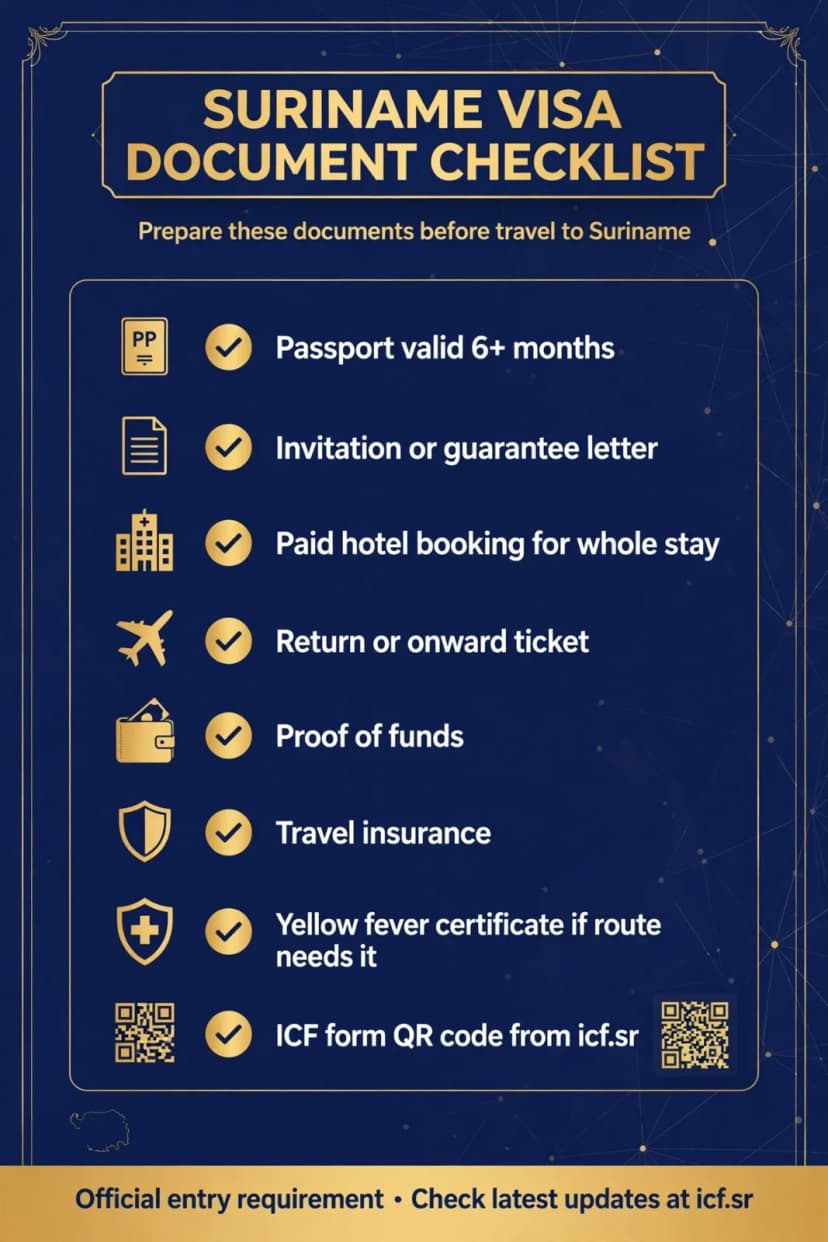
No single official document list for Pakistani applicants was published on a page found for this guide, so the checklists below combine what the government's 1 May 2023 notice requires of the 21 visa-required nationalities, what the VFS portal asks of applicants, what the FCDO says border officers check, and what the Pakistan-focused 2026 guides report. Prepare originals and clean scans; a blurry passport scan is the commonest reason an online application stalls.
Short visit — e-Visa (the route most readers will use)
- Pakistani passport valid for at least six months — the FCDO states six months after the date of arrival, and the VFS FAQ states six months from the date of departure from Suriname; keep six months beyond your planned return to satisfy both readings
- A recent passport-size photograph, digital, for the online form
- A completed visa application form, signed (for the online route, the portal form)
- Copy of the full passport
- Return or onward ticket, or a confirmed itinerary showing you will leave
- A letter of guarantee or invitation from a company registered with the Chamber of Commerce in Suriname, or from a person in Suriname — required of the 21 visa-required nationalities by the 1 May 2023 government notice
- Proof of a paid hotel reservation covering the whole stay, for tourism or business — also required of the 21 nationalities by the same notice; if you are staying with a host, carry the host's name, address and contact details as well
- Proof of sufficient funds — recent bank statements that plainly cover the trip; no official minimum balance is published
- Travel insurance — listed as a document by the Pakistan-focused guide checked 19 November 2026
- Yellow fever vaccination certificate, if you arrive from or through an at-risk country (see the health section below) — listed by the Surinamese embassy for visa applications
- A payment card in your name for the USD 60 visa fee plus the USD 18 service fee
- A printed copy of the e-Visa approval, to present at boarding and on arrival
- Your Vietnamese temporary residence card, for the journey home
- Polio vaccination certificate from NADRA, needed to leave Pakistan — a Pakistani exit requirement, not a Surinamese one, relevant if you travel via Pakistan
The ICF — a separate form, not a visa document
- The Immigration and Customs Form (ICF) at icf.sr, completed within 7 days before arrival and again before departure, with the QR code saved — it is free, mandatory for every traveller, and separate from the e-Visa
- Your e-Visa reference number, which the ICF asks for; complete the e-Visa first, then the ICF
- A live selfie, uploaded during the ICF process for immigration verification, according to the 2026 ICF guides
Business visit
- Everything in the short-visit checklist above, plus:
- An invitation letter from the Surinamese company or partner, with their Chamber of Commerce registration details and the purpose and dates of the visit
- Your own covering letter explaining the purpose of the trip, and evidence of your business or employment in Vietnam or Pakistan
- Proof of funds that covers a business trip, not just a holiday
Student — entering to study
- Everything in the short-visit checklist above, plus:
- Acceptance or enrolment letter from a licensed Surinamese educational institution
- Proof of funds for tuition and living costs; academic certificates and transcripts
- Police clearance certificate and medical certificate, if the institution or the mission asks for them
- An MKV applied for before travel if the stay will exceed 90 days — a tourist e-Visa cannot be converted into an MKV inside Suriname
Work permit and residence permit (MKV route)
- Everything in the short-visit checklist above, plus:
- A genuine job offer and signed employment contract from a registered Surinamese employer
- Police clearance certificate and medical certificate
- Proof of accommodation in Suriname
- The MKV application filed at a Surinamese mission at least three months before arrival; on arrival, registration with the Aliens Department and a residence permit application within the deadline the mission gives you (reported as 8 days to register and 2 weeks to apply — see the flags)
Children travelling with you
- Each child needs their own passport, valid six months, and their own e-Visa — every traveller, including an infant, needs a separate application where one is required
- Birth certificate showing the parents' names
- If a child travels with one parent only, or with neither parent, carry a notarised parental consent letter — officers do ask for it
- Each child needs their own ICF form; the ICF site asks for a form per passenger
- Yellow fever certificate for each child aged 1 year or older, if arriving from or through an at-risk country
How to Apply: Step-by-Step
There are two sequences in this guide, because Suriname genuinely offers two routes: the e-Visa is the default for a Pakistani passport, and the in-person mission application is the fallback for long stays and special cases.
e-Visa — step by step
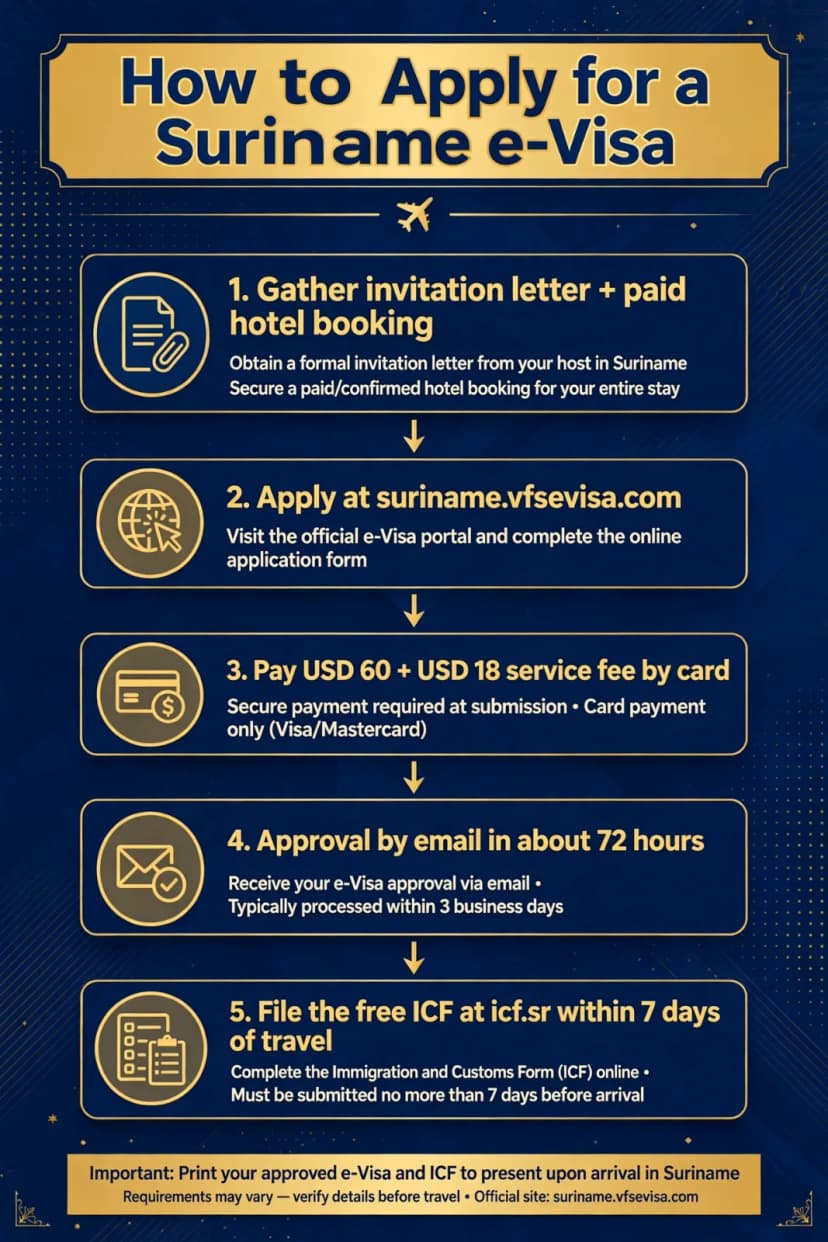
Step 1 — Check your passport and your invitation. Make sure your passport is valid for at least six months beyond your planned return. Line up the two documents that are specific to the 21 visa-required nationalities: the letter of guarantee or invitation from a company registered with the Chamber of Commerce or a person in Suriname, and proof of a paid hotel reservation covering the whole stay. Without these, the application is incomplete by the government's own notice.
Step 2 — Open the official portal. Go to suriname.vfsevisa.com yourself by typing the address — never through a link in an email or an advertisement. This is the only valid portal since 10 August 2026. Beware of lookalike sites: an older portal address (evisa.suriname-gov.com) and other e-visa sites still circulate online and are not the current official route. Third-party sites add their own charges on top of the government fee.
Step 3 — Choose the visa type. Select the 3-month tourist e-Visa (USD 60) or the 1-year tourist e-Visa (USD 210), and the purpose that matches your trip — tourist, business, transit or short stay, as the portal lists them for Pakistani passports. Do not pick a cheaper document and hope it covers a different purpose: the Entry Fee voucher and the eTourist Card do not cover a Pakistani passport at all, and a visitor e-Visa cannot be used for work.
Step 4 — Complete the form. Fill in your personal details exactly as they appear on your passport. Enter your travel dates, your accommodation address in Suriname and your contact details in Vietnam. A name mismatch between the form and the passport is one of the commonest reasons for delay. Remember the validity rule: you may enter only between the issue date and the expiry date printed on the visa.
Step 5 — Upload your documents and pay. Upload the passport copy and photograph the portal asks for, plus your invitation letter, your paid hotel reservation, your return ticket or itinerary, and your proof of funds. Pay the fee by card through the portal — USD 60 plus the USD 18 service fee for the 3-month visa. Keep the payment receipt and the application reference number. Fees are non-refundable if the application is denied or withdrawn.
Step 6 — Wait for the approval by email. The commonly reported standard is about 72 hours, with 3–5 business days as the longer estimate. Plan on a week and apply at least two weeks before travel. Print the approval when it arrives.
Step 7 — File the ICF and travel. Within 7 days before travel, complete the Immigration and Customs Form at icf.sr — it is free, mandatory, and needs your e-Visa reference number — and keep the QR code. Carry the printed e-Visa approval, your return ticket, your hotel booking or invitation, your proof of funds and, if applicable, your yellow fever certificate in your hand luggage. Airlines check the entry document at boarding, and immigration officers at Johan Adolf Pengel International Airport may ask for the supporting documents again. Before you fly home, file the departure ICF as well.
Applying through a mission — step by step
Use this route if you need an MKV for a stay over 90 days, or if the portal directs you to a mission. Contact the mission first — for a Pakistani living in Vietnam, the Embassy of Suriname in New Delhi is the post accredited to Vietnam — confirm that it accepts applications from Pakistani nationals resident in Vietnam, and ask for its current form, fee and document list, whether you need an appointment, and whether you must apply in person. In-person applications by non-EU nationals are reported to take at least two weeks. Keep a copy of everything you submit and a receipt for everything you pay, and check the name, passport number, dates and entries on the visa before you leave the mission.
Staying longer once you are there
If your stay will pass 30 days, register with the Department for Alien Registration (Vreemdelingendienst) before day 30, according to the Pakistan-focused guide checked 19 November 2026. Extensions up to 90 days in total are handled by the Aliens Department in Paramaribo, according to the October 2026 entry guide. For a stay beyond 90 days you need the MKV, and it cannot be applied for inside Suriname while you are on a tourist visa — it must have been applied for before you travelled. Do not overstay while waiting: apply early, in person, in Paramaribo.
Applying from Vietnam and Pakistan — No Surinamese Mission in Vietnam
For a Pakistani living in Vietnam, the important fact is that Suriname has no embassy or consulate in Vietnam. That would be a problem in most countries in this series; in Suriname it barely matters for a short visit, because the e-Visa portal covers the whole application online without a mission at all. You only need a mission for an MKV, a long stay, or a purpose the portal cannot handle.
The mission that matters to you is the Embassy of Suriname in New Delhi, which is accredited to Vietnam (and to Sri Lanka), according to the list of diplomatic missions of Suriname. Its address is C1/15, First Floor, Vasant Vihar, New Delhi 110057, India; telephone +91 11 4552 3733 and +91 11 4565 7553; email amb.newdelhi@mofa.gov.sr. Do not assume it will accept an application from a Vietnamese resident without asking first — accreditation is about diplomatic relations, not a promise to process your visa — so write to it before you travel to New Delhi. Note that the Embassy of Suriname in Beijing is accredited to Cambodia, Japan, New Zealand and South Korea — not to Vietnam — so Beijing is not your covering post, despite being closer to Ho Chi Minh City.
From Europe, the practical posts are the Embassy of Suriname in The Hague (Alexander Gogelweg 2, 2517 JH The Hague, Netherlands; +31 70 365 0844) and the Embassy of Suriname in Brussels, whose tourist-visa price of USD 45 plus a USD 20 administration fee is the published in-person example used in this guide. The Consulate General in Amsterdam is the post reported to take at least two weeks for in-person applications by non-EU nationals.
From Pakistan, there is no Surinamese mission either. The practical route is the same online e-Visa. Your own mission in Suriname is Pakistan's Embassy in Brasília, Brazil, which is accredited to Suriname — there is no Pakistani embassy in Paramaribo. Find its current contact details before you travel and keep them with your passport.
| Mission | Address | Contact | Note |
|---|---|---|---|
| Embassy of Suriname, New Delhi (accredited to Vietnam) | C1/15, First Floor, Vasant Vihar, New Delhi 110057, India | +91 11 4552 3733 / +91 11 4565 7553; amb.newdelhi@mofa.gov.sr | Ask in writing first whether it accepts applications from Vietnamese residents |
| Embassy of Suriname, Beijing | 2-2-22 Diplomatic Compound Office, Jianguomenwai Dajie, Beijing 100600, China | +86 10 6532 2939 / 2938; amb.beijing@mofa.gov.sr | Accredited to Cambodia, Japan, New Zealand, South Korea — not Vietnam |
| Embassy of Suriname, The Hague | Alexander Gogelweg 2, 2517 JH, The Hague, Netherlands | +31 70 365 0844; amb.denhaag@mofa.gov.sr | Main European post |
| Embassy of Suriname, Brussels | Brussels, Belgium | Confirm before travel | In-person tourist visa USD 45 + USD 20 administration fee (reported example) |
| Embassy of Pakistan, Brasília (accredited to Suriname) | Brasília, Brazil | Confirm before travel | Your own mission for Suriname; no Pakistani embassy in Paramaribo |
| Ministry of Foreign Affairs (BIBIS), Paramaribo | Paramaribo, Suriname | gov.sr | The controlling source for entry rules |
Student Route: Studying in Suriname
There is no separate student e-Visa class on the portal that this guide could verify. A Pakistani student enters Suriname on the ordinary tourist e-Visa — USD 60 for 3 months — because the portal's purposes for Pakistani passports are tourist, business, transit and short stay. That e-Visa covers a stay of up to 90 days, so a full programme means sorting out long-stay status before you travel, not after arrival.
For any stay beyond 90 days, apply for the MKV at a Surinamese mission at least three months before your intended arrival. Visa-required nationals generally request the MKV through a Surinamese embassy or consulate in their country of origin or region — for you, New Delhi. On arrival with an approved MKV you receive a KV visa, then register with the Aliens Department and apply for a residence permit. A residence permit is reported to cost USD 150 or the equivalent in Surinamese dollars, but that figure comes from an immigration-law guide, not an official fee page, so confirm it at the mission. No processing time for the residence permit was found for this guide.
Apply with the institution's acceptance letter, proof of funds for tuition and living costs, and your academic records; the institution will usually guide the filing. Student status is not permission to work: a visitor e-Visa must not be used for employment, and paid work needs a separate work permit. Suriname's official language is Dutch, and most university teaching is in Dutch — an English-speaking Pakistani student should confirm the language of instruction before applying, because no English-taught programme was verified for this guide.
Teaching English in Suriname. Readers of this guide are often English teachers, so this deserves a direct answer. English is widely spoken in Suriname, but Dutch is the official language and the language of schools and government. There is demand for English teachers in private and international schools in Paramaribo, but there is no special English-teacher visa: you need a job offer first, then an MKV and a work permit through the mission, exactly as in the work section below. Do not fly to Paramaribo on an e-Visa and expect to be hired on arrival: the authorisation must come first, and the employer is part of the process.
Work Route: Jobs, Business and Work Permits
A visitor e-Visa must not be used for paid work. Working in Suriname needs two things: an MKV for the long stay, and a work permit (Werkvergunning Vreemdelingen) for the employment itself.
The MKV first. Apply at a Surinamese mission at least three months before your intended arrival. The reported processing time is 4–12 weeks depending on the embassy. The application needs your passport, police clearance, medical certificate and proof of income or employment, according to the 2026 visa guides. On arrival you receive a KV visa, register with the Aliens Department (reported as within 8 days of arrival by one guide and within 2 weeks by another — confirm the deadline at the mission), and apply for the residence permit. A general residence permit may be granted for up to two years and can be extended, with the extension request normally reaching the Aliens Department at least three months before the current permit expires.
The work permit. The employer submits the application and the foreign worker signs it. The employer must show why a Surinamese worker cannot be substituted, with the employer's and company's documents, a description of the activity, and qualification evidence in Dutch or English with legalised translations. The stated decision period is 30 days, with a possible additional 30 days, according to the immigration-law guide — which conflicts with the 6–12 weeks reported by the expat guides. A government One Stop Unit process for certain international workers is reported at approximately 21 days with an accelerated fee of USD 1,500. The published ordinary fees conflict sharply: one current government page states USD 300 for inland gold mining and SRD 75 otherwise, while a 2024/2025 work-permit folder states USD 500 for inland gold, timber or oil extraction. None of these figures was confirmed on an official fee page this guide could read, so do not budget against any of them — get the fee in writing from the mission or the employer before you travel.
Business and investment. A business visitor enters on the ordinary e-Visa with a local invitation letter from a company registered with the Chamber of Commerce. Running a business needs the work permit above, and self-employment needs a business licence (handelsvergunning) from the Ministry of Economic Affairs, with company registration through the Chamber of Commerce (KKF) in Paramaribo. Suriname's gold, timber and oil sectors attract the most foreign investment and also the strictest licensing: check the sector rules with the ministry before committing money.
No digital-nomad visa was found. No published remote-work or digital-nomad visa class for Suriname was found for this guide. Working remotely for a foreign employer while on a tourist e-Visa is not a published route, and the 90-day stay limit still applies.
Family Visits and Permanent Residence
Family visits. Visiting family resident in Suriname uses the ordinary e-Visa: USD 60 for 3 months, stay of up to 90 days per entry as decided on arrival. You will need evidence of the family relationship and your host's invitation letter with their address and contact details in Suriname — the invitation letter is a requirement for the 21 visa-required nationalities in any case.
Joining family who live there. For a stay beyond 90 days, the family member applies for an MKV at a Surinamese mission before travelling, then a residence permit after arrival. No published family-reunification fee or timeline was found for this guide. Confirm the route and the dependant documents with the mission before anyone travels, because no official family-joining procedure was found for this guide. Persons of Surinamese Origin (PSA) card holders — people born in Suriname, or with a Surinamese parent or grandparent — need no visa or Entry Fee and no work permit, and the card is valid for five years; that route does not apply to a Pakistani passport holder without Surinamese origin.
Permanent residence and citizenship. After five years of residence, permanent residency is reported to be possible, according to the expat visa guide — but no official route, fee or timeline was found for this guide, and the immigration-law guide describes residence permits as renewable rather than as a published path to permanent residence. Do not pay any agent who promises permanent residence or citizenship: no official route was found, and any such promise is a red flag. If you plan a life in Suriname, build it on renewable residence permits and an MKV, and take advice from the mission itself.
Extending a short stay. Extensions up to 90 days in total are handled by the Aliens Department (Vreemdelingendienst) in Paramaribo, according to the October 2026 entry guide, and stays over 30 days must be registered with the Department for Alien Registration before day 30. No extension fee was found for this guide. Apply before the current stay expires, and do not assume an extension will be granted.
Common Mistakes to Avoid
Paying the Entry Fee instead of getting a visa. The USD 50 Entry Fee is for visa-exempt nationalities. A Pakistani passport holder who buys only the Entry Fee voucher will be refused boarding or entry. You need the e-Visa, and the e-Visa exempts you from the Entry Fee.
Using an unofficial e-Visa site. The only official portal is suriname.vfsevisa.com, run by VFS Global for the Ministry of Foreign Affairs. Older addresses and lookalike sites still circulate and add their own charges on top of the government fee. Type the address yourself, and never share one-time passwords or application numbers with anyone.
Forgetting the invitation letter and the paid hotel booking. These are not optional extras for your nationality: the government's 1 May 2023 notice requires both of the 21 visa-required nationalities, including Pakistan. An application without them is incomplete by the government's own rule.
Forgetting the ICF. Every traveller must complete the Immigration and Customs Form at icf.sr within 7 days before arrival and again before departure, and keep the QR code. It is free and separate from the visa, and airlines will not board you without it. Complete the e-Visa first, because the ICF asks for your e-Visa reference number.
Arriving without a yellow fever certificate when your route needs one. Yellow fever vaccination is required if you arrive within 6 days after leaving or transiting a country with yellow fever risk — and the vaccine must have been given at least 10 days before arrival. A transit through an at-risk country can trigger the requirement, so check your routing, not just your departure country. Get vaccinated in Vietnam at least ten days before you fly if there is any doubt, and carry the yellow card in your hand luggage with your passport.
Assuming the visa fixes your length of stay. The visa does not set your length of stay; the immigration officer decides it on arrival. Check the stamp before you walk away: it is your proof of the date you entered and the length of stay you were given.
Booking non-refundable travel before approval. e-Visa fees are non-refundable and processing can stretch beyond the usual 72 hours. Book refundable flights and accommodation until the approval email arrives.
Transiting Amsterdam without checking the transit rule. The commonest routing from Ho Chi Minh City to Paramaribo runs through Amsterdam Schiphol. Pakistani passport holders generally need an airport transit visa for the Schengen area, and the conditions and exemptions change — check the Dutch rules for your exact routing before you book, and allow enough connection time. A missed connection in Amsterdam without the right transit document can strand you.
Forgetting the return to Vietnam. Your Vietnamese TRC is your way back in. Keep it valid for the whole trip and carry it with your passport — an expired TRC can strand you outside Vietnam.
Reasons for Refusal
No official list of refusal reasons is published by the Surinamese authorities, so the reasons below are the typical ones reported across the 2026 guides and the ones that follow directly from the published requirements. A visa is pre-entry clearance, not a guarantee of admission: the immigration officer at Johan Adolf Pengel International Airport makes the final decision in every case, even with a valid e-Visa.
- Passport fails the validity rule. Less than six months' validity from arrival or from departure from Suriname, depending on which reading is applied — satisfy both.
- No invitation letter or no paid hotel reservation. Both are required of the 21 visa-required nationalities by the 1 May 2023 government notice. Without them the application is incomplete.
- No return or onward ticket, or no accommodation proof. Officers routinely ask for both. A traveller with no visible plan to leave and nowhere to stay looks like an overstay risk.
- Insufficient funds, or funds that cannot be verified. Bank statements that do not plainly cover the trip, or documents that look altered, invite refusal.
- No ICF form. The form is mandatory for arrival and departure, and airlines check the QR code at boarding.
- Yellow fever certificate missing where the route requires it. Arriving within 6 days after leaving or transiting an at-risk country without a certificate valid for at least 10 days can mean refusal.
- Wrong purpose. Applying for a visit e-Visa while intending to work, or to stay for more than 90 days without an MKV. Work needs a work permit; a long stay needs an MKV applied for before travel.
- Inconsistent or incorrect details. A name, date of birth or passport number that does not match the passport exactly, or documents that contradict each other.
- Previous overstay or immigration history. Overstaying a Surinamese visa can affect future applications, and overstaying or working without a permit is illegal.
- Applying through an unofficial channel. Applications filed by unverified agents, or payments made outside the approved channels, can be rejected outright — and the fee is not refunded.
If you are refused. The fee is not refunded. Read the refusal notice carefully, fix the specific problem it names, and reapply with corrected documents — do not simply submit the same file again. If the refusal relates to an MKV or a work permit, ask the mission or your employer what the file was missing before refiling. There is no published appeal route for e-Visa refusals that this guide could verify.
Frequently Asked Questions
1. Do Pakistani citizens need a visa for Suriname?
Yes. Since 1 May 2023 Pakistan is one of 21 countries whose citizens must hold a visa for Suriname. Paying the USD 50 Entry Fee alone is not enough. Apply for the e-Visa online at suriname.vfsevisa.com before you travel.
2. How much does a Suriname e-Visa cost for a Pakistani passport?
USD 60 for the 3-month tourist e-Visa, plus a USD 18 VFS service fee — USD 78 in total at checkout, according to the VFS fee page quoted in October and November 2026. The 1-year tourist e-Visa costs USD 210 plus the service fee. An in-person application at a Surinamese embassy is reported at USD 45 plus a USD 20 administration fee, but that is the mission price, not the e-Visa price.
3. How long can I stay in Suriname on an e-Visa?
Up to 90 days per entry, according to the guides that read the portal — but the exact stay is decided by the immigration officer on arrival, and the visa itself does not fix it. Stays over 30 days must be registered with the Department for Alien Registration before day 30, and stays over 90 days need an MKV applied for before travel.
4. Can I apply for a Suriname visa online before I travel?
Yes, through the official e-Visa portal at suriname.vfsevisa.com — the only valid portal since 10 August 2026, run by VFS Global for the Ministry of Foreign Affairs. Apply, upload your documents, pay by card, and receive the approval by email. Do not use lookalike sites, which add their own charges.
5. How long does the e-Visa take to process?
Commonly about 72 hours, according to the Pakistan-focused guide checked 19 November 2026 and the visa-requirements guide checked 1 November 2026. Other 2026 guides report 3–5 business days. Apply at least two weeks before travel.
6. Is there a Surinamese embassy in Vietnam?
No. Suriname has no mission in Vietnam. The Embassy of Suriname in New Delhi is accredited to Vietnam — C1/15, First Floor, Vasant Vihar, New Delhi 110057, India. In practice you will rarely need it: the e-Visa portal covers short visits online. Ask the embassy in writing first if you do need it.
7. What documents do I need for Suriname?
A passport valid at least six months; a completed application form; two recent passport photos; a copy of the full passport; a return or onward ticket; a letter of guarantee or invitation from a company registered with the Chamber of Commerce or a person in Suriname; proof of a paid hotel reservation for the whole stay; proof of sufficient funds; travel insurance; and a yellow fever certificate if your route requires one. The full checklists are in the document section.
8. Do I need a yellow fever certificate for Suriname?
Only if you arrive within 6 days after leaving or transiting a country with yellow fever risk, according to the government's 1 May 2023 notice — it is not required of every traveller. The certificate must have been issued at least 10 days before arrival, and the requirement applies from age 1. Vietnam and Pakistan are not yellow fever risk countries, but a transit through one can trigger the requirement, so check your routing. When in doubt, get vaccinated in Vietnam at least ten days before you fly.
9. What is the ICF form, and do I really need it?
Yes. Every traveller to and from Suriname must complete the free Immigration and Customs Form at icf.sr — within 7 days before arrival and again before departure — and keep the QR code. It is separate from your visa and from the Entry Fee, and airlines will not board you without it. It asks for your passport details, your e-Visa reference number, where you will stay, a live selfie and your customs declaration.
10. Can I work in Suriname on a tourist e-Visa?
No. A visitor e-Visa must not be used for employment. You need an MKV applied for at a Surinamese mission at least three months before travel, and then a work permit sponsored by your employer. No work-permit fee was confirmed on an official page for this guide — the published figures conflict — so get the fee in writing before you travel.
11. Can I extend my stay in Suriname?
Extensions up to 90 days in total are handled by the Aliens Department in Paramaribo, and stays over 30 days must be registered before day 30. No extension fee was found for this guide. For a stay beyond 90 days you need an MKV, and it cannot be applied for inside Suriname while you are on a tourist visa — it must have been applied for before you travelled.
12. What happens if I overstay my Suriname visa?
Overstaying or working without a permit is illegal, and an overstay can affect future visa applications. No official overstay fine was found for this guide. Do not overstay; register before day 30 if you stay longer, apply for an extension in Paramaribo before your stay expires, or leave on time.
13. Are there direct flights from Vietnam or Pakistan to Paramaribo?
No. The realistic corridors from Ho Chi Minh City run via Amsterdam (KLM and Surinam Airways), Paris, Doha or Istanbul connecting onward, or via the Americas. Johan Adolf Pengel International Airport sits about 45 kilometres south of Paramaribo, so pre-book the road transfer for arrival day. Check the Amsterdam airport transit visa rule for Pakistani passports before booking a Schiphol routing.
14. Do I need travel insurance for Suriname?
It is listed as a document by the Pakistan-focused guide checked 19 November 2026, and it is strongly advisable in any case. Medical facilities outside Paramaribo are basic, and medical evacuation is expensive — buy a policy that covers medical evacuation. Suriname was declared malaria-free by the WHO on 30 June 2025, but dengue, chikungunya and Zika are present, so mosquito protection still matters.
15. Can children travel with me to Suriname?
Yes, with their own passport and their own e-Visa, a birth certificate showing the parents' names, and — if a child travels with one parent only or with neither parent — a notarised parental consent letter. Each child also needs their own ICF form, and a yellow fever certificate from age 1 if the route requires one.
Official Immigration Websites
Check these sources directly before you apply. The Ministry of Foreign Affairs (BIBIS) is the controlling source for the e-Visa, the Entry Fee and the 21-country rule; the VFS portal is the only place to apply and pay; the FCDO and the US State Department for passport validity, health and safety advice; icf.sr for the arrival and departure form.
| Website | What it is | Link |
|---|---|---|
| Government of Suriname — Entry requirements notice, 1 May 2023 | Official notice: passport 6 months; visa or Entry Fee voucher; sufficient funds; yellow fever if arriving within 6 days of an at-risk country; the 21-country list including Pakistan; invitation letter and paid hotel reservation required of those 21 nationalities; transit visa rule | gov.sr — Entry requirements notice |
| Suriname e-Visa and Entry Fee portal — VFS Global | Official portal, only valid portal since 10 August 2026: e-Visa applications, payment and tracking; tourist e-Visa USD 60 (3 months) / USD 210 (1 year) plus USD 18 service fee; Entry Fee USD/EUR 50 + 8 | suriname.vfsevisa.com |
| UK Foreign, Commonwealth and Development Office — Suriname travel advice | Entry requirements: passport 6 months after arrival; visa-free 90 days for British citizens with a USD 54 Entry Fee; ICF up to 3 days before arrival and departure; yellow fever if coming from a transmission-risk country | gov.uk/foreign-travel-advice/suriname/entry-requirements |
| US Department of State — Suriname Travel Advisory | Level 1 "Exercise Normal Precautions" for Suriname | travel.state.gov — Suriname travel advisory |
| US Department of State — Suriname International Travel Information | Entry, health and safety information for Suriname | travel.state.gov — Suriname |
| Wikipedia — Visa policy of Suriname | The 21-country e-Visa list reimposed 1 May 2023, including Pakistan; visa-free entry up to 90 days with an Entry Fee for other nationalities; passport 6 months | en.wikipedia.org/wiki/Visa_policy_of_Suriname |
| Wikipedia — List of diplomatic missions of Suriname | New Delhi embassy accredited to Vietnam and Sri Lanka; Beijing embassy accredited to Cambodia, Japan, New Zealand and South Korea; The Hague embassy | en.wikipedia.org/wiki/List_of_diplomatic_missions_of_Suriname |
| Wikipedia — List of diplomatic missions of Pakistan | Embassy of Pakistan in Brasília accredited to Suriname; no Pakistani embassy in Paramaribo | en.wikipedia.org/wiki/Diplomatic_missions_of_Pakistan |
| UrduPoint — Suriname Visa for Pakistanis 2026 | Pakistan-focused guide, checked 19 Nov 2026: e-Visa at suriname.vfsevisa.com; about 72 hours; stay decided on arrival; register before day 30; MKV for stays over 90 days; embassy example USD 45 + USD 20 | urdupoint.com/travel/visa/suriname |
| OneTimeLivin — Suriname visa rules for Pakistan passport holders | Quotations from the official portal, checked 16 Nov 2026: Pakistan, all passport types, tourist/business/transit/short stay, 90 days; tourist visa 3 months multiple, 90 days, USD 60 / EUR 50, service fee USD 18 / EUR 17 | onetimelivin.com — Suriname visa rules |
| ExploreSuriname — Suriname Entry Requirements | VFS fees as listed October 2026: Entry Fee USD/EUR 50 + 8, multiple USD/EUR 75 + 8; e-Visa 3 months USD 60 / EUR 50, 1 year USD 210 / EUR 175; eTourist Card USD 40 / EUR 35; ICF free, opens 7 days before travel | exploresuriname.com — Entry requirements |
| VoyageWindow — Suriname Entry Rules: Entry Fee, E-Visa and ICF Form | Checked 8 Nov 2026: 21 nationalities need an e-Visa or tourist card; Entry Fee USD 50 or EUR 50; ICF free, opens 7 days before travel; yellow fever if arriving from or through an at-risk country | voyagewindow.com — Suriname entry rules |
| VisaRequirements.info — Suriname Visa Requirements for Pakistani citizens | Checked 1 Nov 2026: e-Visa, 90-day stay, USD 50 fee quoted, 72 hours processing, single entry — fee figure conflicts with the VFS fee page, see flags | visarequirements.info — Pakistan / Suriname |
| Travel Visa Stack — Suriname Visa for Pakistan Citizens 2026 | Updated 20 Oct 2026: e-Visa fee around USD 25–50, processing 3–5 business days; figures conflict with the VFS fee page, see flags | travelvisastack.com — Suriname visa for Pakistan citizens |
| ICF portal — Immigration and Customs Form | Official ICF form: free, mandatory for arrival and departure, opens 7 days before travel, QR code on completion | icf.sr |
| ExpatLife — Suriname Visa Guide 2026 | MKV 4–12 weeks; register within 8 days and apply for a residence permit within 2 weeks; work permit 6–12 weeks; permanent residence after 5 years (reported) | expatlife.ai — Suriname visa guide |
| VivAtlas — Immigration law in Suriname | MKV before entry for stays over 3 months; residence permit up to 2 years, USD 150 fee reported; work permit decision 30 days + possible 30 days; conflicting work-permit fees | vivavia.ai — Immigration law in Suriname |
| Doing Business Dutch Caribbean — Foreign nationals in Suriname | MKV must be applied for 3 months before arrival at a mission; cannot be submitted in Suriname on a tourist or business visa; PSA status valid 5 years, visa exemption and right to work | doingbusinessdutchcaribbean.com — Foreign nationals |
| PassportReports — Suriname Visa Requirements | ICF mandatory for arrival and departure, opens 7 days before travel, live selfie upload; yellow fever certificate if arriving within 6 days of an at-risk area | passportreports.com — Suriname visa requirements |
| Suriname Business — Business trip to Suriname | Checked 26 Oct 2026: business e-Visa or Entry Fee, free ICF with QR code, passport 6 months; ICF compulsory since 15 January 2025 for everyone aged 18 and over | surinamebusiness.com — Business trip |
Final Checklist and Conclusion
Before you apply: passport valid six months beyond your return; invitation or guarantee letter from a company registered with the Chamber of Commerce or a person in Suriname; paid hotel reservation covering the whole stay; travel dates firm (you may enter only between the issue date and the expiry date on the visa); return or onward ticket; recent bank statements; travel insurance; a payment card for the USD 60 visa fee plus the USD 18 service fee.
Before you fly: e-Visa approval printed and saved offline; ICF filed at icf.sr within 7 days of travel with the QR code saved; yellow fever certificate in hand luggage with your passport if your route requires one; Vietnamese TRC valid for the whole trip and carried with your passport; Amsterdam transit visa checked if your routing runs through Schiphol; road transfer from Johan Adolf Pengel International Airport to Paramaribo pre-booked.
On arrival: present your passport, e-Visa approval, return ticket, accommodation proof and invitation letter; check the entry stamp before you walk away — the officer decides your length of stay; keep the documents for the whole stay; if you stay past 30 days, register with the Department for Alien Registration before day 30; if you need longer than 90 days, remember the MKV had to be applied for before you travelled.
Suriname rewards the traveller who does the paperwork properly: the e-Visa is genuinely online, the fee for a Pakistani passport is USD 60 plus an USD 18 service fee for three months, and the system is straightforward once you know which of the three documents is yours. The three things that will stop a trip are not the visa at all — they are buying the Entry Fee voucher instead of the visa, forgetting the invitation letter and the paid hotel booking that the 21-country rule requires, and forgetting the free ICF form that the airline checks at boarding. Get the e-Visa from suriname.vfsevisa.com, file the ICF inside the 7-day window, and Paramaribo's wooden streets, rivers and rainforest are yours. The rules change without notice, so confirm the live fee and the live entry requirements on suriname.vfsevisa.com and gov.sr before you pay anything.
This guide was checked on 28 November 2026. Visa rules change without notice. Always confirm the live rules on suriname.vfsevisa.com and gov.sr before paying any fee or booking a non-refundable ticket. Nothing in this guide is immigration advice; the Surinamese authorities set and enforce the entry rules, and the immigration officer at Johan Adolf Pengel International Airport makes the final decision. This guide is educational information only and does not guarantee visa approval or entry.


