


Sri Lanka Visa Guide 2026: Types, Requirements, Documents and Application Steps
Last checked: 28 November 2026. This guide is for Pakistani passport holders living in Vietnam. Visa rules change without notice — always confirm the live rules on the Department of Immigration and Emigration website (immigration.gov.lk) and the official ETA portal (eta.gov.lk) before paying any fee or booking a non-refundable ticket.
Introduction
Sri Lanka packs an unusual amount into one small island: the beaches of the south coast, the tea country around Ella and Nuwara Eliya, the ancient cities of Anuradhapura and Polonnaruwa, the elephants of Yala and Udawalawe, and the food — hoppers, kottu and lamprais — that alone justifies the flight from Ho Chi Minh City. For a Pakistani passport holder living in Vietnam, the visa side of the trip is unusually good news in 2026. Since 25 May 2026, Pakistan has been one of 40 nationalities whose tourist ETA (Electronic Travel Authorization) is free of charge, for a 30-day stay with double entry. You still have to apply, and you still have to be approved before you fly — free does not mean automatic — but the fee is zero.
That good news comes with three warnings that matter more than the headline. First, the gazette that created the free scheme set the waiver to run until 24 November 2026, and although the official ETA portal still listed Pakistan as free on 25 November 2026 with no end date published, the waiver could be withdrawn at any time — so you must check the fee shown on eta.gov.lk on the day you apply. Second, the ETA portal went offline for maintenance on 23 November 2026, and the temporary arrangement that lets most nationalities board without an ETA and get one on arrival expressly excludes Pakistan — Pakistani passport holders must still hold an approved ETA before boarding. Third, Sri Lanka's online visa system has changed repeatedly since 2024, and the internet is full of lookalike sites charging USD 79 to USD 100 for a form that is free or USD 20 from the government. The only official portal is eta.gov.lk, on the government's own .gov.lk domain.
This guide covers the free tourist ETA first, then the business and transit ETA classes, the fees that apply if the waiver ends, extensions up to 270 days, the student and work routes, family and residence options, and the practical details of applying from Vietnam — where Sri Lanka has an embassy in Hanoi and an honorary consul in Ho Chi Minh City — and from Pakistan. Every fee names its source, and every point where sources disagree is flagged as a conflict rather than smoothed over.
Do Pakistani Passport Holders Need a Visa for Sri Lanka?
Yes. Every foreign national, including nationals of the 40 free-ETA countries, must obtain an Electronic Travel Authorization (ETA) before arriving in Sri Lanka. That is the stated position of the Department of Immigration and Emigration, repeated in its Special Notice to Short Term Visitors and on the ETA portal itself. There is no visa-free entry for Pakistani passport holders, and there is no general visa-on-arrival route you should plan around.
What Pakistan does get, since 25 May 2026, is a free tourist ETA. The Department's Special Notice, published on immigration.gov.lk and still live when this guide was checked on 28 November 2026, names 40 countries whose nationals are eligible for a tourist visa (ETA) free of charge for 30 days: Australia, Austria, Bahrain, Belarus, Belgium, Canada, China, Czech Republic, Denmark, Finland, France, Germany, India, Indonesia, Iran, Israel, Italy, Japan, Kazakhstan, Kuwait, Malaysia, Nepal, Netherlands, New Zealand, Norway, Oman, Pakistan, Poland, Qatar, Russia, Saudi Arabia, South Korea, Spain, Sweden, Switzerland, Thailand, Turkey, United Arab Emirates, United Kingdom and United States. The notice covers diplomatic, official, service and ordinary passports, and it states that the ETA will be processed free of charge — but that fees paid before 25 May 2026 are non-refundable.
The free ETA gives you 30 days from the date of your first arrival, with a double-entry facility inside that 30-day period. That means you may leave Sri Lanka once and come back, provided both stays fall inside the same 30 days counted from your first arrival. A second visit does not restart the 30 days. If you want to stay longer than 30 days, you apply for a paid extension after you arrive — the extension fee applies even though the original ETA was free.
Two cautions belong in this section, not buried later. The first is the expiry question. Gazette 2490/02, which created the free scheme, set the fee waiver to run from 25 May 2026 through 24 November 2026. On 25 November 2026 the official ETA portal still listed the 40 countries as free of charge, and no notice ending or extending the scheme had been published. This guide therefore reports the tourist ETA for Pakistanis as free as of 28 November 2026, on the strength of the live official notice and the live portal — but treats the position after 24 November 2026 as provisional. Check the fee the portal shows you before you submit. If the waiver is withdrawn, the published general fee table puts Pakistan, as a SAARC member, at USD 20 for a tourist ETA applied for online, or USD 25 on arrival. Some Pakistan-focused guides quote USD 50 for Pakistanis instead; that is the non-SAARC rate, and this guide follows the SAARC rate while flagging the conflict.
The second caution is the November 2026 portal outage. On 23–24 November 2026 the Department of Immigration and Emigration said the ETA website was temporarily unavailable for maintenance, and Sri Lankan missions posted that most travellers could board flights without prior ETA approval and obtain an ETA or a visit visa on arrival until further notice. That arrangement expressly excludes nationals of Pakistan, Cameroon, Nigeria, Côte d'Ivoire, Ghana, Afghanistan and Syria. Pakistanis must therefore still hold an approved ETA before boarding, even while the outage arrangement lasts for other nationalities. The London High Commission posted a different version of the same notice, saying travellers who had already applied could travel even without their approval notice and that ETA checks would be done on arrival. The Department's own sites had not posted the outage notice as of 25 November 2026, and no restoration notice had been published. The practical rule for a Pakistani traveller is simple: apply on eta.gov.lk as normal if you can, and check with your airline and the portal on the day you fly.
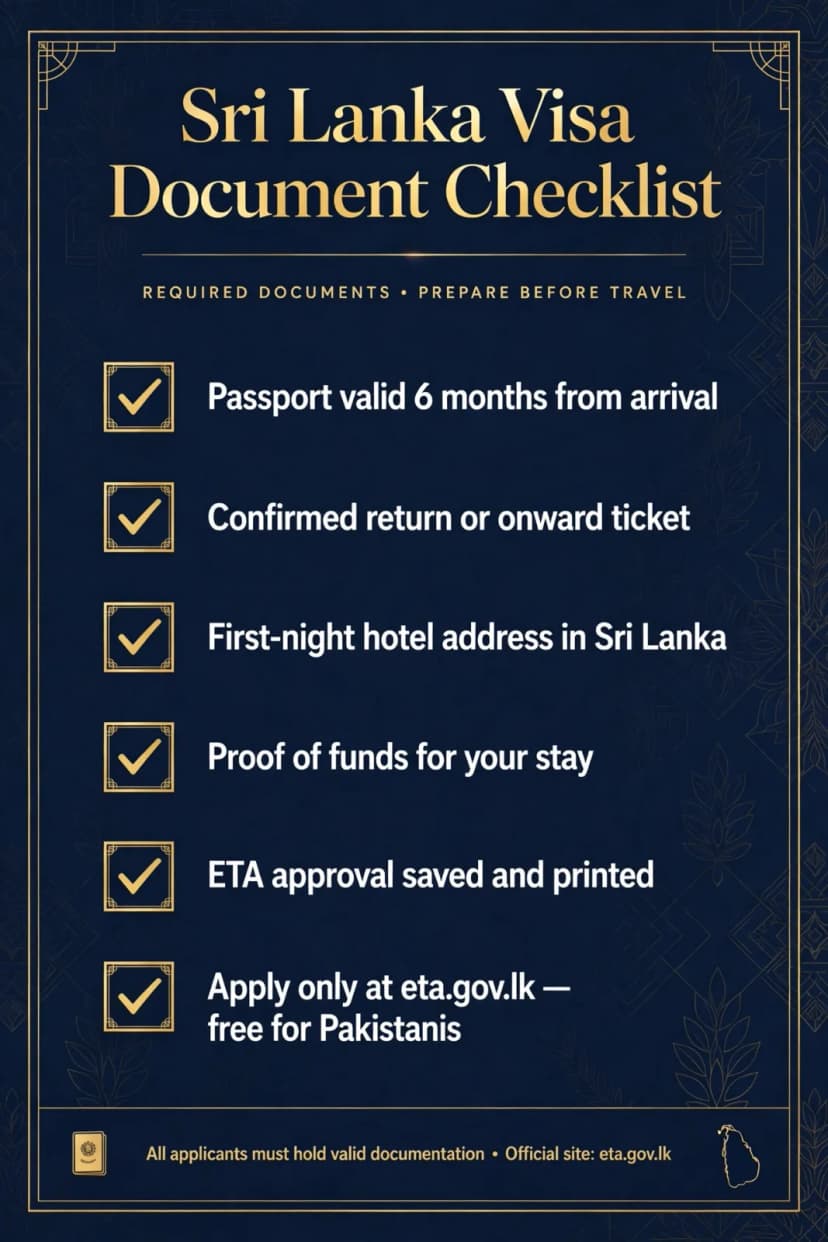
On arrival you need a passport valid for at least six months from the date of arrival, a confirmed return or onward ticket, enough funds for your stay, and the address of your first night's accommodation. Keep a printed or saved copy of your ETA approval to show at the border. The ETA is not a pre-condition for boarding in the Department's own FAQ wording for most nationalities, but for Pakistanis — excluded from the outage arrangement and required to hold the ETA in advance — it is, in practice, exactly that.

Types of Sri Lanka Visas for Pakistani Passport Holders
Sri Lanka's short-visit system is the ETA, issued in three classes: tourist, business and transit. Longer stays and other purposes — study, employment, residence, family reunion — run through separate entry-visa and residence-visa routes handled by the Department of Immigration and Emigration, usually with the involvement of a Sri Lankan mission. The ETA classes are set out below; the longer routes have their own sections later in this guide.
Tourist ETA — the standard route for a holiday. This is the visa almost every Pakistani traveller to Sri Lanka will use. It covers sightseeing, visiting friends and family, and short leisure travel. Since 25 May 2026 it is free for Pakistani passport holders, valid for 30 days from the date of first arrival, with double entry inside those 30 days. It is applied for online at eta.gov.lk before travel, and the approval is linked electronically to your passport number — there is no sticker and no stamp to collect. Children under 12 of any nationality are also free. The tourist ETA cannot be used for work, study or business activity beyond the narrow business-visit purposes covered by the business ETA. A tourist ETA can be extended after arrival, in steps, to a maximum of 270 days from arrival, on payment of the applicable extension fee.
Business ETA — short business visits. The business ETA covers attending meetings, conferences, negotiations and other short business activities. It is a 30-day ETA with multiple entries. Its fee is the most contested figure in this guide. The published general fee table charges USD 55 for a business ETA, or USD 30 for SAARC nationals — which would put a Pakistani applicant at USD 30. Some 2026 guides, however, state that the business ETA is outside the free scheme entirely and costs USD 55, or USD 30 for South Asian countries. Other 2026 guides list the business ETA as free for nationals of the 40 waiver countries. This guide reports the published table figure — USD 30 for a Pakistani (SAARC) applicant, USD 55 for non-SAARC — and flags the conflict: do not assume the business ETA is free just because the tourist ETA is, and confirm the fee the portal shows before paying. Note also that the German Foreign Office warns that using a tourist visa for business or a conference can end in arrest and deportation, so apply for the correct class.
Transit ETA — passing through Sri Lanka. The transit ETA is free for everyone and allows a stay of up to two days. It is for travellers transiting through Sri Lanka to a third country. There is a conflict in the sources here too: the FCDO states that you do not need a visa at all if you are transiting through Sri Lanka by air and your connecting flight is within 24 hours of your arrival. The ETA system, by contrast, provides a free transit ETA for stays of up to two days. The safe reading is that a same-day airside connection within 24 hours needs no ETA, while a longer stopover or any exit from the airport needs the free transit ETA. If your layover is overnight or you plan to leave the airport, apply for the transit ETA in advance rather than relying on the 24-hour reading.
Visa on arrival — exists, but do not plan on it. The visa-on-arrival position has flipped twice in just over a year. On 13 October 2025 the Department announced that from 15 October 2025 every short-stay visitor would need an ETA in advance, with no on-arrival processing. That announcement was revoked on 30 October 2025, so a visa on arrival remained available — at a higher price, USD 60 for most nationalities and USD 25 for SAARC nationals. Then the November 2026 portal-outage circular again allowed most nationalities to obtain an ETA or visit visa on arrival — but expressly excluded Pakistan. The FCDO's current advice is to apply for the ETA before travelling. For a Pakistani passport holder, the visa on arrival is therefore not a reliable plan: it may be available at Bandaranaike International Airport, but you cannot count on being allowed to board without an ETA, and you would pay more than the online route in any case. Apply online in advance.
Entry visa — for study, work and residence. If your purpose is study, employment, a long stay or residence, the ETA is not the right route. You need an entry visa approved in advance by the Controller General of Immigration and Emigration, usually applied for through a Sri Lankan mission — the High Commission in Islamabad if you are in Pakistan, or the Embassy in Hanoi if you are in Vietnam — and then a residence visa after arrival. A tourist ETA cannot be converted into a student or work residence visa inside Sri Lanka. The student and work sections below give the details.
Exemptions from the ETA requirement. The Department's notice lists categories that do not need an ETA at all: holders of a valid Sri Lankan resident visa or permanent resident visa, holders of a valid dual citizenship certificate with the relevant endorsement in the foreign passport, holders of a registration certificate under Section 5(2) of the Citizenship Act (passengers below 22 years of age) with the endorsement, holders of a valid entry visa issued by the Department, holders of a valid landing endorsement, and persons travelling for official or diplomatic purposes who are exempt under the Immigrants and Emigrants Act. None of these will apply to an ordinary Pakistani tourist, but a Pakistani who already holds Sri Lankan residence, or who is of Sri Lankan origin, should check whether an exemption covers them before applying for an ETA they do not need.
Visa Comparison Table
| Route | Purpose | Fee for a Pakistani passport | Stay | Entries | Where to apply |
|---|---|---|---|---|---|
| Tourist ETA | Holiday, visiting friends/family | Free since 25 May 2026 (see fee warning) | 30 days from first arrival | Double | eta.gov.lk, before travel |
| Business ETA | Meetings, conferences, negotiations | USD 30 (SAARC rate; see conflict) | 30 days | Multiple | eta.gov.lk, before travel |
| Transit ETA | Transit to a third country | Free | Up to 2 days | Single transit | eta.gov.lk, before travel |
| Visa on arrival | Tourist/business at the airport | USD 25 (SAARC rate) | 30 days | As granted | Bandaranaike Airport — not reliable for Pakistanis |
| Tourist ETA extension | Staying beyond 30 days | USD 60 (31–90 days); USD 150 (91–180); USD 200 (181–270) | Up to 270 days total from arrival | Extension cancels double entry | Online extension portal or Battaramulla head office |
| Student entry visa + residence visa | Full-time study | Residence visa USD 200 per year | 1 year, renewable | Multiple | Mission in advance; residence visa within 30 days of arrival |
| Employment residence visa | Sponsored job in Sri Lanka | Residence visa USD 200 per year | 1 year, renewable | Multiple | Employer + Department; mission in advance |
| Digital Nomad Visa | Remote work for overseas clients | Fee not published | 1 year, renewable | As granted | Department — reported only, see work section |
| Investor residence visa | Residence by investment | USD 200 per year per person | 5 years (USD 100,000) or 10 years (USD 200,000) | Multiple | Department of Immigration and Emigration |
| Spouse residence visa (RV-5) | Spouse of a Sri Lankan citizen | Free of visa fees | As granted | Multiple | Department of Immigration and Emigration |
Visa Fees: What Each Route Costs
All Sri Lanka ETA fees are quoted in US dollars. The Department states that fees paid are non-refundable, including fees paid before 25 May 2026 by nationals who later became eligible for the free ETA. If you pay for an ETA and then have to reapply because of a mistake, you pay again. Check every detail — passport number, nationality, date of birth — before you submit, because a mismatch can mean paying twice.
Tourist ETA — free for Pakistanis, for now. Since 25 May 2026 the tourist ETA is free of charge for Pakistani passport holders under the Department's Special Notice covering 40 countries. That is the fee this guide reports as current on 28 November 2026, because the official notice is still live on immigration.gov.lk and the ETA portal still listed the scheme as free on 25 November 2026. But the gazette behind the scheme, Gazette 2490/02, set the waiver to run until 24 November 2026, and no extension or ending notice had been published by 25 November 2026. Treat the free fee as provisional: the portal's own fee display on the day you apply is the controlling figure. If the waiver is withdrawn, the published general fee table charges SAARC nationals USD 20 for a tourist ETA applied for online, and USD 25 on arrival. Pakistan is a SAARC member, so the SAARC rate is the one that should apply — but some Pakistan-focused guides quote USD 50, the non-SAARC rate, for Pakistani applicants, and this guide flags that as an unresolved conflict. Do not pay USD 50 for a tourist ETA without checking the portal's fee table first.
Business ETA — USD 30 for SAARC nationals, with a conflict. The published general fee table charges USD 55 for a business ETA, or USD 30 for SAARC nationals. A Pakistani applicant should therefore pay USD 30. Two conflicts attach to this figure. First, some 2026 guides state that the business ETA is outside the free scheme and costs USD 55, or USD 30 for South Asian countries — consistent with the table. Second, other 2026 guides list the business ETA as free for nationals of the 40 waiver countries, including Pakistan. This guide follows the published table (USD 30) and flags the free-business-ETA claim as unverified. Confirm the fee on the portal before paying.
Transit ETA — free. A transit ETA of up to two days is free for everyone, of every nationality. Children under 12 are free for a tourist ETA of up to 30 days, of any nationality.
Visa on arrival — USD 25 for SAARC nationals, USD 60 for others. The ETA site's fee information lists USD 60 on arrival for most nationalities and USD 25 for SAARC nationals. As explained above, Pakistanis should not plan on this route, because the November 2026 outage arrangement excludes Pakistan and the FCDO advises applying in advance.
Extensions — paid, even after a free ETA. Extending costs money even though the original ETA was free. The Department's extension fee page sets the fees by nationality band and by total length of stay counted from arrival. For most passports — the "any other country" band, which the fee-page readings place Pakistan in — the fees are USD 60 for a stay of 31 to 90 days, USD 150 for 91 to 180 days, and USD 200 for 181 to 270 days. A separate band of 27 countries (the UK, most of Western Europe, Australia, New Zealand, Canada and Japan among them) pays USD 100 for 31 to 90 days, USD 150 for 91 to 180 days, and USD 200 for 181 to 270 days. The United States is listed at USD 100 for 31 to 180 days and USD 200 for 181 to 270 days in some readings, and as "check with the department" for the longer bands in others. Singapore, Maldives, Seychelles and the Czech Republic pay nothing for the first extension band and USD 150 and USD 200 for the later ones. Two cautions: first, the fee-page readings do not spell out whether the bands add up across successive extensions, so confirm the total before you pay; second, older guides quote a different scheme — USD 100 per 30-day extension up to 180 days total — which conflicts with the current fee page and is not followed here.
Express processing — reported, not verified. One 2026 guide lists an express ETA add-on of about USD 20. No official page seen for this guide confirms an express fee, so this guide reports it as unverified and does not rely on it. The standard processing time is short enough that an express option is rarely needed.
Lookalike sites — the most expensive mistake. The Department's Controller General has warned travellers about misleading websites that charge exorbitant fees for ETAs, and the Indian High Commission in Colombo lists more than a dozen of them in an advisory telling travellers to use only eta.gov.lk. Lookalike sites typically charge around USD 79 to USD 100 for a form that is free or USD 20 from the government. The test is the address: the official site is eta.gov.lk, ending in .gov.lk. If your country is on the free list, the official tourist ETA costs nothing, so any site asking you to pay for one is either not the official site or is adding its own fee. Type eta.gov.lk into the browser yourself rather than clicking a search result or an advertisement.
Overstay penalties — gazetted flat tiers. Overstaying is expensive, and the penalties are set by Gazette Extraordinary No. 2337/10 of 21 June 2023. If you depart within seven days of your visa expiring, you pay only the applicable visa fee at the port of departure, with no penalty. An overstay of more than seven days and up to 14 days carries a flat penalty of USD 250 in addition to the applicable visa fee. An overstay of more than 14 days carries a flat penalty of USD 500 in addition to the applicable visa fee. The bands are flat, not per day — a nine-day and a 14-day overstay both cost USD 250. The FCDO adds that overstaying can also mean temporary detention, a fine, deportation at your own expense, a travel ban, or refusal of entry in the future. Older reports quote much lower fines (USD 25, USD 50 and USD 100 in staged bands); those are superseded by the 2023 gazette and are not followed here.
Processing Times
Tourist and business ETA — usually 24 to 48 hours. The commonly reported standard approval time for an ETA applied for online is 24 to 48 hours, and several 2026 guides report approvals landing within that window. The ETA site itself does not publish a guaranteed processing time in the material seen for this guide, so 24 to 48 hours is reported, not officially guaranteed. Apply at least 72 hours before departure, and ideally a full week before, so that a query, a referral or a portal outage does not cost you the trip. If the portal is offline — as it was from 23 November 2026 — you cannot rely on a fast turnaround, and Pakistanis, unlike most nationalities, cannot fall back on boarding without an ETA.
Entry visas (study, work, residence) — a few weeks. Entry-visa applications made through a mission take materially longer than an ETA. The High Commission of Pakistan in Sri Lanka, giving the mirror-image guidance for Sri Lankan missions, advises applying well in time because processing takes a minimum of three to four weeks; Sri Lanka-side reporting for employment and student entry visas similarly describes processing as typically a few weeks once sponsorship or admission documents are complete. No official processing time is published for Sri Lankan entry visas, so plan on at least four weeks and apply as soon as your admission or employment documents are ready.
Extensions — apply before the current permission expires. Apply for an extension through the Department's online extension portal, or in person at the Battaramulla head office, before your 30 days run out. An online application that is still pending does not protect you from overstay fines: the Department asks applicants who have had no response to visit Battaramulla within three working days. Do not leave an extension to the last day.
ETA validity — a conflict. The ETA site's own pages disagree about how long an approved ETA stays valid before you must use it. The instructions on the site say an ETA lets you enter within three months of issue, while the FAQ calls it valid for six months. The extension page adds a third figure, describing the online portal as handling extensions up to six months. This guide reports the conflict and advises treating three months as the safe limit: travel within three months of the ETA being issued, and you satisfy both readings.
Complete Document Checklists
The ETA application is deliberately light on documents — the ETA site says no passport copies, documents or photographs are required for the online form. That is itself a point of conflict: the Department's tourist-visa page lists a JPG of your passport data page among its requirements. In practice, have the passport data page ready as a scan or photo even if the form does not ask for it, and have the items below ready before you start.
Tourist ETA checklist
- Pakistani passport valid for at least six months from the date of arrival, with at least one blank page for the arrival stamp. The FCDO measures the six months from the day you arrive; some guides measure it from the date of application. Six months beyond your planned return satisfies both.
- A confirmed return or onward ticket. The ETA form asks for your travel dates, and the border officer may ask to see the ticket.
- The address and telephone number of your first night's accommodation in Sri Lanka. The form asks for it; have the hotel booking confirmation ready.
- Enough funds for your stay. No minimum balance is published on any official page. One Pakistan-focused agency guide recommends a six-month bank statement with a closing balance of PKR 400,000 to PKR 600,000 plus an Account Maintenance Certificate stamped by the bank. That figure is that agency's advice, not a government rule, and this guide reports it as such. Carry a bank statement and a card that works internationally in case you are asked.
- A Visa, Mastercard or American Express card, if your ETA carries a fee. For a Pakistani tourist ETA under the free scheme there is nothing to pay, but the business ETA and any fallback fee are paid online by card.
- A printout or saved copy of the ETA approval, and the ETA reference number. Keep it with your passport for the whole trip.
- Your Vietnam residence details. You are applying as a Pakistani passport holder living in Vietnam; the form asks for your country of residence and your address there. Your Vietnamese temporary residence card is useful supporting evidence, though it is not listed as an ETA requirement.
Business ETA checklist
- Everything on the tourist ETA checklist, plus an invitation letter from the Sri Lankan company or organisation you are visiting, stating the purpose and dates of the visit.
- Evidence of your own employment or business in Vietnam or Pakistan — an employer letter or business registration — showing why you are travelling.
- The business ETA fee (USD 30 for a SAARC national under the published table) payable by card online.
Transit ETA checklist
- Pakistani passport valid for at least six months from arrival.
- A confirmed onward ticket to a third country, departing within two days.
- A visa for your onward destination, if that country requires one.
Extension checklist (apply after arrival)
- Valid passport and the current ETA/visa.
- A passport-size photograph.
- The address and telephone number of your accommodation in Sri Lanka.
- A confirmed return ticket.
- The extension fee for your nationality band and total length of stay (USD 60, USD 150 or USD 200 for the "any other country" band).
- Apply online through the Department's visa extension e-services portal, or in person at the head office in Battaramulla, before the current 30 days expire. Extending within the first 30 days cancels the double-entry facility.
Student entry-visa and residence-visa checklist
- Admission letter from a recognised Sri Lankan university or government-approved institution. For state universities, foreign students apply through the University Grants Commission scheme; the UGC places you at a university.
- Prior entry-visa approval from the Controller General of Immigration and Emigration, obtained before boarding. A tourist ETA cannot be converted into a student residence visa inside Sri Lanka.
- Residence-visa application (form IM 35) within 30 days of arrival, with a recommendation letter from the university.
- Certified colour copy of the passport data page and two photographs (35 x 45 mm).
- Encashment receipts showing at least USD 1,500 of foreign currency changed into rupees per year.
- A health protection plan and the residence-visa fee of USD 200 per year.
- Passport valid for at least six months. No paid employment is permitted on a student residence visa.
Employment residence-visa checklist
- A job offer or employment contract with a Sri Lankan-registered employer, and the employer's sponsorship documents.
- Entry-visa approval from the Controller General before travel.
- Educational and professional certificates, attested as the mission requires.
- Police clearance certificate and medical reports, if the mission or the Department asks for them.
- Residence-visa fee of USD 200 per year (Residence Visa-1 category).
How to Apply: Step-by-Step
Tourist ETA — online, before you travel
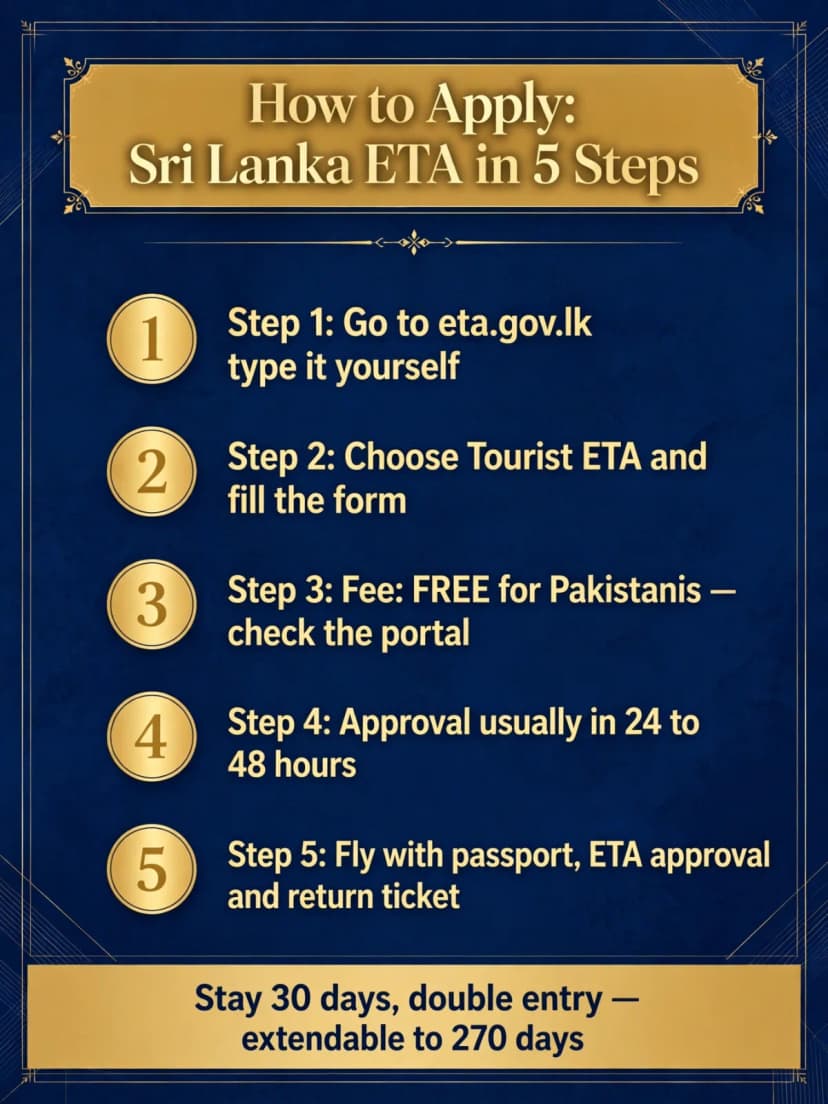
- Type eta.gov.lk into your browser yourself. Do not click a search result or an advertisement, and do not use any other site. Check the address ends in .gov.lk.
- Choose "Apply" and read the terms and conditions. Select the tourist ETA class.
- Fill in the form: passport number, nationality (Pakistan), date of birth, travel dates, address of your first night's accommodation, and your country of residence (Vietnam) with your Vietnamese address.
- Check the fee shown. For a Pakistani tourist ETA it should be free under the 25 May 2026 scheme. If the portal shows a fee, read it against the fee table in this guide (SAARC rate USD 20 online) and do not proceed on a site charging USD 79 to USD 100.
- Submit. If a fee applies, pay by Visa, Mastercard or American Express. Fees are non-refundable.
- Wait for the approval notice, usually within 24 to 48 hours. The ETA is linked electronically to your passport number. Save and print the approval and keep the reference number.
- Check your ETA status on eta.gov.lk if you do not hear back. The Department runs a 24-hour ETA call centre on +94 71 99 67 888 for questions about an application's status.
- Fly with your passport, the ETA approval, your return ticket, your accommodation address and proof of funds. The immigration officer at Bandaranaike International Airport (Katunayake) makes the final decision on entry.
Business ETA — online, before you travel
- Follow the same steps on eta.gov.lk, selecting the business ETA class.
- Have the Sri Lankan host company's invitation letter ready, with the purpose and dates of the visit.
- Pay the fee shown — USD 30 for a SAARC national under the published table — by card. Confirm the figure before paying, because of the free-business-ETA conflict described in the fees section.
- Wait for approval, save the approval notice, and travel with the invitation letter as well as the ETA approval.
Transit ETA — online, before you travel
- Apply on eta.gov.lk for a transit ETA, with your onward ticket details.
- The transit ETA is free and allows up to two days. If your connection is within 24 hours and you do not leave the airport, the FCDO states no visa is needed at all — but if there is any doubt, or your layover is overnight, hold the transit ETA.
Extension — after arrival, before the 30 days expire
- Apply through the Department's online visa extension portal, or in person at the head office ("Suhurupaya", Sri Subhuthipura Road, Battaramulla, near Colombo), Monday to Friday, 9:00 am to 3:00 pm. An appointment is needed for an in-person application, and you must attend in person to submit and collect.
- Submit your passport, a photograph, your accommodation address and telephone number, your return ticket and the extension fee for your band.
- Do not leave Sri Lanka during an extended period and expect to return on the same visa — leaving during the extended period cancels it, and a new visa is needed to return. Extending within the first 30 days also cancels the double-entry facility.
- If you applied online and have had no response, visit Battaramulla within three working days. A pending online application does not protect you from overstay fines.
Entry visa for study or work — through a mission, before travel
- Secure the underlying approval first: university admission (through the UGC scheme for state universities) or a job offer with employer sponsorship.
- Apply for entry-visa approval through the Sri Lankan mission that covers you — the Embassy in Hanoi if you are in Vietnam, or the High Commission in Islamabad if you are in Pakistan. The mission forwards the application to the Controller General in Colombo.
- Travel only after the entry visa is approved. On arrival, apply for the residence visa within 30 days at the Department of Immigration and Emigration, with the documents in the student or employment checklist above.
Applying from Vietnam and Pakistan — Embassy in Hanoi and Missions in Pakistan
From Vietnam — you are well covered. Sri Lanka has a resident Embassy in Hanoi and an Honorary Consul in Ho Chi Minh City, which is unusually convenient for a Pakistani living in Vietnam. The Embassy of Sri Lanka in Vietnam is at No. 55B, Tran Phu Street, Dien Bien Ward, Ba Dinh District, Hanoi. Its telephone numbers are +84 24 3734 1894 and +84 24 3734 1895, fax +84 24 3734 1897, email slemb.hanoi@mfa.gov.lk, website emb-hanoi.gov.lk. Office days are Monday to Friday, 8:30 am to 4:30 pm. There is a conflict over the ambassador's name: the Ministry of Foreign Affairs register names H.E. W.A.U.P. Perera, while Wikipedia's list of ambassadors and high commissioners (as of 25 November 2026) names Poshitha Perera. The address and contact details agree across sources; the name does not, so this guide gives the address and tells you to confirm the head of mission on the embassy website.
The Honorary Consul of Sri Lanka in Ho Chi Minh City is Ms. Marguerite Aluwihare, at Compound No. 14A35, Thao Dien Street, An Khanh Ward, Ho Chi Minh City — close to home for a resident of Ho Chi Minh City. An honorary consul can help with information and contacts, but ETA applications are made online and entry-visa applications go through the Embassy in Hanoi or the Department in Colombo, so do not expect the honorary consul to issue a visa.
For the ordinary tourist ETA you do not need to visit the embassy at all: apply online at eta.gov.lk from Vietnam, exactly as you would from anywhere else. Your country of residence on the form is Vietnam, and your Vietnamese address is the address to give. The embassy becomes relevant if you need an entry visa for study or work, if your ETA application is referred, or if you need help while in Sri Lanka — in which case the embassy in Hanoi is your nearest mission, and the High Commission of Pakistan in Colombo (No. 42–44, Bullers Lane, Colombo-7) is the Pakistani mission in Sri Lanka.
From Pakistan — High Commission in Islamabad, consulates in Karachi and Lahore. The High Commission of Sri Lanka in Islamabad is the mission for applicants in Pakistan. There is a conflict over its address. Several directories list it as House No. 2C, Street No. 55, F-6/4, Islamabad, with telephone +92 51 2828723 / 2278175, fax +92 51 2828751, email slhc.islamabad@mfa.gov.lk and website slhcpakistan.org. Another source lists it as House No. 62, Ataturk Avenue, G-6/3, Islamabad, with the same telephone numbers. This guide uses the F-6/4 address because it appears in the most directories, and flags the Ataturk Avenue variant — confirm the address by telephone before visiting. Sri Lanka also has a Consulate General in Karachi at No. 20/1, 18th Street, Khayaban-e-Shamsheer, Phase V, DHA, Karachi (telephone +92 21 35346614), and an Honorary Consulate in Lahore at No. 329, Johar Avenue, New Campus Road, Johar Town, Lahore. For a tourist ETA, an applicant in Pakistan also applies online at eta.gov.lk and does not need to visit a mission.
Which mission if something goes wrong. If your ETA is delayed or refused, contact the ETA call centre on +94 71 99 67 888, or the Embassy in Hanoi if you are in Vietnam. If you are already in Sri Lanka and need an extension or have an immigration problem, go to the Department of Immigration and Emigration head office at "Suhurupaya", Sri Subhuthipura Road, Battaramulla, near Colombo. If you lose your passport in Sri Lanka, contact the High Commission of Pakistan in Colombo.
Arrival ports. Bandaranaike International Airport at Katunayake, near Colombo, is the main gateway. The Department also lists Mattala, Ratmalana, Jaffna and Batticaloa airports and the seaports of Hambantota and Colombo Port City as approved ports of entry. Arrive through an approved port, with your ETA approval and return ticket ready.
Student Route: Studying in Sri Lanka
A Pakistani student needs an entry visa approved in advance and then a student residence visa — the tourist ETA is not a route into study. The sequence is fixed: get admitted, get entry-visa approval from the Controller General of Immigration and Emigration before boarding, enter Sri Lanka on that entry visa, and apply for the residence visa within 30 days of arrival at the Department of Immigration and Emigration.
For state universities, foreign students apply through the University Grants Commission (UGC) scheme; the UGC places you at a university. The closing date for 2025–26 entry was 17 August 2026, so check the current UGC handbook for the next cycle before paying any processing charge. Self-funded routes run through the institution's own admission and entry-visa process. Confirm how the UGC treats your Pakistani qualification (FSc, A-levels or a bachelor's degree) before paying a fee, and do not assume a tourist entry can become student residence — the Department's rule is that it cannot.
The residence-visa application uses form IM 35 and needs a recommendation letter from the university, a certified colour copy of the passport data page, two photographs (35 x 45 mm), the letter of admission, encashment receipts showing at least USD 1,500 of foreign currency changed into rupees per year, a health protection plan, and the visa fee. The student residence visa is granted for one year at a time and is renewable annually for the duration of the course; the residence visa fee is USD 200 per year or part of a year. Paid employment in Sri Lanka is prohibited on a student residence visa, and the residence visa covers only its stated purpose — no work, and no switching to employment without a fresh application. Tuition for international undergraduates is reported in the range of USD 3,000 to USD 15,000 a year under the UGC fee table, and some institutions ask for evidence of one year's course fee held for three months; both figures are reported from student guides, not from an official fee page, so confirm them with the university that admits you. There is no published post-study work route in Sri Lanka: no official page describes a graduate visa, so plan on leaving or securing sponsored employment before your student residence expires.
Work Route: Jobs, Business and Work Permits
Employment — sponsored residence visa. The standard work route is an employment residence visa (Residence Visa-1) sponsored by a Sri Lankan-registered employer and processed through the Department of Immigration and Emigration. The sequence is: a job offer and employment contract, entry-visa approval from the Controller General before travel, entry on that visa, and a residence-visa application after arrival. The residence visa fee is USD 200 for one year. Processing is typically a few weeks once sponsorship documents are complete, but no official processing time is published. The employer must be registered in Sri Lanka and must sponsor the application; there is no published route for arriving first and finding work afterwards, and working on a tourist ETA is not permitted. The German Foreign Office warning applies here too: using a tourist visa for business or employment activity can end in arrest and deportation.
Business visits — the business ETA. For short business trips — meetings, conferences, negotiations — the business ETA described above is the correct route: 30 days, multiple entry, USD 30 for a SAARC national under the published table, applied for online at eta.gov.lk. It does not authorise employment in Sri Lanka.
Digital Nomad Visa — new, and reported only. Sri Lanka launched a Digital Nomad Visa in February 2026, according to the reporting seen for this guide. It is described as a one-year residence, renewable annually, for remote workers whose income comes from clients or employers outside Sri Lanka, on a minimum remittance of USD 2,000 a month, plus USD 500 a month for each dependant beyond two. Bank accounts, leases and school enrolment for children are described as allowed. This guide has not verified the Digital Nomad Visa against an official Department page, and no official fee or application portal was found in the sources checked — so the figures are reported, not verified, and you should confirm the scheme's existence, fee and application route with the Department or the Embassy in Hanoi before making any plan around it. For a Pakistani English teacher working online from Vietnam, the remittance threshold is the key test: USD 2,000 a month of remitted foreign income is a high bar, and the scheme is aimed at remote workers relocating to Sri Lanka, not at short visits.
Investor residence — capital-tiered. Sri Lanka offers a residence visa by investment under the Immigrants and Emigrants Act No. 20 of 1948: an investment of USD 100,000 secures five years of residence, and USD 200,000 secures ten years (endorsed in two five-year stages), for the investor, spouse and dependants. The fee is USD 200 a year per person. This is a residence route, not a work permit, and the investment and endorsement conditions should be confirmed with the Department before any funds move.
What is not published. No published fee or processing time was found for a general work permit as distinct from the residence visa, and no official page seen for this guide lists a shortage-occupation route, a seasonal-work route or a job-seeker visa for Sri Lanka. Do not pay any agent who offers a Sri Lankan "work permit" or "job-seeker visa" without a named Sri Lankan employer and a Department-issued entry visa.
Family Visits and Permanent Residence
Visiting family — the tourist ETA. There is no separate family-visit visa class published for Sri Lanka. A Pakistani visiting family in Sri Lanka uses the tourist ETA, exactly as a holiday traveller does: free for 30 days with double entry under the 25 May 2026 scheme, applied for online at eta.gov.lk. If the family member is a Sri Lankan citizen or resident who will host you, carry their address and telephone number for the form, and a letter of invitation if you have one — it is useful supporting evidence, though it is not listed as an ETA requirement.
Spouse residence visa (RV-5) — free of visa fees. The foreign spouse of a Sri Lankan citizen, married for more than six months, can obtain a spouse residence visa (class RV-5) free of visa fees. The application goes to the Department of Immigration and Emigration, with the marriage certificate and the Sri Lankan spouse's documents. This is the most favourable family route in the Sri Lankan system, and it is the only residence class reported as free of fees.
Dependant residence. Dependants of a residence-visa holder — spouse and children — are covered under the principal holder's residence application, with their own residence endorsements. The investor residence route expressly covers spouse and dependants; the student and employment routes require dependant applications alongside the principal's. No separate fee schedule for dependants was found in the sources checked.
Permanent residence and citizenship — no short route. Permanent residence in Sri Lanka is tied to the investor route (five or ten years by investment) and to long residence; there is no published points-based permanent-residence route, no published timeline for ordinary naturalisation, and no family-reunification visa class beyond the spouse and dependant residence routes described above. Citizenship routes are by registration or descent for those of Sri Lankan origin — including a separate dual-citizenship reacquisition scheme — and by marriage to a Sri Lankan citizen, with standard naturalisation for unrelated foreign residents. None of these is a realistic short-term plan for a Pakistani visitor, and this guide does not present them as one.
Common Mistakes to Avoid
- Paying a lookalike site. The single most common and most expensive mistake. Sites with official-sounding names charge USD 79 to USD 100 for an ETA that is free or USD 20 from the government. Only eta.gov.lk is official. Type it yourself; never click a search advertisement.
- Assuming free means no application. The free ETA still has to be applied for and approved before you fly. Travellers who arrive without one because they thought "free" meant "visa-free" are the ones who get stopped at check-in.
- Assuming the outage arrangement covers Pakistan. The November 2026 temporary arrangement letting most nationalities board without an ETA expressly excludes Pakistan. If you are Pakistani, hold an approved ETA before boarding, whatever the arrangement says for other passports.
- Assuming the free scheme has no end date. The gazette ran the waiver to 24 November 2026. The portal still showed it as free on 25 November 2026, but check the fee on the day you apply — and be ready for the SAARC rate of USD 20 online if the waiver has been withdrawn.
- Using a tourist ETA for business or work. Attending a conference or doing business on a tourist ETA can end in arrest and deportation, according to the German Foreign Office warning. Apply for the business ETA for business, and an entry visa for employment.
- Arriving on a tourist ETA intending to study. A tourist ETA cannot be converted into a student residence visa inside Sri Lanka. Students must hold entry-visa approval before boarding.
- Leaving during an extended stay. Leaving Sri Lanka during an extended period cancels the extension, and a new visa is needed to return. Extending within the first 30 days also cancels the double-entry facility.
- Letting the 30 days run out. Apply for an extension before the 30 days expire. A pending online extension application does not protect you from overstay fines, and the Department asks applicants with no response to visit Battaramulla within three working days.
- Showing a Buddha tattoo. The FCDO warns that visible Buddha tattoos can mean refused entry or deportation, and posing in front of a Buddha statue for photographs is not acceptable. Cover any Buddha tattoo before arrival and in public.
- Forgetting the money rules. Currency over USD 15,000 or its equivalent must be declared on arrival, and over USD 10,000 on departure. Carry proof of funds for your stay even though no minimum balance is published.
- Booking a non-refundable ticket before the ETA is approved. Fees are non-refundable and the ETA, though usually fast, is not guaranteed. Hold the approval first, then book anything you cannot cancel.
Reasons for Refusal
The Department does not publish a list of refusal reasons for ETAs, and there is no published appeal route for an ETA refusal. The reasons below are drawn from the published rules and the standard grounds on which short-visit applications fail.
- Passport validity. A passport valid for less than six months from the date of arrival is the most common documentary refusal. Check the expiry date before you apply, and renew in Vietnam or Pakistan if it is short.
- Wrong visa class. Applying for a tourist ETA when the real purpose is business, study or employment. The Department's notice is explicit that a tourist ETA does not cover study or work, and the business-visit warning from the German Foreign Office shows the consequences.
- Incorrect details on the form. A mismatch between the form and the passport — passport number, nationality, date of birth — can mean the ETA is not honoured at the border, and a fresh application with a fresh fee. Check every field before submitting.
- No return ticket or no accommodation address. The ETA form asks for travel dates and a first-night address, and the border officer may ask to see the return ticket. An applicant who cannot show either looks like an intending overstayer.
- Insufficient funds. No minimum is published, but an applicant who cannot show funds for the stay can be refused entry. Carry a bank statement and a working international card.
- Previous overstay or breach. A previous overstay in Sri Lanka — with its USD 250 or USD 500 penalty, detention or deportation — counts against any later application, including residence and Digital Nomad applications.
- Security or sponsor-country referral. Nationals of a small group of countries, including Afghanistan, Cameroon, Ghana, Côte d'Ivoire, Nigeria, Syria, Taiwan and Kosovo, must apply through a sponsor in Sri Lanka at the Department's head office in Battaramulla. Pakistan is not in that group, but any application can be referred for further checks, which is why applying a week ahead matters.
- If you are refused. There is no published ETA appeal process. The practical course is to fix the named problem — renew the passport, correct the details, apply for the right class — and reapply, paying any fee again. For an entry-visa refusal, contact the mission that handled the application and ask what was missing before reapplying.
Frequently Asked Questions
1. Do Pakistani passport holders need a visa for Sri Lanka? Yes. Every foreign national must obtain an ETA before arriving, including nationals of the 40 free-ETA countries. For Pakistanis the tourist ETA has been free since 25 May 2026, but you must still apply on eta.gov.lk and be approved before you fly.
2. Is the Sri Lanka tourist ETA really free for Pakistanis? Yes, as of 28 November 2026. Pakistan is named in the Department of Immigration and Emigration's Special Notice covering 40 countries, and the notice is still live on immigration.gov.lk. But the gazette behind the scheme ran the waiver to 24 November 2026, and the portal still showed it as free on 25 November 2026 with no end date published — so check the fee on the day you apply. If the waiver ends, the SAARC rate of USD 20 online should apply.
3. How long can I stay on a tourist ETA, and can I enter twice? 30 days from the date of your first arrival, with double entry inside those 30 days. You may leave once and come back, but the second stay only gets the balance of the original 30 days — it does not restart the clock.
4. Where do I apply for the Sri Lanka ETA? Only on eta.gov.lk, the Department of Immigration and Emigration's own site. Type the address yourself. Any other site is a reseller or a lookalike, and lookalikes typically charge USD 79 to USD 100 for a form that is free or USD 20 from the government.
5. How long does the ETA take to process? Usually 24 to 48 hours for an online application, according to 2026 reporting. No official guaranteed time is published, so apply at least 72 hours before departure and ideally a week ahead.
6. How long is an approved ETA valid before I must travel? The ETA site's own pages disagree: the instructions say you may enter within three months of issue, while the FAQ says six months. Treat three months as the safe limit and travel inside it.
7. Can I get a visa on arrival in Sri Lanka? A visa on arrival exists — USD 25 for SAARC nationals, USD 60 for others — but Pakistanis should not plan on it. The October 2025 mandatory-ETA announcement was revoked, but the November 2026 portal-outage arrangement that lets most nationalities board without an ETA expressly excludes Pakistan. Apply online in advance.
8. What is the business ETA fee for a Pakistani? USD 30 under the published fee table (USD 55 for non-SAARC nationals). There is a conflict: some 2026 guides list the business ETA as free for the 40 waiver countries. This guide follows the published table and advises confirming the fee the portal shows before paying.
9. Do I need a transit visa for a layover in Colombo? If your connecting flight is within 24 hours and you do not leave the airport, the FCDO states no visa is needed. For a longer stopover, or if you leave the airport, apply for the free transit ETA (up to two days) on eta.gov.lk before you travel.
10. Can I extend my stay beyond 30 days? Yes, after arrival, online or in person at the Department's head office in Battaramulla, before the 30 days expire. Extensions run in steps to a maximum of 270 days from arrival. For the "any other country" band, which fee-page readings place Pakistan in, the fees are USD 60 for 31 to 90 days, USD 150 for 91 to 180 days, and USD 200 for 181 to 270 days.
11. What happens if I overstay my ETA? If you leave within seven days of expiry you pay only the applicable visa fee, with no penalty. An overstay of 8 to 14 days carries a flat USD 250 penalty plus the visa fee; more than 14 days carries a flat USD 500 penalty plus the fee (Gazette 2337/10, 21 June 2023). Overstaying can also mean detention, deportation at your own expense, a travel ban or refusal next time.
12. Can I study in Sri Lanka on a tourist ETA? No. A tourist ETA cannot be converted into a student residence visa. You need entry-visa approval from the Controller General before boarding, then a student residence visa (form IM 35) within 30 days of arrival, with USD 1,500 a year in encashment receipts and a fee of USD 200 a year. No paid work is allowed on a student visa.
13. Can I work in Sri Lanka on a tourist ETA? No. Employment needs a sponsored employment residence visa (USD 200 a year), with entry-visa approval before travel. Working on a tourist ETA, or attending a conference on one, can end in arrest and deportation. The Digital Nomad Visa reported as launched in February 2026 (one year, USD 2,000 a month remitted income) is unverified against an official page.
14. Is there a Sri Lankan embassy in Vietnam? Yes. The Embassy of Sri Lanka in Vietnam is at No. 55B, Tran Phu Street, Ba Dinh District, Hanoi (+84 24 3734 1894/1895, slemb.hanoi@mfa.gov.lk). There is also an Honorary Consul in Ho Chi Minh City, Ms. Marguerite Aluwihare, at 14A35 Thao Dien Street, An Khanh Ward. For a tourist ETA you do not need the embassy — apply online.
15. Do I need a yellow fever certificate for Sri Lanka? Only if you arrive from a country listed as a yellow fever transmission risk. The FCDO states a certificate is required in that case. Pakistan and Vietnam are not on the risk list for this purpose, so an ordinary flight from Ho Chi Minh City does not trigger the requirement — but check the current list if you have recently travelled elsewhere.
Official Immigration Websites
| Website | What it is for |
|---|---|
| eta.gov.lk | Official ETA portal — the only place to apply for a tourist, business or transit ETA, check ETA status and read the fee table |
| immigration.gov.lk — Special Notice | Department of Immigration and Emigration — Special Notice on the free 40-country ETA, visa fees, extensions and entry-visa information |
| mfa.gov.lk — missions register | Ministry of Foreign Affairs, Foreign Employment and Tourism — register of Sri Lankan missions abroad, including the Hanoi embassy |
| emb-hanoi.gov.lk | Embassy of Sri Lanka in Vietnam (Hanoi) — consular services and contact details |
| slhcpakistan.org | High Commission of Sri Lanka in Islamabad — the mission for applicants in Pakistan |
| gov.uk — FCDO Sri Lanka travel advice | UK FCDO travel advice for Sri Lanka — entry requirements, passport validity, overstay consequences, safety |
Final Checklist and Conclusion
Before you fly, run through this list. Apply for the tourist ETA on eta.gov.lk — and only on eta.gov.lk — at least a week before departure, and confirm the fee the portal shows on the day: free for a Pakistani passport under the 25 May 2026 scheme, with the SAARC rate of USD 20 as the fallback if the waiver has been withdrawn. Save and print the approval and keep the reference number with your passport. Check your passport is valid for at least six months from arrival. Hold a confirmed return ticket, the address and telephone number of your first night's accommodation, and proof of funds. If you are travelling for business, apply for the business ETA, not the tourist ETA. If you are studying or working, hold entry-visa approval before boarding — the tourist ETA cannot be converted inside Sri Lanka. If you want to stay beyond 30 days, apply for the extension before the 30 days expire, at the online portal or in Battaramulla, and budget USD 60, USD 150 or USD 200 by length of stay. Do not overstay: seven days' grace costs only the visa fee, but eight days costs USD 250 and fifteen days costs USD 500 on top of it.
Sri Lanka is, on paper, one of the easiest visas a Pakistani passport holder will ever deal with in 2026: a free ETA, applied for online in minutes, approved in a day or two, good for 30 days with a second entry thrown in. The difficulty is not the visa but the noise around it — the lookalike sites, the expired gazette date, the portal outage that does not cover Pakistan, and the fee figures that change with the nationality band. Get the ETA from the official portal, check the fee on the day, and the rest of the trip is the easy part: the beaches, the tea country, the elephants and the food.
This guide was checked on 28 November 2026. Visa rules change without notice. Always confirm the live rules on immigration.gov.lk and eta.gov.lk before paying any fee or booking a non-refundable ticket. Nothing in this guide is immigration advice; the Sri Lankan authorities set and enforce the entry rules, and the immigration officer at Bandaranaike International Airport makes the final decision. This guide is educational information only and does not guarantee visa approval or entry.


