Introduction
Spain is a popular European destination for international students, skilled professionals, entrepreneurs, remote workers and tourists. Its universities, cultural heritage, Mediterranean lifestyle and access to the European market make it an attractive destination for both short visits and long-term relocation.
However, travelling to Spain requires careful preparation. Depending on your nationality and purpose of travel, you may need a Schengen visa, national visa, residence authorization or work permit.
This guide explains the principal Spanish immigration pathways, application requirements, financial requirements and procedures, including guidance for Pakistani nationals legally residing in Vietnam.
Last researched (as stated in original draft): 25 November 2026. Always confirm the latest requirements with the responsible Spanish diplomatic mission before submitting an application.
Why people visit, study and work in Spain
International education: Undergraduate degrees, postgraduate education, research and language programmes.
Professional opportunities: Technology, engineering, hospitality, renewable energy and international business.
Tourism and culture: Historic architecture, museums, coastal destinations and cultural experiences.
Remote working: Immigration opportunities for eligible international remote professionals.
Spain participates in the Schengen Area. Nevertheless, holding permission to visit Spain does not automatically give a foreign national the right to work or settle elsewhere in Europe.
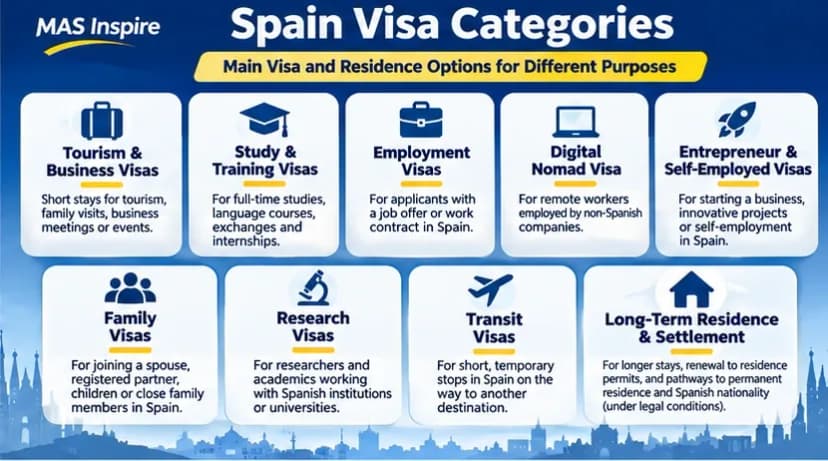
Types of Spain visas and residence permits
1. Tourist and visitor visa
The short-stay Schengen Type C visa is suitable for tourism, visiting relatives and other permitted temporary activities.
Its principal conditions include:
- A maximum stay of 90 days within any rolling 180-day period.
- Evidence of accommodation and sufficient financial resources.
- Suitable travel medical insurance.
- Evidence supporting the intention to leave before the authorized stay ends.
- No ordinary employment rights.
Pakistani and Vietnamese ordinary passport holders generally require this visa for tourist travel.
The visa sticker may be valid for longer than the number of days the holder is authorized to remain.
Official Schengen visa guidance
2. Business visitor visa
Business visitors generally use the Schengen short-stay visa category rather than a separate long-term business residence permit.
Permitted activities can include conferences, business consultations, trade exhibitions and meetings with commercial partners.
Applicants may need an invitation from a Spanish organization, employer documentation, business registration records and evidence of trip financing.
A business visitor visa does not replace a work authorization when the intended activity constitutes employment.
3. Student visa
Non-EU nationals undertaking eligible educational programmes lasting more than 90 days generally require long-term study authorization and, where applicable, a national study visa.
Eligible activities may include higher education, approved training, student exchanges and qualifying language programmes.
Applicants must demonstrate admission, financial capacity and appropriate medical insurance.
The precise work rights depend on the educational activity and authorization granted. Qualifying higher-education students may generally work up to 30 hours per week when compatible with their studies.
Official immigration regulation
4. Employer-sponsored work visa
The employed-worker route is intended for foreign nationals who have secured eligible employment in Spain.
In ordinary cases, the Spanish employer must initiate the relevant residence and work authorization before the employee applies for the entry visa.
Supporting documents include the employment contract, employer information, professional qualifications and authorization decision.
Labour-market requirements may apply unless the applicant qualifies for an exemption.
5. Highly qualified professional and EU Blue Card routes
Spain offers immigration options for eligible highly qualified professionals.
These pathways may require an appropriate employment offer, recognized professional qualifications or relevant experience, and compliance with applicable remuneration requirements.
They are particularly relevant to specialized professionals and certain senior employees.
The salary requirements differ by route. Applicants should not assume that meeting a general Spanish minimum salary qualifies them for a highly skilled permit.
6. Job-seeker residence authorization
Spain has a post-study job-search or entrepreneurial-project residence authorization for eligible international graduates who have completed qualifying higher education in Spain.
The completed qualification must generally correspond to at least European Qualifications Framework Level 6.
This authorization can last up to 24 months and cannot be extended under the same route.
It does not itself authorize employment. A successful job seeker must obtain the appropriate work authorization before starting work.
Spain also has limited job-search mechanisms under its immigration legislation. Applicants living abroad should not assume that a general unrestricted job-seeker visa is available to every foreign national.
Official graduate immigration guidance
7. Digital nomad visa
Spain's international teleworking route is designed for eligible non-EU professionals working remotely for organizations outside Spain.
Applicants typically need to demonstrate an existing professional relationship, authorization to work remotely, qualifications or professional experience, and suitable social-security arrangements.
Self-employed professionals may undertake limited activity for Spanish clients, subject to the applicable statutory limit.
Spanish consular guidance reviewed for 2026 gives a minimum monthly financial requirement of €2,849 for a principal applicant (annualised basis; consulates show €2,442 as the 14-payment equivalent). Additional resources are required for accompanying relatives: +€1,068.38 for the first, +€356.13 for each further (annualised basis).
Official digital nomad visa guidance
8. Entrepreneur and self-employed visas
Spain distinguishes between innovative entrepreneurial projects and ordinary self-employed economic activities.
The entrepreneur route generally requires an innovative business proposal that satisfies the applicable assessment criteria.
The ordinary self-employed route may require business planning, evidence of investment capacity, professional qualifications and relevant licences.
Buying property or registering a company does not automatically establish eligibility for residence.
Spain ended its former golden visa programme for new investor applications in April 2025. Existing beneficiaries and eligible transitional cases are subject to separate provisions.
9. Non-lucrative residence visa
This pathway is designed for applicants who intend to live in Spain without undertaking employment or professional activities.
Applicants must demonstrate adequate independent financial resources and qualifying health insurance.
The standard financial benchmark is 400% of IPREM for the main applicant, with additional resources for dependants.
With a monthly IPREM of €600, this corresponds to €2,400 monthly or €28,800 for an initial full year. Confirm the applicable benchmark and consular calculation before applying.
This route should not be used as a substitute for the digital nomad visa.
10. Family reunion and spouse visas
Eligible residents may be able to sponsor certain family members under Spain's family reunification rules.
Separate immigration regimes exist for relatives of Spanish nationals, EU citizens and qualifying non-EU residents.
Applicants may need marriage or birth certificates, evidence of the sponsor's status, accommodation and financial resources.
The right to work depends on the family residence category granted.
11. Airport transit visa
An airport transit visa permits eligible passengers to remain within the international transit area during a qualifying connection.
Pakistani passport holders may require an airport transit visa, subject to specific exemptions.
An airport transit visa does not authorize entry into Spain or the wider Schengen Area.
Flights requiring baggage collection, airport changes or passage through immigration may require a different visa.
Spanish Embassy visa information
12. Exchange, internship and training visas
Spain offers pathways for approved training activities, student mobility, internships and certain educational or cultural programmes.
The correct route depends on the duration, nature of the programme and whether the activity involves employment.
Applicants should obtain a formal agreement from the educational institution or host organization before choosing their application category.
13. Researcher and academic visas
Researchers may qualify for national visas and residence authorizations based on research contracts or agreements with eligible Spanish institutions.
The Spanish Embassy in Hanoi specifically directs doctoral applicants towards the researcher visa category.
Applicants should confirm the correct pathway with their university or research institution.
Official Spanish researcher visa information
14. Humanitarian protection
International protection, refugee status, subsidiary protection and certain exceptional residence authorizations exist within Spain's legal framework.
These procedures involve specific legal conditions and are not ordinary alternatives to tourist, employment or student visas.
Individuals requiring protection should consult the responsible Spanish authorities or qualified legal assistance.
Spanish Ministry of the Interior
15. Other specialized immigration categories
Additional Spanish immigration pathways cover certain seasonal workers, intra-company transfers, audiovisual professionals, international service providers, religious personnel and other specialized activities.
The correct authorization depends on the applicant's duties, qualifications and the organization supporting the application.
Spain visa comparison table
| Category | Main purpose | Work rights | Duration |
|---|---|---|---|
| Tourist / visitor | Holidays and visits | No | 90/180-day rule |
| Business visitor | Meetings and conferences | No ordinary employment | 90/180-day rule |
| Student | Education | Conditional | Programme-dependent |
| Employment | Sponsored employment | Yes, subject to authorization | Permit-dependent |
| Highly qualified | Specialized employment | Yes | Permit-dependent |
| Graduate job seeker | Finding work after study | No | Up to 24 months |
| Digital nomad | International remote work | Authorized remote activity | Visa up to one year; residence route differs |
| Entrepreneur | Innovative business | Authorized activity | Permit-dependent |
| Self-employed | Approved independent work | Yes | Permit-dependent |
| Non-lucrative | Independent residence | No | Initially generally one year |
| Family reunion | Joining relatives | Category-dependent | Sponsor and route-dependent |
| Airport transit | International connection | No | Eligible transit only |
| Internship | Approved placement | Placement-dependent | Agreement-dependent |
| Researcher | Academic research | Authorized research | Contract-dependent |
| Long-term residence | Settlement | Yes | Indefinite residence status |
National visa validity and the duration of an underlying residence authorization are not necessarily identical.
Eligibility requirements
Before starting an application, establish which immigration rules apply to your circumstances.
EU, EEA and Swiss nationals generally benefit from free-movement arrangements, although registration requirements can apply for longer residence.
Other nationals must determine whether they require a visa and which authorization corresponds to their intended activities.
General eligibility considerations include a valid passport, genuine travel purpose, financial capacity, appropriate insurance and compliance with immigration and public-security requirements.
Long-term routes may also require criminal-record certificates, medical certificates, employment authorization or institutional sponsorship.
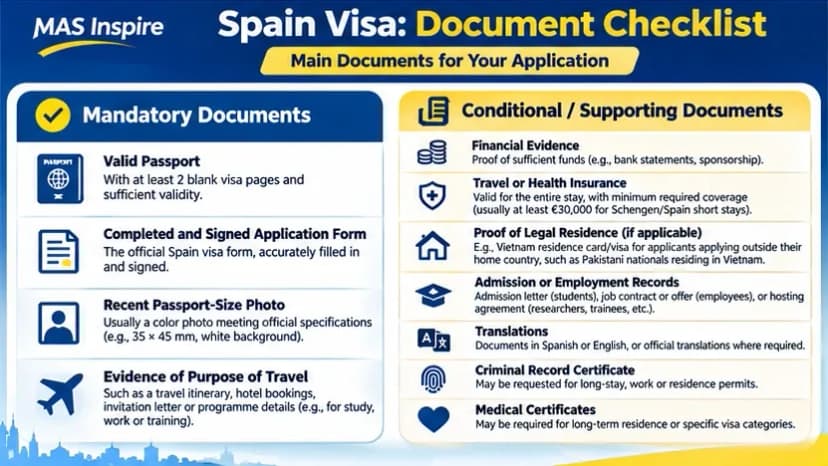
Complete document checklists
The following tables provide a preparation framework. They are not a substitute for the official checklist applicable to your nationality, location and immigration category.
General application documents
| Document | Requirement |
|---|---|
| Valid passport | Mandatory |
| Correct signed application form | Mandatory |
| Passport-style photograph | Mandatory |
| Visa fee payment | Mandatory unless exempt |
| Evidence of legal residence | Required where applicable |
| Evidence of travel purpose | Mandatory |
| Financial documentation | Category-dependent |
| Accommodation evidence | Category-dependent |
| Travel or health insurance | Category-dependent |
| Certified translations | Conditional |
| Apostille or legalization | Conditional |
| Criminal-record certificate | Conditional |
| Medical certificate | Conditional |
| Biometrics | When required |
| Interview | When requested |
Documents by immigration category
| Visa category | Principal route-specific evidence |
|---|---|
| Tourist | Itinerary, accommodation, financial evidence |
| Business | Business invitation and employer documentation |
| Student | Admission, enrolment or tuition-payment evidence, financial means and insurance |
| Employment | Contract and approved work authorization |
| Highly qualified | Employment offer, credentials and applicable salary evidence |
| Digital nomad | Remote-work confirmation, professional relationship, income and social-security evidence |
| Entrepreneur | Business proposal and relevant project assessment |
| Self-employed | Business plan, licences and investment evidence |
| Non-lucrative | Independent funds and qualifying insurance |
| Family reunion | Relationship certificates and sponsor documentation |
| Internship | Placement or training agreement |
| Researcher | Research contract or hosting agreement |
| Graduate job seeker | Qualifying Spanish degree, previous study status, funds and insurance |
| Long-term residence | Evidence of qualifying residence history |
Recommended supporting evidence
Depending on the application, additional evidence may strengthen the explanation of your circumstances. Examples include a clear cover letter, documented sources of funds, employment leave approval, academic history and previous immigration records.
Only provide authentic information. Documents submitted from another country may require translation and authentication under the applicable rules.
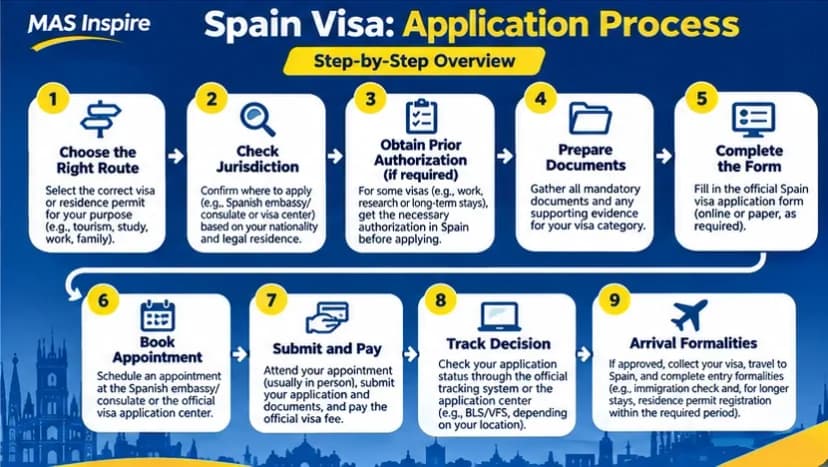
How to apply for a Spain visa: step-by-step
- Choose the correct visa route. Determine the purpose and intended length of your stay.
- Check nationality and residence. Identify the Spanish mission responsible for your application.
- Obtain prior authorization. Complete employer, sponsor or institutional procedures when required.
- Prepare your documents. Follow the official category-specific checklist.
- Complete the form. Use the Schengen or national visa application form as appropriate.
- Book an appointment. Follow the mission's designated booking procedure.
- Submit and pay. Present documents, pay applicable fees and provide biometrics when required.
- Respond to requests. Supply further evidence or attend an interview if instructed.
- Track the application. Follow the reference and tracking instructions issued at submission.
- Receive the decision and prepare for arrival. Check visa details and complete any required residence-card or registration formalities.
Not every Spanish immigration procedure begins online. Some require a sponsor to submit an electronic residence application in Spain before the applicant attends a visa appointment abroad.
Official application resources
- Spanish Embassy visa forms and information
- Authorized Spain visa application centre in Vietnam
- Spanish electronic administration portal
- Spanish Ministry of Migration
Spain visa fees and financial requirements 2026
Visa application fees
| Category | Application fee |
|---|---|
| Schengen visa — adults | €90 |
| Schengen visa — children aged 6–11 | €45 |
| Schengen visa — children under six | Exempt |
| Student national visa | Check local consular tariff |
| Employment visa | Check local consular tariff |
| Digital nomad visa | Check local consular tariff |
| Entrepreneur visa | Check local consular tariff |
| Family residence visa | Route and exemption-dependent |
| Non-lucrative visa | Check local consular tariff |
| Residence authorization | Applicable administrative tariff |
Applicants in Vietnam should consult the Spanish Embassy's fee schedule for the amount payable in Vietnamese dong. The authorized application centre may also charge a separate service fee.
Financial evidence
| Route | Financial benchmark |
|---|---|
| Tourist | Current Spanish entry financial requirement |
| Student | €600 per month |
| First accompanying student dependant | Additional €450 per month |
| Additional student dependants | Additional €300 per person per month |
| Digital nomad | €2,849 per month (annualised basis; consulates show €2,442 as the 14-payment equivalent) |
| Non-lucrative | 400% of IPREM for principal applicant |
| Family reunification | Applicable household and sponsorship requirements |
| Entrepreneur | Project-specific financial assessment |
| Employment | Applicable salary and employment conditions |
IPREM is Spain's public income reference indicator. SMI is the statutory minimum wage. Immigration categories may use different financial indicators.
Do not confuse required financial resources with visa application fees or actual living expenses.
Spain visa processing times
| Immigration route | Processing period |
|---|---|
| Schengen short stay | Normally 15 days |
| Schengen applications requiring further examination | Up to 45 days |
| Student national visa | Confirm applicable consular decision period |
| Employment | Prior authorization plus visa procedure |
| Digital nomad | Procedure-dependent |
| Family reunification | Prior authorization where necessary, followed by visa processing |
| Long-term residence | Applicable administrative procedure |
Appointment waiting times, translation, legalization and preparation of sponsor documents may significantly increase the total time required.
Do not book non-refundable travel solely on the assumption that a visa will be approved within a published decision period.
Applying from Pakistan or Vietnam
Pakistani passport holders living in Vietnam
Pakistani citizens who legally reside or work in Vietnam may be eligible to apply for a Spanish visa through the responsible mission in Vietnam.
The Spanish Embassy requires foreign applicants to establish residence within its consular jurisdiction.
A Vietnamese temporary residence card or permanent residence card may help establish this eligibility. However, holding a residence document does not guarantee that every Spanish immigration category can be submitted locally.
Before paying application fees, confirm that:
- The Spanish mission accepts applications from Pakistani residents for the chosen visa.
- Your Vietnamese residence status satisfies its requirements.
- Your residence document will remain valid for the relevant period.
- Your Pakistani and Vietnamese documents meet translation and authentication rules.
- Any required prior authorization in Spain has been obtained.
Additional documents for Pakistani residents
| Document | Purpose |
|---|---|
| Pakistani passport | Nationality and identity |
| Vietnamese residence card | Evidence of local residence |
| Vietnamese work permit | Employment evidence, where relevant |
| Employment contract | Current employment circumstances |
| Salary and banking records | Financial evidence where required |
| Pakistani civil documents | Identity or family relationship |
| Criminal-record certificates | Where required by the selected route |
| Certified translations | Where applicable |
Where to submit applications in Vietnam
The Spanish Embassy identifies BLS visa centres in Hanoi and Ho Chi Minh City as submission locations for ordinary Schengen and national visa applications.
Certain family members of Spanish or EU citizens may have an alternative embassy submission option.
Consult the embassy's dedicated submission guidance and your appointment confirmation. Different official pages currently display different centre addresses, so the physical location should be confirmed directly.
Official Vietnam submission instructions
Pakistan versus Vietnam applications
| Factor | Applying from Pakistan | Applying from Vietnam |
|---|---|---|
| Responsible mission | Spanish mission in Pakistan | Spanish mission in Vietnam |
| Local residence evidence | Pakistani nationals generally recognized within jurisdiction | Vietnamese legal residence evidence required |
| Currency | Local published PKR tariff | Local published VND tariff |
| Documents | Pakistan-specific checklist | Vietnam-specific checklist |
| Authentication | Depends on document origin | Depends on document origin |
| Appointment | Pakistan mission's designated procedure | Vietnam designated procedure |
Applicants should never select an application country solely because they believe approval there will be easier.
Spain student visa guide 2026
Spain offers an extensive range of educational opportunities through public and private universities, authorized training providers and research institutions.
Admission requirements
Begin by securing admission to an eligible Spanish educational programme. Verify that the institution and course qualify for the relevant immigration authorization.
For a study visa submitted from Vietnam, the published embassy checklist also identifies tuition-payment evidence and a personal introduction or motivation letter.
Applicants receiving assistance from an education agency should disclose the agency details when required by the mission.
Student financial requirements
The Spanish consular guidance reviewed provides the following 2026 financial calculations for a principal student.
| Study period | Base financial evidence |
|---|---|
| 3 months | €1,800 |
| 6 months | €3,600 |
| 9 months | €5,400 |
| 12 months | €7,200 |
These figures are calculated using €600 monthly. They exclude tuition and other expenses. The three-month example is illustrative; a programme lasting no more than 90 days is generally handled under short-stay rules.
Recognized prepaid accommodation and other eligible circumstances may affect the amount required.
Student health insurance
Applicants must arrange medical coverage that complies with Spanish immigration requirements. An ordinary short-term travel insurance policy may not satisfy the requirements for long-term studies.
Check coverage, provider eligibility and the insurance period before purchasing a policy.
Working while studying in Spain
Students holding eligible higher-education authorizations may undertake compatible employment or self-employed activity within the applicable limits, generally up to 30 hours weekly.
Other study or training categories may require additional authorization.
Students should prioritize compliance with the educational programme and should not depend on future employment to demonstrate their initial financial capacity.
Staying after graduation
Graduates may qualify to change to an employment or self-employment authorization. Eligible university graduates may also qualify for the post-study job-search residence route described earlier.
Graduation does not automatically grant permanent residence or unrestricted employment rights.
Official study visa guidance for Vietnam
Work visas and job opportunities in Spain
International professionals may explore opportunities in information technology, engineering, manufacturing, hospitality, healthcare, education and renewable energy.
Employment availability depends on qualifications, language abilities, professional recognition and market demand.
Regulated professions may require formal recognition of foreign qualifications before an applicant can practise.
A prospective employer should understand the sponsorship procedure before offering employment to a person who does not already have Spanish work rights.
Official employment resources include:
- EURES European employment portal
- Spanish Public Employment Service — SEPE
- Spanish Ministry of Migration
A job offer alone does not guarantee approval of a work-related visa.
Family immigration and permanent residence
Spain provides residence pathways for eligible family members and foreign residents who meet long-term residence conditions.
Family reunification
Eligibility depends on the sponsor's nationality, residence authorization and relationship to the applicant.
The required evidence may include authenticated civil-status documents, sponsor identification, evidence of sufficient resources and suitable accommodation.
Family members of Spanish or EU citizens should not automatically use the general non-EU family reunification procedure.
Long-term residence in Spain
Eligible foreign nationals may generally qualify for national long-term residence following five years of qualifying legal and continuous residence, subject to applicable rules and exceptions.
This status permits residence and employment in Spain indefinitely.
Periods spent under student stay authorization are not automatically equivalent to qualifying ordinary residence. National long-term residence and EU long-term residence also have different rules.
Citizenship is a separate legal process with its own residence requirements and eligibility conditions.
Common application mistakes
- Applying for tourism when the actual intention is employment.
- Using outdated visa requirements or fee tables.
- Submitting inconsistent employment or financial information.
- Providing documents without required authentication.
- Purchasing unsuitable health insurance.
- Assuming a Vietnamese residence card guarantees local application eligibility.
- Confusing visa validity with authorized duration of stay.
- Starting employment before receiving the required authorization.
- Booking non-refundable travel before receiving a decision.
- Using fabricated financial records or invitation letters.
Reasons for visa refusal
Spanish visa authorities may refuse applications that do not satisfy the applicable immigration requirements.
Potential reasons include insufficient financial evidence, unreliable documentation, failure to demonstrate the intended purpose, missing prior authorization, inadequate insurance or concerns about compliance with immigration conditions.
Applicants receiving a refusal should read the official decision carefully. It should identify the relevant reasons and applicable review or appeal procedures.
Submitting another application without addressing the refusal reasons may lead to a similar outcome.
Frequently asked questions
1. Do Pakistani passport holders need a visa for Spain?
Yes. Ordinary Pakistani passport holders generally require a visa for tourist and other short-stay visits unless a specific exemption applies.
2. Can Pakistani citizens apply for a Spain visa from Vietnam?
Potentially, provided they establish acceptable legal residence and meet the Spanish mission's category-specific jurisdiction requirements.
3. How much is a Spain tourist visa in 2026?
The standard adult Schengen visa application fee is €90, excluding applicable service charges.
4. How much bank balance is required for a Spain student visa?
The principal student's base financial requirement is €600 per month under the 2026 guidance reviewed. Additional requirements may apply.
5. Can international students work in Spain?
Eligible higher-education students may generally work up to 30 hours weekly when the activity is compatible with their studies.
6. Can I convert a tourist visa into a work permit?
Ordinary employment routes generally require the appropriate prior authorization. Certain specialized in-country residence procedures may exist, but conversion is not automatic.
7. Does Spain offer a digital nomad visa?
Yes. Eligible international remote professionals can apply under the international teleworking framework.
8. Does Spain still offer a golden visa?
The former investor golden visa programme closed to new applications in April 2025. Transitional arrangements may apply to existing cases.
9. How long does a Spain Schengen visa take?
The ordinary decision period is 15 days and may extend to 45 days.
10. Is IELTS mandatory for a Spain student visa?
There is no universal IELTS requirement for every Spanish study visa. Language requirements depend primarily on the educational institution and programme.
11. Can graduates stay in Spain to look for work?
Eligible graduates may obtain a job-search residence authorization for up to 24 months, but it does not independently authorize employment.
12. Can I work in Germany using a Spanish residence permit?
A Spanish residence permit does not ordinarily grant automatic employment rights in another European country.
13. Can international students bring family members?
Certain study and specialized training categories permit eligible accompanying relatives, subject to applicable requirements.
14. When can I apply for permanent residence?
National long-term residence is generally available after five years of qualifying legal and continuous residence, subject to the relevant conditions.
15. Does a Spain visa guarantee entry?
No. Border authorities may verify that travellers continue to satisfy applicable entry conditions.
Official immigration websites
| Authority | Official resource |
|---|---|
| Spanish Ministry of Foreign Affairs | exteriores.gob.es |
| Spanish Ministry of Migration | Immigration information |
| Spanish Embassy in Vietnam | Visa services |
| Spanish Embassy in Pakistan | Embassy website |
| European Commission | Schengen visa guidance |
| Spanish Official State Gazette | Immigration regulation |
| Spanish Official State Gazette | 2026 regulatory amendment |
| Spanish electronic administration | Administrative procedures |
| Authorized application provider | BLS Spain Vietnam |
Final checklist and conclusion
Spain visa readiness checklist
- [ ] Select the correct visa and residence category
- [ ] Confirm nationality and consular jurisdiction requirements
- [ ] Obtain prior authorization or sponsorship if required
- [ ] Download the latest official application form
- [ ] Prepare genuine financial and supporting documents
- [ ] Arrange compliant insurance
- [ ] Complete necessary translations and legalization
- [ ] Confirm current fees and appointment location
- [ ] Attend the appointment and provide biometrics when required
- [ ] Check the visa decision and post-arrival obligations
Spain offers many opportunities for international visitors, students, professionals and families. A successful immigration application begins with choosing the correct legal pathway, understanding its conditions and preparing accurate documentation.
MAS Inspire encourages applicants to rely on official immigration information and make informed educational and career decisions.
Disclaimer: This article provides general educational information and does not constitute individual immigration or legal advice. MAS Inspire is not a government immigration authority. Requirements, fees and procedures may change. No visa approval is guaranteed.