Introduction
Iceland attracts visitors for its volcanic landscapes, glaciers, waterfalls, geothermal areas and northern lights. It also welcomes international students, researchers, skilled employees and eligible family members. The correct immigration route depends on the purpose and length of the stay, the applicant’s nationality and, for many residence applications, the legal basis for living in Iceland.
The first distinction is between a short-stay Schengen visa and an Icelandic residence permit. A Schengen C-visa is for temporary visits, normally no more than 90 days in any 180-day period across the entire Schengen Area. It may cover tourism, business visits, family visits and other permitted short-stay purposes. It does not authorize ordinary employment in Iceland. A person planning to live in Iceland for a longer period generally needs the relevant residence permit. If that person is visa-required, an entry (D) visa may be arranged after the residence permit has been approved.
Iceland’s immigration rules are administered through official government channels. Use the links in this guide, and always read the current instructions for the exact category before paying or submitting documents.
Why People Visit, Study, and Work in Iceland
Visitors come for nature tourism, cultural events, family visits and business meetings. International students may pursue full-time university education, doctoral research linked to an Icelandic institution, recognized exchange programmes or qualifying study-related internships. Employers recruit foreign nationals where a role meets the legal requirements for a work-based residence permit, including expert-knowledge and shortage-of-labour routes. Family permits allow qualifying relatives to join eligible residents.
Iceland is not a general open-work destination for visitors. A tourist visa, business visitor visa or visa-free short stay does not give permission to take a job. Applicants should secure the appropriate residence and work authorization before beginning employment.
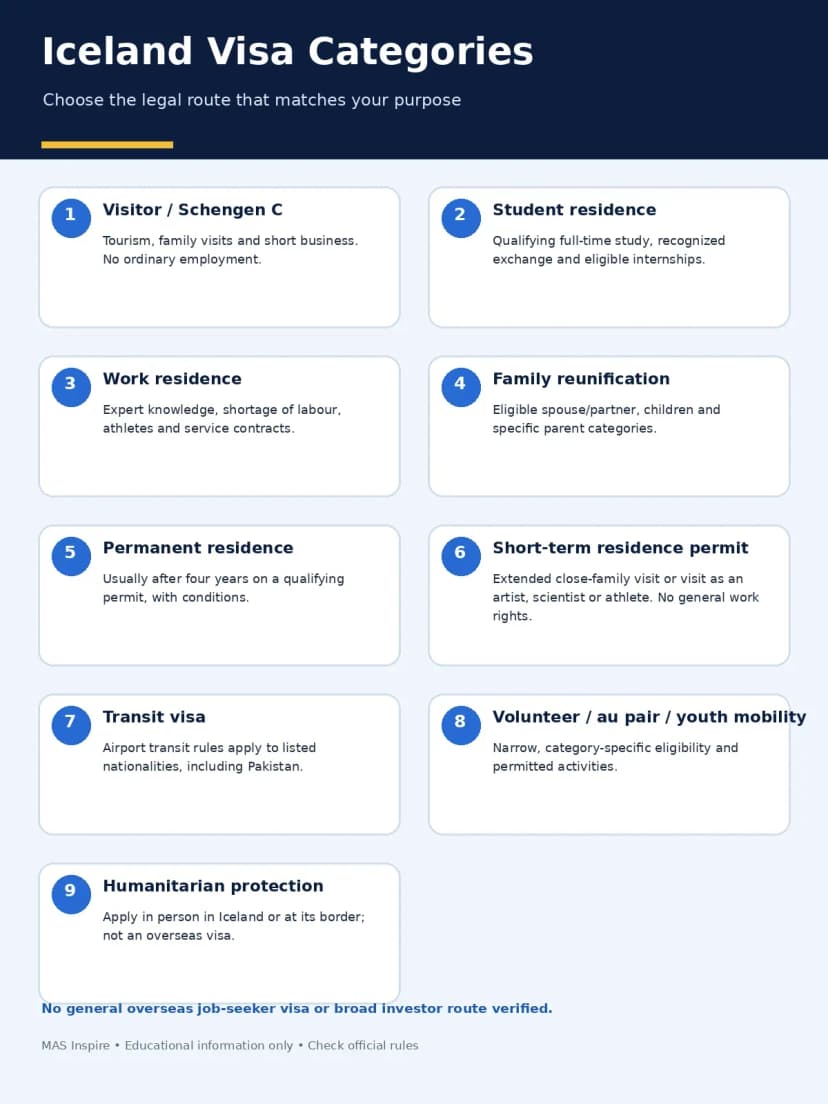
Types of Iceland Visas and Residence Permits
1. Tourist and visitor visa (Schengen C)
Nationals of countries on the Schengen visa-required list need a C-visa for a short visit. The purpose may include tourism, visiting relatives or friends, attending an event, or another temporary activity that does not amount to taking up employment. Visa-exempt nationals may visit without a visa for a short stay but remain subject to the 90/180-day rule and border-entry conditions.
A C-visa is generally issued for the period and number of entries justified by the application. The visa sticker’s validity dates and number of entries must be respected; the maximum short-stay allowance is not automatically granted in every case. Employment is not permitted. Applicants normally provide a passport, photo, itinerary, accommodation details, travel medical insurance, proof of funds and evidence of the purpose of travel and intention to leave. The mission may request additional evidence or an interview.
Fee: EUR 90 for adults; EUR 45 for children aged 6–11. Certain exemptions and reduced fees may apply under the Schengen Visa Code. Published indicative processing: approximately two weeks for a complete file, but it may be extended. Apply through the mission responsible for the applicant’s legal residence and Iceland as main destination.
Official guidance: Apply for a visa to Iceland and supporting documents.
2. Business visitor
There is no separate Icelandic “business residence permit” for an ordinary short business trip. A business visitor generally applies for the same Schengen C-visa, selecting the business purpose and providing evidence such as an invitation from an Icelandic company, meeting agenda, employer letter, travel arrangements and who will pay the costs. Permitted activities are short business visits such as meetings or negotiations; productive employment for an Icelandic employer requires the appropriate work authorization.
Fee and stay: the standard C-visa fee and short-stay limit apply. Invitation requirements depend on the case and local mission checklist. A business invitation does not guarantee approval.
3. Student and language-study residence permit
A student residence permit is available to eligible non-EEA/EFTA nationals admitted to qualifying full-time studies. The official category covers full-time studies at an Icelandic university, certain doctoral arrangements with a foreign university collaborating with an Icelandic university, recognized exchange programmes, qualifying internships forming part of studies, and specified technical or workplace studies. A casual language course should not be assumed to qualify: applicants must confirm that the programme and institution meet the permit rules.
Applicants need admission, a valid passport, health insurance, a criminal-record certificate and proof of secure financial support. The published monthly support amount currently shown is ISK 259,951 for an individual; additional amounts may apply to family members. Student permits may be granted for up to one year and renewed if the conditions and study progress are satisfactory. The application fee is ISK 70,000.
Since 29 June 2026, a student holding a valid student residence permit may work as an employee up to 60% of full-time employment during the academic term without a separate work permit. The 60% limit applies across employers. Full-time work is allowed during scheduled academic breaks. Self-employment is not allowed. A first-time applicant must not start working before the student permit has been issued.
Official guidance: Student residence permit, requirements, and student rights.
4. Work and employer-sponsored residence permits
A non-EEA/EFTA national who intends to live and work in Iceland generally needs a residence permit based on work and the appropriate work authorization. Official work-based categories include:
- Work requiring expert knowledge: a specific job offer and employment agreement; the applicant’s university-level education or recognized industrial, artistic or technical training must be relevant, and the expertise must be essential to the employer. The employer must meet the applicable labour-market and recruitment conditions.
- Shortage of labour: may be available where workers cannot be found in Iceland, the EEA/EFTA states or the Faroe Islands, and the job meets the applicable rules. This is not an unrestricted route for any vacancy.
- Athletes: a specific route for eligible sporting employment.
- Collaboration or service contract: a specific permit basis where the legal conditions for a collaboration/service contract are met.
The work-based residence permit fee is ISK 80,000. A permit for expert knowledge may be granted for up to four years, but not beyond the work permit’s validity; shortage-of-labour permits are generally up to one year, subject to the applicable rules. A holder is normally tied to the employer and job for which authorization was granted. Do not start work until the required permit is granted. A job offer alone is not permission to work.
As of 8 July 2026, work-permit applications are processed by the Directorate of Immigration rather than the Directorate of Labour. This administrative transition may affect processing. Check the live waiting-time page and the current category instructions.
Official guidance: Residence permit based on work, requirements, and work rights.
5. Job-seeking after graduation
Iceland does not offer a general overseas job-seeker visa that allows any foreign national to move to Iceland to look for work. A narrower post-study route may be available to a person who has completed a Bachelor’s, Master’s or Doctoral degree at an Icelandic university and meets the current conditions. It is intended as a bridge to employment based on the graduate’s specialist qualifications, not as a substitute for an employer-sponsored work permit indefinitely. Confirm the current duration, timing and documentary requirements with the Directorate before relying on it.
6. Digital nomad and remote work — no current route verified
Iceland’s former long-term visa for remote work was repealed when the new Visa Act (No. 37/2026) took effect on 13 May 2026. The Directorate of Immigration announced that the long-term-visa provision had been removed. Do not promote the former remote-worker visa, its historic ISK 1,000,000 monthly income threshold, or the former 90–180-day duration as a current application route. The new short-term residence permit is not a digital-nomad substitute and does not authorize ordinary remote employment. Applicants should obtain written clarification from the Directorate if they believe a narrow statutory exception applies. Official change notice: Visa services transferred to the Ministry for Foreign Affairs.
7. Short-term residence permit (more than 90 days, up to 180 days)
Introduced in 2026, this is a limited residence permit for a person who wants to stay longer than 90 days but no more than 180 days to visit a close family member (spouse, parent, child or sibling) or to visit Iceland as an artist, scientist or athlete, where another residence-permit category does not apply. It is not a route to settle, register legal domicile, bring family through family reunification, or work in Iceland as a general rule. It can be granted only once in a 12-month period and cannot be renewed. Applicants who require a Schengen visa may not apply while physically in Iceland; visa-exempt applicants may apply while in Iceland only while their 90-day Schengen stay remains legal.
The fee is ISK 12,200. The authority says a decision can take up to six months. Required evidence includes passport, photo, purpose-of-stay documents, financial support, health and accident insurance and a return ticket or funds for return travel. The published support reference is ISK 259,951 per month for an individual and ISK 415,922 for a married couple. Applicants must not assume the permit grants employment rights; only narrow statutory exemptions for certain activities may apply, with prior notification where required.
Official guidance: Short-term residence permit, requirements, and rights and obligations.
8. Entrepreneur, startup and investor routes
No general stand-alone entrepreneur, startup founder or passive-investor residence permit was identified in the Directorate’s standard public permit list during this review. A business plan or investment does not by itself confer a right to reside or work. A founder may need to qualify under an existing work, service-contract or other statutory category, and must obtain a case-specific assessment. Do not advertise an Icelandic “golden visa” or guaranteed investor route.
9. Family reunion and spouse permits
A spouse or qualifying cohabiting partner may apply to join a person with an eligible right to reside in Iceland. The Icelandic sponsor must fall within an accepted status category. For cohabitation, the couple generally must have lived together for at least one year before applying. The couple must intend to share an address. The Directorate may investigate suspected marriages or partnerships of convenience.
A spouse permit costs ISK 110,000. The applicant must demonstrate support unless an applicable exemption applies, and must normally provide health insurance and criminal-record evidence. A spouse permit does not automatically mean unrestricted work rights: check the permit’s specific rights and whether a separate work permit is required. Children under 18 may qualify for family reunification with an eligible parent; custody and consent documents are important. Separate rules apply to parents aged 67 or older and to certain parents of children in Iceland.
Official guidance: Spouse residence permit, children, and family permit fees.
10. Permanent residence and settlement
Permanent residence is not an entry visa. As a general rule, applicants must hold a valid residence permit that can form the basis of permanent residence and have lived continuously in Iceland on a qualifying permit for four years. There are exceptions, including certain spouses of Icelandic citizens and other specified cases. The applicant must also meet language-course or language-test requirements, financial-support conditions and other legal requirements. Ordinarily, absences must not exceed 90 days in total in each year of the qualifying period. Student residence may count only in limited circumstances and is not automatically a qualifying basis.
The adult application fee is ISK 60,000; the child fee is ISK 30,000. Apply online before the current permit expires. A permanent residence card is valid for five years, but expiry of the card does not itself mean the permanent status must be reapplied for.
Official guidance: Permanent residence requirements and application.
11. Transit visa
Pakistani nationals are specifically listed among nationalities that require an airport transit visa when transiting through an Icelandic airport, even if they remain in the international transit area, unless an exemption applies. Other nationalities may also be subject to this requirement. A valid Schengen visa, certain national long-stay visas or residence permits can exempt some travellers. Check the official list before booking a connecting itinerary. An airport transit visa does not authorize entry into Iceland.
Official guidance: Airport transit visa requirements.
12. Exchange, internship, research, training and other categories
Recognized exchange students and certain study-related interns may qualify under the student residence-permit route. Researchers may qualify through an applicable work or study basis depending on the hosting arrangement, contract and institution; there is no reason to assume that every research invitation creates a separate immigration category. Volunteers, missionaries, au pairs and working-holiday/youth-mobility applicants have specific residence-permit categories with eligibility restrictions. For example, the au pair route is limited to applicants aged 18–25 and requires a qualifying host family; volunteer permits are limited to qualifying non-profit/charitable activity and do not cover ordinary unpaid farm, restaurant or tourism work. Working-holiday eligibility depends on nationality and Iceland’s arrangements with the relevant country; Pakistani citizens should not assume that this route is available to them.
Official category directory: Immigration and visa.
13. Humanitarian protection
International protection is not a visa category for ordinary migration or economic relocation. A person who fears persecution or faces a real risk of death penalty, torture or inhuman or degrading treatment may seek protection under Icelandic and international law. The applicant must be physically present in Iceland or at its border and apply in person; applications sent from abroad are not processed as asylum applications. The process includes an individual assessment and procedural rights. Applicants should seek qualified legal assistance. A separate temporary residence/work authorization may be required before an asylum applicant can work.
Official guidance: International protection: rights and application procedure.
Visa Comparison Table
| Route | Main purpose | Work rights | Typical duration / validity | Published fee |
|---|---|---|---|---|
| Schengen C visitor | Tourism, family, short business | No ordinary employment | Up to 90 days in any 180 days; actual visa dates/entries control | EUR 90 adult; EUR 45 age 6–11 |
| Student residence | Qualifying full-time study | Employee work up to 60% in term; full-time in scheduled breaks; no self-employment | Up to 1 year; renewable if eligible | ISK 70,000 |
| Work residence | Eligible sponsored employment | Employer/job-specific authorization | Depends on work category and authorization | ISK 80,000 |
| Spouse/family | Join eligible family member | Depends on permit; separate work authorization may be required | Depends on sponsor and category | Spouse ISK 110,000; child ISK 60,000 |
| Permanent residence | Long-term settlement after qualifying residence | Work rights under permanent status | Indefinite status; card generally 5 years | Adult ISK 60,000; child ISK 30,000 |
| Remote-worker long-term visa | REPEALED 13 May 2026 — no current route | No work rights under this route | N/A — route repealed | No fee — route repealed |
| Airport transit | Transit through Icelandic airport | No work; transit only | Transit itinerary | Check mission / Schengen fee schedule |
| Volunteer / au pair / youth mobility | Specific cultural or non-profit activity | Only within category conditions | Category-specific | Check official fee table |
Eligibility Requirements
For a short-stay visa, eligibility is assessed under the Schengen Visa Code. Applicants must establish the genuine purpose and conditions of the visit, sufficient means, accommodation or host arrangements, valid travel medical insurance and a credible intention to leave the Schengen Area before the authorized stay ends. A visa may be refused if the purpose is unclear, evidence is unreliable, the applicant is considered a migration risk, an alert or public-policy concern applies, or the applicant fails to meet the legal conditions.
For a residence permit, the applicant must qualify under a specific Icelandic legal category. Common baseline requirements include identity and a valid passport, truthful information, appropriate documents, adequate financial support where required, health insurance where required and no disqualifying criminal or public-order issue. Work permits require the correct employment basis and employer documentation. Student permits require qualifying admission and study. Family permits require proof of the qualifying relationship and sponsor status.
Complete Document Checklists
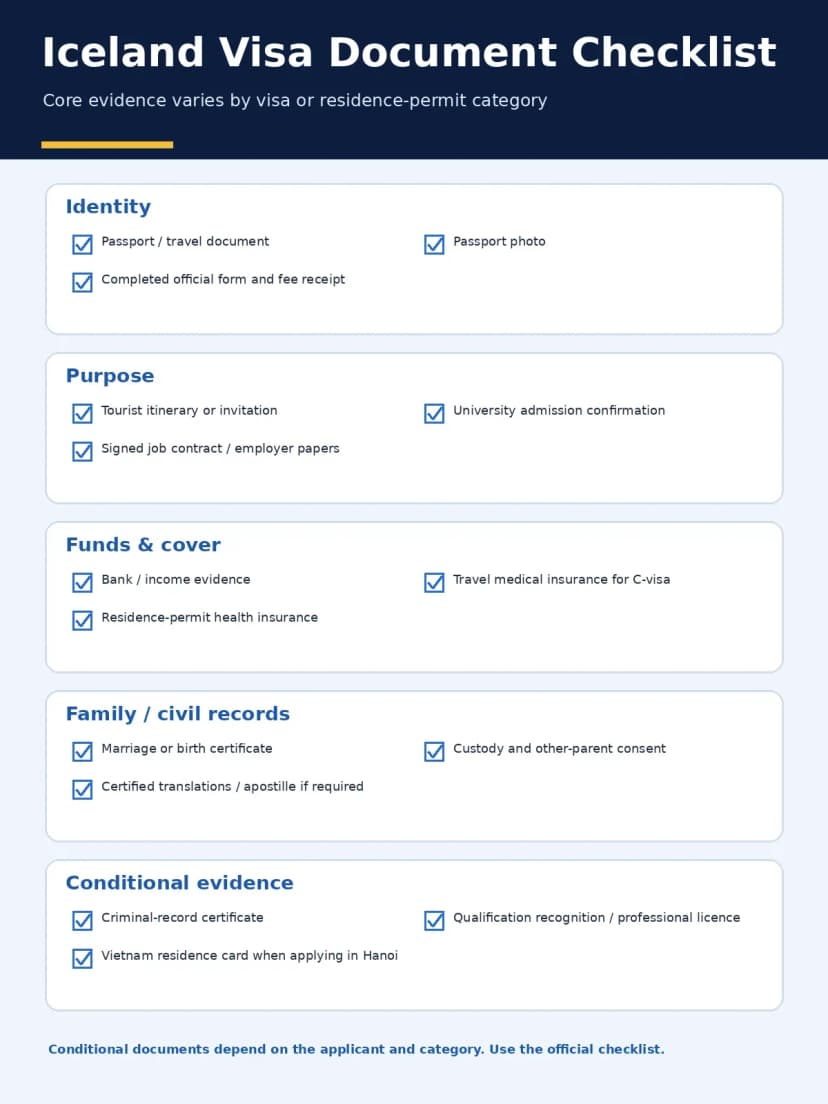
The exact checklist depends on the application location and category. The following separates common core documents from conditional evidence; it is not a universal fixed document count.
Short-stay visitor / business visa
| Document | Status | Notes |
|---|---|---|
| Completed Schengen application form | Mandatory | Use the form and portal specified by the responsible mission |
| Valid passport / travel document | Mandatory | Generally issued within the last 10 years, valid at least 3 months after intended departure, with blank pages |
| Recent passport photo | Mandatory | Follow local photo specifications |
| Travel medical insurance | Mandatory | Must meet Schengen coverage and territorial requirements |
| Proof of purpose and itinerary | Mandatory | Tourism plan, business agenda or family-visit details |
| Accommodation evidence | Usually required | Hotel booking or host accommodation evidence |
| Financial evidence | Mandatory | Bank statements, income evidence or eligible host guarantee |
| Return/onward travel and ties | Supporting | Reservations and evidence relevant to intention to leave |
| Invitation / company letter | Conditional | Business or private visit, where applicable |
| Residence permit in Vietnam / other country | Conditional | Relevant when applying outside nationality country |
| Additional mission-requested evidence | Conditional | Do not submit false or altered documents |
Student residence permit
| Document | Status | Notes |
|---|---|---|
| Application form and fee receipt | Mandatory | Follow current Directorate instructions |
| Passport copy and photo | Mandatory | Ensure passport validity meets the category rule |
| Admission confirmation | Mandatory | Qualifying full-time programme / institution |
| Criminal-record certificate | Mandatory | Follow issue date, country and authentication instructions |
| Health-insurance certificate | Mandatory | Coverage and validity must meet official requirements |
| Proof of secure financial support | Mandatory | Current official threshold; evidence format matters |
| Study-related internship / exchange agreement | Conditional | Where relevant to the programme |
| Certified translations / authentication | Conditional | For foreign-language or foreign-issued records |
Work residence permit
| Document | Status | Notes |
|---|---|---|
| Residence and work permit forms | Mandatory | Use current category forms |
| Passport copy and photo | Mandatory | As specified by the Directorate |
| Signed employment contract | Mandatory | Specific employer, role, wages and conditions |
| Employer work-permit documentation | Mandatory / employer-led | Recruitment and labour-market evidence may apply |
| Qualifications and certificates | Conditional / category-specific | Particularly for expert-knowledge roles |
| Recognition or licence | Conditional | Required for regulated professions where applicable |
| Proof of financial support | Mandatory where specified | Work income may support the application if accepted |
| Criminal record / insurance | Category-specific | Check current instructions |
Family and permanent residence
| Document | Status | Notes |
|---|---|---|
| Passport, photo, application and fee | Mandatory | Category-specific validity rules apply |
| Marriage / cohabitation evidence | Mandatory where relevant | Cohabitation normally requires proof of at least one year together |
| Sponsor’s Icelandic status and address | Mandatory | Sponsor must qualify under the rules |
| Birth certificate and custody evidence | Conditional for children | Include consent of other custodian where required |
| Support and insurance evidence | Usually required | Exemptions differ by relationship/status |
| Criminal-record certificate | Category-specific | Check issuing country, age and authentication rules |
| Icelandic language course/test evidence | Mandatory for most PR applicants | Generally 150 lessons with 85% attendance or accepted test, subject to exemptions |
| Residence history and permit copies | Mandatory for PR | Verify qualifying years and absences |
Foreign civil-status and other official documents may need apostille or chain authentication. Documents not in English or a Nordic language generally need a certified translation into an accepted language. Read the official document-requirements page rather than assuming a scan or ordinary translation will be accepted.
How to Apply: Step-by-Step
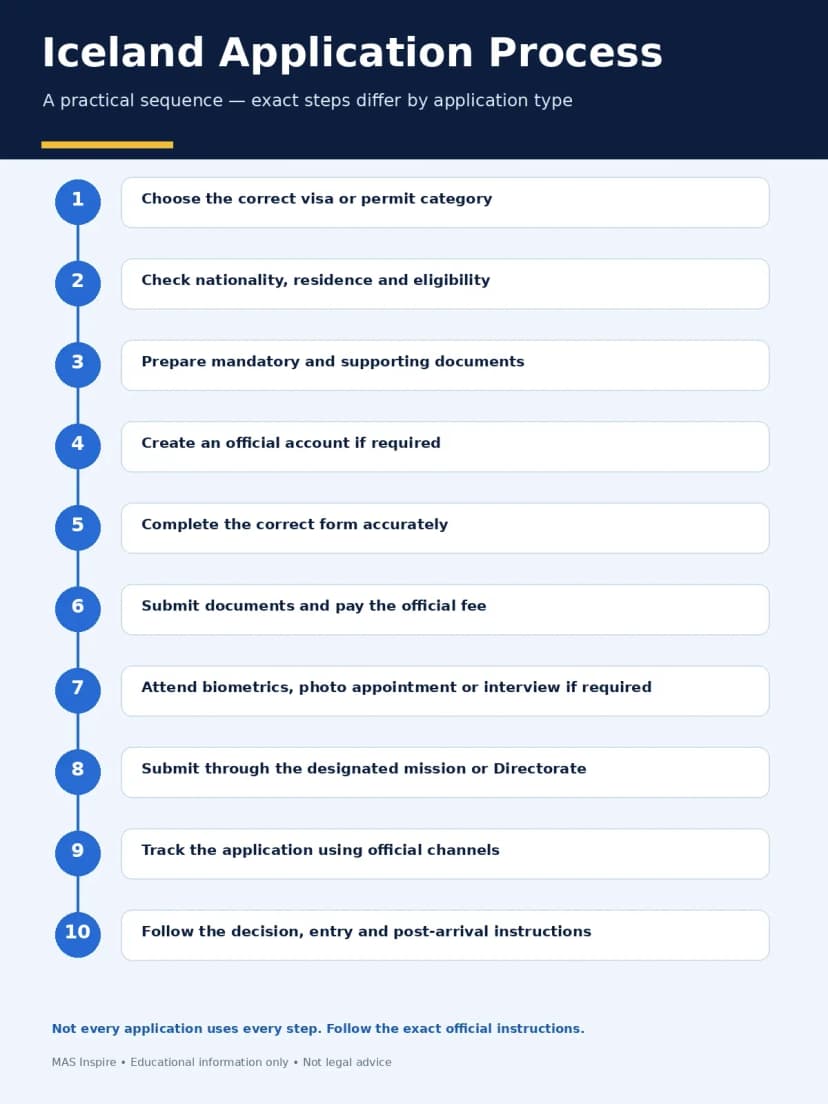
- Choose the correct route. Decide whether the purpose is a short visit, study, sponsored employment, family reunion, transit or settlement. Do not use a visitor visa for employment.
- Check nationality and residence rules. Use the official visa checker. Confirm whether your nationality needs a C-visa or airport transit visa, and which mission has jurisdiction over your lawful residence.
- Read the category checklist. Download the current form and document instructions for the exact permit or visa. Check originals, translations, authentication and validity dates.
- Create an account if the official service requires it. Some Icelandic residence applications are online; many first-time residence-permit applications are paper-based. Schengen application channels depend on the responsible embassy and its service provider.
- Complete the correct form. Match the form to the category. Ensure names, dates, travel history, employment and family details are consistent and truthful.
- Upload or assemble documents and pay. Pay using only the official method. Residence-permit paper applications may require a bank-transfer receipt; online applications require payment in the final online step. Do not send payment to an unofficial intermediary.
- Arrange biometrics or an interview if instructed. Short-stay applicants generally apply in person and may need fingerprints and a photograph. Residence-permit applicants may need a photo appointment after approval. Interview requirements depend on the case.
- Submit through the designated channel. For a Schengen visa, lodge with the mission or VFS centre that represents Iceland in your country of legal residence. For a residence permit, follow the Directorate’s category-specific submission route.
- Track the case. Use the official mission/VFS tracking service for C-visas or the Directorate’s official waiting-time information and contact instructions for residence permits. Processing estimates are not guarantees.
- Follow the decision and entry instructions. If approved, check the visa sticker or permit decision carefully. A visa-required residence-permit applicant may need a D-visa to travel. Complete any required photo appointment, residence notification and medical examination after arrival. Do not work before the required authorization is effective.
Visa Fees and Financial Requirements
| Application / requirement | Official amount shown | Notes |
|---|---|---|
| Schengen short-stay visa, adult | EUR 90 | Children aged 6–11: EUR 45; exemptions/reductions may apply |
| Student residence permit | ISK 70,000 | First permit fee shown in official fee table |
| Work-based residence permit | ISK 80,000 | Expedited service fee abolished in 2026 |
| Spouse residence permit | ISK 110,000 | Paper application; check payment instructions |
| Child residence permit | ISK 60,000 | Family category |
| Permanent residence, adult | ISK 60,000 | Online application |
| Permanent residence, child | ISK 30,000 | Online application |
| Short-term residence permit | ISK 12,200 | More than 90 days, maximum 180; limited purposes only |
| Monthly secure support, individual | ISK 259,951 | Applies to many residence categories; verify category-specific exceptions |
| Monthly secure support, married couple | ISK 415,922 | Category-specific calculation |
| Additional adult family member | ISK 129,976 | Where applicable |
Residence-permit fees are generally non-refundable once an application has been submitted. Fee schedules can change. Use the official Directorate of Immigration fees page on the day of payment. The support figures are not a required balance for every tourist visa application; short-stay financial assessment is made under Schengen rules and the mission’s checklist.
Visa Processing Times
The Icelandic government states that a complete Schengen visa application is generally processed in approximately two weeks when no further documents or checks are required. The Schengen Visa Code allows longer periods in specified circumstances, so applicants should apply well before travel and check the local mission’s appointment availability.
Residence-permit processing times vary by category and workload. The Directorate publishes a live waiting-time page showing which application dates are currently being processed. It warns that an application being taken up for review does not mean a decision will immediately follow; additional documents or checks with other authorities may extend the case. Check current waiting times rather than relying on unofficial averages.
Applying from Pakistan or Vietnam
Pakistani passport holders
Pakistani nationals are visa-required for an ordinary short visit to Iceland. Pakistan is also listed among nationalities requiring an airport transit visa for an Icelandic airport transit, unless an exemption applies. A valid Schengen visa or qualifying residence permit may remove the airport-transit requirement in specified cases; check the official exemption list.
The official Iceland application-location list identifies Islamabad — Royal Danish Embassy / VFS Global as the Schengen visa application channel for Iceland. The Danish mission acts on Iceland’s behalf; it does not turn the application into a Danish-destination visa. Iceland must still be the main destination for the application to be lodged on Iceland’s behalf.
Pakistani citizens legally living or working in Vietnam
The official Iceland list identifies Hanoi — Royal Danish Embassy / VFS Global as the application location for Iceland in Vietnam. As a general rule, a Schengen applicant should apply to the mission responsible for the country where they are legally resident. A Pakistani national living or working in Vietnam should therefore first contact the Danish Embassy/VFS channel in Hanoi and confirm that their Vietnamese residence status is sufficient for local jurisdiction and that the centre accepts their application category.
Prepare evidence of lawful residence in Vietnam, such as a valid temporary/permanent residence card or other official status document, together with the ordinary Schengen documents. A Vietnamese work permit alone should not be assumed to prove immigration residence; present the full evidence of lawful stay and ask the mission what it accepts. If the applicant is only visiting Vietnam, the mission may direct them to apply in Pakistan or the country of their actual residence. The decision depends on the mission’s jurisdiction rules and the applicant’s circumstances.
For a long-term Icelandic residence permit, the application is assessed by Iceland’s Directorate of Immigration, not simply by the local Schengen visa centre. If approved and the applicant needs a visa to enter Iceland, the authority arranges the relevant D-visa through the appropriate embassy. The applicant should ask the Directorate which entry-visa mission will handle the case from Vietnam. Do not assume that the Hanoi C-visa application desk also processes residence permits.
Official location references: Where to apply for an Iceland Schengen visa and entry-visa missions.
Student Visa Guide
Start by obtaining admission to a qualifying full-time programme. Ask the institution whether the programme is recognized for a student residence permit and request the official admission confirmation. Prepare the criminal-record certificate early because obtaining and authenticating it can take time. Arrange compliant health insurance and demonstrate the current support amount for the intended period. Submit the application and supporting documents by the published semester deadlines where possible; the Directorate’s student page gives recommended receipt dates to improve the chance of a decision before the semester begins.
A student permit can be granted for up to one year and renewed where the applicant continues to meet the conditions and shows satisfactory study progress. Student status does not automatically grant family reunification for every programme: the official page states that students enrolled in diploma programmes are not eligible for family reunification. Student employment rights changed in June 2026, so use the current 60% employee-work limit and do not rely on older guides that describe a separate work-permit requirement. Self-employment remains prohibited.
Work Visa and Job Opportunities
The most practical route for a non-EEA/EFTA professional is usually to secure a genuine job offer from an Icelandic employer and determine which work-permit category fits the position. Expert-knowledge permits require relevant specialized skills and an employer’s case for the role. Shortage-of-labour permits are not automatic: the employer must satisfy the labour-market conditions. Athletes and certain collaboration/service-contract workers have separate provisions.
Applicants should check whether their profession is regulated and whether their qualifications need recognition or an Icelandic licence. The employment contract should accurately state duties, hours, wages and employer details. Work authorization is employer- and category-specific; changing employer or role may require a new authorization. Never travel as a visitor with the intention of starting paid work before the relevant permits are granted.
Family Immigration and Permanent Residence
Family reunion depends on the sponsor’s status and the relationship. Spouses and qualifying cohabiting partners may apply if the sponsor meets the accepted conditions. Children under 18 may qualify where the parent in Iceland has an eligible status and custody/consent rules are satisfied. A residence permit for a child or certain parents does not necessarily create a right to bring further relatives. The applicant should examine the rights section for the precise permit.
Permanent residence normally requires four years of continuous qualifying residence, a valid underlying permit, financial self-sufficiency and Icelandic-language evidence. Certain family relationships qualify for shorter periods. The applicant should preserve permit-renewal records and travel history, apply before the current permit expires, and check the rule on absences (generally no more than 90 days per year). Time on a student permit is subject to restrictions and should not be assumed to count in full.
Common Application Mistakes
- Applying to Iceland when another Schengen country is actually the main destination.
- Treating a Schengen C-visa as permission to live or work in Iceland.
- Assuming a residence card from Vietnam automatically establishes local jurisdiction for a Pakistani applicant.
- Using an outdated fee amount, financial threshold or application form.
- Submitting a course that is not eligible for a student permit.
- Providing a job offer without the employer-side work authorization documents.
- Omitting authentication, certified translations, custody evidence or the other parent’s consent.
- Buying non-refundable travel before a decision, despite uncertain processing.
- Exceeding the 90/180-day Schengen stay limit or overstaying a visa.
- Beginning employment before the required permit is granted.
Reasons for Visa Refusal
A Schengen visa may be refused if the purpose or conditions of the visit are not justified, the applicant cannot demonstrate sufficient means, travel medical insurance is inadequate, documents are unreliable, the applicant’s intention to leave is not established, or security/public-policy grounds apply. A residence permit may be refused if the applicant does not meet the selected category, the sponsor or employer is ineligible, the application is incomplete, financial support or insurance is inadequate, a criminal/public-order ground applies, or the authority suspects fraud or a relationship of convenience. A refusal notice should explain the applicable appeal or review route and deadline. Do not submit fabricated bank statements, employment letters, invitations or civil documents.
Frequently Asked Questions
1. Do I need a visa to visit Iceland?
It depends on your nationality and travel document. Use the official Iceland visa checker. Visa-exempt visitors still face the 90/180-day limit.
2. Is an Iceland visa valid for other Schengen countries?
A uniform Schengen visa is generally valid throughout the Schengen Area, subject to its validity dates, entries and conditions.
3. How much is an Iceland tourist visa?
The standard Schengen fee is EUR 90 for adults and EUR 45 for children aged 6–11, subject to exemptions or reductions.
4. How long does an Iceland Schengen visa take?
The official guidance says approximately two weeks for a complete application when no further checks or documents are needed. Longer processing is possible.
5. Can I work in Iceland on a tourist visa?
No. A short-stay visitor visa does not authorize ordinary employment.
6. Can international students work in Iceland?
Yes. From June 2026, holders of a valid student residence permit may work as employees up to 60% of full-time during academic terms and full-time during scheduled breaks. Self-employment is prohibited.
7. Can I move to Iceland without a job offer?
Most work-based residence permits require a specific employment basis. There is no general overseas job-seeker visa. Eligible Icelandic university graduates may qualify for a limited post-study employment-seeking permit.
8. Is there an Iceland digital nomad visa?
No current general digital-nomad or remote-work visa was identified. Iceland repealed its former long-term remote-work visa in May 2026. The new short-term residence permit is limited to close-family visits and visits by artists, scientists or athletes; it is not a remote-work replacement.
9. Can my spouse join me in Iceland?
Potentially, if your Icelandic status and relationship meet the family-reunification rules. Not every residence category supports family reunification.
10. How long until I can apply for permanent residence?
The general rule is four years on qualifying continuous residence permits, but exceptions and restrictions apply. Student time does not automatically count in full.
11. Can a Pakistani citizen apply for an Iceland visa in Vietnam?
Potentially, if legally resident in Vietnam and the Danish Embassy/VFS channel in Hanoi confirms it has territorial jurisdiction and accepts the application. A Vietnamese residence card does not itself guarantee acceptance.
12. Where do Pakistanis apply for an Iceland Schengen visa?
The official Iceland list identifies Islamabad through the Royal Danish Embassy and VFS Global.
13. Do Pakistani citizens need an airport transit visa for Iceland?
Pakistan is on Iceland’s airport-transit-visa list, subject to specified exemptions. Check before booking a connection.
14. What is the minimum bank balance for Iceland?
There is no single universal tourist-visa balance. Residence permits have category-specific secure-support rules; the current published figure for many categories is ISK 259,951 per month for one person.
15. Does a residence permit automatically give permanent residence?
No. Permanent residence is a separate application with qualifying residence, language, support and other legal conditions.
Official Immigration Websites
- Ísland.is — Immigration and visa
- Check whether you need a visa
- Apply for an Iceland Schengen visa
- Where to apply / mission representation
- Schengen visa supporting documents
- Residence permit based on work
- Student residence permit
- Spouse residence permit
- Permanent residence
- Fees
- Short-term residence permit
- Current processing / waiting times
- International protection
Final Checklist and Conclusion
Before applying, confirm the purpose and category, nationality-based visa requirement, correct mission, passport validity, official form, fee, financial threshold, insurance, supporting documents, authentication and translation rules. Check whether the applicant must apply from outside Iceland and whether a D-visa is needed after a residence permit is approved. Do not work until authorized, and do not overstay the visa or residence permission.
Iceland offers several lawful routes for temporary visits, study, employment, family life and longer-term settlement, but each has distinct requirements. The safest approach is to use the official Icelandic government page for the exact category and confirm the local embassy/VFS procedure before booking an appointment.
Educational information only — not legal advice and not an official government publication. Immigration rules, fees, processing times and mission arrangements can change. MAS Inspire is an independent educational resource and is not affiliated with the Government of Iceland. Always confirm the latest requirements with Icelandic authorities before applying.