By MAS Inspire | Draft review date: 25 November 2026
Introduction
Ireland offers international students, skilled professionals, entrepreneurs and visitors opportunities to pursue education, employment, business and tourism in an English-speaking European country.
However, applying for an Ireland visa requires choosing the correct immigration route, preparing financial evidence and understanding the conditions attached to your permission.
This guide explains the principal Irish immigration routes, application requirements, costs and procedures, including guidance for Pakistani and Vietnamese applicants.
Why people visit, study and work in Ireland
Ireland attracts international applicants for several reasons:
- Internationally recognized universities and English-language education.
- Employment opportunities in technology, healthcare, engineering and other industries.
- Post-study employment opportunities for eligible graduates.
- Business and entrepreneurship opportunities.
- Historic cities, cultural attractions and natural landscapes.
- Family reunification and qualifying long-term residence pathways.
Ireland does not provide automatic immigration rights simply because someone has completed a degree, received a job offer or purchased property.
Each immigration route has separate eligibility requirements.
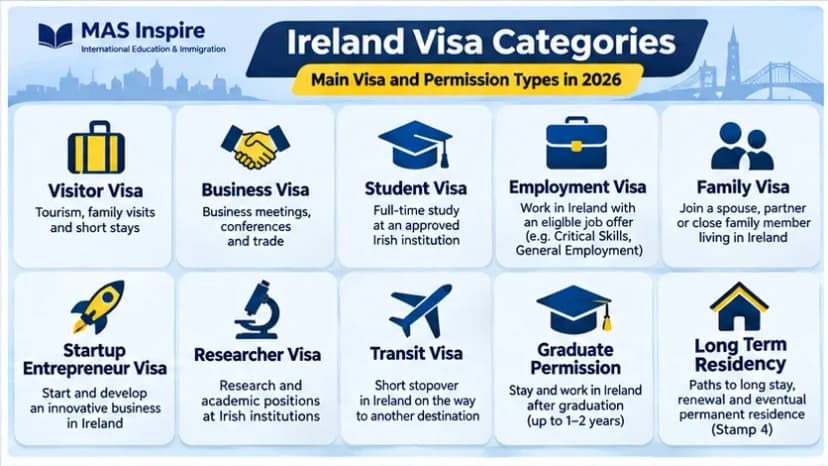
Types of Ireland visas
1. Tourist and visitor visa — Short Stay C
The short-stay tourist visa is intended for temporary holidays, sightseeing and other permitted visitor activities.
Visa-required nationals generally need to apply before travelling.
Main requirements: A valid passport, application form, travel plans, accommodation evidence, sufficient financial resources and evidence supporting the intention to leave Ireland.
The standard single-entry fee is €60. A multiple-entry visa costs €100, where eligible.
The maximum permitted visit is normally 90 days, but the immigration officer determines the actual authorized stay. Ordinary tourism permission does not authorize employment.
Official visitor visa guidance
2. Business visitor visa
A short-stay business visa allows eligible applicants to undertake specified temporary business activities, including meetings and conferences.
Applicants should provide evidence of the business purpose, such as an invitation from an Irish company, an employer's letter and details of the planned itinerary.
The standard entry visa fees apply. The maximum short stay is generally 90 days.
A business visitor permission should not be treated as a substitute for an employment permit. Separate conditions apply to narrowly defined short-term work activities.
Official short-stay visa guidance
3. Student visa — Long Stay D
International applicants planning to study for longer than three months generally require a long-stay study visa if their nationality is visa-required.
Applicants usually need admission to an eligible full-time programme, evidence of tuition payments, academic qualifications, language ability, financial resources and private health insurance.
An eligible student may subsequently receive Stamp 2 residence permission, which provides limited employment rights.
Short courses may instead fall under a short-stay study route.
Official study visa requirements
4. Employment visa — Long Stay D
Non-EEA nationals who require employment authorization generally need to obtain an appropriate Irish employment permit or qualifying exemption before applying for an employment visa.
An employment offer alone does not normally authorize someone to begin working.
The applicant may need an employment contract, employer's letter, employment permit, professional qualifications and financial records.
Employment permission is subject to the conditions of the relevant permit and immigration stamp.
Official employment visa guidance
5. Critical Skills Employment Permit
This route supports recruitment into qualifying skilled occupations.
The applicant needs a suitable employment offer and must satisfy the relevant occupation, remuneration and qualification conditions.
From March 2026, the principal remuneration thresholds include €40,904 for the relevant-degree route and €68,911 for the higher-salary route. Special graduate provisions also exist.
The Critical Skills route can support subsequent immigration permission changes, subject to eligibility.
Official employment permit information
6. General Employment Permit
The General Employment Permit covers eligible occupations that meet the employment permit conditions.
The standard annual remuneration threshold in 2026 is €36,605, with specified exceptions.
Certain occupations are ineligible, and a Labour Market Needs Test may be required.
A new General Employment Permit costs €500 for a period of up to six months or €1,000 for a longer period of up to 24 months.
Official General Employment Permit requirements
7. Job seeker and graduate immigration permission
Ireland does not generally offer a standalone job seeker visa for international applicants to enter the country solely to search for work.
However, qualifying graduates of Irish higher education institutions may apply under the Third Level Graduate Programme.
Eligible graduates may obtain Stamp 1G permission, allowing them to seek qualifying employment and work full-time while the permission remains valid.
The initial period is generally 12 months. Eligible master's-level graduates may receive a further period, subject to conditions.
Self-employment is not permitted under graduate Stamp 1G conditions.
Official immigration stamp guidance
8. Digital nomad visa
Ireland does not have a dedicated general-purpose digital nomad visa.
Remote employees and freelancers should not assume that tourist status authorizes them to live and work remotely in Ireland.
Applicants should identify an immigration permission that explicitly permits their intended economic activities.
9. Startup and entrepreneur immigration
Ireland has a Start-up Entrepreneur Programme (STEP) intended for qualifying innovative businesses, rather than ordinary employment or passive investment.
Applicants should consult the current programme requirements for funding, business proposals, application fees and eligibility.
Ireland's former Immigrant Investor Programme is closed to new applications. Buying property is not itself an immigration route.
Editorial verification required: Check the current STEP funding threshold, fee and application instructions before publication.
10. Family reunion and spouse immigration
Eligible applicants may apply to join qualifying family members in Ireland.
Requirements depend on factors including the sponsor's nationality, immigration status, financial circumstances and the applicant's relationship to the sponsor.
Marriage or a family relationship does not automatically guarantee an immigration permission.
Applicants may need marriage or birth certificates, sponsor income records, accommodation evidence and proof of the relationship.
Work rights depend on the permission granted.
Official family immigration guidance
11. Long-term residency
Ireland's employment-based Long Term Residency scheme is available to qualifying residents who have accumulated at least 60 months of eligible residence.
Successful applicants can receive a further five-year permission with employment rights without needing another employment permit.
The approval-related fee is €500.
Not every immigration stamp qualifies. Ordinary student residence does not satisfy this employment-based scheme.
Official Long Term Residency requirements
12. Transit visa
Ireland requires transit visas for nationals of specified countries and in qualifying transit circumstances.
A transit visa costs €25 and does not provide general permission to enter Ireland.
Travellers who need to collect baggage, transfer outside the airside area or stay overnight may require an entry visa instead.
Pakistani and Vietnamese nationals are not included in the transit-required nationality list reviewed for this guide. Nevertheless, they must check whether their particular journey requires permission to pass through Irish border control.
13. Internships, exchange and training
Ireland provides different immigration options for certain internships, training programmes and educational exchanges.
The correct route depends on the length of the programme, whether it is paid, the applicant's academic status and the organization hosting the placement.
Unpaid internships may qualify for a short-stay route. Paid placements may require an employment permit or Atypical Working Scheme permission.
Applicants should obtain a detailed placement agreement and confirm the required authorization before travelling.
Official work immigration guidance
14. Researchers and academics
Eligible researchers may qualify for immigration arrangements involving a Hosting Agreement with an approved research organization.
Other academic employment may require a conventional employment permit or another qualifying permission.
Supporting evidence generally includes the research agreement, qualifications, financial arrangements and institutional sponsorship.
Official employment and research immigration guidance
15. International protection
Ireland operates international protection procedures for people seeking protection under applicable refugee and subsidiary protection law.
This is a separate legal framework, not an ordinary work, visitor or student visa.
Individuals requiring protection should obtain appropriate legal guidance.
International Protection Office
Ireland visa comparison table
| Category | Main purpose | Duration | Employment rights |
|---|---|---|---|
| Tourist C | Holidays and visits | Up to 90 days | No |
| Business C | Meetings and business visits | Up to 90 days | Restricted |
| Study D | Long-term education | Course and permission dependent | Limited with eligible Stamp 2 |
| Employment D | Authorized employment | Permit dependent | Permit dependent |
| Critical Skills | Skilled employment | Permit dependent | Authorized employment |
| General Employment | Eligible occupations | Initially up to 24 months | Authorized employment |
| Graduate Stamp 1G | Graduate employment | Usually 12–24 months, where eligible | Full-time, subject to conditions |
| STEP | Innovative business | Permission dependent | Approved business activities |
| Family reunion | Joining eligible relatives | Permission dependent | Varies |
| Long Term Residency | Qualifying settlement | Five-year permission | Yes |
| Transit | Qualifying airport transit | Journey dependent | No |
| Internship | Training or placement | Programme dependent | Varies |
| Research | Eligible research activities | Agreement dependent | Authorized activities |
| Dedicated digital nomad | Not available | — | — |
| General overseas job seeker visa | Not available | — | — |
Eligibility requirements
There is no single universal eligibility test for every Irish visa.
Visa officers consider whether the evidence supports the stated purpose of travel and the immigration permission requested.
Applicants should establish their identity, lawful circumstances, financial ability and genuine reasons for travelling.
Temporary visitors should demonstrate that their circumstances support their intention to leave Ireland after the permitted period.
Students need a credible academic plan. Workers need the appropriate employment authorization. Family applicants must satisfy the applicable relationship and sponsorship rules.
Previous immigration refusals should be disclosed honestly.
Complete document checklists
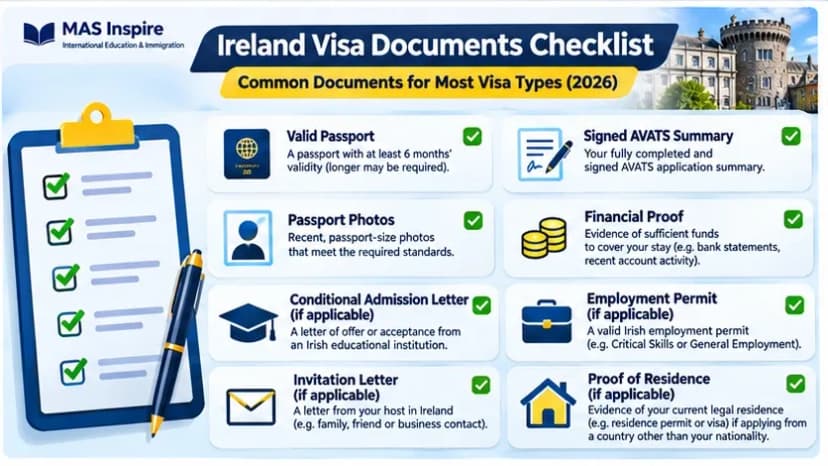
General visa application documents
| Document | Requirement |
|---|---|
| Current passport | Normally mandatory |
| Signed AVATS summary form | Mandatory for AVATS visa applications |
| Passport photographs | Follow official specifications |
| Application letter | Where required by category |
| Visa fee payment evidence | Where applicable |
| Previous passports | As specified by visa office |
| Financial evidence | According to category |
| Previous refusal letters | If previously refused |
| Certified translations | When required |
| Legal residence evidence | For applicants applying outside their nationality country |
| Invitation or sponsor letter | Conditional |
| Travel or medical insurance | According to category |
Category-specific documents
| Visa category | Additional evidence |
|---|---|
| Tourist | Itinerary, accommodation and return intentions |
| Business | Business invitation and employer confirmation |
| Student | Acceptance letter, fee receipts, academic records, language evidence and insurance |
| Employment | Permit, job contract, qualifications and employer confirmation |
| Family | Civil-status records, sponsor permission and financial evidence |
| Startup | Business proposal and qualifying funding evidence |
| Internship | Placement agreement and applicable authorization |
| Research | Hosting Agreement or relevant employment documents |
| Transit | Onward travel arrangements and destination authorization |
These tables are preparation aids, not replacements for the official category-specific checklist. Additional documentation can be requested.
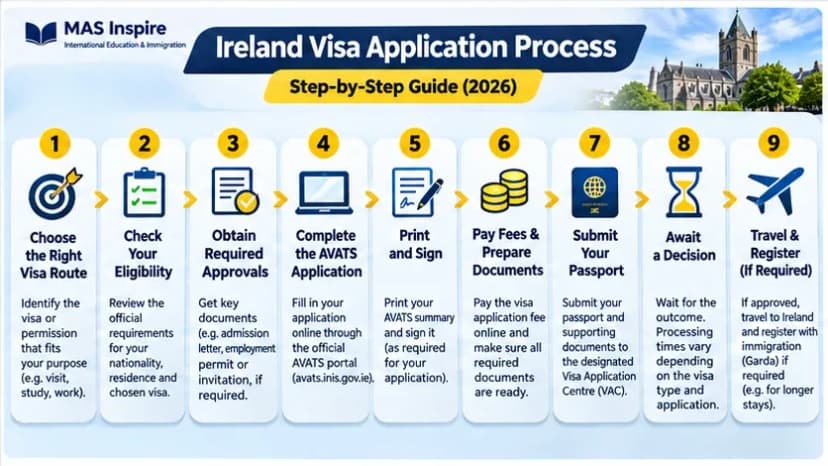
How to apply for an Ireland visa: Step-by-step
- Select the correct visa or permission. Identify whether your journey involves a visit, education, employment or another purpose.
- Check your nationality and legal residence. Determine whether an entry visa is necessary and which application office is responsible.
- Obtain prerequisite approvals. Secure your admission letter, employment permit or other required authorization.
- Complete AVATS. Enter accurate personal, passport and travel details using the official online system.
- Print and sign the application summary. Follow the submission instructions generated by AVATS.
- Prepare documents and pay applicable fees. Follow the responsible visa office's payment and document requirements.
- Attend an appointment if required. Provide biometrics or attend interviews when instructed.
- Submit your passport and supporting evidence. Use the designated embassy, consulate or application facility.
- Wait for the decision. Track your application using the relevant office's published procedure.
- Travel and register if required. Check visa conditions, prepare for border control and register long-term immigration permission.
Apply through the official AVATS portal
Ireland does not use a universal fully digital visa application procedure. Completing AVATS alone is insufficient; the supporting documents must also be submitted as instructed.
Visa fees and financial requirements
All amounts below are in euros.
| Application or requirement | Amount |
|---|---|
| Single-entry visa | €60 |
| Multiple-entry visa | €100 |
| Transit visa | €25 |
| Standard student registration | €300 |
| New General Employment Permit, up to six months | €500 |
| New General Employment Permit, up to 24 months | €1,000 |
| Long Term Residency approval | €500 |
| Student living funds, one academic year | €10,000 |
| Student living funds, eligible shorter courses | €833/month, capped at €6,665 |
| Tourist financial evidence | No universal amount confirmed |
Visa fees are generally non-refundable. Additional costs may include insurance, translations, courier services, tuition payments and local administrative charges.
Student financial requirements are separate from tuition fees.
Visa fees · Student financial requirements
Ireland visa processing times
The earlier guide reported the following approximate planning timelines from the Department of Foreign Affairs. Confirm the applicable office's current guidance before publication.
| Category | Planning timeline |
|---|---|
| Tourist and visitor | 8–12 weeks minimum |
| Business and conference | 8–12 weeks minimum |
| Employment | 8–12 weeks minimum |
| Study | 8–12 weeks minimum |
| Join Family | 2 years minimum |
These are not guaranteed decision dates. Actual timelines depend on the processing office and application circumstances.
Applicants should avoid purchasing non-refundable tickets before receiving a decision.
Employment permit processing is separate from employment visa processing. Applicants should allow sufficient time for both.
Applying from Pakistan or Vietnam
Pakistani and Vietnamese passport holders generally require an Irish entry visa for ordinary visits unless a specific exemption applies.
Nationality determines the visa requirement, while lawful residence helps determine where the application should be submitted.
Pakistani passport holders legally residing in Vietnam
A Pakistani citizen holding valid Vietnamese residence permission may be able to submit an Irish visa application from Vietnam.
However, this must be confirmed through the AVATS application instructions and, where necessary, the Embassy of Ireland in Hanoi.
Additional documentation may include:
- Vietnamese temporary or permanent residence card.
- Valid Vietnamese visa or other lawful residence authorization.
- Vietnamese work permit, where applicable.
- Employment confirmation from a Vietnam-based employer.
- Local bank statements and salary records.
- Evidence of accommodation and residence in Vietnam.
- Evidence of continuing lawful residence or return rights, where required.
- Appropriate translations of Vietnamese or Pakistani documents.
A Vietnamese work permit should not be treated as conclusive evidence of legal residence by itself.
Embassy of Ireland in Vietnam
Embassy of Ireland, Hanoi: 2nd floor, 41A Ly Thai To, Hoan Kiem District, Hanoi, Vietnam. Telephone: +84 24 3974 3291.
The embassy publishes local submission and payment instructions. Applicants should follow those instructions and confirm current arrangements before visiting or transferring money.
Pakistan versus Vietnam applications
| Consideration | Applying from Pakistan | Applying from Vietnam |
|---|---|---|
| Nationality | Pakistani | Pakistani or other nationality |
| Entry visa requirement | Based on passport | Based on passport |
| Residence evidence | As required | Vietnamese legal residence evidence for foreign nationals |
| Submission office | As directed by AVATS | As directed by AVATS |
| Biometrics | Confirm with responsible office | Confirm with responsible office |
| Supporting financial records | Relevant personal or sponsor records | Relevant Vietnamese or overseas records |
| Processing times | Office dependent | Office dependent |
No evidence reviewed establishes an automatic faster approval route for Pakistani citizens living in Vietnam.
The specific Pakistan submission facility and nationality-specific biometric instructions require further confirmation before publication.
Ireland student visa guide
Ireland is an attractive option for international students considering undergraduate, postgraduate, research and English-language programmes.
University admission
Before applying for a long-stay study visa, applicants should obtain admission to an institution and programme that satisfies Irish immigration requirements.
An acceptance letter should explain the course, tuition, duration and relevant payment arrangements.
Applicants should check the current eligible programme and education-provider rules rather than relying only on a school's marketing materials.
Tuition fee payment
Where tuition fees are below €6,000, the official study visa guidance requires full payment before applying. Where tuition exceeds €6,000, at least €6,000 must generally be paid.
The institution may require more.
Financial proof
For one academic year, the student must demonstrate access to at least €10,000 in living funds, separate from course fees.
For qualifying shorter programmes, the published requirement is €833 per month, subject to the €6,665 cap.
Applicants should provide genuine financial records and explain significant or unusual deposits.
Sponsored students should document their relationship with the sponsor, the sponsor's resources and the financial commitment.
English-language requirements
The applicant must demonstrate the language ability required to undertake the chosen course.
University admission requirements and immigration language requirements may differ.
Applicants should use an accepted test or other evidence permitted by the immigration authority.
Health insurance
Non-EEA international students must arrange appropriate private medical insurance.
Insurance may be included through the educational institution or purchased independently, provided it meets applicable requirements.
Working while studying
Eligible Stamp 2 students may work 20 hours per week during term and 40 hours per week during permitted holiday periods: June through September and from 15 December through 15 January. Students should not rely on future casual employment to satisfy initial immigration financial requirements.
Stamp 2A does not provide the same employment entitlement.
Work visa and job opportunities
International professionals should begin by identifying occupations that qualify for an Irish employment permit.
Potential sectors include information technology, engineering, healthcare, financial services, construction and scientific research. Actual permit eligibility depends on the specific occupation, employer and remuneration.
Employment application sequence
The worker normally obtains a genuine job offer, checks the occupation and salary conditions, completes the necessary employment permit process and applies for an entry visa if required.
Professional registration may be necessary for regulated occupations, particularly in healthcare.
After arriving, applicable residence registration and employment conditions must be followed.
Official employment resources
| Resource | Website |
|---|---|
| Employment permit authority | enterprise.gov.ie |
| Irish public employment service | JobsIreland |
| European employment network | EURES |
| Immigration permission guidance | Irish Immigration Service |
Applicants should be cautious of recruiters demanding payment in return for guaranteed job offers or visa approvals.
Family immigration and permanent residence
Family reunification depends on the sponsor's immigration category and the applicable relationship requirements.
Some family members may qualify for employment rights, while others may receive more restricted residence permission.
Ireland does not automatically grant permanent residence after someone has spent five calendar years in the country.
Under the employment-based Long Term Residency scheme, applicants need qualifying residence records and must satisfy the relevant employment and immigration conditions.
Citizenship by naturalisation is a separate process with its own residence calculations and eligibility requirements.
Stamp 4, Long Term Residency and Irish citizenship should not be treated as interchangeable legal statuses.
Common application mistakes
Applicants should avoid choosing the wrong visa category, applying before obtaining necessary authorization, submitting incomplete financial records or failing to disclose prior visa refusals.
Other common problems include inconsistent employment dates, unexplained educational gaps, incorrect translations, insufficient insurance, inappropriate accommodation evidence and relying on unofficial immigration advice.
Documents should accurately reflect the applicant's actual circumstances.
Reasons for Ireland visa refusal
Possible reasons for refusal include inadequate financial resources, insufficient evidence of travel purpose, failure to meet category eligibility, incomplete documents, inconsistencies or misleading declarations.
A refusal letter normally explains the grounds for refusal and indicates whether an appeal is available.
Applicants should assess the stated reasons before submitting an appeal or preparing a new application.
No visa agency, university or employer can guarantee immigration approval.
Frequently asked questions
1. Is Ireland part of the Schengen visa system?
No. Ireland operates its own entry visa system.
2. Can Pakistani citizens apply for an Ireland visa from Vietnam?
Potentially, provided they meet lawful-residence requirements and receive appropriate submission instructions.
3. How much does an Ireland visa cost?
The standard single-entry fee is €60, multiple-entry fee €100 and transit fee €25.
4. How much money does an international student need?
Generally €10,000 for one academic year's living expenses, in addition to tuition.
5. Can international students work in Ireland?
Eligible Stamp 2 students can work within the prescribed weekly limits.
6. Is there an Ireland job seeker visa?
There is no general standalone overseas job seeker visa. Eligible Irish graduates may qualify for graduate permission.
7. Does Ireland have a digital nomad visa?
There is no dedicated general-purpose digital nomad route.
8. Can I work with a tourist visa?
Ordinary tourist permission does not authorize employment.
9. Can I apply for a work visa without an employment permit?
Applicants who require a permit normally need it before applying for the employment visa. Certain alternative permissions and exemptions exist.
10. How long does visa processing take?
Processing varies. The earlier guide reported general planning guidance of at least 8–12 weeks for many categories, with significantly longer family reunification timelines. Confirm with the responsible office.
11. Can international students bring their family?
Most international students cannot automatically sponsor accompanying family members. Limited exceptions exist.
12. Can I obtain residency by purchasing property?
Purchasing property does not automatically create an immigration entitlement.
13. Does an Irish visa guarantee entry?
No. The immigration officer at the border makes the entry decision.
14. Can I obtain permanent residence after studying in Ireland?
Studying alone does not establish eligibility for employment-based Long Term Residency. Graduates may transition into eligible employment routes.
15. Where can I apply for an Irish visa online?
Use the official AVATS visa application website and follow the generated submission instructions.
Official immigration websites
Always check the latest information directly with the relevant authority.
| Official resource | Link |
|---|---|
| Irish Immigration Service | irishimmigration.ie |
| AVATS visa portal | visas.inis.gov.ie |
| Employment permits | enterprise.gov.ie |
| Education in Ireland | educationinireland.com |
| Embassy in Vietnam | ireland.ie — Hanoi |
| Department of Foreign Affairs | ireland.ie |
| International Protection Office | ipo.gov.ie |
Final checklist and conclusion
- [ ] Selected the appropriate immigration category
- [ ] Checked nationality and lawful-residence requirements
- [ ] Confirmed the correct application office
- [ ] Obtained prerequisite admission or employment approvals
- [ ] Prepared genuine supporting documents
- [ ] Checked financial requirements and applicable fees
- [ ] Completed and signed the application
- [ ] Confirmed appointment and biometric requirements
- [ ] Allowed sufficient processing time
- [ ] Reviewed arrival and residence registration requirements
Ireland offers valuable opportunities for international visitors, students, professionals and families. Successful preparation begins with understanding the correct immigration pathway and complying with official requirements.
Applicants should plan early, maintain accurate records and verify all relevant conditions before submitting their application.
Disclaimer: MAS Inspire provides educational immigration information and is not an Irish government authority. This article does not constitute legal advice or guarantee visa approval. Immigration rules, fees and processing times may change.