


South Sudan Visa Guide 2026: Types, Requirements, Documents and Application Steps
Last checked: 28 November 2026. This guide is for Pakistani passport holders living in Vietnam. Visa rules change without notice — always confirm the live rules on the official South Sudan eVisa portal (evisa.gov.ss) and with the nearest South Sudanese embassy before paying any fee or booking a non-refundable ticket.
Introduction
South Sudan is the world's youngest country, independent since 9 July 2011, and it is also one of the hardest places on earth to visit as a tourist. Its capital, Juba, sits on the White Nile; the country holds the vast Sudd wetlands, the Boma and Badingilo national parks, and some of Africa's great wildlife migrations. Almost none of that is reachable as ordinary leisure travel in 2026, and this guide does not pretend otherwise. The United States rates South Sudan Level 4: Do Not Travel, its highest warning, and the United Kingdom's Foreign, Commonwealth and Development Office (FCDO) advises against all travel to the whole country. Canada advises against all travel too. If you are a Pakistani passport holder living in Vietnam and you need to go — for work with an aid agency, a United Nations posting, a business contract, or a family emergency — this guide gives you the visa facts as they stood on 28 November 2026. If you are planning a holiday, the honest advice in this guide is: do not go.
The visa itself is straightforward on paper. Pakistan is not visa-exempt, so you need an eVisa applied for in advance through the official portal evisa.gov.ss, run by the Directorate of Civil Registry, Nationality, Passports and Immigration under the Ministry of Interior. The fee most 2026 sources quote for a Pakistani passport is USD 100 for a single-entry eVisa, with multiple-entry options reported at USD 200 for three months and USD 350 for six months. A yellow fever certificate is mandatory, your passport must be valid for at least six months with two blank pages, and after arrival you must register with the authorities in Juba. There is no visa on arrival for ordinary Pakistani travellers, no South Sudanese embassy in Vietnam or in Pakistan, and no published fee or timeline for extensions, overstay fines, student visas or work permits. Where this guide could not verify a figure on an official page, it says so plainly and names the source, instead of presenting a guess as a government rule.
Do Pakistani Passport Holders Need a Visa for South Sudan?
Yes. Every Pakistani passport holder needs a visa before travelling to South Sudan. There is no visa-free entry and no visa on arrival for ordinary Pakistani travellers. The standard route is the eVisa, applied for online in advance at evisa.gov.ss. You must hold the approved eVisa before you board your flight: airlines may refuse boarding without a pre-approved visa, and South Sudan's own guidance treats the eVisa as the entry document. Do not travel expecting to buy a visa at Juba International Airport. That facility is effectively suspended for ordinary passport holders; the only people reported as able to obtain a visa on arrival are nationals of Burundi and Rwanda, holders of diplomatic, official or service passports, and holders of a United Nations identity card with clearance from South Sudan's Ministry of Foreign Affairs. None of those categories covers a Pakistani travelling on an ordinary passport.
The visa-exempt list itself is in dispute in 2026, and the dispute matters for the region even though it does not change anything for Pakistan. Wikipedia's visa policy page, following Timatic, lists Kenya, Tanzania and Uganda as visa-free for an indefinite period, with Burundi and Rwanda eligible for visa on arrival. A TRT Afrika report from October 2026, however, says South Sudan revised the list so that only Tanzania and Egypt are fully exempt, while Kenya, Uganda, the Democratic Republic of Congo, the Central African Republic, Rwanda and Sudan now pay reduced fees of USD 50 for a single entry, USD 125 for a three-month multiple entry and USD 250 for a six-month multiple entry. This guide follows the newer report as the more recent account but flags it as unconfirmed on any official page it could read. Either way, Pakistan is not on any exemption list, and the eVisa is your only route.
One more warning belongs here, before any discussion of fees. The US State Department's South Sudan advisory, dated 16 May 2026 and still Level 4 on 28 November 2026, says: do not travel to South Sudan due to the risk of unrest, crime, kidnapping, landmines and health risks, and that the US government has limited ability to provide emergency consular services. The FCDO advises against all travel to South Sudan due to the risk of armed violence and criminality, and warns that your travel insurance could be invalidated if you travel against its advice. Standard travel insurance policies commonly exclude declared active conflict zones, so confirm exact coverage in writing with your insurer before you travel. If your trip is not essential, postpone it. The rest of this guide is written for people whose travel is essential and who have already accepted that risk with their employer or sponsor.

Types of South Sudan Visas for Pakistani Passport Holders
South Sudan's eVisa system covers the ordinary short-stay categories. The portal issues tourist, business, official and NGO, student, family-visit and transit-type eVisas, although the published detail for the last three categories is thin. The categories below are the ones a Pakistani applicant in Vietnam is realistically likely to use, with the honest limits of each stated.
Tourist eVisa (single entry). For sightseeing and personal visits. This is the default category for a short private trip. The fee most 2026 sources quote is USD 100. The stay most sources report is 30 days, although some report up to 90 days; the stay printed on your issued eVisa is the one that counts, and you should plan on 30 days. You need an invitation letter from a host in South Sudan or proof of accommodation such as a hotel booking, plus a return or onward ticket. Tourist eVisa holders may not work or earn money in South Sudan.
Business eVisa (single entry). For meetings, conferences and commercial visits. The fee most 2026 sources quote is also USD 100. You need an invitation letter from a South Sudanese company or organisation, in addition to the standard documents. A business eVisa is not a work permit: it does not authorise employment in South Sudan, and working without a work permit can lead to fines, deportation, or your passport being temporarily confiscated, according to US State Department country information.
Multiple-entry eVisa (3 months and 6 months). For travellers who need to enter South Sudan more than once, for example aid workers or business people on repeat trips. Several 2026 sources quote USD 200 for a three-month multiple-entry eVisa and USD 350 for a six-month multiple-entry eVisa. One source, Laba Africa, states that multiple-entry visas are only granted to diplomatic and official passport holders. This guide reports the USD 200 and USD 350 figures because several independent 2026 sources quote them, but flags the conflict: confirm on the portal or with the Nairobi embassy whether a multiple-entry eVisa is actually available to an ordinary Pakistani passport holder before you pay.
Official and NGO eVisa. For government, United Nations and aid workers travelling on official business, with sponsor documentation from the employing organisation. Diplomatic, official and service passport holders are issued visas free of charge on production of an official Note Verbale from their embassy, and may obtain a visa on arrival. If you are deploying with the UN or an NGO, your organisation's travel desk normally handles this category; follow its instructions rather than applying as a tourist.
Student eVisa. Listed as a category for foreign nationals visiting South Sudan for study, training or research. No fee for a student eVisa was found on any official page, and no published list of the extra documents a student must upload was found either. If you have a place at a South Sudanese institution, get the institution to confirm the exact category and documents in writing before you apply, and expect to register with the immigration authorities in Juba after arrival.
Family and friends visit eVisa. For visiting relatives or friends in South Sudan. The category exists in published visa lists, but no separate fee, stay length or document list was found for it. In practice applicants use the tourist eVisa route with an invitation letter from the host in South Sudan. A host invitation letter is the single most useful document for this category.
Transit. No published transit-visa category or fee was found for South Sudan. The FCDO states plainly that you must have a visa to enter or travel through South Sudan, so do not assume you can transit Juba without one. If your itinerary involves changing planes in Juba, hold a valid eVisa for the transit, and confirm the position with the airline and the nearest embassy before you book.
What does not exist. There is no published family-reunification visa class, no published permanent-residence route or timeline, and no published long-stay retirement or digital-nomad category for South Sudan. Do not pay any agent who offers to sell you one.
Visa Comparison Table
| Visa type | Who it is for | Fee (reported) | Stay (reported) | Entries |
|---|---|---|---|---|
| Tourist eVisa | Leisure and personal visits | USD 100 | 30 days (some sources say up to 90) | Single |
| Business eVisa | Meetings, conferences, commercial visits | USD 100 | 30 days (some sources say up to 90) | Single |
| Multiple-entry eVisa, 3 months | Repeat business or aid travel | USD 200 | Per visit as printed on the eVisa | Multiple |
| Multiple-entry eVisa, 6 months | Repeat business or aid travel | USD 350 | Per visit as printed on the eVisa | Multiple |
| Official and NGO eVisa | UN, government and aid workers | Sponsor route; diplomatic passports free | As printed on the eVisa | As issued |
| Student eVisa | Study, training, research | Not published | As printed on the eVisa | Single |
| Family and friends visit | Visiting relatives or friends | USD 100 (tourist route) | 30 days (reported) | Single |
| Visa on arrival | Not available to ordinary Pakistani travellers | Not applicable | Not applicable | Not applicable |
| Visa-free entry | Not available to Pakistani passport holders | Not applicable | Not applicable | Not applicable |
Every fee in this table is a reported figure, not a figure this guide read on an official South Sudanese fee page. The USD 100 single-entry fee is the figure quoted by the Embassy of South Sudan in Washington's schedule (as reported by QuickTravelTools, checked 10 October 2026), by TRT Afrika's October 2026 report on the revised fee schedule, and by most Pakistan-focused 2026 guides. The USD 200 and USD 350 multiple-entry figures come from the same reporting. Confirm the live fee on evisa.gov.ss at the moment you apply, because the fee schedule was revised in 2026 and may change again without notice.
Visa Fees: What Each Route Costs
Single-entry eVisa: USD 100. This is the fee a Pakistani passport holder should expect to pay for a tourist or business eVisa. It is non-refundable, even if the application is refused. Pay it online by bank card on the official portal only. One 2026 guide, evisa-south-sudan.info, reports that the portal adds a processing surcharge of about USD 26, bringing the total to about USD 126. This guide could not verify that surcharge on an official page, so treat the total as USD 100 plus any surcharge the portal itself shows you at checkout, and never pay a fee quoted by a third-party website.
Multiple-entry eVisa: USD 200 (3 months) and USD 350 (6 months). These figures are reported by several 2026 sources, including the TRT Afrika report on the October 2026 fee revision. They are subject to the conflict noted above: one source says multiple-entry visas are only granted to diplomatic and official passport holders. Confirm availability before paying.
Reduced fees do not apply to Pakistan. Nationals of Kenya, Uganda, the Democratic Republic of Congo, the Central African Republic, Rwanda and Sudan are reported to pay reduced fees of USD 50 single entry, USD 125 three-month multiple entry and USD 250 six-month multiple entry under the October 2026 revision. US passport holders are reported to pay USD 160 for a single entry and USD 500 for a three-month multiple entry, with no six-month option. None of these bands applies to a Pakistani passport.
One conflicting fee figure. Laba Africa states that nationals travelling on African or Asian passports pay a non-refundable fee of USD 50. That conflicts with the USD 100 figure quoted for Asian passports by the Washington embassy schedule and by TRT Afrika. This guide follows USD 100 for Pakistan, because it is the figure in the most recent and most widely repeated 2026 reporting, but records the USD 50 claim here so you are not surprised if an older page or an agent quotes it. The portal's own checkout figure is the one that decides.
Other costs to budget for. The eVisa fee is only part of the cost. Budget for the yellow fever vaccination in Vietnam, which is a private-clinic cost; for the mandatory registration step in Juba, which some guides report involves a registration fee but for which no official amount was found; for cash in US dollars, because the card payment gateway on the portal is reported to fail at times and cash is the fallback; and for comprehensive travel and medical-evacuation insurance, which is effectively essential given the near absence of advanced medical care in South Sudan. There is no published fee for a visa extension, for an overstay fine, or for a work permit. Do not trust any figure an agent quotes for those; ask the Directorate of Nationality, Passports and Immigration in Juba in person.
Do not pay third-party visa websites. Several lookalike sites sell "South Sudan eVisa" services at inflated prices. The only official portal is evisa.gov.ss. If a site asks for more than the portal fee, or claims to guarantee approval, it is not the government.
Processing Times
Processing times for the South Sudan eVisa are reported inconsistently, and the range is wide enough that you should plan around the slowest figure, not the fastest.
| Source | Reported processing time |
|---|---|
| VisaVerge (2026 guide, updated 3 January 2026) | 2–5 business days |
| Backpack.travel (updated 26 November 2026) | Up to 5 working days |
| World Visa Encyclopedia (dyimin) | About 3–5 business days (about 72 hours) |
| Embassy of South Sudan, Washington (via QuickTravelTools) | Visa issued within 10 business days |
| Travel Visa Stack (Pakistan guide, updated October 2026) | 5–10 business days for the approval letter |
| Himal to Horizon (Pakistan guide, February 2026 data) | 3–6 weeks |
This guide's advice: apply at least four weeks before travel, and six weeks if you still need an invitation letter from a host or employer in South Sudan, because the invitation letter is usually the slowest document to obtain. The portal's card payment gateway is reported to experience technical problems, so an early application also gives you time to retry a failed payment. There is no published express or urgent processing option. If the portal is unavailable or your application stalls, contact the Embassy of South Sudan in Nairobi, which is the nearest practical mission for a Pakistani in Vietnam. One aggregator, QuickTravelTools, noted an embassy statement that online applications were temporarily suspended at some point; this guide could not confirm a current suspension, and the portal remains the official channel, but the note is a reason to start early and to have the Nairobi embassy's contact details ready.
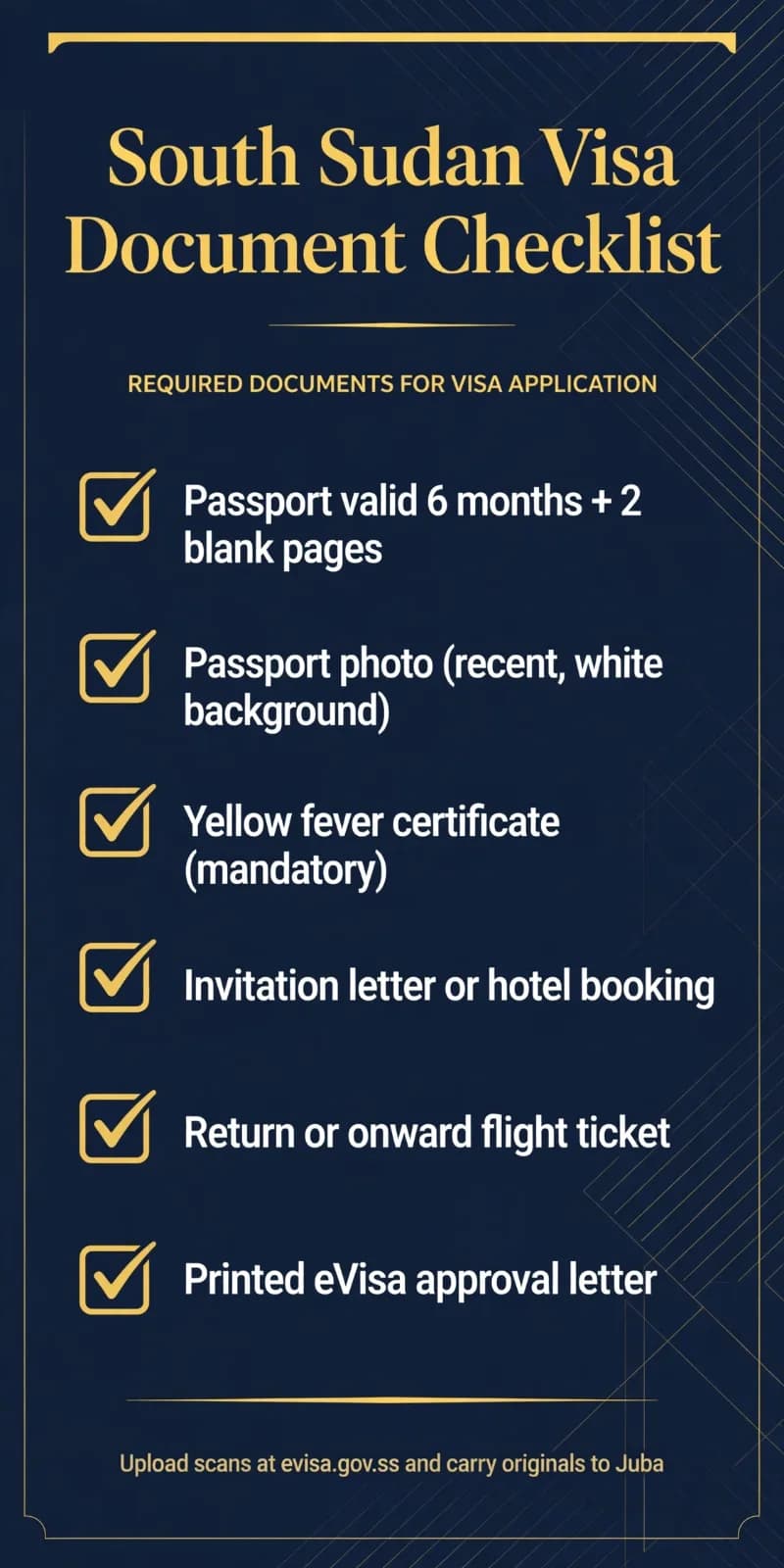
Complete Document Checklists
Prepare scans in JPEG or PDF format, legible and in colour. Upload exactly what the portal asks for, and carry the originals with you to Juba: documents are checked repeatedly, including at checkpoints outside Juba, so carry several paper copies of the approved eVisa.
Tourist eVisa checklist
- Pakistani passport valid for at least 6 months beyond the date of entry, with at least 2 blank pages (FCDO requirement)
- Scanned copy of the passport bio-data page
- Two recent passport-style photographs (2 x 2 inches, white background), taken within the last 6 months
- Yellow fever vaccination certificate (International Certificate of Vaccination or Prophylaxis), uploaded with the application and carried as the original booklet
- Letter of invitation from a host in South Sudan, or proof of accommodation such as a confirmed hotel booking in Juba
- Return or onward flight ticket, or a confirmed flight itinerary
- Evidence of sufficient funds for the stay (no official minimum amount is published)
- Completed eVisa application form on evisa.gov.ss and the online fee payment receipt
Business eVisa checklist
- All tourist eVisa documents above
- Invitation letter from a South Sudanese company or organisation, stating the purpose and dates of the visit
- A letter from your employer or sponsor in Vietnam or Pakistan confirming your employment and the purpose of the trip
- Business registration or contact details of the inviting company, if the portal asks for them
Official and NGO eVisa checklist
- All standard documents above
- Sponsor documentation from the United Nations agency, government body or NGO deploying you
- For diplomatic, official or service passport holders, an official Note Verbale from the relevant embassy (diplomatic visas are issued free of charge)
Student eVisa checklist
- All standard documents above
- Admission or enrolment letter from the South Sudanese institution
- Evidence of funds for study and living costs (no official minimum is published)
- Written confirmation from the institution of the exact visa category, because no student fee or document list is published
Documents for children
- The child's own passport, valid for at least 6 months with 2 blank pages
- The child's yellow fever certificate. Children under 9 months are reported exempt from the yellow fever requirement; confirm this with the embassy, because the exemption is reported by a secondary guide, not by an official page this guide could read
- Birth certificate and a consent letter from any non-travelling parent, as good practice; no published South Sudanese rule for children travelling with one parent was found, so carry the documents rather than argue the point at the airport
After arrival: registration
Registration is not part of the eVisa application, but it is a legal requirement after you land, and missing it causes problems at internal checkpoints and on departure. The deadline is reported three different ways: the FCDO says you must register at a local police station if you are in South Sudan for 5 days or more; US State Department country information says if you are staying longer than three days, register with the Department of Immigration and Aliens Control at the Ministry of Interior in Juba; and several 2026 guides say registration is required within 72 hours of arrival at the Directorate of Nationality, Passports and Immigration (DNPI) headquarters in Juba. This guide's advice is to register within 72 hours of arrival, which satisfies all three readings. Take your passport and your printed eVisa approval; the registration officer stamps your passport. Some guides report a registration fee, but no official amount was found. Major hotels in Juba are reported to assist guests with registration submissions, but personal appearance or passport surrender may still be required.
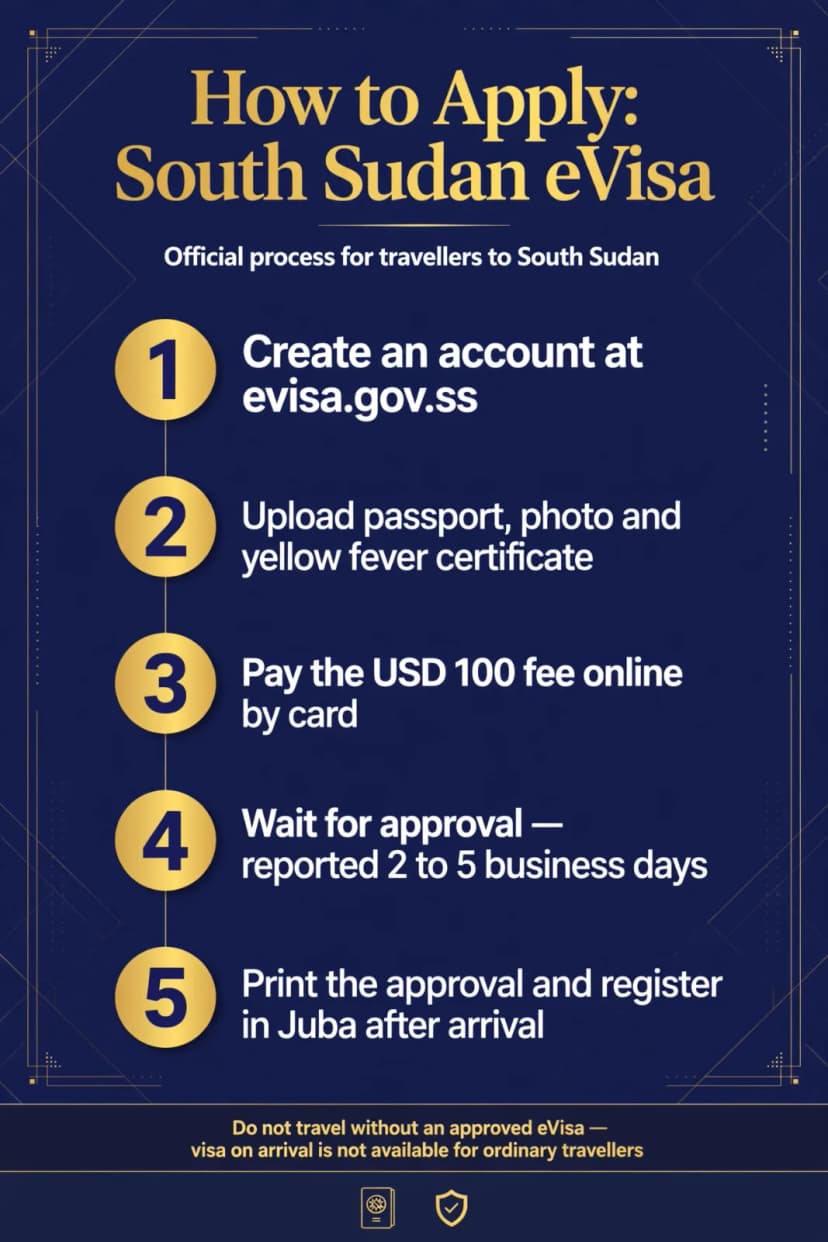
How to Apply: Step-by-Step
Step 1: Read the safety advice and decide whether the trip is essential. Check the US State Department advisory, the FCDO advice and the Government of Canada advice for South Sudan, and confirm in writing with your insurer that your policy covers travel to a Level 4 destination. If the trip is not essential, do not proceed.
Step 2: Get the yellow fever vaccination. Do this first, because the certificate only becomes valid 10 days after vaccination, and you must upload it with the application. Get vaccinated at a travel clinic in Ho Chi Minh City or Hanoi, and keep the original yellow booklet safe. The certificate is valid for life.
Step 3: Secure your invitation letter. Ask your host, employer, NGO or hotel in Juba for a signed invitation letter stating the purpose and dates of your visit, with the host's full contact details. This is the document most likely to delay your application, so request it early.
Step 4: Create an account on evisa.gov.ss. Use the official portal only. Enter your personal details exactly as they appear in your passport, select the visa type, and upload your documents: passport bio-page scan, passport photo, yellow fever certificate, invitation letter or hotel booking, and flight itinerary.
Step 5: Pay the fee online by card. The fee shown at checkout is the fee you pay. Expect USD 100 for a single-entry eVisa. If the payment gateway fails, retry later rather than paying a third-party site, and keep the payment receipt.
Step 6: Wait for approval. Reported processing ranges from 2–5 business days to 3–6 weeks. Do not book a non-refundable ticket until the eVisa is approved. When approval arrives, download the approval letter and print several paper copies.
Step 7: Fly to Juba International Airport. There are no direct flights from Vietnam; travel is normally via a regional hub such as Nairobi, Addis Ababa or Dubai. Carry your passport, printed eVisa approval, yellow fever certificate original, invitation letter, hotel booking and return ticket in your hand luggage, not in checked baggage.
Step 8: Clear immigration at Juba. Present your passport, printed eVisa approval and yellow fever certificate. Border officers check the yellow fever certificate strictly, and arriving without it can lead to immediate refusal of entry. Your fingerprints may be taken on arrival. Check the stay and entry count stamped in your passport before you leave the desk, because the stamp, not any website, states your authorised stay.
Step 9: Register within 72 hours. Go to the Directorate of Nationality, Passports and Immigration in Juba, or register at a local police station, and get the registration stamp in your passport. Keep the stamp safe: it is checked at internal checkpoints and on departure.
Step 10: Keep your documents on you. Carry your passport, eVisa approval and registration stamp whenever you move around Juba, and keep photocopies separate from the originals. Declare high-value items and currency on entry, as required.
Applying from Vietnam and Pakistan: No South Sudanese Mission in Vietnam
There is no South Sudanese embassy or consulate in Vietnam, and none in Pakistan. South Sudan's diplomatic network is small: 29 resident embassies worldwide, with the nearest practical missions for a Pakistani living in Vietnam being the Embassy of South Sudan in Nairobi, Kenya, and the Embassy of South Sudan in New Delhi, India. Neither mission's published concurrent accreditation covers Vietnam or Pakistan. Wikipedia's list of South Sudan's missions shows the Beijing embassy accredited to Australia, Malaysia and South Korea, and the New Delhi embassy accredited to Sri Lanka; no published accreditation for Vietnam or Pakistan was found. Treat the position as unconfirmed and ask the mission directly whether it can handle your application before you travel to it or send documents.
Embassy of South Sudan in Nairobi, Kenya. This is the nearest mission to Vietnam in practical terms, because Nairobi is the main air hub for Juba and most travellers to South Sudan route through it. The embassy is at the 6th Floor, Bishops Gate, 5th Ngong Avenue, Bishop Road, Nairobi, P.O. Box 73699-00200. Telephone: +254 20 271 1382 and +254 729 790 144. Website: embassyofsouthsudankenya.com. The head of mission is Ambassador Simon Juach Deng. If the eVisa portal is unavailable or your application stalls, this is the mission to contact first.
Embassy of South Sudan in New Delhi, India. The other practical option for a Pakistani applicant, particularly if you are in Pakistan rather than Vietnam. No New Delhi street address or telephone number was verified for this guide, so confirm the current contact details through the South Sudan Ministry of Foreign Affairs and International Cooperation website (mofaic.gov.ss) before you travel or send documents.
Applying from Pakistan. The route is the same: apply online at evisa.gov.ss before travel. Pakistan-focused guides confirm there is no South Sudanese mission in Pakistan, and describe a process in which the applicant submits documents through the embassy's online channel or by email, receives an approval letter by email, prints it, and presents it with the passport and the visa fee on arrival at Juba, where the visa is stamped into the passport. Some applicants instead route the application through a sponsor who lodges it with the Ministry of Foreign Affairs in Juba directly. Whichever channel you use, do not board a flight without written approval in hand.
Applying from Vietnam. Apply online from Vietnam; there is no in-person step in Vietnam. Get the yellow fever vaccination at a travel clinic in Ho Chi Minh City or Hanoi well before you apply, because the certificate must be uploaded with the application and only becomes valid 10 days after vaccination. Keep your Vietnamese temporary residence card and your Pakistani passport details consistent across the application, the flight booking and the hotel booking: name spelling differences between documents are a common cause of delay.
Pakistan's own representation. Pakistan has no embassy in Juba. The nearest Pakistani mission in the region is the Pakistan High Commission in Nairobi, Kenya. If you need consular help while in South Sudan, that is the mission to contact, but understand its ability to help inside South Sudan is limited by the security situation, just as the US government says its own ability to provide emergency consular services in South Sudan is limited.
Student Route: Studying in South Sudan
South Sudan is not a study destination for Pakistani students in any practical sense in 2026, and this section is short because the published facts are thin. A student eVisa category is listed for foreign nationals visiting for study, training or research, but no fee, no processing time and no document list for it was found on any official page. There is no published list of recognised institutions, no published scholarship route, and no published post-study work route.
If you hold a genuine admission offer from a South Sudanese institution, or a research or training placement with an NGO or university, take these steps: get the institution to confirm in writing the exact visa category, the fee, and the documents you must upload; apply for the eVisa through evisa.gov.ss with the admission letter attached; and register with the Directorate of Nationality, Passports and Immigration in Juba within 72 hours of arrival. Do not pay any agent who promises a South Sudan student visa package, a scholarship, or a guaranteed admission: no such published programme was found. Given the Level 4 security advisory, a study trip to South Sudan should only be undertaken with full institutional backing, security briefing and insurance.
Work Route: Jobs, Business and Work Permits
Business visits. A business eVisa covers meetings, conferences and commercial visits. It does not authorise employment. You need an invitation letter from a South Sudanese company or organisation, and the fee most sources quote is USD 100 for a single entry.
Working in South Sudan. Do not work without a work permit. US State Department country information states that working without a work permit can lead to your passport being temporarily confiscated, and that a work permit or long-term visa may be obtained at any Republic of South Sudan immigration office. No work-permit fee schedule, processing time or document list was found on any official page, and no online work-permit portal was found. In practice, work permits for aid workers, UN staff and contractors are arranged by the employing organisation in Juba, through the Ministry of Interior and the Ministry of Labour. If an employer in South Sudan offers you a job, ask for the work-permit arrangement in writing before you resign from your job in Vietnam or pay any fee. Never pay a recruitment agent for a South Sudan job: the country's security situation makes it a prime target for job scams, and no legitimate employer charges a worker for a work permit.
Money and banking. The currency is the South Sudanese pound (SSP), but US dollars are widely accepted, and visa and registration payments are commonly made in cash US dollars. Carry enough cash in US dollars for your whole stay, in clean, undamaged notes, because ATMs and card payments are unreliable outside a few Juba hotels, and the card payment gateway on the eVisa portal itself is reported to fail at times. Keep receipts for any official payment you make, and be aware that in August 2026 the Ministry of Interior ordered police to stop collecting unlawful fees from East African Community travellers at Juba airport and border checkpoints under the pretext of alien registration: if anyone demands an unofficial payment, ask for a written receipt and the name of the office.
Health and safety on the ground. Medical facilities are extremely limited, including in Juba, and a serious case requires international medical evacuation. Comprehensive insurance with medical evacuation cover is effectively essential, and you must confirm in writing that the policy covers a Level 4 destination. Malaria, cholera, yellow fever and mpox are listed as health risks by the FCDO. Do not photograph military compounds, police checkpoints, government ministries, airports or the Juba Bridge: several guides report that photographing such sites is treated as espionage and can lead to arrest and confiscation of your camera. A photography permit from the Ministry of Interior is reported to be required for photography in general. Same-sex sexual relations are illegal in South Sudan, with penalties of up to 10 years' imprisonment if consensual, according to US State Department country information. US government personnel in South Sudan are under a strict curfew and must use armoured vehicles for nearly all movements; take that as a measure of the risk environment, not as a rule that applies to you directly.
Family Visits and Permanent Residence
Visiting family and friends. Use the tourist eVisa route with an invitation letter from your host in South Sudan. The letter should state the host's full name, address and telephone number in Juba, your relationship, the purpose and dates of the visit, and where you will stay. There is no published separate fee or stay length for a family-visit visa, and no published family-reunification visa class. If your host is a South Sudanese national, a copy of their identity document attached to the invitation strengthens the application.
Staying longer. If you need to stay beyond the period printed on your eVisa, apply for an extension in person at the Ministry of Interior, Airport Road, Juba, before your visa expires. The FCDO gives the Ministry's telephone as +211 (0)926 388 499 and email as info@mol.gov.ss. No extension fee, processing time or document list is published. Extensions are discretionary, not routine, and depend on local security and administrative conditions. Apply well before expiry: overstaying can result in fines, departure delays and future entry bans, and the overstay fine is charged on departure with no published amount. One guide notes that the fine is calculated at the moment of departure and that published rates contradict one another, so carry cash in US dollars and allow an extra hour at the airport.
Permanent residence. No published permanent-residence route or timeline was found for South Sudan. No published route to citizenship by residence for a Pakistani national was found either. Do not pay anyone who offers to sell you residence or citizenship.
Common Mistakes to Avoid
- Travelling without an approved eVisa. There is no visa on arrival for ordinary Pakistani travellers. Boarding a flight without approval risks refusal at check-in and refusal at Juba.
- Using a third-party visa website. Only evisa.gov.ss is official. Lookalike sites charge inflated fees and cannot guarantee approval.
- Applying too late. Reported processing ranges from 2–5 business days to 3–6 weeks. Apply at least four weeks ahead, six if you still need an invitation letter.
- Forgetting the yellow fever certificate. It is mandatory, must be uploaded with the application, and the original booklet is checked strictly at Juba. Get vaccinated at least 10 days before travel, because the certificate only becomes valid then.
- Applying with a passport short on validity or blank pages. You need at least 6 months' validity beyond entry and at least 2 blank pages. Renew your passport in Vietnam or Pakistan before you apply if it falls short.
- Missing the 72-hour registration. Register in Juba within 72 hours of arrival. Missing it causes problems at internal checkpoints and on departure.
- Assuming the stay is 90 days. Most sources report 30 days for a single-entry eVisa. The stay printed on your issued eVisa is the rule; plan on 30.
- Paying an agent for a job, a student place or residence. No published work-permit fee, student-visa fee or residence route exists. A fee demanded in advance is a red flag.
- Photographing checkpoints, ministries or the Juba Bridge. This can lead to arrest. Get a photography permit from the Ministry of Interior first.
- Travelling against FCDO advice without checking insurance. Your policy may be invalidated. Confirm coverage in writing before you travel.
- Entering through an unauthorised route. Entry is limited to Juba International Airport and five designated land border crossings. Arriving through an unauthorised route risks refusal even with an approval letter in hand.
- Carrying only a digital copy of the eVisa. Print several paper copies. Documents are checked repeatedly, including at checkpoints outside Juba.
Reasons for Refusal
No official list of refusal reasons is published for the South Sudan eVisa, and no published appeal route was found. The reasons below are drawn from the published requirements and from applicant reporting, and they are the points to check before you submit.
- No invitation letter or accommodation proof. The eVisa requires a host invitation or a confirmed hotel booking. An application without either is the most common avoidable refusal.
- Missing or illegible yellow fever certificate. The certificate is a condition of the application itself, not just an arrival check.
- Passport validity or blank pages. Less than 6 months' validity or fewer than 2 blank pages.
- Name or date mismatches. Your name, date of birth and passport number must match exactly across the application, the passport scan, the flight booking and the hotel booking.
- No return or onward ticket. A one-way ticket with no onward travel plan raises a refusal risk.
- Unclear purpose of visit. A vague or inconsistent stated purpose, or a business purpose declared on a tourist application, invites refusal.
- Previous overstay or immigration violation. Overstaying can result in future entry bans, so a previous overstay in South Sudan is a serious negative factor.
- Security concerns. Given the security situation, applications are reviewed with the security environment in mind; incomplete or inconsistent sponsor details will not help.
If your eVisa is refused, the fee is non-refundable. Fix the named problem, get a fresh invitation letter if that was the issue, and reapply. There is no published appeal process, so a corrected reapplication is the practical route. Do not try to travel to Juba and sort it out on arrival: there is no visa on arrival for you.
Frequently Asked Questions
1. Do Pakistani passport holders need a visa for South Sudan?
Yes. Every Pakistani passport holder needs a visa before travelling. The standard route is the eVisa applied for online in advance at evisa.gov.ss. There is no visa-free entry and no visa on arrival for ordinary Pakistani travellers.
2. How much is a South Sudan visa for Pakistanis?
The fee most 2026 sources quote is USD 100 for a single-entry eVisa, USD 200 for a three-month multiple-entry eVisa and USD 350 for a six-month multiple-entry eVisa. The fee is non-refundable. One guide reports a processing surcharge of about USD 26 on top of the USD 100; this guide could not verify that surcharge on an official page. Confirm the live fee on the portal at checkout.
3. How long does the South Sudan eVisa take?
Reported times range from 2–5 business days to 3–6 weeks, with the Washington embassy schedule saying within 10 business days. Apply at least four weeks before travel, and six weeks if you still need an invitation letter.
4. How long can I stay in South Sudan on an eVisa?
Most sources report 30 days for a single-entry eVisa, although some report up to 90 days. The stay printed on your issued eVisa is the one that counts. Plan on 30 days and check the stamp in your passport at Juba airport before you leave the immigration desk.
5. Can I get a visa on arrival at Juba airport?
No, not as an ordinary Pakistani traveller. Visa on arrival is reported only for nationals of Burundi and Rwanda, holders of diplomatic, official or service passports, and UN identity-card holders with Ministry of Foreign Affairs clearance. Other 2026 guides describe visa on arrival as effectively suspended for ordinary travellers. Do not rely on it.
6. Is South Sudan safe to visit in 2026?
No government advises leisure travel to South Sudan. The US State Department rates it Level 4: Do Not Travel (advisory dated 16 May 2026, still current on 28 November 2026), citing unrest, crime, kidnapping, landmines and health risks. The FCDO advises against all travel, and Canada advises against all travel. Only essential travel should be considered, with full insurance and sponsor support.
7. Is a yellow fever certificate really mandatory?
Yes. A yellow fever vaccination certificate is mandatory for entry, must be uploaded with the eVisa application, and the original booklet is checked strictly at Juba airport. Arriving without it can lead to immediate refusal of entry. The vaccine must be given at least 10 days before arrival, and the certificate is valid for life.
8. Do I need to register after arriving in Juba?
Yes. You must register with the immigration authorities in Juba. The deadline is reported as 5 days or more (FCDO, at a local police station), longer than 3 days (US State Department, with the Department of Immigration and Aliens Control), and within 72 hours (several 2026 guides, at the DNPI headquarters). Register within 72 hours of arrival to satisfy all three readings.
9. Is there a South Sudanese embassy in Vietnam or Pakistan?
No. There is no South Sudanese mission in Vietnam or in Pakistan. The nearest practical missions are the Embassy of South Sudan in Nairobi, Kenya (6th Floor, Bishops Gate, 5th Ngong Avenue, Bishop Road; +254 20 271 1382) and the embassy in New Delhi, India. No published accreditation of either mission to Vietnam or Pakistan was found.
10. Can I extend my South Sudan visa?
Extensions are handled in person at the Ministry of Interior, Airport Road, Juba (telephone +211 (0)926 388 499, email info@mol.gov.ss), before your visa expires. No extension fee, processing time or document list is published, and extensions are discretionary. Apply well before expiry.
11. What happens if I overstay my visa?
Overstaying can result in a fine charged on departure, departure delays and a future entry ban. No official fine amount was found; one guide notes the amount is calculated at departure and published rates contradict one another. Carry cash in US dollars and allow extra time at the airport.
12. Can I work in South Sudan on a tourist or business eVisa?
No. A tourist or business eVisa does not authorise employment. Working without a work permit can lead to fines, deportation or temporary confiscation of your passport. Work permits are arranged through the employing organisation in Juba; no fee schedule or online portal for them was found.
13. What documents do I need for the eVisa?
A passport valid for at least 6 months with 2 blank pages, a passport bio-page scan, two recent passport photos, a yellow fever certificate, an invitation letter or hotel booking, a return or onward ticket, and evidence of sufficient funds. Carry the originals and several paper copies of the approved eVisa to Juba.
14. Are there direct flights from Vietnam to South Sudan?
No. There are no direct flights from Vietnam to Juba. Travel is normally via a regional hub such as Nairobi, Addis Ababa or Dubai. Check that your transit route does not require a separate transit visa for the hub country.
15. Can I transit through Juba airport without a visa?
No published transit-visa category was found, and the FCDO states you must have a visa to enter or travel through South Sudan. Hold a valid eVisa for any itinerary that involves Juba, and confirm the position with your airline before you book.
Official Immigration Websites
| Website | What it is | URL |
|---|---|---|
| South Sudan eVisa portal | Official eVisa application portal, Directorate of Civil Registry, Nationality, Passports and Immigration, Ministry of Interior | evisa.gov.ss |
| Ministry of Foreign Affairs and International Cooperation | Foreign ministry, missions abroad and visa information | mofaic.gov.ss |
| Ministry of Interior | Extension applications in person; Airport Road, Juba; +211 (0)926 388 499; info@mol.gov.ss | mol.gov.ss |
| UK FCDO South Sudan travel advice | Entry requirements, passport validity, yellow fever and safety advice | gov.uk/foreign-travel-advice/south-sudan |
| US State Department South Sudan advisory | Level 4: Do Not Travel advisory and country information | travel.state.gov |
| Government of Canada South Sudan advice | Avoid all travel advice | travel.gc.ca |
| TravelHealthPro South Sudan | Health and vaccination guidance, including yellow fever | travelhealthpro.org.uk |
| Embassy of South Sudan, Nairobi | Nearest practical mission; Bishops Gate, Ngong Avenue, Nairobi; +254 20 271 1382 | embassyofsouthsudankenya.com |
| Wikipedia: Visa policy of South Sudan | Visa-exempt and visa-on-arrival lists, eVisa scope | en.wikipedia.org/wiki/Visa_policy_of_South_Sudan |
| World Health Organization | Yellow fever and International Certificate of Vaccination rules | who.int |
Final Checklist and Conclusion
Before you apply, run through this checklist. Every item on it is drawn from the verified facts in this guide.
- [ ] Your trip is essential, your insurer has confirmed in writing that your policy covers a Level 4 destination, and you have read the US, UK and Canadian travel advice.
- [ ] Your Pakistani passport is valid for at least 6 months beyond entry and has at least 2 blank pages.
- [ ] You have a yellow fever vaccination certificate, given at least 10 days before travel, with the original booklet in hand.
- [ ] You have an invitation letter from a host, employer or organisation in South Sudan, or a confirmed hotel booking in Juba.
- [ ] You have a return or onward flight ticket and evidence of sufficient funds.
- [ ] You have applied on evisa.gov.ss only, paid the fee shown at checkout (expect USD 100 for a single entry), and received the approval letter.
- [ ] You have printed several paper copies of the approved eVisa, and packed the originals in your hand luggage.
- [ ] You have the Nairobi embassy's contact details saved: +254 20 271 1382, embassyofsouthsudankenya.com.
- [ ] You have cash in US dollars for the whole stay, and a plan to register in Juba within 72 hours of arrival.
South Sudan's visa system is simple in shape and difficult in practice: one portal, one main fee, one mandatory vaccine, and a registration step that many travellers miss. The difficulty is not the paperwork but the country itself. A Level 4 advisory, an active conflict, minimal medical care and limited consular help mean the visa is the easiest part of the trip and the least important risk to manage. If your travel is essential, apply early, carry paper copies of everything, register within 72 hours, and keep your sponsor's telephone number with you at all times. If it is not essential, wait.
This guide was checked on 28 November 2026 against the official South Sudan eVisa portal (evisa.gov.ss), the UK FCDO South Sudan travel advice, the US State Department Level 4 travel advisory dated 16 May 2026, the Wikipedia visa policy and diplomatic missions pages, the Embassy of South Sudan in Nairobi, and Pakistan-focused and 2026 guides (Travel Visa Stack, Visa From Pakistan, Himal to Horizon, QuickTravelTools, VisaRequirements.info, VisaVerge, Backpack.travel, Laba Africa and TRT Afrika's October 2026 fee report). Every fee, stay length and processing time in this guide names its source or is labelled reported rather than verified, and every conflict found is disclosed in the article. Visa rules for South Sudan change without notice, the fee schedule was revised in October 2026, and the exemption list is disputed between sources, so confirm the live rules on evisa.gov.ss and with the nearest South Sudanese embassy before you pay or travel, because the immigration officer at Juba International Airport makes the final decision.


