

Slovakia Visa Guide 2026: Types, Requirements, Documents and Application Steps
Last checked: 28 November 2026. This guide is for Pakistani passport holders living in Vietnam. Visa rules change without notice — always confirm the live rules on the Slovak Ministry of Foreign and European Affairs website (mzv.sk), the Embassy of Slovakia in Hanoi (mzv.sk/web/hanoi) and VFS Global (visa.vfsglobal.com) before paying any fee or booking a non-refundable ticket.
Introduction
Slovakia is the compact, affordable heart of Central Europe: Bratislava Castle above the Danube, the medieval lanes of the Old Town, the High Tatras, Spiš Castle, and a capital that sits an hour from Vienna Airport. It is a full member of the European Union and the Schengen Area and it uses the euro, so a Slovak visa is a Schengen visa — one sticker that also opens Austria, Czechia, Hungary, Poland and the rest of the area for the same trip. For a Pakistani passport holder living in Vietnam, the route is clear but it has one feature that surprises almost every applicant: you cannot simply book a hotel and apply. Slovak rules require nationals of Pakistan — and of Vietnam — to submit a police-verified invitation from Slovakia whatever the purpose of the journey, and that invitation has to be arranged inside Slovakia before you file anything in Vietnam.
This guide covers the Schengen short-stay visa first, then the airport-transit visa, the national D visa and the temporary-residence routes for study, work and business, the fees, the processing times, the full document checklists, and the two very different filing routes — VFS Global in Hanoi or Ho Chi Minh City if you live in Vietnam, and the Czech Embassy in Islamabad or the Slovak Embassy in Tehran if you apply from Pakistan. Two warnings belong in the first minute. First, Slovakia changed its visa-service provider in Vietnam in mid-2026, and the old provider and the new provider were still publishing contradictory information months later; this guide reports that conflict rather than picking a side. Second, several figures in this guide are reported by good secondary sources but were not published on any official page this guide could read — the daily funds figure and the VFS service fee among them. Where that is the case, this guide says so plainly and names the source, instead of presenting a guess as a government fee.
Do Pakistani Passport Holders Need a Visa for Slovakia?
Yes. Pakistan is not on the Schengen visa-exemption list, and there is no visa-free entry, no visa on arrival and no e-visa for Pakistani passport holders travelling to Slovakia. You must hold a Schengen short-stay visa (Type C) before you travel, and it must be issued before you board your flight — airlines will not let you fly to the Schengen Area without it.
The visa is a Schengen visa, not a Slovakia-only visa. Once issued, it allows stays of up to 90 days in any 180-day period across the whole Schengen Area, and the days you spend in any other Schengen country count towards the same 90 days. Slovakia must be your main destination — the country where you spend the most days, or where the main purpose of the trip lies — because the Slovak mission (or its VFS centre) only accepts your application if Slovakia is the main destination. If you plan a longer trip split evenly between Slovakia and Austria, for example, apply where you will spend the most time, and keep the itinerary honest: consulates check it.
There is one more condition that is specific to Slovakia and easy to miss. Under the Slovak Foreign Ministry's published supporting-documents checklists, nationals of a listed group of countries — Bangladesh, Belarus, Iran, Morocco, Pakistan and Vietnam — must submit a police-certified invitation with their application regardless of the purpose of the journey, and information on exemptions is given only by the diplomatic missions. For a Pakistani applicant that means a tourist trip needs the same verified invitation as a family visit. Do not assume a hotel booking replaces it; the invitation is a separate document, verified by the Slovak Foreign Police, and it is covered in detail in the sections below.

Types of Slovakia Visas for Pakistani Passport Holders
Schengen short-stay visa (Type C). The visa almost every reader of this guide needs. It covers tourism, visiting family or friends, business meetings, conferences, cultural or sports events, and short study or training. It allows a stay of up to 90 days in any 180-day period in the Schengen Area, as a single entry or multiple entries. The fee is EUR 90 for adults, EUR 45 for children aged 6 to 11, and free for children under 6, under the EU Visa Code. You apply through VFS Global in Vietnam, or through the representing mission if you apply from Pakistan.
Schengen airport-transit visa (Type A). For transit through the international transit area of a Slovak airport without entering Slovakia. The fee is also EUR 90. In practice very few Pakistani travellers need this, because most flights from Vietnam to Slovakia connect through a hub such as Vienna, Doha or Istanbul rather than through a Slovak airport — but if your itinerary does route you through Bratislava Airport without entering Slovakia, check whether a Type A visa is required for your nationality on that routing before you book.
National visa (Type D). A long-stay visa for stays of more than three months, up to one year, granted for a defined purpose under the Slovak Foreigners' Residence Act (Act No. 404/2011). The two uses that matter to Pakistani applicants are the D visa "to submit a residence application", issued for 120 days so you can travel to Slovakia and file for temporary residence at the Foreign Police there, and the D visa "to take over granted residence", issued so you can enter Slovakia and collect your residence card after your residence has been approved. The fee is EUR 90 for the D visa to file a residence application, EUR 15 for the D visa to collect granted residence, and EUR 50 for a national visa granted in the interest of the Slovak Republic. The Interior Ministry gives its opinion within 30 days of filing and the Foreign Ministry decides within 10 working days after that. A D visa is not a shortcut to work or study: it is an entry document tied to a residence decision, and the residence itself is a separate application with its own fee and decision time.
Temporary residence. This is not a visa but a residence permit, and it is the route for any stay longer than 90 days. The main purposes are study, employment, business, family reunification, special activities (including sport), research and development, and the EU Blue Card for highly qualified employment. Each purpose has its own fee, maximum term and decision deadline, set out in the comparison table and the fees section below. You normally apply at the Slovak embassy accredited for your country of residence — for a Pakistani living in Vietnam, that is the Embassy of Slovakia in Hanoi — and the embassy interviews you and sends its opinion to the Foreign Police, who decide. If you already hold a Slovak national visa, you can apply at a Foreign Police department inside Slovakia instead. There is one exception to know about: a national visa is not granted for filing a temporary-residence application for the purpose of business, so business applicants file their residence application at the embassy.
No e-visa, no visa on arrival. Slovakia does not operate an e-visa for Pakistani passport holders, and there is no visa on arrival at Bratislava Airport or any land border. You may fill in the Schengen application form online, but the visa itself is a sticker placed in your passport after an in-person appointment with fingerprints. Any website offering a Slovak e-visa or an instant online Slovak visa for a Pakistani passport is not selling a real Slovak visa.
Visa Comparison Table
| Visa or status | Who it is for | Maximum stay | Fee | Decision time |
|---|---|---|---|---|
| Schengen Type C | Tourist, family visit, business, short study | Up to 90 days in any 180 days | EUR 90 adult; EUR 45 ages 6–11; free under 6 | 15 calendar days, up to 45 days |
| Schengen Type A | Airport transit only | Transit area only | EUR 90 | 15 calendar days, up to 45 days |
| National visa D — to file residence | Entering Slovakia to apply for temporary residence | 120 days | EUR 90 | Interior Ministry opinion in 30 days; Foreign Ministry decision in 10 working days |
| National visa D — to collect residence | Entering Slovakia after residence approved | As granted, to collect the card | EUR 15 | As above |
| National visa D — in Slovakia's interest | Special cases | Up to 1 year | EUR 50 | As above |
| Temporary residence — study | University, language preparation, secondary school | Length of studies, up to 6 years | No fee; card EUR 10 | 90 days |
| Temporary residence — employment | Job with a Slovak employer | Contract term, up to 5 years | EUR 250 | 60 days; 30 days for shortage occupations |
| Temporary residence — business | Self-employment, trade | Up to 3 years | EUR 350 at embassy; EUR 330 at the police | 90 days |
| Temporary residence — seasonal work | Seasonal employment | 240 days in 12 months | EUR 50 | 90 days |
| Temporary residence — special activities | Sport, lecturing, other special activity | Up to 2 years; sport up to 5 years | EUR 140 | 30 days |
| Temporary residence — research | Research and development | Hosting agreement, up to 2 years | No fee | 30 days |
| Temporary residence — family reunification | Joining a family member in Slovakia | As granted | EUR 200 | Not confirmed in sources read |
| EU Blue Card | Highly qualified employment | Up to 5 years | EUR 250 | 30 days |
| Long-term residence (EU) | After years of residence, with Slovak at A2 | Permanent | EUR 250 | 90 days |
Decision times for residence are the legal deadlines under Act No. 404/2011 as amended with effect from 1 October 2026 and Act No. 128/2026, which took effect on 15 July 2026. The study-residence deadline changed on that date from 30 days to 90 days, so apply as soon as you are admitted. The residence card costs EUR 10 in every case.
Visa Fees: What Each Route Costs
Schengen Type C and Type A: EUR 90. The adult fee is set by the EU Visa Code and is the same at every Schengen consulate. Children aged 6 to 11 pay EUR 45, and children under 6 pay nothing. The Czech Embassy in Islamabad published the same EUR 90 / EUR 45 / free table in October 2026, and the BLS fee table for Vietnam showed the same fees converted to Vietnamese dong: EUR 90 as VND 2,650,000 and EUR 45 as VND 1,330,000. Confirm the live dong amount at VFS before you pay, because the embassy sets the exchange rate and it changes.
Invitation verification: EUR 33. This is not paid by you but by your host in Slovakia, to the Slovak Foreign Police when they apply to have the invitation verified. It is an administrative fee set by the Slovak Ministry of Interior. If an agent in Vietnam or Pakistan asks you to pay EUR 33 for the invitation, ask exactly what it covers: the official fee is paid in Slovakia by the inviting person or company.
Visa-centre service fee: confirm before you pay. VFS Global is the contracted service provider for the Slovak Embassy in Vietnam, and a service fee applies on top of the EUR 90 visa fee. This guide could not find a published VFS service fee for Slovakia in Vietnam, so no figure is given here — check the fee page at visa.vfsglobal.com before your appointment. Do not use the old provider's figure: BLS International's published service charge for Slovakia in Vietnam was EUR 16.90 (VND 500,671), but BLS was suspended in June 2026 and that figure is not a VFS fee. The EU Visa Code caps a visa centre's service fee at half the visa fee, so the VFS fee cannot lawfully exceed EUR 45.
National visa D: EUR 90 / EUR 15 / EUR 50. EUR 90 for the D visa to file a residence application, EUR 15 for the D visa to collect granted residence, and EUR 50 for a national visa granted in the interest of the Slovak Republic.
Temporary residence: EUR 0 to EUR 350. Study and research applications carry no state fee; the residence card is EUR 10. Employment and the EU Blue Card cost EUR 250. Business costs EUR 350 when filed at an embassy and EUR 330 when filed at the Foreign Police in Slovakia. Seasonal work costs EUR 50, special activities EUR 140, family reunification EUR 200, and long-term residence EUR 250. These are the state fees under Act No. 145/1995 on Administrative Fees, as reported in November 2026 guides working from the acts in force; confirm the figure for your purpose with the embassy before you file, because a fee paid in the wrong amount can delay the application.
What is free. Children under 6 pay no Schengen visa fee. Study-residence and research-residence applications carry no state fee. The Entry/Exit System registration at the border is free. There is no fee for ETIAS, because ETIAS is not in operation — see the border section below.
Non-refundable. Visa fees and service fees are not refunded if the visa is refused. Do not pay any person who promises a visa for an extra fee: the decision is made by the embassy, not by the visa centre and not by an agent.
Processing Times
Schengen visa: 15 calendar days as standard, up to 45 days. Under the EU Visa Code the consulate decides within 15 calendar days of receiving an admissible application, and may extend the deadline to a maximum of 45 calendar days in individual cases, in particular where further scrutiny is needed. That is the figure to plan around, and it is also the figure published by the Czech Embassy in Islamabad for Slovak applications: a decision in most cases within 15 days of the appointment, and up to 45 days.
There is one conflict to report honestly. The BLS fee-and-processing page for Slovakia in Vietnam states that processing takes "up to 15 working days" from the date the embassy receives the application, "in some cases may take up to 45 days", and recommends applying at least 15 days before the planned trip. Fifteen working days is three working weeks, which is longer than 15 calendar days, so the two statements do not agree. This guide follows the EU Visa Code — 15 calendar days, extendable to 45 — because the Visa Code is the controlling law, but you should still apply early: the BLS wording is a reminder that in practice, with the file travelling between the visa centre and the embassy, the wait can stretch past two calendar weeks.
When to apply. You may apply no earlier than six months before your trip and no later than 15 days before it. In practice, apply six to eight weeks before departure: the invitation alone takes up to 15 days to verify in Slovakia before you can even file, and the visa decision then takes up to 15 more days. Applying at the last legal moment — 15 days before travel — leaves no room for a request for extra documents, and a request for extra documents stops the clock.
Invitation verification: within 15 days. The Foreign Police department decides on verification of the invitation within 15 days of receiving the application, and the confirmation is valid for 90 days from the date of issue. Time your host's application so the confirmation is still valid when you attend your VFS appointment: if it expires, your host must start again.
National visa D: opinion in 30 days, decision in 10 working days. The Interior Ministry gives its opinion within 30 days of filing, and the Foreign Ministry decides within 10 working days after that opinion. Count on roughly six weeks from filing to decision.
Temporary residence: 30 to 90 days by purpose. Study residence is decided within 90 days (the deadline was 30 days before 15 July 2026, when Act No. 128/2026 took effect). Employment residence is decided within 60 days, or within 30 days for jobs in occupations with a regional labour shortage. Business and seasonal-work residence take up to 90 days. Special activities, research and the EU Blue Card take 30 days. Long-term residence takes 90 days. The decision time for family reunification was not stated in the sources this guide read, so it is not given here — ask the embassy when you file.
No fast-track was found. No official source publishes an express or priority service for Slovak Schengen visas in Vietnam, and no fee buys a faster decision. Any agent offering one is selling something the embassy does not sell.
Complete Document Checklists
Schengen Type C — tourist or family visit (applying from Vietnam)
- Schengen visa application form, completed and signed. You may fill it in online, but you still attend in person.
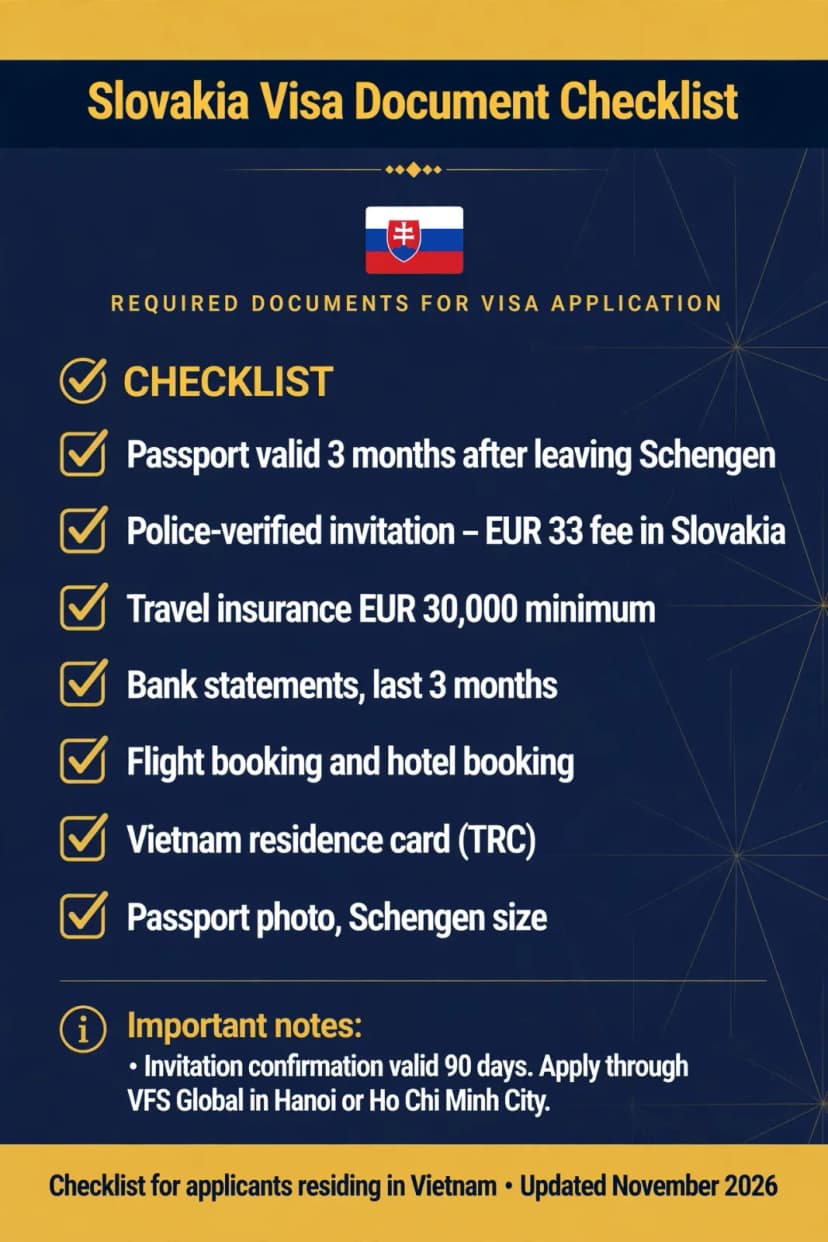
- Passport: issued within the last 10 years, valid for at least 3 months after the day you plan to leave the Schengen Area, with at least two blank pages. Bring the original and a copy of the data page and of any previous Schengen visas.
- One recent passport-size colour photograph meeting ICAO standards (35 × 45 mm, plain light background, taken within the last six months).
- Police-verified invitation on the official form, confirmed by the Slovak Foreign Police — mandatory for Pakistani nationals regardless of the purpose of travel. The confirmation is valid for 90 days from issue. If you are staying in a hotel as well, bring the hotel booking too; it does not replace the invitation.
- Travel medical insurance covering the whole Schengen Area for the entire stay, minimum coverage EUR 30,000, covering repatriation for medical reasons, urgent medical treatment, emergency hospital treatment and death. The published checklist requires zero deductible (EUR 0). For a multiple-entry visa, the insurance must cover the first trip.
- Proof of sufficient funds: recent bank statements showing movements over at least the last three months, plus proof of regular income such as salary slips, an employment certificate or a work contract. One guide verified on 26 November 2026 reports the Slovak requirement as at least EUR 56 per day; that figure comes from that guide alone and was not found on an official page this guide could read, so treat it as reported, not verified, and show comfortably more than the minimum.
- Proof of your life in Vietnam: your Vietnamese temporary residence card (TRC) or long-term visa and proof of address in Vietnam. You are applying as a resident of Vietnam, so the centre will ask for it.
- Employment proof: an employer letter or no-objection certificate stating your position, salary, length of employment and approved leave, or business registration and tax documents if self-employed.
- Flight reservation for the whole trip and accommodation proof (hotel bookings or the invitation's accommodation confirmation). Do not buy a non-refundable ticket before the visa is issued — a reservation is enough.
- Visa fee EUR 90, plus the VFS service fee (confirm the current amount at visa.vfsglobal.com).
- For children: birth certificate, NADRA Family Registration Certificate, and the consent of both parents if the child travels with one parent or alone.
Schengen Type C — business
Everything in the tourist checklist, plus: an invitation from the Slovak company on the official form, verified by the Foreign Police (the EUR 33 fee is paid in Slovakia by the inviting company); a letter from your employer in Vietnam stating the purpose and duration of the trip and who pays the costs; and proof of the business relationship, such as contracts, invoices or correspondence. The verified invitation is still mandatory for Pakistani nationals even for a business trip.
National visa D and temporary residence — study
- Passport as above, plus two photos of 3 × 3.5 cm for the D visa (no photo is attached to the residence application itself since 1 July 2025).
- Confirmation of admission from the Slovak university or school.
- Criminal record certificate (police clearance) from Pakistan and from Vietnam if you have lived there, with an apostille and a translation.
- Proof of accommodation — except that university students do not have to prove accommodation.
- Proof of funds: the law does not require proof of funds with a study application, but the consulate may ask for it. The benchmark reported in 2026 guides is the subsistence minimum of EUR 295.22 per month (in force from 1 July 2026), up to EUR 3,542.64 for a year.
- Health insurance for the stay.
- The study-residence application itself carries no state fee; the residence card costs EUR 10, and the D visa to enter and collect the card costs EUR 15.
National visa D and temporary residence — employment and business
- Passport as above.
- Employment: a work contract or a binding job offer, and the employer's confirmation. Business: a business plan and proof of funds — EUR 5,904.40 on a sole trader's business account was the figure reported from July 2026.
- Criminal record certificate with an apostille and a translation.
- Proof of accommodation and health insurance.
- Proof of funds for the stay.
- Employment residence fee EUR 250; business residence fee EUR 350 at the embassy (EUR 330 at the police); EU Blue Card EUR 250.
What to bring to the appointment
Bring originals and one copy of each document, the appointment confirmation, and a pen. Fingerprints are taken at the appointment (children under 12 are not fingerprinted for the visa, and under EES children under 12 give a photo only). If your fingerprints were taken for a Schengen visa within the last 59 months, say so — they may be reusable, but the centre decides.
How to Apply: Step-by-Step
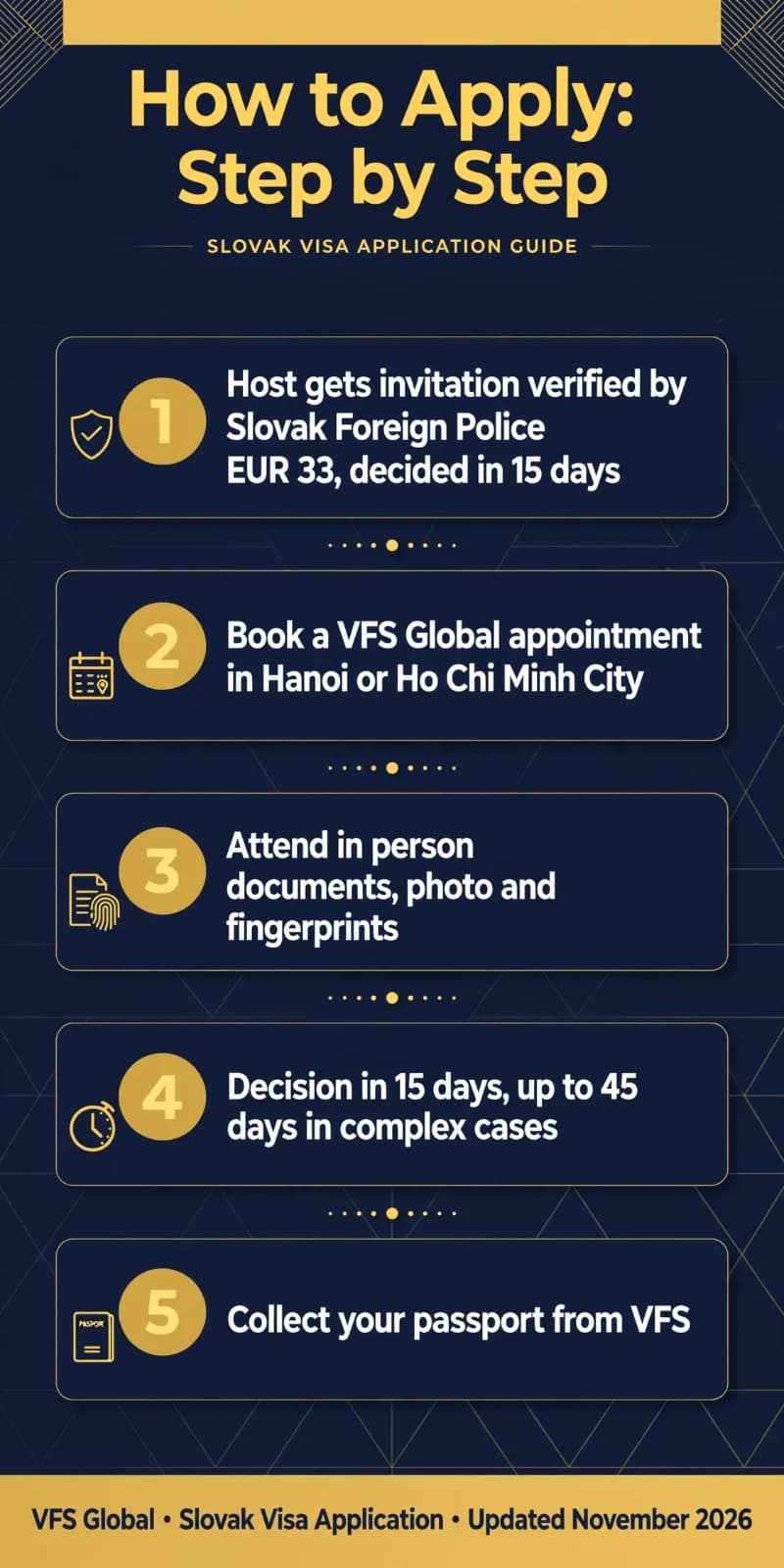
Step 1 — Your host in Slovakia gets the invitation verified. Your relative, friend or company in Slovakia applies in person at their local Department of Foreign Police, on the official invitation form, attaching documents not older than 90 days that prove the purpose of the visit, that your costs and accommodation are covered, and that the inviter can afford it — the inviter's bank balance must amount to twelve times the subsistence minimum plus the funds for each day of your stay, under Decree No. 499/2011. The inviter pays the EUR 33 administrative fee. The Foreign Police decide within 15 days, and the confirmation is valid for 90 days from issue. Start here, because nothing else can be filed until this exists.
Step 2 — Prepare your documents and insurance. Use the checklist above. Buy travel insurance with at least EUR 30,000 coverage and zero deductible, valid for the whole Schengen Area and the whole trip. Print your flight reservation (not a paid non-refundable ticket) and your accommodation proof.
Step 3 — Book a VFS Global appointment. Book through visa.vfsglobal.com for Slovakia in Vietnam, choosing the Hanoi or Ho Chi Minh City centre. Appointments are free to book through the official site; never pay a third party for a slot. If the VFS site is unclear about which provider is current, call the Embassy of Slovakia in Hanoi first — the provider changed in 2026 and the old provider's pages are still online.
Step 4 — Attend in person. Go to the VFS centre on the appointed day with your passport, the verified invitation, the full file and the fee. Your documents are checked, your photo and fingerprints are taken, and the file is sent to the Embassy of Slovakia in Hanoi for decision. Keep the receipt and the tracking number.
Step 5 — Wait for the decision. The standard decision time is 15 calendar days, extendable to 45 days. Do not book non-refundable travel until the visa is in your passport. Track the application on the VFS site.
Step 6 — Collect your passport. Collect it from the VFS centre, or use the courier return service if offered. Check the visa sticker before you leave the counter: your name, passport number, the dates, the number of entries and the number of days must all be correct. A mistake found at the airport is too late to fix cheaply.
If you are applying from Pakistan instead, the steps are different and are covered in the next section: the Czech Embassy in Islamabad works by a monthly email draw, and long-stay applications go to Tehran.
Applying from Vietnam and Pakistan — Embassy in Hanoi, VFS, and the Czech and Tehran Routes
Living in Vietnam: the Embassy of Slovakia in Hanoi and VFS Global. Slovakia has a resident embassy in Vietnam — the Embassy of the Slovak Republic at 12 Ba Huyen Thanh Quan, Ba Dinh District, Hanoi; telephone +84 24 3734 7601; email emb.hanoi@mzv.sk and cons.hanoi@mzv.sk for the consular section; website mzv.sk/web/hanoi. There is also an Honorary Consulate General in Ho Chi Minh City at 64–68 Hai Ba Trung, District 1; an honorary consulate does not take visa applications, so use it only for direction and file through VFS. Visa applications in Vietnam are handled through VFS Global, the embassy's contracted service provider: VFS schedules appointments, accepts applications and fees, submits them to the embassy and returns the documents. Its centres are in Hanoi and Ho Chi Minh City; get the current centre addresses from visa.vfsglobal.com before travelling, because they are not listed in this guide from a verified source.
One conflict must be reported. Slovakia suspended BLS International's visa services in Vietnam from 24 June 2026, citing integrity concerns and recurring operational problems, and on 6 July 2026 the Embassy of Slovakia in Hanoi directed applicants to use VFS Global, which had won a five-year contract after a global tender in early 2026. Yet BLS International published a press release on 14 July 2026 saying it was still accepting Slovakia visa applications in Hanoi and Ho Chi Minh City. The two statements cannot both be current. This guide follows the embassy's direction — apply through VFS Global — but check with the embassy before you book, because the position may have moved again since July 2026. A second, smaller conflict: directories name different heads of mission in Hanoi — Igor Pacolák as ambassador in older listings, and Marián Vereš as chargé d'affaires in a more recent directory. The address, telephone and email above are consistent across sources; the head of mission is not, so this guide does not state it as fact.
Applying from Pakistan: the Czech Embassy in Islamabad for short stays. Slovakia has no embassy in Pakistan. Since 5 December 2011, under an agreement between the two countries, the Embassy of the Czech Republic in Islamabad has issued short-stay Schengen visas for Slovakia. Appointments work by a monthly email draw: on the last working day of the month, between 12:00 and 18:00 Pakistan time, send one email per applicant to islamabad.schengen@mzv.cz with only your passport number in the subject line, giving your full name, visa type and purpose (Slovakia), travel dates and phone number, and attaching a PDF scan of your passport data page under 10 MB. The coming registration days reported in November 2026 were 30 November and 31 December 2026 and 29 January 2027. The embassy usually replies within 14 days if you are selected; no reply means you were not selected, and emails sent twice, sent outside the window or with attachments over 10 MB are disqualified. The appointment date given cannot be changed, and a missed appointment is cancelled. The fee is EUR 90 in euro cash, paid at the embassy, and there is no visa-centre service charge because you apply at the embassy itself. The embassy is at House 49, Street 27, Sector F-6/2, Islamabad; telephone +92 51 282 06 79, consular section +92 51 227 43 04; office hours Tuesday and Thursday 09:00–12:00, by appointment only. You will still need the police-verified invitation from Slovakia, and the same standard Schengen documents.
Applying from Pakistan: Tehran for long stays. The Czech Embassy handles only short-stay visas for Slovakia. Applications for Slovak long-term visas and residence are processed by the Embassy of the Slovak Republic in Tehran. Since 1 February 2025, residents of Pakistan may also apply at the Slovak Embassy in Tehran for Schengen visas, as an alternative to the Czech Embassy. Since the same date, residents of Pakistan may also submit temporary-residence and national-visa applications at Slovak missions in Baku, Abu Dhabi and Istanbul, subject to each mission's procedure and appointment capacity. Confirm the current position with the mission you choose before you travel, because this is a recent change and missions apply it differently.
Polio certificate if you travel from Pakistan. If your journey starts in Pakistan, get a polio vaccination certificate from NADRA NIMS before you leave: Pakistan requires proof of polio vaccination for departure, and airlines check it. This is a Pakistani exit requirement, not a Slovak one, and it does not apply to a trip that starts in Vietnam.
Student Route: Studying in Slovakia
Slovak universities teach in Slovak and, increasingly, in English, and tuition at public universities in Slovak is free even for non-EU students, with English-language programmes charging fees set by each university. A non-EU student does not study on a visa: you study on temporary residence for the purpose of study, granted for the expected length of your studies up to six years, and the national D visa is only the entry document that lets you travel to Slovakia and collect your residence card.
Apply in person at the Slovak embassy accredited for the country where you live — the Embassy of Slovakia in Hanoi if you live in Vietnam, or the Embassy of Slovakia in Tehran if you apply from Pakistan. The embassy interviews you and sends its opinion to the Foreign Police, who decide within 90 days. That deadline changed on 15 July 2026 from 30 days to 90 days, so apply as soon as you are admitted, in June or July for an autumn start. The application itself is free; you pay EUR 10 for the residence card and EUR 15 for the D visa to enter after approval. If you want to apply for residence inside Slovakia instead, you need a D visa "to submit a residence application", issued for 120 days at a fee of EUR 90.
You need your passport, the university's confirmation of admission, a criminal record certificate with an apostille and a translation, and health insurance. University students do not have to prove accommodation. The law does not require proof of funds with a study application, but the consulate may ask for it; the benchmark reported in 2026 guides is EUR 295.22 for each month, and no more than EUR 3,542.64 for a year. Two photos of 3 × 3.5 cm are needed for the D visa; no photo is attached to the residence application itself since 1 July 2025.
Students may work up to 80 hours a month without a separate work permit, and may run a business on the permit. After successful graduation, residence can be renewed for nine months to look for a job or start a business. A short trip for an entrance exam or an open day is different: that is a Schengen Type C visa, up to 90 days, with the verified invitation still required for a Pakistani national.
Work Route: Jobs, Business and Residence
Employment. To work in Slovakia as a Pakistani national you need temporary residence for the purpose of employment, tied to a specific job with a Slovak employer. The state fee is EUR 250 and the Foreign Police decide within 60 days — or within 30 days if the job is in an occupation with a regional labour shortage. The permit runs for the term of the contract, up to five years. You apply at the embassy, which interviews you; the file then goes to the Foreign Police. Bring the work contract or binding job offer, the employer's confirmation, your criminal record certificate with an apostille and translation, proof of accommodation and health insurance, and proof of funds. There is no published list in this guide of shortage occupations, and no Slovak job board is endorsed here: a genuine offer from a real Slovak employer comes first, and the permit follows the offer, never the other way round. Never pay an agent for a job offer. If an employer asks you to pay for the work permit, walk away.
EU Blue Card. For highly qualified employment — normally a university degree and a job offer with a salary above the national threshold — the EU Blue Card is the faster route: EUR 250, a decision within 30 days, and a permit of up to five years. The salary threshold is set by Slovak law and changes, so this guide does not state a figure; ask the embassy for the current threshold before you rely on it.
Business. Temporary residence for the purpose of business is granted for up to three years. The fee is EUR 350 when filed at an embassy and EUR 330 when filed at the Foreign Police in Slovakia, and the decision takes up to 90 days. A business plan and proof of funds are required; EUR 5,904.40 on a sole trader's business account was the figure reported from July 2026. Note that a national visa is not granted for filing a business-residence application, so business applicants file at the embassy and wait for the decision before travelling.
Seasonal work. Temporary residence for seasonal work costs EUR 50, is decided within 90 days, and is granted for up to 240 days in any 12 months.
After arrival. Holders of work residence must report unemployment as required under the rules that took effect on 15 July 2026, and changing employer or purpose usually means applying for a change of purpose — some changes cannot be made at the police in Slovakia and require a fresh application. Keep your residence card, work contract and proof of address together; the Foreign Police can ask for them.
Family Visits and Permanent Residence
Visiting family. A visit to family in Slovakia is a Schengen Type C visa, and the police-verified invitation is the central document: your family member in Slovakia applies at their local Foreign Police department, pays the EUR 33 fee, and the confirmation is valid for 90 days. Bring the same supporting documents as a tourist, plus proof of the family relationship. If your family member is an EU citizen, different and more favourable rules may apply under EU free-movement law; ask the embassy, because this guide does not cover that route in detail.
Family reunification. If your spouse, partner or child already lives in Slovakia on temporary residence, you apply for temporary residence for the purpose of family reunification. The state fee is EUR 200. The decision time was not stated in the sources this guide read, so it is not given here — confirm it with the embassy when you file, and allow several months.
Permanent and long-term residence. After years of continuous temporary residence you may apply for permanent residence, and for EU long-term residence. Long-term residence costs EUR 250, is decided within 90 days, and requires stable and regular resources, accommodation, health insurance and a Slovak-language exam at level A2. The exact qualifying period and the distinction between permanent residence and EU long-term residence depend on your permit history, so this guide does not state a single number of years as a promise — ask the embassy or the Foreign Police for the route that fits your history before you plan around it.
Common Mistakes to Avoid
- Applying without the verified invitation. This is the single most common reason a Slovak application from a Pakistani passport fails before it starts. A hotel booking, a letter from a friend, or an invitation that has not been verified by the Foreign Police does not meet the requirement. The invitation must be on the official form, verified, and still within its 90-day validity on the day you file.
- Letting the invitation expire. The confirmation is valid for 90 days from issue, and the Foreign Police take up to 15 days to issue it. If your host applies too early, it can expire before your VFS appointment; if too late, you miss your travel date. Work backwards from your appointment date.
- Applying to the wrong provider in Vietnam. BLS International's Slovakia pages are still online, but the embassy directed applicants to VFS Global in July 2026. Book through visa.vfsglobal.com and confirm with the embassy if anything is unclear.
- Applying less than 15 days before travel. The consulate may refuse to accept an application filed inside the 15-day window, and even a timely application can take up to 45 days. Apply six to eight weeks ahead.
- Counting only Slovakia's days. The 90-in-180 rule counts every Schengen country. A week in Austria and a week in Hungary before Slovakia are 14 of your 90 days. Add up the whole trip.
- Buying a non-refundable ticket before the visa. A reservation is enough for the application. A refused visa does not refund a ticket.
- Weak proof of funds or of return. Three months of bank statements, a job letter and your Vietnamese residence card are the evidence that you will return. A single recent deposit, or no evidence of a life in Vietnam, invites a refusal.
- Forgetting the residence report after arrival. If you stay in private accommodation, you must report where you are staying to the nearest Foreigners Police Department within 3 working days of arrival; hotels report for you. Keep the proof.
- Paying a fake ETIAS site. ETIAS is not in operation and no applications are being collected. Any website charging you for ETIAS today is fake, and as a visa holder you will not need ETIAS anyway.
- Paying anyone for a guaranteed visa or a VFS slot. Appointments are booked free through the official VFS site, and no payment to an agent changes the embassy's decision.
Reasons for Refusal
A refusal letter states the reason and how to appeal, so keep it. The common grounds for Slovak Schengen refusals for Pakistani applicants are: no verified invitation, or an invitation that has expired; unclear purpose of travel; insufficient proof of funds; no convincing evidence that you will leave the Schengen Area before the visa expires — usually weak ties to Vietnam or Pakistan, such as no job, no residence card, or no family evidence; travel insurance that does not meet the EUR 30,000 minimum or does not cover the whole trip; a passport that fails the validity rules; and previous Schengen overstays or refusals that were not disclosed. If you are refused, do not simply reapply with the same file: fix the named problem first, add the missing evidence, and, if the refusal was wrong on the facts, use the appeal route stated in the letter. A fresh application with the same weakness is likely to be refused again, and each refusal stays on your record.
Frequently Asked Questions
1. Do Pakistani citizens need a visa for Slovakia?
Yes. Pakistani passport holders need a Schengen Type C visa before travelling to Slovakia, for any purpose and any length of stay. There is no visa-free entry, no visa on arrival and no e-visa for a Pakistani passport.
2. How much does a Slovakia Schengen visa cost for a Pakistani passport?
EUR 90 for adults, EUR 45 for children aged 6 to 11, and free for children under 6. In Vietnam the fee is also shown in dong — EUR 90 was listed as VND 2,650,000 — and a VFS service fee applies on top; confirm the current VFS service fee at visa.vfsglobal.com before you pay. Fees are non-refundable if the visa is refused.
3. How long can I stay in Slovakia on a Schengen visa?
Up to 90 days in any 180-day period, across the whole Schengen Area. Days spent in other Schengen countries count towards the same 90 days, so add up the entire trip.
4. Where do I apply for a Slovakia visa if I live in Vietnam?
Through VFS Global, the contracted service provider for the Embassy of Slovakia in Hanoi, at its Visa Application Centres in Hanoi and Ho Chi Minh City. Book the appointment at visa.vfsglobal.com. The embassy itself is at 12 Ba Huyen Thanh Quan, Ba Dinh District, Hanoi.
5. Do I really need a verified invitation, even as a tourist?
Yes. Slovak checklists require nationals of Pakistan (and of Vietnam) to submit a police-certified invitation regardless of the purpose of the journey. Your host in Slovakia applies at the local Foreign Police department, pays EUR 33, and the police decide within 15 days; the confirmation is valid for 90 days. A hotel booking does not replace it.
6. How long does a Slovakia visa take to process?
The EU Visa Code gives 15 calendar days as standard, extendable to 45 days in individual cases. One provider page in Vietnam says "up to 15 working days" instead — this guide follows the Visa Code but advises applying six to eight weeks before departure, because the invitation takes up to 15 days before you can even file.
7. Is there a Slovak embassy in Pakistan?
No. For short-stay visas, the Embassy of the Czech Republic in Islamabad has represented Slovakia since 5 December 2011, by a monthly email draw on the last working day of the month. For long-term visas and residence, apply at the Embassy of the Slovak Republic in Tehran; since 1 February 2025 residents of Pakistan may also use Tehran for Schengen visas.
8. Can I apply for a Slovakia visa online?
You can fill in the application form online, but there is no Slovak e-visa for Pakistani passport holders. You must attend in person at a VFS centre (in Vietnam) or at the representing embassy (from Pakistan) to submit documents and give fingerprints, and the visa is a sticker in your passport.
9. What is the VFS service fee in Vietnam?
This guide could not find a published VFS service fee for Slovakia in Vietnam, so no figure is given. The old provider, BLS International, charged EUR 16.90 (VND 500,671), but that is not a VFS fee. Check the fee page at visa.vfsglobal.com before your appointment; under the EU Visa Code a centre's service fee cannot exceed half the visa fee.
10. Do I need travel insurance, and how much?
Yes. Travel medical insurance of at least EUR 30,000, valid throughout the Schengen Area for the whole stay, covering repatriation for medical reasons, urgent medical treatment, emergency hospital treatment and death. The published checklist requires zero deductible.
11. How much money do I need to show?
Bank statements for at least the last three months plus proof of regular income. One guide verified on 26 November 2026 reports the Slovak requirement as at least EUR 56 per day; that figure comes from that guide alone and was not found on an official page, so treat it as reported rather than verified and show comfortably more than the minimum.
12. What is the national D visa, and when do I need one?
A D visa is a long-stay visa for more than three months, up to one year. You need one to enter Slovakia to file a temporary-residence application (issued for 120 days, EUR 90) or to enter after your residence has been approved so you can collect your card (EUR 15). Study, work and business stays run on temporary residence, not on a D visa alone.
13. Can I study in Slovakia, and what does it cost?
Yes — on temporary residence for the purpose of study, granted for the length of your studies up to six years. The application carries no state fee, the residence card costs EUR 10, and the D visa to enter costs EUR 15. The Foreign Police decide within 90 days. Students may work up to 80 hours a month without a separate work permit.
14. Do I need ETIAS to travel to Slovakia?
No. ETIAS is not in operation, has no start date, and is expected in 2027 at the earliest. It will apply only to visa-exempt travellers, so as a visa holder you will not need it. Any website charging for ETIAS now is fake. The Entry/Exit System, by contrast, is fully operational since 10 April 2026: your fingerprints and photo are recorded free of charge at your first Schengen entry.
15. What must I do after I arrive in Slovakia?
Carry your passport at all times. If you stay in private accommodation, report where you are staying to the nearest Foreigners Police Department within 3 working days of arrival — hotels report for you. Keep your return ticket, hotel booking and insurance to hand, declare cash of EUR 10,000 or more, and do not overstay the 90 days: overstaying can lead to a fine and to future refusals.
Official Immigration Websites
| Website | What it is |
|---|---|
| https://www.mzv.sk/web/hanoi | Embassy of Slovakia in Hanoi (official) |
| https://www.minv.sk/?invitation-of-an-foreigner-1&subor=337548 | Slovak Ministry of Interior — invitation of a foreigner (official) |
| https://consular-protection.ec.europa.eu/representation-offices/slovakia-sk-representation-vietnam-vn_en | EU Consular Protection — Slovakia's representation in Vietnam |
| https://visa.vfsglobal.com/vnm/en/svk/disclaimer | VFS Global — Slovakia in Vietnam, disclaimer and service terms |
| https://www.blsslovakiavisa.com/vietnam/schengen-visit-visa.php | BLS International — Slovakia visit visa from Vietnam, fee table |
| https://www.gov.uk/foreign-travel-advice/slovakia/entry-requirements | UK FCDO — Slovakia entry requirements |
| https://travel.state.gov/en/international-travel/travel-advisories/slovakia.html | US Department of State — Slovakia travel advisory |
| https://www.urdupoint.com/travel/visa/slovakia.html | UrduPoint — Slovakia visa for Pakistanis 2026, checked 22 Nov 2026 |
| https://www.studyu.org/en/blog-student-residence-permit-slovakia | StudyU — Slovakia student visa and study residence |
| https://murblz.com/en/blog/slovakia-residence-permit | Murblz — Slovakia residence permit in 2026, fees and timelines |
| https://visadocumentcheck.com/checklist/vietnam/slovakia | VisaDocumentCheck — Slovakia tourist visa checklist, verified 26 Nov 2026 |
| https://schengenvisum.info/en/etias-postponed-again-now-until-the-end-of-2026/ | SchengenVisum.info — ETIAS postponed, no start date |
Final Checklist and Conclusion
Before you file, run through this list. Your host's invitation is verified by the Foreign Police and still valid. Your passport was issued within the last 10 years, is valid for at least 3 months after you leave the Schengen Area, and has two blank pages. Your insurance covers EUR 30,000 with zero deductible for the whole trip. Your bank statements cover three months and your job or business proof is ready. Your Vietnamese residence card is in the file. Your VFS appointment is booked through the official site, and you have not paid anyone for a slot or a guaranteed visa. Your travel dates leave at least six weeks before departure.
Slovakia rewards the traveller who does the paperwork in the right order: invitation first, then the VFS appointment, then the wait. The EUR 90 Schengen fee is standard across the area, the 90-day stay is generous for a country this small, and a Slovak visa opens the whole Schengen Area from a base in Bratislava — with Vienna an hour away and the Tatras a train ride north. The two things that will stop a trip are not the fee or the form: they are the missing verified invitation and the wrong visa-service provider. Get the invitation verified in Slovakia, file through VFS Global in Hanoi or Ho Chi Minh City, and Bratislava's castle, Old Town and Danube are yours. The rules change without notice, so confirm the live fee, the live provider and the live checklist on mzv.sk and visa.vfsglobal.com before you pay anything.
This guide was checked on 28 November 2026. Visa rules change without notice. Always confirm the live rules on mzv.sk, the Embassy of Slovakia in Hanoi (mzv.sk/web/hanoi) and VFS Global (visa.vfsglobal.com) before paying any fee or booking a non-refundable ticket. Nothing in this guide is immigration advice; the Slovak authorities set and enforce the entry rules, and the immigration officer at Bratislava makes the final decision. This guide is educational information only and does not guarantee visa approval or entry.


