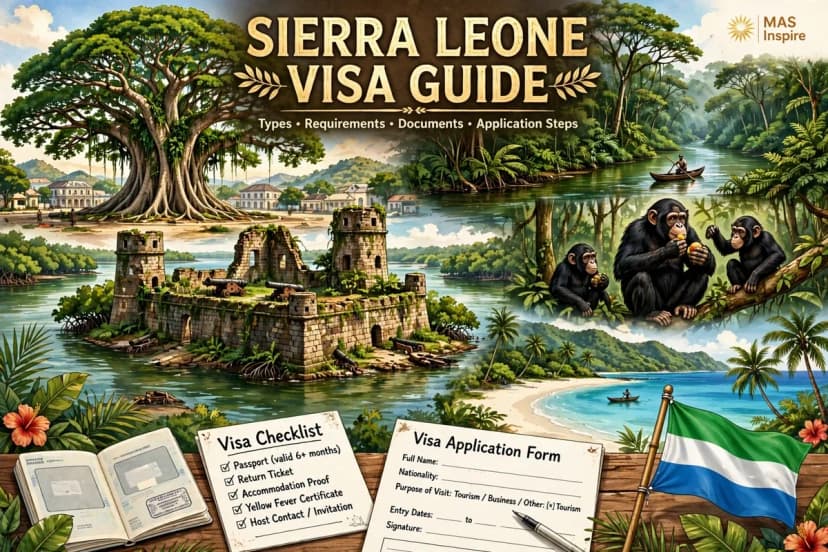
# Sierra Leone Visa Guide 2026: Types, Requirements, Documents and Application Steps
Last checked: 28 November 2026. This guide is for Pakistani passport holders living in Vietnam. Visa rules change without notice — always confirm the live rules on the Sierra Leone Immigration Department website (slid.gov.sl) and the official eVisa portal (evisa.sl) before paying any fee or booking a non-refundable ticket.
Introduction
Sierra Leone is one of West Africa's most rewarding and least visited destinations: the white-sand beaches of the Freetown Peninsula, the chimpanzees of the Tacugama Sanctuary, the rainforest of Tiwai Island, the sobering history of Bunce Island, and the Cotton Tree at the heart of the capital. For a Pakistani living in Vietnam, getting there is straightforward on paper — Sierra Leone runs a genuine online eVisa system, launched on 9 March 2023, through the official portal evisa.sl — but the details matter more than the headline. The fee depends on your nationality band, the visa's validity clock runs from the date of issue rather than the date of entry, a yellow fever certificate is mandatory for every traveller without exception, and every traveller entering or leaving must also file an online health declaration within 72 hours of travel.
This guide covers the eVisa first, then the visa on arrival that still exists at Freetown International Airport, the fees, the processing times, the full document checklists, the work and study routes that run through a separate permits portal, and the health and safety rules that changed in 2026. One warning belongs in the first minute: several figures in this guide are reported by good secondary sources but are not published on any official page this guide could read — the extension fee, the overstay fine, and the student residence price among them. Where that is the case, this guide says so plainly and names the source, instead of presenting a guess as a government fee.
Do Pakistani Passport Holders Need a Visa for Sierra Leone?
Yes. Pakistan is not a member of ECOWAS, the West African bloc whose citizens enter Sierra Leone visa-free, and Pakistan is not on any visa-exemption list for Sierra Leone. A Pakistani passport holder must hold a visa before travelling or obtain one on arrival. The standard route is the eVisa: apply online at evisa.sl before you travel, pay the fee by card, and receive the approval by email. The Sierra Leone Immigration Department (SLID) directs all visa applicants to that portal, and its own FAQ answers the question "Where do I apply for an eVisa?" with a single line: "Use the official eVisa portal at evisa.sl."
Pakistan falls in the higher fee band. Sierra Leone charges eVisa fees by nationality group: nationals of African Union member states pay a preferential rate, and nationals outside the African Union pay the standard rate. Pakistan is not an African Union member, so a Pakistani passport holder pays the standard rate — USD 80 for a single-entry eVisa and USD 160 for a multiple-entry eVisa. The preferential African Union rates (USD 25 single entry, USD 50 multiple entry) do not apply to you, and no Commonwealth waiver exists for Sierra Leone as it does for Rwanda.
A visa on arrival is also available. The UK Foreign, Commonwealth and Development Office (FCDO) states that a visitor or business traveller can get a visa on arrival in Sierra Leone for USD 80, paid in cash in US dollars, or apply online for an eVisa before travelling. Visa-on-arrival issuance is reported at Freetown International Airport and at the Gbalamuya (Guinea border) and Jendema (Liberia border) land crossings. Treat the visa on arrival as a fallback, not a strategy: queues and cash handling in the arrivals hall are exactly what the eVisa was introduced to remove, and an airline can refuse boarding to a passenger whose entry position is unclear. Anyone eligible for the eVisa should hold it before check-in.
The rule follows your passport, not where you live. Living in Vietnam, holding a Vietnamese temporary residence card (TRC), or holding a US, UK or Schengen visa does not change the Sierra Leonean rule. Your Vietnamese residence matters for the journey home: keep your TRC valid for the whole trip and carry it with your passport, because it is your proof of the right to return to Vietnam. If your TRC is close to expiry, renew it before you travel.
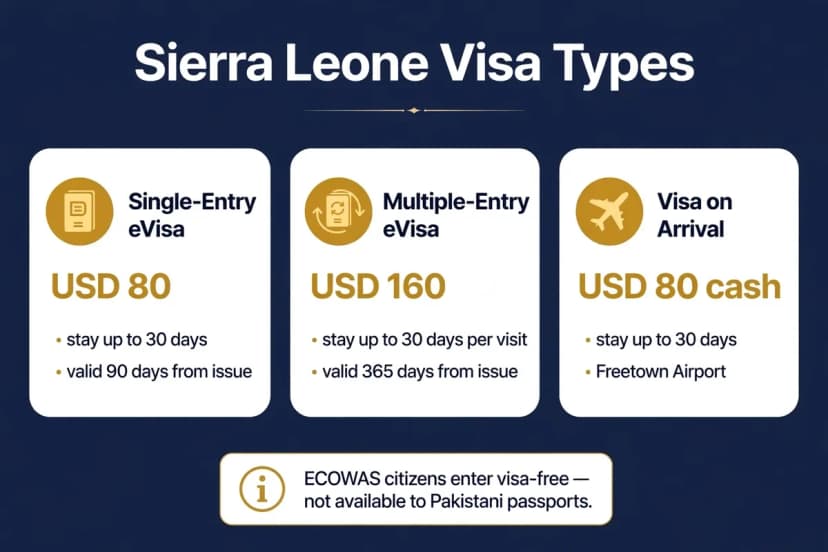
Types of Sierra Leone Visas for Pakistani Passport Holders
Sierra Leone's short-stay system is simpler than most countries in this series: one eVisa covers tourism, business, family visits and study entry, in single-entry and multiple-entry forms. There is no separate tourist-visa, business-visa or student-visa class on the eVisa portal that this guide could verify. Longer stays run through a different system entirely — residence and work permits on the Unified Permit portal — covered in the work and student sections below.
Single-entry eVisa
The standard short-stay visa for a Pakistani visitor. Valid for entry within 90 days of the date of issue, and allowing a stay of up to 30 days once you enter. Fee USD 80 for non-African Union nationals. Covers tourism, business, family visits and study entry. Apply online at evisa.sl, pay by card, and receive the approval by email. This is the visa almost every reader of this guide will use.
Multiple-entry eVisa
For travellers who will enter Sierra Leone more than once in a year — for example, a trip combining Sierra Leone with neighbouring Guinea or Liberia, or repeated business travel. Valid for entry within 365 days of the date of issue, with each separate visit limited to a maximum of 30 days. Fee USD 160 for non-African Union nationals. The 365-day window runs from issue, so do not buy it months before the first trip.
Visa on arrival
Available at Freetown International Airport (Lungi) and at the Gbalamuya and Jendema land crossings, for visit or business travel. Fee USD 80, paid in cash in US dollars, according to the FCDO. Single entry, stay of up to 30 days. You must still present a passport valid for at least six months, a yellow fever certificate, a return or onward ticket and proof of accommodation. The immigration officer makes the final decision, and a visa on arrival is permission to seek entry, not a guarantee of admission.
ECOWAS visa-free entry — not available to Pakistanis
Citizens of ECOWAS member states enter Sierra Leone visa-free, for up to 90 days. This is the only visa-free group. It does not cover Pakistan, and no other exemption applies to a Pakistani passport.
Residence and work permits
For stays beyond the short visitor window, Sierra Leone uses residence permits and work permits applied for online through the Unified Permit portal (unifiedpermit.gov.sl) since 1 January 2026. The portal states that all foreign nationals residing, studying or investing in Sierra Leone for more than 90 days need a residence permit. A residence permit lets you live there; it does not by itself authorise any work — that needs a separate work permit under the Work Permit Act 2023. These are covered in the student and work sections below.
No separate transit or student visa class confirmed
No transit-visa category and no student-visa class on the eVisa portal was confirmed for this guide. The eVisa portal's purposes are tourism, business, studies and family visit, all on the same single- or multiple-entry eVisa. If you are only changing planes in Freetown without passing through immigration, confirm with your airline whether a visa is needed at all; if you will pass through immigration, hold an eVisa.
Visa Comparison Table
| Visa / permit | Stay | Entries | Fee (Pakistani passport) | Where to get it |
|---|---|---|---|---|
| Single-entry eVisa | Up to 30 days | Single | USD 80 | Online at evisa.sl before travel |
| Multiple-entry eVisa | Up to 30 days per visit | Multiple within 365 days | USD 160 | Online at evisa.sl before travel |
| Visa on arrival (visit / business) | Up to 30 days | Single | USD 80, cash in US dollars | Freetown airport; Gbalamuya; Jendema |
| ECOWAS visa-free entry | Up to 90 days | — | Free | Not available to Pakistani passports |
| Residence permit | Typically 1 year, renewable | Multiple | USD 350–1,000 by sector; dependants USD 200 (portal price checker) | Online at unifiedpermit.gov.sl |
| Work permit | Typically 1 year, renewable | Multiple | USD 1,500 non-ECOWAS formal sector (portal price checker) | Online at unifiedpermit.gov.sl, with a residence permit |
Visa Fees: What Each Route Costs
The fee table below gives every figure this guide could verify, with its source. The controlling figures are the eVisa fees as quoted from the portal itself: USD 80 single entry and USD 160 multiple entry for nationals outside the African Union, and USD 25 and USD 50 for African Union nationals. Those figures are confirmed by the FCDO (USD 80 on arrival), by the portal's own application pages as quoted in November 2026 guides, and across the 2026 guides. Fees are paid online by card (Visa, Mastercard and American Express are reported as accepted) and are non-refundable, even if the application is refused — so settle the nationality band, the entry count and the travel dates before the payment screen, not after it.
| Item | Figure | Source |
|---|---|---|
| Single-entry eVisa, non-African Union national | USD 80 | evisa.sl (portal application pages, quoted Nov 2026); FCDO |
| Multiple-entry eVisa, non-African Union national | USD 160 | evisa.sl (portal application pages, quoted Nov 2026) |
| Single-entry eVisa, African Union national | USD 25 | evisa.sl (portal application pages, quoted Nov 2026) |
| Multiple-entry eVisa, African Union national | USD 50 | evisa.sl (portal application pages, quoted Nov 2026) |
| Visa on arrival, visit / business | USD 80, cash in US dollars | FCDO travel advice, updated 19 June 2026 |
| Extension of a single-entry visa (one further 30 days) | About USD 50 (reported, not official) | EntryBrief, verified 2 Aug 2026 — no SLID fee found |
| Residence permit, non-African national | USD 350–1,000 by sector; USD 700 general business; dependants USD 200 | Unified Permit portal price checker, read Oct–Nov 2026 |
| Work permit, non-ECOWAS formal sector | USD 1,500 | Unified Permit portal price checker, read Nov 2026 |
| Work permit, ECOWAS formal / non-ECOWAS African informal | USD 1,000 | Unified Permit portal price checker, read Nov 2026 |
| Work permit, ECOWAS informal | USD 500 | Unified Permit portal price checker, read Nov 2026 |
| Work permit, government or NGO contract | USD 220 | Unified Permit portal price checker, read Nov 2026 |
| Airport security fee (USD 25) | Suspended from 6 July 2026 until further notice | Ministry of Internal Affairs, via Premier Media |
What the visa does not cost. There is no separate "e-visa service fee", no appointment fee and no authorised agent fee. The Immigration Department warns applicants to use official portals and approved payment channels only, and not to share application numbers or personal details with unverified third parties. One Pakistan-focused agency guide quotes a certified six-month bank statement with a closing balance of PKR 1,000,000 to 2,000,000 as a requirement — no official page found for this guide publishes any minimum bank balance, so treat that figure as that agency's own advice, not a government rule. Carry recent statements that plainly cover the trip, and do not let any agent invent a balance threshold for you.
The suspended airport security fee. Several sources still list a USD 25 airport security fee payable by arriving and departing passengers. The Ministry of Internal Affairs suspended that fee from 6 July 2026 pending a contract review and independent audit, as reported by Premier Media. If you are asked to pay it, ask for the current official notice — and do not budget it as a certain cost.
Processing Times
Processing time is the one figure in this guide where the sources genuinely disagree — and the disagreement decides how early you apply.
| Route | Processing time reported | Source |
|---|---|---|
| eVisa, standard | 2–5 business days | Visamundi, from portal guidance |
| eVisa, standard | Around 3 working days | Always Packed, checked 15 Nov 2026 on evisa.sl |
| eVisa, straightforward approvals | About 24–72 hours to 5 working days | Applicant reporting, via Always Packed |
| eVisa, slower cases | Several weeks or longer in some cases | Visamundi eVisa launch guide (2023) |
| eVisa for Pakistanis | About 3 working days (commercial aggregator) | Kawenter, updated 15 Nov 2026 |
| Visa on arrival | Issued on the spot at the airport counter | FCDO; all 2026 guides |
| Extension in Freetown | 1–3 working days (reported) | EntryBrief, verified 2 Aug 2026 |
| Residence / work permit | No processing time published | Unified Permit portal — no figure found |
Planning rule. Apply at least two weeks before travel: that covers the longest commonly reported figure (about five working days) with a week to spare for a correction or a failed card payment. Do not apply absurdly early either, because the single-entry eVisa's 90-day entry window runs from the date of issue — apply more than 90 days before departure and the visa can expire before you fly. For residence and work permits, no processing time is published at all, so start months ahead and file before your visitor stay runs out.
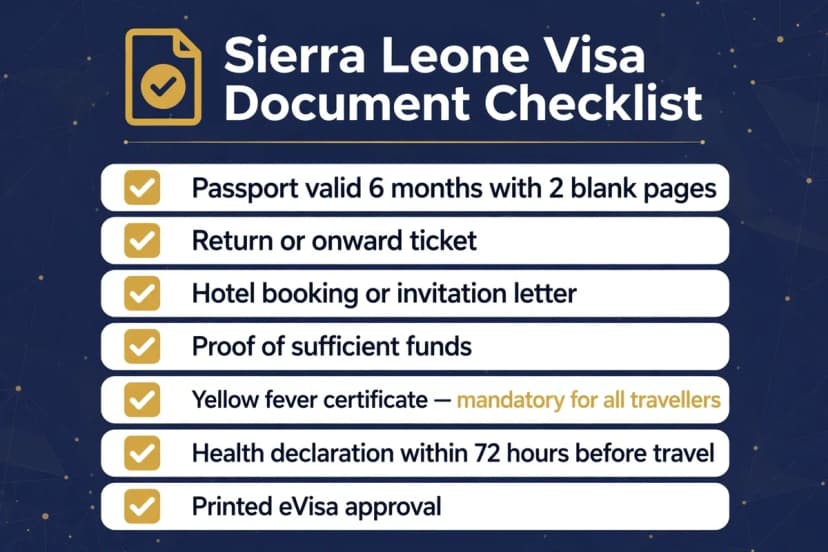
Complete Document Checklists
No single official document list for Pakistani applicants was published on a SLID page found for this guide, so the checklists below combine what the eVisa portal asks of applicants, what the FCDO says border officers check, what the Sierra Leonean foreign ministry's guidance lists, and what the Pakistan-focused 2026 guides report. Prepare originals and clean scans; a blurry passport scan is the commonest reason an online application stalls.
Short visit — eVisa (the route most readers will use)
- Pakistani passport valid for at least six months — the FCDO states six months after the date of your visa application, and the eVisa terms state six months at the time of entry; keep six months beyond your planned return to satisfy both readings
- Two consecutive blank pages in the passport, as the eVisa guidance states (some guides say one blank page — carry two to be safe)
- A recent passport-size photograph, digital, for the online form
- Return or onward ticket, or a confirmed itinerary showing you will leave
- Proof of accommodation — hotel booking for the whole stay, or an invitation letter from your host in Sierra Leone with their address and contact details
- Proof of sufficient funds — recent bank statements that plainly cover the trip; no official minimum balance is published
- Yellow fever vaccination certificate (the International Certificate of Vaccination or Prophylaxis, the "yellow card") — mandatory for every traveller, with the vaccine given at least 10 days before arrival
- Health declaration filed on the Sierra Leone Health Travel Portal (poep.npha.gov.sl) within 72 hours before travel, with the QR code or reference number saved
- A payment card in your name (Visa, Mastercard or American Express) for the USD 80 or USD 160 fee
- A printed copy of the eVisa approval, to present at boarding and on arrival
- Your Vietnamese temporary residence card, for the journey home
- Polio vaccination certificate from NADRA, needed to leave Pakistan — a Pakistani exit requirement, not a Sierra Leonean one, relevant if you travel via Pakistan
Short visit — visa on arrival (fallback route)
- Everything in the eVisa checklist above, plus:
- USD 80 in cash, in clean US dollar notes, for the visa fee at the airport counter
- Printed copies of your return ticket, hotel booking and yellow fever certificate — do not rely on phone signal in the arrivals hall
Business visit
- Everything in the short-visit checklist above, plus:
- An invitation letter from the Sierra Leonean company or partner, with their registration details and the purpose and dates of the visit
- Your own covering letter explaining the purpose of the trip, and evidence of your business or employment in Vietnam or Pakistan
- Proof of funds that covers a business trip, not just a holiday
Student — entering to study
- Everything in the short-visit checklist above, plus:
- Acceptance or enrolment letter from a licensed Sierra Leonean educational institution
- Proof of funds for tuition and living costs; academic certificates and transcripts
- Police clearance certificate and medical certificate, if the institution or the Immigration Department asks for them
- After arrival: registration with the National Civil Registration Authority (NCRA) for a National Identity Number, then a residence permit application on the Unified Permit portal before the 30-day eVisa stay runs out
Work permit and residence permit (Unified Permit portal)
- Everything in the short-visit checklist above, plus:
- A genuine job offer and signed employment contract from a registered Sierra Leonean employer, or evidence of the business you will run if self-employed
- Registration with the NCRA for a National Identity Number and a non-national ID card, before filing
- Academic and professional certificates; police clearance certificate; medical certificate if asked for
- Proof of accommodation in Sierra Leone; the residence permit application filed alongside the work permit on the same portal
Children travelling with you
- Each child needs their own passport, valid six months, and their own eVisa or visa-on-arrival entry — every traveller, including an infant, needs a separate application where one is required
- Birth certificate showing the parents' names
- If a child travels with one parent only, or with neither parent, carry a notarised parental consent letter — officers do ask for it
- Each child needs their own yellow fever certificate (vaccination is recommended from 9 months of age) and their own health declaration
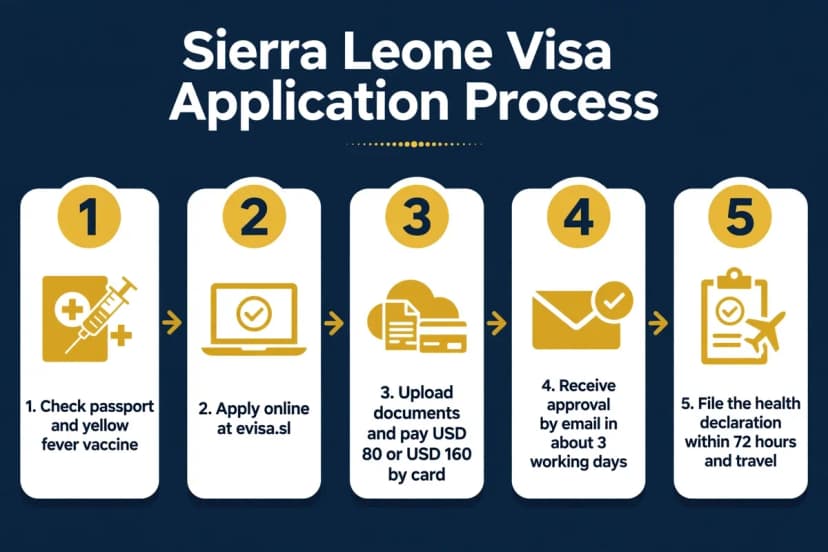
How to Apply: Step-by-Step
There are two sequences in this guide, because Sierra Leone genuinely offers two routes: the eVisa is the default, and the visa on arrival is the fallback.
eVisa — step by step
Step 1 — Check your passport and your health documents. Make sure your passport is valid for at least six months beyond your planned return and has two blank pages. Get your yellow fever vaccination at least ten days before travel if you do not already hold a valid certificate — the certificate is not valid until ten days after vaccination, and since 11 July 2016 it is valid for life, so a certificate more than ten years old cannot be rejected on age alone.
Step 2 — Open the official portal. Go to evisa.sl yourself by typing the address — never through a link in an email or an advertisement. The Immigration Department's own site links to the same portal, and its FAQ names it as the only official route. Beware of lookalike sites: third-party eVisa sites add their own charges on top of the government fee.
Step 3 — Choose the visa type. Select single entry (USD 80) or multiple entry (USD 160) for a non-African Union national, and the purpose that matches your trip — tourism, business, family visit or study entry. Do not pick a cheaper class and hope it covers a different purpose: a visitor eVisa cannot be used for work.
Step 4 — Complete the form. Fill in your personal details exactly as they appear on your passport. Enter your travel dates, your accommodation address in Sierra Leone and your contact details in Vietnam. A name mismatch between the form and the passport is one of the commonest reasons for delay. Remember the validity clock: the single-entry eVisa is valid for entry within 90 days of issue, so apply once your dates are firm.
Step 5 — Upload your documents and pay. Upload the passport copy and photograph the portal asks for, plus your return ticket or itinerary, your accommodation proof or invitation, and your proof of funds. Pay the fee by card through the portal. Keep the payment receipt and the application reference number. Fees are non-refundable if the application is denied or withdrawn.
Step 6 — Wait for the approval by email. The commonly reported standard is around three working days, with a 2–5 business day range. Plan on a week and apply at least two weeks before travel. Track the application on the portal using its tracking function, and print the approval when it arrives.
Step 7 — File the health declaration and travel. Within 72 hours before travel, complete the health declaration on the Sierra Leone Health Travel Portal (poep.npha.gov.sl) and keep the QR code or reference number. Carry the printed eVisa approval, your return ticket, your hotel booking or invitation, your proof of funds and your yellow fever certificate in your hand luggage. Airlines check the approval at boarding, and immigration officers at Lungi may ask for the supporting documents again.
Visa on arrival — step by step
Step 1 — Prepare the same file. Passport with six months' validity, yellow fever certificate, return or onward ticket, accommodation proof, proof of funds, and the health declaration filed within 72 hours of travel.
Step 2 — Carry USD 80 in cash. The visa-on-arrival fee is USD 80, paid in cash in US dollars at the airport counter, according to the FCDO. Card facilities at the airport may be limited, so do not rely on a card.
Step 3 — Present yourself at immigration at Lungi. Hand over your passport and documents. The officer issues the visa and stamps your passport. Check the stamp before you walk away: it is your proof of the date you entered and the length of stay you were given.
Step 4 — Cross to Freetown. Lungi International Airport sits across the Sierra Leone River estuary from the capital, so the onward transfer by ferry, boat or road is part of arrival-day planning — pre-book the Sea Coach Express boat or a water taxi, and allow for weather delays.
Applying through a mission — step by step
Use this route only if you are travelling for a purpose other than a visit or business — the FCDO says those travellers must get a visa before they travel and should contact the Sierra Leone High Commission in the UK — or if a mission specifically asks you to. Contact the mission first, confirm that it accepts applications from Pakistani nationals resident in Vietnam, and ask for its current form, fee and document list, whether you need an appointment, and whether you must apply in person. Keep a copy of everything you submit and a receipt for everything you pay, and check the name, passport number, dates and entries on the sticker before you leave the mission.
Applying from Vietnam and Pakistan — No Sierra Leonean Mission in Vietnam
For a Pakistani living in Vietnam, the important fact is that Sierra Leone has no embassy or high commission in Vietnam. That would be a problem in most countries in this series; in Sierra Leone it barely matters, because the eVisa portal and the visa on arrival cover almost every short visit without a mission at all. You only need a mission for a purpose other than a visit or business, or if a mission specifically asks you to apply through it.
The nearest mission that matters to you is the Embassy of Sierra Leone in Beijing, which is accredited to Vietnam — the list of diplomatic missions of Sierra Leone names Vietnam among the countries the Beijing embassy covers, alongside Australia, Japan, New Zealand, North Korea, Singapore, Sri Lanka and Thailand. Its address is 7 Dongzhimenwai, Sanlitun, Beijing 100600; telephone numbers for it are reported as +86 10 6532 2174 and +86 10 6532 1222, and the two numbers conflict, so confirm the number before calling. Do not assume it will accept an application from a Vietnamese resident without asking first — accreditation is about diplomatic relations, not a promise to process your visa — so write to it before you travel to Beijing.
From Pakistan, the practical contact is the Honorary Consulate General of Sierra Leone in Karachi, at the Schon Centre, I.I. Chundrigar Road, Karachi, headed by Honorary Consul General Nasir Schon. Telephone numbers for it are reported differently in different directories, so confirm the number before calling, and note that an honorary consulate may not itself issue visas — ask whether it can help or whether it will direct you to the eVisa portal. The Embassy of Sierra Leone in Tehran is the mission accredited to Pakistan, among other countries.
Your own mission in Sierra Leone is a Pakistan Honorary Consulate in Freetown, listed with telephone +232 22 22 3973. No address for it was confirmed for this guide, and honorary consulates offer limited services — find its current contact details before you travel and keep them with your passport. The Immigration Department itself can be contacted at its headquarters, 14 Gloucester Street, Freetown, telephone +232-22-223034 or +232-22-225081. Note that one secondary source gives the headquarters as 1 Walpole Street and another as 7 Walpole Street; the Gloucester Street address is the one carried by the Pakistan-focused guides citing the Department, so use it and confirm on slid.gov.sl.
| Mission | Address | Contact | Note |
|---|---|---|---|
| Embassy of Sierra Leone, Beijing (accredited to Vietnam) | 7 Dongzhimenwai, Sanlitun, Beijing 100600 | +86 10 6532 2174 (also reported as 1222 — confirm first) | Ask in writing first whether it accepts applications from Vietnamese residents |
| Embassy of Sierra Leone, Tehran (accredited to Pakistan) | Tehran, Iran | Confirm before travel | For applications connected with Pakistan |
| Honorary Consulate General of Sierra Leone, Karachi | Schon Centre, I.I. Chundrigar Road, Karachi | Hon. Nasir Schon; telephone numbers conflict across directories — confirm first | Honorary post; may not issue visas itself |
| Honorary Consulate of Pakistan, Freetown | Freetown, Sierra Leone | +232 22 22 3973 (unconfirmed) | Your own mission in Sierra Leone; limited services; no address confirmed |
| Sierra Leone Immigration Department, Freetown | 14 Gloucester Street, Freetown | +232-22-223034 / +232-22-225081 | The controlling source for visa questions; Walpole Street address also circulates — confirm on slid.gov.sl |
| Sierra Leone High Commission, London | London, United Kingdom | slhc-uk.org | FCDO directs non-visit / non-business applicants here |
Student Route: Studying in Sierra Leone
There is no separate student visa on the eVisa portal. A Pakistani student enters Sierra Leone on the ordinary eVisa — USD 80 single entry or USD 160 multiple entry — because the portal's purposes include studies but its classes are only single and multiple entry. That eVisa allows a stay of up to 30 days per entry, so a full programme means sorting out residence status after arrival, not before.
For any stay beyond 90 days, the Unified Permit portal states that a residence permit is required. The sequence is: enter on the eVisa, register with the National Civil Registration Authority (NCRA) to get a National Identity Number and a non-national ID card, then file the student residence permit online through the Unified Permit portal (unifiedpermit.gov.sl) before the 30-day eVisa stay runs out, and renew it on proof of attendance. The residence permit tracks the course and is typically issued for up to one year at a time.
Two figures about student costs must not be treated as verified. The Unified Permit portal's price checker has no student category at all, so no official student residence price was found for this guide — get the price from the Immigration Department at filing. A USD 40–70 "student visa" fee circulates online but appears on no official page, so do not budget against it. Apply with the institution's acceptance letter, proof of funds for tuition and living costs, and your academic records; the institution will usually guide the filing. Student status is not permission to work: under the Work Permit Act 2023 any trade, occupation or business needs a work permit, and working without one is an offence.
Teaching English in Sierra Leone. Readers of this guide are often English teachers, so this deserves a direct answer. Sierra Leone is an English-speaking country — English is the official language — and there is demand for English teachers in private and international schools in Freetown. But there is no special English-teacher visa: you need a job offer first, then a work permit and a residence permit through the Unified Permit portal, exactly as in the work section below. Do not fly to Freetown on an eVisa and expect to be hired on arrival: the permits must come first, and the employer is part of the process.
Work Route: Jobs, Business and Work Permits
Sierra Leone rebuilt its permit system in 2026, and the new system is entirely online. Since 1 January 2026, residence and work permit applications and renewals go exclusively through the Unified Permit platform (unifiedpermit.gov.sl), run by the Sierra Leone Immigration Department with the Ministry of Employment, Labour and Social Security. Manual paper permits were declared invalid in April 2026, and a nationwide verification drive at workplaces, business premises and project sites began on 1 June 2026. Do not pay anyone for a paper permit.
The two permits, and why you need both. The residence permit is your "I live here lawfully" status; the work permit is your permission to hold a paid job or run a business. The work permit form asks for your residence permit, so the two are filed together on the same portal. The residence permit is required for anyone residing, studying or investing for more than 90 days. The work permit is governed by the Work Permit Act 2023, which replaced the old work-permit part of the 1965 Non-Citizens Act, and applies to any non-citizen who intends to engage in a trade, occupation or business — including self-employed applicants, who describe their business on the form.
Fees — portal price-checker figures, not a published fee page. The fees below come from the Unified Permit portal's own price checker as read in October and November 2026, not from a SLID fee page, so confirm the live figure at filing. The work permit is priced in US dollars by nationality band and formality: USD 1,500 for a non-ECOWAS national in the formal sector; USD 1,000 for an ECOWAS national in the formal sector or a non-ECOWAS African in the informal sector; USD 500 for an ECOWAS national in the informal sector; and USD 220 on a government or NGO contract. A Pakistani teacher or professional in formal employment falls in the USD 1,500 band. A three-month provisional permit is available so work can start while the file is processed. The residence permit for a non-African national costs USD 350 to USD 1,000 a year by sector — USD 1,000 for mining, energy, aviation, marine, casino and telecom; USD 700 for general merchandise, banking, hotels, manufacturing, construction and similar sectors; USD 350 for education, health, NGOs and similar; and USD 200 for dependants. No processing time is published for either permit.
How to apply. Register with the NCRA first for a National Identity Number and a non-national ID card. Then create an account on unifiedpermit.gov.sl, choose the residence permit — or residence and work permits together — and file with your job offer and signed contract from a registered Sierra Leonean employer, your academic and professional certificates, police clearance, and proof of accommodation. Renew the annual permits online before they expire, and notify the Commissioner of Labour within 15 days of any change affecting your permit details. Never travel on a tourist eVisa intending to start work: working without a permit can lead to fines, detention and deportation.
Business and investment. A business visitor enters on the ordinary eVisa with a local invitation letter. Running a business needs the work permit above, and the residence permit band follows the sector — USD 700 for general business, USD 1,000 for mining and energy. Sierra Leone's mining and energy sectors attract the most foreign investment, and also the highest permit fees and the strictest licensing: export of precious stones requires an export licence, and the FCDO warns that any gem or mineral deal that appears too good to be true probably is.
Family Visits and Permanent Residence
Family visits. Visiting family resident in Sierra Leone uses the ordinary eVisa: single entry USD 80 or multiple entry USD 160, stay of up to 30 days per entry. The eVisa portal's purposes include family visit. You will need evidence of the family relationship and your host's invitation letter with their address and contact details in Sierra Leone.
Joining family who live there. There is no published family-reunification visa class for Sierra Leone that this guide could verify. In practice, a family member joins on an eVisa and then applies for a residence permit through the Unified Permit portal — dependants are a priced category on the portal at USD 200 for a non-African national (USD 100 for ECOWAS nationals). Register with the NCRA first, then file on unifiedpermit.gov.sl before the 30-day eVisa stay runs out. Confirm the route and the dependant documents with the Immigration Department before anyone travels, because no official family-joining procedure was found for this guide.
Permanent residence and citizenship. No published permanent-residence route or timeline was found for this guide. Sierra Leone's long-stay system is built on renewable one-year residence permits, not on a published path to permanent residence, and citizenship is decided under the Citizenship Act by the responsible Minister. Do not pay any agent who promises permanent residence or citizenship: no official route was found, and any such promise is a red flag. If you plan a life in Sierra Leone, build it on renewable residence and work permits, and take advice from the Immigration Department itself.
Extending a short stay. A single-entry tourist eVisa can be extended once for a further 30 days by applying to the Immigration Department in Freetown before the current visa expires — that is the consistent report across the 2026 guides. The extension fee is reported at about USD 50 and the processing at 1–3 working days, but neither figure comes from an official page, so confirm both at the office. Bring your passport, the original visa, proof of funds and proof of address. One older source states that eVisas are not extendable at all — that conflicts with the 2026 guides, and this guide follows the 2026 reporting while flagging the conflict. Do not overstay while waiting: apply early.
Common Mistakes to Avoid
Using an unofficial eVisa site. The only official portal is evisa.sl, linked from slid.gov.sl. Lookalike sites charge their own service fees on top of the government fee and may harvest your passport details. Type the address yourself, and never share one-time passwords or application numbers with anyone — the Immigration Department warns about this explicitly.
Paying the wrong fee band. Pakistan is not an African Union member, so the USD 25 / USD 50 preferential rates do not apply to you. The correct fees for a Pakistani passport are USD 80 single entry and USD 160 multiple entry. If a site quotes you USD 25, it has your nationality wrong — or it is not the official portal.
Applying too early. The single-entry eVisa is valid for entry within 90 days of issue. Apply more than 90 days before departure and the visa can expire before you fly. Apply once your dates are firm, at least two weeks before travel.
Arriving without a yellow fever certificate. The certificate is mandatory for every traveller, and airlines can deny boarding without it. The vaccine must be given at least ten days before arrival, so a last-minute vaccination does not help — get it in Vietnam at least ten days before you fly, and carry the yellow card in your hand luggage with your passport.
Forgetting the health declaration. Every traveller entering or leaving Sierra Leone must complete the health declaration on the Sierra Leone Health Travel Portal (poep.npha.gov.sl) within 72 hours before travel and keep the QR code or reference number. It is separate from the visa and separate from the yellow fever certificate, and travellers without it can face delays or be refused entry or departure.
Assuming the visa on arrival is guaranteed. It exists, but it is a decision made by an immigration officer, not a right. Arrive without a return ticket, accommodation proof or proof of funds and you can be refused even with USD 80 in hand. Hold the eVisa before you fly.
Budgeting against an invented bank balance. No official page publishes a minimum bank balance for the eVisa. An agency figure of PKR 1,000,000 to 2,000,000 circulates for Pakistani applicants — it is that agency's advice, not a government rule. Carry recent statements that plainly cover the trip.
Booking non-refundable travel before approval. eVisa fees are non-refundable and processing can stretch beyond the usual three working days. Book refundable flights and accommodation until the approval email arrives.
Forgetting the return to Vietnam. Your Vietnamese TRC is your way back in. Keep it valid for the whole trip and carry it with your passport — an expired TRC can strand you outside Vietnam.
Reasons for Refusal
No official list of refusal reasons is published by the Immigration Department, so the reasons below are the typical ones reported across the 2026 guides and the ones that follow directly from the published requirements. A visa is pre-entry clearance, not a guarantee of admission: the immigration officer at Lungi makes the final decision in every case, even with a valid eVisa.
- Passport fails the validity rule. Less than six months' validity, or no blank pages for the entry stamp. The FCDO measures the six months from the date of your visa application; the eVisa terms measure it at entry — satisfy both.
- No yellow fever certificate, or a certificate less than ten days old. The certificate is mandatory for every traveller and is not valid until ten days after vaccination. Without it, airlines can deny boarding and border authorities can refuse entry.
- No health declaration. The declaration on poep.npha.gov.sl is mandatory for entry and exit; non-compliance can mean delays or refusal of entry or departure.
- No return or onward ticket, or no accommodation proof. Officers routinely ask for both. A traveller with no visible plan to leave and nowhere to stay looks like an overstay risk.
- Insufficient funds, or funds that cannot be verified. Bank statements that do not plainly cover the trip, or documents that look altered, invite refusal.
- Wrong purpose. Applying for a visit eVisa while intending to work, or to study for more than 90 days without a residence-permit plan. Work needs a work permit; long study needs a residence permit.
- Inconsistent or incorrect details. A name, date of birth or passport number that does not match the passport exactly, or documents that contradict each other.
- Previous overstay or immigration history. Overstaying a Sierra Leonean visa can affect future applications, and a serious overstay can mean detention and deportation at your own expense.
- Applying through an unofficial channel. Applications filed by unverified agents, or payments made outside the approved channels, can be rejected outright — and the fee is not refunded.
If you are refused. The fee is not refunded. Read the refusal notice carefully, fix the specific problem it names, and reapply with corrected documents — do not simply submit the same file again. If the refusal relates to a work or residence permit, ask the Immigration Department or your employer what the file was missing before refiling. There is no published appeal route for eVisa refusals that this guide could verify.
Frequently Asked Questions
1. Do Pakistani citizens need a visa for Sierra Leone?
Yes. Pakistan is not an ECOWAS member, so a Pakistani passport holder must hold a visa. The standard route is the eVisa on the official portal evisa.sl before travel. A visa on arrival is also available at Freetown International Airport for USD 80 cash, but the eVisa before travel is the recommended route.
2. How much does a Sierra Leone eVisa cost for a Pakistani passport?
USD 80 for a single entry and USD 160 for multiple entries. Pakistan is not an African Union member, so the preferential African Union rates of USD 25 and USD 50 do not apply. Fees are paid online by card and are non-refundable.
3. How long can I stay in Sierra Leone on an eVisa?
Up to 30 days per entry. A single-entry eVisa is valid for entry within 90 days of the date of issue; a multiple-entry eVisa is valid for entry within 365 days of issue, with each visit limited to 30 days. A single-entry visa can reportedly be extended once for a further 30 days in Freetown.
4. Can I apply for a Sierra Leone visa online before I travel?
Yes, through the official eVisa portal at evisa.sl — the only official portal, linked from the Immigration Department's website slid.gov.sl. Apply, upload your documents, pay by card, and receive the approval by email. Do not use lookalike third-party sites, which add their own charges.
5. How long does the eVisa take to process?
Commonly around three working days, with a reported standard range of 2–5 business days and straightforward approvals sometimes in 24–72 hours. One older source warns processing can take several weeks in some cases. Apply at least two weeks before travel.
6. Is there a Sierra Leonean embassy in Vietnam?
No. Sierra Leone has no mission in Vietnam. The Embassy of Sierra Leone in Beijing is accredited to Vietnam — 7 Dongzhimenwai, Sanlitun, Beijing 100600. In practice you will rarely need it: the eVisa portal and the visa on arrival cover short visits. Ask the embassy in writing first if you do need it.
7. What documents do I need for Sierra Leone?
A passport valid at least six months with two blank pages; a return or onward ticket; proof of accommodation or an invitation letter; proof of sufficient funds; a yellow fever vaccination certificate; and the health declaration filed on poep.npha.gov.sl within 72 hours before travel. For an online application, add a digital photograph and a payment card. The full checklists are in the document section.
8. Do I need a yellow fever certificate for Sierra Leone?
Yes — it is mandatory for every traveller, without exception. The FCDO, TravelHealthPro and the WHO all state this. The vaccine must be given at least ten days before arrival, and since 11 July 2016 the certificate is valid for life. Without it, airlines can deny boarding and border authorities can refuse entry. Get vaccinated in Vietnam at least ten days before you fly.
9. What is the health declaration, and do I really need it?
Yes. Every traveller entering or leaving Sierra Leone must complete a health declaration on the Sierra Leone Health Travel Portal (poep.npha.gov.sl) within 72 hours before travel and keep the QR code or reference number. It is separate from your visa and from your yellow fever certificate. Travellers without it can face delays or be refused entry or departure.
10. Can I work in Sierra Leone on a tourist eVisa?
No. A visitor eVisa must not be used for employment. You need a job offer from a registered Sierra Leonean employer first, then a work permit and a residence permit through the Unified Permit portal (unifiedpermit.gov.sl). For a non-ECOWAS national in formal employment the work permit is USD 1,500, plus a residence permit of USD 350–1,000 by sector.
11. Can I extend my stay in Sierra Leone?
A single-entry eVisa can reportedly be extended once for a further 30 days by applying to the Immigration Department in Freetown before the current visa expires. The fee is reported at about USD 50 with 1–3 working days' processing, but neither figure comes from an official page — confirm both at the office. For stays beyond 90 days, a residence permit on the Unified Permit portal is required instead.
12. What happens if I overstay my Sierra Leone visa?
You will be fined, and a serious overstay can mean detention and deportation at your own expense — and can affect future visa applications. The fine itself is disputed: secondary sources quote USD 20 a day, USD 50 a day capped at USD 500, or Le 100,000 and above, and no official figure was found for this guide. Do not overstay; apply for an extension before your visa expires, or leave on time.
13. Are there direct flights from Vietnam or Pakistan to Freetown?
No. The realistic corridors from Ho Chi Minh City are via Istanbul (Turkish Airlines), Doha (Qatar Airways), Dubai (Emirates), Addis Ababa (Ethiopian Airlines), Brussels (Brussels Airlines) or Casablanca (Royal Air Maroc). Lungi International Airport sits across the estuary from Freetown, so pre-book the ferry, boat or road transfer for arrival day.
14. Do I need travel insurance for Sierra Leone?
It is not listed as a required visa document, but it is strongly advisable. Medical facilities outside Freetown are basic, malaria is a year-round risk, and medical evacuation is expensive — buy a policy that covers medical evacuation, and check that it covers you given the US State Department's Level 2 advisory. Carry more than USD 10,000 in cash only with a declaration: anything above that must be declared to Customs and Immigration.
15. Can children travel with me to Sierra Leone?
Yes, with their own passport and their own eVisa or visa-on-arrival entry, a birth certificate showing the parents' names, and — if a child travels with one parent only or with neither parent — a notarised parental consent letter. Each child also needs their own yellow fever certificate (vaccination is recommended from 9 months of age) and their own health declaration.
Official Immigration Websites
Check these sources directly before you apply. The Immigration Department is the controlling source for the eVisa portal and the permit portals; the FCDO and the US State Department for passport validity, health and safety advice; the National Public Health Agency for the health declaration.
| Website | What it is | Link |
|---|---|---|
| Sierra Leone Immigration Department — FAQ | Official SLID page: eVisa portal is evisa.sl; permits via unifiedpermit.gov.sl; fraud warning; emergency hotline 019 | slid.gov.sl/faq |
| Sierra Leone eVisa portal | Official eVisa website: applications, payment and tracking; single-entry USD 80 / multiple-entry USD 160 for non-African Union nationals; 90-day / 365-day entry windows; 30-day stay | evisa.sl |
| UK Foreign, Commonwealth and Development Office — Sierra Leone travel advice | Entry requirements (updated 19 June 2026): passport 6 months after visa application; visa on arrival USD 80 cash; single entry 90 days from issue, 30-day stay; multiple entry 365 days; yellow fever mandatory; health declaration within 72 hours; Ebola screening | gov.uk/foreign-travel-advice/sierra-leone/entry-requirements |
| US Department of State — Sierra Leone Travel Advisory | Level 2 "Exercise Increased Caution" (issued 10 November 2026): crime, unrest and inadequate health infrastructure; health declaration required from 18 June 2026 | travel.state.gov — Sierra Leone travel advisory |
| US Department of State — Sierra Leone International Travel Information | Entry, health and safety information for Sierra Leone, including the USD 25 airport security fee (suspended July 2026) | travel.state.gov — Sierra Leone |
| TravelHealthPro — Sierra Leone | UK travel health guidance: yellow fever certificate required from all travellers; certificate valid for life since 11 July 2016; vaccination recommended from 9 months of age | travelhealthpro.org.uk — Sierra Leone |
| Sierra Leone Health Travel Portal (National Public Health Agency) | Official health declaration portal: every traveller entering or leaving must file within 72 hours before travel and keep the QR code | poep.npha.gov.sl |
| Wikipedia — List of diplomatic missions of Sierra Leone | Beijing embassy accredited to Vietnam (with Australia, Japan, New Zealand, North Korea, Singapore, Sri Lanka, Thailand); Tehran embassy accredited to Pakistan | en.wikipedia.org/wiki/List_of_diplomatic_missions_of_Sierra_Leone |
| UrduPoint — Sierra Leone Visa for Pakistanis 2026 | Pakistan-focused guide, checked 19 Nov 2026: eVisa at evisa.sl; passport 6 months; SLID headquarters 14 Gloucester Street, Freetown, +232-22-223034 / 225081 | urdupoint.com/travel/visa/sierra-leone |
| Always Packed — Sierra Leone eVisa: $80 Fee, 30-Day Stay | Checked 15 Nov 2026 on evisa.sl: USD 80 single / USD 160 multiple for non-African Union nationals; 90-day and 365-day entry windows; around 3 working days processing; yellow fever mandatory | alwayspacked.com — Sierra Leone eVisa |
| Visamundi — Sierra Leone e-Visa | eVisa fees (USD 80 / 160 non-African Union; USD 25 / 50 African Union), 2–5 business days processing, 30 days per entry, 2 blank pages, purposes tourism / business / studies / family visit | visamundi.co — Sierra Leone e-Visa |
| Visamundi — Sierra Leone launches e-Visa (2023) | eVisa system launched 9 March 2023; warning that processing can take several weeks in some cases | visamundi.co — e-Visa launch 2023 |
| OneTimeLivin — Sierra Leone visa rules for Pakistan passport holders | Quotations from the eVisa portal: Non-African Union single entry USD 80, validity 90 days, stay 30 days, one entry; passport 6 months at entry | onetimelivin.com — Sierra Leone visa rules |
| VisaVerge — Sierra Leone Visa Guide 2026 | Visa on arrival at Freetown, Gbalamuya and Jendema; tourist eVisa extendable once; ECOWAS visa-free 90 days; overstay fines from Le 100,000 | visaverge.com — Sierra Leone visa guide |
| LoopHoleDB — Immigrate to Sierra Leone | Residence and work permit system: Unified Permit portal since 1 Jan 2026; manual permits invalid April 2026; verification drive from 1 June 2026; Work Permit Act 2023 | loopholedb.com — Immigrate to Sierra Leone |
| LoopHoleDB — Sierra Leone Work Permit | Work permit fee bands: USD 1,500 non-ECOWAS formal; USD 1,000 ECOWAS formal / non-ECOWAS African informal; USD 500 ECOWAS informal; USD 220 government / NGO contract; 3-month provisional permit | loopholedb.com — Sierra Leone work permit |
| LoopHoleDB — Sierra Leone Residence Permit | Residence permit for stays over 90 days; NCRA registration first; fees USD 350–1,000 by sector, dependants USD 200; no student category in the price checker | loopholedb.com — Sierra Leone residence permit |
| IPC Travel — Sierra Leone Visa Requirements | Visa on arrival since September 2019 alongside the eVisa; USD 25 airport security fee suspended July 2026; health declaration within 72 hours via poep.npha.gov.sl | ipctravel.com — Sierra Leone visa requirements |
| EntryBrief — Sierra Leone Entry Requirements | Extension once for 30 days at SLID Freetown (about USD 50, 1–3 working days); overstay fine figures (USD 20–50 a day); SLID headquarters address variants | entrybrief.com — Sierra Leone entry requirements |
| Novista — Sierra Leone: visa, residence permit and citizenship | Three systems separated: visas at evisa.sl; residence and work permits at unifiedpermit.gov.sl; passports and border movement at slid.gov.sl; official warning to use government channels only | novista.com.cn — Sierra Leone visa, residence and citizenship |
Final Checklist and Conclusion
Before you apply: passport valid six months beyond your return with two blank pages; yellow fever vaccination at least ten days before travel; travel dates firm (the 90-day entry window runs from issue); accommodation booked or an invitation letter in hand; return or onward ticket; recent bank statements; a payment card for the USD 80 or USD 160 fee.
Before you fly: eVisa approval printed and saved offline; health declaration filed on poep.npha.gov.sl within 72 hours of travel with the QR code saved; yellow fever certificate in hand luggage with your passport; USD 80 in cash as a contingency; Vietnamese TRC valid for the whole trip and carried with your passport; ferry or boat transfer from Lungi pre-booked.
On arrival: present your passport, eVisa approval, return ticket, accommodation proof and yellow fever certificate; check the entry stamp before you walk away; keep the documents for the whole stay; if you need longer, apply for an extension at the Immigration Department in Freetown before the visa expires — or, for a stay beyond 90 days, file a residence permit on the Unified Permit portal.
Sierra Leone rewards the traveller who does the paperwork properly: the eVisa is genuinely online, the fee for a Pakistani passport is a flat USD 80 for a single entry, and the visa on arrival stands behind it as a fallback. The two things that will stop a trip are not the visa at all — they are the yellow fever certificate and the health declaration, both mandatory, both checked, and both easy to forget. Get the vaccination done in Vietnam at least ten days before you fly, file the declaration inside the 72-hour window, hold the eVisa before check-in, and Freetown's beaches, forests and history are yours. The rules change without notice, so confirm the live fee and the live health requirements on evisa.sl and slid.gov.sl before you pay anything.
This guide was checked on 28 November 2026. Visa rules change without notice. Always confirm the live rules on slid.gov.sl and evisa.sl before paying any fee or booking a non-refundable ticket. Nothing in this guide is immigration advice; the Sierra Leonean authorities set and enforce the entry rules, and the immigration officer at Lungi makes the final decision. This guide is educational information only and does not guarantee visa approval or entry.