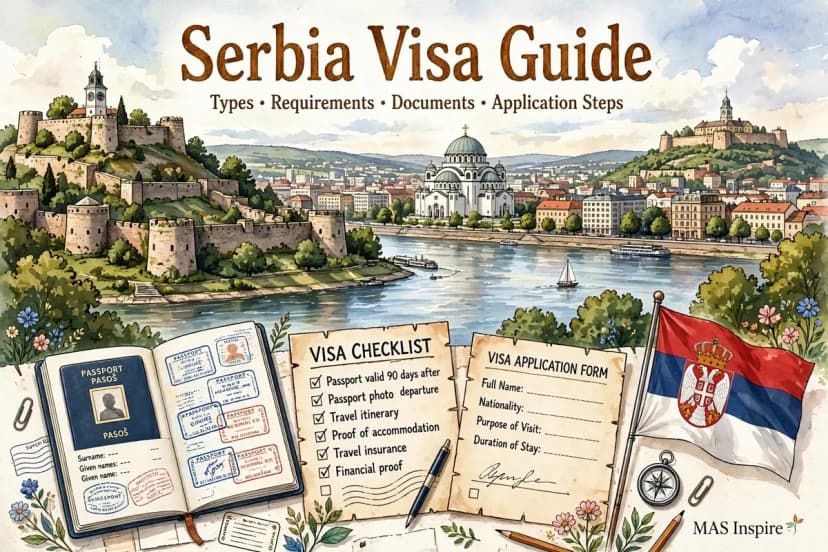
Serbia Visa Guide 2026: Types, Requirements, Documents and Application Steps
Last checked: 28 November 2026. This guide is for Pakistani passport holders living in Vietnam. Visa rules change without notice — always confirm the live rules on the Serbian Ministry of Foreign Affairs website (mfa.gov.rs) and the official Welcome to Serbia portal (welcometoserbia.gov.rs) before paying any fee or booking a non-refundable ticket.
Introduction
But the visa route is not simple. Serbia has no embassy in Pakistan and none in Vietnam, the embassy that used to handle Pakistani applications stopped doing so in June 2025, and the fee itself is the subject of a genuine conflict between sources.
An ordinary Pakistani passport holder needs a visa for Serbia. The main route is the short-stay Visa C, applied for online through Serbia's official Welcome to Serbia portal and issued since April 2025 as a Digital Travel Authorization — an approval PDF with QR codes, instead of a sticker in your passport. The standard fee is €90, paid in Serbian dinars at the National Bank of Serbia's middle exchange rate, and the Ministry of Foreign Affairs puts standard processing at about 15 days, extendable to 30. There is one big exception: if you already hold a valid Schengen, UK, EU or US visa, or a residence permit from one of those places, you can enter Serbia without a Serbian visa at all and stay up to 90 days in any six months. Check that first, before you start any application.
First, the fee question is genuinely unsettled: Serbia's own Visa C instructions carry a fee-exemption note naming Pakistani passports, and some guides say Pakistanis pay nothing on the portal, while other Pakistan-focused guides report that €90 is what applicants are actually charged. This guide budgets €90 and tells you to confirm the fee with the Embassy of Serbia in Beijing before paying anyone. Second, there is no visa on arrival for Serbia and no Serbian embassy in Vietnam or Pakistan — do not fly to Belgrade hoping to sort the visa at the airport, and do not trust any website that claims there is a Serbian embassy in Islamabad.
Do Pakistani Passport Holders Need a Visa for Serbia?
Yes, if you hold an ordinary Pakistani passport. Serbia's Ministry of Foreign Affairs publishes a visa regime page for every nationality, and the page for Pakistan is unambiguous: "For holders of ordinary passports and other travel documents: Visas required." Only holders of Pakistani diplomatic and official passports are exempt, and only for visits of up to 30 days.
Under a Serbian Government decision of 30 October 2014, still published on the MFA website, holders of a valid Schengen visa, a visa of an EU member state, a UK visa or a US visa — and holders of a residence permit of a Schengen country, the EU or the US — may enter, transit and stay in Serbia for up to 90 days in a six-month period without a Serbian visa, as long as their stay does not outlast the validity of that visa or permit. The MFA's own wording says only that the visa must be valid; it does not say it must be multiple-entry or already used. The Serbian Embassy in New Delhi, however, describes the rule more narrowly and mentions a visa with multiple entries, and several Pakistan-focused guides advise travelling on a multiple-entry visa. The safe reading is the stricter one: if your Schengen, UK, EU or US visa is multiple-entry and still valid for your whole stay, you can rely on the exemption. If it is single-entry, or expires during your trip, do not rely on it — apply for a Serbian Visa C instead. Gulf residence and a Vietnamese residence card do not count: the MFA names residence permits only from Schengen-area, EU and US states.
The second exception is narrower: the transit zone. If your journey only passes through the international transit zone of a Serbian airport and you do not leave it, you are not entering Serbia and need no visa. The moment you need to leave the transit zone — to collect baggage, to change airports, to spend a night — you need a visa. Do not book a self-transfer connection through Belgrade without a Serbian visa in hand.
The rule follows your passport, not where you live. Living in Vietnam, holding a Vietnamese temporary residence card, or holding a long-stay visa for another country does not change the Serbian rule for a Pakistani passport. What your Vietnamese residence does change is the practical side: keep your TRC valid for the whole trip and carry it with your passport, because it is your proof of the right to return to Vietnam. If your TRC is close to expiry, renew it before you travel.
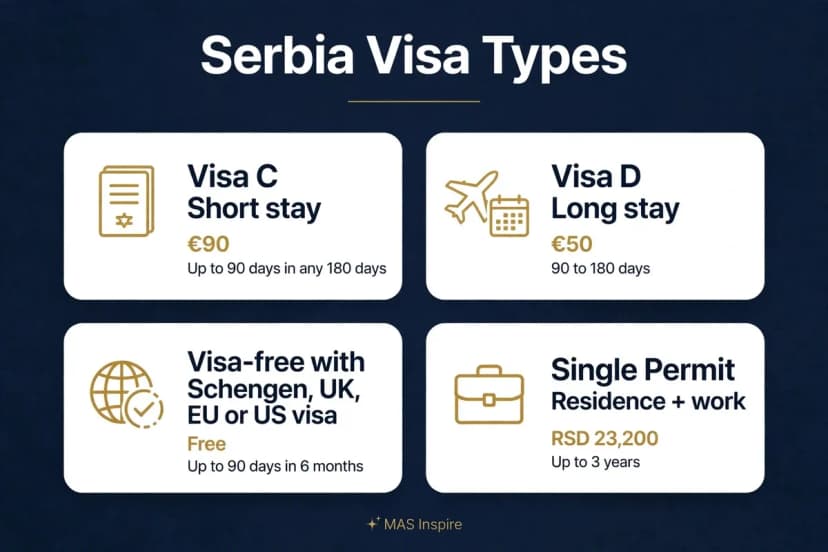
Types of Serbia Visas for Pakistani Passport Holders
Serbia has two visa categories, plus a residence system that takes over for longer stays.
Short-stay visa — Visa C
The visa almost every reader of this guide will use. It covers tourism, private visits to family or friends, business trips, conferences and events, cultural and sports events, medical treatment, and transit through Serbia. It allows a stay of up to 90 days in any 180-day period and can be issued for one, two or multiple entries, with a validity of up to five years for multiple-entry visas. It does not allow work, and it is not a route to long-term residence. Since April 2025, Visa C for Pakistanis has been issued as a Digital Travel Authorization: an approval PDF with QR codes for online verification and border checks, instead of a visa sticker in your passport. Pakistan is one of the 46 nationalities Serbia has enabled for the electronic Visa C, according to the official portal's country list as reported by multiple 2026 guides — but see the flag in the fees section, because whether the fully electronic route works end-to-end for every Pakistani applicant is not settled, and one guide advises confirming with the Beijing embassy before assuming the portal accepts you.
Long-stay visa — Visa D
For stays of 90 to 180 days, issued for a single purpose: employment, study, family reunification, medical treatment, scientific research, religious service, professional practice, or ownership of immovable property in Serbia. A Visa D is normally the entry step before applying for temporary residence inside Serbia — you enter on the D visa and then apply for a residence permit. It can be issued for single, double or multiple entries. The standard fee is €50 on the official portal (€52 at embassies, per the New Delhi price list). You cannot use a Visa D to work on arrival: for employment you need the single permit as well, covered in the work section.
Temporary residence and the single permit
For any stay longer than 90 days in a 180-day period, Serbia uses a temporary residence permit, issued for up to three years and renewable. Since February 2024, residence and work authorisation have been merged into one biometric card, the single permit (jedinstvena dozvola), applied for online only through the government's portal for foreigners. The single permit is covered in the work section; family and study routes in their own sections.
| Visa / permit | Stay | Entries | Fee | Where to get it |
|---|---|---|---|---|
| Short-stay Visa C | Up to 90 days in any 180 days | Single, double or multiple | €90 online (see fee conflict) | Online portal; or a Serbian embassy |
| Long-stay Visa D | 90 to 180 days | Single, double or multiple | €50 online / €52 at embassies | Online portal; or a Serbian embassy |
| Visa-free with Schengen / UK / EU / US visa or residence permit | Up to 90 days in 6 months | As the underlying visa allows | Free | At the border — no application |
| Temporary residence permit | Up to 3 years, renewable | Multiple | RSD 430 + RSD 23,450 approval | Online via portal for foreigners; MUP in Serbia |
| Single permit (residence + work) | Up to 3 years, renewable | Multiple | RSD 430 + RSD 22,770 approval | Online via portal for foreigners; MUP in Serbia |
| Diplomatic / official passport | Up to 30 days | As issued | Free | At the border — no application |
Visa Comparison Table
| Your situation | Route | Stay allowed | Fee | Processing |
|---|---|---|---|---|
| Holiday, family visit, business trip or event, up to 90 days | Visa C (e-visa / Digital Travel Authorization) | Up to 90 days in any 180 days | €90 (see fee conflict) | About 15 days, up to 30 |
| You hold a valid multiple-entry Schengen, UK, EU or US visa, or a residence permit from one of those places | No Serbian visa — enter visa-free | Up to 90 days in 6 months, within the visa or permit validity | Free | None |
| You hold only a single-entry Schengen, UK, EU or US visa, or one that expires during your trip | Visa C — do not rely on the exemption | Up to 90 days in any 180 days | €90 (see fee conflict) | About 15 days, up to 30 |
| Transit through Belgrade airport, staying inside the transit zone | No visa needed | Transit zone only | Free | None |
| Transit where you must leave the transit zone | Visa C | Up to 90 days in any 180 days | €90 (see fee conflict) | About 15 days, up to 30 |
| Work in Serbia | Visa D, then single permit in Serbia | 90–180 days on the D visa; up to 3 years on the single permit | €50 (D) + RSD 23,200 (single permit) | 15 days (D); 15 days (single permit) |
| Study in Serbia | Visa D, then temporary residence for study | 90–180 days on the D visa; up to 3 years on the permit | €50 (D) + residence fees | 15 days (D); 30 days (residence) |
| Join family in Serbia | Visa D for family reunification, then temporary residence | 90–180 days on the D visa; up to 3 years on the permit | €50 (D) + residence fees | 15 days (D); 30 days (residence) |
| Diplomatic or official passport holder | Visa-free | Up to 30 days | Free | None |
| Stay longer than 90 days for any other reason | Temporary residence permit | Up to 3 years, renewable | RSD 430 + RSD 23,450 approval | About 30 days |
One comparison that saves real money: Serbia is not in the Schengen area, and its 90 days are counted separately from the Schengen 90 days. Time in Serbia does not use up your Schengen allowance, and a Serbian visa does not grant entry to any Schengen country.
Visa Fees: What Each Route Costs
The fee table below gives every figure this guide could verify, with its source. The standard Visa C fee is €90 — plainly below.
| Item | Figure | Source |
|---|---|---|
| Short-stay Visa C (online, official portal) | €90, paid in Serbian dinars at the National Bank of Serbia middle exchange rate (about 10,590 RSD) | Serbia's official Visa C instructions; Welcometoserbia.gov.rs fee schedule |
| Short-stay Visa C at an embassy (adult) | €92 | Embassy of Serbia in New Delhi — price list of consular services |
| Short-stay Visa C at an embassy (child under 12) | €47 | Embassy of Serbia in New Delhi — price list of consular services |
| Long-stay Visa D (online) | €50 | Official portal fee schedule, via 2026 guides |
| Long-stay Visa D (at an embassy) | €52 | Embassy of Serbia in New Delhi — price list of consular services |
| Appeal against a visa refusal | €100 | Embassy of Serbia in New Delhi — price list of consular services |
| Single permit (residence + work) | RSD 430 application + RSD 22,770 approval = RSD 23,200 (about €197) | Government fee schedule, via 2026 residence guides |
| Temporary residence permit | RSD 430 application + RSD 23,450 approval | Government fee schedule, via 2026 residence guides |
| Biometric residence card | RSD 2,028 | Government decree of 12 September 2026, via 2026 residence guides |
| Travel medical insurance (required) | Cover of at least €20,000 | Serbian embassy document lists; MFA general requirements |
| Funds to show | €50 for each day of stay | Serbia MFA general requirements; Pakistan MOFA Serbia page |
The Pakistani fee conflict — read this before you pay. Serbia's official Visa C application instructions and at least one embassy price list carry a fee-exemption note naming Pakistani passports, under a bilateral agreement, and several 2026 guides state that Pakistani applicants are exempt from the portal fee payment. Other Pakistan-focused guides, checked in October and November 2026, report the opposite in practice: that the fee actually charged to Pakistani applicants is €90, and advise budgeting for €90. This guide cannot settle the conflict from the sources available: the exemption note exists in official instructions, but the €90 charge is what applicants report paying. Budget for €90, and ask the Embassy of Serbia in Beijing in writing whether the exemption applies to your application before you pay. Do not plan your budget around a fee waiver you have not confirmed.
How to pay. Online applications are paid in the portal in Serbian dinars at the National Bank of Serbia's middle exchange rate — the portal converts the €90 (about 10,590 RSD at November 2026 rates) and you pay by card. At an embassy, the fee is charged in the local currency at that mission's price list: New Delhi charges €92 for an adult Visa C, so the exact amount depends on where you apply. Fees are not refunded if an application is refused or withdrawn. There is no separate "e-visa fee", no appointment fee, and no authorised agent fee — the portal and the embassy are the only official channels.
What the visa does not cost. The visa-free route costs nothing: if you enter on a valid Schengen, UK, EU or US visa or residence permit, there is no Serbian fee at all. Diplomatic and official passport holders also pay nothing for their 30-day visa-free visits, and students on Serbian government scholarships do not pay the temporary residence fee.
Processing Times
Serbia's Ministry of Foreign Affairs puts standard Visa C processing at about 15 days from the date of application, with extension to 30 days in individual cases. That is the controlling figure. Plan on the longer number.
| Route | Processing time reported | Source |
|---|---|---|
| Visa C (online or at an embassy) | About 15 days; up to 30 days in exceptional cases | Serbia MFA |
| Visa D (long stay) | About 15 days | Serbia MFA, via 2026 guides |
| Single permit (residence + work) | Within 15 days of a complete application | Law on Foreigners, via 2026 residence guides |
| Temporary residence permit | About 30 days after a complete application | 2026 residence guides |
| Visa C — agency-reported range | 3–8 weeks; in some cases several months | Commercial agency guides — not the MFA figure |
Planning rule. You can apply no earlier than three months before your travel date, and Pakistan's MOFA page says visa applications must be lodged in person at the embassy at least three weeks before the date of entry. Apply as soon as the three-month window opens if your dates are fixed, and do not pay for non-refundable flights until the approval is in your inbox. If the mission asks for extra documents, that request can push the decision toward the 30-day limit. The agency-reported range of three to eight weeks conflicts with the MFA's 15-day figure; the MFA is the controlling source, but the longer reports are a reason to apply early rather than to trust the shortest number.
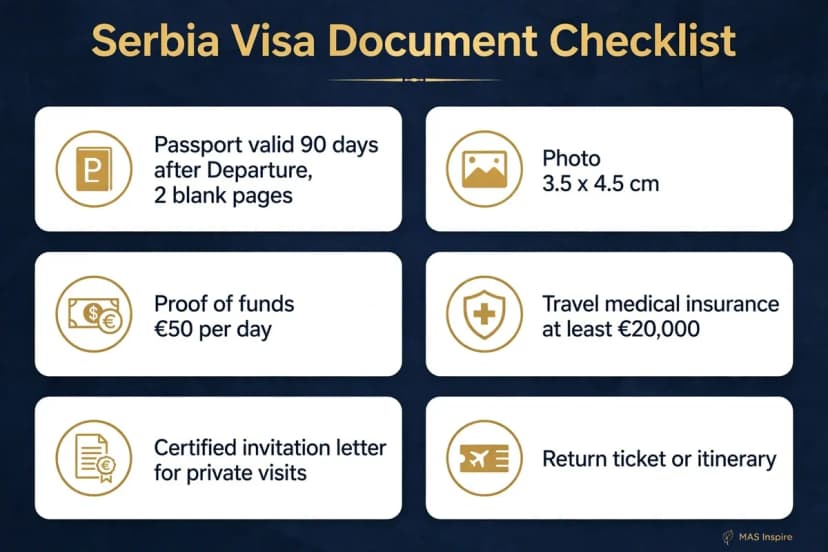
Complete Document Checklists
No single official checklist for Pakistani applicants living in Vietnam was published on an MFA page found for this guide, so the checklists below combine Serbia's official general visa requirements, Pakistan's MOFA page on Serbia, Serbian embassy document lists, and the Pakistan-focused 2026 guides that reproduce them. Prepare originals and clean scans; a blurry passport scan is a common reason an online application stalls. Do not staple documents when applying in person — Pakistan's MOFA page states that stapled documents will not be accepted, and incomplete applications will not be accepted.
Short visit — Visa C (tourism, private visit, business, events, transit)
- Pakistani passport issued within the last 10 years, valid at least 90 days after your planned departure from Serbia, with at least two blank pages side by side
- Completed Visa C application form (filled in on the portal for online applications)
- One recent photograph, 3.5 x 4.5 cm
- Travel medical insurance covering the whole stay, with cover of at least €20,000 for medical costs — the €30,000 figure quoted on some websites is the Schengen amount, not Serbia's
- Proof of sufficient funds: €50 for each day of stay, shown by cash or a bank statement (a 10-day trip means showing about €500, roughly PKR 155,000 at October 2026 rates)
- Return ticket or travel itinerary
- Proof of accommodation — hotel booking for the whole stay, or an invitation letter from your host in Serbia
- For a private visit: an invitation letter from your host, certified by the competent authority in Serbia (in practice attested by a court or the local municipality office where your host lives), carrying the host's details, your details, the reason for the invitation, and a statement that the host accepts responsibility for your stay costs and possible removal costs
- For tourism: proof of payment for the trip issued by a travel agency (voucher or other payment receipt)
- For business: an invitation letter and appropriate contracts, legal decision and certificates from the Serbian company or institution, plus a letter from the Pakistani company or institution you represent
- Proof you will leave Serbia before the visa expires — employment, studies, a business, or family ties in Pakistan or Vietnam
- A short cover letter stating your purpose, your travel dates, and your ties to Pakistan and Vietnam
- Proof of visa fee payment, if a fee applies to your application
- Your Vietnamese temporary residence card, for the journey home
Visa-free entry on a Schengen, UK, EU or US visa or residence permit
- Pakistani passport valid at least 90 days after your planned departure from Serbia, with at least two blank pages
- The qualifying visa or residence permit, valid for your whole stay in Serbia — carry it with your passport, and if the visa is in an old passport, carry both passports
- Travel medical insurance covering the whole stay (at least €20,000 cover)
- Proof of accommodation and of sufficient funds (€50 per day), and a return or onward ticket — border officers can ask for these even when no visa is needed
Long stay — Visa D (work, study, family reunification)
- Everything in the Visa C checklist above, plus:
- For employment: an invitation letter and contracts, legal decision and certificates from the Serbian employer, plus a letter from the Pakistani company or institution you represent, where applicable
- For study: an acceptance or enrolment letter from the recognised Serbian educational institution, and proof of funds for tuition and living costs
- For family reunification: proof of the family relationship (marriage certificate, birth certificate) and evidence of the family member's status in Serbia
- For medical treatment: confirmation from the Serbian medical institution
- Academic certificates and transcripts, where the purpose requires them
- Police clearance certificate and medical certificate, if the mission asks for them
Children travelling with you
- Each child needs their own passport, valid at least 90 days after departure, with two blank pages, and their own visa or visa-free entry
- Children's applications cannot be filed on the online portal, which accepts applicants aged 18 or over only — a child's application is filed in person at a Serbian embassy or consulate
- If a child under 18 travels without both parents, a parental consent letter in Serbian or English, verified by the Ministry of Foreign Affairs of Pakistan, must be presented
- Birth certificate showing the parents' names
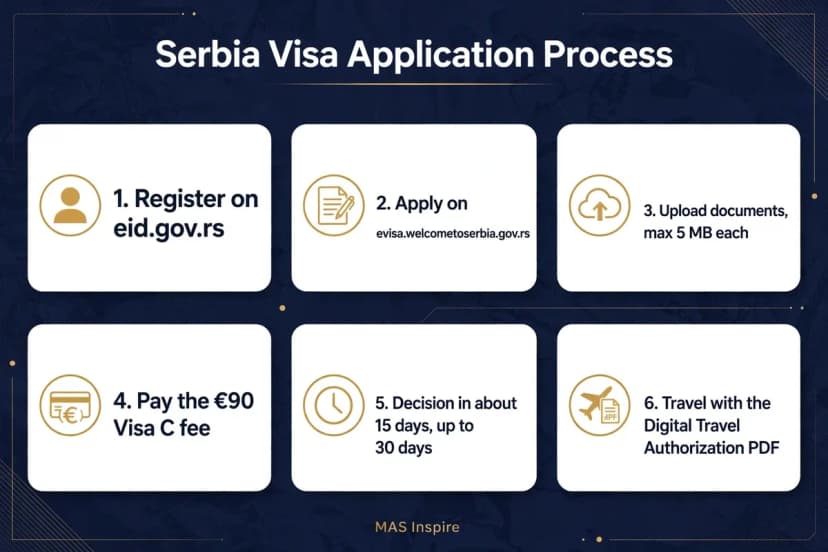
How to Apply: Step-by-Step
Online — Visa C through the Welcome to Serbia portal, step by step
Step 1 — Check the visa-free rule first. If you hold a valid multiple-entry Schengen, UK, EU or US visa, or a residence permit from one of those places, you may not need a Serbian visa at all. Do not start an application you do not need.
Step 2 — Register on Serbia's eGovernment portal. Create an account on eid.gov.rs, Serbia's Electronic Identification Portal. An account there is a prerequisite for the visa portal. The portal is for applicants aged 18 or over.
Step 3 — Open the Visa C portal. Go to evisa.welcometoserbia.gov.rs yourself by typing the address — never through a link in an email or an advertisement — and click "Start your application". Choose your travel purpose: tourism, private visit, business, and so on. The form asks different questions depending on the purpose.
Step 4 — Enter your details. Fill in your personal, family and employment data, then your passport data, exactly as they appear on your passport. Enter the visa and stay details — entry type, previous stays in Serbia, and your intended stay.
Step 5 — Upload your documents. Upload the passport bio-page scan, your photograph, your return ticket or itinerary, your accommodation proof or invitation, your proof of funds, and your travel medical insurance. Files must be in the accepted formats and no larger than 5 MB each, and each scan must be legible.
Step 6 — Pay, if a fee applies. Pay the €90 Visa C fee in the portal, in Serbian dinars at the National Bank of Serbia's middle exchange rate. If the portal shows no fee for a Pakistani passport, that is the fee-exemption note in action — keep the confirmation either way. See the fee conflict in the fees section and confirm with the Beijing embassy if the portal's behaviour is unclear.
Step 7 — Track your application. Check the status in the portal under "My Requests" at any time; updates also arrive by email. Standard processing is about 15 days, extendable to 30. If the mission asks for extra documents, answer quickly — the request can push the decision toward the 30-day limit.
Step 8 — Travel with the Digital Travel Authorization. The approval is issued as a PDF with QR codes for online verification and border checks. Print it and carry it with your passport, and keep a copy on your phone. Airlines check it at boarding, and border officers at Belgrade Nikola Tesla Airport will check it on arrival.
At a Serbian embassy — step by step
Use this route if the portal does not accept your application, if you are applying for a child, or if a mission specifically asks you to. Contact the mission first — for Pakistanis this is currently the Embassy of Serbia in Beijing, because the Tehran embassy stopped processing Pakistani applications on 30 June 2025 — and confirm that it accepts applications from Pakistani nationals resident in Vietnam, and ask for its current form, fee and document list, whether you need an appointment, and whether you must apply in person or can send the passport by courier. Submit the application in person with all documents and the fee, at least three weeks before your date of entry. Keep a copy of everything you submit and a receipt for everything you pay, and check the name, passport number, dates and entries on the visa before you leave the mission.
On arrival in Serbia — the white card and the entry stamp
Register your stay within 24 hours. Every foreigner in Serbia must register their place of stay with the police within 24 hours of arrival — the confirmation is commonly called the white card (beli karton), governed by Article 111 of the Law on Foreigners. Hotels and hostels register you automatically through the eTurista system; if you stay with friends or family, your host must register you; if you stay nowhere that registers you, you must register yourself at the police station for the address. Registration is free, but failing to register can be fined RSD 5,000 to 150,000 under Article 120, and the white card is later required if you apply for temporary residence. Keep your copy with your passport.
Cash declaration. If you carry cash or travellers' cheques worth more than €10,000, you must declare them at customs on arrival, keep the certified form while you are in Serbia, and show it on departure. The currency is the Serbian dinar (RSD); euros are not legal tender, though banks and exchange offices convert them freely.
Applying from Vietnam and Pakistan — No Serbian Mission in Either Country
For a Pakistani living in Vietnam, the important fact is that Serbia has no embassy or consulate in Vietnam — the Serbian embassy in Hanoi was closed in the 2001–2006 round of closures — and none in Pakistan either. In practice the online route covers it: Pakistan is one of the 46 nationalities enabled for the electronic Visa C, so a Pakistani resident of Vietnam can in principle apply entirely online without visiting any mission. Whether the fully electronic route works end-to-end for every Pakistani applicant is not settled in the sources, so confirm with the Beijing embassy before assuming the portal accepts you — and do not book non-refundable travel until the approval is in your inbox.
The Embassy of Serbia in Beijing — the desk for Pakistanis. Serbia covers Pakistan on a non-resident basis through its embassy in Tehran, but the Tehran embassy stopped processing Pakistani (and Afghan) visa applications on 30 June 2025. Its notice, and the Beijing embassy's own notice, direct citizens of Pakistan to apply to the Embassy of the Republic of Serbia in Beijing: No. 1, Dong Liu Jie, Sanlitun, Chaoyang District, Beijing 100600; telephone +86 10 6532 3516; email embserbia@embserbia.cn; website beijing.mfa.gov.rs. Consular services are by appointment, Monday to Friday. Whether the Beijing embassy accepts applications from Pakistani nationals resident in Vietnam is not stated on any source found for this guide. Write to it before you travel to Beijing, and ask in writing.
The Embassy of Serbia in Jakarta — accredited to Vietnam. The Serbian embassy in Jakarta is concurrently accredited to Vietnam (as well as Brunei, Cambodia, Malaysia, Philippines, Singapore, Thailand and Timor-Leste): Jl. H.O.S. Cokroaminoto No. 109, Menteng, Jakarta Pusat 10310, Indonesia; telephone +62 21 314 3560 / 314 3720; email consular.jakarta@mfa.rs; website jakarta.mfa.gov.rs. It is the mission accredited to the country where you live, and the closest Serbian mission to Ho Chi Minh City. Whether it accepts visa applications from Pakistani nationals is not confirmed on any source found for this guide. Ask it in writing too, before you travel to Jakarta.
The Embassy of Serbia in Tehran — covers Pakistan, not currently processing. No. 3, 4th Alley, North Mohammad Reza Shajarian St., Shahrak e Qods (Gharb), Tehran, Iran. It is the mission that formally covers Pakistan, but it is not processing Pakistani visa applications until further notice, and it refers applicants to Beijing. Do not travel to Tehran for a Serbian visa.
There is no Serbian embassy in Islamabad. Some commercial guides list an "Embassy of Serbia in Islamabad" with an appointment and biometrics process. That is wrong: Serbia has no embassy or consulate in Pakistan, only an honorary consulate in Karachi, and the MFA does not say the honorary consulate handles visas. Any guide or agent that tells you to book an appointment at a Serbian embassy in Islamabad is working from bad information. The Islamabad embassy was closed years ago, and the two capitals were still discussing reopening it as recently as November 2025.
Your own mission in Serbia. Pakistan has an embassy in Belgrade: Bulevar Kneza Aleksandra Karadjordjevica 62, 11040 Belgrade; telephone +381 11 2661 676; email parepbelgrade@mofa.gov.pk. Keep its details with your passport before you travel — it is your consular help if you lose your passport or get into difficulty in Serbia.
| Mission | Address | Contact | Note |
|---|---|---|---|
| Embassy of Serbia, Beijing (desk for Pakistanis) | No. 1, Dong Liu Jie, Sanlitun, Chaoyang District, Beijing 100600 | +86 10 6532 3516; embserbia@embserbia.cn | Ask in writing first whether it accepts applications from Pakistani residents of Vietnam |
| Embassy of Serbia, Jakarta (accredited to Vietnam) | Jl. H.O.S. Cokroaminoto No. 109, Menteng, Jakarta Pusat 10310, Indonesia | +62 21 314 3560 / 3720; consular.jakarta@mfa.rs | Closest mission to Ho Chi Minh City; whether it takes Pakistani nationals is unconfirmed |
| Embassy of Serbia, Tehran (covers Pakistan) | Tehran, Iran | Confirm before travel | Not processing Pakistani applications since 30 June 2025; refers applicants to Beijing |
| Embassy of Serbia, New Delhi | New Delhi, India | Confirm before travel | Accredited to Bangladesh, Bhutan, Maldives, Nepal, Sri Lanka — not Vietnam or Pakistan |
| Honorary Consulate of Serbia, Karachi | Karachi, Pakistan | Confirm before travel | Honorary consulate; the MFA does not say it handles visas |
| Embassy of Pakistan, Belgrade | Bulevar Kneza Aleksandra Karadjordjevica 62, 11040 Belgrade | +381 11 2661 676; parepbelgrade@mofa.gov.pk | Your own mission in Serbia |
Flights. There is no direct flight from Vietnam to Serbia, and none from Pakistan either. The realistic corridors from Ho Chi Minh City are Turkish Airlines via Istanbul, Qatar Airways via Doha, Emirates via Dubai, and Etihad via Abu Dhabi, with onward connections to Belgrade Nikola Tesla Airport (BEG). Book the whole journey on one ticket where you can, and leave a generous connection time — a self-transfer through Belgrade without a Serbian visa is not possible, because you would have to leave the transit zone.
The polio certificate. Pakistan checks the polio vaccination of departing travellers: a polio vaccination certificate from NADRA is needed to leave Pakistan. This is a Pakistani exit requirement, not a Serbian entry requirement, and it applies if your journey starts in Pakistan. There are no mandatory vaccinations for entry to Serbia itself, and no COVID-19 entry restrictions are in place.
Money and safety on arrival. The currency is the Serbian dinar (RSD), at roughly 117 dinars to the euro in November 2026. Exchange cash at banks or licensed exchange offices rather than on the street. The US State Department rates Serbia Level 2, "Exercise Increased Caution", updated 26 August 2026, because of crime — petty theft in tourist areas, occasional violence linked to organised crime or sporting events. The FCDO does not advise against travel to any part of Serbia (page updated 22 October 2026) but warns of demonstrations in Belgrade and other cities. Emergency numbers: police 192, ambulance 194, fire 193. One border warning from the FCDO: Serbia does not consider the designated crossing points with Kosovo to be official international border crossings, and you are likely to be refused entry into Serbia from Kosovo without a Serbian entry stamp from an airport or a land border with a neighbouring country.
Student Visa and Studying in Serbia
Serbia's universities — above all the University of Belgrade, the University of Novi Sad and the University of Niš — teach a growing number of programmes in English, and tuition is lower than in most of Western Europe. The route for a Pakistani student is a Visa D followed by temporary residence for study.
The route. First, get an acceptance or enrolment letter from a recognised Serbian educational institution. Then apply for a Visa D for study (90 to 180 days, €50 on the portal) from Vietnam, through the online portal or the Beijing embassy. On arrival in Serbia, register your stay within 24 hours (the white card), then apply for temporary residence for study before the D visa runs out — temporary residence can be granted for up to three years and is issued for the study period. The application is made online through the portal for foreigners, with the institution usually guiding the filing. Fees for temporary residence are RSD 430 for the application plus RSD 23,450 for approval, plus RSD 2,028 for the biometric card — but foreign students on Serbian government scholarships do not pay the temporary residence fee.
What you need to show. The acceptance letter, proof of funds for tuition and living costs (the €50-a-day rule applies to the stay, and the mission will want to see that the course and the living costs are covered), your academic certificates and transcripts, travel medical insurance, and a police clearance certificate and medical certificate if the mission asks for them. Serbian universities commonly teach in English, but the institution sets its own language requirement.
Working while you study. Study-based residence generally allows work of up to 16 hours a week, subject to the applicable conditions. One rule that matters for long-term planning: time spent in Serbia on study residence is counted at only 50% toward permanent residence after you change to another qualifying basis. Do not plan a permanent-residence timeline on study years alone.
Teaching English in Serbia. Readers of this guide are often English teachers, so this deserves a direct answer. Serbia is not an English-speaking country — Serbian is the official language — but there is demand for English teachers in private language schools and international schools in Belgrade and Novi Sad. There is no special English-teacher visa: you need a job offer first, then a Visa D and the employer-linked single permit, exactly as in the work section below. Do not fly to Belgrade on a Visa C and expect to be hired on arrival.
Work Visa and the Single Permit
Serbia wants foreign workers in sectors with shortages, and since February 2024 the system has been simpler than it used to be: residence and work authorisation are one document, the single permit. But the route still starts with a job offer, and you cannot work on a visitor visa while you wait.
The route. First, get a genuine job offer and a signed employment contract from a registered Serbian employer. Then apply for a Visa D for employment (90 to 180 days, €50 on the portal) from Vietnam, through the online portal or the Beijing embassy. On arrival, register your stay within 24 hours, then apply for the single permit — the combined temporary residence and work permit — online through the portal for foreigners (eforeigner.welcometoserbia.gov.rs). You appear in person once, at the police station, to give biometrics. A properly completed single-permit application should be decided within 15 days. The permit is issued for up to three years, renewable on the same basis, and it is tied to the specific employment contract: if you change employers, the permit needs to be updated. A separate work permit has not been required since the 2024 reform.
Fees. The single permit costs RSD 430 for the application plus RSD 22,770 for approval, a total of RSD 23,200 (about €197), plus RSD 2,028 for the biometric card. The full first-permit cost with the card is about RSD 27,418 per adult, per the government decree of 12 September 2026. All fees are payable at submission and are non-refundable.
What the employer must do. The single-permit process is employer-linked: the employer is part of the filing, and for most employment routes a labour market test applies — the employer must show the post could not be filled locally — though the exact test depends on the route and the occupation. Get the fee, the timeline and the employer's obligations confirmed by the employer and the portal before you resign from anything or book anything.
Self-employment and company owners. The single permit also covers self-employment, company owners, posted workers, intra-company transferees, independent professionals and trainees. Owners of a home in Serbia, spouses of Serbian citizens and students work without a single permit, under their own residence basis.
Never work on a Visa C. A short-stay visa does not give the right to employment, except for short business activities expressly allowed by law. Working without a permit can be fined RSD 15,000 and above, and can lead to a return decision and an entry ban. Never travel on a tourist visa intending to start work: the permit must come first.
Family Reunification and Permanent Residence
Family reunification. If your spouse, parent or child is a Serbian citizen or a lawful resident of Serbia, you can apply for a Visa D for family reunification (90 to 180 days, €50 on the portal), then for temporary residence on the family basis inside Serbia. You will need proof of the relationship — a marriage certificate or birth certificate — and evidence of the family member's status in Serbia, plus the standard documents: passport, photograph, proof of funds (€50 a day), travel medical insurance, and accommodation proof. Family members of a temporary residence holder can apply for reunification on the same basis, and the residence is granted for up to three years, renewable while the family basis continues.
Permanent residence. After three years of continuous qualifying temporary residence, you can apply for permanent residence. This is the reformed rule: Serbia shortened the normal route to permanent residence from five years to three in the 2024 reforms. Some older summaries still state five years — that is the pre-reform figure, and this guide treats the three-year rule as the current one. Time spent on study residence is counted at only 50% toward permanent residence after you change to another qualifying basis, so a student who later works should plan on that discount. Permanent residence is the step before citizenship; one 2026 guide reports citizenship from six years, but this guide could not confirm that figure against an official source, so it is unverified here.
Property ownership. Owning immovable property in Serbia is a recognised basis for a Visa D and for temporary residence, and the law sets no minimum property price. Buying a home does not by itself grant citizenship or permanent residence. Get independent legal advice in Serbia before buying property for immigration purposes — this guide is not that advice.
Common Mistakes That Get Applications Delayed or Refused
Applying for the wrong visa for the real plan. Applying for a short visit when the actual intention is to stay long-term or work. That needs a Visa D and, for work, the single permit. A Visa C cannot be converted into a work permit inside Serbia.
A trip story that does not hold together. Hotel dates, leave letters, bank activity and the stated purpose pointing at different trips.
Weak proof of funds. A statement that cannot cover €50 a day, or a balance that appeared the week before you applied with no activity behind it. Present a recent statement covering the last three to six months with a steady history. A last-minute deposit invites questions.
A weak invitation package. A vague letter from a host, missing host details, a vague purpose, or no responsibility statement. For a private visit the invitation letter must be certified by the competent authority in Serbia — a court or the local municipality office where your host lives. An uncertified letter weakens the file.
Thin return ties. Nothing in the file showing a job, studies, a business or family that brings you back to Pakistan or Vietnam. For a Pakistani living in Vietnam, show both: your employment in Vietnam and your ties to Pakistan. Your Vietnamese TRC helps here — include it.
Passport problems. A passport issued more than 10 years ago, valid for less than 90 days after your planned departure, or without two blank pages side by side. Renew it before you apply.
Booking non-refundable travel before the approval. Do not pay for non-refundable flights or hotels until the Digital Travel Authorization is in your inbox. Processing can extend to 30 days, and a request for extra documents can push it further.
Forgetting the white card. Failing to register your stay within 24 hours of arrival. Hotels do it automatically, but if you stay with friends or family, your host must do it — and the fine for failing to register is RSD 5,000 to 150,000.
Entering from Kosovo without a stamp. Serbia does not treat Kosovo crossing points as international borders. Entering Serbia from Kosovo without a Serbian entry stamp risks refusal at the border.
Reasons for Refusal and What to Do After a Refusal
Serbia does not publish refusal statistics for Pakistani applicants, and this guide does not invent any. The reasons below are the ones the 2026 Pakistan-focused guides and the official document lists agree are the commonest, and they match the refusal grounds in Serbia's visa practice generally.
Unclear purpose of the visit. The file does not convince the officer that the stated purpose is real — a tourist with no itinerary, a business visitor with no Serbian counterpart, a private visitor with a vague invitation. Fix it with a specific, dated itinerary and a certified invitation that names the host, the dates and the responsibility for costs.
Insufficient funds. The bank statement cannot cover €50 a day, or the balance has no history behind it. Fix it with a statement covering three to six months of genuine activity, and do not submit a last-minute deposit as if it were savings.
Weak ties to home. Nothing showing you will leave Serbia before the visa expires. Fix it with an employer's no-objection certificate and salary slips, an enrolment letter, business registration and tax records, or family documents — and show your Vietnamese employment and residence as well as your Pakistani ties.
Doubts about the documents. Falsified bank statements, doctored documents or an invitation that cannot be verified lead to refusal, and can bring a ban on future applications. Never submit anything that is not genuine. If a document is weak, leave it out and strengthen the file honestly rather than improving it on paper.
Wrong visa category. Applying for a Visa C when the real plan is work, study or a stay over 90 days. Fix it by applying for the right category — Visa D and the single permit for work, Visa D and temporary residence for study — even though that takes longer.
After a refusal. Read the stated reason, fix that specific weakness, and apply again with a file that answers it. Reapplying with the same file rarely changes the answer. If the weak point is your profile itself — little travel history, thin ties — it can pay to build a record first: take a few easier trips, keep a clean entry-and-exit record on each one, and then apply for Serbia with the stronger history behind you. A refusal can also be challenged through an appeal to Serbia's Ministry of Foreign Affairs instead of starting over; the New Delhi price list puts the appeal fee at €100. Get the appeal deadline and procedure from the refusing mission, because this guide could not confirm them from an official source.
Overstay: what it costs. Staying longer than 90 days in 180 without a permit makes your stay unlawful under Article 74 of the Law on Foreigners. The fine for unlawful stay is RSD 50,000 to 150,000 (about €425 to €1,275) under Article 122, and the authority issues a return decision with a deadline of 7 to 30 days to leave voluntarily. An entry ban of up to five years can be added if no voluntary-return period was granted or you miss the deadline, or on other grounds in Article 78. Some commercial guides quote much smaller fines — €50 to €100, or RSD 5,000 to 50,000 — but those figures are not traced to the law, and this guide treats the Law on Foreigners figures as controlling. Do not overstay, even by a day: the 90-day rule is a rolling 180-day window, and every day you spend in Serbia counts toward it.
Frequently Asked Questions
1. Do Pakistani citizens need a visa for Serbia?
Yes, if you hold an ordinary Pakistani passport. Serbia's Ministry of Foreign Affairs states that ordinary Pakistani passport holders require a visa. Only diplomatic and official passport holders are exempt, for visits of up to 30 days. The exception is if you hold a valid Schengen, UK, EU or US visa, or a residence permit from one of those places — then you can enter without a Serbian visa for up to 90 days in six months.
2. Can I enter Serbia with a valid Schengen, UK or US visa instead of a Serbian visa?
Yes, under a Serbian Government decision of 30 October 2014. Holders of a valid Schengen, UK, EU member state or US visa, or a residence permit of a Schengen country, the EU or the US, may enter, transit and stay in Serbia for up to 90 days in a six-month period, within the validity of that visa or permit. The MFA's wording does not say the visa must be multiple-entry, but the New Delhi embassy mentions multiple-entry visas, so travel on a multiple-entry visa if you can.
3. How much is the Serbia visa fee for Pakistanis?
The standard Visa C fee is €90, paid in Serbian dinars at the National Bank of Serbia's middle exchange rate (about 10,590 RSD). At an embassy the adult fee is €92, per the New Delhi price list. There is a genuine conflict: Serbia's official Visa C instructions carry a fee-exemption note naming Pakistani passports, and some guides say Pakistanis pay nothing on the portal, while other guides report €90 is actually charged. Budget for €90 and confirm with the Beijing embassy before you pay.
4. Can Pakistani applicants apply for a Serbia visa online?
Yes. Register on Serbia's eGovernment portal (eid.gov.rs), then apply at evisa.welcometoserbia.gov.rs. Pakistan is one of the 46 nationalities enabled for the electronic Visa C, issued since April 2025 as a Digital Travel Authorization — an approval PDF with QR codes, instead of a sticker. The portal accepts applicants aged 18 or over only; children apply in person at an embassy. Whether the fully electronic route works end-to-end for every Pakistani applicant is not settled in the sources, so confirm with the Beijing embassy before assuming the portal accepts you.
5. How long does Serbia visa processing take?
About 15 days in standard cases, according to Serbia's MFA, extendable to 30 days in individual cases. A request for extra documents can push the decision toward the 30-day limit. You can apply no earlier than three months before travel, and Pakistan's MOFA page says in-person applications must be lodged at least three weeks before entry. Apply early and do not book non-refundable travel until the approval arrives.
6. How long can I stay in Serbia on a visit visa?
Up to 90 days in any 180-day period on a Visa C, which can be issued for one, two or multiple entries, with a validity of up to five years for multiple-entry visas. The visa-free route on a Schengen, UK, EU or US visa or residence permit also allows up to 90 days in six months, within that visa or permit's validity. Serbia's 90 days are counted separately from the Schengen 90 days.
7. How much money do I need to show for a Serbia visa?
€50 for each day of your stay — roughly PKR 15,500 per day at October 2026 rates. A 10-day trip means showing around €500 (about PKR 155,000), ideally as a bank balance with a steady three-to-six-month history rather than a last-minute deposit. Serbia publishes no fixed bank-statement period or minimum balance beyond the €50-a-day rule; agency benchmarks of PKR 1,800,000 to 3,500,000 are advisory, not official.
8. Is there a Serbian embassy in Vietnam or Pakistan?
No, in neither country. The Serbian embassy in Jakarta is accredited to Vietnam, and the embassy in Tehran formally covers Pakistan but stopped processing Pakistani applications on 30 June 2025, referring applicants to the Embassy of Serbia in Beijing (+86 10 6532 3516, embserbia@embserbia.cn). There is no Serbian embassy in Islamabad — only an honorary consulate in Karachi, which does not handle visas. For most Pakistani applicants the online e-visa route is the practical option.
9. What documents do I need for a Serbia visa?
A passport issued within the last 10 years, valid at least 90 days after you leave Serbia, with two blank pages; a completed application form; one 3.5 x 4.5 cm photograph; travel medical insurance with at least €20,000 cover; proof of €50 a day in funds; a return ticket or itinerary; proof of accommodation or a certified invitation letter; and proof you will leave Serbia before the visa expires.
10. Do I need to register with the police after arriving in Serbia?
Yes. Every foreigner must register their place of stay within 24 hours of arrival — the confirmation is commonly called the white card. Hotels and hostels register you automatically; if you stay with friends or family, your host must register you; otherwise you register yourself at the police station. Registration is free, but failing to register can be fined RSD 5,000 to 150,000. Also make sure the border guard stamps your passport on entry.
11. Can I work in Serbia on a tourist visa?
No. A Visa C does not give the right to employment. You need a job offer from a Serbian employer first, then a Visa D for employment, then the single permit — the combined temporary residence and work permit — applied for online in Serbia and decided within about 15 days. Working without a permit can be fined and can lead to a return decision and an entry ban.
12. Can I study in Serbia, and can I work while studying?
Yes. Apply for a Visa D for study with an acceptance letter from a recognised Serbian institution, then for temporary residence for study inside Serbia, valid for up to three years. Study-based residence generally allows work of up to 16 hours a week, and students on Serbian government scholarships do not pay the temporary residence fee. Time on study residence counts at only 50% toward permanent residence if you later change to another basis.
13. What happens if I overstay my visa in Serbia?
Your stay becomes unlawful under Article 74 of the Law on Foreigners. The fine is RSD 50,000 to 150,000 (about €425 to €1,275) under Article 122, and the authority issues a return decision with 7 to 30 days to leave voluntarily. An entry ban of up to five years can be added. Some commercial guides quote much smaller fines, but the Law on Foreigners figures are the controlling ones. Apply for temporary residence before your 90 days run out, or leave on time.
14. Are there direct flights from Vietnam or Pakistan to Belgrade?
No. The realistic corridors from Ho Chi Minh City are Turkish Airlines via Istanbul, Qatar Airways via Doha, Emirates via Dubai, and Etihad via Abu Dhabi, connecting to Belgrade Nikola Tesla Airport. Book on one ticket where you can, and do not book a self-transfer through Belgrade without a Serbian visa, because you would have to leave the transit zone.
15. Do I need travel insurance and a polio certificate for Serbia?
Travel medical insurance is required for the visa, with cover of at least €20,000 for medical costs, for the whole stay. The polio vaccination certificate from NADRA is a Pakistani exit requirement, not a Serbian entry requirement — it is needed to leave Pakistan, and it applies if your journey starts there. There are no mandatory vaccinations for entry to Serbia itself.
Official Immigration Websites
| Website | What it is | Link |
|---|---|---|
| Ministry of Foreign Affairs of Serbia — Visa regime for Pakistan | Official MFA page: ordinary Pakistani passports need a visa; diplomatic and official passports visa-free up to 30 days | mfa.gov.rs — visa regime, Pakistan |
| Welcome to Serbia — official e-visa portal | Serbia's official portal for electronic visa applications and the portal for foreigners | welcometoserbia.gov.rs |
| Welcome to Serbia — eApplication for Visa C | The online Visa C application: register on eid.gov.rs first, then apply here | evisa.welcometoserbia.gov.rs |
| Serbia eID portal | Serbia's Electronic Identification Portal — an account here is a prerequisite for the visa portal | eid.gov.rs |
| Pakistan Ministry of Foreign Affairs — Visa Requirement for travelling to Serbia | Official Pakistan page: Visa C and Visa D requirements, €50 a day, photo size, parental consent for minors, apply three weeks before entry | mofa.gov.pk — Serbia visa requirements |
| Embassy of Serbia in Beijing — Important information about visa applications | Official notice directing citizens of Pakistan to apply to the Beijing embassy after Tehran stopped processing | beijing.mfa.gov.rs — visa applications |
| Embassy of Serbia in New Delhi — Price list of consular services | Official mission price list: Visa C €92 (adult), €47 (under 12), Visa D €52, appeal €100 | newdelhi.mfa.gov.rs — price list |
| UK Foreign, Commonwealth and Development Office — Serbia entry requirements | Passport valid 90 days after departure, entry stamp warning, 24-hour police registration, Kosovo crossing warning; no advice against travel (updated 22 Oct 2026) | gov.uk — Serbia entry requirements |
| US Department of State — Serbia Travel Advisory | Level 2: Exercise Increased Caution, due to crime (updated 26 Aug 2026) | travel.state.gov — Serbia advisory |
| Wikipedia — List of diplomatic missions of Serbia | Jakarta embassy accredited to Vietnam; Hanoi and Islamabad embassies closed in 2001–2006 | en.wikipedia.org — diplomatic missions of Serbia |
| UrduPoint — Serbia Visa for Pakistanis 2026 | Pakistan-focused guide, checked 19 Nov 2026: visa-free with Schengen/UK/EU/US visa, Tehran refers Pakistanis to Beijing | urdupoint.com — Serbia visa for Pakistanis |
| DUA Services — Serbia Visit Visa for Pakistanis 2026 | Pakistan-focused guide, checked 28 Oct 2026: €90 Visa C fee, e-visa steps, Digital Travel Authorization, €50-a-day funds | duaservicess.com — Serbia visit visa |
| Visarun — Serbia: Visa Requirements 2026, Fees & How to Apply | 2026 guide: €90 Visa C / €50 Visa D fees, New Delhi price list, Pakistani fee-exemption note | visarun.ai — Serbia visa requirements |
| Travel Requirements — Serbia | MFA-derived entry rules: €50 a day, insurance of at least €20,000, white card, overstay fine RSD 50,000–150,000 | travelrequirements.info — Serbia |
| iReside — Serbia Visa-Free | Law on Foreigners articles: 90 days in 180, unlawful stay, RSD 50,000–150,000 fine, return decision, entry ban up to 5 years | ireside.ai — Serbia visa-free |
| Advokat Novi Sad — Residence Permit in Serbia for Foreigners | Serbian law firm guide: white card, Visa C/D, single permit, residence fees | advokat-novi-sad.com — residence permit |
| Krešo Law — Registration of place of stay (white card) | Serbian law firm guide: 24-hour registration, who registers, fines under Article 120 | kresolaw.rs — white card |
| Murblz — How to move to Serbia in 2026 | 2026 residence guide: single permit RSD 23,200, residence up to 3 years, permanent residence after 3 years | murblz.com — move to Serbia |
| Consilio — Serbia Residence Permit 2026 | 2026 residence guide: single permit 15-day decision, residence 30 days, 3-year route to permanent residence | consiliojus.com — residence permit |
| Pakistan Ministry of Foreign Affairs — Embassy of Pakistan, Belgrade | Your own mission in Serbia: Bulevar Kneza Aleksandra Karadjordjevica 62, 11040 Belgrade; +381 11 2661 676; parepbelgrade@mofa.gov.pk | mofa.gov.pk — Belgrade contact |
Final Checklist and Conclusion
Serbia rewards the traveller who does the paperwork properly. The visa is not free and not instant, but it is straightforward: an online application, a €90 fee (or possibly none — confirm it), a 15-day wait, and a PDF approval with QR codes. The single most valuable step costs nothing: check whether a Schengen, UK, EU or US visa or residence permit you already hold lets you enter without a Serbian visa at all. The second is the one most travellers skip: write to the Beijing embassy before you assume anything about where a Pakistani resident of Vietnam applies.
Before you apply: check whether your Schengen, UK, EU or US visa or residence permit already lets you in visa-free — and make sure it is multiple-entry and valid for your whole stay. Check your passport: issued within the last 10 years, valid at least 90 days after you leave Serbia, with two blank pages. Renew your Vietnamese TRC if it is close to expiry. Buy travel medical insurance with at least €20,000 of cover for the whole stay.
When you apply: register on eid.gov.rs, apply on evisa.welcometoserbia.gov.rs, upload clear scans under 5 MB each, and pay the fee the portal shows — budgeting €90 until the exemption is confirmed in writing. Apply no earlier than three months before travel and at least six weeks before you need the answer. Do not book non-refundable travel until the Digital Travel Authorization is in your inbox. If the portal does not accept you, or you are applying for a child, write to the Beijing embassy first.
When you travel: carry the printed Digital Travel Authorization, your passport, your return ticket, your hotel booking or certified invitation, your proof of funds and your insurance. Keep your Vietnamese TRC with your passport for the journey home. At the border, make sure your passport is stamped. Within 24 hours of arrival, make sure your stay is registered — your hotel does it automatically, otherwise your host or you must do it at the police station. Declare cash over €10,000 at customs. Stay within 90 days in 180, or apply for temporary residence before the 90 days run out.
This guide was checked on 28 November 2026. Visa rules change without notice. Always confirm the live rules on mfa.gov.rs and welcometoserbia.gov.rs, and with the Embassy of Serbia in Beijing, before paying any fee or booking a non-refundable ticket. Nothing in this guide is immigration advice; the Serbian authorities set and enforce the entry rules, and the immigration officer at Belgrade makes the final decision. No visa outcome is guaranteed.