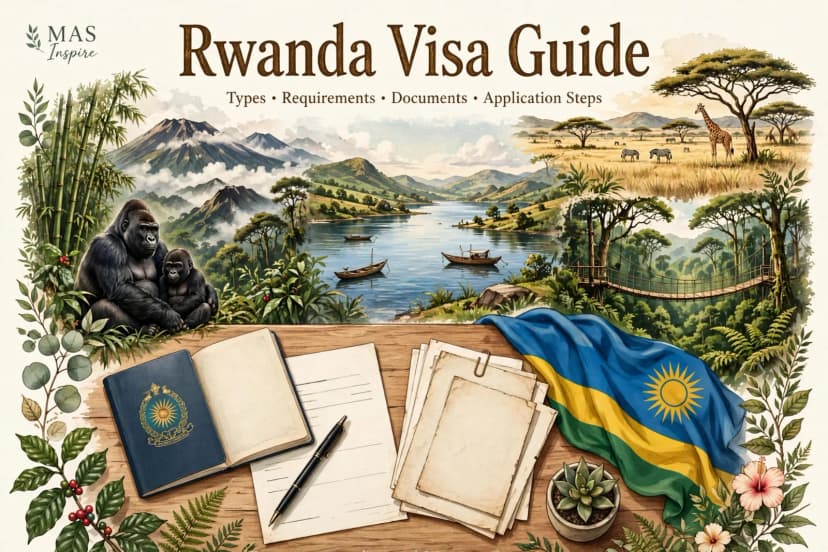
Rwanda Visa Guide 2026: Types, Requirements, Documents and Application Steps
Last checked: 28 November 2026. This guide is for Pakistani passport holders living in Vietnam. Visa rules change without notice — always confirm the live rules on the Rwanda Directorate General of Immigration and Emigration website (migration.gov.rw) and the Irembo portal (irembo.gov.rw) before paying any fee or booking a non-refundable ticket.
Introduction
Rwanda is the easiest African visa story in this whole series. Since 1 January 2018, citizens of every country can get a visa on arrival at Kigali International Airport and at every land border, and citizens of Commonwealth, African Union and La Francophonie member countries — Pakistan among them — get that 30-day visa with the fee waived. For a Pakistani living in Vietnam, the visa itself is the least of your problems. The real work is the journey, the health rules, and knowing which of the conflicting fee and processing figures floating around the internet actually comes from the Rwandan government.
Kigali is one of Africa's cleanest and safest capitals, a city of green hills and a fast-growing conference and tech scene. Beyond it lie the mountain gorillas of Volcanoes National Park — the most famous wildlife experience in Africa, and the most expensive, at USD 1,500 a permit — the savannah of Akagera, the rainforest canopy walk of Nyungwe, and Lake Kivu. The Rwanda Development Board registers a company in as little as six hours. This guide covers the tourist route first, then the work, business and study routes, the East Africa Tourist Visa, and the health and safety rules that have changed in 2026.
One warning belongs in the first minute. Rwanda's entry rules are generous, but the numbers quoted about them are not consistent: the online processing time is given as four days by Irembo, about seven days by a Pakistan-focused guide, and two to eight days by another 2026 guide; the work-permit fee is quoted anywhere from USD 200 to USD 500; the overstay fine as USD 10 a day by one source and as a stepped scale reaching one million Rwandan francs by another. This guide names the controlling source for every figure and reports the conflicts instead of hiding them.
Do Pakistani Passport Holders Need a Visa for Rwanda?
Yes, formally — but no in practice. An ordinary Pakistani passport holder needs a visa to enter Rwanda, and Pakistan is not on Rwanda's list of nationalities that enter with no visa at all. But since 1 January 2018, citizens of all countries receive a visa on arrival at Kigali International Airport and at all land borders, with no application before departure. For Pakistanis, that visa on arrival is free for a 30-day visit, because Pakistan is a member of the Commonwealth and the DGIE waives visa fees for a 30-day visit for citizens of Commonwealth, African Union and La Francophonie member countries. The DGIE's own page states this in plain words: "Citizens of countries members to the following international organizations; African Union, Commonwealth and La Francophonie get visa upon arrival and are waived visa fees for a visit of 30 days." Pakistan is listed by name in the DGIE's visa-regime document among the countries covered, and Wikipedia's visa-policy summary lists Pakistan in the 30-day fee-waiver group as well.
One terminology trap: some sources — including Wikipedia's visa-policy page — call this "visa not required (30 days)" or "visa-free entry", but the DGIE itself does not call it visa-free: it says you "get visa upon arrival" and the fee is waived. You still present yourself at an immigration desk, the officer still decides, and you still need a passport valid for at least six months and evidence of sufficient funds. What you do not need is a prior application, an appointment, or a fee.
The rule follows your passport, not where you live. Living in Vietnam, holding a Vietnamese temporary residence card (TRC), or holding a US, UK or Schengen visa does not change the Rwandan rule — but in this case it does not need to, because the rule is already generous. Your Vietnamese residence matters for the journey home: keep your TRC valid for the whole trip and carry it with your passport, because it is your proof of the right to return to Vietnam. If your TRC is close to expiry, renew it before you travel.
The free 30-day arrangement covers a short visit only — tourism, family visits, meetings. It does not cover work: the DGIE states plainly that the visitor's visa and the East Africa Tourist Visa "should not be used for employment". If you intend to work, study, or stay longer than 30 days, you need a different visa class, covered in the types and work sections below.
Visa on Arrival and the Free 30-Day Commonwealth Waiver
Fly to Kigali, present your Pakistani passport at immigration, and you should be issued a visa on arrival for a 30-day visit with no fee. No form needs to be filled in before travel, no embassy visit is needed, and no agent is needed — the DGIE warns that there is no authorised agent at all, and that agents "may mislead you and charge more than the visa fees". Any website or agent offering to "arrange" your Rwanda visa for a fee is selling you something the Rwandan government gives you at the border.
Three cautions keep the good news honest. First, the fee waiver covers a visit of 30 days only. If you want a multiple-entry visa valid for 90 days, the waiver does not cover it: the standard fee is USD 70 for multiple entries, and the single-entry 30-day visa for a traveller who is not covered by the waiver is USD 50. Those two figures — USD 50 single entry, USD 70 multiple entry — are the DGIE's published caps: the DGIE states that visa fees "must not exceed US$50 for a single entry visa or US$70 for multiple entry", and the same figures appear on the Rwanda High Commission in Kenya's official visa page, on the Irembo fee tables, and across the 2026 guides. They are the best-verified figures in this guide.
Second, carry USD 50 in cash anyway. The waiver is the published rule, confirmed by multiple Pakistan-focused guides checked in November 2026 — but counter practice can differ from web pages, and if an officer applies the standard USD 50 fee instead of the waiver, you want to be able to pay it on the spot. Carry clean, undamaged US dollar notes printed in 2006 or later: older notes are widely refused in East Africa. The same applies online: if Irembo charges you, pay the amount the portal shows and keep the receipt — fees are not refunded if an application is denied or withdrawn.
Third, the visa on arrival is a decision made by an immigration officer, not a right. The officer may ask for your return or onward ticket, your hotel booking or invitation, and proof of sufficient funds — the DGIE states that an applicant "must have sufficient funds to cover the costs of their stay in Rwanda" and that evidence "may be requested" at the entry point. Carry those documents in your hand luggage, not in checked baggage. A traveller who arrives with no return ticket, no accommodation and no visible means of support can be refused even when the visa itself is free.
The one practical dispute in this section. A small number of commercial aggregator sites list a Rwanda holiday-visa "total cost" of USD 120, roughly double the DGIE's USD 50 single-entry figure. No official source found for this guide supports USD 120 as a government fee. It most likely bundles an agency margin on top of the government fee: do not budget against it, and do not pay it to a third party when the DGIE and Irembo are the only official channels.
Types of Rwanda Visas for Pakistani Passport Holders
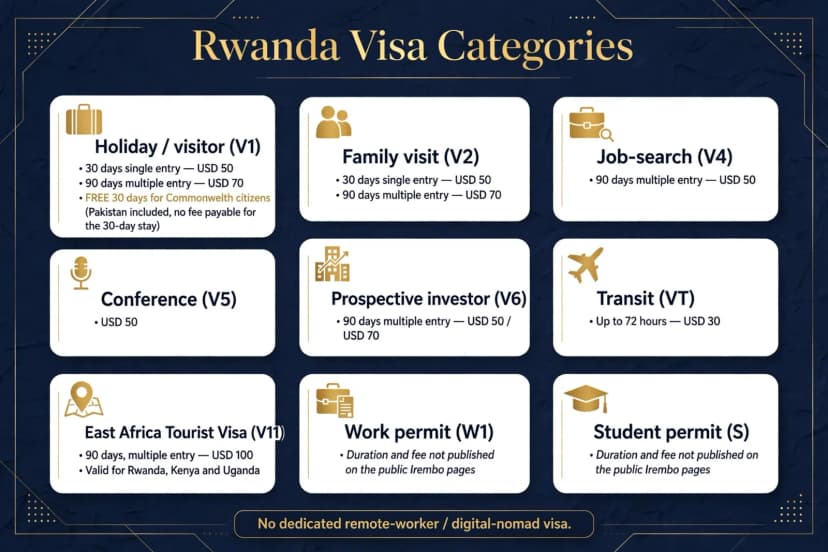
Rwanda's visa classes are lettered — V1, V2, V3 and so on for visitor visas, with separate letter classes for residence and work permits. The classes below are the ones a Pakistani living in Vietnam is realistically likely to use. Fees quoted are the DGIE's published figures as carried on the Rwanda High Commission in Kenya's official visa page and the Irembo fee tables, unless flagged otherwise.
Holiday / visitor visa (V1)
The standard short-stay visa for holidays, sightseeing, social visits and short family visits. Single entry, valid for 30 days; multiple entry, valid for 90 days. Standard fee USD 50 single entry or USD 70 multiple entry — waived for a 30-day visit for Commonwealth citizens, Pakistan included. Available on arrival at Kigali airport and land borders, or online through Irembo. Work is not allowed, and the visa "may be extended in exceptional circumstances". This is the visa almost every reader of this guide will use.
Family visit visa (V2)
For visiting family resident in Rwanda. The same fee shape as V1 — USD 50 single entry, USD 70 multiple entry, 30 days single or 90 days multiple — and the same extension treatment. You will need evidence of the family relationship and your host's invitation letter.
Diplomat visa (V3)
For a foreign diplomat visiting Rwanda for official purposes. Free of charge, valid for 30 days with multiple entries, issued on arrival, online or at an embassy. Needs a Note Verbale and two passport photographs on a white background.
Job-search visa (V4)
For a foreign skilled worker seeking employment whose skills are on Rwanda's Occupations on Demand List. Fee USD 50, multiple entries, valid for 90 days. Work is not allowed on this visa — it is a visa to look for work, not to do it. If you find a job, you must then obtain a work permit.
Conference and meetings visa (V5)
For attending a conference, meeting or similar event in Rwanda. Listed at USD 50 in the 2026 guides that reproduce the DGIE fee schedule. You will need the conference invitation or registration and the event details. Kigali is a major conference city, so this is a genuinely common route for Pakistani professionals.
Prospective investor / business survey visa (V6)
For a prospective investor, entrepreneur or trader visiting Rwanda to explore business opportunities. Fee USD 50 for a single entry or USD 70 for multiple entries, both valid for 90 days. This is the right visa for a first scouting trip — meeting the Rwanda Development Board, looking at premises, talking to partners — before any investment is made. It does not allow you to run a business or take employment.
Other visitor classes
The DGIE's schedule also lists a transit visa (VT, USD 30, up to 72 hours), a group tourist visa (V8, for groups of four to ten tourists with prior DGIE approval), a visa for medical treatment, and a student visa class. The East Africa Tourist Visa (V11) is covered in its own section below.
Residence and work permits
For stays beyond a visit, Rwanda uses a separate permit system: work permits (H1, H2, H5, Q1), a student permit (U1), business and investor permits by sector (A, B, F, O, W, X, Z), a dependant permit (M2), a retiree permit (K class, 55 and over), and a post-study work permit (P2). These are covered in the work and study section below, because their fees are the least certain figures in this guide.
| Visa / permit | Stay | Entries | Fee | Where to get it |
|---|---|---|---|---|
| Holiday / visitor (V1) | 30 days single / 90 days multiple | Single or multiple | USD 50 / USD 70 — waived 30 days for Commonwealth citizens | On arrival, Irembo, or a mission |
| Family visit (V2) | 30 days single / 90 days multiple | Single or multiple | USD 50 / USD 70 | On arrival, Irembo, or a mission |
| Diplomat (V3) | 30 days | Multiple | Free | On arrival, online, or embassy |
| Job search (V4) | 90 days | Multiple | USD 50 | Irembo or a mission |
| Conference / meetings (V5) | As issued | As issued | USD 50 | Irembo or a mission |
| Prospective investor (V6) | 90 days | Single or multiple | USD 50 / USD 70 | Irembo or a mission |
| Transit (VT) | Up to 72 hours | Single | USD 30 | On arrival or Irembo |
| East Africa Tourist Visa (V11) | 90 days | Multiple within Kenya, Uganda, Rwanda | USD 100 | On arrival, Irembo, or a mission |
| Student permit (U1) | 1 year, renewable | Multiple | RWF 20,000 (reported) | Irembo / DGIE |
| Work permit (H1 / H2 / H5 / Q1) | 1–2 years | Multiple | Disputed: USD 200–500 or RWF 150,000 | Employer-sponsored via Irembo / DGIE |
Visa Fees: What Each Route Costs
The fee table below gives every figure this guide could verify, with its source. The DGIE's published caps are the controlling figures: a single-entry visa must not cost more than USD 50, a multiple-entry visa not more than USD 70, and the East Africa Tourist Visa is USD 100. For a Pakistani on a 30-day visit, the fee is waived under the Commonwealth arrangement — so the most likely amount you will actually pay for the visa itself is zero.
| Item | Figure | Source |
|---|---|---|
| Holiday / visitor visa (V1), single entry, 30 days | USD 50 — waived for Commonwealth citizens | DGIE (migration.gov.rw); Rwanda High Commission in Kenya |
| Holiday / visitor visa (V1), multiple entry, 90 days | USD 70 | DGIE; Rwanda High Commission in Kenya |
| Family visit (V2), single / multiple | USD 50 / USD 70 | Rwanda High Commission in Kenya |
| Job search (V4), multiple, 90 days | USD 50 | Rwanda High Commission in Kenya |
| Conference / meetings (V5) | USD 50 | DGIE fee schedule via 2026 guides |
| Prospective investor (V6), single / multiple, 90 days | USD 50 / USD 70 | Rwanda High Commission in Kenya |
| Transit visa (VT), up to 72 hours | USD 30 | DGIE; Irembo fee tables |
| East Africa Tourist Visa (V11), 90 days | USD 100 | DGIE; Rwanda High Commission in Japan; Rwanda High Commission in Sudan |
| Holiday visa "total cost" | USD 120 (aggregator listing) | BorderProof — NOT an official fee; DGIE cap is USD 50 |
| Student permit (U1), 1 year | RWF 20,000 (about USD 14) | BorderProof; IziVisas — reported, not confirmed on a DGIE page |
| Work permit (H classes) | Disputed: USD 200–500, or RWF 150,000 | See work section — no DGIE fee confirmed |
| Business / entrepreneur permit, 2 years | RWF 200,000 (about USD 143) | BorderProof — reported, not confirmed on a DGIE page |
| Yellow fever vaccination on arrival | USD 40 | RwandAir notice following the Ministry of Health |
| Gorilla trekking permit, foreign non-resident | USD 1,500 per person per trek | Rwanda Development Board, via multiple 2026 guides |
| Gorilla permit, low season (Nov–May, with 2 nights in Akagera or Nyungwe) | USD 1,050 | Rwanda Development Board, via multiple 2026 guides |
How to pay. Travellers applying online have the option to pay online or on arrival, according to the DGIE. The Irembo portal accepts payment by card, and paid applications generate a bill that can also be settled at the Bank of Kigali. On arrival, the fee — if one applies to you — is payable in US dollars or Rwandan francs, and card payment (Visa or MasterCard) is reported as accepted at Kigali airport, though cash is safer at land borders. The US State Department notes the fee is payable in US dollars printed in 2006 or later. Keep the payment receipt: the DGIE states that fees are not refunded if an application is denied or withdrawn.
What the visa does not cost. There is no separate "e-visa fee", no appointment fee, and no authorised agent fee. Rwanda's system is deliberately direct: Irembo or the border. If a website asks you to pay a service fee to "process" a Rwanda visa on arrival, you are paying a middleman for something that is free at the border for you.
The East Africa Tourist Visa: One Visa, Three Countries
If your trip includes Kenya and Uganda as well as Rwanda, the East Africa Tourist Visa (EATV) is the best-value document in East African travel: a single joint visa issued under the Northern Corridor Integration Projects agreement between Rwanda, Kenya and Uganda. One application, one fee of USD 100, and one approval cover all three countries for 90 days, with multiple entries between them. It is for tourism only, it cannot be extended, and it ends the moment you leave the three-country zone.
The DGIE states: "The East Africa Tourist Visa costs US$100, is valid for 90 days and is multiple entry (if staying within the three countries)." The Rwanda High Commission in Japan adds the two rules that catch people out: travellers holding an East African tourist visa "must enter the country which the visa was issued" — so if you apply through Rwanda, your first entry point must be Rwanda. It can also be obtained on arrival, online through Irembo, or from a Rwandan diplomatic mission abroad.
When the 90 days start. This is the one genuine conflict about the EATV. One 2026 guide says the 90-day clock starts on the date of issue, another says it starts on the day you first enter one of the three countries. The difference can be worth weeks. The safer reading is the stricter one: assume the clock starts when the visa is issued, apply close to your travel date, and enter the issuing country first.
Is it worth it for you? A Pakistani visiting Rwanda alone pays nothing for the 30-day waiver, so the EATV only makes sense if you are actually going to Kenya and Uganda too. Separate visas would cost roughly USD 30 (Kenya eTA) + USD 50 (Uganda e-visa) + USD 0–50 (Rwanda) — about USD 80–130 — so the USD 100 EATV saves money and paperwork if you visit all three, and gives you multiple entries between them. Tanzania and Burundi are not part of the scheme. Kenya and Uganda are both yellow-fever endemic countries, so an EATV trip makes the yellow-fever certificate a live question — see the health section.
Processing Times
Processing time is the one figure in this guide where the sources genuinely disagree — and the disagreement decides whether you apply online or simply fly.
| Route | Processing time reported | Source |
|---|---|---|
| Visa on arrival, Kigali airport or land border | Issued on the spot | DGIE; all 2026 guides |
| Online application via Irembo | 4 days | Irembo portal service listing |
| Online application via Irembo | About 7 days (confirmation email) | UrduPoint, checked 19 November 2026 |
| Online application via Irembo | 2–8 days | VisaVerge, refreshed January 2026 |
| Visa renewal / extension via Irembo | 7 days | Irembo agent support centre |
| Work / residence permit | About 1 week to 2–6 weeks | Conflicting guides — see work section |
Planning rule. The visa on arrival needs no planning time at all — that is the point of it. If you prefer a confirmed visa before you fly, apply on Irembo at least two weeks before travel: that covers the longest reported figure (about seven days) with a week to spare for a correction. Do not apply absurdly early either, because a visa's validity clock may run from issue rather than from entry. For work and residence permits, allow six weeks.
Complete Document Checklists
Short visit — visa on arrival (the route most readers will use)
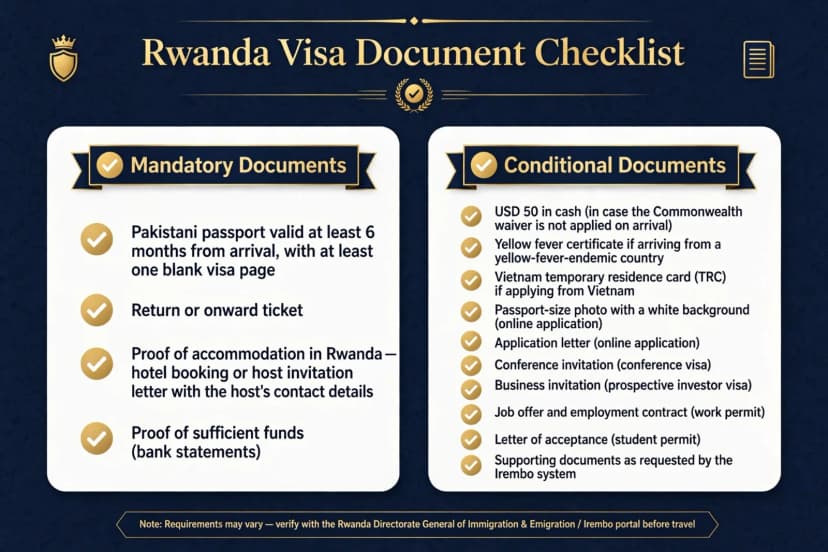
- Pakistani passport valid for at least six months from arrival, with at least one blank page for the entry stamp (the FCDO and the US State Department state six months and one blank page; some guides say two)
- Return or onward ticket, or a confirmed itinerary showing you will leave
- Proof of accommodation — hotel booking for the whole stay, or an invitation letter from your host in Rwanda with their address and contact details
- Proof of sufficient funds — recent bank statements or evidence of cash that plainly cover the trip; the DGIE says evidence "may be requested" at the entry point
- USD 50 in cash in clean, undamaged notes printed in 2006 or later, in case the counter applies the standard fee instead of the waiver
- Yellow fever vaccination certificate, if you are arriving from or transiting an endemic country (see the health section)
- Your Vietnamese temporary residence card, for the journey home
Short visit — online application via Irembo (if you prefer a visa in hand before flying)
- Everything in the visa-on-arrival checklist above, plus:
- A scan of the passport bio-data page (PDF, as the portal specifies)
- One recent passport photograph with a white background, in the portal's size and format
- An application letter, where the portal asks for one — the requirement varies by visa class
- A payment card in your name for the online fee, if a fee applies to your class
- A printed copy of the Irembo confirmation email and the payment receipt, to present at boarding and on arrival
East Africa Tourist Visa (V11)
- Everything in the online checklist above, plus an itinerary showing entry into the issuing country first and travel between Rwanda, Kenya and Uganda only
- Yellow fever vaccination certificate — Kenya and Uganda are both endemic countries, so carry it even if your first entry is Rwanda
- USD 100 for the fee, payable online or on arrival
Business / conference / investor visit (V5 / V6)
- Everything in the short-visit checklist above, plus:
- For a conference: the invitation or registration from the event organiser, with the event name, dates and venue
- For a business survey trip: an invitation letter from the Rwandan company or partner, and your own covering letter explaining the purpose
- For a prospective investor: evidence of your business background and any Rwanda Development Board contact details
- Proof of funds that covers a business trip, not just a holiday
Work permit — employer-sponsored (H classes)
- Everything in the short-visit checklist above, plus:
- A genuine job offer and signed employment contract from a registered, tax-compliant Rwandan employer
- The employer's application on your behalf through Irembo — the employer sponsors the permit, not you alone
- Academic and professional certificates, and proof that your skills are on the Occupations on Demand List where required
- Police clearance certificate; medical certificate if the DGIE asks for one; proof of accommodation in Rwanda
Student permit (U1)
- Everything in the short-visit checklist above, plus:
- Acceptance or enrolment letter from a recognised Rwandan educational institution
- Proof of funds for tuition and living costs; academic certificates and transcripts
- Police clearance certificate and medical certificate, if the DGIE asks for them
Children travelling with you
- Each child needs their own passport, valid six months, with a blank page, and their own visa or fee-waiver entry
- Birth certificate showing the parents' names
- If a child travels with one parent only, or with neither parent, carry a notarised parental consent letter — officers do ask for it
- Children under 15 cannot be issued a gorilla trekking permit
How to Apply: Step-by-Step
Visa on arrival — step by step
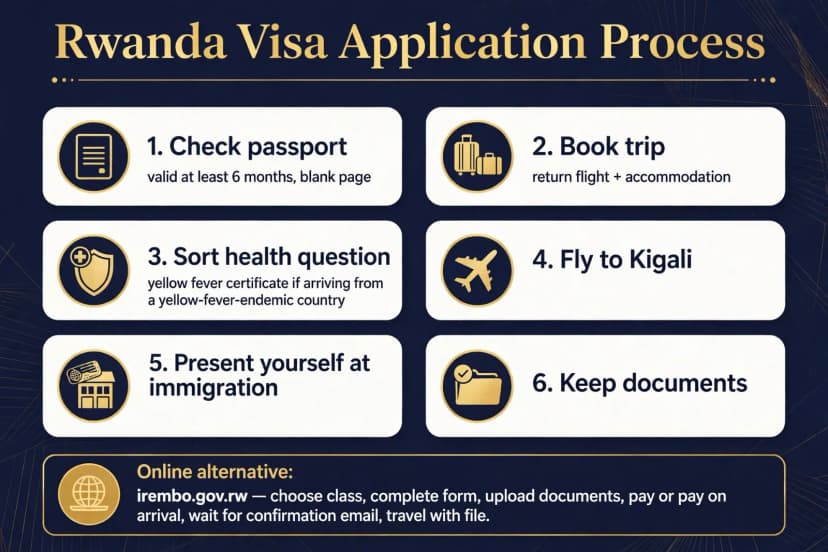
Step 1 — Check your passport. Make sure it is valid for at least six months from your arrival date and has at least one blank page. Renew it before you travel if it is anywhere near the limit.
Step 2 — Book the trip. Book your return or onward flight and your first nights' accommodation. Keep the confirmations where you can show them at the immigration desk — printed, or on your phone with the phone charged.
Step 3 — Sort the health question. Decide whether you need a yellow fever certificate for your routing (see the health section). If there is any doubt, get vaccinated in Vietnam at least ten days before travel and carry the yellow card with your passport.
Step 4 — Fly to Kigali. At check-in in Ho Chi Minh City, the airline will check your passport and may ask about your visa. Rwanda's visa-on-arrival rule for all nationalities is in Timatic, the database airlines use, so a Pakistani passport should be accepted for boarding — but carry a printout of the DGIE's visa page, and arrive early in case the check-in agent needs to verify the rule.
Step 5 — Present yourself at immigration in Kigali. Hand over your passport, return ticket, hotel booking and proof of funds if asked. The officer issues the visa on arrival — free for a 30-day visit under the Commonwealth waiver — and stamps your passport. Check the stamp before you walk away: it is your proof of the date you entered and the length of stay you were given.
Step 6 — Keep the documents. Keep your return ticket, hotel booking and proof of funds with you for the whole stay. The DGIE will ask for the entry stamp if you apply for an extension.
Online application via Irembo — step by step
Step 1 — Open the official portal. Go to irembo.gov.rw yourself by typing the address — never through a link in an email or an advertisement. Open Immigration and Emigration and choose Visa Application. You do not need an Irembo account.
Step 2 — Choose the visa class. Select the class that matches your purpose — V1 for a holiday, V2 for a family visit, V5 for a conference, V6 for a business survey, V11 for the East Africa Tourist Visa. Do not pick a cheaper class and hope it covers a different purpose: a visitor visa cannot be used for work.
Step 3 — Complete the form. Fill in your personal details exactly as they appear on your passport. Enter your travel dates, your accommodation address in Rwanda and your contact details in Vietnam. A name mismatch between the form and the passport is one of the commonest reasons for delay.
Step 4 — Upload your documents. Upload the passport bio-page scan, your photograph, your return ticket or itinerary, your accommodation proof or invitation, and your proof of funds, plus the application letter if the class asks for one. Check each scan is legible before you submit.
Step 5 — Pay, or choose to pay on arrival. Free visas go straight to the DGIE; paid ones generate a bill you pay online by card or at the Bank of Kigali, and the DGIE also allows online applicants to pay on arrival. Keep the payment receipt and the application reference number. Fees are not refunded if the application is denied or withdrawn.
Step 6 — Wait for the confirmation email. The Irembo portal lists four days for an online application; other 2026 guides report about seven days or two to eight days. Plan on a week and apply at least two weeks before travel. Print the approval and carry it with your passport.
Step 7 — Travel with the file. Carry the printed approval, your return ticket, your hotel booking or invitation, and your proof of funds in your hand luggage. Airlines check the approval at boarding, and immigration officers at Kigali may ask for the supporting documents again.
Applying through a Rwandan mission — step by step
Use this route only if you need a visa class that cannot be issued on arrival or online, or if a mission specifically asks you to. Contact the mission first — the Beijing embassy is the one accredited to Vietnam — confirm that it accepts applications from Pakistani nationals resident in Vietnam, and ask for its current form, fee and document list, whether you need an appointment, and whether you must apply in person. Keep a copy of everything you submit and a receipt for everything you pay, and check the name, passport number, dates and entries on the sticker before you leave the mission.
Applying from Vietnam — No Rwandan Mission in Vietnam
For a Pakistani living in Vietnam, the important fact is that Rwanda has no embassy or high commission in Vietnam. That would be a problem in most countries in this series; in Rwanda it barely matters, because the visa on arrival and the Irembo portal cover almost every short visit without a mission at all. You only need a mission for a class that cannot be issued on arrival or online.
The nearest mission that matters to you is the Embassy of Rwanda in Beijing, accredited to Vietnam as well as to North Korea, according to the list of diplomatic missions of Rwanda. Its address is No. 30, Xiu Shui Bei Jie, Chaoyang District, Beijing 100600; telephone +86 10 6532 2193 and +86 10 6532 1762; fax +86 10 6532 2006; email ambabeijing@minaffet.gov.rw. Do not assume it will accept an application from a Vietnamese resident without asking first — accreditation is about diplomatic relations, not a promise to process your visa — so write to it before you travel to Beijing.
The other Asian missions worth knowing are the High Commission of Rwanda in Singapore — 8 Temasek Boulevard, #14-03 Suntec Tower 3, Singapore 038988; telephone +65 6884 4621; email infosingapore@minaffet.gov.rw — a short flight from Ho Chi Minh City and the mission most likely to be useful in practice; the High Commission in New Delhi, accredited to Bangladesh, Maldives, Nepal and Sri Lanka; and the Embassy in Jakarta, which handles ASEAN matters. Rwanda also has a High Commission in Islamabad — website rwandainpakistan.gov.rw — the mission to contact if you are applying from Pakistan itself, though no address or telephone number for it was confirmed for this guide.
Your own mission in Rwanda is the High Commission of Pakistan in Kigali. A Pakistan-focused guide checked in November 2026 states that Pakistan has a High Commission in Kigali for Pakistanis in Rwanda, but no address or telephone number for it was confirmed for this guide — find its current contact details before you travel and keep them with your passport. The DGIE itself can be contacted on info@migration.gov.rw or visa@migration.gov.rw, telephone +250 722 17 29 74 or +250 788 152 222, Monday to Friday, 8am to 5pm.
| Mission | Address | Contact | Note |
|---|---|---|---|
| Embassy of Rwanda, Beijing (accredited to Vietnam) | No. 30, Xiu Shui Bei Jie, Chaoyang District, Beijing 100600 | +86 10 6532 2193 / 1762; ambabeijing@minaffet.gov.rw | Ask in writing first whether it accepts applications from Vietnamese residents |
| High Commission of Rwanda, Singapore | 8 Temasek Boulevard, #14-03 Suntec Tower 3, Singapore 038988 | +65 6884 4621; infosingapore@minaffet.gov.rw | Short flight from Ho Chi Minh City; practical fallback mission |
| High Commission of Rwanda, New Delhi | New Delhi, India | Confirm before travel | Accredited to Bangladesh, Maldives, Nepal, Sri Lanka — not Vietnam |
| High Commission of Rwanda, Islamabad | Islamabad, Pakistan | rwandainpakistan.gov.rw | For applications from Pakistan; no address or phone confirmed for this guide |
| High Commission of Pakistan, Kigali | Kigali, Rwanda | Confirm before travel | Your own mission in Rwanda; no address or phone confirmed for this guide |
| DGIE, Kigali (direct contact) | Kigali, Rwanda | info@migration.gov.rw; visa@migration.gov.rw; +250 722 17 29 74 | Mon–Fri, 8am–5pm; the controlling source for visa questions |
Entry Points and Arrival at Kigali Airport
Kigali International Airport (KGL) is the main gateway to Rwanda, and it is where almost every Pakistani traveller from Vietnam will arrive. It is a small, modern, efficient airport: visa-on-arrival counters, a health screening point, and baggage reclaim in one compact terminal. Land borders also issue visas on arrival — Gatuna and Kagitumba with Uganda, Rusizi (Cyangugu) and Rubavu (Gisenyi) with the DR Congo, Nemba with Burundi, and Rusumo with Tanzania — but the airport is the smoothest first entry, and the DR Congo borders carry the safety and health warnings in the section below.
At the immigration desk, expect to show your passport, and to be asked for your return or onward ticket, your hotel booking or invitation letter, and your proof of funds. The immigration officer makes the final decision in every case, whatever document you hold. Keep those documents in your hand luggage, check the entry stamp before you walk away — the DGIE will ask for it if you apply for an extension — and carry US dollars in cash for the visa fee contingency and for the first day.
Two practical details catch first-time visitors: plastic bags are banned in Rwanda and are confiscated at the airport, and vapes and e-cigarettes are illegal. Health screening at the airport is a real step in 2026: travellers arriving from DR Congo face enhanced screening, and foreign nationals who travelled to or transited through the DR Congo within the previous 30 days are refused entry — see the health section. Your temperature may be checked, and you may be asked about recent travel and symptoms. Keep your yellow fever certificate — if you have one — with your passport rather than in checked luggage.
Extending Your Stay and Overstay Rules
A visa can be extended inside Rwanda, but the extension is discretionary, it must be applied for while the initial visa is still valid, and the figures for it conflict — so this section reports the range rather than a single number.
The official rule. The DGIE's general information states that an application for a visa extension is submitted at DGIE offices, that "extension of a visa should be applied for whilst initial visas remain valid", and that "a grace period of 5 days after a visa has expired is allowed for a person to either depart or renew their visa without a penalty; otherwise the person will be subjected to a penalty and a visa extension may be denied". The Irembo agent support centre, which reproduces the DGIE's renewal procedure, adds that a visa renewal takes 7 days to process, that the price depends on the visa type, and that the V1 holiday and V2 family-visit classes are renewable. One 2026 guide reports that a tourist stay can be renewed once, up to 90 days in total.
How to extend. Apply online through Irembo, or in person at the DGIE office in Kigali or any immigration office — not at an airport or a land border. You will need the same supporting documents as for initial entry (accommodation proof, proof of funds, return ticket) plus a completed application form, and your passport with the entry stamp. Apply well before the visa expires: the renewal takes about seven days, so start at least two weeks before expiry. The DGIE also allows a change of status in some cases, but not for the group tourist visa, and it is not a way to start working.
Overstay: the figures conflict, and the conflict is large. The DGIE's published rule is the five-day grace period, after which a penalty applies and an extension may be denied. How large the penalty is depends on which source you read. The Irembo agent support centre, citing Article 58 of the Ministerial Order, states that the penalty is RWF 50,000 for a delay of 6 to 15 days, with further categories from 16 days to nine months and above. A Rwandan lawyer's public video from September 2026 gives the stepped scale in full: RWF 50,000 for 6–15 days, RWF 70,000 for 16–30 days, RWF 100,000 for 31 days to 3 months, RWF 300,000 for over 3–6 months, RWF 500,000 for over 6–9 months, and RWF 1,000,000 for over 9 months, with deportation for long overstays. Other 2026 guides quote about USD 10 per day, or RWF 100,000–500,000. The RWF 50,000 figure for 6–15 days is the best-sourced, because it cites the Ministerial Order directly; the USD 10-a-day figure is not traced to any official source found for this guide. Do not overstay, even by a day beyond the grace period.
Work, Business and Study Routes
Rwanda wants skilled foreign workers and investors, and its permit system is genuinely more open than most African countries'. But the fees are the least certain figures in this guide, and this section says so openly rather than presenting one guide's numbers as fact.
Work permits. A foreign national employed by a Rwandan company needs a work permit, and the process is employer-sponsored: the employer applies on your behalf through Irembo, and you cannot work on a visitor visa while you wait. The permit classes are H1 (occupations on demand), H2 (sponsored skilled worker), H5 (international organisation staff) and Q1 (intra-company transfer). A genuine job offer from a registered, tax-compliant Rwandan employer is required, and work is only for the sponsoring employer in the permitted role. The job-search visa (V4, USD 50, 90 days, multiple entries) allows you to look for work, not to do it.
The fee conflict. Three different figures circulate for the work permit, and no DGIE fee page found for this guide settles it. One 2026 guide lists work visas at USD 50 for under three months, USD 250 for three to twelve months and USD 500 for one to two years. Another lists Class A work permits at USD 200 and Class B at USD 250, with processing of about one week. A third lists the work permit at RWF 150,000 (about USD 107) with processing of 30 business days. Processing time is equally unsettled: about one week in one summary, two to six weeks in another. This guide reports all three fee figures and both processing ranges, and treats none of them as verified. Get the fee and the timeline from the DGIE or from your employer's filing on Irembo before you resign from anything or book anything. Never travel on a tourist visa intending to start work: working without a permit can lead to fines, detention and deportation.
Business and investor permits. Rwanda actively courts foreign investment through the Rwanda Development Board (RDB), which certifies investors for visa eligibility. Investor and business residence permits are issued by sector — A1 mining, B1 agriculture, F1 manufacturing, O1 hospitality, W1 information technology, X1 transport, Z1 other — and require an investment certificate and business registration. One source lists the business and entrepreneur permit at RWF 200,000 for two years, renewable. Company registration at the RDB takes as little as six hours, and the registration fee is reported at RWF 40,000 (about USD 30). Treat the permit fee as unconfirmed until the RDB or the DGIE confirms it for your sector.
Study. The student permit (U1) is for foreigners enrolled in a recognised Rwandan educational institution, valid for one year and renewable. Two sources list its fee at RWF 20,000 (about USD 14) with processing of about one week, but neither figure was confirmed on a DGIE page found for this guide, so treat it as reported rather than verified. Apply with the institution's acceptance letter, proof of funds for tuition and living costs, and your academic records; the institution will usually guide the filing. A post-study work permit (P2) exists for students who want to work during holidays or after completing their studies, valid for up to one year and listed at RWF 20,000. Dependants of a temporary resident permit holder can apply for M2 permits at 50% of the principal's fee.
Teaching English in Rwanda. Readers of this guide are often English teachers, so this deserves a direct answer. Rwanda is an English-speaking country — English is an official language alongside Kinyarwanda, French and Swahili — and there is demand for English teachers in private schools, international schools and language centres in Kigali. But there is no special English-teacher visa: you need a job offer first, then the employer-sponsored work permit, exactly as above. Do not fly to Kigali on a V1 or a V4 and expect to be hired on arrival: the permit must come first, and the employer is the sponsor.
Transit, Flights and Money: Practical Notes
Transit through Rwanda. If you are passing through Rwanda to a third country, the transit visa (VT) costs USD 30 and is valid for up to 72 hours — for travellers delayed by events beyond their control, such as a flight schedule change or bad weather. Most Pakistani travellers from Vietnam will not need one, because the realistic routings to Kigali transit through Addis Ababa, Nairobi, Doha, Dubai or Istanbul rather than through Rwanda itself. Note that the DGIE's own fee page lists the transit visa as both USD 30 and free of charge in different places, so confirm the fee before you travel.
Flights. There is no direct flight from Vietnam to Rwanda, and none from Pakistan either. The realistic corridors from Ho Chi Minh City are Ethiopian Airlines via Addis Ababa, Kenya Airways via Nairobi, Qatar Airways via Doha (with RwandAir also flying the Doha–Kigali route), Emirates via Dubai, and Turkish Airlines via Istanbul. The Addis Ababa and Nairobi routings are the most direct, but they are also the two that make the yellow-fever question live, because Ethiopia and Kenya are both on the yellow-fever endemic list — see the health section. Book the whole journey on one ticket where you can, and leave a generous connection time. RwandAir flies from Kigali to Doha, Dubai, Istanbul, Brussels, Amsterdam and London, which gives you a second set of routings for the journey home.
Money. The currency is the Rwandan franc (RWF), at roughly 1,400 francs to the US dollar in 2026. US dollars in cash are widely useful at the border and on arrival, and the visa fee — if one is charged to you — is payable in US dollars printed in 2006 or later, in Rwandan francs, or by Visa or MasterCard, according to the US State Department. Kigali itself is largely cashless: mobile money (MTN MoMo) and cards are accepted in most hotels, restaurants and shops. ATMs in Kigali accept foreign cards, but some outside the capital do not, so do not land with no cash. There is no published minimum bank balance for the tourist visa: carry recent statements that plainly cover the trip.
What a trip costs beyond the visa. The visa is free for you, but Rwanda is not a cheap destination once you are there. The gorilla trekking permit is USD 1,500 per person per trek for foreign non-residents, set by the Rwanda Development Board — with a 30% reduction to USD 1,050 in the low season from November to May, when your stay also includes two nights in Akagera or Nyungwe National Parks under the Board's conditions. Permits are limited to 96 a day, and in the July–August peak they sell out three to six months ahead, so book the permit before you book the flight if gorillas are the reason for the trip. Children under 15 cannot be issued a permit. Akagera and Nyungwe have their own park fees on top.
Safety, Health and Arrival Checks
Security. Rwanda is widely regarded as one of the safest countries in Africa for visitors, and violent crime against tourists is rare. The specific advice in 2026 concerns the border with the DR Congo: the US State Department rates Rwanda Level 3, "Reconsider Travel", reissued on 4 June 2026 after raising it from Level 2 on 19 May 2026 because of the Ebola outbreak in the region, and advises against all travel within 10 km of the DR Congo border. The FCDO advises against all but essential travel to the parts of Rusizi District within 10 km of the border, including the Rwandan islands in Lake Kivu and Kamembe Airport (page updated 4 September 2026). The main tourist areas — Kigali, Volcanoes National Park, Kinigi and Musanze, Akagera and Nyungwe — lie outside that 10 km zone, and gorilla trekking continues normally. Read the current FCDO and US State Department pages before you travel, and do not travel to the DR Congo border districts without a specific, current reason.
Yellow fever — the most misunderstood rule in this guide. Rwanda requires a yellow fever certificate only from travellers arriving from countries with a risk of yellow fever transmission, or from a country with an active outbreak. The Rwanda Biomedical Centre's official traveller page states this directly: a certificate is "not required" for travellers coming from non-endemic countries without an active outbreak, and "mandatory" for travellers coming from endemic countries or countries with an active outbreak. The endemic list includes Kenya, Uganda, Ethiopia, Burundi, DR Congo, Tanzania, Nigeria, Ghana and Senegal — and neither Pakistan nor Vietnam is on it. But the two most likely routings from Ho Chi Minh City — via Addis Ababa (Ethiopia) and via Nairobi (Kenya) — both transit endemic countries, and whether an airside transit counts as "coming from" an endemic country is not answered on the official page found for this guide. One safari guide reports a 12-hour transit threshold that no official source confirms. The safe course is to get vaccinated in Vietnam at least ten days before travel — the certificate is not valid until ten days after vaccination — and carry the yellow card with your passport. If you arrive from an endemic country without a valid certificate, you will be vaccinated on arrival at your own cost: RwandAir's notice following the Ministry of Health puts that vaccination at USD 40, and a traveller whose certificate is less than ten days old will be quarantined until it becomes valid. A traveller who refuses the preventive measures is refused entry. A Pakistan-side rule is also worth knowing: a polio vaccination certificate from NADRA is needed to leave Pakistan — a Pakistani exit requirement, not a Rwandan one.
Ebola and the DR Congo. The Rwanda Biomedical Centre's notice of 22 May 2026 states that all foreign nationals who have travelled to, or transited through, the DR Congo within the previous 30 days will be denied entry to Rwanda, as an Ebola prevention measure. No confirmed Ebola cases had been reported in Rwanda as of October 2026, and the WHO had declared the outbreak a public health emergency of international concern in May 2026. Whether the 30-day refusal is still in force could not be confirmed for this guide — no lifting notice was found — so plan as if it is: do Rwanda first, and do not combine it with a DR Congo trip in the same month. The health hotline is 114, and the police emergency number is 112.
Other health notes and arrival checks. Malaria is present in Rwanda: take prophylaxis as your doctor in Ho Chi Minh City advises, use repellent and a net, and drink bottled water. Travel insurance is not a required visa document, but medical facilities outside Kigali are basic and medical evacuation is expensive — buy a policy that covers medical evacuation, and check that it covers you given the Level 3 advisory, because some policies exclude travel against government advice. At Kigali airport, expect to show your passport with the visa, your return or onward ticket, your hotel booking or invitation letter, and your proof of funds, and expect a health screening point where your temperature may be checked and you may be asked about recent travel to or through the DR Congo.
Frequently Asked Questions
1. Do Pakistani citizens need a visa for Rwanda?
Yes, formally — but it is issued on arrival with no prior application. Since 1 January 2018, citizens of all countries receive a visa on arrival at Kigali International Airport and at all land borders. For Pakistanis the 30-day visa is free, because Pakistan is a Commonwealth member and the DGIE waives visa fees for a 30-day visit for citizens of Commonwealth, African Union and La Francophonie countries.
2. Is the Rwanda visa really free for Pakistanis?
For a visit of up to 30 days, yes, under the Commonwealth fee waiver published by the DGIE. The standard fee for a traveller not covered by the waiver is USD 50 for a single entry and USD 70 for multiple entries. Carry USD 50 in cash anyway, in case the counter applies the standard fee instead of the waiver.
3. Can I apply for a Rwanda visa online before I travel?
Yes, through the official Irembo portal at irembo.gov.rw — open Immigration and Emigration and choose Visa Application. You do not need an Irembo account. Free visas go straight to the DGIE; paid ones generate a bill you pay online by card or at the Bank of Kigali, or on arrival. The portal lists four days, but other 2026 guides report about seven days or two to eight days — apply at least two weeks before travel.
4. How long can I stay in Rwanda on a visitor visa?
A single-entry holiday visa is valid for 30 days; a multiple-entry visa for 90 days. The free Commonwealth arrangement covers the 30-day visit only — a 90-day multiple-entry visa costs USD 70. The East Africa Tourist Visa is valid for 90 days across Rwanda, Kenya and Uganda.
5. What is the East Africa Tourist Visa, and is it worth it?
It is one joint visa for Rwanda, Kenya and Uganda: USD 100, valid for 90 days, multiple entries between the three countries. It cannot be extended, and it ends if you leave the three-country zone. It is worth it if you are actually visiting all three countries; if you are visiting Rwanda alone, the free 30-day visa on arrival is better. You must enter the issuing country first.
6. Is there a Rwandan embassy in Vietnam?
No. Rwanda has no mission in Vietnam. The Embassy of Rwanda in Beijing is accredited to Vietnam — No. 30, Xiu Shui Bei Jie, Chaoyang District, Beijing 100600; telephone +86 10 6532 2193; email ambabeijing@minaffet.gov.rw. The High Commission in Singapore is the most practical fallback from Ho Chi Minh City. In practice you will rarely need either: the visa on arrival and Irembo cover short visits.
7. What documents do I need for Rwanda?
A passport valid at least six months from arrival with at least one blank page; a return or onward ticket; proof of accommodation or an invitation letter; and proof of sufficient funds. For an online application, add a scan of the passport bio-data page, a white-background photograph, and an application letter if the class asks for one. The full checklists are in the document section.
8. Do I need a yellow fever certificate for Rwanda?
Only if you are arriving from a country with yellow-fever transmission risk, or one with an active outbreak. Neither Pakistan nor Vietnam is endemic, but Kenya, Uganda and Ethiopia are, so the Addis Ababa and Nairobi routings make this a live question. If in doubt, get vaccinated in Vietnam at least ten days before travel and carry the yellow card. Without a valid certificate you may be vaccinated on arrival for USD 40 at your own cost.
9. Can I work in Rwanda on a tourist visa?
No. A visitor visa must not be used for employment — the DGIE states this plainly. You need a job offer from a registered Rwandan employer first, then an employer-sponsored work permit through Irembo. The work-permit fee is disputed between sources (USD 200–500 or RWF 150,000), so get the figure from the DGIE or your employer before you make plans.
10. Can I extend my stay in Rwanda?
Yes, by applying to the DGIE while your visa is still valid, online through Irembo or in person at a DGIE office — not at an airport or border. A renewal takes about seven days. There is a five-day grace period after a visa expires; after that a penalty applies and an extension may be denied. One 2026 guide reports a tourist stay can be renewed once, up to 90 days in total.
11. What happens if I overstay my Rwanda visa?
You will be fined, and a long overstay can mean detention and deportation. The best-sourced figure is RWF 50,000 for a delay of 6–15 days, citing Article 58 of the Ministerial Order, with a stepped scale rising to RWF 1,000,000 for overstays over nine months. Other guides quote about USD 10 a day or RWF 100,000–500,000 — none traced to an official source. Apply for an extension before your visa expires, or leave on time.
12. Are there direct flights from Vietnam or Pakistan to Kigali?
No. The realistic corridors from Ho Chi Minh City are Ethiopian Airlines via Addis Ababa, Kenya Airways via Nairobi, Qatar Airways or RwandAir via Doha, Emirates via Dubai, and Turkish Airlines via Istanbul. Book on one ticket and leave a generous connection time.
13. Do I need travel insurance for Rwanda?
It is not a required visa document, but it is strongly advisable. Medical facilities outside Kigali are basic, malaria is present, and medical evacuation is expensive. Check that your policy covers you given the US State Department's Level 3 advisory, because some policies exclude travel against government advice.
14. Can children travel with me to Rwanda?
Yes, with their own passport and visa or fee-waiver entry, a birth certificate showing the parents' names, and — if a child travels with one parent only or with neither parent — a notarised parental consent letter. Children under 15 cannot get a gorilla trekking permit.
15. How much does gorilla trekking cost, and do I need to book ahead?
A gorilla permit costs USD 1,500 per person per trek for foreign non-residents, set by the Rwanda Development Board, with a 30% reduction to USD 1,050 in the low season from November to May when your stay also includes two nights in Akagera or Nyungwe National Parks. Only 96 permits are issued a day, and in the July–August peak they sell out three to six months ahead — book the permit before you book the flight if gorillas are the reason for the trip.
Official Immigration Websites
| Website | What it is | Link |
|---|---|---|
| Directorate General of Immigration and Emigration (DGIE) — visa under special arrangement | Official DGIE page: visa on arrival for all nationalities since 1 Jan 2018, Commonwealth/AU/Francophonie fee waiver for 30 days, EATV USD 100, 5-day grace period, no authorised agents | migration.gov.rw — visa under special arrangement |
| Directorate General of Immigration and Emigration (DGIE) | Rwanda's immigration authority — visa classes, fees, extensions | migration.gov.rw |
| Irembo — official government services portal | Online visa applications, East Africa Tourist Visa, visa renewals; portal lists 4 days | irembo.gov.rw |
| Irembo — East Africa Tourist Visa | DGIE's own EATV application page on the Irembo portal | irembo.gov.rw — East Africa Tourist Visa |
| UK Foreign, Commonwealth and Development Office — Rwanda travel advice | Entry requirements, passport validity (6 months, 1 blank page), yellow fever, Rusizi border warning | gov.uk/foreign-travel-advice/rwanda |
| US Department of State — Rwanda International Travel Information | Visa rules, Level 3 advisory (4 June 2026), 10 km DR Congo border warning, payment methods at the border | travel.state.gov — Rwanda |
| Wikipedia — Visa policy of Rwanda | Summary of visa exemption groups, visa on arrival and e-visa, with Pakistan in the 30-day fee-waiver group | en.wikipedia.org/wiki/Visa_policy_of_Rwanda |
| Wikipedia — List of diplomatic missions of Rwanda | Beijing embassy accredited to Vietnam and North Korea; Singapore, New Delhi, Jakarta and Islamabad missions | en.wikipedia.org/wiki/List_of_diplomatic_missions_of_Rwanda |
| Rwanda Biomedical Centre — Info note for travelers | Official yellow-fever rules: mandatory only from endemic or outbreak countries; vaccination on arrival at the traveller's cost; DR Congo 30-day refusal (22 May 2026) | rbc.gov.rw — info note for travelers |
| RwandAir — Yellow fever preventive measures | National carrier's notice following the Ministry of Health: vaccination on arrival USD 40; certificate valid 10 days after vaccination | rwandair.com — yellow fever measures |
| Rwanda High Commission in Kenya — Visa | Official mission page listing V1–V6 fees: USD 50 single / USD 70 multiple, V4 USD 50, transit USD 30 | rwandainkenya.gov.rw — Visa |
| Rwanda High Commission in Japan — East Africa Tourist Visa | Official EATV terms: USD 100, 90 days, multiple entry; must enter the issuing country first; available on arrival | rwandainjapan.gov.rw — East Africa Tourist Visa |
| UrduPoint — Rwanda Visa for Pakistanis 2026 | Pakistan-focused guide, checked 19 Nov 2026: free 30-day visa on arrival for Commonwealth citizens, Irembo steps, Pakistan High Commission in Kigali | urdupoint.com/travel/visa/rwanda |
| HTG — Rwanda Visa On Arrival for Pakistanis | Pakistan-focused guide: Commonwealth fee waiver, USD 50 standard fee, Irembo processing about 4 days | htg.com.pk — Rwanda visa on arrival |
| RwandaTrip — Rwanda Visa Guide | 2026 guide: V1 USD 50/70, EATV USD 100, transit USD 30, conference visa USD 50, Irembo 4-day processing | rwandatrip.com — Rwanda visa guide |
| East Africa Guide — Rwanda Visa Requirements 2026 | Guide citing DGIE figures: V1 USD 50/70, EATV USD 100, transit USD 30, Commonwealth waiver | eastafrica.guide — Rwanda visa requirements |
| Irembo Agent Support — How an agent can help renew a visa | Irembo's renewal procedure: 7-day processing, V1/V2 renewable, 5-day grace, RWF 50,000 penalty for 6–15 days (Ministerial Order Art. 58) | iremboagent.freshdesk.com — visa renewal |
| VisaRay — Rwanda immigration and visas 2026 | Work-permit figures showing the conflict: USD 250–500 for 1–2 year permits, processing 1 week to 2–6 weeks; student permit U1 | visaray.com — Rwanda immigration and visas |
| TravelChinaGuide — Rwanda Embassy in Beijing | Beijing embassy address, phone and email: No. 30 Xiu Shui Bei Jie, Chaoyang District; +86 10 6532 2193; ambabeijing@minaffet.gov.rw | travelchinaguide.com — Rwanda Embassy, Beijing |
| Rwanda High Commission in Sudan — East Africa Tourist Visa | Official EATV page: USD 100, 90 days, multiple entries within Kenya, Rwanda and Uganda | rwandainsudan.gov.rw — East Africa Tourist Visa |
This guide was checked on 28 November 2026. Visa rules change without notice. Always confirm the live rules on migration.gov.rw and irembo.gov.rw before paying any fee or booking a non-refundable ticket. Nothing in this guide is immigration advice; the Rwandan authorities set and enforce the entry rules, and the immigration officer at Kigali makes the final decision.