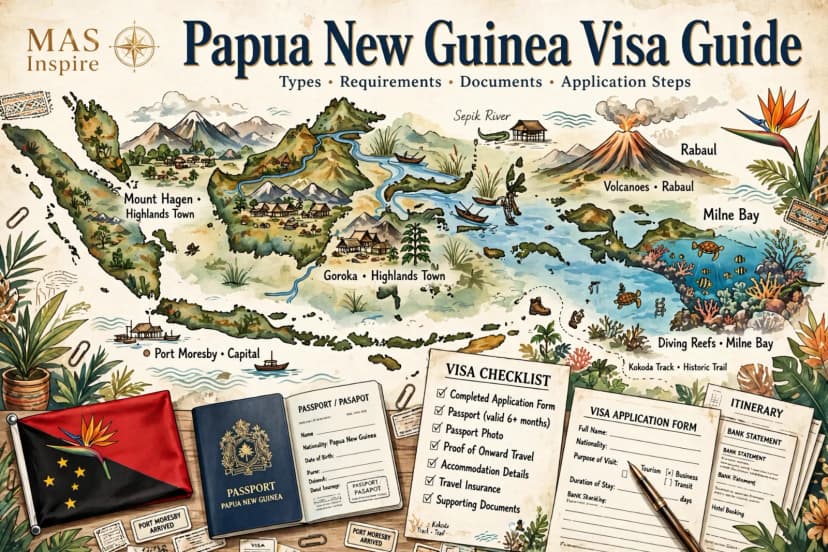
Papua New Guinea Visa Guide 2026: Types, Requirements, Documents and Application Steps
Last checked: 28 November 2026. This guide is for Pakistani passport holders living in Vietnam. Visa rules change without notice — always confirm the live rules on the official e-visa portal (evisa.ica.gov.pg) and with the PNG High Commission in New Delhi before paying any fee or booking a non-refundable ticket.
Introduction
Papua New Guinea is the eastern half of the island of New Guinea, plus some 600 offshore islands, in the south-west Pacific. Port Moresby, the capital, sits on the south coast; beyond it lie the Sepik River, the Highlands towns of Goroka and Mount Hagen, the diving reefs of Milne Bay, the volcanoes of Rabaul and the Kokoda Track. It is also a serious business destination: gold, copper, oil and gas projects around Porgera, Ok Tedi and the PNG LNG plant employ thousands of expatriates, and that is why this guide covers work routes as carefully as the tourist ones.
Papua New Guinea runs two different visitor lanes online, and Pakistan is in the harder one. Nationals of about 70 countries can use the Easy Visitor Permit, a light online permit that costs a flat USD 50. Pakistan is not on that list. A Pakistani passport holder must instead apply for a Tourist Visitor visa — Own Itinerary, Tour Package or Visiting Relative — through the same e-visa portal, and even that is not settled: some 2026 guides say Pakistanis can lodge online without difficulty, while others say the portal may not offer the right class for a Pakistani passport at all and the applicant must be directed to the Papua New Guinea High Commission in New Delhi, or apply by email to the Immigration and Citizenship Services Authority (ICSA) in Port Moresby.
The authority that runs all of this is the Immigration and Citizenship Authority, usually shortened to ICA and still called ICSA (Immigration and Citizenship Services Authority) on some official pages. Its e-visa portal is evisa.ica.gov.pg — note the domain ends in .gov.pg, not .gov.png — and its main site is ica.gov.pg. A second, separate requirement arrived on 1 October 2025: every traveller must complete the free PNG Digital Arrival Card (PNGDAC) within 72 hours before arrival, and since 6 August 2026 airlines have been instructed to check it before issuing a boarding pass. The arrival card is not a visa, and a visa is not an arrival card — you need both.
Do Pakistani Passport Holders Need a Visa for Papua New Guinea?
Yes. Every holder of an ordinary Pakistani passport needs a visa before travelling to Papua New Guinea. Pakistan is not on the visa-on-arrival list and is not one of the Easy Visitor Permit countries. The UK Foreign, Commonwealth and Development Office (FCDO) states the general rule plainly — you must have a visa to visit Papua New Guinea, obtainable in advance online or at a Papua New Guinea embassy or high commission — and ICSA states that travellers must hold a visa, with visa on arrival available only to eligible travellers. For a Pakistani passport, the visa must be approved before you fly.
The rule follows your passport, not where you live. Living in Vietnam, holding a Vietnamese temporary residence card (TRC), holding a US, UK or Schengen visa, or having lived in the Gulf does not remove the visa requirement, and no simplified regime for Vietnamese residents of Pakistani nationality was found for Papua New Guinea.
What is not in dispute is the passport rule. The FCDO states that to enter Papua New Guinea your passport must have an expiry date at least six months after the date you arrive. ICSA's own guidance says the same, and the guides that report the portal's requirements add at least one blank page for the visa stamp. Apply that rule to the whole trip, not just the arrival date, and renew your passport in Vietnam or Pakistan before you apply if it is anywhere near the limit.
The Big Question: Can Pakistanis Use the E-Visa Portal?
Position A — Pakistanis can apply online for a Tourist Visitor visa. Several 2026 guides written for Pakistani travellers say Pakistani citizens can apply for a Papua New Guinea tourist e-visa online through the ICA e-visa portal, with a fee of approximately USD 100 and processing of 3 to 5 working days for a 60-day stay. One Pakistani visa site puts the fee at USD 100 exactly (PKR 22,376 at its quoted rate) and describes the process as fully online with no embassy visit. A further guide lists Pakistan explicitly among the countries that use the Tourist Visa (Own Itinerary) route rather than the Easy Visitor Permit, with the same USD 50 online lodgement fee as other visitor classes.
Position B — the portal may not accept a Pakistani passport, and the applicant must go through a mission or by email. A Pakistan-focused guide checked 19 November 2026 states that some nationalities can apply on the e-visa portal and others must send their application by email to ICSA, and that it could not confirm on an official page which of these applies to Pakistani passports — so check the eligible-passport list on the portal first. A second Pakistan-focused research database, updated 4 September 2026, is blunter: Pakistani passports are not in the Easy Visitor eligibility list, a standard paper application is needed, and if the portal does not offer the correct Visitor category for a Pakistani passport holder, the applicant should contact ICA or the PNG High Commission in New Delhi before paying. A third source, a Pakistani visa agency, says Pakistani nationals must apply online through the ICA e-visa portal before travel and that visa on arrival is not granted to Pakistani nationals, but gives no verifiable fee at all, describing it only as "Official Consular Fee per Embassy Schedule", with standard processing of 3 to 6 weeks.
How to settle it for your own passport. Do not take either position on trust, including this guide. The controlling source is the portal itself, and the test takes five minutes: open evisa.ica.gov.pg, create an account, select Pakistan as your nationality and Visitor as your category, and see whether the system offers you a Tourist Visitor visa (Own Itinerary, Tour Package or Visiting Relative) or refuses you, or offers you only the Easy Visitor Permit — which Pakistan is not eligible for. If the portal offers you the Tourist Visitor application and shows you a fee at checkout, Position A is right for you and the fee on that checkout screen is the only fee that counts. If the portal refuses Pakistan or offers no suitable class, stop, do not pay anything, and follow the mission route in the applying-from-Vietnam section: contact the PNG High Commission in New Delhi, which the Australian High Commission in New Delhi says handles PNG visa applications from Pakistan, or write to ICSA as its guidance instructs. Keep a screenshot of whatever the portal shows you. Run the portal test early, plan on the Tourist Visitor route, and have the New Delhi mission's contact details ready before you pay — because the one thing every source agrees on is that you cannot fly without a visa already approved.
Types of Papua New Guinea Visas for Pakistani Passport Holders
Papua New Guinea's entry permits are issued by ICSA under the Migration Act, and the portal organises them into Visitor, Business, Employment, Student and other classes. The categories below are the ones a Pakistani passport holder living in Vietnam is realistically likely to use.
Easy Visitor Permit — not available to Pakistani passports
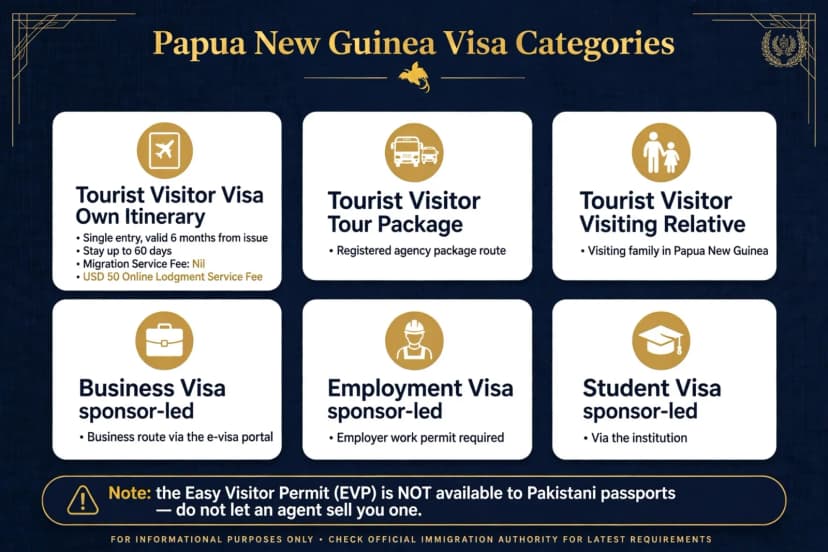
The Easy Visitor Permit (EVP) is the light online permit for nationals of about 70 countries and territories, including every EU member state, the United Kingdom, the United States, Canada, New Zealand, Japan, South Korea, Singapore, Malaysia, Thailand, the Philippines, Indonesia, India, Vietnam and most Pacific states. It is issued for 30 or 60 days depending on nationality, is single entry, and cannot be extended. Pakistan is not on either EVP list. Do not let an agent sell you an Easy Visitor Permit for a Pakistani passport: the portal will not issue one to you.
Tourist Visitor visa — Own Itinerary
The standard route for a Pakistani tourist travelling on their own plan. It is a single-entry visa, valid for six months from issue, allowing a stay of up to 60 days from arrival. The Migration Service Fee for this class is nil — the fee is the USD 50 Online Lodgment Service Fee described in the fees section — although one 2026 Pakistani guide quotes USD 100, and that conflict is dealt with below. You will need an itinerary, proof of accommodation, bank statements for the last three months and an employment letter or proof of income.
Tourist Visitor visa — Tour Package
The same visitor class for travellers arriving on a pre-booked package through a registered Papua New Guinea travel agency. The fee structure is the same (nil Migration Service Fee plus the USD 50 online lodgement fee), and the agency's booking confirmation replaces the own-itinerary documents.
Tourist Visitor visa — Visiting Relative
For visiting a relative living in Papua New Guinea. The fee structure is the same again, and the application adds the host relative's invitation and evidence of the relationship. A host's invitation is not a substitute for your own proof of funds or your return ticket.
Business visa — short-term
For meetings, board meetings, conferences, exploratory business visits and negotiations. The Business Short-Term Single Entry and Multiple Entry classes both currently list a USD 350 Migration Service Fee plus the USD 50 online lodgement fee, a total of USD 400. A business application needs a sponsor letter from a PNG-based company, a passport biodata-page copy, the prescribed fee and onward or return ticket evidence. It does not allow employment.
Employment visa — Working Resident
For paid employment. This is a sponsor-led route: the PNG employer applies for the work permit and the employment visa together through ICSA's Sponsor Portal, and the worker cannot lodge it alone. The ICA handbook, as reported by a 2026 visa database, lists USD 380 initially for a working resident's employment visa and USD 700 for an eligible extension. Never travel on a tourist or business visa intending to start work.
Student visa
For study at a Papua New Guinea institution, sponsored by the institution. No published student-visa fee for Pakistani applicants was found for this guide — the portal's fee screen for the class is the controlling source — so this guide quotes none rather than inventing one.
Transit visa
For passing through Papua New Guinea to a third country. In practice most Pakistani travellers will not need a PNG transit visa, because the realistic routings from Vietnam transit through Singapore, Manila or Australia rather than through Papua New Guinea itself. The transit rules for the hubs you actually pass through are covered in the transit section: a Brisbane or Cairns connection needs an Australian transit visa, while Singapore and Manila airside transits normally do not.
| Visa type | Typical stay | Entries | Where to apply | Can it be extended? |
|---|---|---|---|---|
| Easy Visitor Permit | 30 or 60 days | Single | evisa.ica.gov.pg — NOT for Pakistani passports | No |
| Tourist Visitor — Own Itinerary | Up to 60 days; visa valid 6 months | Single | eVisa portal, or New Delhi mission / ICSA email if the portal refuses | Yes, in limited cases — see extension section |
| Tourist Visitor — Tour Package | Up to 60 days | Single | eVisa portal, with registered agency booking | As for Own Itinerary |
| Tourist Visitor — Visiting Relative | Up to 60 days | Single | eVisa portal, with host invitation | As for Own Itinerary |
| Business Short-Term | As granted | Single or multiple | eVisa portal, with PNG sponsor letter | Through ICSA |
| Employment (Working Resident) | 6 months to 3 years | As granted | Employer via ICSA Sponsor Portal | Yes, sponsor-led |
| Student visa | Set by the course | As issued | Institution-sponsored, via ICSA | Through the institution |
| Transit visa | Short transit | As issued | ICSA before travel | No |
E-Visa Fees: The USD 50 Lodgement Fee and the USD 100 Dispute
Papua New Guinea's pricing is built from two different fee concepts, and most of the confusion comes from mixing them up. The Migration Service Fee (MSF) is the immigration fee attached to the visa class, and it can be zero. The Online Lodgment Service Fee (OLSF) is a separate USD 50 charged for lodging an application through the e-visa portal. The total is MSF plus OLSF, and ICSA displays the final amount on the payment screen before you pay. Saying "the PNG e-visa costs USD 50" is accurate only for a class whose MSF is currently zero.
| Item | Figure reported | Source |
|---|---|---|
| Tourist Visitor (Own Itinerary / Tour Package / Visiting Relative) — MSF | USD 0 (nil) | ICA class wording as reported by two 2026 fee guides and a Pakistan-focused research database |
| Tourist Visitor — online lodgement fee (OLSF) | USD 50 | ICA portal fee structure as reported by the same guides; charged in kina equivalent, non-refundable |
| Tourist Visitor — total online charge | USD 50 | MSF nil + OLSF USD 50 |
| Tourist e-visa | About USD 100 | Travel Visa Stack (October 2026) and a Pakistani visa site (USD 100.00 / PKR 22,376) |
| Business Short-Term Single or Multiple Entry — MSF | USD 350 | ICA class wording as reported by a 2026 fee guide |
| Business Short-Term — total online charge | USD 400 | MSF USD 350 + OLSF USD 50 |
| Restricted Employment Visa — total | USD 400 | MSF USD 350 + OLSF USD 50, as reported by a 2026 fee guide |
| Special Exemption — Aid Worker / Volunteer — total | USD 100 | MSF USD 50 + OLSF USD 50, as reported by a 2026 fee guide |
| Employment (Working Resident) visa — initial | USD 380 | ICA 2025 handbook as reported by a 2026 visa database; work-permit fee in kina is separate |
| Employment visa — extension | USD 700 | Same handbook report; treat as reported, not confirmed on an official page |
| Visa on arrival (eligible nationalities only) | USD 50 | Multiple 2026 guides; payable by card at Port Moresby, cash not accepted per one guide |
| Visitor permit extension (in-country) | USD 150; USD 700 if applied late | ICA handbook as reported by a 2026 guide; treat as reported, not confirmed on an official page |
| PNG Digital Arrival Card | Free | ICSA; never pay a site that charges for it |
The controlling figure is the one the portal shows you at checkout. The USD 50 total for a Tourist Visitor visa is the best-supported published figure: it appears identically in two independent 2026 fee guides that both say they are reporting the ICA class wording, and it is confirmed by a Pakistan-focused research database updated 4 September 2026, which states that Tourist — Own Itinerary, Tourist — Tour Package and Visiting Relative all have a nil base Migration Service Fee and that online lodgement carries a USD 50 Online Lodgment Service Fee. Against that, two Pakistani-facing guides quote about USD 100 for a tourist e-visa. The USD 100 figure may be a reseller price with a service margin added, or it may reflect a different class or an older fee — neither guide quotes the portal's MSF/OLSF breakdown, so neither can be checked against the portal's own wording. Do not budget against USD 100: if evisa.ica.gov.pg shows you USD 50 at checkout, that is your fee; if it shows you something else, that screen is the fee. The USD 50 is charged in kina equivalent, is non-refundable, and the portal accepts Visa and Mastercard but not American Express, according to a 2026 guide that reports the portal's payment rules.
Two practical warnings about money. First, apply only on evisa.ica.gov.pg, typing the address yourself, and never through a lookalike site: the domain ends in .gov.pg, not .gov.png, and the inflated figures on commercial sites show how much margin resellers add. Second, visa fees are generally non-refundable, including if your application is refused — another reason to confirm the fee on the checkout screen before you pay, rather than after. The PNG Digital Arrival Card is free: any website charging a fee to submit it is not the official portal.
Processing Times
The sources report: 10 working days, provided all requirements are met (a Pakistan-focused research database, and the ICA handbook as reported by a 2026 visa database); 3 to 5 working days (a commercial Pakistan-to-PNG guide, October 2026); 3 to 10 working days (a 2026 tourist-visa processing guide); 15 working days (the PNG High Commission in New Zealand, as reported by a Pakistan-focused guide checked 19 November 2026); and 3 to 6 weeks (a Pakistani visa agency, verified 28 October 2026). For the Easy Visitor Permit, which does not apply to Pakistani passports, decisions are usually made within 24 to 72 hours — do not mistake that figure for your own timeline.
Planning rule. For a Tourist Visitor visa, plan on 10 working days and apply at least four weeks before travel, so a rejected scan, a missing bank statement or a name mismatch can be corrected without losing the trip. If your case goes through the New Delhi mission or by email to ICSA, apply at least six weeks ahead: the 15-working-day figure from the New Zealand High Commission and the 3-to-6-week agency figure both point the same way. A tourist visa is valid for six months from issue, so do not apply absurdly early either. There is no formal paid express track on the official portal — applications are handled in the order received — so do not pay any agent who promises to speed one up.
Complete Document Checklists
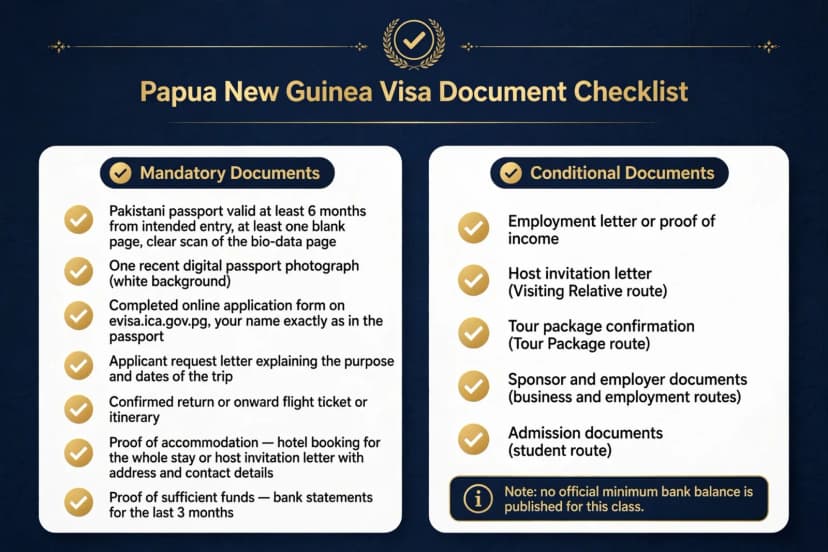
No single official document list for Pakistani applicants was published on a page found for this guide, so the checklists below combine what the portal asks of visitor applicants generally and what the Pakistan-focused guides report for this route. The portal's checklist for your class is the one that governs your application, so read it on evisa.ica.gov.pg before you submit. Prepare originals and clean scans; a blurry passport scan is the commonest reason an online application stalls.
Tourist Visitor visa — Own Itinerary (e-visa route)
- Pakistani passport valid at least six months from your intended date of entry, with at least one blank page; a clear scan of the bio-data page
- One recent digital passport photograph (white background, the portal's size and format as specified on the upload page)
- Completed online application form on evisa.ica.gov.pg, with your name exactly as it appears on the passport
- Applicant request letter explaining the purpose and dates of the trip
- Confirmed return or onward flight ticket or itinerary
- Proof of accommodation — hotel booking for the whole stay, or an invitation letter from your host in Papua New Guinea with their address and contact details
- Proof of sufficient funds — bank statements for the last three months; no official minimum balance has been published for this class, so carry statements that plainly cover the trip. One Pakistani agency advises a closing balance of PKR 1,000,000 to 2,000,000 with an Account Maintenance Certificate — an agency benchmark, not an official rule. ICSA publishes no fixed amount: you must show that you are financially secure, with a recent bank statement in PDF or a sponsor's guarantee of support
- Employment letter or proof of income
- Payment card (Visa or Mastercard) for the online fee, in your name
- Printed copy of the e-visa approval to present at boarding and on arrival
- PNG Digital Arrival Card, completed free within 72 hours before arrival — separate from the visa
Tourist or business visa — mission route (New Delhi, or ICSA email)
- Original Pakistani passport, valid at least six months from the date you enter Papua New Guinea, with blank visa pages
- Completed visa application form (the mission's or ICSA's own form)
- Two recent passport-sized colour photographs (white background)
- Confirmed return or onward flight ticket or itinerary
- Proof of accommodation — hotel booking, or an invitation letter from your host in Papua New Guinea
- For business: a sponsor letter from the PNG-based company, and be ready to provide the company's registration details
- Proof of sufficient funds — bank statements, and your Vietnamese temporary residence card and proof of address in Vietnam, to show where you live and that you will return there
- A covering note explaining your itinerary in plain language, and a copy of everything you submit, kept for yourself
- Any fee the mission charges, in the form the mission accepts — confirm in advance
Work visa — employer-sponsored
- Everything in the mission checklist above, plus:
- Work permit from the Department of Labour and Industrial Relations (DLIR), obtained by your PNG employer before you apply — the employer lodges the work permit and the employment visa together through ICSA's Sponsor Portal
- Signed employment contract with the PNG employer, detailed job description, and the employer's letter requesting the visa
- Employer's certificate of incorporation and current Investment Promotion Authority (IPA) company extract, and a foreign enterprise certificate where applicable
- Police clearance certificate, and a medical examination report — ICSA requires health clearance including HIV, TB and hepatitis screening for employment applicants
- Certified academic and professional qualifications and an updated CV
- Proof of accommodation in Papua New Guinea and a repatriation guarantee
Student visa — institution-sponsored
- Everything in the mission checklist above, plus:
- Acceptance or enrolment letter from the Papua New Guinea institution
- Proof of funds for tuition and living costs for the course
- Academic certificates and transcripts for your previous studies
- Police clearance certificate and medical certificate if the mission asks for them
Children travelling with you
- Each child needs their own passport, valid six months, with at least one blank page, and their own visa
- Birth certificate listing both parents
- If a child travels with one parent only, or with neither parent, carry a notarised parental consent letter — officers do ask for it, and the consent should be recent
How to Apply: Step-by-Step
E-visa — step by step
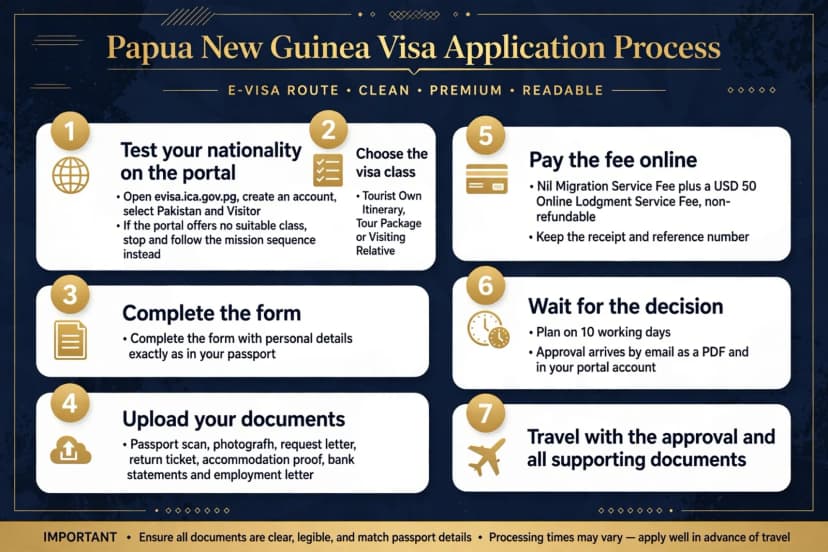
Step 1 — Test your nationality on the portal. Open evisa.ica.gov.pg and create an account, confirming your email address. Select Pakistan as your nationality and Visitor as your category. If the system offers you a Tourist Visitor visa (Own Itinerary, Tour Package or Visiting Relative), proceed. If it refuses Pakistan, offers you only the Easy Visitor Permit, or offers no suitable class, stop here and follow the mission sequence below — do not try to force the application through with a different nationality or a different purpose, and do not pay anything yet.
Step 2 — Choose the visa class. Select Tourist — Own Itinerary for a self-planned holiday, Tour Package if you are on a registered agency package, or Visiting Relative if you are visiting family. Read the class checklist on the portal before you start typing: it is the list that governs your file.
Step 3 — Complete the form. Fill in your personal details exactly as they appear on your passport, including the passport number, dates and place of birth. Enter your travel dates, your accommodation address in Papua New Guinea and your contact details in Vietnam. A name mismatch between the form and the passport is one of the commonest reasons for delay.
Step 4 — Upload your documents. Upload the passport bio-page scan, your photograph, your request letter, your return ticket or itinerary, your accommodation proof or invitation, your bank statements and your employment letter or proof of income. Check each scan is legible before you submit; the portal will return an illegible document and the clock restarts.
Step 5 — Pay the fee online. Pay the amount the portal shows at checkout — that figure, not any figure in this guide or on any other website, is the fee you owe. For a Tourist Visitor visa the published structure is a nil Migration Service Fee plus a USD 50 Online Lodgment Service Fee. Keep the payment receipt and the application reference number. The fee is non-refundable.
Step 6 — Wait for the decision. Plan on 10 working days. The approval arrives by email as a PDF and in your portal account. If the portal asks for a correction, make it immediately and note that the review clock may restart from the corrected submission.
Step 7 — Complete the Digital Arrival Card and travel. Within 72 hours before arrival, complete the free PNG Digital Arrival Card at pngdac.ica.gov.pg — airlines check it before issuing a boarding pass. Print the e-visa approval, your return ticket, your hotel booking or invitation, and your proof of funds, and carry them in your hand luggage. Airlines check the approval at boarding, and immigration officers at Port Moresby may ask for the supporting documents again.
Mission or email route — step by step
Step 1 — Contact the PNG High Commission in New Delhi. Write to or telephone the mission (B-2/19, Vasant Vihar, New Delhi 110057; telephone +91 11 26145909) and confirm, in writing if you can, that it accepts visa applications from Pakistani nationals resident in Vietnam, what its current form, fee and document list are, and whether you must apply in person or by post or email. The Australian High Commission in New Delhi states that PNG visa applications from Pakistan go to this mission. Do not travel to New Delhi until you have this confirmation.
Step 2 — Prepare the file. Assemble the mission checklist above, with originals and photocopies. Get your police clearance and medical certificate, if required, while they are still current. Ask your host or employer in Papua New Guinea for the invitation or sponsorship letter early, because a slow letter is the usual delay.
Step 3 — Submit as the mission directs. Lodge the application in the way the mission instructs — online, by email to ICSA, by post or in person — and keep a copy of everything you submit and a receipt for everything you pay.
Step 4 — Wait for the decision. Allow at least six weeks in total before travel: the New Zealand High Commission's 15-working-day figure and the 3-to-6-week agency figure both point to a longer chain than the portal route.
Step 5 — Check the visa and travel with the file. When the visa is issued, check the name, passport number, dates, number of entries and validity before you travel. Carry the passport with the visa, your return ticket, your accommodation proof or invitation, and your proof of funds in your hand luggage for the arrival check at Port Moresby, and complete the PNG Digital Arrival Card within 72 hours before arrival.
Applying from Vietnam — the Nearest Missions
For a Pakistani living in Vietnam, the hardest fact in this guide is that Papua New Guinea has no mission in Vietnam and no mission in Pakistan. There is no PNG embassy in Hanoi to walk into, and no PNG high commission in Islamabad or Karachi
The mission that handles Pakistani applications is the PNG High Commission in New Delhi. The Australian High Commission in New Delhi states that applicants for PNG visas from India, Sri Lanka, Pakistan and Bangladesh should send their PNG visa applications to that mission, at B-2/19, Vasant Vihar, New Delhi 110057, India, telephone +91 11 26145909, fax +91 11 46012812. Older listings give the email kundund@yahoo.com and kundund@pnghcdelhi.in, and office hours as Monday to Friday, 0900 to 1700, with visa hours 1000 to 1500 — but those details come from third-party listings, some of them years old, so confirm them with the mission itself. Note the practical cost: reaching New Delhi from Ho Chi Minh City means an international flight and an Indian visa for yourself, so exhaust the online route first.
Geographically, the nearest PNG mission to Vietnam is the Embassy of Papua New Guinea in Jakarta, Indonesia — Papua New Guinea's missions list includes embassies in Beijing and Jakarta and a consulate-general in Jayapura, as well as the High Commission in New Delhi. No source found for this guide states that the Jakarta embassy accepts visa applications from Pakistani nationals resident in Vietnam, so do not assume it will: ask it in writing first. The same caution applies to the Embassy in Beijing. The PNG High Commission in Wellington, New Zealand, is the mission quoted for the 15-working-day standard processing time, and it states that all visa applications are lodged online — useful as a processing-time reference, not as a place to travel to.
Also useful from Vietnam: there is no Pakistani mission in Papua New Guinea either, so if anything goes wrong while you are travelling, your help will come from the nearest Pakistani mission covering the country — ask Pakistan's Ministry of Foreign Affairs (mofa.gov.pk) before you travel which mission that is, because no source found for this guide confirms it. Keep your Vietnamese temporary residence card valid for the whole trip and carry it with your passport, because it is your proof of the right to return to Vietnam. If your TRC is close to expiry, renew it before you travel.
| Mission | Address | Telephone / email | Note |
|---|---|---|---|
| High Commission of Papua New Guinea, New Delhi (handles Pakistani applications) | B-2/19, Vasant Vihar, New Delhi 110057, India | +91 11 26145909; fax +91 11 46012812; kundund@yahoo.com (third-party listing, confirm) | Contact before travel; confirm it accepts applications from Vietnamese residents and its current fee and form |
| Embassy of Papua New Guinea, Jakarta (nearest to Vietnam) | Jakarta, Indonesia | Confirm before travel | Nearest geographically; no source confirms it accepts Pakistani applications from Vietnamese residents |
| Embassy of Papua New Guinea, Beijing | Beijing, China | Confirm before travel | Fallback mission; no source confirms it accepts applications from Vietnamese residents |
| High Commission of Papua New Guinea, Wellington | Wellington, New Zealand | Confirm before travel | Quoted 15 working days standard processing; states all applications are lodged online |
| ICSA, Port Moresby (online) | Port Moresby, Papua New Guinea | evisa.ica.gov.pg; ica.gov.pg | The controlling source for the e-visa; some nationalities apply by email to ICSA if the portal does not accept them |
Entry Points, Visa on Arrival and the Digital Arrival Card
Jacksons International Airport (POM) in Port Moresby is the main gateway to Papua New Guinea, and it is where almost every Pakistani traveller from Vietnam will arrive. ICSA's 2025 handbook names Jacksons International Airport and the Wutung land border post near Vanimo, on the Indonesian border, as the approved entry ports, and its website also lists Daru and Kagamuga Airport in Mount Hagen. Plan your entry through Jacksons unless you have confirmed otherwise in writing: the smaller posts may not process visa applications at all.
Visa on arrival is not available to Pakistani passports. The visa-on-arrival list, as published by ICSA and summarised in the visa-policy record, covers Canada, the United Kingdom, Japan, Indonesia, Singapore, Israel, the United Arab Emirates and the Pacific Island states — Fiji, Solomon Islands, Vanuatu, Samoa, Tonga, Kiribati, Tuvalu, Nauru, Palau, the Marshall Islands and the Federated States of Micronesia — plus the French and US Pacific territories, with China limited to diplomatic and official passports or group tours through a registered PNG travel agency. Mainland France, the mainland United States and mainland New Zealand are expressly not eligible. Pakistan is on none of these lists, and two Pakistan-focused guides state it directly: visa on arrival is not granted to Pakistani nationals. The visa-on-arrival fee for eligible nationalities is USD 50, payable by card at Port Moresby according to one guide — but that figure is irrelevant to a Pakistani passport: do not fly to Port Moresby with no visa document and a plan to buy one at the airport. An airline applying the Timatic database at check-in in Ho Chi Minh City may refuse to board you without a visa in the first place.
The Digital Arrival Card is mandatory and separate from the visa. From 1 October 2025 every traveller to Papua New Guinea must complete and submit online a Digital Arrival Card (PNGDAC), and the FCDO confirms this. The card is free, it is submitted at pngdac.ica.gov.pg, and it can be submitted within 72 hours before arrival. On 6 August 2026 ICSA issued a directive making the card a pre-departure requirement: airlines and check-in staff must verify completion of the PNGDAC before issuing a boarding pass, and Air Niugini has separately reminded passengers that the declaration is mandatory within the 72-hour window. The card replaces the old paper incoming passenger card and is part of PNG's e-Border system; for now it applies to air arrivals at Jacksons International Airport. The PNGDAC is not a visa and does not authorise entry — you need the visa and the card. Never pay a website that charges a fee to submit it: the official portal is free.
Arrival checks. At Jacksons, expect to show your passport with the visa, your printed e-visa approval, your return or onward ticket, your hotel booking or invitation letter, and your proof of funds. The immigration officer makes the final decision, whatever document you hold. Check the stamp in your passport before you walk away from the desk — the stamp is your proof of the date you entered and the length of stay you were given, and it is the document ICSA will ask for if you apply for an extension. One travel planner reports a K50 Green Fee climate levy payable on departure and a currency declaration threshold of K20,000 — both are third-party reports, not confirmed on an official page for this guide, so carry some kina in cash for departure and declare large amounts of currency. It is illegal to enter Papua New Guinea with many fruits, vegetables and animal products because of local quarantine controls, according to the FCDO, so declare food and plant material rather than carrying it in.
Extending Your Stay and Overstay Rules
A Tourist Visitor visa allows a stay of up to 60 days, and the Easy Visitor Permit — which does not apply to Pakistani passports — cannot be extended at all. For a Tourist Visitor visa, extension is possible in limited cases: a 2026 guide reporting the ICA handbook states that a 60-day permit can be extended for USD 150, and that a late application costs USD 700. Both figures come from a single third-party report of the handbook, not from a page on ica.gov.pg found for this guide, so treat them as reported, not confirmed — and note the shape of the rule even if the numbers move: extending on time is far cheaper than extending late, and applying late is punished hard.
The cleanest way to stay longer is to avoid needing an extension at all: if you know you want the full 60 days, say so in the application and make sure the visa issued covers it. Apply for any extension at the ICSA office in Port Moresby before your current stay expires, with your passport, photographs, proof of funds and accommodation. Do not assume an extension will be granted: it is discretionary, and the handbook's own wording is that extension is possible "in limited cases".
Overstay is taken seriously. No official per-day overstay fine for Papua New Guinea was found for this guide, so this guide quotes none rather than inventing one. What is certain is that overstaying a visa in Papua New Guinea can mean fines, detention and deportation, and trouble with every future visa application. Do not overstay, even by a day. If your departure is delayed by a cancelled flight or an emergency, go to the ICSA office before your visa expires, not after, and keep every document that proves the delay was outside your control.
Work and Study Routes
Papua New Guinea's work route is employer-led and has two separate permissions that must both be in place before you start work. A foreign national intending to engage in paid employment must hold a valid Work Permit from the Department of Labour and Industrial Relations (DLIR) and a Temporary Resident Permit from ICSA. The requirement applies to employees of PNG-registered companies including resource-sector operators, intra-company transferees, technical specialists and consultants on projects exceeding 60 days, foreign directors and key executives, and NGO workers receiving a salary.
Step one — the work permit. Your PNG employer applies to DLIR for the work permit, demonstrating that the role requires skills not readily available locally and complying with localisation requirements. Work permits are employer-tied and role-specific, valid for one to two years and renewable. The employer submits the company registration certificate, a signed employment contract, a detailed job description justifying the foreign hire, a training and localisation plan, and your certified qualifications, CV, police clearance and medical certificate. One 2026 guide puts work-permit approval at four to six weeks; treat that as a third-party estimate.
Step two — the employment visa. The employer applies for the work permit and the employment visa together through ICSA's online Sponsor Portal, or at the ICSA office. ICSA also requires health clearance, including HIV, TB and hepatitis screening, for employment applicants. The Working Resident Employment route is generally valid for six months to three years. The ICA handbook, as reported by a 2026 visa database, lists USD 380 initially for a working resident's employment visa and USD 700 for an eligible extension, with the work-permit fee in kina charged separately. Once the permits are approved, a national of a country not eligible for visa on arrival — which includes Pakistan — must obtain an entry visa from a PNG diplomatic mission before travelling.
Step three — after arrival. After arrival you must hold the Temporary Resident Permit from ICSA, which legally allows you to live and work. Working without it, or working for a different employer than the one on your visa, can lead to fines, deportation and a ban. Police clearance is required for applicants aged 16 or older intending to stay six months or longer; criminal matters must be disclosed.
For study, the route is simpler but still sponsor-based: get accepted by a Papua New Guinea institution, which sponsors the student visa. Apply with the acceptance letter, proof of funds for the course, and your academic records. There is no published student-visa fee for this guide to quote — the portal's fee screen for the class is the one that counts.
A final warning: a tourist or business visa does not give the right to work, and a business visa is for meetings, conferences and exploratory visits — not for taking up a job. Be particularly careful of anyone offering a PNG work visa for an upfront fee without a named employer, a signed contract and a DLIR work permit: that is not how the system works.
Transit, Flights and Money: Practical Notes
Flights. There is no direct flight from Vietnam to Papua New Guinea, and none from Pakistan either. The two clean corridors from Ho Chi Minh City are via Singapore and via Manila, both with direct Air Niugini sectors into Port Moresby: Singapore to Port Moresby takes about six and a half hours, Manila to Port Moresby about five hours. Air Niugini also flies direct from Brisbane (about three hours), Cairns (under two hours), Sydney, Hong Kong (about six and a half hours) and Tokyo. Qantas links Port Moresby with Brisbane, and Philippine Airlines serves the Manila route. Book the whole journey on one ticket where you can, so a missed connection is the airline's problem, and leave a generous connection time.
Transit visas — the trap is Australia, not Singapore or Manila. A Pakistani passport holder transiting Singapore airside, staying in the transit area on a single ticket with an onward flight, normally needs no Singapore visa; the same applies to an airside transit through Manila. Confirm both with your airline before you book, because the rule depends on staying airside and on the ticket being through. Australia is different: a Pakistani passport holder transiting Australia needs an Australian Transit Visa (subclass 771) even if they remain on the same aircraft in the same airport, according to the Australian High Commission in Islamabad. The transit visa is free, allows the holder to enter and remain in Australia for up to 72 hours, and is applied for on form 876; the Islamabad post gives an average processing time of one to two weeks. Pakistan is not on Australia's transit-without-visa eligible-country list, so a Brisbane, Cairns or Sydney connection without a subclass 771 in hand risks refused boarding. Apply for the transit visa before you book a non-refundable ticket — the Australian High Commission warns explicitly not to book flights until you have a visa to travel to Australia.
Money. The currency is the Papua New Guinean kina (PGK). US dollars in cash are useful at the border and in Port Moresby. Card payments are not reliably available outside Port Moresby, and ATMs outside the capital can be unreliable, so do not land with no cash. There is no published minimum bank balance for the tourist visa: carry recent statements that plainly cover the trip, and keep them with your passport rather than in checked luggage. Mobile data and a local SIM are easy to arrange in Port Moresby; buy the SIM at the airport if you can.
Where to stay. Port Moresby has hotels at every level, from backpacker guesthouses to the business hotels used by the resources industry, and the diving lodges of Milne Bay and the resorts of East New Britain are priced for international tourism — book the accommodation you will show at immigration before you apply, because the booking is part of the visa file. Jacksons International Airport is about 8 km from central Port Moresby; public transport is limited, so use a hotel transfer, a registered taxi or an organised tour, and do not walk alone at night.
Safety, Health and Arrival Checks
Security. Papua New Guinea is a high-risk destination by the standards of official travel advice — read the current advice in full before you travel rather than relying on this summary. The US State Department rates it at Level 3 — Reconsider Travel — because of crime, civil unrest and piracy, and advises against travel to central Bougainville, especially near the Panguna mine, and to the Highlands region except the towns of Mount Hagen and Goroka. It states that violent crime, including sexual assault, carjackings, home invasions and armed robberies, is common, and that police presence is limited outside Port Moresby. The FCDO advises against all but essential travel to Hela and Southern Highlands Provinces because of the high risk of tribal fighting, and to Enga Province except Wabag District, where widespread intercommunal violence in the Wapenamanda area led the provincial government to declare all districts except Wabag District "fighting zones". The FCDO also warns of a high risk of serious crime in Port Moresby, Lae and Mount Hagen, naming the area around Parliament House in the Port Moresby suburb of Waigani and the highway between Lae and Nadzab Airport as high-risk areas. Travel insurance can be invalidated if you travel against FCDO advice, so check the clause in your policy before you book.
For a first trip, the practical rules are simple: stay in Port Moresby, Goroka, Mount Hagen, Rabaul or the Milne Bay islands with a reputable local tour operator; do not travel to Hela, Southern Highlands or Enga without a specific, current reason and a sponsor who can vouch for the security arrangements; do not travel to central Bougainville, which should not be visited without prior authorisation; avoid secluded areas, keep valuables out of sight, never walk alone at night, and travel in convoy or with a security escort after dark if you can. The Papua New Guinea–Indonesia border needs extreme caution because armed clashes sometimes occur there and the Wutung crossing may suddenly close. Papua New Guinea is in the "Ring of Fire", so earthquakes are a serious risk, and unexploded Second World War ordnance remains a hazard, particularly along the Kokoda Track, at Milne Bay and Rabaul. Register your trip with the Pakistani mission that covers Papua New Guinea before you travel.
Health. The FCDO states that to enter Papua New Guinea you must have a certificate proving a yellow fever vaccination if you are coming from a country listed as a transmission risk. Neither Pakistan nor Vietnam is on the yellow-fever risk list itself, so a routing through Singapore or Manila should not need the certificate — but check the current risk list before you book, because a routing that transits a risk country changes the answer. A polio vaccination certificate from NADRA is needed to leave Pakistan, according to a Pakistan-focused guide — that requirement attaches to your departure from Pakistan, not to entry into Papua New Guinea. Malaria is present throughout Papua New Guinea: take prophylaxis as your doctor in Ho Chi Minh City advises, use repellent and a net, and drink bottled water. Medical facilities outside Port Moresby are basic, and serious conditions often require evacuation to Australia, which is expensive — buy a policy that covers medical evacuation before you travel. The FCDO also reports deaths and serious illness from alcoholic drinks containing methanol, so drink only sealed, reputable brands.
Frequently Asked Questions
1. Do Pakistani citizens need a visa for Papua New Guinea?
Yes. Ordinary Pakistani passports need a visa before travel. Pakistan is not on the visa-on-arrival list and is not one of the Easy Visitor Permit countries. The rule follows your passport, not where you live, so holding a Vietnamese residence card does not remove it.
2. Can Pakistanis apply for a Papua New Guinea e-visa online?
Probably, for a Tourist Visitor visa — but it is not settled. Several 2026 guides say Pakistanis can apply online through evisa.ica.gov.pg for a Tourist Visitor visa. Against that, a Pakistan-focused guide checked 19 November 2026 could not confirm on an official page whether Pakistani passports use the e-visa portal or must apply by email to ICSA, and a research database updated 4 September 2026 says the portal may not offer the correct Visitor category for a Pakistani passport and the applicant should contact ICA or the PNG High Commission in New Delhi before paying. Settle it on the portal itself: select Pakistan as your nationality and Visitor as your category and see what it offers.
3. How much does a Papua New Guinea tourist visa cost for Pakistanis?
The portal's published structure is a nil Migration Service Fee plus a USD 50 Online Lodgment Service Fee — a total of USD 50, charged in kina equivalent and non-refundable. Two Pakistani-facing guides quote about USD 100 instead. The figure the portal shows you at checkout is the only one that counts; do not pay USD 100 on the official portal if it shows USD 50.
4. How long does a Papua New Guinea visa take?
Sources report 10 working days where all requirements are met, 3 to 5 working days, 3 to 10 working days, 15 working days (PNG High Commission in New Zealand) and 3 to 6 weeks (a Pakistani agency). Plan on 10 working days for the portal route and apply at least four weeks before travel — six weeks if your case goes through a mission. There is no formal paid express track on the official portal.
5. How long can I stay in Papua New Guinea on a tourist visa?
A Tourist Visitor visa is valid for six months from issue and allows a stay of up to 60 days from arrival, single entry. The Easy Visitor Permit, which is not available to Pakistani passports, is 30 or 60 days and cannot be extended. A Tourist Visitor stay can be extended in limited cases — one guide reports USD 150, or USD 700 if applied late — but apply before your stay expires and do not count on it.
6. Can Pakistanis get a visa on arrival at Port Moresby airport?
No. Visa on arrival is for Canada, the United Kingdom, Japan, Indonesia, Singapore, Israel, the United Arab Emirates and the Pacific Island states, with China limited to diplomatic and official passports or group tours. Mainland France, the mainland United States and mainland New Zealand are expressly excluded, and Pakistan is on none of the lists. Get your visa approved before you leave Vietnam.
7. Is there a Papua New Guinea embassy in Vietnam or Pakistan?
No. There is no PNG mission in Vietnam and none in Pakistan. The mission that handles PNG visa applications from Pakistan is the High Commission in New Delhi (B-2/19, Vasant Vihar, New Delhi 110057; telephone +91 11 26145909). Geographically the nearest mission to Vietnam is the Embassy in Jakarta, but no source confirms it accepts applications from Pakistani residents of Vietnam — ask in writing first.
8. What documents do I need for a Papua New Guinea visa?
A passport valid at least six months from entry with at least one blank page; a recent passport photograph; a completed application form; an applicant request letter; a confirmed return or onward ticket; proof of accommodation or an invitation letter; bank statements for the last three months; and an employment letter or proof of income. Business applications add a sponsor letter from a PNG-based company; work applications add a DLIR work permit, a contract and police and medical certificates. The full checklists are in the document section above.
9. What is the PNG Digital Arrival Card, and do I need it?
Yes. The PNG Digital Arrival Card (PNGDAC) is a free online arrival declaration that every traveller must complete within 72 hours before arrival, at pngdac.ica.gov.pg. Since 6 August 2026 airlines must verify it before issuing a boarding pass. It is not a visa and does not authorise entry — you need the visa and the card. Never pay a website that charges a fee to submit it.
10. Can I work in Papua New Guinea on a tourist or business visa?
No. A tourist or business visa does not give the right to work. A work visa needs a work permit from the Department of Labour and Industrial Relations first, obtained by your PNG employer, then an employment visa lodged by the employer through ICSA's Sponsor Portal, then a Temporary Resident Permit from ICSA after arrival. The whole process takes weeks or months — never travel on a tourist visa intending to start work.
11. What happens if I overstay my Papua New Guinea visa?
No official per-day overstay fine was found for this guide, so none is quoted here. What is certain is that overstaying can mean fines, detention and deportation, and trouble with every future visa application. Apply for an extension at the ICSA office before your visa expires, or leave on time. A late extension application is reported to cost USD 700, against USD 150 on time — a further reason to apply early.
12. Do I need a transit visa for Singapore, Manila or Australia on the way?
Singapore and Manila: normally no visa is needed for a same-ticket airside transit where you stay in the transit area — confirm with your airline before you book. Australia: yes. A Pakistani passport holder transiting Australia needs an Australian Transit Visa (subclass 771) even if they stay on the same aircraft in the same airport. It is free, allows up to 72 hours, and takes one to two weeks on average from Islamabad — apply before booking a non-refundable ticket through Brisbane, Cairns or Sydney.
13. Are there direct flights from Vietnam or Pakistan to Port Moresby?
No. The clean corridors from Ho Chi Minh City are via Singapore (about six and a half hours to Port Moresby) and via Manila (about five hours), both on Air Niugini. Air Niugini also flies direct from Brisbane, Cairns, Sydney, Hong Kong and Tokyo, Qantas flies from Brisbane, and Philippine Airlines serves Manila. Book on one ticket where you can.
14. Do I need travel insurance for Papua New Guinea?
It is not listed as a required visa document, but it is strongly advisable. Medical facilities outside Port Moresby are basic, malaria is present throughout the country, and serious conditions often require evacuation to Australia, which is expensive. Buy a policy that covers medical evacuation before you travel — and check whether it is invalidated by travelling against FCDO advice for the Highlands provinces.
15. Can children travel with me to Papua New Guinea?
Yes, with their own passport and visa, a birth certificate listing both parents, and — if a child travels with one parent only or with neither parent — a notarised parental consent letter. Given the security situation, children should travel only to the safer areas named in this guide and with a reputable operator, and the trip should be registered with the covering Pakistani mission in advance.
Official Immigration Websites
Check these sources directly before you apply. The portal is the controlling source for e-visa eligibility and fees; the FCDO and the US State Department are the controlling sources for passport validity, health and safety advice.
| Website | What it is | Link |
|---|---|---|
| Papua New Guinea e-Visa portal (ICA / ICSA) | Official e-visa platform — eligibility checker, applications, fee at checkout. Domain ends in .gov.pg, not .gov.png | evisa.ica.gov.pg |
| Immigration and Citizenship Authority (ICA / ICSA) | Main immigration site — visa classes, PNG Digital Arrival Card notice, public notices | ica.gov.pg |
| PNG Digital Arrival Card | Free mandatory arrival declaration, within 72 hours before arrival | pngdac.ica.gov.pg |
| UK Foreign, Commonwealth and Development Office — Papua New Guinea travel advice | Entry requirements, passport validity, yellow fever, safety advice including Hela, Southern Highlands and Enga | gov.uk/foreign-travel-advice/papua-new-guinea |
| US Department of State — Papua New Guinea Travel Advisory | Level 3 Reconsider Travel; crime, civil unrest and piracy; areas to avoid | travel.state.gov — Papua New Guinea Travel Advisory |
| Australian High Commission, New Delhi — Papua New Guinea Visas | States PNG visa applications from Pakistan go to the PNG High Commission in New Delhi | india.embassy.gov.au — Papua New Guinea Visas |
| Australian High Commission, Islamabad — Transit Visa | Transit visa (subclass 771) required for Pakistani passports even airside; free; 1–2 weeks from Islamabad | pakistan.highcommission.gov.au — Transit Visa |
| UrduPoint — Papua New Guinea Visa for Pakistanis 2026 | Pakistan-focused guide checked 19 November 2026; could not confirm the portal-vs-email channel for Pakistanis | urdupoint.com/travel/visa/papua-new-guinea |
| Varioline Traveller — Papua New Guinea Visa for Pakistanis | Pakistan-focused research database, updated 4 September 2026; nil MSF plus USD 50 OLSF; 10 working days | variolinetraveller.com — Papua New Guinea Visa |
| VisaPNG — Papua New Guinea eVisa Fees | 2026 fee guide reporting the ICA MSF and OLSF structure by class | visapng.com — Papua New Guinea eVisa Fees |
| VisaPNG — Papua New Guinea eVisa FAQ | 2026 FAQ on eligibility, visa on arrival list and the PNGDAC | visapng.com — Papua New Guinea eVisa FAQ |
| Wikipedia — Visa policy of Papua New Guinea | Summary of visa on arrival, Easy Visitor Permit lists and tourist-visa validity | en.wikipedia.org/wiki/Visa_policy_of_Papua_New_Guinea |
| Wikipedia — List of diplomatic missions of Papua New Guinea | Missions including New Delhi, Jakarta, Beijing and Wellington | en.wikipedia.org/wiki/List_of_diplomatic_missions_of_Papua_New_Guinea |
| Travel Visa Stack — Papua New Guinea Visa for Pakistan Citizens 2026 | Commercial guide saying Pakistanis can apply online, about USD 100, 3–5 working days | travelvisastack.com — Papua New Guinea Visa for Pakistan Citizens |
| Visa From Pakistan — Papua New Guinea Tourist Visa | Pakistani visa site quoting USD 100.00 (PKR 22,376) for a tourist e-visa, 60-day stay | visafrompakistan.com — Papua New Guinea Tourist Visa |
| Visaska — Papua New Guinea visa | 2026 guide reporting the ICA handbook: extension USD 150, late USD 700; 10 working days | visaska.com — Papua New Guinea visa |
| iVisa — PNG Digital Arrival Card Checked Before Boarding | Report on the 6 August 2026 ICSA directive making the PNGDAC a pre-boarding requirement | ivisa.com — PNG Digital Arrival Card Checked Before Boarding |
| Air Niugini | National carrier — Singapore, Manila, Brisbane, Cairns, Sydney, Hong Kong and Tokyo sectors into Port Moresby | airniugini.com.pg |
This guide was checked on 28 November 2026. Visa rules change without notice. Always confirm the live rules on evisa.ica.gov.pg and with the PNG High Commission in New Delhi before paying any fee or booking a non-refundable ticket. Nothing in this guide is immigration advice; the Papua New Guinea authorities set and enforce the entry rules, and the immigration officer at Port Moresby makes the final decision.