Russia Visa Guide 2026: Types, Requirements, Documents and Application Steps
Last checked: 28 November 2026. This guide is for Pakistani passport holders living in Vietnam. Visa rules change without notice — always confirm the live rules with the Russian Consulate General in Ho Chi Minh City or the Russian Embassy in Hanoi before paying any fee or booking a non-refundable ticket. Read the safety section first: the US State Department rates Russia Level 4 (Do Not Travel) and the UK Foreign Office advises against all travel to Russia.
Introduction
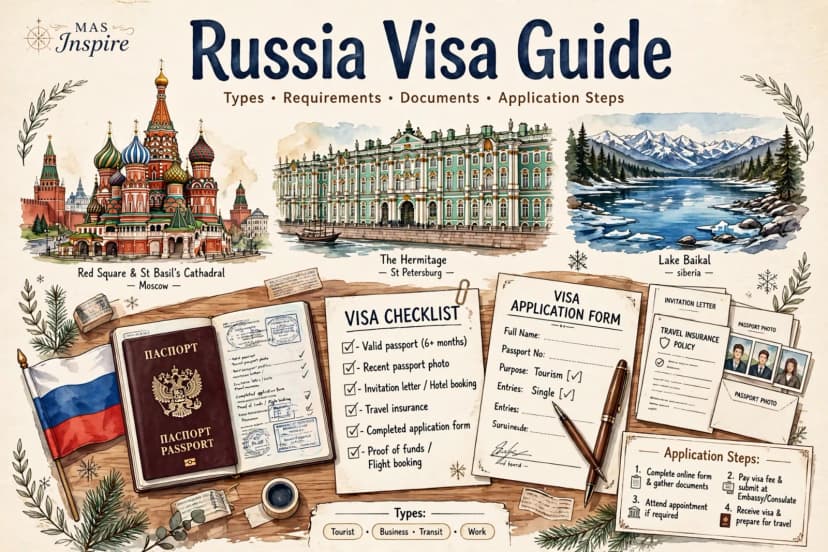
Russia is the largest country on earth, and for a Pakistani traveller living in Vietnam it is also one of the most complicated to enter. Moscow's Red Square and St Basil's Cathedral, the Hermitage in St Petersburg, the Trans-Siberian railway, Lake Baikal and the Caucasus are real draws, and there is a direct Aeroflot flight from Ho Chi Minh City to Moscow. But Russia is also, in 2026, a country under a Level 4 travel advisory from the United States and an advise-against-all-travel warning from the United Kingdom, a country where no foreign bank card works, and a country whose visa system for Pakistanis runs entirely on paper, invitations and appointments — there is no online shortcut for your passport.
The single most important fact in this guide is simple: Pakistan is not on Russia's unified e-visa list. The e-visa that many travellers read about — applied for online, decided in four days — is closed to Pakistani passports. You need a regular sticker visa, issued by a Russian mission, and the paperwork is built around an invitation: a tourist confirmation from a registered Russian tour operator, a private invitation registered with the Ministry of Internal Affairs, or a business invitation from a Russian company. Without an invitation, there is no application at all.
The second fact that shapes everything is that you are applying from Vietnam, and Vietnam is unusually well served by Russian missions. There is a Consulate General in Ho Chi Minh City — your nearest mission — plus an embassy in Hanoi and a consulate general in Da Nang.
The third fact is about money, and it is the one that catches most first-time visitors. Since March 2022, Visa, Mastercard, American Express, JCB and Maestro cards issued outside Russia do not work inside the country — not in shops, not online, not at ATMs. Apple Pay and Google Pay linked to foreign cards are dead too. You will run your whole trip on cash, on a Russian Mir card opened in Russia, or on prepaid bookings made from home.
Do Pakistani Passport Holders Need a Visa for Russia?
Yes. Every holder of an ordinary Pakistani passport needs a visa before travelling to Russia. There is no visa-free regime for ordinary Pakistani passports, no visa on arrival, and no e-visa for Pakistani nationals. The Russian Foreign Ministry's own entry-conditions list for Pakistan, as translated and checked against the Consular Department's pages in September and October 2026, states it plainly: ordinary passports — visa required; diplomatic and service passports — visa-free for up to 90 days. Unless you hold a Pakistani diplomatic or service passport, that 90-day exemption does not apply to you.
The rule follows your passport, not where you live. Living in Vietnam, holding a Vietnamese temporary residence card, holding a US, UK or Schengen visa, or having lived in the Gulf does not remove the visa requirement, and no simplified regime for Vietnamese residents of Pakistani nationality was found for Russia.
The contrast with your Vietnamese neighbours is worth understanding, because it is a common source of confusion. Vietnamese citizens can enter Russia without a visa for stays of up to 30 days, under an arrangement that applies until 15 October 2027 inclusive, and Vietnam is also on Russia's e-visa list. That is why a Vietnamese colleague can fly to Moscow on a passport alone, and why a Vietnamese travel agent may assume the same applies to you. It does not. Your Vietnamese friends travel visa-free; you travel on a sticker visa with an invitation. Do not let anyone book you on their rules.
What is not in dispute is the passport rule. The UK Foreign, Commonwealth and Development Office (FCDO) states that to enter Russia your passport must have an expiry date at least six months after the date your visa expires, and you cannot enter Russia using a visa in an expired passport even if you are also carrying a new, valid passport — you would need a new visa or a visa transfer. The US State Department's Russia information says the same in its own terms: a passport valid for six months beyond the intended stay, with two blank pages per stamp. The Russian Consular Department's own guidance, as reported by the most careful 2026 guides, puts it the same way: as a rule, the passport must be valid for at least six months after the visa expires, with two blank visa pages. For work and study visas the bar is higher — the passport must be valid for at least 18 months. Renew your passport in Vietnam or Pakistan before you apply if it is anywhere near the limit — a visa cannot be issued into a passport that will fail the six-month test, and a visa in an expired passport is worthless even if you carry the new passport alongside it.
The Big Question: Can Pakistanis Use the Russian E-Visa?
No. Pakistan is not among the countries whose nationals can apply for Russia's unified e-visa, and this is one of the few points on which every source found for this guide agrees. The Russian Foreign Ministry's Consular Department publishes a fixed list of the countries whose nationals may apply for an e-visa at evisa.kdmid.ru. The list has 64 names (one October 2026 guide counts 65 — flagged, not resolved; the list itself is the authority). Pakistan is not on it. India, Iran, Saudi Arabia and Oman are; Pakistan is not.
What the e-visa is, for those who can use it. For eligible nationals, the unified e-visa is a single-entry visa applied for online at evisa.kdmid.ru, with the decision in four calendar days. The rules changed on 23 August 2025: an e-visa issued on or after that date is valid for 120 days from issue, and the holder may stay for up to 30 days from entry. Before that change, the e-visa was valid for 60 days with a stay of up to 16 days — and the old 16-day figure still circulates in many guides, including some updated in 2026, which is why you will see both numbers quoted. The 120-day validity and 30-day stay are the current figures for eligible nationals, confirmed by the e-visa portal's own FAQ and by the Russian Foreign Ministry's entry-conditions pages.
The fee for the e-visa is disputed, and it does not apply to you anyway. The original e-visa fee was USD 40. Guides updated in late 2026 report different current figures: one commercial guide quotes USD 52, and another reports that applicants have paid AED 238 (about USD 65) since 14 October 2026, invoiced in dirhams or yuan and paid by a card issued outside Russia, with the portal showing the exact amount before payment.
The scam warning matters more than the fee. Any website that offers a Russian "e-visa" for a Pakistani passport is not the official system. The official application form is at evisa.kdmid.ru and status checks run at evisacheck.kdmid.ru — both under the kdmid.ru domain of the Russian Foreign Ministry's Consular Department. A site that accepts a Pakistani passport for an e-visa, or that charges you for one, is selling you a document Russia will not issue. Do not pay it, and do not hand it your passport details. The same warning applies to agents who promise an e-visa route for Pakistanis: the portal will not issue one to you, and the money will not come back.
One narrow exception: a second passport. The e-visa is decided by the nationality of the passport you apply with. A Pakistani who also holds the passport of a listed country — Germany or Italy, for example — can apply as a national of that country, on that passport. That is the only route by which a Pakistani national can use the e-visa, and it requires holding and travelling on the second passport. The e-visa FAQ does not address dual nationals directly, so if this is your situation, confirm it with the Consular Department by email at evisa_info@kdmid.ru before you pay. Your route is the paper visa, and the rest of this guide is built around it: an invitation first, the online form at visa.kdmid.ru second, and an in-person submission at a Russian mission in Vietnam third.
Types of Russia Visas for Pakistani Passport Holders
Russia's visa categories are set by the Consular Department of the Foreign Ministry, and the category you apply for must match the real purpose of your trip. Every one of them needs a supporting document — an invitation of some kind — and the invitation is different for each category. There is no category you can apply for with a passport and a form alone.
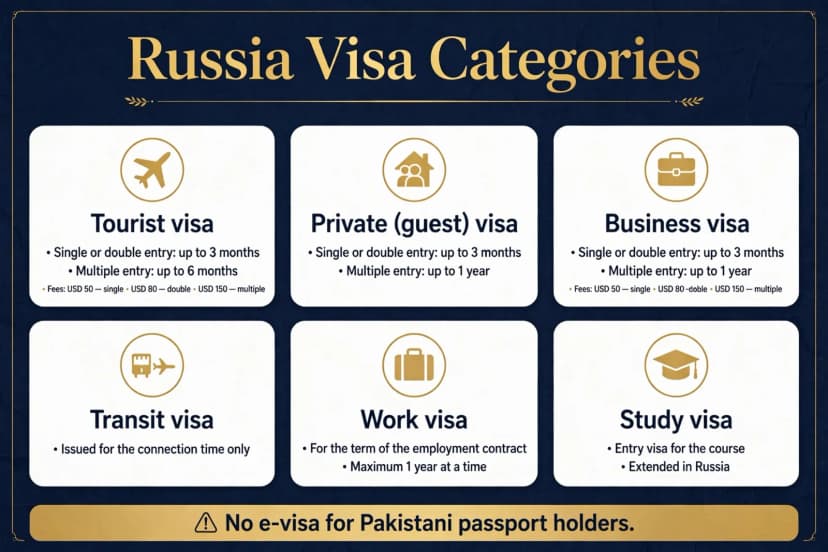
Tourist visa
The standard short-stay visa for holidays and sightseeing. A tourist visa is issued as a single or double entry for up to three months, or as a multiple-entry visa for up to six months. It needs a tourist confirmation from a registered Russian tour operator — the document usually called a tourist voucher or tourist invitation. The voucher is issued by the operator or by an accredited Russian hotel, confirms your accommodation or tour booking, and must match your exact travel dates. It is a mandatory document: the application cannot be lodged without it.
Private (guest) visa
For visiting friends or relatives who live in Russia. A private visa is issued as a single or double entry for up to three months, or as a multiple-entry visa for up to one year. It needs an invitation from the Ministry of Internal Affairs (MVD) — the invitation is issued in Russia by your host, who applies to the MVD, and the process takes time, so start it well before your trip. If you are staying with family or friends rather than in a hotel, this is your category, not the tourist visa —
Business visa
For meetings, trade fairs, conferences and commercial visits. A business visa is issued as a single or double entry for up to three months, or as a multiple-entry visa for up to one year, and it needs an official invitation — issued by the Russian company you are visiting, through the MVD or the Foreign Ministry.
Transit visa
For passing through Russia to a third country. A transit visa is issued for the time needed to make the connection, and it needs the onward ticket and the visa for the destination country where one is required. Whether you need one depends on your routing: if you stay inside the international transit zone of the same airport and do not pass through passport control, no transit visa is normally required, but if you change airports — for example, arriving at Sheremetyevo and departing from Domodedovo — or leave the transit zone, you need one. No official statement confirming the airside transit rule for Pakistani passports was found for this guide, so this is flagged as unverified: confirm it with the mission in Ho Chi Minh City or with your airline before you book a routing that transits Russia.
| Visa type | Typical validity | Entries | Invitation needed | Can it be extended? |
|---|---|---|---|---|
| Tourist visa | Up to 3 months single/double; up to 6 months multiple | Single, double or multiple | Tourist confirmation from a registered tour operator | Generally no — apply for the right length first |
| Private (guest) visa | Up to 3 months single/double; up to 1 year multiple | Single, double or multiple | MVD invitation from your host in Russia | Through the MVD, in limited circumstances |
| Business visa | Up to 3 months single/double; up to 1 year multiple | Single, double or multiple | Official invitation from the Russian company | Generally no |
| Transit visa | For the connection time | As issued | Onward ticket and destination visa if required | No |
| Work visa | Term of the contract, at most 1 year at a time | As issued | MVD invitation + work permit from the employer | With a new permit and contract |
| Study visa | Entry visa, then extended for the course | As issued | University invitation (30–45 days to issue) | Yes, inside Russia for the course length |
| Humanitarian visa | As issued | As issued | Invitation from the host organisation | Through the MVD, in limited circumstances |
The stay limit. Whatever the visa, the total stay cannot exceed 90 days in any 180-day period, except on work and study visas — that is the rule as stated in the Russian Foreign Ministry's entry conditions for Pakistan, as translated in the most careful 2026 guides. Since 1 January 2025, Federal Law No. 260-FZ replaced the old 90-in-180 rule with a 90-days-per-calendar-year limit for visa-free nationals; for visa nationals the visa's own terms govern. The visa states a maximum stay per visit and a total stay limit, and the border officer's stamp states what you were actually given.
Visa Fees: What a Russian Visa Costs for Pakistanis
The fee picture is the most conflicted part of this guide, and the disagreement is large enough that you need to see all the numbers before you pay anyone. The table below gives the figures as reported, with the source of each, and the text underneath explains which figure this guide treats as most authoritative.
| Item | Figure reported | Source |
|---|---|---|
| Single-entry visa, standard (4–20 working days) | USD 50 | Government Decree No. 1292 of 2 October 2026, applied since 14 October 2026 (via Russiable, checked 31 October 2026) |
| Double-entry visa, standard | USD 80 | Same decree |
| Multiple-entry visa, standard | USD 150 | Same decree |
| Single-entry visa, urgent (within 3 working days) | USD 200 | Same decree |
| Double-entry visa, urgent | USD 320 | Same decree |
| Multiple-entry visa, urgent | USD 600 | Same decree |
| Single-entry tourist visa | PKR 22,560 (about USD 80) | Samaa report and GoingRus guide, via ReloadedVisa (November 2026) |
| Single-entry tourist visa | EUR 90 | AMG Visa, verified 28 October 2026 |
| Single-entry tourist/business visa | About USD 160 | Travel Visa Stack, October 2026 |
| Single / double / multiple entry (Vietnam missions) | About USD 92 / 130 / 215 | Meo.Tips guide to the Russian missions in Vietnam (October 2026) |
| Unified e-visa (eligible nationals only — NOT Pakistanis) | USD 40 (original); USD 52; AED 238 (about USD 65) since 14 October 2026 | Original fee; Travel Visa Stack; Russiable (e-visa as an alternative, Vietnam page) |
| Tourist confirmation (voucher) from a tour operator | From about USD 19 | Commercial invitation services, via RussianVisa.co |
The controlling figure is the decree rate, but the amount you actually pay is set at the office where you apply. Government Decree No. 1292 of 2 October 2026 amended the consular fee rates of Decree No. 889, and it has applied since 14 October 2026. Its base rates — USD 50 single, USD 80 double, USD 150 multiple for standard processing of 4 to 20 working days, and USD 200, USD 320 and USD 600 for urgent processing within three working days — are the most authoritative figures found for this guide, because they come from a published Russian government decree rather than from a travel agent. But the same source that reports the decree adds two qualifications that matter: each country's tariff adds its own charge for costs, and you pay in local currency; and a treaty on visa fees takes priority, so the amount at your office can differ. The PKR 22,560 figure reported by two sources for applications in Pakistan is consistent with a USD 50 base fee plus local charges and the exchange rate at the time — about USD 80 at late-2026 rates. The USD 92 / 130 / 215 figures from the Vietnam guide are the ones most relevant to you, because they are quoted for the Russian missions in Vietnam —
What to do. Get the exact figure from the Consulate General in Ho Chi Minh City before you travel there, in writing if you can. Ask three questions: the consular fee for your visa type, whether a visa-centre service fee applies on top, and in what currency and by what method the fee is payable. The fee is paid at the office where you apply and is not refunded if the visa is refused.
Two figures this guide does not quote as fact. No published fee list for the Russian missions in Vietnam was found — no consular fee table on the Hanoi embassy site, the Ho Chi Minh City consulate site or the VFS Global Russia pages for Vietnam. The figures in the table above are therefore reported figures, not figures taken from the mission's own price list, and this guide says so plainly.
Processing Times
Processing time is the second disputed figure, and the honest answer is a range with a planning rule. The sources report: 4 to 20 working days as standard, or within three working days at the urgent rate — the figures tied to Decree No. 1292's fee bands, and the most authoritative statement found. One commercial guide reports standard processing of 4 to 8 days for Pakistani applicants, verified in October 2026. A guide to the Russian missions in Vietnam reports 20 days to one month for Vietnamese citizens' applications. A Pakistan-focused guide reports processing of up to about one month, and says expedited processing is not available at the Pakistan missions — which conflicts with the decree's urgent rate, and is flagged here as a conflict rather than resolved, because the urgent rate may not be offered at every mission.
Planning rule. Submit your documents at least one month before your trip, and no earlier than 90 days before your planned date of entry — the 90-day earliest-submission rule is reported by the GoingRus guide for the Pakistan missions, and it is a useful guard against applying so early that the visa expires before you travel. For a tourist visa, plan on the standard 4-to-20-working-day window and apply four to six weeks before travel, so a rejected scan, a name mismatch or a slow invitation can be corrected without losing the trip.
Complete Document Checklists
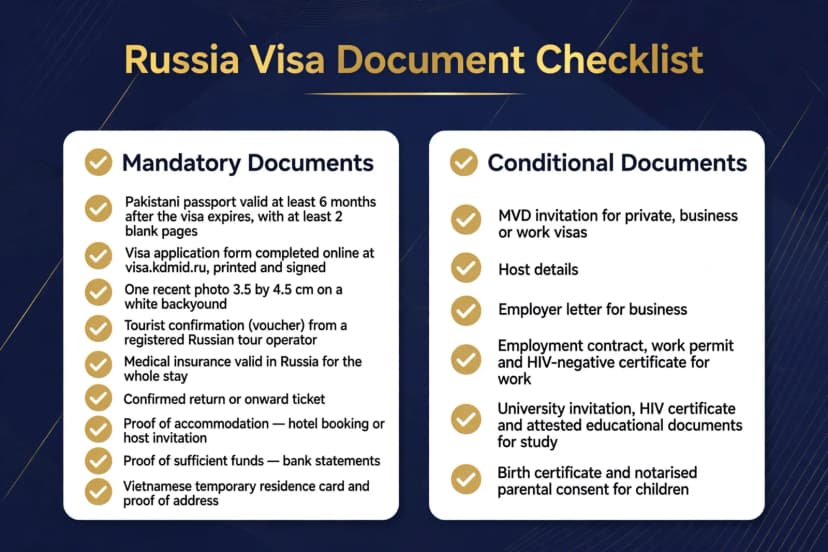
No single official document list for Pakistani applicants in Vietnam was published on a page found for this guide, so the checklists below combine what the Russian Consular Department asks of visa applicants generally, what the most careful 2026 guides report for Pakistani applicants, and what the FCDO and the US State Department say border officers check on arrival.
Tourist visa
- Pakistani passport valid at least six months after the visa expires, with at least two blank visa pages; a clear scan of the bio-data page
- Visa application form completed online at visa.kdmid.ru, printed and signed by you — with your name exactly as it appears on the passport
- One recent photograph, 3.5 x 4.5 cm, colour or black and white, full face, white background
- Tourist confirmation (voucher) from a registered Russian tour operator or accredited hotel, matching your exact travel dates
- Medical insurance policy valid in Russia for the whole stay (commercial guides report a minimum cover of USD 30,000 — reported, not verified on an official page)
- Confirmed return or onward flight ticket or itinerary
- Proof of accommodation for the whole stay — hotel bookings, or the accommodation named on the tourist confirmation
- Proof of sufficient funds — recent bank statements; no official minimum balance has been published
- Your Vietnamese temporary residence card (TRC) and proof of address in Vietnam, to show where you lawfully live and that you will return there
- The visa fee, in the form the mission accepts — confirm the amount and the payment method in advance
Private (guest) visa
- Everything in the tourist checklist above, except the tourist confirmation, plus:
- Invitation from the Ministry of Internal Affairs, issued in Russia by your host — your host applies for it, and it takes time, so start it early
- Your host's details and address in Russia, and evidence of your relationship if the mission asks for it
Business visa
- Everything in the tourist checklist above, except the tourist confirmation, plus:
- Official invitation from the Russian company, issued through the MVD or the Foreign Ministry
- A letter from your employer in Vietnam or Pakistan explaining the purpose of the visit, if the mission asks for it
- The inviting company's registration details, if the mission asks for them
Work visa — employer-sponsored
- Everything in the tourist checklist above, except the tourist confirmation, plus:
- MVD invitation and work permit in your name, obtained by your Russian employer within the annual quota before you apply
- Signed employment contract with the Russian employer
- Passport valid for at least 18 months
- HIV-negative certificate issued within the last three months
- Medical certificate if the mission asks for it, and police clearance if the employer or the mission asks for it
- Academic and professional certificates, translated into Russian and attested where required
Study visa — university-sponsored
- Everything in the tourist checklist above, except the tourist confirmation, plus:
- Official study invitation from the Russian university, issued after admission or quota placement — usually 30 to 45 days to issue
- Passport valid for at least 18 months
- HIV-negative certificate issued within the last three months
- Attested educational documents and transcripts, translated into Russian
- Proof of funds for tuition and living costs, where the mission asks for it
Children travelling with you
- Each child needs their own passport, valid six months after the visa expires, with two blank pages, and their own visa
- Birth certificate showing both parents
- If a child travels with one parent only, or with neither parent, a notarised parental consent — the FCDO states that children under 18 travelling out of Russia without a parent or legal guardian must carry a notarised travel permission from one of their parents or legal guardians, and the same document is sensible for the journey in
How to Apply: Step-by-Step
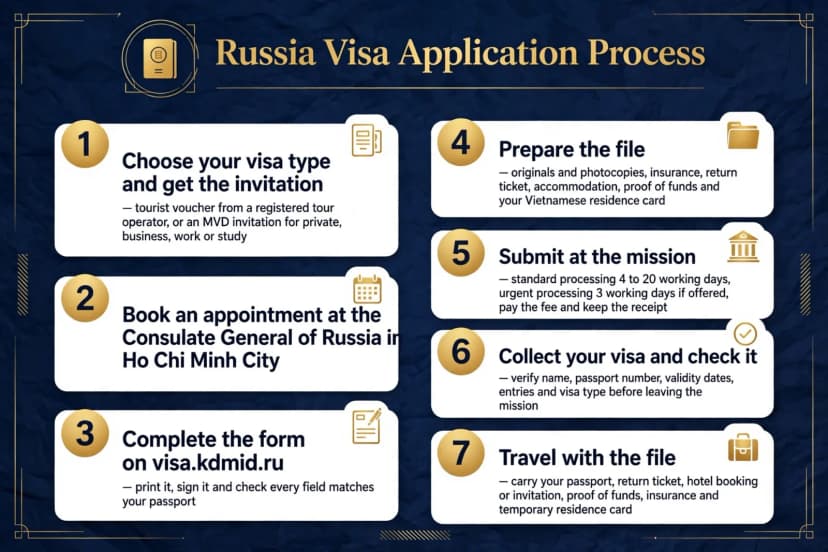
There is one sequence in this guide, because there is one route for your passport: the paper visa. The steps below are written for applying in Vietnam, where you live. The fallback — applying in Pakistan — is covered at the end.
Step 1 — Choose the visa type and get the invitation. Decide whether your trip is tourism, a private visit, business, work or study, because the invitation is different for each. For tourism, ask a registered Russian tour operator or an accredited hotel for the tourist confirmation, and check that it names you, your passport number and your exact travel dates. For a private visit, ask your host in Russia to apply to the MVD for the invitation. For business, ask the Russian company to issue its invitation. For work or study, your employer or university arranges the invitation — you cannot arrange it yourself.
Step 2 — Book the appointment. Contact the Consulate General in Ho Chi Minh City (or the embassy in Hanoi, or the consulate in Da Nang — see the next section for which mission covers you) and book an appointment. The missions work by appointment and take applications only in narrow morning windows, so book as soon as the invitation arrives. Confirm at the same time what the mission's current form, fee, document list and payment method are, and whether you must apply in person.
Step 3 — Complete the form on visa.kdmid.ru. Fill in the visa application form online on the Consular Department's portal, visa.kdmid.ru, selecting the mission where you will apply. Print it and sign it. Check every field against your passport: a name mismatch between the form and the passport is one of the commonest reasons for delay.
Step 5 — Prepare the file. Assemble the checklist for your visa type, with originals and photocopies, including the medical insurance policy valid in Russia for the whole stay. Get your bank statements and your TRC copy ready, and keep a copy of everything you submit for yourself.
Step 6 — Submit at the mission. Attend the mission with your file and the fee in the form the mission accepts. Plan on 4 to 20 working days as standard, or within three working days at the urgent rate if the mission offers it —
Step 7 — Collect the visa and check it. When the visa is issued, check the name, passport number, dates, number of entries and validity on the sticker before you leave the mission. Remember you cannot enter Russia before the date written on the visa, and you must leave before it expires.
Step 8 — Travel with the file. Carry the passport with the visa, your return ticket, your hotel booking or invitation, your proof of funds and your medical insurance in your hand luggage for the arrival check. Keep your Vietnamese TRC with your passport as well, because it is your proof of the right to return to Vietnam, and airlines and immigration officers on the way home will ask for it.
Applying in Pakistan instead. If the Vietnam missions cannot take your file — for example, if a mission says it only accepts applications from Vietnamese nationals — the fallback is the Embassy of Russia in Islamabad (Diplomatic Enclave, Khayaban-e-Suhrawardy, G-4, Islamabad; consular phone +92-51-260-08-13; email islamabad@dks.ru; foreign citizens received Tuesday and Wednesday, 10:30 to 14:00; covers Islamabad, Punjab, Khyber Pakhtunkhwa, Gilgit-Baltistan and Azad Jammu and Kashmir) or the Consulate General in Karachi (Plot No. FL-1, Block-4, Scheme 5, Clifton, Karachi; phone +92-21-358-61-336; email rfconsul@gmail.com and karachi@mid.ru; Tuesday and Thursday, 10:00 to 13:00; covers Sindh and Balochistan). Applications there are by appointment only, in limited numbers, and no earlier than 90 days before entry.
Applying from Vietnam — the Missions in Ho Chi Minh City, Hanoi and Da Nang
For a Pakistani living in Vietnam, the most useful fact in this guide is that Russia has three missions in Vietnam, and the nearest one is in your own city. The Consulate General of the Russian Federation in Ho Chi Minh City is at 40 Ba Huyen Thanh Quan Street, District 3, Ho Chi Minh City, telephone +84-28-3-930-39-36, email cgrushcm@yandex.ru. Visa documents are accepted on Monday and Tuesday from 09:00 to 12:00 and on Friday from 09:00 to 11:00, by advance appointment.
The Embassy of the Russian Federation in Hanoi is at 191 La Thanh Road, Lang Thuong, Dong Da, Hanoi, consular phone +84-4-3833-69-96, email kons_hanoi@inbox.ru and hanoi@dks.ru. Its consular reception is Monday to Wednesday and Friday, 09:00 to 12:00, by appointment booked through its website at hanoi.kdmid.ru. The Consulate General in Da Nang is at 22 Tran Phu Street, Thach Thang, Hai Chau, Da Nang, telephone +84 (236) 382 23 80, with public reception on Monday, Tuesday, Thursday and Friday, 09:00 to 11:30.
The visa-centre question is unresolved, and it matters. Two different pictures circulate. On one side, VFS Global lists Russia visa application centres in Hanoi (1st floor, Ocean Park Building, 1 Dao Duy Anh Street, Dong Da) and in Ho Chi Minh City (4th floor, Resco Building, 94–96 Nguyen Du Street, Ben Nghe, District 1), with application submission 09:00–15:00 and passport collection 15:00–17:00, Monday to Friday, and an email address info.russiavn@russia-visacentre.com. On the other side, the most careful 2026 guide to the Vietnam missions states that the visa centre is listed as closed since 2023, that document intake is generally handled directly by the Russian consulates, and that any centre listing should be verified on the responsible mission's official page before visiting. This guide does not resolve the conflict, because no official statement found for it does: treat the VFS listings as unverified, telephone the consulate first, and do not travel to a visa centre until the mission confirms it currently accepts your category, its appointment process and any separate service fee.
Three cautions belong here. First, no published fee list for the Russian missions in Vietnam was found for this guide — no consular fee table on the Hanoi embassy site, the Ho Chi Minh City consulate site or the VFS pages for Vietnam. The fee figures in this guide are therefore reported figures, not figures taken from the mission's own price list, and the mission's own quote is the only one that counts. Second, the missions' ability to issue a tourist visa to a Pakistani national resident in Vietnam, as opposed to a Vietnamese national, is the exact question to put to the mission: it is the mission that decides, and a written confirmation from it is worth more than any statement in this guide.
| Mission | Address | Telephone / email | Note |
|---|---|---|---|
| Consulate General of Russia, Ho Chi Minh City (nearest to you) | 40 Ba Huyen Thanh Quan Street, District 3, Ho Chi Minh City | +84-28-3-930-39-36; cgrushcm@yandex.ru | Visa intake Mon/Tue 09:00–12:00, Fri 09:00–11:00, by appointment |
| Embassy of Russia, Hanoi | 191 La Thanh Road, Lang Thuong, Dong Da, Hanoi | +84-4-3833-69-96; kons_hanoi@inbox.ru; hanoi@dks.ru | Consular reception Mon–Wed & Fri 09:00–12:00; appointments via hanoi.kdmid.ru |
| Consulate General of Russia, Da Nang | 22 Tran Phu Street, Thach Thang, Hai Chau, Da Nang | +84 (236) 382 23 80 | Public reception Mon, Tue, Thu, Fri 09:00–11:30 |
| VFS Global, Ho Chi Minh City — UNVERIFIED | 4th floor, Resco Building, 94–96 Nguyen Du Street, District 1 | info.russiavn@russia-visacentre.com | Listed by VFS; another 2026 guide says the centre is closed since 2023 — confirm with the consulate first |
| VFS Global, Hanoi — UNVERIFIED | 1st floor, Ocean Park Building, 1 Dao Duy Anh Street, Dong Da, Hanoi | info.russiavn@russia-visacentre.com | Same conflict as above — confirm with the embassy first |
| Embassy of Russia, Islamabad (fallback) | Diplomatic Enclave, Khayaban-e-Suhrawardy, G-4, Islamabad | +92-51-260-08-13; islamabad@dks.ru | Foreign citizens Tue/Wed 10:30–14:00; covers Islamabad, Punjab, KP, GB, AJK |
| Consulate General of Russia, Karachi (fallback) | Plot No. FL-1, Block-4, Scheme 5, Clifton, Karachi | +92-21-358-61-336; rfconsul@gmail.com; karachi@mid.ru | Tue/Thu 10:00–13:00; covers Sindh and Balochistan |
Entry Points, Arrival and Registration
Moscow's Sheremetyevo (SVO) is the main gateway for a Pakistani traveller from Vietnam, and it is where the direct Aeroflot flight from Ho Chi Minh City lands. The other international airports that process entries are Domodedovo (DME) and Vnukovo (VKO) in Moscow, and Pulkovo (LED) in St Petersburg. There is no visa on arrival at any of them: you must hold the visa before you board the aircraft in Ho Chi Minh City, and the airline will check it at check-in.
At passport control you will fill in a migration card, which is stamped and handed back to you — keep your part with your passport until you leave the country, because you must hand it in when you depart. The FCDO notes that foreigners entering Russia will be required to register their biometric details, such as fingerprints and photographs, on arrival. Expect long questioning at the border: Russian authorities strictly enforce visa and immigration law, and the US State Department's information warns that two administrative violations within three years can mean denial of entry or re-entry for five years or more and cancellation of the visa. Show your passport and visa, your return ticket, your hotel booking or invitation, and your proof of funds if asked.
Registration within seven working days. Under Article 20 of Federal Law No. 109-FZ on migration registration, the arrival notification must be filed within seven working days of your arrival at your place of stay — working days, not calendar days. The duty falls on the hosting party, not on you: the hotel, the apartment owner, the dormitory or the employer files the notification, usually through the Gosuslugi portal, a multifunctional service centre (MFC) or a post office. If you stay in a hotel, the hotel files it for you, and the deadline for hotels is shorter: one working day. If you stay in a private apartment, the landlord must file it, so discuss this with the landlord or host before you arrive.
A missed registration is not a small slip. Moscow State University's guidance for its own foreign staff and students puts the fine at 2,000 to 5,000 roubles, and warns of up to deportation and a five-year entry ban for serious violations. More recent guidance reports that the fine ranges were raised from 3 November 2026 by Federal Law No. 294-FZ, to 4,000–7,000 roubles generally and 7,000–9,000 roubles in Moscow, St Petersburg and the Moscow and Leningrad regions — reported, not verified against the text of the law itself.
Extending Your Stay and Overstay Rules
A Russian tourist visa is, as a rule, not extendable. Russia does not run a routine tourist-visa extension counter where you can buy another 30 days. Extensions exist only in limited circumstances — through the MVD, for example where a medical emergency or another force majeure makes departure impossible — and they are discretionary, not a service you can plan a trip around.
Overstay is taken very seriously, and the penalties were made harsher in 2026. Under Article 18.8 of the Code of Administrative Offences, Part 1.1 (no documents authorising stay, or failure to leave after the authorised period expires), the fine is 4,000 to 7,000 roubles, or 7,000 to 9,000 roubles in Moscow, St Petersburg and the Moscow and Leningrad regions, and since 3 November 2026 (Federal Law No. 294-FZ) expulsion under this part is mandatory, not discretionary. Beyond the fine, the entry bans are the real consequence. Under Article 27 of Federal Law No. 114-FZ, exceeding the permitted stay carries an entry ban of three years for an overstay of up to 90 days past the limit, five years for more than 180 days, and ten years for more than 270 days; administrative expulsion or deportation carries a five-year ban. The ban is an administrative measure, not a punishment, and the courts have held that it applies without discretion — a reported 2025 case concerned a foreigner banned for three years after overstaying by only three days, and the court dismissed the argument that the overstay was too minor to matter. Since 1 January 2025 the limit for visa-free nationals is 90 days per calendar year, not per 180 days; Russia counts every day, including entry and departure days. Do not overstay, even by a day. If your departure is delayed by a cancelled flight or an emergency, go to the MVD migration unit before your visa expires, not after, and keep every document that proves the delay was outside your control.
Work and Study Routes
Russia's work route is employer-led, quota-based and slow, with three steps in order: the labour step first, the visa second, and the medical and registration steps third. It is also, in 2026, a route with a serious fraud warning attached to it, and this guide puts that warning first.
Fraud warning. Pakistan's Federal Investigation Agency has opened an inquiry into fake Russian job offers that allegedly ended in military recruitment. A genuine job offer names a civilian employer and arrives with an MVD work-permit invitation in your name. Never pay an agent for a Russian job, never travel on a tourist visa intending to start work, and check the employer in the Russian company register and through licensed channels in Pakistan — including the Bureau of Emigration and Overseas Employment (BEOE) and a licensed Overseas Employment Promoter — before you pay anyone anything.
The work permit and the quota. Under Federal Law 115-FZ, a foreigner may work in Russia only with a work permit or a patent. The patent is for foreigners who entered Russia without a visa — in practice citizens of former Soviet republics such as Uzbekistan and Tajikistan. A Pakistani passport needs a visa, so the patent is closed to you: you need a work permit requested by the employer. The government sets an annual quota for visa workers: Decree No. 1920 of 28 November 2025 allows 278,940 work invitations and permits for 2026, up from 234,958 in 2025. Within that quota, the employer first needs an MVD permission to attract and use foreign workers, issued only with a conclusion from the regional employment service and valid for a year. The MVD then issues an invitation and a work permit for each named worker.
The highly qualified specialist (HQS) route. For a well-paid job, the HQS route is faster. The employer files the request, the authorities decide within 14 working days, and the permit lasts up to three years. The general salary threshold is RUB 750,000 per quarter; invited scientists and teachers need RUB 83,500 per month.
Study. There are two ways in. The first is the Russian government quota scholarship: every year the Russian government funds around 30,000 places for international students, applied for through the official portal education-in-russia.com. Levels run from bachelor's and specialist degrees (including MBBS) through master's and PhD, with a free preparatory year of Russian language where needed. Tuition is free for the full course and students reportedly receive a modest monthly stipend; flights, food and living costs are your own. Russian officials said in late 2025 that the number of places for Pakistan had tripled. The 2026–27 round closed on 15 January 2026, and the 2027–28 round is reportedly open, with the non-CIS deadline expected around mid-January 2027 — confirm the date on the portal, because it is set each year. The second way is self-funded admission: you apply directly to a Russian university, send attested transcripts and a passport copy, and pay the first-year fee once you are offered a place.
After admission or quota placement, the university applies for the official study invitation — usually 30 to 45 days — and you apply for the study visa at the mission with the invitation, a passport valid for more than 18 months, an HIV-negative certificate issued within the last three months, attested educational documents translated into Russian, and proof of funds where asked.
Transit, Flights and Money: Practical Notes
Flights. There is a direct flight from Ho Chi Minh City to Moscow, and it is the best piece of news in this guide for a traveller based in Ho Chi Minh City. Aeroflot flies nonstop from Moscow Sheremetyevo to Ho Chi Minh City, about 9.5 to 10 hours in the air, and the route is listed as operating about twice a week (Thursday and Saturday) in November 2026 schedules — but the sources conflict, and the conflict is disclosed here: the Ho Chi Minh City airport route listings and a flight-schedule site both list the Aeroflot nonstop, while a flight-comparison site states that there are currently no non-stop flights between Ho Chi Minh City and Moscow and that all available flights have at least one stop. Check the schedule on aeroflot.ru for your dates before you plan around the direct flight, because the schedule changes by season and the direct flight sells out early over New Year and Tet. Vietnam Airlines has no nonstop Moscow–Ho Chi Minh City flight: it flies from Sheremetyevo to Hanoi — four times a week on a Boeing 787-9 since July 2026 — and on to Ho Chi Minh City on a domestic flight, with the fastest journey taking about 13 hours 40 minutes. The other realistic routings are via Istanbul (Turkish Airlines, daily), Dubai (Emirates) or Doha (Qatar Airways), or via Beijing. No airline flies direct from the US, UK, EU, Canada, Australia or New Zealand to Russia.
Money — read this before you travel. Since March 2022, Visa, Mastercard, Maestro, JCB and American Express cards issued outside Russia do not work inside the country: not for paying in a shop, not for withdrawing cash from an ATM, not online. Apple Pay and Google Pay linked to foreign cards are dead as well, and the few co-badged Visa/Mastercard products that lingered after 2022 were finally cut off on 1 August 2025. The only international card network that still functions at some merchants is UnionPay, issued mainly by Chinese banks — but acceptance is inconsistent, depends on the issuing bank and the individual terminal, and several issuers have restricted Russian transactions, so treat UnionPay as a possible bonus, never as your plan.
What does work: ruble cash, above all. Bring clean, recent US dollar or euro banknotes and exchange them for roubles at bank branches in the city, where the rates are fair and the spread is small — airport exchange rates are worse, so change only a small amount on arrival and the rest in the city. Banks may reject worn, torn or older-series notes, so bring immaculate bills. Cash is accepted everywhere, from museums to taxis, and as a rough guide a three-day Moscow visit costs around 15,000 to 25,000 roubles per person if you pay entirely in cash. Declare cash and monetary instruments above the equivalent of USD 10,000 on entry, and keep the stamped declaration for departure. Two other options are worth knowing. First, prepay before you fly: anything you can pay for from home, you should. Hotels across Russia can be prebooked and prepaid with your normal card through platforms such as Ostrovok or Trip.com, which process the payment outside Russia — every rouble you prepay is a rouble you do not have to carry. Second, a Mir card: Mir is Russia's domestic card network, and foreigners can in principle open a Mir card at a Russian bank with a passport — some banks even have counters at major airports — and then load it with cash and pay by card and phone like a local, including on the metro.
Safety, Health and Arrival Checks
Security — read this section before you decide to travel at all. The US State Department rates Russia Level 4: Do Not Travel, for the whole country. Its advisory states: do not travel to Russia for any reason, due to the danger associated with the continuing war between Russia and Ukraine, the risk of harassment or wrongful detention by Russian security officials, the arbitrary enforcement of local laws, and the possibility of terrorism — and US citizens in Russia should leave immediately. A US Embassy security alert of 7 August 2026 describes an escalating drone threat: drone attacks and explosions have occurred in cities several hundred miles from the border with Ukraine, including Ufa, Omsk, Perm and Yekaterinburg, and have reached regions including Moscow, Leningrad, Kaluga, Tula, Voronezh, Samara, Saratov, Volgograd, Rostov and Krasnodar Krai. Major airports are subject to frequent closures, and flights may be significantly delayed, cancelled or diverted. The UK Foreign, Commonwealth and Development Office advises against all travel to Russia, due to the risks and threats from its continuing invasion of Ukraine, including security incidents such as drone attacks and Russian air defence activity, a lack of flights to return to the UK, and limited UK government support; it also warns of an increased risk of British nationals being detained, including if the Russian authorities suspect them of engaging in or supporting activities against Russian law, even if the activities took place outside Russia. Canada says avoid all travel.
Those advisories are written for US, British and Canadian nationals, and you are a Pakistani national — but the risks they describe (drone attacks, airport closures, arbitrary detention, limited consular help) apply to any foreigner in Russia, and your own government's advice should be checked as well. Travelling against FCDO advice can invalidate your travel insurance, and the same logic applies to any insurer that follows government advisories. The Embassy of Pakistan in Moscow is your own mission if anything goes wrong — look up its address and telephone number before you travel and keep them with your passport.
Health. No vaccinations are listed as required for entry to Russia in the US State Department's information, and no yellow-fever or other certificate requirement was found for a traveller arriving from Vietnam. Medical insurance is, however, required for the visa itself: the Consular Department requires a policy valid in Russia, and commercial guides report a minimum cover of USD 30,000 — a reported figure, not one verified on an official page. Buy a policy that covers medical evacuation as well as treatment, and check that the insurer actually covers Russia and that the policy is not invalidated by the travel advisories. For a long stay, note the medical examination required within 30 days of entry for work-visa holders, and the HIV-negative certificate required within the last three months for work and study visas.
Frequently Asked Questions
1. Do Pakistani citizens need a visa for Russia?
Yes. Ordinary Pakistani passports need a visa before travel. There is no visa-free regime for ordinary Pakistani passports, no visa on arrival and no e-visa. Only diplomatic and service passports are visa-free, for up to 90 days.
2. Can Pakistanis apply for a Russian e-visa online?
No. Pakistan is not on the Russian Foreign Ministry's list of 64 countries whose nationals can apply for the unified e-visa at evisa.kdmid.ru. Any website that offers a Russian "e-visa" for a Pakistani passport is not the official system — do not pay it. A second passport from a listed country is the only exception.
3. How much does a Russian tourist visa cost for a Pakistani?
The figures conflict. The most authoritative is Government Decree No. 1292 of 2 October 2026, applied since 14 October 2026: USD 50 single entry, USD 80 double entry and USD 150 multiple entry for standard processing of 4 to 20 working days, or USD 200, USD 320 and USD 600 urgent within three working days. Other sources quote PKR 22,560, EUR 90, about USD 160, and about USD 92 / 130 / 215 at the Vietnam missions. The fee is not refunded if the visa is refused.
4. How long does a Russian visa take?
Standard processing is 4 to 20 working days, or within three working days at the urgent rate if the mission offers it. Other guides report 4 to 8 days, or 20 days to one month. Submit at least one month before your trip and no earlier than 90 days before entry.
5. What is the tourist invitation, and do I really need one?
Yes — it is mandatory. A tourist visa needs a tourist confirmation (voucher) from a registered Russian tour operator or an accredited hotel, matching your exact travel dates. Without it there is no application. Private and business visits need their own invitations.
6. Where do I apply from Vietnam?
At the Consulate General of Russia in Ho Chi Minh City, 40 Ba Huyen Thanh Quan Street, District 3, telephone +84-28-3-930-39-36, email cgrushcm@yandex.ru — visa intake Monday and Tuesday 09:00–12:00 and Friday 09:00–11:00, by appointment. The embassy in Hanoi (191 La Thanh Road, +84-4-3833-69-96) and the consulate general in Da Nang (22 Tran Phu Street, +84 (236) 382 23 80) are the other missions.
7. Is there a VFS visa centre for Russia in Vietnam?
Unverified — the sources conflict. VFS Global lists centres in Hanoi (Ocean Park Building, 1 Dao Duy Anh Street) and Ho Chi Minh City (Resco Building, 94–96 Nguyen Du Street, District 1), but a careful 2026 guide states the visa centre is listed as closed since 2023 and that intake is generally handled directly by the consulates.
8. How long can I stay in Russia on a tourist visa?
A tourist visa is issued as a single or double entry for up to three months, or as a multiple entry for up to six months. The total stay cannot exceed 90 days in any 180-day period, except on work and study visas, according to the Foreign Ministry's entry conditions for Pakistan. A tourist visa is generally not extendable inside Russia.
9. Do I need to register after I arrive in Russia?
Yes. The arrival notification must be filed within seven working days of your arrival at your place of stay, under Article 20 of Federal Law No. 109-FZ. The duty falls on your host — the hotel files it for you within one working day; a private landlord must file it. Missing it can mean a fine and, in serious cases, deportation and a ban.
10. Can I work in Russia on a tourist or business visa?
No. A tourist or business visa does not give the right to work. A work visa needs a work permit first, obtained by your Russian employer within the annual government quota (278,940 invitations and permits for 2026), then an MVD invitation in your name, then the visa. The patent work permit is closed to Pakistanis because it is only for nationals who enter Russia without a visa. Beware fake job offers — Pakistan's FIA is investigating offers that allegedly ended in military recruitment.
11. Can I study in Russia, and is there a scholarship?
Yes. The Russian government funds around 30,000 quota places a year for international students through education-in-russia.com, with free tuition and a modest stipend; the number of places for Pakistan reportedly tripled in late 2025. The 2026–27 round closed on 15 January 2026 and the 2027–28 round is reportedly open, with the non-CIS deadline expected around mid-January 2027. After admission, the university applies for your study invitation and you apply for the study visa.
12. Will my Pakistani bank card work in Russia?
No. Visa, Mastercard, American Express, JCB and Maestro cards issued outside Russia do not work inside the country — not in shops, not online, not at ATMs — and Apple Pay and Google Pay linked to foreign cards are dead too. Run the trip on ruble cash (bring clean USD or euro notes and exchange them at bank branches in the city), on hotels prepaid from home through platforms such as Ostrovok or Trip.com, or on a Mir card opened at a Russian bank with your passport. Declare cash above USD 10,000 on entry.
13. Are there direct flights from Ho Chi Minh City to Moscow?
According to the airport route listings, yes: Aeroflot flies nonstop from Ho Chi Minh City (SGN) to Moscow Sheremetyevo (SVO), about 9.5 to 10 hours, about twice a week (Thursday and Saturday) in November 2026 schedules. Check the schedule on aeroflot.ru for your dates. The alternatives are Vietnam Airlines via Hanoi (about 13 hours 40 minutes), or via Istanbul, Dubai, Doha or Beijing.
14. Is it safe to travel to Russia in 2026?
Western governments say no. The US State Department rates Russia Level 4 (Do Not Travel) for the whole country, citing the war with Ukraine, wrongful detention, arbitrary enforcement of local laws and terrorism, and says US citizens in Russia should leave immediately. The UK Foreign Office advises against all travel to Russia, and Canada says avoid all travel. Travelling against FCDO advice can invalidate your travel insurance.
15. What happens if I overstay my Russian visa?
You will be fined 4,000 to 7,000 roubles — 7,000 to 9,000 in Moscow, St Petersburg and the Moscow and Leningrad regions — and since 3 November 2026 expulsion is mandatory for overstaying, not discretionary. Beyond the fine, the entry bans are the real consequence: three years for an overstay of up to 90 days past the limit, five years for more than 180 days, and ten years for more than 270 days, under Article 27 of Federal Law No. 114-FZ. Do not overstay, even by a day.
Official Immigration Websites
Check these sources directly before you apply. The Consular Department's portals control the form, the e-visa list and the visa categories; the Ho Chi Minh City mission controls the fee, the document list and the appointment; the FCDO and the US State Department control passport validity, safety and health advice.
| Website | What it is | Link |
|---|---|---|
| Russian e-visa portal (MFA Consular Department) | Official e-visa platform — 64-country list; Pakistan is not on it | evisa.kdmid.ru |
| Russian visa form portal (MFA Consular Department) | Official form for paper visas — complete, print, sign | visa.kdmid.ru |
| UK FCDO — Russia travel advice | Against all travel; passport, biometrics, registration, customs | gov.uk/foreign-travel-advice/russia |
| UK FCDO — Russia entry requirements | Visa before travel; 6-month passport rule; 7-day registration | gov.uk — Russia entry requirements |
| US Embassy Moscow — Security Alert, 7 August 2026 | Level 4 (Do Not Travel); drone threat; airport closures | ru.usembassy.gov — Security Alert |
| US State Department — Russia Travel Advisory (via OSAC) | Level 4: Do Not Travel — war, detention, arbitrary laws, terrorism | osac.gov — Russia Travel Advisory |
| Consulate General of Russia, Ho Chi Minh City | Nearest mission — 40 Ba Huyen Thanh Quan, District 3 | 40 Ba Huyen Thanh Quan Street, District 3, Ho Chi Minh City |
| Embassy of Russia, Hanoi | 191 La Thanh Road, Hanoi; +84-4-3833-69-96 | 191 La Thanh Road, Lang Thuong, Dong Da, Hanoi |
| Russiable — Russia visa for Pakistanis 2026 | MFA entry conditions; Decree No. 1292 fees; Pakistan missions | russiable.com — Russia visa for Pakistanis |
| Russiable — Russia visa for Vietnamese citizens 2026 | Vietnam missions' hours; VFS centre closed since 2023; e-visa fee AED 238 | russiable.com — Russia visa for Vietnamese citizens |
| Pakera — Russia e-visa for Pakistanis | E-visa list check; 23 August 2025 change (120 days, 30-day stay) | pakera.pk — Russia e-visa for Pakistanis |
| UrduPoint — Russia Visa for Pakistanis 2026 | No e-visa for Pakistan; fee unpublished; apply one month ahead | urdupoint.com/travel/visa/russia |
| ReloadedVisa — Russia visa for Pakistanis 2026 | Embassy route; tour invitation; PKR 22,560 fee | reloadedvisa.com — Russia visa for Pakistanis |
| ExpatMoscow — Moving to Moscow from Pakistan (2026) | Work and study routes; HQS thresholds; FIA inquiry | expatmoscow.com — Moving to Moscow from Pakistan |
| Hijrat — Russia student visa for Pakistanis 2026 | Quota scholarship (30,000 places); invitation 30–45 days | hijrat.pk — Russia student visa for Pakistanis |
| Meo.Tips — Russian tourist visa guide (Vietnam) | VFS listings; fees USD 92 / 130 / 215; 20 days–1 month | meo.tips — Russian tourist visa guide |
| Russiable — How to pay in Russia 2026 | Foreign cards do not work; cash, Mir, UnionPay, prepayment | russiable.com — How to pay in Russia |
| VisitRF — The 90/180 rule in Russia 2026 | 90 days per calendar year (visa-free, since 2025); fines and bans | visitrf.com — 90/180 rule in Russia |
| Novika — Russia's 90-day visa-free rule | Law No. 260-FZ; 3-year ban; fines raised 3 November 2026 | novika.info — 90-day rule |
| Moscow State University — After arrival | 7-working-day registration; fines 2,000–5,000 roubles | international.msu.ru — After arrival |
This guide was checked on 28 November 2026. Visa rules change without notice. Always confirm the live rules with the Russian Consulate General in Ho Chi Minh City or the Russian Embassy in Hanoi before paying any fee or booking a non-refundable ticket. Read the safety advisories in full before you decide to travel: the US State Department rates Russia Level 4 (Do Not Travel) and the UK Foreign Office advises against all travel to Russia. Nothing in this guide is immigration advice; the Russian authorities set and enforce the entry rules, and the immigration officer at the airport makes the final decision.