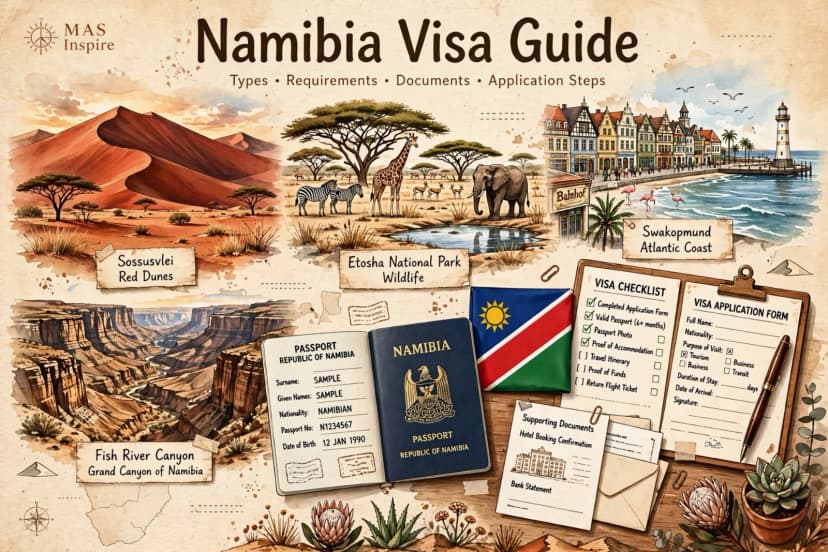
Namibia Visa Guide 2026: Types, Requirements, Documents and Application Steps
Last checked: 27 November 2026. This guide is for Pakistani passport holders living in Vietnam. Visa rules change without notice — confirm the live rules on eservices.mhaiss.gov.na and with the Embassy of Namibia in Beijing before paying any fee or booking a non-refundable ticket.
Table of Contents
- Introduction
- Do Pakistani Passport Holders Need a Visa for Namibia?
- E-Visa Yes, Visa on Arrival No: The Key Distinction
- Types of Namibia Visas for Pakistani Passport Holders
- Visa Fees and Financial Requirements
- Processing Times
- Complete Document Checklists
- How to Apply: Step-by-Step
- Applying from Vietnam — No Namibian Mission in Vietnam
- Entry Points and Arrival Checks
- Extending Your Stay and Overstay Rules
- Work, Study and Digital Nomad Routes
- Family Immigration and Permanent Residence
- Transit, Flights and Money: Practical Notes
- Safety, Health and Arrival Checks
- Frequently Asked Questions
- Official Immigration Websites
Introduction
Pakistan is not on Namibia's visa-free list, and it is not on the visa-on-arrival list either. What Pakistan does have, according to the visa-policy summary and the Pakistan-focused guide that checked the portal in November 2026, is access to a separate e-visa: a pre-travel online visa for nationalities that are neither visa-exempt nor eligible for visa on arrival, which asks for more documents and takes longer than the visa-on-arrival lane.
Namibia's entry system changed on 1 April 2025, when the Ministry of Home Affairs, Immigration, Safety and Security (MHAISS) ended visa-free entry for every country that does not give Namibian citizens visa-free entry in return. The ministry's fact sheet — version 3, dated 31 March 2025, with a further list expansion on 23 September 2025 — sets out three lanes: nationalities that need no visa at all; nationalities that may obtain a visa on arrival or as an e-visa; and nationalities that must hold a visa before travelling. Pakistan sits in the third lane. The fee for the holiday e-visa is N$1,600 (about USD 88–95) per adult, the passport rule is six months' validity with three blank pages, and the stay is up to 90 days. Every figure in this guide is labelled with where it came from, because the sources disagree about processing times, validity and extensions; where a figure could not be verified, this guide says so plainly.
Do Pakistani Passport Holders Need a Visa for Namibia?
Yes. Every holder of an ordinary Pakistani passport needs a visa before travelling to Namibia. Pakistan is not on Namibia's visa-free list, which covers Angola, Botswana, Brazil, Cuba, Eswatini, Hong Kong, Indonesia, Jamaica, Kenya, Lesotho, Macau, Malawi, Malaysia, Mauritius, Mozambique, Russia, Seychelles, Singapore, South Africa, Tanzania, Zambia and Zimbabwe, for up to three months in a calendar year. Pakistan is also not on the visa-on-arrival list, which covers about 120 countries and territories — all European Union member states, the United States, the United Kingdom, Canada, Australia, Japan, most of Europe, Vietnam, and many African, Caribbean and Pacific states. Pakistan appears on neither list, and no source found for this guide suggests otherwise.
The rule follows your passport, not where you live. Living in Vietnam, holding a Vietnamese temporary residence card (TRC), holding a US, UK or Schengen visa, or having lived in the Gulf does not remove the visa requirement, and no simplified regime for Vietnamese residents of Pakistani nationality was found. Note the contrast: Vietnam is on the visa-on-arrival list, so a Vietnamese passport holder can buy the visa at Windhoek airport while you, on the same flight with a Pakistani passport, cannot.
What is not in dispute is the passport rule. The FCDO states that to enter Namibia your passport must have an expiry date at least six months after the date you arrive, and you need at least three blank pages. The US Embassy in Windhoek says the same: six months' validity beyond your planned departure and three completely blank pages. Apply that rule to the whole trip, and renew your passport in Vietnam or Pakistan before you apply if it is anywhere near the limit. One older US State Department mirror page says six blank pages; the current FCDO and US Embassy pages both say three, and this guide follows the current figure.
E-Visa Yes, Visa on Arrival No: The Key Distinction
This is the single most important section of the guide, because the two answers in circulation lead to completely different plans — and booking a flight on the wrong one could leave you refused boarding in Ho Chi Minh City or refused entry at Hosea Kutako International Airport.
The visa-on-arrival lane is closed to Pakistani passports. Since 1 April 2025, nationals on the visa-on-arrival list can obtain a visa at designated ports — Hosea Kutako and Walvis Bay airports, the ports of Lüderitz and Walvis Bay, and named land borders — or apply online in advance. Pakistan is not on that list. The Pakistan-focused guide that checked the rules on 7 November 2026 states it plainly: Pakistan is not on either the exemption or the visa-on-arrival list, so Pakistanis must apply online and get the visa before arriving, and visa on arrival is not available to them. A second, independent 2026 guide that checked the ministry's portal on 21 November 2026 reaches the same conclusion from the other direction: if your nationality is on neither the visa-on-arrival list nor the exemption list — it names China, India and Nigeria as examples — you cannot simply turn up; you need a visa issued before travel, either through the same online portal (with more supporting documents and a longer wait) or through a Namibian embassy or high commission.
The e-visa lane is the route for Pakistanis. The visa-policy summary states that holders of passports from countries that are neither visa-exempt nor eligible for a visa on arrival can obtain a separate e-visa that requires more documents and has a longer processing time, while nationals eligible for visa on arrival can use a simplified e-visa. The Pakistan-focused guide confirms the practical shape: apply on eservices.mhaiss.gov.na before you travel, choose the number of days you need (up to 90), upload the passport page, photograph, covering letter, return ticket, bank statement and hotel booking, pay the fee and track the application online, then print the approved e-visa and carry it with your passport. Two cautions belong here. First, the portal's own lists move: the ministry added 36 countries in September 2025, so check the live list in the week you apply. Second, do not confuse the two e-visa products: the simplified e-visa for visa-on-arrival nationalities and the fuller e-visa for nationalities like Pakistan are different applications, with different document lists and different waits.
Do not pay a reseller for a visa on arrival. Several commercial sites sell a "Namibia e-visa" or "eVOA" for USD 299–349 with 4–12 working days' processing. Those are private assistance services, not the government: the official fee is N$1,600, payable on the ministry's own portal. A reseller cannot make a Pakistani passport eligible for visa on arrival. Apply only on eservices.mhaiss.gov.na, typing the address yourself.
Types of Namibia Visas for Pakistani Passport Holders
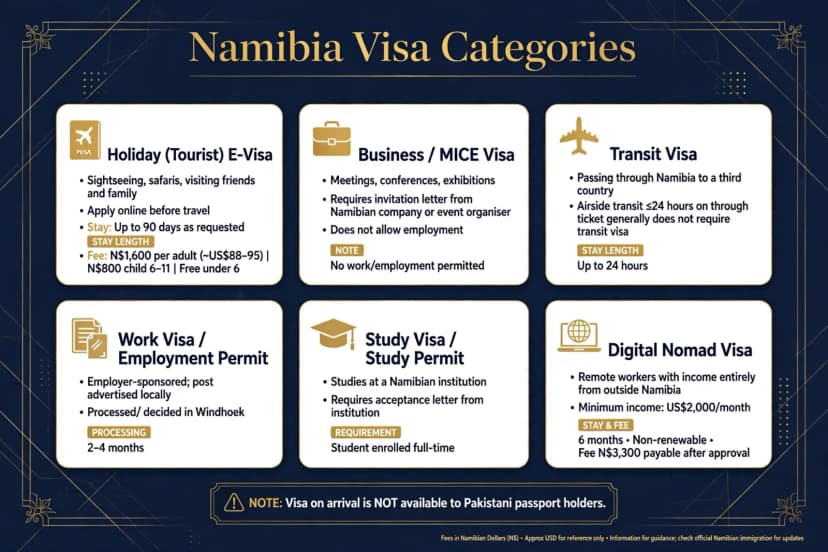
Namibia's visitor system has one main product — the holiday visa — plus a set of permits and visas that are handled separately by the ministry in Windhoek and by Namibian missions abroad. The categories below are the ones a Pakistani passport holder living in Vietnam is realistically likely to use. Work, study and residence are not visas you buy at the airport: they are permits decided in Windhoek, and the full sequence is set out in the work and study section below.
Holiday (tourist) e-visa
The standard short-stay visa for sightseeing, safaris, visiting friends and family, and holidays. For Pakistanis it is applied for online before travel on eservices.mhaiss.gov.na, for the number of days requested up to 90 days, multiple entry. It does not allow paid work of any kind. Staying with family or friends rather than a hotel? Carry a host invitation letter plus proof of their legal status in Namibia.
Business and MICE visa
For meetings, conferences, exhibitions and other business events. The ministry's e-services portal lists a MICE (meetings, incentives, conferences and exhibitions) visa alongside the holiday visa, and business travel is handled through the same online system or through a mission. A business application needs an invitation letter from the Namibian company or event organiser. Like the holiday visa, it does not allow employment or residence: it is the right tool for a prospecting trip and the wrong tool for taking up a job.
Visa on arrival (not available to Pakistanis)
The same holiday visa, bought at a designated port of entry instead of online, for nationals on the ministry's visa-on-arrival list. The fee is the same — N$1,600 for non-African nationals, N$1,200 for listed African nationals — and the stay is up to 90 days. It is described here only so you can recognise it: it is not your route, and no agent can sell it to a Pakistani passport holder.
Transit visa
For passing through Namibia to a third country. If you stay airside at Hosea Kutako International Airport and depart within 24 hours on a through ticket, you generally do not need a transit visa. If you leave the airport — to collect and re-check luggage, to stay overnight, or to spend a layover in Windhoek — you need a visa that permits entry, which for a Pakistani means the e-visa or a transit visa applied for in advance. One commercial site quotes a transit-visa fee of about €50 (about N$950), unverified against any ministry publication — confirm it on the portal or with the Beijing embassy.
Work visa and employment permit
For a foreigner entering to work for a Namibian employer. The employer sponsors the application, the post must have been advertised locally, and the ministry decides in Windhoek; the process takes two to four months according to the Embassy of Namibia in Washington. A work visa for up to six months can be applied for through an embassy; a longer stay needs a temporary employment permit. Never travel on a holiday visa intending to start work.
Study visa and study permit
For studies at a Namibian institution such as the University of Namibia or the Namibia University of Science and Technology. The institution supports the application, decided by the ministry in Windhoek; a study visa for up to six months can be applied for through an embassy, and a longer stay needs a study permit. You need the acceptance letter and proof of funds.
Digital nomad visa
For remote workers, freelancers and self-employed professionals whose income comes entirely from outside Namibia. It is a real, purpose-built programme run by the Namibia Investment Promotion and Development Board (NIPDB) with the ministry: six months, non-renewable, with a minimum income of USD 2,000 a month and a fee of N$3,300 payable after approval. It is covered in full in the work and study section.
Investor and business residence permit
For foreigners who want to run a business in Namibia. Since 1 September 2026 there is a dedicated Employment Permit to Conduct a Business, valid for up to five years, assessed by NIPDB with the final decision by the Immigration Selection Board. No minimum investment figure has been published.
| Visa or permit | Typical stay | Entries | Where to apply | Can it be extended? |
|---|---|---|---|---|
| Holiday e-visa | Up to 90 days, as requested | Multiple | eservices.mhaiss.gov.na, before travel | Yes — at MHAISS in Windhoek, before expiry |
| Business / MICE visa | Up to 90 days | As issued | Portal or mission, with invitation | Through the ministry |
| Visa on arrival | Up to 90 days | Multiple | Designated ports — not open to Pakistanis | Not applicable |
| Transit visa | Up to 3 days reported | As issued | Portal or mission, in advance | No |
| Work visa (up to 6 months) | Up to 6 months | As issued | Embassy, employer-sponsored | Through an employment permit |
| Employment permit | Matched to the contract, commonly 1–2 years | As issued | Ministry in Windhoek, via the employer | Yes, while the post continues |
| Study visa / study permit | Up to 6 months / programme length | As issued | Embassy / ministry, with institution support | Annually, through the institution |
| Digital nomad visa | 6 months, non-renewable | Single entry reported | By email via NIPDB | No — reapply only 12 months after expiry |
Visa Fees and Financial Requirements
The headline fee is clean; the figures underneath it are murkier. The verified figure comes first, then the ones that could not be verified.
| Item | Figure reported | Source |
|---|---|---|
| Holiday e-visa / visa on arrival, adult (non-African nationalities) | N$1,600 (about USD 88–95) | Ministry fact sheet v3, 31 March 2025; FCDO; US Embassy Windhoek |
| Holiday e-visa / visa on arrival, adult (listed African nationalities) | N$1,200 (about USD 66–70) | Ministry fact sheet v3, 31 March 2025 |
| Child aged 6–11 (non-African nationalities) | N$800 (half the adult fee) | Ministry fact sheet v3, 31 March 2025 |
| Child aged 6–11 (listed African nationalities) | N$600 (half the adult fee) | Ministry fact sheet v3, 31 March 2025 |
| Child under 6 | Free | Ministry fact sheet v3, 31 March 2025 |
| Manual (paper) application at the counter | N$1,600 + N$400 surcharge (N$2,000 total) | Ministry announcement, September 2025 — not confirmed as collected |
| Digital nomad visa | N$3,300 (about USD 189), payable after approval | NIPDB official page |
| Employment permit | N$80 handling + N$2,790 success fee (older guide); N$2,600 per 12 months (2026 gazette, reported) | Elidge guide; 2026 gazette — figures conflict |
| Study permit (1 year) | N$80 handling + N$1,395 success fee | Elidge guide (older figures, unverified against the current gazette) |
| Permanent residence permit | N$20,000 reported | Commercial immigration guide — unverified against a ministry publication |
| Cruise passengers (Lüderitz / Walvis Bay) | N$300 per passenger per day | Ministry fact sheet v3, 31 March 2025 |
The controlling figure is N$1,600. It appears identically in the ministry's fact sheet, the FCDO advice, the US Embassy's notice and every 2026 guide that cites the ministry — and it is the same online or at the counter, which is why the September 2025 announcement of an extra N$400 for paper applications at the counter matters: the ministry said the surcharge would start once gazetted, and the November 2026 guide reporting it could not confirm it is being collected. Apply online and you pay N$1,600. The Namibian dollar is pegged 1:1 to the rand; N$1,600 was roughly USD 88–95 in November 2026 — the fact sheet says about USD 90, one guide about USD 95; the difference is the exchange rate, not a different fee. Fees are subject to annual review, so check the portal before you pay.
Two figures to treat with care. First, one commercial e-visa site adds a 3% online service fee to the N$1,600; no ministry publication mentions one, so do not budget for it or pay it to a third party. Second, one Pakistani visa agency quotes a minimum closing bank balance of PKR 1,000,000–2,000,000 (about USD 3,000–6,000) with a six-month certified statement. That is the agency's own requirement, not a published ministry rule: no official minimum bank balance for the holiday e-visa was found. Carry recent bank statements that plainly cover the trip, and keep them with your passport. Visa fees are generally non-refundable, including if your application is refused, so confirm the fee before you pay.
Processing Times
No processing time for the holiday e-visa is published by the ministry. The Pakistan-focused guide that checked the rules in November 2026 says so directly: "Not published; apply well in advance." Everything else in this section is a third-party report, and the reports disagree — which is itself useful information, because it tells you to leave a wide margin.
For the e-visa, commercial guides report 3–5 business days, 5–10 business days, 4–12 working days and about 5 working days. One guide reports approvals in as little as five minutes, which is not a time to plan around. Embassy applications are reported at 7–10 working days by one guide and 3–8 weeks by a Pakistani visa agency — the longer figure is for applications routed through a mission with ministry approval, not the holiday e-visa. The planning rule: apply at least two to three weeks before travel. The portal has had intermittent faults in its first year, so apply early, keep the payment receipt, and keep the printed approval with you.
For the longer routes the waits are months, not days. The Washington embassy puts a temporary work or study permit at two to four months; the Geneva mission puts study and work visa approval at two to three months. Permanent residence is reported at six to twelve months by a commercial guide — unverified, but the shape is right: it is a board decision, not a counter transaction. The digital nomad visa has no published processing time; NIPDB reviews the file and forwards it to the ministry, and payment is made only after approval, so do not book flights or accommodation before approval.
Validity is a separate question from processing, and it is also disputed. The Pakistan-focused guide says the holiday visa is valid only for the period stated on it, up to 90 days. One entry guide says the e-visa is valid for 30 days from issue and you must enter within that window; another says it is valid for 90 days from approval with a maximum stay of 30 days per visit; a third says the standard stay is 30 days, extendable to 90 at the inspector's discretion, with the visa valid up to 90 days in a calendar year and multiple-entry by default. The US Embassy's notice is the clearest official word: the default entry period is generally 30 days, although up to 90 days may be granted on arrival, and visitors can apply to extend an initial 30-day stay through the ministry in Windhoek. The practical rule: ask for the full number of days you need, and check the stamp before you leave the counter — the stamp, not the visa, is your authorised length of stay.
Complete Document Checklists
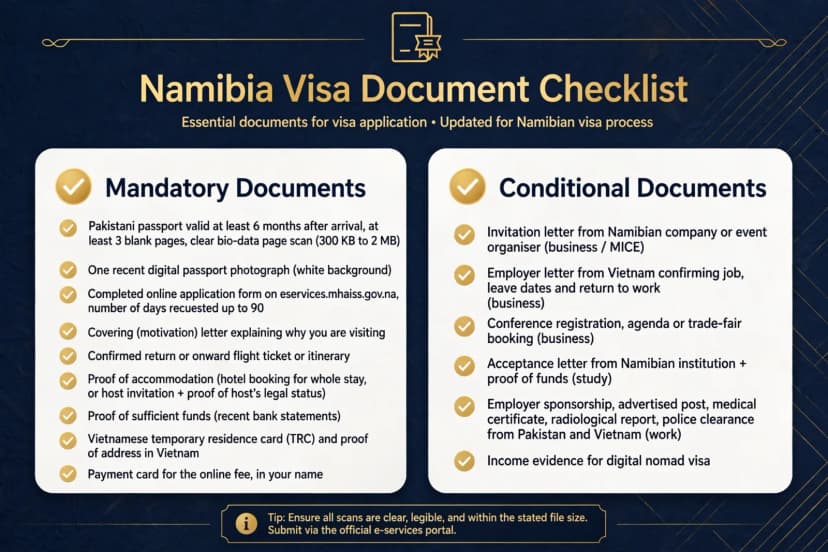
No single official document list for Pakistani applicants was published on a page found for this guide, so the checklists below combine what the portal asks of e-visa applicants generally, what the Pakistan-focused guide lists for Pakistanis, and what the FCDO and the US Embassy say border officers check on arrival. The portal's own list governs your application — confirm it before you submit. Prepare clean scans; a blurry passport scan is the commonest reason an application stalls. Documents must be in English or have a sworn English translation.
Holiday e-visa — the core file
- Pakistani passport valid at least six months after your arrival date, with at least three blank pages; a clear scan of the bio-data page (the portal accepts files between 300 KB and 2 MB — a phone photo usually has to be resized)
- One recent digital passport photograph (white background, the portal's size and format as specified on the upload page)
- Completed online application form on eservices.mhaiss.gov.na, with your name exactly as it appears on the passport, and the number of days you are requesting (up to 90)
- Covering (motivation) letter explaining why you are visiting, in plain language
- Confirmed return or onward flight ticket or itinerary
- Proof of accommodation — hotel booking for the whole stay, or an invitation letter from your host in Namibia plus proof of their legal status in Namibia
- Proof of sufficient funds — recent bank statements; no official minimum balance has been published for the e-visa, so carry statements that plainly cover the trip
- Your Vietnamese temporary residence card (TRC) and proof of address in Vietnam, to show where you live and that you will return there
- Payment card for the online fee, in your name
- Printed copy of the e-visa approval to present at boarding and on arrival
Business or MICE visa — add to the core file
- Invitation letter from the Namibian company or event organiser, with their address, contact details and the purpose and dates of the visit
- Letter from your employer in Vietnam confirming your job, your leave dates and that you will return to work
- Evidence of the event or meeting — conference registration, agenda or trade-fair booking
Work visa and employment permit — employer-sponsored
- Everything in the core file, plus:
- Duly completed application form 3-1/0001, representation-by-employer form 3-1/0002, and deed of surety form 3-1/0005
- Medical certificate on form 3-1/0003 and radiological report on form 3-1/0004
- Two passport-size photographs of the applicant (and accompanying spouse)
- Highest educational qualifications and certificates, and previous work references or certificates of service
- Police clearance certificate from the country of origin, for applicants aged 18 and over — and from the last place of residence, which for you means Vietnam as well as Pakistan
- Copy of the job advertisement, and the names and qualifications of unsuccessful Namibian applicants, where asked for; letters from the Namibian company and from your current employer
- All permits are subject to approval by the Ministry of Home Affairs before entering Namibia — a permit from another ministry alone is not enough
Study visa and study permit — add to the core file
- Proof of acceptance or registration with the Namibian study institution
- Written reason for studying in Namibia, and a written undertaking from a parent, guardian or sponsor to sponsor the studies
- Proof of funds for tuition and living costs, and proof of bursary if applicable
- Letter from the Ministry of Education confirming no objection, where asked for
- Police clearance certificate and medical certificate with radiological report, where the mission asks for them
Digital nomad visa — add to the core file
- Visa application form 3-1/0033, signed; a separate form for each accompanying dependant
- Medical certificate on form 3-1/0003 and radiological report on form 3-1/0004
- Certified copy of the passport, and proof of international health and travel insurance
- Proof of income: payslips or employment contract showing at least USD 2,000 a month after tax, plus USD 1,000 for a spouse and USD 500 per child, with six months of bank statements
- Motivation letter from the employer (or equivalent for freelancers), copies of qualifications, and a police clearance certificate from the country of origin, translated into English
- Motivation letter from NIPDB, sent directly by NIPDB to the ministry
Children travelling with you
- Each child needs their own passport, valid six months, with three blank pages, and their own visa — children under 6 are free of the fee but still need a passport and a visa
- Full (unabridged) birth certificate naming both parents — the original or a certified copy; short-form certificates that do not show the parents are not accepted
- If a child travels with one parent only, a signed consent affidavit from the other parent (or a death certificate or court order giving sole custody, where that applies)
- If a child travels with neither parent, consent affidavits from the parents or legal guardians, and for an unaccompanied child a letter from the person receiving them with a contact address
How to Apply: Step-by-Step
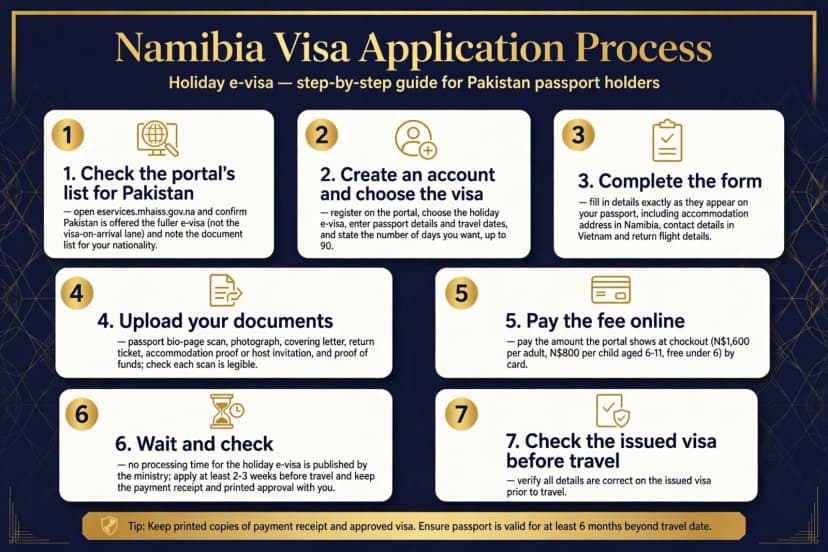
There is one sequence for the holiday e-visa, which almost every reader of this guide will use, and a second for the permit routes decided in Windhoek. Do not mix them up: a work application filed as a holiday e-visa will be refused, and a holiday trip filed as a permit application will waste months.
Holiday e-visa — step by step
Step 1 — Check the portal's list for Pakistan. Open eservices.mhaiss.gov.na and find the visa-on-arrival / e-visa nationality lists. Confirm that Pakistan is offered the fuller e-visa (not the visa-on-arrival lane) and note the document list for your nationality. The lists move, so check in the week you apply.
Step 2 — Create an account and choose the visa. Register on the portal (one account can cover a family). Choose the holiday e-visa, enter your passport details and travel dates, and state the number of days you want, up to 90 — the stay you are given is decided by the officer on arrival, so ask for the full number you need.
Step 3 — Complete the form. Fill in your details exactly as they appear on your passport, including the passport number, dates and place of birth. Enter your accommodation address in Namibia, your contact details in Vietnam and your return flight details. A name mismatch is one of the commonest reasons for delay.
Step 4 — Upload your documents. Upload the passport bio-page scan (300 KB to 2 MB), your photograph, your covering letter, your return ticket or itinerary, your accommodation proof or host invitation, and your proof of funds. Check each scan is legible before you submit; the portal will return an illegible document and the clock restarts.
Step 5 — Pay the fee online. Pay the amount the portal shows at checkout — N$1,600 per adult, N$800 per child aged 6–11, free for children under 6 — by card. That figure, not any figure in this guide or on any other website, is the fee you owe. Keep the payment receipt and the application reference number, and track the application on the portal.
Step 6 — Wait for the decision. No processing time is published; third-party reports range from 3–5 to 4–12 working days. Apply at least two to three weeks before travel. The approval arrives by email and in your portal account as a printable document. If the portal asks for a correction, make it immediately — the review clock may restart.
Step 7 — Print everything and travel. Print the e-visa approval, return ticket, hotel booking or invitation, and proof of funds, and carry them in your hand luggage. Airlines check the approval at boarding; officers at Windhoek may ask for the documents again. Check the entry stamp before you leave the counter.
Work, study and digital nomad routes — step by step
Step 1 — Get the sponsor first. For work, that means a Namibian employer willing to advertise the post and sponsor the permit. For study, it means an acceptance letter from a Namibian institution. For the digital nomad visa, it means assembling the income evidence and contacting NIPDB. Nothing else in the sequence works without the sponsor.
Step 2 — Assemble the permit file. Use the checklists above: forms 3-1/0001, 3-1/0002 and 3-1/0005 for work; form 3-1/0033 for the digital nomad visa; medical certificate 3-1/0003 and radiological report 3-1/0004 in every case; police clearance from Pakistan and from Vietnam; qualifications, references and the deed of surety. All documents not in English need a certified English translation.
Step 3 — File through the right channel. Work and study visas for up to six months can be applied for through a Namibian embassy — for you, Beijing — which forwards the file to the ministry in Windhoek. Longer permits are decided by the ministry itself. Digital nomad applications go by email to NIPDB. Do not pay the visa fee when applying for a work or study visa: only the handling fee is paid on application, and the visa fee is paid after approval.
Step 4 — Wait for ministry approval. Plan on two to four months for a work or study permit. Do not book flights or accommodation before approval — NIPDB advises against it for the nomad visa, and the same logic applies to the permit routes.
Step 5 — Pay, collect and travel. Pay the fee only after approval, collect the visa or permit, and check the name, passport number, dates and conditions on it before you leave the mission. Carry the full file in your hand luggage for the arrival check.
Applying from Vietnam — No Namibian Mission in Vietnam
For a Pakistani living in Vietnam, the most useful fact in this section is a negative one: Namibia has no embassy or high commission in Vietnam. The list of diplomatic missions in Vietnam contains no Namibian mission, and the Hanoi embassy directories confirm the absence. That is not a problem for a holiday trip, because the holiday e-visa is entirely online. It matters only for the routes that need a mission: work and study visas, and any case where the portal cannot help you.
The nearest Namibian mission for you is the Embassy of Namibia in Beijing, formally accredited to Vietnam (alongside Cambodia, Mongolia and North Korea). Its address is 2-9-2, Ta Yuan Diplomatic Office Building, Chaoyang District, Beijing 100600, telephone +86 10 6532 4810 / 6532 4811 / 6532 2211, fax +86 10 6532 4549. No published email address was found. Contact it before travelling to Beijing, confirm that it accepts visa applications from Pakistani nationals resident in Vietnam, and ask for its current form, fee and appointment rules in writing — accreditation does not by itself guarantee it will take an application from a third-country national resident there.
The other Asian mission is the High Commission of Namibia in New Delhi, at B-9/6 Vasant Vihar, New Delhi 110057 (one directory gives E-86 Paschimi Marg instead — confirm before travelling), telephone +91 11 2614 0389 / 2614 4772 / 2615 5481, email nam@nhcdelhi.com. Its accreditation covers Afghanistan, Bangladesh, Myanmar, the Maldives, Nepal and Sri Lanka — not Pakistan or Vietnam — so it is a fallback, not your first call. There is no Namibian mission in Pakistan either.
Also useful from Vietnam: the Embassy of Pakistan in Hanoi is your own mission if anything goes wrong — telephone +84 24 3726 2051 / 2252. Keep your Vietnamese temporary residence card valid for the whole trip and carry it with your passport: it is your proof of the right to return to Vietnam. If your TRC is close to expiry, renew it before you travel. One note that applies only if you travel via Pakistan: the Pakistan-focused guide lists a polio vaccination certificate from NADRA as needed to leave Pakistan. That is a Pakistan exit requirement, not a Namibian entry requirement — but if your itinerary takes you through Pakistan, carry the NADRA certificate.
| Mission | Address | Telephone | Note |
|---|---|---|---|
| Embassy of Namibia, Beijing (accredited to Vietnam — nearest mission) | 2-9-2, Ta Yuan Diplomatic Office Building, Chaoyang District, Beijing 100600 | +86 10 6532 4810 / 4811 / 2211 (fax +86 10 6532 4549) | No published email found; confirm it accepts applications from Pakistani residents of Vietnam before travelling |
| High Commission of Namibia, New Delhi | B-9/6 Vasant Vihar, New Delhi 110057 (one directory gives E-86 Paschimi Marg instead) | +91 11 2614 0389 / 2614 4772 / 2615 5481 | nam@nhcdelhi.com; accredited to Afghanistan, Bangladesh, Myanmar, Maldives, Nepal, Sri Lanka — not Pakistan or Vietnam |
| Embassy of Pakistan, Hanoi (your own mission) | Hanoi, Vietnam | +84 24 3726 2051 / 2252 | Consular help if anything goes wrong while applying or travelling |
| Ministry of Home Affairs, Windhoek (decides permits) | Windhoek, Namibia | +264 61 292 2111; visa enquiries +264 81 951 0064 / 65 / 66 | esupport@mhaiss.gov.na reported for portal enquiries — confirm the address on the portal |
Entry Points and Arrival Checks
Hosea Kutako International Airport (WDH), about 45 kilometres east of Windhoek, is the main gateway, and where almost every Pakistani traveller from Vietnam will arrive. Walvis Bay Airport is the second international airport. Visas on arrival — for the nationalities that can buy them — are issued only at designated ports: Hosea Kutako and Walvis Bay airports, the ports of Lüderitz and Walvis Bay, and named land borders with South Africa, Botswana, Zambia and Angola, plus Impalila Island. An e-visa is accepted at all gazetted ports except a group of small posts and airfields not connected to the system — the Dobe, Kasika, Klein Manasse, Mata-Mata, Nkurenkuru, Sarasungu, Singalamwe and Vioolsdrift borders and the airports at Gobabis, Grootfontein, Keetmanshoop, Lüderitz, Mpacha, Ondangwa and Rundu. Do not enter through any of those: the Mata-Mata gate from South Africa's Kgalagadi Transfrontier Park catches self-drivers out. Windhoek's city airport, Eros, handles charters and domestic flights only.
At the airport, expect to show your passport with the printed e-visa approval, your return or onward ticket, your hotel booking or invitation, and your proof of funds. The ministry's checklist also lists health or travel insurance and the arrival form handed out on the aircraft or at the counter. In practice, officers at Windhoek ask most holidaymakers only for the passport, the visa and the address of the first night — have the rest on your phone and on paper anyway. The immigration officer makes the final decision in every case.
Check the stamp before you walk away from the desk. Your authorised length of stay is determined by the immigration officer's stamp, not by the validity of your visa. The US Embassy warns visitors to check the stamp before leaving the counter, and that overstaying the time granted, or having an incorrect or missing entry stamp, can result in detention, arrest and fines. The default entry period is generally 30 days, although the inspector may grant up to 90 days. If you need more than the stamp gives you, ask at the counter before you leave it — one 2026 entry guide reports that an extension to 90 days can be requested there, at the inspector's discretion.
Extending Your Stay and Overstay Rules
A stay can be extended inside Namibia, but the extension is discretionary, it must be applied for before the initial stay expires, and the figures for it conflict between sources — so this section reports the range rather than a single number. The US Embassy states that visitors can apply to extend an initial 30-day stay through the ministry in Windhoek, and a 2026 entry guide adds that extensions are not guaranteed and are at the officials' discretion. Another guide reports an extension fee of N$1,000, five to ten working days' processing, and a total stay capped at 90 days per calendar year, granted for compelling reasons such as medical treatment or a vehicle breakdown — tourism extensions for extra sightseeing are rarely approved. The N$1,000 fee and processing time come from a single commercial guide and are unverified against a ministry publication. Apply in Windhoek well before your stamp expires, with your passport, proof of funds, a letter explaining the need, and the fee in a form the ministry accepts.
The cleanest way to stay longer is to avoid needing an extension: ask for the full number of days you need — up to 90 — on the application, and ask the inspector at the counter for the full stay. Tourist stays are also capped in a way that surprises first-time visitors: several 2026 guides report that total tourist stays cannot exceed 90 days in a single calendar year. If you plan a long or repeated stay, count your days across the whole year.
Overstay is taken seriously. The US Embassy and the US State Department both warn that overstaying can result in detention, arrest and fines. One commercial guide reports N$100 per day, deportation and a re-entry ban of one to five years — from a single commercial guide, unverified against a ministry publication — but the official warning behind them is real. Do not overstay, even by a day. If your departure is delayed, go to the ministry in Windhoek before your stamp expires, not after, and keep every document proving the delay was outside your control.
Work, Study and Digital Nomad Routes
Namibia's work route is employer-led and slow, and it has three separate steps that must happen in the right order: the labour step comes first, the visa second, and the permit third. A 2026 legal summary of the system and the Embassy of Namibia in Washington set the sequence out clearly, and it is worth following exactly.
Step one — the job and the labour-market test. Your Namibian employer must show that the post was advertised locally and that no suitably qualified Namibian was available. The test is applied in substance, not as a formality: the employer provides the advertisement, the names and qualifications of unsuccessful Namibian applicants, a motivation letter and the company profile. Regulated professions — medicine, engineering, law, accountancy, teaching — also need registration with the relevant council, and qualifications may need evaluation by the Namibia Qualifications Authority.
Step two — the work visa. With the employer's sponsorship, you apply for a work visa at a Namibian embassy — for you, Beijing — on the ministry's forms, for up to six months. The file includes forms 3-1/0001, 3-1/0002 and 3-1/0005, a medical certificate (3-1/0003), a radiological report (3-1/0004), two photographs, your qualifications, previous work references, police clearance from your country of origin and your last place of residence, and letters from the Namibian company and your current employer. The Geneva mission states that study and work visas are issued by the ministry in Windhoek, not the embassy, that approval takes two to three months, and that you pay only the handling fee on application — the visa fee is paid after approval.
Step three — the employment permit. For work beyond six months you need a temporary employment permit, decided by the ministry in Windhoek on the Immigration Selection Board's recommendation and tied to a named employer and post. It is granted for a period matched to the contract, commonly one to two years, and renewable while the post continues. The fees are disputed: an older guide lists N$80 handling plus a N$2,790 success fee, while a 2026 review citing the gazette reports N$2,600 per 12 months — confirm the gazette figure with the ministry. Working for a different employer than the one on your permit, or without a permit, can lead to fines, deportation and a ban.
For study, the route is simpler but still ministry-based: get accepted by a Namibian institution such as the University of Namibia or the Namibia University of Science and Technology, which supports the application. A study visa for up to six months can be applied for through an embassy; a longer stay needs a study permit, granted for the programme and renewed annually. The file includes proof of acceptance, a written reason for studying, a sponsor's undertaking, proof of funds, and a Ministry of Education no-objection letter where asked for. No student-visa fee was published — the ministry's fee counts. A final warning for every route: a holiday or business visa does not give the right to work.
Digital nomad visa — the remote-work route. Namibia has a purpose-built digital nomad visa, launched in October 2022 by NIPDB with the ministry, and one of the clearest such programmes in Africa. It grants a six-month stay, is non-renewable, cannot change conditions in Namibia, and can only be reapplied for 12 months after expiry. You must work remotely for companies or clients outside Namibia — as an employee, freelancer or self-employed professional — and may not seek local employment. The income floor is USD 2,000 a month after tax, plus USD 1,000 for a spouse and USD 500 per child, evidenced by payslips or a contract and six months of bank statements; if income falls short, NIPDB says savings can be considered. The fee is N$3,300, payable after ministry approval and before arrival — the NIPDB page also carries a stray line giving the fee as "Approx. NAD195", plainly a misprint for the USD equivalent. Applications go by email to NIPDB, which reviews the file, writes its motivation letter and forwards everything to the ministry; third-party guides give nomadvisa@nipdb.com, but confirm the address on the NIPDB page first. You must also hold international health and travel insurance, supply police clearance, a medical certificate and a radiological report, and have no legal status in Namibia when you apply. The visa does not lead to permanent residence, and time on it does not count towards naturalisation.
Investor route. Since 1 September 2026, foreign investors use the Employment Permit to Conduct a Business, valid for up to five years, with NIPDB confirming the investor and assessing the business and the Immigration Selection Board deciding. NIPDB aims to finish its stage within 30 working days. No minimum investment has been published; a private figure of USD 365,000 for one real-estate development is a property price, not a government threshold.
Family Immigration and Permanent Residence
There is no separate family-reunion visa on the portal. Dependants travel on the same logic as the main applicant: a spouse or child of a work-permit holder applies for a temporary stay linked to the main holder's permit, filing together with the marriage or birth certificates that prove the relationship. Children need their own passport and visa in every case, plus the unabridged birth certificate and consent documents in the checklist section. If you are married to a Namibian citizen, the work-permit file asks for the marriage contract; the spouse route is assessed on its own merits, not as an automatic right — confirm the requirements with the ministry first.
Permanent residence is decided by the Immigration Selection Board under section 26 of the Immigration Control Act 7 of 1993, which sets no fixed number of years as a qualifying condition: it lists character, means or employability, and assimilation. In practice, commercial guides describe the recognised routes as ten years of lawful residence on a work permit, five years running a registered business, or retirement at 60 or over with sufficient means — one guide puts a N$4 million net investment value on the retiree route, unverified against a ministry publication. A 2024 High Court order, upheld by the Supreme Court in December 2025, bars the Board from requiring fixed assets in Namibia: means can be shown through assets and income held abroad. The reported fee is N$20,000, processing six to twelve months, with a requirement to enter Namibia at least once every two years — all from a single commercial guide, unverified. Treat permanent residence as a long, discretionary board decision, not an automatic milestone.
Naturalisation is longer still. Under the Constitution as amended in 2010, it requires ten years of continuous ordinary residence on a permanent residence permit — years on temporary employment, study or visitor permits do not count — plus good character, knowledge of the responsibilities and privileges of citizenship, and an intention to remain. A naturalised citizen must be willing to renounce any other citizenship. The reported certificate fee is N$1,200. The honest summary: Namibia is a realistic holiday, remote-work or sponsored-employment destination, and a very long road to a passport.
Transit, Flights and Money: Practical Notes
Flights. There is no direct flight from Vietnam to Namibia, and none from Pakistan either. The realistic corridors from Ho Chi Minh City all connect through a hub: Johannesburg (South African Airways or Airlink onward to Windhoek), Addis Ababa (Ethiopian Airlines), Doha (Qatar Airways) or Dubai (Emirates). The Johannesburg routing is the one to check twice. A Pakistani travel desk reported in 2026 that Pakistani passports need a South African transit visa even airside at OR Tambo; that claim is from a single commercial source and unverified against a South African government page, so confirm it with the South African mission or your airline, or use Addis Ababa, Doha or Dubai, where no second visa is reported for a straightforward airside transit. Book the whole journey on one ticket, and leave a generous connection time. If your itinerary routes you through Namibia to somewhere else, the transit rules in the visa-types section apply: airside under 24 hours generally needs no visa, but leaving the airport needs one.
Money. The currency is the Namibian dollar (N$ or NAD), pegged 1:1 to the South African rand, and rand notes and coins are accepted alongside Namibian dollars throughout the country. At the November 2026 rate, N$1,600 was roughly USD 88–95 and N$3,300 roughly USD 189. US dollars in cash are useful in Windhoek and at lodges, but the portal fee is paid by card, and at the counter the fact sheet expects card payment — carry a second card and enough cash in rand or Namibian dollars to cover the fee in case the terminal is offline, because cash acceptance at the counter is not promised. ATMs outside Windhoek and Swakopmund can be unreliable, so do not land with no cash. There is no published minimum bank balance for the holiday visa: carry recent statements that plainly cover the trip. No cash-declaration threshold for Namibia was verified — check the customs rules on the arrival form.
Where to stay and what it costs. Windhoek has hotels at every level, Swakopmund has guesthouses and lodges on the coast, and the safari areas — Etosha, Sossusvlei, Damaraland — are priced for international tourism, with camps that must be booked well ahead in the dry season (May to October). Book the accommodation you will show at immigration before you apply: the booking is part of the visa file. A local SIM is easy to arrange in Windhoek; buy one at the airport. Self-drivers should note that distances are long, roads off the main tarred routes are gravel, and the FCDO advises low speeds when roads deteriorate, spare tyres, plenty of water, and no driving at night because of wildlife and livestock.
Safety, Health and Arrival Checks
Security. The FCDO does not advise against travel to any part of Namibia — a stable, low-risk destination for tourists who take normal precautions. The risks are ordinary: pickpocketing and robbery in crowded areas, malls and markets in Windhoek, and the road risks above. Register your trip with the Embassy of Pakistan in Hanoi, keep copies of your passport and e-visa separate from the originals, and keep your hotel's and the embassy's numbers in your phone.
Health. There is no yellow fever in Namibia, and no vaccination is required of travellers arriving directly from Europe, North America, Asia or Australasia. A certificate is required from travellers aged nine months and over who arrive from a risk country, or who spend more than 12 hours in transit in an airport in such a country — and that matters here, because the Addis Ababa, Nairobi and Luanda routings pass through risk countries. If your layover there is longer than 12 hours, get vaccinated in Vietnam before you travel and carry the yellow card with your passport; the certificate is valid for life. Neither Pakistan nor Vietnam is on the risk list, so a short transit under 12 hours should not need the certificate — but if there is any doubt, vaccinate. Malaria is a risk in the north — Kavango East, Kavango West and the Zambezi Region are high risk all year — so discuss antimalarials with your doctor in Ho Chi Minh City, use repellent and a net, and drink bottled water. Travel insurance is on the ministry's arrival checklist; facilities outside Windhoek are basic and evacuation is expensive, so buy a policy covering medical evacuation.
Arrival checks. At Hosea Kutako airport, expect to show your passport with the printed e-visa approval, your return or onward ticket, your hotel booking or invitation, and your proof of funds. The immigration officer makes the final decision, whatever document you hold. Check the entry stamp before you walk away — it is your proof of entry date and stay length, and the ministry will ask for it if you apply for an extension — and keep the arrival form until you leave, since it is checked on departure.
Frequently Asked Questions
1. Do Pakistani citizens need a visa for Namibia?
Yes. Ordinary Pakistani passports need a visa before travel. Pakistan is not on Namibia's visa-free list and is not on the visa-on-arrival list either. The rule follows your passport, not where you live, so holding a Vietnamese residence card does not remove it.
2. Can Pakistanis get a visa on arrival in Namibia?
No. Pakistan is not on the ministry's visa-on-arrival list, which covers about 120 countries including the United States, the United Kingdom, most of Europe, Vietnam and many African states. You must hold a visa before you travel, and an airline may refuse to board you without one.
3. How do Pakistanis apply for a Namibia visa?
Online, on the ministry's e-services portal at eservices.mhaiss.gov.na, using the fuller e-visa for nationalities that are neither visa-exempt nor eligible for visa on arrival: create an account, choose the holiday e-visa, upload your documents, pay the fee and print the approval. No embassy visit is needed for a holiday visa.
4. How much does a Namibia e-visa cost for Pakistanis?
N$1,600 (about USD 88–95) per adult, N$800 for children aged 6–11, free for children under 6 — from the ministry's fact sheet of 31 March 2025, confirmed by the FCDO and the US Embassy. Fees are subject to annual review; check the portal before you pay, and do not pay a reseller's USD 299–349 for the same visa.
5. How long does the Namibia e-visa take?
None is published by the ministry. Third-party guides report 3–5, 5–10 and 4–12 working days. Apply at least two to three weeks before travel. Work and study permits take two to four months.
6. How long can I stay in Namibia on a holiday visa?
Up to 90 days, for the days you ask for — but the stay you are given is decided by the immigration officer's stamp, and the default is generally 30 days, with up to 90 at the inspector's discretion. Total tourist stays are reported as capped at 90 days in a calendar year. Ask for the full stay and check the stamp before you leave the counter.
7. Is there an embassy of Namibia in Vietnam?
No. Namibia has no mission in Vietnam, and you do not need one for a holiday e-visa, which is entirely online. The nearest mission is the Embassy of Namibia in Beijing, accredited to Vietnam: 2-9-2, Ta Yuan Diplomatic Office Building, Chaoyang District, Beijing 100600, telephone +86 10 6532 4810 / 4811 / 2211. Confirm it accepts applications from Pakistani residents of Vietnam before travelling to Beijing.
8. What documents do I need for a Namibia e-visa?
A passport valid six months after arrival with three blank pages; a recent photograph; a covering letter; a confirmed return ticket; proof of accommodation or a host invitation with proof of the host's legal status; proof of funds; and your Vietnamese residence card. Documents must be in English or have a sworn translation. Full checklists are in the document section above.
9. Do I need a yellow fever certificate for Namibia?
Only if you arrive from a risk country, or spend more than 12 hours in transit in an airport in one — which matters if you fly via Addis Ababa, Nairobi or Luanda with a long layover. If in doubt, get vaccinated in Vietnam and carry the yellow card.
10. Can I work in Namibia on a holiday or business visa?
No. A holiday or business visa does not give the right to work. A work visa needs an employer sponsor, a local labour-market test and ministry approval, and takes two to four months. Never travel on a holiday visa intending to start work.
11. Does Namibia have a digital nomad visa?
Yes, and it is one of the clearest in Africa: a six-month, non-renewable stay for remote workers earning at least USD 2,000 a month after tax from outside Namibia (plus USD 1,000 for a spouse and USD 500 per child). The fee is N$3,300, payable after approval. Reapply only 12 months after expiry; it does not lead to permanent residence.
12. What happens if I overstay my Namibia visa?
Overstaying can result in detention, arrest and fines, according to the US Embassy and the US State Department. One commercial guide reports N$100 per day plus deportation and a one-to-five-year re-entry ban, unverified against a ministry publication. Apply for an extension in Windhoek before your stamp expires, or leave on time.
13. Are there direct flights from Vietnam or Pakistan to Windhoek?
No. The corridors from Ho Chi Minh City are via Johannesburg, Addis Ababa, Doha or Dubai. Check Johannesburg twice: a Pakistani travel desk reports that Pakistani passports need a South African transit visa even airside at OR Tambo, a claim unverified against a South African government page.
14. Can children travel with me to Namibia?
Yes, with their own passport and visa (free if under 6), a full unabridged birth certificate naming both parents, and — if a child travels with one parent only or neither — a signed consent affidavit from the other parent or parents, or a court order or death certificate. Short-form certificates that do not show the parents are not accepted.
15. Can I get permanent residence or citizenship in Namibia?
Eventually, but slowly. Permanent residence is decided by the Immigration Selection Board under section 26 of the Immigration Control Act, which sets no fixed number of years; in practice it follows long lawful residence on a work permit, five years running a business, or retirement with sufficient means. Naturalisation needs ten years of continuous residence on a permanent residence permit, and you must be willing to renounce your other citizenship.
Official Immigration Websites
Check these sources directly before you apply. The portal controls e-visa eligibility and fees; the FCDO and the US Embassy control passport, health and safety advice; the Beijing embassy controls the mission route.
| Website | What it is | Link |
|---|---|---|
| MHAISS e-services portal | Official portal — e-visa applications, nationality lists, fee at checkout, tracking | eservices.mhaiss.gov.na |
| Ministry fact sheet v3, 31 March 2025 (PDF) | Official fact sheet: fees N$1,600 / N$1,200, ports of entry | ncl.com — Namibia Fact Sheet (PDF) |
| UK Foreign, Commonwealth and Development Office — Namibia travel advice | Entry requirements, passport rules, N$1,600 fee, yellow fever, safety | gov.uk/foreign-travel-advice/namibia |
| US Department of State — Namibia International Travel Information | Visa rules, passport and children rules, overstay warning | travel.state.gov — Namibia |
| US Embassy Windhoek — new entry requirements, 1 April 2025 | Online route, 30-day default entry, extension route, children rules | na.usembassy.gov — new entry requirements |
| UrduPoint — Namibia Visa for Pakistanis 2026 | Pakistan-focused guide, portal check 7 Nov 2026: e-visa only, N$1,600, documents | urdupoint.com/travel/visa/namibia |
| Wikipedia — Visa policy of Namibia | Summary of exemption, visa-on-arrival and e-visa lanes | en.wikipedia.org/wiki/Visa_policy_of_Namibia |
| Wikipedia — List of diplomatic missions of Namibia | Beijing embassy accredited to Vietnam; New Delhi high commission accreditation list | en.wikipedia.org/wiki/List_of_diplomatic_missions_of_Namibia |
| NamibiaSafaris — Namibia Visa 2026–27 | Nov 2026 guide: lists, N$400 surcharge, ports, children, yellow fever | namibiasafaris.com/visa |
| AlwaysPacked — Namibia Visa Explained | Nov 2026 explainer: e-visa, visa on arrival, fees, 90 days | alwayspacked.com — Namibia Visa Explained |
| NIPDB — Digital Nomad Visa | Official digital nomad programme: 6 months, USD 2,000 income floor, N$3,300 fee | nipdb.com/digital-nomad-visa |
| Embassy of Namibia, Washington — temporary work / study permit | Permit requirements, forms 3-1/0001 to 3-1/0005, 2–4 months | namibiaembassyusa.org — work / study permit |
| Embassy of Namibia, Washington — implementation of new visa requirements | Ministry notice: 33 countries added to visa on arrival, 1 April 2025 | namibiaembassyusa.org — implementation notice (PDF) |
| Mission of Namibia, Geneva — Study & Work Visa | Study/work visas decided by the ministry, 2–3 months, handling fee only on application | missionofnamibia.ch — Study & Work Visa |
| TravelChinaGuide — Namibia Embassy in Beijing | Beijing embassy address and telephone | travelchinaguide.com — Namibia Embassy, Beijing |
| SafariFind — Namibia Entry Requirements 2026 | Entry guide: e-visa 5–10 business days, 30-day validity, extension at the counter | safarifind.com — Namibia Entry Requirements |
| evisa-namibia.info — processing time | Commercial guide: e-visa 3–5 business days, eVOA up to 72 hours, embassy 7–10 working days | evisa-namibia.info — processing time |
| Elidge — guide to permits in Namibia | Permit requirements and older fees (study N$80 + N$1,395; work N$80 + N$2,790) | elidge.com — permits guide |
| Visiearth — Namibia Visa Requirements & Entry Rules | Commercial guide: extension fee N$1,000, overstay N$100/day, transit rules | visiearth.com — Namibia Visa Requirements |
| Trips.pk — Namibia Visa from Pakistan 2026 | Pakistani travel guide: e-visa, N$1,600, 5 working days, up to 90 days | trips.pk — Namibia Visa from Pakistan |
This guide was checked on 27 November 2026. Visa rules change without notice. Confirm the live rules on eservices.mhaiss.gov.na and with the Embassy of Namibia in Beijing before paying any fee or booking a non-refundable ticket.