Iran Visa Guide 2026: Types, Requirements, Documents and Application Steps
Table of contents
- Introduction
- Do Pakistani Citizens Need a Visa for Iran?
- Safety Warning: Read This Before You Book
- Types of Iran Visas
- Iran Visa Fees 2026
- Processing Times and Visa Validity
- How to Apply: Step-by-Step
- Complete Document Checklists
- Applying from Vietnam: The Embassy in Hanoi
- Ziyarat (Pilgrimage) Visas and the ZGO Rule
- Extending Your Stay in Iran
- Travel Insurance: Mandatory and Iran-Specific
- Money in Iran: Cash Only, No Foreign Cards
- Dress Code, Local Laws and Entry Notes
- Frequently Asked Questions
- Official Immigration Websites
Introduction
Iran attracts Pakistani travellers for its history, architecture, food and, above all, pilgrimage: the shrines of Mashhad and Qom draw hundreds of thousands of Pakistani zaireen every year, alongside tourists visiting Tehran, Isfahan, Shiraz, Yazd and the deserts and mountains in between. But Iran has one of the more restrictive visa regimes in the region for Pakistani passport holders, and the rules are widely misunderstood online. The most common mistake is assuming that a visa on arrival or a simple online e-visa will be waiting at Tehran airport. For an ordinary Pakistani passport, neither is true.
This guide is written for Pakistani passport holders living in Vietnam, and it explains the route that actually applies to you: apply online through the Iranian Ministry of Foreign Affairs (MFA) e-visa portal to obtain an authorisation (grant notice), then collect the visa sticker in person at an Iranian mission — most practically the Embassy of Iran in Hanoi, or a mission in Pakistan if you are travelling via Pakistan. It also covers the separate pilgrimage (ziyarat) system, which since 1 January 2026 runs only through registered Pakistani group organisers.
Every fee, processing time, validity and stay figure in this guide was re-verified against the sources listed in Section 16 on 28 November 2026. Where sources conflict — and on the fee and on e-visa eligibility they do — the conflict is disclosed in the text and the controlling source is named. Never pay a fee or book a non-refundable ticket on the strength of a single secondary website: confirm the current figure with the mission that will issue your visa.
Do Pakistani Citizens Need a Visa for Iran?
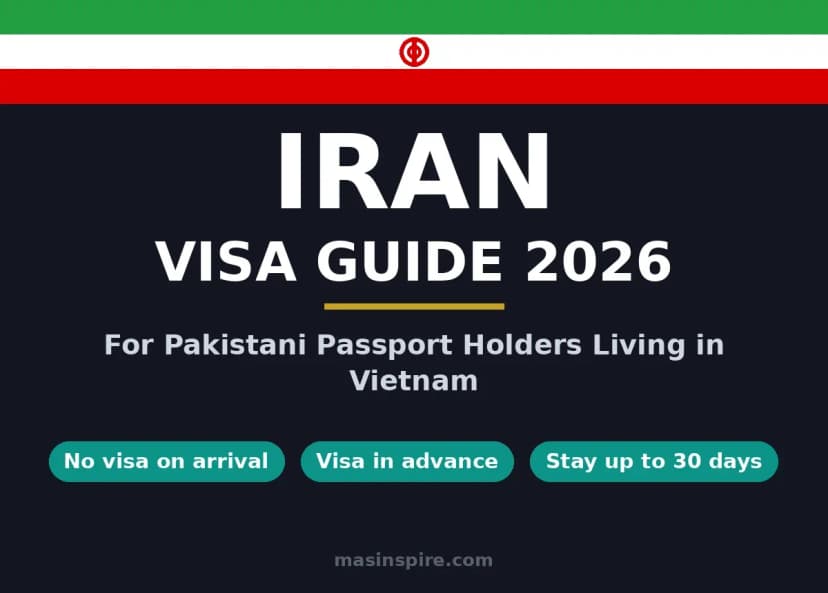
Yes. Pakistani ordinary passport holders need a visa in advance for Iran. There is no visa-free entry and no visa on arrival for a Pakistani ordinary passport, at any airport, land border or port. Airlines will generally refuse boarding to a passenger travelling to Iran without a visa already issued, so do not plan to sort it out on arrival.
The position is confirmed consistently across sources: the visa-policy record for Iran lists Pakistan among the nationalities that must obtain a visa in advance at an Iranian embassy or consulate, and multiple 2026 guides for Pakistani applicants state the same. The only limited exception is the 14-day visa-free access to Kish Island and Qeshm Island, which applies only to visa-on-arrival-eligible nationalities — Pakistanis are expressly excluded from it.
Holders of Pakistani diplomatic or official passports are in a different position: the visa-policy record shows a three-month visa exemption for holders of Pakistani diplomatic and official passports. This guide is for ordinary passport holders, to whom that exemption does not apply.
Important disclosure — the "e-visa" wording trap. Sources use the word "e-visa" for Iran in two different senses, and the difference matters. The MFA portal at evisa.mfa.ir is an online application system: you submit the form online and receive an authorisation code (Visa Grant Notice) by email. For most nationalities that code can then be used to collect the visa at the airport on arrival. For Pakistani citizens it cannot: the visa-policy record states that the e-visa does not apply to citizens of Pakistan (along with Afghanistan, Bangladesh, Canada, Colombia, Jordan, Somalia, the United Kingdom and the United States), and that Pakistanis must obtain a visa in advance at a mission. In practice the two statements reconcile as follows, and this is the route this guide describes: apply online through the MFA portal to get the authorisation, then take that authorisation to an Iranian embassy or consulate and collect the visa sticker there before you travel. Do not treat the portal application alone as permission to fly, and do not expect an airport visa counter to issue you a visa. If a travel agent tells you a Pakistani passport can collect an Iran visa on arrival at Tehran airport, that advice is wrong.
A second practical point follows from this: several Iranian visa agencies state that Pakistani passport holders without a residence permit in another country are not processed by them for ordinary tourist visas and are referred to Iranian consulates in Pakistan instead. If you live in Vietnam on a valid temporary residence card (TRC), carry it and mention it in your application — it may help, because it shows lawful residence outside Pakistan — but it has not been confirmed by the Hanoi embassy that a Vietnam TRC changes the procedure for a Pakistani applicant. Confirm directly with the embassy before you rely on it.
Safety Warning: Read This Before You Book
Visa information is not travel advice, and for Iran the two point in different directions. As of November 2026 the UK Foreign, Commonwealth and Development Office (FCDO) advises against all travel to Iran, citing the risk of military conflict involving air and missile strikes and the risk of arbitrary detention, arrest, questioning or harassment. The US Department of State rates Iran Level 4: Do Not Travel, updated 6 December 2025, citing terrorism, civil unrest, kidnapping, arbitrary arrest and wrongful detention, and states that US citizens in Iran should leave immediately. The US has no diplomatic or consular relations with Iran; the Swiss Embassy in Tehran acts as protecting power for US interests. Other governments, including Canada and Australia, maintain similarly serious warnings.
For a Pakistani citizen the consular picture is different — Pakistan has an embassy in Tehran and consulates in Iran — but the security situation, the risk of sudden airspace closures and flight cancellations, and the absence of reliable consular help from many Western governments still apply to everyone on the ground. Read your own government's current advice, and the FCDO and US State Department advisories, immediately before booking and again immediately before departure. A visa does not make a trip safe, and travel insurance can be invalidated if you travel against official advice — check your policy wording, not just its price.
Two further consequences of a trip to Iran are worth knowing before you go. First, Iran does not stamp passports on entry for most nationalities, but travel to Iran since 1 March 2011 makes a traveller ineligible for the US ESTA visa-waiver programme — a regular US visa is required instead, and the rule turns on the travel itself, not on a stamp. Second, flights to Iran can be disrupted or cancelled at short notice when regional tensions rise; keep your itinerary flexible and your return options open.
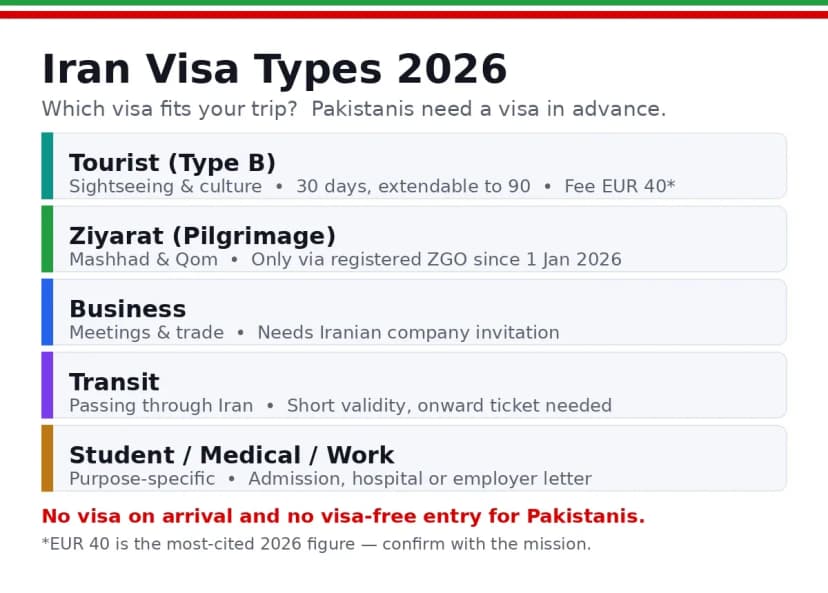
Types of Iran Visas
Iran issues visas by purpose of travel. The MFA portal lists all visa types, and the applicant must choose the one matching the real purpose of the trip. The categories most relevant to Pakistani residents in Vietnam are:
1. Tourist visa (Type B)
The ordinary visa for sightseeing, culture, food, nature and visiting friends. Single entry as standard, with a 30-day stay that can be extended inside Iran (see Section 11). This is the visa most readers of this guide will apply for. It does not permit work, study or journalism.
2. Pilgrimage / ziyarat visa
A visa for religious pilgrimage to the shrines, principally Mashhad and Qom. For Pakistanis travelling from Pakistan this is now a separate system: since 1 January 2026 pilgrimage travel to Iran must be booked through a Zaireen Group Organiser (ZGO) registered with Pakistan's Ministry of Religious Affairs and Interfaith Harmony. See Section 10. Do not apply for a tourist visa and then travel as a pilgrim in an organised group, and do not use a pilgrimage visa for ordinary tourism.
3. Business visa
For meetings, trade and commercial visits. Requires an invitation from an Iranian company or chamber of commerce. A business visa is not a work permit: taking up employment in Iran requires a separate work authorisation.
4. Transit visa
For passing through Iran to a third country. Transit visas are short-validity and require proof of onward travel and a visa for the onward destination where one is needed. Check with the mission whether your routing genuinely needs one — a same-ticket airside connection may not.
5. Student, medical, work and family visas
These exist but are purpose-specific and need supporting documents from the Iranian side: a university admission letter, a hospital or medical invitation, an Iranian employer and work permit, or family sponsorship. They are not shortcuts to a tourist stay and are outside the scope of this guide except as noted in the document checklists.
There is no Iranian "visa on arrival" category for Pakistanis, no visa-free tourist entry, and no general digital-nomad or retirement visa. Any agent offering one of those to a Pakistani passport holder is selling something that does not exist.
Iran Visa Fees 2026
Iran sets its visa stamp fee by nationality, largely on a reciprocal basis — broadly mirroring what Iranian citizens pay for a visa to that country. That is why there is no single "Iran visa fee" and why figures online range from about EUR 10 to about EUR 180. For Pakistan the figures conflict, and the conflict must be stated plainly.
| Fee item | Amount | Source and status |
|---|---|---|
| Tourist visa (Type B), single entry — consular stamp fee | EUR 40 | Most-cited 2026 figure for Pakistan: fee tables listing Pakistan at EUR 40 for an embassy visa (visa on arrival "not possible"); also stated by a 2026 Pakistani e-visa guide verified against the MFA portal. Treat as the working figure; confirm with the issuing mission. |
| Tourist visa (Type B), single entry — Lahore consulate schedule | PKR 14,000 | Consulate General of Iran in Lahore fee schedule. The schedule itself is dated 28 June 2019, so it is stale; it is the only official Pakistan-side figure published, but do not rely on it without re-confirmation. |
| Urgent tourist visa (50% surcharge on the Lahore schedule) | PKR 21,000 | Calculated from the Lahore schedule's "50% extra for urgent" note (PKR 14,000 + 50%). Same 2019-dating caveat applies. |
| Ziyarat (pilgrimage) visa, single entry — consulate-published | PKR 5,250 | Last published consulate figure reported in a November 2026 ziyarat guide; organisers now quote about PKR 8,500–13,500 for the visa including their service. Confirm with your ZGO. |
| Ziyarat visa, double entry — consulate-published | PKR 7,875 | As above; the double-entry figure is the consulate-published rate, not an organiser quote. |
| Mandatory Iranian travel insurance | About EUR 10–34 | Reported range for the compulsory Iranian policy bundled with the visa, by duration. See Section 12. |
| Visa extension in Iran (per 30 days) | About EUR 20–30 | Reported by secondary guides only; NOT verified against an official source. Confirm at the Foreigners Police office when you apply. |
| Agency service fee (if you use an agent) | About EUR 36 standard / EUR 54 urgent | Reported agency service fees on top of the EUR 40 stamp fee (total about EUR 76–94). The government portal itself charges no service fee. Agencies are not affiliated with the Iranian government. |
Disclosure — the EUR 75 figure. The brief for this guide mentioned a reported fee of about EUR 75. That figure could not be verified: no official source and no 2026 fee table found in this research lists EUR 75 for a Pakistani tourist visa, and the figures actually found are EUR 40 (fee tables and a 2026 Pakistani guide) and PKR 14,000 (2019 Lahore schedule). Some general guides quote USD 50–75 as an approximate range for an Iran tourist e-visa depending on category, which may be the origin of the EUR 75 figure, but a range is not a price. Do not budget on EUR 75 and do not present it as the fee. The controlling source is the mission that will collect your payment: ask the Hanoi embassy (or the Pakistan mission you use) for the current payable amount, in which currency, and whether it is payable in cash, before you attend.
Other costs to budget for: passport photos, document translation or notarisation if the mission asks for it, travel to Hanoi if you apply there, the mandatory insurance above, and — for pilgrims — the ZGO's package price, which covers transport, hotel and food as well as the visa. Fees are generally non-refundable if the visa is refused, and a refused application does not entitle you to a refund of the insurance or agency fee.
Processing Times and Visa Validity
Processing times for Iran vary sharply by nationality, by season, by the workload of the MFA in Tehran and by whether an interview is required. For Pakistani applicants the picture worsened in early 2026: a 2026 guide verified against the MFA portal reports that MFA policy changes in January–February 2026 caused longer processing times and significantly lower approval rates for Pakistani applicants. Apply early and do not book non-refundable travel until the visa is in your passport.
| Item | Timeframe | Notes |
|---|---|---|
| MFA online process (portal guidance) | Allow 10 business days | The MFA portal's own stated allowance for its online process. |
| Authorisation code, typical range reported for most nationalities | 5–7 business days | Reported by several 2026 visa guides; agency-reported turnaround is 2–3 weeks in some cases, and technical problems at the MFA have lengthened times during 2026. |
| Authorisation code, broader reported range | 3–10 business days | Other 2026 guides quote 3–10 business days for standard e-visa processing. |
| Embassy sticker collection after authorisation | About 2 working days to 1 week | Reported for direct referral to an embassy; allow a week if posting documents. |
| Recommended application lead time (Pakistani passport) | 4–6 weeks before travel | This guide's recommendation given the 2026 slowdown for Pakistani applicants. Do not rely on the shortest reported time. |
| Visa validity — enter within | About 60 days from issue (embassy pickup) | Reported by a 2026 visa guide: the Visa Grant Notice is valid 90 days for airport pickup and 60 days for embassy pickup, with 45 days to enter once the visa is issued. These figures are agency-reported, not MFA-confirmed for Pakistani applicants; confirm with your mission. |
| Stay on a tourist visa (Type B) | 30 days from entry | Consistently reported across sources. |
| Maximum stay after extensions | 90 days in total | Two extensions of 30 days each, at the Foreigners Police office in Iran. See Section 11. |
Iranian weekends are Thursday and Friday, so "business days" in MFA processing exclude those days as well as Iranian public holidays. A file submitted on a Wednesday in Vietnam may therefore not move until the following Sunday in Tehran. Factor that into your planning, and remember that Nowruz (the Iranian New Year, around 20–21 March) and other long holidays slow the MFA considerably.
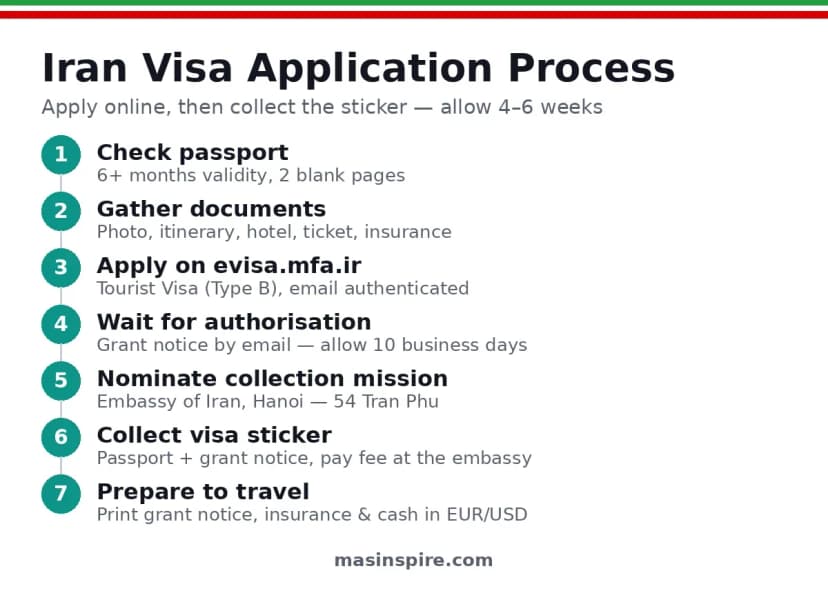
How to Apply: Step-by-Step
There are two stages: the online application for authorisation, and the in-person collection of the visa sticker. Both are required for a Pakistani passport holder. Do not skip the second stage.
Step 1 — Check your passport
Your passport must have at least six months' validity beyond your travel date, and at least two blank pages. The MFA portal blocks applications with less than six months' validity. If your passport is close to expiry, renew it first — in Vietnam, through the Embassy of Pakistan in Hanoi.
Step 2 — Gather your documents
Collect the items in Section 8 before you start the online form: passport scan, digital photo, itinerary, hotel booking or invitation, return ticket, proof of funds, travel insurance that names Iran, and your Vietnam residence card (TRC) if you hold one. Having them ready avoids a half-finished application timing out.
Step 3 — Apply on the MFA e-visa portal
Go to evisa.mfa.ir and choose the visa type matching your purpose — "Tourist Visa (Type B)" for sightseeing. Register with an email address you can access throughout the process: the MFA authenticates your email and sends the reference number and the grant notice to it. Fill in personal, passport and travel details exactly as they appear in your passport, upload the documents, and submit. The portal states that electronically submitting the online application is the first step, that some applicants will need an interview, and that some may qualify without one.
Step 4 — Wait for the authorisation code
The MFA reviews the file in Tehran and, if approved, emails a Visa Grant Notice with an authorisation (reference) code. Allow 10 business days as the MFA advises, and in practice up to 2–3 weeks for Pakistani applicants in 2026. You can check the status on the portal with your reference number or passport number, date of birth and email. Do not book non-refundable flights or hotels before this arrives.
Step 5 — Choose your collection mission
When you apply you nominate the embassy or consulate where you will collect the visa. From Vietnam the natural choice is the Embassy of Iran in Hanoi (Section 9). If you will be in Pakistan before travelling, you may nominate a mission there instead — Islamabad, Karachi, Lahore, Peshawar or Quetta. Nominate the mission you can actually visit in person with your passport.
Step 6 — Collect the visa sticker
Take your passport, the printed Visa Grant Notice, your photos and the documents the mission asks for to the embassy or consulate, and pay the stamp fee there. The mission affixes the visa sticker to your passport. Confirm the fee, the currency accepted and the opening hours by phone or email first — do not assume card payment is possible, and do not assume the fee published in Pakistan applies unchanged in Hanoi. Check the sticker before you leave the counter: name, passport number, dates, entries and validity must all match your passport and your travel plan. If anything is wrong, raise it on the spot.
Step 7 — Prepare for departure
Print the Visa Grant Notice and your insurance policy, carry your hotel bookings and return ticket, and carry enough cash in euros or US dollars for the whole trip (Section 13). Keep a copy of your passport photo page and visa separate from the originals. Check the security situation and flight status on the day of travel.
Refusal risks. The commonest reasons for refusal or long delay for Pakistani applicants in 2026 are an incomplete or inconsistent file, a passport with less than six months' validity, no credible itinerary or accommodation, no insurance naming Iran, and evidence of travel to Israel (Section 14). A previous refusal does not automatically bar a fresh application, but a fresh application with the same defects will fail again. If you are refused, ask the mission — politely, in writing — what was missing, fix exactly that, and reapply; do not simply resubmit the same file. There is no published appeal process for a tourist-visa refusal.
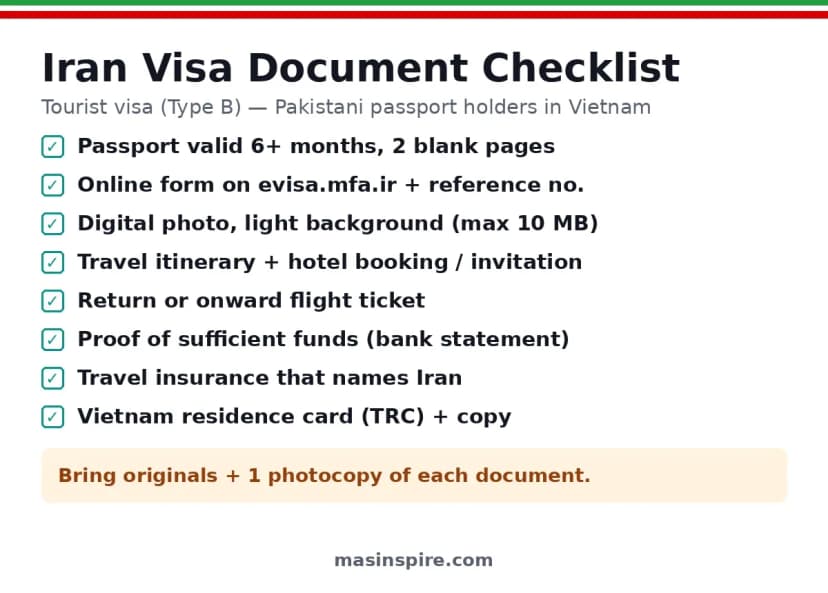
Complete Document Checklists
Iranian missions publish slightly different lists, and the mission handling your case is the authority. The checklists below are the standard set reported across the MFA portal guidance and 2026 applicant guides. Bring originals plus one photocopy of each, and have digital scans ready for the portal upload.
Tourist visa (Type B) — standard checklist
| Document | Requirement |
|---|---|
| Passport | Original, valid at least 6 months beyond travel date, with at least 2 blank pages; plus a clear scan of the bio page. |
| Visa application form | Completed online on evisa.mfa.ir; printed confirmation/reference number. |
| Digital passport photo | Recent, plain light background, maximum 10 MB for the portal upload; carry 2 printed copies. Women and girls aged 10 or over should wear a headscarf in the visa photo, per FCDO guidance on Iranian requirements. |
| Travel itinerary | Planned dates, cities and outline of the trip; required by the portal guidance "if already arranged". |
| Hotel booking or host invitation | Confirmed hotel reservations for the stay, or an invitation letter from an Iranian host/sponsor with their address and contact details. |
| Return or onward ticket | Confirmed return or onward flight booking. |
| Proof of sufficient funds | Bank statement or other evidence you can fund the stay. No published minimum amount was found — the figure is unverified, so carry a recent statement showing a credible balance and ask the mission what it expects. |
| Travel insurance naming Iran | Policy that explicitly covers Iran (Section 12). The compulsory Iranian policy is normally arranged with the visa. |
| Vietnam residence evidence | Temporary residence card (TRC) or valid Vietnam visa, plus a copy. Shows lawful residence in Vietnam; whether it changes the procedure for a Pakistani applicant is unconfirmed — ask the Hanoi embassy. |
| CNIC / national ID | Pakistani CNIC copy; some missions and agents ask for it. Carry it even if not listed. |
Business visa — additional documents
| Document | Requirement |
|---|---|
| Invitation letter | From an Iranian company or chamber of commerce, stating purpose, dates and who bears costs. |
| Employer letter (Pakistan or Vietnam) | Letter from your employer confirming your job, the business purpose and leave approval, if employed. |
| Company registration evidence | Registration or trade licence of the inviting Iranian company, if the mission asks for it. |
Ziyarat (pilgrimage) visa — documents via your ZGO
| Document | Requirement |
|---|---|
| Passport and CNIC | As for a tourist visa; your ZGO will advise on validity and copies. |
| Photographs | Passport photos as specified by the ZGO. |
| ZGO booking confirmation | Proof of booking with a registered Zaireen Group Organiser, including group and return arrangements. |
| Travel insurance | As arranged by the ZGO or separately; confirm it names Iran. |
Do not submit originals the mission does not ask to keep, and never hand your passport to an unregistered agent. If any document is not in English or Persian, ask the mission whether a translation is needed before you pay for one.
Applying from Vietnam: The Embassy in Hanoi
Iran has one diplomatic mission in Vietnam: the Embassy of the Islamic Republic of Iran in Hanoi. There is no Iranian consulate in Ho Chi Minh City, so applicants living in the south must travel to Hanoi or apply through a mission in Pakistan.
| Detail | Information |
|---|---|
| Mission | Embassy of the Islamic Republic of Iran, Hanoi |
| Address | 54 Tran Phu Street, Ba Dinh District, Hanoi, Vietnam |
| Telephone | +84 24 3823 2068 / +84 24 3823 2069 |
| iremb.hanoi@mfa.gov.ir (also listed: embiri@fpt.vn) | |
| Website | hanoi.mfa.gov.ir |
| Hours reported | Monday–Friday, about 08:00–16:30 (one listing says 08:30–17:00 with a midday break). Confirm before travelling. |
What to confirm with Hanoi before you apply. Three things are not established in the published sources and only the embassy can answer them: (1) whether the Hanoi embassy accepts visa-sticker collection from a Pakistani passport holder resident in Vietnam, or whether you must collect in Pakistan; (2) the exact fee payable in Hanoi and in which currency; and (3) whether your Vietnam TRC affects the file. Phone or email the embassy with those three questions before you submit the portal application, because the collection mission is nominated in the application itself. A Hanoi visa agent quoted 5–7 days' processing for a sticker visa at this embassy, but that figure was for Vietnamese nationals and should not be assumed for a Pakistani applicant.
If Hanoi cannot process your file, the fallback is a mission in Pakistan: the Embassy of Iran in Islamabad and consulates general in Karachi, Lahore, Peshawar and Quetta. That means routing your trip via Pakistan, or posting your passport — which this guide does not recommend for a document you cannot afford to lose.
Also note for your return: your Vietnam TRC and re-entry conditions are separate from the Iran visa. Make sure your Vietnam residence remains valid for your return date, and that your passport will still have six months' validity when you re-enter Vietnam.
Ziyarat (Pilgrimage) Visas and the ZGO Rule
For most Pakistani travellers, Iran means ziyarat — pilgrimage to Mashhad, Qom and other shrines. The rules for this changed fundamentally on 1 January 2026, and anyone travelling from Pakistan must follow the new system.
Under Pakistan's Zaireen Management Policy, from 1 January 2026 pilgrims may travel to Iran (and Iraq and Syria) only through a Zaireen Group Organiser (ZGO) registered with the Ministry of Religious Affairs and Interfaith Harmony (MoRA). The old salar system, in which an informal group leader arranged the trip, was abolished. The ZGO handles the visa, transport, hotel, food and the return of every pilgrim, and is responsible for bringing the group back. The Ministry published a list of registered organisers — 67 new organisers were registered in December 2025, bringing the total to 91 — in the Dawah and Ziarat Wing section of mora.gov.pk. Check your organiser's name and registration number on that list before you pay anything.
The last consulate-published ziyarat visa fee reported is PKR 5,250 for a single entry and PKR 7,875 for a double entry. Organisers in November 2026 were quoting about PKR 8,500–13,500 for the visa alone, including their service. The difference is the organiser's charge, not a second government fee — ask for an itemised breakdown. There is no visa on arrival for pilgrims either.
Two further warnings. First, in 2025 Pakistan barred pilgrims from travelling by road to Iran and Iraq for Arbaeen on security grounds, and the government has been moving pilgrim travel to air (and, from 2026, sea) routes with fixed itineraries. Road travel for pilgrimage should not be assumed available. Second, the new system applies to pilgrims travelling from Pakistan; if you are living in Vietnam and wish to travel to Iran for pilgrimage, ask the Hanoi embassy and MoRA whether the ZGO rule applies to you or whether you follow the ordinary tourist-visa route with a pilgrimage purpose stated. That point is unresolved in the published sources — do not guess.
Extending Your Stay in Iran
A tourist visa gives you 30 days from entry. If you want to stay longer, you can extend it twice, for 30 days each time, giving a maximum total stay of 90 days. Extensions are done in person at the Foreigners Police office (the Passport and Immigration Police, Edareh Gozarnameh) in the city where you are staying — not at the airport and not online. Go before your visa expires, early in the morning, and take your passport, a copy of your visa, passport photos and your hotel address. The process usually takes a few hours but can take longer, and in some reports one to three days.
The extension fee most often quoted is about EUR 20–30 per extension, but that figure is not verified against an official source and should be confirmed at the office when you apply. Do not overstay: overstaying can lead to fines, detention, deportation and difficulty obtaining future Iranian visas. If your extension is refused, leave before the current visa expires. Note that one secondary guide states the maximum total stay after extension as 60 days rather than 90; the 90-day figure (30 + 30 + 30) is the one reported by the MFA-linked visa-policy record and by the majority of 2026 guides, and this guide follows it while disclosing the disagreement.
Travel Insurance: Mandatory and Iran-Specific
Travel insurance that covers Iran is mandatory for entry, and this is the area where travellers most often buy the wrong product. Since 21 May 2024 an Iranian travel insurance policy has been compulsory for visa applicants. It is issued by an Iranian insurer, is bundled with the visa, and is emailed to the traveller about a day after issue; travellers arriving without one buy it at the airport. The reported cost is about EUR 10–34 depending on duration, and the medical cap is about EUR 10,000 — enough for small in-country medical bills, but not for a serious event: an air ambulance costs ten to twenty times that.
Three things quietly void cover. First, most ordinary international policies exclude Iran because of sanctions — a "worldwide" label is not enough if the policy excludes Iran or excludes travel against government advice. Second, the FCDO advises against all travel to Iran and states that travel insurance could be invalidated if you travel against that advice; the same logic applies to other governments' advisories. Third, war exclusions are live: every standard policy excludes war, and that exclusion matters for Iran in the current climate.
The practical position is therefore two policies, not one: the compulsory Iranian policy, which satisfies the visa requirement and small local bills, and — if you can find one that genuinely names Iran, covers your activities and remains valid despite the travel advisories — a real international policy for a serious event. Read the actual wording before you pay: confirm that "Iran" is named, that the advisory exclusion does not void it, and what the medical and evacuation limits are. Carry the printed policy with you; some airlines ask for proof of insurance at check-in.
Money in Iran: Cash Only, No Foreign Cards
No international bank card works in Iran. Visa, Mastercard and American Express are blocked by sanctions, and no ATM in Iran will recognise a foreign card. This is not a minor inconvenience — it determines how you plan the whole trip. Bring all the money you will spend, in cash, in clean euros or US dollars, before you fly. Bring more than you think you need, as an emergency reserve, and keep it split between two secure places.
Notes matter: money changers are particular. Bills printed before 2013, or notes with tears, pen marks or heavy creases, are routinely rejected. Bring crisp, newer notes. The official currency is the Iranian rial (IRR), but prices are almost always quoted in tomans — one toman equals ten rials, so always confirm whether a quoted price is in rials or tomans before you pay, or you will overpay tenfold.
Licensed exchange offices (sarafi) are plentiful in cities, and banks also exchange currency. Some Iranian banks and apps now offer prepaid tourist cards that visitors can load with cash on arrival and use inside Iran for the duration of the visa; these can be a useful complement to cash, but they are not a substitute for bringing cash in the first place, and you should not rely on any single payment method. Tell your own bank you are travelling — not because your card will work in Iran, but because a transit stop in Dubai or Istanbul might otherwise trigger a freeze.
Dress Code, Local Laws and Entry Notes
Iranian law applies to foreign visitors exactly as it does to Iranians, and several rules catch first-time visitors by surprise. Read this section in full before you pack.
Dress code. Women must by law cover their hair with a headscarf in public and wear loose clothing covering arms and legs — trousers or a floor-length skirt, and a long-sleeved tunic or coat reaching at least mid-thigh. This applies to foreign women from the moment they leave the aircraft, and women and girls aged 10 or over should wear a headscarf in visa application photos. At some religious sites, especially shrines, women are asked to wear a chador, a full-length cloak often lent at the entrance. Men should wear long trousers and long-sleeved shirts in public; shorts and sleeveless shirts are not acceptable. Enforcement varies over time and place, but crackdowns have led to mass arrests, and women have been arrested and treated violently over dress. Do not test the boundary.
Alcohol, drugs and relationships. It is illegal to bring in, sell, make or drink alcohol, and penalties are severe. Drug offences carry very severe penalties. Sex outside marriage is illegal and can carry the death penalty, and relationships between non-Muslim men and Muslim women are illegal. Public displays of affection should be avoided.
Photography and devices. It is illegal to photograph military or government sites, critical infrastructure and protests. You need permission to fly a drone or use a satellite phone. Using a laptop or other device in public, especially with photos on it, can be misread and has led to arrests on suspicion of spying. Ask before photographing people, especially women. Carry copies of your passport photo page and visa.
Evidence of travel to Israel. Iran refuses entry to travellers with evidence of a visit to Israel. Israel itself no longer stamps passports — visitors receive a separate entry card — but a land crossing via Jordan or Egypt leaves Jordanian or Egyptian stamps naming the border crossing, which can betray the trip, and an Israeli visa or stamp in the passport is grounds for refusal. One secondary source states a "less than 12 months old" rule for Israeli stamps; that 12-month qualifier is not confirmed by any official source found in this research and should not be relied on — the safe position is that any evidence of travel to Israel can cause refusal, and if your passport contains such evidence you should renew the passport before applying. Note also that Iran does not stamp passports on entry for most nationalities, which protects your passport for later travel but does not change the Israel rule.
Dual nationality. If you hold any other nationality in addition to Pakistani, declare it honestly in the application. Concealing a second nationality that later comes to light can lead to refusal or detention. Dual nationals of countries whose governments warn against travel to Iran should read that advice with particular care.
Frequently Asked Questions
1. Do Pakistani citizens need a visa for Iran?
Yes. Pakistani ordinary passport holders need a visa in advance. There is no visa-free entry and no visa on arrival for a Pakistani ordinary passport. Holders of Pakistani diplomatic or official passports are visa-exempt for three months, but that does not apply to ordinary passports.
2. Can I get an Iran visa on arrival at Tehran airport?
No. Visa on arrival is not available to Pakistani citizens at any Iranian airport, land border or port. You must hold the visa sticker in your passport before you travel, or the airline will generally refuse boarding.
3. What is the Iran e-visa, and can Pakistanis use it?
The MFA portal at evisa.mfa.ir is an online application system: you apply online and receive an authorisation code (Visa Grant Notice). For Pakistanis that code must then be taken to an Iranian embassy or consulate to collect the visa sticker. The portal application alone is not permission to fly, and Pakistanis cannot collect the visa at the airport on arrival.
4. How much does an Iran tourist visa cost for a Pakistani passport?
The most-cited 2026 figure is a EUR 40 consular stamp fee. The only official Pakistan-side figure published is PKR 14,000 for a single-entry tourist visa on the Lahore consulate's schedule, but that schedule is dated 28 June 2019 and is stale. A reported EUR 75 figure could not be verified. Confirm the current payable amount and currency with the mission that will issue your visa before you pay.
5. How long does an Iran visa take for a Pakistani applicant?
The MFA advises allowing 10 business days for the online process. Reported ranges are 3–10 business days, typically 5–7, but agency reports put authorisation at 2–3 weeks, and processing for Pakistani applicants lengthened after MFA policy changes in January–February 2026. Apply 4–6 weeks before travel.
6. How long can I stay in Iran on a tourist visa?
30 days from entry. You can extend twice, for 30 days each time, at the Foreigners Police office in Iran, for a maximum total stay of 90 days. One secondary guide states 60 days as the maximum; the 90-day figure is the majority position and is followed in this guide with the disagreement disclosed.
7. How long is the visa valid before I must travel?
For embassy pickup, the Visa Grant Notice is reported valid for about 60 days, with about 45 days to enter once the visa sticker is issued. These figures are agency-reported, not MFA-confirmed for Pakistani applicants — confirm them with your issuing mission, and do not let the validity lapse, or you will have to reapply.
8. Where do I apply if I live in Vietnam?
Apply online on the MFA portal, then collect the visa sticker at the Embassy of Iran in Hanoi, 54 Tran Phu Street, Ba Dinh District (+84 24 3823 2068/2069). Confirm with the embassy first that it accepts collection from a Pakistani resident in Vietnam, what fee it charges, and whether your Vietnam residence card affects the file. There is no Iranian consulate in Ho Chi Minh City.
9. Can I travel to Iran for ziyarat as a pilgrim?
Yes, but since 1 January 2026 pilgrimage travel from Pakistan must be booked only through a Zaireen Group Organiser (ZGO) registered with Pakistan's Ministry of Religious Affairs. Check your organiser on the official list at mora.gov.pk before paying. The last consulate-published ziyarat fee is PKR 5,250 single entry and PKR 7,875 double entry; organisers quote about PKR 8,500–13,500 including service.
10. Is travel insurance mandatory for Iran?
Yes. An Iranian travel insurance policy has been compulsory for visa applicants since 21 May 2024. It costs about EUR 10–34, is bundled with the visa and has a medical cap of about EUR 10,000. Most ordinary international policies exclude Iran, so check that any policy you buy explicitly names Iran and is not voided by travel advisories.
11. Can I use my bank card or ATM card in Iran?
No. No foreign Visa, Mastercard or American Express card works in Iran, and no ATM accepts a foreign card. Bring all your spending money in cash — clean, newer euro or US dollar notes — and remember prices are usually quoted in tomans (1 toman = 10 rials).
12. Will an Israeli stamp in my passport cause refusal?
Yes, evidence of a visit to Israel can lead to refusal of entry to Iran. Israel no longer stamps passports, but land-border stamps from Jordan or Egypt naming the crossing can reveal the trip. A reported "less than 12 months" rule is unconfirmed — do not rely on it. If your passport contains evidence of Israel travel, renew the passport before applying.
13. What is the dress code for visitors to Iran?
Women must by law wear a headscarf in public and loose clothing covering arms and legs; men must wear long trousers and long sleeves — no shorts or sleeveless shirts. The rules apply to foreign visitors from the moment they leave the aircraft, and a chador may be required at shrines. Enforcement varies but crackdowns have led to arrests.
14. Is it safe to travel to Iran in 2026?
Several governments say no: the UK FCDO advises against all travel to Iran, and the US State Department rates it Level 4: Do Not Travel. Read your own government's current advice and the FCDO and US advisories immediately before booking and before departure, and check that your insurance remains valid if you travel against official advice.
15. What should I do if my Iran visa is refused?
Ask the mission in writing what was missing, correct exactly that defect, and reapply with a complete file. There is no published appeal process for a tourist-visa refusal, and fees are generally non-refundable. Do not resubmit the same unchanged application, and do not pay an agent who promises a guaranteed approval — no one can guarantee an Iranian visa.
Official Immigration Websites
| Authority / source | Website | What it is for |
|---|---|---|
| Iran MFA e-Visa portal | evisa.mfa.ir | Official online visa application, visa types, application status check and portal guidance. Start every application here. |
| Embassy of Iran in Hanoi | hanoi.mfa.gov.ir | Iran's only mission in Vietnam; visa-sticker collection for applicants resident in Vietnam. Address: 54 Tran Phu, Ba Dinh, Hanoi. |
| Iran Ministry of Foreign Affairs | mfa.gov.ir | Parent ministry of the e-visa portal and of all Iranian missions abroad. |
| Consulate General of Iran in Lahore (fee schedule) | lahore.mfa.gov.ir | Pakistan-side official fee schedule (tourist visa PKR 14,000; urgent +50%) — dated 28 June 2019, so re-confirm before paying. |
| Pakistan Ministry of Religious Affairs (ZGO lists) | mora.gov.pk | Registered Zaireen Group Organiser lists (Dawah and Ziarat Wing) for pilgrimage travel from 1 January 2026. |
| UK FCDO travel advice — Iran | gov.uk/foreign-travel-advice/iran | UK government travel advice: currently advises against all travel to Iran; entry requirements, dress code and local laws. |
| US State Department travel advisory — Iran | travel.state.gov | US travel advisory: Iran is Level 4: Do Not Travel (updated 6 December 2025). |
| Embassy of Pakistan in Hanoi | pakistanembassy.vn | Pakistani passport renewal and consular help in Vietnam while you prepare your Iran application. |
Guide prepared 28 November 2026 for Pakistani passport holders living in Vietnam. Visa rules change without notice and differ by passport and by mission: verify every figure with the MFA portal and the mission that will issue your visa before you pay or travel. This guide is general information, not legal advice and not a guarantee that a visa will be issued.