Introduction
Hong Kong is one of Asia's major centres for finance, trade, logistics, education, tourism and professional services. It welcomes visitors and international residents under a range of immigration arrangements, but the correct permission depends on the purpose of travel, passport nationality and personal circumstances.
Hong Kong is not governed by the same visitor-visa rules as mainland China. It is the Hong Kong Special Administrative Region (HKSAR), with its own Immigration Department and entry requirements. A traveller who can enter mainland China visa-free may still need a Hong Kong visa, and the reverse can also be true.
This 2026 guide explains the main Hong Kong visa and entry-permission categories, the documents applicants may need, published fees and processing times, and how to apply. It includes a focused section for Pakistani passport holders who live or work legally in Vietnam.
Verification date: 26 November 2026. Always recheck the official Immigration Department website before paying a fee or making travel arrangements.
Why People Visit, Study and Work in Hong Kong
Visitors travel to Hong Kong for tourism, shopping, family visits, conferences and short business meetings. Students choose its universities and specialist institutions for internationally recognised education and access to regional industries. Professionals may find opportunities in finance, technology, logistics, professional services, trade, education and research.
Hong Kong's immigration arrangements distinguish between a short visit and permission to take up employment, study or residence. A visitor permission is not a work permit. A business visitor cannot use a short visit to take up a local job or actively operate a business.
Types of Hong Kong Visas and Entry Permissions
The following categories are real Hong Kong arrangements. Some are visas or entry permits; others are talent admission schemes that result in an e-Visa or permission to stay.
1. Visitor visa
Pakistani passport holders require a visa for an ordinary visit. A visitor application may be considered for tourism, visiting relatives or friends, or other short-term purposes. Applicants should demonstrate that the visit is genuine, that they can fund the stay without working, and that they have a credible plan to leave Hong Kong.
Visitors must not take up paid or unpaid employment, establish or join a business, or enrol as a student. A visitor should normally have return or onward travel arrangements. The visa does not guarantee admission at the border.
Fee: Ordinary visa HK$330 under the current ImmD fee table. Published processing time: Normally four weeks after all required documents are received. Official source: Visit Visa / Entry Permit Requirements and Visit/Transit.
2. Business visitor
A short business visit may cover meetings, contract negotiations, attending trade fairs or conferences, and other permitted visitor activities. It does not authorize local employment or running a business in Hong Kong. If the planned activity amounts to employment or active business operation, obtain the correct entry permission first.
A business visitor should prepare an invitation from the Hong Kong host, employer letter explaining the purpose and dates, itinerary, proof of employment or business, and evidence of funds. The exact supporting evidence depends on the case.
3. Student visa / entry permit
A non-local student generally needs a student visa or entry permit before beginning study. The applicant must be accepted by an eligible school or institution and normally nominate a local sponsor. The institution may act as sponsor, or an individual sponsor may be used if the official conditions are met.
Study permission is available for qualifying programmes, including eligible full-time locally accredited post-secondary programmes and certain other specified study arrangements. The applicant must show the ability to pay tuition and living and accommodation costs without working or relying on public funds.
The ImmD states that the application normally takes six weeks after all required documents are received. The student application uses form ID 995A; the sponsor uses ID 995B. These forms are available free from ImmD and through its website.
Work rights: Do not assume that a student may work freely. Any permitted internship or employment must fall within the applicable student policy and conditions. Check the current official student guidance and the conditions printed on the e-Visa.
Official source: Students.
4. Employment visa — General Employment Policy (GEP)
The GEP is the main route for many overseas professionals with a Hong Kong job offer. It is quota-free and non-sector-specific. The applicant should have skills, knowledge or experience of value to Hong Kong that is not readily available locally.
Core criteria include a genuine vacancy, a confirmed offer of employment, a job relevant to the applicant's qualifications or experience, and remuneration broadly in line with the Hong Kong market. A good educational background is normally expected, although documented technical qualifications, professional ability and experience may be considered in special circumstances.
The employer will normally need to provide company information and explain the role, salary and why the applicant is suitable. The applicant provides identity, education, experience and other supporting documents. A successful applicant is subject to the conditions of stay attached to the approval.
Published processing time: Normally four weeks after all required documents and the application fee are received. Fee: GEP is a specified scheme: HK$600 application fee and, upon approval, the applicable issuance fee (normally HK$1,300 for a period over 180 days or HK$600 for 180 days or less). Official source: General Employment Policy.
5. Top Talent Pass Scheme (TTPS)
TTPS allows eligible high-income individuals and graduates of specified universities to apply without first securing a Hong Kong job offer. It has three categories:
- Category A: Annual income of at least HK$2.5 million in the year immediately before application.
- Category B: A bachelor's degree from an eligible university and at least three years of work experience over the five years immediately before application.
- Category C: A bachelor's degree from an eligible university obtained in the five years immediately before application, with less than three years of work experience. This category is subject to an annual quota and does not apply to certain local non-local graduates.
The eligible-university list is maintained by the Labour and Welfare Bureau and can change. Applicants should check the current aggregate list, degree recognition and evidence rules before applying. TTPS is not a general visa for anyone wishing to search for work.
Successful applicants are normally granted 36 months under Category A or 24 months under Categories B and C. Initial entry does not require a job offer, but extensions and later stay conditions must be checked separately.
Published processing time: Normally four weeks after complete documents and fee. Fee: Specified-scheme fee structure applies. Official source: Top Talent Pass Scheme.
6. Quality Migrant Admission Scheme (QMAS)
QMAS is a selective admission scheme for talented people who may contribute to Hong Kong's economy. Applicants must first satisfy the prerequisites and then choose either the General Points Test or Achievement-based Points Test. The General Points Test assesses factors such as age, academic qualifications, language ability, work experience, income and business ownership. The Achievement-based route is for exceptional achievements and has demanding evidence requirements.
The current ImmD guidance describes a 12-criterion General Points Test and a passing threshold of 6 out of 12. Applicants who meet the threshold are considered in selection exercises; reaching the threshold does not mean automatic approval. Selection takes account of the applicant's profile and Hong Kong's broader needs.
Fee: Specified-scheme application and issuance fee structure applies. Processing time: Selection-based; do not assume a fixed decision date. Official source: Quality Migrant Admission Scheme.
7. Immigration Arrangements for Non-local Graduates (IANG)
IANG is designed for eligible graduates of full-time, locally accredited Hong Kong programmes and certain graduates from designated Greater Bay Area campuses. Recent non-local graduates who apply within six months of graduation normally do not need a job offer at the time of application and may receive 24 months' stay. Non-recent graduates generally need a job offer at degree-holder level with market-level remuneration.
IANG is not a route for every overseas graduate. A degree obtained outside the qualifying Hong Kong / specified Greater Bay Area programmes does not automatically qualify.
Official source: IANG.
8. Entrepreneur / business establishment
Overseas entrepreneurs who intend to establish or join a business may be considered under the GEP entrepreneur arrangements. The applicant must demonstrate a genuine business plan and a substantial contribution to Hong Kong's economy. Relevant evidence may include the business plan, capital investment, proposed local jobs, company registration, financial projections, premises and any support from a recognised government-backed programme.
This is not a simple business-registration visa. A company incorporation certificate by itself does not establish immigration eligibility.
Official source: Investment as Entrepreneurs.
9. New Capital Investment Entrant Scheme (New CIES)
New CIES is a residence admission scheme for qualifying investors. Applicants must be at least 18, fall within the eligible nationality/residence scope, demonstrate net assets of at least HK$30 million throughout the six months before the net-asset assessment, and invest at least HK$30 million net in permissible investment assets. The applicant must also meet character, immigration and self-support requirements.
The investment must comply with the scheme's detailed asset rules. The scheme should not be confused with an entrepreneur visa, and the old Capital Investment Entrant Scheme is suspended.
Official source: New Capital Investment Entrant Scheme.
10. Family / dependant entry
Eligible persons admitted under specified employment, talent, investment or study arrangements may sponsor certain dependants. The policy generally covers a spouse or qualifying legally recognised partnership and unmarried dependent children under 18. A sponsor must normally demonstrate the ability to support the dependant and provide suitable accommodation. The relationship must be genuine and properly documented.
The official dependant page gives a normal processing time of about six weeks for a new dependant application once all documents and any relevant fee are received. Exact eligibility depends on the sponsor's category and the relationship evidence.
Official source: Dependants.
11. Transit visa
Some nationalities may transit airside without a Hong Kong visa if they remain within the airport transit area and meet the direct-transit conditions. Pakistani nationals appear in the ImmD table as requiring a visa, with a specific exception shown for direct air transit without leaving the airport transit area. If the traveller needs to pass immigration, collect baggage landside, change airports, stay in Hong Kong or otherwise leave the transit area, check and obtain the correct permission in advance.
Fee: Transit visa HK$170. Official source: Visit Visa / Entry Permit Requirements.
12. Training, internship and research
Hong Kong has a specific training arrangement for limited periods, normally not exceeding 12 months, where the applicant is to acquire special skills or knowledge unavailable in their country or territory of domicile. It requires a bona fide sponsor, a training contract, an appropriate programme and sponsor undertakings. Student internships and research-related activity may be governed by the student's or institution's applicable rules. Do not treat an internship or research placement as automatically covered by visitor status.
Official source: Immigration Guidelines for Entry to the HKSAR.
13. Permanent residence / right of abode
For a non-Chinese national, one important route to Hong Kong permanent resident status is having entered Hong Kong with a valid travel document, ordinarily resided in Hong Kong continuously for at least seven years, and taken Hong Kong as the person's place of permanent residence. The seven-year period must be immediately before the application. Evidence can include employment, school records, official receipts, bank statements and tax records.
Seven years on a calendar alone is not enough: the applicant must satisfy the legal test for ordinary residence and the permanent-home declaration. Applicants should read the statutory categories and official evidence list carefully.
Official source: Right of Abode FAQs and Apply for Right of Abode.
Categories that are not standalone Hong Kong routes
Hong Kong does not list a general job-seeker visa or a digital-nomad visa as a standalone category. TTPS and QMAS are structured talent schemes with specific criteria, not universal job-search permissions. There is no generic “retirement visa” established by the categories reviewed here. Humanitarian protection and non-refoulement claims are handled under separate legal and administrative procedures and should not be presented as an ordinary visitor or settlement visa.
Visa Comparison Table
| Category | Main purpose | Job offer / sponsor | Published initial stay or timing | Work rights |
|---|---|---|---|---|
| Visitor | Tourism, family, short business visit | Invitation may support; no work sponsor | Nationality-specific; visit processing normally 4 weeks | No employment or business |
| Transit | Direct transit | Onward ticket / transit itinerary | Transit processing normally 4 weeks | No work |
| Study | Eligible course | Institution / local sponsor | Study processing normally 6 weeks | Only as permitted by student policy |
| GEP | Skilled professional job | Confirmed Hong Kong employer and offer | 4 weeks processing normally | Employment subject to conditions |
| TTPS | Eligible high-income / top-university talent | No job offer at initial application | 36 months A; 24 months B/C | May seek work subject to conditions |
| QMAS | Highly skilled / exceptional talent | No job offer at application | Selection-based | Subject to approved conditions |
| IANG | Eligible Hong Kong / designated GBA graduates | No offer for recent graduates; offer for non-recent | Normally 24 months initial stay | Work allowed under IANG conditions |
| Entrepreneur | Establish / join a business | Business plan and evidence | Individual assessment | Business activity under approval |
| New CIES | Qualifying capital investment | Investment / net-asset evidence | Scheme-specific | Not an employment visa |
| Dependant | Join eligible sponsor | Eligible family sponsor | Normally 6 weeks processing | Dependants are generally not prohibited from work or study, subject to policy |

Eligibility Requirements
Most applicants must satisfy general immigration requirements as well as the rules for their specific category. These commonly include:
- A valid passport or travel document with sufficient validity.
- A genuine and clearly explained purpose of entry.
- No security objection or serious adverse criminal record.
- Evidence of funds and ability to support oneself where required.
- Adequate returnability to the country of residence or citizenship.
- A sponsor, employer, institution or qualifying relationship where the category requires one.
- Accurate and consistent information across forms and supporting documents.
Nationality matters. Pakistan is a visa-required nationality for ordinary visits. Nationality may also affect eligibility under specific schemes, and certain schemes exclude nationals of Afghanistan, Cuba and the Democratic People's Republic of Korea. Always check the precise scheme page, not just the general visitor table.
Complete Document Checklists
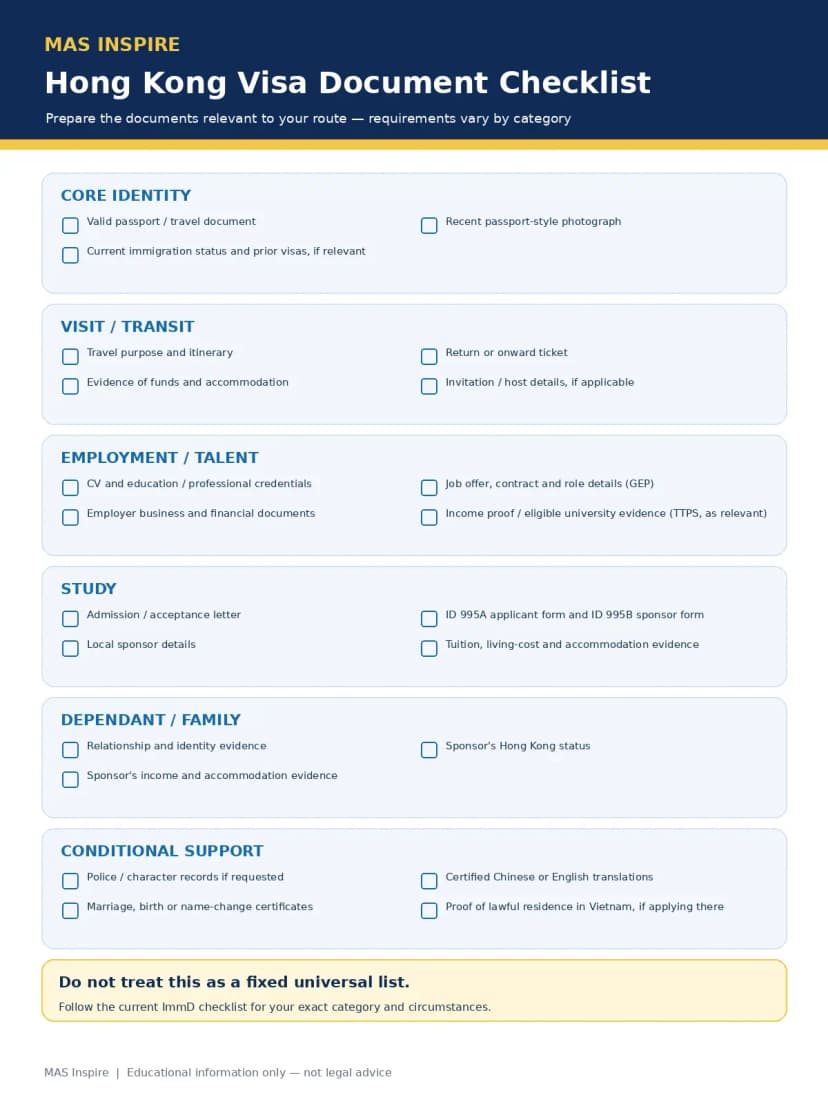
The following tables distinguish typical core evidence from conditional evidence. They are planning lists, not a claim that every applicant must submit every item.
Visitor / business visit
| Document | Status | Notes |
|---|---|---|
| Valid passport / travel document | Core | Include identity and validity pages |
| Completed visit application and photo | As directed | Use the current official form / channel |
| Travel itinerary and purpose | Core supporting evidence | Explain dates and planned activities |
| Return / onward ticket | Normally expected | ImmD requires return or onward ticket except specified transit to Mainland/Macao |
| Funds evidence | Core eligibility issue | Bank statements, income or sponsor support as appropriate |
| Accommodation details | Supporting | Hotel booking or host address |
| Invitation / host letter | Conditional | For family or business visits |
| Employment / business evidence | Supporting | Shows ties and source of funds |
| Vietnam residence evidence | Conditional | Relevant for a Pakistani applicant lodging from Vietnam |
Study
| Document | Status | Notes |
|---|---|---|
| Passport and recent photo | Core | Valid travel document |
| Form ID 995A | Core | Applicant form |
| Form ID 995B | Core | Sponsor form |
| Admission / acceptance letter | Core | From eligible institution |
| Sponsor details | Core | Institution or qualifying individual |
| Tuition and living-cost evidence | Core eligibility issue | Show ability to support study and accommodation |
| Academic records | Supporting | As required by institution / ImmD |
| Accommodation details | Supporting | Where available |
| Certified translations | Conditional | For documents not in Chinese or English |
Employment / talent
| Document | Status | Notes |
|---|---|---|
| Passport and photo | Core | Applicant identity |
| CV and employment history | Core supporting evidence | Relevant to the route |
| Degree / professional certificates | Route-dependent | Especially relevant to GEP / TTPS |
| Job offer and employment contract | Core for GEP | Not required for initial TTPS application |
| Employer's company documents | Core for employer-sponsored cases | Business registration, financial and operational evidence as requested |
| Salary and benefits details | Core for GEP | Must be broadly market-level |
| Eligible-university proof and work experience | Core for TTPS B/C | Check the current aggregate list |
| Income evidence | Core for TTPS A | Evidence of qualifying annual income |
| Police / character evidence | Conditional | If requested or required |
| Certified translations | Conditional | Chinese or English translation |
Dependant / family
| Document | Status | Notes |
|---|---|---|
| Applicant passport and photo | Core | Identity |
| Sponsor's Hong Kong status | Core | Visa / e-Visa / identity evidence |
| Marriage / partnership / birth certificates | Core as relevant | Relationship evidence |
| Sponsor income evidence | Core eligibility issue | Ability to support dependant |
| Accommodation evidence | Core eligibility issue | Suitable Hong Kong accommodation |
| Other custody / consent evidence | Conditional | For children where relevant |
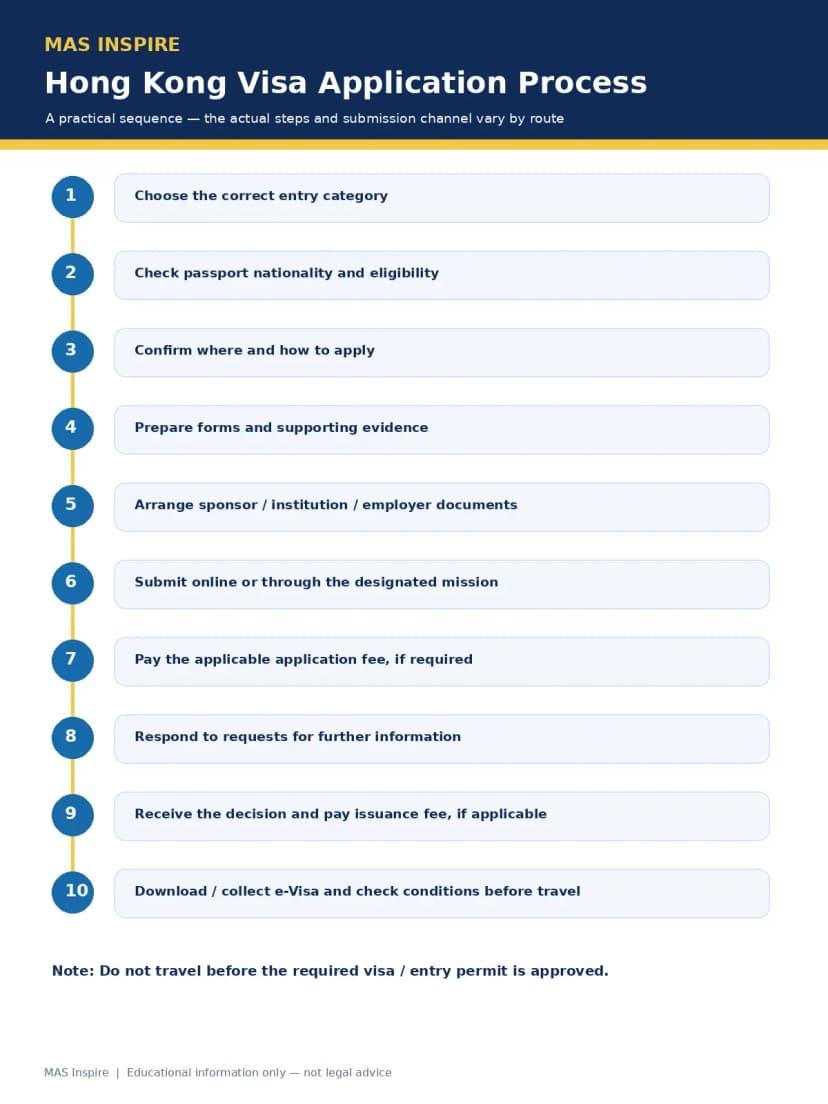
How to Apply: Step by Step
- Choose the correct category. Identify whether the purpose is a visit, transit, study, employment, talent admission, business establishment, investment or family residence.
- Check nationality and residence. Use the official nationality table and read the detailed category page. A Pakistani passport requires a visit visa; a Vietnam residence card does not remove that requirement.
- Confirm the application channel. Some categories use online submission, while overseas visit applications may be lodged through the nearest Chinese diplomatic or consular mission or directly with ImmD / through a local sponsor where allowed.
- Prepare the current forms. For study, the ImmD lists ID 995A and ID 995B. Other routes have their own online forms and guidance notes.
- Collect sponsor documents. Obtain the employer's, institution's, family sponsor's or business sponsor's evidence before filing.
- Upload or submit the application. Follow the exact instructions for the chosen route. Do not assume that a visa centre handles every category.
- Pay the required fee. Some specified schemes require an application fee first and an issuance fee after approval. Do not confuse the two.
- Respond to additional requests. ImmD may request more information, original documents, verification or clarification.
- Track the application. Use the reference number and the official enquiry method provided for the category.
- Check the decision and conditions. Download or collect the e-Visa / visa label as instructed. Check validity, permitted stay, employment conditions and entry arrangements before travel.
Not every category follows all ten steps in the same way. Biometrics or interviews should not be assumed; follow the instructions issued for the individual application.
Visa Fees and Financial Requirements
The ImmD's current fee table lists these standard amounts:
| Fee item | Amount |
|---|---|
| Ordinary visa — not issued under a specified scheme | HK$330 |
| Transit visa | HK$170 |
| Specified-scheme application fee | HK$600 |
| Specified-scheme visa issuance fee, relevant period over 180 days | HK$1,300 |
| Specified-scheme visa issuance fee, relevant period not more than 180 days | HK$600 |
| Change of condition / extension — ordinary cases | HK$330 |
| Change of condition / extension — specified scheme, over 180 days | HK$1,300 |
| Change of condition / extension — specified scheme, 180 days or less | HK$600 |
Specified schemes include GEP, TTPS, QMAS, IANG, New CIES and certain other named arrangements. The two-tier fee structure means that the application fee and issuance fee are separate. The application fee is non-refundable. Do not add the HK$600 application fee to every visitor or study application unless the official route says it applies.
Financial requirements are category-specific. Visitors must show adequate funds for the trip without working. Students must be able to pay tuition, accommodation and living expenses. GEP applicants are assessed on the remuneration package and employer evidence. New CIES has a stated HK$30 million net-asset and investment threshold. No universal bank balance applies to every Hong Kong visa applicant.
Official source: ImmD Fee Tables.
Visa Processing Times
| Application type | Officially published normal processing time |
|---|---|
| Visit / transit | 4 weeks after all required documents are received |
| GEP | 4 weeks after all required documents and fee are received |
| TTPS | 4 weeks after all required documents and fee are received |
| Study | 6 weeks after all required documents are received |
| Dependant | Normally 6 weeks after all required documents and relevant fee are received |
| QMAS | Selection-based; no guaranteed fixed decision period |
| New CIES | Scheme assessment; verify current guidance |
These are normal published estimates, not service guarantees. Missing documents, verification, peak demand or complex circumstances can extend processing. Do not book non-refundable travel on the assumption that a decision will arrive by a particular date.
Applying from Pakistan or Vietnam
Pakistani passport holders
The ImmD nationality table lists Pakistan as Visa Required for ordinary visits. The table shows an exception for direct airside transit when the traveller does not leave the airport transit area. This is not a general transit permission for a landside hotel stay, airport change or baggage collection requiring immigration clearance.
Pakistani applicants should prepare a clear itinerary, evidence of funds, accommodation, return or onward travel and supporting evidence for the purpose of the visit. Business travellers should add an invitation and employer letter. Family visitors should add host details and evidence of the relationship where relevant.
For work, study or residence, the correct category must be approved before travel. A visitor visa does not permit work or study.
Pakistani nationals legally living or working in Vietnam
A Vietnamese temporary residence card, work permit or other lawful residence evidence may help establish the applicant's current place of residence and explain where the application is being lodged. It does not convert a Pakistani passport into a visa-exempt passport and does not automatically guarantee that a Chinese diplomatic mission in Vietnam will accept the HKSAR application.
The ImmD's general overseas guidance says applicants may submit through the nearest Chinese diplomatic and consular mission in their place of domicile. It also notes that some missions use a Chinese Visa Application Service Center for foreign ordinary passport holders. The exact local intake arrangement is mission-specific.
Before travelling to an application centre, contact the Chinese Embassy in Hanoi or the Chinese Consulate-General with jurisdiction over the applicant's residence in Vietnam. Ask specifically whether they accept Hong Kong SAR visa / entry-permit applications from Pakistani ordinary passport holders who are lawful Vietnamese residents, whether the applicant must apply in person, and whether the centre accepts the relevant category. Do not assume that a mainland China visa application service automatically processes HKSAR visa cases.
If the local mission does not accept the application, ImmD's general rules also describe submission directly to the HKSAR Immigration Department or through a local sponsor for relevant applications. Confirm the route and document originals with ImmD before mailing anything.
Useful official links: - HKSAR visit visa and nationality requirements - ImmD visit / transit application arrangements - Chinese diplomatic and consular missions
Applying from Pakistan
Applicants residing in Pakistan should contact the Chinese diplomatic and consular mission responsible for their place of residence and ask about HKSAR visa submission, appointment, document legalisation / translation and payment. The same ImmD category criteria apply; the local filing procedure may differ from Vietnam.
Student Visa Guide
A student should first obtain admission to a programme that qualifies under Hong Kong's rules. The applicant and sponsor complete the relevant forms, commonly ID 995A and ID 995B, and provide identity, admission, sponsor and financial evidence. ImmD normally takes six weeks after receiving all required information and documents.
Students should confirm whether the programme is full-time, locally accredited and within the categories accepted by ImmD. A short course or exchange arrangement may have different rules. The student should not travel as a visitor intending to start a course that requires prior student permission.
Work Visa and Job Opportunities
The GEP is a common route for professionals with a genuine Hong Kong offer. The employer should be prepared to explain the role, recruitment need, salary and business operations. The candidate should provide a coherent CV and documentary evidence of education and relevant experience.
TTPS may suit people who meet the high-income or eligible-university criteria and want to enter before securing a job. QMAS may suit highly skilled or exceptionally accomplished applicants who satisfy its selection criteria. IANG is specifically for qualifying graduates, not all international graduates worldwide.
Hong Kong does not have a general job-seeker visa. Do not travel as a visitor and begin working while waiting for a work application.
Family Immigration and Permanent Residence
Eligible Hong Kong residents admitted under relevant schemes may sponsor a spouse or qualifying partner and unmarried dependent children under 18. The sponsor normally needs to show a genuine relationship, adequate financial means and suitable accommodation. A dependant's permission is linked to the sponsor and applicable policy.
Permanent residence is a separate legal status. For non-Chinese nationals, the ordinary-residence route generally requires seven continuous years immediately before application and evidence that Hong Kong has become the person's place of permanent residence. Retain employment, tax, school, housing and other records throughout residence.
Common Application Mistakes
- Applying for a mainland China visa instead of the required HKSAR permission.
- Assuming that Pakistani lawful residence in Vietnam removes the Hong Kong visit-visa requirement.
- Applying under visitor status while intending to work, study or operate a business.
- Using a non-qualifying university degree for TTPS.
- Treating a QMAS points threshold as automatic approval.
- Submitting an incomplete sponsor package.
- Providing inconsistent employment dates, salary figures or travel history.
- Using untranslated documents where a certified Chinese or English translation is required.
- Confusing an application fee with the visa issuance fee.
- Booking non-refundable flights before approval.
Reasons for Visa Refusal or Delay
An application may be refused or delayed if the purpose is unclear, evidence is inconsistent, funds are insufficient, a sponsor does not meet the relevant requirements, a job does not satisfy the GEP criteria, the proposed study programme is ineligible, the applicant has relevant adverse immigration or criminal history, or the applicant does not satisfy a scheme's nationality or qualification rules.
The ImmD may request additional evidence or conduct verification. False statements or documents can have serious legal consequences and may invalidate permission granted. Never conceal a refusal, overstay or material fact when asked.
Frequently Asked Questions
1. Do Pakistani citizens need a visa for Hong Kong?
Yes. The ImmD nationality table lists Pakistan as visa-required for ordinary visits. A limited direct-airside transit exception is shown when the traveller does not leave the airport transit area.
2. Can a Pakistani citizen living in Vietnam apply for a Hong Kong visa in Vietnam?
Possibly, but the local intake procedure must be confirmed with the relevant Chinese diplomatic mission or designated visa centre. Lawful Vietnamese residence does not guarantee acceptance of a third-country national's application.
3. Does a Vietnam residence card make a Pakistani passport visa-free for Hong Kong?
No. Visa requirements are based on the travel document / nationality rules. Residence evidence may support the application location and circumstances but does not remove the visa requirement.
4. Can I work in Hong Kong on a visitor visa?
No. Visitors cannot take up paid or unpaid employment or establish or join a business.
5. Is there a Hong Kong job-seeker visa?
There is no general-purpose job-seeker visa listed as a standalone category. TTPS and QMAS have their own specific eligibility requirements.
6. Can I apply for TTPS without a job offer?
Yes. A job offer is not required at the initial TTPS application stage if the applicant meets Category A, B or C requirements.
7. What is the TTPS income threshold?
Category A requires annual income of at least HK$2.5 million in the year immediately before application. Categories B and C are based on eligible-university degrees and work experience.
8. How long does a Hong Kong student visa take?
ImmD normally quotes six weeks after receiving all required documents and information.
9. How long does a Hong Kong work visa take?
For GEP, ImmD normally quotes four weeks after receiving all required documents and the relevant application fee.
10. How much is a Hong Kong visitor visa?
The current ImmD fee table lists an ordinary visa at HK$330. Confirm the amount at the time of application.
11. How much is a Hong Kong transit visa?
The current fee table lists HK$170. Direct airside transit may not require a visa for certain travellers, subject to nationality-specific rules and remaining in the transit area.
12. Can a foreign student work in Hong Kong?
Do not assume unrestricted work rights. The permitted activities depend on the student's status and current student policy. Check the official conditions and any internship / employment permission.
13. Can my spouse and children join me?
Eligible sponsors may apply for a spouse or qualifying partner and unmarried dependent children under 18, subject to relationship, support and accommodation requirements.
14. Can I get permanent residence after seven years?
A non-Chinese national may qualify after at least seven years' continuous ordinary residence immediately before application and if Hong Kong is the person's place of permanent residence. The legal test is more than simply counting years.
15. Is Hong Kong's New CIES a property investment visa?
No. It requires HK$30 million net assets and HK$30 million investment in specified permissible assets under the scheme rules. Do not assume that buying any property alone qualifies.
Official Immigration Websites
- Hong Kong Immigration Department
- Visit Visa / Entry Permit Requirements
- Visit / Transit
- General Employment Policy
- Students
- Top Talent Pass Scheme
- Quality Migrant Admission Scheme
- IANG
- Dependants
- New Capital Investment Entrant Scheme
- Right of Abode
- Fee Tables
Final Checklist and Conclusion
Before applying, confirm your passport nationality, current country of residence, purpose of travel and exact immigration category. Use the official ImmD page for that category, prepare the correct sponsor and financial evidence, check the current fee and application channel, and allow enough time for processing.
For Pakistani passport holders in Vietnam, the most important extra step is confirming whether the relevant Chinese diplomatic mission or visa centre in Vietnam accepts HKSAR applications from Pakistani residents. Do not assume that the process is identical to a mainland China visa application.
Hong Kong offers several distinct routes for visitors, students, professionals, graduates, entrepreneurs, investors and family members. Choosing the correct route and submitting complete, truthful evidence is essential. No visa or entry permission is guaranteed.
Disclaimer: This guide is for general educational purposes only and is not legal advice. Immigration rules, fees, forms and processing times may change. The Hong Kong Immigration Department's current instructions and the decision in each individual case take precedence.