Gambia Visa Guide 2026: Types, Requirements, Documents and Application Steps
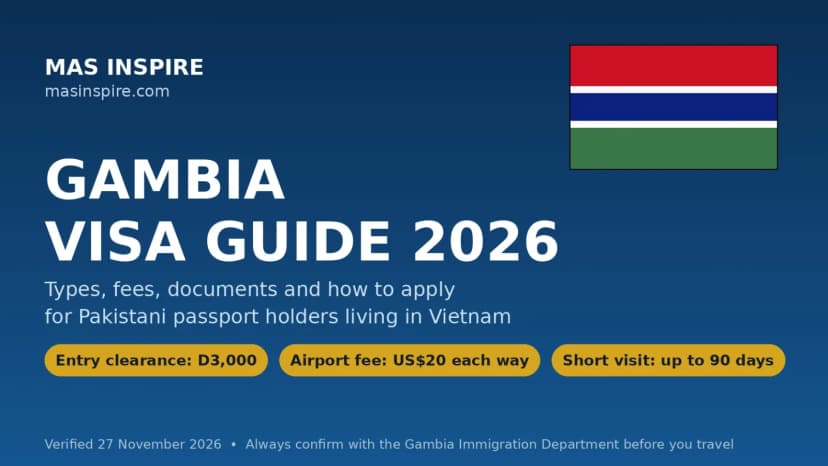
For Pakistani passport holders living in Vietnam — verified 28 November 2026. Always confirm the live rule with the Gambia Immigration Department or the nearest Gambian mission before you book, because The Gambia's own sources disagree on the key question in this guide.
1. Introduction
The Gambia is the smallest country on mainland Africa, a narrow strip of land along the Gambia River in West Africa, surrounded by Senegal except for its short Atlantic coastline. Its capital is Banjul, and almost all international visitors arrive through Banjul International Airport (BJL) at Yundum, about 25 km from the capital. The country is known for its Atlantic beaches around Kololi and Kotu, river cruises, birdwatching, colourful markets and a warm, English-speaking welcome — English is the official language, which makes it an easy destination for a Pakistani traveller to navigate.
For a Pakistani passport holder living in Vietnam, The Gambia is a realistic short-visit destination, but it is not a simple one. There is no Gambian embassy or consulate in Vietnam, and there is no Gambian mission in Pakistan either. The nearest practical mission is the Gambian Consulate General in Bangkok, Thailand. More importantly, The Gambia's own official sources disagree about whether a Pakistani passport holder needs a visa at all — and that disagreement is the single most important fact in this guide.
This guide is written for a Pakistani passport holder who lives in Vietnam and holds a Vietnamese temporary residence card. It covers the visa requirement and the conflict behind it, every visa and entry route, the fees you will actually pay at the airport, the documents to prepare, how to apply from Vietnam, extensions, residence and work permits, overstay penalties, health rules and practical entry tips. Every fee, processing time and validity figure is either verified against an official or government source, attributed to the secondary source that published it, or clearly marked as unverified where no reliable figure exists. Figures that conflict between sources are disclosed with the controlling source named, so you can decide on the safest course instead of discovering the problem at check-in.
2. Do Pakistani Passport Holders Need a Visa for The Gambia?
Short answer: treat the answer as yes — a Pakistani passport holder needs a Gambian visa and an advance entry clearance arranged by a host in The Gambia, even though some sources say you can enter visa-free. Do not book a flight on the assumption of visa-free entry. Get written confirmation from the Gambia Immigration Department (GID) or a Gambian mission before you travel.
The reason for this cautious answer is a genuine conflict between The Gambia's own official sources, and it is the most important disclosure in this guide:
| Source | What it says about Pakistani passport holders | Status |
|---|---|---|
| Government of The Gambia, official portal (gambia.gov.gm, Immigration and Visas page) | Citizens of the United Kingdom, full EU members, the Commonwealth, ECOWAS states and countries with a reciprocal visa-exemption agreement "do not require a visa to enter the country; whether on holiday or on a business trip not exceeding 90 days". Pakistan is a Commonwealth member, so on a plain reading of this page a Pakistani visitor would be visa-exempt for up to 90 days. | Official government page, still live |
| Gambia Immigration Department (gid.gov.gm), country annexures | Pakistan is listed in Annexure C — the group of countries whose nationals need both a visa and an entry clearance (security clearance) approved by the Director General of Immigration before travel. A host in The Gambia must apply for the clearance on the traveller's behalf. | Official immigration authority; nationality-specific list |
| Gambia Investment and Export Promotion Agency (GIEPA, giepa.gm) | Repeats the general rule: UK, Commonwealth, ECOWAS and reciprocal-agreement citizens do not need a visa for up to 90 days. | Official agency, general statement only |
| Several visa-information websites (Travel Visa Stack, doineedavisa.org, isvisarequired.com, Vindesh) | State that Pakistani citizens enter visa-free for up to 90 days, citing the Commonwealth exemption and passport-index data. | Secondary sources; they repeat the general rule and do not appear to account for the GID annexure |
| UrduPoint Travel (last checked 7 November 2026), Varioline Traveller (updated 4 September 2026), Jetlygo | State that Pakistanis need a visa plus entry clearance, because Pakistan is in Annexure C. UrduPoint gives the clearance fee and procedure in detail. | Secondary sources that cite the GID annexure directly |
How this guide resolves the conflict. The GID annexure is the controlling source for a Pakistani applicant, for three reasons. First, it is nationality-specific: it names Pakistan, while the government portal states a general Commonwealth rule without naming any country. Second, it is published by the Gambia Immigration Department itself, the authority that decides entry at the border. Third, the more detailed recent reporting (UrduPoint, 7 November 2026; Varioline, 4 September 2026) that quotes the annexure is consistent with it. The general Commonwealth exemption may be an older or broader statement that does not reflect the annexure in force, but that cannot be confirmed from the published pages alone — the government portal page carries no date. The safe course is therefore to obtain the visa and the entry clearance, and to treat any visa-free claim as unconfirmed until GID or a Gambian mission confirms it in writing for your passport.
What this means in practice. You need a host in The Gambia — a person, company, hotel, tour operator or institution — who takes financial responsibility for your visit and applies for your entry clearance to the Director General of Immigration. You also need a Gambian visa in your passport, issued by a Gambian mission. There is no special exemption reported for holders of a US, UK, Schengen or Gulf visa or residence permit, and your Vietnamese residence card does not change the Gambian rule: it is your Pakistani passport that decides the requirement. Travelling without the clearance risks being refused boarding by your airline or refused entry on arrival in Banjul, even if a visa is stamped in your passport.
What is not in dispute. All sources agree on the following: entry is through Banjul International Airport; a valid passport is required; a yellow fever vaccination certificate is required in the circumstances described in Section 13; and every passenger pays a Securiport airport fee of D1,000 (US$20) on arrival and again on departure, as set out in Section 4.
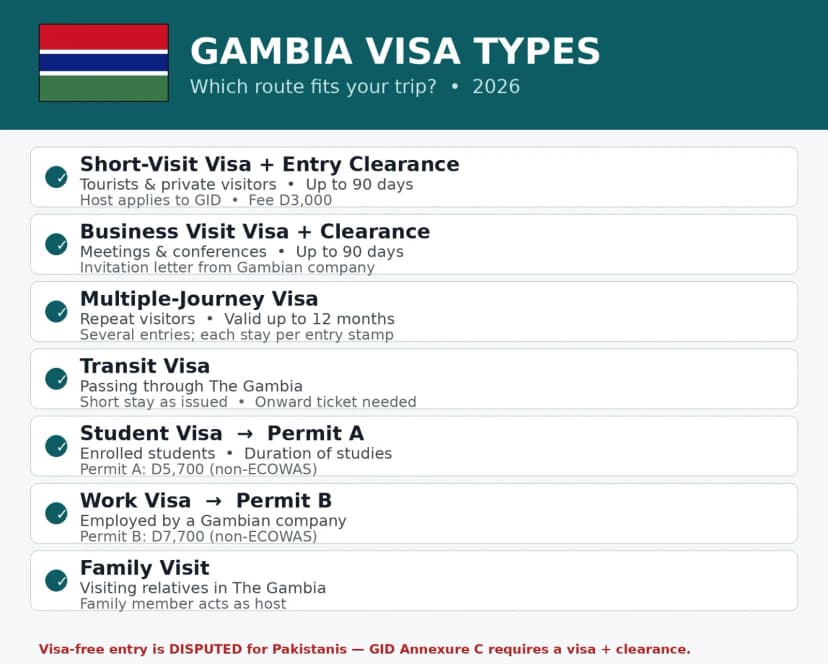
3. Types of Gambia Visas and Entry Routes
The Gambia Immigration Department lists single-journey, multiple-journey and transit visas. The table below sets out each route as it applies to a Pakistani passport holder, with the important warning that the visa-free row reflects the disputed general rule and must not be relied on without written confirmation.
| Visa / entry route | Who it is for | Maximum stay | How you get it |
|---|---|---|---|
| Short-visit (single-journey) visa + entry clearance | Tourists and private visitors | Up to 90 days, subject to security clearance | Host applies for entry clearance to the Director General of Immigration; visa issued by a Gambian mission |
| Business visit (single-journey) visa + entry clearance | Meetings, negotiations, conferences, short business trips | Up to 90 days, subject to security clearance | Same clearance route; Gambian company or host provides an invitation letter |
| Multiple-journey visa | Repeat visitors who need several entries | Valid for any number of journeys for up to 12 months; each stay governed by the entry stamp | Gambian mission, with entry clearance as directed by GID |
| Transit visa | Travellers passing through The Gambia to another country | Short transit stay as issued | Gambian mission in advance; confirm whether your routing needs one, since most Pakistan-to-Banjul routings transit a third country rather than The Gambia itself |
| Visa on arrival at Banjul International Airport | Visa-required nationalities without a Gambian mission in their country, and last-minute travellers | Up to 30 days as stamped (see the conflict note below) | At the airport on arrival — but not a reliable route for Pakistanis without prior clearance |
| Student visa / Permit A residence | Students enrolled at a recognised Gambian institution | Duration of studies, renewable annually through a residence permit | Admission letter first, then mission visa and, after arrival, a Permit A residence permit (see Section 11) |
| Work visa / Permit B residence | People employed by a Gambian company | One year, renewable | Employer sponsorship, then mission visa and, after arrival, a Permit B residence permit (see Section 11) |
| Family visit | Visiting relatives or a spouse in The Gambia | Up to 90 days as a short visit | Same clearance route; the family member in The Gambia acts as host |
| Visa-free entry (DISPUTED — do not rely on it) | Claimed for Commonwealth citizens, including Pakistanis, for holiday or business up to 90 days | Up to 90 days if it applied | No application — but the GID Annexure C listing for Pakistan contradicts it, so this guide does not recommend relying on it |
Visa on arrival — conflict note. The government portal says that where there is no Gambian diplomatic representative, visitors may obtain an entry visa at Banjul International Airport on arrival, and that last-minute travellers will be allowed entry but must submit their passport to the Department of Immigration in Banjul within 48 hours to be issued a proper visa. The US State Department (updated 29 January 2026) says US citizens can obtain a visa on arrival for US$100–105 in cash. Commercial visa services advertise a Gambian eVisa at US$100 for a 30-day stay with 7–9 days of processing. None of these routes has been verified as available to a Pakistani passport holder, and the Annexure C clearance rule states that clearance is arranged in advance and cannot be obtained at the border. A Pakistani traveller should therefore not plan to rely on a visa on arrival or an eVisa. If a mission or GID tells you in writing that one of these routes applies to you, keep that written confirmation with your travel documents.
What a visa does not do. A Gambian visa does not guarantee entry. Immigration officers at the port of arrival make the final decision, and they may refuse entry even to a visa holder. A visa also does not permit paid employment: working in The Gambia requires a residence permit and a work permit, as explained in Section 11.
4. Visa Fees and Airport Charges
There is no single published Gambian visa fee for Pakistani applicants. The fees that are published, and the charges every traveller pays, are set out below. Where a figure could not be verified, this guide says so rather than inventing a number.
| Fee or charge | Amount | Who pays it | Source and status |
|---|---|---|---|
| Entry clearance fee | D3,000 (Gambian dalasi), non-refundable | Your host in The Gambia, paid when the clearance is applied for | UrduPoint, last checked 7 November 2026, citing GID practice |
| Gambian visa fee (mission-issued visa) | Not published — ask the issuing mission | The applicant, at the mission | No official Pakistan-specific visa fee could be verified; do not rely on any figure quoted by an agent |
| Securiport airport security fee — arrival | D1,000 (US$20) | Every passenger on arrival, in cash | Gambia Immigration Department, via published arrival procedures; corroborated by UK FCDO and US State Department |
| Securiport airport security fee — departure | D1,000 (US$20) | Every passenger on departure, in cash | Same sources as above; budget for this fee twice per trip |
| Visa on arrival (other nationalities, e.g. US citizens) | US$100–105, cash only | Visa-required travellers who obtain a visa at Banjul airport | US State Department, updated 29 January 2026 — not verified as applying to Pakistani passport holders |
| Advertised eVisa government fee | US$100 | Online applicants, if the route applies | Commercial visa service only; no official Gambian eVisa portal fee could be verified — treat as unverified |
| Residence Permit A (live, no work), non-ECOWAS | D5,700, including a D2,500 Alien Card | Non-ECOWAS nationals, including Pakistanis, staying long term | Gambia Immigration Department residence-permit page, read 19 October 2026 |
| Residence Permit B (live and work), non-ECOWAS | D7,700, including a D2,500 Alien Card | Non-ECOWAS nationals employed in The Gambia | Gambia Immigration Department residence-permit page, read 19 October 2026 |
| Extension of stay | Conflicting figures — see Section 10 | Visitors extending a short stay | Not verified; see the conflict note in Section 10 |
| Overstay penalty | US$15 per month, cash on departure | Anyone who stays beyond the permitted period | US State Department, updated 29 January 2026 — see the conflict note in Section 12 |
Currency note. The Gambian dalasi is written as D or GMD. The Securiport fee is quoted by GID as D1,000, equal to US$20, which implies an official rate of about D50 to US$1 for this fee; do not use that rate for general currency conversion, as market rates differ. Carry US dollars in cash for the airport fees, because the visa-on-arrival fee (where it applies) and the Securiport fee are payable in cash, and card payment at the airport cannot be relied on. The GID itself notes that the Securiport fee is not mandated by the department — no law or regulation creating the charge is named on the official pages — but every passenger is charged it in practice, so budget for it regardless.
Exemptions from the Securiport fee. Diplomats are exempt. The age threshold for children is itself a small conflict: GID's arrival procedures exempt children aged 2 and under, while UK FCDO advice exempts children aged 1 or under, and FCDO also exempts transit passengers. If you travel with a small child, carry cash for the fee and ask at the kiosk; the amount at stake is US$20.
Agent fees. Commercial visa services advertise total costs far above the government figures (one guide cites agent service costs of US$238–549 for The Gambia). Those are service charges, not government fees, and this guide does not recommend paying an agent to "arrange" an entry clearance: the clearance must come from your host and the Immigration Department, and no agent can replace that step.
5. Processing Times
| Step | Processing time | Source and status |
|---|---|---|
| Entry clearance (host applies to GID) | At least 7 days' notice required | UrduPoint, last checked 7 November 2026 — allow more than 7 days in practice |
| Mission visa (e.g. Brussels embassy, where cited) | At least 48 hours | UrduPoint, last checked 7 November 2026 — mission-specific; the Bangkok mission may differ |
| Mission visa, general estimate | 1–3 weeks | AMG Visa, verified 28 October 2026 — commercial agent estimate, not an official commitment |
| Advertised eVisa government processing | 7–9 business days; apply at least 7 days before arrival | Commercial visa service — unverified against any official portal |
| General embassy visa processing (all nationalities) | 5–10 business days in faster channels; 4–8 weeks for some categories such as student or media | VisaVerge Gambia guide 2026, citing embassy channels — broad range, not Pakistan-specific |
| Visa on arrival | Issued at the airport desk once documents and cash are checked | US State Department and guide reporting — not verified as a route for Pakistani passport holders |
| Residence permit (Permit A or B) | Not published | GID permit page gives fees and steps but no processing time — ask GID in Banjul |
Planning rule. Start at least four weeks before your intended departure. The clearance alone needs a minimum of 7 days, your host needs time to prepare and lodge the application, and the mission visa adds its own time on top. A one-week plan leaves no margin for a query from GID, a missing document, or a mission closure. Apply as early as you can: applications are accepted well ahead of travel, and no government source guarantees a decision by a particular date.
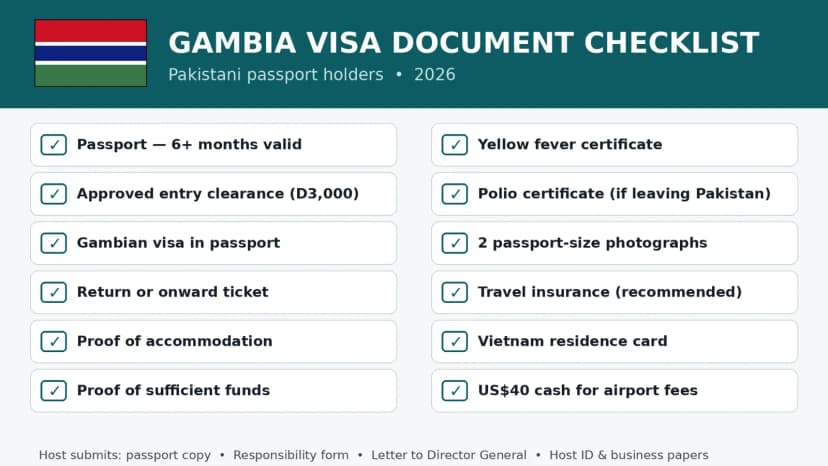
6. Complete Document Checklists
Prepare the documents below before your host lodges the clearance application. Keep originals and one full set of photocopies, and carry a copy of the approved clearance separately from the original.
6.1 Tourist or private visit — what you need
| Document | Requirement |
|---|---|
| Pakistani passport | Valid for at least 6 months beyond your intended stay, undamaged, with at least one blank page for the entry stamp; some sources advise two blank pages |
| Approved entry clearance | Original held by your host and presented on or before your arrival; carry your own copy |
| Gambian visa | Issued by a Gambian mission and endorsed in your passport before departure |
| Return or onward ticket | Confirmed booking out of The Gambia; immigration may ask to see it |
| Proof of accommodation | Hotel booking or your host's address with full contact details |
| Proof of sufficient funds | Evidence you can maintain yourself for the stay; bank statements may be requested (see the note below) |
| Yellow fever vaccination certificate | Required if arriving from, or transiting more than 12 hours through, a yellow-fever risk country — see Section 13 |
| Polio vaccination certificate | Required to leave Pakistan (NADRA-issued) if you depart from Pakistan — see Section 13 |
| Passport photographs | Two recent passport-size photographs, for the visa application and any in-country form |
| Travel insurance | Recommended, not mandatory; see Section 13 |
| Vietnam residence card | Your Vietnamese temporary residence card, to show your residence in Vietnam and to support re-entry to Vietnam |
Bank statements — a figure this guide does not endorse. One commercial agent (AMG Visa) states that Pakistani applicants need a certified 6-month bank statement with a closing balance of PKR 1,000,000 to 2,000,000 and an Account Maintenance Certificate, and another table on the same site gives PKR 800,000 to 1,800,000 (US$3,000 to 6,000). No official Gambian source publishes a minimum bank balance for Pakistani visitors. This guide therefore does not state a required balance: carry a recent bank statement showing funds clearly sufficient for your trip, and ask the issuing mission what it expects before you submit.
6.2 Business visit — additional documents
| Document | Requirement |
|---|---|
| Invitation letter | From the Gambian company or organisation, stating the purpose, dates and who bears the costs |
| Host business papers | Your host's business registration or institutional documents, as GID requires |
| Employment evidence | Letter from your employer in Vietnam (or your business documents, if self-employed) confirming your role and leave |
| All tourist-visit documents in 6.1 | Passport, clearance, visa, return ticket, accommodation, funds, vaccinations |
6.3 Student visit — additional documents
| Document | Requirement |
|---|---|
| Admission letter | From a recognised Gambian institution, confirming enrolment, course and dates |
| Proof of funds | Evidence of funds for tuition and living costs for the period of study |
| Academic records | Certificates and transcripts supporting the admission |
| All tourist-visit documents in 6.1 | Passport, clearance, visa, return ticket, accommodation, vaccinations |
6.4 Work — additional documents
| Document | Requirement |
|---|---|
| Employment contract or offer | From the Gambian employer, stating role, salary and duration |
| Employer sponsorship | The employer sponsors the work and residence permits through the Ministry of Labour and GID |
| Qualifications and CV | Degree, professional certificates and work history supporting the role |
| All tourist-visit documents in 6.1 | Passport, clearance, visa, return ticket, accommodation, vaccinations |
6.5 Family visit — additional documents
| Document | Requirement |
|---|---|
| Host invitation | Letter from the family member in The Gambia, with their address and contact details |
| Proof of relationship | Documents showing the family relationship, if requested |
| Host ID or residence permit | Your host's Gambian ID or residence permit, as GID requires |
| All tourist-visit documents in 6.1 | Passport, clearance, visa, return ticket, accommodation, funds, vaccinations |
6.6 Transit — additional documents
| Document | Requirement |
|---|---|
| Onward ticket and visa | Confirmed ticket to your final destination and, if required, a visa for that country |
| Passport and yellow fever certificate | As in 6.1; transit passengers are exempt from the Securiport fee according to UK FCDO advice |
What your host must submit for the entry clearance. According to UrduPoint's account of the GID procedure, your host gives the Director General of Immigration: a copy of your passport, a signed Immigration Responsibility form, a letter to the Director General of Immigration, and the host's own ID or residence permit and business papers, together with payment of the D3,000 clearance fee. Confirm the current form and payment method with GID before your host lodges the application, because the published procedure may have changed.
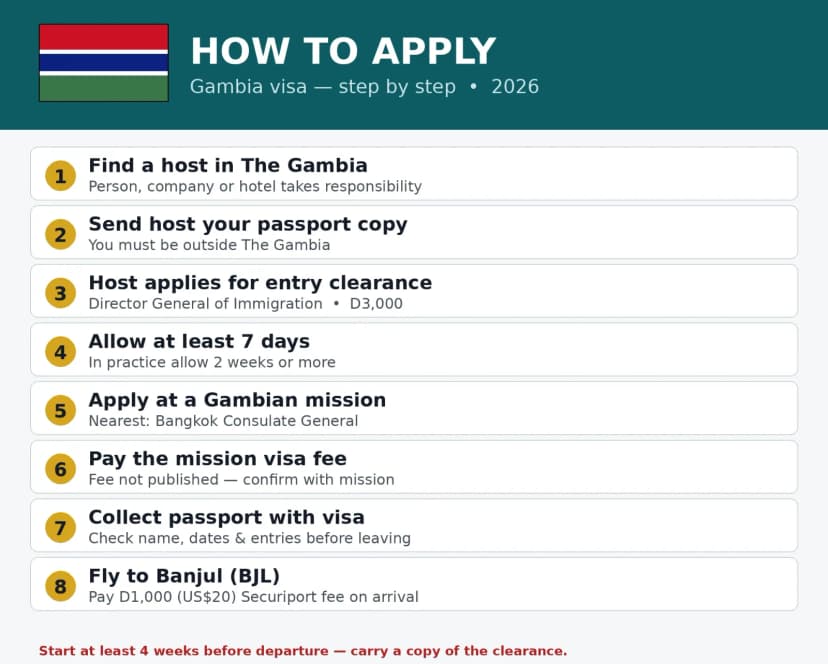
7. How to Apply: Step-by-Step
There is no reliable online application route for a Pakistani passport holder that this guide could verify — no official Gambian eVisa portal fee or procedure could be confirmed against a government source, and the clearance itself is a paper process handled by your host inside The Gambia. Follow these steps in order.
- Find a host in The Gambia. This is the indispensable first step: a person, company, hotel, tour operator or institution that will take financial responsibility for your visit. Without a host there is no entry clearance, and without the clearance there is no lawful entry under the Annexure C rule.
- Send your host a copy of your passport. You must be outside The Gambia while the clearance is processed. Send a clear colour copy of the passport data page and confirm your travel dates and the purpose of your visit.
- Your host applies to the Director General of Immigration. The host lodges the clearance application with the Immigration Responsibility form, the letter to the Director General, the host's ID or residence permit and business papers, and pays the D3,000 fee (non-refundable).
- Allow at least 7 days for the clearance. In practice allow two weeks or more. The host keeps the approved original clearance and presents it on or before your arrival; you should carry a copy.
- Apply for the visa at a Gambian mission. With the clearance approved (or as GID advises), apply at the nearest mission that accepts Pakistani applications — for a resident of Vietnam, the Gambian Consulate General in Bangkok is the nearest (see Section 8). Ask the mission first, in writing, which documents it wants, what the visa fee is, and whether you must submit your passport in person or by post.
- Pay the mission visa fee and lodge your documents. The visa fee is not published; confirm the amount and the accepted payment method with the mission before you send money or travel. Get a receipt.
- Collect your passport with the visa endorsed. Check the visa before you leave the mission: your name, passport number, validity dates, number of entries and the permitted stay must all be correct. Keep the clearance copy with the passport.
- Book your flights only after the visa is issued. Most Pakistan-to-Banjul routings go via a Gulf hub (for example Doha or Dubai), Istanbul, or West African hubs such as Dakar or Accra. Check the transit visa rules of every transit country on your routing, and leave a generous connection margin.
- Prepare your arrival pack. Passport, visa, clearance copy, return ticket, accommodation proof, funds evidence, yellow fever certificate, polio certificate if departing from Pakistan, travel insurance, and US$40 in cash for the two Securiport fees (arrival and departure) plus US$20–40 extra for contingencies.
- On arrival in Banjul, present your documents at immigration. Expect a biometric registration (photograph and fingerprints, and in some accounts iris capture). Answer questions about your host, your accommodation and your funds honestly and briefly. Pay the D1,000 (US$20) Securiport fee at the kiosk and keep the receipt.
Applying from Pakistan instead of Vietnam. If you happen to be in Pakistan when you apply, the same clearance route applies, and the same warning is stronger: there is no Gambian mission covering Pakistan, and the only Gambian representation in Pakistan is an honorary consulate in Karachi, whose visa-issuing role is not confirmed. Ask GID, through your host, how your visa will be issued. A polio vaccination certificate from NADRA is required to leave Pakistan, so obtain it before departure.
8. Applying from Vietnam: Nearest Gambian Missions
There is no Gambian embassy or consulate in Vietnam. The nearest missions, and the other missions a Pakistani applicant is most likely to be directed to, are:
| Mission | Address / contact as published | Note for a Vietnam-based applicant |
|---|---|---|
| Consulate General of The Gambia, Bangkok (nearest) | 610/5-6 Songwad Road, Samphantwongse, Bangkok 10100, Thailand; telephone +66 2 224-0091 | Closest mission to Ho Chi Minh City (about a 1.5-hour flight). Confirm before travelling to Bangkok that this mission accepts visa applications from Pakistani passport holders and whether you must attend in person. |
| High Commission of The Gambia, New Delhi | New Delhi, India; concurrent accreditation listed as Bangladesh, Indonesia, Maldives, Myanmar, Nepal and Sri Lanka | Vietnam and Pakistan are not in its published concurrent-accreditation list, so do not assume it will take your application — ask first. |
| Embassy of The Gambia, Abu Dhabi | Abu Dhabi, United Arab Emirates | An option if your routing passes through the UAE; UrduPoint names Abu Dhabi among the missions used by Pakistani applicants in the Gulf. |
| Embassy of The Gambia, Doha | Doha, Qatar (Al Hilal area, D-Ring Road) | An option if your routing passes through Doha; named by UrduPoint for Pakistani applicants in the Gulf. |
| Embassy of The Gambia, Riyadh; Consulate-General, Jeddah | Riyadh and Jeddah, Saudi Arabia | Named by UrduPoint for Pakistani applicants resident in Saudi Arabia; relevant only if you are in the Kingdom. |
| High Commission of The Gambia, London | 57 Kensington Court, High Street Kensington, London W8 5DG, United Kingdom | The principal Gambian mission in Europe; useful only if you are travelling via the UK. |
| Honorary Consulate of The Gambia, Karachi | Karachi, Pakistan | The only Gambian representation in Pakistan; its visa-issuing role is not confirmed — contact it for guidance only. |
Two cautions about the Bangkok mission. First, the Bangkok Consulate General appears in embassy directories with the Songwad Road address and telephone number above, but it does not appear on the current-missions list in the standard published list of Gambian diplomatic missions — so confirm that it is still operating and still issuing visas before you book a trip to Bangkok. Second, the Gambian High Commission in Kuala Lumpur closed in 2020, so Malaysia is no longer a mission option. In every case, email or telephone the mission before you travel to it: confirm that it accepts applications from a Pakistani passport holder resident in Vietnam, the exact documents and fee, the payment method, and whether the passport must be lodged in person.
Vietnam-side preparation. Before you leave Vietnam, make sure your Vietnamese temporary residence card and any re-entry permission remain valid for your return, and carry your residence card with your passport. If your residence card expires while you are away, you may not be able to re-enter Vietnam. Check your airline's transit requirements too: a routing via a Gulf or European hub may need a transit visa for a Pakistani passport holder even if you never leave the airport.
9. Entry on Arrival at Banjul International Airport (BJL)
Banjul International Airport (BJL) at Yundum, about 25 km from Banjul, is The Gambia's only international airport and the point of entry for almost every visitor. On arrival, expect the following sequence:
- Immigration control. Present your passport with the Gambian visa, your copy of the approved entry clearance, your return or onward ticket, proof of accommodation and evidence of funds. Your host's name and contact details may be checked against the clearance. Travellers are registered in a biometric system that collects a photograph, fingerprints and passport data, and in some accounts iris data as well.
- Entry stamp. If you are admitted, your passport is stamped with the permitted stay. Check the stamp before you leave the desk: the number of days granted is what counts, and it may be less than the 90 days the visa allows. If you were admitted under the last-minute route described on the government portal, you must submit your passport to the Department of Immigration in Banjul within 48 hours to be issued a proper visa — do not miss this deadline.
- Securiport fee. Pay D1,000 (US$20) in cash at the kiosk on arrival, and keep the receipt. You will pay the same amount again on departure.
- Customs and health checks. Your yellow fever certificate may be checked, particularly if you arrived from or transited through a risk country. The Gambia has strict laws on the import and export of illegal and narcotic drugs; do not carry any prohibited substance, including cannabis, and declare medicines as required.
- Registration expectation. Some official guidance describes visitors submitting their passport to the Department of Immigration in Banjul within 48 hours of arrival. This appears in the government portal's own text for last-minute travellers; if an immigration officer tells you to register, do so promptly and keep the receipt.
- Onward travel. Taxis and hotel transfers are available at the airport. Agree the fare before you set off, carry small-denomination dalasi or US dollars, and keep your passport and clearance copy with you rather than in checked luggage.
10. Extending Your Stay in The Gambia
If your entry stamp allows fewer days than you need, or your plans change, extend your stay before it expires. Extensions are handled by the Gambia Immigration Department in Banjul and by tourist police stations in the Tourism Development Area. Start at least one week before your permitted stay runs out.
| Extension fact | What the sources say |
|---|---|
| Who can extend | Visitors admitted on a short stay; UK FCDO advice describes two extensions of 28 days each for British visitors |
| Where to apply | Immigration Office in Banjul, or tourist police stations in the Tourism Development Area (FCDO, updated 7 July 2026) |
| Length of extension | 28 days per extension (FCDO); one commercial guide describes 30 additional days per extension |
| Extension fee | CONFLICT — see below |
| For longer stays | A residence permit is required (Permit A or B, see Section 11) |
Extension-fee conflict. The published figures for an extension fee do not agree, and no official GID fee for a short-stay extension could be verified: one older emigration guide puts extensions at D250 for each additional month; a 2026 commercial guide puts a 30-day extension at GMD 1,000–2,000 (about US$20–40); and a general visa guide puts a one-month extension at GMD 1,000 and a three-month extension at GMD 2,500. The controlling advice is to ask the Immigration Office in Banjul for the current fee before you apply, pay only against a receipt, and not rely on any of these figures when budgeting. Extending is always cheaper than overstaying (see Section 12).
Non-ECOWAS registration note. One published guide states that for non-ECOWAS nationals an extension of stay is required at a designated immigration office from day 56 of cumulative presence within a 12-month period. A Pakistani passport holder is a non-ECOWAS national, so keep count of your cumulative days in The Gambia within any 12-month period and visit the Immigration Office in good time if your stay approaches that point.
11. Residence Permits: Living, Studying and Working
A visa is for a visit. Living, studying or working in The Gambia needs a residence permit, applied for after arrival at the Gambia Immigration Department in Banjul. The GID residence-permit page lists two permits, each in an ECOWAS and a non-ECOWAS version. Pakistan is not an ECOWAS member, so the non-ECOWAS fees apply to you.
| Permit | Who it is for | Non-ECOWAS fee (Pakistani applicant) | ECOWAS fee (for comparison) |
|---|---|---|---|
| Permit A — residence without paid work | Foreign students residing in The Gambia, retirees, and individuals on a short business visit or mission | D5,700, of which D2,500 is the Alien Card | D3,100 |
| Permit B — residence with work | Business people, expatriates, unskilled workers and other professionals employed in The Gambia | D7,700, of which D2,500 is the Alien Card | D3,600 |
Source and limits of these figures. The fees above come from the Gambia Immigration Department's own residence-permit page, as read on 19 October 2026. The page carries no date, does not state how long a permit runs, and does not say whether the same fee applies at any time of year — those points are therefore disclosed as unverified. Other guides state that residence permits are valid for one year and renewable annually at the immigration office in Banjul, and that the government may revoke a permit at any time; those statements could not be verified against the GID page, so treat them as indicative only and confirm them with GID.
How a permit is obtained. According to the published account of the GID procedure, you pay for and collect the forms at the bank the department uses at its issuing centres (the page names VISTA Bank), and you hand in the application at the Gambia Immigration Department in Banjul. Confirm the current bank, form and payment steps with GID before you go, because this detail comes from a secondary reading of the GID page.
Work permits. A residence permit is not the same as a work permit. Once you have applied for a residence permit, you may also apply for a work permit; only when you hold both permits are you eligible for the labour rights available to Gambians, including joining a union. A work permit requires employer sponsorship and approval from the Ministry of Labour, and one commercial guide quotes a processing fee of about US$200 — that figure is unverified, and this guide does not rely on it. Do not take paid employment in The Gambia on a visitor's entry: working without the permits risks a fine, detention or deportation.
Students. A student enters on a student visa and then takes a Permit A residence permit for the duration of studies, renewable annually. You will need your admission letter, proof of funds for tuition and living costs, and the documents in Section 6.3. Confirm with the institution whether it assists with the permit application.
12. Overstay Rules and Penalties
Your permitted stay is the number of days stamped in your passport on arrival, not the maximum the visa allows. Staying beyond that date is an overstay, and it is penalised.
| Point | Detail |
|---|---|
| Controlling penalty figure | US$15 per month of overstay, paid in cash on departure (US State Department, updated 29 January 2026) |
| Conflicting figure | GMD 500 (about US$8) per day, with no official cap, per one commercial guide (EntryBrief) — this guide does not rely on it; the State Department figure is the controlling one |
| Other consequences | Questioning by immigration, a record that can affect future visa applications, possible detention or deportation, and refusal of entry on a later visit |
| How to avoid it | Extend your stay before it expires (Section 10), or leave before the stamped date; keep your entry stamp and extension receipts |
Overstay-fee conflict, stated plainly. The US$15-per-month figure and the GMD-500-per-day figure differ by more than an order of magnitude, and they cannot both be the current rule. The US$15 figure comes from the US State Department's country information, updated 29 January 2026, and is corroborated by two independent 2026 guides citing the same State Department source; the per-day figure comes from a single commercial guide. This guide therefore treats US$15 per month as the working figure and flags the per-day figure as unverified. Even on the lower figure, overstaying is a false economy: it creates an immigration record that can cost you a future visa. If you realise you have overstayed, go to the Immigration Office in Banjul before your departure date if you can, and carry enough cash to pay the penalty at the airport.
13. Health, Vaccinations and Travel Insurance
| Health item | Requirement |
|---|---|
| Yellow fever vaccination | CONFLICT — see below; carry the certificate in all cases |
| Polio vaccination (departing from Pakistan) | Polio vaccination certificate from NADRA is needed to leave Pakistan |
| Malaria | Anti-malaria medicine is recommended; consult your doctor on which prophylaxis to take, and use insect repellent |
| Other recommended vaccinations | Hepatitis A, tetanus/diphtheria and typhoid are recommended by travel-health guidance |
| Travel insurance | Recommended, not mandatory; comprehensive cover for baggage, injury, death, illness and personal belongings is advised by Gambian tourism guidance |
| Medical care | Medical facilities in The Gambia are limited; make sure your insurance covers medical evacuation |
Yellow fever conflict. The Government of The Gambia's own portal states that all visitors must have a valid passport and evidence of a yellow fever vaccination card. UK FCDO and US State Department advice, and the GID's more detailed health wording, say instead that a certificate is required for travellers aged 9 months or over arriving from countries with a risk of yellow fever transmission, and for travellers who have transited for more than 12 hours through an airport in such a country. Vietnam is not a yellow-fever risk country, so a traveller flying directly from Vietnam via a non-risk hub would not need the certificate under the narrower rule — but your routing may pass through a risk country, and the government portal's broader wording means an immigration officer may ask for the card regardless. The controlling advice is simple: get the yellow fever vaccination at least 10 days before travel and carry the certificate (the WHO "yellow book"). It costs little, removes the argument at the border, and is also needed for onward travel to some other countries because The Gambia itself is listed as a transmission-risk country. GIEPA's investor page adds that an international vaccination certificate is no longer compulsory for investors, but that does not help a tourist: carry the card.
COVID-19. The GID entry page was still listing a PCR certificate within 72 hours of arrival at the last published reading (21 October 2026). That requirement is almost certainly out of date, but this guide flags it rather than deleting it: confirm with your airline and with GID before travel, and do not assume a PCR test is either required or unnecessary.
Travel insurance. Take comprehensive travel insurance before you travel, covering medical treatment, medical evacuation, trip cancellation, baggage and personal liability. Medical care in The Gambia is basic outside the main towns, and evacuation to Dakar or Europe is expensive without cover.
14. Money, Flights and Practical Entry Tips
- Currency. The currency is the Gambian dalasi (GMD, written D), divided into 100 bututs. Carry US dollars and euros in cash for easy exchange into dalasi, and small-denomination notes for taxis and markets. Do not rely on card payments outside major hotels.
- Cash for the airport. Carry at least US$40 in cash for the two Securiport fees (US$20 on arrival, US$20 on departure), plus a margin for the visa-on-arrival fee if a mission has told you that route applies to you (US$100–105) and for the overstay penalty if your plans slip (US$15 per month).
- Flights. There are no direct flights from Vietnam to Banjul. Typical routings from Ho Chi Minh City go via Doha, Dubai, Istanbul, or West African hubs such as Dakar or Accra. Check the transit visa rules of each transit country for a Pakistani passport holder, and allow at least three hours between connecting flights in an unfamiliar hub.
- Best time to visit. The dry season, roughly November to May, is the most comfortable time to visit, with lower humidity and little rain. The rainy season runs roughly June to October. The Gambia is on GMT all year, with no daylight saving — Vietnam is 7 hours ahead (UTC+7), so expect jet lag on arrival.
- Language and etiquette. English is the official language, so a Pakistani English speaker will manage easily. Greetings matter: a polite greeting before any request is expected. Dress modestly outside beach resorts, ask before photographing people, and respect prayer times — The Gambia is a majority-Muslim country, and Friday is the main congregational prayer day.
- Safety. The US State Department rates The Gambia at Level 2: Exercise Increased Caution (updated 16 January 2026). Take normal precautions: keep valuables out of sight, avoid isolated beaches at night, use registered taxis, and keep a copy of your passport and clearance separate from the originals.
- Driving. UK advice says a UK photocard driving licence can be used for up to 3 months. A Pakistani licence holder should carry an International Driving Permit and confirm its acceptance with the car-hire company; do not assume a Pakistani licence alone is sufficient.
- Staying connected. Buy a local SIM card on arrival for mobile data, and keep your host's telephone number saved in your phone. Keep the telephone number of the Gambia Immigration Department in Banjul (+220 422 7295, as published in directories) and of the nearest Gambian mission saved as well.
- Keep every receipt. Keep the Securiport receipts, the entry stamp, any extension receipt, the residence-permit receipts and the clearance copy together until you have left The Gambia. They are your proof of lawful entry and stay if any question arises later.
15. Frequently Asked Questions (FAQs)
1. Do Pakistani passport holders need a visa for The Gambia?
Yes — treat the answer as yes. Pakistan is listed by the Gambia Immigration Department in Annexure C, the group of countries whose nationals need both a visa and an advance entry clearance arranged by a host in The Gambia. Some sources, including the Government of The Gambia's own portal, state a general rule that Commonwealth citizens do not need a visa for up to 90 days, but that general rule conflicts with the nationality-specific Annexure C listing. Get the visa and the clearance, and get written confirmation from GID or a Gambian mission before you travel.
2. What is the Gambia entry clearance, and who applies for it?
The entry clearance is a security clearance approved by the Director General of Immigration before you travel. Your host in The Gambia applies for it on your behalf, submitting a copy of your passport, a signed Immigration Responsibility form, a letter to the Director General, and the host's own ID or residence permit and business papers, with a D3,000 fee. You must be outside The Gambia while it is processed, and the host keeps the approved original and presents it on or before your arrival.
3. How long can a Pakistani visitor stay in The Gambia?
A short-visit visa is issued for up to 90 days, subject to security clearance. In practice the stay that counts is the number of days stamped in your passport on arrival, which may be less than 90 days. A multiple-journey visa is valid for up to 12 months, with each stay governed by its entry stamp. For longer stays you need a residence permit.
4. How much does a Gambia visa cost for a Pakistani passport holder?
The entry clearance costs D3,000 (non-refundable), paid by your host. The mission visa fee is not published and could not be verified — ask the issuing mission. Every passenger also pays a D1,000 (US$20) Securiport fee on arrival and again on departure. Do not rely on any agent's quoted visa fee without confirmation from the mission.
5. Is there a Gambia eVisa for Pakistani passport holders?
No official Gambian eVisa portal or fee could be verified for Pakistani applicants. Commercial visa services advertise a US$100 eVisa with a 30-day stay and 7–9 days of processing, but that figure comes from a commercial site, not a government source. Do not pay for an eVisa until a Gambian mission or GID confirms in writing that the route applies to you.
6. Can I get a visa on arrival in Banjul?
Possibly, but not reliably as a Pakistani passport holder. The government portal says visitors from countries with no Gambian mission may obtain a visa at Banjul International Airport, and the US State Department says US citizens can get one for US$100–105 in cash. The Annexure C rule, however, says clearance is arranged in advance and cannot be obtained at the border. Do not plan your trip around a visa on arrival.
7. How long does the application take?
Allow at least four weeks from start to finish. The entry clearance needs at least 7 days' notice, the mission visa takes from 48 hours (one cited embassy) to 1–3 weeks (a commercial estimate), and your host needs time to prepare the clearance application. No government source guarantees a decision by a particular date.
8. Is there a Gambian embassy in Vietnam?
No. There is no Gambian embassy or consulate in Vietnam, and none in Pakistan. The nearest mission to Ho Chi Minh City is the Gambian Consulate General in Bangkok, Thailand (610/5-6 Songwad Road, Samphantwongse, Bangkok 10100; +66 2 224-0091). Confirm before travelling to Bangkok that it is still operating and accepts applications from Pakistani passport holders.
9. What documents do I need for a Gambia tourist visa?
A passport valid for at least 6 months with a blank page, the approved entry clearance, the mission visa, a return or onward ticket, proof of accommodation, evidence of sufficient funds, a yellow fever vaccination certificate, two passport photographs and, if departing from Pakistan, a NADRA polio certificate. Your host also submits the clearance documents listed in Section 6. No official minimum bank balance is published, so ask the mission what it expects.
10. Do I need a yellow fever vaccination to enter The Gambia?
Carry the certificate. The government portal says all visitors need evidence of yellow fever vaccination, while UK and US advice say it is required only if you arrive from, or transit more than 12 hours through, a yellow-fever risk country. Vietnam is not a risk country, but your routing may pass through one, and the broader official wording means an officer may ask for the card anyway. Get vaccinated at least 10 days before travel.
11. Can I extend my stay in The Gambia?
Yes. Apply at the Immigration Office in Banjul or a tourist police station in the Tourism Development Area before your permitted stay expires. UK FCDO advice describes two extensions of 28 days each. The extension fee is not reliably published — quoted figures range from D250 per month to GMD 1,000–2,000 — so ask the Immigration Office for the current fee and pay only against a receipt.
12. What happens if I overstay in The Gambia?
Overstaying is penalised at US$15 per month, paid in cash on departure, according to the US State Department (updated 29 January 2026). One commercial guide quotes GMD 500 per day instead; this guide treats the State Department figure as controlling and the per-day figure as unverified. Overstaying can also lead to questioning, detention or deportation and can harm future visa applications, so extend before your stay expires.
13. Can I work in The Gambia on a tourist visa?
No. A visitor's entry does not permit paid employment. To work you need a Permit B residence permit (D7,700 for non-ECOWAS nationals, including a D2,500 Alien Card) and a work permit, with sponsorship from a Gambian employer and approval from the Ministry of Labour. Working without the permits risks a fine, detention or deportation.
14. Can I study in The Gambia?
Yes, with a student visa followed by a Permit A residence permit (D5,700 for non-ECOWAS nationals, including a D2,500 Alien Card). You need an admission letter from a recognised Gambian institution and proof of funds for tuition and living costs. The permit is renewable annually for the duration of your studies.
15. What is the Securiport fee at Banjul airport?
It is a D1,000 (US$20) security fee paid in cash by every passenger on arrival and again on departure — so US$40 in total per trip. Diplomats are exempt, and children are exempt up to an age threshold that the sources disagree on (2 and under per GID, 1 or under per UK FCDO). Transit passengers are exempt according to FCDO advice. The Immigration Department itself notes that the fee is not mandated by the department, but it is charged in practice, so budget for it.
16. Official Immigration Websites
| Organisation | Website | What to check there |
|---|---|---|
| Government of The Gambia — Immigration and Visas | gambia.gov.gm — Immigration and Visas | Official entry requirements and the general Commonwealth visa-exemption statement |
| Gambia Immigration Department (GID) | immigration.gov.gm | Country annexures, visa categories, entry clearance, residence permits and arrival procedures |
| Gambia Immigration Department — Visa and permits (gid.gov.gm) | gid.gov.gm | GID visa, permit and arrival-procedure pages as cited in this guide |
| Ministry of Foreign Affairs, The Gambia (mfa.gov.gm) | mfa.gov.gm | Gambian embassies and consulates worldwide |
| Gambia Investment and Export Promotion Agency (GIEPA) | giepa.gm — Visiting The Gambia | Visiting and staying in The Gambia, including the Commonwealth exemption statement |
| UK Foreign, Commonwealth and Development Office — The Gambia travel advice | gov.uk — The Gambia travel advice | Entry requirements, 28-day stamp and extensions, yellow fever, Securiport fee and safety advice |
| US Department of State — The Gambia International Travel Information | travel.state.gov — The Gambia | Visa on arrival fee (US$100–105), overstay penalty (US$15 per month) and Level 2 advisory |
| World Health Organization — Yellow fever vaccination | who.int — Yellow fever | Yellow fever risk countries and vaccination guidance |
Editorial note: This guide was verified on 27 November 2026. The Gambia's own sources disagree on whether Pakistani passport holders need a visa (see Section 2), and several figures in this guide are disclosed as conflicting or unverified rather than presented as settled fact. Confirm the current rule with the Gambia Immigration Department or the nearest Gambian mission before you book or pay any fee. This guide is general information, not immigration advice.