Haiti Visa Guide 2026: Types, Requirements, Fees and How to Apply
By MAS Inspire | Editorial draft: 27 November 2026 (fees and rules re-verified 28 November 2026)
Introduction
Haiti is a Caribbean country on the western third of the island of Hispaniola, which it shares with the Dominican Republic. It is known for the mountain fortress of the Citadelle Laferrière, the French colonial old town of Cap-Haïtien, the beaches of Jacmel and Labadee, and a rich history as the first country founded by formerly enslaved people. Most visitors come for family, church and humanitarian work, or for heritage tourism.
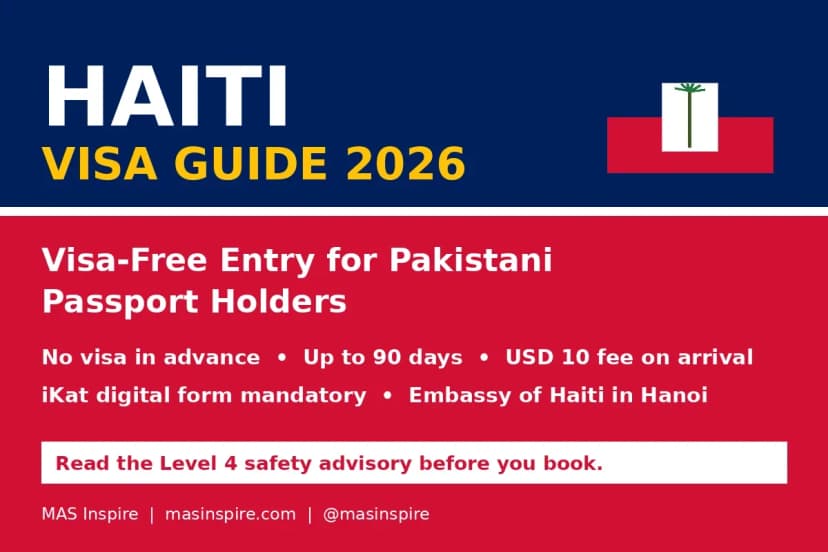
The good news for Pakistani passport holders is simple: Pakistan is not on Haiti's short list of nationalities that need a visa in advance, so a Pakistani tourist can normally enter without a visa and pay a small tourist fee at the airport. The serious news is equally simple: Haiti is under the highest possible travel warnings from the United States and the United Kingdom, flights to the capital are suspended, and there is almost no consular help on the ground. Meeting the entry rules does not make a trip safe.
This Haiti visa guide explains the visa-free route, the consular visa for people who do need one, the mandatory iKat digital arrival and departure form, the fees, the documents, and the practical points for a Pakistani citizen living in Vietnam.
Table of contents
- Why visit Haiti, and why this guide starts with safety
- Haiti visa categories
- Visa comparison
- Eligibility
- Documents
- Application procedure
- Fees
- Processing times
- Pakistan and Vietnam
- Student visa
- Work visas
- Family and permanent residence
- Mistakes
- Refusals
- FAQs
- Official websites
1. Why people visit Haiti, and why this guide starts with safety
People travel to Haiti to visit family, to work with churches and aid organisations, to study Haitian history and culture, and to see the Citadelle Laferrière, the Sans-Souci Palace ruins and the art town of Jacmel. Cap-Haïtien in the north is the main alternative gateway, and it is calmer than the capital in most reporting.
Read the safety position before you book anything. The US State Department rates Haiti Level 4: Do Not Travel, in an advisory issued on 10 July 2026, because of crime, kidnapping, terrorism, unrest and limited health care. The UK Foreign, Commonwealth and Development Office (FCDO) advises against all travel to Haiti because of the volatile security situation, and warns that travel insurance could be invalidated if you travel against its advice. Haiti has been under a national state of emergency since March 2024, and it remains in effect. The US State Department says US commercial flights are not currently operating to or from Port-au-Prince, and the Government of Canada says there are no regular international flights to or from Port-au-Prince until further notice. American Airlines resumed non-stop flights between Miami and Cap-Haïtien on 1 November 2026, so the northern airport is the realistic air gateway at the time of writing, but the Level 4 advisory covers all of Haiti, including Cap-Haïtien. There are no British consular officials in Haiti, consular assistance is severely limited, and Pakistan has no mission in Haiti at all. This guide is visa guidance, not a safety clearance: if you decide to travel against official advice, you do so at your own risk, and you should read the full US and UK advisories and your insurer's terms first.
2. Types of Haiti visas
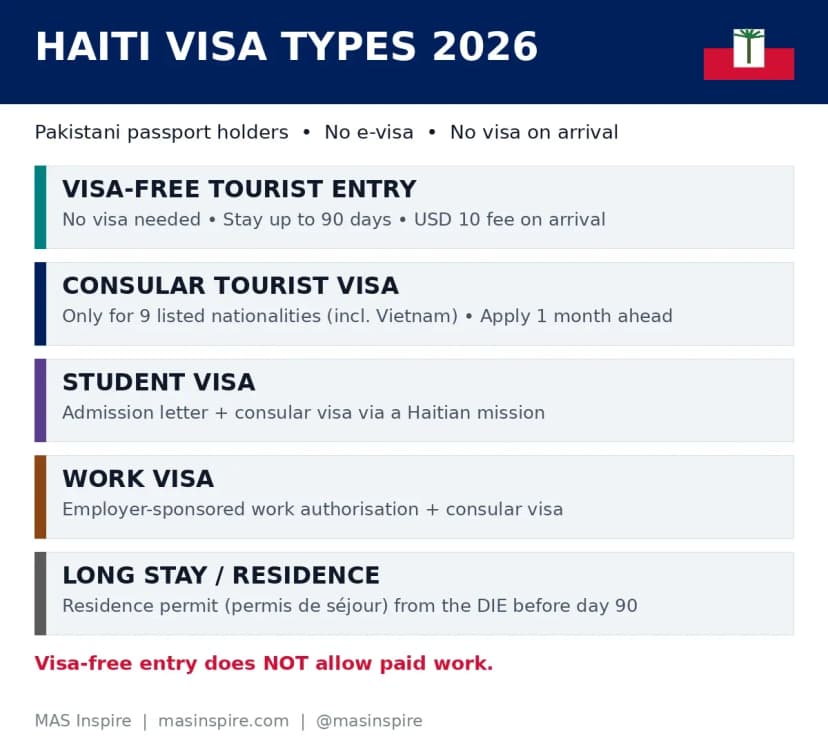
Haiti has no e-visa system and no visa-on-arrival system. There are two ways in for ordinary travellers: visa-free entry for most nationalities, or a pre-arranged consular visa for the nine nationalities on the official list. Longer stays, work and study need separate permission inside the country or from a Haitian mission.
Visa-free tourist entry
Most visitors, including Pakistani passport holders, may enter Haiti without a visa for a short stay. The widely reported limit is up to 90 days, and the UK FCDO states that British citizens do not need a visa to visit Haiti for up to 90 days. On arrival you pay the tourist fee described in section 7 and complete the iKat form described in section 6. Visa-free entry is for tourism, family visits and short non-working business visits such as meetings. It does not authorise paid work.
Pre-arranged consular tourist visa
Nationals of nine countries must obtain a visa from a Haitian embassy or consulate before travelling: the Dominican Republic, Panama, Colombia, Cuba, Syria, Libya, Iran, Vietnam and Yemen. This is the list published by the Embassy of Haiti in Washington and by the Consulate General of Haiti in New York. Pakistan is not on this list. Note that Vietnam is on the list: this matters because the reader of this guide lives in Vietnam, but what counts is your passport, not your address. A Pakistani passport holder living in Vietnam does not need a consular visa; a Vietnamese passport holder travelling with you would. There is one exemption worth knowing: according to IATA Timatic as summarised in the visa policy of Haiti, nationals of the nine listed countries may enter without a visa for up to 90 days if they hold a valid visa or residence permit issued by a Schengen Area member state, Canada or the United States. Confirm this exemption with the mission and your airline before relying on it.
Business visitor entry
Short business visits, such as meetings, conferences and site visits without local employment, are normally admitted under the same visa-free entry as tourists, subject to the immigration officer's decision. Bring an invitation letter from the Haitian company or organisation, your employer's letter, and your return ticket. Paid work for a Haitian employer is a different matter and needs a work authorisation (see section 11).
Student visa
Study in Haiti needs a consular visa arranged before travel through a Haitian embassy or consulate, with proof of admission to a Haitian institution. See section 10.
Work visa
Employment in Haiti needs a consular visa and a work authorisation arranged with the Haitian authorities, normally sponsored by the employer. See section 11.
Long-stay and residence permit
Stays beyond 90 days need a residence permit (permis de séjour) from the Direction de l'Immigration et de l'Émigration (DIE) in Port-au-Prince. Apply before your 90 days run out. See section 12.
Transit
Haiti has no published transit-visa scheme, and secondary travel guides report that no transit visa is needed if you stay airside and do not pass through immigration at Toussaint Louverture International Airport in Port-au-Prince. This is not confirmed by an official Haitian source, so treat it as unverified and check with your airline before booking a connection. If you leave the transit area, the normal entry rules apply.
Digital nomad visa
Haiti has no digital nomad visa. Visa-free entry does not authorise remote work for a foreign employer as a formal category, and there is no published remote-work permit.
3. Haiti visa comparison table
| Route | Who it is for | Visa before travel? | Maximum stay | Main fee |
|---|---|---|---|---|
| Visa-free tourist entry | Pakistani and most other passport holders visiting for tourism or family | No | Up to 90 days (see the disclosure in section 4) | USD 10 tourist fee on arrival (see the fee conflict in section 7) |
| Visa-free business visit | Short meetings and conferences without local employment | No | Up to 90 days | USD 10 tourist fee on arrival |
| Consular tourist visa | Nationals of the 9 listed countries (Dominican Republic, Panama, Colombia, Cuba, Syria, Libya, Iran, Vietnam, Yemen) | Yes, at least 1 month ahead | 3 months single entry, or 6 months multiple entry at US missions | USD 100 (3 months) or USD 200 (6 months) at Washington and New York; see the fee conflict in section 7 |
| Student visa | Students admitted to a Haitian institution | Yes, through a Haitian mission | Length of the course, as granted | Confirm with the mission; no published tariff found |
| Work visa | People employed by a Haitian employer | Yes, with employer sponsorship | As granted with the work authorisation | Confirm with the mission; no published tariff found |
| Residence permit (permis de séjour) | Anyone staying beyond 90 days | Apply inside Haiti to the DIE before day 90 | As granted, usually one year | Not verified; one secondary source quotes HTG 7,500 deposit and HTG 5,000 residence fee |
| Transit (airside) | Passengers connecting without leaving the airport | No, if staying airside (unverified) | Length of the connection | None published |
4. Haiti visa eligibility requirements
Identity and nationality
Your passport decides whether you need a visa, not where you live. A Pakistani ordinary passport is not on the nine-country visa-required list, so you qualify for visa-free entry. Your passport must be valid for at least 6 months from the date you arrive, according to both the Embassy of Haiti in Washington and the UK FCDO. You will be denied entry if you do not have a valid travel document or if you try to use a passport reported lost or stolen. Carry at least one blank page for the entry stamp.
The 90-day stay: a disclosure
The 90-day visa-free stay is reported by the FCDO, by IATA Timatic as summarised in the visa policy of Haiti, and by most 2026 guides, and this guide uses it as the working figure. However, the Embassy of Haiti's own tourist-visa page does not state a permitted length of stay for visa-exempt visitors, and at least one careful 2026 guide records the permitted stay as unstated on the official page. The controlling position is therefore: plan for a stay of no more than 90 days, and treat the exact length admitted as the immigration officer's decision at the border, stamped in your passport. Do not book a 90-day stay that you cannot cut short, and apply for a residence permit before day 90 if you need longer.
Genuine purpose
Visa-free entry is for tourism, family visits and short business visits. You must be able to explain your purpose, show where you will stay, and show a return or onward ticket. Work, study and long stays need the correct permission, and claiming a tourist purpose while intending to work is a refusal risk.
Financial capacity
Immigration officers may ask for proof of sufficient funds for your stay. No official minimum daily amount is published by the Haitian authorities, and this guide does not invent one. Carry recent bank statements, a card that works internationally, and enough US dollars in cash for the arrival fee, transport and the first nights, because Haitian ATMs are unreliable and hospitals generally expect immediate cash payment.
Health and character
Haiti has no yellow fever risk of its own, but a yellow fever vaccination certificate is required for travellers aged 1 year or over arriving from a country with a risk of yellow fever transmission. Vietnam and Pakistan are not yellow fever risk countries, so a direct journey from Vietnam does not trigger the rule, but a long transit through a risk country such as Brazil, Colombia or Peru can. Routine vaccines, including measles, hepatitis A and typhoid, are recommended by travel-health authorities; see a travel clinic 4 to 6 weeks before you go. There is no published character or police-certificate requirement for a short tourist visit. If you are departing from Pakistan, you also need the NADRA polio vaccination certificate that Pakistan requires for exit.
Language
There is no English-language test for a Haitian visa or for visa-free entry. Haiti's official languages are French and Haitian Creole, so carry your hotel address and host contact details written down in French if you do not speak the language.
5. Complete Haiti visa document checklists
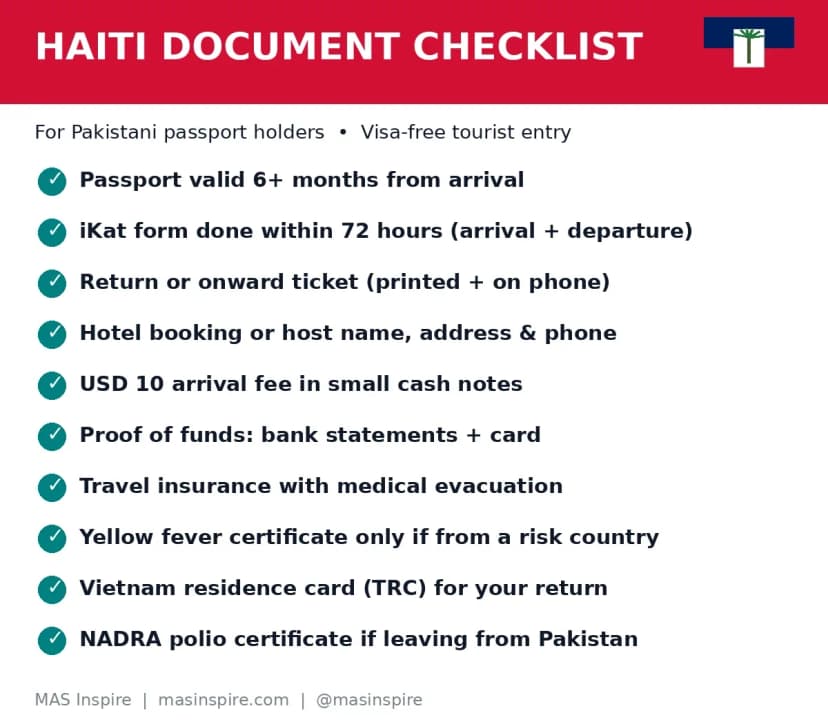
General documents for every traveller
- Pakistani passport valid for at least 6 months from the date of arrival, with at least one blank page.
- Completed iKat digital arrival form, submitted within 72 hours before travel, with the QR code saved on your phone and printed (see section 6).
- Return or onward ticket, printed as well as on your phone.
- Hotel booking or the name, address and telephone number of your host in Haiti.
- USD 10 in small US dollar notes for the tourist fee, plus extra cash for the departure tax if it is not included in your ticket (see section 7).
- Proof of funds: recent bank statements and a working payment card.
- Travel health insurance covering emergency treatment and medical evacuation, with a high cover limit, because health care in Haiti is limited and hospitals expect cash payment.
- Yellow fever certificate only if you arrive from, or transited through, a yellow fever risk country.
- NADRA polio vaccination certificate if you are departing from Pakistan.
- Your Vietnam residence card or TRC and a copy of it, to prove your right to return to Vietnam.
Visa-free tourist checklist
- All general documents above.
- No visa application form, no photos and no embassy appointment are needed.
- A short written itinerary and the contact details of your host or hotel.
Consular tourist visa checklist (for nationals of the 9 listed countries)
- Visa application form, duly completed and signed (from the Haitian embassy or consulate).
- Valid passport (at least 6 months) and a photocopy of the passport data page.
- Two recent colour passport photos.
- Letter explaining the purpose and duration of the stay, with the name, address and telephone number of the hotel or private home where you will stay in Haiti.
- Photocopy of the airline reservation confirmation or round-trip ticket.
- Letter from your current employer.
- Fee by money order or certified check where the mission requires it; cash and personal checks are not accepted at the Washington embassy or the New York consulate.
- Additional documents may be requested depending on the situation.
Student visa checklist
- All consular documents above, plus the admission letter from the Haitian institution.
- Proof of funds or sponsorship covering tuition and living costs.
- Educational certificates and transcripts.
- Confirm the exact list with the mission before you apply, because no published student-visa checklist was found for Haiti.
Work visa checklist
- All consular documents above, plus the employment contract or job offer from the Haitian employer.
- Work authorisation from the Haitian authorities, arranged by the employer.
- Professional qualifications and certificates for the job.
- Confirm the exact list with the mission before you apply, because no published work-visa checklist was found for Haiti.
Family visit checklist
- All general documents above.
- Invitation letter from your family member in Haiti with their address, telephone number and a copy of their identity document or residence status.
- Proof of the family relationship where relevant.
6. How to apply for a Haiti visa: step-by-step
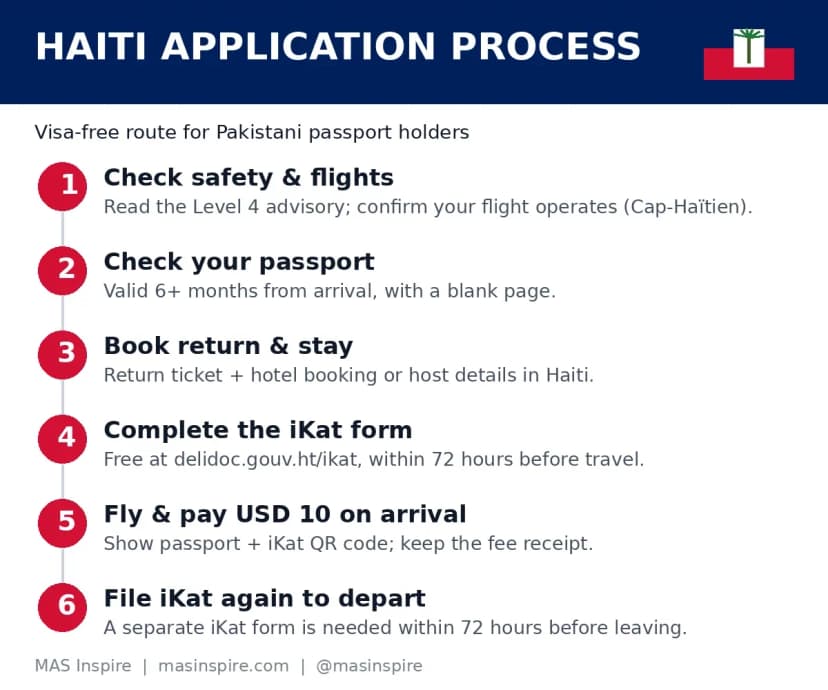
For a Pakistani passport holder the process is a travel-preparation process, not a visa application. There is no embassy visit, no form to lodge and no waiting period for the visa itself. The mandatory step that travellers miss is the iKat form.
Step 1: Check the security position and your flights
Read the US State Department Level 4 advisory and the UK FCDO advice in full, and check your travel insurance: many policies are invalid if you travel against FCDO advice. Confirm with your airline that the flight is actually operating. At the time of writing there are no regular international flights to or from Port-au-Prince, while American Airlines flies Miami to Cap-Haïtien. Do not book a ticket to Port-au-Prince on the assumption that the route has reopened.
Step 2: Check your passport
Make sure your Pakistani passport is valid for at least 6 months from the date you arrive, has a blank page, and is not reported lost or stolen. Renew it in Vietnam or Pakistan if it is short. Keep a photocopy and a phone photo of the data page separate from the original.
Step 3: Book return travel and accommodation
Book a return or onward ticket and your first nights' accommodation, or confirm your host's full name, address and telephone number in Haiti. Immigration officers routinely ask for both. Choose accommodation with secure transport arranged in advance, and do not plan to travel by road between Port-au-Prince, Les Cayes and Cap-Haïtien without checking current advice, because gang roadblocks are reported on those roads.
Step 4: Complete the iKat form
Haiti's Directorate of Immigration and Emigration (DIE) made the iKat digital embarkation and disembarkation card mandatory for all travellers, Haitian and foreign, from 1 October 2026. Complete it on the official portal, delidoc.gouv.ht/ikat, within 72 hours before travel. It replaces the old paper arrival and departure cards and combines personal details, travel information, customs and health declarations. You receive a PDF with a QR code and a nine-character code for updating the form; show the QR code printed or on your phone at control points. File a separate iKat form for departure as well, within 72 hours before you leave Haiti: one submission does not cover a round trip. The form is free on the official portal; third-party websites charging an expediting fee for it are not official. One disclosure: the DIE's own page has been reported as mentioning 48 hours in advance in one place while the ministry circular says within 72 hours before travel. Complete the form inside the 72-hour window and as early as that window allows, and you satisfy both wordings.
Step 5: Fly and pay the tourist fee on arrival
At the airport, present your passport, your iKat QR code, your return ticket and your accommodation details to immigration. Pay the tourist fee in cash (see section 7) and keep the receipt until departure. The officer decides the length of your stay and stamps your passport: check the stamp before you leave the counter.
Step 6: If you need a consular visa (nationals of the 9 listed countries)
Apply at a Haitian embassy or consulate at least one month before departure. Submit the documents in section 5, pay the mission's fee, and keep the non-refundable receipt. A Pakistani passport holder does not need this step for tourism, but it is the route for a Vietnamese travelling companion who has no US, Canadian, UK or Schengen visa or residence permit, and for any Pakistani who needs a student or work visa. The nearest mission for a person living in Vietnam is the Embassy of Haiti in Hanoi (see section 9).
7. Haiti visa fees and financial requirements in 2026
| Fee | Amount | When and how it is paid | Source and status |
|---|---|---|---|
| Visa fee for Pakistani tourists | USD 0 (no visa needed) | Nothing to pay in advance | Embassy of Haiti, Washington; FCDO |
| Tourist fee on arrival | USD 10 | Cash on arrival at the airport | Embassy of Haiti, Washington; FCDO (cash) |
| Border tax (conflict, see below) | HTG 2,000 per adult, about USD 15.30 | On arrival; keep the receipt until departure | Code Fiscal in force since 1 October 2026, as reported by Latamthread; conflicts with the USD 10 figure |
| Departure tax | USD 55 | Usually included in the ticket price for most international flights; if not, pay at the airport | UK FCDO |
| Consular tourist visa, 3 months | USD 100 at Washington and New York | Money order or certified check only; cash and personal checks not accepted | Official tariffs of the Embassy of Haiti in Washington and the Consulate General in New York |
| Consular tourist visa, 6 months multiple entry | USD 200 at Washington and New York | Money order or certified check only | Official tariffs of the Embassy of Haiti in Washington and the Consulate General in New York |
| Consular tourist visa, older figure (conflict) | USD 25 | By money order or certified check, per older guides | Secondary sources only; not the current published US-mission tariff |
| iKat digital form | Free | Official portal only; never pay a third-party expediting fee | Ministry of the Interior (MICT) circular; DIE |
| Residence permit fees | Not verified (one secondary source: HTG 7,500 deposit and HTG 5,000 residence fee) | Payable to the DIE in Port-au-Prince | Single secondary source; do not rely on these figures |
| Student and work visa fees | Not published | Confirm with the mission before applying | No published tariff found |
Fee conflict 1: the arrival fee, USD 10 or about USD 15.30?
Two figures are in circulation and this guide does not hide the disagreement. The Embassy of Haiti in Washington and the UK FCDO both state a USD 10 tourist or entry fee on arrival, payable in cash. A separate 2026 guide reports that the Code Fiscal in force since 1 October 2026 sets a border tax of HTG 2,000 per adult, about USD 15.30 at the central bank reference rate of HTG 130.7542 per US dollar on 8 November 2026, and notes that the Washington embassy still mentions USD 10. The controlling source is not settled: the embassy page may simply be out of date, or the gourde tax may be collected alongside or instead of the dollar fee at different ports. Practical advice: carry USD 20 in small notes for the arrival charge, keep the receipt, and ask at the counter what the payment covers. Do not argue the figure with the officer.
Fee conflict 2: the consular visa fee, USD 25 or USD 100?
Older and general guides quote a USD 25 embassy fee for the pre-arranged tourist visa, payable by money order or certified check. The current published tariffs of the Embassy of Haiti in Washington and the Consulate General of Haiti in New York both state USD 100 for a three-month tourist visa and USD 200 for a six-month multiple-entry tourist visa, and the New York consulate also lists USD 16 for two passport photos. The USD 100 and USD 200 figures are the controlling figures for the US missions, because they are the missions' own current tariff pages. The USD 25 figure may still apply at other missions: secondary sources quote CAD 40 or 50 in Ottawa and USD 30 in Santiago. Fees vary by mission, so always confirm the exact fee with the mission where you will apply, and remember that consular fees are non-refundable even if the visa is refused. For a Pakistani tourist this conflict is academic, because no consular visa is needed.
Financial requirements
No official minimum funds figure is published for visitors to Haiti, and this guide does not invent one. In practice, carry recent bank statements, a working international card and enough US dollars in cash: ATMs are unreliable, many places take cash only, and hospitals expect immediate cash payment even from insured patients. Budget generously, because a disrupted trip, a changed flight or a medical evacuation is expensive, and comprehensive travel insurance with medical evacuation cover is strongly recommended.
8. Haiti visa processing times
| Route | Processing time | Notes |
|---|---|---|
| Visa-free entry (Pakistani tourists) | No processing time; entry is decided on arrival | Allow extra time at the airport for the iKat check and the fee payment |
| iKat digital form | Immediate; QR code issued on submission | Submit within 72 hours before travel, for arrival and separately for departure |
| Consular tourist visa (9 listed nationalities) | 1 to 4 weeks, per most 2026 guides; 5 to 10 business days per other guides | Apply at least 1 month before departure, as the Embassy of Haiti in Washington advises |
| Student or work visa | Not published | Apply well ahead and confirm the timeline with the mission |
| Residence permit (DIE) | Not published | Apply before day 90 of your stay; the procedure is not published in detail |
Processing-time disclosure: the 1-to-4-week range and the 5-to-10-business-day range for consular visas come from different secondary guides, and no official processing time is published by the Embassy of Haiti in Washington. The only official timing instruction is to apply at least one month before departure. Apply a month ahead at the minimum, and earlier if your travel dates are fixed. For the visa-free route there is no processing time at all, which is one reason to double-check the iKat form and the fee before you fly rather than at the airport.
9. Applying for a Haiti visa from Pakistan or Vietnam
From Vietnam (where the reader lives)
Good news: Haiti has an embassy in Hanoi, so a person living in Vietnam does not need to travel abroad to reach a Haitian mission. The Embassy of Haiti in Hanoi is listed at 44/4 Van Bao Street, Ba Dinh District, Hanoi, telephone (84-4) 7107 8888, email amb.vietnam@diplomatie.ht. One disclosure: the street number is also published as 444 Van Bao in some directories, so confirm the exact address by telephone or email before visiting. The Hanoi embassy is also accredited to Australia, Brunei, Indonesia, Laos, Malaysia, Myanmar, the Philippines and Thailand. A Pakistani passport holder in Vietnam normally needs no visa and therefore needs no embassy visit at all; the Hanoi embassy is the place to contact for a student or work visa, for a Vietnamese travelling companion who needs a consular visa, or for any question about the rules. From Ho Chi Minh City, the embassy is a flight to Hanoi away, so email first. Also confirm your Vietnam residence status before you travel: carry your temporary residence card and make sure it remains valid for your return, because re-entering Vietnam is a separate matter from entering Haiti.
From Pakistan
There is no Haitian embassy or consulate in Pakistan, and no published list of a Haitian mission accredited to Pakistan was found. A Pakistani applying from Pakistan for a student or work visa would need to contact a Haitian mission in another country, such as the Embassy of Haiti in Tokyo or the Embassy of Haiti in Washington, and confirm that it accepts applications from Pakistan residents. For tourism, no application is needed at all. Before leaving Pakistan, obtain the NADRA polio vaccination certificate that Pakistan requires for exit. Pakistan has no embassy in Haiti; the Embassy of Pakistan in Havana, Cuba, is accredited to Haiti and is the nearest Pakistani mission for emergency help. Save its contact details before you travel, and register your trip with your family and your insurer.
Which mission if you need a consular visa
Use the mission responsible for your place of residence: Hanoi for Vietnam residents, and the nearest accepting mission for Pakistan residents. Fees, document lists and payment methods vary by mission, so the Washington and New York tariffs in section 7 are examples, not a promise about what Hanoi or Tokyo will charge. Always confirm with the mission itself.
10. Haiti student visa guide 2026
Study in Haiti requires a consular visa arranged before travel. No dedicated student-visa fee, processing time or document checklist is published by the Haitian authorities, and this guide does not invent one. The expected route is: secure admission to a Haitian university or institution; contact the Haitian mission responsible for your residence (Hanoi if you live in Vietnam); submit the consular documents in section 5 with your admission letter, proof of funds or sponsorship, and your educational certificates; and pay the mission's fee. Ask the institution whether it provides a support letter for the visa and whether it can help with accommodation and airport transfer, because independent arrival in Port-au-Prince is not advisable under the current security advice. Given the Level 4 advisory and the state of emergency, think carefully before choosing Haiti for study, and check whether your chosen programme can be followed online or from a safer location.
11. Haiti work visas and job opportunities
Paid work in Haiti is not covered by visa-free entry. You need a consular visa and a work authorisation arranged with the Haitian authorities, normally sponsored by your employer. No published work-visa fee, processing time or checklist was found, so the employer and the mission are the sources for the exact requirements. Most foreign workers in Haiti are with aid agencies, international organisations, churches and missions, or Haitian employers with an international workforce; there is no published general work-permit quota or shortage list. Do not travel to Haiti to look for work on a tourist entry: you cannot legally take a job on it, and the security situation makes casual job-seeking unsafe. Teaching English is sometimes asked about by readers of this guide: there is no published Haitian work route for foreign English teachers, and any offer should be checked with the mission and the employer in writing before you spend money on travel.
12. Family immigration and permanent residence
Family visits use the same visa-free entry as tourism, with an invitation letter from your family member in Haiti. For stays beyond 90 days, apply for a residence permit (permis de séjour) from the Direction de l'Immigration et de l'Émigration (DIE) in Port-au-Prince before your 90 days expire. The iKat system is designed to track stays beyond the 90-day limit, so an overstay is likely to be recorded. The detailed procedure, the documents and the fees for a residence permit are not published in a form this guide could verify: one secondary source quotes a HTG 7,500 deposit and a HTG 5,000 residence fee, but that is a single secondary source and is flagged as unverified in section 7. There is no published family-reunification or permanent-residence route with a fixed timeline, and no published route from a residence permit to Haitian citizenship is described in this guide. Anyone planning a long stay should take advice from the DIE and the Haitian mission before travelling, and should not rely on an extension being granted.
13. Common Haiti visa application mistakes
- Skipping the iKat form. Since 1 October 2026 the digital form is mandatory for every traveller, on arrival and on departure. Forgetting the departure form is the easiest mistake to make.
- Paying a third party for iKat or an e-visa. The iKat form is free on the official portal, and Haiti has no official e-visa. Websites charging to expedite either are not official.
- Booking a flight to Port-au-Prince that does not operate. Check with the airline that the route is actually flying; Cap-Haïtien is the operating international gateway at the time of writing.
- Arriving without cash. The tourist fee is payable in cash, ATMs are unreliable, and the departure tax may not be in your ticket. Carry small US dollar notes.
- Assuming your residence decides your visa requirement. Living in Vietnam does not change your passport's status, and a Vietnamese companion needs a visa even though you do not.
- Planning exactly 90 days with no margin. The admitted stay is the officer's decision, and flight disruption in Haiti is common. Keep a margin and know the DIE extension route before day 90.
- Travelling against advice without checking insurance. Many policies are invalid if you travel against FCDO advice, and medical evacuation from Haiti is expensive.
- Planning to cross from the Dominican Republic by land. The FCDO states that the border between Haiti and the Dominican Republic is closed to travellers.
14. Reasons for a Haiti visa refusal
Because most Pakistanis enter visa-free, a refusal usually happens at the border rather than at an embassy. Common reasons include a passport valid for less than 6 months, no return or onward ticket, no address or host details in Haiti, insufficient funds for the stay, an incomplete or missing iKat form, or an officer's judgement that the stated purpose does not match the evidence, for example intending to work on a tourist entry. For consular visas, the common reasons are an incomplete file, missing employer or host letters, applying less than a month before departure, or a fee paid in the wrong form. There is no published appeal process for a refused Haitian visa or a refused entry, and consular fees are non-refundable. If you are refused entry, the practical consequence is return on the next available flight at your own cost, so carry the documents that prove a genuine short visit and a ticket home.
15. Frequently asked questions
Do Pakistani citizens need a visa for Haiti?
No. Pakistan is not on Haiti's nine-country list of nationalities that need a visa in advance, so Pakistani passport holders can normally enter Haiti without a visa for a short tourist or family visit, pay the tourist fee on arrival, and complete the iKat form. Work, study and long stays need separate permission.
How long can Pakistanis stay in Haiti without a visa?
Up to 90 days is the widely reported figure, including from the UK FCDO and IATA Timatic, but the Embassy of Haiti's own page does not state a permitted stay for visa-exempt visitors, so treat the exact length as the immigration officer's decision at the border and check the stamp in your passport. Apply for a residence permit before day 90 if you need longer.
How much does it cost to enter Haiti?
There is no visa fee for Pakistani tourists. The arrival charge is reported as USD 10 in cash by the Embassy of Haiti in Washington and the FCDO, but a 2026 guide reports a border tax of HTG 2,000, about USD 15.30, under the Code Fiscal in force since 1 October 2026. Carry USD 20 in small notes and keep the receipt. A departure tax of USD 55 is usually included in your ticket.
Is there a Haiti e-visa or visa on arrival?
No. Haiti has no official e-visa system and no visa-on-arrival system. Pakistani tourists enter visa-free and pay the tourist fee at the airport. Any website selling a Haitian e-visa is not official.
What is the iKat form and is it mandatory?
iKat is Haiti's digital arrival and departure card, run by the Directorate of Immigration and Emigration. It has been mandatory for all travellers, on arrival and on departure, since 1 October 2026. Complete it free on the official portal, delidoc.gouv.ht/ikat, within 72 hours before travel, and show the QR code it issues. File one form for arrival and a separate one for departure.
Can a Pakistani living in Vietnam apply from Vietnam?
Yes, and for tourism no application is needed at all. For a student or work visa, the Embassy of Haiti in Hanoi is the nearest mission. Your Vietnamese residence does not change your visa requirement, because the rule follows your Pakistani passport.
Where is the nearest Haitian embassy to Vietnam?
The Embassy of Haiti in Hanoi, at 44/4 Van Bao Street, Ba Dinh District, Hanoi, telephone (84-4) 7107 8888, email amb.vietnam@diplomatie.ht. The street number is also published as 444 Van Bao, so confirm it before visiting.
What documents do I need on arrival in Haiti?
A passport valid for at least 6 months, your iKat QR code, a return or onward ticket, your hotel booking or host's name, address and telephone number, proof of funds, travel insurance, and cash US dollars for the tourist fee. A yellow fever certificate is only needed if you arrive from a risk country.
Do I need a yellow fever certificate for Haiti?
Only if you arrive from, or had a long transit through, a country with a risk of yellow fever transmission, and you are aged 1 year or over. A direct journey from Vietnam or Pakistan does not trigger the rule. Hepatitis A, typhoid and routine vaccines are recommended by travel-health authorities.
How long does a Haitian consular visa take?
No official processing time is published. Secondary guides report 1 to 4 weeks, or 5 to 10 business days, and the Embassy of Haiti in Washington advises applying at least one month before departure. Apply a month ahead at the minimum. This does not apply to Pakistani tourists, who need no consular visa.
Can I work in Haiti on visa-free entry?
No. Visa-free entry covers tourism, family visits and short business meetings only. Paid work needs a consular visa and a work authorisation sponsored by the employer, arranged before you travel.
Can I extend my stay beyond 90 days?
Apply for a residence permit from the Direction de l'Immigration et de l'Émigration in Port-au-Prince before your 90 days expire. The detailed procedure and fees are not published in a verifiable form, and an extension is not guaranteed, so do not overstay.
Do I need a transit visa for Haiti?
Secondary guides report that no transit visa is needed if you stay airside and do not pass through immigration. This is not confirmed by an official Haitian source, so check with your airline before booking a connection. If you leave the airport, the normal entry rules apply.
Is it safe to travel to Haiti in 2026?
No authority describes Haiti as safe for tourism in 2026. The US State Department rates it Level 4: Do Not Travel, and the UK FCDO advises against all travel to the country. The state of emergency in force since March 2024 remains in effect, there are no regular international flights to or from Port-au-Prince, and consular help is severely limited. This guide gives visa information only; it is not a safety clearance.
What should I do if my flight is to Port-au-Prince?
Check with your airline first, because US commercial flights are not currently operating to or from Port-au-Prince and Canada reports no regular international flights there until further notice. American Airlines resumed Miami to Cap-Haïtien flights on 1 November 2026, so Cap-Haïtien is the realistic gateway. Do not travel by road between the airports and the capital without current local advice.
16. Official Haiti immigration websites
| Resource | Purpose |
|---|---|
| Consulate General of Haiti in New York — Tourist Visa | Official source: the 9-country visa list, documents, and the USD 100 and USD 200 tariffs |
| UK Foreign, Commonwealth & Development Office — Haiti travel advice | Official source: advises against all travel; 90-day visa-free stay, USD 10 cash entry fee, USD 55 departure tax, 6-month passport rule |
| US State Department — Haiti Travel Advisory | Official source: Level 4 Do Not Travel, issued 10 July 2026 |
| iKat — official digital arrival and departure form (DIE) | Official source: mandatory form, free, within 72 hours before travel |
| Visa policy of Haiti (summarising IATA Timatic and the Embassy of Haiti in Washington) | Reference: visa-free entry up to 3 months, the 9-country list, USD 10 tourist fee, Schengen/US/Canada visa exemption |
| UrduPoint — Haiti Visa for Pakistanis 2026 | Reference: Pakistan not on the visa-required list; USD 10 fee on arrival; Pakistan's embassy in Havana covers Haiti |
| VisaVerge — Haiti 2026 Visa Policy | Reference: 90-day visa-free entry, USD 25 embassy fee in older guidance, 1 to 4 week processing range |
| Latamthread — Visitors and business trips to Haiti | Reference: HTG 2,000 border tax under the Code Fiscal since 1 October 2026; USD 100 and USD 200 Washington tariffs |
| iVisa — Haiti makes iKat digital form mandatory from October 2026 | Reference: iKat mandatory from 1 October 2026, separate arrival and departure filings, free on the official portal |
| Gulf News — Pakistani passport: visa-free, VOA and e-visa destinations | Reference: Haiti listed as visa-free for Pakistani passport holders (Henley Passport Index) |
| List of diplomatic missions of Haiti | Reference: Embassy of Haiti in Hanoi, accredited to Vietnam and eight Asia-Pacific countries |
Final checklist before you travel
- [ ] Read the US Level 4 advisory and the UK FCDO advice in full, and checked that your travel insurance remains valid.
- [ ] Confirmed with your airline that your flight is actually operating, and to which airport.
- [ ] Checked your passport is valid for at least 6 months from arrival, with a blank page.
- [ ] Booked a return or onward ticket and accommodation, or confirmed your host's details.
- [ ] Completed the iKat arrival form within 72 hours before travel and saved the QR code.
- [ ] Prepared USD 20 in small notes for the arrival charge and checked whether the USD 55 departure tax is in your ticket.
- [ ] Arranged travel health insurance with medical evacuation cover.
- [ ] Saved the contact details of the Embassy of Haiti in Hanoi and the Embassy of Pakistan in Havana.
- [ ] Remembered to file a separate iKat form within 72 hours before departure from Haiti.
- [ ] Understood that visa-free entry does not authorise work, and that the stay admitted is the officer's decision.
Haiti is one of the few countries a Pakistani passport holder can enter without a visa, and the paperwork is light: a valid passport, a return ticket, a place to stay, the iKat form and a small cash fee. The weight of this guide is not in the paperwork but in the warning that comes with it. A visa-free stamp is not a safety guarantee, and in 2026 the governments that track Haiti most closely are all telling their citizens not to go. If you have family or essential work there, prepare carefully, travel through Cap-Haïtien, keep your documents and cash close, and stay in contact with your host and your insurer throughout.
For Pakistani citizens living in Vietnam, the most important consideration is that citizenship, legal residence and immigration eligibility are separate matters. Always consult the official immigration authority before lodging an application.
Disclaimer: MAS Inspire provides independent educational information and is not a Haitian government authority. This article does not constitute personalised immigration or legal advice. Immigration rules, fees and processing priorities may change. Visa approval and entry are not guaranteed.