Kazakhstan Visa Guide 2026: Requirements, Fees and How to Apply for Pakistani Passport Holders in Vietnam
Last checked: 27 November 2026. This guide is for Pakistani passport holders living in Vietnam. Visa rules change without notice — always confirm the live rules with the Embassy of Kazakhstan in Hanoi and the official Visa and Migration Portal (vmp.gov.kz) before paying any fee or booking a non-refundable ticket.
Table of Contents
- Introduction
- Do Pakistani Passport Holders Need a Visa for Kazakhstan?
- Important Correction: There Is No Tourist E-Visa for Pakistanis
- Types of Kazakhstan Visas for Pakistani Passport Holders
- The Business E-Visa (B3): Only Until 31 December 2026
- The Embassy Tourist Visa (B12): The Main Route for Holidays
- Kazakhstan Visa Fees
- Processing Times
- Complete Document Checklists
- How to Apply: Step-by-Step
- Applying from Vietnam — and from Pakistan
- Registration After Arrival
- Transit Through Kazakhstan
- Overstay, Fines and Entry Bans
- Travel, Flights and Money: Practical Notes
- Frequently Asked Questions
- Official Immigration Websites
Introduction
Kazakhstan is the largest country in Central Asia, a land of wide steppe, the Tian Shan mountains, the modern capital Astana, the former capital Almaty, the Charyn Canyon, the Kolsai Lakes and the historic city of Turkistan. It attracts visitors for mountain hiking and skiing at Shymbulak, city breaks in Almaty and Astana, Silk Road history and business travel linked to its oil, mining and finance sectors. For a Pakistani passport holder living in Vietnam, it is a realistic holiday or business destination — but only if the visa is arranged correctly, because the rules for Pakistanis are stricter than the rules for most other nationalities, and much of what travel-agent websites say about a Kazakh tourist e-visa for Pakistanis is wrong.
This guide gives the position as checked on 27 November 2026. Its single most important point is that Pakistani citizens cannot get a tourist e-visa for Kazakhstan. The only electronic visa open to a Pakistani passport holder is a single-entry business e-visa (category B3), and even that route ends on 31 December 2026 unless the rules change. A holidaymaker must instead apply at a Kazakh embassy for a tourist visa (category B12), and that application needs a Visa Support number issued in Kazakhstan by the Ministry of Internal Affairs through a host. That invitation step is the part of the process that takes the most time, so it should be started first.
Living in Vietnam changes where you apply, not what you need. Kazakhstan has an embassy in Hanoi, and the Visa Rules allow you to apply in your country of stay if you have residence, work or study there. A Vietnamese temporary residence card or a valid work arrangement therefore lets you use the Hanoi mission instead of travelling to the Embassy of Kazakhstan in Islamabad. Your Pakistani passport is what decides the visa requirement; your Vietnamese residence does not remove it, and it does not give you visa-free entry.
This guide covers every visa type open to Pakistanis, the exact fees published by the Kazakh Foreign Ministry, processing times, full document checklists, the step-by-step application process, registration after arrival, transit, overstay fines and practical travel notes from Vietnam. Where sources conflict, the conflict is stated openly and the controlling source is named, so you can check it yourself before you spend money.
Do Pakistani Passport Holders Need a Visa for Kazakhstan?
Yes. Every holder of an ordinary Pakistani passport needs a visa to enter Kazakhstan. There is no visa-free entry, no visa on arrival and no visa-free transit that lets a Pakistani walk out of the airport without a visa. This is confirmed by the Kazakh Foreign Ministry's visa table (updated 21 August 2026) and by the official gov.kz e-visa page, which states a special condition for citizens of the Islamic Republic of Pakistan: only a single-entry electronic business visa under category B3 is issued to them.
The rule follows your passport, not where you live. Living in Vietnam, holding a Vietnamese temporary residence card, holding a US, UK or Schengen visa, or living in the Gulf does not change the requirement. No official rule found during the research for this guide grants any exemption to Pakistanis on any of those grounds. If a travel agent tells you that a Gulf residence visa or a Western visa makes Kazakhstan visa-free for you, ask them to show the official rule — none was found.
By contrast, citizens of 87 countries and territories — including the United States, the United Kingdom, all EU member states, Canada, Australia, Japan, South Korea, Singapore, China and the UAE — can visit Kazakhstan visa-free for up to 30 days per entry, subject to a limit of 90 days in any 180-day period. Pakistan is not on that list, and Decree No. 148 as amended by Decree No. 890 of 10 October 2026 does not add Pakistan to any visa-free list.
Children are not exempt either. A child travelling on their own Pakistani passport needs their own visa, and the invitation and Visa Support requirement applies to them in the same way. Applicants aged 16 or over must attend in person to give fingerprints, so a family application means a visit to the embassy for every member aged 16 or above.
Important Correction: There Is No Tourist E-Visa for Pakistanis
This section exists because most of the travel websites a Pakistani traveller will find first give the wrong answer. Many agent and blog pages state that Pakistani citizens can apply for a Kazakhstan tourist e-visa online, pay about USD 60 (some say USD 20–30, others USD 45–50), wait about five working days, and receive a tourist e-visa valid for 90 days with a stay of up to 30 or even 90 days. That description is out of date and, for a tourist, it is wrong.
The controlling source is the official Kazakh government portal, gov.kz ("How to get an e-visa?"), which states: "A special condition applies to citizens of the Islamic Republic of Pakistan: the issuance of a single-entry electronic business visa under category B3." The same restriction is set out in the Rules for the Issuance of Invitations and Visas (Appendix 11, item 73), which keeps the Pakistan line in the e-visa list in force only until 31 December 2026. A detailed independent guide that tracks the Kazakh decrees (charyn.kz, updated 5 November 2026) confirms that the February 2026 changes limited Pakistan to category B3, so any page offering Pakistanis a tourist e-visa is out of date.
What this means in practice is simple. If your purpose is tourism — a holiday, sightseeing, visiting friends — there is no online e-visa for you. You must use the embassy tourist visa (B12), with a Visa Support number from the Ministry of Internal Affairs. If your purpose is genuinely business — negotiations or concluding contracts — you may use the B3 e-visa, but only until 31 December 2026, and only with an invitation number plus a confirmation of financial standing and business reputation from the Federation of Chambers of Commerce of Pakistan. From 1 January 2027, unless the rules change, the e-visa route closes for Pakistanis entirely and every application goes through an embassy. No announcement of a replacement had been found as of 5 November 2026, so a trip planned for 2027 should be planned on the embassy route.
Do not pay any website that offers you a Kazakhstan "tourist e-visa" for a Pakistani passport. The official e-visa portal is the Visa and Migration Portal at vmp.gov.kz (also reached through qazeta.kz), and the fee is shown at checkout. Any third-party site charging for a tourist e-visa for a Pakistani is selling something the official system does not issue. The e-visa fee that does exist for Pakistanis is USD 80 for the B3 business e-visa, and it is non-refundable.
Types of Kazakhstan Visas for Pakistani Passport Holders
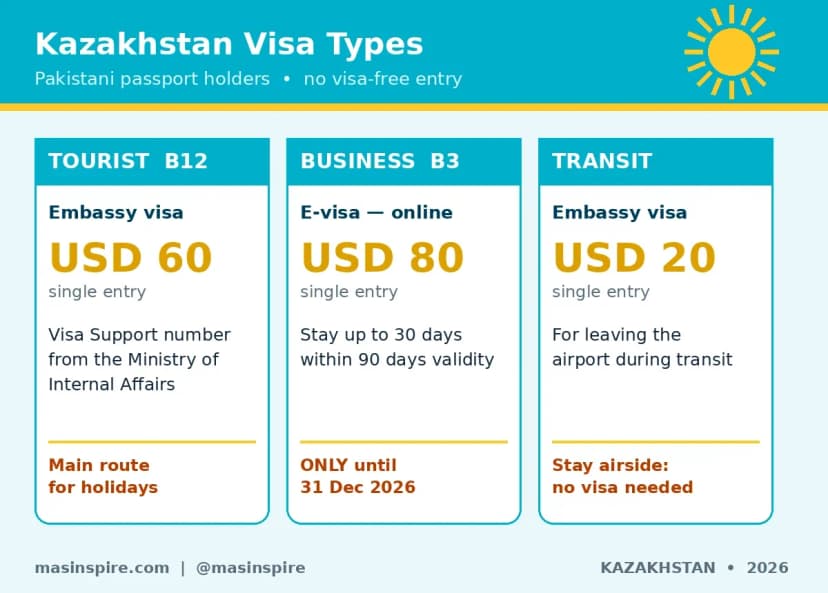
Pakistani passport holders realistically use three routes into Kazakhstan: the embassy tourist visa, the business e-visa (B3) while it lasts, and the embassy business visa. Transit, private-visit, work and study visas exist but are less common for a first trip, and each of them also needs an invitation or a sponsoring organisation in Kazakhstan. The table below summarises the routes that matter.
| Visa route | Purpose | Where it is issued | Stay and validity | Key requirement |
|---|---|---|---|---|
| Tourist visa (B12) | Holiday, sightseeing, visiting friends | Kazakh embassy (Hanoi or Islamabad) | As issued by the embassy; typically up to 30 days per stay | Visa Support number from the Ministry of Internal Affairs, obtained through a host in Kazakhstan |
| Business e-visa (B3) | Negotiations, concluding contracts, company founders and directors | Online via vmp.gov.kz | Stay up to 30 days within up to 90 days of validity; single entry; international airports only | Invitation number plus a Federation of Chambers of Commerce of Pakistan confirmation; only until 31 December 2026 |
| Business visa (B1/B2/B3, embassy) | Conferences, meetings, negotiations, business trips | Kazakh embassy | Single entry up to 90 days validity (up to 30 days stay); multiple entry up to 1 year (no more than 30 days at each entry) | Invitation or letter of request from the inviting Kazakh side |
| Transit visa | Passing through Kazakhstan to a third country and leaving the airport | Kazakh embassy | As issued by the embassy | Onward ticket and a visa for the onward destination if one is needed |
| Private-visit visa | Visiting family or friends in Kazakhstan | Kazakh embassy | As issued by the embassy | Invitation from a private host registered with the Ministry of Internal Affairs |
| Work or study visa | Employment or study in Kazakhstan | Kazakh embassy | As issued; tied to a work permit or a place of study | Employer sponsorship and work permit, or an invitation from the educational institution |
Two points in this table deserve emphasis. First, the stay shown for the tourist visa is "as issued by the embassy": the embassy decides the permitted stay when it issues the visa, and you must not assume 30 days or 90 days until you see the visa itself. Several agent websites quote "usually 30 days (up to 90)" for a tourist visa, but no official source found for this guide confirms a 90-day tourist stay for Pakistanis, so treat 90 days as unverified. Second, the B3 e-visa is valid only for entry and exit through international airports, so a B3 holder cannot enter Kazakhstan by land.
QazETA, Kazakhstan's new Electronic Travel Authorisation, does not apply to you as a Pakistani visa holder. QazETA is for nationals of visa-free countries: it is being introduced in phases from 1 November 2026 (Aktau airport and four road crossings), reaches Astana and Almaty airports on 1 January 2027 and all other crossings on 1 March 2027, and becomes mandatory for visa-free travellers on 1 July 2027. Holders of a valid Kazakh visa are expressly exempt, so a Pakistani travelling on a B12 or B3 visa does not need QazETA. Do not let anyone sell you a QazETA application as a substitute for a visa.
The Business E-Visa (B3): Only Until 31 December 2026
The B3 e-visa is the only electronic visa a Pakistani passport holder can obtain, and it is for business only. It is issued as a single-entry visa, valid for up to 90 days from issue, with a permitted stay of up to 30 days inside Kazakhstan. The fee is USD 80 and it is non-refundable, including if the application is refused. The fee is paid online by card on the official Visa and Migration Portal, vmp.gov.kz, and the amount shown at the portal checkout is the controlling figure — if the checkout shows a different amount from this guide, the checkout is right and this guide is out of date.
To apply for a B3 e-visa you need two things that a tourist does not have. First, an invitation number: the inviting Kazakh company must arrange an electronically issued invitation through the territorial migration service of the Ministry of Internal Affairs, and the invitation number is entered in the e-visa application. Second, a confirmation of your financial standing and business reputation from the Federation of Chambers of Commerce of Pakistan. Without that confirmation the B3 application is incomplete. A hotel booking or a tourist itinerary is not a substitute, and a B3 visa must not be used for a holiday: working or travelling for a purpose that does not match the visa is an offence under Article 517 of the Code of Administrative Offences and can lead to a fine of 25 MCI (108,125 tenge in 2026), detention of up to 10 days or expulsion.
The B3 e-visa is delivered as a PDF to your email. Print it and carry it with your passport; airlines check it at boarding and border officers check it on arrival. It is valid only for the holder and does not cover accompanying family members, each of whom needs their own visa. If you renew or replace your passport after the e-visa is issued, the e-visa does not transfer — you must apply again. Entry and exit on a B3 e-visa are through international airports only, so plan to fly into Astana (NQZ) or Almaty (ALA).
The deadline matters more than any other detail in this section. Item 73 of Appendix 11 keeps the Pakistan line in the e-visa list in force only until 31 December 2026. From 1 January 2027, Pakistani applicants leave the e-visa route entirely unless the rules change again. No replacement had been announced as of 5 November 2026. If your business trip is in 2027, do not rely on the e-visa: start the embassy business-visa route instead, and confirm the current position with the Embassy of Kazakhstan in Hanoi before you commit to dates.
The Embassy Tourist Visa (B12): The Main Route for Holidays
For a holiday, the embassy tourist visa (B12) is the route. It is a paper visa placed in your passport by a Kazakh embassy or consulate, and it is the route every Pakistani tourist must use. The process has three stages: the invitation, the application, and the issue of the visa. The invitation stage is the one that catches people out, because it happens inside Kazakhstan before you can even file your application.
Stage one is the Visa Support number. Your host in Kazakhstan — usually a licensed tour operator or a hotel, or a Kazakh company or person inviting you — registers an invitation for you with the Ministry of Internal Affairs and sends you the Visa Support number. Many Almaty tour companies and some hotels arrange this for tourists; ask before you pay anything whether they can provide the Visa Support number, how long it takes, and what it costs. One agent website quotes around USD 40 for arranging an invitation letter, but that figure is an agent's price, not an official fee, and it could not be verified against an official source — treat it as an unverified market price, not a fact. Do not pay for an invitation until you have confirmed the provider is a real, licensed Kazakh operator.
Stage two is the application at the embassy. You book an appointment, attend in person, hand in your passport, the completed application form, one photo (3.5 x 4.5 cm), the Visa Support number and your supporting documents, and pay the consular fee. Applicants aged 16 or over give fingerprints in person, and postal applications are not accepted. The Islamabad embassy takes documents on Monday, Wednesday and Friday from 10:30 am to 12:30 pm and returns passports from 4:00 to 5:00 pm; confirm the Hanoi embassy's own days and hours before you travel there, because they were not published in a source this guide could verify.
Stage three is the decision. The embassy issues the visa with the stay it has approved. Check the visa sticker the moment you collect your passport: the validity dates, the number of entries and the permitted stay are printed on it, and they are what the border officer will enforce. If anything on the sticker differs from what you applied for, raise it at the embassy counter immediately rather than at the airport.
Kazakhstan Visa Fees
Visa fees for Kazakhstan are set in US dollars by the Foreign Ministry. The table below reproduces the consular rates in the edition of 21 July 2025, as published by Kazakh missions and checked against the gov.kz visa-information page. The fee is not refunded if the visa is refused. Always confirm the amount and the accepted payment method with the mission where you apply before paying, because this guide could not confirm which currency and exchange rate the Hanoi embassy accepts, and an embassy may charge in dollars, in tenge or in local currency at its own rate.
| Visa | Fee (USD) | Notes |
|---|---|---|
| Tourist (B12), single entry | 60 | About PKR 16,800 at the November 2026 rate quoted by one checked source |
| Tourist (B12), multiple entry | 90 | Multiple entry is granted at the embassy's discretion |
| Business, single entry | 80 | Includes embassy business visas; the B3 e-visa is also USD 80 |
| Business, multiple entry | 200 | One-year multiple entry; see the conflict note below for longer periods |
| Business, multiple entry (longer) | Up to 1,000 | Up to USD 1,000 for a 5-year multiple-entry visa, per the mission fee table |
| Business e-visa (B3) | 80 | Non-refundable; paid online by card on vmp.gov.kz |
| Transit, single entry | 20 | For leaving the airport during transit |
| Transit, multiple entry | 90 | Per the mission fee table |
| Private-visit visa, single entry | 80 | Same rate as other non-tourist single-entry visas |
| Private-visit visa, multiple entry | 200 | Per the mission fee table |
Conflict disclosed — business multiple-entry fees: the gov.kz visa-information page lists the B3 business fee as "Single Entry — 80 USD; Multiple — 200 USD; Multiple Entries for 2 years — 400 USD", while the mission fee table reproduced by the specialist guide lists "200 for a year, up to 1,000 for 5 years". The single-entry figure of USD 80 agrees everywhere; the longer multiple-entry prices differ between the two sources. If you need a multiple-entry business visa, ask the mission for its current price in writing before you pay, and treat the figure in this table as indicative for periods beyond one year. There is no conflict on the figures that matter to most readers: tourist USD 60 single / USD 90 multiple, business single USD 80, B3 e-visa USD 80, transit USD 20 single.
Conflict disclosed — the "USD 60 tourist e-visa": several websites quote USD 60 as the price of a tourist e-visa for Pakistanis, and others quote USD 20–30 or USD 45–50 for the same product. None of those figures can be right, because no tourist e-visa is issued to Pakistanis at all. The USD 60 figure is real, but it is the fee for the single-entry embassy tourist visa (B12), not an e-visa. The USD 20–30 and USD 45–50 figures appear on agent pages only and could not be traced to any official source; do not rely on them.
On top of the consular fee, budget for the invitation arrangement (an unverified market price of around USD 40 is quoted by one agent site), travel to Hanoi for the in-person appointment and fingerprints, travel insurance, and the cost of a 6-month bank statement if your bank charges for it. There is no official service fee when you apply directly through the government portal or at the embassy; any extra charge comes from an agent you choose to use.
Processing Times
The standard processing time for a Kazakh visa is up to 5 working days from the day you hand in the complete set of documents. That figure is consistent across the embassy pages and the specialist guides checked for this guide. A few agent websites quote 3–5 working days or 5–15 working days; the official position is "up to 5 working days", so plan on five and treat anything faster as a bonus.
| Stage | Time | Notes |
|---|---|---|
| Visa Support (invitation) registration in Kazakhstan | Not published | Arranged by your host through the Ministry of Internal Affairs; ask the host for its own timeline before you book anything |
| Embassy visa processing (complete file) | Up to 5 working days | Counted from submission of the full document package |
| Processing with security clearance | Up to 30 days | Security clearance can extend the wait; the Dubai consulate gives the same warning |
| Business e-visa (B3) online | About 5 working days | Some agent pages quote 3–5 working days; the portal gives the decision by email |
| Transit visa | Up to 5 working days | Same standard processing time as other visas |
Because security clearance can extend processing to 30 days, do not buy a non-refundable ticket before the visa is in your passport. Apply at least four weeks before travel, and six weeks if your travel dates are fixed. The invitation stage sits in front of the 5-day processing clock, so the real end-to-end time from first contacting a tour operator to holding the visa is longer than five working days — start the invitation at least six to eight weeks before departure. There is no verified express or urgent processing service for Pakistani applicants; one agent page mentions express processing in 1–2 days for an extra fee, but no official source confirms it, so do not plan around it.
Complete Document Checklists
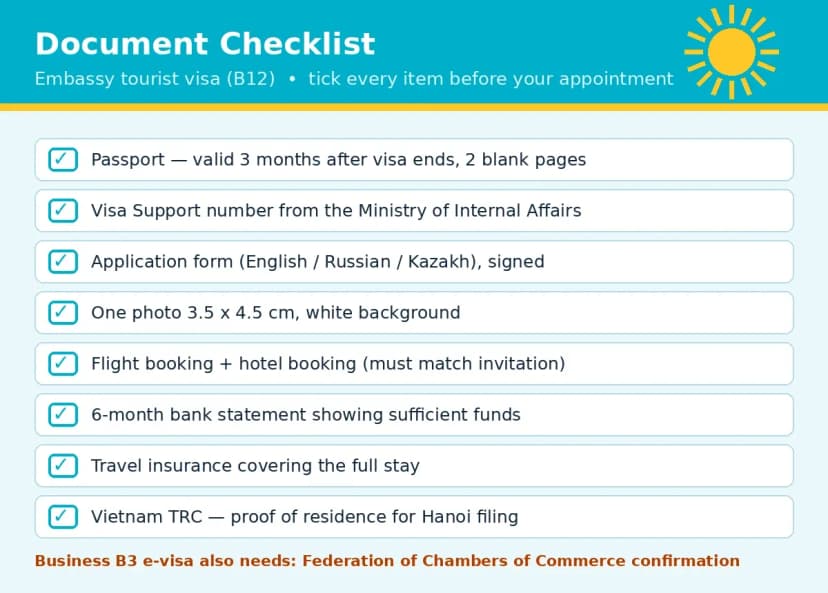
A complete and consistent file is the best protection against delay or refusal. The checklists below are drawn from the embassy requirements for the tourist visa (B12) as published by the Kazakh mission, the gov.kz visa-information page and the Dubai consulate's published list for Pakistani applicants. Where a document is required by one mission but not confirmed for Hanoi, that is noted. Use the checklist for your route and tick each item off before your appointment.
Tourist visa (B12) — embassy route
| Document | Requirement |
|---|---|
| Passport | Original, valid for at least 3 months after the visa ends, with at least 2 blank pages and no extension marks; plus a photocopy of the passport |
| Visa application form | Completed in English, Russian or Kazakh, signed by you |
| Photograph | One recent colour photo, 3.5 x 4.5 cm, full face, white or grey background |
| Visa Support number | Number issued by the Ministry of Internal Affairs through your host in Kazakhstan |
| Flight booking | Ticket or reservation showing entry and exit; do not buy a non-refundable ticket before the visa is issued |
| Accommodation booking | Hotel booking or other accommodation proof matching the invitation |
| Bank statement | 6-month bank statement showing sufficient funds for the trip |
| Travel insurance | Insurance covering the full stay in Kazakhstan |
| Consular fee receipt | Original receipt for the fee payment; the fee is not refunded |
| Vietnam residence proof | If applying in Hanoi: your Vietnamese temporary residence card or other proof of residence, work or study in Vietnam |
| Polio vaccination certificate | NADRA polio certificate is listed by the Islamabad embassy for travellers leaving Pakistan; if you are departing from Vietnam, confirm with the Hanoi embassy whether it is required |
| CNIC copy | Listed by agent checklists; carry a copy of your Pakistani national identity card |
Business e-visa (B3) — online route, until 31 December 2026
| Document | Requirement |
|---|---|
| Passport | Scan of the bio-data page; valid for at least 3 months after the visa ends, with 2 blank pages |
| Digital photograph | Recent passport-size photo, white background |
| Invitation number | Electronically issued invitation from the inviting Kazakh company, arranged through the migration service |
| Chamber of Commerce confirmation | Confirmation of financial standing and business reputation from the Federation of Chambers of Commerce of Pakistan |
| Card payment | Credit or debit card for the USD 80 fee on vmp.gov.kz |
| Printed e-visa | Print the PDF approval and carry it with your passport |
Transit visa — embassy route
| Document | Requirement |
|---|---|
| Passport | Original, valid for at least 3 months after the visa ends, with 2 blank pages |
| Visa application form and photo | Completed form, signed; one photo 3.5 x 4.5 cm |
| Onward ticket | Confirmed ticket to the third country |
| Onward visa | Visa for the onward destination, if one is required for a Pakistani passport holder |
| Consular fee receipt | USD 20 single entry / USD 90 multiple entry; non-refundable |
Two general points apply to every checklist. First, the passport-validity rule: the Visa Rules require your passport to remain valid for at least 3 months after the visa ends, with two blank pages. The UK FCDO page, which describes visa-free British travellers, says a passport must be valid for at least 30 days from arrival with one blank page — that is the rule for visa-free nationals, not for visa holders, and it does not override the 3-month, 2-page rule for your visa application. Hold six months' validity if you can; it also clears the strictest portal checks. Second, keep every document consistent: the names, dates and hotel on your invitation, your flight booking, your hotel booking and your application form must match each other. The accommodation on the application should be the accommodation you present at the border.
How to Apply: Step-by-Step
The embassy tourist route and the B3 e-visa route follow different steps. Follow the one that matches your trip, and do not mix them: a tourist cannot use the e-visa steps, and a business traveller who uses the e-visa must still have the Chamber of Commerce confirmation.
Embassy tourist visa (B12) — step by step
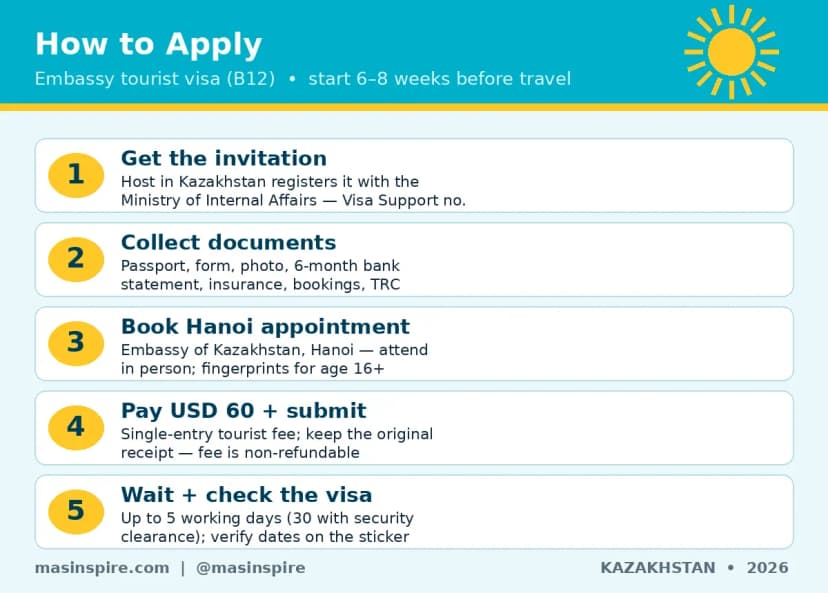
- Choose your host and start the invitation. Contact a licensed Kazakh tour operator or hotel and ask them to register an invitation for you with the Ministry of Internal Affairs. Confirm in writing that they can provide a Visa Support number, how long it takes and what it costs.
- Collect your documents. Use the B12 checklist above. Get your 6-month bank statement, travel insurance and photo ready while the invitation is being processed.
- Book the embassy appointment. Contact the Embassy of Kazakhstan in Hanoi (or Islamabad if you are applying from Pakistan) and book an appointment. Confirm the submission days and hours, the fee and the accepted payment method.
- Complete the application form. Fill it in English, Russian or Kazakh, in block letters, and sign it. Attach the photo in the marked space.
- Attend in person. Hand in your passport, form, photo, Visa Support number and supporting documents. Applicants aged 16 or over give fingerprints. Postal applications are not accepted.
- Pay the consular fee and keep the original receipt. Tourist single entry is USD 60. The fee is not refunded if the visa is refused.
- Wait for the decision. Standard processing is up to 5 working days from submission of the complete file; security clearance can extend it to 30 days.
- Check the visa on collection. Verify the validity dates, number of entries and permitted stay printed on the visa sticker before you leave the embassy.
Business e-visa (B3) — step by step, until 31 December 2026
- Confirm you qualify. Your purpose must be business — negotiations or concluding contracts — and you must have an inviting Kazakh company.
- Get the invitation number. The inviting company arranges the electronically issued invitation through the migration service of the Ministry of Internal Affairs.
- Get the Chamber of Commerce confirmation. Obtain the confirmation of your financial standing and business reputation from the Federation of Chambers of Commerce of Pakistan.
- Register on the Visa and Migration Portal. Go to vmp.gov.kz, create an account, select Pakistan as your citizenship and B3 as the visa category, and complete the online application with your passport and travel details.
- Upload your documents and pay USD 80 online by card. The fee is non-refundable. The amount shown at the portal checkout is the controlling figure.
- Wait for the emailed decision. Processing takes about 5 working days. The approval arrives as a PDF.
- Print the e-visa and carry it with your passport. Present the printed e-visa at boarding and at passport control. Enter and exit through an international airport (Astana or Almaty).
Common mistakes to avoid: applying for a tourist e-visa that does not exist for Pakistanis; paying an agent for a "tourist e-visa" before checking the official portal; booking a non-refundable flight before the visa is issued; submitting a bank statement shorter than six months; giving a hotel on the application that differs from the hotel on the invitation; and, for the B3 route, travelling for tourism on a business visa or entering by land, which the e-visa does not permit.
Applying from Vietnam — and from Pakistan
For a Pakistani living in Vietnam, the nearest Kazakh mission is the Embassy of Kazakhstan in Hanoi. Kazakhstan has an embassy in Hanoi — Villa 51, 10 Dang Thai Mai Street, Tay Ho District, Hanoi — and its consular section can be reached on +84 4 3718 0777. It is also accredited to Cambodia and Laos. There is no Kazakh consulate in Ho Chi Minh City, so an applicant living in the south should expect a trip to Hanoi for the in-person appointment and fingerprints, and a second trip or an arranged collection for the passport. Confirm the Hanoi embassy's current submission days, hours, fee payment method and appointment system by phone or on the gov.kz mission pages before travelling, because the Hanoi-specific appointment details could not be verified in a published source for this guide.
The Visa Rules allow you to apply in your country of stay if you have residence, work or study there, so a Vietnamese temporary residence card (TRC) or a work permit and residence arrangement supports a Hanoi application. Bring the TRC and a copy to the appointment, together with proof of your address in Vietnam. Your Vietnamese residence does not change the visa requirement, the fee or the invitation requirement — it only changes where you file.
If you are in Pakistan when you apply, the mission is the Embassy of Kazakhstan in Islamabad (House 11, Street 45, Sector F-8/1, Islamabad; telephone +92 51 226 2920). The Islamabad embassy asks applicants to book an appointment and attend an interview, takes documents on Monday, Wednesday and Friday from 10:30 am to 12:30 pm, and returns passports from 4:00 to 5:00 pm. It also lists a NADRA polio vaccination certificate among the documents for travellers leaving Pakistan — a requirement tied to departure from Pakistan, so confirm with the Hanoi embassy whether it applies when you depart from Vietnam. Other missions that can matter to a Pakistani traveller are the Embassy of Kazakhstan in Kuala Lumpur (115 Jalan Ampang Hilir, 55000 Kuala Lumpur; telephone +60 3 4252 2999) and the Consulate General in Dubai, which publishes the same invitation and in-person requirements.
For help while you are in Kazakhstan, the Embassy of Pakistan in Astana is at Syganak Street 27, Business Centre "Beijing Palace", 15th floor, Astana, telephone +7 7172 79 93 74. It handles passports, NICOP matters and emergency help for Pakistanis in Kazakhstan. Save its number in your phone before you travel, and keep a photocopy of your passport and visa separate from the originals.
Registration After Arrival
Registration is the rule most visitors get wrong, because the old rule and the current rule sound similar but put the duty on different people. The old rule, still repeated on many travel websites, says that every foreigner must register with the migration police within 5 days of arrival. The current rule, under Decree No. 148 as amended by Decree No. 890 of 10 October 2026 and the Law on Population Migration, is different: in most cases your host registers you, and you do not register yourself at all.
| Your situation | Who acts | Deadline | What you do |
|---|---|---|---|
| Staying in a hotel | The hotel | Within 3 working days of arrival | Ask at check-in that the hotel will notify the authorities |
| Staying with a private host or in a rented flat | Your host | Within 3 working days of arrival | Raise it before arrival and ask how the host will file the notification |
| Moving to a new city or address | The new host | Within 3 working days of the move | Do not skip it because the stop is short; each change of address restarts the deadline |
| Holding a visa issued on an invitation | Automatic at the border | Address taken from the invitation | Check that the address on the invitation is correct |
| Holding a valid e-visa (B3) | Exempt | While the visa is valid | The Foreign Ministry states that valid e-visa holders are exempt from registration; keep the visa accessible |
| Immigrant staying over 30 days | You | By the 30th calendar day | Register yourself with the internal affairs authorities |
| Immigrant changing address | You | Within 5 working days | Update your address with the authorities |
The UK FCDO confirms the host's duty in plain terms: "Your hotel or the person hosting you must register your arrival with the Kazakh authorities. They must do this within 3 working days of your arrival in Kazakhstan." So on a normal short tourist trip your job is to make sure the hotel or host does it — ask at check-in, and ask for confirmation. If you are staying with friends or in a rented apartment, you are responsible for making sure the host files the notification; the obligation sits with the host, but the consequences of a missed notification fall on you at departure. Notification can be filed through the Visa and Migration Portal (vmp.gov.kz), egov.kz, a migration service office, by post, or through e-Qonaq at eqonaq.kz.
Conflict disclosed — the "5-day" rule: a large number of travel guides still state that visitors must register with the migration police within 5 days of arrival, and some quote a fine of around USD 1,000 for failing to do so. That 5-day self-registration rule and the USD 1,000 fine figure come from the pre-2026 practice and older guidebooks; they do not match the current decree, which puts a 3-working-day notification duty on the host and a 30-day self-registration duty only on immigrants staying over 30 days. The current fines are set under Article 517 of the Code of Administrative Offences in monthly calculation index (MCI) units, not in a flat USD 1,000 — see the overstay section below. Follow the decree and the FCDO, not the older guides.
Transit Through Kazakhstan
Many travellers from Vietnam to Europe or Central Asia connect through Almaty or Astana, so the transit rules matter even if Kazakhstan is not your destination. The position depends on whether you leave the airport transit zone. If you stay airside in the international transit zone and do not pass through immigration, no Kazakh visa is required for the connection. One secondary guide puts the maximum airside connection at 24 hours between flights at Almaty and Astana airports, but that 24-hour figure could not be confirmed against an official source, so confirm it with your airline before relying on a long airside layover.
If you leave the airport during transit — to stay overnight in the city, to collect and re-check luggage on separate tickets, or to take a later flight the next day — you need a visa that covers entry into Kazakhstan. For a Pakistani passport holder that means either a valid Kazakh visa (for example, your B12 tourist visa or B3 e-visa) or a transit visa from a Kazakh embassy. The transit visa costs USD 20 for a single entry and USD 90 for multiple entries, and standard processing is up to 5 working days. You will need your onward ticket and, if the onward destination requires a visa for Pakistanis, that visa as well.
Two practical warnings follow from this. First, if you book two separate tickets (for example, Ho Chi Minh City to Almaty on one ticket and Almaty to Istanbul on another), you will usually have to pass through immigration to collect and re-check your bags, which means you need a visa even though you never intended to visit Kazakhstan. Book a single through-ticket with checked-through luggage where possible. Second, transit passengers who stay in the transit zone without crossing the border are expressly exempt from QazETA, so the new electronic authorisation does not change the transit picture for you.
Overstay, Fines and Entry Bans
Overstaying a Kazakh visa is expensive and can close the country to you for years, so count your days carefully. The permitted stay is the one printed on your visa, not the length of your hotel booking or your return ticket. The penalties are set by Article 517 of the Code of Administrative Offences and are calculated in monthly calculation index (MCI) units. In 2026 one MCI is 4,325 tenge, so the fines convert as follows.
| Length of overstay | Penalty (Article 517) | Amount in tenge (2026 MCI = 4,325 ₸) |
|---|---|---|
| Up to 3 days | Warning | No fine |
| Over 3 and up to 5 days | Fine of 10 MCI | 43,250 ₸ |
| Over 5 and up to 10 days | Fine of 15 MCI | 64,875 ₸ |
| Evading departure for over 10 days | Fine of 25 MCI or expulsion | 108,125 ₸ or expulsion |
| Repeat offence within a year (short overstay) | Fine of 15 MCI or expulsion | 64,875 ₸ or expulsion |
| Repeat of a serious offence within a year | Arrest of up to 15 days with expulsion | Plus expulsion |
| Activity not matching the visa purpose, or working without a permit | Fine of 25 MCI, arrest up to 10 days, or expulsion | 108,125 ₸ |
Expulsion carries a five-year entry ban. There is also a quieter trap: an unpaid fine from a previous stay can itself block your next entry. Under the Law on Population Migration, entry is restricted for foreign nationals who have not fulfilled an administrative penalty imposed during a previous stay, and the restriction is lifted only once the fine is paid. There are reported cases of travellers who left Kazakhstan after a short overstay without any fine being recorded at departure, only to be refused entry on their next trip because a fine had been issued against them in the meantime. If you overstay, even by a day, deal with it through the migration authorities before you leave, keep the receipt, and check for any outstanding fine or restriction before your next trip.
If your plans change while you are in Kazakhstan and you need more time, go to the migration service well before your visa expires to ask about an extension. Do not simply stay past the date on the visa and hope the short-overstay warning will cover you: the warning applies only up to three days, and a repeat offence within a year can mean expulsion. Carry your original passport with your visa at all times in Kazakhstan; copies are not accepted as identification.
Travel, Flights and Money: Practical Notes
There is no direct flight from Ho Chi Minh City to Almaty. The shortest connecting journeys take about 11 to 12.5 hours, and return fares found in late November 2026 started at around USD 767. The practical route from Vietnam changed in October 2026, when Vietjet launched direct flights between Hanoi and Almaty (about 6 hours 35 minutes, twice a week, with promotional one-way Eco fares from USD 135 including taxes). For a traveller based in Ho Chi Minh City, the sensible options are a short domestic hop to Hanoi followed by the Vietjet direct flight to Almaty, or a one-stop connection through a hub such as Istanbul, Dubai, Doha, Bangkok or Kuala Lumpur. Air Astana also flies Delhi to Almaty in about 3 hours 15 minutes, which can matter if your trip combines Pakistan and Kazakhstan. Flight times and fares change by season, so treat the figures in this section as a snapshot from late November 2026, not a price guarantee.
The currency is the Kazakhstani tenge (KZT, ₸). Kazakhstan is not part of the Schengen Area and not part of the eurozone. Cash of more than USD 10,000 must be declared on arrival, and you cannot take more than USD 10,000 in foreign cash out of the country. Card payment is widespread in Almaty and Astana, but carry some tenge for taxis, buses and small shops. Almaty buses take no cash — buy an ONAY transport card on arrival. There is no official minimum-funds figure published for Pakistani visitors: border officers may ask for proof of funds, but no source found for this guide states a sum per day. One secondary guide suggests around USD 50–100 per day as a working figure; that is a suggestion, not an official requirement, and your 6-month bank statement is the evidence the embassy actually asks for.
Health and safety notes: travel insurance covering the full stay is part of the embassy document list, so buy it before you apply, not after. A yellow fever vaccination certificate is required if you are arriving from a country listed as a yellow fever transmission risk; Vietnam is not on that list for a direct departure, but check the rule if your routing passes through an affected country. Kazakhstan's emergency number is 112. The FCDO does not advise against travel to any part of Kazakhstan, but it notes that the Baikonur area, Gvardeyskiy village in the Almaty region and the Karmakchi and Kazalinsk districts need prior permission to visit, and that Kazakhstan, Kyrgyzstan, Russia and Belarus form a single customs union, which matters if you plan to travel overland between them in your own vehicle. If you use a local SIM card for more than 30 days, verify your phone's IMEI at imei.kz or the SIM can be blocked.
Finally, the weather shapes the trip more than most visitors expect. Almaty and Astana have severe winters — Astana is one of the coldest capitals in the world — and the best months for a first visit are May to September. Shymbulak ski season runs through the winter, and the mountain lakes around Almaty are at their best from late spring. Pack for the season you are actually travelling in, and remember that distances inside Kazakhstan are vast: Almaty to Astana is a 1.5-hour flight or a 12-hour train journey, so do not plan to see both cities and the Kolsai Lakes in a three-day trip.
Frequently Asked Questions
1. Do Pakistani passport holders need a visa for Kazakhstan?
Yes. Holders of ordinary Pakistani passports need a visa for Kazakhstan. There is no visa-free entry, no visa on arrival and no exemption for living in Vietnam or holding a US, UK or Schengen visa.
2. Can a Pakistani apply for a Kazakhstan tourist e-visa?
No. Since the February 2026 changes to the Visa Rules, the only electronic visa open to Pakistani citizens is the single-entry business e-visa (category B3). A tourist must apply at a Kazakh embassy for a B12 tourist visa with a Visa Support number. Any website offering you a tourist e-visa on a Pakistani passport is out of date.
3. How much is the Kazakhstan visa fee for Pakistanis?
The single-entry tourist visa (B12) costs USD 60 and a multiple-entry tourist visa costs USD 90. A single-entry business visa costs USD 80, a one-year multiple-entry business visa costs USD 200, and the B3 business e-visa costs USD 80 (non-refundable). A single-entry transit visa costs USD 20. Fees are set in US dollars by the Foreign Ministry; confirm the amount and payment method with the mission before paying.
4. How long does a Kazakhstan visa take to process?
Standard processing is up to 5 working days from submission of the complete document package. Security clearance can extend the wait to 30 days, so apply at least four weeks before travel and do not buy a non-refundable ticket before the visa is issued. The invitation (Visa Support) stage comes first and adds its own time.
5. What is a Visa Support number and who issues it?
A Visa Support number is issued by the Ministry of Internal Affairs of Kazakhstan through your host — usually a licensed tour operator, hotel or inviting company — which registers an invitation for you. You need the number before you can apply for an embassy tourist or business visa, and for the B3 e-visa you need the related electronic invitation number.
6. Can I apply for a Kazakhstan visa from Vietnam?
Yes. The Visa Rules allow you to apply in your country of stay if you have residence, work or study there, so a Pakistani holding a Vietnamese temporary residence card can apply at the Embassy of Kazakhstan in Hanoi (Villa 51, 10 Dang Thai Mai Street, Tay Ho District, Hanoi; telephone +84 4 3718 0777). Your Vietnamese residence does not remove the visa requirement or the invitation requirement.
7. How long can I stay in Kazakhstan on a visa?
On a B3 business e-visa you may stay up to 30 days within a validity of up to 90 days. On an embassy tourist visa (B12) the permitted stay is decided by the embassy and printed on the visa sticker — check it when you collect your passport. Several agent sites quote "usually 30 days (up to 90)", but no official source found for this guide confirms a 90-day tourist stay for Pakistanis.
8. Is the business e-visa (B3) still available?
Yes, but only until 31 December 2026. Item 73 of Appendix 11 keeps the Pakistan line in the e-visa list in force only until that date. From 1 January 2027, unless the rules change, Pakistanis leave the e-visa route entirely and must apply through an embassy. No replacement had been announced as of 5 November 2026.
9. Do I need an invitation letter for a Kazakhstan visa?
Yes. Pakistan is not among the countries excused from showing an invitation, so every route — tourist, business and private visit — needs an invitation or Visa Support number registered with the Ministry of Internal Affairs. For the B3 e-visa you also need a confirmation of financial standing and business reputation from the Federation of Chambers of Commerce of Pakistan.
10. Do I need to register after arriving in Kazakhstan?
In most cases your hotel or host registers you: the host must notify the authorities within 3 working days of your arrival. Holders of a valid e-visa are exempt from registration. You only register yourself if you are an immigrant staying over 30 days (by the 30th calendar day). The older advice that every visitor must register personally with the migration police within 5 days is out of date.
11. Do I need QazETA as a Pakistani traveller?
No. QazETA is an Electronic Travel Authorisation for nationals of visa-free countries, becoming mandatory for them on 1 July 2027. Holders of a valid Kazakh visa are expressly exempt, so a Pakistani travelling on a B12 or B3 visa does not need QazETA, and QazETA is not a substitute for a visa.
12. Can I transit through Almaty or Astana without a visa?
Yes, if you stay airside in the international transit zone and do not pass through immigration. If you leave the airport — for example, to stay overnight or to collect and re-check luggage on separate tickets — you need a visa or a transit visa (USD 20 single entry). Book a single through-ticket with checked-through luggage where possible.
13. What happens if I overstay my Kazakhstan visa?
Under Article 517 of the Code of Administrative Offences, an overstay of up to 3 days brings a warning; over 3 to 5 days brings a fine of 10 MCI (43,250 tenge in 2026); over 5 to 10 days brings 15 MCI (64,875 tenge); and evading departure for over 10 days brings 25 MCI (108,125 tenge) or expulsion. Expulsion carries a five-year entry ban, and an unpaid fine can block your next entry.
14. How long must my passport be valid?
For a visa application, your passport must be valid for at least 3 months after the visa ends and have at least 2 blank pages. The 30-day validity rule quoted on the FCDO page applies to visa-free nationals, not to visa holders. Holding six months' validity is the safest option and also clears the strictest portal checks.
15. Is there a direct flight from Vietnam to Kazakhstan?
Yes, from Hanoi: Vietjet launched direct Hanoi–Almaty flights in October 2026 (about 6 hours 35 minutes, twice a week, promotional fares from USD 135 one-way). There is no direct flight from Ho Chi Minh City to Almaty; connecting journeys take about 11 to 12.5 hours, with return fares from around USD 767 in late November 2026. Confirm current schedules with the airline before booking.
Disclaimer: This guide is general information based on sources checked on 27 November 2026, not legal advice. Kazakh visa rules change without notice. Always confirm the current requirements, fees and procedures with the Embassy of Kazakhstan in Hanoi and the official Visa and Migration Portal (vmp.gov.kz) before applying or travelling. Where this guide discloses a conflict between sources, the controlling source named in the text should be checked first.
Official Immigration Websites
| Organisation | What it is for | Website |
|---|---|---|
| Visa and Migration Portal (VMP) | Official e-visa applications, invitation and registration services | vmp.gov.kz |
| QazETA | Electronic Travel Authorisation for visa-free nationals; e-visa services in pilot | qazeta.kz |
| Government of Kazakhstan — How to get an e-visa | Official confirmation that Pakistanis receive only a B3 business e-visa | gov.kz — How to get an e-visa? |
| Government of Kazakhstan — Visa information | Official visa categories, validity, stay periods and fees | gov.kz — Information on issuance of visa |
| Government of Kazakhstan — QazETA platform | Official QazETA launch, phases and exemptions | gov.kz — QazETA digital platform |
| UK Foreign, Commonwealth & Development Office | Entry requirements, passport validity, registration and safety advice | gov.uk — Kazakhstan entry requirements |
| US Department of State | Travel advisory and entry information for Kazakhstan | travel.state.gov — Kazakhstan |
| eQonaq | Online registration notification for foreign guests | eqonaq.kz |
| Embassy of Kazakhstan in Hanoi | Nearest Kazakh mission for residents of Vietnam (Villa 51, 10 Dang Thai Mai Street, Tay Ho, Hanoi) | List of diplomatic missions of Kazakhstan |
| Ministry of Foreign Affairs of Pakistan | Pakistan's missions abroad, including the Embassy of Pakistan in Astana | mofa.gov.pk |
Use only the official portal (vmp.gov.kz) for e-visa applications. Agent websites that copy the official design are common; check the address bar before entering passport details or paying. If a link in this table has moved, search gov.kz for the current page rather than trusting a third-party copy.