Iraq Visa Guide 2026: Types, Requirements, Documents and Application Steps
Last checked: 27 November 2026. This guide is for Pakistani passport holders living in Vietnam. Visa rules for Iraq changed fundamentally on 1 March 2025 and several figures are reported differently by different sources. Where sources conflict, this guide says so openly and names the controlling source. Always confirm the live position on the official portal before paying any fee or booking travel. This guide is general information, not legal advice, and it is not a safety clearance: Iraq carries the highest-level travel advisories from several governments, covered honestly in Section 2 and Section 13.
Contents
- Introduction
- Do Pakistani Passport Holders Need a Visa for Iraq?
- Iraq Visa at a Glance
- Types of Iraq Visas
- Federal Iraq E-Visa: Fees, Validity and Stay
- Visa on Arrival: What Changed on 1 March 2025
- The Kurdistan Region (Erbil) Visa: A Separate System
- Ziyarat (Pilgrimage) Visas for Pakistanis: The Rules That Matter Most
- Complete Document Checklists
- How to Apply: Step-by-Step
- Applying from Vietnam: The Hanoi Question and Your Nearest Missions
- Processing Times: What to Plan Around
- Entry, Arrival and the First 15 Days in Iraq
- Extending Your Stay, Overstaying and Exit Rules
- Frequently Asked Questions
- Official Immigration Websites
- Final Checklist and Key Takeaways
Introduction
Iraq is one of the most rewarding and one of the most complicated destinations a Pakistani traveller can attempt. The shrine cities of Najaf and Karbala draw hundreds of thousands of Pakistani pilgrims every year, Baghdad is rebuilding as a business and cultural capital, and the Kurdistan Region around Erbil feels like a different country at the border. That last impression is not far from the truth: Iraq runs two separate immigration systems inside one sovereign state, and choosing the wrong one is the single most common and most expensive mistake travellers make.
This guide is written for a specific reader: a Pakistani passport holder living in Vietnam who wants to visit Iraq, whether for Ziyarat, tourism, business, study or family. Living in Vietnam changes the practical side of the application — which mission you can reach, which documents prove your residence, and how you get to Iraq — but it does not change the visa rule itself. Iraq decides entry by nationality and passport, not by where you live. Your Vietnamese residence permit helps with the practicalities; it does not exempt you from the visa.
Three facts shape everything that follows. First, there is no visa on arrival in federal Iraq any more: it was suspended on 1 March 2025, and you must hold an approved e-visa before you board your flight. Second, the federal e-visa and the Kurdistan Region visa are different documents from different authorities, and only one of them covers the whole country. Third, for Pakistani pilgrims there is a second layer of rules imposed by Pakistan itself — the Ziyarat Management Policy — which can stop a trip even when Iraq would admit you. Each of these is covered in full below, with the conflicts between sources disclosed rather than smoothed over.
Do Pakistani Passport Holders Need a Visa for Iraq?
Yes. Pakistani passport holders need a visa for Iraq, obtained in advance. There is no visa-free entry for Pakistani citizens, and there is no visa on arrival at Baghdad, Basra or Najaf airports. That position is consistent across the sources checked: the UK Foreign, Commonwealth and Development Office (FCDO) states that a visa is required and that visit visas are no longer available on arrival; the Iraqi Ministry of Interior's e-visa portal is the application route; and Pakistan-focused guides agree that an e-visa or an embassy-issued visa must be arranged before departure.
The important qualification is about which advance route a Pakistani applicant can actually use. The federal e-visa portal, evisa.iq, was opened to the 37 nationalities that previously held visa on arrival — EU states except Poland, plus the UK, US, Canada, Australia, New Zealand, Japan, South Korea, Switzerland, Norway, China and Russia. Pakistan is not on that published list. Some Pakistan-focused guides published in November 2026 state that the e-visa works for Pakistanis at around USD 160 for 30 days, while another detailed guide states plainly that Indians and Pakistanis are outside the e-visa list for individual tourism and that the operator route or pilgrimage channels are the practical doors. This is a genuine conflict in the published material, and it has a direct practical consequence: do not pay for flights until you have tested your own eligibility on the portal or received written confirmation from an Iraqi mission or a licensed operator. If the portal does not list Pakistan as eligible for a direct e-visa, your route is the embassy channel (Islamabad, or the missions discussed in Section 11) or a licensed Ziyarat Group Organiser for pilgrimage travel. Section 8 covers the pilgrimage route in detail, because for most Pakistani travellers it is the route that actually works.
Your residence in Vietnam does not change the nationality rule, but it does affect where you can file. Iraq has an embassy listed in Hanoi, discussed in Section 11, and the e-visa — where available to you — can be applied for online from anywhere. What you must not do is travel to Iraq hoping to fix the visa at the airport: airlines check the visa before boarding, and the FCDO warns that without it you risk being refused boarding.
Iraq Visa at a Glance
| Question | Answer for a Pakistani passport holder living in Vietnam |
|---|---|
| Visa required? | Yes — in advance. No visa-free entry and no visa on arrival in federal Iraq. |
| Main route | Federal e-visa via evisa.iq (applications at eservice.evisa.iq), where eligible; otherwise an Iraqi embassy, or a licensed Ziyarat Group Organiser for pilgrimage. |
| Planning fee (federal e-visa) | About USD 160 for the ordinary e-visa (206,000 IQD); about USD 114 for the visit e-visa (151,000 IQD). See Section 5 — sources conflict and older USD 75–77 figures still circulate. |
| Validity / stay | Contested: FCDO and the Iraqi Embassy in Ottawa say 60 days; the evisa.iq homepage says 30 days, single or multiple entry. Go by the dates printed on your issued visa. |
| Processing time | FCDO minimum: apply at least 24 hours before travel. Reported approvals range from 6–72 hours to 5–10 business days. Apply at least 2 weeks ahead. |
| Passport | Valid at least 6 months after arrival, with at least one blank page. |
| Kurdistan Region (Erbil) | Separate visa, 100,000 IQD, via visit.gov.krd or on arrival for List A nationalities. Pakistan is not on the published List A, so a local sponsor is needed. A Kurdistan visa does not cover Baghdad or the south. |
| Ziyarat (pilgrimage) | Must travel through a licensed Ziyarat Group Organiser under Pakistan's Ziyarat Management Policy. Men under 50 travelling alone are barred. Pilgrimage visa valid 30 days. |
| Safety advisories | US State Department: Level 4, Do Not Travel (reissued 23 October 2026). FCDO: regionalised advice, updated 27 October 2026 — against all travel to some areas, all but essential travel elsewhere. This guide is visa guidance, not a safety clearance. |
Types of Iraq Visas
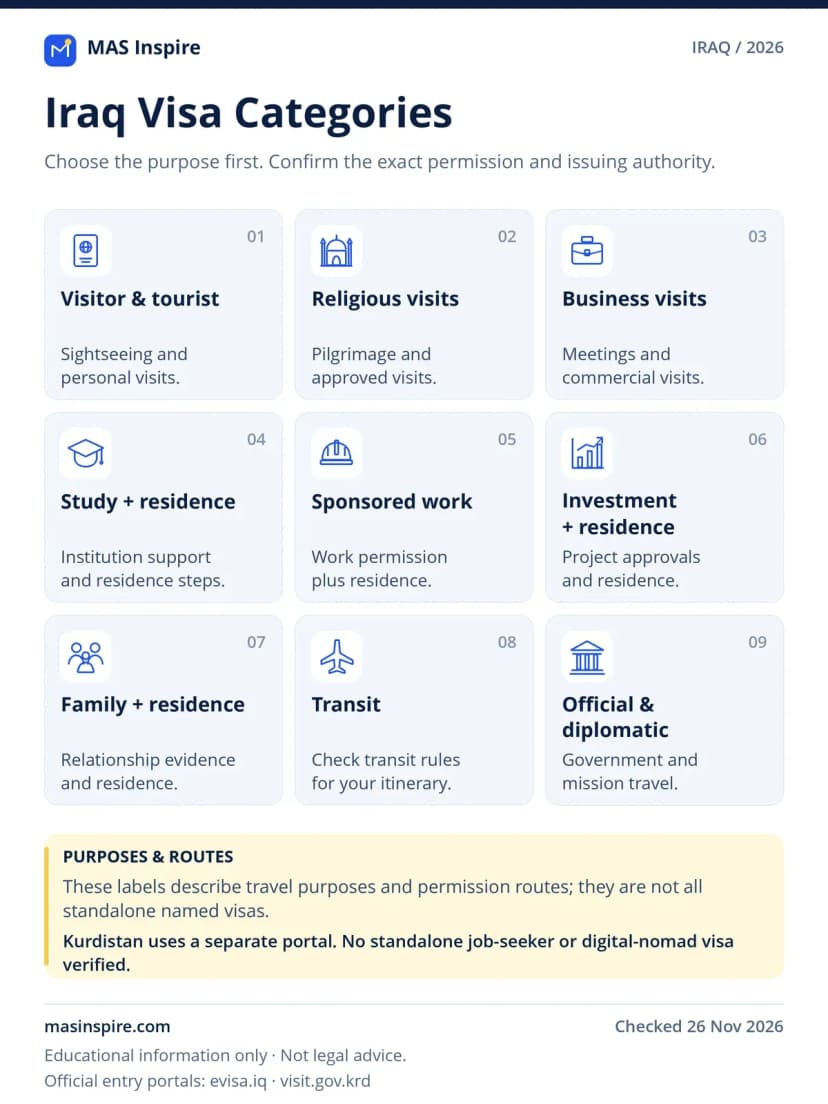
Iraq does not publish one neat list of visa names that matches every traveller's purpose. The categories below are the purposes and permission routes that appear across the official portal, embassy schedules and the guides checked. Treat the labels as purposes first and confirm the exact visa name on the portal or with the mission that issues it, because the same purpose can be filed under different names in different channels.
1. Visit visa (federal e-visa tier)
The lower federal e-visa tier, priced at 151,000 Iraqi dinars (about USD 114) in the portal's published tiers. It is a single-entry visa with entry allowed within 90 days of issue and a stay limited to 30 days, according to the detailed portal walkthroughs checked. This is the tier most short tourist visits would use where the applicant is eligible for the direct e-visa.
2. Ordinary visa (federal e-visa tier)
The higher federal e-visa tier, priced at 206,000 Iraqi dinars (about USD 160). It allows one entry within 60 days of issue and a stay of up to 60 days, according to the same portal walkthroughs. The FCDO's figure of USD 160 valid for 60 days matches this tier. This is the tier most travellers should plan and budget around.
3. Tourist visa (sponsored)
A 30-day tourist visa that requires sponsorship by a licensed Iraqi tourism company. You cannot apply for this one independently; your tour operator arranges it. Some agency quotes of around USD 250 relate to sponsored or handled applications rather than the government fee alone.
4. Religious / Ziyarat (pilgrimage) visa
The visa used for Najaf, Karbala and other shrine cities. For Pakistanis this is arranged through a licensed Ziyarat Group Organiser under Pakistan's Ziyarat Management Policy (Section 8). The Embassy of Iraq in Islamabad's schedule, as reported in November 2026, lists USD 30 for approved religious groups and USD 40 for an individual visit or religious visit visa, valid for one month. Note that this embassy schedule conflicts with the portal's IQD tiers — the two channels price differently, and you pay the fee of the channel you actually use.
5. Business visa
For meetings, commercial visits and business activity. The e-visa route requires an invitation letter from an Iraqi company or government entity. Business activity on a visit or pilgrimage visa is not permitted, and the June 2026 Pakistani circular warns that using a pilgrimage or visit visa to seek employment can mean refusal of entry, deportation and loss of the fee.
6. Work and residence visas
Employment in Iraq requires a sponsored work permission and residence steps arranged through the Iraqi employer and the Ministry of Interior. There is no verified standalone job-seeker visa and no digital-nomad visa for Iraq in the sources checked. Do not travel on a visit visa intending to find work and convert it: the conversion route is not documented for visitors, and overstaying or working on the wrong visa carries the penalties in Section 14.
7. Study visa and residence
Study requires institution support and residence steps through the Iraqi institution and the authorities. The FCDO notes a blood test for HIV and hepatitis for travellers not on a visit visa (Section 13), which is relevant to longer study and residence stays.
8. Family visit and residence
Family visits use the visit route with evidence of the relationship and the host in Iraq. Longer family residence follows the residence procedures of the Ministry of Interior and is not a standard e-visa product.
9. Transit visa
Transit arrangements depend on the itinerary and the airline. The embassy schedule in Washington lists transit among the single-entry categories at USD 50 for some nationalities, but no transit fee or rule specific to Pakistani passport holders was verified in the sources checked. If you only change planes in Iraq without entering, confirm with the airline whether a transit visa is needed; if you leave the airport, you need a visa.
10. Official and diplomatic visas
Official and diplomatic passport holders follow a separate channel through their government and the Iraqi mission. The June 2026 circular notes that holders of diplomatic and official passports are exempt from the passport-retention measure applied to Pakistani pilgrims on entry.
11. Kurdistan Region visa
Not a federal visa type at all, but a separate regional authorisation covered in full in Section 7. It is listed here only so that nobody mistakes it for a cheaper federal visa: it costs 100,000 IQD and is valid in the Kurdistan Region only.
Federal Iraq E-Visa: Fees, Validity and Stay
This is the section where honest disclosure matters most, because the published figures disagree with each other. The table below gives every figure found, its source, and what to plan around. Do not treat any single figure as settled until the portal shows it to you at checkout.
| Item | Figure reported | Source | Status |
|---|---|---|---|
| Visit e-visa | 151,000 IQD (about USD 114); stay 30 days, entry within 90 days of issue | Portal walkthroughs of evisa.iq tiers, November 2026 | Reported from the portal's tiers; confirm at checkout |
| Ordinary e-visa | 206,000 IQD (about USD 160); entry within 60 days of issue, stay up to 60 days | Portal walkthroughs of evisa.iq tiers; FCDO (USD 160, valid 60 days) | Best-supported planning figure: about USD 160 |
| FCDO headline figure | USD 160, valid for 60 days; apply at least 24 hours before travel | UK FCDO entry requirements, updated 18 November 2026 | Controlling official source for the headline figure |
| Portal homepage | Valid for 30 days, single or multiple entry | evisa.iq homepage, read live 28 November 2026 | Conflicts with the FCDO's 60 days — see disclosure below |
| Older e-visa figure | About USD 75–77, single entry, 60 days | Several 2026 Pakistan-focused guides | Conflicts with the IQD tiers; USD 77 was the pre-2025 visa-on-arrival fee |
| Embassy schedule (Islamabad) | USD 30 approved religious groups; USD 40 individual visit or religious visit; valid one month | Embassy of Iraq, Islamabad schedule as reported November 2026 | Embassy channel only, not the portal price |
| Agency-handled applications | USD 160–190 typical, up to USD 250 with sponsorship | Portal walkthroughs and agency reporting, 2026 | Government fee plus handling; not a government fee |
| Arbaeen-season e-visa | Around USD 55 for pilgrims | Portal walkthroughs, 2026 | Reported seasonal figure; not verified for Pakistani applicants |
| Kurdistan Region visa | 100,000 IQD (about USD 75–76) | KRG portal and FCDO | Regional visa only — see Section 7 |
Disclosure 1: the validity conflict — 30 days or 60 days?
The FCDO states that the e-visa costs USD 160 and is valid for 60 days. The Iraqi Embassy in Ottawa's visa page says the electronic visa is valid for 60 days and can be used for single or multiple entries. But the evisa.iq homepage, read live on 28 November 2026, states that the e-visa is valid for 30 days and can be used for single or multiple entries. The portal's own tier descriptions split the difference: the visit tier allows a 30-day stay and the ordinary tier allows a 60-day stay. The honest conclusion is that validity depends on which tier you buy, and the only dates that matter are the ones printed on your issued visa. Plan your trip inside 30 days unless your issued visa clearly allows longer, and never assume the FCDO's 60 days applies to the cheaper tier.
Disclosure 2: the fee conflict — USD 77, USD 114, USD 160 or USD 30?
USD 77 was the visa-on-arrival fee charged in cash at Baghdad airport before 1 March 2025. It is not the current e-visa fee, but several guides updated in 2026 still quote USD 75–77 for the e-visa, and one licensed travel agency still lists USD 77 as the federal visa-on-arrival fee. Treat any page quoting USD 77 for a 2026 e-visa as stale or wrong. The portal's own tiers are 151,000 IQD (about USD 114) and 206,000 IQD (about USD 160), and the FCDO's USD 160 matches the higher tier. The USD 30 and USD 40 figures come from the Islamabad embassy's schedule for religious and visit visas and belong to the embassy channel, not the portal. Budget around USD 160 for the ordinary e-visa, plus any card fee: one walkthrough reports a 5.5 percent surcharge on international card payments on the portal, which would take the ordinary tier to roughly USD 169. That surcharge is reported by a single source and is not confirmed on an official page, so it is flagged here rather than stated as fact.
Disclosure 3: health insurance is bundled into the fee
On 30 September 2025 the Iraqi Council of Ministers approved the federal e-visa platform as the single portal for issuing entry visas and attached a mandatory health insurance certificate to every visa issued through it, under Cabinet Resolution 37 of 2025. The quoted e-visa fee therefore includes health insurance. That matters for two reasons: the fee cannot be compared directly with the old USD 77 arrival fee, which did not include insurance; and you should still carry your own travel insurance, because the bundled certificate is a visa condition, not a substitute for comprehensive cover — and travelling against FCDO advice can invalidate a standard policy, as Section 13 explains.
Single or multiple entry
Both the portal homepage and the Ottawa embassy page describe the e-visa as usable for single or multiple entries. No separate multiple-entry fee was verified in the sources checked. If you need to leave Iraq and re-enter on the same trip, confirm at application stage that your tier and your issued visa allow it, and do not rely on a general statement.
Visa on Arrival: What Changed on 1 March 2025
Until 28 February 2025, nationals of 37 countries could land at Baghdad, Basra or Najaf airports, pay USD 77 in cash, and receive a visa on arrival. On 28 February 2025 the Ministry of Interior announced that the scheme would end, and from 1 March 2025 those same 37 nationalities were told to obtain an electronic entry visa before travelling instead. The change has not been reversed since. The FCDO states it plainly: you are no longer able to get a visit visa on arrival in Iraq, and you must apply on the Government of Iraq e-visa portal at least 24 hours before you travel.
This matters for Pakistani travellers in two ways. First, the old advice is still everywhere: travel blogs, tour operators and even some visa agencies still describe paying USD 77 at Baghdad airport as if it were current. It is not. A page that tells you to pay at the airport, quotes USD 77 on arrival, or promises a visa at Basra or Najaf for walk-in travellers is out of date, and following it risks being refused boarding at your departure airport. Second, Pakistan was among the nationalities affected by the suspension, according to the November 2026 Pakistan-focused reporting: the e-visa became the only entry process. There is no counter fallback at Baghdad, Najaf or Basra airports for federal entry.
The one place visa on arrival still exists is the Kurdistan Region, at Erbil and Sulaymaniyah airports and the region's land crossings, for nationalities on its List A. That is a regional visa, not a federal one, and it does not get you to Baghdad. Section 7 explains the trap in full.
The Kurdistan Region (Erbil) Visa: A Separate System
The Kurdistan Region of Iraq — the governorates of Erbil, Sulaymaniyah, Duhok and Halabja — is a federal region recognised in Iraq's 2005 constitution, with its own parliament, security forces and immigration practice at the entry points it controls. It runs its own visa system through the Kurdistan Regional Government's portal at visit.gov.krd, with its own nationality lists and its own fee. The relationship between the two systems is one-directional, and it is the most consequential fact in this guide.
| Question | Federal Iraq e-visa | Kurdistan Region visa |
|---|---|---|
| Issued by | Iraqi Ministry of Interior, Baghdad | Kurdistan Regional Government, Ministry of Interior |
| Apply at | evisa.iq (applications at eservice.evisa.iq) | visit.gov.krd, or on arrival for List A nationalities |
| Fee | About USD 160 (ordinary tier, 206,000 IQD); about USD 114 (visit tier, 151,000 IQD) | 100,000 IQD (about USD 75–76), by card at the airport |
| Stay | 30 days (visit tier) or up to 60 days (ordinary tier); see Section 5 | 30-day stay, entered within a 90-day window |
| Visa on arrival? | No, since 1 March 2025 | Yes, for Country List A nationalities, at Erbil and Sulaymaniyah airports and land crossings |
| Where it works | All of Iraq, including the Kurdistan Region | Kurdistan Region only — not Baghdad, Najaf, Karbala, Basra or Mosul |
The one-directional rule
A federal Iraqi e-visa is valid across the whole country, including the Kurdistan Region. A Kurdistan visa is valid inside the Kurdistan Region only and does not entitle you to travel into federal Iraq. The FCDO states this, and the detailed guides agree: if your trip includes Baghdad, Karbala, Najaf, Basra or Mosul as well as Erbil, buy the federal visa and skip the regional one entirely. There is no immigration post on the road between Erbil and Mosul where you can upgrade a Kurdish visa into a federal one. Travellers who fly into Erbil on a KRG visa and then decide they want to see Baghdad have, in practice, had to fly out and re-enter on a federal visa, paying again.
Disclosure: one source says the opposite
Wikivoyage's Iraqi Kurdistan page states that a regular Iraqi visa is not valid for travel to Iraqi Kurdistan and that a separate Kurdistan visa is needed. That contradicts the FCDO and the detailed visa guides, which state that the federal visa covers the whole country including the Kurdistan Region. The FCDO is the controlling source here: it is the official government advice, and it is explicit that the Kurdistan visa is valid for travel in the Kurdistan Region only, while the federal visa is the national one. The Wikivoyage statement is recorded as a conflict and is not followed in this guide. If you hold a federal e-visa and are flying into Erbil, confirm with your airline before departure, because airline staff sometimes apply the same confusion.
Can a Pakistani get a Kurdistan visa?
This needs care. The Kurdistan Region's Country List A — the nationalities that can apply for the e-visa online or get a visa on arrival — covers EU member states, GCC states, Albania, Australia, Azerbaijan, Brazil, Canada, China, Iceland, Iran, Japan, Jordan, Lebanon, Liechtenstein, Malaysia, New Zealand, Norway, Russia, South Korea, Switzerland, Turkey, the UK, the US and the Vatican. Pakistan is not on that published list. All other nationalities need a local sponsor in Iraqi Kurdistan to file the visa application and pay the fee on their behalf. So a Pakistani traveller cannot simply land at Erbil and buy the 100,000 IQD visa at the counter on the same terms as a List A traveller. If Erbil is your destination, arrange the sponsor route through a Kurdistan-based host or operator before you travel, or take the federal e-visa route instead — which, on the FCDO's account, covers Erbil as well. Confirm the current List A position on visit.gov.krd before you rely on either route, because the lists are the KRG's own and can change.
A note on the September 2025 cabinet decision
In September 2025 the federal cabinet made the e-visa portal the single national system for issuing entry visas. Some reporting at the time suggested the two systems would merge. As of the November 2026 sources checked, they have not merged in practice: the KRG portal still operates, the 100,000 IQD fee still applies, and the one-directional rule still stands. Whether the KRG portal will still exist next year is openly described as unresolved in the specialist reporting. Do not plan a 2027 trip on the assumption that the systems will have merged.
Ziyarat (Pilgrimage) Visas for Pakistanis: The Rules That Matter Most
For most Pakistani travellers, Iraq means Ziyarat: Najaf, Karbala, Baghdad's shrines, and the Arbaeen pilgrimage. This is also the area with the most rules, the strictest recent enforcement, and the highest cost of getting it wrong. Read this section before you pay any operator.
Pakistan's Ziyarat Management Policy: you must travel through a licensed organiser
From 1 January 2026, Pakistan's old Salar (caravan leader) system was replaced. Under the Ziyarat Management Policy, every pilgrimage to Iraq, Iran and Syria must be booked through a Ziyarat Group Organiser (ZGO) licensed by Pakistan's Ministry of Religious Affairs and Interfaith Harmony. The ZGO arranges the religious visit visa, and is responsible for the accuracy of applications, for pilgrims travelling for the stated purpose, and for everyone returning on time. Firms that break the rules can lose their registration. The Ministry states that it is not responsible for bookings made with unregistered agents. Before you pay, check that the organiser is on the Ministry's licensed list — that check is your main protection against fraud and against being stranded.
Men under 50 travelling alone are barred
This is the rule that catches the most people. The Government of Iraq has introduced a regulation under which male pilgrims under the age of 50 must be accompanied by their families and will not be permitted to travel alone for Ziyarat to Iraq. Pakistan's Ministry of Religious Affairs circulated it on 17 September 2025 and again, with strict enforcement ordered, in a circular dated 22 June 2026 (reference No. 1(1)/2026-Ziarat). The circular was still listed among the ZGO notices on the Ministry's page on 22 October 2026, with no later notice cancelling it. Treat it as live until the Ministry or the Iraqi side says otherwise.
Two honest gaps in the rule must be stated. The circular does not define which relatives count as family, how many must travel, or what proof is needed, and it does not say whether a group trip led by a licensed operator counts as family. A man in his thirties who has booked a group trip should not assume the group counts: ask the licensed operator, in writing, how the rule applies to you before you pay. The circular speaks only about male pilgrims under 50; it says nothing about women, and this guide does not guess beyond the text. People who obtain a visa as part of a family group but travel without that family will be refused entry.
Your passport will be kept on entry
Iraqi immigration authorities retain the passports of Pakistani pilgrims when they enter Iraq, as a measure to prevent overstays and unauthorised employment. Holders of diplomatic and official passports are exempt. Carry photocopies and digital copies of your passport and visa, keep your ZGO's contact details with you, and do not panic when the passport is taken: it is the published procedure, not a scam. Confirm with your ZGO how and when passports are returned before departure.
One visa, one event: Ashura and Arbaeen need separate visas
Iraqi pilgrimage visas are valid for 30 days. A single Ziyarat visa cannot be used for both Ashura and Arbaeen: pilgrims returning for Arbaeen after an Ashura visit need a fresh visa. Pilgrims who stay on between the two events without proper documentation are treated as overstayers, with the penalties in Section 14.
Routes: only Baghdad and Najaf airports for now
The Al-Sheeb land crossing — the only crossing allowed for Pakistani pilgrims coming from Iran — has been closed since 21 October 2026, and ZGOs have been told not to send pilgrims that way. For now, Pakistani pilgrims can enter Iraq only through Baghdad and Najaf airports. The road route from Iran is also affected by the 2025 federal ban on pilgrims travelling to Iran and Iraq by road for Arbaeen on security grounds, with extra flights arranged instead. Check that your flight is actually operating before you pay: Iraqi Airways resumed nonstop Baghdad–Karachi flights in May 2026 after an 86-day suspension, and Gulf connections have been cancelled at short notice during 2026. The Ministry has told ZGOs to plan backup flights and rooms, and to carry extra funds for cancellations.
Fees for Ziyarat visas
The Islamabad embassy schedule reported in November 2026 lists USD 30 for approved religious groups and USD 40 for an individual visit or religious visit visa, valid for one month. Some reporting notes that Iraq has waived pilgrim visa fees for Pakistanis in the past, but that fees and service charges in 2026 vary between organisers. Visa fees are non-refundable if an application is rejected or entry is denied. The Arbaeen-season e-visa is reported at around USD 55 for pilgrims, but that figure is not verified for Pakistani applicants through the ZGO channel. Get the total price — visa, operator service charge, flights, accommodation — in writing from the ZGO before paying anything.
Complete Document Checklists
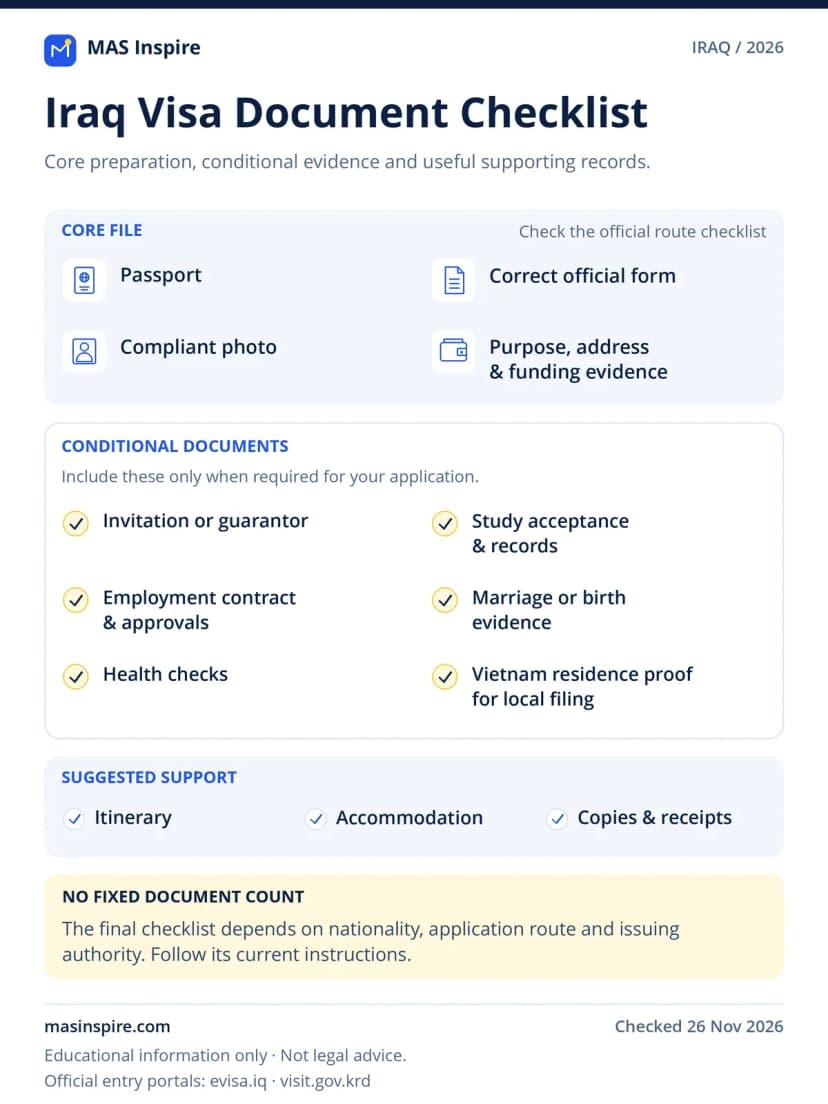
There is no single published document list that covers every Iraqi visa route, because the e-visa portal, the embassy channel and the ZGO channel each ask for slightly different evidence. The checklists below combine the documents that appear consistently across the sources checked. The final list is always the one the channel you use asks for — follow its current instructions, and do not submit a document it has not asked for in place of one it has.
| Document | E-visa (federal) | Embassy route | Ziyarat via ZGO | Notes |
|---|---|---|---|---|
| Pakistani passport | Required | Required | Required | Valid at least 6 months after arrival; at least one blank page; every pilgrim including newborn children needs one. |
| Passport bio-page scan | Required | Required | Required | Clear colour scan for the online application. |
| Digital passport photo | Required | Required | Required | Recent, white background, meeting the portal's size rules. |
| Completed application form | Online form | Embassy form | Via ZGO | All information must be accurate, complete and verifiable. |
| Return or onward ticket | Required | Required | Required | FCDO: without one, the airline may refuse boarding. |
| Hotel booking or host address | Required | Required | Via ZGO | Hotel booking or invitation letter with the host's address in Iraq. |
| Proof of sufficient funds | Required | Required | Advised | Bank statement; one agency guide cites PKR 400,000–1,000,000 closing balance, another PKR 1,000,000–2,000,000 — neither figure is confirmed on an official page, so treat both as agency claims, not requirements. |
| Travel / health insurance | Recommended; health certificate bundled in e-visa fee | Recommended | Recommended | Confirm in writing that the policy covers Iraq despite the advisories. |
| Invitation letter (business) | Required for business | Required for business | Not applicable | From an Iraqi company or government entity. |
| Sponsor / ZGO documents | For sponsored tourist visa | As directed | Required | Licensed ZGO registration; confirm the organiser is on the Ministry list. |
| Vietnam residence proof | Useful | Useful | Useful | Your Vietnamese temporary residence card or visa, and proof of your address in Ho Chi Minh City; the Ottawa embassy page lists proof of residence among the e-visa requirements. |
| Family relationship evidence | For family visits | For family visits | For under-50 men | Needed to show family accompaniment under the under-50 rule; the circular does not specify what proof counts, so ask your ZGO. |
| Employment / study evidence | For work or study | For work or study | Not applicable | Contract, employer approvals, institution acceptance letter as applicable. |
| Payment card | Required | As directed | Via ZGO | Credit or debit card for the online portal fee; some embassies take cash only. |
What is not needed in advance
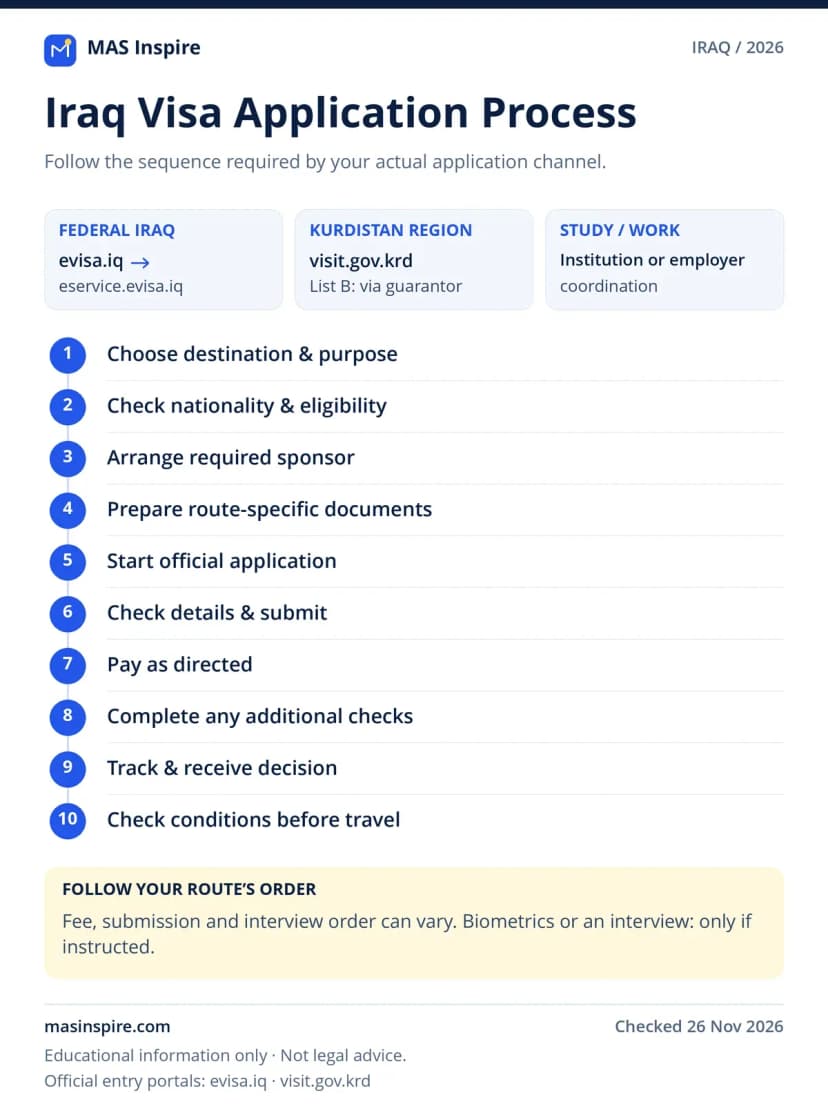
No advance biometrics are required for the e-visa: fingerprints and a photograph may be captured on arrival at Iraqi airports. There is no verified requirement for an interview for a standard visit e-visa; if an interview or extra check is instructed, it will come through the channel you applied with. Do not pay any third party that claims an interview slot or biometric appointment is mandatory for the e-visa.
How to Apply: Step-by-Step
Route A: Federal e-visa (where you are eligible)
- Check your eligibility first. Go to evisa.iq and check whether Pakistan is listed as eligible for the direct e-visa. This is the step that decides everything else. If Pakistan is not listed, stop and use Route B or Route C instead of paying an agent to file a direct application that cannot succeed.
- Prepare your documents from the checklist in Section 9: passport scan, digital photo, return ticket, accommodation details and proof of funds.
- Go to evisa.iq and choose "Direct e-visa". Click "Apply now for a visa" and you land on the application system at eservice.evisa.iq. Accept no substitutes: commercial lookalike sites with official-looking crests charge USD 160–250 for the same visa or collect passport scans for nothing. Only evisa.iq is the Ministry of Interior's own portal.
- Choose the tier. Visit visa (151,000 IQD, about USD 114, 30-day stay) or ordinary visa (206,000 IQD, about USD 160, up to 60-day stay). Most travellers should select the ordinary visa. The sponsored tourist visa is arranged by your operator, not by you.
- Create your account and complete the form. Enter personal, passport and travel details exactly as they appear in your passport. One reported quirk: the application path on the portal is labelled "Visa on Arrival" even though you are applying for the pre-arrival e-visa. Click it anyway. The one-time password for account creation has been reported as arriving from a misspelled domain (noreply at evissa.iq) — check spam, and do not let the typo convince you it is phishing, though you should still verify you are on the real eservice.evisa.iq address before entering payment details.
- Upload your documents in the formats and sizes the portal asks for.
- Pay by card. The fee is payable online only; there is no cash option on the portal. Expect the government fee plus any card surcharge the portal shows at checkout.
- Wait for the decision and watch your email. The approved e-visa is emailed as a printable document. Print it and carry it with your passport.
- Check the dates on your issued visa before you book anything non-refundable. Validity, stay length and single versus multiple entry are whatever your visa says, not whatever a guide promised.
- Register for the health screening if your stay exceeds 15 days. The Iraqi Ministry of Health's electronic screening programme applies to Arab and foreign travellers staying more than 15 days, with registration through the national services platform (see Section 13).
Route B: Iraqi embassy (when the direct e-visa is not available to you)
- Contact the mission before travelling to it. The nearest missions are discussed in Section 11. Confirm by phone or email that the mission accepts visa applications from a Pakistani passport holder resident in Vietnam, what its current fee is, and whether it takes cash or card.
- Prepare the embassy file from the Section 9 checklist, including the invitation or sponsor letter for your purpose of travel.
- Submit and pay the embassy fee. Embassy fees differ from portal fees: the Islamabad schedule lists USD 30 for approved religious groups and USD 40 for an individual visit or religious visit visa. Other missions publish their own schedules — the Washington embassy, for example, lists USD 50 for a single-entry visa and USD 150 for a one-year multiple-entry visa for US citizens on a reciprocity basis. Do not assume one mission's fee applies at another.
- Allow far more time. One agency guide puts embassy processing at 3–8 weeks. That figure is not confirmed on an official page and is flagged as such, but the embassy route is plainly slower than the portal. Apply at least a month ahead, and longer if you can.
Route C: Ziyarat through a licensed ZGO (pilgrimage)
- Choose a licensed ZGO from the Ministry of Religious Affairs list and verify the licence before paying.
- Confirm the under-50 rule in writing if you are a man under 50: how the organiser satisfies the family-accompaniment requirement for you.
- Hand over the documents the ZGO asks for and get a written receipt listing the total price, the flight, the accommodation and the visa fee.
- Confirm the flight is operating and that the entry airport is Baghdad or Najaf, since the Al-Sheeb land crossing is closed.
- Carry copies of everything, including your ZGO's contact details, because your passport will be retained on entry.
Route D: Kurdistan Region (Erbil only)
- Check List A on visit.gov.krd. Pakistan is not on the published List A, so plan on the sponsor route: a local sponsor in Kurdistan files the application and pays the fee on your behalf.
- Apply on visit.gov.krd or arrange the on-arrival route through your sponsor, and pay the 100,000 IQD administrative fee by Visa or Mastercard at the airport where applicable.
- Remember the limit: this visa covers the Kurdistan Region only. If Baghdad, Najaf or Karbala are on your itinerary, you need the federal visa instead.
Applying from Vietnam: The Hanoi Question and Your Nearest Missions
Living in Vietnam gives you one apparent advantage — an Iraqi embassy in your country of residence — and one real complication: that embassy's current operating status could not be confirmed, so you must verify it yourself before relying on it.
The Embassy of Iraq in Hanoi
Iraq has an embassy listed in Hanoi at 66 Tran Hung Dao Street, with the telephone number +84 4 9424141, according to multiple directories and the list of diplomatic missions of Iraq. However, one Hanoi embassy directory updated in 2026 reports the Embassy of Iraq as temporarily closed since August 2017, and no current Iraqi MFA page for a Hanoi mission was found in the sources checked for this guide. That is a direct conflict between the mission lists, and it is not resolved here. Do not travel to Hanoi assuming the embassy will receive you. Telephone first, and if you cannot reach it, treat the embassy channel as unavailable from Vietnam and use the e-visa or ZGO routes instead. If the Hanoi mission is in fact operating, it is your nearest mission and the natural place for an embassy-route application from Vietnam.
Nearest missions if Hanoi cannot help
| Mission | Why it matters from Vietnam | What is verified |
|---|---|---|
| Embassy of Iraq, Islamabad, Pakistan | Your home-country mission; handles Pakistani applicants and publishes the religious-group fee schedule | Address 6-13, Street No. 31, G-5 Diplomatic Enclave, Islamabad; schedule USD 30 religious groups / USD 40 individual visit, as reported November 2026 |
| Embassy of Iraq, Kuala Lumpur, Malaysia | Closest operating regional mission to Vietnam; active MFA page with November 2026 news posts | Embassy active on mofa.gov.iq; head of mission listed as Chargé d'affaires Dr. Hamed Ibraheem Abd-Alkareem Al-Jeboori |
| Embassy of Iraq, New Delhi, India | Large regional mission with a consulate-general in Mumbai | Embassy in New Delhi; concurrent accreditation for Nepal; phone +91 11 2653 5593 / 5594 as listed by VisaHQ |
| Embassy of Iraq, Beijing, China | Major regional mission with a consulate-general in Guangzhou | Address No. 25, Xiu Shui Bei Jie, Jian Guo Men Wai, Beijing; phone +86 10 6532 3385 |
| Embassy of Iraq, Bangkok, Thailand | Regional option sometimes used by travellers in South-East Asia | Listed among Iraqi missions in Asia; address and current visa practice not verified for this guide — confirm before travelling |
In practice, most Pakistani residents in Vietnam will never need to visit any of these missions: the e-visa (where eligible) and the ZGO channel (for pilgrimage) are both handled online or through the organiser. Reserve the mission route for cases where the portal does not list Pakistan, where you need a work, study or long-stay visa, or where an application has been refused and you need advice in person. If you do travel to a mission, carry your Vietnamese residence card, your passport, and printed copies of every document in Section 9.
Getting to Iraq from Vietnam
No direct flight from Vietnam to Iraq was found in the sources checked. Most itineraries connect through Gulf hubs such as Dubai, Doha or Sharjah, or through Istanbul, and land at Baghdad (BGW) or Najaf (NJF). For pilgrims, the practical airports are Baghdad and Najaf, since the Al-Sheeb land crossing is closed. Check that each leg is operating before you pay: Gulf connections and Iran–Iraq flights were cancelled at short notice during 2026, and Iraqi Airways' Baghdad–Karachi service itself resumed only in May 2026 after an 86-day suspension. Allow a generous connection window and keep your e-visa printout, return ticket and accommodation proof in your hand luggage, because the airline checks the visa before boarding and immigration checks it again on arrival.
Processing Times: What to Plan Around
| Route | Processing time reported | Source | Plan around |
|---|---|---|---|
| Federal e-visa (minimum) | At least 24 hours before travel | FCDO | The legal minimum, not a safe plan |
| Federal e-visa (official quote) | 6–72 hours | Portal reporting, 2026 | Often slower in practice |
| Federal e-visa (typical) | 1–3 days; also reported 3–5 business days | Portal walkthroughs; Pakistan-focused guides | Apply at least 2 weeks ahead |
| Federal e-visa (slow end) | 5–10 business days; some reports of up to 3 weeks | Pakistan-focused guides; portal reporting | Do not book non-refundable travel inside this window |
| Embassy route | 3–8 weeks | Agency guide, October 2026 | Unverified on any official page; apply at least a month ahead |
| Kurdistan Region visa | Up to 5 days online; on arrival for List A | KRG reporting, 2026 | Apply at least a week ahead; sponsor route takes longer |
| Ziyarat via ZGO | Set by the organiser and the group departure | ZGO practice | Book with the group timetable, not the e-visa timetable |
The honest picture is that processing times are the least stable figure in this guide. The FCDO's 24-hour minimum is a floor: it tells you the latest you may apply, not how long approval takes. Approvals have been reported in as little as six hours and have also taken three weeks. Demand surges around Muharram and Safar, when Najaf-bound traffic peaks and the portal slows. There was also an April 2026 report, citing a senior source, that approvals had been quietly frozen for several nationalities including British and Canadian applicants after the abduction of an American journalist in Baghdad; the Interior Ministry publicly denied it the following day, saying issuance was ongoing. The episode is recorded here because it shows the system can be unsettled without warning. The practical rule is simple: apply at least two weeks before travel for the e-visa, a month or more for the embassy route, and never pay for non-refundable flights or hotels until the visa is in your inbox.
There is no verified express or priority service for the federal e-visa in the sources checked. Any third party selling an express upgrade is selling its own handling, not a government fast track. Fees are non-refundable if an application is rejected or entry is denied, so a refused application costs you the fee as well as the trip.
Entry, Arrival and the First 15 Days in Iraq
Getting the visa is only the first half of entry. What happens at the airport and in the first two weeks carries its own obligations, and two of them catch people out while their visa is still perfectly valid.
At the airport
Carry your printed e-visa, your passport, your return or onward ticket and your accommodation proof together. The airline checks the visa before boarding, and Iraqi immigration checks it again on arrival. Fingerprints and a photograph may be captured on arrival. If you are a Pakistani pilgrim, expect your passport to be retained by immigration on entry, as described in Section 8. Keep photocopies and digital copies with you, and keep your ZGO's contact details accessible.
Register with a residence officer within 15 days
Under Article 44 of Iraq's Foreigners' Residence Law No. 76 of 2017, a foreigner must present himself to a residence officer within the first 15 days of arrival. Failing to do that carries a fine of at least 100,000 IQD plus 10,000 IQD for every additional day, capped at five million dinars. That penalty is distinct from overstaying your visa: you can trip it while your visa is still valid. The published public office for the Residency Directorate in Baghdad is Al-Karrada, Al-Andalus Square. If you are travelling with a ZGO or a host, ask them to arrange or confirm the registration step; if you are travelling independently, go in person and keep the receipt.
Blood test and health screening
The FCDO states that you must have a blood test for HIV and hepatitis unless you are travelling on a visit visa. You must take the test within 10 days of arrival and repeat it every 90 days while you are in Iraq, with guidance on where to go available at the airport when you arrive. Separately, the Ministry of Health's electronic screening programme for incoming travellers requires Arab and foreign travellers whose stay will exceed 15 days to register on the national services platform to schedule the date and location of their medical screening; registration can also be done before entering Iraq. If your stay is 15 days or shorter, the screening registration does not apply on the terms published, but confirm the current position when you apply, because health rules change.
Money and customs
On entering or exiting Iraq you must declare all local currency over 200,000 Iraqi dinars and all currency or items valued over 10,000 US dollars or the same value in any other foreign currency. Iraq is a cash-heavy economy: bring enough cash for your stay, in US dollars, and change it with a licensed exchanger rather than a bank. The Central Bank's official rate was about 1,510–1,520 dinars to the dollar in October 2026, while Baghdad's cash shops were paying about 1,680 — a reminder that the rate you actually get depends on where you change money, and that no single exchange rate in a guide should be treated as the rate you will receive.
Security advisories: read before you decide
This guide is visa guidance, not a safety clearance, and Iraq's advisories must be stated plainly. The US State Department rates Iraq Level 4, "Do Not Travel", reissued on 23 October 2026: "Do not travel to Iraq for any reason", citing terrorism, kidnapping, armed conflict, civil unrest and the US government's limited ability to provide emergency services, with non-emergency US government employees ordered to leave on 2 March 2026. The UK FCDO's advice is regionalised rather than blanket: updated 27 October 2026, it advises against all travel to parts of Anbar, Diyala, Kirkuk, Ninawa and Salah al-Din provinces, Jurf al-Sakr town in Babil, Sadr City in Baghdad, and within 5 kilometres of the borders with Iran, Saudi Arabia and Kuwait; and against all but essential travel to the remainder of most other provinces including Baghdad (except Sadr City), Karbala, Najaf and Basra, and to the whole Kurdistan Region. The FCDO also warns that consular support is severely limited in areas it advises against, that there is a high threat of kidnapping throughout Iraq, and that travelling against its advice could invalidate your travel insurance. The shrine cities are heavily policed pilgrimage zones and Baghdad has recovered a functioning normality, but border-adjacent regions still carry advisories, and conditions can change quickly: a US Mission security alert on 24 November 2026 warned of regional armed attack threats and airport disruptions. Read the current FCDO and US State Department advisories, and your own government's advice, before you decide to travel, and get any insurer to confirm Iraq cover in writing.
Extending Your Stay, Overstaying and Exit Rules
Extending a federal visa
Legally, yes: Article 17 of Law No. 76 of 2017 gives the Director General of Residence power to extend an entry visa once only, against a doubled fee. In practice the route is poorly documented in English and agency-dependent. Do not plan a trip that depends on an extension being granted. If you need longer, apply for the ordinary e-visa tier (up to 60 days) from the start, or leave and reapply. The extension application goes to the Residency Directorate under the Ministry of Interior.
Extending a Kurdistan Region visa
In the Kurdistan Region the route is clearer: a 30-day visit visa can be extended twice, 30 days at a time, to a 90-day maximum, at a residency directorate in Erbil, Sulaymaniyah or Duhok, for 100,000 IQD per extension plus 10,000 IQD administration. That is a regional extension only and does not extend a federal visa.
Overstaying: the penalties are severe and they differ by channel
For Pakistani pilgrims, the June 2026 circular is specific: overstaying for up to 60 days brings a fine of 500,000 Iraqi dinars. Overstaying beyond 60 days brings the same fine plus detention, deportation and a lifetime ban on re-entering Iraq. If the fine is not paid, detention continues until the full amount is paid. A separate report of the same circular gives the fine as around Rs107,000 for stays of up to 60 days — the two figures are the same penalty expressed in different currencies at different rates, and the dinar figure is the one the Iraqi authorities will collect.
For other travellers the published penalties also conflict, and all of them are severe. Fragomen, the immigration law firm, reports fines of IQD 500,000 to IQD 3,000,000 (approximately USD 380 to USD 2,300) depending on nationality and authority discretion, plus a potential entry ban. An older practitioner alert reports an initial levy of USD 80 plus USD 8 for each subsequent day, capped at USD 4,000. In the Kurdistan Region the overstay fine is reported at 20,000 IQD per day. And the Article 44 registration fine — 100,000 IQD plus 10,000 IQD per day, capped at 5,000,000 IQD — applies separately if you failed to register within 15 days. The Kurdistan Region announced a 90-day facilitation measure on 27 April 2026 under which overstayers paid only 25 percent of the applicable penalties, but that window expired after 90 days and full sanctions were reinstated. Overstayers in federal Iraq must obtain an exit visa from the Ministry of Interior rather than at the airport, which adds time and a separate visit to the process. The consistent message across every source is the same: do not overstay. The fine is the smallest part of the consequence; detention, deportation and a lifetime ban are the parts that end future travel.
Exit rules
Keep your visa, your entry stamp and your registration receipt until you have left Iraq. If you overstayed, obtain the exit visa from the Ministry of Interior before going to the airport, and allow extra days for it: an exit visa is valid for 10 days, and if you do not leave within that time you need a new one, valid for five days, with a further fine. Declare currency over the thresholds in Section 13 when leaving as well as when entering.
Frequently Asked Questions
1. Do Pakistani passport holders need a visa for Iraq?
Yes. Pakistani citizens need a visa obtained in advance. There is no visa-free entry and no visa on arrival in federal Iraq. The route is the federal e-visa where you are eligible, an Iraqi embassy, or a licensed Ziyarat Group Organiser for pilgrimage.
2. Can I get a visa on arrival at Baghdad airport?
No. Visa on arrival in federal Iraq was suspended on 1 March 2025 for the 37 nationalities that held it, including Pakistan. You must hold an approved e-visa before you board your flight. The USD 77 arrival fee quoted by older guides no longer applies in federal Iraq.
3. What is the official Iraq e-visa website?
The official portal is evisa.iq, run by the Ministry of Interior, and applications are submitted at eservice.evisa.iq. That address is confirmed by the FCDO and by Iraqi MFA embassy pages in Seoul and Ottawa. The address eservice.mofa.gov.iq was reported in some material as the e-visa platform, but no source checked for this guide confirms it as the e-visa portal, so do not use it. Commercial lookalike sites charge USD 160–250 for the same visa.
4. How much does the Iraq e-visa cost?
Budget around USD 160 for the ordinary e-visa (206,000 IQD). The visit tier is 151,000 IQD (about USD 114). The FCDO gives USD 160. Older guides quoting USD 75–77 are repeating the pre-2025 arrival fee and should not be relied on. The fee includes mandatory health insurance. Embassy and ZGO channels price differently: the Islamabad schedule lists USD 30 for religious groups and USD 40 for individual visits.
5. How long is the Iraq e-visa valid, and how long can I stay?
This is contested. The FCDO and the Iraqi Embassy in Ottawa say 60 days; the evisa.iq homepage says 30 days, single or multiple entry; the portal's tier descriptions give a 30-day stay on the visit tier and up to 60 days on the ordinary tier. Go by the dates printed on your issued visa, and plan inside 30 days unless your visa clearly allows longer.
6. How long does the Iraq e-visa take?
The FCDO minimum is to apply at least 24 hours before travel. Reported approvals range from 6–72 hours to 5–10 business days, and some reports run to three weeks. Apply at least two weeks ahead and do not book non-refundable travel until the visa is in your inbox. There is no verified express service.
7. Can Pakistanis apply for the Iraq e-visa directly, or must they use an agent?
This is not settled in the published material. Some November 2026 Pakistan-focused guides say the e-visa works for Pakistanis at around USD 160; another detailed guide says Pakistanis are outside the e-visa list for individual tourism and should use the operator or pilgrimage channels. Test your own eligibility on evisa.iq before paying anything, and if Pakistan is not listed, use the embassy route or a licensed ZGO.
8. Does a Kurdistan (Erbil) visa let me visit Baghdad, Najaf or Karbala?
No. A Kurdistan Region visa is valid in the Kurdistan Region only. A federal e-visa covers the whole country, including the Kurdistan Region. If your itinerary includes both halves of the country, get the federal visa.
9. How much is the Kurdistan Region visa, and can Pakistanis get one on arrival?
The Kurdistan visa costs 100,000 IQD (about USD 75–76) for a 30-day stay. Visa on arrival exists at Erbil and Sulaymaniyah for Country List A nationalities, but Pakistan is not on the published List A, so a Pakistani applicant needs a local sponsor in Kurdistan to file the application and pay the fee on their behalf.
10. I am a Pakistani man under 50. Can I travel to Iraq for Ziyarat alone?
No, on the published rule. Iraqi authorities bar male pilgrims under 50 travelling alone for Ziyarat; they must be accompanied by their families. Pakistan's Ministry of Religious Affairs circulated the rule in September 2025 and again in June 2026, and it was still listed as live in October 2026. The circular does not define "family" or say whether a group trip counts, so ask your licensed ZGO in writing how it applies to you before you pay.
11. Must I travel through a Ziyarat Group Organiser?
Yes, for pilgrimage. Under Pakistan's Ziyarat Management Policy in force from 1 January 2026, every pilgrimage to Iraq must be booked through a ZGO licensed by the Ministry of Religious Affairs. The Ministry says it is not responsible for bookings made with unregistered agents.
12. Is there an Iraqi embassy in Vietnam?
An Embassy of Iraq is listed in Hanoi at 66 Tran Hung Dao Street (phone +84 4 9424141), but one 2026 directory reports it as temporarily closed since August 2017, and no current MFA page for it was found. Telephone before travelling to Hanoi. If it cannot help, the nearest alternatives are Islamabad, Kuala Lumpur, New Delhi and Beijing — or use the e-visa or ZGO routes, which need no embassy visit.
13. What happens if I overstay my Iraq visa?
For pilgrims, overstaying up to 60 days brings a fine of IQD 500,000; beyond 60 days the same fine plus detention, deportation and a lifetime ban. Other reports put general overstay fines at IQD 500,000–3,000,000, and the Kurdistan Region at 20,000 IQD per day. Overstayers must also obtain an exit visa from the Ministry of Interior. Do not overstay.
14. Do I need a blood test or health screening in Iraq?
The FCDO states you must have a blood test for HIV and hepatitis unless you are travelling on a visit visa, within 10 days of arrival and repeated every 90 days. Travellers staying more than 15 days must also register for the Ministry of Health's electronic screening programme. The e-visa fee includes a mandatory health insurance certificate.
15. Is it safe to travel to Iraq?
This guide cannot clear Iraq as safe. The US State Department rates Iraq Level 4, Do Not Travel (reissued 23 October 2026). The FCDO advises against all travel to some areas and against all but essential travel to most others, including Baghdad, Karbala, Najaf and the Kurdistan Region (updated 27 October 2026), and warns that consular support is severely limited and travel insurance may be invalidated. Read the current advisories from your own government and your insurer before deciding.
Official Immigration Websites
| Authority / purpose | Website |
|---|---|
| Federal e-visa portal — Iraq Ministry of Interior (apply here; homepage read live 28 November 2026) | https://evisa.iq |
| Federal e-visa application system (where "Apply now" sends you) | https://eservice.evisa.iq |
| Kurdistan Region e-visa portal — Kurdistan Regional Government | https://visit.gov.krd |
| UK FCDO — Iraq travel advice, entry requirements (updated 18 November 2026) | https://www.gov.uk/foreign-travel-advice/iraq/entry-requirements |
| US State Department — Iraq Travel Advisory (Level 4, reissued 23 October 2026) | https://travel.state.gov/content/travel/en/traveladvisories/traveladvisories/iraq-travel-advisory.html |
| US Embassy in Iraq — Travel Advisory, October 2026 | https://iq.usembassy.gov/travel-advisory-iraq-october-2026/ |
| Embassy of Iraq in Seoul (MFA) — electronic entry visa announcement | https://mofa.gov.iq/seoul/en/visa/ |
| Embassy of Iraq in Ottawa (MFA) — visa and health screening | https://mofa.gov.iq/ottawa/?page_id=554&lang=en |
| Iraqi Ministry of Foreign Affairs — missions directory | https://mofa.gov.iq |
| Pakistan Ministry of Religious Affairs — licensed Ziyarat Group Organisers | https://mora.gov.pk |
Only the first three rows are application portals. The FCDO and US State Department pages are advisories, not application routes. The mora.gov.pk link is the Pakistani ministry's homepage: the licensed-ZGO list sits inside it, so search the site for the current Ziyarat organiser list rather than assuming a direct link. Do not pay any other