Holy See Visa Guide 2026: Types, Requirements, Documents and Application Steps
Introduction
The Holy See — the central government of the Catholic Church, seated in Vatican City — is one of the most visited places on earth, and one of the most misunderstood in visa terms. Every year, millions of pilgrims and tourists walk into St Peter's Square, visit St Peter's Basilica, and tour the Vatican Museums and the Sistine Chapel. Many of them arrive believing they need a "Vatican visa". They do not, because no such visa exists.
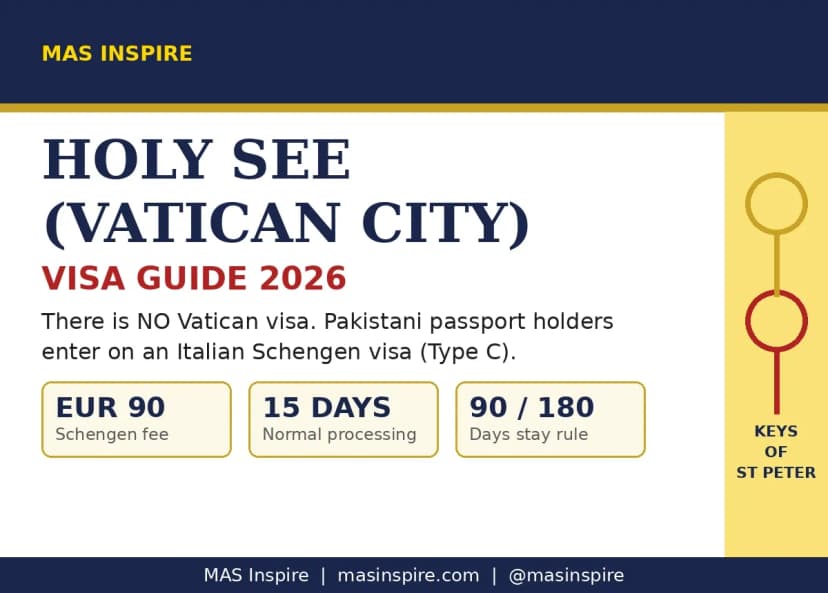
This guide states the fact plainly at the start, because everything else in it follows from it: there is no Vatican visa, no Vatican embassy visa application, and no Vatican border control. Vatican City is the world's smallest sovereign state — about 0.44 square kilometres, entirely enclosed within the city of Rome, Italy — and it has no passport checks on its boundary with Italy. You walk in from Rome, and you walk back out again. What controls your entry is therefore not a Vatican rule at all, but Italy's entry rule for your passport.
For a Pakistani passport holder living in Vietnam, that means one thing: you need an Italian short-stay Schengen visa (Type C), applied for in Vietnam through the Italian mission's authorised visa application centres run by VFS Global. Pakistan is listed in Annex I of Regulation (EU) 2018/1806, which means Pakistani nationals must hold a visa before crossing the external border of any Schengen state, including Italy. There is no visa on arrival and no visa-free entry for an ordinary Pakistani passport.
This guide explains the Italian Schengen route in full — the visa types, the fee of EUR 90, the documents, the VFS Global centres in Hanoi, Da Nang and Ho Chi Minh City, the 15-day processing time, and the proof of funds — and then explains what is different, and what is not different, once you are inside Vatican City: no passport stamp, no separate stay count, no overnight tourist accommodation, and no tourist route to living or working in the Vatican. Figures were re-verified against official Italian sources on 28 November 2026. Where sources disagree, the disagreement is disclosed in the text and the controlling source is named. Always confirm the live fee in Vietnamese dong and the current VFS appointment position before you pay or travel, because consular exchange rates are updated quarterly.
Why People Visit the Holy See and Vatican City
People visit the Vatican for reasons that go well beyond ordinary sightseeing. For Catholics, it is the spiritual heart of the Church: St Peter's Basilica stands over the tomb of St Peter, the Pope celebrates Mass and gives audiences here, and pilgrims come to pray, to attend liturgies, and to pass through the Holy Door in a Jubilee year. For lovers of art and history, the Vatican Museums hold one of the greatest collections in the world, ending in Michelangelo's Sistine Chapel ceiling and The Last Judgment, alongside the Raphael Rooms, the Gallery of Maps and the Pinacoteca. For general travellers, St Peter's Square, Bernini's colonnade and the dome — the tallest in the world — are among the most recognisable sights in Europe, and a visit to Rome without the Vatican feels incomplete.
Most visitors combine the Vatican with a wider trip to Rome and Italy: a few days in the capital, perhaps Florence, Venice or the Amalfi Coast, with one full day set aside for the Vatican itself. That matters for the visa, because the Schengen visa you apply for is an Italian visa for the whole trip, not a Vatican-only document. Your itinerary, hotel bookings and proof of funds should cover the entire Italian stay, with the Vatican day as one part of it. A trip described as "Vatican only" with no accommodation in Rome will confuse a consular officer, because there is no tourist hotel inside Vatican City at all — every visitor sleeps in Rome.
Some visitors come for a specific event: a papal audience on a Wednesday, an Easter or Christmas liturgy, a canonisation, or a Jubilee pilgrimage. If that is your purpose, say so in your cover letter and support it with the relevant booking or registration. A clear, dated purpose strengthens an application; a vague one weakens it. Whatever brings you, the entry rule is the same for everyone on a Pakistani passport: an Italian Schengen visa, obtained before departure from Vietnam.
No Vatican Visa: How Entry Really Works
The Holy See and Vatican City State are two different things, and neither of them issues tourist visas. The Holy See is the central governing body of the Catholic Church and the subject of international law that maintains diplomatic relations with states around the world. Vatican City State is the small physical territory within Rome created by the Lateran Treaty of 1929, which settled the relationship between the Holy See and Italy. The Pope is the sovereign of Vatican City State, and the Holy See conducts its diplomacy. Neither entity operates a visa system for visitors, an online visa portal, or a border force.
In practice, entry works like this. You fly into Italy — almost always Rome's Fiumicino or Ciampino airport — and you pass through Italian Schengen border control there. Your passport is checked, your Schengen visa is examined, and, since the EU Entry/Exit System (EES) became fully operational on 10 April 2026, your facial image and fingerprints are recorded electronically at that external Schengen border. From the airport you travel into Rome. When you walk across St Peter's Square, you cross from Italy into Vatican City without any checkpoint, passport check, stamp or form. There is a security screening — airport-style metal detectors and bag checks — to enter St Peter's Basilica and the Vatican Museums, but that is security, not immigration. Nobody asks for your visa there, and nobody stamps your passport.
Three consequences follow, and each of them matters for planning. First, time spent in Vatican City counts as time in Italy and in the Schengen Area. The 90-days-in-any-180-day rule keeps running while you are inside the Vatican; stepping across the square does not pause or reset your Schengen clock, and there is no separate Vatican stay allowance. Second, there is no Vatican passport stamp. If you collect stamps, you will not get one at St Peter's — the Vatican does not stamp tourists' passports, and there is no office that does so. Third, your right to be in the Vatican depends entirely on your right to be in Italy. If your Schengen visa expires, or you entered Italy unlawfully, you have no separate Vatican permission to fall back on.
This also means you should be deeply suspicious of anyone selling a "Vatican visa", a "Vatican e-visa", a "Holy See visa approval" or a "Vatican invitation letter for a fee". No such document exists for tourists. Any website or agent charging for one is either mistaken or fraudulent. The only genuine document is the Italian Schengen visa in your passport, and the only genuine invitation that matters is one supporting that Italian application — for example, a letter from a host in Italy, if you are staying with one.
Types of Visas and Entry Routes
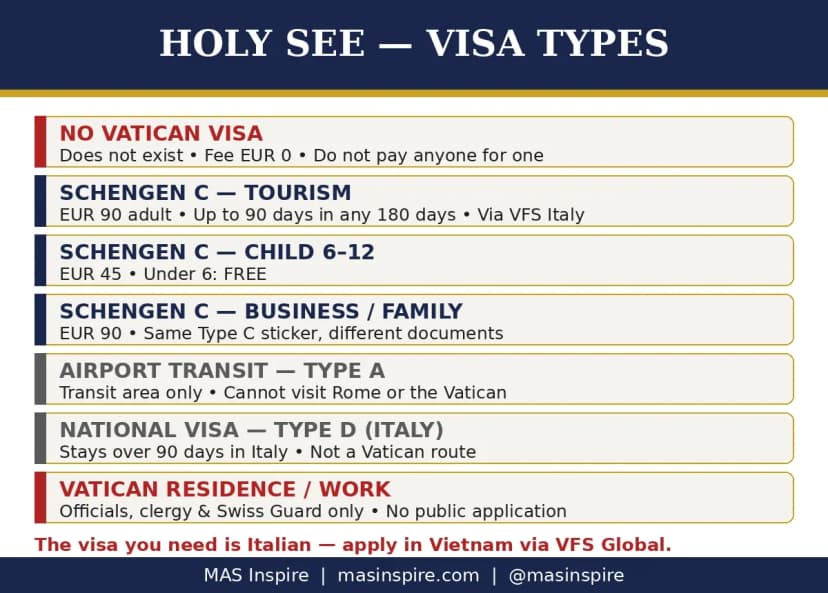
Because the Vatican has no visa of its own, the "types" in this guide are the Italian visa types that get you there. The right one depends on the purpose and length of your trip. For almost every Pakistani visitor living in Vietnam, the answer is the short-stay Schengen visa, Type C. The other routes below are included so you can recognise them — and recognise when an agent is offering you the wrong one.
1. Schengen short-stay visa, Type C — tourism and pilgrimage
This is the visa for holidays, pilgrimages, visiting friends and family, and short business trips of up to 90 days in any 180-day period across the whole Schengen Area. It is a uniform visa: the same sticker covers Italy and the other 28 Schengen states. You apply to Italy when Italy is your main destination — the country where you will spend the most days — or, if no main destination exists, the country of first entry. A Rome-and-Vatican trip is plainly an Italian main destination. The fee is EUR 90 for adults. The visa may be issued for a single entry, two entries or multiple entries, and for a validity longer than your trip; the number of days you may actually stay is printed on the sticker and is never more than 90 in any 180 days.
2. Schengen short-stay visa, Type C — business and other short purposes
The same Type C sticker covers short business visits, conferences, and short study or training courses under 90 days. The difference is in the supporting documents: a business invitation from the Italian company, a conference registration, or an enrolment letter replaces or supplements the tourist itinerary. You must not use a tourist Type C visa to take up employment in Italy or in the Vatican.
3. Schengen visa for family visits
If you are visiting family legally resident in Italy, you apply for the same Type C visa with a family-visit purpose, supported by an invitation and proof of the family relationship and of your host's legal residence in Italy. The fee and processing time are the same as for tourism.
4. Airport transit visa, Type A
A Type A visa is only for passing through the international transit area of an airport without entering Schengen territory. It does not let you leave the airport, visit Rome, or enter the Vatican. It is irrelevant to a Vatican trip unless your journey involves a transit-only connection, and it must not be confused with a visit visa.
5. National long-stay visa, Type D — Italy
For stays over 90 days in Italy — work, long-term study, family reunification, elective residence — Italy issues a national Type D visa, decided within 90 days of application (30 days for some employment and family cases, 120 days for self-employment, under Italian MFA guidance). A Type D visa is an Italian route, not a Vatican one. It does not give you a right to reside inside Vatican City, and it is not a shortcut to Vatican employment or residence.
6. Residence and work inside Vatican City — not a tourist route
There is no tourist application for residence, work or study inside Vatican City. The tiny resident population — clergy, members of the Swiss Guard, and officials and employees of the Holy See and Vatican City State and their families — live there by virtue of their office or employment, under arrangements made through the Holy See, not through a public visa application. A job offer from a Vatican body is a matter for that body and the Holy See; it is not something you apply for at VFS Global. Section 13 explains this in more detail, including the warning signs of recruitment fraud.
7. ETIAS — not a visa, and not in operation
ETIAS, the European Travel Information and Authorisation System, is a future online pre-travel authorisation for visa-exempt travellers — people who do not need a visa at all. It is not a visa, it does not apply to Pakistani passport holders (who need a visa in any case), and, importantly, it is not in operation: the EU has announced no start date, and no applications are being collected. Do not pay any website that claims to sell you an ETIAS authorisation today.
Holy See Visa and Entry Comparison Table
The table below summarises the whole picture on one page. The controlling fact is the first row: there is no Vatican visa to compare against, so every route in the table is an Italian one.
| Route | Who it is for | Maximum stay | Fee (adult) | Where to apply (from Vietnam) |
|---|---|---|---|---|
| Vatican / Holy See tourist visa | Nobody — does not exist | Not applicable | EUR 0 — no fee, no form | Nowhere — do not pay anyone for one |
| Italian Schengen visa, Type C (tourism / pilgrimage) | Pakistani visitors to Rome and the Vatican | 90 days in any 180 days | EUR 90 (2,800,000 VND at the HCMC consulate rate) | VFS Global, Hanoi / Da Nang / Ho Chi Minh City |
| Italian Schengen visa, Type C (business / family visit) | Short business or family visits | 90 days in any 180 days | EUR 90 | VFS Global, Hanoi / Da Nang / Ho Chi Minh City |
| Italian Schengen visa, Type C (child 6–12) | Children aged 6 to 12 | 90 days in any 180 days | EUR 45 (1,400,000 VND at the HCMC consulate rate) | VFS Global, Hanoi / Da Nang / Ho Chi Minh City |
| Italian Schengen visa, Type C (child under 6) | Children under 6 | 90 days in any 180 days | Free | VFS Global, Hanoi / Da Nang / Ho Chi Minh City |
| Airport transit visa, Type A | Transit only, no entry to Italy | Transit area only | EUR 90 | VFS Global (not usable for a Vatican visit) |
| Italian national visa, Type D | Long stays over 90 days in Italy | Over 90 days, per permit | Separate national-visa fee — confirm at the mission | Italian mission via VFS Global |
| Vatican residence / work | Holy See officials, clergy, Swiss Guard, Vatican employees only | By office, not by visa | Not a public fee | Through the Holy See body concerned — no public application |
Two notes on the table. First, the reduced Schengen fee of EUR 35 (1,100,000 VND) on the HCMC consulate page applies to nationals of Armenia, Azerbaijan and Belarus under visa facilitation agreements — it does not apply to Pakistani nationals, who pay the full EUR 90. Second, the Type D national-visa fee is deliberately not stated here: it is a separate fee outside the scope of a Vatican visit, and the figure was not verified against the HCMC consulate fee page for this guide, so it must be confirmed with the mission before any payment.
Eligibility Requirements
To qualify for the Italian Schengen visa that takes you to the Vatican, you must meet the standard Schengen conditions, and the consulate must be satisfied on each of them. A visa is not a right; it is a permission granted when the conditions are met and the consulate is convinced you will leave on time.
Lawful residence in Vietnam. You apply in the country where you legally reside. As a Pakistani national living in Vietnam, you apply through the Italian mission responsible for Vietnam — the Embassy of Italy in Hanoi or the Consulate General of Italy in Ho Chi Minh City, via their VFS Global centres — and you must show your Vietnamese residence status (temporary residence card, valid visa, or work permit, as applicable). Apply in the jurisdiction that covers your place of residence in Vietnam: the north is served from Hanoi, and the centre and south from Ho Chi Minh City, with a Da Nang centre for the central region. Applying in the wrong jurisdiction is a common cause of delay.
A valid passport. Your Pakistani passport must have been issued within the last 10 years, remain valid for at least three months beyond your planned departure from the Schengen Area, and contain at least two blank pages. A passport that fails any of these three tests makes the application inadmissible, not merely weak.
Purpose and conditions of the stay. You must show a credible, documented purpose: a tourist itinerary for Rome and the Vatican, hotel bookings, and a day-by-day plan. The consulate checks that the purpose matches the documents — a "pilgrimage" with no Vatican booking and no itinerary will raise questions, just as a "business trip" with no invitation will.
Sufficient means of subsistence. Italy applies a fixed statutory scale for means of support (Interior Ministry Directive of 1 March 2000). For a solo traveller, the minimum is EUR 269.60 in total for a trip of 1 to 5 days; EUR 44.93 per day for 6 to 10 days; EUR 51.64 plus EUR 36.67 per day for 11 to 20 days; and EUR 206.58 plus EUR 27.89 per day for trips over 20 days. Lower rates apply per person when two or more people travel together. These are legal minimums, not recommendations: in practice, show comfortably more than the minimum, with a stable balance over several months, because a balance that only just meets the minimum on the day of application is not persuasive.
Travel medical insurance. You need insurance valid throughout the Schengen Area for the whole trip, covering emergency medical treatment, hospitalisation and repatriation (including repatriation of remains) with a minimum cover of EUR 30,000. A policy that excludes Italy, covers less than EUR 30,000, or ends before your departure date will be rejected.
Intention to leave. You must convince the consulate that you will leave the Schengen Area before your visa expires and return to Vietnam (or Pakistan). For a teacher or worker resident in Vietnam, the strongest evidence is your employment contract, salary slips, leave approval from your employer, your Vietnamese residence card, and ties such as a lease or family in Vietnam. Previous lawful travel history — especially previous Schengen visas used correctly — helps considerably. A first-time applicant with weak ties is the highest-risk profile, so document your life in Vietnam thoroughly.
Biometrics. First-time applicants must appear in person so fingerprints and a photograph can be taken. Fingerprints in the Visa Information System remain valid for 59 months, after which they are taken again. Children under 12 are exempt from fingerprinting.
No threat to public order or public health. The consulate consults the Schengen Information System and may refuse where there is an alert or a security concern. Prior overstays, refusals or deportations from any Schengen state must be declared honestly; they will be found anyway, and concealment is itself a ground for refusal.
Complete Document Checklists
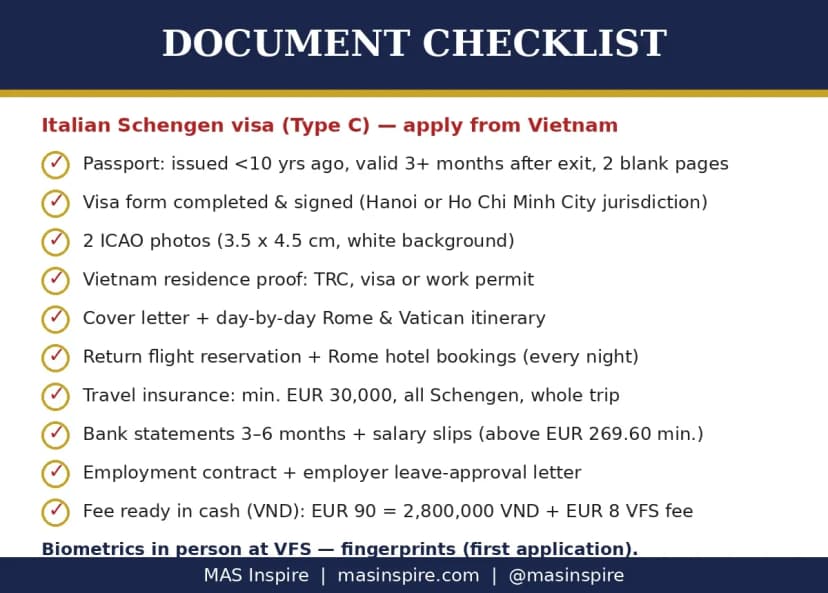
Prepare the file in the order the VFS checklist uses, with originals and photocopies as the checklist requires. A missing document is the single most common reason a file is delayed or refused. Do not submit a document you have not read: every bank statement, letter and booking must be consistent with every other one — same dates, same names, same hotels.
Tourist / pilgrimage checklist (Type C, adult)
| Document | Details |
|---|---|
| Visa application form | Completed and signed; use the form for your jurisdiction (Hanoi or Ho Chi Minh City), or the form from the Visto per l'Italia portal |
| Passport | Issued within the last 10 years; valid 3+ months beyond Schengen exit; 2 blank pages; plus copies of all used pages and previous passports |
| Photographs | Two recent passport-size colour photos, ICAO standard, white background (3.5 × 4.5 cm) |
| Vietnam residence proof | Temporary residence card, valid Vietnamese visa, or work permit, plus copies |
| Cover letter | Purpose of trip, day-by-day itinerary (Rome and Vatican), travel dates, who is paying, and your ties to Vietnam |
| Flight reservation | Return or onward ticket (reservation, not necessarily a paid ticket, unless the checklist requires it) |
| Accommodation proof | Hotel bookings in Rome for every night; a host invitation if staying with family or friends in Italy |
| Travel medical insurance | Minimum EUR 30,000, valid in all Schengen states for the whole trip |
| Proof of funds | Bank statements for the last 3 to 6 months, showing a stable balance above the Italian minimum scale; salary slips |
| Employment proof | Employment contract, employer letter stating position, salary, leave approval and return to work; or business registration and tax returns if self-employed |
| Vatican visit evidence | Vatican Museums ticket booking (official site), papal audience registration or pilgrimage programme details, if applicable |
| Visa fee payment | EUR 90 (2,800,000 VND at the HCMC consulate rate), cash in VND at submission, plus the VFS service fee (see Section 9) |
Business visit checklist (additions and changes)
| Document | Details |
|---|---|
| Invitation from the Italian company | On company letterhead, stating purpose, dates, who pays, and the inviter's details; the company should also send it to the competent Italian mission |
| Employer letter (Vietnam) | Your position, salary, purpose of travel and leave approval |
| Company documents (Vietnam) | Business registration and recent tax returns, if self-employed or a company owner |
| Conference / event proof | Registration confirmation, agenda or programme, if attending an event |
Family visit checklist (additions and changes)
| Document | Details |
|---|---|
| Invitation from the host in Italy | Signed invitation with the host's details and address |
| Proof of relationship | Birth or marriage certificates showing the family link |
| Host's legal residence | Copy of the host's Italian residence permit or ID, and proof of accommodation |
Children (additions)
For a child travelling with you, add the child's birth certificate, copies of both parents' passports, and — if the child travels with only one parent or a third person — a notarised consent letter from the non-travelling parent(s). The visa fee is EUR 45 for children aged 6 to 12 and free for children under 6. Children under 12 do not give fingerprints, but they must still appear in person where the checklist requires it.
How to Apply: Step-by-Step
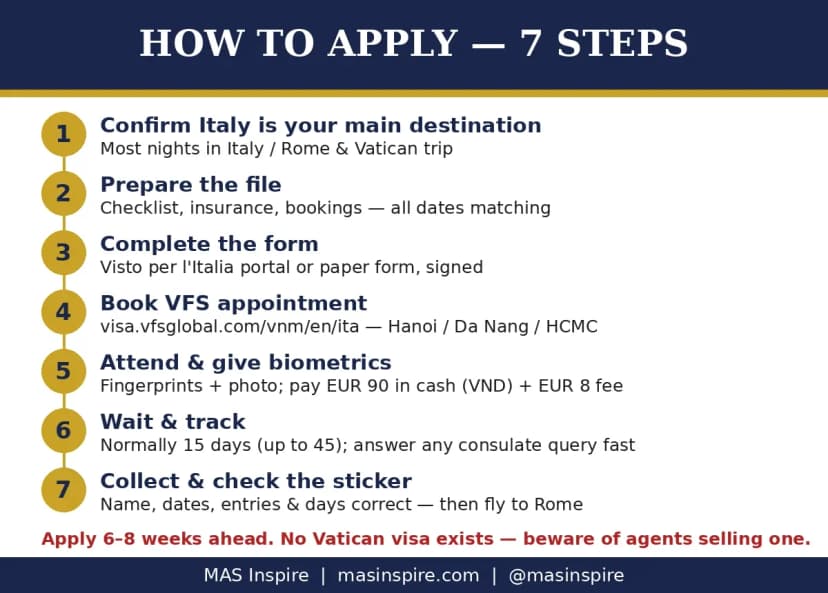
Apply from Vietnam, not from Pakistan, because you legally reside in Vietnam. The steps below follow the official Italian mission and VFS Global route for Vietnam.
Step 1 — Confirm Italy is the competent state. Italy must be your main destination (most nights) or, if stays are equal, your first Schengen entry. A Rome-and-Vatican trip with onward travel elsewhere in Schengen still goes to Italy if Italy has the most nights. If another country has more nights, apply to that country instead.
Step 2 — Prepare the file. Work through the checklist in Section 7. Book refundable or changeable flights and hotels where possible, buy the insurance only once dates are firm, and make sure every document shows the same dates and spellings. Get the employer letter and bank statements last, so they are recent at submission.
Step 3 — Complete the form. Fill in the Schengen application form — via the Visto per l'Italia portal (vistoperitalia.esteri.it) or the paper form for your jurisdiction — and print and sign it. Answer every question; a blank field is treated as an omission.
Step 4 — Book the VFS appointment. Book in advance on the VFS Global Italy–Vietnam website (visa.vfsglobal.com/vnm/en/ita). Choose the centre for your jurisdiction: Hanoi, Da Nang or Ho Chi Minh City. Appointment slots fill quickly in peak season (Easter, summer, Christmas), so book as soon as your dates are firm. Groups of six or more should contact the VFS helpline in advance.
Step 5 — Attend in person and give biometrics. Go to the centre at your appointment time with the complete file. You will give fingerprints and a photograph (unless exempt), pay the visa fee in cash in Vietnamese dong and the VFS service fee, and receive a receipt with a reference number. Keep that receipt: it is your only proof of submission and your tracking key.
Step 6 — Wait for the decision and track the file. Track the application on the VFS website with your reference number. The consulate may call you or request additional documents; answer promptly and in full. Do not book non-refundable travel until the visa is issued.
Step 7 — Collect the passport and check the sticker. When the passport is returned, check the visa sticker immediately: your name, passport number, validity dates, number of entries, and the number of days of stay. Any error must be reported to the centre at once — an error discovered at the airport is usually too late. If the visa is refused, the refusal letter states the grounds; you may appeal or reapply with a corrected file (see Section 14).
Visa Fees and Financial Requirements
Fees are set at EU level for the Schengen visa and converted into Vietnamese dong by the Italian mission at a quarterly consular rate, so the dong figure changes even when the euro figure does not. The figures below are those published by the Consulate General of Italy in Ho Chi Minh City and re-verified for this guide on 28 November 2026.
| Fee | Amount | Notes |
|---|---|---|
| Schengen visa, Type C — adult (12 and over) | EUR 90 / 2,800,000 VND | Paid in cash in VND at submission; non-refundable if refused |
| Schengen visa, Type C — child 6 to 12 | EUR 45 / 1,400,000 VND | Non-refundable if refused |
| Schengen visa, Type C — child under 6 | Free | Visa fee waived |
| Schengen visa, Type C — reduced (Armenia, Azerbaijan, Belarus) | EUR 35 / 1,100,000 VND | Visa facilitation agreements — does not apply to Pakistani nationals |
| VFS Global service fee (Vietnam) | EUR 8 | Charged in addition when applying through VFS, per the HCMC consulate page (see disclosure below) |
| Vatican / Holy See visa | EUR 0 | No such visa exists; anyone charging for one is not legitimate |
| Travel medical insurance | Varies by provider | Minimum cover EUR 30,000, whole trip, all Schengen states |
Disclosure — VFS service fee conflict. The HCMC consulate's official fee page states that an additional service fee of EUR 8 is charged when the application is submitted through VFS. General Schengen guides, by contrast, quote a VFS/TLS service fee of EUR 15 to EUR 35, and EU rules cap the external provider's fee at half the visa fee (EUR 45). These figures do not agree, and this guide does not smooth over the gap: the controlling source for an application made in Vietnam is the HCMC consulate's own page (EUR 8), and you should confirm the exact dong amount at the VFS centre before your appointment, because the centre may charge additional optional services (courier return, SMS updates, photocopying) on top. Budget for the EUR 90 visa fee plus the EUR 8 service fee as the minimum, and treat the EUR 15–35 range as a general, non-Vietnam-specific figure that does not govern your application.
Proof of funds — the Italian scale. The minimum means of subsistence for tourism are fixed by the Interior Ministry Directive of 1 March 2000 and reproduced in the EU's Annex 25 reference amounts. For one person travelling alone:
| Trip length | Minimum (solo traveller) | Minimum (two or more travelling together, per person) |
|---|---|---|
| 1 to 5 days | EUR 269.60 fixed total | EUR 212.81 fixed total |
| 6 to 10 days | EUR 44.93 per day | EUR 26.33 per day |
| 11 to 20 days | EUR 51.64 fixed + EUR 36.67 per day | EUR 25.82 fixed + EUR 22.21 per day |
| More than 20 days | EUR 206.58 fixed + EUR 27.89 per day | EUR 118.79 fixed + EUR 17.04 per day |
Worked example: a solo 7-day trip to Rome needs at least 7 × EUR 44.93 = EUR 314.51 under the scale, and a solo 14-day trip needs EUR 51.64 + (14 × EUR 36.67) = EUR 565.02. These are floors, not targets. In practice, show a balance well above the floor, held steadily for three to six months, plus evidence of regular salary income. A large lump-sum deposit made days before the application is a red flag, not a solution: consulates look at the pattern, not just the final number. Pre-paid accommodation and a return ticket reduce the amount you must show for subsistence and repatriation, but they do not remove the requirement.
Processing Times
| Stage | Time | Notes |
|---|---|---|
| Appointment wait | Days to weeks | Varies by season and centre; peak periods (Easter, May–August, Christmas) are longest |
| Schengen visa (Type C) decision | 15 calendar days, normally | Counted from the date the admissible application reaches the consulate |
| Extended examination | Up to 45 calendar days | Where further documents or checks are needed (Article 23, Visa Code) |
| Italian national visa (Type D) decision | Within 90 days | 30 days for some employment and family reunification cases; 120 days for self-employment |
| Earliest you may apply | 6 months before travel | 9 months for seafarers |
| Latest you may apply | 15 calendar days before travel | Later applications are inadmissible as a rule |
The 15-day figure is the legal standard under the EU Visa Code, confirmed by the Italian Ministry of Foreign Affairs: Schengen visas take 15 days, extendable to 45 days where the law provides. It is not a guarantee — it is the time the consulate is allowed, and a complex file can use all of it. The practical lesson is to apply early: submit six to eight weeks before departure, and never less than three weeks before, because the appointment wait sits on top of the 15 days. If you apply 16 days before a flight, a single request for an extra document can make the trip impossible. There is no official express or priority service that shortens the legal decision time for a tourist Schengen visa from Vietnam; anyone selling a "guaranteed 3-day Vatican visa" is selling a fiction.
Applying from Pakistan or Vietnam
Applying from Vietnam (your route). As a Pakistani national legally resident in Vietnam, you apply in Vietnam. The Italian mission network in Vietnam is the Embassy of Italy in Hanoi and the Consulate General of Italy in Ho Chi Minh City, and both use VFS Global centres for collection. Current centres, per the Embassy of Italy in Hanoi notice of 1 October 2025, are: Hanoi — 3rd Floor, Ocean Park Building, 1 Dao Duy Anh, Dong Da; Ho Chi Minh City — 11th Floor, President Place Tower, 93 Nguyen Du, Ben Nghe, District 1; and Da Nang — 8th Floor, Bach Dang Complex, 50 Bach Dang, Hai Chau. The VFS helpline is +84 28 3521 2002 and the email is info.itvn@vfshelpline.com. Appointments are booked in advance at visa.vfsglobal.com/vnm/en/ita. Centres are open Monday to Friday, 8:00–12:00 and 13:00–15:00. Your jurisdiction follows your residence: the Hanoi embassy covers the north, and the Ho Chi Minh City consulate general covers the centre and south (with Da Nang serving the central region). Confirm your jurisdiction on the VFS site before booking.
Disclosure — VFS centre addresses have changed. Older guides and agency pages still list different addresses for the same cities — for example, a Resco Building address on Nguyen Du in Ho Chi Minh City and a Central Building address on Hai Ba Trung in Hanoi. Those addresses are superseded by the Embassy of Italy in Hanoi notice that closed the Haiphong, Can Tho and Vung Tau centres on 1 October 2025 and restated the three current centres. The addresses in the paragraph above are the controlling ones; do not travel to an address from an older page without checking the VFS site first.
Applying from Pakistan (for comparison). If you were in Pakistan rather than Vietnam, you would apply through the Italian Embassy in Islamabad or the Consulate General in Karachi, via their BLS International centres. The visa, fee (EUR 90) and 15-day processing rule would be identical, because the Schengen rules are uniform — only the collection partner, the local currency conversion (rupees instead of dong) and the jurisdiction differ. You cannot apply in Pakistan while resident in Vietnam and expect a faster result, and you cannot apply by post: the first application requires an in-person appearance for biometrics. If your Vietnamese residence has expired or you are in Vietnam only as a short-term visitor, raise that with the mission before applying, because the competent mission is determined by lawful residence, not by where you happen to be.
Residence documents to include. Enclose your Vietnamese temporary residence card (TRC) or long-term visa and work permit, your employment contract and a leave-approval letter from your school or employer, recent salary slips, and proof of address in Vietnam. These documents do double duty: they prove lawful residence in Vietnam (so Vietnam is the right place to apply) and they prove ties that support your return (so the consulate believes you will come back).
Visiting the Vatican: Practical Guide for Pilgrims and Tourists
Once the visa is in your passport, the Vatican itself is straightforward — but a few practical facts save a wasted day.
Getting there. There is no airport, railway station or hotel inside Vatican City for tourists. You stay in Rome and walk in. The nearest metro stop is Ottaviano (Line A), about a ten-minute walk from St Peter's Square; Roma San Pietro station is also close. St Peter's Square itself is free and open to all, day and night, with no ticket. Entry to St Peter's Basilica is free, through airport-style security screening on the right side of the square as you face the façade. The Vatican Museums have a separate entrance on Viale Vaticano, outside the square, and require a ticket.
Tickets and prices. A Vatican Museums ticket, which includes the Sistine Chapel, costs EUR 20 at the ticket office or EUR 25 booked online on the official site (tickets.museivaticani.va), the EUR 5 difference being the online booking supplement. Reduced tickets for ages 7 to 18 and for students up to 25 with proof of enrolment cost EUR 10 at the ticket office or EUR 15 online, and children under 7 enter free. The dome of St Peter's costs EUR 17 by stairs or EUR 22 with the lift. Disclosure: these ticket prices were verified against the Vatican Museums' official price list as reported by specialist guides checked on 1 November 2026, not by a live read of the Vatican's own ticketing page for this guide — re-check the price on tickets.museivaticani.va when you book, and buy only there, because third-party sellers add large mark-ups and the Museums do not refund tickets.
Hours. The Vatican Museums are open Monday to Saturday, 8:00 to 20:00, with last entry at 18:00, and closed on Sundays except the last Sunday of the month, when entry is free from 9:00 to 14:00 (last entry 12:30). St Peter's Basilica is open daily; hours vary by season. Disclosure: secondary sources disagree on the Basilica's closing time — 19:00 in the winter schedule and 20:00 in the summer schedule introduced on 1 June 2026 — so this guide does not state a single closing time as fact; check the Basilica's own opening-hours page for your travel dates. The Museums are also closed on fixed holidays (1 and 6 January, 11 February, 19 March, Easter Monday, 1 May, 29 June, 14 and 15 August, 1 November, 8, 25 and 26 December), and the free Sunday is cancelled when it falls on Easter Sunday, 29 June, or 25, 26 or 31 December.
Dress code. Shoulders and knees must be covered for both men and women in the Basilica, the Museums, the Sistine Chapel and the Vatican Gardens. Sleeveless and low-cut tops, shorts above the knee, miniskirts and hats are not allowed, and guards do turn people away. Bring a light scarf or long trousers rather than hoping a cover-up will pass. Remove hats inside the Basilica.
Inside the Sistine Chapel. No photography or video of any kind is allowed in the Sistine Chapel, and guards enforce it. Photography without flash is permitted in most of the Museums. Silence is requested in the Chapel.
Papal audiences and Mass. The Pope's general audience is usually held on Wednesday mornings in St Peter's Square (or the Paul VI Hall in winter). Tickets are free and are requested in advance through the Prefecture of the Papal Household; they are not sold, and anyone selling audience tickets is not legitimate. Sunday Angelus at noon in the Square needs no ticket. For Easter, Christmas and canonisations, arrive very early and expect long security queues.
Money. The Vatican uses the euro under a monetary agreement with the EU, and even mints its own euro coins. There is no currency to change when you walk in from Rome. Cards are accepted at the Museums; small vendors and donations are often cash-only.
No overnight stay. There are no public hotels or tourist accommodation inside Vatican City. Overnight stays are restricted to Vatican residents and official guests of the Holy See. Plan every night in Rome, and make sure your visa file's hotel bookings reflect that.
Work, Study and Long-Stay in Vatican City
This section exists mainly to prevent a costly mistake: the Vatican is not a destination for job-seeking, study or long-term residence through any public application, and treating it as one is how people lose money to fraud.
Work. Vatican City has no labour market open to foreign applicants. Its workforce is small and specific: clergy, members of the Pontifical Swiss Guard, and lay officials and employees of the Holy See and of Vatican City State, engaged through those institutions. The Swiss Guard itself recruits only Swiss Catholic men who meet strict age, height, military-service and character requirements — it is not a route for a Pakistani national. There is no Vatican work permit you can apply for at VFS Global, no quota, and no employer-sponsored Vatican visa. Any advertisement offering "Vatican jobs with visa and accommodation" for a fee is fraudulent. If a genuine Vatican body ever offered you a post, the engagement would be arranged by that body and the Holy See, and you would still enter Italy on an Italian visa first.
Study. There is no Vatican student visa. The pontifical universities and athenaeums in Rome (such as the Gregorian and the Angelicum) are in Italy, and a student there applies for an Italian national study visa (Type D) through the ordinary Italian route, with an enrolment letter, proof of funds and accommodation in Rome. Studying in Rome does not confer residence inside Vatican City.
Long stay and residence. A stay in Italy of more than 90 days requires an Italian national visa and then a permesso di soggiorno (residence permit) in Italy. There is no equivalent "Vatican residence permit" for tourists, and no period spent visiting the Vatican counts toward Italian residence. Vatican City residence is a status attached to office or employment with the Holy See, not something acquired by length of stay.
Asylum and protection. Vatican City is not a route for asylum claims, and it has no asylum procedure for the public. Protection claims in Italy follow Italian and EU procedures and must be made to the Italian authorities.
Common Application Mistakes and Reasons for Refusal
Most refusals of Pakistani applicants for an Italian Schengen visa are not about the Vatican at all — they are about the Italian file. The commonest mistakes are avoidable.
Applying to the wrong country. If you spend more nights in France or Spain than in Italy, Italy is not competent and the application will be refused or returned. Count the nights honestly and apply to the country with the most.
Applying for a "Vatican visa". There is none. An application addressed to the Vatican, a payment to a "Vatican visa agent", or a cover letter asking the Holy See for a visa wastes the fee and the trip. The application goes to Italy, through VFS Global.
Inconsistent documents. Hotel dates that do not match flight dates, a cover letter that says 10 days while the insurance covers 7, a bank statement in a different name, or an employer letter without leave dates — any of these can produce a refusal for "justification for the purpose and conditions of the intended stay was not provided" or "not reliable". Read the whole file as a stranger would before submitting it.
Weak proof of funds. A balance that barely meets the Italian minimum, a sudden large deposit, or statements showing only one month. Show three to six months of steady salary credits and a balance comfortably above the scale in Section 9.
No proof of ties to Vietnam. The refusal ground "reasonable doubts as to the intention to leave" is the most frequent for first-time applicants. Your TRC, employment contract, leave approval, salary slips and lease are the answer — include them even if the checklist calls them optional.
Wrong or missing insurance. A policy under EUR 30,000, one that excludes Italy or the Schengen Area, or one that ends before your return date. Buy the policy only after dates are fixed, and check the territorial validity line by line.
Expired passport validity or missing blank pages. The three-months-beyond-exit and two-blank-pages rules are checked mechanically. Renew the passport first if it fails them.
Previous overstay or undeclared refusal. Schengen refusals and overstays are recorded and shared. Declare them and explain what changed; concealment is discovered and is itself a refusal ground.
Applying too late. A complete file submitted 15 days before departure leaves no room for a request for extra documents. Apply six to eight weeks ahead.
If you are refused, the refusal letter lists the legal grounds. You can appeal through the channel stated in the letter, or submit a new, corrected application addressing each ground specifically. A new application that repeats the same file will be refused again; fix the cause, not just the date.
Frequently Asked Questions
1. Do Pakistani passport holders need a visa to visit the Vatican?
Yes — but it is an Italian Schengen visa, not a Vatican visa. Pakistan is a visa-required nationality for the Schengen Area, so you must hold a valid Italian Type C visa before travelling. There is no separate Vatican visa to apply for.
2. Is there a Vatican visa at all?
No. The Holy See and Vatican City State issue no tourist visas, run no visa portal, and operate no border control with Italy. Anyone charging a fee for a "Vatican visa" or "Vatican e-visa" is not legitimate.
3. How much does the visa cost?
EUR 90 for an adult (2,800,000 VND at the Consulate General of Italy in Ho Chi Minh City's published rate), EUR 45 for a child aged 6 to 12 (1,400,000 VND), and free for a child under 6. A VFS Global service fee of EUR 8 is charged in addition in Vietnam, per the HCMC consulate page — see the disclosure in Section 9, because general guides quote a wider EUR 15–35 range that does not govern Vietnam applications. All fees are non-refundable if the visa is refused.
4. Where do I apply from Vietnam?
At a VFS Global Italy centre in Hanoi (3rd Floor, Ocean Park Building, 1 Dao Duy Anh), Da Nang (8th Floor, Bach Dang Complex, 50 Bach Dang) or Ho Chi Minh City (11th Floor, President Place Tower, 93 Nguyen Du). Book in advance at visa.vfsglobal.com/vnm/en/ita. Your jurisdiction follows where you live in Vietnam.
5. How long does the visa take?
Normally 15 calendar days from the date the admissible application reaches the consulate, extendable to 45 days if further checks are needed. Apply between 6 months and 15 days before travel, and in practice six to eight weeks ahead.
6. How long can I stay?
Up to 90 days in any 180-day period across the whole Schengen Area, or fewer if your visa sticker says so. Time in the Vatican counts toward that total; it does not pause the clock.
7. Do I get a passport stamp at the Vatican?
No. There is no immigration control between Italy and Vatican City and no passport stamping for tourists. Your only Schengen record is the Entry/Exit System entry made when you entered Italy.
8. Can I visit the Vatican if my trip is only one day?
Yes, if your Italian Schengen visa covers that day and you are lawfully in Italy. You still need the visa in advance, hotel or day-trip arrangements in Rome (there is no tourist accommodation inside the Vatican), and travel insurance for the whole trip.
9. Do I need ETIAS to visit the Vatican?
No. ETIAS is not in operation, no start date has been announced, and no applications are being collected. It is also a system for visa-exempt travellers, which does not include Pakistani passport holders. Do not pay any site claiming to sell ETIAS.
10. What is the minimum money I must show?
Under Italy's statutory scale, a solo traveller needs EUR 269.60 for a 1–5 day trip, EUR 44.93 per day for 6–10 days, EUR 51.64 plus EUR 36.67 per day for 11–20 days, and EUR 206.58 plus EUR 27.89 per day beyond 20 days. Show comfortably more than the minimum, with three to six months of steady bank statements.
11. Is St Peter's Basilica free to enter?
Yes. Entry to the Basilica is free, through security screening. The Vatican Museums (including the Sistine Chapel) are ticketed: EUR 20 at the ticket office or EUR 25 online, with reduced tickets of EUR 10/15 and free entry for children under 7. The dome climb costs EUR 17 by stairs or EUR 22 with the lift.
12. What should I wear in the Vatican?
Shoulders and knees covered, for both men and women, in the Basilica, the Museums, the Sistine Chapel and the Gardens. Sleeveless tops, shorts above the knee, miniskirts and hats are not allowed, and guards turn people away.
13. Can I work or live in Vatican City?
No, not through any tourist route. Residence inside Vatican City is attached to office or employment with the Holy See — clergy, Swiss Guard members, and Vatican officials and employees. There is no public application, no work permit and no quota. Job offers for the Vatican that ask for a fee are fraud.
14. Can I apply for the visa from Pakistan instead of Vietnam?
If you live in Vietnam, you should apply in Vietnam — the competent mission is determined by lawful residence. Applying in Pakistan (through BLS centres for the Italian Embassy in Islamabad or Consulate General in Karachi) is the route for people resident in Pakistan, with the same EUR 90 fee and the same 15-day rule.
15. What happens if my visa is refused?
You receive a written refusal stating the legal grounds. You may appeal through the channel in the letter or submit a new application that directly fixes each ground — for example, stronger proof of funds or clearer ties to Vietnam. Reapplying with an unchanged file will be refused again. The fee is not refunded.
Official Immigration Websites
| Organisation | Website | What it is for |
|---|---|---|
| Italian Ministry of Foreign Affairs — Visto per l'Italia | vistoperitalia.esteri.it | Official Italian visa portal: check whether you need a visa and start the application |
| Italian Ministry of Foreign Affairs — Entry into Italy (FAQ) | esteri.it — Entry into Italy | Processing times (15 days, up to 45) and application windows (6 months to 15 days) |
| Consulate General of Italy in Ho Chi Minh City — Visa fees | conshochiminh.esteri.it — Visa fees | Schengen fees in EUR and VND, and the EUR 8 VFS service fee |
| Embassy of Italy in Hanoi | ambhanoi.esteri.it — Consular services and visas | Hanoi jurisdiction, VFS centre notice and appointments |
| VFS Global — Italy in Vietnam | visa.vfsglobal.com/vnm/en/ita | Book appointments, checklists and tracking for Hanoi, Da Nang and Ho Chi Minh City |
| European Commission — Schengen visa policy | home-affairs.ec.europa.eu — Applying for a Schengen visa | EU-wide Schengen rules, fees and procedures |
| Holy See — Official website | vatican.va | Official Holy See website; no visa service is offered there |
| Vatican Museums — Official tickets | tickets.museivaticani.va | The only official online seller of Vatican Museums tickets |
Final Checklist and Conclusion
Before you apply, run through this list. Every box should be ticked before your VFS appointment.
- Passport issued within the last 10 years, valid 3+ months beyond Schengen exit, with 2 blank pages.
- Vietnamese residence proof (TRC, visa or work permit) and proof of your address in Vietnam.
- Completed and signed Schengen application form for the correct jurisdiction.
- Two ICAO passport photos, recent, white background.
- Cover letter with a day-by-day Rome and Vatican itinerary.
- Return flight reservation and hotel bookings in Rome for every night.
- Travel medical insurance: minimum EUR 30,000, valid in all Schengen states for the whole trip.
- Bank statements for 3 to 6 months showing a stable balance above the Italian minimum scale, plus salary slips.
- Employment contract and employer leave-approval letter.
- Vatican Museums booking (official site) or audience/pilgrimage registration, if applicable.
- VFS appointment booked at the correct centre (Hanoi, Da Nang or Ho Chi Minh City).
- Visa fee ready in cash in VND: EUR 90 (2,800,000 VND) plus the VFS service fee.
- Applied 6 to 8 weeks before departure — never later than 15 days before.
- No payment made to any "Vatican visa" agent or website.
The Holy See is unlike every other destination in this guide series, and that is exactly the point: the visa you need is not a Vatican visa at all. A Pakistani passport holder living in Vietnam visits the Vatican on an Italian Schengen visa — EUR 90, applied for at VFS Global in Hanoi, Da Nang or Ho Chi Minh City, decided normally in 15 days, valid for up to 90 days in any 180 across the Schengen Area. Once you are in Rome, the Vatican is an open walk across St Peter's Square: no checkpoint, no stamp, no separate permission, and no extra fee. Keep that single fact in mind, build the Italian file carefully, and the smallest country in the world is also one of the simplest to enter — provided the Italian visa is in your passport before you fly. Figures in this guide were verified against official Italian sources on 28 November 2026; re-check the live consular exchange rate and VFS appointment position before you pay or travel.
Editorial note: this guide was prepared on 27 November 2026 and verified on 28 November 2026. Immigration rules, fees and VFS arrangements change; the official sources in Section 16 are controlling if anything here differs from them.