Comoros Visa Guide 2026: Types, Requirements, Fees and How to Apply
By MAS Inspire | Editorial draft: 27 November 2026 (fact-checked 26 November 2026; U.S. advisory fee conflict and passport-validity rule re-verified 27 November 2026)
Comoros is an Indian Ocean island nation made up of Grande Comore (Ngazidja), Anjouan (Ndzuwani) and Mohéli (Mwali). Whether you plan to visit for a holiday, attend business meetings, study, join family or take up employment, it is important to distinguish the entry visa from permission to reside or work.
Comorian immigration law provides for transit, tourist, short-stay and long-stay visas, as well as residence and resident cards. Tourist visas are commonly available on arrival, according to several foreign-government travel advisories. However, the official fee information available online is inconsistent. A visa on arrival should never be treated as a guarantee of entry: the immigration officer makes the admission decision at the border.
This guide was checked on 26 November 2026. It is an educational resource from MAS Inspire, not legal advice and not an official Comorian government publication.
Table of contents
- Why visit Comoros?
- Types of Comoros visas and permissions
- Visa comparison table
- Eligibility requirements
- Document checklists
- How to apply
- Visa fees and financial requirements
- Processing times and validity
- Applying from Pakistan or Vietnam
- Student, work and job opportunities
- Common application mistakes
- Reasons for refusal or entry denial
- Frequently asked questions
- Official immigration websites and useful links
- Final checklist and conclusion
Why visit Comoros?
Comoros attracts visitors interested in volcanic landscapes, marine environments, island culture and history. Grande Comore is home to the capital, Moroni, and the active Karthala volcano. Anjouan and Mohéli offer distinctive landscapes and coastal communities. Visitors may also travel for commercial meetings, official assignments, education, research or family reasons.
The purpose of travel matters. A visitor attending meetings is not automatically authorized to take up paid employment. A person intending to remain for an extended period should investigate long-stay and residence procedures before travelling.
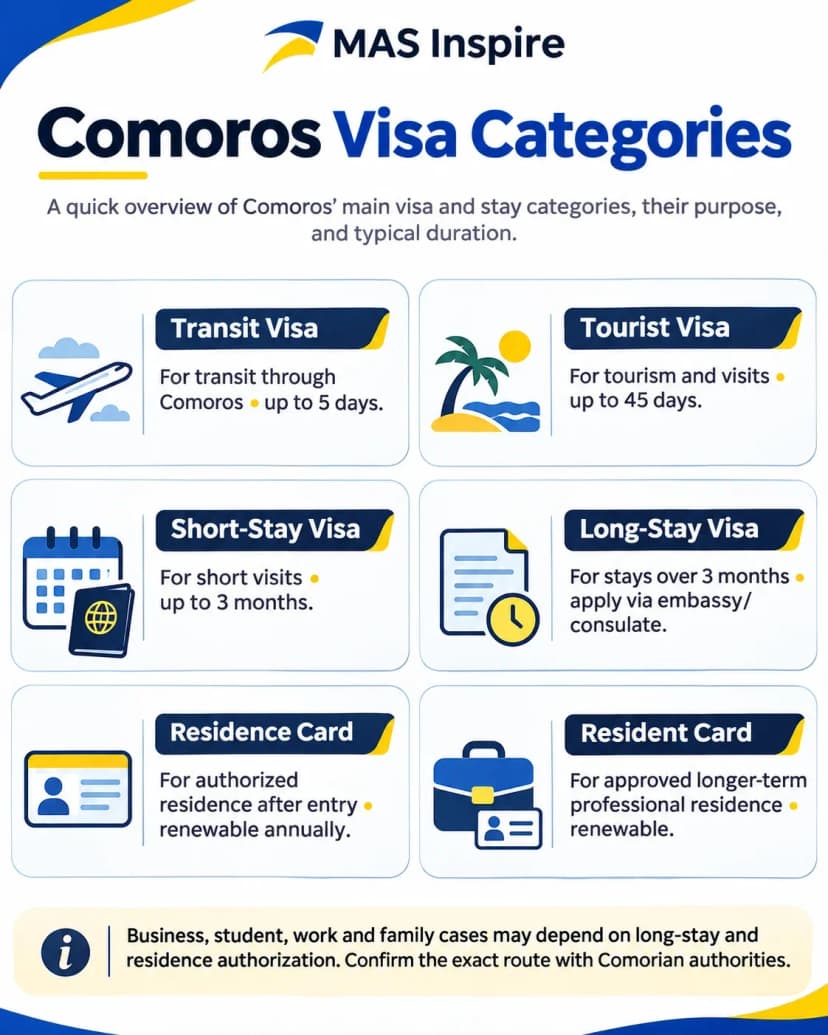
Types of Comoros visas and permissions
The main statutory framework is Law No. 88-025, published by the Comoros Ministry of Justice. It does not establish every visa label commonly used by international travel websites. The categories below distinguish what the law expressly identifies from purposes for which a separate visa category was not confirmed in the official material reviewed.
1. Tourist visa
The law describes a tourist visa as valid for a stay of up to 45 days. The U.S. Department of State and Government of Canada report that tourist visas can be obtained on arrival, including at Moroni's Prince Said Ibrahim International Airport and other points of entry. Travellers should carry a return or onward ticket, accommodation details, sufficient funds and the visa fee in an accepted form of cash.
A tourist visa does not authorize employment or other lucrative activity. Do not use it to work remotely for a Comorian employer or provide paid services in Comoros without written confirmation of the required authorization.
2. Transit visa
The law provides for a transit visa allowing a stay of up to five days, issued at an airport or port. This is for a genuine transit itinerary, not a substitute for a tourist or residence permission. Confirm eligibility and whether the transit visa is issued at the specific entry point before travelling.
3. Short-stay visa
A short-stay visa may authorize a stay of no more than three months and may potentially be renewed once under Article 2. The exact permitted duration, entry count, conditions and renewal process must be confirmed with the issuing authority. Do not assume that the maximum statutory period is automatically granted.
4. Long-stay visa and residence card
A foreign national wishing to stay for more than three months must apply for a long-stay visa through the nearest Comorian diplomatic or consular representation. Under Article 5, the decision is taken by the Council of Ministers. Within ten days of entry, the Ministry of the Interior is to issue a residence card, which is renewable annually.
The residence card is not the same as a work authorization. The law separately requires a resident card for a foreign national who wishes to exercise a professional activity.
5. Work and resident-card route
Under Articles 10–12, a foreign national who holds a residence card and wants to work must obtain a resident card. For salaried employment, the application is submitted to the minister responsible for labour and must include an employment contract. For industrial, commercial, craft or liberal-profession activity, the application goes to the minister responsible for economy and finance; setting up a business requires an application for authorization to create the enterprise. Decisions are made by the Council of Ministers under the statutory text.
The Labour Code also refers to a special foreign-worker card and restricts employing a foreign national who does not hold the required card. An ordinary tourist or short-stay visa is not a work permit.
6. Business visitor
The law excludes brief business transactions by people who have no fixed establishment in Comoros from the general prohibition on lucrative activity. This is a narrow exception for business visitors and should not be read as permission to take a local job, establish a business, or perform ongoing paid services. The French foreign-ministry factsheet describes business visitors as needing a return ticket, means of support, employment evidence or an invitation from a Comorian company, and an address for their stay. Confirm current requirements with the authorities.
7. Student, family, researcher, internship and other purposes
The Government of Canada classifies a student visa as required for Comoros, but the public primary sources reviewed did not provide a separate, detailed student-visa procedure, fee schedule or online form. The same limitation applies to a dedicated family-reunion, researcher, exchange, internship, job-seeker, digital-nomad or startup visa. This does not prove that no administrative route exists; it means the relevant category and its conditions could not be independently verified from the available official material.
Applicants should request written instructions from Comorian immigration authorities or the nearest accredited diplomatic mission. For a stay exceeding three months, ask whether the long-stay visa and residence-card process applies and what additional approval is needed for the proposed activity.
8. Diplomatic, service and courtesy visas
The law recognizes diplomatic visas for specified accredited diplomatic personnel and eligible family members, service visas for certain mission staff and foreign public officials serving Comorian public bodies under agreements, and courtesy or diplomatic visas for certain visiting dignitaries or missions. These are official-purpose categories, not general visitor options. Article 3 assigns issuance to the Ministry of Foreign Affairs in the specified cases.
9. Permanent residence and settlement
The law reviewed describes annual renewable residence cards and a ten-year renewable resident card. It does not establish a general permanent-residence or settlement route in the material available for this guide. A ten-year resident card should not automatically be described as permanent residence or citizenship. Ask the Ministry of the Interior for current eligibility and renewal rules.
10. Humanitarian protection
This review did not identify a publicly accessible, country-specific official procedure describing asylum or humanitarian residence applications in sufficient detail. People seeking protection should contact competent Comorian authorities and qualified legal or humanitarian assistance. Do not treat a tourist visa as a protection status.
Visa comparison table
| Category or permission | Main purpose | Period stated in law / public source | Work rights | Key point |
|---|---|---|---|---|
| Transit visa | Transit through Comoros | Up to 5 days | No | Statutory category; issued at airport or port |
| Tourist visa | Tourism and visiting | Up to 45 days | No | Tourist visa on arrival reported by foreign-government advisories |
| Short-stay visa | Temporary stay | Up to 3 months; potentially renewable once | No | Conditions and renewal must be confirmed |
| Long-stay visa | Stay over 3 months | Long-stay; duration to be confirmed | Not by itself | Council of Ministers decision; residence card follows |
| Residence card | Documenting residence | Annual renewal under Article 5 | Not by itself | Separate from resident card |
| Resident card | Professional activity | 10 years, renewable, under Article 10 | Professional activity subject to approvals | Salaried route requires contract |
| Diplomatic/service/courtesy | Official functions | As authorized | Not a general employment route | Limited to defined official circumstances |
| Student/family/research/etc. | Specific non-tourism purpose | Not officially published in sources reviewed | Depends on authorization | Obtain written case-specific instructions |
Eligibility requirements
The statute applies to foreign nationals and stateless persons, subject to published international agreements or special legal exceptions. Article 2 requires a valid national passport or equivalent travel document bearing a Comorian visa. It also requires a ticket allowing the traveller to leave Comorian territory at the end of the stay.
Travel advisories add practical details. The U.S. Department of State says the passport must be valid at the time of entry and have one blank page available per stamp. Canada advises presenting a return or onward ticket. Some airlines or consular offices may apply stricter passport-validity rules, so confirm with the carrier and the relevant Comorian authority before departure.
Eligibility may depend on nationality, travel purpose, previous immigration history, public-order or public-health considerations, and the decision of the border authority. Article 16 permits refusal of entry where a person's presence would threaten public order, public health, state security or the national economy.
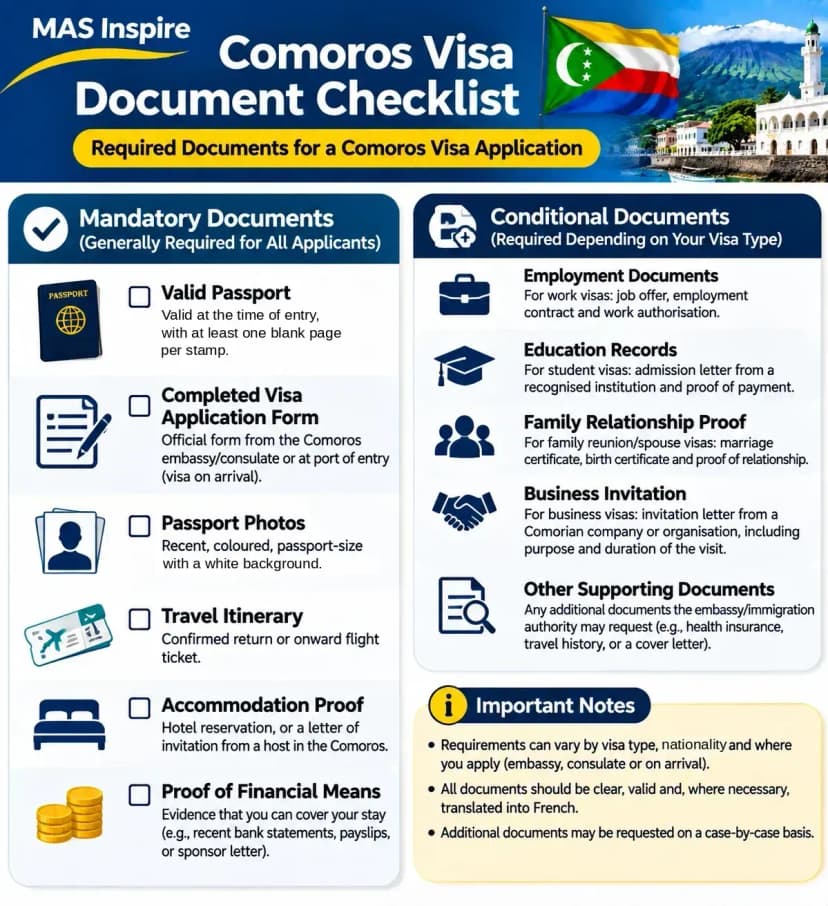
Document checklists
The law and travel advisories do not publish one universal checklist for every visa type. The following tables separate statutory or commonly reported items from supporting evidence that may be requested. Confirm the precise list for your nationality and purpose.
Tourist or short-stay visit
| Document | Status | Notes |
|---|---|---|
| Valid passport or travel document | Required by law | Passport must bear the relevant Comorian visa; check blank-page and validity rules |
| Return or onward ticket | Required by law / entry guidance | Article 2 requires transport to leave at end of stay |
| Accommodation booking or host address | Supporting evidence | Have a hotel booking or host contact available |
| Travel-purpose explanation / itinerary | Recommended | Keep dates and activities consistent |
| Proof of funds | Supporting evidence | No universal minimum balance was found in the official sources reviewed |
| Visa fee in accepted cash currency | Required if fee applies | U.S. advisory identifies US dollars or euros; confirm amount and accepted currency |
| Yellow-fever vaccination certificate | Conditional | Check current health rules based on countries visited/transited and official health guidance |
| Travel insurance | Recommended | No universal mandatory insurance rule was verified in the sources reviewed |
Business visit
| Document | Status | Notes |
|---|---|---|
| Passport and visa | Required | As applicable to nationality and entry route |
| Return/onward ticket | Reported requirement | French foreign-ministry business guidance |
| Invitation from Comorian company or proof of employment | Conditional / purpose evidence | The French factsheet lists an invitation or employment justification |
| Proof of funds / means of support | Supporting evidence | No fixed minimum officially verified |
| Address of accommodation | Supporting evidence | Keep host or hotel details available |
| Detailed activity plan | Recommended | Meetings only; do not undertake unauthorized local employment |
Long-stay, residence and employment
| Document | Status | Notes |
|---|---|---|
| Passport and long-stay visa application | Required route under Article 5 | Apply through the nearest Comorian diplomatic/consular representation |
| Evidence of purpose and intended duration | Case-specific | Ask the mission for its current checklist |
| Employment contract | Required for salaried resident-card application | Article 11 |
| Business-creation authorization request | Required where creating a business | Article 11; relevant economic approval required |
| Residence-card application | Required after entry for qualifying long stay | Article 5 says within ten days of entry |
| Special foreign-worker card | Labour-law requirement | Labour Code Articles 149–151; employer and applicant should confirm current procedure |
| Tax-compliance evidence | May be required | Article 15 links card issuance/renewal to tax obligations |
| Police clearance, medical evidence, qualifications, photographs | Conditional | No universal list verified; obtain the official case-specific checklist |
Student, family, research or internship purpose
Before committing to travel, obtain the official checklist in writing. Depending on the actual route, ask whether the authority requires an admission/enrolment letter, sponsor or host undertaking, proof of tuition or funding, accommodation, birth or marriage certificates, parental consent for minors, qualifications, research authorization, insurance or police certificates. These are potential supporting records, not a verified universal Comorian checklist.
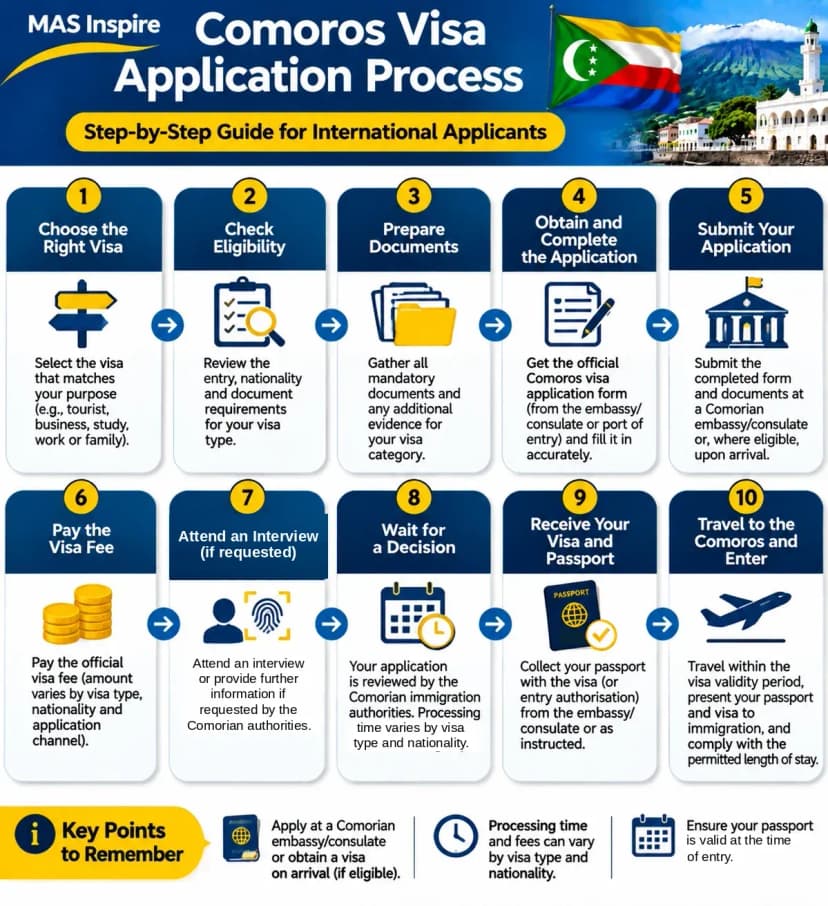
How to apply
The exact route depends on the purpose and whether the traveller can use visa on arrival. Not every category follows the same ten steps.
- Choose the correct purpose. Tourism, transit, a brief business visit, long-term residence and paid employment are legally different situations.
- Check nationality and entry arrangements. Ask whether your passport is eligible for visa on arrival and whether any special approval is required. Do not rely solely on an airline or third-party visa checker.
- Decide where to apply. For a stay over three months, Article 5 directs applicants to apply through the nearest Comorian diplomatic or consular representation. Confirm which mission is accredited to your country of residence.
- Request the current checklist and fee in writing. Ask for the correct form, accepted payment method, appointment or postal procedure, and whether the mission accepts third-country nationals.
- Prepare documents. Ensure names, passport numbers, travel dates, invitations and accommodation details match across the file.
- Submit the application or follow the visa-on-arrival route. No verified universal online application portal was identified in this research. Do not enter personal or payment information into an unofficial site claiming to be a government portal.
- Pay the confirmed fee. Obtain a receipt. The publicly available fee information is inconsistent; see the fee section below.
- Attend any interview or provide further information if requested. The reviewed sources do not establish universal biometrics or interview requirements.
- Track the case using the method given by the authority. A standard online tracking system or published processing time was not verified.
- Check the visa and entry conditions before travel. Confirm validity, permitted stay, entries, any residence-card deadline and whether separate work authorization is needed. Carry the supporting documents in hand luggage.
At the border, answer questions accurately and present the requested evidence. A visa does not remove the immigration officer's power to refuse entry under applicable law.
Visa fees and financial requirements
No single current fee schedule could be verified from an authoritative Comorian government tariff. Article 15 of Law No. 88-025 says that fees for visas, residence cards and resident cards, including renewals, are set by the Finance Law. The law page does not state the current amounts.
The U.S. Department of State's Comoros advisory is internally inconsistent: one section reports EUR 60–500, while another reports EUR 30–50. Both describe payment in cash in euros or US dollars. The French foreign-ministry factsheet refers to EUR 30 for an ordinary one-month visa and EUR 240 for a one-year visa conversion in its business-travel section. A Comoros ASEAN consular-services page lists US$160 for a three-year multiple-entry visa. These may refer to different visa types, dates, or issuing channels and cannot safely be combined into a single fee table.
| Fee item | Published figure | Verification status |
|---|---|---|
| Tourist/visa on arrival | EUR 30–50 in one U.S. advisory section; EUR 60–500 in another | Conflicting source information; confirm directly before travel |
| Ordinary one-month visa (business-travel factsheet) | EUR 30 | Foreign-government factsheet; not a universal tariff |
| One-year visa conversion (business-travel factsheet) | EUR 240 | Foreign-government factsheet; eligibility and current fee require confirmation |
| Three-year multiple-entry visa (ASEAN consular page) | US$160 | Scope/current applicability to an individual applicant not independently confirmed |
| Residence / resident card | Not officially published in reviewed sources | Article 15 refers to Finance Law; request current amount |
Do not budget on the assumption that any one of these figures applies to your case. Ask the issuing authority for the fee, currency, payment method and whether any additional administrative charges apply. No official minimum bank balance was identified.
Processing times and validity
The statutory periods that can be stated are the maximum five-day transit stay, maximum 45-day tourist stay, and short stay not exceeding three months with possible renewal once. A long-stay visa is for a period exceeding three months; the law says the Council of Ministers decides the grant. The residence card is to be issued within ten days after entry and renewed annually. The resident card is stated to be valid for ten years and renewable.
These are legal periods, not processing-time promises. The sources reviewed do not publish a reliable general processing time for visa applications, work authorization, student cases or residence cards. Ask the responsible office for current service standards and do not purchase non-refundable travel until the required permission is confirmed.
Applying from Pakistan or Vietnam
Pakistani passport holders
Pakistani nationals should check their visa arrangements individually with the Comorian authorities or the mission responsible for their place of residence. The available foreign-government advisories describe visa on arrival as a general tourist facility, but the sources reviewed do not provide a country-by-country Comorian nationality matrix or a Pakistani-specific guarantee. Obtain written confirmation that a Pakistani passport holder may board and obtain the intended visa on arrival, including any pre-approval requirement.
Pakistani citizens legally living or working in Vietnam
A Vietnamese temporary residence card, work permit or other proof of lawful stay does not automatically establish that a Comorian mission in Vietnam has jurisdiction to accept a Pakistani citizen's application. Nor does it convert a tourist visa into permission to work in Comoros.
Before applying, the traveller should:
- Ask the nearest Comorian embassy, consulate or mission accredited to Vietnam whether it accepts applications from Pakistani nationals resident in Vietnam.
- Provide a copy of the Pakistani passport and Vietnamese residence/work documentation when asking about jurisdiction.
- Ask whether the application must instead be lodged in Pakistan or another country, and whether the original passport must be submitted.
- Request written confirmation of the visa category, documents, fee, payment currency, appointment method and processing time.
- For employment or a stay over three months, ask about the long-stay visa, residence card, resident card and foreign-worker card requirements before departure.
The law permits Comorian diplomatic or consular authorities, where authorized, to issue certain visas. However, this research did not confirm a Comorian embassy in Vietnam or an official published procedure for Pakistani applicants applying there. Do not travel to another country to apply until the relevant mission confirms it can accept the case.
Applying in Pakistan
If applying from Pakistan, contact the Comorian diplomatic or consular representation responsible for Pakistan and ask whether it issues visas directly or whether another accredited mission handles applications. The public sources reviewed did not establish a verified Comorian visa application centre in Pakistan. Do not assume a third-party agent is an official representative.
Student, work and job opportunities
Studying in Comoros
Canada's travel advice lists a student visa as required. However, a detailed official student-visa checklist, fee, form and published processing time were not found in the primary sources reviewed. A prospective student should obtain written instructions from the institution and Comorian immigration authority before paying tuition or travelling. Ask whether the correct legal route is a long-stay visa and residence card, and whether the institution must provide a formal admission or sponsorship document.
Working in Comoros
The legal framework is explicit that ordinary visas and the long-stay visa described in Article 5 do not, by themselves, authorize lucrative activity. For salaried work, Article 11 requires an employment contract with the resident-card application. The Labour Code additionally refers to a special foreign-worker card. Employers should verify the current administrative sequence with the Ministry of Labour and the Ministry of the Interior before the employee starts work.
A business visitor may conduct limited transactions if they have no fixed establishment in Comoros, but that exception is not a general work permit. A foreign entrepreneur or investor should seek approval for the business activity and any enterprise-creation authorization before operating.
Job-seeker, digital nomad and startup routes
No dedicated job-seeker or digital-nomad visa was verified in the sources reviewed. No separate startup visa was identified. A person intending to establish a business should investigate the resident-card and enterprise-authorization rules rather than assume a visitor permission covers the activity.
Family immigration and permanent residence
The reviewed law does not set out a detailed general family-reunification visa route. It does identify certain family members of accredited diplomatic personnel who may receive diplomatic visas under Article 3. For other family cases, ask the Ministry of the Interior or nearest accredited mission which long-stay category and supporting relationship documents apply.
The law describes an annually renewable residence card and a ten-year renewable resident card. Neither should be represented as automatic permanent residence or citizenship. The current legal route, eligibility criteria and any time-based settlement rules require direct confirmation.
Common application mistakes
- Treating a tourist visa as permission to work.
- Assuming the 45-day tourist maximum is automatically granted to every traveller.
- Assuming visa-on-arrival availability means every nationality is exempt from pre-travel checks.
- Relying on conflicting online fee figures without confirming the exact amount and currency.
- Applying at a mission that does not have jurisdiction over the applicant's country of residence.
- Assuming a Vietnamese residence permit guarantees a right to apply in Vietnam.
- Booking non-refundable travel before a long-stay or work-related approval is issued.
- Presenting inconsistent travel dates, accommodation details or invitation information.
- Overstaying or failing to obtain the required residence or professional authorization.
Reasons for refusal or entry denial
The official law permits refusal of entry on public-order, public-health, state-security or national-economic grounds. Practical risks also include an invalid or unsuitable travel document, missing visa, no onward ticket, unclear travel purpose, insufficient supporting evidence, suspected false declarations, or an attempt to work without the required authorization. The reviewed sources do not provide a complete published refusal-code list.
Never submit false documents or conceal the actual purpose of travel. If refused, request the written reason and follow the authority's appeal or departure instructions where available.
Frequently asked questions
1. Do I need a visa to visit Comoros?
A visa is required under the general legal framework. Tourist visas are reported as available on arrival by the U.S. Department of State and Government of Canada. Confirm your nationality-specific boarding and entry conditions before departure.
2. Can I get a Comoros visa on arrival?
Foreign-government travel advisories say a tourist visa can be obtained on arrival at Moroni airport and other points of entry. Carry a valid passport, onward or return ticket, accommodation details and the confirmed fee in the accepted currency.
3. How long can I stay on a tourist visa?
The Comorian law describes a tourist visa for a stay of up to 45 days. The actual period granted may be shorter and should be checked on the visa or entry record.
4. Is there a transit visa?
Yes. Article 2 provides for a transit visa of up to five days, issued at an airport or port. Confirm that your itinerary qualifies and that the point of entry issues it.
5. What is the Comoros visa fee in 2026?
A single reliable current fee could not be verified. Published sources conflict, and fees may vary by visa type and issuing channel. Obtain the amount and payment method directly from the responsible authority.
6. Can I work in Comoros with a tourist visa?
No. The law prohibits lucrative activity for holders of the ordinary visas described in Articles 2 and 5, subject to a narrow exception for brief business transactions without a fixed establishment. Employment requires the appropriate resident and foreign-worker authorizations.
7. Is there a work visa?
The law provides a long-stay visa, residence card and resident-card framework for professional activity, with an employment contract required for salaried work. The Labour Code also refers to a special foreign-worker card. Confirm the current application sequence with the authorities.
8. Is a student visa available?
Canada's travel advice says a student visa is required. The detailed official student procedure and fee were not available in the sources reviewed, so applicants should obtain written instructions from their institution and Comorian immigration authorities.
9. Can I apply from Vietnam as a Pakistani citizen?
Possibly, but this review could not confirm a Comorian mission in Vietnam that accepts Pakistani third-country residents. A Vietnamese residence permit does not guarantee local application eligibility. Obtain written confirmation of consular jurisdiction before submitting documents or booking travel.
10. Does a residence card allow employment?
Not by itself under the statutory framework. Article 10 says a foreigner holding a residence card who wants to undertake professional activity must obtain a resident card. Salaried applications require an employment contract.
11. Is permanent residence available?
The law reviewed describes an annual residence card and a ten-year renewable resident card. It does not establish a general permanent-residence pathway in the material reviewed. Confirm current settlement law directly.
12. Is an online visa application portal available?
No official universal online visa portal was verified in this research. Use only links supplied by a Comorian government authority or an accredited mission.
13. How long does processing take?
A general published processing time was not verified. Ask the office handling your specific case and allow additional time for approvals involving the Council of Ministers.
14. Can I extend my stay?
The law says a short-stay visa not exceeding three months may potentially be renewed once. It does not provide a complete current extension procedure in the source reviewed. Apply before expiry and obtain written approval.
15. Does a visa guarantee entry?
No. A visa does not remove border-control powers. The law allows refusal of entry on specified grounds, and travellers must satisfy the entry conditions at the port of arrival.
Official immigration websites and useful links
- Comoros Ministry of Justice — published immigration and labour legislation.
- Law No. 88-025 — foreign entry, stay, residence and professional-activity framework.
- Comoros Labour Code 2012 — foreign-worker provisions.
- U.S. Department of State: Comoros — tourist visa on arrival and entry advice.
- Government of Canada: Comoros — visa and entry requirements.
- French Ministry for Europe and Foreign Affairs: Comoros factsheet — business-travel information.
- Comoros ASEAN consular information — consular service details; confirm current scope and jurisdiction directly.
Final checklist and conclusion
Before travelling, confirm your nationality-specific entry route, the correct visa category, passport validity, onward ticket, accommodation, exact fee and accepted currency. If you intend to stay longer than three months or undertake professional activity, obtain written guidance on the long-stay visa, residence card, resident card and foreign-worker card before departure. Pakistani citizens residing in Vietnam should verify consular jurisdiction rather than assume a local application is accepted.
Comoros offers a relatively straightforward tourist-visa-on-arrival route according to foreign-government advisories, but longer stays and employment involve distinct legal permissions. The safest approach is to rely on the Comorian legal text, obtain case-specific instructions from the competent authority, and keep written confirmation of all approvals.
Disclaimer: This article is for general educational purposes only. Immigration laws, fees, administrative procedures and border practices can change. MAS Inspire is not a government authority, embassy, consulate or immigration law firm. This guide does not guarantee entry, a visa or a residence/work permit. Verify your case with the competent Comorian authority before making travel or financial commitments.