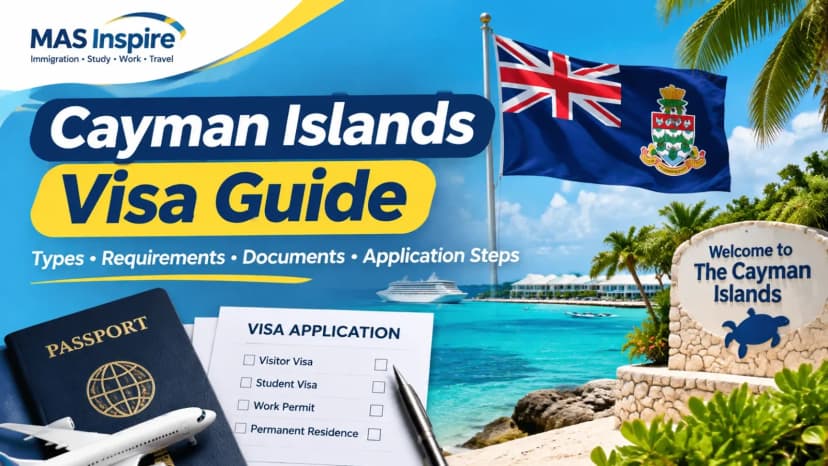
Cayman Islands Visa Guide 2026: Types, Requirements, Fees and How to Apply
By MAS Inspire | Editorial draft: 27 November 2026 (fees and rules re-verified 27 November 2026)
Table of contents
- Why visit, study and work
- Visa types and permissions
- Visa comparison table
- Eligibility requirements
- Document checklists
- How to apply: step-by-step
- Fees and financial requirements
- Processing times
- Applying from Pakistan or Vietnam
- Student visa guide
- Work visa and job opportunities
- Family immigration and permanent residence
- Common application mistakes
- Reasons for visa refusal
- Frequently asked questions
- Official immigration websites
- Final checklist and conclusion
Introduction
The Cayman Islands is a popular Caribbean destination known for its beaches, financial services sector, tourism industry and international business community. Visitors may travel for holidays, meetings or short business activities, while people planning to study, take employment or settle need to understand the territory's separate immigration permissions.
There is no single all-purpose “Cayman visa” that covers every purpose. A visitor visa is different from a student visa; a work permit is generally employer-led; and residence certificates or permanent residence provide longer-term rights under specific legal categories. The correct route depends on nationality, purpose, intended duration and personal circumstances.
This guide reflects official information checked on 26 November 2026, including reforms that took effect on 1 May 2026. Always recheck the linked government pages before applying.
Why People Visit, Study, and Work in the Cayman Islands
Visitors are drawn by Seven Mile Beach, diving, marine life, island culture and family travel. Business visitors may attend meetings, negotiate contracts or undertake limited authorised commercial activities. Students may enrol full-time at a recognised local educational institution. Employment opportunities exist across tourism, hospitality, financial and professional services, construction, healthcare and domestic or care work, but foreign nationals must have the correct permission before starting work.
The Cayman Islands has no general-purpose digital nomad visa, job-seeker visa or points-based skilled migration visa comparable to those offered by some larger countries. A person cannot use visitor status as a substitute for work authorisation.
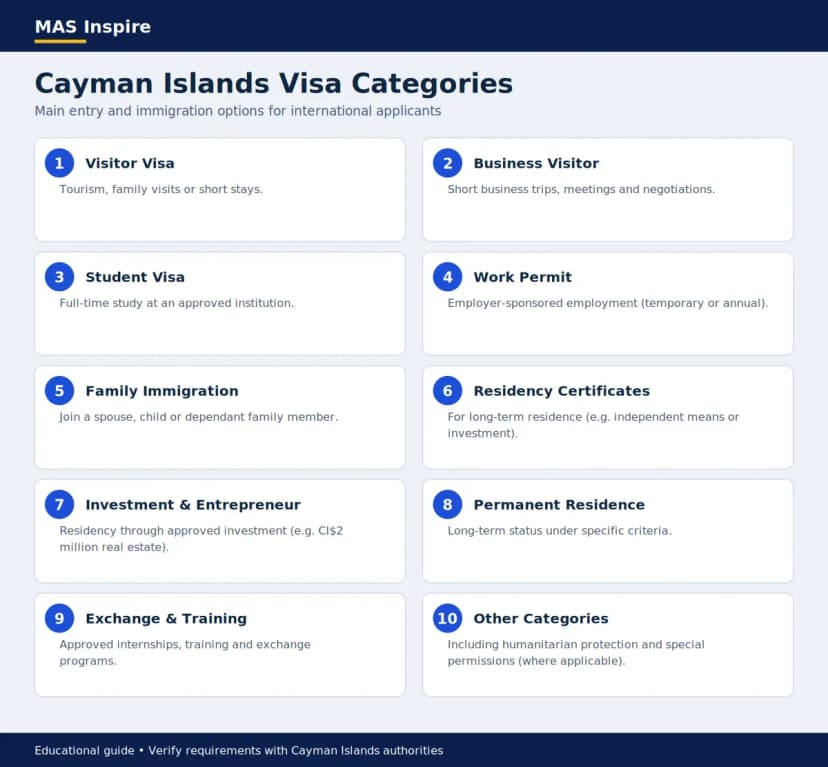
Types of Cayman Islands Visas and Immigration Permissions
1. Tourist and general visitor visa
A visitor visa is for a person whose nationality requires a visa and who seeks entry for a temporary visit, commonly tourism or visiting family and friends. The visa is not a work permit and does not confer residence rights. A visa-required visitor must apply online through CBC's visitor visa page. The authority may issue a single-entry visa or, at its discretion, a multiple-entry visa. CBC says a single-entry visa is generally valid for travel for three months after approval; this is the period to use the visa, not a promise of a three-month stay.
Visitors may be granted permission to land for up to six months, but the actual permission is decided at the border. A visitor who needs more time must apply for an extension before their permission expires. CBC's visitor-extension page links to the online application form; check the page for the current instructions before applying.
2. Business visits and Visitor's Work Visa
Ordinary business meetings may fall within visitor activities, but commercial work must not be assumed to be permitted simply because the traveller has a visitor visa. Cayman has a specific Visitor's Work Visa (VWV) facility for certain commercial activities for no more than five calendar days. The official page requires the BC5 online form and a non-refundable CI$100 administrative filing fee. Applications and permitted activities are subject to the applicable legislation and approval. This short facility is not a general employment permit and should not be used for routine work or longer assignments.
The 2026 reform guide also sets out a separate Business Visitors' Permit fee structure linked to the occupation's annual work-permit fee band and the island of work. For Grand Cayman, the published bands include CI$150, CI$375 and CI$750 per visit per person in the relevant calendar year, depending on the occupational fee band; express fees are separately stated. Employers and visitors should obtain the correct classification and current total from WORC before travel.
3. Student visa
A student visa is for an eligible non-Caymanian adult coming to study full-time at a recognised Cayman Islands educational institution. The applicant needs an acceptance letter showing the course, duration, weekly attendance hours and annual tuition. The authority also requests evidence of financial resources, police clearance and a medical declaration. Dependants may accompany a student if the student demonstrates adequate funds for them and provides proof of relationship and the additional documents listed by CBC.
A student visa holder cannot take ordinary paid employment. CBC states that gainful occupation is prohibited except unpaid student work connected with the course. The student should remain outside the Islands until the student visa is approved. The published fee is CI$92 (or US$112.20 on the CBC page); confirm the live payment amount before submitting.
4. Employer-sponsored annual work permit
Most foreign employees need a work permit granted for a specific employer and occupation. The Cayman employer normally leads the application and must comply with local recruitment and advertising rules. Since 1 May 2026, the vacancy generally must be advertised for at least 21 days on both the WORC electronic Jobs Portal and in a locally printed newspaper, with prescribed information and proof of publication. Exceptions include specified personal-employer and religious roles and approved advertising waivers.
A work permit is not a portable right to work for any company. The 2026 rules generally require a first-time permit holder granted permission on or after 1 May 2026 to remain with the sponsoring employer for at least two years. Leaving early can require departure from the Islands for one year unless a prescribed exception applies. The work permit and its conditions determine the authorised occupation and duration. Do not begin work while an application is pending.
5. Temporary work permits and seasonal/entertainer permissions
Temporary work permits are available for qualifying short-term employment, including specific seasonal-worker and entertainer arrangements. They are still work authorisations, not visitor visas. The employer must select the correct category, provide the required supporting evidence and pay application and permit fees. The 2026 fee guide sets application fees for temporary permits in bands: CI$150 where the annual permit fee is CI$2,100 or less; CI$250 for the CI$2,101–10,400 band; and CI$500 where the annual work-permit fee exceeds CI$10,400. The actual grant/permit fee is additional and depends on the occupation, duration and location. A 91–180-day temporary permit may attract 50% of the annual work-permit cost under the guide's stated rule.
6. Job-seeker and skilled-worker routes
There is no general Cayman Islands job-seeker visa that lets a foreign national arrive and search for work with permission to work. There is also no stand-alone points-based skilled-worker entry visa. Skilled applicants may be recruited by a Cayman employer, after which the employer must follow the work-permit process. Permanent residence assessment is a separate later immigration route and should not be confused with a work visa.
7. Digital nomad visa
No dedicated Cayman Islands digital nomad visa was identified in the official immigration categories reviewed. A visitor should not assume that remote work for an overseas employer is automatically authorised. Obtain written advice from CBC/WORC about the proposed activities and status before relying on visitor permission.
8. Entrepreneur, investor and substantial business presence routes
The Cayman system has specific certificates for qualifying business investment and substantial business presence; these are not generic startup visas. The Certificate of Direct Investment route requires at least CI$1 million invested or proposed in an employment-generating business under the published regulations. A Residency Certificate (Substantial Business Presence) has continuing criteria; the 2026 regulations describe, among other requirements, at least 10% ownership in an approved business or qualifying senior-management employment, a physical business presence, at least four full-time employees legally and ordinarily resident for the required period, and at least 90 days' physical presence in the calendar year for the annual declaration. Applicants must examine the full legislation and certificate conditions.
9. Family, spouse and dependant permissions
A spouse or civil partner of a Caymanian may apply for a Residency and Employment Rights Certificate (RERC). If granted, the certificate permits residence and work in any occupation while the marriage remains stable, subject to the statutory conditions. The authority considers whether the relationship is genuine and stable, good character, health and sufficient financial means. A spouse or dependant of a work-permit holder or qualifying residence-certificate holder may have derivative permission, but that permission does not necessarily include unrestricted work rights.
A spouse or civil partner of a permanent resident has a separate route under the legislation and 2026 fee regulations. Do not assume that marriage to any foreign resident automatically creates Cayman residence rights.
10. Permanent residence and independent means
Permanent residence is a distinct long-term status, not a visa. The ordinary route includes legal and ordinary residence in the Islands and a points-based assessment under the Immigration Regulations. The 2026 reform amendments did not change the permanent-residence points framework. The relevant authority and current legislation should be consulted for the exact qualifying period, points, evidence and application timing; eight years' residence alone does not guarantee approval.
Separate categories exist for persons of independent means. The Residency Certificate for Persons of Independent Means is not permanent residence and does not itself provide a general right to work. The Certificate of Permanent Residence for Persons of Independent Means requires an investment of CI$2 million in developed Cayman real estate under the published regulations, and its certificate carries a substantial fee. A Certificate of Direct Investment and a Residency Certificate (Substantial Business Presence) are further distinct routes.
11. Transit visa
Some nationalities need a visa even when transiting through the Cayman Islands. The official visitor application page lists extra transit evidence where applicable, including valid visas for onward destinations and evidence of residence status in a country other than the passport-issuing country. CBC's FAQ says a transit traveller relying on the no-visa transit rule must have a valid travel document, an onward ticket to a destination outside the Islands other than the country of arrival, and depart within 24 hours. Check the transit-country list and itinerary conditions before booking.
12. Exchange, internship, research and training
No separate broad exchange, internship, researcher or academic visa category was identified in the official public category list reviewed. The legal route depends on whether the activity is study, unpaid course-connected placement, commercial activity or employment. A paid internship or research role may require work authorisation; a full-time course may require a student visa. The host institution or employer should obtain a written classification from CBC/WORC.
13. Humanitarian protection and asylum
Asylum is a protection procedure, not a travel visa or overseas resettlement application. The Customs and Border Control Law sets eligibility and process rules for a person who is in the Islands and meets the statutory conditions. A successful applicant may receive indefinite leave and work rights. Anyone fearing persecution should seek qualified legal advice and contact the competent authorities; this guide cannot assess an individual protection claim.
Visa and Permission Comparison Table
| Route | Main purpose | Work rights | Published fee / timing |
|---|---|---|---|
| Visitor visa | Tourism, family visit, eligible short visit | No general employment | CI$92; CBC estimate 7–10 working days |
| Student visa | Full-time recognised study | No paid work; limited unpaid course-related work | CI$92; processing time not published on page |
| Visitor's Work Visa | Certain commercial activity up to 5 calendar days | Only approved activity and period | CI$100 administrative fee |
| Business Visitors' Permit | Approved short business activity | Only within permit conditions | CI$150/375/750 per visit bands for Grand Cayman; occupation-based |
| Annual work permit | Employment with sponsoring employer | Specific employer/occupation | Application fee CI$150/250/500 banded; permit fee varies |
| Temporary work permit | Qualifying short employment | Specific approved job | Application fee CI$150/250/500 banded; permit fee varies |
| Spouse of Caymanian RERC | Residence through qualifying marriage/civil partnership | Broad work permission if granted | 2026 fees: CI$300 application, CI$400 issue |
| Independent-means residency | Residence based on independent means | Generally no work right | Certificate issue fee CI$50,000 |
| PR for independent means | Permanent residence through qualifying investment | Generally no work right unless varied | CI$2m qualifying developed real-estate investment; CI$200,000 issue fee |
| Ordinary permanent residence | Long-term residence under statutory assessment | Rights depend on certificate/status | Assessment and fees depend on route; check WORC |
Fees are Cayman Islands dollars (CI$) unless otherwise stated. The visitor/student pages also display a US-dollar card payment equivalent. Fees may exclude permit charges, dependants, annual declarations, express services and other charges.
Eligibility Requirements
Eligibility depends on the category. Visitor applicants should demonstrate a genuine temporary purpose, sufficient means, credible travel plans and compliance with entry rules. Student applicants need acceptance at a recognised institution, full-time study intent, finances and the required police/medical evidence. Work applicants need an employer prepared to sponsor the role and meet Cayman recruitment rules. Residence applicants must satisfy the detailed statutory conditions for their specific certificate.
Nationality is material. The official CBC visa-required list includes Pakistan and Vietnam. A person with a Pakistani passport who lives in Vietnam should therefore plan on needing a Cayman visitor visa unless a specific statutory exemption applies. A Vietnam residence card is evidence of lawful residence, not an automatic Cayman visa exemption.
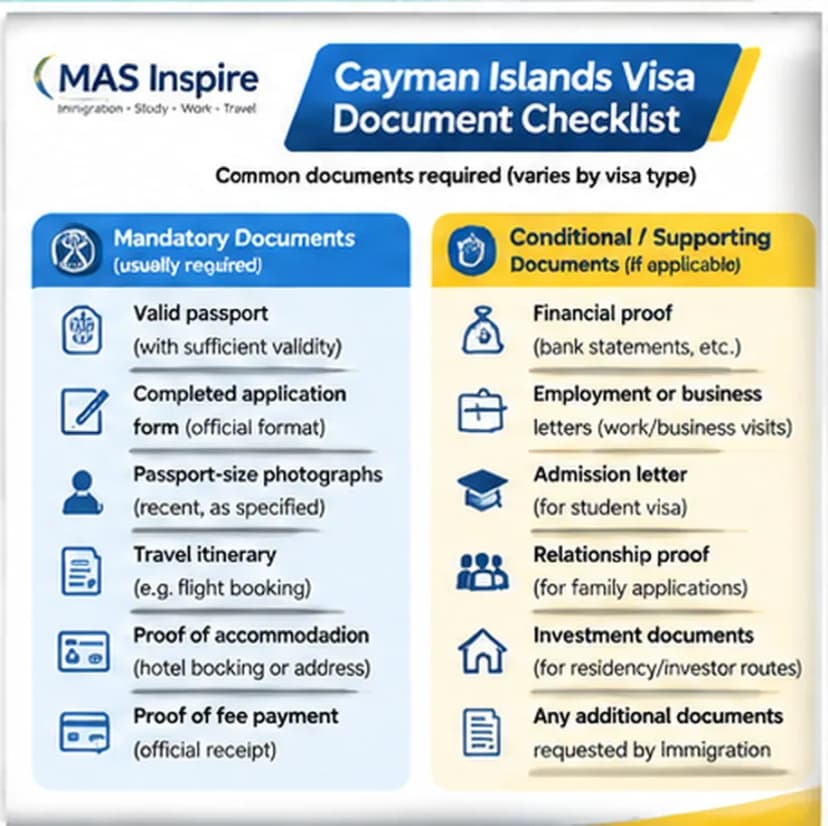
Complete Document Checklists
The authority may request further evidence. The lists below distinguish the published core requirements from helpful or conditional material; they are not a guarantee that every case needs the same documents.
Visitor visa documents
| Document | Status / notes |
|---|---|
| Valid passport with at least six months remaining | Listed by CBC |
| Full-face passport-size photograph | Listed by CBC |
| Bank statement | Listed by CBC; show funds and source where appropriate |
| Current employment or study evidence | Listed by CBC |
| Original signed and sealed police clearance, under six months old, from last place of residence | Listed by CBC; visa nationals aged 71+ are exempt from this police-clearance requirement on the country-list page |
| Birth certificate for applicants under 18 | Listed by CBC |
| Marital-status evidence, payslips, other income/assets | Supporting evidence CBC says may assist |
| Onward/return ticket, accommodation and itinerary | Sensible supporting evidence; border officers may ask for onward travel and funds |
| For transit: onward-destination visas and foreign residence evidence, where applicable | CBC's additional transit list |
| For applicants living in Vietnam: valid Vietnamese residence/work card and evidence of current address/status | Relevant supporting evidence; does not itself guarantee local processing eligibility |
Student visa documents
| Document | Status / notes |
|---|---|
| Passport photograph and travel document | CBC checklist |
| Evidence of financial resources | CBC checklist |
| Institution acceptance letter confirming course, duration, weekly hours and annual tuition | CBC checklist |
| Sponsor's employment/income evidence, if an individual sponsors the student | Conditional CBC requirement |
| Original signed and sealed police clearance under six months old from last place of residence | CBC checklist |
| Original Medical Declaration Cover Letter | CBC checklist |
| Dependants' birth/marriage evidence and separate financial support | Conditional for accompanying family |
Work permit and residence evidence
The employer-led work-permit application has category-specific requirements. Prepare the signed employment offer/contract, job description, employer/company details, proof of required recruitment advertising, qualifications and professional licences, identity documents, police/medical evidence where requested, and dependant details if applicable. The employer should use the current WORC application checklist rather than relying on this general list.
For residence or investment certificates, expect identity, character, medical/health-insurance, source-of-funds, investment/property or business evidence, financial support evidence, relationship documents and declarations appropriate to the selected route. The precise requirements are certificate-specific.
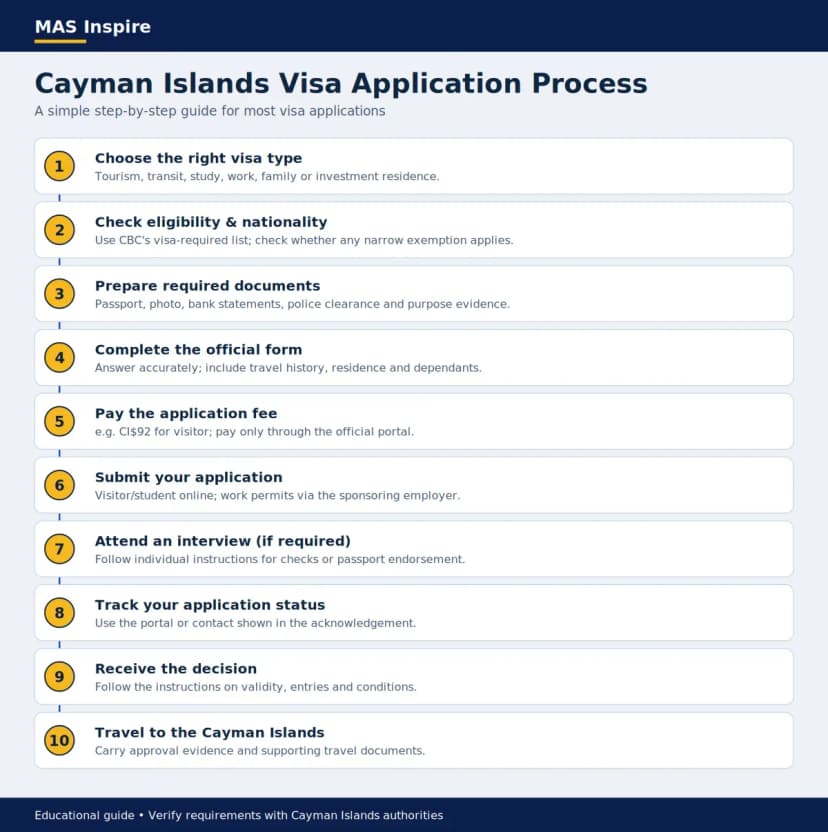
How to Apply: Step-by-Step
- Choose the route. Identify whether the purpose is tourism, transit, full-time study, short commercial activity, employment, family residence or investment-based residence.
- Check nationality and status. Use CBC's current visa-required list. Check whether any narrow exemption applies. Applicants in Vietnam should establish their lawful Vietnamese status and ask CBC how it affects submission and passport handling.
- Prepare documents. Use the CBC visitor/student checklist or the employer/WORC checklist for work and residence. Obtain official translations where needed and do not submit altered or misleading evidence.
- Open the correct portal. Visitor and student applications are linked from the CBC website to the online government service. Work-permit applications are generally submitted by the Cayman employer through WORC's systems.
- Complete the correct form. Answer all questions accurately, including travel history, residence, employment, dependants and intended activities.
- Upload and pay. Pay only through the official portal or method stated by the authority. Visitor and student application fees are non-refundable.
- Attend any requested checks. Follow individual instructions for identity verification, medical documents, interviews or passport endorsement. Do not assume biometrics are routinely required; the published pages reviewed do not state a universal biometric appointment.
- Submit/complete the application. For employment, the employer must complete the recruitment and permit process. Do not work before the permission is effective.
- Track and respond. Use the portal or contact shown in the acknowledgement. Respond promptly to requests for further documents.
- Check the decision and travel conditions. Confirm validity, number of entries, passport endorsement, permitted stay and any work/study conditions. Carry approval evidence and supporting travel documents.
Visa Fees and Financial Requirements
| Category / service | Fee shown in official source | Notes |
|---|---|---|
| Visitor visa application | CI$92 / US$112.20 | Non-refundable; CBC online page |
| Student visa application | CI$92 / US$112.20 | Non-refundable; CBC student page |
| Visitor extension — first application | CI$50 | Non-refundable; subject to individual decision |
| Visitor extension — subsequent application | CI$100 | Non-refundable; check CBC instructions for the current application route |
| Visitor's Work Visa | CI$100 | Administrative filing fee; up to five calendar days for qualifying activities |
| Temporary work permit application | CI$150 / 250 / 500 | Band depends on annual permit-fee bracket; permit grant fee is additional |
| Annual work permit application | CI$150 / 250 / 500 | Band depends on annual permit-fee bracket; annual permit fee is occupation-based |
| Spouse of Caymanian RERC application | CI$300 | 2026 Fees Regulations |
| Spouse of Caymanian RERC issue | CI$400 | No annual RERC fee stated for this spouse category; annual declaration fee applies |
| Residency Certificate for Persons of Independent Means issue | CI$50,000 | Separate from PR; dependant and annual declaration fees may apply |
| PR Certificate for Persons of Independent Means issue | CI$200,000 | Separate investment condition: CI$2 million in developed real estate |
| Certificate of Direct Investment issue | CI$50,000 | Minimum CI$1 million investment in employment-generating business under regulations |
Financial sufficiency requirements vary by route. CBC asks visitor applicants for bank statements and other evidence of personal circumstances but does not publish one universal minimum bank balance on the visitor page. Student applicants must show financial resources, including funds beyond tuition for accompanying dependants. Independent-means and investor routes have statutory investment and support tests.
Visa Processing Times
CBC publishes an estimate of 7–10 working days for visitor visas after the application is submitted to the Cayman Islands Visa Office. It warns that peak travel periods may affect processing. No guaranteed processing time was found on the student visa page or for the general work permit and residence categories in the sources reviewed. Work-permit timelines depend on employer advertising, application completeness, board/administrative review and any requests for information. Do not book non-refundable travel based solely on an estimated timeline.
Applying from Pakistan or Vietnam
Pakistani citizens require a Cayman visitor visa unless an exemption applies. The same is true of Vietnamese citizens. A Pakistani passport holder who is legally resident or employed in Vietnam should:
- Apply using the official CBC online visitor visa application, not a third-party agent claiming guaranteed approval.
- Upload evidence of lawful Vietnamese residence, such as the current residence card or work authorisation, where relevant to explaining the place of residence and return ties.
- Provide the required police clearance from the last place of residence as CBC directs. If the applicant has lived in more than one country, ask CBC whether additional clearances are required.
- Include evidence of employment in Vietnam, approved leave, salary and funds, plus a clear itinerary and onward/return travel plan.
- Check the current passport-endorsement instructions. CBC states that an approved visitor visa should generally be endorsed in the passport within three months of approval.
- Ask the Cayman Islands Visa Office directly if it requires the passport to be sent to a specific location or whether additional arrangements apply to a Vietnam-based applicant.
The public Cayman pages reviewed direct applicants to an online application to the Cayman Islands Visa Office; they do not confirm a Cayman visa counter in Pakistan or Vietnam, nor do they establish that the British Embassy in Hanoi or Islamabad accepts or decides Cayman applications. Applying while resident in Vietnam may be practical because the online system is available, but the applicant must confirm any local submission or passport-handling instructions with CBC. A Vietnam residence permit does not change the nationality-based visa requirement.
Student Visa Guide
First obtain admission from a recognised institution and ask the institution to provide a letter containing all the details CBC requests. Prepare proof of funds, police clearance and medical declaration. Apply directly to CBC through the official student visa link. CBC's FAQ says the school does not apply on the student's behalf and the student should remain outside Cayman until approval. A student visa holder may not undertake ordinary paid work. Spouses and children may accompany the student if adequate additional financial support and relationship evidence are provided. Health insurance is not stated as a legal requirement on the FAQ page, but CBC recommends adequate cover.
Work Visa and Job Opportunities
The practical route to employment is usually to secure a job offer from an employer willing and able to sponsor the work permit. The employer must consider Caymanian recruitment requirements, advertise the position for the prescribed period and media unless an exception applies, and submit the permit application. Applicants should verify that the proposed role, salary, qualifications and permit category match the actual job. A work permit is employer/occupation-specific, and the 2026 two-year employer commitment rule is particularly important for first-time permits granted from 1 May 2026.
A visitor visa, student visa or short business visitor permission is not a substitute for a work permit. Do not start paid work, freelance locally or provide services outside the approved scope until the required authorisation is in force.
Family Immigration and Permanent Residence
Family rights depend on the sponsor's status. The spouse of a Caymanian may qualify for an RERC after assessment of the relationship, character, health and financial position. The spouse of a permanent resident and dependants of relevant certificate holders have different statutory routes and fee rules. Student dependants and work-permit dependants have conditions that may restrict employment.
Ordinary permanent residence is assessed under the applicable points and eligibility framework. The independent-means PR route instead requires the qualifying CI$2 million developed-real-estate investment. A Residency Certificate for Persons of Independent Means is a different status and should not be advertised as permanent residence. Investors and business owners should compare the Certificate of Direct Investment and Substantial Business Presence routes with legal and tax advice before committing capital.
Common Application Mistakes
- Assuming a UK visa or Vietnamese residence card removes the Cayman visa requirement.
- Treating a visitor visa as permission to work.
- Applying under the wrong category for paid business activity or an internship.
- Submitting an outdated police certificate or a passport with insufficient validity.
- Failing to explain the source of funds, employment or residence ties.
- Assuming a multiple-entry visa will be granted because it was requested.
- Confusing visa validity with the period of stay authorised at the border.
- Using an old fee schedule after the 1 May 2026 reform.
- Beginning work before the employer's permit is effective.
- Assuming eight years of residence automatically guarantees permanent residence.
Reasons for Visa Refusal
A refusal may result from incomplete or inconsistent information, insufficient evidence of funds or genuine temporary purpose, concerns about the applicant's intention to leave, adverse immigration or criminal history, failure to meet category requirements, inadequate sponsorship or institutional evidence, or failure to satisfy the decision-maker that entry is appropriate. The precise reasons are case-specific. Do not conceal previous refusals or provide false documents. Review the refusal notice and follow the official reconsideration or reapplication instructions, if available.
Frequently Asked Questions
1. Do Pakistani citizens need a visa for the Cayman Islands?
Yes. Pakistan appears on the official visa-required list unless a specific exemption applies.
2. Can a Pakistani living in Vietnam apply for a Cayman visa from Vietnam?
The official visitor process is online, but the public guidance does not confirm a local Cayman application centre in Vietnam. Apply through CBC's official route and confirm passport-endorsement arrangements with the Cayman Islands Visa Office.
3. Does a Vietnam residence permit exempt me from a Cayman visa?
No general exemption is stated for holding a Vietnamese residence permit. Pakistan and Vietnam are both listed as visa-required nationalities.
4. How much does a Cayman visitor visa cost?
CBC currently lists CI$92 or US$112.20, non-refundable.
5. How long does visitor visa processing take?
CBC publishes 7–10 working days after submission to the Cayman Islands Visa Office, with possible peak-period delays.
6. How long can I stay as a visitor?
CBC says visitors may be granted up to six months, but the actual period is decided on arrival. Apply for an extension before permission expires.
7. Can I work on a visitor visa?
No. Visitor status does not generally authorise employment. Certain short commercial activities may qualify for a Visitor's Work Visa or Business Visitors' Permit.
8. Can international students work part-time?
Not in ordinary paid employment. CBC permits only unpaid student work undertaken in connection with the course.
9. Is there a Cayman digital nomad visa?
No dedicated digital nomad category was identified in the official categories reviewed. Seek written guidance before performing remote work while in Cayman.
10. Is there a job-seeker visa?
No general job-seeker visa was identified. Employment normally requires an employer-sponsored work permit.
11. What is the student visa fee?
The CBC student page lists CI$92 or US$112.20, non-refundable.
12. What is the minimum investment for permanent residence by independent means?
The regulations specify CI$2 million invested in developed real estate for the Certificate of Permanent Residence for Persons of Independent Means. The issue fee is separate.
13. Can marriage to a Caymanian give me the right to work?
A spouse may apply for an RERC. If granted, it permits residence and work in any occupation while the marriage remains stable, subject to the law and certificate conditions.
14. Has Cayman immigration law changed in 2026?
Yes. Major amendments and regulations took effect on 1 May 2026, including changes to work permits, business visitor permissions, fees and declarations.
15. Is visa approval guaranteed if I submit all documents?
No. Applications are assessed individually and complete documentation does not guarantee approval.
Official Immigration Websites
- Customs and Border Control (CBC)
- Visitor visa application
- Visa-required country list
- Student visa application information
- Visitor extension
- Workforce Opportunities & Residency Cayman (WORC)
- Immigration reform and guidebook
- Cayman Islands legislation
Final Checklist and Conclusion
Before applying, identify the correct permission, confirm nationality rules, check the current fee and portal, prepare accurate supporting evidence, and verify passport endorsement and entry conditions. Pakistani applicants based in Vietnam should include evidence of their lawful Vietnamese status but must not assume this creates an exemption or guarantees local processing. Employers and investors should use the 2026 regulations and obtain category-specific advice before committing to a job or investment.
The Cayman Islands offers several routes for visitors, students, workers, family members and qualifying investors, but each has different conditions. Use official government information and seek qualified advice for complex cases. No visa, work permit or residence certificate is guaranteed.
Educational-information disclaimer: This article is general information only, not legal, financial, tax or immigration advice. MAS Inspire is not a government authority and does not issue Cayman Islands visas or guarantee outcomes. Confirm the law, fees and procedures with CBC/WORC or a qualified Cayman Islands immigration professional before acting.