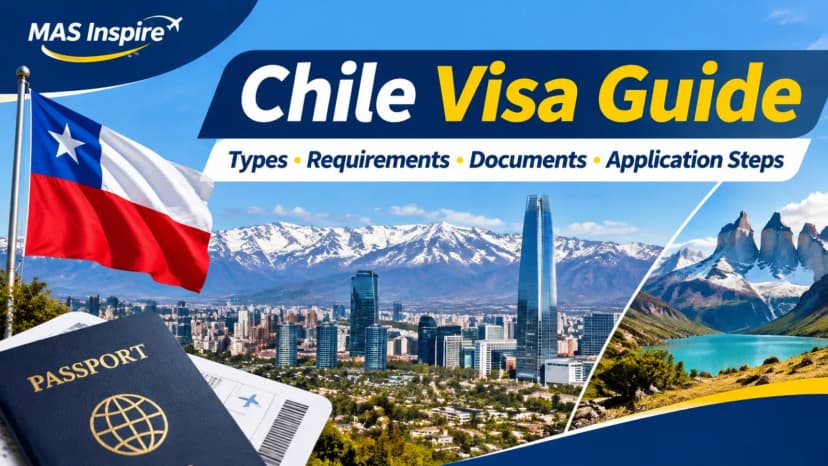
Chile Visa Guide 2026: Types, Requirements, Fees and How to Apply
By MAS Inspire | Editorial draft: 27 November 2026 (fees and rules re-verified 27 November 2026)
Chile attracts visitors, students, professionals, investors and families with its Pacific coastline, Andean landscapes, universities, mining and renewable-energy sectors, and relatively diverse regional economy. Before travelling or planning a move, applicants should understand that Chile does not use one universal visa for every purpose. Its immigration system separates short stays from residence permits, and each residence category has its own eligibility rules.
This guide explains the main routes, the application process, costs that can be verified, and special considerations for Pakistani passport holders legally living or working in Vietnam. It is educational information, not legal advice or a promise of approval.
Table of contents
- Why People Visit, Study, and Work in Chile
- Types of Chile Visas and Permits
- Visa Comparison Table
- Eligibility Requirements
- Complete Document Checklists
- How to Apply: Step-by-Step
- Visa Fees and Financial Requirements
- Visa Processing Times
- Applying from Pakistan or Vietnam
- Student Visa Guide
- Work Visa and Job Opportunities
- Family Immigration and Permanent Residence
- Common Application Mistakes
- Reasons for Visa Refusal
- Frequently Asked Questions
- Official Immigration Websites
- Final Checklist and Conclusion
Why People Visit, Study, and Work in Chile
Chile offers major urban centres such as Santiago and Valparaíso, established universities, internationally connected businesses, and industries including mining, agriculture, forestry, technology, tourism and clean energy. Visitors may travel for tourism, family visits, short business activities, conferences or medical appointments. Longer stays require the immigration permission matching the applicant's purpose.
A short business visit is not the same as taking a job in Chile. Likewise, enrolling in a course does not automatically mean that a visitor can remain indefinitely. Applicants should choose the correct legal route before travel.
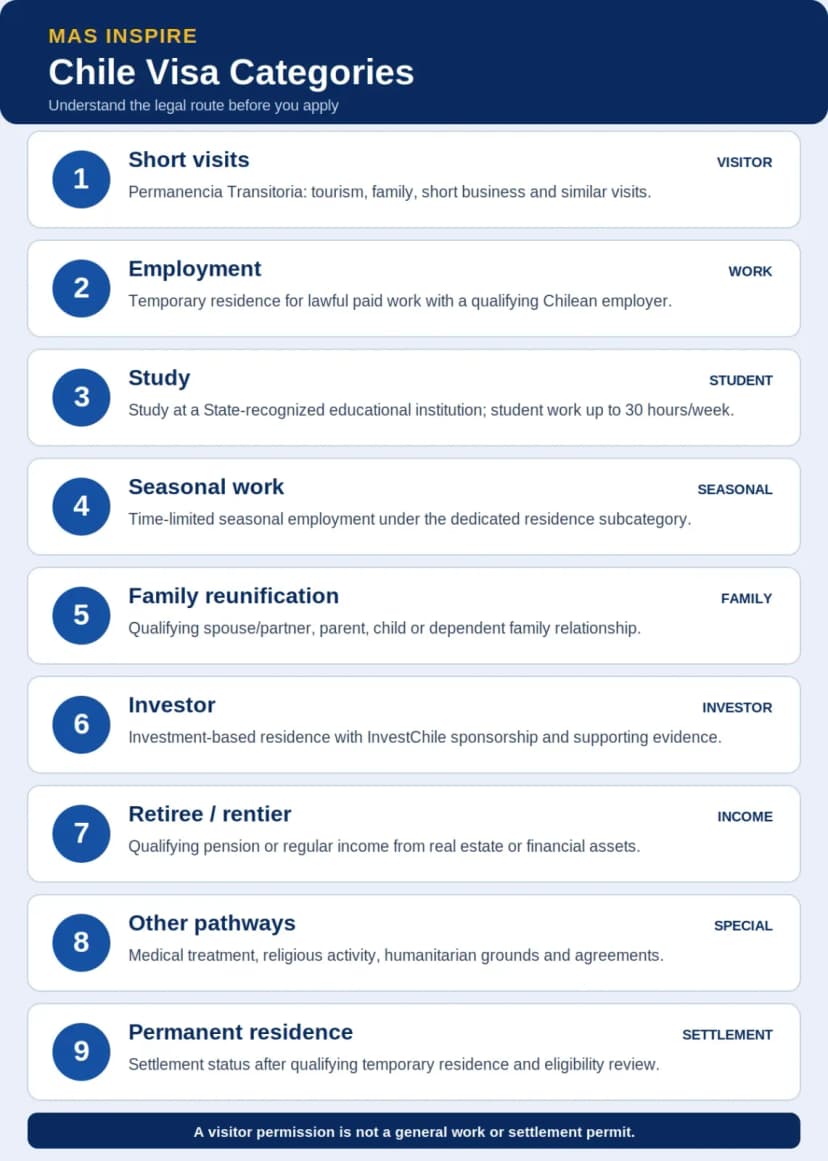
Types of Chile Visas and Permits
1. Short visits: Permanencia Transitoria
Permanencia Transitoria is the permission for people entering temporarily without intending to settle. It covers tourism, recreation, certain business activities, family visits, short studies and similar purposes. It is normally granted for up to 90 days, although authorities may grant a shorter period. The stay may be extended once for up to 90 additional days, if the request is submitted before the original permission expires.
Some nationalities can travel without obtaining a visa in advance; others must secure prior authorization or a consular visa. The official nationality list must be checked for the passport actually used. Visitors must be able to demonstrate sufficient means for their stay. Ordinary holders cannot undertake paid work. SERMIG describes a limited authorization for specific occasional paid activities such as public performances, sporting events, lectures, consulting or technical expertise; it must be requested in advance and is not a substitute for a work residence permit.
Official guidance: Permanencia Transitoria and work authorization for temporary-stay holders.
2. Business visitors and multiple-entry business management
Short business meetings, negotiations and similar visits may fall within temporary stay, subject to the applicant's nationality and the scope of activities. For executives or managers who must repeatedly enter Chile to handle business or investment matters, SERMIG lists a specific multiple-entry business-management temporary-residence subcategory. Total time spent in Chile under that category may not exceed six months in each calendar year. Applicants need evidence explaining the visit and their economic or commercial interests, as well as a letter from the foreign institution represented.
This category should not be confused with employment by a Chilean company. See Multiple-entry businesses.
3. Student temporary residence
Foreign nationals intending to establish residence in Chile to study at an educational institution recognized by the State may apply for the student subcategory. The application is made from outside Chile through SERMIG. Evidence includes a valid passport, police-clearance certificate for adults, recent photograph, enrolment or regular-student certificate, and proof of financial support. Scholarship holders should provide the scholarship certificate with its duration, funding and institution details.
Student residents may work lawfully for up to 30 hours per week without obtaining an additional work authorization, subject to the published conditions. A student permit may be affected if the holder ceases to be a regular student. Official source: Students from state-recognized establishments.
4. Work and remunerated-activity temporary residence
Chile's temporary-residence route for lawful remunerated activities is for foreigners intending to live in Chile and perform paid work. The employer must have a domicile or branch in Chile for the subordinate-employment route. SERMIG says this permit may be valid for up to two years and may be extended for successive two-year periods.
A formal job offer may also support an application. If approved on that basis, SERMIG may issue a 90-day temporary-residence permission; after entering Chile, the applicant has 45 days to submit the definitive employment contract, which can support a one-year extension. The contract must comply with Chilean labour law. The employer or contractor's tax documentation, or evidence of sufficient solvency in applicable cases, may be required. This application is generally made from abroad.
Official source: Foreigners engaged in lawful remunerated activities.
5. Seasonal workers
Seasonal work has a dedicated temporary-residence subcategory. It is intended for specific seasonal duties over limited periods. The usual basis is an employment contract with a Chilean employer that has registered business activity and an eligible business purpose. The SERMIG page describes a permit potentially granted for up to five years, extendable by two years, while limiting the foreigner's stay to no more than six months in each calendar year. The applicant must follow the post-approval contract-submission requirements, including the 45-day deadline after entry described by SERMIG.
Official source: Seasonal workers.
6. Family reunification
Family reunification may be available to qualifying family members of Chilean citizens or foreign nationals holding Residencia Definitiva. SERMIG lists spouses or legally equivalent partners, parents, children under 18, children with disabilities, unmarried children under 24 who are studying, and minors under the applicant's care or guardianship, subject to the detailed rules for each relationship.
A family-reunification temporary resident may undertake lawful remunerated activities. The application can be made from abroad; some qualifying cases may apply from within Chile. Required evidence depends on the family relationship and may include marriage or civil-union certificates, birth certificates, custody documents, criminal records and proof of the sponsor's status.
Official source: Family reunification.
7. Retired persons and rentiers
Retired applicants may qualify if they receive a pension sufficient to meet at least their basic needs in Chile, assessed against the relevant government indicators. Rentiers may qualify where they receive regular income from real estate or financial assets sufficient to meet basic needs. SERMIG does not publish a single universal minimum monthly income in the cited category summary; applicants should use the detailed current checklist and not rely on informal thresholds.
Official source: Retired foreigners or leasers.
8. Investors and related personnel
Chile has a temporary-residence category for investors and related personnel, including qualifying foreign individuals, legal representatives and senior managers seeking to invest. SERMIG's published checklist includes a sponsorship letter from InvestChile, evidence describing the investment's purpose and amount, and details of the applicant's functions. Existing companies may need to provide tax-registration and tax-folder evidence and municipal-patent payment evidence where applicable.
There is no basis to assume that simply purchasing property or opening a small company automatically qualifies an applicant. Review the official criteria and obtain the required investment sponsorship documentation.
Official source: Investors and related personnel.
9. Other recognized temporary-residence subcategories
SERMIG also lists temporary residence for people covered by international agreements, religious personnel of legally recognized religious entities, people receiving medical treatment in Chile, former holders of Residencia Definitiva whose status was revoked, people under the custody of Chile's prison service, people in Chile under court orders, and humanitarian cases. Each has specific legal and evidentiary requirements. Humanitarian protection is not a general-purpose migration or job-seeker visa; applicants should seek qualified legal assistance where safety or protection needs are involved.
The official subcategory directory is here.
10. Job seeker, digital nomad and startup routes
The official SERMIG subcategory list reviewed for this guide does not identify a general-purpose job-seeker visa or a dedicated digital-nomad visa. Nor does it list a generic startup visa as a standalone category. A remote worker, entrepreneur or job seeker must not assume that visitor status permits local employment. Depending on the actual facts, a person may need a remunerated-activities permit, investor category, multiple-entry business category or another specific legal basis. Obtain a category assessment before making plans.
11. Permanent residence
Residencia Definitiva is a settlement status, not a first-entry visa. Under the current framework, most temporary residents whose applications were submitted after 14 May 2022 must have held qualifying temporary residence in Chile for at least 24 months before applying. The required period may be reduced to 12 months in specified circumstances, including qualifying family ties, official missions, income or pensions, investments or effective business activity, and certain contributions to Chile. A longer period may be required in cases involving insufficient means, unstable work or income, lengthy absences or legal violations.
Official source: Residencia Definitiva.
Visa Comparison Table
| Route | Main purpose | Application location | Stay / validity | Work rights |
|---|---|---|---|---|
| Permanencia Transitoria | Tourism, short visits, qualifying business | Consulate if nationality requires; otherwise entry process | Up to 90 days; one extension up to 90 days | No ordinary paid work |
| Student Residencia Temporal | Study at state-recognized institution | Generally outside Chile | Up to 2 years, category rules apply | Up to 30 hours/week |
| Remunerated activities | Employment or qualifying paid activity | Generally outside Chile | Up to 2 years; offer-based route has special 90-day/45-day process | Yes, subject to permit and law |
| Seasonal worker | Time-limited seasonal employment | Outside Chile | Category may be granted up to 5 years; stay limited to 6 months/year | Yes, within seasonal basis |
| Family reunification | Qualifying family relationship | Abroad or qualifying in-country cases | Temporary residence rules | Yes |
| Retired/rentier | Pension or recurring passive income | Outside Chile | Temporary residence rules | No automatic employment basis should be assumed |
| Investor | Qualifying investment and InvestChile support | Outside Chile | Temporary residence rules | Depends on granted category and conditions |
| Multiple-entry business | Repeated executive/investment visits | Outside Chile | Category-specific | Business management, not a general job permission |
| Residencia Definitiva | Long-term settlement | From qualifying residence in Chile | Indefinite status, subject to law | Broad residence rights under applicable law |
Eligibility Requirements
Eligibility depends on nationality, purpose, the selected subcategory and the applicant's personal record. Common considerations include:
- A valid passport. For applications from abroad, SERMIG generally requires the passport to have at least one year of validity remaining at the application date.
- A police or judicial-record certificate for applicants aged 18 or older, from the country of nationality or a country where the applicant lived during the preceding five years, as specified by the category.
- Evidence matching the purpose: admission and enrolment for study; a compliant job offer or contract for work; proof of qualifying relationship for family reunification; or pension, rental or financial-asset income for the retiree/rentier route.
- Financial means appropriate to the category. Chile's official pages do not establish one universal bank-balance figure for all applicants.
- Apostille or legalization for foreign public documents, as applicable. Documents not in Spanish or English generally need an authorized translation.
- Correct application location. Many temporary-residence applications must be submitted from outside Chile.
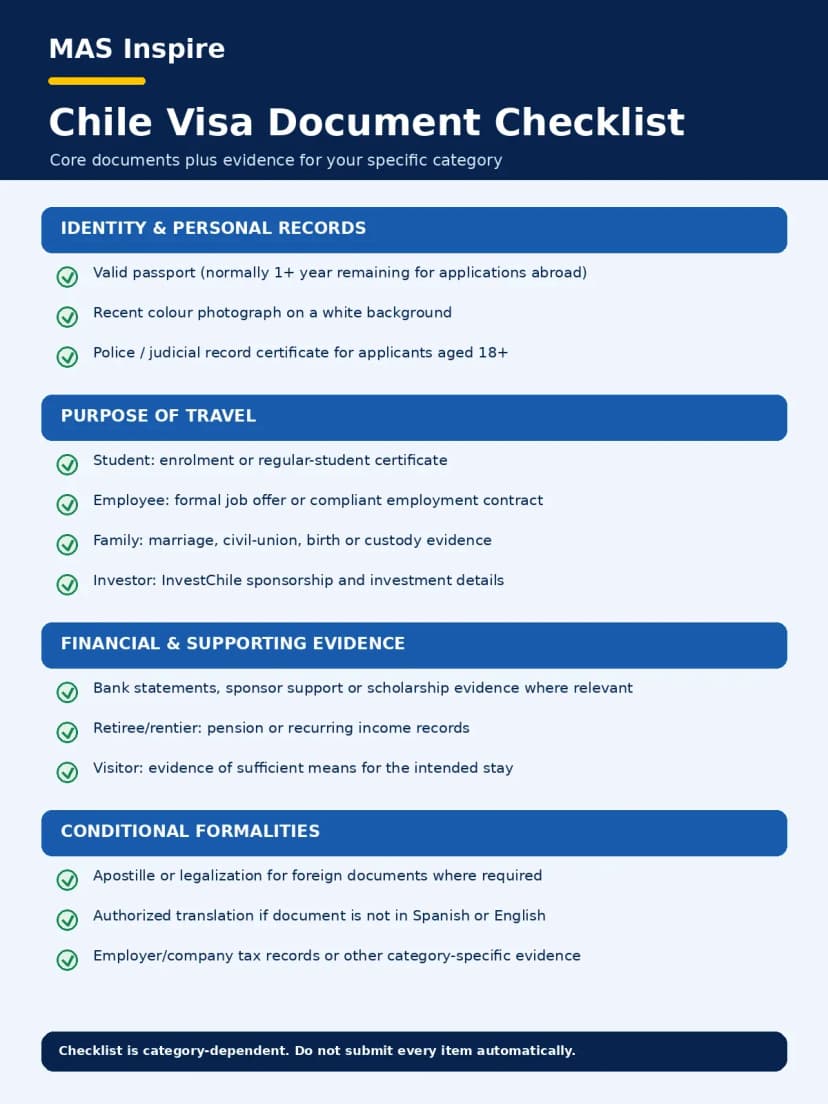
Complete Document Checklists
The exact list is category-specific. The tables below distinguish generally published core items from conditional evidence; they are not a claim that every applicant must submit every item.
General temporary-residence documents
| Document | Status | Notes |
|---|---|---|
| Passport identity page | Generally required | For applications abroad, normally at least one year remaining |
| Recent colour photograph | Generally required | White background; follow portal specifications |
| Police/judicial record certificate | Required for applicants 18+ in relevant categories | Origin country or country of residence in the previous five years; category-specific |
| Apostille/legalization | Conditional | For foreign-issued documents where required |
| Authorized translation | Conditional | If document is neither Spanish nor English |
| Financial evidence | Category-dependent | Do not assume a universal minimum balance |
Purpose-specific supporting documents
| Applicant type | Main evidence | Conditional or additional evidence |
|---|---|---|
| Visitor | Passport, travel purpose, means of support | Return/onward travel, accommodation, itinerary, invitation, consular visa if nationality requires |
| Student | Enrolment/regular-student certificate | Scholarship certificate, bank deposits, sponsor's notarized support declaration and income |
| Employee | Formal job offer or employment contract | Employer tax folder/registration, contract details, proof of solvency where applicable |
| Seasonal worker | Seasonal employment contract or qualifying offer | Employer business-registration evidence and post-entry notarized/electronic contract registration |
| Family member | Relationship certificate | Sponsor's Chilean identity or permanent-residence evidence; custody/guardianship evidence where relevant |
| Retiree/rentier | Pension certificate or regular income proof | Bank statements, asset/lease evidence and records showing recurring income |
| Investor | InvestChile sponsorship letter and investment details | Company tax folder, business-start certificate, municipal patent and role evidence |
| Multiple-entry business | Passport, police record, photograph, reason for visits | Foreign institution letter confirming role, interests and associated income |
Pakistani applicants: document preparation
A Pakistani applicant may need police certificates and civil records from Pakistan and, depending on the applicable SERMIG category, from a country of residence during the previous five years. A Vietnamese residence card or work permit can document lawful residence in Vietnam, but it does not replace a Pakistani passport visa requirement, and it does not itself prove that a Chilean consular office in Vietnam will accept the application. Confirm jurisdiction before paying for translations, legalization or courier services.
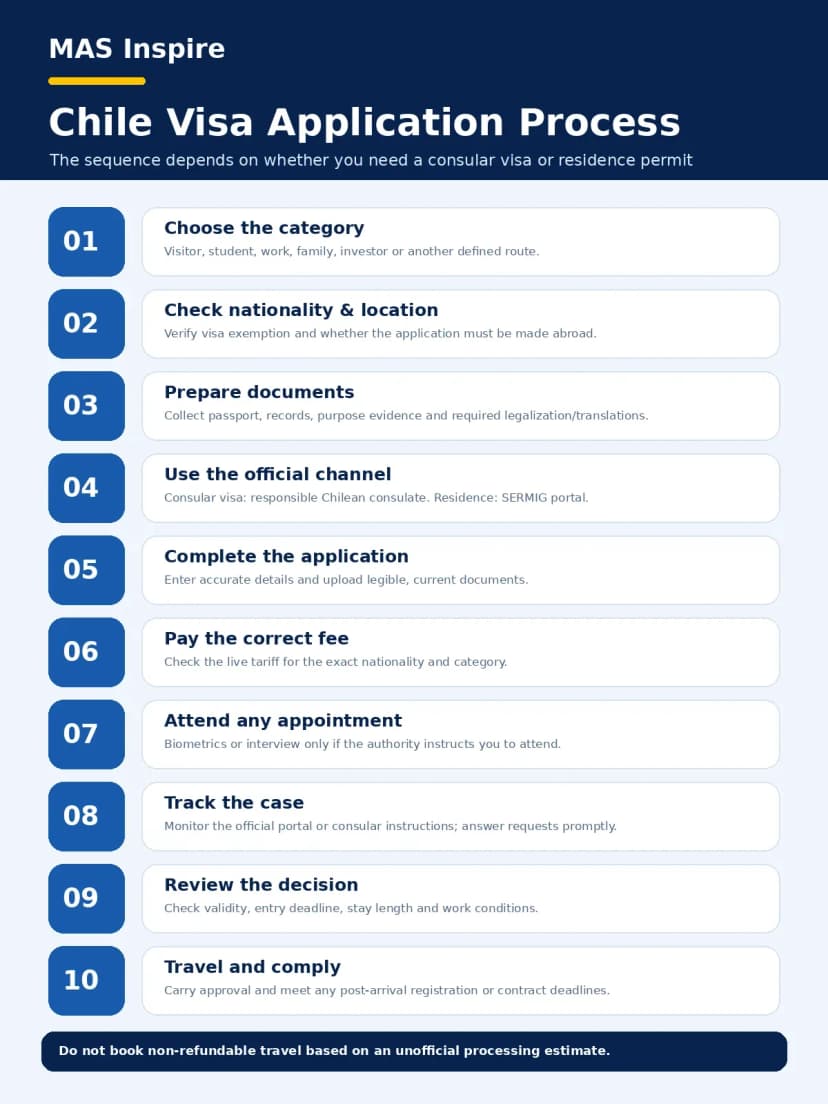
How to Apply: Step-by-Step
- Choose the correct category. Decide whether the trip is a short visit, study, employment, seasonal work, family reunification, investment or another defined purpose.
- Check nationality and residence rules. Use the Chilean Ministry of Foreign Affairs visa list for the passport you will use. Confirm where an application may be lodged.
- Prepare the documents. Follow the exact SERMIG or consular checklist. Arrange police certificates, translations and apostilles/legalizations early.
- Create an account where required. For temporary residence, use SERMIG's Digital Procedures Portal. Select the correct outside-Chile or inside-Chile application route.
- Complete the correct form. Provide consistent details and truthful travel, work, study, financial and family information.
- Upload documents and pay the applicable fee. Use the fee shown for the exact category and nationality. Keep payment confirmation.
- Attend biometrics or an interview if instructed. Do not assume biometrics or an interview is required for every route; follow the consulate's or SERMIG's notice.
- Submit the application. Check that each file is legible, complete, correctly translated and within its validity period.
- Track the application. Use the official portal or the consular contact method stated on the application receipt. Respond promptly to requests for further documents.
- Review the decision and travel conditions. Check the validity, entry deadline, permitted stay, work rights and any post-arrival registration or contract deadline before travelling.
Not every category follows all ten steps in exactly this order. A consular visa and a SERMIG residence permit are different administrative processes.
Visa Fees and Financial Requirements
The SERMIG fee schedule updated 2 November 2026 states:
| Procedure | Published fee |
|---|---|
| Extension of Permanencia Transitoria | USD 100 (children under 18 exempt) |
| Temporary-stay work authorization | 150% of the nationality-based temporary-residence fee for lawful remunerated activities |
| Temporary residence | Varies by nationality and category; consult current tariff |
| Permanent residence | CLP 142,726 for most applicants |
| Permanent residence with Chilean spouse | Exempt |
| Permanent residence for applicants under 18 | Exempt |
These are SERMIG administrative fees, not necessarily the same as a consular visa fee charged abroad. The extension fee is USD 100 and the request must be submitted before the current permission expires. For temporary residence, use the official fee schedule and the fee calculation for the applicant's nationality. Do not convert an old fee or assume one price applies to every passport.
Financial evidence is also category-specific. Visitors must show sufficient means for their stay. Students need to demonstrate how their stay will be funded. Retirees and rentiers must show regular income sufficient for basic needs under the applicable government indicators. No universal minimum bank balance is stated in the official sources cited here.
Visa Processing Times
The official pages reviewed do not provide one guaranteed processing time covering all Chilean visa and residence categories. Processing depends on nationality, application volume, document quality, security checks, category and whether further information is requested. Apply well before intended travel, keep documents current, and rely on the official portal or consulate for case-specific updates. Do not buy non-refundable travel based on an unofficial processing estimate.
Applying from Pakistan or Vietnam
Pakistani passport holders
Chile's Ministry of Foreign Affairs VIDO list identifies Pakistan as a nationality that requires a visa for short-term entry. The list names the Chilean Embassy in the United Arab Emirates as the Chilean representation concurrent for Pakistan. This is an important practical point: a Pakistani citizen should not assume that a Vietnamese residence permit changes the nationality-based visa requirement.
Pakistani citizens legally living or working in Vietnam
A Pakistani national who legally lives or works in Vietnam should:
- Keep a valid Pakistani passport and Vietnamese residence card/work authorization available.
- Contact the Chilean Embassy in Vietnam and the Chilean consular network to ask which post has jurisdiction and whether it accepts applications from Pakistani nationals resident in Vietnam.
- If directed to the Chilean Embassy in the UAE or another post, follow that post's submission, interview and passport-return instructions.
- Ask whether proof of Vietnamese legal residence, employment, income and permission to return to Vietnam is required.
- Prepare the category-specific documents, including Pakistan and/or Vietnam police certificates if required by the residence category and five-year residence history.
- Confirm the exact consular fee, currency, payment method and whether an appointment is needed before submitting the passport.
The VIDO list's designation of the UAE as the representation concurrent for Pakistan does not, by itself, conclusively establish whether the embassy in Vietnam will accept a particular application. That point must be confirmed directly. A Vietnamese residence permit is evidence of lawful residence in Vietnam, not a guarantee of local consular jurisdiction or approval.
Applying from Pakistan
Applicants in Pakistan should contact the Chilean Embassy in the UAE, identified as concurrent for Pakistan, to confirm the current process. Ask about appointment availability, original-document requirements, translation/legalization, fee payment, courier arrangements and passport return. For temporary residence, verify whether the application should instead be submitted directly through SERMIG's online portal from outside Chile.
Vietnamese passport holders
The VIDO list consulted states that Vietnamese nationals do not require a visa for a stay under 90 days, subject to the stated conditions. This nationality-based short-stay exemption is separate from the residence-permit process for anyone planning to live, study or work in Chile.
Student Visa Guide
Students should first obtain admission to an educational establishment recognized by the Chilean State. The SERMIG student residence application is made from outside Chile. The checklist includes a valid passport, adult police certificate, current photograph, proof of enrolment and evidence of financial support. A scholarship certificate should state the duration and funding arrangements.
Student temporary residents may work up to 30 hours per week in lawful paid activities without separate authorization. Work must not undermine the student's status; SERMIG states that exceeding the 30-hour limit can create a problem. Students who stop being regular students may risk revocation. For extensions, evidence of continued study and financial means is required.
Official page: Student temporary residence.
Work Visa and Job Opportunities
Chile's remunerated-activities temporary residence is the main route for many foreign employees intending to reside and work in the country. A qualifying Chilean employer and compliant employment documentation are central. A formal offer may support a special initial 90-day permit, followed by a 45-day period after entry to present the final contract, as described by SERMIG.
Potential sectors include mining, engineering, agriculture, renewable energy, logistics, tourism, education, technology and professional services. Demand does not create immigration eligibility by itself. Applicants should obtain a genuine offer, check professional licensing and credential recognition where relevant, and avoid paying recruiters for fabricated contracts. Ordinary visitor status does not authorize a person to take up regular paid employment.
Family Immigration and Permanent Residence
Family reunification may be available to the spouse or equivalent partner, parent, qualifying child or a minor under the care/guardianship of a Chilean citizen or permanent resident. The sponsor's status and the exact legal relationship must be documented. Some family applications may be filed inside Chile under the permitted exceptions; do not assume every visitor can switch status.
Permanent residence is a later step. The usual qualifying period is at least 24 months of temporary residence for applications under the post-14 May 2022 rules. Certain circumstances can reduce the period to 12 months, while insufficient means, unstable income, extended absences or violations may lead to a longer required period. Permanent residence is not automatic after two years; the applicant must meet the legal and documentary criteria and receive approval.
Common Application Mistakes
- Applying under a visitor category when the real purpose is employment or long-term study.
- Assuming that visa-free entry for one nationality applies to another passport.
- Treating a Vietnamese residence card as a substitute for a Chilean visa required by Pakistani nationality.
- Applying from inside Chile when the selected residence category must be requested abroad.
- Submitting expired police certificates, passports or private documents.
- Omitting apostilles, legalization or authorized translations.
- Uploading illegible scans or inconsistent personal details.
- Assuming that a job offer, property purchase or investment automatically guarantees residence.
- Relying on unverified fee amounts or processing times.
- Overstaying or working without the required authorization.
Reasons for Visa Refusal
A refusal or adverse decision may result from ineligibility for the chosen category, missing or unreliable documents, inconsistent statements, insufficient evidence of the declared purpose or financial means, failure to meet criminal-record or other legal requirements, misrepresentation, or failure to respond to an official request. This list is illustrative, not a complete statutory list. Applicants should read the reasons in any decision notice and use the official review or appeal route where available.
Frequently Asked Questions
1. Do all nationalities need a visa to visit Chile?
No. Some nationalities are visa-exempt for short stays, while others must obtain prior consular authorization. Check the official VIDO list for the passport you will use.
2. Do Pakistani citizens need a visa for Chile?
Yes. The Ministry of Foreign Affairs VIDO list consulted identifies Pakistan as requiring a visa.
3. Can a Pakistani citizen living in Vietnam apply for a Chile visa there?
Possibly, but local acceptance and consular jurisdiction must be confirmed directly. The VIDO list identifies the UAE embassy as concurrent for Pakistan; Vietnamese residence does not guarantee that the Chilean Embassy in Vietnam will accept the application.
4. How long can a visitor stay in Chile?
Permanencia Transitoria is normally granted for up to 90 days. One extension of up to 90 additional days may be available if requested before expiry.
5. Can a tourist work in Chile?
No ordinary paid employment is allowed under visitor permission. A narrow authorization may be available for specific occasional activities; regular employment requires the appropriate residence/work route.
6. Is there a Chile digital nomad visa?
The SERMIG subcategory list reviewed does not identify a dedicated digital-nomad category. Remote workers should obtain advice on the correct legal category rather than assuming visitor status authorizes residence or work.
7. Can I get a job-seeker visa for Chile?
The official category list reviewed does not show a general job-seeker visa. A genuine job offer and the appropriate remunerated-activities residence category may be relevant.
8. Can international students work?
Holders of the student temporary-residence subcategory may perform lawful paid activities for up to 30 hours per week without separate authorization, subject to the published conditions.
9. How long is temporary residence valid?
Residencia Temporal is generally valid for up to two years, except for seasonal-worker rules and category-specific conditions.
10. How much does a Chile visa cost?
There is no single fee for every nationality and category. SERMIG lists USD 100 for an extension of Permanencia Transitoria and CLP 142,726 for most permanent-residence applications; temporary-residence fees depend on nationality. Consular visa charges must be checked with the responsible consulate.
11. What is the minimum bank balance for Chile?
The official sources reviewed do not state one universal minimum balance. Financial evidence depends on the purpose and category.
12. How long does Chile visa processing take?
A single guaranteed processing time is not published for all categories. Check the relevant portal or consulate and apply early.
13. Can I apply for permanent residence after two years?
Many applicants under the current framework need at least 24 months of temporary residence, but eligibility depends on the category and personal circumstances. Some applicants may qualify after 12 months; others may need longer.
14. Can I change from tourist status to temporary residence inside Chile?
Generally, holders of Permanencia Transitoria cannot apply for residence from within Chile except for specified legal exceptions, such as qualifying family, dependent or humanitarian cases and other defined circumstances.
15. Does Chile offer an investor residence route?
Yes. SERMIG lists an investor and related-personnel category with specific requirements, including an InvestChile sponsorship letter and investment evidence. It is not an automatic residence entitlement based simply on owning property.
Official Immigration Websites
- Servicio Nacional de Migraciones (SERMIG)
- SERMIG Digital Procedures Portal
- Chile Ministry of Foreign Affairs
- Chile Consular Services
- Chile visa-exemption list (VIDO PDF)
- InvestChile
Final Checklist and Conclusion
Before applying, confirm your passport's visa requirement, select the correct short-stay or residence category, verify where the application must be lodged, prepare valid and properly legalized documents, check the current nationality-specific fee, and follow all post-approval conditions. Pakistani citizens in Vietnam should obtain written confirmation of consular jurisdiction before sending a passport or paying a fee.
Chile offers several lawful routes for visitors and people intending to study, work, reunite with family, invest or settle. The safest application is one that matches the real purpose of travel and is supported by complete, truthful evidence. No website or adviser can guarantee approval.
Disclaimer: This article is for general educational information and is not legal advice. Immigration rules, consular jurisdiction, fees and procedures may change. The competent Chilean authority's current instructions and the applicant's individual decision notice take precedence. MAS Inspire is an independent educational publisher, not a Chilean government authority or visa-approval agency.